Four generations have been born since 1918, but each of us certainly carries the scars of that war in their DNA. The task of my generation – soon to be the oldest – is to tell why … what happened? How did they survive … everything? The time to keep silent is over. Hopefully, speaking is going to build and not break us. We are not yet a harmonious nation.Footnote 1
As site of cultural intervention and innovation, performance is a place of experiment, claim, conflict, negotiation, transgression: a place where preconceptions, expectations and critical faculties may be dislocated and confounded … At site it may do this at the very locales of that which is under critique …Footnote 2
On 28 April 2013, ninety-five years after Finland's civil war (27 January–15 May 1918), the artist Kaisa Salmi created a performance called Fellman Field: A Living Monument to 22,000 People.Footnote 3 It was a site-specific event organized at Fellman Park in the vicinity of Lahti in south-eastern Finland. For almost a week in 1918, thousands of civil war prisoners were held in Fellman Park awaiting transport to a prison camp. In 2013, an impressive number of people (close to 10,000) gathered at the same site to participate in a commemoration of the civil war, which is still one of the most repressed traumas in the national consciousness of the Finns. In our article we will discuss Fellman Field as an artwork in terms of its approach to embodied empathy.Footnote 4 We consider embodied empathy to be the sympathetic understanding of the other through physical and emotional experience. Where empathy is typically understood as an emotional or intellectual identification with information, embodied empathy often feels more holistic and personal because the identification with the bodily experience of another is triggered by one's own physical experience; for example, the simulation of bodily actions and sensory conditions.
We endeavour to examine whether the ineluctable fact of a history-shaping violent conflict can be processed in a productive way by means of a participatory performance. To achieve our goal, we need to consider Fellman Field from several perspectives. Its potential to create embodied empathy rests on its engagement with three key elements: site-specificity, bodily experience and participation. Our article discusses how each of these elements contributes to the objective of generating embodied empathy. In the context of this performance we refer to embodied empathy both as a desired participant experience and as an instrument for creating that experience.
While we discuss the performance and its effects, our impression of the public response primarily relies on discussions and reports of the event in the media and the audience reactions in the organizer's Facebook page.Footnote 5 The page was originally founded for inviting people to the event, but we found the reactions and discussion on the page particularly interesting for analysing participant experience. The focus on written responses is fruitful for our research since these responses allow us to read about the experience as described by participants themselves, as opposed to solely making interpretations based on perceived live reactions.
The article begins with a brief overview of the historical and social contexts relevant to Fellman Field. We will give a short introduction to the content of the performance, but our main focus is on the most vital elements in producing embodied empathy: first the site, then bodily experience, proceeding to participation on both physical and virtual levels. We then consider the political implications and controversies of Fellman Field and the challenge they pose to the production of embodied empathy. We also examine whether or not a performance can successfully or ethically attempt to seek reconciliation with the past.
The civil war of 1918: a traumatic experience for the new nation
Finland's civil war in 1918 was the culmination of political tensions that arose in the aftermath of the First World War and the revolution in Russia the previous year.Footnote 6 The revolution had created an opportunity for Finland to declare independence from Russia, which was announced on 6 December 1917. However, the events of 1917 had divided Finnish political forces into two sides.Footnote 7 The labour movement and the bourgeois parties had differing ideas on how to pursue Finnish independence and on how to organize power in the newly sovereign state. Collapsed social structures caused class conflict to fester. During the winter, political tensions escalated all over the country and led to strikes, violent clashes between the left and the right, and the establishment of armed groups: the middle classes formed the White Civil Guards and the White Army, while the socialists established the Red Guards.Footnote 8
The war started in January and ended in May 1918 with a victory for the Whites. It resulted in the deaths of 38,000 people, 85 per cent of whom were Reds.Footnote 9 By the end of the war, the Whites had imprisoned 80,000 Red soldiers in concentration camps around the country, where they awaited trial for treason or political crimes.Footnote 10 The majority of the victims died in the prison camps. In April and May of 1918, more than 20,000 Red soldiers and civilians – many of whom were women and children – were confined in a temporary prison camp at Fellman Field in Lahti (see Fig. 1). The prisoners were held for almost a week before they were transported to a prison camp in nearby Hennala.Footnote 11 Some of them were killed at Fellman Field, but more than 13,000 died later in Hennala, most of them from hunger and disease.Footnote 12
Prisoners on the Fellman Field in 1918. Photograph courtesy of Lahti City Museum Picture Archives. Photographer unknown.

The civil war divided the Finnish nation into ‘the victors and the defeated’, a division that would cast a shadow over Finns’ political and psychological landscape for decades. The perspective on the war of the victors (meaning the middle class) dominated public discourse until the 1960s. Slowly, the nation was able to regain unity through the experience of fighting an external enemy during the Second World War, as well as through the post-war project of building a Nordic welfare state. Although the sharp division between Red and White allegiances would seem to have receded in the consciousness of Finnish society today, the ‘national catastrophe’ in Finland's very first steps as an independent state remains an integral part of the collective historical narrative.Footnote 13 The disastrous violence at the beginning of the sovereign nation traumatized generations and continues to dismay new ones.
In a European context (especially following the Second World War), questions of history, memory, guilt, victimhood, participation and trauma have been approached in various performative ways.Footnote 14 While this discussion is both relevant and ongoing in Finland, it is our view that the nation's most pressing questions and silenced memories are related to the civil war of 1918. The need for constructive discussion arises from the fact that the civil war itself is still a topic of controversy among Finns. In the case of Fellman Field, the attempt at reconciliation was apparent from the moment Salmi invited people from all over Finland through traditional and social media to join the performance: ‘We are all there in the same situation, together, with our different backgrounds. The aim of the movements and the course of events is to bring together those histories, to accept history and declare that it happened. Reconciliation is the purpose here.’Footnote 15
The use of the term ‘reconciliation’ to describe the aim of an artwork about an historical armed conflict risks leading to misunderstandings. Thus we take particular care in explaining how we conceive of reconciliation in the context of our argument and case study. It is not in our interest to make judgements, assign blame, dismiss the conflict or demand apology from either party to the conflict. When we ask whether it is possible to reconcile the painful trauma of the past through embodied empathy, the reconciliation with which we are concerned is not between the two sides of the original conflict, but between the present-day citizen and the unimaginable violence that tore society apart in 1918.
While not unprecedented as a performative representation of the civil war in Finland, Fellman Field is unique in both popularity and form. Even though Salmi's ambitious goal of simulating the prison camp conditions with 22,000 participants did not come to fruition, the performance is the largest participatory performance ever staged in Finland. The attraction of this participatory site-specific performance was the subject matter, and the number of participants reveals its significance in the minds of Finns. The discussion that followed across social media indicates that not only did the artist choose an affective topic, but also, we argue, she successfully employed an effective performance method, which we have called embodied empathy.
Sensing the weight of the past
The hour-long performance consisted of partly choreographed and partly improvised elements, including music, texts, site and movement.Footnote 16 Music and text were the most traditional parts of the event, performed to the audience rather than necessarily requiring their participation. We argue that their purpose was to set a conciliatory tone to the performance. The event began with a song, ‘Työväen Marseljeesi’ (The Workers’ Marseillaise) – a Russian revolutionary song to the French tune Marseillaise. The song's lyrics deal with the struggles faced by the working class and the freedom they wanted to achieve. The performance ended by encouraging the participants to join in to sing the song to new lyrics written for this event. Instead of pointing out class differences or conflicting aims, the lyrics focused on the shared challenges of humanity, such as adapting to the accelerating speed of change in the world.
The participants were reminded of the history of the site by a text read from a small stage by actors: ‘One per cent of Finns were killed in that war … It took six months to kill them. Is that a lot or only a little? They amounted to 36,640 people. Is that a lot? Was it a long time ago? Somewhere else, right now, the same number of people die of hunger every 36 hours.’Footnote 17 The text was trying to put the tragedy of the war into a contemporary perspective by bringing up the numbers of those killed in a neutral tone. Both rewriting the lyrics to a song of the labour movement and the effort to grasp the extent of the past violence support the work's goal of promoting understanding and human solidarity.
As thematically relevant as the texts were to the piece, the whole existence of Salmi's performance was based on the specific place. As Mike Pearson claims, the social, cultural, political, geographical and architectural aspects of the context at a performance site may inform or prescribe the structure and content of the presentation.Footnote 18 Fellman Field could not have taken place elsewhere without losing a great deal of its meaning and connection with the events of the past.
Following Pierre Nora, the performance site was both a lieu d'histoire and a lieu de mémoire. Nora argues that, in order for a site or a place to become a lieu de mémoire, there needs to be the intention to remember, otherwise the site would be a lieu d'histoire.Footnote 19 Whereas in 1918 there was a large field right outside the town of Lahti (then a township of 6,500 inhabitants, now a municipality of 120,000), there is now a public park, Fellman Park, and urban sprawl surrounds the site. The decision to preserve the area as a park indicates an intention to remember, thus making the place a lieu de mémoire.
The park contains an official monument to Red prisoners created by the sculptor Erkki Kannosto and erected in 1978 as a symbol of what happened in that place in 1918.Footnote 20 Five bronze figures before a granite gate on a fourteen-metre-wide square platform portray Red prisoners being released from captivity. The monument was the spatial centre of the Fellman Field event, with some segments performed on the platform. In our opinion, the choice to incorporate the monument into the performance was a recognition of past efforts to commemorate the history of the site. To the previous layers of memorialization – namely the park preserved as a lieu de mémoire and the civil war monument – the performance added a live form of commemorating. This time, the monument invited bodily engagement and identification, hence the official title Fellman Field: A Living Monument to 22,000 People.
In site-specific performances the sense of locality is central.Footnote 21 For the participants from the Lahti area, the site in its current state is familiar from everyday life. The performance had the potential to change the way they felt about the place forever afterwards. As one participant described the occurrence on Facebook, ‘Thank you for letting me attend and experience this unbelievably powerful event. Lahti feels different now.’Footnote 22 The experience of the site or the lack of experience beforehand can also be considered one aspect of the performance itself, as appears in this comment:
It is great that we talk about the things that have been silenced before. When I was in school, I remember how the events of the year 1918 were quickly run through with just a few sentences and paragraphs. Today the subject is taught more matter-of-factly. It is interesting to learn about the events in Fellman Park.Footnote 23
Fellman Field created a place for negotiating the participants’ comprehension of past events. Producing the performance at the historically accurate site with an enormous number of people seems to us like an invitation for the participants to physically imagine themselves as the prisoners in that same place almost one hundred years before and to experience the location as one aspect of this historical event. Such site-specific performances can also be powerful vehicles for remembering and forming a community, as, according to Jen Harvie, ‘the location can work as a potent mnemonic trigger, helping to evoke specific past times related to the place and time of performance and facilitating a negotiation between the meanings of those times’.Footnote 24
Embodying the experience
According to Mike Pearson, performance works with and on all the senses, so the visual aspect does not need to take precedence. He sees the emphasis of a site-specific performance as being on bodily contact, corporeality and embodiment. What (and who) you hear, see, smell, grasp, touch lightly or bump into forms your experience of the performance. Therefore the participants’ sensual engagement could be considered phenomenological.Footnote 25 Site-specific performance thus may offer the audience new sensual experiences; at an outdoor site the participants are more aware of the surface, the climate and the ambience in a way that differs from a traditional theatre space.Footnote 26
Fellman Field certainly engaged all the senses of its participants. Bodily experience was built on participation in the mass choreography led by 120 volunteers – the number of White military officials who were in charge of guarding the camp in 1918. Instead of aiming at historical accuracy, the choreography functioned as an allusive simulation of the conditions of the camp. The movements were simple: the crowd was asked to turn their heads or lift their arms in simultaneous motion, to move in unison, making small moves or gestures, looking around to find a piece of bread, turning to look in the eyes of a stranger and hugging them. Many participants in Fellman Field described taking part in moving together and sensing the crowd of thousands of people as an emotional experience. One of them wrote,
When the movements were practised, I was a bit sceptical about whether people would come along and experience it with their bodies. False belief! It was an amazing feeling to hear 7,000 people crying out with full hearts and calling to their mothers for help. Also the silence of 7,000 people was indescribable. Thank you, PEOPLE!Footnote 27
Amazement at the power of bodily participation also comes across in another comment: ‘I was surprised by how touching the movement was. Tears flowed freely when I let myself live the events. A cleansing experience.’Footnote 28
As Fellman Field was arranged at the same time of year as the events that took place on the field in 1918, we also consider the season as one of the features of the site-specific and physical experience. The cool and changeable weather of early Finnish spring, as well as the wet, cold ground, potentially took the participants’ minds to the bodily experience of the prisoners who were detained there for a week with hardly any shelter. One participant described how the weather conditions made her feel during the performance: ‘The sleet was a very persuasive creator of the atmosphere and the sun warmed wonderfully at the end.’Footnote 29 We interpret these comments as signs of the participants’ emotional identification with the bodily experiences of the prisoners. In our opinion, the act of moving and simulating the events in historic surroundings creates a possibility for embodied empathy with historical events and subjects.
Participation at several sites
Participatory art posits people themselves as the most important artistic media and material. As such, participatory art tends to focus on the process of making art instead of focusing on the end product, as Claire Bishop has defined.Footnote 30 Fellman Field had two kinds of audience – primary and secondary – who participated in different ways. The primary audience consists of those who participated in Fellman Field at the site, while the secondary audience refers to those who encountered the performance through various mediating vehicles, including social media. According to Bishop, these can be anything from material objects to abstract concepts or they can take the form of an image or a story. They serve as ‘evidence’ of the premise, events and effects of the artwork for those who were not present to participate and witness them first-hand.Footnote 31
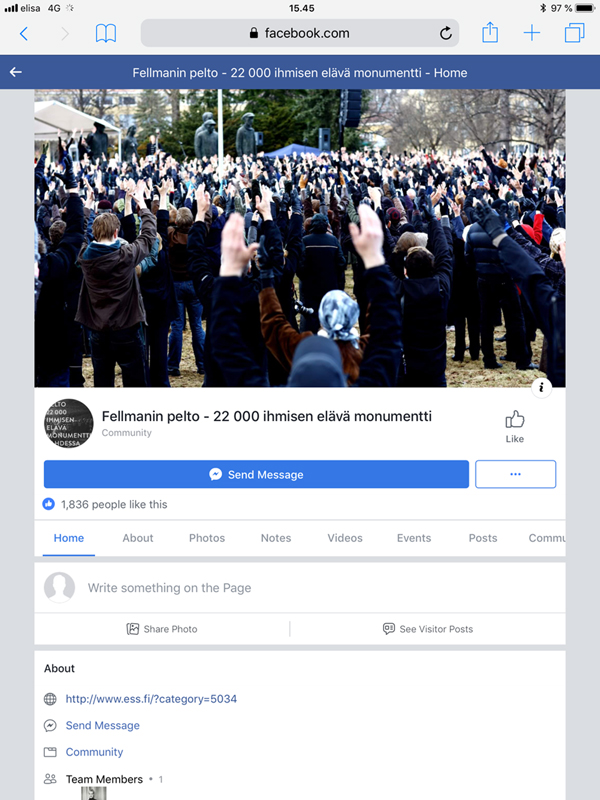
The secondary audience of Fellman Field was vast. As a widely publicized and discussed event, it drew the attention of several media outlets, and in the days following the performance it was also covered on traditional media. The performance was made into a short documentary film, which was later shown at several museums, galleries and film festivals around Finland and abroad.Footnote 32 In addition – on the fringes of the ‘official’ promotion, yet simultaneously at the heart of the artwork as an essential ‘recruitment channel’ – there was the social-media presence on the official Fellman Field Facebook page (Fig. 2). The Facebook page can be seen as a virtual site of the performance that served both audiences: the participants were able to share their experiences of the performance, while the secondary audience could see the evidence and join the conversation. The artistic working group also used the platform to communicate to their audiences, both primary and secondary.
Screengrab of Fellman Field Facebook page.

Discussing the participation of the primary audience we draw from Diana Taylor, who argues that even people who were not present at a given event (in our case the civil war) can be concerned and can experience powerful feelings through a performance. Although it can be said that embodied knowledge disappears because it cannot be contained or recovered from archival documents, there are multiple forms of embodied act that are ‘always present, reconstructing themselves – transmitting communal memories, histories and values from one group/generation to the next’.Footnote 33 The movements choreographed in Salmi's performance – such as looking for a piece of bread and raising a hand to ask for help – are ways to convey feelings, and the experience generates emotions throughout the entire body.Footnote 34 The participants embraced history and sometimes also past generations by engaging in physical contact with the people around them.Footnote 35
Sruti Bala notes that theatrical spectatorship can be a mode of witnessing.Footnote 36 The participatory action of Fellman Field functions in a similar way and concerns both the primary and secondary audiences. For the primary audience, appropriating choreography and performing meaningful movements were not only ways to impersonate, but also a way of witnessing the events of 1918. This can potentially help to generate public reflection, and this is something that Salmi was both interested in and successful in doing, as can be observed in the comments on social media.Footnote 37 Based on news articles and the comments on the Facebook page, it is evident that many participants had personal connections with the civil war and the location. Several people shared their family stories with the Facebook page before and after the performance, describing the violent fates of their relatives and their connections to the site.Footnote 38
The Facebook page accumulated followers; the primary audience, as well as those who were not present at the event, wrote comments to give their second-hand impressions of Fellman Field and share their family stories. ‘My grandfather's mother was right there in the camp in her time and made it out physically but not mentally,’ wrote one.Footnote 39 The page acts as a site where the voices of the primary and secondary audience mix. As such we argue that the page formed a virtual site of encounter and participation, expanding the limits and influence of the piece through commenting, commemorating, story sharing and even poetry.
From the viewpoint of producing embodied empathy we argue that the discussion of and return to the performance on the Facebook page enforces the experience of the primary audience. The bodily experience, otherwise disappearing, can be revisited. Furthermore, the stories shared by the secondary audience added depth to the impact. The secondary audience cannot reach the embodied empathy of the primary audience but they see evidence of the effectiveness of the performance. An impression of an emotionally impactful experience is unavoidable based on the multitude of glowing comments: ‘Thanks for letting me be a part of it. I won't ever forget it, as it was such a moving moment. I hope we the people never forget what has happened here …’Footnote 40
Challenges to embodied empathy
According to Mike Pearson, the context of a site may elicit particular modes of engagement from participants. As Pearson puts it, ‘Any encounter with site is potentially divisive, recovering that which was thought lost – reawakening memories, stirring emotions, mobilizing causes … Performance may need to tread carefully, or at least accept responsibility for what it might disturb.’Footnote 41 Fellman Field certainly stirred emotions. The civil war is a sensitive subject for many Finns, especially people of older generations who were often indirectly, if not directly, affected by the conflict. For each new generation of Finns, the trauma of the civil war has become, if not less shocking, then at least less personal; so much so that few are aware of the side of the conflict on which their own family members stood. The lack of knowledge is due in part to a culture of silence around the topic that persisted for years. Both sides contributed to this silence: the losing side – the Reds and their families – kept quiet out of shame and fear of possible retribution, while voices on the White side found remembering wartime violence unnecessary or inconvenient.Footnote 42 For many, only temporal distance from the events has allowed an unobstructed processing of the facts. ‘The first generation experiences, the second keeps silent and the third finds out. I belong to the third one. It has felt very heavy and wearing to try to find out. My only son already knows everything and his children will certainly remember.’Footnote 43
Some Finns are still painfully aware of their relatives’ position in the war. One participant in Salmi's work sympathized with descendants of the Red victims: ‘As I looked around me in Fellman Park, I recognized plenty of comrades whose families continue to carry the burden of being a victim.’Footnote 44 While the question of wartime allegiances generally no longer divides the nation into two camps, tensions can still arise, usually in political contexts.Footnote 45 The word ‘comrade’ (toveri in Finnish) is politically charged; it identifies the commentator as an ideological descendant of the socialist Reds and most likely an active member of the contemporary labour movement.
Whether or not Fellman Field had a political agenda has been a topic of heated debate. Judging by the public attention to the issue of Salmi's political views, as well as the outraged reactions of some politically oriented citizens, the issue of politics is the burning question about the piece, even taking precedence over the theme of reconciliation. Many seemed willing to interpret the work as a political statement – a comment on the outcome of the war – and wanted to know what the intended message was. Various choices made by the artist have been taken as signs of political bias and an attempt to ‘point the finger’. A participant's relation to the politics of the conflict thus affected their response to the work.
According to Diana Taylor, there are always problems with appropriating social memories: who is allowed to tell the story of whom? How can a person relate to the suffering and trauma of someone from a different generation and era?Footnote 46 In our opinion the question of appropriating considers not only social and cultural memories but also political memories. Having strong political convictions might challenge the ability to empathize with one's ideological ‘other’, since it makes one opt out for fear of disingenuity and manipulation, and thus hinder the experience of embodied empathy.
Certainly, the site of the performance was anything but neutral. It is significant that the performance site was not only historically relevant, but also a place of largely one-sided violence. Fellman Field was not a battleground; it was the location of a prison camp. The choice – to build the performance around a camp that imprisoned only Reds – was interpreted by some as an indication of political bias, as it allegedly elevated the memory of Red victims over White ones. Another suspect choice was featuring a monument commemorating Red prisoners as a centrepiece of the staging. This alienated some Finns who had strong White roots in the war.Footnote 47
Indeed, treading on the site of a past civil war, Salmi has awakened some tragic memories and exposed fault lines that had long been buried. Has the artist accepted responsibility for the reactions to her choice of performance site, as Pearson suggests artists should? Salmi's declarations of political non-alignment generated backlash from both ends of the political spectrum.Footnote 48 Some members of the labour movement were outraged after Salmi dissociated her piece from a leftist-themed weekend that coincided with the Lahti event. This following Facebook comment exemplifies the concern of workers’ organizations regarding the non-political approach to the civil war:
I believe that these events should not be organized by private individuals who claim that the event is not political. Talking about Red prisoners is always political, and dealing with that belongs to the workers’ parties and organizations. Despite the request, it is not the time to reconcile nor to forgive. Who asks for forgiveness and from whom?Footnote 49
Salmi still refused to take political sides.Footnote 50 Her team reacted to the debate by stating that ‘Salmi's piece was political as an action and as an experience, and we have not tried to hide that. However, in our communications before the event, party-political non-alignment was an unconditionally important definition of policy.’Footnote 51 Salmi's statements about her political non-alignment provoked a great deal of discussion on the Facebook page. At least to some participants, Salmi's statement of neutrality seemed reasonable. One Facebook comment reads, ‘The causes of suffering may be political, but suffering in itself is non-political. The performance succeeded in demonstrating that in a great way. Whether a Red Finland would have been better than a White one is politics, and in the face of suffering the question loses its relevance.’Footnote 52
From the expressions of concern about commemorating the civil war outside the context of the labour movement emerged the question of who is allowed to commemorate the events of a war. To revisit Taylor's remarks on the potential problem of cultural impersonation and appropriation: who has ownership of a social memory?Footnote 53 When brought to a political context, is it possible or even appropriate to relate to the pain of someone who represents the opposite side of the conflict? This framing poses another important question: does every contemporary Finn have a side in the conflict? There is no reliable way to allocate anyone today a side in a war based on ideology and class that was fought a hundred years ago. Even the family lineage of a contemporary Finn is often more complex than all White or all Red. If organizing commemorative events for Red victims were to be reserved to the labour movement, political alignment would determine an individual's suitability to take part in the act of remembering the victims of the civil war. If we accept that the right to address a trauma is reserved for the ideological descendants of the victims, we run the risk of polarizing the commemorative process. Having separate events for Red and White victims undoubtedly perpetuates the discord and leaves out all those Finns who resist taking a side. To achieve reconciliation, we might have to accept that it is important for anyone to be able to take part in the act of commemorating.
Steps towards reconciliation
The gathering of thousands shaped a collective performance that enabled the sensation of embodied empathy through bodily movements. Those present were offered insight into the events of the war and a window on the experience of those who suffered during the conflict. Endeavouring to achieve embodied empathy is a constructive gesture in itself, an expression of solidarity towards the generations affected by the war, and an attempt at reconciliation.
There have been efforts on both cultural and official levels to create understanding and reconciliation in the Finnish society of which Fellman Field was a part. One indication of attempts to reconcile was the change in attitude towards memorials for the defeated. For over two decades after the war, monuments to Red soldiers (where they existed at all) were mostly found in remote places like woods or swamps, often near unofficial graves of fallen Red soldiers. Changes in the political climate came in the 1940s, when all Finns fought together against the Soviet Union, and still more in the 1950s, when monuments to Reds began to be permitted in official locations such as cemeteries. Finally, it was possible to restore unofficial graves and, for the first time, have them clerically consecrated.Footnote 54
An official step towards reconciliation was the national project called War Victims of Finland 1914–1922 (Suomen sotasurmat 1914–1922), a database in which the names of the country's war victims in those years were registered. The project was initiated by Finland's then prime minister funded by the Finnish government in the years 1998–2003.Footnote 55 Its aim was to collect information about those who perished in war-related circumstances in Finland, the idea being that the database could then be used as objective source material for future research. The project's greater goal was to ‘definitively dismantle the national trauma caused by the war of 1918’.Footnote 56 At present, the online registry (which has been used by more than 1.2 million visitors) contains over 35,000 names of war dead, 97 per cent of whom died in the war of 1918 or its aftermath.Footnote 57
However commendable this project is, we believe that simply collecting data will not be sufficient to achieve national reconciliation. Moreover, we do not think that the finalization of the process is a goal worth pursuing. We do not endorse the project's promise of an ultimate resolution to the trauma, as we believe that declaring the process completed will in fact silence necessary discussion. Consider that even ten years after the closure of the War Victims project, Fellman Field triggered disagreement on this subject. In fact, it is the discussion and reception of Fellman Field in 2013 that indicates how highly sensitive a topic the civil war remains in Finland to this day, nor has the matter been put to rest. Along with accurate information about the war, we need other ways to handle the trauma.
While site-specific artwork goes some way towards reckoning with the effects of trauma, we believe that the addition of a participatory quality enables the emergence of collectively felt embodied empathy. This quality and the impact of the performance were recognized in the public discussion about Fellman Field. For example, an editorial in the Etelä-Suomen Sanomat newspaper stated, ‘It is part of the reconciliation that even those people who do not have a personal connection with the events can participate in and identify with them, and share the pain and agony that was felt on Fellman Field in April 1918.’Footnote 58 Even though the performance generated political discussion and raised tensions, it also reconciled many participants with their history (as can be seen from the comments above). The performance was recorded as successfully creating embodied empathy, allowing participants to release their anxieties over the violence of the past.Footnote 59
Even among all the positive experiences, the possibility of reconciliation still divided opinions of both participants and commentators. It is likely that people understood the notion of reconciliation in very different ways, and not always in the way the artist had intended. Based on the reception, parts of the audience assumed the attempted reconciliation to lie between the parties involved in the conflict. Instead the artist aimed for reconciliation in terms of accepting historical events. Peace was tentatively built between the present and the past instead of between the parties to the war.
If the purpose had been to settle the conflict between the Reds and the Whites – or, in fact, their ideological and/or familial descendants – the choice of site would not have been suitable since it so strongly represents Red suffering. For those who viewed the performance from this standpoint, the site appeared so politically charged and so partial as to obstruct their willingness to engage in embodied empathy. To be more effective in terms of soliciting empathic engagement, the performance might have benefited from being organized on as neutral a site as possible. On the other hand, Salmi preferred to create a mass participatory performance around the symbolism of thousands of people on Fellman Field in 1918 and on the day of the performance.Footnote 60 The specific demands of the performance concept seemed to overrule the ideal of the neutrality of the site.
In addition to the site, some of the commentators felt sceptical about finding common ground due to other factors, such as the bitter memory of the arbitrary violence of wartime,Footnote 61 the closeness of one's family tragedy,Footnote 62 or suspicion about the event's political agenda.Footnote 63 Some openly denied the possibility of reconciliation through performance: ‘I do not believe in an overall performance reconciliation; reconciliation is not a mass event. A performance can be the beginning of a process and a new way of sharing and experiencing, but it cannot guarantee an end to the pain.’Footnote 64
Conclusion
The volume of comments and the variety of opinions in the media prove that Fellman Field was an exceptionally successful catalyst for public discussion, offering a platform for dealing with Finland's civil war trauma. Primary and secondary audiences came together to discuss and participate at different sites, both material and virtual. The active discussion on the Facebook page offered a window into the first-hand experiences of the participants and enabled anyone to chime in with their impressions. In our view, a few disagreeing voices do not invalidate the reconciling quality of Fellman Field. On the contrary, the plurality of opinion is a prerequisite to the process of reconciliation. As stated earlier, reconciliation need not mean a final resolution of a conflict and lasting peace. Nor does it mean an ‘end to the pain’ or even forgiveness. Rather, reconciliation might be an invitation to a conversational space between two poles of silence – the first of which is suppression and the second of which is closure – a space accessible to all through embodied empathy. Site-specific participatory performances are particularly effective in producing these spaces, which is why they can mediate societal crises and traumatic histories.