Introduction
Organizations nowadays rely increasingly on the initiatives of their employees. As a result, being proactive has emerged as a highly desirable qualification for many jobs (Chan, Reference Chan2006; Parker and Collins, Reference Parker and Collins2010). Proactive behaviors are defined as employees’ anticipatory actions that are intended to improve themselves or their environment. However, while such behaviors are believed to deliver desired individual outcomes, such as better performance and creativity (Parker & Collins, Reference Parker and Collins2010), previous studies have suggested that leaders are not always receptive to these efforts (Grant, Parker, & Collins, Reference Grant, Parker and Collins2009; Whiting, Maynes, Podsakoff, & Podsakoff, Reference Whiting, Maynes, Podsakoff and Podsakoff2012). In fact, some leaders may regard employees’ self-initiative actions as acts of insubordination, ingratiation, and disrespect, or even a threat to their authority, and this may hinder relationship development within the dyad (Bolino, Reference Bolino1999; Frese & Fay, Reference Frese and Fay2001). To explain this phenomenon, past studies have suggested that leaders judge employees’ self-initiative behaviors based on their perceptions of the focal employees’ motivations, such as their altruistic intentions or self-enhancement motivations (Allen & Rush, Reference Allen and Rush1998; Bolino, Reference Bolino1999), or the perceived usefulness of these behaviors, such as the constructiveness of their voice (Huang, Xu, Huang, & Liu, Reference Huang, Xu, Huang and Liu2018; Whiting et al., Reference Whiting, Maynes, Podsakoff and Podsakoff2012). However, the majority of these studies focus on the effects of the employees’ behavior, via the leader’s judgment, on the employees’ job performance or promotability, rather than the interpersonal relationship between the leaders and the focal employee. Past research has suggested that employees who experience high quality of leader–member exchange (LMX) are more likely to have mutual trust, respect, and supportive relationships with their leader (Liden, Sparrowe, & Wayne, Reference Liden, Sparrowe and Wayne1997). Beyond those psychological benefits, numerous studies have empirically showed that high-quality LMX enhances employees’ outcome such as job performance, creativity, and organizational behavior citizenship while reduces the negative work behaviors (see Dulebohn, Bommer, Liden, Brouer, & Ferris, Reference Dulebohn, Bommer, Liden, Brouer and Ferris2012; Martin, Guillaume, Thomas, Lee, & Epitropaki, Reference Martin, Guillaume, Thomas, Lee and Epitropaki2016). Thus, the current study sets out to investigate the mechanisms which prompt leaders to attribute employees’ self-initiative behaviors as favorable and subsequently enhance the dyad relationship.
Although previous studies have reported that the leader–member relationship is strongly associated with manager-rated performance (Martin et al., Reference Martin, Guillaume, Thomas, Lee and Epitropaki2016), we argue in this study that the effort expended by employees in pursuing proactive behaviors is more relevant to the state of the dyad relationship than the employees’ actual performance. Taking into account the fact that proactive behaviors are considered out-roles efforts, it seems reasonable to argue that despite the effort, time and resources expended, proactive behaviors do not necessarily assure an improved employee performance. Nevertheless, as long as leaders perceive the potential usefulness and motivations of these behaviors, they tend to regard them as efforts by the employee to contribute to their leadership, and subsequently improve their relationship (Xu, Loi, Cai, & Liden, Reference Xu, Loi, Cai and Liden2019).
According to social exchange theory, any social exchange event entails an implicit obligation. In particular, when one does another a favor, it is expected that there should be some return in the future (Blau, Reference Blau1964). However, it is not specified when this favor should be returned, nor in what form (Wayne, Shore, & Liden, Reference Liden, Sparrowe and Wayne1997). Social resources theory posits that humans exchange many different types of resources via daily interpersonal behaviors, ranging from general resources, such as money, goods, and information, to more particularistic resources, such as status, affiliation, and services (Foa & Foa, Reference Foa, Foa and Gergen1980). In our study, we integrate these two theories and contend that employees’ proactive behaviors initiate social exchange within the dyad by offering resources in the form of services. When the leader perceives the effort to be valuable and accepts the offered resources, he/she joins the mutual exchange relationship and becomes obligated to return the favor. In other words, the social exchange cycle within the dyad is completed by the leader’s reciprocation to the employee’s effort. Furthermore, leaders may respond by rewarding and appreciating the focal employee, which further enhances the interpersonal relationship between them (e.g., the LMX).
This study considers two particular forms of follower proactive behaviors: taking charge and voice. Taking charge refers to followers’ self-initiative actions intended to bring about functional changes in the way in which work is executed in jobs, work units, or the organization (Morrison & Phelps, Reference Morrison and Phelps1999). By contrast, voice refers to behaviors that challenge the status quo and seek to improve the situation rather than merely complaining about it. Typically, employee voice behaviors involve speaking up about organizational issues, or propounding changes to standard operating procedures (Whiting et al., Reference Whiting, Maynes, Podsakoff and Podsakoff2012).
We focus on these particular behaviors for two reasons. First, compared to other proactive constructs, such as problem prevention or stress-coping, taking-charge and voice behaviors are more perceptible, and lead to more observable outcomes (Thomas, Whitman, & Viswesvaran, Reference Thomas, Whitman and Viswesvaran2010). In addition, both behaviors also openly and directly influence or involve others in the workplace, as opposed to behaviors such as feedback seeking, which are more discrete in nature. Thus, leaders can easily discern taking-charge and voice behaviors even when they do not lead to a successful outcome. Second, both behaviors are considered general actions rather than context-specific behaviors (Crant, Reference Crant2000). Moreover, in contrast with other leader-targeted proactive behaviors such as career initiative, taking-charge and voice behaviors are not necessarily targeted only at the leader and may take place irrespective of the context. As such, they are consistently included in proactive behavior studies (Parker & Collins, Reference Parker and Collins2010). By doing so in our study, we aim to answer the call of Xu et al. (Reference Xu, Loi, Cai and Liden2019) for more research to explore different types of proactive behaviors that followers may adopt to influence their leaders.
Considering the fact that not all leaders are receptive toward employees taking initiative, we propose two moderators which, we suggest, jointly interact with employees’ proactive behaviors and impact the dyad outcome as a result. According to Parks, Conlon, Ang, and Bontempo (Reference Parks, Conlon, Ang and Bontempo1999), leaders prefer equity rules when allocating resources. In this way, employees whom the leader perceives as highly contributing, or inputting more resources into his/her leadership, tend to receive better reciprocated resources. In addition, high-promotion-focus leaders favor change advancement-oriented behaviors and are thus more responsive to the potential of proactive behaviors, such as the possibility of improved productivity or work processes (Crowe & Higgins, Reference Crowe and Higgins1997; Kark & Van Dijk, Reference Kark and Van Dijk2007). By contrast, supervisors with low promotion focus are less likely to be attracted to change-oriented behaviors (Wu, McMullen, Neubert, & Yi, Reference Wu, McMullen, Neubert and Yi2008), and thus tend to devalue employees’ proactive behaviors. Previous research has suggested that a proactive personality on the part of employees only leads to favorable outcomes if combined with high skills (Chan, Reference Chan2006). In our study, we contend that a consistent high-performance record implies that an employee is an expert in his/her job, and thus enhances the likelihood of leaders judging their proactive behaviors as effective and aimed at improving and contributing to the organization rather than impulsive actions. Xu et al. (Reference Xu, Loi, Cai and Liden2019) called for more research on how leaders’ attributes influence their assessment of whether employees’ initiatives serve as a source of resources. The current study answers this call and contributes to the literature by exploring the boundary conditions that govern the process of leaders evaluating their employees’ behaviors.
Our study makes three contributions to the literature. First, we draw on social exchange theory and social resources theory and posit that employee proactive behaviors provide valuable resources to leaders. We further contend that two particular forms of employee proactive behaviors, namely taking charge and voice, influence upwardly and enhance interpersonal outcomes. We therefore contribute to a follower-focused viewpoint by exploring what type and why employee-initiated behaviors can lead to positive dyad outcomes. We also further contribute to the proactive behavior literature by exploring how and when employee’s self-initiated behaviors lead to enhanced interpersonal relationships. Second, we introduce an extended construct termed as the leader’s perceived constructiveness. We postulate that this construct serves as a mediator which enables the leader’s reciprocation process. We thus contribute to the social exchange aspect of LMX literature. Third, we propose two moderators that influence how leaders perceive and attribute their employees’ behaviors. By doing so, we answer the call for research on the boundary conditions that regulate the manner in which leaders interpret their followers’ proactive behaviors (Huang et al., Reference Huang, Xu, Huang and Liu2018; Whiting et al., Reference Whiting, Maynes, Podsakoff and Podsakoff2012).
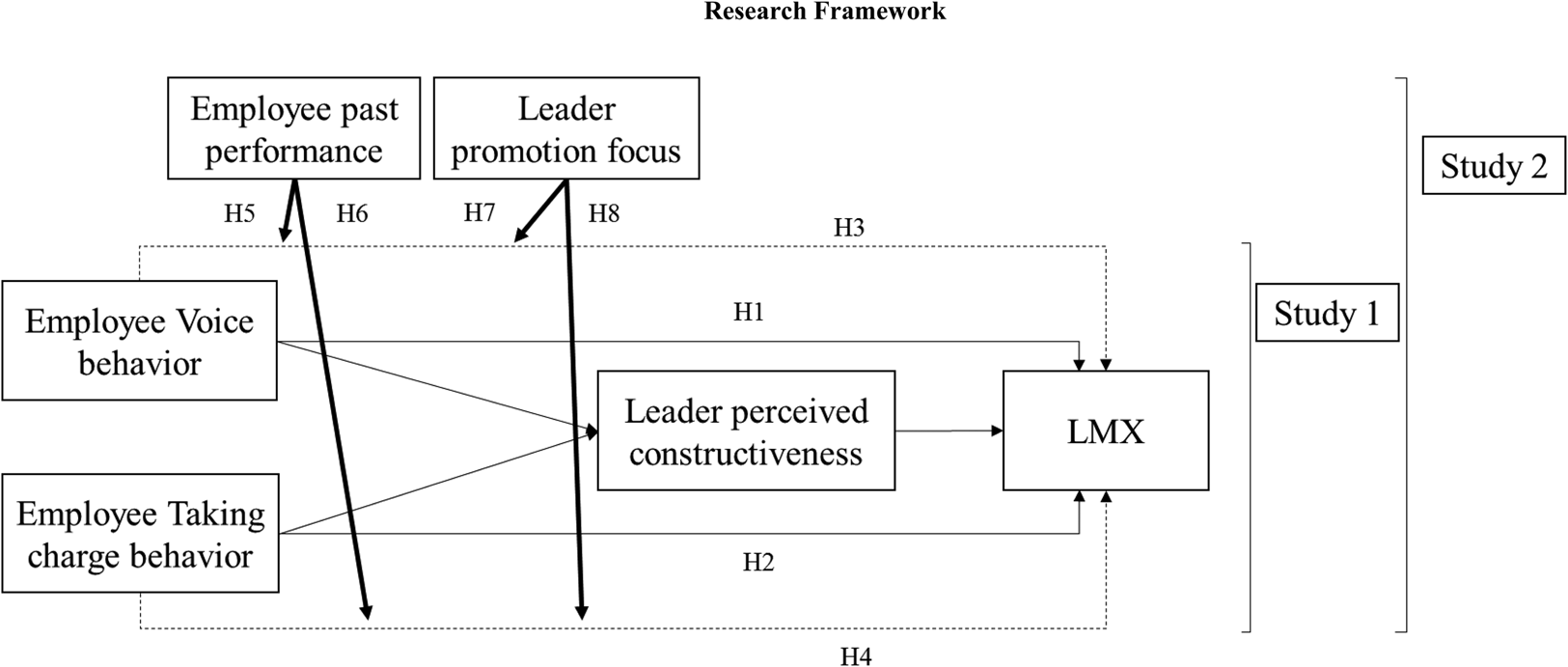
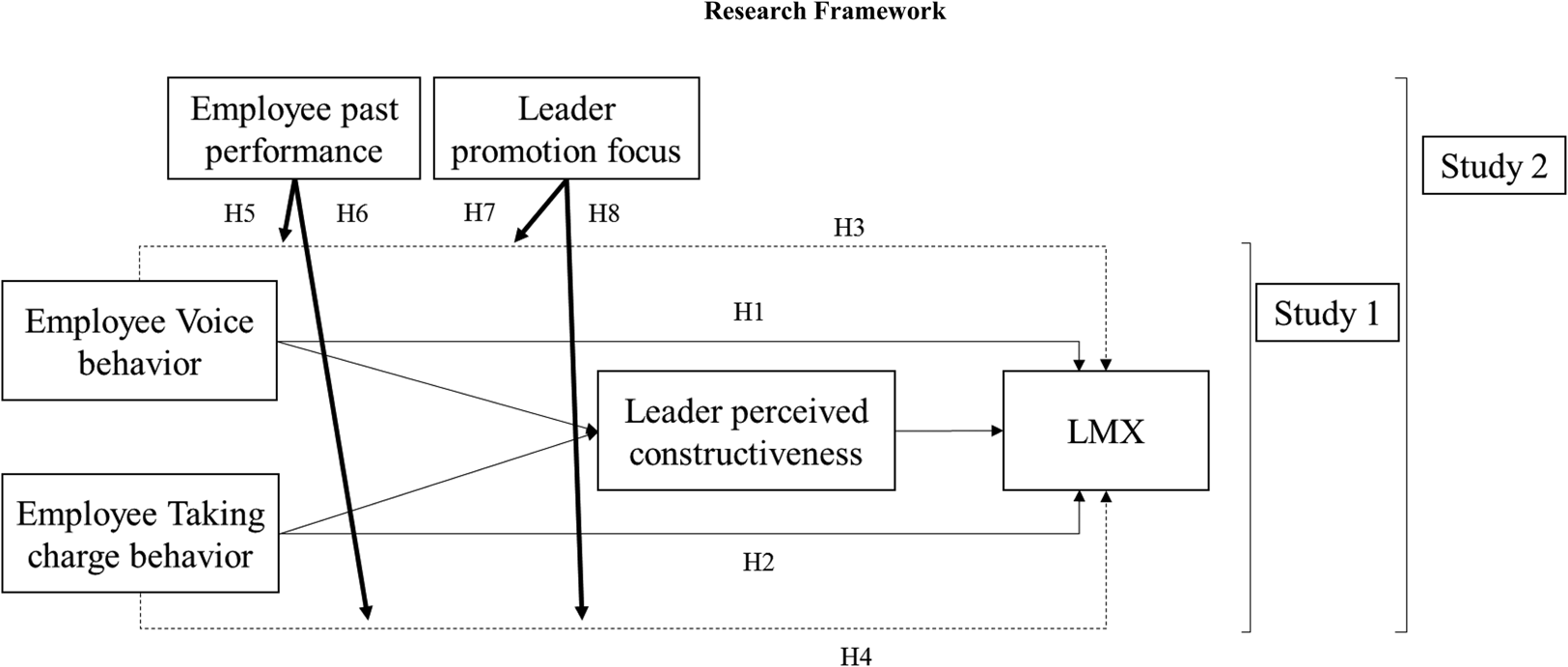
Figure 1 illustrates the framework and hypotheses adopted in the present research. We note that study 1 aims to examine the role of the leader perceived constructiveness construct in mediating the relationship between the employees’ proactive behaviors and the LMX in the dyad, while study 2 sets out to explore the boundary condition effects of the employees’ past performance and leader’s promotion focus on the proposed hypotheses.
Research framework.
Note: Dashed arrows indicate mediation effect. Bold solid arrows indicate moderated mediation effect.
Theory and hypotheses
Follower behaviors and LMX
The concept of LMX posits that leaders develop separated dyadic relationships with their followers (Liao, Liu, & Loi, Reference Liao, Liu and Loi2010; Wayne & Green, Reference Wayne and Green1993). While low-LMX relationships are characterized mainly by economic exchanges, such as pay for performance, high-LMX relationships involve feelings of mutual obligation and reciprocity (Liden & Maslyn, Reference Liden and Maslyn1998). Furthermore, different dyad reactions determine and differentiate the relationship between the leader and each of his/her subordinates (Dulebohn et al., Reference Dulebohn, Bommer, Liden, Brouer and Ferris2012). Since LMX is a dyadic interpersonal resources exchange process, it is reasonable to expect that both parties are able to affect and determine the quality of the LMX (Graen & Uhl-Bien, Reference Graen and Uhl-Bien1995; Xu et al., Reference Xu, Loi, Cai and Liden2019). According to the social exchange viewpoint of LMX, it is of no importance who (i.e., which party) initiates the exchange, but simply that a process of initiation and reciprocation takes place between them (Maslyn & Uhl-Bien, Reference Maslyn and Uhl-Bien2001). Thus, in the current study, we postulate that employees initiate the resources exchange process between the dyad members by contributing service resources in the form of proactive behaviors. We further posit that employers who recognize such resources as valuable and beneficial to the organization or his/her leadership will voluntarily participate in this mutual exchange relationship. In particular, he/she will reciprocate by joining the process of resources exchange and will thus further enhance the LMX quality of the dyad.
Social resources theory identifies and classifies various types of resources that contribute to the exchange relationship. According to Foa & Foa (Reference Foa, Foa and Gergen1980), resources can involve any commodity (material or symbolic) and can be transmitted through interpersonal behaviors. Furthermore, social resources can be classified along two dimensions: particularism–universalism and concreteness–abstractness. The first dimension defines the value of the resources based on their uniqueness (as determined by the specific exchange partners) or their universality (common resources). The second dimension refers to the form in which the resources are manifested, i.e., intangible and symbolic or tangible and concrete. Social resources theory groups resources into six types: money, goods, information, status, affiliation, and service, where the term service refers to the activities, behaviors, or belongings of one individual, which often constitute labor for others (Foa & Foa, Reference Foa, Foa and Gergen1980). In our study, we argue that employees’ taking-charge and voice behaviors are forms of service resources and contribute to their social exchanges with the leader in two main regards.
First, taking-charge and voice behaviors are voluntary out-role behaviors rather than behaviors called for by the job description. Furthermore, they are change-oriented behaviors, and may be either self-initiated (taking-charge behavior) or driven by the desire to gain the attention of others on a particular issue (voice behavior) (LePine & Van Dyne, Reference LePine and Van Dyne1998; Morrison & Phelps, Reference Morrison and Phelps1999). Employees who participate in taking-charge or speaking-up behaviors with the intention of promoting the productivity and performance of the work unit are naturally more aligned with the organization’s interests. For example, taking-charge employees may propose a new method for reducing the time required to perform a specific task, while speaking-up employees may suggest procedural improvements which ease the load on the entire unit (Parker & Collins, Reference Parker and Collins2010). Being responsible for their work unit, leaders benefit greatly from such behaviors since they enhance the performance of the unit as a whole and thus add to his/her own overall achievements. Additionally, leaders may assess followers who exhibit taking-charge and voice behaviors as self-directed, thus having no need for close supervision or instruction. Such self-monitoring on the part of the employees conserves the leader’s time and effort and contributes favorably toward the employees’ overall performance. Thus, proactive employees share the leader’s burden by offering resources in the form of thoughts, considerations, suggestions (voice behavior), and labor efforts (taking-charge behavior). As service resources are defined as activities performed on one’s mind or body that provide benefits to others, we argue that employees’ taking-charge and voice behaviors may also be considered as service resources to the leader’s leadership.
Second, interpersonal behaviors can range from symbolic actions to more concrete actions (Dorsch, Törnblom, & Kazemi, Reference Dorsch, Törnblom and Kazemi2017). Furthermore, in contrast to indistinctive or discrete behaviors, such as career initiatives or feedback inquiries, taking-charge and voice behaviors are observable actions that can catch the attention of others regardless of whether or not these others are the direct targets of such behaviors. This fits well with the definition of service resources, which are defined as the highest in concreteness among other resource types. However, it is important to clarify that although voice behaviors may involve transmitting facts and knowledge, which are related to information resources, the main purpose of employee voice behavior is to raise constructive challenges, or to openly state one’s view and suggestions, with the aim of bringing about change and improvement (Dyne, Ang, & Botero, Reference Dyne, Ang and Botero2003; LePine & Van Dyne, Reference LePine and Van Dyne1998). Such actions contribute challenging thoughts from a different perspective and bring to the table issues that are important but otherwise ignored. Furthermore, information resources have low concreteness and particularism, and are generally announced without a specific target or purpose (Foa, Reference Foa1971). In contrast, employees who speak up with the purpose of improving the current situation or attracting the attention of leaders or coworkers, serve as service resource providers. That is, their voice behaviors offer resources in the form of consideration and rational thoughts (i.e., service) rather than in the form of crucial information to the leader. We note that our argument here is in line with the model of resource exchange between leaders and members developed by Wilson, Sin, and Conlon (Reference Wilson, Sin and Conlon2010), who suggested that employee citizenship behaviors (i.e., out-role behaviors) contribute to the dyad relationship in the form of service. Thus, in our study, we contend that employees initiate social exchange between the dyad members by contributing service resources in the form of taking-charge and voice behaviors to the leader’s leadership.
Social exchange theory posits that relationships are initiated when one party does a favor for another, and the receiver reciprocates (Blau, Reference Blau1964). As we argue above, when employees initiate an exchange process by offering service resources to the leader, the leader is motivated to reciprocate. For example, they may offer the focal employee resources in the form of goods (e.g., office resources such as equipment), information (e.g., vertical information, development opportunities), affiliation (e.g., social emotional support, encouragement), or service itself (e.g., doing favors for the focal employee) (Wilson, Sin, & Conlon, Reference Wilson, Sin and Conlon2010). This process of initiating and reciprocating gradually fosters a higher quality of social exchange between the dyad parties, which in turn enhances the quality of the LMX (Graen & Uhl-Bien, Reference Graen and Uhl-Bien1995). In the same vein, Kim, Liu, and Diefendorff (Reference Kim, Liu and Diefendorff2015) and Ahmed, Afzal, and Rasid (Reference Ahmed, Afzal and Rasid2021) observed that employees who engage in taking charge, or achieve high performance, often gain greater trust, appreciation, and liking from their leaders. Furthermore, Cheng, Lu, Chang, and Johnstone (Reference Cheng, Lu, Chang and Johnstone2013) posited that employee voice behavior leads to a higher LMX, while Xu et al. (Reference Xu, Loi, Cai and Liden2019) contended that employee taking-charge behavior also enhances LMX by contributing resources to the dyad relationship. Thus, we propose the following hypotheses:
Hypothesis 1: Follower voice behavior is positively related to LMX.
Hypothesis 2: Follower taking-charge behavior is positively related to LMX.
Mediation role of leader perceived constructiveness
So far, we have discussed the form of resources which employee behaviors contribute to the development of LMX. However, an important question remains as to what actually happens when employees display proactive behaviors that enhance the relationship between them and their leaders. Social exchange theory posits that any relationship is based on social exchange, wherein each of the parties involved contributes something that the other party sees as valuable. Past studies have shown empirically that as the perceived value of the exchanged commodities increases, the quality of the LMX scales accordingly (Wayne et al., Reference Wayne, Shore and Liden1997). In other words, the resources which an employee contributes to the relationship must be viewed as valuable in order to attract the other party (i.e., the leader) to participate in the mutual exchange. Thus, this study draws on social exchange theory and proposes that an employee’s proactive efforts initiate the social exchange process by contributing to the supervisor’s leadership. If the supervisor regards these efforts as valuable and helpful, he/she will reciprocate the favor and engage in the social exchange. This process of receiving and reciprocating then enhances the interpersonal relationship within the dyad.
Employee taking-charge behaviors are attempts to improve the working process (Gorden, Reference Gorden1988), while employee voice behaviors aim to draw attention to important issues that might otherwise be overlooked (Huang et al., Reference Huang, Xu, Huang and Liu2018). Employees who exhibit taking-charge and voice behaviors are generally viewed as desirable and valuable employees, who offer assistance to the work unit. While taking-charge and voice behaviors may not directly impact the department’s performance, they nevertheless contribute valuable assistance to the leader in leading the group. Thus, they are likely to be perceived as valuable by those who receive the benefit (e.g., the leader or supervisor) due to the valuable service resources they provide, irrespective of the final outcome. Past studies have proposed the concept of leader perceived voice constructiveness to describe a leader’s impression of his/her followers’ voice behaviors. For example, according to Whiting et al. (Reference Whiting, Maynes, Podsakoff and Podsakoff2012), a leader’s perceived constructiveness of employee voice represents the extent to which he/she regards the voice to make a positive contribution to the firm. In our study, we extend this concept and introduce a new construct, referred to as leader perceived constructiveness, to describe the extent to which a leader regards the ideas, voice, and efforts of his/her followers as making a positive contribution to the organization.
When employees engage in taking-charge and voice behaviors, they initiate the social exchange process by offering their leaders indispensable service resources over and above those stipulated in their job descriptions. Given that highly proactive employees habitually execute or recommend adjustments aimed at enhancing the workplace, it is reasonable to expect that supervisors will appraise them more highly (Parker, Wang, & Liao, Reference Parker, Wang and Liao2019). Furthermore, the leader is more likely to treat them as resources which are useful for his/her leadership and achievement and will thus appreciate their efforts more. It is therefore fair to assume that supervisors will recognize and regard taking-charge and voice behaviors as valuable resources and will enter a reciprocal process of social exchange between the dyad members as a result. For example, leaders may reciprocate by rewarding the focal follower with greater resources, such as information, training, and promotion opportunities (Li, Liang, & Crant, Reference Li, Liang and Crant2010). In addition, supervisors are more willing to participate in communication exchange with followers in whom they have trust and appreciation (Liden & Maslyn, Reference Liden and Maslyn1998). The resulting series of efficient interactions subsequently enables the pair to develop an enhanced LMX, which benefits both parties and ultimately facilitates organizational goals. Previous studies posited that employees’ voice behaviors are instrumental in forming receivers’ perceptions (i.e., the leader’s judgment or liking toward the voicing employee), and consequently impact the interpersonal relationship between them (Burris, Detert, & Romney, Reference Burris, Detert and Romney2013; Burris, Rockmann, & Kimmons, Reference Burris, Rockmann and Kimmons2017). Thus, we postulate that the leader–follower dyad derives a higher level of LMX from follower taking-charge and voice behaviors via the process of the leader perceiving the constructiveness of such proactive behaviors. In particular, we posit the following hypotheses:
Hypothesis 3: Leader perceived constructiveness mediates the positive indirect effect of follower voice behavior on LMX.
Hypothesis 4: Leader perceived constructiveness mediates the positive indirect effect of follower taking-charge behavior on LMX.
As described above, followers’ proactive behaviors benefit the organization and are thus conceptualized by their leaders as helpful and constructive service resources. Therefore, it seems reasonable to assume that supervisors will show reciprocation behaviors to such followers by rewarding them with greater resources. However, past research posited that since proactive behaviors may cause change, or challenge the status quo in the workplace, supervisors may also interpret such actions as insubordination, or even a threat to their personal authority (Burris, Detert, & Romney, Reference Burris, Detert and Romney2013; Whiting et al., Reference Whiting, Maynes, Podsakoff and Podsakoff2012). This implies that, while employee proactive behaviors are likely to be rewarded by favorable leader treatment, boundary conditions exist which govern this relationship.
The behaviors which employees demonstrate when interacting with their leaders may serve to advance the leader and assist the leadership process. However, they may also negatively affect the leader’s leadership (e.g., disengagement), or even overthrow him/her altogether (Uhl-Bien, Riggio, Lowe, & Carsten, Reference Uhl-Bien, Riggio, Lowe and Carsten2014). Past research suggested that leaders’ cognition styles and employees’ traits may play significant roles in shaping a leader’s impressions and expectations of the focal employee (Kong, Xu, Zhou, & Yuan, Reference Kong, Xu, Zhou and Yuan2019). Thus, in our study, we propose that followers’ past performance and the leader’s promotion focus serve as boundary conditions that regulate the indirect effects of followers’ taking-charge and voice behaviors on the dyad relationship via the leader’s perceived constructiveness.
Followers’ past performance
It is mandatory for employees to accomplish their job assignments. Thus, leaders generally determine the ability of focal employees based on their in-role performance in the past (Lapierre, Naidoo, & Bonaccio, Reference Lapierre, Naidoo and Bonaccio2012). Employees who have a history of efficacy and promptly complete their assigned tasks are more likely to be evaluated by their leaders as productive and highly capable. Conversely, those who are unable to fulfill their task requirements are more likely to be assessed as low performers and may be seen as incompetent, or even unqualified, to perform their jobs.
As proactive behaviors involve both in-role and extra-role behaviors, leaders may appraise the feasibility and effectiveness of proactive behaviors based on their perceptions of the employee’s past performance. Given that followers with high-performance records are considered to be experts and competent in their fields, supervisors may be more inclined to appraise their insights and counsel as useful and contributive. Furthermore, a track history of task accomplishment implies a higher success possibility in implementing changes or enhancements. This further reinforces the credibility and anticipated contributions of the proactive behaviors of high-performance employees. Thus, leaders are more likely to attribute these suggestions and self-initiated actions as contributing services to his/her leadership process. In such a situation, they tend to participate more willingly in the mutual exchange process with the focal employee and reciprocate the efforts. Thus, highly proactive behavior employees who possess high-past-performance records tend to be rewarded with more positive appraisals, greater resources, and more encouraging communications, which in turn strengthen the quality of the inner-dyad relationship.
Conversely, employees with low-performance records may be labeled as incompetent and unable to fulfill their basic task requirements (Lapierre, Naidoo, & Bonaccio, Reference Lapierre, Naidoo and Bonaccio2012). When low-performance employees engage in proactive behaviors, leaders may consider their efforts to be unproductive and questionable rather than an honest attempt for improvement. Moreover, low-performance employees are often regarded as needing close supervision and guidance. Thus, their engagement in taking-charge or voice behaviors may be viewed as distractions, a waste of time, or even a deliberate attempt to avoid doing the job. Consequently, leaders are less likely to perceive low performance employee’s proactive behaviors as an effort to initiate social exchange, and may thus withdraw from such a process.
As described earlier, we posit that follower taking-charge and voice behaviors may enhance the leader’s perceived constructiveness of the focal employee, and in turn increase the LMX. We further posit that followers’ past performance augments the effects of their taking-charge and voice behaviors on the leader’s perceived constructiveness and subsequently contributes toward a higher quality LMX. In particular, we postulate the following hypotheses.
Hypothesis 5: Follower past performance moderates the indirect relationship between follower voice behavior and LMX via leader perceived constructiveness, and this indirect relationship is augmented when the follower past performance is high.
Hypothesis 6: Follower past performance moderates the indirect relationship between follower taking-charge behavior and LMX via leader perceived constructiveness, and this indirect relationship is augmented when the follower past performance is high.
Leader’s promotion focus
The promotion-focus concept is rooted in regulatory focus theory and involves the motivation of an individual to achieve goals based on the aspirations of whom he/she desires to be (Higgins, Reference Higgins1998). A promotion-focus individual tends toward strategies that favor maximizing gains and minimizing nongains (Kark & Van Dijk, Reference Kark and Van Dijk2007). In addition, such individuals often emphasize change and favor advancement-oriented behaviors (Crowe & Higgins, Reference Crowe and Higgins1997; Kark & Van Dijk, Reference Kark and Van Dijk2007). As promotion focus involves an initiative mindset, it is important to differentiate between promotion focus and proactive personality. For example, proactive individuals anticipate and prepare for specific situations, whereas promotion-focus individuals carefully consider the possible gain and loss of any future event and thus place more emphasis on the possibility of resources gain/loss. Second, proactive personality individuals engage in physical behaviors aimed at taking control and causing change as a means of preparing for future situations (Parker & Collins, Reference Parker and Collins2010), while promotion-focus individuals emphasize the cognitive process of strategy selection. Finally, individuals with a proactive focus tend to initiate change independently of others, whereas individuals with a promotion focus also utilize outside resources which may enhance the gain and minimize the possible loss. As a result, they are eager to grasp opportunities and are more open to chances of improvement resulting from others’ actions (Crowe & Higgins, Reference Crowe and Higgins1997).
Given that employees’ taking-charge and voice behaviors involve initiating or proposing amendments in the workplace (Morrison & Phelps, Reference Morrison and Phelps1999), supervisors with high-promotion focus may be more receptive to such behaviors. High-promotion-focus supervisors are also more responsive to the potential of proactive behaviors, such as the possibility of creatively improving productivity or work processes (Wu et al., Reference Wu, McMullen, Neubert and Yi2008). Thus, they are more inclined to evaluate followers’ proactive behaviors as valuable service resources and are subsequently more willing to form high-quality relationships with them.
By contrast, supervisors with low-promotion focus are less likely to accept change, and are more closed toward change-oriented behaviors (Wu et al., Reference Wu, McMullen, Neubert and Yi2008). Low-promotion-focus individuals have the tendency to be apathetic toward revision and hence may not hold followers’ initiative behaviors in high regard, even when they recognize the possibility for advancement that such behaviors may bring. Instead, low-promotion-focus leaders may assess followers’ taking-charge and voice behaviors as distractions and may undervalue the employee’s contributed resources accordingly. According to social resources theory, the value of high-particularism resources is determined mainly by their perceived uniqueness by the person who is the target of such resources (Dorsch, Törnblom, & Kazemi, Reference Dorsch, Törnblom and Kazemi2017). Thus, low-promotion-focus leaders who show little appreciation for the efforts of others are less likely to attribute followers’ taking-charge and voice behaviors as contributions to the leadership process. They may thus respond to such behaviors by expressing little attention, or ignoring them altogether. Thus, low-promotion-focus leaders are less likely to participate in the employee-initiated exchange process. As a result, the interpersonal relationships within the dyad gradually erode over time, and hence the development of the dyad’s LMX is impaired.
Drawing on these assertions, we contend that a leader’s promotion focus amplifies the effects of followers’ taking-charge and voice behaviors on the perceived constructiveness of the focal employee and, in turn, affects the LMX. In other words, we posit the following hypotheses.
Hypothesis 7: Leader promotion focus moderates the indirect relationship between follower voice behavior and LMX via leader perceived constructiveness, and this indirect relationship is more augmented when the leader promotion focus is high.
Hypothesis 8: Leader promotion focus moderates the indirect relationship between follower taking-charge behavior and LMX via leader perceived constructiveness, and this indirect relationship is more augmented when the leader promotion focus is high.
Overview of studies
LMX is an interpersonal relationship construct, and is thus manifested from both sides of the dyad (Liden, Anand, & Vidyarthi, Reference Liden, Anand and Vidyarthi2016). This study, therefore, conducted two studies with several purposes in mind. First, to respond to the research limitation noted by Xu et al. (Reference Xu, Loi, Cai and Liden2019) we collected LMX data from the followers in one study (study 1) and from the leaders in another study (study 2). In this way, we aimed to alleviate the potential common method bias resulting from one-sided measurements of the interpersonal construct (Huang et al., Reference Huang, Xu, Huang and Liu2018). Second, in study 1, we set out to test the mediator role of the proposed leader perceived constructiveness construct in the relationship between the employees’ proactive behaviors and the LMX. In doing so, we collected data from the leader–follower dyads at two time points over a 2-month period. By contrast, in study 2, we aimed to examine the overall theorized framework, with particular emphasis on the mediation effects and boundary conditions of the focal employees’ past performance and leaders’ promotion focus. In this case, data collection was performed over a 3-month period using a three-wave survey approach.
Study 1
Samples
The participants in the first study were full-time employees working in Taiwanese firms. We sent a letter to the target firms explaining that we wished to collect matched data from employees and supervisor pairs, and asked for participation. We received consent from 185 pairs of volunteering employees and supervisors, with each employee matched to one supervisor. We sent each employee a questionnaire to collect their demographic information and obtain their ratings on their taking-charge and voice behaviors. Past research has reported that employee behaviors meant to change the workplace take time to emerge and manifest (Fuller, Marler, Hester, & Otondo, Reference Fuller, Marler, Hester and Otondo2015). Hence, we conducted a second wave of data collection 2 months later, in which we asked the employees’ direct supervisors to rate their perceived constructiveness of their paired followers. At the same time, we asked the followers to report their experienced LMX. We received effective responses from 165 pairs of followers and supervisors, thereby attaining a response rate of 89%. One-third (32%) of the participating employees were male, while 68% were female. The average employee age was 35, and the average dyad tenure was 4.6 years. In accordance with Guthrie (Reference Guthrie2001), we divided the responses received into two groups: the earliest 75% received and the latest 25% received. We employed t-tests to check for nonresponse bias and found no significant difference between the early and late responses in any of the research variables.
Measures
All of the constructs in the two studies were rated using 7-point Likert scales ranging from strongly disagree (1) to strongly agree (7) unless specified otherwise. The scales were originally developed in English. Hence, we followed the approach of previous authors and translated the scales into Chinese and then performed back translation to ensure equivalence of meaning (Brislin, Reference Brislin1986). We adopted Parker and Collins (Reference Parker and Collins2010)’s three-item Taking Charge scale and four-item Voice Behaviors scale. Sample items included: ‘How frequently do you try to bring about improved procedures in your workplace?’ for Taking Charge, and ‘How frequently do you communicate your views about work issues to others in the workplace, even if your views differ, and others disagree with you?’ for Voice Behaviors. The two constructs had α values of .85 and .84, respectively. We measured the employees’ LMX using the seven-item scale developed by Graen and Uhl-Bien (Reference Graen and Uhl-Bien1995), with one sample item being: ‘I know where I stand with my leader, and how satisfied my leader is with what I do.’ The construct had an α value of .95.
We adapted the leader perception of constructive voice construct proposed by Whiting et al. (Reference Whiting, Maynes, Podsakoff and Podsakoff2012) and used in the study of Huang et al. (Reference Huang, Xu, Huang and Liu2018) to develop the leader perceived constructiveness mediator proposed in our study. We adjusted the items in the original construct and measured the leader perceived constructiveness toward employees’ proactive behaviors using two items: ‘This employee’s suggestions, comments, and efforts are likely to enhance the performance of his/her workgroup’ and ‘This employee’s suggestions, comments, and efforts are constructive,’ where a higher score indicated that the leader perceived the follower’s idea, voice, or effort to make a more positive contribution to the organization. The construct had an α value of .93. Since followers who are more familiar with their supervisors may naturally develop a higher degree of LMX, we controlled for the employee’s work tenure with his/her supervisor in addition to their age, gender, and education.
Study 1 results
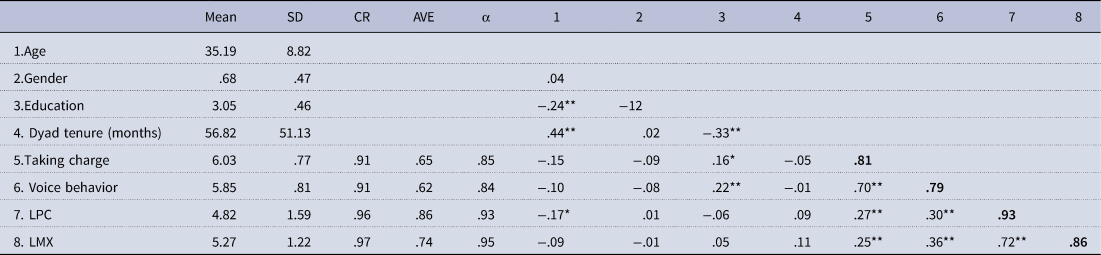
Table 1 shows the basic statistics and correlations of the variables involved in study 1. Confirmatory factorial analysis (CFA) was employed to test the model validity. The data were found to be well described by the model (χ2/df = 1.34, Tucker-Lewis index (TLI) = .98, comparative fit index (CFI) = .99, Root Mean Square Residual (RMR) = .06). Moreover, all of the items showed a significant loading onto their intended constructs (p < .01). We compared the theoretical four-factor model (see Figure 1) with several alternative models and found that the hypothesized model provided a significantly better fit to the received data than any of the other models. We therefore obtained good support for the distinctiveness of the constructs. The average variance extracted (AVE) and composed reliability were greater than .5 and .6, respectively, and thus showed support for the convergent validity of the data (Gerbing & Anderson, Reference Gerbing and Anderson1988).
Validity, mean, standard deviation, and correlation matrix of study 1
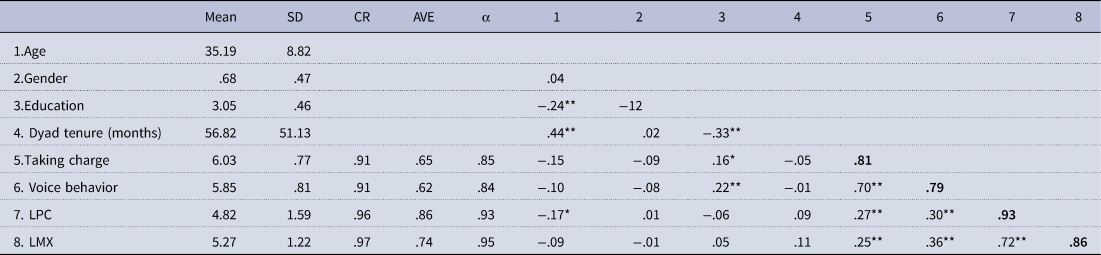
CR, composite reliability; AVE, average variance extracted; α, Cronbach’s alpha; LMX, leader–member exchange; LPC, leader perceived constructiveness.
The square root of AVEs is shown on the diagonal line in bold face.
*p < .05; **p < .01; ***p < .001. N = 165 .
**Correlation is significant at the .01 level (2-tailed).
*Correlation is significant at the .05 level (2-tailed).
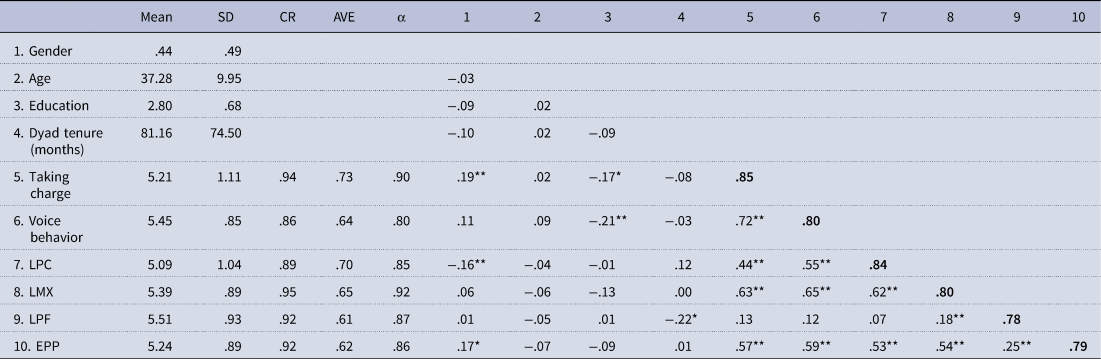
We further computed the AVE square roots of each construct and compared the results with all the other correlation values in order to test their discriminant validity (Fornell & Larcker, Reference Fornell and Larcker1981). As shown by the bold entries in Table 1, all of the AVE square root values were higher than the correlation values, and hence the discriminant validity of the data was confirmed (Raykov & Marcoulides, Reference Raykov and Marcoulides2012). A Harman’s single factor test was additionally performed. The result (a percentage of 39) indicated that the common method variance of the data fell within an acceptable range, and hence the data were deemed to be valid for hypothesis testing.
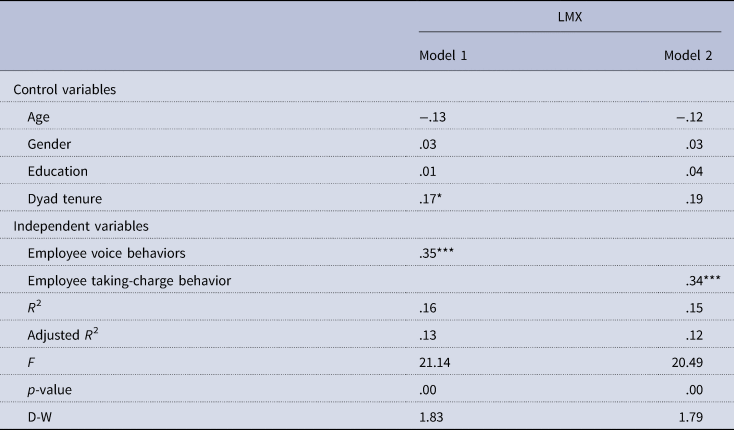
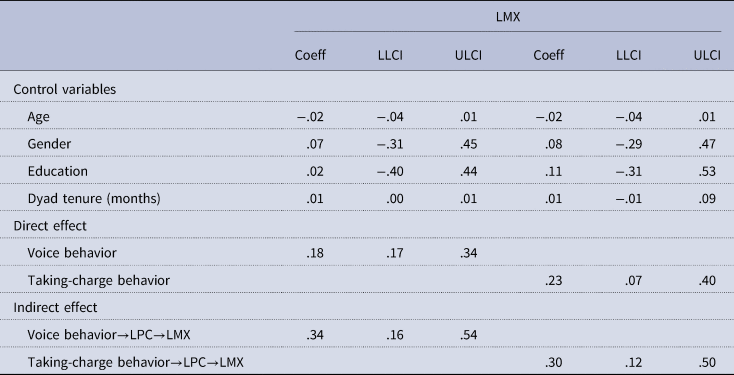
We tested Hypotheses 1 and 2 by employing linear regression to examine the direct effects of the employees’ proactive behaviors on the LMX. As shown in Table 2, the employees’ voice behaviors and taking-charge behaviors were both significantly and positively related to the LMX (β = .35, p < .00 and β = .34, p < .00 respectively). In other words, Hypotheses 1 and 2 were both supported. To test Hypotheses 3 and 4, which predict the mediation effects of the leader’s perceived constructiveness, we performed bootstrapping tests using the PROCESS macro (Hayes, Reference Hayes2013). In particular, tests of 95% bias-corrected CIs for the indirect effects were executed by bootstrapping 10000 samples. As shown in Table 3, the indirect effect of employees’ voice behavior on the LMX via the leader perceived constructiveness mediator had an effect size of .34, while the CIs ranged from .16 to .54. Consequently, Hypothesis 3 was supported. The employees’ taking-charge behavior construct also exhibited a significant indirect effect on the LMX via the leader perceived constructiveness (Coeff = .30, CI = [.12;.50]). Hence, Hypothesis 4 was also supported.
Study 1 regression result
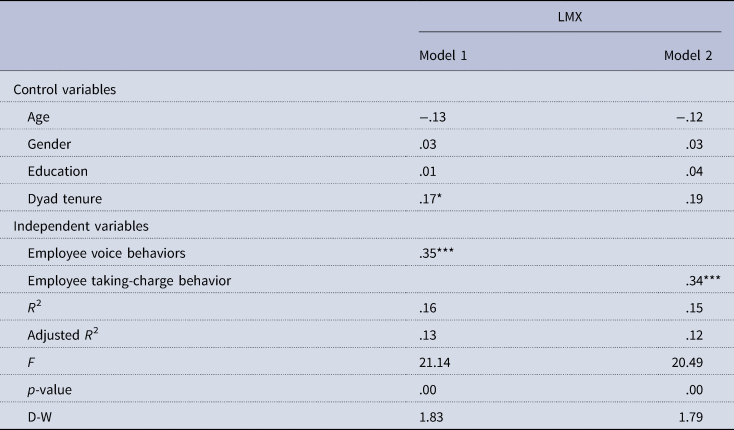
LMX, leader–member exchange.
Note: N = 165.
Study 1 bootstrapping result
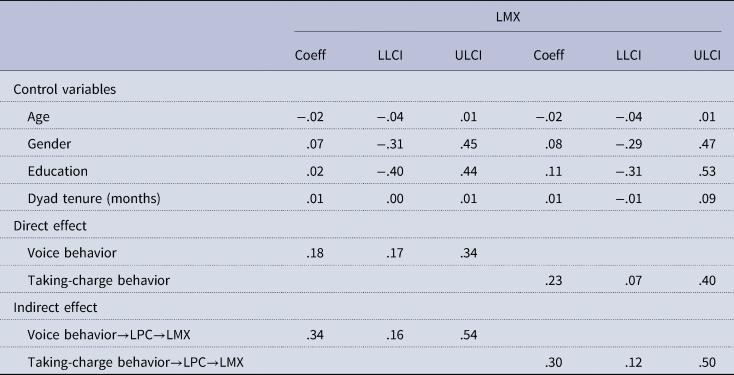
LPC, leader perceived constructiveness; LMX, leader–member exchange.
Note: N = 165.
Overall, the results obtained in study 1 showed that employees’ taking-charge and voice behaviors indirectly increased LMX through the leader’s perceived constructiveness. In other words, the results confirm the validity of the developed construct and its mediator roles. However, they take no account of the possible boundary conditions acting on this construct. Furthermore, in study 1, both the independent and the outcome variables were rated by the followers, and the leader perceived constructiveness and employee LMX were collected at the same time. Consequently, even though the data were collected via a time-lagged survey from two sources, concerns over common bias remain. Thus, a further study (study 2) was conducted to address this issue, examine the LMX from the leaders’ perspective, and investigate how the relationships described in Hypotheses 1 and 2 may be affected by the followers’ past task performance and leaders’ promotion focus.
Study 2
Samples
We conducted a three-wave survey of leader–follower pairs of employed alumni and students of graduate programs from several business schools in Taiwan. We first contacted and briefed potential participants on the research objectives and procedures. Complete confidentiality was assured. Each consenting participant was asked to provide the work email of their immediate supervisor. On receipt of this information, we sent the first set of questionnaires to the followers to collect data on their demographic information, taking-charge and voice behaviors, and dyad tenure. Each follower was assigned a unique code for reference purposes throughout the remainder of the study. We then sent a second set of questionnaires, together with this matched code, to the followers’ supervisors in order to collect data on their promotion focus and evaluation of their paired followers’ performance in the previous 3 months. As in study 1, a second wave of data collection was performed 2 months later, in which the supervisors were asked to report the perceived constructiveness of their paired followers. Finally, 4 weeks after that, a third set of questionnaires was sent to the supervisors to ask them to rate the LMX quality of their dyads. We received effective responses from 189 pairs of followers and supervisors, thereby attaining a response rate of 86%. The participating employees consisted of 105 males and 84 females, accounting for 55.6 and 44.4% of the employee population, respectively. The average age of the participants was 37, while the average dyad tenure was 6 years. As in study 1, t-tests were performed to check for nonresponse bias. No significant difference was found between the early and late responses for any of the research variables.
Measures
We used the same scales as those used in study 1 to measure the employee taking-charge and voice behaviors, LMX, and leader perceived constructiveness. In addition, we followed the method of Vecchio and Norris (Reference Vecchio and Norris1996) and asked the leaders to rate the performance of their followers over the previous 3 months using seven items from the scale developed by Williams and Anderson (Reference Williams and Anderson1991) with markers ranging from 1 (strongly disagree) to 7 (strongly agree) and an α value of .86. A sample item from the scale was, ‘This employee fulfills all responsibilities required by his/her job in the past three months.’ The supervisor’s promotion focus was measured using six items from the Regulation Focus at Work (RFW) scale developed by Wallace and Chen (Reference Wallace and Chen2005). The leaders were asked to rate how often they engaged in promotion-focused thoughts and activities while working (1 = never, 7 = constantly, α = .87). Sample items included, ‘Getting my work done no matter what’ and ‘Accomplishing a lot of work.’ As for study 1, we controlled for the demographic information of the employees and the time for which they had worked with their supervisors.
Results
Table 4 presents the basic statistics and correlations of the variables involved in study 2. As shown, the AVE square roots of the constructs were higher than all the other correlation values, and thus the discriminant validity of the data was confirmed (Raykov & Marcoulides, Reference Raykov and Marcoulides2012). We additionally performed CFA to test the construct validity. The collected data adequately fit the six-factor model (χ2/df = 2.40, p < .01, CFI = .91, TLI = .89, root mean square error of approximation (RMSEA) = .08). Both the absolute fit (RMSEA⩽.08) and the parsimonious fit (χ2/df<3.0) satisfied the standard requirement. Although the TLI was lower than the recommended value, the CFI had a value of .91 and was thus able to prove the marginally acceptable level of the data’s incremental fit (Hooper, Coughlan, & Mullen, Reference Hooper, Coughlan and Mullen2008). We conducted χ2 difference tests to compare the alternative models. The results showed that the six-factor model fits the data significantly better than any of the other construct combinations, such as the five-factor model (voice and taking-charge behaviors combined χ2/df = 2.54, p < .01, CFI = .89, TLI = .87, RMSEA = .09), or four-factor model (LMX and leader perceived constructiveness combined, voice and taking charge combined: χ2/df = 3.40, p < .01, CFI = .82, TLI = .80, RMSEA = .11).
Validity, mean, standard deviation, and correlation matrix of study 2
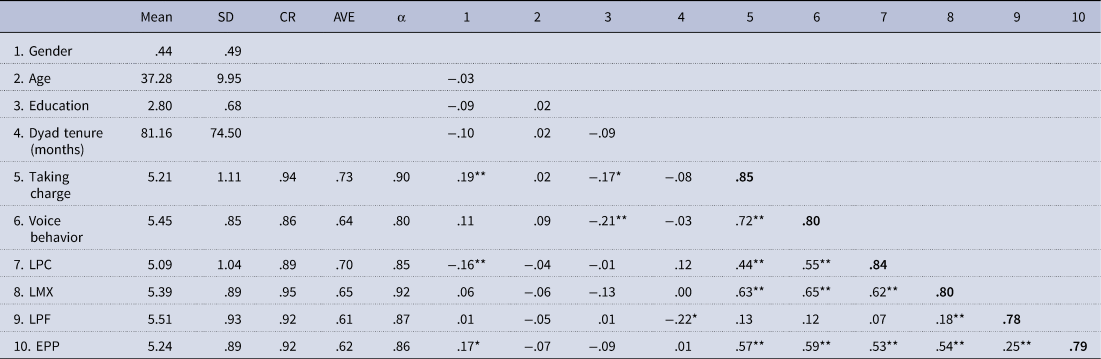
CR, composite reliability; AVE, average variance extracted; α, Cronbach’s alpha; LMX, leader–member exchange; LPC, leader perceived constructiveness; LPF, leader’s promotion focus; EPP, employee past performance.
The square root of AVEs is shown on the diagonal line in bold face.
*p < .05; **p < .01; ***p < .001. N = 189.
**Correlation is significant at the .01 level (2-tailed).
*Correlation is significant at the .05 level (2-tailed).
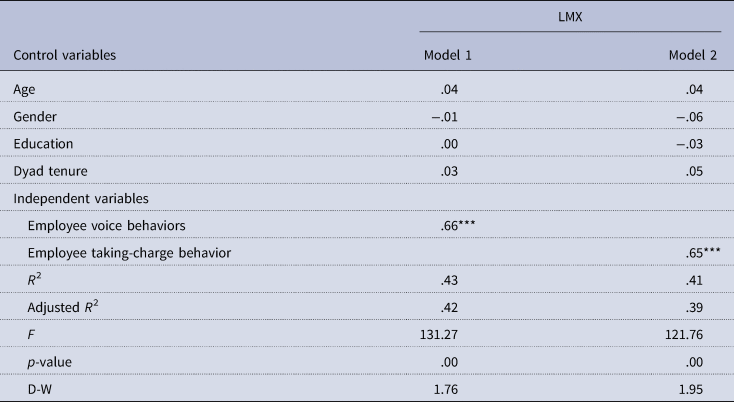
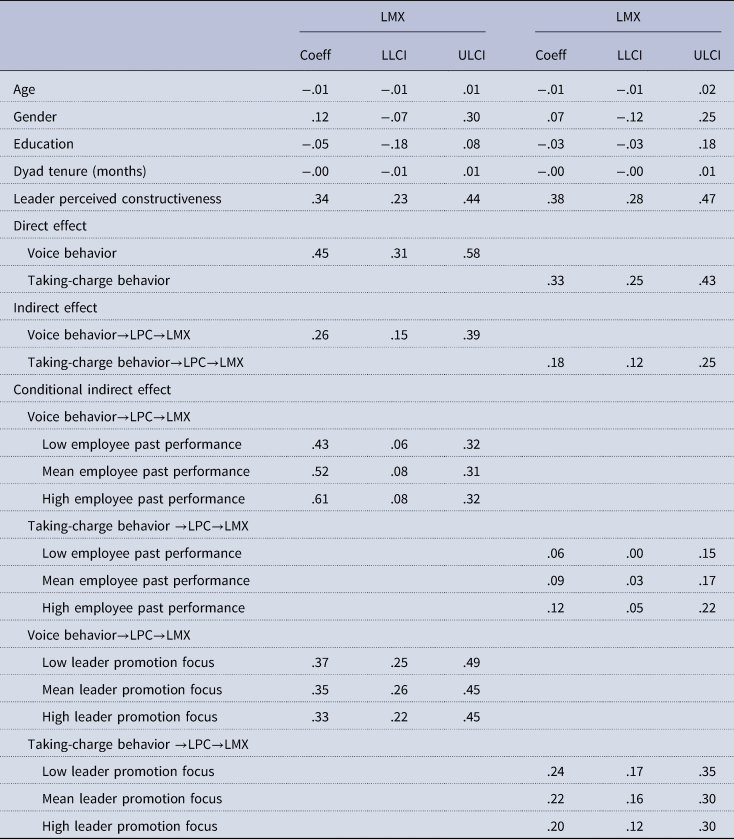
Hypotheses 1–4 were re-tested by conducting linear regression and bootstrapping analyses using the SPSS and PROCESS macro (Hayes, Reference Hayes2013). Table 5 shows support for Hypotheses 1 and 2, which posit the direct effects of employees’ voice behaviors and taking-charge behaviors on LMX (β = .66, p < .00 and β = .65, p < .00 respectively). As shown in Table 6, the employee voice behavior and taking-charge behavior constructs significantly affected LMX via the leader perceived constructiveness (Coeff = .26, Lower limit of Confidence intervals (LLCI) = .15, Upper limit of Confidence intervals (ULCI) = .39 and Coeff = .18, LLCI = .12, ULCI = .25, respectively). Thus, the results supported Hypotheses 3 and 4 and reconfirmed the findings of study 1.
Study 2 regression result

LMX, leader–member exchange.
Note: N = 189.
Study 2 bootstrapping result
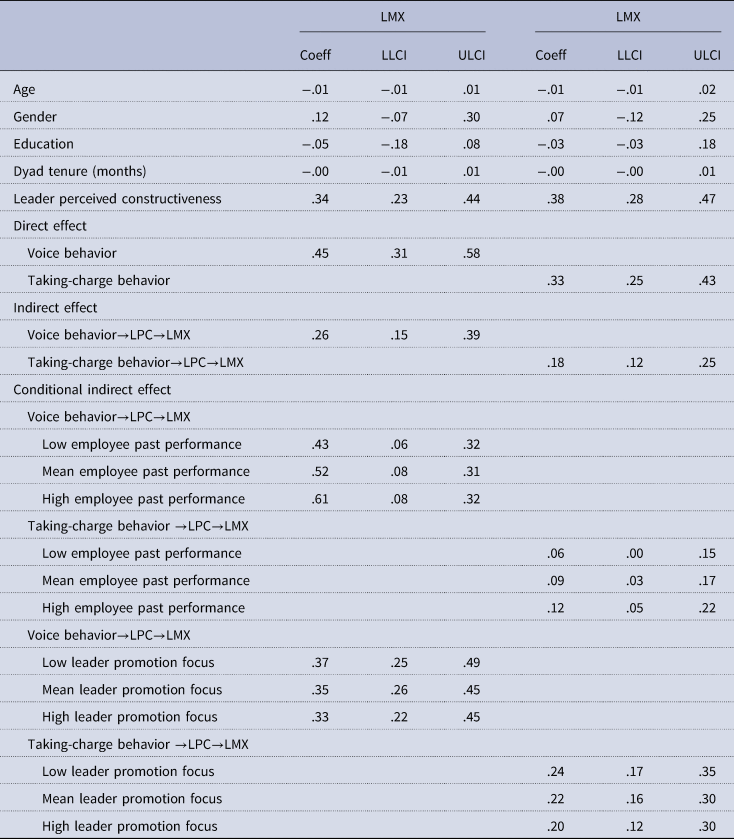
LPC, leader perceived constructiveness; LMX, leader–member exchange.
Note: N = 189.
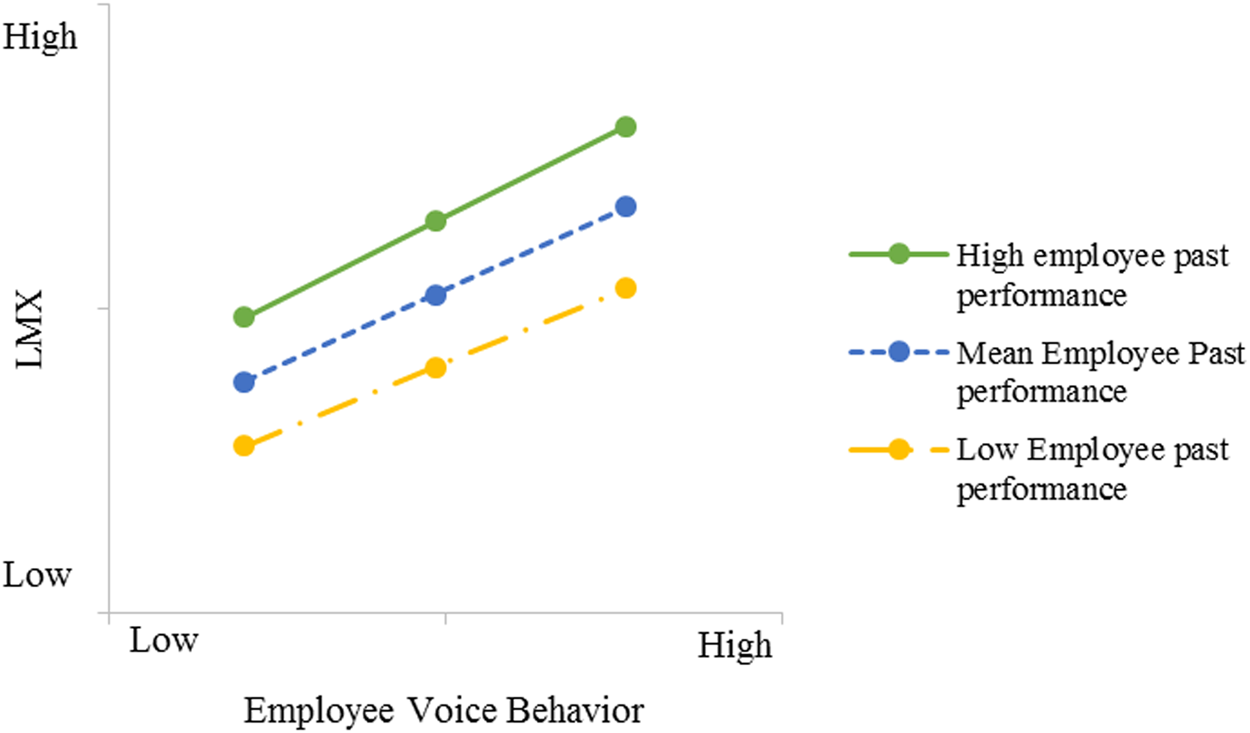
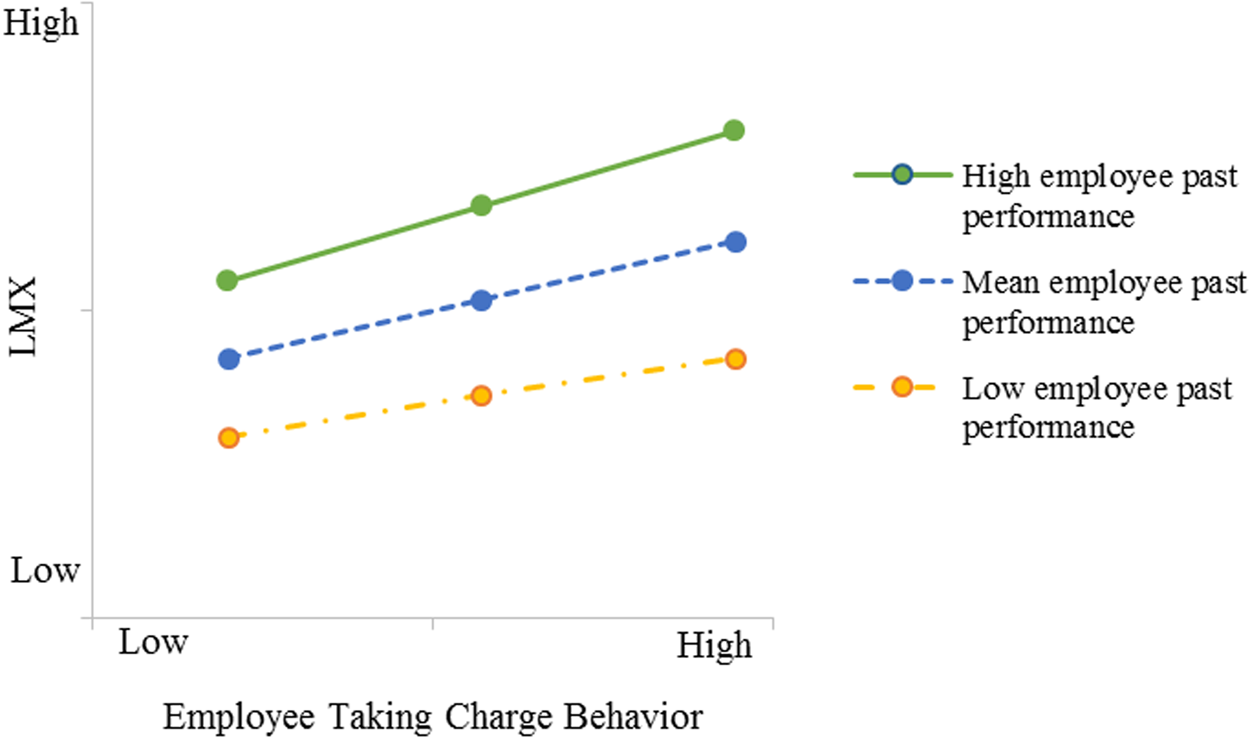
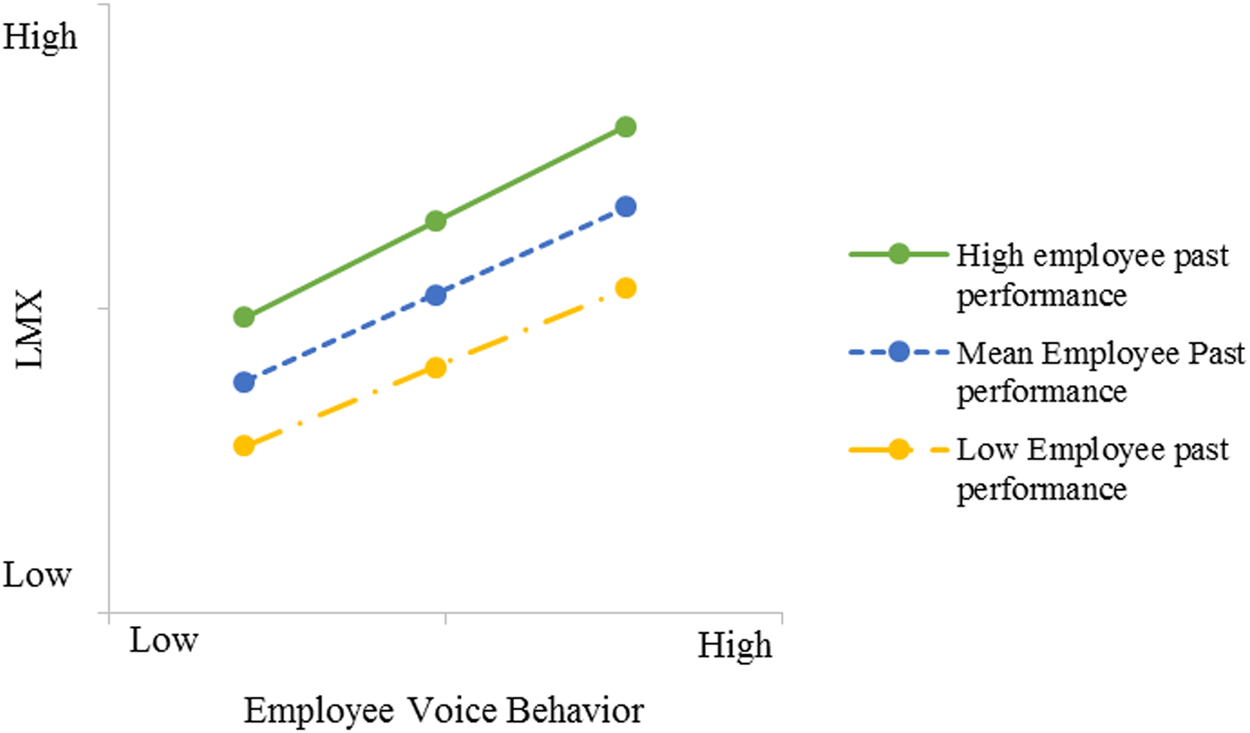
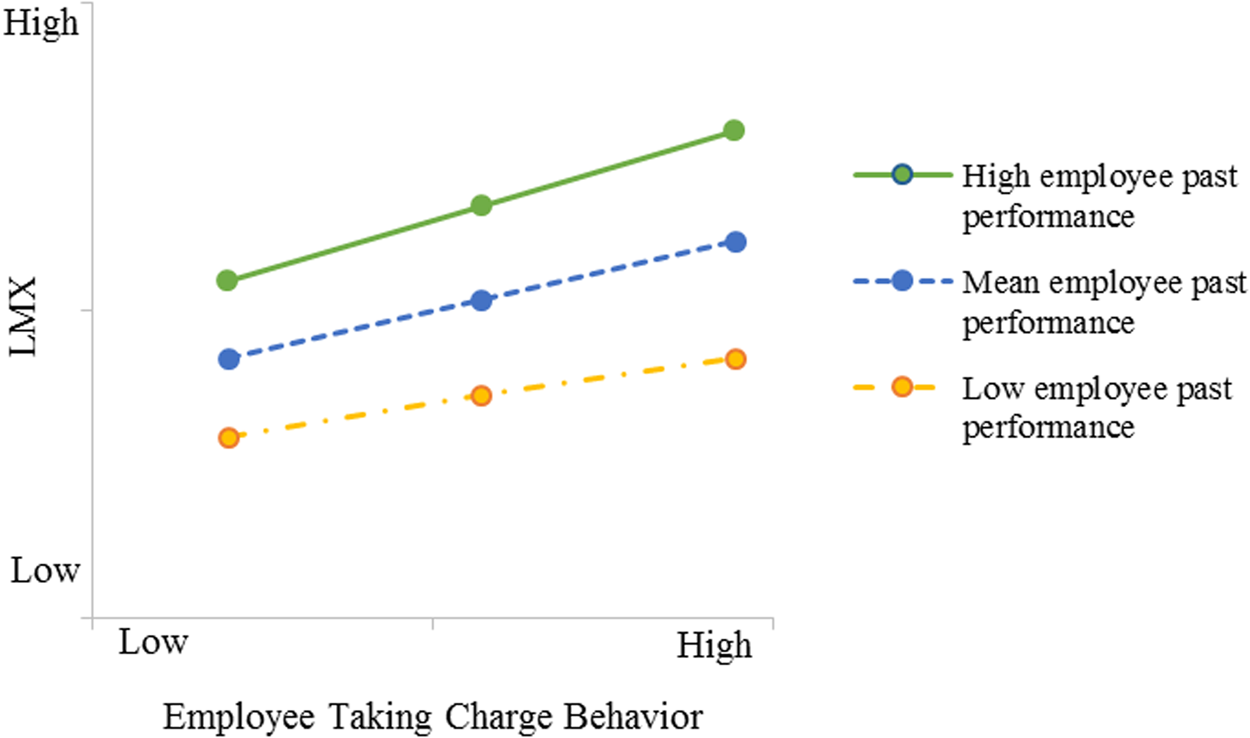
We used the PROCESS macro to examine the mediated moderation effects (Hypotheses 5–8). Following the recommendation of Preacher, Rucker, and Hayes (Reference Preacher, Rucker and Hayes2007), we set the high and low levels of the moderators at +1 and−1 standard deviation from the mean score of the respective moderator. The results showed that employees’ past performance significantly moderated the indirect effects of their taking-charge and voice behaviors on LMX via the leader perceived constructiveness (see Table 6). As expected, the indirect effect of employees’ taking-charge behavior on the LMX was stronger when the employees’ past performance was rated as high (β = .12, LLCI = .05, ULCI = .22) than when it was rated as low (β = .06, LLCI = .00, ULCI = .15), as illustrated in Figure 2. Similarly, the indirect effect of employees’ voice behavior on the LMX via the leader perceived constructiveness was also stronger for high-performance employees (β = .61, LLCI = .08, ULCI = .32) than for low-performance employees (β = .43, LLCI = .06, ULCI = .32), as shown in Figure 3. The overall moderated mediation indexes for the two effects were also significant, with β = .10, LLCI = .02, ULCI = .13 and β = .02, LLCI = .01, ULCI = .07, respectively. Thus, the indirect effects of the employees’ proactive behaviors were significantly enhanced when their past performance increased from a low level to a high level. Thus, Hypotheses 5 and 6 were supported.
Moderation effect of employee past performance on the indirect effect of employee voice behavior on LMX via leader perceived constructiveness.
Moderation effect of employee past performance on the indirect effect of employee taking-charge behavior on LMX via leader perceived constructiveness.
Hypotheses 7 and 8 posit that a leader’s promotion focus moderates the indirect effects of employees’ proactive behaviors on the LMX via the leader perceived constructiveness, and the indirect effects are enhanced when the leader’s promotion focus is high. However, the results of Study 2 revealed that the indirect effects of employees’ voice behavior on the LMX via the leader perceived constructiveness were more pronounced when the leader’s promotion focus was low (β = .37, LLCI = .25, ULCI = .49) rather than high (β = .33, LLCI = .22, ULCI = .45). Similarly, the conditional indirect β of the employees’ taking-charge behavior on the LMX was .24, LLCI = .17, ULCI = .35 for low-promotion-focus leaders and decreased as the leader’s promotion focus increased (β = .20, LLCI = .12, ULCI = .30). Furthermore, the overall moderated mediation indexes indicated that the indirect effects tended to decrease as the leader’s promotion focus increased (β = −.02, LLCI = −.15, ULCI = −.00 and β = −.03, LLCI = −.10, ULCI = −.00, respectively). In other words, although the leader’s promotion focus indeed moderated the indirect effects of the employees’ proactive behavior, the direction of the moderation effect was the opposite to that expected. Thus, Hypotheses 7 and 8 were not supported.
Discussion
Drawing on social resources theory and social exchange theory, this study has employed a reverse lens research framework to examine the relationship between employee proactive behavior and LMX via a new mediator termed as the leader perceived constructiveness. The study has additionally explored the moderating effects of the employees’ past performance and leaders’ promotion focus on this indirect relationship. The results have shown that employees’ taking-charge and voice behaviors are both positively related to LMX and the leader’s perceived constructiveness significantly mediates their effects. In addition, employees’ past performance amplifies the indirect effects of their voice and taking-charge behaviors on the dyad’s LMX. Finally, the leader’s promotion focus reinforces these indirect effects when it exists at a low level. As described in the following, the findings provide several crucial theoretical contributions to the literature and yield valuable insights for practical implementation.
Theoretical contributions
Our study enriches the literature in at least three ways. First, we root our study in social resources theory and social exchange theory and posit that employee proactive behaviors provide valuable resources to leaders by contributing service resources to the dyad relationship. Through our research, we contribute to the model of categories of resource exchange between leaders and followers by theorizing, and empirically showing, that followers’ voluntary initiatives provide resources in the form of services to the LMX (Wilson, Sin, & Conlon, Reference Wilson, Sin and Conlon2010). We also contribute to LMX literature by demonstrating a more follower-centric framework. Previous studies have examined the antecedent role of LMX on followers’ outcomes and proactive behaviors (Chiaburu, Smith, Wang, & Zimmerman, Reference Chiaburu, Smith, Wang and Zimmerman2014; Van Dyne, Kamdar, & Joireman, Reference Van Dyne, Kamdar and Joireman2008; Wang, Gan, & Wu, Reference Wang, Gan and Wu2016). The current study, however, departs from previous research by showing that LMX can be formed and developed regardless of the initiator party. Moreover, we extend the current literature by showing that two forms of employee proactive behaviors, namely taking charge and voice, lead to enhanced LMX within the dyad. In so doing, we both theorize a follower-centered framework and further advance the LMX literature. Furthermore, our study also demonstrates how and when employee’s self-initiated behaviors influence their interpersonal relationship at work and thus contributes to the proactive behavior literature.
Second, although previous studies have found support for the impact of employees’ proactive behaviors on the LMX (Cheng et al., Reference Cheng, Lu, Chang and Johnstone2013; Lam, Huang, & Snape, Reference Lam, Huang and Snape2007), the mechanisms which underlie this effect still need further insight. Our study fills this gap by drawing on social exchange theory and introducing the leader’s perceived constructiveness as a mediating mechanism between employees’ proactive behaviors and the resulting interpersonal outcomes. Huang et al. (Reference Huang, Xu, Huang and Liu2018) posited that the frequency and content of employees’ voice behaviors influence the leader’s evaluation of their effectiveness, and hence predict the leader’s reciprocal behavior toward the follower. We extend this finding by introducing the construct of leader perceived constructiveness and, through this construct, provide a more thorough understanding of how employee behaviors may affect leaders. In particular, we postulate that it serves as a mediator which enables the leader’s reciprocation process. Through doing so, we contribute to the social exchange aspect of LMX literature and answer the call for new mechanisms to explain how employee-driven behaviors affect leaders and leadership (Kong et al., Reference Kong, Xu, Zhou and Yuan2019).
Finally, our study shows that followers’ past performance acts as a boundary condition on their upward effects. In particular, we show that followers’ past performance significantly amplifies the indirect effect between their proactive behaviors and LMX via the leader perceived constructiveness mediator. This finding confirms that a follower’s performance record acts as a reference for leaders when evaluating whether the employee’s behaviors are feasible, appropriate, and beneficial (Lapierre, Naidoo, & Bonaccio, Reference Lapierre, Naidoo and Bonaccio2012). Furthermore, based on this evaluation, leaders may decide to engage in mutual social exchange with the focal employees, which then regulates the interpersonal relationship between them. By explicating the perceptions of leaders toward proactive followers as boundary conditions on the indirect relationship between follower behaviors and increased LMX relations, the present study answers the call for research on the boundary conditions that regulate how leaders interpret followers’ proactive behaviors (Huang et al., Reference Huang, Xu, Huang and Liu2018; Whiting et al., Reference Whiting, Maynes, Podsakoff and Podsakoff2012) and provides further scholarly understanding of the LMX literature.
However, the present findings have shown no support for the proposed positive moderation effect of the leader’s promotion focus on the indirect effect of employees’ proactive behaviors on LMX. In fact, the results have shown that the moderation effect actually reduces as the leader’s promotion focus increases. We speculate that this may be due to a difference in leaders’ perceptions of what constitutes competent followers. In particular, high-promotion-focus leaders tend to aim to maximize their gains and are thus enthusiastic about grasping opportunities for advancement. Furthermore, being profoundly engaged in looking for advances themselves, such leaders may assume it to be a natural obligation and standard behavior for employees to constantly come up with new ideas and tactics to improve work processes, or to actively seek to improve the situation they find themselves in rather than merely criticizing it. This expectation may subconsciously temper the leader’s appreciation of the helpfulness of their employees’ initiative behaviors, and hence delay their recognition of such efforts as special contributions worthy of note and reward. Conversely, leaders with low promotion focus are better able to appreciate the potential benefits of employees’ self-initiative behaviors, and are thus more likely to acknowledge the contributions of highly proactive followers. Shin, Kim, Choi, Kim, and Oh (Reference Shin, Kim, Choi, Kim and Oh2017) asserted that when a high-initiative, goal-focused follower pairs with a low-promotion-focus leader, he/she may feel the need to make changes in their work process. Thus, low-promotion-focus leaders may stimulate employees to increase the frequency at which they exhibit proactive behaviors. The resulting intensified efforts tend to magnify the success rate of the employees’ taking-charge and voice behaviors, and consequently reinforce the leader’s impression of their constructiveness.
Practical implications
High-quality leader–member relationships are consistently reported as being related to positive outcomes (Dulebohn, Wu, & Liao, Reference Dulebohn, Wu and Liao2017; Martin et al., Reference Martin, Guillaume, Thomas, Lee and Epitropaki2016). Thus, the present findings are of value to both company executives and employees seeking to improve their interpersonal relationships in the workplace. In particular, the results indicate that employee initiative can induce a positive effect on relationships with the leader. As a result, employees seeking to improve their workplace relationships should actively demonstrate to their supervisors the constructive nature of their behaviors. For example, they should take effort to express their suggestions and opinions in a methodical manner, take initiative in an organized and thoughtful fashion, and show the potential benefits systematically and clearly. By doing so, employees can not only ensure that their efforts are acknowledged, but can also enhance the interrelationship quality with their leaders.
Our results have shown that a leader’s perception of his/her employees’ performance influences how they perceive their behavior. Thus, employees should carefully balance their time and effort between engaging in proactive behaviors and executing job-related responsibilities. Moreover, they should pay close attention to their image, as perceived by the leader, and formulate appropriate strategies for taking initiative accordingly. For instance, while high-performance employees can directly and comfortably speak up or make changes at work, other employees should adopt a slower and more steady approach, while clearly stating their objectives and proposed means of achieving them. Notably, and somewhat surprisingly, our results have revealed that high-promotion-focus leaders tend to overlook employees’ proactive behaviors. Thus, employees should clearly exhibit their motivations, and explicitly present their contributions, when observing that their leaders assume it to be a natural obligation for employees to consistently seek out new ideas and tactics for making advancements in the workplace.
The current findings also have important managerial implications. The relationship with one’s leader is known to have a strong influence on work outcomes. Consequently, both the leader and the organization can benefit from developing and maintaining high-quality relationships with the employees. Our findings remind managers of the need to assess employees based not only on their success in discharging their assigned duties, but also on their motivations toward advancing the workplace. Since the successful implementation of any new procedure requires more than mere behaviors of taking charge or speaking up, it is essential to notice and encourage employees’ efforts rather than evaluating them only on the basis of their final results.
Leaders should also be aware of their own expectations and prejudgments when evaluating their followers and should explicitly acknowledge and provide support to employees’ proactive behaviors as and when called for. Moreover, to create a harmonious workplace, leaders should reassess their relationships with their followers from an objective viewpoint in order to minimize the potential for relationship bias. In addition, organizations should offer leadership development programs to equip leaders with sufficient knowledge, tools, and resources to identify and reward employees’ initiative behaviors as required. Finally, organizations should implement programs such as mentorship to encourage the frequency and efficacy of employee proactive behaviors and should constantly remind leaders to be more active in guiding and supporting employees who voluntarily assist the organization.
Limitations and future research
The present research has performed two time-lagged studies (with different sources of data) and has examined the interpersonal relationship construct from two viewpoints: the leader and the follower. It thus advances scholarly understanding of the reverse-lens view of employee initiative behaviors and LMX. However, despite this contribution, the study has several limitations which must be acknowledged.
First, the study has expanded the construct of leader perceived voice constructiveness to posit a broader construct, designated as leader perceived constructiveness, which involves leaders’ perceptions of their employees’ voice, efforts, and initiative behaviors. We have postulated this construct as a linkage mechanism to explain the manner in which employees’ proactive behaviors impact leaders’ reactions. Although our findings show support for the mediation role of this construct, further research is required to confirm the validity of the construct and its applicability to other contexts and roles.
Second, in study 2, we collected the leaders’ perceived constructiveness and LMX from the same source. Thus, even though we deliberately collected the data through a time-lagged survey, we cannot guarantee the absence of common method bias. This may cause our data to fit only marginally to the proposed 6-factor model. Furthermore, the current study measured the supervisor rated LMX using a mirrored version of the follower measurement. Although this method is aligned with our research question and design, there have been calls in the literature to adopt a leader-focused LMX measurement approach, which is more dynamic and thus better able to capture the interpersonal exchange nature of the LMX relationship (Greguras & Ford, Reference Greguras and Ford2006; Paglis & Green, Reference Paglis and Green2002). Consequently, future studies should aim to develop more robust research designs to address these issues.
Third, our study draws on social resources theory and social exchange theory to posit that employees’ proactive behaviors shape a leader’s perception of them and may subsequently build up LMX. However, even though we collected data through multiple-wave surveys, we cannot rule out the reverse causal effect of LMX on employee proactive behaviors. Thus, future research should adopt a longitudinal approach to clarify alternative causalities.
Fourth, we hypothesized that the indirect effect of employees’ proactive behaviors on LMX are enhanced when the leader’s promotion focus is stronger. Interestingly, our results have shown that this effect is in fact reversed. We speculate that this may be due to low-promotion-focus leaders being more perceptible to employees’ proactive behaviors than high-promotion-focus leaders. However, future research should explore this phenomenon further from different theoretical points of view. For example, employees’ proactive behavior may contribute resources to the leader’s leadership. According to the conservation of resources theory, individuals are motivated to gain more resources while at the same time protecting themselves from resource losses (Hobfoll, Reference Hobfoll1989). Low-promotion-focus leaders, due to their inherent resistance toward change, are more likely to focus on preventing resource loss than actively looking for resource gain. Thus, they tend to appreciate and welcome the contributed resources which are produced when employees perform proactive behaviors voluntarily. The need for resources may then outweigh their skepticism toward the new idea/method and thus enhance their constructive perception of the focal employee, which further improves the LMX. We therefore recommend that future research should consider other attributes that may also influence how leaders perceive employee proactive behavior (e.g., leader narcissism, the need for achievement, and so on). In addition, a high manager-rated performance evaluation may indicate a high LMX quality. Consequently, future studies should also explore the moderating effects of other indicators of employee capability, such as objective task performance, to minimize potential correlation biases.
Finally, our study has examined two employee proactive behaviors, namely taking-charge and voice behavior, by measuring how frequently employees perform such actions. However, we have not considered the specific contents, feasibilities, or success rates of these behaviors. Whiting et al. (Reference Whiting, Maynes, Podsakoff and Podsakoff2012) found that the source, content, and context of voice behaviors determine their effectiveness and constructiveness. Furthermore, Huang et al. (Reference Huang, Xu, Huang and Liu2018) showed that the contents of voice behaviors (e.g., promotive or prohibitive) have distinct effects on employees’ promotability. Thus, future research should explore the effects of contextual factors, purpose, and success rate of these behaviors on the LMX.
Conclusion
In summary, this study adds to scholarly knowledge on how and when followers’ taking-charge and voice behaviors increase LMX. The study further proposes two boundary conditions for these indirect effects. As such, the findings complement existing literature on LMX and leadership, and provide useful insights and suggestions for managerial practice.
Conflict of interest
None. All authors have seen and approved the manuscript being submitted. The article is the authors’ original work. The article has not received prior publication and is not under consideration for publication elsewhere.
Hsi-An Shih is a professor of human resource management at the Institute of International Business, National Cheng Kung University, Taiwan. His current research interests include HPWP, HRM in innovation, and team/group processes. He has authored or co-authored papers in the Journal of Applied Psychology, Asia Pacific Journal of Management, Journal of Business Research, IEEE Transactions on Engineering Management, R & D Management, International Journal of Human Resource Management, Creativity Research Journal, International Journal of Conflict Management, International Journal of Manpower, and other journals. He also served as area editor of Organization & Management Journal (in Chinese).
Tuong-Vy Nguyen is an assistant professor at the Department of Business Management, National Taiwan University of Science and Technology, Taiwan. Her research interests include human resource management in innovation and performance, leadership, and team/group processes. She has published papers in academic journals such as European Journal of Work and Organizational Psychology and Personnel Review.