

The role of social media in supporting the ethical implications of organizations regulating death have been overlooked by research analyzing ethics in and around organizations, despite some earlier attempts (Willis, Reference Willis2015). The recent reemergence of authoritarianism at a global scale (Robinson & Bristow, Reference Robinson and Bristow2020) has been commonly linked to specific legitimation discourses on how the ethics of life and death—that is, determining the moral status of life, the conditions under which it should be protected or ended, and the responsibilities of the groups in charge of these decisions (Feldman, Reference Feldman1994; Kamm, Reference Kamm1993)—is organized (Bourgeron, Reference Bourgeron2022). Furthermore, researchers suggest that organizations have been at least complicit if not perpetrators of the regulation of death (Banerjee, Reference Banerjee2008). Recent studies have shown how governments have either used their sovereign power of killing “through the law” or employed “criminal organizations” to do their bidding (Estévez, Reference Estévez and Estévez2021; Pérezts, Reference Pérezts and Estévez2021).
Previous literature suggests that the state, in alliance with private organizations, legitimizes death through two discourses: normalization (Fotaki, Reference Fotaki2022; Varman & Al-Amoudi, Reference Varman and Al-Amoudi2016) and invisibilization (Smith, Reference Smith2016; Willmott, Reference Willmott2000). Historically, these discourses have been reinforced through state channels and the press (Jagannathan & Rai, Reference Jagannathan and Rai2022; Rose, Reference Rose2009; Taylor, Reference Taylor1992). However, the influence of the recent rise of new social technologies of communication on the organizing of life and death are less explored.
This question becomes central considering that social media is a fundamental source of interaction among people, especially after the pandemic, and recent forms of authoritarianism, in governments and corporations (Robinson & Bristow, Reference Robinson and Bristow2020), have risen and gained strength owing to the use of social media channels (Gustafsson & Weinryb, Reference Gustafsson and Weinryb2020). For instance, the Trump administration famously criticized the traditional “fake press” with the recent open and enthusiastic support of Tech giants (Jones, Witze, Tollefson, & Kozlov, Reference Jones, Witze, Tollefson and Kozlov2025), in favor of exploiting social technologies as privileged channels to legitimize their “state of exception” at the border, enabling their governmental agencies (e.g., US Immigration and Customs Enforcement) to treat immigrants as “rapists” whose lives are not “worth sacrificing” (Agamben, Reference Agamben2008). Instead of news articles and op-eds, government officials and organizations (and their allies) seem to have turned to social media posts and memes to justify their actions and gain popularity.
Considering rising authoritarianism, to understand how social media has influenced the legitimation discourse of the organization of death, we investigated the use of Internet memes to legitimize police massacres in Brazilian favelas. Brazilian police have been historically employed to oppress marginalized populations; however, the recent boastful discourse through social media suggests a worrying change in how their actions are legitimized. We propose that the police work as an extreme case (Hällgren, Rouleau, & De Rond, Reference Hällgren, Rouleau and De Rond2018) that helps to explore how organizations and its supporters, within the recent authoritarian drive, justify their role in the organization of death by employing social media and, specifically, memes. Moreover, following a long tradition in our field (Burrell & Morgan, Reference Burrell and Morgan1979), we explore unconventional research contexts such as state institutions and agencies, which have the potential to generate findings that challenge prevailing assumptions and reveal practices usually “too weak to notice or capture in traditional settings” (Bamberger & Pratt, Reference Bamberger and Pratt2010: 668).
Among the elements that have appeared as new language forms in social media, online memes—collections of technical content created within online software environments, shaped by the unique features and affordances of the platforms (Rogers & Giorgi, Reference Rogers and Giorgi2024)—have become increasingly central (Newton, Zappavigna, Drysdale, & Newman, Reference Newton, Zappavigna, Drysdale and Newman2022; Shifman, Reference Shifman2013). Recent research suggests that memes are increasingly used to influence the reputation and perception of organizational actions (Barkemeyer, Faugère, Gergaud, & Preuss, Reference Barkemeyer, Faugère, Gergaud and Preuss2020; Blevins & Ragozzino, Reference Blevins and Ragozzino2019; Etter, Colleoni, Illian, Meggiorin, & D’Eugenio, Reference Etter, Colleoni, Illia, Meggiorin and D’Eugenio2018); however, little is known about their role in the organizational ethics of death. Rather than seeing organizations as discrete and static entities, we assume organizations to be performed into being in many practices and events in a never-ending organizing process (Czarniawska, Reference Czarniawska, Robichaud and Cooren2013), with social media (and online memes) having an increasingly important role (Leonardi & Vaast, Reference Leonardi and Vaast2017). Hence, this article addresses the following research question: how do social media memes legitimize organizational actions related to the ethics of life and death?
To answer this question, we analyze a case that involves three police operations that took place over two years (2021/2022) in three distinct favelas located in Rio de Janeiro (Brazil), resulting in seventy-one deaths (Couto & Lopes, Reference Couto and Lopes2022; Resende & Brasil, Reference Resende and Brasil2022). These three massacres, the most fatal police actions in the annals of Brazilian history, represent pervasive instances of law enforcement fatalities that breach the anticipated conduct of police forces within the context of a democratic society (Ahnen, Reference Ahnen2007; Caldeira, Reference Caldeira2002; Huggins, Reference Huggins2000). These events have been met with significant favorable social media mobilization and support, mostly through the circulation of Internet memes.
Our study employed a qualitative analysis on six of the most circulated and commented on memes among the 495 collected from Instagram, following the three police operations. Three primary legitimation discourses were identified in relation to the form and content of the memes: denying life worthiness, establishing actors deserving death, and upholding the police as executioners of death. Our analysis suggested that the use of memes aimed to dismiss human rights perspectives within the favelas, assert them as a particular state of exception, warrant punishment for death, and defend the legitimacy of police operations. These three meme discourses were constructed through cultural media artefacts, such as police operation photos and blockbuster movie clips, making visible and “gloating” over the victims’ death through a legitimation discourse that employs simultaneously “humorous” derision and abjection to dehumanize the favela’s habitants and a triumphant tone that deifies the state organizations.
This study makes three major contributions to existing literature. First, we contribute to the ethics of the organization of death debate by showing how social media supports a different legitimation discourse that, rather than hiding or normalizing death, makes it visible and turns it into something to be celebrated, especially when directed at marginalized groups. Second, we suggest that this discourse, within the context of rising authoritarianism, is particularly enabled by social media memes that, by their quick and humorous nature, potentially void the debate on the ethics of life and death towards vacuous and ephemeral engagement. Third, our case highlights, within the discussion of how life and death are governmentally organized, the role of the state apparatus of law enforcement as an expression of racialized inequalities within colonial contexts. We conclude by questioning the ethical position of big tech companies, whose complicity allows this type of content to circulate freely, thus contributing to the regulation of death and the terror in the lives of millions of vulnerable people.
LITERATURE REVIEW
Ethics of Death Through the State and Organizations
The ethics of organizations are associated with aspects like the alignment of their goals and the expectations of society, which can be ruled and intervened by the government to be realized (Svensson & Wood, Reference Svensson and Wood2008). In this sense, the ethical question of how life and death are organized (Agamben, Reference Agamben2008; Kamm, Reference Kamm1993; Luper, Reference Luper2014) has historically and fundamentally been linked to the power of governmental institutions (Duschinski, Reference Duschinski2009; Jagannathan & Rai, Reference Jagannathan and Rai2022). The state and its apparatus have traditionally held the sovereign authority to decide how populations live and die within and at the margins of their territory (Iliadou, Reference Iliadou, Bhatia and Canning2021; Sabo et al., Reference Sabo, Shaw, Ingram, Teufel-Shone, Carvajal, De Zapien, Rosales, Redondo, Garcia and Rubio-Goldsmith2014), and often beyond it through imperial and colonial domination (Banerjee, Reference Banerjee2008).
Thus, researchers have shown how governmental organizations have managed death, often linked to the “reproduction of the colonial status quo” (Estévez, Reference Estévez and Estévez2021; Pérezts, Reference Pérezts and Estévez2021). On the one hand, scholars have found that governments work alongside private corporations to profit from death management “through the law” by racializing the “selection of desirable and undesirable lives in modernity” under the control and violence of institutions (Vilchis-Díaz, Reference Vilchis-Díaz2021). On the other hand, studies suggest that the state instrumentalizes its police enforcement apparatus and other “criminal organizations” to do their bidding in the administration of death within their borders (Rebolledo, Reference Rebolledo and John2021). In general, studies have highlighted how corporations are at least complicit with governments, if not main actors, in the regulation of death (Banerjee, Reference Banerjee2008).
Police organizations are among the few organizations that have the right to use violence on behalf of the state, often through deadly force (Willis, Reference Willis2015). While police regulation of death has been largely overlooked in management and organization studies, it has been extensively discussed in broader social sciences and police studies (Fyfe, Reference Fyfe1981; Rappert, Adang, De Paepe, Dymond, Easton, & Probert, Reference Rappert, Adang, De Paepe, Dymond, Easton and Probert2023; Terrill, Reference Terrill2023). Research in this area primarily investigates the reasons behind police use of lethal violence (Oramas Mora, Terrill, & Foster, Reference Oramas Mora, Terrill and Foster2023) and the factors contributing to police killings, including the use of firearms (Pickering & Klinger, Reference Pickering and Klinger2023), the influence of the officer’s occupational subculture (Waegel, Reference Waegel1984), and the racial profile of victims (Prince & Sun, Reference Prince and Sun2023). Such studies often inform and provide a basis for implementing police reforms (Fyfe, Reference Fyfe1988; Lee, Reference Lee2018).
While these studies focus on the motivations and consequences of police lethal brutality, less has been said about how these actions are organizationally legitimized, particularly in the current (social) media landscape, where the necessity of such action is up to public scrutiny.
Discursive Legitimation of Death
In the organization of death, scholars have suggested that states, and complicit organizations, have used their sovereignty to establish “spaces of death” and “ungrievable subjects” (Butler, Reference Butler2016). Particularly, studies have explored how “states of exception” are created where transgressions to the rule of law are normalized within the judicial framework (Agamben, Reference Agamben2008). In these necropolitical movements within late capitalism (Banerjee, Reference Banerjee2008; Mbembé, Reference Mbembé2019), people are deemed outside of acceptable humanity and thus subject to death with no negative impact on society (Fotaki, Reference Fotaki2022).
Studies on the ethics of organization of death have suggested that the use of the concepts of “spaces of death” and “ungrievable subjects” have been traditionally deployed discursively within two legitimation discourses: normalization and invisibilization. Normalization suggests that states of exception are normal for social order and that deaths are a predictable consequence of a community outside of the acceptable forms of living (Bloomfield, Burrell, & Vurdubakis, Reference Bloomfield, Burrell and Vurdubakis2017; Giroux, Reference Giroux2011; Pérezts, Reference Pérezts and Estévez2021; Valencia, Reference Valencia2018; Varman & Al-Amoudi, Reference Varman and Al-Amoudi2016). Contrarily, invisibilization treats these populations at the margin of the law and their casualties as disgusting occurrences that should be hidden away from sensible “human beings” leading respectful lives (Courpasson, Reference Courpasson2016; Smith, Reference Smith2016; Varman & Srinivas, Reference Varman and Srinivas2025; Willmott, Reference Willmott2000).
These discourses have been a staple of discourses on the organization of death (Bourgeron, Reference Bourgeron2022). Research has shown how states and organizations use their channels and the mainstream press to diffuse these messages, which support and protect the current status quo enjoyed by the citizens (Jagannathan & Rai, Reference Jagannathan and Rai2022; Rose, Reference Rose2009; Taylor, Reference Taylor1992). However, the impact of social media on these legitimation discourses has been less explored, although its potential to strengthen stereotypes, including those related to marginalized populations (Dobson & Knezevic, Reference Dobson and Knezevic2017), usually supporting extreme political ideologies.
Social Media Memes and Organizational Legitimation
Media has always occupied an important role in business ethics, disseminating information, destroying reputations, warning society about “unsavoury practices”, and reflecting “dominant social morales of the day” (Svensson & Wood, Reference Svensson and Wood2008: 310). Nevertheless, social media has introduced a new form of language and communication between individuals and organizations (Bazarova & Choi, Reference Bazarova and Choi2014; Kapoor, Tamilmani, Rana, Patil, Dwivedi, & Nerur, Reference Kapoor, Tamilmani, Rana, Patil, Dwivedi and Nerur2018; Leonardi, Huysman & Steinfield, Reference Leonardi, Huysman and Steinfield2013). Therefore, within this new form of communication, the relationship with online users gains relevance in understanding the construction of legitimacy around organizational ethical practices (Barkemeyer et al., Reference Barkemeyer, Faugère, Gergaud and Preuss2020; Blevins & Ragozzino, Reference Blevins and Ragozzino2019; Etter et al., Reference Etter, Colleoni, Illia, Meggiorin and D’Eugenio2018) in the field of social media legitimation (Barros, Reference Barros2014, Reference Barros2018; Castelló, Etter, & Årup Nielsen, Reference Castelló, Etter and Årup Nielsen2016; Etter et al., Reference Etter, Colleoni, Illia, Meggiorin and D’Eugenio2018; Sillince & Brown, Reference Sillince and Brown2009). However, in these studies on social media legitimations, less has been said about the role of pictorial tools, such as memes, leaving aside the relevance of these content as meaningful and inspiring for those who interact on social media platforms (Rieger & Klimmt, Reference Rieger and Klimmt2019).
Recently, images have become a ubiquitous form of content (Thomson, Angus, & Dootson, Reference Thomson, Angus and Dootson2020) that can easily be shared across different platforms (Fardouly & Holland, Reference Fardouly and Holland2018; Pearce et al., Reference Pearce, Özkula, Greene, Teeling, Bansard, Omena and Rabello2020), with the distinctive feature of evoking emotions and driving reactions (Cotter, Reference Cotter2019; McGrane, Reference McGrane, Hjorth and Souza2020; O’Neill, Reference O’Neill2016; Ruckenstein & Granroth, Reference Ruckenstein and Granroth2020; Zuboff, Reference Zuboff2019).The circulation of social media images has become a critical form of expression, communication, and cultural propagation (Carah, Reference Carah2014; Hokka & Nelimarkka, Reference Hokka and Nelimarkka2020). In particular, researchers focused on the evolution of online communication, observing that social media platforms allow users to produce and spread “collections of technical content resulting from a combination of digital participatory culture as well as software production practices” called memes (Rogers & Giorgi, Reference Rogers and Giorgi2024: 74).
Memes are considered one of the most popular online cultural artefacts, becoming an essential aspect of this pictorial communication (Bayerl & Stoynov, Reference Bayerl and Stoynov2016). Originally a concept in biology (Semon, Reference Semon1925) and later in cultural studies (Dawkins, Reference Dawkins1976), memes evolved with the advent of the Internet to denote ideas, styles, and broadcast modes in the digital realm (Dobson & Knezevic, Reference Dobson and Knezevic2017; Knobel & Lankshear, Reference Knobel, Lankshear, Knobel and Lankshear2007; Lankshear & Knobel, Reference Lankshear and Knobel2003). They follow social media platforms’ goal of guiding user interactions to increase connections and interactions through content replication, relying on various media formats, languages, and images (Crawford, Reference Crawford2021; Faulkner, Vis, & D’Orazio, Reference Faulkner, Vis, D’Orazio, Burgess, Marwick and Poell2018; Poell, Nieborg & Van Djick, Reference Poell, Nieborg and Van Dijck2019).
Researchers have identified several attributes justifying the specificity of online memes as a new form of communication. Online memes are assemblages of technical content, shaped and negotiated according to platforms norms, conventions, and features, where the raw material are, for example, videos, X screenshots, texts over images or videos (Rogers & Giorgi, Reference Rogers and Giorgi2024; Shifman, Reference Shifman2014). Consequently, they are a novel form of language with distinct storytelling elements (Knobel & Lankshear, Reference Knobel, Lankshear, Knobel and Lankshear2007; Lankshear & Knobel, Reference Lankshear and Knobel2003). Subsequently, they spread quickly and numerous times (Phillips & Milner, Reference Phillips and Milner2017; Rintel, Reference Rintel2014; Shifman, Reference Shifman2013), relying on the affinity of social media users for the issue addressed (Phillips & Milner, Reference Phillips and Milner2017; Tuters & Hagen, Reference Tuters and Hagen2020). Also, online memes are usually diffused anonymously through applications and software with no registration required (DeCook, Reference DeCook2018; Goriunova, Reference Goriunova2014).
Finally, studies propose that memes impact through their ability to thrill, motivate, inspire, and affect thoughts and social behaviors (Guadagno, Rempala, Murphy, & Odkie, Reference Guadagno, Rempala, Murphy and Okdie2013; Hadley, Reference Hadley2016; Shifman, Reference Shifman2013). Research shows that they operate dynamically through media to express positions on political, social, and cultural matters (Benson, Reference Benson2015; DeCook, Reference DeCook2018; Goriunova, Reference Goriunova2013; Highfield & Leaver, Reference Highfield and Leaver2016; Ross & Rivers, Reference Ross and Rivers2017). Despite that, researchers need to further explore how memes can legitimize deaths inflicted by organizations.
Authoritarianism and Death in Social Media Legitimation
Recently, organizational research has found a connection between social media legitimacy and more extreme ideologies (Barros, Alcadipani, Coupland, & Brown, Reference Barros, Alcadipani, Coupland and Brown2023; Barros, Rosenthal, Coelho, & Leandro, Reference Barros, Rosenthal, Coelho and Leandro2025). Previous studies suggest that social media platforms (such as Facebook) have been used as spaces for the formation and organization of extreme right-wing groups. Authors have shown how they legitimize lethal violence against minority groups, such as immigrants and refugees, through an aggressive rhetoric in words and texts (Wahlström, Törnberg, & Ekbrand, Reference Wahlström, Törnberg and Ekbrand2021), or by imposing a discourse of ethnic superiority (Hakoköngäs, Halmesvaara, & Sakki, Reference Hakoköngäs, Halmesvaara and Sakki2020).
Studies have recently suggested that the discourse of authoritarianism has been further legitimated in the realm of corporations (Robinson & Bristow, Reference Robinson and Bristow2020). For instance, authors have shown how business leaders strategically use online memes to advocate for the policies of far-right governments (Barros et al., Reference Barros, Rosenthal, Coelho and Leandro2025). However, while researchers have examined the political role of online memes in organizing, through their mediation of power struggles, and representation of forms of resistance (Bayerl & Stoynov, Reference Bayerl and Stoynov2016; Gal, Shifman, & Kampf, Reference Gal, Shifman and Kampf2016; Intravia, Thompson, & Pickett, Reference Intravia, Thompson and Pickett2020; Ross & Rivers, Reference Ross and Rivers2017), few studies have explored their use in supporting the organizing of life and death.
The study of the legitimation of the ethics of life and death through online memes is particularly essential considering the close link between current social communication technologies and the rise of recent forms of authoritarianism (Gustafsson & Weinryb, Reference Gustafsson and Weinryb2020). In their justification of “states of exception” and “ungrievable lives,” as we have seen in the recent migration crisis (Squire, Reference Squire2020), governmental officials, with the complicity or full engagement of organizations (and their allies), seem to turn to social media posts and memes (Avraamidou & Ioannou, Reference Avraamidou and Ioannou2023). To explore how, in the context of rising authoritarianism, social media has contributed to the organization of life and death, we analyzed the memes used to justify police massacres in Brazilian favelas.
METHODOLOGY
Context: Brazilian Police and the Cases of Jacarezinho, Vila Cruzeiro, and Alemão
Historically, within the heritage of slavery (Souza, Reference Souza2017), Brazilian police have been employed to control and subjugate racialized and marginalized populations, with an increased intensity during the authoritarian regime, starting in 1964, owing to the additional targeting of political adversaries (Alcadipani, Silva, Bueno, & Lima, Reference Alcadipani, Silva, Bueno and Lima2021; Costa, Reference Costa2011). Despite the end of the regime, police interactions with lower-class citizens and people of color continue to be characterized by illegality, arbitrariness, and violence, posing significant challenges to democracy in Brazil (Ahnen, Reference Ahnen2007; Costa, Reference Costa2011; Caldeira, Reference Caldeira2002; Huggins, Reference Huggins2000). In the country, police lethality rates are disproportionately high, with most victims being African descendants (FBSP, 2020), making this pervasive issue particularly prevalent in impoverished (and notably racialized) communities in cities, such as Rio de Janeiro (Phillips, Reference Phillips2020; Viana, Reference Viana2020).
The three emblematic cases analyzed here involve lethal police operations in three famous favelas—Jacarezinho, Vila Cruzeiro, and Alemão—in Rio de Janeiro, all of which occurred between 2021 and 2022. Brazilian favelas are known as “stigmatized spaces and off-limit zones where police repression and violence can break out at any moment” (Quental & Shymko, Reference Quental and Shymko2021: 5). These cases, although not entirely uncommon in Brazil, were marked by the excessive use of force and took place over a relatively short span of time, arguably as a right-wing response to a Supreme Court ruling banning police operations during the Covid-19 pandemic (Milhorance & Londoño, Reference Milhorance and Londoño2021). The operations garnered support from right-wing government officials and police officers who used social media to legitimize their actions, while also facing criticism from residents, nongovernmental organizations, and the mainstream media (Betim, Reference Betim2021; Couto & Lopes, Reference Couto and Lopes2022).
Furthermore, the cases presented in this study occurred during the Jair Bolsonaro government, a military with a political history in Rio de Janeiro, elected in 2018. The period was marked by the most significant political polarization in Brazil’s history, evidenced by Bolsonaro’s rise to the presidency through agendas and rhetoric notably rooted in a racist, misogynistic, and xenophobic ideology (highly inspired by his US counterpart at the time, Donald Trump). Moreover, one of Bolsonaro’s political promises was to amplify legal permission for the police to kill (Brazil, Reference Brazil2019). Consequently, in 2020, the rate of deaths caused by police officers was the highest in twenty years (Rodrigues, Reference Rodrigues2020), and in 2022, the police killed 6,429 individuals, on average 17 per day (FBSP, 2023), making the Brazilian military police one of the most lethal forces worldwide. Also, Bolsonaro participation on social media is remarkable, making him the Brazilian politician with the highest engagement (Brambila & Ferneda, Reference Brambila and Ferneda2023). However, this prominence has been accompanied by numerous problematic contents, including fake news, which ultimately led to charges of abuse of political power and improper use of communication channels during the 2022 presidential election campaign, particularly through the dissemination of fake news about voting machines (de Vitta, Reference De Vitta2023).
The police massacre, therefore, is an essential and ideal occurrence to study the social media legitimation of organizational ethics of life and death for three reasons. We suggest that the police represent an extreme case (Hällgren, Rouleau, & De Rond, Reference Hällgren, Rouleau and De Rond2018), in a significant historically authoritarian context, that helps to highlight, by its conspicuousness and intense violence, how corporations, within the recent authoritarian drive, might (less visibly) legitimize their role in the organization of death. Moreover, beyond its extremism, the police as an organization of the state, have been traditionally used in management and organization studies to illuminate organizing as a whole (Bamberger & Pratt, Reference Bamberger and Pratt2010). Finally, the visibility of the police action has granted us unrestricted access to the social media content produced in relation to the event.
Data Collection
To understand how memes have contributed to the organization of life and death in the context of rising authoritarianism, we chose an inductive qualitative approach (Shepherd & Sutcliffe, Reference Shepherd and Sutcliffe2011). We collected and analyzed memes shared on Instagram referring to the controversial police actions mentioned above. The sample befitted our purpose since the use of memes in Brazil is common as a political and resistance tool (da Silva, Reference Da Silva2020; Gambarato & Komesu, Reference Gambarato and Komesu2018; Komesu, Gamabarto, & Tenani, Reference Komesu, Gambarato and Tenani2018). Moreover, as a social media platform, Instagram was suited to understand legitimation because of its focus on images as a way of interaction, while engaging with other media, such as written comments. Furthermore, the platform was particularly favored by police officers and their supporters for exchanging and diffusing content, and the posts were aligned with the definition of memes, presenting collections of technical content shaped by the features of the platform (Rogers & Giorgi, Reference Rogers and Giorgi2024).
Regarding access, two authors of this study are conducting long-term research among police officers in Brazil and are in close contact with these professionals in different realms of life, including social media. Thus, we could locate police officers’, politicians’, and influencers’ social media profiles on the platforms via their contacts and via users aligned with weapons proponents and right-wing politicians. We only collected memes from public profiles and preserved the anonymity of those who shared them to protect their privacy and avoid harmful consequences. Furthermore, different social media users widely post the memes presented here.
We collected 495 memes in different formats spread on social media platforms. For one week after each case, the researchers visited the profiles of police officers, politicians, police groups, public agents, influencers, and social media content producers on Instagram. In addition, researchers searched for memes related to the events on Instagram’s search tool using # combined with different expressions, all related to the places where the events took place, the police groups or departments involved, and extreme-right politicians’ support: #jacarezinho, #alemao, #cruzeiro, #bope, #core, #prf, #fechadocombolsonaro (#standwithbolsonaro), #bolsonaro2022, and #bandidobomébandidomorto (#goodthugisdeadthug). We follow the data collection practice of previous studies analyzing extreme-right events online (Koehler, Fiebig, & Jugl, Reference Koehler, Fiebig and Jugl2023; Lee & Knott, Reference Lee and Knott2022; O’Callaghan, Greene, Conway, Carthy, & Cunningham, Reference O’Callaghan, Greene, Conway, Carthy and Cunningham2015). We chose not to collect data from left-wing supporters since our goal was to study actors who supported police actions, in alignment with previous studies who collected material specifically produced or related to these users with a focus on understanding extreme-right wing practices (Barros et al., Reference Barros, Rosenthal, Coelho and Leandro2025; Masood & Nisar, Reference Masood and Nisar2020).
The choice of data collection focusing on a short period was justified by the rapid replacement of emerging topics on social media (Annamoradnejad & Habibi, Reference Annamoradnejad and Habibi2019; Pervin, Fang, Datta, Dutta, & Vandermeer, Reference Pervin, Fang, Datta, Dutta and Vandermeer2013). The most common topics, which were the focus of interactions among users, did not remain for more than an hour, lasting approximately thirty hours between their growth and fall (Lu & Yang, Reference Lu and Yang2012). Thus, visits to social media focused on collecting memes shared by police officers in their feeds and stories.
Following the rapid production and replacement of content, we collected data from two Instagram functionalities. Instagram feeds are posts of images, videos, texts, or memes that users make over time, which remain on their profiles and the most recent are always highlighted (Leaver, Highfield, & Abidin, Reference Leaver, Highfield and Abidin2020). Additionally, we collected data from Instagram stories, that is, short narratives or parts of them (Page, Reference Page, De Fina and Georgakopoulou2015) that users post in a single or several shots of a maximum ten-second duration, which are excluded by the platform itself within twenty-four hours (Bainotti, Caliandro, & Gandini, Reference Bainotti, Caliandro and Gandini2021; Leaver et al., Reference Leaver, Highfield and Abidin2020).
Initial Analysis and Further Data Collection
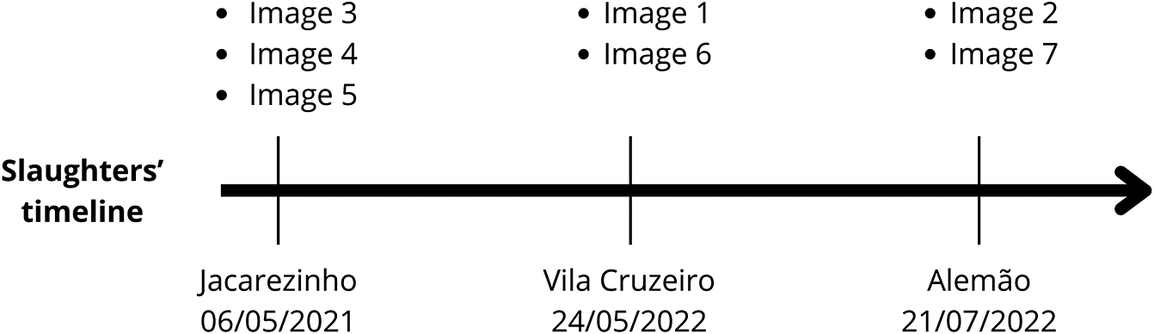
Our initial analysis of memes was conducted to determine the relevance and impact of defining the most representative sample. Of the 495 memes collected, we tried to select those that seemed the most impactful and relevant, which was revealed in terms of the intensity of interaction. Although numerous memes were shared by Instagram users, only a select few garnered significant engagement from a broader audience, depending on factors such as the sentiment invoked, the meme’s origin, and its recipient (Guadagno et al., Reference Guadagno, Rempala, Murphy and Okdie2013). Therefore, we chose seven memes based on the number of shares and comments posted during the seven days following the killings by the police. Of the seven memes, three were selected after the Jacarezinho event, two after the Vila Cruzeiro event, and two after the Alemão Complex event. Figure 1 depicts the images associated with each event and when they occurred.
Timeline with the Events and the Memes Related to Them

Following this selection, we analyzed the social media user groups that shared the memes and their connections. To analyze the social media user groups, we searched for users who shared the same memes and surveyed their characteristics. We examined how they defined themselves on social media, the number of their followers and comments, and the labels accompanying their posts. We also looked for instances of intertextuality, that is, how images/texts draw on other images/texts (Hardy, Reference Hardy2004), to understand the memetic trail.
Then, we observed that all the memes worked in response to traditional media news and notable individual’s posts (mainly traditional media journalists and representatives of human rights groups) about the events. We looked for news and posts related to the memes posted by the social media users that we analyzed. For example, when they were not explicitly mentioned or linked in the original post, we looked for traditional media news that mentioned the term “slaughter” to refer to the events.
We used the Google news search tool to search for the term “slaughter Jacarezinho.” The results included six news articles published during the week that mentioned the term. Moreover, three of these news articles mentioned the Rio de Janeiro governor’s statement immediately after the episode, in which he called the murdered people “bums.” We also observed that some meme references were not related to current media news about the episodes, but to old ones related to police violence, abuse, and mistakes.
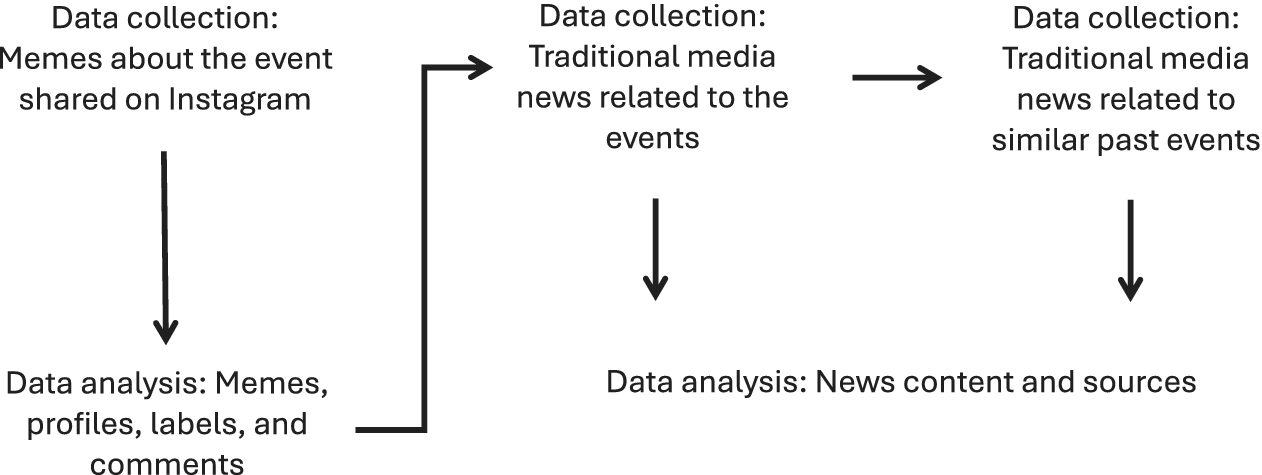
The path followed during data collection and analysis is shown in Figure 2. This path indicates that we collected the memes, then analyzed them in terms of profiles, labels, and comments. Next, we observed traditional media news to understand the focus of the memes and determine whether they were related to any specialist statements or traditional media channels. When we did not find a connection to any specialist statement or traditional media channel, we searched for past events reported by traditional media to understand the references in the memes. Finally, we analyzed the memes with the complete context in mind.
Data Collection and Data Analysis Path

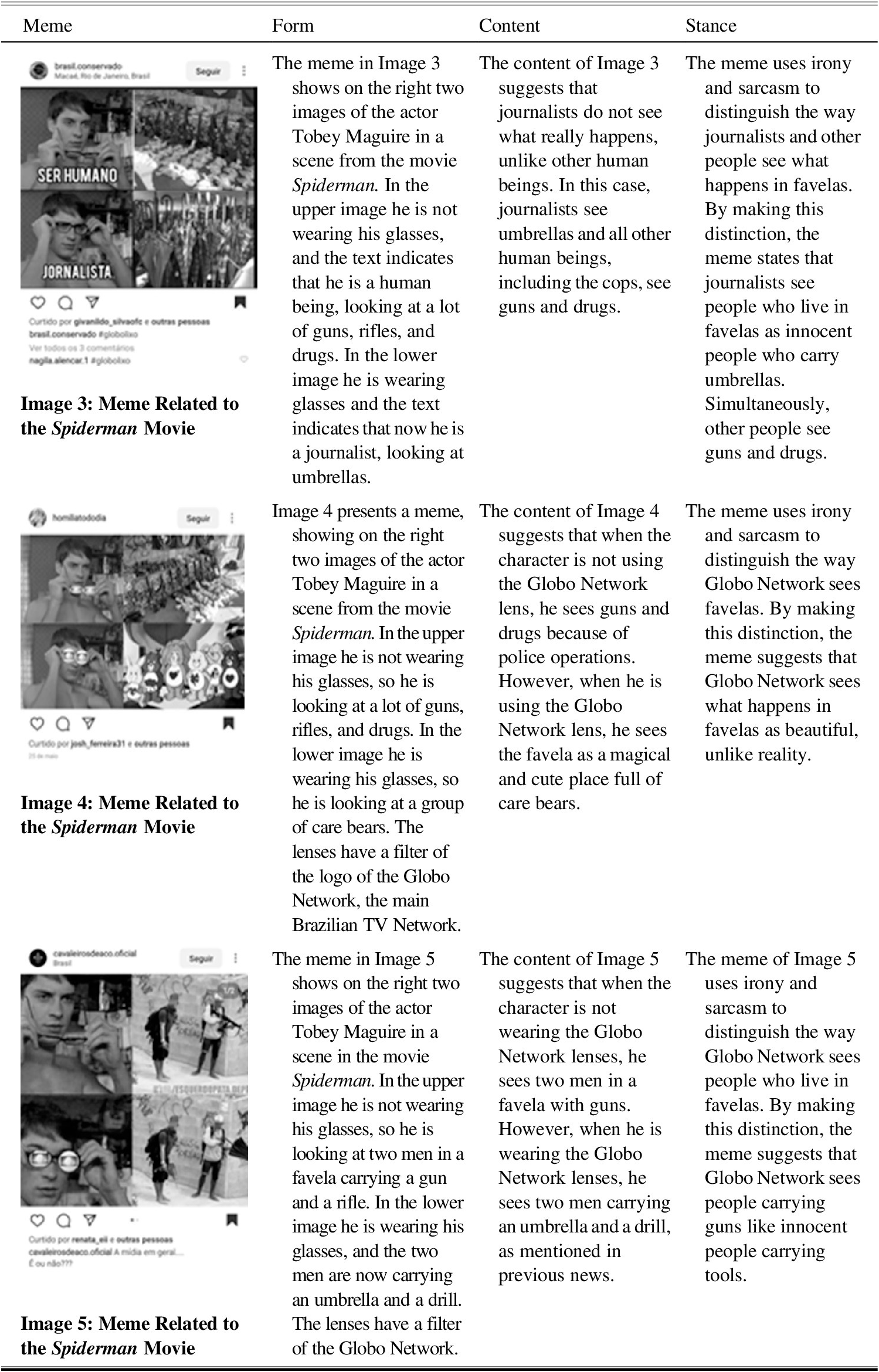
This approach was applied, for example, when we examined memes featuring the image of Peter Parker struggling to see without his glasses. In the meme, without his glasses, he saw the “reality” of the favela, where men were armed with guns. However, when he put on the Globo Network glasses, the guns turned into umbrellas. Initially, this transformation seemed nonsensical, but when we searched past news reports, we found a case where the police killed a man carrying an umbrella, mistaking it for a machine gun.
Data Analysis
After defining our sample and following the intertextual mimetic trail, we analyzed each meme as a form of action and discourse (Gal et al., Reference Gal, Shifman and Kampf2016; Shifman, Reference Shifman2013). The analysis of memes involved an investigation of memes’ discourse based on three dimensions: form, content, and stance (Gal et al., Reference Gal, Shifman and Kampf2016; Shifman, Reference Shifman2013). Form analysis is centered on the physical formulation of the meme “perceived through our senses,” mainly related to the composition of the message in its denotative elements. Content analysis refers to the meanings and beliefs incorporated into memes, particularly those related to themes and their frames. Finally, stance concerns the information that memes convey about the positionality of users, with the identities of the people that present or are presented in the meme being central (Gal et al., Reference Gal, Shifman and Kampf2016; Shifman, Reference Shifman2013, Reference Shifman2014).
This process, being an open-ended inductive approach (Charmaz, Reference Charmaz2006), required several cycles of memetic coding with constant interaction between the data and emerging theory. From the initial analysis of the memes, some initial elements surfaced, suggesting an ethical legitimation discourse following the ethics of life and death (Feldman, Reference Feldman1994; Kamm, Reference Kamm1993), particularly around the value of the lives of these three favelas, the conditions that made them deserving of being killed, and the role the police played in regulating them. As our theorization progressed, the concept of necropolitics (Mbembé, Reference Mbembé2019), its further development in necrocapitalism (Banerjee, Reference Banerjee2008) and necroptics (Varman & Srinivas, Reference Varman and Srinivas2025) exploring how death is organizationally legitimated, provided sensitizing concepts to refine our ideas.
At the end of the analytical process, we uncovered three legitimization discourses of different degrees for each chosen image. First, denying life worthiness disavowed opposing narratives of human rights regarding police action and questions their authority by discrediting and mocking them by suggesting their ignorance of the issue. Next, establishing actors deserving death portrayed and framed the action positively by ironically contrasting the “real” community warranting death with a supposed idealized representation of critics. Finally, upholding the police as executioners of death presented the public with a ready-made representation of the rightfulness of police actions supported by an absurd superposition of unrelated events. Our analysis suggested that these three discourses coalesced into a legitimation of the organization of life and death that makes visible and gloats over death by dehumanizing favela residents through “humorous” derision and abjection, and by deifying the police with a triumphant tone.
What particularly struck us through the analysis of each meme and the following cross-analysis was the use of “cultural” artefacts (Peter Parker, school massacre, fear imagery) and expressions to counterpose different traditional media standpoints (Laskin & Laskin, Reference Laskin, Laskin, Hanlon and Tuten2022). Moreover, social media users resorted to old news and unproven alternative narratives to legitimize their viewpoints and delegitimize critics and traditional media content (Knight & Tsoukas, Reference Knight and Tsoukas2019). These elements referred to known characters or situations in the Brazilian society that claim or deny a specific perspective on violence and racial relations represented in police acts (Alcadipani et al., Reference Alcadipani, Silva, Bueno and Lima2021; Costa, Reference Costa2011; Paes-Machado & Noronha, Reference Paes-Machado and Noronha2002).
FINDINGS
In the following sections, we explore online memes spread by individuals through social media after each police massacre in the three Brazilian favelas. We argue that the memetic trail suggests two interacting and overlapping moments in which traditional media news motivates meme creation and sharing. Each meme has a similar trail, each a pertinent illustration, allowing us to go deeper into its analysis of a particular legitimation discourse: denying life worthiness, establishing actors deserving death, and upholding the police as arbiters of life and death. Finally, we show that many elements are common to all three discourses.
Denying Life Worthiness
The first legitimation memetic discourse—denying life worthiness—was used to disavow the favela’s residents’ human rights. This discourse was performed mainly by challenging opposing narratives concerning police actions, and challenging the moral status of favela habitants’ lives. The main target was journalists, as the first example below illustrates.
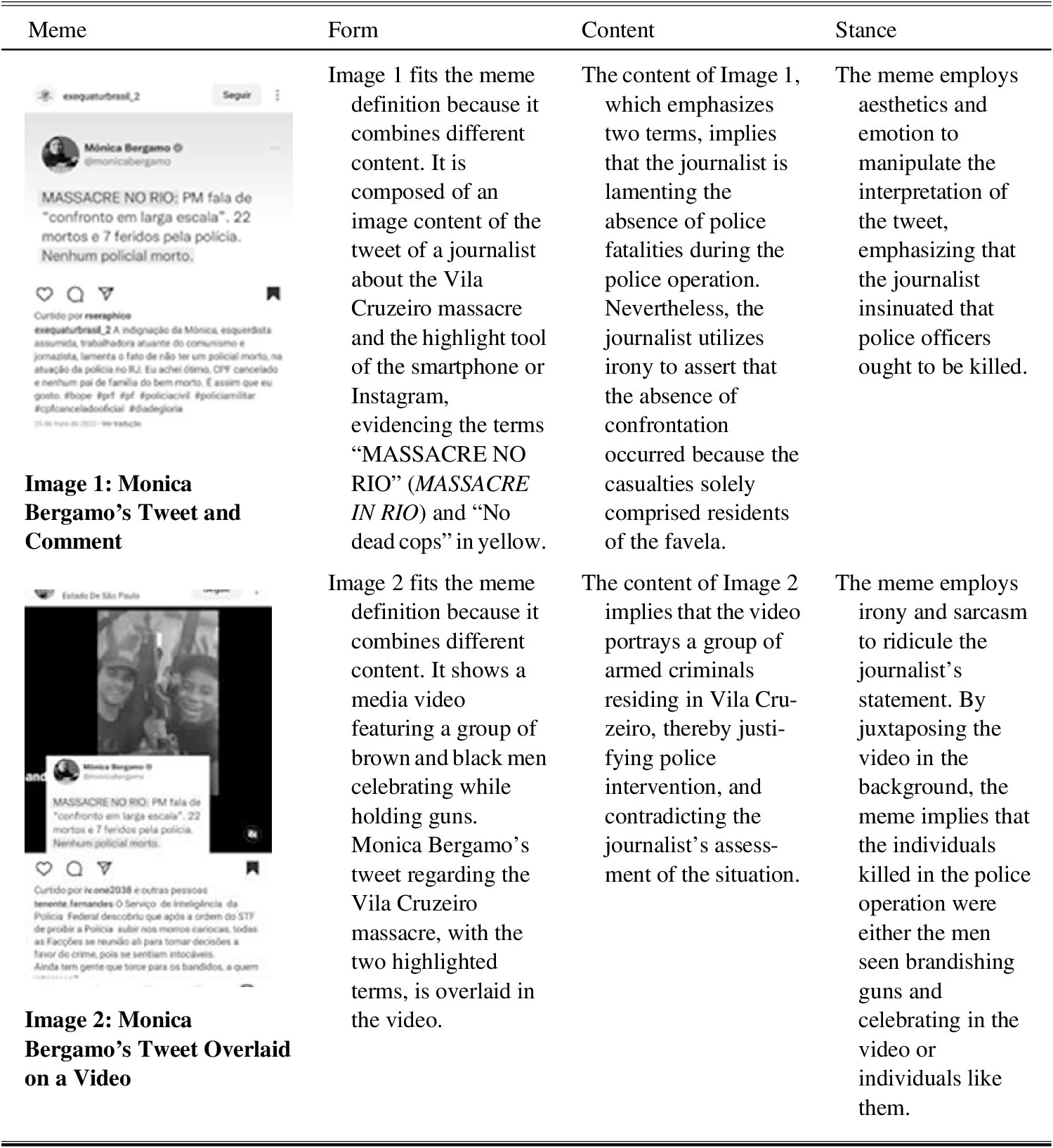
After the Vila Cruzeiro massacre on May 24, 2022, Monica Bergamo—an experienced and well-known Brazilian journalist—posted on Twitter, “Massacre in Rio: PM (Military police) talks about a ‘large-scale confrontation.’ Twenty-two dead and seven hurt by the police. No cops dead” (see Images 1 and 2 in Table 1). The journalist ironically used the term used by the police to refer to the event as a “large-scale confrontation,” given that no police officers were killed or even injured. Furthermore, Monica based her comment on the Military Police spokesperson’s statement, where he affirmed that the event was against a “gang of more than sixty men armed with rifles in a large-scale confrontation.” The police statement featured on Journal Nacional, Brazil’s premier evening news program, on May 24, 2022.
Meme Analysis

Almost instantaneously, social media users who were supportive of the police action answered using Monica Bergamo’s tweet to generate memes aimed at challenging and undermining statements that raised ethical human rights concerns regarding the incident. That is, how could a large confrontation occur if no police officers were killed? The journalist’s underlining message was that the police killed people without facing resistance. For instance, Image 1 was collected from an extreme right-wing Instagram profile called ‘exequaturbrasil_2,” who posted Monica Bergamo’s tweet highlighting the terms “Massacre in Rio” and “No dead cops.” In the comments on the post, the following was stated:
Monica Bergamo’s indignation, openly left-wing, pro-communist worker and Nazi journalist, she is sorry because no cops were killed. I thought it was great, ID cancelled, and no family man was killed. That is the way I like it.
The journalist is not recognized in Brazil as being left-wing at all. The poster flipped the journalist’s concerns about the deaths, as if she were advocating for the killing of police officers. The comment was complemented by the hashtags #bope, #pf, #policiacivil, #policiamilitar (four Brazilian police forces), #cpfcancelado (translation: #IDcancelled referring to the fact that when someone dies their ID is cancelled), and #diadealegria (translation #happyday). The last one suggests the tone of boastfulness used throughout the memes supporting police action and the deaths of the favela’s residents.
Image 2, a similar reaction to the original journalist tweet, was collected from a retired military police officer’s Instagram profile called “tenente_fernandes.” A video was posted featuring a group of armed black and brown men, which was not from that incident or even the same location, with Monica Bergamo’s tweet overlaid on the video. The followers’ comments on the profile aligned with the position of the military police officer, with many using the expression “a good criminal is a dead criminal,” clearly denying to supposed criminals any human rights. In the comments on the post, the following was stated:
The Federal Police Intelligence Service found out, after the Supreme Court’s order to prohibit the police from entering the favelas, that all factions gather there to make decisions in favour of crime, as they believe they are untouchable there. There are still people who root for the criminals, who benefits from this?
In addition to these two examples, after Monica Bergamo’s post, we found eighteen posts on Instagram from seventeen different profiles that used similar messages, ironically challenging journalists’ tweets and gloating over police actions. They all conveyed support for the police and criticized the journalist with messages such as: “Inversion of values! The journalist is a spokesperson of the left, always defending the wrong people.” The meme in Image 1 is one of the most common comments on Instagram. We can see here how this meme has a police-killing boastfulness tone that denies the human rights of the deceased by questioning the journalist’s challenge of the police version of the event.
Other examples of text accompanying the post also show support for the original profile sharing the meme with support for the police killings, while dismissing or deforming the ethical concerns about the lives lost raised by the media as a dismissal of the value of police lives (in a related rhetoric to the “all lives matter” response during the Black Lives Matter campaign). For example, the well-known far-right blogger @devidsonsantosmg suggested that when Monica Bergamo questioned the existence of a confrontation, as just one side having victims, she wanted police officers to be killed. Similarly, the same narrative was done by @flaviobolsonaro, son of the-then Brazilian president and one of the most-voted senators in Brazil, when he mentioned that the journalist “almost said ‘Oh crap’” because no cops were murdered in the police action.
Our analysis of the above example indicated the discredit of positions of those who defended human rights as “defenders of criminals” and against the police. Therefore, the person who posted the meme attached a series of characteristics to the journalist as an extreme left-wing person whose statements ignored the ethical dimensions of police killings. The underlying idea spread among the people who were reposting and agreeing with the meme was that a confrontation resulting in dead favela residents was a positive scenario over which to gloat since these favelas’ inhabitants deserved their fate. By defending the killings, specific ethics of life and death, denying the moral worth of their lives, were imposed onto the victims.
Establishing Actors Deserving to Die
Here, we discuss memes representing discourses that legitimize the denial of life, establishing the conditions to justify killing. These memes go hand-in-hand with those justifying favelas as places where the worth of life is denied. The underlying idea in the memes here was that the “dignified life,” suggested by the human rights proponents within the favela, was a fake perception of the real favela, which the police were confronting and deciding on regarding who got to live and who deserved to die.
Two groups of memes that represented the legitimation discourse of “establishing actors deserving death” were analyzed. The first group of memes was shared after the events in the three favelas and was created as an answer to news questions regarding lethal police actions. To produce and organize memes that legitimized the deaths as warranted by these individuals, social media users brought up images of police action alongside cultural artifacts, making the deaths subjects of derision.
In Table 2, we present three memes that were used by far-right social media profiles. Images 3, 4, and 5 emerged after the Jacarezinho, Vila Cruzeiro, and Alemão complex events, respectively. To establish that those who live in the favelas can always be inclined to criminality and deserve to die in police killings, social media users contrasted the “fake,” “dignified lives” attributed to the communities by the media and human rights activists with the police’s “real” portrait of the people deserving to be killed. More specifically, they purportedly “exposed” the traditional media bias by using irony and sarcasm over the “rosy” perspective of these favelas.
Meme Analysis

The first and last memes (Images 3 and 5) refer to a report of mainstream Brazilian communication vehicles in September 2018 regarding the case of a man killed by the military police in a Rio de Janeiro favela after his umbrella was mistaken for a rifle (Moura, Reference Moura2018). The incident was not isolated, as similar occurrences have tragically resulted in the deaths of individuals in Brazilian favelas over the years. In two separate incidents, three men were fatally shot by police who mistook a work tool or drill for a gun (Teles, Reference Teles2023). Traditional media widely reported these three cases, and journalists and human rights specialists analyzed the news and publicly condemned them. Supporters of police action in the three favelas later appropriated these past events to create a discourse legitimizing the deaths of their residents as warranted.
The memes presented in Images 3 and 4 utilize photos of guns and drugs presented by the police as items seized in operations, whereas Image 5 depicts individuals carrying weapons to legitimize the discourse that favors residents, portrayed in the meme as apparently possessing these weapons and illegal materials, as killable individuals. Furthermore, the memes suggest that when journalists and traditional media do not legitimize the killings, they look at favelas through fantasy filters, seeing only umbrellas or “care bears” instead of the dangerous materials taken from or carried by “ungrievable people” who “should be exterminated.” Here, extreme right-wing social media users considered operations and the items seized as sufficient to justify police killings, while also legitimizing previous and current events when innocent people were mistakenly killed in favelas.
Three profiles were dedicated to producing content related to shared memes of the extreme right-wing and police operations. In addition, the profile with the highest number of followers (62,000) pointed out that “media, in general, is a shame,” suggesting that they do not understand the danger these communities’ police face in these locations. The comments on this post showed a great number of followers agreeing and reproducing the derision with which they made fun of and gloated over the deaths. The focus of their rhetoric is the Globo Network (with its symbol portrayed in the glasses); however, other traditional media outlets have been targeted by similar memes and posts.
The second group of memes that supported the police killing, legitimating the discourse “establishing actors deserving death,” is related to the Jacarezinho favela massacre. On May 6, 2021, after the episode, the Spanish journal El Pais, in its Brazilian edition, published a full report about the incident with the title “Deaths in the Jacarezinho slaughter rise to 28. At least 13 were not investigated by the police.” On the same day, the Globo Network published a report on its website, G1, with the statement of a sociologist affirming that what happened in Jacarezinho was the most lethal operation in Rio de Janeiro’s history.
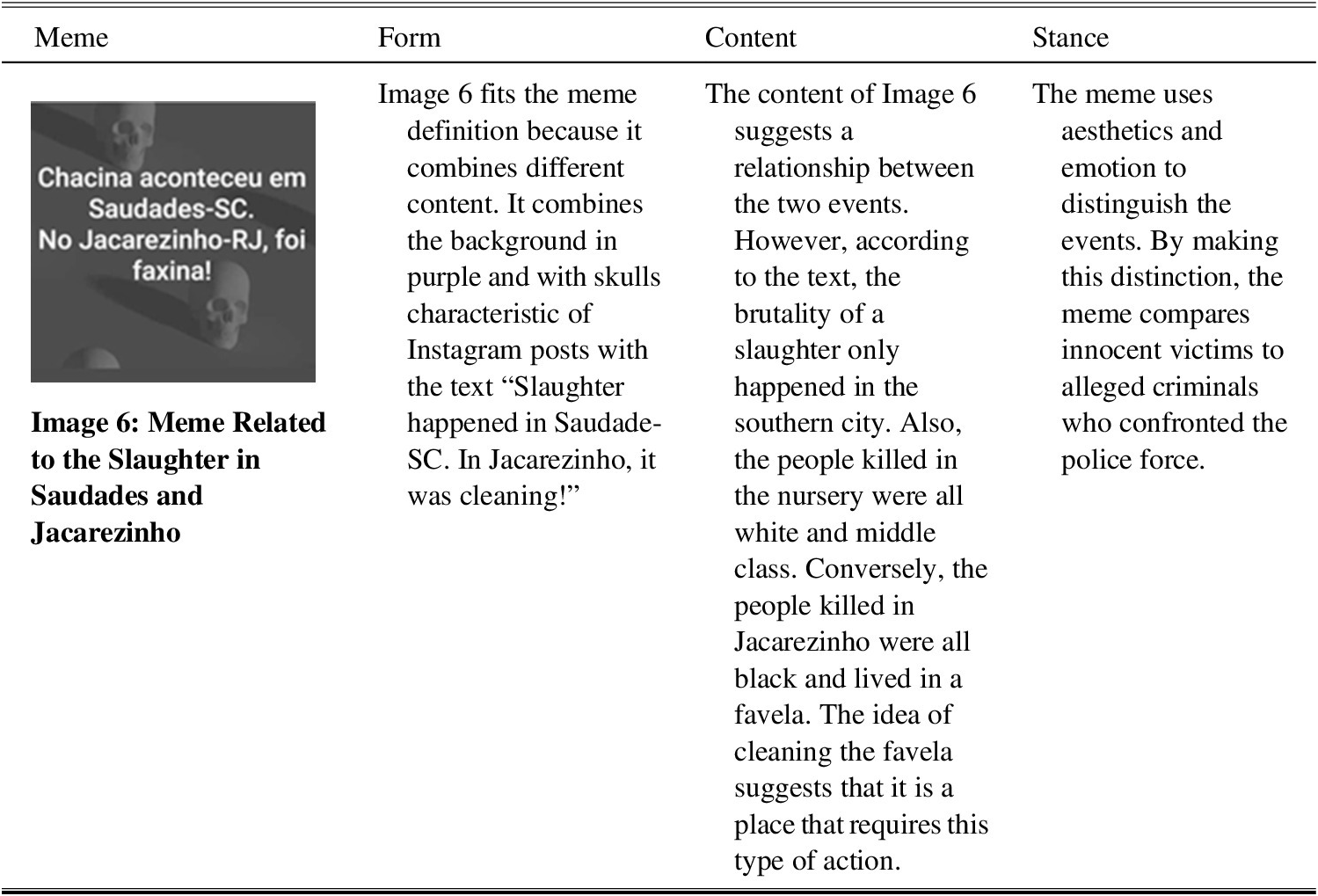
Therefore, to legitimize a new discourse on what happened, just after the use of the term slaughter by traditional media, social media users aligned with the far right started to share media content on Instagram comparing the Jacarezinho episode with a violent event that occurred in a city in southern Brazil, called Saudade, two days before the Jacarezinho slaughter. During this event, a young man entered the nursery with a knife and killed three children and two women. The users compared the two events, suggesting that what occurred in the nursery was “slaughter,” but what happened in the favela was “cleaning,” as shown in the meme (Image 6) in Table 3. The expression used similar Portuguese phonetics for two terms: chacina and faxina (slaughter and cleaning).
Meme Analysis

The same message was shared by five well-known far-right Instagram profiles. Social media profiles belong to politicians and other content producers, with varying numbers of followers, reaching hundreds of thousands. One of the profiles sharing this content was @capitaoderrite, a former military police officer in São Paulo who was then a congressman on leave, currently occupying the São Paulo State Secretary of Public Security and in charge of the largest military police agency in Brazil. According to him, “Attention hypocrites: SLAUGHTER occurred in Saudade-SC; what happened in Rio de Janeiro was CLEANING!”
Furthermore, the five posts received 2,405 comments from followers of Instagram profiles that shared similar messages, with nearly all engaging with the far right and agreeing with the argument presented. Many comments gloated over this police action. stating that this “type of cleaning should happen more often” or “every week.” Others also rejoiced in these favela killings by suggesting other communities where this kind of “cleaning” should happen, like other favelas in the city of Rio de Janeiro.
Although the racial undertones of these legitimation discourses were present in previous examples, this meme is particularly discernible in terms of the racial characteristics of the victims and the place in which the events occurred. In the favelas, the people who “warranted killing” were black and poor, while, in the nursery in the southern part of Brazil, the victims were white and middle class. Therefore, establishing actors deserving death in a murder event involves comparing the killers, the murdered, and the location, justifying and fostering this type of racialized action.
Analyzing the above memes, we observed that some influential social media users posted memes to transform the news about the residents murdered in the favelas into acceptable phenomena warranted by the favelas’ conditions. The meme legitimated as a discourse that established actors deserving death by suggesting that anyone living in these places were a danger to society and warranted being killed by the police, in contrast to the white kids in nurseries whose lives should be protected. The narrative was extremely different from the scenarios presented by traditional media and their journalists, which social media users continuously challenge, making fun of their “fake” view of reality. The underlying idea behind these memes was to establish who should live and die.
The Police as Executioners of Death
In tandem with the reactions against journalists and human rights experts who raised ethical concerns about the police action, influential social media users developed memes, creating a legitimation discourse on the role of the police in the execution of death. With a boastfulness undertone, these memes suggested that the police were the sole knowledgeable authority of the “reality” of their actions and their effects. This legitimation discourse, related to the ethical question of who should have responsibility over life-and-death decisions, suggested that the police should be the executioners of death.
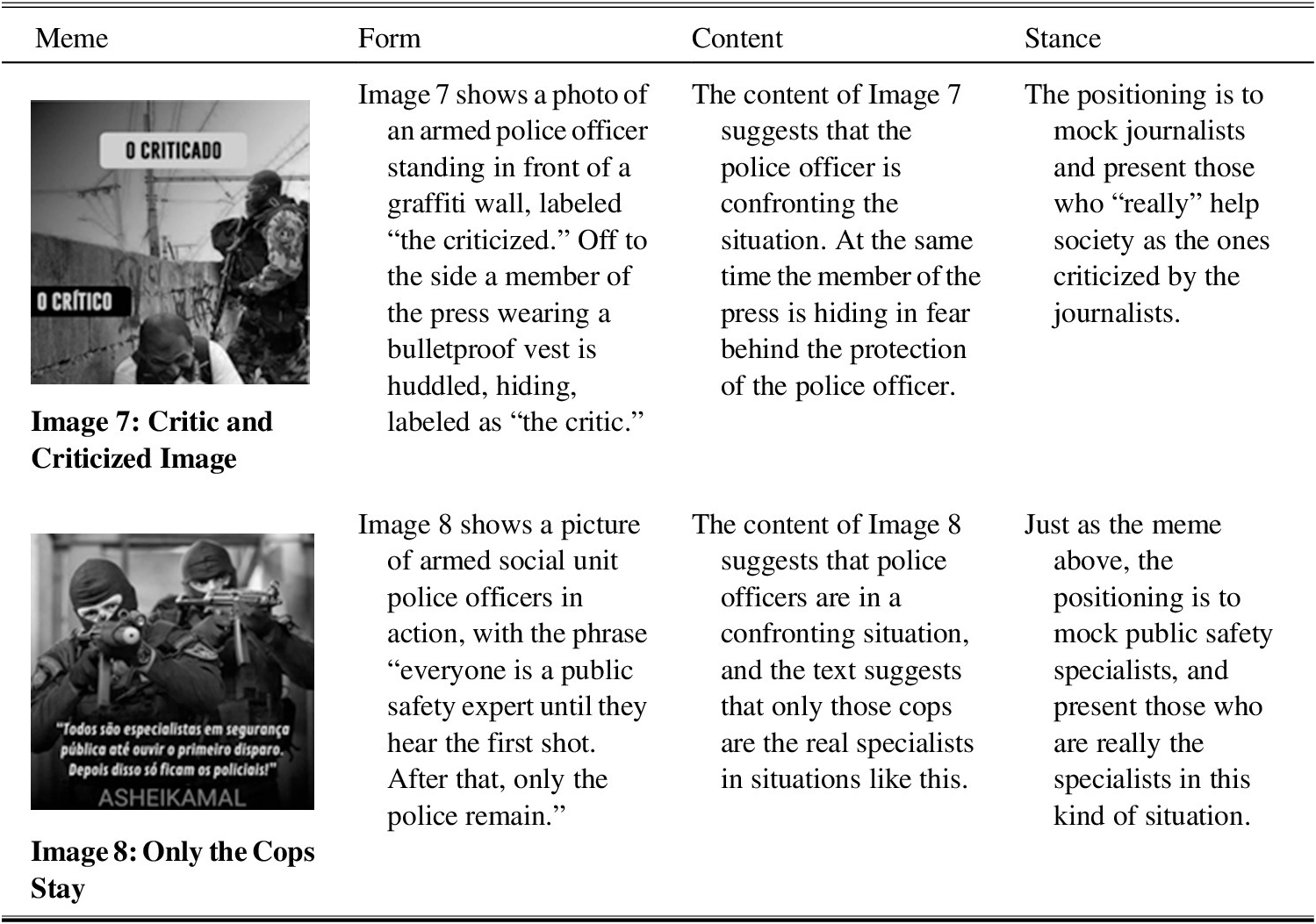
These elements can be seen in the two most visible memes shared by different Instagram profiles during these police killings: Image 7 was collected in the week after the Alemão complex event and Image 8 was collected in the week after the Jacarezinho event (Table 4). The profiles who shared the memes belonged to a military police officer, a blogger among other content producers, and politicians, including the former Brazilian president Jair Bolsonaro and his son Flavio Bolsonaro. Their visibility varies, but most have thousands of followers.
Meme Analysis

Therefore, Images 7 and 8 depict memes that gloat over the police killings while employing mockery to discredit journalists and public security specialists, usually academics who criticize these controversial actions. The memes portray police officers as individuals capable of accurately assessing and responding to situations, thus portraying them as heroes, willingly risking their lives in violent and perilous environments to safeguard society, even in the face of criticism. Critics are depicted as individuals who cannot handle a confrontation, cowardly conceal themselves, and lack an understanding of such situations. In essence, the memes employed a boastfulness tone to legitimize and uphold the cops as the only specialists in public security who have the right to execute death.
Similar to previous examples, related memes were widely shared, underscoring the significance of this mode of communication among police supporters. Furthermore, we noted the involvement of diverse social media profiles, with both substantial and limited follower counts, in this meme sharing activity. Moreover, when followers comment, their responses predominantly echo the memes’ main messages, highlighting the importance of this form of communication.
For example, the meme represented in Image 7 was shared by three Instagram profiles, and Image 8 was shared by five Instagram profiles, both of which were extreme right-wing and supported police action. The two profiles that shared Image 8 were digital content producers (@plataformagravatai and @policiadopovo) with more than 12,000 followers and 180,000 followers, respectively. Both profiles complemented the post with different #, but both with #bope (i.e., Special Operations battalion) and #forcanacional (i.e., National Force), indicating support for police organizations involved in the police actions.
One of the profiles that shared Image 7 was @coronel.diegomelo, a military police officer with more than 35,000 followers who presided over a military officer association in Brazil. Moreover, in his post, the military police officer shared the meme, which was complemented with a caption saying that “In the fight against crime, there are two sides,” indicating that one side represents the state and the rule of law represented by the police, while the other side represents “criminals, barbarism, and violence.” The post had more than sixty comments, with almost all applauding it with emojis and supporting it through phrases like “these critics are part of the leftist media that idolize criminality” (@anderson. ambiente).
In summary, we observed that the construction of the legitimation discourse of the police as the actors with the responsibility to be executioners of death built on the memes analyzed above. Initially, social media users presented a humorous challenge towards positions that affirmed the human rights of favelas’ residents and reinforcing a derisive perspective of these communities as states of exception with “ungrievable individuals” that deserved to be killed. This discourse was followed by a boastfulness, ready-made representation of the rightfulness of police action, exalting the government apparatus as the sole knowledgeable and apt actor to execute deaths.
The meme language was simplistic and direct and was presented as if it established what is real and what is fake. There was no debate as to which contradictory arguments emerged. As such, the use of decontextualized images and questionable comparisons were hidden behind the boastfulness and humorous tones of the memes, which forego any deeper discussion of the ethical dilemmas of life and death around the value of life, who gets to be killed, and who gets to pull the trigger.
DISCUSSION: ONLINE MEMES IN THE “ETHICAL” LEGITIMATION OF DEATH
We began our article by asking: in the context of rising authoritarianism, how do social media memes legitimize organizational actions related to the ethics of life and death? The ethics of life and death involve determining the moral status of life, the conditions under which it should be protected or ended, and the responsibilities of the groups in charge of these decisions (Feldman, Reference Feldman1994; Kamm, Reference Kamm1993). By exploring the use of Internet memes to justify police massacres in three Brazilian favelas, we found three primary legitimation discourses linked to the ethics of life and death: denying life worthiness, establishing actors deserving death, and upholding the police as executioners of death. Through their use of a humorous and boastfulness tone, these memes dehumanized the favelas’ residents and deified the state apparatus.
This study makes three major contributions to the literature on organizational ethics of life and death.
First, we contribute to the ethics of the organization of death debate by showing how social media fundamentally alters legitimation discourse and dynamics. Previous studies have shown the state’s role, with the complicity of corporations (Banerjee, Reference Banerjee2008), in justifying who lives and dies within and at the borders of its territory (Estévez, Reference Estévez and Estévez2021; Pérezts, Reference Pérezts and Estévez2021). Traditionally, these efforts were enabled by government channels and (friendly) mainstream media (Jagannathan & Rai Reference Jagannathan and Rai2022; Rose, Reference Rose2009), which diffused and supported official discourse, as in the case of the Gulf War (Taylor, Reference Taylor1992).
Our case explores a recent discursive dynamic created by the synergy between new forms of authoritarianism and their reliance on (and recent enthusiastic support by) social media (Gustafsson & Weinryb, Reference Gustafsson and Weinryb2020; Jones et al., Reference Jones, Witze, Tollefson and Kozlov2025; Robinson & Bristow, Reference Robinson and Bristow2020). Therefore, while previous studies would show two different legitimation discourses that rely either on the normalization or invisibilization of death (Bloomfield et al., Reference Bloomfield, Burrell and Vurdubakis2017; Courpasson, Reference Courpasson2016; Giroux, Reference Giroux2011; Pérezts, Reference Pérezts and Estévez2021; Smith, Reference Smith2016; Valencia, Reference Valencia2018; Varman & Al-Amoudi, Reference Varman and Al-Amoudi2016; Varman & Srinivas, Reference Varman and Srinivas2025; Willmott, Reference Willmott2000), our study suggests a different discourse that seems to make death visible and gloats over it as an outstanding righteous event.
In the cases discussed here, memes were not only used to impose a continuous discourse of ethnic superiority (Hakoköngäs et al., Reference Hakoköngäs, Halmesvaara and Sakki2020), but also to delegitimize a particular discourse or political candidate (e.g., Ross & Rivers, Reference Ross and Rivers2017). Our analysis showed how social media users, employing the visibility aspect of social media (Barros, Reference Barros2018), collectively and publicly supported police actions leading to the death of favela residents, gloating over the “cleaning” of these communities, and the fatal consequences of the governmental organization. Online interactions can not only instigate political violence (Wahlström et al., Reference Wahlström, Törnberg and Ekbrand2021), via memes, they can work to kill vulnerable people as a cause for gloating.
Second, we suggest that this gloating discourse legitimizing the police’s killing of specific groups of people, while immersed in a long history of extreme right-wing ideology renewed within the context of rising authoritarianism, is particularly enabled by social media memes’ emotional and humorous nature (Guadagno et al., Reference Guadagno, Rempala, Murphy and Okdie2013). Previous studies have suggested that these visual forms of social communication are linked to the creation of stereotypes and divisive positions on social issues (DeCook, Reference DeCook2018; Goriunova, Reference Goriunova2013; Highfield & Leaver, Reference Highfield and Leaver2016; Ross & Rivers, Reference Ross and Rivers2017) through their ability to thrill and motivate (Hadley, Reference Hadley2016; Shifman, Reference Shifman2013). Although connected to right-wing movements (Barros et al., Reference Barros, Alcadipani, Coupland and Brown2023), the impact of social media memes on the “organization of life and death” has received little attention, particularly its appealing capacity to emotion and derision. Because of its inherent multimodal possibilities, we show here that memes can be part of this colorful and impactful discourse that is deployed to legitimize the killing of people of color in deprived “state of exception” areas (Agamben, Reference Agamben1998).
In our study, we saw how the editing and juxtaposing of images of police actions and cultural media artifacts, based on arguably questionable information and decontextualized facts, have been hidden behind humorous tones that serve as ways to discredit opposing human rights perspectives and deride the death of individuals that “deserved to be killed.” Furthermore, images using similar “stock photos,” also created for quick circulation and apprehension, were employed to gloat over a heroic image of the police force and imbued them with the right to decide and execute who lives or dies. The implication of these memetic legitimation discourses is to potentially void the debate on the ethics of life and death (Agamben, Reference Agamben2008; Luper, Reference Luper2014), based on a deep appreciation of individuals’ basic right to live with dignity towards vacuous and ephemeral (Dean, Reference Dean2005), humoristic and boastfulness engagement with the contemptuous dehumanization of the other. In our research, we found that the use of memes is a means of enabling a specific audience of extreme right-wing social media users to delegitimize and legitimize discourses, showing how these new forms of social media expression severely limit rational ethical debates.
Third, in the discussion of how life and death are governmentally organized (Bhan and Duschinski, Reference Bhan and Duschinski2020; Bourgeron, Reference Bourgeron2022; Murdza & Ewing, Reference Murdza and Ewing2021), we highlight how memes can reinforce the role of the state police enforcement apparatus as an expression of racialized inequalities. Previous discussions on necropolitics (Mbembé, Reference Mbembé2019), necrocapitalism (Banerjee, Reference Banerjee2008) and necroptics (Varman & Srinivas, Reference Varman and Srinivas2025) have focused mostly on the role of government in subjugating populations by exploiting their physical spaces and minds (Quijano, Reference Quijano2000; Mignolo, Reference Mignolo, Isasi-Díaz and Mendieta2012). Our analysis suggests that organizations, such as the police, whose legitimacy is supported by the memetic discourse we analyzed, has a central function in exercising a deeply racialized organization of life and death within a society with a heritage of slavery (Souza, Reference Souza2017).
As an example of this connection between meme sharing and police killing in practice, Capitão Derrite, whose profile is one of the most prolific sharing memes supporting police killings, was recently named Secretary of Public Safety in São Paulo, Brazil. During the first year of his term in office (2023), police kills increased by 34 percent in São Paulo. Additionally, he commanded a police operation in the State’s coastal area that killed forty-seven people in a little more than one month (Acayaba, Reference Acayaba2024).
Our case shows how, for many extreme right-wing social media users who widely use memes, the police incorporated the role of legitimate executioners of life and death. Moreover, these police actions were particularly justified within “states of exception” (Agamben, Reference Agamben1998), that is, favela communities that included racialized individuals deemed “ungrievable subjects” (Butler, Reference Butler2016; Fotaki, Reference Fotaki2022). The dehumanization of the favelas’ residents, filled with derision, was in tandem with the deification of these governmental apparatus as intensively living and thus deeply knowing the “reality” of these communities and individuals, therefore legitimating their position in deciding the “organisation of life and death.”
With the current incorporation of authoritarian tendencies within corporations (Robinson & Bristow, Reference Robinson and Bristow2020) and the historical and ever-stronger promiscuous relation with extreme-right politicians and ideologies (Barros et al., Reference Barros, Rosenthal, Coelho and Leandro2025), we suggest that our analysis of the ethics of life and death decisions and their legitimation are generalizable to “traditional” corporations. The decision of the worth of the life workers and communities, in what conditions their lives are expendable, and their belief in their fundamental right to make these decisions are part of “business-as-usual.”
CONCLUSION
Brazilian police already have a historical record of illegality and brutality (Huggins, Reference Huggins2000), especially against poor and black populations (Alcadipani et al., Reference Alcadipani, Silva, Bueno and Lima2021). In our case, extreme right-wing politicians, public figures, and content producers used social media memes to support and reinforce these actions by manipulating images, texts, and videos with partial, artificial, and out-of-context data and information, privileging quickly shareable humor and intensity instead of meaning (Dean, Reference Dean2005; Shifman, Reference Shifman2013). By using cultural artifacts as shortcuts to a political position, they bypass any meaningful debate on the ethical “life and death” aspects of the police action (Luper, Reference Luper2014) and can counter the rational arguments used by the defenders of human rights.
Our study on the effects of online memes on the legitimation discourses of the ethics of life and death touches on a greater debate on the still current “post-truth” era (Knight & Tsoukas, Reference Knight and Tsoukas2019; Meyer & Quattrone, Reference Meyer and Quattrone2021). Thus, our case is especially related to the realm of organizations and states in the post-truth era, and how social media bubbles employ social media memes to construct irrational binary narratives (Meyer & Quattrone, Reference Meyer and Quattrone2021) around such distinct cases such as the slaughter and cleaning (faxina and chacina) memes. Memes have the power to produce a language using false facts that can legitimize (make visible and celebrate) actions that dehumanize and bring death to racialized marginal populations (Estévez, Reference Estévez and Estévez2021; Pérezts, Reference Pérezts and Estévez2021).
However, our study also suggests that, in contrast to the perspective of a problematic tool to legitimize deaths by the police, social media could play a role in combating these inequalities in the organization of life and death, as seen in the George Floyd case. It is important to debate future research on the organizational ethics of life and death and the role of social media platforms in allowing the legitimacy of killings to occur within their realms. Ethical corporations must account for the messages they allow; however, the recent complicity between Tech giants and the Trump administration (Jones et al., Reference Jones, Witze, Tollefson and Kozlov2025) seem to suggest that they will favor “business-as-usual.”
Fernando Vianna (fernandovianna@utfpr.edu.br, corresponding author) is a professor of organization studies at Universidade Tecnológica Federal do Paraná (UTFPR), Brazil. His research focuses on digital platforms, technology, and qualitative studies of social evaluation, legitimacy, and reputation. His work has been published in journals such as the International Journal of Computer Integrated Manufacturing, and he has an article forthcoming in the Academy of Management Learning & Education.
Rafael Alcadipani is a professor of organization studies at the São Paulo School of Business Administration, Fundação Getulio Vargas (FGV EAESP), Brazil. His research adopts an inductive and process-oriented approach, addressing themes such as power, resistance, violence, identity, and the politics of knowledge production within the field of management and organization studies. He serves as associate editor for both Human Relations and Organization, and has published in leading journals in the field.
Marcos Barros is a professor of organization studies at Grenoble École de Management, France. His research focuses on alternative forms of organization, technology, and critical perspectives on identity and resistance. His work has been published in leading journals, including Organization, Organization Studies, Organization Science, Journal of Business Ethics, Business Ethics Quarterly, M@n@gement, Organizational Research Methods, and Journal of Management Inquiry.
Gustavo Matarazzo Rezende is a professor of management at the Federal Institute of Education, Science and Technology of São Paulo (IFSP). His research focuses on organizational studies, public administration, and ethics, with an emphasis on discourse, institutions, and critical approaches to organizational life. He has collaborated on interdisciplinary projects that explore how ethical and institutional dynamics shape organizations and management practices. His work has been published in academic journals and edited volumes in Brazil and abroad.