


INTRODUCTION
Of all plant–herbivore interactions, probably the most complex and poorly understood is that of gall-inducing insect species and their host plants (Cuevas-Reyes et al. Reference CUEVAS-REYES, QUESADA and OYAMA2006, Fernandes & Carneiro Reference FERNANDES, CARNEIRO, Panizzi and Parra2009). Both biotic (e.g. natural enemies, host-plant composition, plant structural complexity, host density and host resistance) and abiotic factors (e.g. hygrothermal stress, scleromorphic environments and soil fertility) can influence both richness and the abundance of gall-inducing insect species over both temporal and spatial scales (Cuevas-Reyes et al. Reference CUEVAS-REYES, QUESADA, HANSON, DIRZO and OYAMA2004a, Reference CUEVAS-REYES, QUESADA, SIEBE and OYAMA2004b; Fernandes & Price Reference FERNANDES and PRICE1988, Reference FERNANDES, PRICE, Price, Lewinsohn, Fernandes and Benson1991, Reference FERNANDES and PRICE1992; Oyama et al. Reference OYAMA, PÉREZ-PÉREZ, CUEVAS-REYES and LUNA2003). These factors are not mutually exclusive and can be formalized at least into three hypotheses.
The plant species richness hypothesis proposes that more plant species represent more potential sites to colonize by insect herbivores (Fernandes & Price Reference FERNANDES and PRICE1988). In some cases the abundance of gall-inducing insect species at the level of the plant community is positively (Cuevas-Reyes et al. Reference CUEVAS-REYES, QUESADA, HANSON, DIRZO and OYAMA2004a, Fernandes & Price Reference FERNANDES and PRICE1988) while in others abundance is negatively associated with plant species richness (Oyama et al. Reference OYAMA, PÉREZ-PÉREZ, CUEVAS-REYES and LUNA2003). Floristic diversity of habitats may be responsible for differences in local and regional patterns of richness and abundance of gall-inducing insects (Cuevas-Reyes et al. Reference CUEVAS-REYES, QUESADA, HANSON, DIRZO and OYAMA2004a, Stone & Schönrogge Reference STONE and SCHÖNROGGE2003).
The hygrothermal stress hypothesis states that abundance of gall-inducing insects increases with the environment hygrothermal stress (Fernandes & Price Reference FERNANDES and PRICE1988, Reference FERNANDES, PRICE, Price, Lewinsohn, Fernandes and Benson1991). Some studies show that gall-inducing insects are more common in scleromorphic than mesophytic vegetation, because sclerophyllous leaves are generally long-lived and hence present lower rates of abscission, while under ambient hygrothermal stress the probability of attack by natural enemies such as parasitoids and pathogens is diminished. The combination of plant traits and habitat stress provide favourable sites for colonization by gall-inducing insect species even under low resource availability (i.e. water, soil fertility) (Blanche & Westoby Reference BLANCHE and WESTOBY1995). Finally, Fernandes & Price (Reference FERNANDES, PRICE, Price, Lewinsohn, Fernandes and Benson1991) argued that soil fertility is an important factor that affects the abundance and species richness of gall-inducing insects in relation to latitudinal gradients. This hypothesis states that lower abundance of gall-inducing insect species should occur in fertile soils (Cuevas-Reyes et al. Reference CUEVAS-REYES, QUESADA, SIEBE and OYAMA2004b, Fernandes & Price Reference FERNANDES, PRICE, Price, Lewinsohn, Fernandes and Benson1991). Soil stress may induce nutrient deficiencies and favour the presence of toxic elements in the soil (Cuevas-Reyes et al. Reference CUEVAS-REYES, QUESADA, SIEBE and OYAMA2004b, Price et al. Reference PRICE, FERNANDES, LARA, BRAWN, BARRIOS, WRIGHT, RIBEIRO and ROTHCLIFF1998). Plant species that grow under conditions of dystrophic soils tend to have lower rates of growth and accumulate higher concentrations of secondary metabolites such as phenols, alkaloids and terpenoids (Fernandes et al. Reference FERNANDES, LARA, PRICE, Price, Mattson and Barranchikov1994). Gall-inducing insects may incorporate or sequester the biologically active chemicals of their host plants during the formation of gall tissues, and thereby gain protection from their predators and parasites (Hartley & Lawton Reference HARTLEY and LAWTON1992, Pascual-Alvarado et al. Reference PASCUAL-ALVARADO, CUEVAS-REYES, QUESADA and OYAMA2008).
The effect of soil properties on the abundance, survivorship and species richness of gall-inducing insects at local or regional scales has been evaluated in some studies (Blanche & Ludwig Reference BLANCHE and LUDWIG2001, Blanche & Westoby Reference BLANCHE and WESTOBY1995, Cuevas-Reyes et al. Reference CUEVAS-REYES, SIEBE, MARTÍNEZ-RAMOS and OYAMA2003, Reference CUEVAS-REYES, QUESADA, SIEBE and OYAMA2004b). Less understood are the effects of soil fertility via sclerophyllous hosts on gall-inducing insects. In this study, we evaluated the effects of soil fertilization in Brazilian savanna on gall-inducing insects’ attack on Eremanthus glomerulatus (Asteraceae) under experimental field conditions. This is the first experimental study in fertilized fields of savanna that attempts to document the interaction between gall-inducing insects and soil fertility. In particular, our hypotheses were: (1) soil fertility positively affects the nutritional quality of tissues in E. glomerulatus, (2) soil fertility reduces the gall-inducing insect species richness in E. glomerulatus, (3) the abundance of galls by different gall-inducing insect species is negatively affected by soil fertility.
METHODS
Study area
The experiment was carried out at the Ecological Reserve of the Instituto Brasileiro de Geografia e Estatística covering 1300 ha, near Brasília (15°56ʹS, 47°53ʹW) in central Brazil. Soil is characterized as acidic oxisols, with high Al levels and low cation exchange capacity. The study site elevation ranges between 900–1100 m with an average annual precipitation of 1453 mm (Pereira et al. Reference PEREIRA, SILVA and MENDONÇA1993). The vegetation is characterized as savanna with trees and shrubs varying in cover from 10% to 60%. Eremanthus glomerulatus Less is a dominant native species with a density of 176 individuals ha−1 (Andrade et al. Reference ANDRADE, FELFILI and VIOLATTI2002, Pereira et al. Reference PEREIRA, SILVA and MENDONÇA1993). We performed the experiment in permanent plots with additions of nitrogen and phosphorus to soils (for details see Kozovits et al. Reference KOZOVITS, BUSTAMANTE, GAROFALO, BUCCI, FRANCO, GOLDSTEIN and MEINZER2007).
Experimental design
To determine the effects of soil fertility on gall-inducing insect species richness, we used three treatments: (1) plots fertilized with nitrogen: addition of 100 kg−1 ha−1 y of (NH4)2SO4; (2) plots fertilized with phosphorus: addition of 100 kg−1 ha−1 y of Ca(H2PO4)2 + CaSO4 2H2O; and (3) Control plots: soils without fertilization. Treatments were randomly distributed in 15 × 15-m plots separated by 20 m with four replicates per treatment. The amount of fertilizer followed recommendations for removing nutrient limitations in Eucalyptus plantations in the savanna region. Nutrients were applied from 1998 to 2007 at the beginning and end of the wet season over the litter layer to avoid major disturbance in the plots and in granular form in order to release N and P more slowly. Three samples were collected in each plot using a 5-cm-diameter PVC coring device. The field-moist soil samples were extracted with 1 M KCl for 1 h, and the inorganic N concentrations were determined by colorimetry. N-NH4 was analysed through reaction with Nessler reagent and N-NO3 by UV absorption according to the method proposed by Meier (Reference MEIER1991). We collected all samples of E. glomerulatus in 2007.
Soil fertility and nutritional quality of Eremanthus glomerulatus
To determine the effects of nitrogen and phosphorus on nutritional quality of E. glomerulatus tissues, we sampled 12 individual plants in each treatment plot (i.e. 36 plants overall) and collected 20 leaves with galls and 20 leaves without galls per individual (i.e. 480 leaves per plot). We determined nitrogen concentration per leaf using a Kjeldahl distillation method (Pontes et al. Reference PONTES, MARINHO, CARNEIRO, COSTA, VAITSMAN, ROCHA, SILVA, NETO, MONTEIRO and COUTO2009) and phosphorus concentration by nitroperchloric digestion (Campbell & Plank Reference CAMPBELL, PLANK and Kalra1998).
Soil fertility and gall-inducing insect species richness
To evaluate the potential relationships between soil fertility and gall-inducing insect species richness, we randomly sampled 12 individuals of E. glomerulatus in each plot. Because it is generally assumed that gall morphology is unique to a gall-inducing insect and that each gall species is specific to a single plant species (Ananthakrishnan Reference ANANTHAKRISHNAN and Ananthakrishnan1984, Cuevas-Reyes et al. Reference CUEVAS-REYES, SIEBE, MARTÍNEZ-RAMOS and OYAMA2003, Dreger-Jauffret & Shorthouse Reference DREGER-JAUFFRET, SHORTHOUSE, Shorthouse and Rohfritsch1992, Weis et al. Reference WEIS, WALTON and CREGO1988), we counted and separated all gall-inducing insects on the basis of gall morphology and plant organ.
To assess the effects of soil fertility on density of stem galls, we used the same 12 individuals of the soil fertility and nutritional quality analyses, and recorded the total number of stem galls divided by the number of stems per individual. For leaf galls, on the same individual plants of each treatment (i.e. 36 plants overall), we sampled five branches and randomly collected 10 leaves, and on each leaf we estimated the gall density (i.e. number of galls divided by the total foliar area). We first obtained a digital image of each leaf and then estimated the total area of the leaf using Sigma Scan Pro software.
Statistical analyses
We used a two-way ANOVA to determine the effects of soil on the nutritional quality of tissues of E. glomerulatus (after Box–Cox transformation) (Stokes et al. Reference STOKES, DAVIS and KOCH2000). We considered nitrogen and phosphorus addition as independent variables and foliar nitrogen concentration and foliar phosphorus as response variables. A LSMeans test was used for a posteriori comparisons (SAS 2000). To determine if gall density depends on soil fertility, for each gall-inducing insect species, we applied a one-way ANOVA (after Box–Cox transformation) (Stokes et al. Reference STOKES, DAVIS and KOCH2000) and a posteriori LSMeans test for the comparison of means (SAS 2000). In addition, we used a t-test to determine the differences in gall density between insect guilds (foliar vs. stem galls). We considered insect guilds as independent variables and gall density as response variable. To evaluate the relationship among gall density and foliar nitrogen and foliar phosphorus concentration, in each fertilizer treatment and for each gall-inducing insect species, we applied a linear regression analysis. Finally we used a linear regression analysis to determine the relationship between gall density and foliar nitrogen and foliar phosphorus concentration in ungalled leaves for each gall-inducing species.
RESULTS
During the study period six species of Cecidomyiidae (Diptera) were found on E. glomerulatus. Four species attacked leaves (sp. 1 to sp. 4) while two induced galls on stems (sp. 5 and sp. 6). We did not find differences in gall-inducing insect species richness (F = 2.3; df = 2, P > 0.3) and plant density (F = 1.6; df = 2, P > 0.2) between the fertilization treatment plots.
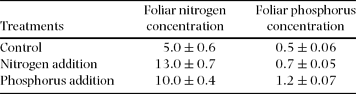
The foliar nitrogen concentration of E. glomerulatus was significantly higher in plants from plots in which nitrogen was added (F = 7.2; df = 2; P < 0.004). Similarly, in plants from plots in which phosphorus was added, we found higher phosphorus concentration in leaves (F = 11.9; df = 2; P < 0.0003) (Table 1). Notably, leaves with galls had higher nitrogen concentration compared with leaves without galls in plants that occur in soils with addition of nitrogen (t = 2.5; df = 1; P < 0.01) (Figure 1a). In addition, leaves with galls had higher foliar phosphorus concentration than leaves without galls in plots with addition of phosphorus (t = 2.4; df = 1; P < 0.02) (Figure 1b).
Differences in foliar nitrogen and phosphorus concentration between treatments of plant fertilization (mg g−1). Numbers indicate the mean ± SE. Statistical comparisons are shown in the text.
Effects of soil fertilization on galled and ungalled leaves of Eremanthus glomerulatus. Nitrogen addition in the soil on foliar nitrogen concentration (a); phosphorus addition on foliar phosphorus concentration (b). Common letters identify means within treatments that were not significantly different according to LSMeans test (P > 0.001) following two-way ANOVA analysis.

The density of galls differed significantly between the fertilizer treatments, but the response varied according to the galling species. For example, in one species, we found that gall density was lower in plots with addition of nitrogen (sp. 2: F = 5.4; df = 2; P < 0.02) and in three species we found lower density of galls in plots with addition of phosphorus in the soil (sp. 1: F = 5.2; df = 2; P < 0.03); (sp. 4: F = 7.2; df = 2; P < 0.01); (sp. 5: F = 7.9; df = 2; P < 0.01). In contrast, in one species, we found that gall density was higher in treatments with addition of nitrogen (sp. 3: F = 5.9; df = 2; P < 0.02). Similarly, in one species, gall density was higher in treatments with addition of phosphorus (sp. 6: F = 22.7; df = 2; P < 0.0003) (Figure 2). We found differences in gall density between insect guilds (foliar galls vs. stem galls). The density of foliar galls was higher than stem galls (F = 9.7, df = 1; P < 0.002). In galled leaves, we found a negative relationship between gall density and concentration of leaf nitrogen for only one leaf gall-inducing insect species (sp. 2: F = 12.0; R2 = 0.6; P < 0.006). Conversely, for three leaf gall-inducing insect species, we found a positive relationship between gall density and concentration of leaf nitrogen (sp. 1: F = 9.7; R2 = 0.5; P < 0.01); (sp. 3: F = 7.4; R2 = 0.42; P < 0.02); (sp. 4: F = 10.0; R2 = 0.5; P < 0.01) (Figure 3). No relationship between gall density and concentration of leaf nitrogen was observed in two gall-inducing insect species (sp. 5: F = 0.2; R2 = 0.01; P > 0.05); (sp. 6: F = 2.2; R2 = 0.2; P > 0.05).
Comparison of gall density between different treatments of soil fertility in six galling species associated to Eremanthus glomerulatus. Untransformed data are shown. Values with the same letter did not differ significantly after a LSMeans multiple comparison test (P > 0.001).

Relationships between foliar nitrogen of galled leaves and gall density in plots with addition of nitrogen in three galling species associated with Eremanthus glomerulatus. Cecidomyiidae sp. 1 (a); Cecidomyiidae sp. 3 (b); Cecidomyiidae sp. 4 (c); and relationships between foliar phosphorus of galled leaves and gall density in plots with addition of phosphorus in three galling species. Cecidomyiidae sp. 1 (d); Cecidomyiidae sp. 2 (e); Cecidomyiidae sp. 4 (f).

Negative relationships between gall density and concentration of leaf phosphorus were observed in galled leaves for four gall-inducing insect species (sp. 1: F = 11.0; R2 = 0.52; P < 0.007); (sp. 2: F = 7.1; R2 = 0.41; P < 0.01); (sp. 4: F = 15.5; R2 = 0.6; P < 0.002); (sp. 5: F = 7.3; R2 = 0.42; P < 0.01) (Figure 3). In contrast, only two gall-inducing insect species presented a positive relationships between both variables (sp. 3: F = 6.0; R2 = 0.37; P < 0.03); (sp. 6: F = 13.9; R2 = 0.58; P < 0.003).
In only one species did we find a negative relationship among gall density and leaf nitrogen concentration in ungalled leaves (sp. 6: F = 9.9; R2 = 0.46; P < 0.005). In no gall-inducing insect species was a significant relationship found between gall density and concentration of leaf phosphorus in ungalled leaves.
In control plots, we found a negative relationship among gall density and concentration of leaf nitrogen in two species (sp. 2: F = 66.6; R2 = 0.86; P < 0.0001); (sp. 6: F = 54.1; R2 = 0.84; P < 0.0001). No relationship between gall density and concentration of leaf nitrogen was observed in four species (sp. 1: F = 0.6; R2 = 0.05; P > 0.05); (sp. 3: F = 1.1; R2 = 0.09; P > 0.05); (sp. 4: F = 0.7; R2 = 0.05; P > 0.05); (sp. 5: F = 0.3; R2 = 0.02; P > 0.05). Finally, five gall-inducing insect species presented a negative relationship between gall density and concentration of leaf phosphorus (sp. 1: F = 45.1; R2 = 81.8; P > 0.0001); (sp. 3: F = 56.6; R2 = 0.84; P < 0.0001); (sp. 4: F = 24.8; R2 = 0.7; P < 0.0001); (sp. 5: F = 19.6; R2 = 0.6; P < 0.001); (sp. 6: F = 14.9; R2 = 0.6; P < 0.003).
DISCUSSION
The patterns of herbivore attack on host plants have been associated with nutrient availability and chemical defences as a consequence of physiological stress (Cobb et al. Reference COBB, MOPPER, GEHRING, CAOUETTE, CHRISTENSEN and WHITHAM1997, Pires & Price Reference PIRES and PRICE2000). Nitrogen and phosphorus are the two primary limiting resources for plant growth in many terrestrial ecosystems (Bobbink et al. Reference BOBBINK, HICKS, GALLOWAY, SPRANGER, ALKEMADE, ASHMORE, BUSTAMANTE, CINDERBY, DAVIDSON, DENTENER, EMMETT, ERISMAN, FENN, GILLIAM, NORDIN, PARDO and DE VRIES2010, Perring et al. Reference PERRING, HEDING, LEVIN, MACGRODDY and DE MAZANCOURT2008). Therefore, an increment of nutrient availability may modify plant–herbivore interactions as a result of uptake and use efficiency of nutrients by plants (Crawley et al. Reference CRAWLEY, JOHNSTON, SILVERTOWN, DODD, DE MAZANCOURT, HEART, HENMAN and EDWARDS2005, Gough et al. Reference GOUGH, OSENBERG, GROSS and COLLINS2000). Nutrient concentration, primarily nitrogen and phosphorus, is crucial to organ/module production such as leaves, roots and inflorescences (Abrahamson & McCrea Reference ABRAHAMSON and MCCREA1985, Aerts & Chapin Reference AERTS and CHAPIN2000). Plant species adapted to nutrient-poor environments are well-known to retranslocate nitrogen and phosphorus out of above-ground organs, especially leaves (Chapin Reference CHAPIN1991, Chapin et al. Reference CHAPIN, JOHNSON and MACKENDRICK1980). Variation in the quality of foliage, particularly nitrogen, may influence the incidence of herbivores by changes in survival, fecundity and mortality (Helms & Hunter Reference HELMS and HUNTER2005). In our study, a significantly higher nitrogen and phosphorus concentration was observed in galled compared with ungalled leaves when these nutrients were added experimentally to soil. These results support the findings of other experiments that suggest that galls act as nutrient sinks (Blanche & Westoby Reference BLANCHE and WESTOBY1995). Limiting macronutrients in the soils such as nitrogen and phosphorus, affected the density of gall-inducing insect species on E. glomerulatus in the savanna study area. It has been suggested that species from low-nutrient (nitrogen and phosphorus) habitats have higher nutrient resorption efficiencies (percentage of a nutrient withdrawn from mature leaves before leaf abscission) (Van Heerwaarden et al. Reference VAN HEERWAARDEN, TOET and AERTS2003). Nitrogen and phosphorus fertilization result in higher concentration in the litter (Van Heerwaarden et al. Reference VAN HEERWAARDEN, TOET and AERTS2003, Vitousek Reference VITOUSEK1998) indicating lower nitrogen resorption efficiency of most species (Eckstein et al. Reference ECKSTEIN, KARLSSON and WEIH1999). However, Resende (Reference RESENDE2001) show that savanna plant species have a highly efficient and complete phosphorus resorption. In contrast, nitrogen concentrations in senesced leaves show intermediate or incomplete resorption efficiencies suggesting that savanna plants occur in conditions with low nutrient availability, especially nitrogen and phosphorus (Haridasan Reference HARIDASAN, McClain, Victoria and Richey2001, Kozovits et al. Reference KOZOVITS, BUSTAMANTE, GAROFALO, BUCCI, FRANCO, GOLDSTEIN and MEINZER2007). As result of conditions of low nutrient availability, these plant species have developed efficient systems to minimize nutrient losses such as higher resorption of nutrients (Kozovits et al. Reference KOZOVITS, BUSTAMANTE, GAROFALO, BUCCI, FRANCO, GOLDSTEIN and MEINZER2007, Nardoto et al. Reference NARDOTO, BUSTAMANTE, PINTO and KLINK2006) and scleromorphic leaves that in turn, reduce the probability of abscission and facilitate high concentration of chemical defences (Fernandes & Price Reference FERNANDES and PRICE1988, Price et al. Reference PRICE, FERNANDES, LARA, BRAWN, BARRIOS, WRIGHT, RIBEIRO and ROTHCLIFF1998). We argue that gall-inducing insect species are capable of manipulating their host plants extending to control above chemical composition of gall tissues, that in turn, usually have elevated concentrations of nutrients and low concentrations of secondary chemical compounds (Hartley & Lawton Reference HARTLEY and LAWTON1992, Pascual-Alvarado et al. Reference PASCUAL-ALVARADO, CUEVAS-REYES, QUESADA and OYAMA2008). These results corroborate the higher incidence of gall-inducing insect species found in scleromorphic vegetation (Fernandes & Price Reference FERNANDES and PRICE1988, Fernandes et al. Reference FERNANDES, LARA, PRICE, Price, Mattson and Barranchikov1994) and suggest that scleromorphic plant species represent favourable sites to colonize by gall-inducing insect species (Price et al. Reference PRICE, FERNANDES, LARA, BRAWN, BARRIOS, WRIGHT, RIBEIRO and ROTHCLIFF1998).
We used nitrogen and phosphorus as indicators of soil fertility in our study and we found two different patterns: the first indicated that in treatments with addition of nitrogen and phosphorus, the density of galls decreased in four gall-inducing insect species (Cecidomyiidae sp. 1, sp. 2, sp. 4 and sp. 5). Gall density was higher on hosts with lower foliar phosphorus concentration in four gall-inducing insect species (Cecidomyiidae sp. 1, sp. 2, sp. 4 and sp. 5), while in control plots, we found a similar pattern that shows a negative relationship between gall density and concentration of leaf phosphorus in five gall-inducing insect species. In addition, no relationship was found among gall density and foliar nitrogen and phosphorus concentration in ungalled leaves. The relative nutrient status of plants is likely to be reflected in the foliar nutrient concentration of ungalled leaves. Therefore, these results suggest that foliar nitrogen and phosphorus concentration respond to gall density in galled leaves and corroborate a chemical manipulation of the host plant by gall-inducing insects (Hartley & Lawton Reference HARTLEY and LAWTON1992). In contrast, the second trend shows that gall density presented positive relationships with foliar nitrogen concentration in three gall-inducing insect species (Cecidomyiidae sp. 1, sp. 3 and sp. 4). Herbivore responses to host plant stress (i.e. low nitrogen, phosphorus and water availability) may be negative, positive or in some cases show no response to plant stress (Larsson Reference LARSSON1989, Waring & Cobb Reference WARING, COBB and Bernays1992). Blanche & Westoby (Reference BLANCHE and WESTOBY1995) showed that abundance and richness of gall-inducing insects were not directly linked to soil fertility but, instead, via host plant taxon in a community dominated by Eucalyptus spp. The mechanism that explained this result is that eucalypts are adapted to infertile soils and may indirectly affect the incidence of gall-inducing insects that were already in association with the Eucalyptus community. However, it has been suggested that plants that occur in low soil fertility, especially low soil phosphorus have high abundance of gall-inducing insect species (Blanche & Ludwig Reference BLANCHE and LUDWIG2001, Cuevas-Reyes et al. Reference CUEVAS-REYES, QUESADA, SIEBE and OYAMA2004b, Fernandes & Price Reference FERNANDES, PRICE, Price, Lewinsohn, Fernandes and Benson1991). These plants usually have high concentrations of secondary chemical compounds such as oils and phenols and each gall-inducing insect species has the ability to manipulate the growth and development of plant tissue (Weis et al. Reference WEIS, WALTON and CREGO1988) and may also be capable of modifying host nutritional quality and plant secondary metabolites for protection against natural enemies (Fernandes & Price Reference FERNANDES and PRICE1992, Hartley & Lawton Reference HARTLEY and LAWTON1992, Pascual-Alvarado et al. Reference PASCUAL-ALVARADO, CUEVAS-REYES, QUESADA and OYAMA2008).
We conclude that soil fertility affected in different ways the density of gall-inducing insect species on E. glomerulatus under experimental soil conditions. In the first case, a given host that occurred in different conditions with low levels of soil phosphorus and nitrogen had greater density of galls than the same host species that occurred in fertile plots. Therefore, direct effects of soil fertility may also explain the reduction in the density of galls on E. glomerulatus that are present in different soil fertility conditions. Adaptive phenotypic plasticity within each individual may explain differences in the incidence of gall-inducing insects for E. glomerulatus analysed in our study (Cuevas-Reyes et al. Reference CUEVAS-REYES, QUESADA, SIEBE and OYAMA2004b, Schlichting & Pigliucci Reference SCHLICHTING and PIGLIUCCI1998). Host plants of the same species adapt to variable soil fertility and gall-inducing insects negatively respond to the quality of the environment experienced by their hosts. Because some plant species respond to low soil fertility by having long-lived parts with a high concentration of chemical secondary compounds (Coley et al.1985) and gall-inducing insects may sequester these chemicals in the gall chamber for protection against natural enemies, we expect galling insects to select individuals of a given host species with greater chemical defences under low nutrient availability. In the second case, our study shows that gall density presented positive relationships with foliar nitrogen concentration in three gall-inducing insect species. The herbivore responses to plant quality may be a continuum that included herbivore species that feed preferentially on stressed plants to herbivores that feed on vigorous plants or plant modules (Price Reference PRICE1991). The evidence indicates that the patterns of herbivory are higher in plants that grow in rich environments, compared with plant species adapted to low resources (Coley et al. Reference COLEY, BRYANT and CHAPIN1985, Price Reference PRICE1991). Therefore, plants with more nitrogen and phosphorus availability represent sites more vigorous to colonize by gall-inducing insect species because the larval performance may be highest in these sites (Fritz et al. Reference FRITZ, CRABB and HOCHWENDER2000, Price et al. Reference PRICE, COBB, CRAIG, FERNANDES, ITAMI, MOPPER, PRESZLER and Bernays1990). This suggests an oviposition preference for more vigorous plant modules and potential relationship among oviposition site selection and larval survival (Craig et al. Reference CRAIG, ITAMI and PRICE1989, Price et al. Reference PRICE, COBB, CRAIG, FERNANDES, ITAMI, MOPPER, PRESZLER and Bernays1990). In our study the gall density was different between insect guilds (foliar vs. stem galls). Because stem galls were larger than foliar galls, it is probable that gall-inducing insect species with large galls produce many insects and occur on their host plants at low densities. This idea is in accord with some studies that indicated that the number of galling insects present within galls is positively related to gall size for many insect species (Freeman & Geoghagen Reference FREEMAN and GEOGHAGEN1987, Honek Reference HONEK1993). Because gall size is a good indicator of insect fitness (Sopow & Quiring Reference SOPOW and QUIRING2001), the differences observed in gall density between insect guilds may reflect different strategies of uptake and use efficiency of nutrients by foliar and stem gall-inducing insect species. Finally, this study provides the first experimental evidence for the incidence of gall-inducing insects on the sclerophyllous savanna. These results show the ecological importance of abiotic factors in structuring plant–insect interactions.
ACKNOWLEDGEMENTS
We thank the logistical support provided by the Reserva Biológica do IBGE and the financial support provided by CNPq (309633/2007-9, 476178/2008-8) and FAPEMIG (EDT-465/07, APQ-01278/08). This work was in partial fulfilment for the Master dissertation of F. Ker at the Universidade Federal de Minas Gerais, Brazil. Pablo Cuevas-Reyes thanks Dirección Adjunta de Desarrollo Científico y Académico del CONACyT for their generous support. We thank Antonio González-Rodríguez for the constructive comments that greatly improved earlier versions of the manuscript.



