INTRODUCTION
Prospective memory (PM) refers to memory for future intentions, such as remembering to take medication or turn off appliances. This ability is crucial to the maintenance of functional independence, which is a fundamental concern for older adults (Chasteen, Park, & Schwarz, Reference Chasteen, Park and Schwarz2001). Problems with PM cause more deficits in activities of daily living, instrumental activities of daily living, and caregiver burden than do retrospective memory failures (Smith, Della Sala, Logie, & Maylor, Reference Smith, Della Sala, Logie and Maylor2000). It is, therefore, of considerable concern that PM is often disrupted in the context of normal adult aging (Henry, Macleod, Phillips, & Crawford, Reference Henry, Macleod, Phillips and Crawford2004) and to an even greater extent in dementia, even in the mild (Martins & Damasceno, Reference Martins and Damasceno2008) and preclinical (Duchek, Balota, & Cortese, Reference Duchek, Balota and Cortese2006; Jones, Livner, & Backman, Reference Jones, Livner and Backman2006) stages.
To date, seven dementia studies have examined PM performance and have included controls, thus allowing the presence and magnitude of PM impairment to be quantified. All seven of these studies reported that individuals with dementia exhibit PM difficulties relative to controls (Blanco-Campal, Coen, Lawlor, Walsh, & Burke, Reference Blanco-Campal, Coen, Lawlor, Walsh and Burke2009; Duchek et al., Reference Duchek, Balota and Cortese2006; Jones et al., Reference Jones, Livner and Backman2006; Kazui et al., Reference Kazui, Matsuda, Hirono, Mori, Miyoshi and Ogino2005; Kinsella, Ong, Storey, Wallace, & Hester, Reference Kinsella, Ong, Storey, Wallace and Hester2007; Martins & Damasceno, Reference Martins and Damasceno2008; Troyer & Murphy, Reference Troyer and Murphy2007). Particularly striking were the findings of Kinsella et al. (Reference Kinsella, Ong, Storey, Wallace and Hester2007). In their study, a simple event-based PM task was administered, in which participants were required to remember to make a word substitution whenever a target word appeared in a passage of text. Despite minimal retrospective memory demands (participants were required to recall only one target word), and a relatively mild level of dementia, the Alzheimer’s disease (AD) group performed close to floor-level on this task. Therefore, PM difficulties appear to be a prominent and consistent feature of dementia. Such findings are unsurprising given that the neural structures affected in the most common types of dementia, even in the early stages, are also known to be implicated in PM function. In particular, prominent atrophy and tau deposition is observed in temporal and frontal neocortices (e.g., Barnes, Ourselin, & Fox, Reference Barnes, Ourselin and Fox2009; Scheltens, Reference Scheltens2009). There is evidence that the frontal lobes play a key role in various cognitive control operations, such as planning and monitoring, each of which are considered essential to PM performance (see Glisky, Reference Glisky, Brandimonte, Einstein and McDaniel1996; Reynolds, West, & Braver, Reference Reynolds, West and Braver2009; Zöllig, West, Martin, Altgassen, Lemke, & Kliegel, Reference Zöllig, West, Martin, Altgassen, Lemke and Kliegel2007). Furthermore, recent evidence has highlighted the importance of temporal neural structures in subserving many important aspects of PM function (den Ouden, Frith, Frith, & Blakemore, Reference den Ouden, Frith, Frith and Blakemore2005; Reynolds et al., Reference Reynolds, West and Braver2009).
Research attention has increasingly focused on clarifying whether PM difficulties may have diagnostic significance for early detection of dementia over and above the contribution of retrospective memory, with most research to date supportive of this possibility. Thus, it has been shown that measures of PM make an independent contribution beyond that of retrospective memory to the diagnosis of dementia (Duchek et al., Reference Duchek, Balota and Cortese2006) and to the prediction of dementia 3 years later (Jones et al., Reference Jones, Livner and Backman2006). Specifically, Jones et al. (Reference Jones, Livner and Backman2006) administered measures of prospective and retrospective memory to preclinical AD and control participants, 3 years before dementia diagnosis. The results indicated the preclinical AD participants were impaired on both measures, and within the PM task itself, the prospective and retrospective components were comparably impaired. Furthermore, the PM task contributed significant unique variance to the prediction of AD. These data were particularly striking given that a relatively insensitive measure of PM was used: a single trial that involved reminding the experimenter to make a telephone call after all the tests had been completed. Duchek et al. (Reference Duchek, Balota and Cortese2006) also found that an event-based PM task contributed additional unique variance to discriminating mild dementia from controls, above and beyond measures of retrospective memory.
Another way of addressing how early in the disease process PM difficulties arise, and whether the presence of PM difficulties has diagnostic significance, is to examine those diagnosed with mild cognitive impairment (MCI). MCI is characterized by subjective and objective cognitive decline greater than expected for an individual’s age and education level, but which does not cause significant functional impairment (Petersen, Reference Petersen2007). Although there is ongoing debate as to whether MCI represents a prodrome of dementia, relative to the general older adult population, this group has a substantially elevated risk of developing dementia and presents with cognitive and brain changes that are generally intermediate between individuals with dementia and nonclinical controls (Albert & Blacker, Reference Albert and Blacker2006; Petersen, Reference Petersen2007).
As in dementia, PM is disrupted in MCI and not simply because of problems with the retrospective component of the PM task (Blanco-Campal et al., Reference Blanco-Campal, Coen, Lawlor, Walsh and Burke2009; Karantzoulis, Troyer, & Rich, Reference Karantzoulis, Troyer and Rich2009; Kazui et al., Reference Kazui, Matsuda, Hirono, Mori, Miyoshi and Ogino2005; Schmitter-Edgecombe, Woo, & Greeley, Reference Schmitter-Edgecombe, Woo and Greeley2009; Troyer & Murphy, Reference Troyer and Murphy2007). Karantzoulis et al. (Reference Karantzoulis, Troyer and Rich2009) found that individuals with amnestic-MCI were impaired relative to controls on measures of time- and event-based PM, and these difficulties reflected failures in both the prospective and retrospective components of the tasks. Schmitter-Edgecombe et al. (Reference Schmitter-Edgecombe, Woo and Greeley2009) found that amnestic and non-amnestic MCI participants were impaired on a simple event-based measure of PM (remembering to request a medicine bottle every time a specific task was completed). Because all participants were able to recall the PM task instructions, the PM failure could not be attributed to problems with the retrospective component of the task. It was also argued that the level of MCI-related impairment on the PM measure was greater than the corresponding impairment observed on a separate measure of retrospective memory. Finally, Blanco-Campal et al. (Reference Blanco-Campal, Coen, Lawlor, Walsh and Burke2009) found that an event-based PM task was superior to two retrospective memory tasks in discriminating between MCI of suspected AD etiology and normal controls.
However, a key issue in clinical practice is whether there are group differences, not only between normal aging and pathology, but between different clinical states. Only two PM studies to date have simultaneously assessed both MCI and dementia in comparison to healthy controls, and these came to different conclusions (Kazui et al., Reference Kazui, Matsuda, Hirono, Mori, Miyoshi and Ogino2005; Troyer & Murphy, Reference Troyer and Murphy2007). Kazui et al. (Reference Kazui, Matsuda, Hirono, Mori, Miyoshi and Ogino2005) compared individuals with MCI, AD and demographically matched controls on the Rivermead Behavioral Memory Test (RBMT; Wilson et al., Reference Wilson, Cockburn, Baddeley and Hiorns1989), which includes three PM subcomponents, each consisting of a single task. Although both the MCI and the dementia groups exhibited PM impairment relative to controls, PM performance was comparable for the two clinical groups. Troyer and Murphy (Reference Troyer and Murphy2007) also found that two PM measures (time- and event-based PM) were impaired in both clinical groups, but those with AD were more impaired than the amnestic MCI group.
It, therefore, remains unclear whether measures of PM are sensitive to group differences between these two clinical conditions. The difference in Mini-Mental State Examination (MMSE) scores between the MCI and AD groups was greater in the study by Kazui et al. (Reference Kazui, Matsuda, Hirono, Mori, Miyoshi and Ogino2005) (26.7 vs. 21.9) than in the study by Troyer and Murphy (Reference Troyer and Murphy2007) (27.8 vs. 25.5), thus the absence of PM performance differences in the former study did not simply reflect more closely overlapping clinical groups. One possibility is that the differences between these studies reflect method variance, and specifically, differences in the sensitivity of the PM measure used to index this construct. McDaniel and Einstein (Reference McDaniel and Einstein2007) concluded that most PM tasks lack reliability, with some tasks as low as 20%. It was argued that this lack of reliability is attributable to the few opportunities typically given to perform the PM task, with this in particular an issue for many clinical assessments such as the RBMT. In the study by Kazui et al. (Reference Kazui, Matsuda, Hirono, Mori, Miyoshi and Ogino2005), the RBMT was used to index PM, with scores on each one of the three RBMT PM tasks reported separately. By contrast, Troyer & Murphy’s (Reference Troyer and Murphy2007) study would have had greater sensitivity, with scores based on a total of eight targets assessed.
The present study’s first aim was to assess whether a measure of PM with documented reliability and sensitivity shows group differences in performance between normal aging, MCI and dementia. We used an adapted version of a board game to test PM, Virtual Week (see below), which has documented sensitivity to age-related cognitive impairment (Rendell & Henry, Reference Rendell and Henry2009; Will, Rendell, Ozgis, Pierson, Ong, & Henry, Reference Will, Rendell, Ozgis, Pierson, Ong and Henry2008). An important advantage of Virtual Week is the inclusion of PM tasks that vary in their relative task demands. In the context of clinical practice, a differentiated profile of impairment on Virtual Week may be informative of the degree of PM impairment per se and, also of the particular circumstances in which PM impairment is more likely to arise (and consequently the manner in which rehabilitation efforts should be targeted). Of the MCI and dementia studies conducted to date, only three have compared performance across multiple task parameters, and consequently helped clarify whether specific types of PM processing are particularly disrupted. Troyer and Murphy (Reference Troyer and Murphy2007) found that, although participants with dementia were equivalently impaired on measures of time- and event-based PM, participants with MCI were particularly impaired on the former. Similarly, while Karantzoulis et al. (Reference Karantzoulis, Troyer and Rich2009) found that MCI participants were impaired on both time- and event-based PM, the magnitude of the deficit for the former was nearly twice as large. Finally, Blanco-Campal et al. (Reference Blanco-Campal, Coen, Lawlor, Walsh and Burke2009) manipulated the specificity of the instructions and perceptual salience of the PM cue and found that the nonspecific, non-salient condition was associated with greater MCI-related impairment. Kazui et al. (Reference Kazui, Matsuda, Hirono, Mori, Miyoshi and Ogino2005) also presented performance separately across the three individual PM tasks of the RBMT, but did not present any statistical comparison of these task-types. Taken together, these studies suggest that PM tasks that impose relatively greater demands on self-initiated retrieval processes, or strategic resources, may be particularly sensitive to the presence of MCI, although they may not differ in their relative sensitivity to dementia.
The second aim was to further assess whether the specific demands of the PM task interact with group status. Virtual Week not only differentiates between event- and time-based PM, but between regular and irregular tasks. This was the one task distinction that was found by Rendell and Craik (Reference Rendell and Craik2000) to interact with age, with age-related deficits substantially attenuated on regular compared with irregular tasks. Kliegel, Martin, McDaniel, and Einstein (Reference Kliegel, Martin, McDaniel and Einstein2002) argue that remembering the content of the many different irregular tasks requires more processing resources than remembering the content of the same two regular tasks each day, and in particular, imposes greater demands on retrospective memory. Consequently, it seems likely that irregular tasks will be more sensitive to the presence of MCI than regular tasks.
Our third aim was to provide an assessment of whether PM as indexed by Virtual Week is sensitive to differences between healthy controls, MCI, and dementia, even after taking into account group differences in retrospective memory, working memory and executive functioning. This assessment was considered important because each of these cognitive abilities are related to PM function in normal adult aging (Martin, Kliegel, & McDaniel, Reference Martin, Kliegel and McDaniel2003; McDaniel & Einstein, Reference McDaniel and Einstein1992), with preliminary evidence supporting such a relationship in the context of abnormal adult aging (Schmitter-Edgecombe et al., Reference Schmitter-Edgecombe, Woo and Greeley2009; Troyer & Murphy, Reference Troyer and Murphy2007; although see Martins & Damasceno, Reference Martins and Damasceno2008).
METHODS
Participants
Of 140 community dwelling Sydney participants, 39 met Diagnostic and Statistical Manual of Mental Disorder (DSM-IV) criteria for dementia (diagnoses of subtype were not known in all cases but included 10 cases of AD, 2 mixed AD and vascular dementia, 1 Lewy body dementia, and 1 dementia pugilistica. These diagnostic groupings are not explored in this study as the groups would be too small for meaningful analysis), 48 met the modified criteria for MCI (14 amnestic single-domain, 6 amnestic multi-domain, and 28 non-amnestic cases; Artero, Petersen, Touchon, & Ritchie, Reference Artero, Petersen, Touchon and Ritchie2006; Petersen, Reference Petersen2007), and 53 were controls without cognitive impairment. All participants had adequate eyesight, hearing and English language ability for the assessment. Participants were excluded if they had a previous diagnosis of psychiatric or neurological illness. Typical medications included cholinesterase inhibitors (taken by 10 participants in the dementia group), and treatments for physical illnesses. The groups did not differ in age, F(2,135) = 1.68; p = .191;  , education, F(2,98) = 0.50; p = .611;
 , or gender, χ2(2, N = 140) = 1.77; p = .412; φ = .11), but MMSE scores differentiated the groups, (F(2,134) = 19.66; p < .001,
 ; see Table 1). Follow-up Tukey tests indicated that participants with dementia had lower scores on the MMSE relative to controls (p < .001), and to the MCI group (p = .001), but the MCI and control groups did not differ (p = .329). MMSE scores indicate that dementia participants were in the very mild stage of illness, consistent with the majority of this group being less than 2 years after diagnosis.
Demographic characteristics of the control, mild cognitive impairment (MCI), and dementia participants.

Note
MMSE refers to the Mini-Mental State Examination; VW refers to Virtual Week; TOL refers to Tower of London.
The majority of participants (> 90%) were recruited from a large epidemiological study of aging (Kochan et al., Reference Kochan, Brodaty, Crawford, Slavin, Low and Trollor2009), which commenced 2 years before the current study. The second source of recruitment was from a Memory Disorders Clinic, with many of these participants newly diagnosed with dementia at the time of recruitment. MCI and dementia were diagnosed by consensus conference of the memory clinic or epidemiological study. One of the authors (HB) was a consultant psychiatrist in both of these conferences, the same neuropsychologist oversaw both, and the test batteries used were identical. The same criteria were applied in both situations.
Procedure
Ethics approval was obtained from the South-Eastern Sydney Illawarra Area Health Service–Eastern Section Human Research Ethics Committee. After participants gave informed consent, the following measures were administered to participants in an individual testing session.
Virtual Week
Performance on an adapted version of this laboratory measure of PM was the primary dependent measure of interest. As noted, Virtual Week was selected as it has been consistently identified as a reliable indicator of PM (for a review, see Rendell & Henry, Reference Rendell and Henry2009), and the incorporation of the different types of PM tasks means that PM performance can be investigated systematically in relation to different PM task demands.
Virtual Week is a computerized board game, in which participants move around the board with the roll of a dice. The times of day people are typically awake are marked on the board, with each circuit of the board representing a day. As participants move around the board a series of events occur, in which a screen pops up describing an event (e.g., “you stop at a café for lunch”), the participant is required to make choices about the event (e.g., what to eat) and in some of these events remember to carry out an event-based PM task (e.g., take medication). The original version (Rendell & Craik, Reference Rendell and Craik2000) was modified in the present study for older adults with MCI and early stages of dementia, by reducing the overall task requirements to 4 (instead of 10) PM tasks per virtual day, over 2 (instead of 7) simulated days (plus a practice day). Two PM tasks were time-based (i.e., triggered by passing a particular time on the board), and two were event-based (i.e., triggered by encountering a specific event in the game). For each virtual day, one of the time-based and one of the event-based tasks was regular (a routine task involving remembering to take medication which recurred every day), and one of the time-based and one of the event-based tasks was irregular (a one-off, nonrecurring task that differed for each virtual day). Virtual Week was administered on an HP Tablet Notebook TC4400 via a touch-screen computer interface. The Virtual Week gameboard, cards, and dice were electronically presented, and the participants interacted with the game by tapping the screen with a pen-stylus. As in Rendell and Craik (Reference Rendell and Craik2000), participants were given pre-game instructions and then a practice virtual day to ensure they understood all features of the game, thus regular tasks occurred three times and irregular tasks only once.
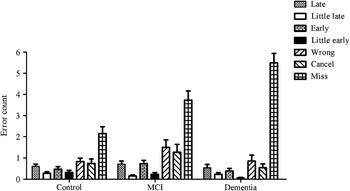
Responses were scored as the number (out of eight) Correct, Missed, Wrong, Late, Early, Little Late, Little Early, or Cancel. Correct scores indicated the target item was remembered at the correct time (correct time was after the dice roll for the move that took the token onto or past the target square and before the next roll of the dice); participants were marked Wrong when they selected the wrong task; Missed indicated the participant did not remember the target item at any time; Little Late items were remembered after the correct time criterion but within two further rolls of the dice and Late items were after the Little Late criterion and before the end of the virtual day. Little Early and Early items were the converse of Late items; Little Early was within two dice rolls before the correct time criterion and Early was before the Little Early criterion and after the start of the virtual day. Cancel was when participants opened the perform task list and closed the list without selecting a task. In the present study, Cronbach’s alpha for the total score was estimated to be .74.
Retrospective memory
After completion of the virtual days, the participant was asked to recall the PM tasks. Once the participant could recall no more tasks, a list of randomly ordered correct tasks and foils was given to the participant to check off the tasks that were in the game. This provided a measure of both recall and recognition of the tasks. Cronbach’s alpha was estimated to be .65 for recall and .69 for recognition.
Working memory
The Colorado Assessment Tests (CATS) Visual Span task (Davis & Keller, Reference Davis and Keller2002) is a computerized version of a block tapping task (Corsi, Reference Corsi1972) used to assess working memory. It is analogous to established digit-span testing (Wechsler, Reference Wechsler1997), with spans of increasing length being presented, and recalled by the examinee in a forward and then backward direction. Normative data shows increasing performance with age until the twenties and then declining performance thereafter (Davis & Keller, Reference Davis and Keller2002).
Executive functioning
The Tower of London test (Davis & Keller, Reference Davis and Keller2002; Shallice, Reference Shallice1982) is used to assess executive control, and specifically planning and execution skills, which are considered to be particularly relevant to PM function (Phillips, Henry, & Martin, Reference Phillips, Henry, Martin, Kliegel, McDaniel and Einstein2008). The CATS Tower of London (Davis & Keller, Reference Davis and Keller2002) is a computerized version of the task which involves moving different colored pegs to match an arrangement shown in a target picture. The CATS version includes trials of varying complexity, thereby overcoming ceiling effects seen in previous versions of the Tower of London (Tunstall, Reference Tunstall1999). Normative data for the CATS version show increasing performance with age until the twenties and then declining performance thereafter (Davis & Keller, Reference Davis and Keller2002). Studies using a similar (noncomputerized) version of the task have reported good reliability and criterion-related validity (Culbertson & Zillmer, Reference Culbertson and Zillmer1998).
RESULTS
Background Cognitive Measures
There were group differences in Visual Span, F(2,134) = 17.01; p < .001;  ; and the Tower of London, F(2,131) = 9.34; p < .001;
 (see Table 1). Follow-up Tukey HSD tests indicated that both measures differentiated between dementia and controls (both ps < .001). Visual Span differentiated between the control and MCI groups (p = .016), and between the MCI and dementia groups (p = .006). Tower of London differentiated between the MCI and dementia groups (p = .002), but not the MCI and control groups (p = .770).
Prospective Memory: Virtual Week
The number of correct PM responses are presented in Figure 1 as a function of group (control, MCI, dementia) and PM cue (time, event). These data were analyzed with a 3 × 2 × 2 mixed analysis of variance with the between-subjects variable of group and the within-subjects variables of PM task (regular, irregular) and PM cue (time, event). There was no main effect of PM task, F(1,137) = 0.42; p = .520;  , but there was a main effect of PM cue F(1,137) = 24.90; p < .001;
 and of group, F(2,137) = 23.32, p < .001,
 . None of the two- or three-way interactions were significant (all Fs < 1.2, ps > .320). The main effect of PM cue indicated better performance in response to time-based than event-based cues. Follow-up Tukey HSD tests of the group main effect indicated that the dementia and MCI groups were each impaired relative to the control group (both p < .001) and the dementia group in turn performed more poorly than the MCI group (p = .035). There was no difference in PM performance between MCI subtypes, F(2,45) = .583; p = .56;
 . Nor was there any difference between the amnestic MCI subtypes and non-amnestic MCI subtype, t(46) = .284; p = .78;
 .
Number of correct responses on the Virtual Week as a function of prospective memory cue type (time & event) for controls and participants with mild cognitive impairment (MCI) and dementia. Bars represent SE.

Figure 2 shows the pattern of errors on Virtual Week. Most of the errors involved a failure to respond (missed responses), with all other error types relatively infrequent. Thus the PM tasks were nearly always either remembered reasonably accurately or not remembered at all.
Types of error responses on Virtual Week for controls and participants with mild cognitive impairment (MCI) and dementia.

Differentiating the Prospective and Retrospective Components of Virtual Week
The next step in the analyses involved assessing whether any of the group differences observed on Virtual Week could be attributed to difficulties with the retrospective memory component of the task (i.e., correctly recalling the tasks that needed to be done). Performance on this component was measured through recall and recognition tests of the eight Virtual Week tasks (see Table 1). The results indicated a main effect of group for total number of items correctly recalled, F(2,128) = 16.86; p < .001;  ; and recognized, F(2,128) = 11.20; p < .001;
 . Although there was no main effect of PM task, a follow-up t test comparing percentage recall of regular and irregular tasks indicated that of the two task types, regular tasks were more likely to be recalled following completion of Virtual Week, t(129) = 10.66; p < .001;
 ). These data are consistent with earlier studies showing that irregular (relative to regular) tasks impose greater demands on retrospective memory. To explore the patterns of shared variance in Virtual Week, two analyses of covariance (ANCOVA) were conducted with the dependent variable of PM Total Score and either total number of Virtual Week items (i) recalled or (ii) recognized entered as covariate. Following entry of each covariate, the group effect size
 was reduced from .25 to .10 and .18, respectively, but remained significant (ps = .002 and < .001, respectively). Consequently, although interpretation of ANCOVA designs requires caution (Miller & Chapman, Reference Miller and Chapman2001), these data suggest that difficulties with the retrospective component of the task contributed to the group effects observed on Virtual Week, but significant residual variance is attributable to a separable prospective component. Consistent with this interpretation, the correlation between Virtual Week and group status remained significant after partialling out the number of Virtual Week items correctly recalled (rp = .28; p = .001) and recognized (rp = .41; p < .001).
Cognitive Correlates of Prospective Memory Function
Group effects were observed on the measures of Visual Span and Tower of London. Correlational analyses indicated that Virtual Week performance was related to both these measures (rs = .49 and .27, respectively; both ps < .01). To explore the patterns of shared variance in the dataset, further exploratory ANCOVAs were conducted, this time with the dependent variable of PM Total Score, and one of the cognitive measures entered as a covariate. After exploring the influence of Visual Span and Tower of London as covariates individually, the final ANCOVA entered both measures as covariates simultaneously. The group effect size  was reduced from .25 to .13, .20 and .12, respectively, but for all ANCOVAs remained significant (all ps < .05). Again, consistent with this interpretation, the correlation between Virtual Week and group status remained significant after partialling out Visual Span (rp = .35; p < .001), Tower of London (rp = .44; p < .001), and both cognitive measures simultaneously (rp = .34; p < .001).
DISCUSSION
These data confirm previous research studies in showing that individuals with MCI and dementia exhibit PM difficulties relative to demographically matched controls. However, because prior studies have failed to agree on whether reliable group differences exist on measures of this construct between MCI and dementia (Kazui et al., Reference Kazui, Matsuda, Hirono, Mori, Miyoshi and Ogino2005; Troyer & Murphy, Reference Troyer and Murphy2007), the present results are important in showing that individuals with dementia are more impaired on Virtual Week than those with MCI. These data affirm the importance of using measures of PM that have documented reliability and validity. As noted previously, Virtual Week has been well validated, and shown to be sensitive to age-related cognitive impairment specifically (Rendell & Henry, Reference Rendell and Henry2009; Will et al., Reference Will, Rendell, Ozgis, Pierson, Ong and Henry2008). It seems likely that the discrepancies in prior studies reflected method variance, and in particular, fewer opportunities given to perform the PM task in the study by Kazui et al. (Reference Kazui, Matsuda, Hirono, Mori, Miyoshi and Ogino2005) (three) relative to the study by Troyer and Murphy (Reference Troyer and Murphy2007) (eight). As in the latter study, the present study afforded participants eight opportunities to execute the PM task.
The second aim of the study was to assess whether individuals with MCI and dementia exhibit a differentiated profile of impairment on Virtual Week. In line with prior research results, it was predicted that PM tasks which imposed relatively greater demands on strategic resources may be particularly sensitive to the presence of MCI, although they may not differ in their relative sensitivity to dementia. In fact no interaction between group and either cue type (time, event) or task type (regular, irregular) was observed, indicating that both clinical groups exhibited a relatively generalized level of impairment on Virtual Week that did not vary as a function of specific task demands.
In the PM literature, most weight has typically been attributed to the distinction between time- and event-based cues. Prior studies that have manipulated cue-type in this group have shown individuals with MCI to be disproportionately impaired when responding to time-based cues (Karantzoulis et al., Reference Karantzoulis, Troyer and Rich2009; Troyer & Murphy, Reference Troyer and Murphy2007) but those with dementia to be equivalently impaired (Troyer & Murphy, Reference Troyer and Murphy2007). It is suggested that the absence of an interaction with cue type in the present study may reflect the unique manner in which Virtual Week operationalizes these parameters. Relative to most laboratory time-based PM tasks, the time-based tasks in Virtual Week have considerable external cues (the time is cued by the activities relevant to the virtual time of day and the time is clearly seen and “encountered” on the Virtual Week Board Game). The provision of these cues may, therefore, have equated these tasks to the event-based tasks in terms of their reliance on self-initiated processing, representing the situation in daily life where some times of day can have strong environmental cues. Consequently, we do not wish to over-interpret the absence of interaction with cue-type identified in the present study.
More compelling was the absence of any interaction between group and task regularity on Virtual Week. Previous research has shown that the regular tasks in Virtual Week require fewer processing resources (and indeed, in the present study a post hoc analysis of task recall following completion of Virtual Week also suggested that the regular tasks imposed fewer demands on retrospective memory—i.e., irregular, relative to regular, tasks were less likely to be successfully recalled retrospectively). The absence of any interaction effect, therefore, suggests that the MCI- and dementia-related difficulties observed on Virtual Week may not simply be restricted to the retrospective memory component, but also extend to the PM component (i.e., the implementation of delayed intentions). This interpretation is also consistent with the analyses in which number of Virtual Week items correctly recalled and recognized were covaried. While the use of ANCOVA in nonrandomized designs has been subject to some debate, it has been suggested that this methodology may be useful (despite nonrandom assignment) in the context of exploration of a dataset to understand patterns of shared variance (Huitema, Reference Huitema1980; Miller & Chapman, Reference Miller and Chapman2001). Although speculative, taken together these analyses suggest that while difficulties with the retrospective component of the task (as well as working memory and executive functioning) may each have contributed to the group effects observed on Virtual Week, significant residual variance may be attributable to a separable, prospective component. However, given the noted difficulties of ANCOVA use in nonrandomized designs, coupled with the use of single indicators to tap the key cognitive constructs of interest, clearly further research is needed to test this interpretation of these data.
A strength of this study is the recruitment of participants diagnosed by use of consistent diagnostic criteria for MCI and dementia; however, some limitations must be acknowledged. Some of the dementia group were taking dementia medication, but it was not possible to conduct formal analyses assessing medication status and cognitive performance due to the very differing medication types and dosages participants received. The role of medication status in PM function in this group, therefore, remains an important issue for future research. Given that the purpose of such medication is to improve cognition, one possibility is that use of such medication may serve to attenuate dementia effects on PM.
As noted previously, the present study used a modified version of Virtual Week, in which task demands were reduced. Despite these modifications some participants, particularly those with dementia, performed at zero. Thus, while a key strength of Virtual Week is its sensitivity to even very early signs of cognitive decline, further modifications which decreased task difficulty would be needed to further extend its usefulness as a research tool in this particular population.
In conclusion, it has long been recognized that deficits in the ability to implement delayed intentions are likely to lead to problems in daily functioning. The current study indicates that both MCI and dementia are associated with PM deficits, and supports the use of Virtual Week in clinical practice as a tool to quantify the magnitude of these impairments. It is suggested that while failures of retrospective memory, working memory, and executive functioning each potentially contribute to PM difficulties in each of these groups, they may not be sufficient to account for the magnitude of the PM impairment observed.
ACKNOWLEDGMENTS
This study was funded by a PhD scholarship from the UNSW Dementia Collaborative Research Centre awarded to Claire Thompson as well as an Australian Research Council Discovery Project Grant awarded to Dr. Julie Henry and A/Prof. Peter Rendell. We thank Prof. Perminder Sachdev, Dr Melissa Slavin and Nicole Kochan of the University of New South Wales’ Memory and Ageing Study and the Prince Of Wales Hospital, Sydney, Academic Department for Old Age Psychiatry’s Memory Disorders Clinic for assistance with access to participants. We also thank Felicity Leslie, Carine Pose, and Polly Pulford for assistance with the data collection. The authors have no conflict of interest.