


1. Introduction.
Norwegian anaphors have been the subject of interesting research for two decades. In particular, the work of Hellan (1988) and Hestvik (1990, 1991, 1992) has been important to the development of binding theory, where an important topic has been the relation between the simple reflexive seg and the complex reflexive seg selv. However, there are still questions remaining concerning both theory and data.
This article challenges a restriction on binders that has never been called into question in the literature. Hellan (1988:181–192) claims that a Norwegian reflexive must have a binder that is visible. In his terminology, which is adopted here, implicit arguments are not visible, while phonologically realized arguments and PRO are visible. This visibility condition distinguishes the two examples in 1 (from Hellan 1988:182).

Implicit arguments, however, still play a role in Hellan's theory. One of his examples is given in 2 (Hellan 1988:176).

Hellan points out that the only interpretation of 2 is that Jon is the author of the book. His explanation is that bok ‘book’ takes an implicit author role, and this role binds the reflexive. Even so, 2 does not violate Hellan's visibility condition. The object Jon binds the implicit argument, giving the “chain of antecedents” one visible item (Hellan 1988:183).
An important point I make below is that the visibility condition is not observed by many speakers of Norwegian. Sentences such as 1b above are common. I also show that some younger speakers use reflexive forms that have no binder.
This article is based upon two kinds of data, intuitions of native speakers (mostly linguists) and sentences from written texts. The text data were found by searching the World Wide Web and two text corpora (The Oslo Corpus of Tagged Norwegian Texts and the Newspaper Corpus at the University of Bergen). Unless otherwise indicated, example sentences are of this type, although some have been shortened or edited. Their sources are listed in the appendix. All example sentences are acceptable to me if not otherwise indicated.
Before presenting the data, it is necessary to point out one property of Norwegian binding that is important to the discussion. Norwegian does not have “exempt” (or “logophoric”) anaphors. There are no Norwegian equivalents of the sentences in 3, which violate basic binding theory by having antecedents that are too far away from the anaphor, as in 3a, or not more prominent than the anaphor, as in 3b (see Hestvik and Philip 2001, and Barbiers 2000 on Dutch).

This property of Norwegian binding is important to the discussion, because it means that anaphors without visible binders cannot be dismissed as exempt (or “logophoric”) anaphors.
2. Reciprocals.
Hellan's visibility condition does not mention reciprocals. However, reciprocals are interesting in their own right and, at least for many speakers, important aspects of their behavior are similar to that of the reflexives. The Norwegian reciprocals are hverandre ‘each other’ and the possessive hverandres ‘each other's’. They allow invisible binders, as in 4.1
Reciprocals without visible binders can easily be found searching the World Wide Web for English, German, Danish, Swedish, and Icelandic. However, detailed information does not seem to be available for any of these languages. Examples from English and German are in i and ii.


There is no syntactically realized binder in sentences such as those in 4. There is also no need for an antecedent in the linguistic context.
Reciprocals without visible antecedents can be found in all kinds of texts, including newspapers and documents from the parliament and the ministries. All my informants accept them.
The use of reciprocals without visible antecedents can create syntactic ambiguity, because it will often be possible to interpret a visible argument as a binder. In practice, however, the content or context usually make them unambiguous, as in 4c above. Example 5 is ambiguous in itself, but the context makes clear that the subject is not the binder; the text is about what it means to be an “anti-psychopath.”

2.1 Implicit Roles.
Williams (1985, 1987, 1994) has argued that implicit arguments, understood as unrealized thematic roles, are active in binding, giving the example in 6.

In the relevant Norwegian sentences, the reciprocal is often a part of a nominalization of a verb or adjective.2
An implicit argument in a passive sentence can sometimes bind a reciprocal, as in the German example i, from Frey 1993:132.

In Norwegian, similar sentences vary from almost acceptable (see ii) to less acceptable (iii).

The reason example ii is relatively acceptable is probably that it (like example i) does not have a referring subject that competes with the implicit argument to be a binder. It is not clear that binding by implicit arguments in passive sentences is a regular option, and it will be put aside here.
I-arguments that antecede reciprocals usually have a generic interpretation. When the reciprocal is a part of the subject, the sentence is generic. The head of the nominalization is often indefinite, or it is definite because of the identifying effect of the modifier, as in 4b above.
I-arguments do not take an antecedent outside the sentence. Even if sentences that violate this generalization can be found, as in 7, they are barely acceptable, and they will be disregarded here.

2.2 P-arguments.
It is not clear which nouns have an argument structure, but even if one's assumptions are liberal, a noun like tid ‘time’ cannot reasonably be assumed to have an argument structure. It can still head a noun phrase in which a reciprocal can find an invisible binder, as in 8.

Even if there is no I-argument in sentences such as 8, there are reasons to assume an invisible binder. The indefinite subject noun phrase in 8 has a propositional interpretation; a paraphrase would be ‘that we have time for each other’. In the Scandinavian languages, an indefinite subject with this kind of interpretation triggers neuter singular agreement on predicate adjectives, independently of the gender and number of its head (see Enger 2004 and references there). An example is 9, in which the subject is masculine, while the predicate adjective is neuter.

The analysis and representation of these sentences are not well understood. The classical Generative Semantics analysis in Faarlund 1977 assumed an underlying clausal structure, basically as in 10.

This analysis has its problems (Hellan 1986, Enger 2004), and it is not clear what status the underlying clause should have in current grammatical theory. At the same time, assuming a clausal structure at some level of representation is necessary to give the “subject” argument needed to bind the anaphor. In the absence of a standard term, I label this argument a P-argument.
An independent argument for this approach comes from a sentence such as 11, in which the PP til hverandre ‘to each other’ is not interpreted as a modifier of the head noun kopier ‘copies’, but rather as an argument in an underlying clausal structure.

A reciprocal is not acceptable if the noun phrase does not have a propositional interpretation, and/or if there is regular agreement; see 12.

P-arguments differ from I-arguments in not being part of the meaning of the head noun. Even so, they behave like I-arguments in important respects. Like I-arguments, they have a generic interpretation (see examples 9 and 11 above), or they are controlled by another argument within their clause, as in 13.

In some cases, as in 14, one could assume both a P-argument and an I-argument, which must corefer.

Even if the nature of P-arguments is not understood, it is clear that the existence of invisible binders has consequences for binding theory. They give evidence for the classical view in Jackendoff 1972 that at least some anaphor binding has to be accounted for at the level of argument structure. (See Manning and Sag 1998 for a somewhat different approach to binding by semantic arguments.)
3. Reflexives.
Norwegian has the reflexives seg and seg selv, with the possessive form sin/sitt/sine. They can be found with invisible binders, as mentioned in Faarlund et al. 1997:1166.3
It has been claimed that English has reflexives with invisible binders (Williams 1985, 1987, 1994; Bhatt and Izvorski 2002). A difference from the Norwegian situation is that the form used, oneself, can be either bound or free (compare One should be kind to oneself versus These actions only affect oneself). German, Danish, Swedish, and Icelandic are like Norwegian in allowing sich/sig reflexives with invisible binders. Examples can easily be found searching the World Wide Web, but the literature gives practically no information. (Teleman et al. 1999:334 gives one relevant example for Swedish, which is suspiciously similar to example 1b above, which Hellan stars.)

The subject of 15 cannot be the antecedent of the reflexive, and there is no antecedent in the previous sentence. (Example 15 is the first sentence of a paragraph with its own heading; the text is a plan for a kindergarten.) This example has the structure that was found in many of the examples with reciprocals; the reflexive is bound by an I-argument in a nominalization.
As with reciprocals, reflexives with invisible binders can create syntactic ambiguity, because a visible argument can be interpreted as a binder. Example 16 is syntactically ambiguous, but the content makes clear that the possessive is not the binder.

Reflexives with invisible binders also differ from the reciprocals in interesting ways. The most important difference is probably the existence of alternatives to the reflexive seg (selv). There is no obvious alternative to using the reciprocal hverandre in the sentences discussed in section 2, other than changing the wording completely. By contrast, in sentences such as 15, there are two alternatives to the reflexive, namely en (selv) ‘oneself’ and deg (selv) ‘yourself’ (second person singular used generically). Using deg (selv) ‘yourself’ is more colloquial, but it is not always appropriate, because its generic use still carries some of the second person meaning. Both alternatives have binding properties that are different than the reflexive seg (selv); they can be either bound or free. Compare 17a, in which they are bound by PRO, and 17b, in which they are free.
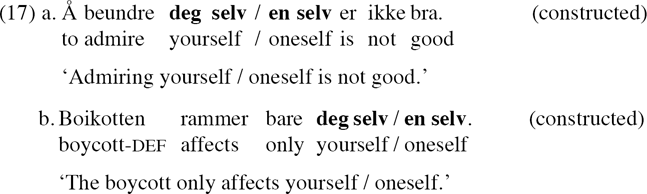
A difficult question is if deg selv ‘yourself’ and en selv ‘oneself’ are bound or free in a sentence such as 18 (constructed, based upon 15 above).

For speakers who accept invisible binders, there is no problem in assuming that deg selv ‘yourself’ and en selv ‘oneself’ are bound in 18. This is different in the case of speakers who do not accept invisible binders for the reflexive seg (selv). These speakers can still use deg selv ‘yourself’ and en selv ‘oneself’ in sentences like 18, forcing the assumption that they have unbound deg selv ‘yourself’ and en selv ‘oneself’ in this context.
The fact that there are alternatives to seg (selv) also gives a different sociolinguistic status for reflexives than for reciprocals with invisible binders. Examples with seg (selv) are easily found in authentic texts from newspapers, schools, private companies, etc. Even so, some speakers, especially older ones, feel that en (selv) ‘oneself’ is the proper choice in a sentence like 15. However, this does not necessarily imply that these speakers find seg (selv) unacceptable. The diachrony and sociolinguistics of reflexives with invisible binders raise interesting questions, which must be left to future research (but see section 4.2 for some speculation).
In examples such as 19, the binder is an I-argument in a nominalization or another noun phrase with argument structure. Most examples have the complex reflexive seg selv, but the simple reflexive seg is also used, as in 19d.4
The distribution of simple and complex reflexives seems to follow the same rules with invisible binders as with visible binders. For example, the use of the simple reflexive in the nominalization in 19d should be compared to the use of the simple reflexive in the corresponding sentence in i.


Only a couple of my informants do not accept sentences in which reflexives are bound by I-arguments. (All of them accept reciprocals bound by I-arguments.)
Like the reciprocals, reflexives can be bound by P-arguments in indefinite noun phrases. Compare the examples in 20.

At least some cases of P-argument binders, like 20a, seem to be generally acceptable.
The distribution of reflexives gives additional evidence for invisible argument binders, which is not available with reciprocals. The basis of the reasoning (suggested to me by Annie Zaenen) is the well-known rule that the simple reflexive seg must be bound by a subject. Examples 21a and 21b show that both I-arguments and P-arguments count as subjects in this respect.

In 21a,b the simple reflexive is bound by the invisible arguments of et nytt syn ‘a new view’ and mye luft ‘much air’, respectively. Both these invisible arguments are controlled by the indirect object ham ‘him’. Saying that the reflexive is bound by the indirect object would violate the rule that the simple reflexive must be bound by a subject.
4. Unbound Reflexives.
Some younger speakers also have reflexives that are not bound by anything. These reflexives always have a generic interpretation. They are used where other speakers use en (selv) ‘oneself’ or generic deg (selv) ‘yourself’. The term unbound reflexives is of course a misnomer, but it will be used for convenience—examples are 22a–d, in which the reflexive is the object of a verb, or of a preposition in a complement or an adjunct.5
Passive sentences such as i probably belong to the same group as 22a–d.

The implicit argument does not seem to act as a binder, one argument being that these passives seem to have the same restricted distribution among speakers as the actives in 22a–d.

Other cases of unbound reflexives are given in 23a, in which the possessive reflexive is a part of the subject, and in 23b, which is a nominalization differing from the nominalizations in 19 above in that the reflexive is not bound by the implicit argument (as shown by its content and context; 23b is about new governmental regulations for doctors.)

Unbound reflexives can even be found as nominal predicates, as in 24. As is well known, a nominal predicate cannot be bound, because it is not referring.

Sentences 22–24 are all examples of reflexives that have no binder, visible or invisible. Even if it might be possible to postulate invisible binders, it would be difficult for all cases, and it would undermine the theory of I-arguments. Assuming invisible binders for all cases would also make it difficult to account for different intuitions—it would be necessary to assume that there are two or more types of I-arguments with different binding properties for different groups of speakers.
The sociolinguistics of unbound reflexives is not known. The informants who told me that they accept this use of reflexives were all born after 1970. The phenomenon must be older, however, since it can be found in a poem by the late poet Sigmund Mjelve (1926–1995). It is also striking that it can be found in texts that are not colloquial in style, such as 22b,c and 23b.
With a certain amount of idealization, one could say that there are two systems for reflexives without visible antecedents (in addition to a system that does not have them). One system—the conservative system—has reflexives with I-argument and P-argument binders, a system parallel to that of the reciprocals. The other system—the radical system—does not limit reflexives to positions where they can find realized or implicit binders. In a sense, this system has unbound reflexives. This is of course a contradiction in terms, and it would be more correct to say that it has a form seg (selv) that is not specified for the feature +/− reflexive. This underspecification is already well established in the system of Norwegian proforms. It can also be found with generic en (selv) ‘oneself’ and deg (selv) ‘yourself’ (see section 3), and with first and second person pronouns (in the sense that they do not have separate reflexive forms).
4.1 Delimitation.
The discussion of unbound reflexives has been based upon reasonably clear example sentences, but their delimitation remains difficult. At the same time, it is important not only for the present discussion, but also for the more general account of binding in Norwegian. An important problem concerns sentences such as 25, with a generic noun phrase in subject position and a reflexive in a subordinate clause.

For speakers who accept unbound reflexives, one could say that the reflexive in 25 is unbound. It is striking, however, that 25 (which is from a parliamentary document) is reasonably acceptable to speakers who do not have unbound reflexives. This indicates that 25 could be a case of long distance binding. A possible argument against this position is that long distance binding cannot cross a finite clause boundary, and that the long distance reflexive is always the simple reflexive. However, this traditional view has to be modified (see Hellan 1988 for the traditional view, and Lødrup 2006 for an alternative). For example, the reflexive in 26 must be bound by the non-generic subject in the higher clause. Example 26 seems to be acceptable to most speakers, even if it has a complex reflexive that is bound across a finite clause boundary.

Example 27 also has a complex reflexive in a clause below a possible binder (the PRO subject of se ‘see’). It is probably an unbound reflexive, however, because 27 is not accepted by speakers who do not have unbound reflexives.

The relevant difference between 25 and 26 on the one hand and 27 on the other is that the former have inanimate subordinate subjects. This property makes long distance binding of complex reflexives more acceptable in general (Lødrup 2006).
All sentences that might be analyzed as involving long distance binding, such as 25 and 26, have been left out of consideration when researching unbound reflexives.
4.2 The Use of Generic Forms.
Why do unbound reflexives always have a generic interpretation? One could point to the fact that PRO also gets a generic interpretation when it is unbound (see Hellan 1988:185). The focus here is on the relation between unbound reflexives and other generic forms. It has been shown that en (selv) ‘oneself’ and seg (selv) can alternate when the binder is an invisible generic argument, as shown in 15 and 18 above. I now show that they can also alternate when the binder is a visible generic argument.
There are two words in Norwegian that could be called generic pronouns, man and en. The pronoun man can only be used as a subject, while the pronoun en can be used in all argument functions, and also has the possessive form ens. A generic pronoun, including generic PRO, usually takes the regular third person reflexive seg (selv) as an anaphor, but en (selv) is also possible. In the same way, the reflexive possessive sin has ens as an alternative. The choice of form does not seem to influence meaning. Examples with en / en selv / ens are given in 28.6
Locally bound en (without selv) might be less common, but Hellan (1988:110) goes too far when he says it is not possible; see 28c. When the antecedent is man, only seg (selv) and sin seem natural to me, but sentences with en (selv) and ens can be found in texts.

This means that seg (selv) and en (selv) alternate both with invisible and visible generic antecedents. One could speculate that this situation is being reinterpreted as a more general option to replace en (selv) by seg (selv), allowing seg (selv) to spread and introduce unbound reflexives in the grammar of some speakers.
One argument for this position concerns the relation between simple and complex reflexives. The rules for the choice between simple and complex reflexives are not active with unbound reflexives. For example, tenke på ‘think of’ can only take the complex reflexive when the reflexive is bound. However, in 22d above, it takes an unbound simple reflexive. With unbound reflexives, the choice between seg and seg selv seems to parallel the choice between unbound en and en selv. In these cases, selv ‘self’ is a focusing or intensifying particle, and its use is not grammaticalized.
To explain the replacement of en (selv) with seg (selv), it might also be relevant that sentences with en (selv) as a non-subject have a non- colloquial flavor to many speakers (see note 8). The use of unbound generic reflexives makes it possible to avoid en (selv) as a non-subject.
The reasons to avoid en do not end here, however. In many dialects (including my own), the pronoun en is even less colloquial in subject position than in non-subject position. In the dialects in question, en is not used as a subject in colloquial speech; it is probably most correct to say that it is ungrammatical.7
One non-linguist informant said that using en as a subject sounds like a school textbook. Using en as a subject with first person meaning is a traditional feature of bureaucratic style, which has often been parodied and ridiculed. For example, the poet André Bjerke wrote about the bureaucrat herr En ‘Mr. One’.
Many traditional dialects differ from the dialects described here in using en as the colloquial form, while man feels literary. The use of generic pronouns in these traditional dialects is the basis of the normative grammar tradition of attacking man and promoting en; man is actually not allowed in the Nynorsk written norm. The normative work Vinje 1987:92 reflects the use of generic pronouns in traditional dialects in stating: “Man is not common in colloquial speech, and it can therefore give the style a somewhat stiff, old fashioned look” (my translation).
The speculations here suggest that unbound reflexives originated in dialects in which en is not colloquial. There is no implication, however, that the phenomenon is limited to these dialects, because it may have spread to other dialects. (No relevant information is available.)
5. Conclusion.
It has been shown that Norwegian has reflexives without visible binders. Unbound reflexive forms, which are used by some younger speakers, are in a group of their own. They are not anaphors, and they have no direct consequences for binding theory. More important to our understanding of binding is the fact that many speakers allow reflexives to be bound by invisible I-arguments and P-arguments. For these speakers, the visibility condition on binders of reflexives is not empirically correct.
APPENDIX
Sources and dates for the example sentences from the World Wide Web:
- (4a) www.kirken.no/stavanger/nyhet.cfm?nyhetid=18208, 09/28/2005.
- (4b) home.online.no/~olavgran/aktiviteter.htm, 09/08/2006.
- (4c) www.norock.no/doc/1000/1014/1015/Festsemreft98.doc, 08/04/2005.
- (4d) www.stortinget.no/dok8/1999/dok8-199900-018.htm, 08/04/2005.
- (5) www.antipsykopat.net/BliAntipsykopat.php, 08/04/2005.
- (7) home.trollnet.no/karesim/GammelNytt.htm, 08/04/2005.
- (8) odin.dep.no/odinarkiv/norsk/ dep/smk/1996/taler/099005-991631/dok-bn.html, 08/04/2005.
- (11) jankare.net/vamp/forum/posting.php?mode=quote&p=842&sid=e1161bcab2f4ad482a91fa2f0db3a964, 09/13/2006.
- (15) www.stenrod-barnehage.no/aarsplan.htm, 04/09/2005.
- (16) www.psykologibanken.com/artikler/FySkamDeg.html, 06/22/2005.
- (19a) http://www.caplex.no/web/artikkel/artdetalj.asp?art_id=9324237, 08/22/2005.
- (19b) www1.sv.no/oslo/org/ulydighet-1.h, 5/24/2005.
- (19c) www.fedrelandsvennen.no/nyheter/kristiansand/article287419.ece, 09/15/2006.
- (19d) www.frena.net/turtips/ornehammer/index.htm, 10/20/2005.
- (20a) forum.kvinneguiden.no/viewtopic.php?t=130573, 09/16/2005.
- (20b) www.dolcevita.no/sider/Oss/ArtOss/omit.htm, 04/09/2005.
- (20c) www.vg.no/pub/vgart.hbs?artid=4386610, 10/20/2005.
- (22a) www.hest.no/?func=debate&sub_func=show_topic&sub_id=2809&id=274, 09/02/2005.
- (22b) http://www.mammanett.no/mn/archive/index.php/t-5846.html, 08/05/2005.
- (22c) www.drammen.kommune.no/SYMFONI/PUBLIKASJON.NSF/0/7D02D46BA08C9F76C1256CB8003E9315?OpenDocument, 08/05/2005.
- (23a) www.canis.no/innlegg.php?hele=ok&nr=18647&forum=10&spmid=NULL, 04/09/2005.
- (23b) www.uib.no/isf/utposten/2000nr4/utp00410.htm, 08/05/2005.
- (24) www.skjeret.com/mmequipm.htm, 12/13/2005.
- (25) www.stortinget.no/inno/1996/199697-070-001.html, 08/05/2005.
- (26) www.dikt.no/index.php?page=vis_tekst&TekstID=152969, 08/05/2005.
- (27) www.erotikknett.no/forums/ lofiversion/index.php/t73.html, 04/09/2005.
- (28a) www.daria.no/skole/?tekst=2834, 5/24/2005.
- (28b) forum.tv2.no/forum/messageview.cfm?catid=117&threadid=14877&STARTPAGE=2&enterthread=y, 5/24/2005.
- (28c) area52.hardware.no/lofiversion/index.php/%5C%22http://amac.no/t262715-50.html, 11/28/2005.
- Note 1, (i) www.crystalgardens.net/lt/05/5.html, 08/04/2005.
- Note 2, (ii) no.wikipedia.org/wiki/Diskusjon:Nazism, 08/04/2005.
- Note 2, (iii) stud.hsh.no/home/alm00lis/eventyr/s2..htm, 08/04/2005.
- Note 5, (i) debatt.sol.no/show.fcgi?category=3500000000000014&conference=24&posting=9433, 8/11/2005.


