Introduction
In 1948, as the new Japan quickly emerged from the ashes of the Asia-Pacific War, the faculty and students at Hokkaido University launched a fundraising campaign that managed to re-erect the statue of William Clark on campus (see figure 1). Clark was the third president of the Massachusetts Agricultural College (now the University of Massachusetts Amherst) in the United States and a specialist in agriculture and chemistry. He came to Japan in 1876 as an employee of Kaitakushi (Hokkaido Development Agency) to advise Japan's colonization of Hokkaido. He founded Sapporo Agricultural College, the precursor to Hokkaido Imperial University (renamed as Hokkaido University in 1947), to train the colonizers of Hokkaido in necessary knowledge and skills. His words, “Boys, be ambitious,” enshrined as the motto of the university itself, had inspired generation after generation of graduates—the thinkers and doers of expansion throughout the history of the Japanese empire. A bronze statue of Clark was originally erected on Hokkaido Imperial University's campus in 1926, only to be removed during World War II in order to erase the suggestion of American influence on Japanese society. Because the empire redefined itself as a challenger of Western imperialism and white supremacy, Clark's statue was melted down and turned into bullets (Frontier News 2011, 3; Ōsaka Reference Shingo1965, 374–76). As postwar Japan re-entered the international arena as an ally of the Free World, the 1948 campaign to re-erect the statue of Clark was to embrace Clark's legacy as a symbol of the shared past between the Japanese and the Americans in frontier conquest.
The statue of William Clark on the main campus of Hokkaido University. Photograph by Dr. Mizuka Kimura, December 15, 2018.

A careful imitation of Anglo-American settler colonialism in North America, Japanese colonial expansion in Hokkaido in early Meiji actually carried far more imprints of the United States than the well-known story of William Clark and the legacy of Sapporo Agricultural College.Footnote 1 Taking place when the Meiji nation-state itself was still in formation, the colonial expansion in Hokkaido constitutes a critical chapter in the history of the Japanese empire. It not only offers a unique lens with which to look at the inseparability of migration and colonial expansion, and of nation-making and empire-building, but also demonstrates the profound intersections between the histories of Japan and the United States, the two Pacific empires in the nineteenth and twentieth centuries.
This article examines how the discourse of overpopulation emerged during Japanese colonial expansion into Hokkaido at the beginning of the Meiji era, modeled after Anglo-American settler colonialism. Invented for Hokkaido, the discourse of overpopulation later became a common excuse to justify migration-driven expansion throughout the history of the Japanese empire. This article also illustrates that the close imitation of American westward expansion into Hokkaido inspired Meiji leaders to see the American West as one of the first ideal targets of Japanese expansion overseas in the 1880s.
Analyzing the emergence and the significance of the overpopulation discourse during Japanese colonial expansion into Hokkaido in early Meiji, this study aims to make two overall contributions to our understandings of the Japanese empire and modern colonialism in world history. First, it heeds the insights of the scholarship in recent years that demonstrates that the colonization of Hokkaido conducted by the Tokugawa and Meiji regimes profoundly shaped the identities and discourses of race, status, and nation, as well as the capitalist economy of the modern Japanese empire (Hirano Reference Hirano2015; Howell Reference Howell1992, Reference Howell2005; Karatani Reference Kōjin and Kyōji1993; Mason Reference Mason2012, 17–23; McCormack Reference McCormack2002; Nagai Reference Hideo2007; Walker Reference Walker2009; Wilson Reference Wilson1995, 251–53; Young Reference Young1998, 312–18). This article traces the origin of expansionism in the Japanese empire to the colonization of Hokkaido in the early Meiji era by focusing on the ideas and power of overpopulation. To justify the policy of colonial migration, Meiji leaders described Japan proper as overpopulated and poor and Hokkaido as empty and rich. Later on, the demand for extra land to accommodate the ever-growing population in the overcrowded archipelago served as a constant excuse used by different generations of Japanese leaders to justify the territorial expansion of the empire.
This article further demonstrates how Japan's imitation of Anglo-American settler colonialism in North America in the colonial expansion into Hokkaido inspired Japanese expansionists to envision the American West as one of the first overseas targets of Japanese migration-driven expansion. This study echoes the scholars of transnational histories who have recently begun exploring the intersections of and parallels between Japanese expansion and American expansion in the Asia-Pacific region. These path-breaking works have revised our understanding of racism, nationalism, and expansionism in the histories of Japan and the United States in important ways. Eiichiro Azuma (Reference Azuma2008) demonstrates how elites in Japanese communities in the American West and in Tokyo jointly invented the story of Japanese American migration as a chapter in the glorious history of Japanese overseas expansion, which was handily embraced by the imperial government to mobilize the masses for Manchurian migration during the war. Comparing the experiences of Japanese American soldiers in the United States and Korean soldiers in the Japanese empire during the Asia-Pacific War, Takashi Fujitani (Reference Fujitani2011) has convincingly shown the unlikely similarities in racial discourses in these two Pacific empires that tended to include the ethnic minorities/colonial subjects instead of excluding them. More recently, Jordan Sand (Reference Sand2016) and other scholars have initiated innovative dialogues to explore the possibilities of reconfiguring the study of Pacific history from transnational perspectives in empires, borders, identities, and migration. Focusing on the discourse of overpopulation, my research demonstrates that Japanese colonial expansion in Asia and trans-Pacific migration in North America were connected since the very beginning of the empire. It is Japan's settler colonialism in Hokkaido in early Meiji, I argue, that laid out the social and intellectual foundations for the Japanese American migration that started in the 1880s.
Hokkaido and the Question of Population
As modern Japan's first colonial project, the colonization of Hokkaido in early Meiji revealed how the processes of nation-making and empire-building were intertwined. To build a modern nation, the Meiji government abolished the Tokugawa era's status system. By 1876, the samurai or shizoku, who were at the top of the Tokugawa social hierarchy, had lost almost all of their economic and political privileges. The Meiji government also implemented a policy of developing industry and trade (shokusan kōgyō) in order to boost the national economy, hiring American and European specialists to formulate concrete plans to modernize Japan's political and economic infrastructure. At the same time, the Meiji leaders were well aware that domestic changes alone were not sufficient to secure Japan's independence in the world of New Imperialism. To be admitted into the ranks of Western powers, Japan needed to have its own colonies. Hokkaido, the island in the northeast that had been a constant object of exploitation by forces in Honshu since the late Tokugawa period, was an easy target. The colonization of Hokkaido (ezochi kaitaku) was among the three most urgent tasks that Iwakura Tomomi, one of the core founders of the Meiji nation, suggested the new government should take on even before the Boshin War came to an end.Footnote 2 To demonstrate the power of the new empire to the entire world, Iwakura reasoned, the Meiji government's success in civilizing Hokkaido and securing sovereignty over it was crucial (Mason and Lee Reference Mason and Lee2012, 33; Tada Reference Kōmon1906, 700; Tanaka Reference Akira2000, 26).
In 1869, the Meiji government established the Hokkaido Development Agency to manage the colonization of Hokkaido. After Kuroda Kiyotaka took charge in 1871, the agency monopolized almost all political and financial policy-making powers in Hokkaido until its abolition in 1882. Originally a samurai of lower rank in the Satsuma domain who held a profound interest in the West, Kuroda's empathy for shizoku and his passion for modernizing the nation according to the Western model came together in his blueprint for Hokkaido colonization. Kuroda regarded Hokkaido as a land of promise that would provide immediate help to the imperial government in two of its most urgent tasks: resettling the declassed samurai and developing the economy. He believed that the land of the island was large enough for the government to distribute to shizoku settlers, and that Hokkaido could provide enough natural resources to boost the entire nation's economic development. These two missions thus converged in the colonial migration of shizoku to Hokkaido under the direction of the Development Agency.
The two flagship migration programs launched by the Development Agency were the program of farmer-soldier (tondenhei) and the program of land development (tochi kaitaku). The farmer-soldier program recruited domestic shizoku as volunteer soldiers and settled them in Hokkaido by providing free land and houses, as well as other living and farming facilities.Footnote 3 These settlers were expected to both conduct military training and work the land in assigned settlement locations. The program of land development, on the other hand, encouraged nonmilitary shizoku settlement in Hokkaido by providing free lease of land between about one and a half chō to three chō to each shizoku household for up to five years.Footnote 4 If their farming proved successful, the shizoku settlers could own the land with no charge (Kikkawa Reference Hidezō1935, 128). These policies led to a wave of collective settlements of the declassed shizoku who were financially sponsored by their former lords. These collective projects were usually launched and organized by private migration associations. Though different in format, both programs aimed to export the impoverished shizoku to Hokkaido and turn them into an engine for colonial development.
For the Development Agency, both the migrants and the land of Hokkaido itself were invaluable for the nation. Through migration, the policymakers aimed to turn the declassed samurai into model subjects of the new nation and trailblazers in its frontier conquest. The land of Hokkaido was imagined as a source of great natural wealth, and the policymakers expected to convert this wealth into strategic economic resources through the boundless energy and massive manpower of the shizoku migrants.
Though Hokkaido was described as an empty, untouched land, justifying the proposal of migration was not an easy task for the early Meiji leaders. Government official Inoue Ishimi, for example, observed in 1868 that the size of the existing population in Japan proper was limited, and most of the residents shouldered the responsibility for providing food to the entire country. Unless its agricultural productivity increased, he believed, the nation could not afford to send people to Hokkaido (Yoshida Reference Hideo1944, 250).Footnote 5 A supporter of Hokkaido migration, Inoue considered the domestic population shortage a barrier and believed that it was necessary to have a surplus population in Japan proper first. He suggested that modernizing agricultural technology would free some individuals from food production (250–51). However, such development still could not provide the timely source of migration that the government immediately needed.
A solution was found, instead, by reinterpreting demography. Based on the assumption that a certain area of land has a maximum number of people that it can accommodate, a document issued by the Meiji government in 1869, Minbushōtatsu (Paper of the Ministry of Popular Affairs), defined the existing population distribution in the nation as imbalanced, with an excess in Japan proper, where most areas were so densely populated that there was not even “a place to stick an awl,” and a shortage in the northeastern part of the empire, where the spacious land was in dire need of human labor (Yoshida Reference Hideo1944, 213–14). This imbalance, the report claimed, led to surplus people and their poverty. To allow for existing resources to be used more evenly, people in overpopulated areas had to be relocated to unpopulated areas to utilize unexplored land. Thus, by presenting a gap in the demographic distribution in the archipelago, the report justified migration as a solution to regional poverty. While this report did not specify Hokkaido as a migration destination, its logic was quickly picked up by Japanese expansionists to justify their proposals for Hokkaido emigration. As explained below, they presented Hokkaido as a rich but empty land ready to accommodate surplus people from the overpopulated areas of Japan proper.Footnote 6
Malthusian Expansionism and the Model of Anglo-American Settler Colonialism
The idea of seeing the empty land of Hokkaido as a cure for domestic poverty was by no means new. Tokugawa intellectuals like Namikawa Tenmin had used it to rationalize their proposals for northward expansion as early as the eighteenth century (Kaiho Reference Mineo1979, 126). However, the discourse of overpopulation that emerged in early Meiji was a direct result of Japan's embrace of the modern nation-state system and new imperialism in the nineteenth century. The government report of 1869 that investigated and interpreted the demographic figures in the archipelago was also a result of the Meiji leaders’ efforts to make information about people, society, and natural resources visible to the state through quantitative methods. As it did in Europe and North America, demography as a modern discipline emerged in Japan as a critical means for the government to both monitor and manage the life and death of its subjects.Footnote 7 Three years later, based on information collected by the national household registration system it had recently established, the Meiji government began to regularly conduct nationwide population surveys.
A central motive behind the quest for demographic knowledge in Meiji Japan was to provide scientific evidence to confirm the common-sense observation of rapid population growth in the archipelago at the time, a phenomenon brought on by the modernization of medicine and public hygiene. Japanese intellectuals, like their Western counterparts since the Age of Enlightenment, interpreted demographic expansion as a symbol of progress and prosperity. Since population size was considered a direct indicator of a nation's military strength and labor capacity, its increase was widely celebrated in the archipelago as the new empire struggled to find its feet in the Social Darwinist world. Therefore, the Japanese intellectuals who introduced English cleric and scholar Thomas Malthus to the archipelago did not oppose population growth per se, but called for attention to the issue of poverty, which they saw as a side effect of population growth. In an article titled “Jinkō sōshoku no kaika ni kai aru no setsu” (On the damage of population growth to civilization), published in 1876 and one of the first articles that discussed Malthusianism in Japanese, the author Motono Sukerokurō admitted that the Malthusian call to reduce population was against the mainstream opinion of the day and might not be applicable to Japan's social conditions (Yoshida Reference Hideo1944, 17–18). In fact, the majority of scholarly writings on Malthus in the Meiji era were critical in tone. Japanese intellectuals attacked Malthus from both theoretical and empirical angles, concluding that population growth within the archipelago was a positive development (43–77).
On the other hand, the celebration of population growth in Japan, as in the West, took place in the context of modern colonialism. The claim of overpopulation, a natural result of the rapidly growing population within the limited territory of the empire, served as a central tenet of legitimacy for Japan's quest for wealth and land overseas. Japanese leaders saw the Western empires’ territorial and demographic expansion as the guidebook for Japan's own project of empire-making. Accepting the Malthusian idea that land had a finite limit on the population it could sustain, they believed that the Japanese in an overpopulated archipelago, a people equally as civilized as the Anglo-Saxons, deserved the same right of global expansion.Footnote 8
I define this set of ideas as Malthusian expansionism. As a discourse of expansion, Malthusian expansionism demanded extra land abroad to accommodate the claimed surplus people in the domestic society on the one hand and emphasized the necessity of the overall population growth of the nation on the other hand. As two sides of the same coin, these seemingly contradictory ideas worked together in the logic of Malthusian expansionism. It rationalized Japan's migration-driven expansion as both a solution to domestic social tensions supposedly caused by overpopulation and a means to leave much-needed room and resources in the homeland so that the nation's population could continue to increase. In other words, Malthusian expansionism is centered on the claim of overpopulation, not the actual fear of it, and focuses on the celebration of population growth, not the actual anxiety over it.
This logic was well elaborated by the writings of Fukuzawa Yukichi at the end of the nineteenth century. According to the rules of biology, Fukuzawa argued, a species always has a quantitative limit to its propagation within a certain space. “There is a cap on how many golden fish can be bred in a pond. In order to raise more, [the breeder] either needs to enlarge the pond or to build a new one.” The same was true, he argued, for human beings. While thrilled by the demographic explosion in the archipelago of the day, Fukuzawa warned that with such a speed of growth, the Japanese population would soon reach the quantitative limit set by Japan's then current territory and stop reproducing. However, population growth, Fukuzawa also reminded his readers, was crucial for a nation's strength and prosperity. No nation, he argued, could achieve substantial success with insufficient population. A nation had to maintain its demographic growth because demographic decline would only lead to the decline of the nation itself (Fukuzawa Reference Yukichi1961a).
Especially inspired by Anglo-American settler colonialism of the recent past, Fukuzawa concluded that the only solution to Japan's crisis of overpopulation was emigration. Although the domestic population of England was even smaller than that of Japan, he reasoned, the British empire enjoyed unmatched prestige and power around the world thanks to the vibrant productivity of the Anglo-Saxon race. The limited space in the British Isles pushed the Anglo-Saxons to leave their home country and conquer foreign lands. The Japanese, Fukuzawa believed, should build their own global empire through overseas migration by following the example of the Anglo-Saxons (Fukuzawa Reference Yukichi1961b).
Malthusian Expansionism and Japanese Settler Colonialism in Hokkaido
As a consistent justification for expansion throughout the history of the Japanese empire, Malthusian expansionism emerged in the Japanese archipelago during Japanese colonial expansion in Hokkaido in early Meiji. The following paragraphs examine how the discourse of Malthusian expansionism came into being in the social and political contexts of late nineteenth-century Japan and was used to legitimize the colonization of Hokkaido, the first colonial project in the Japanese empire. The discourse of Malthusian expansionism further provides a valuable lens through which to look at how Japanese empire builders carefully modeled the colonial expansion in Hokkaido in early Meiji after Anglo-American settler colonialism. This imitation can be revealed in three aspects: the settlement of shizoku, the acquisition of Ainu land, and the accumulation of material capital. Together these three aspects also explain how the call for population growth worked in tandem with the complaint of overpopulation to legitimize Japanese settlers’ colonialism in Hokkaido.
Making Useful Subjects: Shizoku as Mayflower Settlers
While the Meiji government defined imbalanced demographic distribution as the cause of poverty and argued that migration would lift its citizens from destitution, the majority of the selected migrants were not those who lived in absolute poverty but the recently declassed samurai. The abolition of the status system deprived them of their previous affiliations and transferred the loci of their loyalty from individual lords to the Meiji nation-state itself.Footnote 9 Losing almost all inherited privileges and lacking basic business skills, the shizoku were pushed to the edge of survival. These politically conscious shizoku, who struggled for both economic subsistence and political power in the new nation, posed a serious challenge to the safety of the early Meiji state from both within and without. The angry shizoku formed the backbone of a series of armed uprisings in the 1870s that culminated in the Satsuma Rebellion in 1877 and the Freedom and People's Rights Movement spanning from 1874 to the 1890s.
Instead of perceiving the struggling shizoku solely as a burden or threat, Meiji intellectuals and policymakers believed that they could be put to better use. The question of how to resettle these potentially valuable subjects—and to some extent, restore their leadership in the new nation—remained a central concern of Meiji policymakers and a hot topic in public debate until the 1890s. The idea of personal success (risshin shussei), which would later grow into a dominant and persistent discourse of overseas expansion in Japanese history, emerged at this particular moment. Risshin shussei was invented initially to provide alternative value systems for the declassed samurai. In his popular book Saikoku risshi hen (an adapted translation of Self-Help, a bestseller in Victorian Britain by Samuel Smiles), Nakamura Masanao (Keiu) told his shizoku readers that their accomplishments and advancements in society should not come from inherited privileges but from their own virtues such as diligence, perseverance, and frugality (Nakamura Reference Keiu1880, 3–5).Footnote 10 Nakamura also never failed to urge his readers to think beyond their own lives. The independence and prosperity of Japan in the Social Darwinist world, he pointed out, depended on the success of shizoku in finding their feet in the new society by cultivating these virtues (1–3).
One of the most influential promoters of shizoku success was Tsuda Sen, whose career demonstrated the intrinsic ties between the discourse of shizoku independence and that of national prosperity. Born to the family of a middle-rank samurai, Tsuda acquired English proficiency through education and visited the United States in 1867 as an interpreter on a diplomatic mission for the Tokugawa regime. Inspired by his observation of US agricultural development, he began a life-long career in westernizing Japan's agriculture soon after the establishment of the Meiji state. He founded Nōgyō zasshi (Agriculture journal), a widely circulated magazine that disseminated the knowledge of Western agricultural science and advocated the importance of agricultural production. A nation's independence, he argued in the opening article in the magazine's inaugural issue, could only be achieved when the production of the nation became sufficient so that its exports exceeded imports (Takasaki Reference Sōji2008, 66). He also established a school, Gakunōsha (Society of Agriculture Study), to train shizoku in practical farming skills. He sought to overcome the traditional contempt among shizoku for farming and persuade them to “return to agriculture (kinō)” with Western technologies and become “new farmers (shinnō)” of the new nation (39). He firmly believed that the modernization of agriculture would restore honor and wealth to the shizoku, in addition to further enabling Japan to find its footing on the Social Darwinist world stage.
Tsuda's initiative matched well with the Meiji government's policy of shizoku relief (shizoku jusan) that aimed to help the declassed samurai to achieve financial independence while turning them into productive subjects of the nation.Footnote 11 Tsuda himself played a central role in promoting shizoku migration to Hokkaido. With the support of Kuroda Kiyotaka, Tsuda founded Hokkaido kaitaku zasshi (Hokkaido development journal; HKZ) in 1880. This journal served as the mouthpiece of the Hokkaido Development Agency to the general public, promoting its migration programs by linking the individual careers of shizoku with the colonial development of Hokkaido. Though it was decidedly short-lived—it folded after two years due to the agency's demise—this biweekly journal provides a valuable lens through which to look at how the ideology of making useful subjects worked together with Malthusian expansionism to foster shizoku settlement in Hokkaido.Footnote 12
In an editorial, Tsuda reasoned that the peasant population in Japan already exceeded what the existing farmland in Japan proper could accommodate. At the same time, many newly declassed samurai had to turn to farming for a livelihood. Relocating them to Hokkaido served as a perfect solution to the issue of farmland shortages (HKZ 1880g, 170–71). The natural environment of Hokkaido, Tsuda also reminded his readers, was demanding. For Japanese pioneers in Hokkaido, it was extremely difficult to carve out a livelihood in the wilderness. They had to be resolute in the face of such enduring hardships if they were to achieve any measure of success (HKZ 1880b, 4). The fact that Nakamura Masanao's essay appeared in the first issue of the journal demonstrated the importance of the ideology of shizoku self-help as a driving force behind the Hokkaido migration. Nakamura, who enthusiastically applauded Tsuda Sen's efforts, argued that Hokkaido was an ideal place for those who had no land or properties on which to achieve success with their own hands (HKZ 1880a, 5–7).
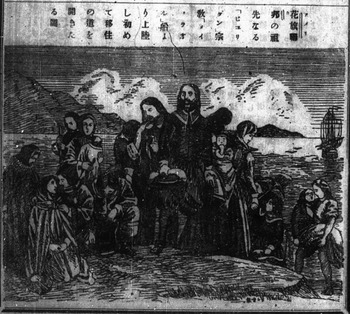
Though Tsuda used the opportunity for personal success to encourage shizoku individuals to migrate, it was the prosperity of the Japanese empire that gave the Hokkaido migration its ultimate meaning. Tsuda took pains to use the legend of the Mayflower Pilgrims to encourage shizoku migrants to connect their lives with the very destiny of the Meiji empire. Conflating the story of the Pilgrims and that of the Puritans during the British expansion in North America, Tsuda described how the Mayflower “Puritans” risked their lives to sail across the Atlantic Ocean to North America in order to pursue political and religious freedom due to persecution in their homeland (see figure 2). Not only was their maritime journey long and often deadly, the initial settlement in the new land was also challenging. In Tsuda's narrative, after enduring every kind of shortage imaginable (food, farming equipment, fishing and hunting tools), the “Puritan” settlers eventually survived. They overcame all these difficulties and turned the barren earth of America into an invaluable land of resources. It was the efforts of these earliest settlers, Tsuda argued, that established the foundation of the United States as one of the most prosperous nations in the world.
This image appeared in the second issue of Hokkaido kaitaku zasshi. The caption reads, “The picture of the Puritans, the American ancestors, who landed from the ship Mayflower and began their path of settlement” (HKZ 1880b, 1). This is a reprint of a 1754 painting by Charles Lucy titled The Landing of the Pilgrim Fathers, America, A.D. 1620.

For Tsuda, the situation of shizoku was reminiscent of the persecuted Mayflower settlers in that they were deprived of inherited privileges. Like the “Puritans” who sailed to America for political rights and religious freedom, the shizoku were supposed to regain their honor and economic independence by migrating to Hokkaido. The success of the Mayflower settlers, therefore, served as a model for the shizoku migrants. Resolved to overcome extreme difficulties and carve out a path for the future empire builders in Hokkaido by sacrificing their own lives, the shizoku migrants could make their achievements as glorious as those of their British counterparts (HKZ 1880b, 1–4).
Sekishinsha (Loyal Hearts Society), a migration association established in 1880 in Kobe, aimed to relocate declassed samurai to Hokkaido. Tsuda applauded it as a success in emulating the example of the Mayflower settlers. The prospectus of the society argued that it was more meaningful for shizoku to find ways to live a happy life than to simply waste their time complaining about their dire conditions. Among all the paths to success, it claimed, the “exploration of Hokkaido” was the most effective and realistic choice. More importantly, participating in the exploration would allow these poor shizoku to associate “their small and humble life with great and noble goals,” since their personal careers would sway the fate of the empire (HKZ 1880f, 147). The regulations of the society further required them to prepare for permanent settlement in Hokkaido, building it both for their descendants and for the empire. For Tsuda, the members of the society further served as living examples of how common Japanese subjects should take on their own responsibilities for the nation (HKZ 1880e, 122–23).
Acquiring the Ainu Land via the Mission Civilisatrice: Ainu as Native Americans
If overpopulation in Japan proper legitimized the relocation of declassed shizoku, the growth of the Japanese population served as a justification for the Meiji empire to acquire and appropriate the land of Hokkaido, originally occupied by the Ainu. In the writings of demographers and economists in early Meiji, the Japanese were listed as one of the most demographically expanding races in the world. Influential Meiji economist and journalist Taguchi Ukichi believed that Japan's population growth proved that the Japanese were as superior as the Anglo-Saxons, rulers of the most successful settler colonial empire in human history (Taguchi Reference Ukichi1878, 73–76).
The image of the Japanese as a growing and thus civilized race was further solidified by being juxtaposed against the image of the disappearing (horobiyuku) Ainu natives in Hokkaido.Footnote 13 The discourse of Japanese growth and Ainu decline in Hokkaido drew parallels with the growth of the white settlers and the decline of the Native Americans in North America (Taguchi Reference Ukichi1878, 73). Through this comparison, not only were the Japanese grouped with the Europeans as the civilized, but also the decrease of the Ainu was understood as natural and unavoidable in the Social Darwinist world.
This comparison mirrors the British explanation of the expansion of the English settlers in North America in contrast with the quick decline of the Native American population in the seventeenth and eighteenth centuries. British expansionists attributed the divergence in the demographic trends of the British settlers and the Native Americans to the physical and cultural superiority of the former over the latter. Ignoring the fact that the decline in the Native American population mainly resulted from the European epidemics brought by the settlers to the new land, Malthus believed that the purported savageness of the Native Americans, too, functioned as a check to keep the growth of their population within the capacity of the food supply. On the other hand, the demographic growth of the British settlers was thought to be a result of their superior manners and the abundance of room in the new world (Bashford and Chaplin Reference Bashford and Chaplin2017, 69–70).
The ideas of Malthus later inspired Charles Darwin as he developed his theory of evolution, which explained the different fates of species as a result of natural selection (Bashford and Chaplin Reference Bashford and Chaplin2017, 268). The application of Darwinism in the understanding of human history and societies helped give rise to facets of modern racism that undergirded the existing discourse of racial hierarchy in the European colonial expansion with scientific reasoning. As faithful subscribers to Social Darwinism, Meiji leaders, too, believed that only the superior races could enjoy rapid population increases while the allegedly inferior peoples were heading down a path of inexorable decline and eventual extinction. The destiny of these inferior races was thought to be sad but unavoidable because, due to their backwardness, they were not capable of either achieving social stability and community growth from within or competing with the superior people from outside who came to colonize their lands (Shiga Reference Shigetaka1891, 13).
The imposed, demography-based racial hierarchy of the Japanese and Ainu was perceived to further justify the Meiji leaders’ appropriation of the Ainu land. Like their European counterparts, the Meiji expansionists believed that the superior and the civilized had the natural right to take over the land originally owned by the inferior and the uncivilized so that the land could be better used. Therefore, it was not surprising for Kuroda Kyotaka to appoint Horace Capron, then the US Commissioner of Agriculture, as the chief advisor of the Hokkaido Development Agency. Before working in the US Department of Agriculture, Capron was assigned by US President Millard Fillmore to relocate several tribes of Native Americans after the Mexican-American War (Capron Reference Capron1884a, 79). Capron himself, while investigating the land of Hokkaido, found close similarities between the “primitive” Ainu and the “savage” Native Americans (Capron Reference Capron1884b, 92–93, 98).
For this reason, the migration from Japan proper to Hokkaido, the land of the Ainu, was seen as not only a solution to the issue of overpopulation in Japan but also an act of spreading civilization and making better use of the land itself. In the very first editorial of Hokkaido kaitaku zasshi, Tsuda tried to convince his readers that Hokkaido of the day was no longer the land of Ezo. The existing understanding of Hokkaido, Tsuda argued, was based on the book Ezoshi (The study of Ezo), which was authored by Confucian scholar Arai Hakuseki 150 years earlier. It described the island as a sterile land with only a few crooked roads. However, Tsuda continued, times had changed. The time had come for the Japanese to view Hokkaido as a land of formidable wealth, where settlers from Japan proper could farm, hunt, and engage in commerce.Footnote 14 Such a transition would be a result of the Japanese government's transplantation of civilization to the island (HKZ 1880a, 2–3). The native Ainu saw their ancestral lands taken away from them due to their supposed “lack of civilization,” and the land of Hokkaido was redefined by the Development Agency as unclaimed land (mushu no chi) based on the Land Regulation Ordinance of 1872, thereafter distributed to the shizoku settlers (Hirano Reference Hirano2015, 197–98; Irish Reference Irish2009, 195).
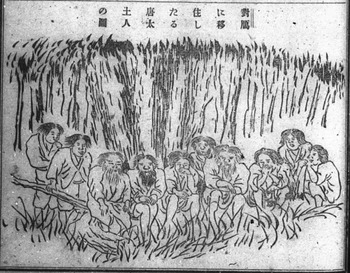
The logic that the civilized had the right to take over the land of the uncivilized so that it could be better used was more explicitly articulated in an article in Hokkaido kaitaku zasshi discussing a coercive Ainu relocation (see figure 3). In order to secure the control of Hokkaido, the Meiji government signed the Treaty of Saint Petersburg with the Russian Empire in 1875, recognizing Russian sovereignty over Sakhalin Island in exchange for full ownership of the Kuril Islands. Ainu residents on Sakhalin were, of course, excluded from the negotiation process. About 840 of them were forced to migrate from Sakhalin Island to Tsuishikari, close to Sapporo (HKZ 1880j, 385).Footnote 15 Though Tsuda recognized the unwillingness of these Ainu to give up their homeland and admitted that forced relocation had caused them grief, he contended that such pain was necessary: since the Ainu lacked both motivation and ability to develop their Sakhalin homeland into a profitable place, it would be a waste to let them stay there in hunger. The Japanese, on the other hand, not only put Sakhalin to better use by exchanging it with Russia for the Kuril Islands, but also had been civilizing these relocated Ainu. Tsuda happily noted that the Ainu in Tsuishikari, in addition to receiving new educational opportunities, were learning the modern ways of hunting, handcrafting, and trading. He posited that these Ainu were now satisfied with their new life and felt grateful for the protection offered by the Development Agency (HKZ 1880j, 387). By this logic, the Meiji government's takeover of Ainu lands was portrayed as an altruistic project that had the native residents’ best interests at heart.
The caption of this image in Hokkaido kaitaku zasshi reads, “the picture of the native people (dojin) of Karafuto who were relocated to Tsuishikari” (HKZ 1880j, 1).

In reality, however, the relocation soon trapped these Ainu in misery. Unfamiliar with the new environment and incapable of adapting to the new ways of production introduced by the Meiji authority, they could not sustain their own livelihood. The community was further decimated by epidemics, especially in 1886, when the spread of smallpox claimed over 300 lives. Many survivors later returned to Sakhalin (Emori Reference Susumu2007, 412). The tragedy of this group of Ainu was only one example of the rapid decline of Ainu communities in general due to a series of Meiji policies that deprived them of their land, materials, and culture in the name of spreading civilization (Hirano Reference Hirano2015, 197).
Accumulating Material Capital: Hokkaido as California
Meiji expansionists’ acclamation of population growth was also a product of the development of Japan's nascent capitalist economy. Their desires to acquire more human and natural resources through expansion were driven by the impulse of capitalist accumulation. The migration of people from Japan proper to Hokkaido to explore and exploit the natural resources was expected to meet these demands. In their imagination, the worthless land of yesterday's Ezo suddenly became a precious source of ever-growing wealth (fugen), because its earth, river, mineral deposits, plants, and wild animals all became potential resources for Japan's nascent capitalist economy.
In the eyes of Tsuda Sen, the enormous amount of natural wealth in Hokkaido was vital to finance the Japanese empire's industrialization, road building, and trade expansion (HKZ 1881a, 50–51). To help readers in Tokyo understand the richness of Hokkaido through the vocabularies of capitalism, almost every issue of Hokkaido kaitaku zasshi included articles that illustrated how various natural resources in Hokkaido could be either extracted for direct profit or used for material production. These included, to name but a few examples, tips for hemp processing, the benefits of planting potatoes, how to run wineries, and methods for salmon fishing (HKZ 1880b, 9; 1880c, 56; 1880d, 97; 1880h, 241; see figure 4).
These two pages in Hokkaido kaitaku zasshi introduce different types of salmon in Hokkaido. The same issue also discusses tips for salmon fishing and canning as well as incubating salmon eggs (HKZ 1881b, 242–43).

For the Meiji empire's capitalist exploitation of Hokkaido through migration, the American westward expansion served a key guide. In addition to Capron, the agency also hired more than forty other American experts who specialized in agriculture, geology, mining, railway building, and mechanical engineering to guide its project of transforming natural deposits in Hokkaido into profitable resources (Fujita Reference Fujita1994, 10).
To draw the parallel between Japanese colonial migration in Hokkaido and American westward expansion, Tsuda Sen declared that soon an “America” would emerge from the Japanese archipelago. While Japan could not compete with America in terms of wealth, power, and progress in democracy and education, he maintained, the soil of Hokkaido was as rich as that of the United States, and their climates were equally suitable for farming. Tsuda assured his readers that as the colonial project continued to develop, material production from Hokkaido would match that in the United States (HKZ 1880c, 50). In particular, he compared the position of Hokkaido in Japan to that of California in the United States. Located on the West Coast of North America, Tsuda argued, California had been no more than an empty land until it became a part of the United States. Within two decades of American settlement, with the discovery of gold and the improvement of agricultural technology, its population and material products grew exponentially. Hokkaido, Tsuda claimed, had not only similar latitudes to California but also equal amounts of natural resources. With the influx of settlers from Japan proper making progress in land exploration, the Ezo of yesterday would surely become the California of tomorrow. It would serve as a permanent land of treasure for Japan, the output of which would sustain Japan's economic growth at home and bring in wealth from abroad through exportation (HKZ 1880c, 51).
At the center of this imitation was the transplantation of American agricultural technology to Hokkaido. Tsuda believed that in addition to the Puritan spirit of the early settlers, the Americans owed much of their triumph to the fertility of their land and high agricultural productivity. Assuming Hokkaido's land would prove to be equally as fertile, Tsuda concluded that the key to the success of Hokkaido exploration was to increase the existing agricultural productivity by transplanting American technology (HKZ 1880c, 59). He not only translated several books on new American farming practices from English to Japanese, but also included many articles in Hokkaido kaitaku zasshi calling on farmers to adopt American farming tools (see figure 5) and techniques in areas such as crop cultivation, animal husbandry, and pest control. Under the direction of the Development Agency, a variety of American crops, livestock, and machines were introduced and used in Hokkaido. In 1876, the agency established the Sapporo Agricultural College to impart advanced agricultural knowledge to future generations of empire builders. William Clark was appointed as the head of the college for a year, and passionately promoted the model of American agriculture in Hokkaido while serving in this position.Footnote 16
A picture of a new wheat-cutting tool in the United States in Hokkaido kaitaku zasshi (HKZ 1880i, 1).

From “America in Japan” to “Japan in America”
The Development Agency's colonial project was expensive. From 1872 to 1882, it cost more than 4.5 percent of the national budget each year on average. In 1880, as much as 7.2 percent of the total government spending went to Hokkaido.Footnote 17 The extent of the financial support indicated a consensus among the Meiji leaders on the overall strategic direction of the Hokkaido venture: the colonial project should be conducted through state planning and under the government's political and financial control. This policy, however, was completely changed at the beginning of the 1880s. To stop the rampant inflation following the Satsuma Rebellion of 1877, the Meiji government made a series of budget cuts that were later known as “Matsukata Deflation.” Amid this wave of fiscal restraint, the Hokkaido Development Agency was abolished in 1882. The prefectural government of Hokkaido, established in 1886, placed the importation of private capital at the center of its colonial policies, thereby reversing the agency's state-sponsored migration-focused approach (Tōhata and Norinaga Reference Seiichi and Toshitarō1978, 559–60). The inflow of private capital to Hokkaido led to a wave of land-grabbing in Hokkaido by wealthy investors and the formation of a big-farm economy similar to the agricultural model in the United States. The implementation of this big-farm model of colonial development was celebrated by colonial thinker Satō Shōsuke as turning Hokkaido into “Japan's America” (Inoue Reference Katsuo and Kōza2006, 21). As a result of the influx of private capital, most of the explored lands in Hokkaido were soon claimed by a small number of wealthy landlords, many of whom lived in Tokyo, while the majority of the local population were turned into agricultural laborers (Tōhata and Norinaga Reference Seiichi and Toshitarō1978, 590–93).
Though the number of migrants substantially increased under the new policies (Tōhata and Norinaga Reference Seiichi and Toshitarō1978, 569), for the colonial thinkers who considered expansion a way to transform shizoku from seeds of instability to model subjects of the nation, Hokkaido was no longer an ideal land. Because agricultural labor without landownership was not sufficient for these shizoku to gain wealth and honor, new frontiers of expansion beyond the Japanese archipelago were needed. Malthusian expansionism was embraced again to legitimize the proposals of migration overseas, which aimed to export the “surplus people” while allowing them to connect their personal ambitions with that of the nation.
Following the policy change in Hokkaido in the beginning of the 1880s, the Meiji government and several individuals made attempts to explore the possibilities of overseas emigration. In 1885, Tokyo answered the request of Hawaiian King Kalākaua by approving and sponsoring the migration of Japanese rural poor to the Hawaiian Kingdom as contract laborers (Dusinberre Reference Dusinberre2016, 282). Between 1885 and 1894, over 29,000 Japanese migrants reached the shores of the Hawaiian islands (Moriyama Reference Moriyama1985, xviii). This decade-long program—known as “government-sponsored emigration” (kanyaku imin)—was successful in terms of migrant numbers. But because most of these emigrants ended up as cheap laborers in sugar plantations, few Meiji expansionists found this program satisfactory (Moriyama Reference Moriyama1985, 16). Instead, they launched their own emigration campaigns. Tsuda Sen, for example, investigated the Ogasawara Islands as a possible place for shizoku migration in 1887 (Takasaki Reference Sōji2008, 103). Others called for expansion to the South Seas (Shiga Reference Shigetaka1891). Yet the agenda of expansion beyond Hokkaido materialized first in the campaign of Japanese migration to the United States initiated by Fukuzawa Yukichi.
I call the campaign of Japanese American migration from the mid-1880s to 1889, spearheaded by Fukuzawa Yukichi and his students, the first wave of Japanese American migration. This migration wave was an ideological offspring of the shizoku-based colonial expansion in Hokkaido in the previous years. Japan's imitation of Anglo-American settler colonialism in Hokkaido directly inspired the Meiji expansionists to consider the American West an alternative to Hokkaido. The imagined similarities between Hokkaido and California also allowed the expansionists to replicate their vision for Hokkaido in Japan's expansion to the other side of the Pacific.
Though not as vocal as Tsuda Sen, Fukuzawa Yukichi was also a firm supporter of colonial expansion in Hokkaido. He believed Hokkaido's enormous wealth should be utilized, and he connected individual success with the act of colonial expansion. Some of his students at Keiō Gijuku (Keiō School) participated in the Hokkaido Development Agency's shizoku-migration program. Among them, Sawa Mōkichi served as president of Seikishinsha (Loyal Heart Society) and Yoda Benzō founded Banseisha (Late Blooming Society), both of which were leading companies in the Hokkaido migration of the day.
Fukuzawa's campaign of promoting migration to the United States began in 1884. In a public speech that year, he used the example of British settler colonialism in New England to criticize the lack of expansionist spirit among the educated youth in Japan:
Let us suppose that Hokkaido is a British territory.… Its soil is rich and it has great natural resources. If such a source of wealth were located 500 miles from London, I doubt that the British would ignore it. Certainly, they would compete with each other to settle Hokkaido and to develop the entire island; and then come up with another New England within a few years.… I am very embarrassed. The Europeans crossed five thousand miles of ocean to develop America, while the Japanese refuse to go to Hokkaido because they say that five hundred miles is too great a distance. (Oxford Reference Oxford1973, 217–18)
In the second half of the speech, after acknowledging the difficulties of the natural and economic conditions in Hokkaido, Fukuzawa proposed, “If Hokkaido is really bad, why don't our young men change their direction and go to foreign countries?” In particular, he pointed out, “America is the most suitable country for anyone to emigrate to” (Oxford Reference Oxford1973, 217–18). For Fukuzawa, the United States, just like Hokkaido, was a land of abundant wealth awaiting Japanese exploration. As he described in Seikai kuni zukushi (The review of nations in the world):
[The United States] is equal to Great Britain in every kind of manufacturing and business, and it excels France in literature, arts, and education. Their land produces grains, animals, cotton, tobacco, grapes, fruit, sweet potatoes, gold, silver, copper, lead, iron, coal; indeed nothing necessary in daily life is wanting. People who want to get clothes and food naturally come to the place where it is easy to make a living, so people gather from all over the world every day and every month. (Fujita Reference Fujita1994, 6)
As an immigrant nation that had a vibrant spirit of progress and stood at the center of modern civilization, Fukuzawa argued, the United States was the place where Japanese subjects could study and grow (Fukuzawa Reference Yukichi1960a, 444). Moreover, the United States was also an expanding nation that kept on opening up new lands through frontier conquest and migration. Fukuzawa encouraged the Japanese to follow the examples of European settlers and participate in American frontier expansion. One day, he expected, the offspring of Japanese immigrants would gain political rights in the United States and sway American politics. In this way, the overseas migrants would establish ten or even twenty “new Japans” around the world (Fukuzawa Reference Yukichi1960b, 546).
If the opportunities of serving the nation, acquiring wealth, and contributing to the progress of civilization were used to encourage Japanese to emigrate to the United States, the logic of Malthusian expansionism turned the migration into an absolute necessity. While the discourse of population imbalance inside Japan was invented to rationalize the migration from Japan proper to Hokkaido, Sugi Kōji, one of the earliest demographers in the Meiji era, applied this view in describing the demographic distribution of the world at large. In a speech delivered in 1887, Sugi argued that since the population was unevenly distributed in the world in general, migration beyond national borders was unavoidable in order to avoid poverty. He believed that the rapid speed of population growth provided Japan the natural right of overseas migration, since exporting the surplus population was the only choice the nation had in order to maintain its prosperity. The United States was the ideal destination for Japanese emigration, because it was not only an advanced nation that would lift the Meiji migrants up in the progress of civilization, but also a largely unoccupied land with abundant space, wealth, and opportunities (Sugi Reference Kōji1902, 150–55).
The discourse of Malthusian expansionism was also embraced by guidebooks for Japanese American emigration in the 1880s. Penned by Meiji travelers and settlers in the United States, these guidebooks described the American West as a heaven for the Japanese, with abundant natural resources and enormous opportunities for both education and work. They encouraged their domestic readers to leave the overcrowded archipelago and follow the example of the Europeans by pursuing their new lives in America. Like the migration to Hokkaido, this route of self-help was also guided by the teleology of Japan's rise as a civilized empire, with the expectation of transforming the emigrants into pioneers of overseas expansion (Akamine Reference Seiichirō1886; Fukuoka Reference Teru1887; Ishida and Shuyu Reference Kumatarō and Sanjin1886; Mutō Reference Sanji1887). Japanese settlers’ colonial encounters with the Ainu in Hokkaido also helped Japanese emigrants to fit themselves into the racial hierarchy in the American West as a dominant race on the same footing as the white settlers. In these guidebooks, Native Americans were called “dojin” (literally meaning “native people”), the same term used for Ainu in Japan. A guidebook titled Beikoku ima fushigi (The United States is wonderful now) drew a further parallel between the Ainu in Hokkaido and the Native Americans in the United States by calling the latter the “red Ainu” (Aka Ezo) (Akamine Reference Seiichirō1886, 141).Footnote 18 The book described at length the backwardness of the Native Americans, such as their lack of a written language, the primitiveness of their religion, and the inequality in their gender relations (see figure 6). As Japanese officials and scholars had written of the Ainu, Beikoku ima fushigi observed that the Native Americans were quickly vanishing. Amid the wave of civilization, the book observed, they were as vulnerable as “leaves in the autumn wind” (144).
This illustration appears in a guidebook for Japanese American migration published in Japan in 1886. The Native Americans were not only described as savage, but also termed “dojin,” the same label used for Ainu in Japan (Akamine Reference Seiichirō1886, 135).

From 1884 to 1888, quite a few graduates of Fukuzawa's Keiō School landed in California. In May 1888, the Alumni Association of Keiō School was established in San Francisco with thirty-five members (Tachikawa Reference Kenji1990, 17). In 1885, Fukuzawa initiated a project of collective migration to the United States with the financial support of Hokkaido entrepreneur Yanagida Tōkichi and Keiō graduate Kai Orie (who opened his own business in California) (Zuzue Reference Ei'ichi1980). His promotion of migrant expansion to the United States reached its peak in 1887. In that year, inspired by British colonial expansion in North America in the previous centuries, Fukuzawa proposed to “establish a Japanese nation in America” (Nihon koku Amerika no chihō ni sōritsu). Thanks to the recent opening of the sea route between Tokyo and Vancouver, he rejoiced, people and goods could now easily move across the ocean. As tens of thousands of Japanese subjects began to populate the American West Coast, a Japanese nation (Nihon koku) would soon emerge on the other side of the Pacific. He further expected that this newly established Japanese settler nation would become a permanent resource of wealth for the home archipelago (Tachikawa Reference Kenji1990, 20–21). To realize this goal, he collaborated with Inoue Kakugorō, his student who had migrated to the United States a year earlier. They planned on purchasing land in California in order to build an agricultural colony for Japanese settlers (21–25). Jiji shinpō also published several articles throughout the year that reported on Inoue's activities in preparation for this plan (23–24). This colonial project was terminated, however, due to the sudden arrest of Inoue during his stay in Japan.Footnote 19
The failure of Inoue's colonial project brought Fukuzawa's promotion of American migration to an end. The early Japanese migrants who made their way to the United States experienced blunt white racism by observing the anti-Chinese campaigns. As Eiichiro Azuma (Reference Azuma2014a) points out, these early Japanese American settlers were well connected with Japanese political debate and policymaking circles. They read the anti-Chinese campaigns as a strong statement that the American West was reserved for the white European settlers and warned their domestic cohorts that the Japanese would soon be excluded like the Chinese. Fukuzawa accordingly suspended his promotion of Japanese migration to the United States in 1888 (Tachikawa Reference Kenji1990, 29–30).
The termination of Fukuzawa's promotion of American migration was by no means an end of his faith in Malthusian expansionism. After Japan acquired Taiwan as a colony from the Qing empire, Fukuzawa immediately called for mass migration from the overcrowded archipelago to Taiwan in order to explore the latter's natural wealth (fugen o kaihatsu suru). To live out the true meaning of civilization (bunmei no hon'i), he suggested, the Japanese should follow the example of the Anglo-Saxons in North America by monopolizing all of the island's resources and banishing the benighted aborigines from their own land (Fukuzawa Reference Yukichi1961c).
In a more general sense, numerous late nineteenth-century participants in the Hokkaido colonial project, as well as people who were directly influenced by them, later also became the arms and brains of Japanese expansion abroad. Tsuda Sen and his extended family provide a telling example. After serving as the editor of Hokkaido kaitaku zasshi, Tsuda Sen turned his colonial gaze toward the Korean peninsula and later northern China, while his son Tsuda Jirō went to California to foster Japanese American agricultural settlements (Takasaki Reference Sōji2008, 138–55, 171–72). Tsuda Yunako (later Abiko Yunako), a daughter of Tsuda Sen, migrated to San Francisco after marrying a Japanese American immigrant, Abiko Kyūtarō. Abiko Yunako established the Japanese Young Women's Christian Association in San Francisco in Reference Yonako1912 and served as the director of the association until 1923. The primary goal of the association was to familiarize Japanese picture brides with American customs and childrearing skills in order to facilitate Japanese community building in the United States (Abiko Reference Yonako1912, 17–18; Iino, Kameda, and Takahashi Reference Masako, Kinuko and Yūko2000, 231, 237–38). Abiko Kyūtarō, husband of Abiko Yunako, was the editor of Nichibei shinbun (Japanese American news), a leading San Francisco–based Japanese American newspaper. He was not only a community leader for Japanese Americans in California but also a trailblazer in Japanese land acquisition in Mexico (Azuma Reference Azuma2014b).
Shiga Shigetaka, Fukumoto Nichinan, and Kuga Katsunan, participants in the colonization of Hokkaido in early Meiji, grew into key members of Seikyōsha (Association of Politics and Education).Footnote 20 The association became the cradle of Japanism (kokusuishugi) and other ideologies in favor of Japanese expansion into Hawaii, the South Pacific, and Latin America in the latter half of the Meiji era. Satō Shōsuke and Nitobe Inazō, who were students at Sapporo Agricultural College, subsequently taught classes on history and the policies of colonialism at the same college. They trained a group of scholars who would later sway public opinion and state policies on overseas expansion throughout the history of the Japanese empire.Footnote 21
Conclusion
Conducted in early Meiji, the formative period of Japan's modern empire, the short-lived shizoku migration into Hokkaido has often been neglected in the conventional narrative of Japanese colonial history. A careful examination, however, demonstrates how it laid an intellectual foundation for Japanese colonial expansion and overseas migration in the following decades. This opening chapter in the modern history of Japanese expansion also reveals the profound parallels and connections in the colonial histories of Japan and the United States, the two Pacific empires in the modern era.
Overpopulation, a central justification for shizoku migration into Hokkaido, emerged in the archipelago as the Meiji empire carefully emulated Anglo-American settler colonialism in the recent past. As demonstrated by Fukuzawa Yukichi's efforts in migration promotion, Japan's imitation of Anglo-American expansion in the colonial project of Hokkaido also allowed Japanese expansionists to turn to North America as the ideal destination of Japanese migration in the 1880s. As was the case in Hokkaido, the discourse of overpopulation served as a justification for Japanese settlement on the other side of the Pacific.
Malthusian expansionism, stressing the need for extra land to accommodate the rapidly growing population in Japan proper, was a common discourse that legitimized migration-driven expansion throughout the history of the Japanese empire. It simultaneously warned against the dangers of overpopulation and celebrated the overall demographic growth in the archipelago. As Japan's migration-driven expansion evolved in response to changing domestic and global environments, Japanese expansionists also envisioned other places such as Mexico, the Korean peninsula, and Brazil as the destinations of Japanese emigration. Invariably portrayed as spacious, empty, but abundant in natural resources, these lands were considered ideal both to accommodate the surplus Japanese subjects and to supply materials to feed the hungry archipelago. In the 1930s, Malthusian expansionists in Japan further placed a life-or-death significance on the empire's unprecedented demands on land and resources in Manchuria, the “lifeline” (seimeisen) of the overcrowded archipelago.
To be sure, the expansion of the Japanese empire was a long and complicated process. Its characteristics, directions, and ideologies were constantly revised by the changes in Japan's domestic social relations and international politics in different times. One may not fully grasp the nature of Japanese expansion without a careful periodization. Malthusian expansionism, though embraced by different generations of Japanese expansionists as a justification of empire, underwent its own evolution as well. This article has explained how Malthusian expansionism emerged in the Japanese archipelago and examined how it empowered Japanese settler colonialism in Hokkaido and Japanese migration to the United States in the 1870s and 1880s, the formative period of Japan's modern empire. Further research is needed to understand the specific ways and contexts in which the discourse of overpopulation continued to serve as a justification of Japanese expansion in the following decades of the empire.
Acknowledgments
I would like to thank Katsuya Hirano, Eiichiro Azuma, and Toyomi Asano for sharing their insights regarding the history of Hokkaido and migration, which inspired me to start this research. I presented earlier versions of this article at the Midwest Japan Seminar held at the University of Michigan, Flint, on September 12, 2015, as well as the Faculty Research Seminar held by the Department of History, Michigan State University, on March 16, 2017. I benefited greatly from useful comments by Charles Keith, Ethan Segal, Helen Veit, Hiromi Mizuno, Liam Brockey, Naoko Wake, and other participants of these two seminars. The JAS editors and anonymous readers also offered invaluable suggestions that helped me polish this article.