

Identifying and using preferred items and activities to increase motivation and participation of children with autism spectrum disorder (ASD) in learning activities has been an important and frequently used intervention strategy (Hagopian, Long, & Rush, Reference Hagopian, Long and Rush2004). Preferred items are generally used as reinforcers, delivered contingent on desired behaviours or skills being performed by children in structured teaching contexts. A significant body of research exists on the assessment of child preferences and a consequence-based approach to the use of preferred items as delayed reinforcers to teach children with ASD a range of behaviours and skills (DeLeon et al., Reference DeLeon, Fisher, Rodriguez-Catter, Maglieri, Herman and Marhefka2001; Lee & Sturmey, Reference Lee and Sturmey2006).
Preferred items can also be incorporated into learning tasks. For example, Dunlap et al. (Reference Dunlap, dePerczel, Clarke, Wilson, Wright, White and Gomez1994) showed that incorporating preferred activities by using an activity choice menu prior to the commencement of an instructional session resulted in less disruptive behaviour and increased task engagement. Incorporating preferred items into learning activities and tasks delivers simultaneous reinforcement in comparison to delayed reinforcement, as previously described. Some research has shown that simultaneous reinforcement can lead to more rapid behaviour change than delayed reinforcement (Kern & Marder, Reference Kern and Marder1996; Piazza et al., Reference Piazza, Patel, Santana, Goh, Delia and Lancaster2002).
However, a more recent study suggests further research is needed to investigate the relative effects of these two contexts. Heal and Hanley (Reference Heal and Hanley2007) conducted a study involving three typically developing young children and one child with developmental delay. The researchers evaluated the effectiveness of, and preference for, three teaching contexts: embedded, sequential, and no programmed reinforcement (control condition). An embedded context involved simultaneous reinforcement where teaching materials that were attractive and thought to be generally preferred by children were used. Thus by manipulating the instructional materials, the child received reinforcement. On the other hand, the sequential condition involved delayed reinforcement whereby highly preferred items or activities were provided as a consequence for responding correctly. In their study, Heal and Hanley used highly preferred edibles or stickers contingent on correct responding in the sequential context. A range of academic skills was targeted and two sets of teaching materials were created for each academic task. A paired-item preference assessment was conducted with the two sets of materials to identify the more preferred set that was then used in the embedded context. Results showed that the four children had a preference for the sequential context over the embedded context, rates of undesirable behaviour were highest in the context least preferred by the child, and there was little difference in rates of correct responding across all contexts. It should be noted that this study involved only one child with a disability (not ASD) and the sequential context used a different type of reinforcer (highly preferred edibles and stickers) than the embedded context. As the authors noted, it is possible that the results merely reflected preference for edibles and stickers used in the sequential context over the teaching materials used in the embedded context. Questions, therefore, remain about using preferred items and interests in sequential and embedded learning contexts and the effects on learning outcomes and behaviour. Furthermore, as the study involved mostly typically developing children, the effects on children with ASD, whose responses and preferences may differ from those of typically developing children, are yet to be determined.
Responses of children with ASD to sequential and embedded contexts may differ from those of typically developing peers or those with other developmental disabilities. Children with ASD often have strong sensory preferences and interact with objects in repetitive and stereotypic ways (cf. Bruckner & Yoder, Reference Bruckner and Yoder2007). Research has indicated that many of these objects that are preferred by children with ASD may increase problem behaviour and encourage more solitary behaviour. Sautter, LeBlanc, and Gillett (Reference Sautter, LeBlanc and Gillett2008) investigated the impact of developmental features of toys and preference level on the play of six children with ASD. Toys were categorised as developmentally oriented or sensory stimulating toys. Their research showed that highly preferred sensory stimulating toys were associated with more problem behaviour and solitary play, whereas developmentally oriented toys that were moderately preferred produced the most interactive play and fewer problem behaviours. The authors concluded that for children with ASD, the sequential context may be more effective in keeping the child on task and achieving desired learning outcomes by reducing off-task problem behaviour associated with some preferred items.
Attention difficulties may also influence the way children with ASD respond in sequential and embedded contexts. Children with ASD are known to have difficulties attending to multiple cues simultaneously, referred to as stimulus overselectivity (Lovaas, Schreibman, Koegel, & Rehm, Reference Lovaas, Schreibman, Koegel and Rehm1971). They may attend to stimuli irrelevant to the task while failing to attend to the cues necessary for learning to take place. Although overselectivity is a feature of typical development, most children are able to respond reliably to simultaneous multiple cues after the age of 3 years (Reed, Stahmer, Suhrheinrick, & Schreibman, Reference Reed, Stahmer, Suhrheinrick and Schreibman2013). For children with ASD, overselectivity persists and using preferred items during instruction could introduce additional stimuli to which children with ASD may attend at the expense of attending to critical cues necessary for learning.
In summary, research is needed to determine ways in which preferred items can be used most effectively to enhance learning and engagement for children with ASD. The aim of this study was to examine the effects of using preferred items in a sequential and embedded context during a word-learning task with young children with ASD.
Method
Participants and Setting
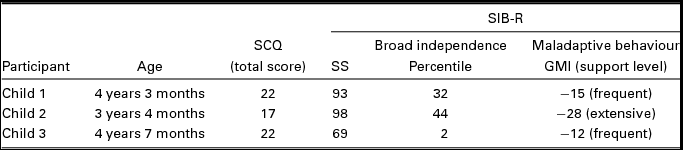
Participants were three boys, aged 3 years 4 months to 4 years 7 months (M chronological age = 4 years), who attended an early intervention centre for children with ASD. Descriptive information about the participants is shown in Table 1. All participants exceeded the cut-off score (15) for ASD on the Social Communication Questionnaire (SCQ; Rutter, Bailey, & Lord, Reference Rutter, Bailey and Lord2007). Scores on the Scales of Independent Behavior – Revised (SIB-R; Bruininks, Woodcock, Weatherman, & Hill, Reference Bruininks, Woodcock, Weatherman and Hill1996) indicated adaptive behaviours below those of typically developing peers with the need for frequent-to-extensive levels of support associated with maladaptive behaviours. The study was conducted in a small, carpeted room within the children's early intervention centre. The room contained a desk and chair and sessions occurred at the table or on the floor. Sessions were recorded using a video camera mounted on a tripod, positioned in the corner of the room.
Participant Descriptive Data
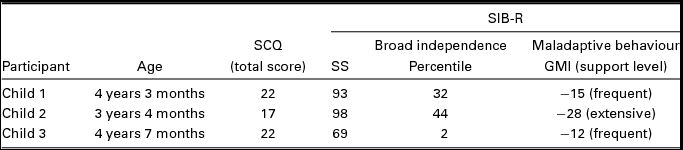
Note. SCQ = Social Communication Questionnaire; SS = standard score; SIB-R = Scales of Independent Behavior – Revised; GMI = General Maladaptive Index.
Task Selection
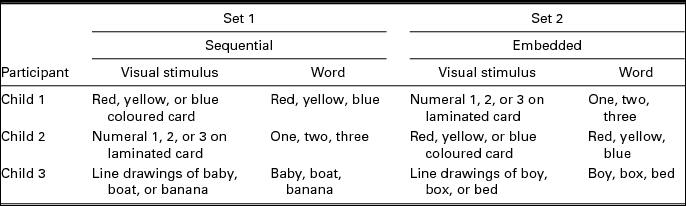
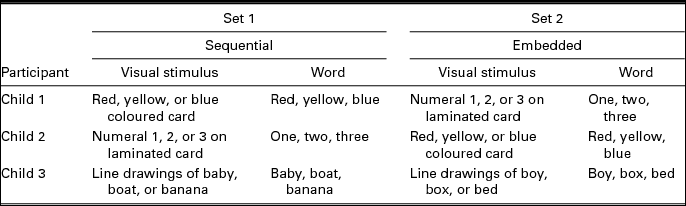
Children were required to match a visual stimulus (e.g., picture of a boat, a red coloured square) with its corresponding label (e.g., boat, red). Two equivalent sets of stimuli, matched on syllable length and word difficulty, were identified for each participant and used in one of the two intervention conditions: sequential or embedded (see Table 2). Number and colour matching sets were used for two of the participants, and objects beginning with the letter ‘b’ were selected from a larger list of words typically used with beginning readers for the third participant.
Stimuli Selected for Intervention
Preference Assessment
An engagement-based preference assessment was conducted using procedures adapted from Keen and Pennell (Reference Keen and Pennell2010). This method involves measuring time spent by children engaging appropriately with objects presented. This procedure was selected to minimise stereotypic play with preferred items that may increase problem behaviour during intervention. A total of seven toys were used in the preference assessment and were selected according to the following criteria: (a) the toys were nominated by the authors and teachers to be engaging and of interest to the participants; (b) toys had features that could accommodate the skills to be taught, but which would be unlikely to elicit sensory or repetitive behaviours; (c) toys could be used in both sequential and embedded conditions. A range of toys were selected, which included trains, superhero figurines, playdough, puzzles, cars with racetrack, a marble run, Zoobs™ and Lego™. As the intervention involved the use of printed word and stimulus cards, these were included in the preference assessment to determine if the participant held any preference for this material.
During the preference assessment, each child was exposed to one of the seven toys for a period of 2 minutes, which was videotaped for later analysis. The percentage of time the child spent interacting with each toy according to its intended purpose was calculated and then used to rank the toys from most to least engaging. The highest ranked toys were then chosen for use during the intervention. None of the participants chose the printed word or stimulus cards during this assessment.
Procedure
The study employed a multiple baseline alternating treatment design (Kennedy, Reference Kennedy2005) to evaluate the effects of the two intervention conditions: sequential and embedded. The experimental design involved four phases: baseline (Phase A), alternating treatments (Phase B), a second treatment phase (Phase C) using the condition that proved to be more effective in Phase B, and follow-up (Phase D).
Baseline (Phase A)
The baseline phase for each participant consisted of recording the number of correct matches. With the child seated at the table, the researcher placed three word cards, left to right, on the table in front of the child. She then held up the stimulus card saying, ‘This is a picture of [stimulus name, e.g., a boat]. Look here at your word cards [researcher points to each of the three word cards] and give me the one that says [stimulus name]’. This was repeated for each word in the set. The child was given 15 seconds to respond. If in that time they gave the researcher a card, she thanked the child but no other feedback was given. If no response was made within the 15 seconds, the researcher said ‘[Child's name], you didn't give me a word card, so we’ll try another one’ and moved to the next trial. Baseline sessions were conducted for both stimulus sets until a stable baseline was achieved. After a stable baseline was established, the first child began intervention (Phase B). Baseline for the third child did not commence until the first two children had participated in the intervention phase.
Alternating intervention (Phase B)
The total number of intervention sessions in Phase B and C varied for each child as intervention continued until the child achieved task competence (at least 80% correct responses for three consecutive sessions) for both stimulus sets. At the beginning of an intervention session, the child was shown their two highly preferred toys and asked to choose the one they would like to play with, and this was used for both the sequential and embedded trials for that intervention session. Each intervention session consisted of a block of 12 teaching trials using the sequential condition and one stimulus set, alternating with a block of 12 teaching trials using the embedded condition and a different but equivalent stimulus set. A short break occurred between the alternating teaching blocks. This provided four presentations of each word during an intervention session. The presentation order of the stimulus cards was randomised across trials, and the order of the word cards in the array was randomised across sessions. The commencement order of sequential and embedded trials within a session was alternated so that, overall, an intervention session began with each condition on 50% of occasions.
Sequential sessions followed a similar format to the baseline sessions, using traditional teaching materials. The child's preferred toy was set aside but within sight of the child, and he was told that he could play with the toy when he was finished his work. During the session, if the child became restless or unresponsive, the researcher would remind the child, ‘Work first, then play with [name of toy]’. The researcher placed the word cards in front of the child and proceeded as in baseline to show the child stimulus cards and instruct the child to give her the corresponding word card. If the correct card was given, the researcher praised the child saying, ‘That's right. You gave me the word that says [name of stimulus]’. If incorrect, the researcher said, ‘Not that one’ and returned the word card to the array and waited for the child to make another choice. If another incorrect response followed, or if the child made no response, the researcher prompted by pointing to the correct card and repeating the original instruction. The child was praised following a prompted correct response. At the end of the 12 trials, the child was given approximately five minutes to play with his chosen toy.
In the embedded condition, traditional teaching materials were used in conjunction with the child's preferred toys, chosen at the beginning of the intervention session. The word cards and stimulus cards were attached to parts of the toy. For example, superhero figurines were attached to each of the word cards using Blu-Tack®, and the cards were then placed in an array on the floor, in front of the child. The stimulus card was attached to the bonnet of the superhero's car. The researcher showed the child the stimulus card and asked the child to give her the corresponding word card using the same format and instructions as the sequential condition. If the child responded with the correct card, the researcher gave the child the superhero that was attached to the card so that he could play with the figurine by putting it in the vehicle and ‘driving it away’, in preparation for the next trial. Similar arrangements and play opportunities occurred with the other toys chosen by each child.
Phase C
In Phase C, the more effective of the two conditions for each child in Phase B was then used to teach the alternate set of words until criteria was reached. The change from Phase B to Phase C occurred when the child's performance in one condition was superior to performance in the alternate condition. The purpose of Phase C was to determine if the words in the less effective condition could be learned using the more effective condition. Phase C was conducted with Child 1 and 2 but was unnecessary for Child 3, who performed equally in both intervention conditions during Phase B.
Phase D
One follow-up session was conducted 5 weeks after the conclusion of Phase C for Child 1 and 2 and after the conclusion of Phase B for Child 3. The follow-up replicated the baseline procedures. The purpose of this was to determine whether the learning had been retained over time.
Measures and Reliability
The percentage of correct responses relative to opportunities was calculated for all baseline and intervention sessions for each participant. A correct response was recorded when a participant gave the researcher, on request and without prompting, the word card that matched the stimulus card presented.
Videotapes were analysed for child on-task behaviour. Each tape was divided into 5-second intervals. The primary observer paused the tape at the end of each interval and recorded the presence or absence of on-task behaviour according to the following definition of on task:
Child must be seated with body, arms and legs relatively still and looking at the teacher or learning materials. Hands must be in lap or on table, relatively still unless pointing to or passing a word card, or actively engaging with embedded materials. Vocalisations must be relevant to the task (e.g., spelling out words).
A second observer independently coded at least 40% of the videotapes for each child. Samples were randomly selected from baseline, sequential and embedded sessions for correct responses and for sequential and embedded sessions for child on-task behaviour. The second observers were doctoral students with prior experience in working with children with ASD and in video coding. Interobserver agreement for correct responses was calculated using the following formula: Agreements/(Agreements + Disagreements) x 100%. For child on-task behaviour, agreement on occurrence and nonoccurrence and on total intervals was calculated for each 5-second interval. Agreement levels for correct responses ranged from 92 to 100%, with a mean agreement of 99%. Agreement on occurrences of child on-task behaviour ranged from 0 to 100%, noting that the 0% agreement occurred on only one 5-second interval of an intervention session for one child, with all remaining intervals obtaining at least 70% agreement on occurrence. Agreement on nonoccurrences ranged from 79 to 100%.
Results
Visual inspection is generally the most accepted method of analysis in single-subject design research (Kennedy, Reference Kennedy2005). The percentage correct responses relative to opportunity for all baseline and intervention sessions are shown in Figure 1. For Child 1, intervention was associated with an increase in correct responses for Word Set 1 in the sequential condition, whereas the percentage correct responses remained at baseline levels in the embedded condition for Word Set 2. When intervention for Word Set 2 changed to the sequential condition, percentage correct responses increased and reached 100% correct within two sessions. For Child 2, performance fluctuated for the first nine intervention sessions, and there was little difference between the two conditions. Correct responses for Word Set 1 then increased in the sequential condition while performance on Word Set 2 in the embedded condition continued at baseline levels. When Word Set 2 was then changed to the sequential intervention, correct responses increased to 90%. The pattern of correct responses for both word sets for Child 3 was similar for the sequential and embedded intervention conditions, with correct responses increasing during intervention to 90% correct by sessions eight and nine, respectively. For all children, learning of both word sets was maintained at follow-up.
Percentage Correct Responses.

The mean percentage of intervals in which the child was on task during embedded and sequential conditions are shown in Figure 2. Overall, the mean percentage on-task behaviour of participants during the sequential condition was 30.57% (ranging from 12.73 to 42.31%). The mean percentage on-task behaviour during the embedded condition was 52.4% (ranging from 48.36 to 57.10%).
Percentage Time on Task.

Discussion
In this study, structured teaching trials using traditional materials followed by a period of access to the child's preferred toy (sequential condition) led to correct word matching for two of the three participants. These two participants did not demonstrate the same learning of an equivalent stimulus set when the same preferred toys were used as teaching materials (embedded condition). When this unlearned stimulus set was then taught using the sequential condition, learning occurred quite rapidly. This differed from the findings of Heal and Hanley (Reference Heal and Hanley2007), who reported little difference in learning outcomes between the two conditions for typically developing children. For the third child, the choice of intervention condition appeared to make no difference to the learning outcome.
A likely reason why the embedded condition was less effective for two of the participants in this study is an attention abnormality known as stimulus overselectivity. Overselectivity involves hyper-attentiveness to selected stimuli in the environment with a corresponding lack of attention to other relevant stimuli. First described by Lovaas in 1971, overselectivity is now recognised as prevalent but not a core cognitive characteristic in children with ASD (Lovaas et al., Reference Lovaas, Schreibman, Koegel and Rehm1971; Ploog, Reference Ploog2010). Other factors such as mental and chronological age may influence overselectivity, which can also occur in preschoolers and children with developmental disorders other than ASD.
In the sequential condition of the current study, the researcher showed and named a picture (e.g., ‘boat’) and pointed to a set of written word cards that included the named object (‘boat’). To respond correctly, the child would need to attend to a complex stimulus set that included a picture, voice and written word. Overselectivity could lead to reduced learning in this condition for children unable to attend to all three aspects, and this has been found to occur in previous studies (Didden, Prinsen, & Sigafoos, Reference Didden, Prinsen and Sigafoos2000; Dittlinger & Lerman, Reference Dittlinger and Lerman2011; Singh & Solomon, Reference Singh and Solomon1990). That all three participants did learn in this sequential condition suggests that they were able to successfully attend to the salient cues.
In the embedded condition, however, the addition of the child's preferred toy may have served as a competing stimulus to which the child attended and that subsequently overshadowed the other more critical cues necessary to perform the task correctly. Although not impacting on the performance of Child 3, overselectivity may well have occurred with the other two participants. This explanation is supported by the rapid learning that took place when the sequential approach was used for two of the children in Phase C with the words they had not learned through the embedded approach in Phase B.
Further support for overselectivity comes from the patterns of task engagement associated with the two conditions. Results showed that on-task behaviour was higher during the embedded condition compared to the sequential condition. Overall, the time on task seemed to be quite low in the sequential condition (M = 30.57%), even for Child 1 (36.68%), who met criteria for word learning within three intervention sessions. Time on task for the same child during the embedded condition was higher (51.73%), but his number of correct responses remained at baseline levels during the embedded intervention sessions. If we accept the overselectivity explanation, then on-task behaviour as defined in this study may have increased as the child attended to and interacted with preferred items but failed to attend to the more salient cues required for word learning. That is, while still meeting the definition of on task, the child was actually attending to stimuli that were not relevant to word learning.
These finding have important implications for intervention practices for children with ASD and for future research. Finding ways to better engage children with ASD in learning is important, and results from this study suggest that we need to consider carefully how we measure task engagement and incorporate the child's interests and preferences during interventions. Definitions of on-task behaviour such as the one used in this study may prove to be a crude way of measuring task engagement. Our definition of being on task listed a number of behaviours that we associate with attending to and performing the task required, but we were not able to discriminate more specifically to what cues the child was attending. Engagement is a multidimensional construct and behavioural indicators of engagement as defined through on-task behaviour fail to take account of the cognitive and emotional aspects of engagement (Keen, Reference Keen2009). To undertake interventions in the future that aim to improve task engagement, research will be needed to better understand the engagement construct and how it can be measured.
In terms of incorporating a child's preferences during intervention, further work is needed to determine how this can be achieved in a way that will enhance engagement but not interfere with learning outcomes. Educators and therapists frequently use a variety of teaching materials that they believe will help to engage children with ASD in the classroom and/or make the learning activities more fun and interesting. Whether using preferred objects as counters or shaping playdough into the letters of the alphabet, it is important to identify how overselectivity by some children with ASD may play a role in the effect of these strategies on learning outcomes.
Acknowledgments
Research reported in this paper was supported with a grant from the Australian Research Council and the Autism Early Intervention Outcomes Unit (AEIOU). We thank the families and staff of AEIOU for their willing participation and assistance throughout this research.