On November 6, 2013, the Republic of the Philippines was hit by a Category 5 Typhoon “Yolanda”, which was also known as “Haiyan.” The typhoon, which had a central pressure of 858-884 hPa and an average wind speed of 315 kph, was the fourth strongest tropical cyclone to hit the Philippines since 1958, affected more than 3 million families and resulted in 6300 deaths, 28,688 injured, and 1062 missing.1
The disasters triggered by natural hazards and the after effects have been found to result in posttraumatic stress disorder (PTSD)Reference Alderman, Turner and Tong2 in victims, with the prevalence ranging from 5% to 60% in the first 1-2 years.Reference Alderman, Turner and Tong2-Reference Dai, Kaminga and Tan4. Some studies have concluded that women have a higher postdisaster risk of developing PTSD symptoms than men because of biological reasons and their social status.Reference Galea, Nandi and Vlahov3,Reference DeSalvo, Hyre and Ompad5-Reference Mason, Andrews and Upton7 Pregnant women, in particular, have been found to be at serious risk due to anxiety about their pregnancy and the health issues suffered when appropriate medical services, antenatal care, and public health services were not available.Reference Sato, Nakamura and Atogami8 For example, it was found that after Hurricane Katrina in the United States, pregnant women who had been exposed to more than 3 severe events during the hurricane had an increased risk of PTSD and depressionReference Xiong, Harville and Mattison9 and postdisaster maternal psychological distress was significantly increased.Reference Lowe, Godoy and Rhodes10
Other studies have also found that the prenatal maternal stress (PNMS) and parental stress in the postdisaster period affects both the mother’s and the baby’s physical and mental health. For example, it has been found that PNMS was negatively associated with functional play development, language, and intellectual functioning in 2-y-old childrenReference Laplante, Zelazo and Brunet11 and strongly associated with their body compositionReference Liu, Dancause and Elgbeili12,Reference Dancause, Laplante and Fraser13 and that parent’s posttraumatic stress symptoms were related to their children’s general psychological stress.Reference Juth, Silver and Seyle14
Appropriate household emergency preparedness is one of the most effective ways to reduce the disaster damage.Reference Levac, Toal-Sullivan and O’Sullivan15 Kohn et al. reported that a higher perceived risk contributed to an increase in personal preparedness activities; however, the depth of psychological distress following a disaster was not found to have a clear link with an increase in disaster preparedness activities.Reference Kohn, Eaton and Feroz16 Unfortunately, after Typhoon Yolanda, many pregnant women were faced with acute food shortages and a lack of safe drinking water and clothes.Reference Sato, Nakamura and Atogami8
Therefore, to ensure the health of the community, it is vital to assess the long-term effects of Typhoon Yolanda on maternal and child health and determine the household disaster preparedness of the females who take care of children, the elderly and the sick. To this end, this study, therefore, sought to assess the current mental health of mothers, specific factors associated with maternal stress, the current state of children’s physical development and the mitigation preparedness related to potential future disasters in Tacloban, the Philippines, 3 y after Typhoon Yolanda.
METHODS
Study Site
The study was conducted on Leyte Island in the Eastern Visayas in Region VIII, which is located between Cebu Island and Samar Island. Tacloban is the capital of Leyte province, which has 42 municipalities and a population of approximately 1.96 million in 2015.17 The Philippines ranked fourth in countries most affected by extreme weather events from 1998 to 2017 and third among all of the countries with the highest risks worldwide.18 Hydro-meteorological events, including floods and storms, accounted for more than 80% of natural hazards in the Philippines during the last half-century.18 Eastern Visayas is composed of 3 main islands, which are Leyte, Samar, and Biliran, and directly faces the Pacific Ocean.19 The sea and island water bring people rich sources of salt and marine products.19 At the time of Typhoon Yolanda, approximately 93% of all the deaths attributable to the natural hazard, primarily caused by drowning and trauma following storm surges,1 occurred in region VIII, with 92% being on Leyte island.
Study Design
This was a cross-sectional study conducted by using structured interviews from January 1 to January 25, 2017.
Study Participants and Data Collection
Mothers and children were recruited by convenience sampling. The inclusion criteria were mothers with children between 0 and 7 y old who had experienced Typhoon Yolanda. In fact, the first author and the research assistant visited a target house introduced by 1 of the research assistants in Barangay 5A and conducted interviews after procuring informed consent and measuring the weight and height of the children. Simultaneously, the other research assistant also visited the neighbors and interviewed and measured children using the same procedure. The structured interviews were conducted in Waray by native Waray-speaking research assistants. The children’s weight and height were recorded using a digital scale and a measuring tape. Their growth was evaluated using the Z-scores of the World Health Organization’s (WHO’s) growth standard.20 In case the children were not at home, such homes were visited again to procure the weight and height measurements. When we visited as many houses as possible in 1 Barangay, we moved to different Barangay using networks of friends and repeated the same processes until reached 300 participants in total. Consequently, we could get the participants from Barangays 1,4, 5, 5A, 8, 8A, 56, 79, 83A, 83C, 97, and 101 in Tacloban.
Tool Development
The questionnaires were developed on the basis of standard tools described below, and other socioeconomic factors were assessed using previously validated questionnaires.
Posttraumatic Stress Disorder
The PTSD Checklist 5 (PCL-5), which has been widely used to measure PTSD, was adopted.21 In a previous study in Leyte province after Yolanda, the Cronbach’s alpha was 0.93 and the scale composite reliability rho was 0.94.Reference Mordeno, Carpio and Nalipay22 PTSD prevalence was judged to be provisional PTSD on the basis of the DSM-V,21 and the total PCL-5 score was used for the multiple regression analysis to investigate the risk factors associated with increased PTSD.
Hurricane-Related Traumatic Experiences
The Hurricane-Related Traumatic Experiences questionnaire (HURTE) was developed by Vernberg et al. to measure hurricane-related traumatic experiences for children after hurricane Andrew.Reference Vernberg, La Greca and Silverman23 It originally had 3 items for perceived life threats (1 question), life-threatening experiences (6 questions), and loss-disruption experiences (10 questions). Two questions were deleted from the loss-disruption item because of a lack of fit, and “your parents” were changed to “you and your partner”. One question was also added about whether any family members had died.
Disaster Preparedness
Three question items for older people and their caregiversReference Wakui, Agree and Saito24 were taken from a study conducted after the Great East Japan Earthquake for which the words “care recipient” were changed to “family.”
Data Analysis
Descriptive statistics were calculated using raw data by R software version 3.6.0.25 As the 2 questions related to pets in HURTE had missing data (116 and 121), the raw data distribution was examined and question meanings re-considered, after which it was decided to exclude these from the analyses because of possible participant misunderstanding. After this procedure, there were still 217 missing values (10.3%) for the 70 variables; that is, each variable included 0 to 24 (8%) missing records. To ensure the effective use of the data, before the further multiple regression analyses, a multiple imputation method was applied to create 1000 datasets, for which the estimated coefficients were integrated, and the multiple imputation conducted in R software and Amelia II version 1.7.5 package.Reference Honaker, King and Blackwell26 The results were found to be statistically significant for P < 0.05.
Cronbach’s alpha was used to assess the reliability of PCL-5, and a t-test and an analysis of variance (ANOVA) were conducted to examine the factorial relationships between the demographic data, the maternal and child health outcomes, the PCL-5, the HURTE, and disaster preparedness. The related HURTE, disaster preparedness, and PCL-5 factors were then analyzed using logistic regression and multiple regression analyses, with the Nagelkerke’s R-squared or adjusted R-squared being used as the goodness of fit indicator.
Ethical Considerations
This study was ethically approved by the ethics committee of Kobe University Graduate School of Health Sciences (approval number = 560). Written informed consent from each participant was obtained before the interviews.
RESULTS
General Information
Demographic Data and Socioeconomic Status
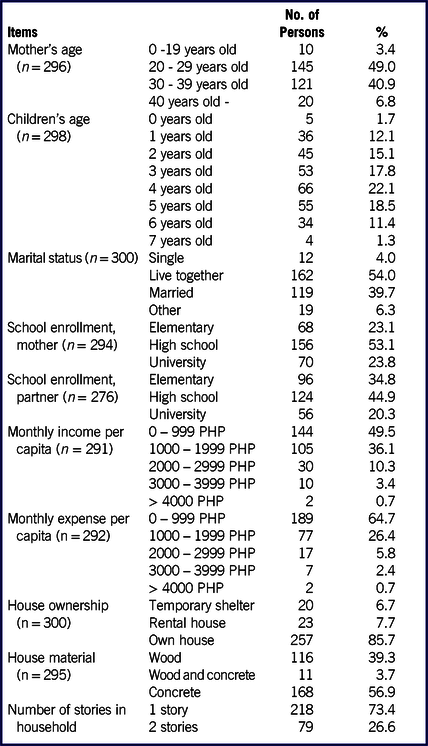
As shown in Table 1, most mothers were in the 20s and 30s, the children ranged in age from under 1 y old to 7 y old, 39.7% of mothers were married, and 54.0% of them were just living together. The education level of the mothers and their husbands/partners were as follows: elementary school (23.1%, 34.8%), high school (53.1%, 44.9%), and university (23.8%, 20.3%); therefore, most mothers had higher education levels than their husbands/partners. Household income in 95% of participant households was below the absolute poverty line (US$1.90 = 95PHP per day; n = 291). A majority of participant mothers were housewives, and 17.7% were self-employed, such as owners of a “Sari-sari store.” Five husbands/partners did not work, and 54.7% of husbands/partners worked in temporary jobs. More than 85% of participants lived in their own houses: 26.6% in multistory houses and approximately 50% in concrete houses.
Demographic Data

Children’s Health
Among 0- to 5-y-old children, 47 (22.9%) children were underweight, 1 (0.5%) was overweight (n = 205), 86 (42.4%) children were stunted, 113 (55.7%) were normal height (n = 203), 13.8% of the children had trouble sleeping, and 11.4% had trouble eating. Children’s health did not appear to be affected by their mother’s PTSD.
HURTE
Perceived Life Threat
In all, 84.8% of women had perceived a life-threatening experience during Yolanda. The Z-scores for the children’s heights were significantly different between the mothers who had a perceived life threat and the mothers who had not (t-test: df = 234.87; t = 2.015; P = 0.045).
Life-Threatening Experiences
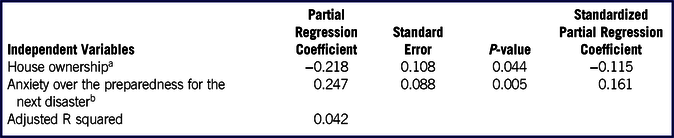
The one-way ANOVA showed statistically significant effects for house ownership (F = 5.034; P = 0.025) and anxiety over the preparedness for the next disaster (F = 8.923; P = 0.003) for life-threatening experiences. The multiple regression model results indicated that there was a relatively larger anxiety contribution to life-threatening experiences than house ownership. The coefficients for house ownership remained negative, and anxiety over the preparedness for the next disaster remained positive (Table 2); however, the variance inflation factors were less than 10, and the adjusted R-square was only 0.042.
Multiple Regression Analysis of Life-Threatening Experiences

a House ownership: 1, temporary house; 2, rental house; 3, own house.
b Anxiety over the preparedness for the next disaster: 1, not very worried; 2, Somewhat worried; 3, Very worried.
Loss-Disruption Experiences
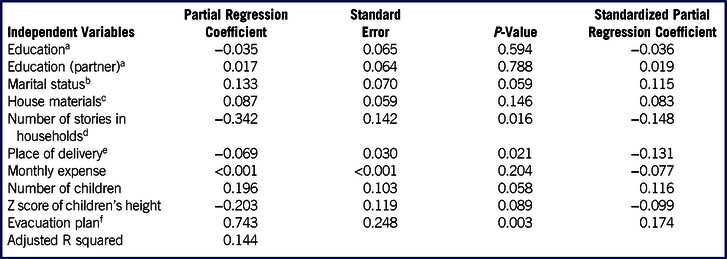
Loss-disruption experiences were significantly affected by education (F = 5.658; P = 0.017), partner’s education (F = 5.256; P = 0.022), marital status (F = 5.299; P = 0.021), house materials (F = 4.245; P = 0.039), number of stories in households (F = 15.096; P < 0.001), place of delivery (F = 0.103; P = 0.004), monthly expenses (F = 4.673; P = 0.031), number of children (F = 5.820; P = 0.016), evacuation plan (F = 6.474; P = 0.011), and missed vaccinations (F = 4.454; P = 0.035). However, most of these effects disappeared when the multiple regression model was applied (Table 3), with the adjusted R-squared being 0.144. The coefficients for number of stories in households and place of delivery remained negative and those for evacuation plan remained positive. The order of contributions to loss-disruption experiences were evacuation plan, number of stories in household, and place of delivery.
Multiple Regression Analysis for Loss- Disruption Experiences

a Education: being enrolled 1, elementary school; 2, junior high school; 3, senior high school; 4, university and more.
b Marital status: 1, single; 2, separated; 3, widowed; 4, living together; 5, married.
c House materials: 1, wood; 2, wood and concrete; 3, concrete.
d Number of stories in households: 1, 1 story; 2, 2 stories.
e Place of delivery:1, home/road; 2, barangay health station; 3, rural health unit; 4, midwifery center; 5, private clinic; 6, hospital.
f Evacuation plan: 0, do not have; 1, have.
Disaster Preparedness
Personal and/or Household Disaster Preparedness
In all, 21% of participants admitted that they were “Not prepared at all,” 26.3% said they were “A little unprepared,” and 52.7% said they were “somewhat well prepared.” Disaster preparedness was found to be statistically significantly affected by house ownership (P = 0.012).
Evacuation Plan
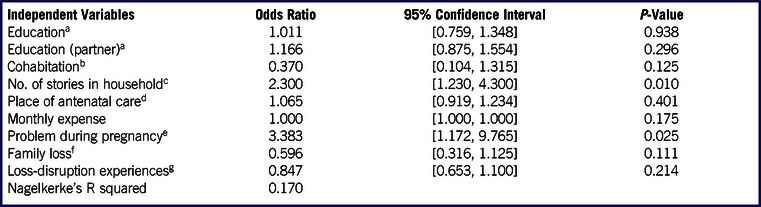
Only 56.5% of respondents had evacuation plans for the next disaster. Education level (P = 0.009), partner’s education level (P = 0.001), marital status (P = 0.041), number of stories in household (P < 0.001), place of antenatal care (P = 0.028), monthly expenses (P = 0.005), existence of problems during pregnancy (P = 0.005), and loss-disruption experiences (P = 0.011) were significantly different, depending on whether there was an evacuation plan or not. The logistic regression analysis showed that the number of stories in household and problems during pregnancy significantly affected whether there was an evacuation plan or not, with the odds ratios, respectively, being 2.30 and 3.38 (Table 4).
Logistic Regression Analysis for Evacuation Plan

a Education: being enrolled 1, elementary school; 2, junior high school; 3, senior high school; 4, university and more.
b Cohabitation: 0, separated; 1, living together.
c Number of stories in households: 1, 1 story; 2, 2 stories.
d Place of antenatal care: 1, barangay health station; 2, rural health unit; 3, midwifery center; 4, private clinic; 5, hospital.
e Problem during pregnancy: 0, do not have; 1, have.
f Family loss: 0, do not; have 1, have.
g Loss-disruption experiences: the total score of Loss-Disruption Experiences section in HURTE.
Anxiety About Disaster Preparedness
Most respondents had anxiety about their lack of preparedness, with 48.3% being “very worried,” 40.7% being “somewhat worried,” and only 11% being “not very worried.” The 1-way ANOVA showed that, during Yolanda, there were information problems (P = 0.001), pregnancy problems (P = 0.036), missed children’s vaccinations (P = 0.003), and life-threatening experiences (P = 0.003), each of which was statistically significant different, depending on the anxiety status. When the multiple regression analysis was applied, information problems, missed vaccinations, and life-threatening experiences remained significant (Table 5). The coefficients for amount of information remained negative, and those for missed vaccinations and life-threatening experiences remained positive. The order of standardized partial regression coefficients was life-threatening, amount of information, and missed vaccinations.
Multiple Regression Analysis for Anxiety Over the Preparedness for the Next Disaster

a Problem during pregnancy: 0, do not have; 1, have.
b Number of information: The number of information sources during Yolanda.
c Missed vaccinations: 0, do not have; 1, have.
d Life-threatening experiences: 0, do nothave; 1, have.
Provisional PTSD and PCL-5
The reliability of the PCL-5 was confirmed by the Cronbach’s alpha, which was 0.8903, and the provisional PTSD prevalence was measured at 53.3%. Consulting during pregnancy about their troubles (P = 0.044), mother’s access to health facilities (P = 0.022), children’s access to health facilities (P = 0.008), child’s sleep disturbances (P = 0.032), anxiety about the preparedness for the next disaster (P < 0.001), and perceived life-threatening experiences (P = 0.017) were all found to be significantly affected by provisional PTSD. The multiple regression showed anxiety over preparedness had a statistically significant effect on the total PCL-5 score (P < 0.001; Table 6).
Multiple Regression Analysis for Total Score of PCL-5

a Consulting person during pregnancy: 1, relatives; 2, husband; 3, hilot; 4, nurse; 5, midwife; 6, doctor; 7, more than 2 medical staff.
b Trouble accessing the health facilities: in the past 6 months, have you (or your children) ever had trouble accessing the health facility? 0, do not have; 1, have.
c Child’s sleep disturbance: in the past 6 months, have you felt your children had any problems sleeping? 0, do not have; 1, have.
d Perceived life-threatening experience: The total number of perceived life-threatening experiences in HURTE.
e Anxiety over the preparedness for the next disaster: 1, not very worried; 2, somewhat worried; 3, very worried.
DISCUSSION
Education Level and Income of Participants
In this study, more than 20% of participants and their partners had graduated from high school. The National Demographic and Health Survey in 2017 (NDHS) reported 8.8% of males and 11.3% of females who were parents of families of 6 or more from the lowest wealth quintile had completed high school.27 Therefore, the current study participants had relatively higher education levels than those reported in the NDHS in 2017.
From the current study, more than 95% of participants and their families lived under the absolute poverty line According to the Philippine Statistic Authority, a family of 5 needed no less than PHP 10,481 (US$ 209.62) monthly, on average. This amount was essential to meet the basic food and other needs in a month during 2018.28 It means at least PHP 69.43 (US$1.39) were necessary to fulfill the basic needs per person per day in the Philippines. The national poverty29 line in the Philippines was lower than absolute poverty. Even if the national poverty line in the Philippines was considered, more than 80% of the participants could not get enough money to fulfil their basic needs in this study. Such poverty circumstances might thereby explain the fact that more than half of participants’ partners were engaged in temporary jobs. To determine whether the percentage of temporary jobs was a consequence of Typhoon Yolanda, the occupation status before Typhoon Yolanda needs to be determined in the future research.
Child Health Condition
The results of the National Nutrition Survey (NNS) in Eastern Visayas on Leyte Island revealed that the prevalence of stunted growth in children less than 5 y old had fallen from 44.5% in 1989 to 33.7% in 2011, and the prevalence for children less than 5 y old to be underweight had also fallen from 27.3% in 1998 to 20.2% in 2011. Compared with data on stunted growth from 2011, 2013, and to the current study, our data were the least favorable; the rates were 30.3% for the 2013 NNS and 42.3% in this study. For underweight, all scores were similar; however, the data in this study were the least favorable, ie, 20% in NNS 2013 and 22.9% in this study. First, the existence of a certain relationship between malnutrition and poverty is obvious. Because most of our participants lived beneath the absolute poverty line, sampling bias and the fact of low observed variation may have affected the results. Second, the prevalence of stunting was more common than underweight for the entire period. There is a possibility that genetic factors played a role in the children’s height because both NNS and this study followed the WHO standard.30 Finally, there is a possibility that height measurements were distorted by sloped ground surfaces and the common tendency of the children of not remaining still; the children often cried and tried to escape while recording the measurements. However, underweight, an indication of acute malnutrition, revealed only a slight increase. This great achievement might be owing to the fact that the GO/NGO efforts had been successful in maintaining and even improving child health in the area.Reference Bernardo, Zamora and Guzman31 No relationship was found between mothers with provisional PTSD and child sleeping disturbances or child eating problems, which differed with the results of an earlier study in Indonesia.Reference Juth, Silver and Seyle14 However, a relationship was found between mothers who had perceived a life threat and the child height Z-scores. Although the present study was unable to determine causality, this finding could support Stewart’s theoryReference Stewart32 that a mother’s distress affects children’s growth.
Disaster Circumstances and Preparedness
Multiple regression analysis revealed that people who lived in their own house had lower life-threatening experiences, and people who lived in a multistory house and had delivered their baby in a health facility had lower loss-disruption experiences. Regarding house ownership, living in their own houses led to taking more precautions and kept people away from life-threating experiences. Additionally, people who had greater life-threatening and loss-disruption experiences felt more anxiety about their own disaster preparedness and had not prepared an evacuation plan. Despite the tragedy brought to Leyte Island by Typhoon Yolanda, 21% of the participants had made no preparations for the next disaster, and 43.5% had no evacuation plan. Previous studies have also highlighted a lack of household disaster preparedness,Reference Levac, Toal-Sullivan and O’Sullivan15,Reference Kohn, Eaton and Feroz16,Reference Wakui, Agree and Saito24 even when the people know its importance. These contradictory phenomena might also explain the presence of unrealistic optimism, a state that is characterized by the belief that one will experience fewer negative life events than others.Reference Sattler, Kaiser and Hittner33,Reference Burger and Palmer34 It was found that respondents who lived in multistory houses and had had problems during pregnancy were more likely to have an evacuation plan, with odds between 2.30 and 3.38, respectively (Table 4), which suggests that mothers who faced problems during pregnancy might feel a greater responsibility toward their unborn child and, therefore, be more motivated to prepare for a future disaster; this finding is consistent with the findings of Levac et al., a study in the United States,Reference Levac, Toal-Sullivan and O’Sullivan15,Reference Olympia, Rivera and Heverley35 who found that caregiving responsibilities toward children or older adults became a motivation for disaster preparedness.
This tendency was seen in the results of the multiple regression analysis for the factors affecting the range of loss-disruption experiences (Table 3) and disaster preparedness anxiety (Table 5). Mothers who faced experiences associated with their child’s health might take action to reduce the damage from the disaster and be more cautious regarding disaster preparedness.
Mother’s Provisional PTSD
There was a 53.3% provisional PTSD prevalence in the current study, which was higher than in previous studies even conducted after Typhoon Yolanda, in which the highest score was 48.1%.Reference Alderman, Turner and Tong2,Reference Galea, Nandi and Vlahov3,Reference Chan, Tang and Hall36-Reference Wang, Wu and Dai38 This may have been because of the participant characteristics, such as being female, having more than 1 child, and living under the absolute poverty line; all of which have been found to be significant risk factors for PTSD.Reference Alderman, Turner and Tong2,Reference Galea, Nandi and Vlahov3,Reference Moreno-Walton and Koenig6 Furthermore, differences were observed in disaster magnitude and diagnosed measurements. On the contrary, over half of the participants expressed doubt of the possibility of having PTSD. It is essential to support those victims with expert-approved methods, as well as by conducting follow-ups and further study.
Different from previous studies,Reference Galea, Nandi and Vlahov3,Reference Xiong, Harville and Mattison9 the total PCL-5 score, however, was found to be significantly associated with only anxiety over disaster preparedness in the multiple regression analysis. In other words, no other risk factors for the development of PTSD were found in this study (Table 6). As mentioned above, the participants in this study had quite similar backgrounds, ie, there was little variance leading to minor overall differences.
LIMITATIONS
Although some long-lasting effects of the typhoon disaster were found on maternal and child health, this study had several limitations. First, convenience sampling may not properly represent all mothers who experienced Typhoon Yolanda. Second, because this was a cross-sectional study, causality cannot be assumed. Third, in some questions, which we aimed to ask participants about situations at the time of Yolanda (eg, about their house), participants might misunderstand and answer to the current situation because we failed to specify temporality. Fourth, although we used the PCL-5 to assess the participants provisional PTSD, it was not possible to diagnose it because we missed some items, such as the psychosocial symptoms. Finally, we may also have missed the potentially related PTSD factors due to the limited sample size. To follow-up on these limitations, more detailed future research is needed.
CONCLUSION/RECOMMENDATION
Living in multistory houses appeared to be important to mitigate typhoon disaster related experiences, and having responsibility for children could be a key factor in making mothers pay attention to disaster preparedness. These findings could be beneficial for policy-making in flood- and hurricane-prone areas.
Acknowledgments
The authors thank the research assistants for the devotion during the data collection and all the study participants for their kind cooperation.
Funding
This study was financially supported by Research Center Urban Safety and Security Kobe University (2017, L3.TAP12).
Conflict of interest
The authors declare that there is no conflict of interest.