INTRODUCTION
In the aftermath of the Civil War, during the period in U.S. history known as Reconstruction, the Republican Party successfully established a wing in the former Confederate states, a portion of the nation that had been effectively closed off to the party in its early years.Footnote 1 With various voting restrictions placed on much of the Southern white population, the Grand Old Party's (GOP's) “Dixie wing” flourished through 1870, as state governments were firmly in Republican hands and the party controlled a majority of seats in the U.S. Congress. In the early 1870s, however, things changed: the onset of violent repression of African American voting, the resurgence of white voting in the South (by 1871), and the elimination of the ban on office holding for most ex-Confederates (via the Amnesty Act of 1872) combined with a severe economic depression following the Panic of 1873 to foster a Democratic revival.Footnote 2 The Democrats regained majority control of the U.S. House in the midterm elections of 1874, and by 1876 had taken back most of the Southern state governments. With the Compromise of 1877, and the eventual election of Rutherford Hayes to the presidency, the Democrats' consolidation of the former Confederacy was complete—in historical parlance, and in the minds of whites in the region, the South had been “redeemed.”
With the South once again closed off to the GOP, Republican Party leaders had to figure out how to deal with the former Confederate states.Footnote 3 Answers varied by context and took many forms. In this article, we examine how the Republicans dealt with the South in terms of GOP National Convention politics in the decades following the end of Reconstruction. The role of Southern delegations at Republican conventions in the late nineteenth and early twentieth centuries presents something of a puzzle: while the probability of any Southern states having a hand in the election of a Republican to the presidency declined (and approached zero) in the years after Reconstruction, these same states were consistently allotted sizable delegations to the Republican convention. Indeed, we show that Southern delegates in several election years represented the deciding votes in ballots selecting the presidential and vice presidential candidates for the Republican ticket. This raises the question of why Republican Party leaders from other parts of the country would allow a region in which the GOP was increasingly nonexistent to continue to have a strong say in the selection of presidential candidates and other major decisions made during national conventions.
As the apportionment of states' delegations to Republican National Conventions had traditionally been determined by the size of their congressional delegations (regardless of party distribution), it is perhaps tempting to claim that “path dependence” overrode the growing disconnect between convention delegation size and electoral performance. However, we argue that two other (related) explanations better capture the historical reality: (1) the ongoing hope in the late nineteenth century for a resurgence of the Republican Party in the South and (2) the continuous incentive for Republican presidents and other ambitious party leaders to treat Southern convention delegations as “rotten boroughs,” that is, as sizable voting blocs that could be bought (controlled) via patronage and bribery.
There is sometimes a danger in reading back in history, such that we (as scholars) impart a complete knowledge of the future to the political actors in question. In this case, for many Republican politicians in the late nineteenth century, it wasn't clear that the Democratic resurgence in the South was unassailable. True Jim Crow restrictions would not start to be implemented until the 1890s, and Republicans continued to have some success at various levels of government (often through fusion arrangements with third parties) in states like Virginia and North Carolina through the end of the century. Indeed, the Stalwart faction of the GOP continued to pursue a Reconstruction policy through 1890, when a new Enforcement Act (which would have placed voting rights' enforcement power in the federal courts) was passed in the House but went down to defeat (narrowly) in the Senate. This victory for white Southerners hastened the adoption of Jim Crow and encouraged the remaining vestiges of Reconstruction to be eliminated—for example, the Enforcement Acts of the early 1870s were formally repealed in 1894, when the Democrats enjoyed unified control of the federal government for the first time since the antebellum era.
As the twentieth century dawned, however, the Republicans began to think with one mind (electorally speaking) with regard to the South. McKinley's smashing presidential victory (and electoral coattails) in 1896, and his reelection four years later, cemented the GOP's dominance in most regions of the country.Footnote 4 Under the “System of 1896,” Republicans could easily win presidential elections and congressional majorities without Southern support, even as their vote total in the former Confederacy decreased even further. Consequently, any remaining Stalwart considerations melted away, as the South could be comfortably ignored without damage to the GOP's national fortunes.Footnote 5 This new reality helped frame how Republican delegations from the South would be viewed by various elements in the party.
In short, in the first two decades after Reconstruction, concerns about Southern representation at the National Convention were raised occasionally, but they never generated much support. Hope still existed that a Southern wing of the party could be rebuilt, and the link to the past (as the “Party of Lincoln”) along with basic concerns of fairness were enough to stymie the desire for a meaningful change. With Republican electoral ascendancy at the turn of the century, a new focus on Southern representation at the convention was established. Soon, the “appropriate” size of the Southern delegations became a bargaining chip in intraparty power struggles. While several meaningful changes were discussed, only one significant alteration in representation was made—in December 1913, in advance of the 1916 Republican National Convention. Here, in response to progressive complaints following the heated Taft–Roosevelt campaign in 1912, representation for former Confederate delegations was finally reduced—which had the effect of dampening Southern strength at the GOP convention by nearly 6 percentage points. A further reduction was adopted by the Republican National Committee (RNC) in 1923, but was quickly rescinded and never went into effect.
In laying out this history, we add significantly to the literature on national party organization in the late nineteenth and early twentieth centuries. Many of the details we present here were previously recorded only in historical case studies, focusing on specific election years or individual political actors, and thus a coherent story of how Republican leaders dealt with Southern delegations in the aftermath of Reconstruction has never been told. In presenting such a story, we consider how leadership incentives changed, as the likelihood of a viable Southern wing of the GOP waned over time (even as the party grew in strength in other parts of the country) and Southern delegates were increasingly seen as votes to be purchased by the highest bidder.
More generally, we enhance scholarly understanding of the relationships among internal Republican politics, presidential elections, and Southern strategies, by showing that these Southern strategies have been more persistent and developmentally significant than previously assumed.Footnote 6 The term Southern strategy was first used to describe the electoral strategies of post–World War II presidential hopefuls Barry Goldwater, Richard Nixon, and Ronald Reagan—but in fact, as we illustrate, Southern strategies have been of constant importance to the Republican Party since its founding.Footnote 7 In the post-Reconstruction decades, the Southern strategy sometimes had internal organizational logics, vote-getting logics, and party-building logics all working simultaneously, while at other times the strategy just had nomination and party-building logics. We also show that group and minority representation—usually associated with the contemporary Democratic Party—played a key role in the evolution of the Republican Party and shaped the candidate nomination processes. In all these ways, we believe that this article highlights and illuminates the evolution of the party system and presidential politics.
A QUICK OVERVIEW OF REPUBLICAN CONVENTION APPORTIONMENT
To understand the problem of Southern representation at the Republican National Convention in the post-Reconstruction era requires a comprehension of how the GOP apportioned delegates. From the Republican Party's inception, representation was based on a dual equality/size model, where all states would be provided with a baseline delegate level that was then enhanced in proportion to the number of congressional districts each state possessed.Footnote 8 In 1856, for example, the rule chosen at the first Republican convention was that each state would receive six at-large delegates plus three for every one of its congressional districts. Incorporating such an equality/size model was pragmatic, as the Republicans in 1856 were a brand new party, so there was no obvious measure of party strength that could be used in the delegate allocation process.
While the decision to adopt an equality/size model was straightforward, the decision to provide representation to every state in the Union was not. Some states, primarily in the South, were effectively closed off to the Republican Party—the question then was, should a party built consciously on free soil principles afford slave states representation at its National Convention? This issue was brought to the forefront in 1860, when the convention's Committee on Credentials proposed a delegate count that included several slave states and territories. Amendments were quickly offered that would have recommitted (i.e., eliminated) several slave-state delegations (Texas, Maryland, Kentucky, Virginia, the Nebraska and Kansas Territories, and the District of Columbia). A spirited debate then ensued, with those seeking to exclude the slave-state delegations expressing concerns about the Republican mission being (potentially) undermined by their inclusion (per the belief that members from pro-slavery regions might work to destroy the party from the inside) and those seeking to seat the slave-state delegates stressing fairness and the need for the party to be truly national in scope (and not just a sectional party, as many had claimed). In the end, the pro-inclusion position won out, as the convention adopted a report advocating the seating of all the delegations, including the slave states and territories. The allocation changed slightly from 1856, with each state given four at-large delegates and two for every congressional district it possessed—which was equal to twice its number of votes in the Electoral College.Footnote 9
Thus, in subsequent years, these two sets of decisions—(1) equality/size driving a state's delegation allocation and (2) convention inclusivity, regardless of a state's receptivity to Republican tenets—would steer Republican National Convention politics down a certain path. With each new convention, and the readoption (tacit or otherwise) of the two aforementioned sets of decisions, precedents were set that would be hard to alter later. For example, an apportionment rule divorced from party strength and a general policy of fairness and inclusion were not problematic during the Civil War and early Reconstruction years, when the Republican Party was present and dominant in every region of the country. In this case, real influence in the convention was in keeping with real influence in presidential selection (in the Electoral College). With the declining fortunes of the GOP in the South following the end of Reconstruction, a fissure opened between the two modes of influence—Southern delegations retained their ability to affect Republican presidential nominations even as they lost all ability to affect outcomes on Election Day.
Even as the political reality changed in the post-Reconstruction years, the status quo arrangement proved impervious to change. Basic beliefs regarding fairness and inclusion continued to hold strong appeal, in part because a sizable segment of the GOP—the Stalwart wing, predominantly, which was the keeper of the radical flame on Reconstruction policy and black civil rights—held out hope that the Democratic resurgence in the South could be reversed. Southern Republicans themselves also lobbied to maintain their position in the GOP governing hierarchy. And, of course, Northern Republican politicians who benefited from a sizable and stable Southern delegation at the convention also opposed a change in the status quo arrangement.
By the end of the nineteenth century, opponents of the pro-Southern status quo began to gain some traction. Arguments about a Republican resurgence below the Mason-Dixon line had lost credibility, as GOP electoral gains in the South—which had produced some successes in the late 1870s and early 1880s, through fusion arrangements with various independent movements—were largely stymied by the mid-1880s. The Republicans' last statutory stand occurred in 1890, during the Harrison Administration, when the party controlled both chambers of Congress and Rep. Henry Cabot Lodge (R-MA) pushed a new enforcement bill that sought to resuscitate black voting rights in the South by granting new oversight powers to the federal judiciary. The Lodge Bill passed in the House, but was stopped in the Senate when “silver” Republicans in the West defected from the party position.Footnote 10 The Democrats responded to this GOP near miss by adopting state-level constitutional restrictions on African American voting rights in the South (Jim Crow laws) and repealing the existing Reconstruction-era Enforcement Acts at the federal level that were still on the books.Footnote 11 In addition, while the Democrats were consolidating their hold on the South, Republicans made popular vote gains in every other region of the country in the 1894–1896 elections;Footnote 12 once these initial gains were seen as stable, following McKinley's reelection in 1900, the GOP leadership was comfortable in asserting the party's national dominance. As a result, fewer and fewer Northern Republicans had any instrumental reason for working to maintain a foothold in the South and, perhaps more importantly, for honoring the decades-old status quo arrangement that disproportionately benefited the South at the National Convention.Footnote 13
As a result, motions began to be offered at the Republican National Convention to tie states' delegate allotment in part to party strength, as measured by state votes cast for the most recent Republican presidential nominee. The first motion, made in 1900, would have provided each state with four at-large delegates and one additional delegate for each 10,000 votes (or majority fraction thereof) cast for the Republican nominee at the last presidential election. (Note that the 1900 motion was based on a similar motion first introduced in 1884, at a time when the Republicans were not yet ready to give up on a Southern wing.) The 1900 motion was quickly dropped, but it surfaced again in the same form in 1908 and generated a close roll-call vote (failing 471–506). A similar motion was offered four years later, in 1912, which would have provided one delegate for each congressional district within a state, along with one additional delegate for each 10,000 votes (or majority fraction thereof) cast for the Republican nominee at the last presidential election.Footnote 14 While this motion was tabled at the convention, a breakthrough finally occurred in December 1913, when the RNC agreed to adopt the 1912 proposal.Footnote 15 This rules change was subsequently ratified by Republican organizations in states that produced GOP electoral majorities in 1908, and at the 1916 Republican National Convention—and went into effect at that time.Footnote 16
During a June 1921 meeting, the RNC agreed to another reapportionment scheme, which provided states with one delegate for each congressional district that maintained a Republican organization and had cast at least 2,500 votes for any Republican in the most recent presidential election plus one additional delegate for each district that cast at least 10,000 such votes. If implemented, this plan would have resulted in a further reduction in Southern delegates, drawing the total down by 40 percent since 1912.Footnote 17 During an RNC meeting in December 1923, however, the previously agreed-upon reapportionment was abandoned and the system of one delegate for each congressional district was reinstated, while the representation of the thirty-seven states that voted Republican in 1920 was increased by three at-large delegates each.Footnote 18
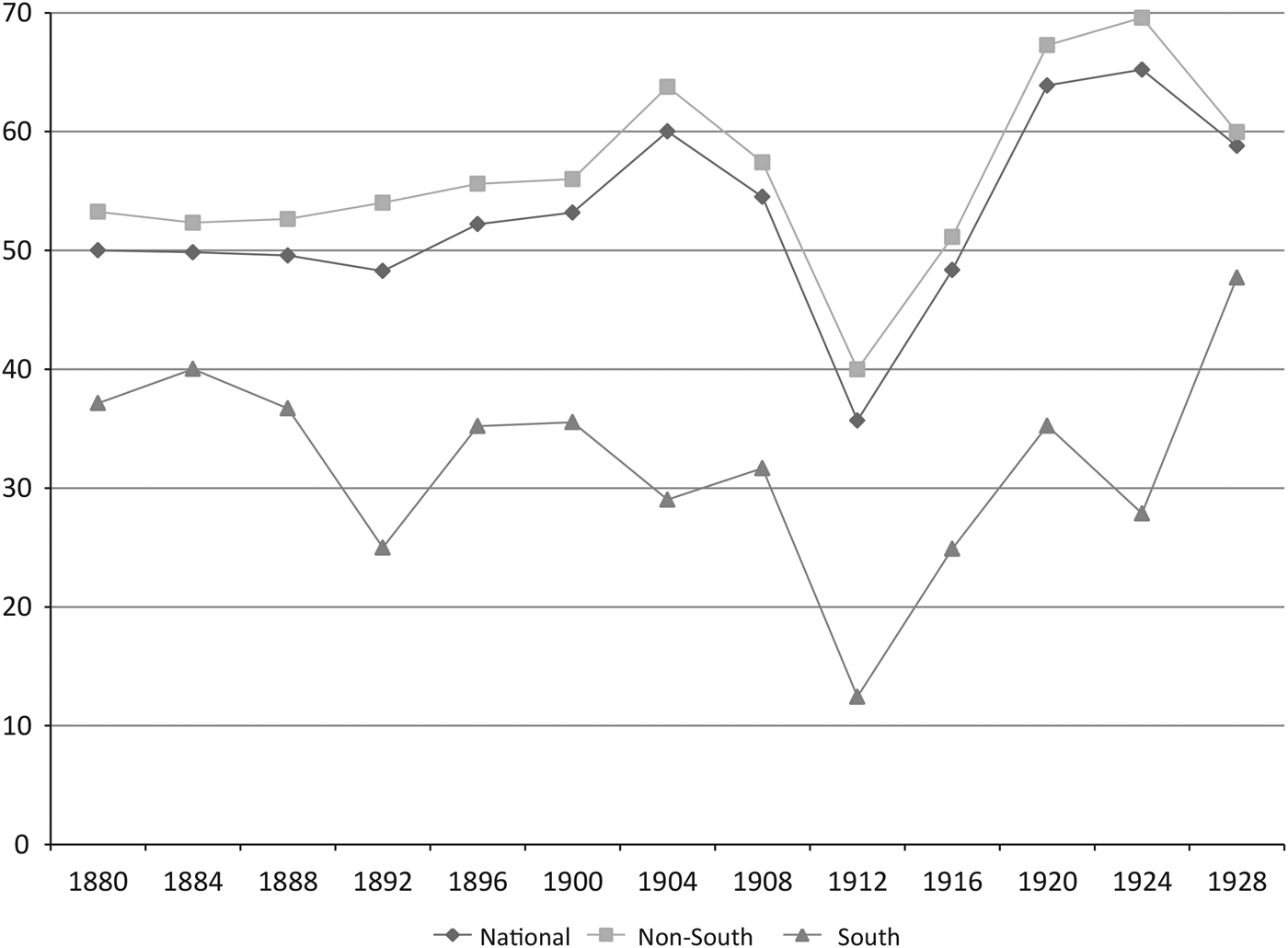
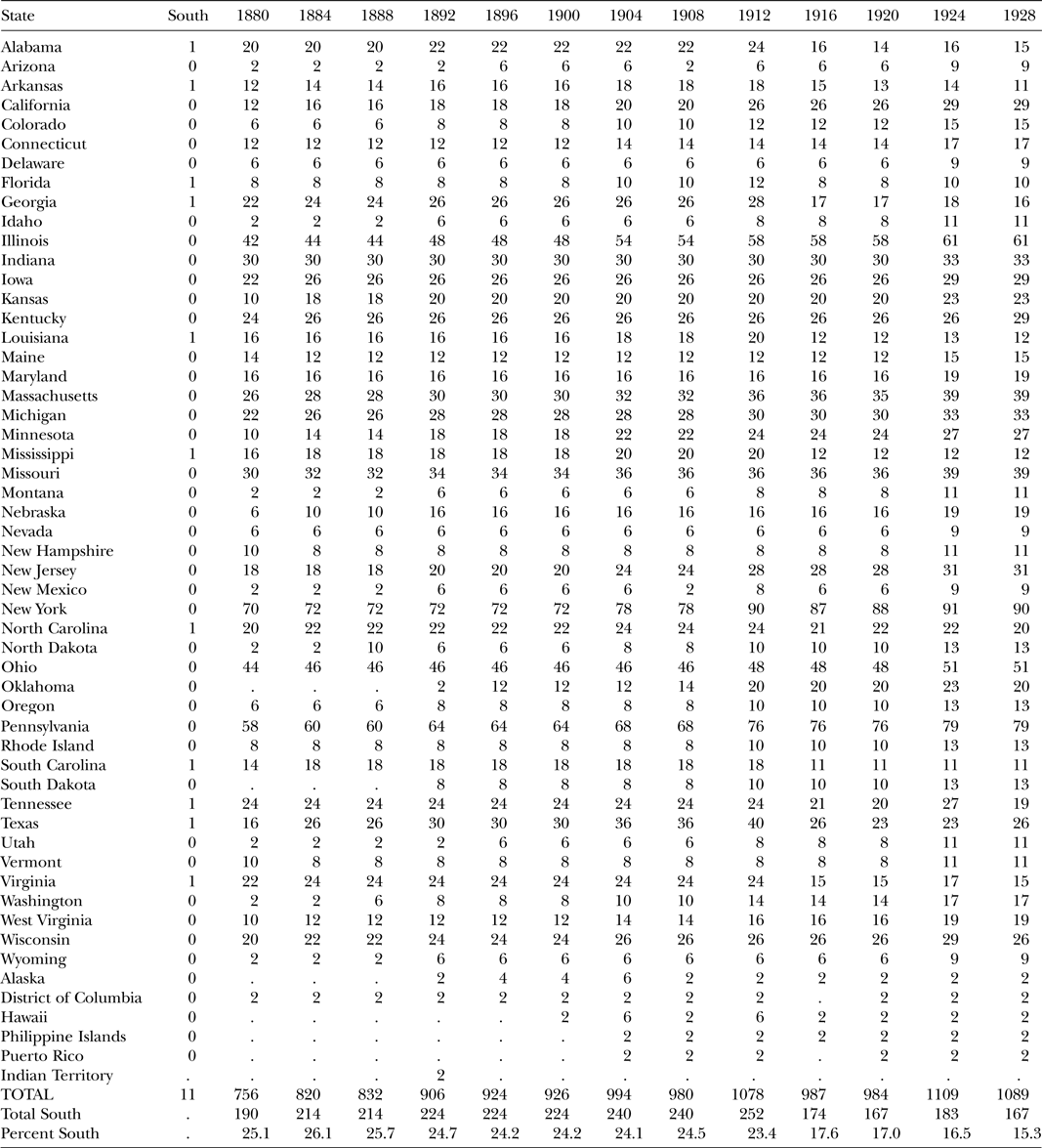
We will recount the political details surrounding the various reapportionment motions in the next few sections. For now, though, it is helpful to get a sense of what was at stake in the reapportionment conflicts, and the extent to which the Republican Party found itself marginalized electorally in the South. Figure 1 details the percentage of the two-party vote that GOP presidential candidates received both nationally and regionally (South vs. non-South) for elections from 1880 through 1928, while Table 1 lays out the state delegation totals at the Republican National Convention from 1880 through 1928. Throughout this period, Republican presidential candidates won landslide national victories (especially from 1896 onwards), despite dramatically underperforming in the South. Yet, for most of these years, the former Confederate states constituted around one-quarter of the GOP convention delegates, a substantial total for a region that provided the party with nothing on Election Day. (This percentage declined slightly until 1912, thanks mostly to the South losing House seats in a relative sense after each congressional reapportionment.) Beginning in 1916, the GOP's new delegate reapportionment scheme went into effect, and the South saw its representation at the National Convention drop by nearly 6 percentage points. The region would lose an additional half percentage point (roughly) in the three succeeding conventions (1920, 1924, and 1928).
Percentage of the Two-Party Vote for Republican Presidential Candidates, 1880–1928

Republican National Convention Delegates by State or Territory, 1880–1928

Source: Congressional Quarterly's Guide to U.S. Elections, 3rd ed. (Washington, DC: Congressional Quarterly, 1994).
REPUBLICAN NATIONAL CONVENTION POLITICS AND SOUTHERN REPRESENTATION, 1880–1928
With the South “redeemed” by white Democrats, the Republicans' approach to the region changed over time. In the early years after the collapse of Reconstruction, hope for a revitalized Southern GOP lingered—and this limited the degree to which Republican leaders viewed the former Confederate South as a collection of rotten boroughs. As a result, only one serious effort to reduce Southern representation at the National Convention was made in the pre-1900 period—in 1884—and it was defeated quickly. That said, attempts to buy Southern convention delegations clearly originated in these early years, before becoming standard practice as the century turned. Indeed, by 1900, GOP leaders had given up on a Southern wing of the party, and pragmatic vote buying of Southern state delegates—and attempts by Republican factions to limit Southern representation at the National Convention, as both a ploy in a larger intrapartisan bargaining game and a sincere institutional strategy—had become commonplace.
The 1880–1896 Period
The 1880 presidential election was the first after the disputed outcome of 1876–1877, and the first after the South as a whole had fallen back into Democratic hands. Yet, in the wake of Reconstruction's demise, Republicans still believed that a Southern wing of the party could be maintained. President Hayes endeavored to construct a “New Departure” in the South, by reaching out to white, conservative Southern Democrats on economic grounds.Footnote 19 As a result, his vision of maintaining a Southern wing meant reconfiguring it to reflect the political realities of the day. The Stalwart wing of the party rejected the Hayes plan and sought instead to keep the traditional Republican organizations alive. As the end of Hayes's term neared—he announced early on that he would not seek reelection—recurrent press stories of violence and intimidation toward black voters largely discredited his New Departure strategy and helped to solidify the need for stronger voting rights protections in the South.
As the 1880 Republican National Convention approached, John Sherman had the upper hand vis-à-vis the South. Thanks to his position as Treasury Secretary under Hayes, Sherman controlled a massive patronage operation—an enterprise that could keep a Southern wing of the GOP alive generally and tied to his presidential aspirations specifically.Footnote 20 As Kenneth D. Ackerman notes: “Sherman … had used Treasury Department employees—all political appointees under his thumb—to pack local caucuses across the South and guarantee a harvest of friendly delegates.”Footnote 21 Unfortunately for Sherman, his chief opponents at the convention—Senator James Blaine (ME) and former President Ulysses S. Grant—commanded the support of a considerably larger group of delegates. Sherman hoped that if he could stay in the race, he would emerge as a compromise candidate. That did not come to pass, as his Ohio colleague Rep. James Garfield would eventually become the convention dark horse. Still, Sherman's Southern delegates stuck by him to the end, rather than backing Grant (who, as leader of the Stalwarts, was quite popular in the South), which had been a significant concern among the non-Grant party managers.Footnote 22 Part of this loyalty was related to Sherman's reputation as a strong civil rights advocate and, before that, a strong antislavery advocate.
The results of the 1880 election kept the White House in Republican hands, as Garfield defeated the Democratic nominee, Winfield Scott Hancock. But Republican leaders' fears were realized when the entirety of the former Confederate South broke for Hancock—not a single electoral vote was cast for the GOP below the Mason-Dixon line. As a result, some party members called for a reconsideration of electoral apportionment rules that governed GOP representation at the National Convention. If the South was lost to the Republicans, these individuals argued, shouldn't those states that could support the party on Election Day have a stronger hand in nominee selection and platform design?
The first major challenge to the fairness and inclusion status quo arrangement at the Republican National Convention occurred in 1883–1884, as a move was made to tie a portion of a state's delegate allotment to its GOP presidential vote total from the previous election. The new initiative was introduced by Senator William P. Frye (ME) at an RNC meeting in December 1883. Frye's plan would provide each state with four at-large delegates, one delegate for each congressional district and one additional delegate for each 10,000 votes (or majority fraction thereof) cast for the Republican nominee at the last presidential election. If implemented, Frye's plan would have had an immediate negative impact on the former Confederate South's level of representation at the 1884 convention, reducing its delegate percentage from 26.1 percent (214 of 820) to 18.4 percent (160 of 870).Footnote 23 After some discussion, the RNC members voted 25–18 to refer the decision to the convention—which, for the time being, forestalled any change.Footnote 24
The sitting president, Chester A. Arthur, was opposed to such a change. Arthur was seeking the nomination in 1884, after ascending to the presidency following Garfield's assassination in 1881. Arthur was a machine politician, rather than an ideological or inspirational leader, who believed that his best chance at retaining the office was to establish a clear following among some element of the GOP. He considered the South to be his best bet and invested considerable time trying to build (or perhaps rebuild) a Southern wing of the party. His strategy was to back various independent movements in the Southern states, in the hope that a combined Independent–Republican coalition would be sufficient to defeat the Democrats.Footnote 25 He also believed that the attention he showed Southern Republican leaders would yield direct benefits at the convention. His choice of adding William E. Chandler of New Hampshire—a favorite of Southern Republicans for his condemnation of white Democrats' actions in the South—to his cabinet was a fundamental part of this strategy. As Vincent P. De Santis notes, Chandler was chosen in part “to conduct the 1882 congressional elections in the South,” but perhaps more importantly,
Chandler was also given the job of rounding up southern delegates for Arthur at the 1884 national convention. The Washington correspondent of the New York Age reported that it was an open secret that Arthur had taken Chandler into the cabinet for this express purpose. … Chandler had the full authority to barter away federal patronage and to use southern offices where they would do the most good in picking up delegates for the President.Footnote 26
While Frye's motion resonated with many in the party, it would not in the end be implemented. Arthur and Chandler saw to that. As noted, important segments within the GOP still believed that Republican electoral success in the South was possible. They merely had to look at the victories achieved by William Mahone in 1879 and 1881 in Virginia for evidence; his “Readjuster” organization—in alliance with state Republicans—successfully defeated the Democrats in the Old Dominion. Arthur and Chandler used Mahone's victory and highlighted their own (somewhat successful) efforts to back fusion tickets in other states in 1882, to counter Frye's challenge.Footnote 27
When Frye's initiative was proposed once again in June 1884 at the Republican National Convention, it elicited sharp debate. The issue of fairness was raised on both sides, by those who believed that state representation at the convention should better mirror state influence on Election Day as well as by those who sought to avoid blaming Southern Republicans for the disfranchisement efforts of Southern Democrats. John Lynch (R-MS), a black delegate and temporary chairman of the convention, spoke passionately about maintaining the South's level of representation in the GOP convention and suggested instead that Southern representation in Congress should be reduced because of disfranchisement, in accordance with the provisions of the 14th Amendment. In the end, the proponents of the Frye plan sensed that they lacked a majority and dropped their challenge, and the status quo arrangement was maintained.Footnote 28
With state apportionment reform defeated, Arthur could focus on retaining his hold on the presidency in 1884. Thanks to his and Chandler's strategic use of patronage appointments, he entered the convention with a solid foundation of Southern support.Footnote 29 Unfortunately, Arthur could not muster much of an additional following, and the nomination eventually went to James Blaine on the fourth ballot.Footnote 30 Nevertheless, Arthur's support among Southern delegates largely held throughout the balloting. As Charles W. Calhoun notes: “From the first to the fourth and last ballot, 82 percent of Arthur's supporters from the states of the old Confederacy stuck by the president.”Footnote 31
As the 1888 presidential election approached, the Republicans found themselves in a different situation—being the “out” presidential party for the first time in three decades. Grover Cleveland bested Blaine in 1884, and the GOP's efforts in the South had trailed off after their moderate success in 1882. By 1888, while the protection of civil and voting rights continued to be mentioned by Republican politicians, the basis of national party politics had inevitably turned to substantive differences on major economic policy (for example, the tariff would be the critical issue in the 1888 general election campaign).Footnote 32
The front-runner for the Republican nomination in 1888 was once again John Sherman of Ohio (now back in the U.S. Senate). His long history of support for black civil rights once again gave him an edge in the South.Footnote 33 However, Southern Republicans had been denied executive patronage since 1885, when Cleveland entered the White House; as a result, they were a beleaguered group, and some worried that they would sacrifice long-term loyalty for short-term benefit (in keeping with the shifting currents of nomination politics). And this is what seems to have occurred: while Sherman led the field for the first six ballots, he could not get much beyond the halfway mark in terms of winning the nomination. Moreover, he saw the Southern share of his delegate total decline, to the benefit of Russell A. Alger, lumber baron, former Union general, and former governor of Michigan, who possessed an “ample wealth [that] gave him the wherewithal to court delegates outside of Michigan, especially in the South.”Footnote 34
That Alger “bought” Southern delegates who had previously been committed to Sherman became the narrative that emerged from the convention. As James A. Kehl recounts,
In explaining Sherman's decline in the South, a subordinate complained that Alger ‘bought our Negro delegates like sheep.’ Under the guise of purchasing gallery tickets from southern blacks who desperately needed expense money, Alger literally purchased the delegates who transferred their allegiance from Sherman.Footnote 35
Sherman himself also subscribed to this narrative. In his memoirs, published in 1895, Sherman made clear that he felt Alger and his lieutenants were corrupt: “I believe and had, as I thought, conclusive proof that the friends of General Alger substantially purchased the votes of many of the delegates of the Southern states who had been instructed by their conventions to vote for me.”Footnote 36 Alger responded by saying such charges had “no foundation” and indicated that Sherman's brother, General William T. Sherman, harbored no ill will toward him.Footnote 37
Prior to 1888, there had been a general belief that Southern delegates could be plied with patronage appointments, and that established loyalties would be honored during the nomination balloting. Beginning in 1888, a more base belief about Southern delegates emerged, that is, that they were available continuously to the highest bidder. More generally, as the viability of the Southern wing of the GOP declined, the degree to which the Southern state organizations became rotten boroughs increased significantly.
Benjamin Harrison, Senator from Indiana, eventually won the 1888 GOP nomination and went on to defeat President Grover Cleveland (and lead the Republicans' recapture of the House and Senate) in November.Footnote 38 All else equal, Harrison, as a sitting president, should have considered renomination in 1892 to be little more than a formality. However, he presided at a time when the party was in a state of disarray, as the Republicans were slaughtered in the 1890 midterms and lost majority control of the House. In addition, Harrison's cold, impersonal style and unwillingness to play ball with GOP party bosses like Tom Platt of New York and Matt Quay of Pennsylvania on matters of patronage created significant dissension within the Republican ranks. Finally, Harrison became estranged from James Blaine, his Secretary of State, who resigned days before the Republican National Convention. As a result, a movement—led by Quay—to replace Harrison at the top of the ticket gained momentum. And Blaine appeared ready to accept the nomination, if it came to him.Footnote 39
In the end, Harrison was saved by the South. His ability to control Southern delegates with patronage was something Platt, Quay, and others could not overcome. The first hint of Harrison's convention strength came on a contest regarding the seating of delegates from Alabama, which Harrison's side won.Footnote 40 This led Quay to remark, “The Harrison people have bought up the colored fellows, and we must try to get them back.”Footnote 41 Quay then frantically tried to convince enough delegates to back Blaine or William McKinley, then a Senator from Ohio, to prevent a Harrison first-ballot majority; his hope was to extend the contest, and by doing so, steadily build a coalition against Harrison. And while he was able to whittle away at some of Harrison's strength, Quay was ultimately unsuccessful—Harrison received a 59 percent majority on the first ballot and captured the nomination.
Table 2 provides a breakdown of the balloting by region. As the numbers make clear, Harrison dominated the South, winning 164.16 of 224 delegate votes, or 73.3 percent. Moreover, those 164.16 votes constituted just under 31 percent of his entire delegate total. Given that 454 votes were necessary for a convention majority, Harrison's Southern support was crucial—as he was able to manage only 371 votes outside of the former Confederacy. As James Kehl notes, “Harrison's patronage power, particularly in the South, was the decisive factor. … In the South, Blaine could attract only 10 percent of the delegate support necessary to acquire the nomination and had no asset comparable to patronage when he went forth to corner the other 90 percent.” Summing things up, with an assist from Quay himself, Kehl states, “With the Republican electoral potential of the South almost nonexistent, Quay commented that ‘the President has been renominated by the powers which cannot give him an electoral vote.’”Footnote 42
Balloting at the 1892 Republican Convention, by Region

Source: Proceedings of the Tenth Republican National Convention, Held in the City of Minneapolis, Minn., June 7, 8, 9, and 10, 1892 (Minneapolis: Harrison & Smith, 1892), 141.
The divisive nature of Harrison's renomination would work against the Republicans in the 1892 general election, as GOP party bosses provided only tepid support in mobilizing voters. The result was that Cleveland would regain the presidency in his rematch with Harrison. This left the Republicans looking ahead to 1896 as the “out party” once again.
The GOP frontrunner in 1896 would be William McKinley, who had been a (reluctant) candidate for the nomination in both 1888 and 1892. His campaign manager, Mark Hanna, had been positioning McKinley for the presidency for some time, and Hanna set out to build a majority coalition for McKinley well in advance of the convention. And having witnessed Harrison defeat a renomination challenge in 1892, and watching how he accomplished it, Hanna understood that “cultivating a strong relationship with southern Republicans [needed to be] a large part of his plan.”Footnote 43 As a result, he decided to “hunt where the ducks were” (more than a half-century before Barry Goldwater would make such a quip) and rented a house in Thomasville, Georgia, so that he and McKinley over several weeks in the winter of 1895 could host Southern GOP delegates—both black and white—and “discuss patronage and other political possibilities in a relaxed atmosphere.”Footnote 44
Hanna and McKinley had hoped to keep their Thomasville strategy as inconspicuous as possible, but word eventually leaked out, and other Republican nomination hopefuls attempted to countermobilize. But such efforts were in vain, as Hanna and McKinley's first-mover advantage paid off—McKinley went on to control the votes of 196.5 of the former Confederacy's 224 votes on his way to a landslide victory at the 1896 convention. New York GOP party boss Tom Platt showed Hanna some grudging respect in the aftermath, saying: “He had the South practically solid before some of us awakened.”Footnote 45
The 1900–1908 Period
The presidential elections of 1896 and 1900 established the Republicans as the majority party across most of the United States for the better part of the next three decades. While the Republicans expanded their dominance in the Northeast, Midwest, and West, however, the South remained almost exclusively Democratic throughout this period. As a result, the traditional argument that a GOP revival in the solid South remained a possibility—which, in part, validated the sizable Southern presence at Republican conventions—increasingly lost its value. As Richard M. Valelly argues, the Republican Party's ability after 1897 to win the presidency and Congress without achieving electoral success in the South produced an “abrupt change in the costs and benefits of the party's historical southern policy.”Footnote 46 That is, Republican leaders concluded that the cost of maintaining a party organization in the South fit to contest elections in the face of an unbeatable (and very hostile)Footnote 47 Democratic majority outweighed the increasingly slim chances at Republican electoral success there.Footnote 48
In this context, the intra-Republican struggle over the South increased after the 1896 election, and the party saw a series of clashes between camps, some of which benefited from the presence of Southern delegates. Republican administrations continued to use their control of patronage in the South to produce a reliable and sizable voting bloc that played a significant role in the selection of presidential candidates in 1908, 1912, 1924, and 1928. However, in the same period, several moves were made by competing party factions to reduce the size of Southern delegations. Not all of these moves were entirely genuine; rather, some represented attempts to use the threat of reapportionment against Southern delegates to force compliance on other issues. Additionally, Republican leaders were far from consistent in their support of or opposition to Southern delegates, and were prone to changing their positions depending on whether they controlled federal patronage or not.
After the 1896 election, McKinley and Hanna increased their control over the Southern GOP through the use of federal patronage. While McKinley's renomination was never in doubt, the 1900 convention, and the period leading up to it, saw two major public attempts to reduce Southern representation at the Republican National Convention. The first came in December 1899, during a two-day RNC meeting at which the convention city of 1900 was to be selected. Henry Clay Payne, RNC member from Wisconsin and an important actor in McKinley's 1896 campaign, proposed to replace the existing division of delegates (in which states received two delegates for each senator and representative they had in Congress, regardless of partisan affiliation) with a new scheme in which each state would receive four at-large delegates and one additional delegate for each 10,000 votes that it had contributed to the Republican presidential ticket in the most recent election. If passed, the plan would have significantly reduced Southern representation at the 1900 convention—from 224 delegates (25 percent of the total), under the existing rules, to 126 delegates (14 percent of the total), based on the 1896 presidential vote totals.Footnote 49 ,Footnote 50
From Payne's perspective (at least as stated publicly), this decrease in Southern representation was simply a case of fairness. He argued the necessity of such a change by asking “why the states of Alabama, Arkansas, Florida, Georgia, Louisiana, Mississippi, South Carolina, casting 200,076 Republican votes at the last Presidential election, should have 124 delegates in the National Convention, while New Jersey, casting 221,367 Republican votes, should have but twenty delegates?”Footnote 51 Unsurprisingly, Southern Republicans were not enthused with Payne's proposal; black Southern GOP members, in particular, charged Payne with attempting to drive out black delegates from the party entirely.Footnote 52 Nonetheless, Payne's proposal was considered reasonable by non-Southern party leaders given that, as the Charlotte Daily Observer noted, “the counsels of white Southern Republican delegates are lightly esteemed in the national conventions of their party and the colored delegates are regarded as so many chattels to be purchased by the highest bidder.”Footnote 53
While black Southern Republican leaders had “little hope of success”Footnote 54 in opposing Payne's proposal, it in fact never came to a vote during the RNC meeting. Instead, the selection of the 1900 convention city and the decision on Payne's delegate plan (the two crucial issues of the meeting) were settled as part of a logroll between the different regional camps. The committee members from Pennsylvania were willing to oppose the Payne plan if Philadelphia were chosen as the 1900 convention city. Meanwhile, Southern members of the RNC decided to vote as one unit on the selection of a convention city and planned to decide their preferences as to the “subject of the selection of the place of meeting in such a way as will win for them most support in their fight against reapportionment.”Footnote 55 ,Footnote 56
These negotiations were concluded successfully, as Philadelphia was selected over Chicago. The Southern bloc played a crucial role in this process—without unanimous Southern support, Pennsylvania would have lost its bid to Illinois, as the outcome was decided by a single vote. After the selection of Philadelphia, Payne was shuttled to the White House for late night meetings with McKinley and Hanna, during which he came to understand that “committeemen who had favored [the reapportionment plan] in private correspondence, had been stormed into opposition by letters and telegrams from every source.”Footnote 57 As a result, Payne withdrew his proposal the following day, stating that while he had not “in the slightest degree changed [his] conviction as to its justice,”Footnote 58 the opposition to the plan had convinced him not to offer it to a committee vote. Whether Payne himself understood the proposal to be a mere bargaining chip (all along) remains unclear, but by the end of the two-day RNC meeting, Philadelphia had been named the host of the 1900 convention with Southern support and Payne's plan for reducing Southern representation had been abandoned.
During the 1900 GOP convention, Pennsylvania's Boss Matt Quay resuscitated the Payne plan, but here too the size of future Southern delegations was used as a bargaining chip to achieve a different goal—to influence the choice of the Republican vice presidential candidate. That is, with McKinley's renomination assured, the only major issue before the convention was who would become the vice presidential candidate after Garret Hobart's death in 1899. Among the most discussed options was New York Governor Theodore Roosevelt, although he was on record as having no interest in the nomination. Nonetheless, Roosevelt's candidacy was pushed by members of the New York Machine, as they sought to rid themselves of their increasingly powerful and independent governor.Footnote 59 While McKinley and Hanna had expressed no interest in having Roosevelt on the ticket, New York's Boss Platt sought Quay's help to ensure that Roosevelt would be nominated.Footnote 60 Quay believed Roosevelt's selection was possible—but only if he could win over Western and Southern delegates. The latter, however, were firmly under Hanna's control.
During the second day of the convention, Quay introduced the Payne proposal to reapportion delegates but, admitting that it “involves a very radical change in the base of representation,”Footnote 61 called for a vote on the proposal to be postponed until the next day. This delay, according to Quay, would give delegates time to educate themselves on the specifics of the plan. With black Southern Republicans already frustrated at the seating of several rival “lily-white” slates (reportedly due to pressure from Quay and PayneFootnote 62 ), the Quay proposal was met with “manifest uneasiness” and the belief that its passage would result in the “death of Republicanism in the South” altogether.Footnote 63 With only hours before a scheduled vote on the matter, Southern delegates lobbied other regional delegations in an attempt to prevent the proposal's passage.
Quay's introduction of the Payne delegation plan can be understood as something of a hostage situation: By proposing a change but immediately postponing further debate, Quay successfully stirred discontent among Northern delegates vis-à-vis the South, while simultaneously threatening Southern delegates with a loss of influence in the future. With Southern desperation rising, “Quay quietly leaked to Southern delegates the idea that he was prepared to withdraw the resolution if they swung their support to the New York governor.”Footnote 64 The move worked as planned: Southern delegates traded their votes for vice president in exchange for Quay dropping his reapportionment proposal.Footnote 65 Sensing imminent defeat, Hanna and McKinley accepted Roosevelt as the vice presidential nominee. At the beginning of the third day of proceedings, Quay withdrew the delegate proposal without further comment and Theodore Roosevelt was selected as McKinley's running mate.
After McKinley's assassination in September 1901, Roosevelt was elevated to the presidency and, while maintaining a cordial relationship with Hanna, understood that he faced a likely challenge to the Republican nomination from the Ohio senator in 1904.Footnote 66 To build majority support at the convention, Roosevelt sought to gain control over Southern delegates through federal patronage, mostly by distributing postmaster positions. While Roosevelt (like Hayes before him) attempted to improve the standing of the GOP in the South through his willingness “to appoint Democrats rather than some of the old party hacks,”Footnote 67 he simultaneously frustrated white Southerners in both parties by appointing several black officeholders. In trying to manage the Republican Party in the South, Roosevelt therefore found himself ensnared in the expanding conflict between lily whites, who sought to make the Southern GOP a “white man's party,” and black & tans, who sought to maintain an active role for African Americans, over the control of these organizations.Footnote 68 As a result, Hanna, while no longer in direct control of patronage, remained popular in the South and a potential challenger to Roosevelt.Footnote 69 However, Hanna's sudden death in February 1904 changed things. Roosevelt's personal popularity left no credible challengers, and he was nominated unanimously during the 1904 convention.
In the four years that followed, Roosevelt expanded his control of Southern GOP organizations and, during the run-up to the 1908 convention, pushed Southern delegates to support William Howard Taft's candidacy. The Roosevelt administration's use of (Southern) patronage was one of the key factors that would lead to Taft's successful nomination. Postmaster General George von Lengerke Meyer in particular played an important role in this regard: recipients of postmaster positions in the South were “selected with Mr. Taft's nomination in mind,” and while postmasters were “discouraged from being officers of the conventions or of the committees, … they could work behind the scenes and could also attend, as delegates, the national convention.”Footnote 70 Indeed, a congressional investigation of the Roosevelt administration in 1909 concluded that “the officeholders in the South practically control the Republican Party organization in their respective states” and that “nearly one in three [Southern delegates], and of some Southern states more than half” at the 1908 Republican convention were federal officeholders.Footnote 71
While Taft himself had been critical of the Southern rotten boroughs and held that votes at the Republican convention should be proportional to the party's vote share,Footnote 72 the Southern delegates proved to be a reliable base for him—of the 240 Southern delegates at the 1908 convention, 223 (an impressive 93 percent) voted for Taft on the first (and only) presidential ballot. Meanwhile, delegates from other regions that Roosevelt controlled defended the South against an attempt by anti-Taft forces to reduce Southern representation. This was done with long-term rather than short-term consequences in mind—Taft could have been nominated without this Southern support on the first ballot—as Roosevelt “was not prepared to see his successor deprived of so useful a political device”Footnote 73 as a reliable Southern voting bloc. This would have dramatic consequences for Roosevelt himself: While the outcome of the 1908 convention was one of party unity behind its new leader, the 1912 convention would see Southern delegates play a crucial role in preventing Roosevelt from regaining the leadership of the GOP.
Standing at Armageddon: The South and the 1912 Republican National Convention
The 1912 convention presented a crucial test of a Republican administration's ability to control Southern delegates and use them to produce a majority. With President Taft up for reelection but facing a challenge from the progressive wing of the party, his lieutenants began organizing the Republican old guard conservatives in 1911. By early 1912, Taft's reelection came to face an even bigger hurdle when Roosevelt announced that he would challenge him for the nomination.
While Roosevelt had anointed Taft as his chosen successor in 1908, their relationship had soured during that campaign and Taft's subsequent presidency. Roosevelt, increasingly restless and frustrated in his exile from power, began in 1911 to consider challenging Taft's reelection.Footnote 74 On the urging of his supporters, Roosevelt in February 1912 finally decided to insert himself into the race, stating that he would not be “unresponsive to a plain public duty.”Footnote 75
Roosevelt's ability to prevent Taft's renomination was limited, however, because of the relatively low number of primaries held in 1912. Only thirteen states held a primary, and the New York election was controlled by the local Republican machine, which was hostile to Roosevelt.Footnote 76 Additionally, Roosevelt struggled to unite Republican progressives due to a clash with Senator Robert La Follette (R-WI), who claimed that Roosevelt had encouraged him to challenge Taft before Roosevelt himself jumped in. This clash made a coherent progressive coalition unlikely during the delegate selection period and the subsequent Republican National Convention. Nonetheless, Taft's ability to survive the progressive challenge would rest, at least in part, on his capacity to produce a reliable Southern bloc. As these party organizations “were kept alive on a diet of federal patronage in order to secure favorable delegates at national conventions,”Footnote 77 and because Roosevelt posed such a serious threat to Taft's renomination, near unanimous Southern support for Taft would be necessary.
Charles D. Hilles, Taft's private secretary and campaign manager, was tasked with securing the South and sought to forestall the Roosevelt campaign by compelling the state committees to select their delegates as early in the election year as possible. Hilles's endeavor proved successful, with eight Southern committees choosing to select their delegates in February and March 1912, and two others selecting theirs in early April. In contrast, only four non-Southern committees held their state conventions before April.Footnote 78 This approach resulted in a predominantly pro-Taft Southern delegation: The New York Times reported that (prior to both the convention and the RNC's decisions on contested delegates) 569 delegates had been pledged to Taft or had been instructed to support him, of which 214 came from Southern states. Based on these numbers, Taft had received the support of 85 percent of all Southern GOP delegates.Footnote 79
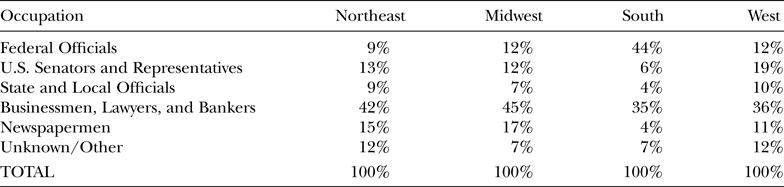
Taft's domination of Southern delegates appears to have followed mainly from the distribution of federal patronage.Footnote 80 Indeed, evidence that the South's support for Taft was closely linked to the federal government's provision of employment is suggested by Wilensky's study of 884 Taft supporters (defined as “men and women who gave their time and money to the regular Republican cause”Footnote 81 ) in the contest for the Republican nomination. While Taft supporters who held federal offices in other regions of the country made up no more than 12 percent of his support in the sample, 44 percent of Southern supporters were federal officials (see Table 3).Footnote 82 Roosevelt, in advance of the convention, decried the role Southern delegates would play for exactly this reason. Writing in the progressive publication Outlook, Roosevelt argued that the Southern delegates “represent nothing but Mr. Taft's own officeholders and the survivors of the carpetbag regime.”Footnote 83 In the same vein, historian William Garrott Brown, a native of Alabama and a strong advocate of a competitive Republican Party in the South, asserted in an article in Harper's Weekly that “the mass of Southern Republican delegates chosen this year are not merely products of the same old methods employed in 1908” but represented a scandal that “has been flagrant for decades, but this year it is so very flagrant that one cannot help hoping something will at last be done about it.”Footnote 84
Occupation of Republican Activists Supporting Taft in 1912, by Region

Source: Norman M. Wilensky, Conservatives in the Progressive Era: The Taft Republicans of 1912 (Gainesville: University of Florida Press, 1965), 36.
With Taft seemingly controlling more delegates than the 540 needed for a majority, the Roosevelt campaign attempted to forestall defeat by challenging a large number of Taft's pledged Southern delegates. Additionally, the Roosevelt camp proposed a cut in the total number of Southern delegates that would be admitted to the convention. Both approaches failed: with Taft in control of the RNC, only nineteen of the 254 contested delegates were awarded to Roosevelt in advance of the convention, while the proposal to decrease Southern representation was voted down 39–14.Footnote 85 The next crucial test of Taft's strength was the selection of a temporary chair at the beginning of the convention. On a close vote (570–501), conservative Senator Elihu Root (R-NY) was elected. Taft's control of the South was crucial to this success: 199 of the delegates who voted for Root were from former Confederate states (comprising 79 percent of all Southern delegates).Footnote 86 On a subsequent vote to refer all debate regarding contested delegates to the convention's Credentials Committee, the South again largely aligned with Taft: 78 percent of Southern delegates voted in favor of tabling discussion on the contested delegates.Footnote 87 Root's selection was consequential: In his role as temporary chairman, he helped the Taft camp by deciding that contested delegates had the right to vote on all of the convention's decisions, even those confirming the RNC's prior decisions on contested delegates (except those that concerned themselves).Footnote 88 This decision resulted in a majority approving the national committee's support for the Southern Taft delegates.Footnote 89
With Taft's victory now all but assured, Roosevelt called upon his delegates to bolt the convention and leave the Republican Party for a new, progressive alternative. As a result, Taft was easily renominated on the first convention ballot, while many of Roosevelt's supporters (who were still in attendance) voted “present” in protest.Footnote 90
While Taft succeeded in winning the GOP nomination, thanks in part to his solid Southern delegate bloc, the contentious 1912 convention would trigger the long-debated reapportionment of delegates. With Roosevelt running on a third-party ticket, the Republican vote in the 1912 presidential election was split, which provided Democratic candidate Woodrow Wilson with a landslide victory in the Electoral College. Taft ran third behind Wilson and Roosevelt, receiving only eight electoral votes and a mere 23.2 percent of the national vote. In the aftermath of the election, both conservatives and many of the progressives who had bolted the GOP for Roosevelt realized that some form of unification between the two camps was needed to prevent a permanent Democratic majority. Shortly after Wilson's inauguration, Republican members of Congress gathered to discuss reorganization of the party and, in the words of Senator Lawrence Sherman (R-IL), “agreed that Southern representation in the convention should be cut down according to the strength of the party in each Southern state.”Footnote 91 ,Footnote 92
In December 1913, the RNC followed the Republican congressional recommendation and voted unanimously to reduce Southern representation by adopting a new apportionment scheme, wherein each state would receive two at-large delegates, but congressional districts would only receive a delegate if the GOP vote in the 1914 midterms was 7,500 or higher. The committee's decision would require ratification by those states that voted Republican in the 1908 election (of which two-thirds would be required to support the proposed reapportionment).Footnote 93 Without a Republican president in the White House to protect Southern delegates against the proposal, RNC Chairman Hilles announced in October 1914 that the plan had been ratified, and thus the division of delegates at the 1916 convention would be based upon the new apportionment scheme.Footnote 94 As a result, Southern representation at the 1916 convention declined relative to 1912: Every former Confederate state lost delegates (a total of seventy-eight for the South as a whole), and the South's proportion of convention delegates decreased from 23.4 percent to 17.6 percent.
Harding, Coolidge, and Hoover: Southern Delegates, 1920–1928
During the 1916 and 1920 conventions, with the Republicans in exile from the executive branch and unable to control patronage, Southern delegates played a muted role. In 1916, Supreme Court Justice Charles Evans Hughes was nominated on the third ballot with little controversy. Additionally, with the new delegate apportionment plan in place, there was little debate regarding the size of the Southern delegations. In 1920, the Republicans faced a highly divided field—with as many as nine presidential candidates. Of these, Frank Harris Hitchcock, the postmaster general under Taft, invested the most in trying to buy a Southern bloc for the 1920 convention; after ending his campaign in early 1920, Hitchcock transferred the operation to General Leonard Wood.Footnote 95 While these investments meant Wood could count on a substantial number of Southern delegates throughout most of the balloting—ten ballots would prove necessary to select a presidential nominee—at no point did he control the South to the extent that previous candidates had.Footnote 96
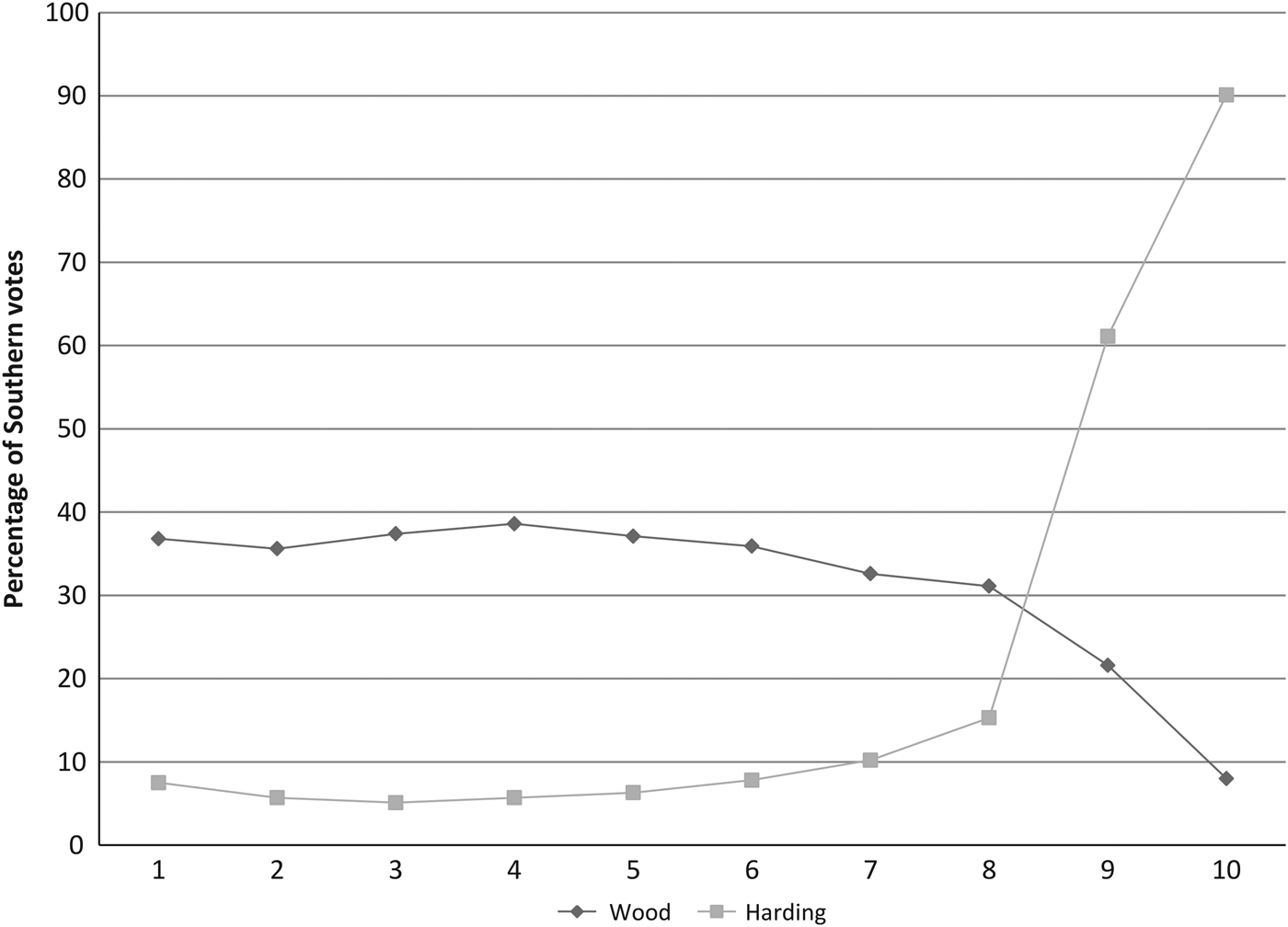
After four ballots on the fourth day of the convention, the body adjourned. Frustrated party bosses met in the proverbial smoke-filled room and decided that Senator Warren G. Harding of Ohio would be the compromise candidate if the deadlock were not broken early the next day. After four ballots on the fifth day of the convention (and eight ballots overall), an adjournment was called; when the body convened again later that afternoon, states began switching their votes to Harding, who achieved a majority on sixth ballot of the day (and tenth overall). A breakdown of the percentages of Southern votes for Wood and Harding across all ten presidential ballots is illustrated in Figure 2.Footnote 97
Percentage of Southern Delegate Support for Presidential Candidates in the 1920 Republican National Convention, by Ballot

The fact that Harding's victory occurred without his investing in Southern party organizations raised the possibility of a further reduction in Southern convention representation. While Southern delegates were protected from such attempts in most previous conventions, due to their inclusion in a majority coalition that had (frequently) been dependent upon their support, Harding's outsider status left the South without such cover. Immediately after the selection of Harding and his vice presidential candidate Calvin Coolidge, the convention passed a resolution calling on the RNC to “adopt a just and equitable basis of representation in future National Conventions,” which was to ensure that “proper and necessary changes in the present apportionment of delegates in proportion to the Republican vote actually cast at general elections throughout the various States of the Union” be achieved, as well as “to inspire a greater effort to erect and maintain substantial party organizations in all the States.”Footnote 98 Despite initial protests by Southern delegates, the resolution was passed by acclamation.Footnote 99
In January 1921, RNC Chairman Will H. Hays announced the creation of the Committee on Reconstruction,Footnote 100 which was chaired by C. Bascom Slemp, a Republican congressman from Virginia who represented the lily-white movement.Footnote 101 On the basis of the Slemp committee's recommendations, the RNC in June 1921 voted to further reduce Southern representation. Per the Slemp proposal, at-large district representation would be eliminated, and congressional districts would receive (a) one delegate if at least 2,500 votes had been cast for the Republican candidate in the last presidential or congressional election and (b) a second delegate if 10,000 or more votes had been cast, or if the Republican candidate had won.Footnote 102 While the effects would be relatively minor and could even have increased the number of delegates for some Southern states,Footnote 103 based on the 1920 elections the South would lose fourteen delegates in the 1924 convention (representing an 8.4 percent decrease relative to 1920). As a result, (black) Southern members of the RNC accused the committee of trying to “penalize people of the South whose only crime has been the voting for such men as McKinley, Roosevelt and Harding.”Footnote 104
The Slemp proposal never went into effect, however, as the RNC voted in December 1923 to restore the basis of representation that had been agreed upon in 1913, while expanding the number of delegates for states that had voted for Harding in 1920. As Richard B. Sherman notes, there were several reasons for this shift.Footnote 105 First, the Republican losses in the 1922 Congressional elections would have meant a decrease in delegate numbers for non-Southern states. Additionally, black Republicans remained strongly opposed to the change, and some Republican leaders feared that a decrease in black votes in other parts of the country would result.Footnote 106 However, most important was the traditional control of Southern delegates by a president up for reelection. While Harding had earned the Republican nomination in 1920 without specific reliance on Southern support, and may therefore not have appreciated the importance of controlling Southern delegates, his death in the summer of 1923 left Calvin Coolidge with less than a year to secure his own nomination.Footnote 107 Facing a challenge by Senator Hiram Johnson of California, who announced his candidacy in November 1923,Footnote 108 Coolidge calculated that controlling “as large a block of southern delegates as possible”Footnote 109 would be the most effective way to maximize his chances of winning the nomination.
The issue of reapportionment was debated during the December 1923 RNC meeting, and in the end, the committee members voted to reinstate the previous delegate proportions.Footnote 110 Unsurprisingly, Hiram Johnson opposed the return to pre-1921 Southern delegate levels, calling it “an act repugnant to every sense of fair dealing,” while describing the Southern states as having “nothing Republican in them except a few office-holders, absolutely under the direction and control of the Administration.”Footnote 111 Coolidge would go on to be nominated with near unanimous support during the 1924 convention.
Four years later, with Coolidge's decision not to run for reelection in 1928, the Republican presidential nomination was up for grabs. Herbert Hoover, who was Coolidge's Secretary of Commerce, devised a preconvention strategy that relied on an informal campaign organization to collect delegates on his behalf. Hubert Work, the Secretary of the Interior, played an important role in this regard and focused much of his attention on lining up support for Hoover in the South. Hoover was by no means an illogical candidate in this regard. After the massive Mississippi flood of 1927, Coolidge had chosen Hoover to direct the administration's response, and Hoover had built up a genuine level of popularity among Southern businessmen based on his efforts.
Nonetheless, the Hoover campaign organization had few qualms about buying Southern support in the McKinley/Hanna tradition: Rush Holland, a close associate of Work's, who “specialized in factional squabbles and patronage,”Footnote 112 was sent to Arkansas, Louisiana, Florida, and South Carolina with $10,000 to dole out among local party leaders.Footnote 113 Thanks to this Southern strategy, as well as participation in carefully chosen primary elections, Hoover entered the Republican convention with a sizable lead in delegates and was elected on the first ballot, receiving 77 percent of the total delegate vote and more than 96 percent of the Southern votes.Footnote 114
In addition, looking ahead to the general election, Hoover used the likelihood of Governor Al Smith of New York—a Roman Catholic—becoming the Democratic candidate to further refine his Southern strategy, by privileging the lily whites over black Southern Republicans. As Allan J. Lichtman has argued, Hoover “saw a unique opportunity to garner the electoral votes of the normally Democratic South by shrewdly directing appeals to religious bigotry, prohibitionism, and racism.”Footnote 115 Hoover adopted this strategy during the convention, as his lieutenants actively supported the lily-white movement while shunning black Republican leaders (who were denied credentials). As a result, Hoover not only received solid Southern support during the convention but also managed to dramatically improve the Republican performance in the South in the general election (see Figure 1)—making a GOP presidential candidate a genuine contender in the South for the first time since Reconstruction.Footnote 116 Whether Hoover's lily-white strategy could have truly opened the (white) South to the GOP is unclear, however, as his presidency was derailed by the Great Depression—an event that crippled the Republican Party nationwide for a generation.
CONCLUSION
The historical overview presented here shows how GOP leaders between 1880 and 1928 developed a Southern strategy by consistently using Southern delegations as reliable voting blocs during Republican National Conventions. While the Republican Party's vote share in the former Confederate states remained very low throughout this period, Republican leaders (most commonly presidents) invested heavily in maintaining a minimum level of party organization in the South for the specific purpose of producing delegates to the national conventions. Such small organizations were easily controlled through the provision of federal patronage (frequently in the form of postmaster positions) to local party leaders. In cases in which presidential hopefuls did not (yet) control patronage, direct bribery proved effective as well. In return for their investments in Southern Republican organizations, and their protection of the size of the Southern delegations, party leaders were rewarded with delegates who could be counted on to support presidential candidates and vote the “right” way on any other crucial convention votes.
Even as party elites openly controlled Southern convention delegations through patronage or other forms of vote buying, it was also clear that the South did not contribute in any way to the party's performance on Election Day. Yet, in the last decades of the nineteenth century, there was relatively little debate about reducing Southern convention representation. There were three reasons for this. First, Southern delegates provided a reliable voting base for incumbent administrations during convention ballots; thus, the “establishment” backed the status quo arrangement. Second, Southern Republicans were largely composed of blacks who were actively disenfranchised by white Southern Democrats, and the Party of Lincoln did not (yet) want to deny these members their last form of political representation—as delegates at the national convention. Third, with the full brunt of Jim Crow not yet in effect, Republican electoral success in the South remained possible, at least in theory. Based on this view, a reduction in Southern representation would destroy any possibility of emerging (or reemerging) Republicanism in the former Confederacy.
After McKinley's victories in 1896 and 1900 and the full implementation of Jim Crow, the Republican Party's dominance in the rest of the country meant that it could consistently win the presidency and majorities in Congress without the South. Additionally, the Republicans' failure to make any notable electoral inroads in the former Confederacy underscored how effective Jim Crow laws were in protecting the Democratic hold on the “solid South.” As a result, the number of open challenges to the size of Southern GOP delegations increased after 1896. Prior to the McKinley victories, only one attempt to reduce the number of Southern delegates occurred (during the 1884 convention), but in the System of 1896, challenges occurred much more frequently (in 1899, 1900, 1908, 1912, 1913, 1920, and 1921). In challenging the status quo, opponents also became increasingly vocal in their assessment of Southern delegates (both black and white) as little more than officeholders from rotten boroughs.
Not all of the proposals to reduce Southern delegations were sincere. Some were issued simply to blackmail Southern delegates into abandoning their patrons on crucial issues. This was an indication that the view of the GOP in the South as an open market for convention votes had increasingly become the norm over time. And while party leaders who favored a reduction in the size of Southern delegations frequently based their arguments on grounds of fairness, many were also inconsistent in their stances. For example, both Taft and Roosevelt completely changed their positions on the issue between 1908 and 1912, based on whether Southern delegates could help or hurt their chances at controlling the convention.
The 1928 convention would be the last before the collapse of the System of 1896 and the end of GOP dominance. Hoover won in a landslide in 1928 and, ironically, for the first time in Republican Party history, succeeded in winning a substantial number of white Southern votes (an achievement helped in no small part by Democratic candidate Al Smith's Catholicism). The Hoover administration entertained ideas of investing in creating a genuine two-party system in the South, but the stock market crash in 1929 and subsequent Great Depression led to dramatic Republican losses in the 1930 midterms and a brutal electoral realignment in 1932. Facing the complete collapse of the electoral coalition that had kept them in power for the better part of three decades, Republicans jettisoned questions of Southern representation in favor of more immediate concerns—like the party's ability to simply survive, even in parts of the country that it used to dominate. Without patronage and with black voters beginning to move into the Democratic Party (partly in response to the New Deal, but also due to the Republicans' embrace of the lily-white movement under Hoover), the GOP found itself from 1932 onwards facing as extreme an exile from Southern politics as it had prior to the 1928 elections. As black voters became a more crucial element of the Democrats' electoral coalition, however, the Republicans had a greater incentive to focus their attention on disgruntled white voters in the South in the 1950s and 1960s, setting up one of the most significant geographical switches in American party history.
To reiterate, our goal in this article has been to examine the role Southerners played in Republican National Convention politics in the half-century after the end of Reconstruction. While we believe we have illuminated much regarding this little-studied subject—and, in doing so, enhanced scholarly understanding of national party organizations and presidential politics in the late nineteenth and early twentieth centuries—we also think that much more can be learned from further study. Two avenues, in particular, look promising. First, individual-level analysis of Southern delegate behavior at specific conventions could provide more detailed insight into how party leaders managed to exert control, as well as identify which delegates might have been open to “elite courting” and the specific benefits they received in exchange for their loyalty (votes). Second, the intraparty struggles between the black & tans and lily whites deserve more study. These racial divisions within the Southern GOP in the late nineteenth and early twentieth centuries likely shaped how national party elites dealt with Southern party organizations. Existing studies on the topic, which are sparse, have suggested that presidents and other national party leaders frequently shifted their alliances between the two rival organizations, based on perceived strategic advantages (i.e., by discerning which group could be more easily “bought”). Future research could examine more systematically the rise of the lily-white movement, and how its conflict with the black & tans affected both Republican convention politics and Southern GOP development more generally. It could also explore the role black Southerners played as public representatives in the Republican Party (beyond the views national leaders appeared to have of them), both at home in their role of running local state party organizations and on the national stage as convention delegates.