There were creative and material advantages to Prokofiev's return to his homeland (a move he completed in 1936), and particular benefits, or so it seemed, in opera, the composer's favoured genre. Opportunities for work in the theatre (and with distinguished directors) were undoubtedly a major attraction, combined with the prospect of being free of the need to tour as a concert pianist in order to maintain his standard of living.Footnote 1 Prokofiev was encouraged by both practical support and the possibilities offered by new ideas, a large and receptive audience, and closer contact with national traditions. In his first Soviet-period opera, Semyon Kotko (1939), he took on a socialist realist subject and a Ukrainian, Civil War setting, and while attempting to meet official standards and address an unsophisticated audience, created an innovative and engaging work of music theatre. Prokofiev had begun to promote – as a description of his own aesthetic ideal or a prescription for his Soviet peers (or both) – a ‘new simplicity’, rejecting the limits that he perceived had been reached by contemporary modernism in the West (‘experimentalism’ and extremes of dissonance on the one hand, the neoclassical trend of ‘Bach with wrong notes’ on the other), and simultaneously pursuing a polemic against provincialism, epigonism and deficient levels of technical skill in Soviet composition.Footnote 2 Prokofiev believed that mass art should be founded on the basis of the standards of high art, but Kotko also points to an inspiration from the popular theatre: the ‘classic’ stage melodrama. As librettist and composer, Prokofiev always attempted to reproduce the particular qualities of his literary sources, rather than force his chosen material into a preconceived notion of operatic form; at the same time he sought to emulate the animation and immediacy of the spoken theatre. In Kotko, Prokofiev highlighted the melodramatic elements of Valentin Katayev's novella, Ya, sïn trudovogo naroda (I, Son of the Working People, 1937), finding in them stimuli for vivid on-stage activity and rich surface detail. In the transposition he introduced two further elements – comedy and stylised stage gesture – that bring the work still closer to the classic melodrama at the same time that they link with a major tradition of Russian opera and with the modernist theatre of Vsevelod Meyerhold.
Melodrama, as an effective method of provoking and guiding powerful emotional responses, was an important element in High Stalinist narratives. It was taken up in the post-revolutionary theatre as a means of communication to a new audience of peasants and proletarians. When socialist realism was decreed as the law of Soviet aesthetics in the early 1930s, the melodramatic mode was incorporated as part of its eclectic merging of the popular with the solemn and grandiose, and its union of everyday reality with monumental spectacle. Melodrama became an essential ingredient in the promotion of the moral absolutes of the Stalinist state. In the case of Soviet opera, the arts administration began by the late 1930s to demand a form that would project ideology with the greatest expressive force; in order to be both accessible and awe-inspiring, it was expected to conform to the conventions of Romantic opera and include maximally effective arias, choruses and mass images. But I suggest that the classic form of melodrama – belonging to the late eighteenth and early nineteenth centuries, created in France by Pixérécourt – provided the basis for Kotko, and this differed significantly from the socialist realist adaptation. Prokofiev maintained, as a core principle of his operatic aesthetic, ‘the fight against bombast, triviality, and so on’, and pursued ‘the universal and timeless’ while avoiding ‘local and topical elements’,Footnote 3 and would not be restricted by the conventions of Romantic opera and constraints of socialist realism.
While attempting to meet contemporary demands, therefore, he continued to write for posterity, and intended that Kotko should remain ‘without propaganda, which quickly goes out of style’.Footnote 4 His lack of willingness to engage fully with official imperatives led to a controversial reception for his first Soviet opera, setting a pattern for his later career in the theatre. In its first and only season Kotko prompted a major public debate among critics and musicologists that centred around a comparison with another opera, Tikhon Khrennikov's V buryu (Into the Storm, 1939). Although the musical quality of Kotko was recognised as being well above the Soviet norm, it was heavily criticised for its treatment of its subject matter, in particular its lack of heroism. The opera was found to be at odds with norms of ritualised solemnity, and its comic elements were considered inappropriately irreverent. My focus on melodrama will get to the heart of both the opera's unique qualities and the pressures surrounding it. While commentators have assumed that Kotko is a work of socialist realism merely because of the novella it sets and the period to which it belongs, I argue that the opera is far removed from that aesthetic model. At the same time, although it has been criticised for dramatic and stylistic incongruities, a reading of the opera as classic melodrama enables an interpretation that accentuates unity, in which its integration of older traditions may be understood as coherent and consistent.
Melodrama and socialist realism
Melodrama is a total art form, a ‘language of the entire theatre, uniting words, music, spectacle and gesture’,Footnote 5 which is marked by moral oppositions, and relies on pathos and sensational effects to produce intense reactions and carry forward its (formulaic) plot.Footnote 6 The use of the term ‘melodrama’ in writing on music usually refers either in a strict sense to the form of spoken dialogue with musical accompaniment, or more generally and colloquially to describe the histrionics, twists of fate and expressive extremes not unfamiliar to the medium of opera.Footnote 7 While elements of melodrama (in this second sense) are obviously present in many operas, Kotko presents a striking and atypical example. It is based not on those elements that had been absorbed into operatic convention during the nineteenth century, but on the narrative properties and expressive means of the original Pixérécourtian form. Rapid action, flexibility of declamation and sharply etched caricature – all characteristic of Prokofiev's operas – tally with a plot featuring stock characters within an abstract moral conflict, and a dramatic structure combining catastrophe with comic relief. This is at some distance from the giant swells of passion that dominate Romantic opera. Prokofiev takes his usual values of clarity and economy almost to an extreme in Kotko's pared-down musical style; its compact formal design and musical materials suit an uncomplicated drama built on contrasts between distinct and opposed elements. At the same time, the expansion in this opera to a wider spectrum of vocal techniques, from songlike melody (though there are still no formal arias) to rhythmically notated speech,Footnote 8 fulfils the same purpose of creating variety and contrast.
Kotko's character as a classic melodrama lends it particular historical significance because it collided with a very different form of melodrama in Stalinist culture of the late 1930s. In the early years of the Soviet Union, melodrama had been endorsed, even heavily promoted, by such leading cultural theorists as Maxim Gorky, Alexander Blok and Anatoly Lunacharsky, who recognised the parallel with its origins in revolutionary France and considered it the ‘ideal popular theatre’ for reaching the masses.Footnote 9 Following the rejection of bourgeois naturalism, melodrama was seen to offer possibilities for the creation of revolutionary theatre, including the modernist theatre of Meyerhold.Footnote 10 Also during the 1920s, the Russian formalists were the first to analyse melodrama from a theoretical perspective, in line with their concern with the structural properties of narrative forms without prejudice against popular or folk literature.Footnote 11 The plans of Lunacharsky and Gorky to create mass art from melodrama were realised most of all in the Soviet cinema, for which it became a major genre (also in combination with other genres).Footnote 12 In the early 1930s, melodrama continued to provide the basis for theatrical genres emerging under socialist realism, such as the political temperance drama, in which ‘wavering’ heroes are caught between the moral choice of revolution and counter-revolution.Footnote 13 This dramatic genre was clearly in parallel with the Soviet novel and what Katerina Clark has described as its ‘masterplot’, which centred on mythical archetypes and involved the redirection of personal drives and development of socialist ‘consciousness’, leading to the accomplishment of a task that benefits the community.Footnote 14 The narrative conventions of the novel (a genre that was of central importance to socialist realism) were essentially melodramatic, if we follow William Sharp's account of the structure of melodrama: ‘The possibility of change in society, or of a change in the hero or heroine who lives in that society, is a necessity for melodrama. Unlike comedy or tragedy where society remains the same and we join it or leave it, melodrama at least implies a change in conviction, and a positive change at that, in either the protagonist (our hero) or the antagonist (society).’Footnote 15 In the masterplot both the hero and society undergo positive transformations, as an allegory of the creation of socialism.
Socialist realism was enforced by the Party as the standard for all Soviet art, signalling the replacement of experimentation by unified content and stylistic neutrality, within which certain aspects of melodrama remained inscribed.Footnote 16 Following Stalin's consolidation of power in the mid-1930s, he was able to claim that ‘the waverers had all been won over’ and ‘the virtuous community had triumphed’;Footnote 17 the melodramatic mode now served to enhance growing nationalist rhetoric and define new moral absolutes. A major focus was the exposure and elimination of threats to the Soviet nation from external and internal enemies, the latter portrayed as the dvurushnik (double-dealer), a figure that was, as Lars T. Lih points out in reference to the Soviet theatre, very similar to the villain of classic melodrama.Footnote 18 At the same time, a shift of emphasis took place, away from the hero's acquisition of knowledge of political theory (since that was assumed to have occurred), towards his accomplishment of superhuman feats. In achieving the goals of a utopian communist state, the positive hero overcame seemingly impossible obstacles, including struggles against nature, through the exercise of his own extraordinary capabilities as a Soviet worker, explorer, pilot or border guard. Heroes and villains were symbols of absolute and opposed moral positions.
As a part of the Gesamtkunstwerk of socialist realism,Footnote 19 public discourse likewise drew on an idiosyncratic interpretation of melodrama in communicating the strict moral codes of High Stalinism. Propaganda concentrated less on Marxist theory than on associations with moments of glory from Russia's past; the intention was to motivate the people's passion for the re-emergence of a great power under Stalin,Footnote 20 by inspiring veneration of the heroes and hatred of the enemies of the former tsarist and future socialist empires. If the young socialist state had offered a revolutionary environment comparable to that of melodrama's origins, by the late 1930s a new autocracy had been put in place, supported by the pseudo-religion of ideological doctrine and worker and leader cults. Melodrama remained a crucial component in this context, for its direct, unambiguous manner of representation, its reliance on non-verbal sign systems, and its characteristics of redundancy and excess. In all media – the cinema, textbooks, parades, newspapers – the same messages were endlessly repeated, and images and slogans became preferred to narratives, as they were more immediately accessible and more easily disseminated. Multimedia art forms such as film and opera gained prominence, since they could draw on the most highly affective means (images and music) to broadcast heroic rhetoric and enact a form of ritual on a grand, national scale. In a similar way to public spectacles such as Red Square marches, the aesthetic aim was to achieve what we might label the socialist realist sublime.
Although Dzerzhinsky's ‘song opera’ Tikhiy Don had received the approval of Stalin himself in 1936,Footnote 21 enthusiasm for this genre, and for Civil War subject matter, subsequently waned.Footnote 22 The arts administration encouraged a higher level of musical quality and an idiom far more powerful, even Wagnerian, in scope and symphonism, though (somehow) still tuneful and based in Russian traditions. An elevated and idealised national culture was required, not mere imitation of folk or popular songs. The eventual failure of Soviet composers to achieve this mix of high and low led to the return of Tsarist-era classics, marked above all by the celebrated 1939 production of Glinka's Ivan Susanin,Footnote 23 which combined the simple and the monumental, focusing on heroic self-sacrifice, faithfulness to the nation and the Tsar, and defence against foreign invasion. In order to achieve results of a similar standard, Soviet opera was expected to condense and enhance the ideological message contained in literary sources.Footnote 24 Prokofiev concentrated instead on those aspects of Katayev's novella he found to be ‘rather lively’,Footnote 25 in pursuit of action and drama rather than propaganda. Kotko is episodic, rather than symphonic, and its treatment of folk melody does not attain monumentality. A more detailed examination of the opera's melodramatic features and their conflict with contemporary aesthetics, however, needs to be preceded by a look at Kotko's link to the tradition of the Little Russian comedy (including its imitations of folk music) and reliance on gesture: both of these features are essential to its inventive take on the classic melodrama and distinguish it from the sententious appropriation of melodrama in socialist realism.
From Little Russian comedy to melodrama
By the time Prokofiev chose it, Ya, sïn trudovogo naroda had already been transposed into two theatre productions (a film would follow) and probably seemed a safe bet.Footnote 26 Set in Ukraine during the Civil War, it was part of a defence literature promoting heroic struggle against foreign invaders (in response to the growing threat from Nazi Germany), and fitted into a contemporaneous reinterpretation of Russian history. The novella addressed the leadership's lingering concerns over nationalist elements in Ukraine, where the peasantry had opposed the Bolsheviks in 1918–20 and resisted forced collectivisation during the first Five Year Plan (1928–32). Katayev's intention was to present Ukrainian peasants turning away from the old life, fighting with rather than against the Red Army, and forging a bond between Ukraine's national aspirations and centralised plans for its full participation in the Union.Footnote 27 The story's hero, Semyon Kotko, is the wavering type common to the socialist realist masterplot. He is persecuted by a sinister villain, Nikanor Vasil'yevich Tkachenko, who in a single figure unites the most abhorred types of enemy, as a kulak (a wealthy peasant, the traditional class opponent) and as a collaborator with foreign invaders.Footnote 28 This concentration on a clash between victim and villain makes the novella particularly melodramatic in the classic sense.
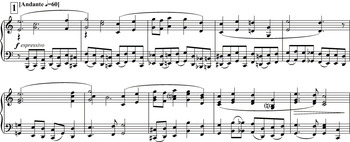
In his handling of the Ukrainian language, motifs and characters, Katayev returned to his usual literary model, Nikolay Gogol, who along with other great Russian writers was then returning to prominence.Footnote 29 To a certain extent Katayev imitated the officially promoted Taras Bul'ba (a folk epic tale of pan-Slavic resistance to foreign invasion),Footnote 30 though in spirit the novella is closer to Gogol's other early stories set in Ukraine, the Evenings on a Farm near Dikan'ka (1832), which are comic and macabre folk tales. Prokofiev largely rejected Katayev's plans (as co-librettist) for verses and conventional numbers,Footnote 31 and he did not adapt folk references into something typically socialist realist. Instead he replicated the blend of folk epic and folk tale through the qualities of understatement, directness and simplicity. Two miniature ‘overtures’ present two themes (which I will refer to as Themes 1 and 2, Ex. 1a and 1b) that function in the opera as complementary markers of joyful and tragic sides of Ukrainian village life (major and minor, ascending and descending; Theme 2 begins as an inversion of Theme 1). Short scenes then follow the novella's concise chapters. When the curtain rises in scene 1 (6), Semyon is making his way home at night, accompanied by a G Aeolian tune shared by the oboe and clarinet that a Ukrainian soldier might have played on his dentsivka (duct flute) and folk-like with its drone and 5/4 metre (notated in 4/4). At rehearsal number 7 he begins an almost banal song in B flat, with a text from the novella's opening sentence (‘A soldier returned from the front’). Similar to his representation in the novella, Semyon is treated musically as a ‘collective hero’ of folk literature, lacking distinctive qualities.
Introduction, bars 9–18 (Theme 1).

Act I, tableau 1, bars 1–8 (Theme 2).

The folk tale as Gogolian village comedy soon prevails, however, beginning with the shenanigans that open tableau 2, as villagers peer curiously over the fence surrounding Semyon's hut the next morning, competing to catch a glimpse of the returned soldier. In the novella only a few words of greeting pass between the villagers and Semyon, but Prokofiev considerably enhanced such opportunities for local colour, drawing on an obvious link to the tradition of ‘Little Russian’ (Ukrainian) comic operas of Tchaikovsky, Rimsky-Korsakov and Musorgsky that were based on Gogol's Dikan'ka tales.Footnote 32 Colloquial language and sharp disputes were always typical of Prokofiev's depiction of the lower classes, and nosey, busybody women and gruff and grouchy men feature in all four Soviet-period operas, but in Kotko they directly recall the Little Russian comedy that was their natural habitat. Appearing at first as a folk hero, Semyon quickly drifts into another stock role, that of Gogolian lover – a village lad, pursuing Sofya just like a Vakula, Levko or Grits'ko in love with Oksana/Ganna/Parasya.Footnote 33 The unselfconscious lyricism of Semyon and Sofya, most prominent in their Act I duet, is in a similar vein to the opera May Night, expressing mildly amusing terms of endearment in regional language (‘Yagodka moya krasnaya’ – ‘My little red berry’; ‘moyo tï oblachko’ – ‘you are my little cloud’). Like Rimsky's lovers they have a teasing, combative aspect to their relationship. The same is true of Semyon's younger sister Frosya and her suitor Mikola; a feature of the Gogolian comedy is that all members of the village are involved in the colloquial humour, and parallels between couples and characters emphasise their stock status and their membership in a small rural community. Frosya seems a young and lively version of the babï (women) when she attempts to assist Semyon with his romantic affair, or in her argument with her mother at the end of the act. There is a gently humorous take on village customs, hierarchy, pretence and politesse, for example through the exaggerated actions and speech of Remenyuk and Tsaryov as matchmakers in Act II.
Numerous further suggestions of folk music strengthen the link to Little Russian comedy. There is one direct quotation of a folk source, the melody in the middle section of Frosya's song in scene 8, earlier used by Tchaikovsky in Cherevichki.Footnote 34Prokofiev also set Ukrainian folk song texts (‘Chto vï, starostï’, ‘I shumit, i gudit’ and ‘Rano, ranen’ko') to newly composed melodies. Other original music is modelled on folk singing, such as the choruses in Act II during the matchmaking ceremony (in the Mixolydian mode), and the imitations of the bustling rhythms of vesnyanki (spring song-dances) in a series of couplets in quick tempos with strong duple beats, sung by the women and girls at almost regular intervals throughout Act I (38, 45–50, 59–60, 73–5, 85). Frosya's song and the Act II choruses conform to kuchkist practice (appearing as they might in real life), while the fragments of vesnyanki seem to be a variant of the method in Musorgsky's Sorochintsï Fair, where dialogue is set to folk tunes.Footnote 35 More generally, Prokofiev evoked the aura of folk music though the use of diatonic modes, especially Aeolian and Dorian (‘Russian’ minor),Footnote 36 an emphasis on vocal melody, minimal textures, and a limited palette of tone colours with prominence given to the winds. There is also a set of short motifs, the most conspicuous being a falling major second and fourth or fifth, which reappears frequently throughout Act I, audibly linking and unifying the main thematic material, in particular that belonging to the principal protagonists.Footnote 37 The overall effect of Act I is of a timeless pastoral ambience, with comic action in the foreground.
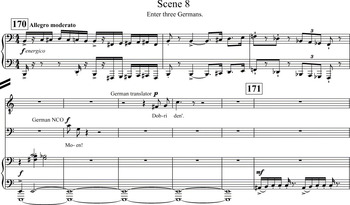
Associations with the Little Russian comedy continue well into Act II, including the familiar change of décor from outside to inside a hut (May Night and Sorochintsï Fair), but a darker atmosphere is introduced along with a character who will emerge as the villain. Thus the melodramatic mode begins to materialise. Tkachenko enters to deliver a short monologue (a parallel with Semyon's opening song),Footnote 38 which contains a Phrygian inflection that places him at the negative extreme of the opera's modal/moral spectrum. Like Rimsky's Village Head, he is fiercely protective of his public image and aspires to wider recognition from the tsarist authorities; he even sings a snippet of the imperial national anthem when mentioning the Tsar (Act II, scene 5). Although Tsaryov and Remenyuk play their part in the matchmaking ritual with a degree of buffoonery, Tkachenko is from the start authoritarian and violent in his treatment of his wife, daughter and the matchmakers, and he lacks the comic qualities that usually soften the obnoxious Gogolian father. While the tension is alleviated by the two choral songs of the village guests that, like other such moments of lyrical song, offer temporary repose within the general build-up, the slowing of pace and relaxation of mood is then abruptly punctured in scene 7, when three German soldiers burst in on the homely setting. As the choir sings the final phrase of the second chorus, they are interrupted just before a return to the tonic A flat by three forte blasts of a brutal B-minor chord from the low brass and double bass. In the context of the gently flowing motion of the chorus (with strings and winds), this knock of fate is as sharp a contrast as it is an utterly simple one. The first violins' and violas' meek attempt to finish the phrase is stopped by a second knock, and the next scene follows immediately as three Germans enter the hut, introduced by a peremptory chromatic figure (in B minor), the distorted fanfare that is their leitmotif (168–70, Ex. 2a).Footnote 39
The shock of this invasion marks the end of the exposition, and leads not just to the development but to a shift in the nature of the drama itself. Commentators have tended to focus on how this moment recalls Ivan Susanin.Footnote 40 But the invasion here is unprepared, and far more startling. The Soviet musicologist Marina Sabinina (author of a book-length study of the opera) suggested in effect that the opera itself is invaded here by another genre: she labels Kotko a ‘double-genre’ incorporating both comedy and ‘heroic struggle’, switching suddenly from one to the other at the point of the German intrusion.Footnote 41 While this impression is understandable as an immediate reaction to this particularly striking moment, a better explanation is available, one that takes into account the work as a whole. Kotko is not an ad hoc combination of genres, nor is it constructed on juxtaposed references to Russian operatic models from the nineteenth century. Rather, it conforms to the third possibility after comedy and tragedy that by definition contains elements of both.Footnote 42 The ‘leap’ from village comedy to disaster drama in the middle of Act II is in itself one of those shock effects characteristic of melodrama: this is not a disruption of one genre by another, but a confirmation of the opera's real genre. The Gogolian and Ukrainian folk references may be seen in retrospect as providing the comic(-pastoral) opening that is typical of classic melodrama.Footnote 43
Performance: Meyerhold and gesture
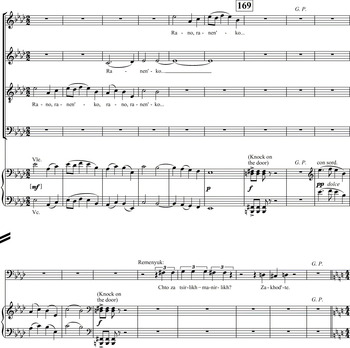
A fundamental reliance on physical gesture, specified by the score or implied by it, is the second crucial aspect that establishes the opera as melodrama in a classic, rather than Stalinist sense. More than any other opera by Prokofiev, Kotko exploits physicality, movement and gesture, as well as mimetic music that synchronises with actors' movements on stage.Footnote 44 To give a few examples: the music at Semyon's first entry, where he is dressed in his soldier's uniform, is an amiable march; Frosya's balletic theme at her first appearance – skipping, bounding – displays a tomboyish exuberance (27), as do her other entrances in Act I; Sofya's repeated faux coy entreaty ‘A s tem dosvidanichka’ (‘And with that let's say goodbye’) suggests a graceful withdrawal, and her ‘Pusti!’ (‘Let go!’), with a similar iambic stress, is like a gentle push (64–7). Tsaryov strolls in at his first entrance playing a cheerfully swaggering tune on his accordion (77). Remenyuk's beneficence edges towards comic ostentation in his 3/4 marchlike song (79), the two statements of which end with a grand ‘Vladey!’ (‘Take it, it's yours!’), matching a flamboyant movement of the arm as he hands Semyon the deeds to land and livestock (the stage direction is ‘He presents a paper’). There are many additional examples of correspondences with gesture in the music as an accompaniment to movement or as a declamatory outline in the voice (often both together), and also wider applications, from rhythmically notated physical actions that produce actual sounds at a diegetic level, for example when Semyon knocks on his mother's door or Remenyuk and Tsaryov strike their staffs on Tkachenko's floor, to a general use of metre to convey attitudes and social spheres, such as 3/4 for a (mock) heroic metre, and 2/4 for the activity of village life. Gesture suits the stock characters and situations, and enhances both humour and disaster, illustrating personalities, revealing subtleties of relationships, and emphasising the violence perpetrated by evil against good.
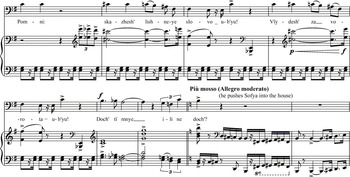
Act II, end of scene 7.

Act II, scene 8, beginning.

Prokofiev's emphasis on stylised gesture is striking, and yet this opera has been claimed by all commentators to be a ‘realist’ work.Footnote 45 Sabinina stresses its ‘psychological’ nature,Footnote 46 and connects Prokofiev's method with ‘the contemporary realistic theatre’ of Stanislavsky and Nemirovich-Danchenko. At the same time she mentions (rather contradictorily) the prevalence of physical gesture, and compares the opera to the work of Bertolt Brecht.Footnote 47 It was apparently self-evident that Prokofiev, ‘as a Soviet artist’, must have been inspired by Brecht's Marxist aesthetics.Footnote 48 These inconsistent claims should be read in terms of official preferences, since Brecht and Stanislavsky had impeccable credentials as celebrated figures of the socialist theatre.Footnote 49 There may be a level of realism in Kotko (its historical subject or geographical setting), but one that comedy and melodrama both require in order to maintain a degree of familiarity, since they are based precisely on an exaggeration of the realistic.Footnote 50 If one does not overlook, as all critics have, the stylised and performative aspects that are integral to Kotko – to the extent that they rule out both ‘realism’ and ‘socialist realism’ – a more convincing suggestion is that Prokofiev was drawing on the aesthetics of Meyerhold, who was involved in the creation of the opera as its intended producer. Meyerhold was after all a pioneer in the use of stylised gesture,Footnote 51 partly inspired by its use in melodrama, which was one important source for his anti-realistic methods. There was a long creative association between the director and the composer,Footnote 52 and it was Meyerhold who encouraged Prokofiev to compose Kotko for the Stanislavsky Theatre, where he had been taken in after his own theatre was forcibly closed by the authorities.Footnote 53 Their shared ideals for the reform of opera were then partly realised in the conception of Kotko, which was developed in close collaboration between them (and Katayev).Footnote 54
Gesture was central to Meyerhold's modernist opposition to the psychological realism of the naturalist theatre. He was drawn to the ‘forgotten elements’Footnote 55 of ancient, foreign and popular theatres – Greek, Japanese Noh, commedia dell'arte, for example – that celebrated the very artificiality of the stage and its conventions, including gesture and other visual symbols; classic melodrama, in which the complementary correspondence of different media (music, gesture, speech, image) to heighten effects is an essential property, was among these points of reference.Footnote 56 For Meyerhold, ‘[m]ovement is the most powerful means of theatrical expression’.Footnote 57 The system of actor training that he developed, biomechanics, provided the foundation for a physical theatre. Already by the early 1930s Meyerhold's methods were criticised as the opposite of the ideals promulgated by the Soviet arts administration,Footnote 58 and yet, I suggest, Prokofiev sought to adopt them in his opera. This claim is supported not only by the gestural music of the scoreFootnote 59 and numerous stage directions, but also by Prokofiev's involvement in the production process. In the absence of Meyerhold, following his arrest (and subsequent execution), and what we know to be the composer's lack of confidence in his replacement (Serafima Birman), Prokofiev attended rehearsals and guided the performers himself, less in the capacity of composer, as it turned out, than of stage director. His comments, as recorded in notes held in the Russian national archive, focused not on the musical execution but almost exclusively on the actors' stylised, symbolic gestures, which are matched to short, rhythmically strongly marked musical phrases and motifs in both voice and orchestra.Footnote 60 For a few examples, some corresponding to those given above: at the first rehearsal of 23 February 1940 Prokofiev asked for ‘a bow or a curtsey’ at Sofya's line ‘And with that let's say goodbye’, and at a full rehearsal on 22 March he requested ‘more hints of pretending to leave’; at the first rehearsal he suggested ‘a broader gesture, more impressive’ at Remenyuk's ‘Vladey!’, and on 22 March stressed that this still needed to be ‘more weighty’. Tsaryov was told to deliver his introduction of Lyubka ‘like a kiss’, Remenyuk's toast ‘to the health of the bride and groom’ in Act II was to be ‘more theatrical, performative [razïgrïvayet]’, and Semyon's entrance at the beginning of Act IV required ‘slower steps, like the music’.Footnote 61 In the absence of a representation of psychological content in the opera, precise and exaggerated physical movements, together with the phrases and fragments of music that accompany them, serve as the ‘algebraic signs’ of the Meyerholdian theatre,Footnote 62 enriching stock characterisation and enhancing a melodramatic narrative.
Classic melodrama in Semyon Kotko
Generic mixture and the importance accorded to gesture belong to the classic form of melodrama that provided the foundation for Kotko. In the exposition, the comic features are prominent, but when disaster strikes, gesture and its simultaneous musical equivalent remain highly effective in demonstrating and intensifying the confrontation between good and evil. Other conventional features of the classic melodrama include: moral opposition of villains and victims; moments of shock, horror, violence and threats of death; sorrow, pathos, comic relief; coincidences, last-minute reversals, revelations, escapes and rescues; and, finally, poetic justice and a happy ending. Of course all this is common to much nineteenth-century opera because it absorbed many melodramatic conventions. Nevertheless, Kotko is more closely connected to the original melodrama by virtue of its rapid pace and the immediacy of its action, as well as the ‘primary colours’ of the music, which defines character, supports dialogue, doubles gesture, and underlines shocks and emotional cruces, reinforcing stock roles and straightforward conflicts rather than representing unconscious experience or moral ambivalence. To understand the opera as melodrama it is necessary to extend our gaze to the work as a whole, picking up where we left off: the end of the exposition in Act II.Footnote 63 At the same time as progressing through the opera in sequence, I draw attention to three major melodramatic features: the clash of moral opposites, extreme violence and visual effects, and the comedy-catastrophe mix.
Classic melodrama is based on a polarity between heroes and villains, who represent pure good and evil. Kotko produces a similarly unambiguous opposition in musical terms: the modal idiom of Act I finds its blatant contrast in Act II in the music of the antagonists, replete with diminished and augmented intervals, mechanical ostinatos and ‘ugly’ tone colours.Footnote 64 The fanfare motif at their first appearance in scene 8 (see Ex. 2b) returns at points of emphasis throughout Act III. The reading of the list of supplies demanded by the Germans (176) (delivered with ‘a sharp gesture’ at the words ‘Achtung! Vnimaniye!’, according to the composer's instructions at rehearsalFootnote 65) is the obverse of Remenyuk's description of land and livestock in Act I. This enumeration concludes with a threat of arrest in the event of non-compliance, by the order of ‘Oberleytnant Fon Virkhov’, where two blasts from the brass on a diminished triad with an added minor second – a chord that is the opera's symbol for ‘horror’, clearly based on the melodramatic cliché of the diminished seventh (with a Prokofievian added note) – surely called for another menacing gesture, the negative counterpart to Remenyuk's outstretched arm as he had proffered his list to Semyon (180).
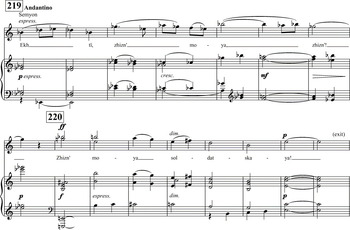
Tsaryov, Remenyuk and Mikola outsmart the Germans and seize their guns and the list of demands, leading to threats of repercussions as the invaders leave. Semyon, however, does not participate in this display of resistance along with his more impetuous peers, even though his matchmaking ceremony has been so abruptly curtailed. The melodramatic plot advances through tribulations that are passively endured (rather than actively resisted) by the hero – more accurately, the victim. This is borne out also in Semyon's narration of the prehistory of his relationship with Tkachenko in Act I, tableau 2, scene 7, when we learn of the mistreatment and manipulation of him by Tkachenko as his superior officer during the war. At points of emphasis, for the effect of pathos, the victim reflects on his or her unfortunate fate. At the end of Act II, after the discouraging turn of events, Semyon laments, in an impassioned aside (219, Ex. 3), ‘So much for the wedding! Oh, this life, this life of mine, my soldier's life!’, in which he sings the melody of the folk song from Cherevichki (previously sung by Frosya in Act I).Footnote 66 It is a moment that confirms Semyon's identity as simultaneously a stock Gogolian/folk character and the standard victim of melodrama. His expression of despair is different from that of a tragic aria, first in being very short, and in that it remains at a ‘primitive’ level of psychology, an external sign of an emotion that functions simply to create the effect of pathos and move the plot forward, and not to reveal anything particular about the character.Footnote 67 Folk song, normally used for national rather than individual expression, lends his aside an almost impersonal quality.
Act II, scene 10.

Moral opposition is embodied in the personal conflict between Semyon and Tkachenko. This is already subtly evoked in Act I, when Semyon and Sonya's duet is interrupted by the sudden appearance in the background of Tkachenko and the mysterious workman. But from Act II it is steadily and very effectively built up, becoming more intense than the general confrontation between villagers and invading army. Tkachenko's hostility to their marriage becomes explicit, and the German intrusion that upsets the other villagers then leaves him strangely unperturbed. At the end of the act, after Semyon's arioso, Tkachenko invites the workman to have a drink with a menacing undercurrent in the music; in spite of the explicitly violent nature of the Germans there is a growing sense of something even more sinister about him and his associate, enhanced by their cryptic spoken exchanges. Act III is then a rapid escalation, leading to a second and far more deadly invasion and a series of violent episodes, during which the gradual revelation of Tkachenko's treachery is highly effective. After Germans and HaydamaksFootnote 68 arrive in scene 6 (with an ostinato, in their key of B minor) to eliminate the troublesome Bolsheviks, Tkachenko's role as collaborator is revealed. He seeks to advance his own status and wealth through the marriage of his daughter into a former landowning family, and therefore supports their plan to regain ownership of the land. The workman turns out to be Klembovsky, the son of the landowner. Thus secret intentions and mysterious identity are uncovered.
Overall, the ‘tyrants and oppressors’ in the form of Germans, Haydamaks and Klembovsky serve to support Tkachenko's designs, just as the ‘democratic’ village community suffers along with Semyon.Footnote 69 And all characters make observations that clarify and reinforce their own and others' virtues or vices:Footnote 70 examples include Semyon's ‘honour’ theme in Act I, tableau 2, scene 5 (where the text is ‘my word cannot be broken’), the villagers' description of Frosya in scene 2 (‘Well, what a clever one’, ‘She knows everything’), Semyon upon the first sighting of the mysterious workman (‘It appears he's not one of our people’), Sonya's anxious comments about the workman when relating her dream, Tsaryov's acid remarks about Tkachenko (‘We get the same sort down on the Black Sea, you know, sons of bitches like that’), and Klembovsky's introduction of Tkachenko to the German officer as ‘a faithful servant and friend. He's one of us’.
Act III concentrates on violence and spectacle as the village is overrun by the intruders. One shattering event is the capture and hanging of Tsaryov and Ivasenko. Tkachenko participates in this with malicious enthusiasm, and at the end of scene 6 his anticipation of the villagers' discovery of the bodies (‘The people will awake’) is demonstrated by what Prokofiev stated at rehearsal ‘must be a gesticulation’.Footnote 71 In scene 9 we learn that he plans to have Semyon murdered, ‘first and foremost’ among the ‘unreliable peasants’. The instrumentation now adapts rapidly to match action and character, in Tkachenko's case the lower strings and pounding drums. Act III progresses in a remarkable sweep, in which machine-like ostinatos, long pedals, heavy brass and percussion (related to the neo-primitivism of Prokofiev's early works) display the barbaric nature of the invaders as they crush the peaceful life of the village. The ostinatos lead, through scene 7, to the scene of the two hangings (off stage), both of which are preceded by a monstrous mutation of a theme from Act II (part of the villagers' skirmish with the Germans),Footnote 72 and followed by a ‘scream of horror’ (description in the score, at 281 and 283) – a graphic representation of terror that is far more extreme than any other example in Prokofiev's dramatic works.
Just after the screams, a unit of German soldiers is heard approaching off stage with a jaunty brass march (284), in a Meyerholdian grotesque juxtaposition.Footnote 73 Simultaneous with this banal music, Lyubka lets out a cry of distress dwelling on the leading note,Footnote 74 and later in scene 10 begins an obsessive mantra of madness as she wanders the stage in despair and confusion – a striking image of the ‘victimized woman's body’.Footnote 75 Expressions of sorrow increase in proportion to the terrible events. The trio for Sofya, Frosya and Khivrya conveys their fears for the future (scene 13), and in scene 11 Semyon sings a plaintive arioso to mournful Theme 2 (F Aeolian), complaining of having to leave his home and loved ones: ‘Suddenly villains swooped down on us, and stood in the way of our peasant life, driving me away from my happiness’. Again at a crucial moment he is characterised by a lament and connected to the nation. Semyon is a folk hero and Gogolian lover who has become trapped in a melodrama, as its central victim.
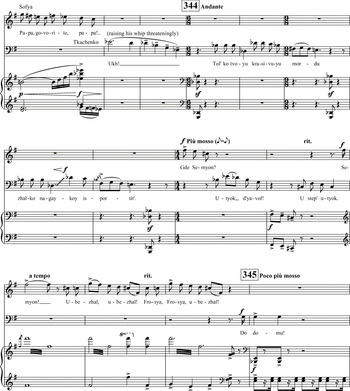
Gesture, as one of the most important non-verbal elements in melodrama, serves in Act III as a powerful means of highlighting the violence of the assault on the village and its inhabitants. In scene 14, Tkachenko, ‘raises his whip’ and threatens Sofya: ‘Ah! It would be such a pity to spoil your pretty face with my whip’ (344, Ex. 4a); his phrases are separated by single thwacks of a diminished triad in the low register. Next, over an aggressive dotted rhythmic pattern in the trumpets (which along with trombones/tuba/bass and then violins/voice form two more overlapping diminished triads), he warns her that he will kill her if she is disobedient (344–5, Ex. 4b). Music is used to represent actual sounds in the diegesis, such as the ostinato in scene 6 that represents the ‘clatter of horses’ hooves', and numerous stage directions connect movement to music: we see Lyubka ‘staggering’ across the stage in scene 8, and the ‘Haydamaks run out (in rhythm)’ to mechanically repeated quavers in scene 13 (horn and trombone on the ‘horror’ chord). The abundance of activity on and off stage is constant and chaotic, building in tempo to reach a peak at the conclusion, in an immense conflagration as the entire village is set ablaze. Though the burning huts have to be imagined off stage – presumably with the aid of glowing lighting effects – this provides the climactic visual scene. An extended ostinato built on a tritone in the bass (368) leads to a loud final chorus (with percussion and brass). Village men drag water barrels across the stage in a struggle to put out the fire, while Lyubka's mad theme is taken up by a women's chorus bewailing the fate of Ukraine, and by Lyubka and Sofya who grieve over their personal losses. The catastrophe is emphasised by obsessive repetitions and the tolling of bells. Act III overall is remarkably vivid, propulsive and intense; small wonder that it was Meyerhold's favourite in the opera.Footnote 76
Acts IV and V exhibit stark contrasts in tone. In a change of pace, the first tableau of Act IV is a prolonged reaction to the events of Act III, a slowing of momentum and decrease in tension, partly due to the absence of the antagonists. A trudging theme portrays Semyon and Mikola pulling a cart with the bodies of Tsaryov and Ivasenko through a forest gully at night. They are stopped and questioned by Remenyuk before he suddenly recognises them, a lighter melodramatic touch (which will be repeated when Frosya later arrives at the camp). But anguish erupts as Remenyuk's discovers the bodies, a ‘confrontation with a murdered victim’Footnote 77 that prompts another ‘horror’ chord from the orchestra and a crash on the cymbal (383). After Remenyuk's expression of sorrow and his call for the partisans to swear revenge three times on the name of Lenin, there follows a funeral chorus, a setting of Taras Shevchenko's Zapovit (‘Testament’) sung by a full choir placed in the orchestra pit. Tableau 1 subsequently required a foil. To produce this contrast, tableau 2, scene 1 returns to the innocent mood of Act I and its humour in a necessary moment of comic relief. The partisans take a lesson from Semyon on how to operate a field gun, but are amusingly obtuse, and unable to understand his instructions. In the novella this lesson does not include any speech for them, so here again comic dialogue had been added by the librettists.
After this brief respite, scene 3 returns again to misfortune, with Frosya describing at length the ongoing suffering in the village. Semyon decides he must rush back to rescue Sofya, a plan immediately thwarted by Remenyuk, who refuses to allow him to take a squadron. He begins to leave on his own, but then in line with his duty-bound nature returns, lamenting that his plans now seem beyond hope: ‘Farewell happiness. Farewell Sonya!’. Circumstances then change miraculously with the delivery of a letter from the division commander (concealed in a watermelon – more light humour), ordering a diversionary attack on the forces occupying the village; Semyon is chosen by Remenyuk for this task, and he rides off with Mikola. Back in the village, Act V begins with a variation on Theme 2, in a final outpouring of the national sorrow that it represents.Footnote 78 A blind bandura player (kobzar) and Semyon's mother then sing ‘Oh woe, bitter woe! A black and bitter smoke has descended over our native Ukraine’. The kobzar is the bard of epic suffering, and together with his instrument is an authentic symbol of Ukraine.Footnote 79 His music, based on the theme of the funeral chorus, provides a realistic image that complements the chorus's abstraction, while his bandura adds an element of local colour that is a pathetic parallel to Tsaryov's accordion and Mikola's guitar (instruments that nodded towards the Little Russian comedy). Semyon appears but his brief moment of heroic endeavour ends with his capture, and Tkachenko reads the execution orders for him and Mikola to pounding chords.
Act III, scene 14.

Act III, scene 14 cont'd.

Sudden entrances and reversals of fortune dominate the action of Act V. The central part consists of a final confrontation between Tkachenko and Semyon, with emphasis on the threat of death. The gloating Tkachenko, ‘grunting with satisfaction’, taunts Semyon and pokes him repeatedly in the ribs with his thumb at his words ‘i tsop!’ (‘and pow!’), together with a sharp chord in the orchestra (an action not described in the novella and another example of the reliance on gesture for emphasis).Footnote 80 As his themes return in sequence, Tkachenko reveals fully his motives and the despicableness of his character, while stressing the class distinction he imagines between Semyon and himself (and his daughter) and his hatred of the Bolsheviks. But Semyon and Mikola are suddenly rescued by the timely arrival of the partisans led by Remenyuk, and when asked to decide Tkachenko's fate they sentence him, somewhat gleefully, to be shot without delay.Footnote 81 The main enemy has at last been overcome (while the Germans are in retreat), and he meets an appropriate end at the hands of the virtuous community: an all-important feature of melodrama's moral foundation is poetic justice. There is not the slightest twinge, not even from Sofya, about her father's death, which is very different from the ambiguity about even villainous or oppressive fathers in Romantic opera. The happy ending follows, as the virtuous celebrate their deliverance.Footnote 82 Semyon has one last moment of reflection, this time musing on the irony of his fate as he returns to the front that he had sought to leave behind for a peaceful village life. Then all burst into song (Theme 1) while a Red Army unit marches in the background. What Sabinina correctly describes as the film-like qualities of Act V – derided by Rita McAllister as those of a ‘bad western’Footnote 83 – are precisely those of classic melodrama.
Reception: aesthetic and political tensions
Prokofiev had praised the opportunities for work in the theatre provided by his new patrons in the Soviet Union and dismissed the relevance of politics, but there was no avoiding politically determined criticism once an opera reached the stage. As a new work by an established yet controversial master, Kotko was put under the microscope at a time when the official opera project, hampered by the song opera tradition, had lost momentum and was reaching for new, more ambitious standards, with nineteenth-century Russian (and also Italian) classics held up as exemplars instead. At its premiere on 23 June 1940, the audience gave Kotko a mixed reception.Footnote 84 There was both praise (‘This is one of the best operas. The music is Rembrandt-like’) and criticism (‘Too long’; ‘Boring. Where is the music?’), and while many limited their admiration to the matchmaking choruses – folk song that was closest to the Soviet opera norm – others found the work a fresh and unique approach to the medium that would reward repeated listening.Footnote 85 A split audience such as this, engaged and even argumentative, was, ironically, Meyerhold's proof of a production's artistic success,Footnote 86 but it pointed to deeper problems that critics, musicologists, composers and officials then went on to examine in a public debate. The controversy featured two camps, one promoting high levels of artistic achievement and supporting Kotko, the other defending the political orthodoxy of Tikhon Khrennikov's V buryu, which continued in the song opera format. Immediately after Kotko's first performance, a positive review was published by the musicologist Semyon Shlifshteyn, who made favourable comparisons to Musorgsky;Footnote 87 in September a lengthy, detailed and mixed review by Izrail' Nest'yev appeared;Footnote 88 and in December a sharply critical judgment was made in an article by official critic Georgiy Khubov.Footnote 89 In October the Moscow Union of Composers put the opera forward for a Stalin Prize,Footnote 90 but it failed to receive this prestigious sign of approval.
A vociferous debate at the All-Union conference on opera in December 1940 then pitted Kotko directly against Khrennikov's V buryu. It was waged with partisanship on both sides, though there was considerable agreement as to the merits and faults of both works. It was generally accepted that the ideal for Soviet opera was Wagnerian symphonism combined with folk song. Librettos were expected to conform to standard poetic forms and thereby prompt conventional musical forms. Kotko and V buryu were ‘polar opposites’, representing two halves that needed to be united: Khrennikov's respect for traditional forms, accessibility to the masses, and a clear and correct ideological message, and Prokofiev's mastery as composer and dramatist. As Viktor Tsukkerman put it, the former strove for feeling and pathos but lacked the musical skill to deliver it, the latter strove for characterisation and humour but lacked expressivity.Footnote 91 Prokofiev's libretto, moreover, was found to be ‘theatrical’, leading to ‘physiological, naturalistic’ drama.Footnote 92 In the context of the Soviet stage of the late 1930s the insipid was always likely to be preferred to the innovative, and while never officially condemned like Shostakovich's Lady Macbeth had been in 1936, Kotko was cancelled after one season while V buryu was performed throughout the country.Footnote 93 The rejection of Kotko can be linked to its classic melodramatic features, and in particular to their impact on the heroism and nationalism essential to the socialist realist version of melodrama. The opera's content as well as its style suggested to critics an insensitivity to some of the most pressing demands of the period.
The strongest and most often repeated criticism of Kotko was that it lacked the necessary heroism in its central characters, Semyon and Remenyuk, an objection that does appear legitimate by contemporary standards. While the librettists tried to associate Semyon with weapons (guns, grenades, artillery) and create a connection between peasant fate (dolya) and Bolshevik power (vlast') in approved socialist realist terms, the character's actions as well as his music, crucially, do not make him into a positive hero of sufficient inspirational power. He appears at times meek and hesitant, and lacks the necessary impulsiveness. In Act I, tableau 2, scene 6 he needs to be encouraged by Frosya and Sofya to approach the matchmakers, and in scene 7 prompted again by his sister to tell them his marriage plans even though his thoughts are clearly with Sofya, as an appearance of the theme from their duet reveals. Semyon has a tendency to adopt the intonations of others, hardly the sign of strong character: that of the village women in scene 4, Frosya in scene 5 (53) and Remenyuk in scene 6. He lacks a theme that stays with him, and after his early soldier's songs he is caught up in events and has no authentic or heroic voice. His Act I narration reveals how he was unable to resist exploitation by Tkachenko during the war. In Act II he does not participate in the taking of the list and guns from the Germans. He has moments of dynamism in Acts III, IV and V, but these are outweighed by his more frequent and prominent moments of dejection, which are a function of his role as the victim of melodrama. The other characters, particularly Tsaryov, Frosya and Sofya, demonstrate impetuosity and bravery: the ensemble cast and the general effort diluted the qualities that needed to be concentrated in the central hero.
Furthermore, even at those few moments when Semyon does take action, he is motivated by his personal goals, to marry Sofya and farm his land, and these remain consistent from beginning to end. There is insufficient evidence of a change in his priorities. A pivotal point is reached in Act IV, when Semyon walks away from his comrades after being denied by Remenyuk the requirements for a raid that would free Sofya. He returns, stating that he recognises that he must fight with the people, even if this means sacrificing his own happiness. This moment does not receive the musical or dramatic emphasis it required as the initiation rite (the acquisition of consciousness) that formed the climax of the socialist realist masterplot.Footnote 94 When Semyon rides off to cause the diversion in the village, Remenyuk sings (without irony) Theme 1 in E flat to the telling words ‘Semyon is fighting for his happiness’, and indeed the drama remains directed towards the resolution of the love narrative. While Semyon may ride a horse and wield a grenade, his actions in Acts IV and V achieve little either for himself or the general cause. There is no aria for this tenor role, stressing the truth of Bolshevik values, no thematic link between him and victory or reflection on how his personal fate is connected with national fulfilment.Footnote 95 Evidence of his ideological redirection remains at best subtly symbolic.
Without this climax, and without the novella's scenes in the village soviet (excluded for their lack of relevance to the central plot line), Remenyuk's role as the Bolshevik agitator providing ideological guidance was diminished. He does not capture interest for his own sake – he too lacks a theme – and fails to emerge as a convincing leader, despite his assumed role in bringing the appropriate consciousness to Semyon. From the sketches for the libretto, it is clear that Katayev planned an aria for Remenyuk in Act IV, tableau 1,Footnote 96 but Prokofiev turned this into a call and response with the partisans: more ‘realistic’, communal, less heroic. In the novella Remenyuk has a speech that strongly suggests a potential aria;Footnote 97 as news is spread of the German invasion, he gathers the villagers around him and delivers a stirring oration like those in films of the late 1930s, inspiring resistance with references to historic victories over the Swedish and the French.Footnote 98 Prokofiev did not, of course, set this speech. Because of the opera's primary focus on the love story and its obstacles, Remenyuk comes across at times almost as a killjoy, standing in the way of Semyon's goals by pointing out that his plans with Sofya are untimely, an inappropriate distraction from resistance operations.
In his very negative review in Teatr, Khubov criticised these two characters severely: ‘[E]ssentially Semyon dreams only about his own petty personal well-being’, while Remenyuk ‘barely moves, and neither speaks nor sings, but “lectures” and “debates”’.Footnote 99 Similar views were repeated by many critics, even otherwise supportive voices such as Panchekin, Tsukkerman and Shaverdyan.Footnote 100 The assessment of the editor of Sovetskaya muzïka was that ‘the central figure of the opera, Semyon Kotko, was not successful: he is schematic and insufficiently rich’,Footnote 101 while in the words of Nest'yev, Remenyuk ‘fails to be a Bolshevik orator’.Footnote 102 Shaverdyan, in his summary of the debate, stated that discussions were not concerned mainly with musical quality (since that was agreed in the case of Kotko) but on whether the musical idiom met with the demands of the ‘ideological-psychological content’ of the Civil War in Ukraine.Footnote 103 He approves of the characters Frosya, Sofya, Mikola and Tkachenko. The narod do not fare so well: on the one hand there is something grotesque in the babï and old men, and on the other the partisan songs appear almost primitive, sharply removed from the overall style of the music. Remenyuk's musical representation was ‘not sufficiently striking and compelling’, and ‘The character of Semyon is not convincing. Semyon is acceptable as a lover and as a soldier, but he is not portrayed as a hero, as a man of big ideas and great love for the motherland’.Footnote 104
It is clear that Khrennikov's opera was more in tune with contemporary standards.Footnote 105 His character Listrat is depicted through music and text as a typical hero of strength, determination and pristine political values (and also typically one-dimensional). Listrat's brother Lyonka is a ‘wavering’ lesser hero involved in a romantic subplot (the brothers recall Ostap and Andriy of Gogol's Taras); unlike Semyon, however, Lyonka comes to recognise explicitly that his personal interests need to be set aside in order to accomplish communal goals (end of Act I, scene 2, at 785). V buryu is a vapid song opera that strives for, though fails utterly to achieve, the expressive power of Glinka or Verdi. Crucially, however, it concentrated its limited resources on projecting its core message in an unequivocal manner, and an uncontroversial form.
A second persistent criticism of Kotko concerned the combination of comedy with a drama of disaster. The novella had synthesised references to Gogol's early work that if taken alone could each have provided the Russian audience with a representation of a Ukraine they preferred to imagine (in the 1930s just as in the 1830s): happy, singing, dancing and faithful to Russia, viewed within a kind of escapist exoticism, as in the Dikan'ka tales,Footnote 106 or heroically resisting foreign invasion while extolling a unified East Slavic empire, as in Taras. It could have been transposed into a pure comic opera, as even the hostile Khubov had pointed out,Footnote 107 in a way that would have met with official approval. Prokofiev's mixing of comedy and calamity was regarded as a serious aesthetic error, detracting from purity of form and content and diminishing the heroism of particular characters. The comic episodes were heavily criticised, particularly the gun lesson scene for showing the partisans in a less than favourable light.Footnote 108 Khubov found that ‘what the librettist wants to say seriously, the composer interprets as grotesque’,Footnote 109 in a thinly veiled reference to the condemned Meyerhold. Ivan Sollertinsky repeated the view that ‘bustling-on-stage’ (i.e., Meyerhold) must not substitute for ‘acting’ (i.e., Stanislavsky) and strongly protested against the intermingling of genres.Footnote 110 In Soviet aesthetics by the late 1930s, gesture was linked to the grotesque, and comedy in the context of heroic, socialist realist subject matter seemed suspiciously close to satire.
The comedy was found to be irreverent, but it also failed to provide a proper counter to the abundant catastrophe. Critics pointed out that the opera had sublime moments of pathos, but did not contain even more impressive moments of romantic heroism, and many blamed this on its lack of a monumental finale. The swift and cheerful ending as the couples are reunited is another section reminiscent of the Little Russian comedy, a connection sarcastically made by Khubov when he described it as ‘a happy wedding finale, in which only the traditional “gopak” is missing!’Footnote 111 The weight at the conclusion fails to balance the climax of Act III, lacking as it does the solemn grandeur of national heroism (as achieved in Nevsky) to answer the ostinato-heavy onslaught of the enemy. There is no imposing march at the appearance of the Red Army to liberate the village;Footnote 112 attention remains on Semyon's individual fate, his last-minute rescue and the reunion of the lovers. Theme 1 and the horse-riding theme, both light-hearted, are combined (in voices and orchestra respectively) in the final chorus, which was in Nest'yev's view ‘particularly disappointing’ since it ‘in no way expresses the pathos of the Civil War’.Footnote 113 In other words, although Prokofiev successfully unites personal with national pathos through the appearances of Theme 2, he does not unite personal with national triumph in Theme 1, while the everyday tone and gestural musical style ruled out epic symphonism, the desired ‘pathetic and romantic sublimity’.Footnote 114
Katayev's final chapter had offered a clear opportunity for a conclusion in the Russian epic tradition. To emphasise the link between Ukraine and big brother Russia and the bright future that lay ahead, it describes a parade in Red Square in the present (1937) that includes Semyon and Sofya's son, a young Pioneer, marching before the leaders.Footnote 115 A Red Square march was the most potent contemporary image of national celebration available, and even the comic mode could have admitted such an ending: a musical comedy film like the extremely popular Tsirk ended in the same way as Katayev's novella, including enormous banners with images of Lenin, Stalin and Voroshilov.Footnote 116 In omitting this scene, Prokofiev chose to ignore warning signs demonstrated by the reception of the play Katayev had adapted from his novella. A Pravda review, published half a year before work began on the music, criticised the external effects of the staging (the sound and visual ‘pyrotechnics’) and the focus on colourful language (both urban and provincial) in place of an exploration of inner feelings and projection of heroism.Footnote 117 Although the Red Square scene was included in the published play, on the evidence of this review it was not part of the performance, since Pravda complained of too much activity in the final scene, leaving no time for reflection on a clear message. A static spectacle celebrating victory and unity was the correct way to end a work for the Soviet stage (or screen). Prokofiev clipped a review of Katayev's play, so we may assume he read it, but ignored its warnings as the opera was criticised for the very same faults.
The lack of confirmation in the opera of the approved ideology was a major error in particular because of the Ukrainian setting. From Moscow's point of view Ukraine was the republic of by far the greatest importance both strategically, for its geographical position as a defensive buffer against invasion from the West, and agriculturally, as the bread basket of the Soviet Union.Footnote 118 Ukrainian peasants had opposed the destruction of their way of life, and their potential for nationalism remained an acute source of Stalin's paranoia,Footnote 119 particularly due to the growing threat from the West. Prokofiev made inappropriate references to Ukrainian traditions on both sides of the melodramatic mix: for comedy, as we have seen, but also in the opera's intense expressions of suffering. His setting in Act IV of the famous Zapovit by Shevchenko (the national poet of Ukraine) leans towards nationalism, making no mention of Russia but reflecting on Ukraine's suffering at the hands of intruders.Footnote 120 Similarly questionable from this perspective was his treatment of the kobzar in Act V, who also reflects poignantly on foreign invasion.Footnote 121 In the context of the late 1930s, there was a possibility for a subtext to be read here of the oppression of Ukraine by a contemporary Russia rather than by a Western enemy. There was little enough in the opera to contradict such a reading, since it lacked an emphatic articulation of the message of unity with Soviet Russia. The final chorus of villagers and partisans returns to Theme 1 (related to village life) and to the opening key of C major, while the text celebrates ‘a free Ukraine’, without mention of Russia, the Bolsheviks, the Red Army or Lenin. The problem with the symbolism and thematic material in the opera was its focus on the Ukrainian experience, eclipsing the involvement of Bolshevik Russia. Throughout Kotko, an original pastoral innocence, the old way of Ukrainian village life, is maintained as an ideal, not just by the character of Semyon himself, but as part of a general mood of nostalgia. Folk culture was appropriated under socialist realism as a means to the ideological education of the masses, but Prokofiev used it within his melodrama for local colour, comedy and catharsis.
Conclusion
In melodrama, positive change occurs in society and/or the hero. The melodramatic aesthetic as employed in socialist realism included the representation of a newly conscious hero or a newly created society (often both together), demonstrated with monumental images of a great past, heroic present or utopian future. In Kotko, there is some ambiguity at the conclusion, leading to the suggestion of a re-established status quo of village life; a transformation of society is only implied, and the inner development of the hero(es) can only be inferred. A Red Square finale (with an obvious connection to Susanin) could have resolved this, but such a spectacle did not accord with the tone of the opera. Nor was there thematic material of sufficient heroic power (ideally, associated with the central protagonists) available in the work. For Prokofiev, the classical value of balanced structure demanded the return to a musical status quo, and therefore Kotko ends with a reprise of Theme 1.
Prokofiev chose a politically acceptable source, but its transposition as classic melodrama proved to be contrary to the version of melodrama that had been subsumed into socialist realism. With the status and privileges of an elite artist came responsibilities. Artistic originality was no longer valued, and political disinterestedness was unacceptable: a creative artist could not be independent from service to the state, and there was no tolerance for ‘wavering’ or doubts about loyalties in the context of High Stalinism's own public melodrama, the struggle between state builders and wreckers, between the nation and growing threats from abroad. In a sense Prokofiev failed in his first Soviet opera to demonstrate his own development of political consciousness and to fulfil his role in Soviet society. Like his character Semyon, he returned to his provincial home after years abroad to find it changed and in the hands of a new power; while appearing to comply with the new regime, he did not surrender his own long-held personal objectives, and he remained on some level an outsider, still attached to the timeless values of another world.
Semyon Kotko was not performed again until many years after Prokofiev's death, and it remained a point of reference through the 1940s for those who wished to criticise his approach to opera. However, as a work that put ‘lively’ drama before propaganda, those characteristics that led to its initial failure enable it to be appreciated today within the traditions of opera and the theatre from which it drew. In presenting moral issues, melodrama tends to be tied to the historical circumstances of its creation;Footnote 122 while Kotko does indeed direct our attention to cultural conditions under Stalin, it can also, unlike the vast majority of the products of socialist realism, lay claim to more than mere historical interest.
 ) is familiar from many Russian melodies in folk, popular and art music. In all the opera's references to folk music Prokofiev was surely aided by his own experiences of authentic music making during his childhood in rural Ukraine.