Metabolic therapy has been advocated for the treatment of different conditions in cardiovascular disease.Reference Hadj, Pepe and Rosenfeldt1 Coenzyme Q10, also known as ubiquinone, is a fat-soluble quinone contained in eukaryotic cells,Reference Singh, Devaraj and Jialal2 which plays a crucial role in cellular production of adenosine triphosphate as an obligatory component for mitochondrial complexes I, II and III.Reference Hadj, Pepe and Rosenfeldt1 High concentrations of coenzyme Q10 are found in the mitochondrions of cardiac cells as a tissue with high-energy requirements.Reference Bhagavan and Chopra3
The potential usefulness of supplementation of the coenzyme as an adjunctive metabolic therapy in adults with cardiac failure or cardiomyopathy has been investigated in several studies.Reference Langsjoen, Vadhanavikit and Folkers4–Reference Keogh, Fenton and Leslie9 These data have raised the question of usefulness of the coenzyme in children. Unfortunately, little is known about its effect in the field of paediatric cardiomyopathy, particularly with regard to diastolic dysfunction.Reference Elshershari, Ozer, Ozkutlu and Ozme10, Reference Soongswang, Sangtawesin and Durongpisitkul11 With the purpose of determining its potential usefulness in children with idiopathic dilated cardiomyopathy, therefore, we carried out a randomized clinical trial.
Methods
We designed a double-blind, placebo-controlled randomized trial of coenzyme Q10 in children with idiopathic dilated cardiomyopathy, recruiting patients younger than 18 years with known diagnoses of primary dilated cardiomyopathy who were referred for follow-up echocardiography to Children’s Medical Center from September, 2006, to March, 2008. Only those patients in whom medications had been stable for at least 1 month were included in the study. According to the classification of cardiomyopathy provided by the World Health Organization,Reference Richardson, McKenna and Bristow12 dilated cardiomyopathy is defined on the basis of reduced left ventricular systolic function in the presence of symptoms, or a family history of dilated cardiomyopathy or a left ventricular fractional shortening of 20 percent or less in the absence of regional wall-motion abnormalities on echocardiography in asymptomatic patients without a family history. The criterions for inclusion in our study, therefore, were
• a complete profile as a known case of idiopathic dilated cardiomyoapathy according to the definition of World Health Organization classification
• aged less than 18 years old
• stability of at least 1 month in medications received for treatment of cardiac failure
• presence of a normal sinus rhythm.
Hence, any patients with recent modification in medications, those with haemodynamic instability, congenital heart disease, metabolic heart disease, cardiac dysfunction resulting from abnormalities in other organs, and those with an acquired cardiomyopathy were all excluded from the study. Our protocol was approved by the hospital ethics committee, and informed written consent was obtained from the parents and patients whenever possible.
Enrolled patients were randomized by the pharmacist to receive either coenzyme Q10 or a matched placebo in a double blind procedure. All the physicians involved in the trial, including those assessing echocardiographic studies, were blinded to the therapeutic regime.
Those receiving coenzyme Q10 had the agent given at a dose of 2 milligram/kilogram/day in 2 or 3 divided doses, these being increased to the maximum dose of 10 milligram/kilogram/day according to tolerance or the appearance of side effects. The placebo was supplied by the hospital pharmacist, and was administered orally in a same way as for coenzyme Q10.
All other treatments, such as digoxin, loop diuretic, inhibitors of angiotensin converting enzyme, spirinolactone, and carvedilol were matched between the groups of patients.
After recruitment, demographic characteristics, as well as weight and baseline heart rate of each subject were recorded. We calculated the score in the index of paediatric cardiac failure established by New York University for all subjects.Reference Connolly, Rutkowski, Auslender and Artman13
Most infants and younger patients were sedated with chloral hydrate prior to performing echocardiography. All data was recorded as VHS videotapes for subsequent analysis and measurement. Left ventricular ejection fraction was measured by M-mode or Simpson’s rule. Peak velocities of the E and A waves, the deceleration time of the E wave, the isovolumic relaxation time, and the duration of the A wave were all derived from the transmitral pulsed Doppler velocity recordings. We classified the patients as showing normal diastolic function, or impaired relaxation, pseudonormal and restrictive patterns of diastolic dysfunction as described by O’Leary and colleaguesReference O’Leary14, Reference O’Leary, Durongpisitkul and Cordes15 by interpretation of transmitral Doppler derived parameters, the ratio of pulmonary venous systolic to diastolic flows, and the duration of reversal of pulmonary venoatrial flow.
Abnormal relaxation is defined as a ratio of the peak E to the peak A wave of less than 2 standard deviations below the mean, prolonged isovolumic relaxation time, and an E deceleration time of more than 2 standard deviations above the mean, with a dominant systolic pulmonary venous flow, the ratio of pulmonary venous systolic to diastolic flow being greater than 1.
A pseudonormal pattern is defined on the basis of the reversal of the velocity of pulmonary venoatrial flow of more than 2 standard deviations of the mean, with the duration of reversal more than 20 milliseconds longer than the duration of the A wave in the presence of apparently normal patterns of transmitral filling.
In the restrictive pattern, the ratio of the peak E to the peak A wave is more than 2 standard deviations above the mean, the deceleration time is less than 2 standard deviations below the mean, and there is a longer reversal in the duration of pulmonary venoatrial flow, more than 30 milliseconds longer than the duration of the mitral valve A wave. Diastolic dominancy of pulmonary venous flow, with a ratio of pulmonary venous systolic to diastolic flow of less than 1, is seen in the restrictive pattern.Reference O’Leary14, Reference O’Leary, Durongpisitkul and Cordes15 Left myocardial performance index was calculated according to the equation previously described by Tei et al.Reference Tei, Ling and Hodge16 Echocardiographic measurements were normalized according to body surface area whenever appropriate.Reference Colan, Parness, Spevak and Sanders17
Baseline evaluations were reviewed again 6 months after reaching the maximum or tolerable dose of coenzyme Q10. Adverse events, and echocardiographic assessment results, as well as heart rate and the score for cardiac failure, were all documented. Compliance was monitored by counting the number of returned pearls at the end of the trial. The outcome was defined as the change from baseline for echocardiographic variables, heart rate, and the cardiac failure score at the end of the 6th month of blind therapy. Data is expressed as means with standard deviations. Descriptive statistics were provided for weight, body surface area, age, and gender. Parameters of left ventricular ejection fraction, fractional shortening, myocardial performance index, left ventricular end diastolic diameter, left ventricular end systolic diameter, and categories of diastolic dysfunction were the echocardiographic variables used in the analysis. The independent sample t-test was used to compare means at baseline, and between baseline and 6-month parameters. Within group comparison of means was done using paired t-test.
For evaluating effectiveness of therapy on diastolic dysfunction, the proportion of patients with either one or two grades improvement in the categories for diastolic dysfunction were compared between two groups by means of chi-square test.
Statistical software package for social sciences inc. (SPSS) for windows standard version 15 was used for statistical analysis, and a value of p less than 0.05 was considered statistically significant.
Results
From September, 2006, to March, 2008, we enrolled 38 known patients with idiopathic dilated cardiomyopathy, 17 being randomized to receive coenzyme Q10 and the remaining 21 to receive placebo. The subjects ranged in age from 8 months to 15 years old. There was no loss to follow-up, and no one discontinued the medication. Compliance was the same between the two groups. Coenzyme Q10 was well tolerated, and no adverse event was documented.
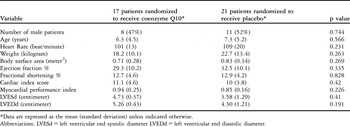
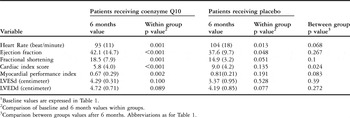
In Table 1, we show the baseline characteristics of the patients receiving coenzyme Q10 and those having placebo. There were no significant differences in any of the baseline parameters between the two groups (Table 1). In Table 2, we compare the mean of the baseline values and those obtained after 6 months supplementation. As can be seen, the mean score for the index of cardiac failure was significantly different between the groups, with p having a value of 0.024.
Baseline characteristics of the patients.

*Data are expressed as the mean (standard deviation) unless indicated otherwise.
Abbreviations: LVESd = left ventricular end systolic diameter LVEDd = left ventricular end diastolic diameter.
Comparison of the variables after the 6 months treatment between and within the study groups.Footnote 1

The corresponding values for p when comparing the means before and after the intervention within each of the study groups are also illustrated in Table 2. This comparison within the groups showed a significant decline in the mean of myocardial performance index for those supplemented with coenzyme Q10, the p value equal to 0.002, the comparable changes for those receiving placebo failing to reach significance.
Although all those receiving coenzyme Q10 showed significant improvements for all variables (Table 2), only the ejection fraction and heart rate in those randomized to receive placebo showed any significant change, with values for p equal to 0.048 and 0.013, respectively.
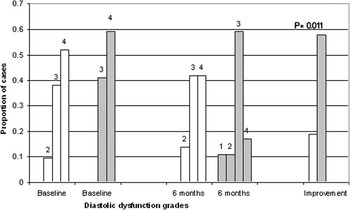
Using echocardiographic parameters, we categorized the patients into grades of diastolic dysfunction grades. At baseline, there was no difference in the proportion of patients in different grades. In Figure 1, we show the proportion of patients in each grade before, and 6 months after, treatment. As shown in right side of Figure 1, improvement in diastolic dysfunction grading by either one or two grades was seen in 10 patients receiving coenzyme Q10, compared to only 4 patients given placebo, this difference being statistically significant with the value of p equal to 0.011. For 2 patients receiving placebo, we observed regression in their grading for diastolic dysfunction (Fig. 1).
Comparison of proportion of patients in different grades for diastolic dysfunction. Gray columns indicate the patients randomized to receive coenzyme Q10, and white columns indicate the control group. 1 = Normal pattern; 2 = Abnormal filling pattern; 3 = Pseudo normal pattern; 4 = Restrictive pattern.

Discussion
In this randomized clinical trial, we compared the echocardiographic parameters at baseline and after 6 months, along with the functional class, of children with idiopathic dilated cardiomyopathy, documenting in this way the effect of supplementation of their medication with coenzyme Q10. The subjects receiving coenzyme Q10 showed significant improvement in the extent of their cardiac failure as judged using the score established by New York UniversityReference Connolly, Rutkowski, Auslender and Artman13 compared to those assigned to receive placebo. Furthermore, a significantly greater proportion of patients assigned to receive coenzyme Q10 showed improvements in the grading of their diastolic function.
The index established by those working at New York University to grade cardiac failure in childrenReference Connolly, Rutkowski, Auslender and Artman13 is a linear and weighted combination of scores, being based on signs and symptoms, ventricular pathophysiology, and medical regime. It pays no attention to the age of the children, or the aetiology of their cardiac failure.Reference Tissières, Aggoun and Da Cruz18 When we consider that the symptoms and signs of diastolic dysfunction are due to inadequate cardiac output due to poor ventricular relaxation, or systemic venous obstruction,Reference Little and Cheng19 it might be assumed that an improvement in diastolic function is able to raise the index score in the same way as an improvement in the systolic function. Although ejection fraction within both groups increased after 6 months follow-up, intergroup comparison revealed that administration of coenzyme Q10 was not associated with any significant increase in cardiac systolic function.
The same result was achieved for the fractional shortening as another indicator of cardiac systolic function. On the other hand, the proportion of patients showing improvements of either one or two grades in diastolic function was significantly higher in those receiving Q10 compared to placebo. This data suggests that the improvement in the index of cardiac failure may partly be due to the improvement in the diastolic function, in addition to systolic improvement. Another notable result of our study is that the mean myocardial performance index significantly decreased for those having 6 months of supplementation with coenzyme Q10, while this change was not significant in those having the placebo.
Myocardial performance index is a Doppler-derived interval index of combined systolic and diastolic myocardial performance,Reference Vivekananthan, Kalapura and Mehra20 and is defined as “the ratio of the summation of isovolumic contraction and relaxation time to ejection time.”Reference Peltier, Slama, Garbi, Enriquez-Sarano, Goissen and Tribouilloy21 The decrease in the ratio of the myocardial performance index could be due to improvement in either systolic or diastolic function, or both. Considering systolic improvement within the groups of those randomized to receive placebo and coenzyme, we conclude that the significant decrease in the myocardial performance index of those receiving coenzyme Q10 may be due to the improvement in diastolic function, achieved in a greater proportion in this group.
There are several studies in adults that have shown that the considerable proportion of patients with symptoms and signs of cardiac failure are those with little abnormality, or even preserved systolic function, in whom diastolic dysfunction component is dominant.Reference Redfield, Jacobsen, Burnett, Mahoney, Bailey and Rodeheffer22, Reference Fischer, Baessler and Hense23 Theoretically, administration of medication with lusitropic effects in such patients, or even in those with both systolic and diastolic dysfunction as the cause of heart failure, could improve the functional class while the amount of systolic dysfunction may remain unchanged.
Recently the potential significance of diastole in cardiac disease in children has become more appreciated. Advances in providing Doppler flow patterns for children of all ages has made it possible to apply the concept of non-invasive diastology to children as well as adults.Reference O’Leary14 Diastole is an energy-consuming process, and myocardial diastolic function is highly adenosine triphosphate dependent.Reference Zile and Brutsaert24 At end-diastole, intraventricular pressure and volume are determined by two components of venous return along with the lusitropic state of the ventricular myocardium.Reference Auslender25 The obligatory role of coenzyme Q10 in adenosine triphosphate synthesis as a member of the mitochondrial electron transport chainReference Bhagavan and Chopra26 has candidate coenzyme Q10 as an effective biological drug in improving the diastolic function of the heart by supplying adenosine triphosphate for cardiac cells, and supporting the lusitropic state of the ventricular myocardium.
The potential role of supplementation with coenzyme Q10 in improving the parameters of diastolic function of the myocardium has been investigated in several studies of adults, particularly in patients with worsening diastolic function receiving statins.Reference Silver, Langsjoen, Szabo, Patil and Zelinger27–Reference Oda29
The effect of coenzyme Q10 in children with idiopathic dilated cardiomyopathy has also been investigated in a few recent studies. To our knowledge, however, ours is the first randomized clinical trial to investigate the usefulness of coenzyme Q10 in this field.
One of the clinically significant vascular effects of coenzyme Q10 which should be taken in account when interpreting the results of our study is its capability of improving endothelium-dependent vasodilation, both in animal models and human.Reference Lönnrot, Pörsti, Alho, Wu, Hervonen and Tolvanen30, Reference Belardinelli, Tiano and Littarru31 This vasodilatory role is suggested to be as a result of scavenging free radicals and also activating major antioxidant enzyme systems that finally protect nitric oxide, a vasoactive molecule, from oxidative inactivation.Reference Tiano, Belardinelli, Carnevali, Principi, Seddaiu and Littarru32 The clinical impact of this nitric oxide-mediated phenomenon could be a potential mild decline in both preload and afterload, which is in turn able to make changes on Doppler derived parameters of diastolic function.
Although interpretation of the net effects of concomitant changes in preload and afterload, and their consequent effect on diastolic dysfunction grading, are rather complex, these changes, if any, seem to be in favour of improving the diastolic function. The dramatic improvements in the score for the index of cardiac failure, however, could not exclusively be interpreted as a result of potential vasodilatory effect of coenzyme Q10.
Maybe application of less preload dependent modalities, like tissue Doppler imaging, will further provide convincing data about the potential lusitropic effect of coenzyme Q10 on myocardial function. Despite the fact that Doppler echocardiography is currently an adequate method for diagnosis of ventricular dysfunction, its implementation in clinical routine is suboptimal due to operator dependency in primary health care.Reference Grodecki and Klein33 Surely, the adjunct of a haemodynamic study in this trial, or use of tissue Doppler Imaging, as a less preload dependent technique, could result in a more reliable grading of the diastolic dysfunction. Assuming if there is any possible technical error in classification of patients according to the Doppler flow study, application of the same technique for the grading in both groups would ultimately lead to a non-differentiating misclassification. Our study was also limited by the relatively small size of its sampled groups. It should be viewed, therefore, as a pilot trial for the initiation of more research in this field. A sample of larger size might improve the power to detect a difference for some of the other variables, such as the myocardial performance index.