SITUATING HOMETOWN ASSOCIATIONS IN THE ‘BELONGING’ DEBATE
Hometown associations bring together indigenes of a place living at or away from their perceived common home. They are frequently a means by which migrants in sub-Saharan Africa maintain links with their place of origin, not necessarily a ‘town’ but sometimes a group of settlements, district or region. This can be their place of birth, that of their parents, or an ancestral homeland. The existence of hometown associations in many African countries dates back to colonial times, sometimes pre-Second World War, although they really grew with increasing rural–urban migration in the immediate post-war period. Though subsequently obscured or prohibited in post-independence nation-building projects, they have enjoyed a resurgence under more recent political liberalization. Associations are most firmly established among the urban ‘domestic diaspora’ – migrants in towns and cities of the home country (Mercer et al. 2008) – but with growing international migration, they are increasingly found in European and North American cities.
Historically the primary concern of hometown associations was mutual support among migrants, particularly when a member or his/her close kin died and the other members would collectively contribute towards sending the body home for burial. Bringing indigenes together for dances and ceremonies, or just to socialize in their vernacular language, were also important functions. Mutualism and conviviality remain core activities but associations now often extend their role to development of the home place, usually through provision of public goods. This is often encouraged by national governments, which rarely prioritize rural development and have been particularly constrained in such projects in recent decades by structural adjustment programmes (Mohan Reference Mohan2006). Most hometown association activity (mutual support or development) relies on endogenous means, although more dynamic or well-connected associations sometimes access resources from government, donors or international NGOs. Members are motivated to contribute by genuine altruism towards their kinsfolk, self-interest in creating a more comfortable environment for visits home or retirement, and by social or legal pressure. For some elites, another important motivation is the desire to nurture political capital or social status at home, for example by distributing their own or external wealth to hometown projects, by building a fine home or by acquiring a neotraditional title (Fisiy and Goheen Reference Fisiy and Goheen1998).
Underlying these activities is the sense of belonging that connects a diaspora to its home place and fuses spatially dispersed indigenes into a community described as ‘translocal’, ‘multilocal’ or ‘extended’ (de Jong Reference de Jong1997; Lambert Reference Lambert2002; Trager Reference Trager1998). In the sense of Benedict Anderson's argument that ‘all communities larger than primordial villages of face-to-face contact (and perhaps even these) are imagined’ (1991: 6), any hometown association can exist only insofar as it can draw members and support from an imagined community, bonded by a shared attachment to home. Research across West Africa has therefore demonstrated the role of hometown associations in constructing and reifying local and ethnic identities, commonly forged in modern, migratory settings despite their pretensions to antiquity (Anderson Reference Anderson1991; Foucher Reference Foucher and Diop2002; Gugler Reference Gugler2002; Nyamnjoh and Rowlands Reference Nyamnjoh and Rowlands1998; van den Bersselaar Reference van den Bersselaar2005). This continuous reworking means that associations are often implicitly ethnic or sub-ethnic in their membership and how they are perceived – even if, in their constitutions and public language, they are ostensibly more inclusive (Hagberg Reference Hagberg, Englund and Nyamnjoh2004).
For these reasons, hometown associations can be vehicles for the politics of belonging. By celebrating and defending ‘indigenous’ communities and reinforcing ethnic identities, they may increase the attention given within such communities to questions of autochthony (Hickey Reference Hickey2004). Local mobilization for development and mutual support can be manipulated by elites seeking national political advancement. Association membership may be automatic for people in the home area, enabling elites to speak in their alleged collective name and help deliver them as an electoral constituency for the ruling party (Hagberg Reference Hagberg, Englund and Nyamnjoh2004; Fonchingong Reference Fonchingong2005). More broadly, association leaders often engage in political campaigning: even if they are not career politicians, many are beholden to the party-state as civil servants (Hagberg Reference Geschiere, Englund and Nyamnjoh2004). In turn, within the logic of neopatrimonialism, associations are increasingly a means by which the state secures a local power base or intervenes in local politics (Hickey Reference Hickey2004; Page Reference Page2003). Hometown associations are thus potential agents of a factional politics of autochthony and ethnoterritorialization, which may operate within a divide-and-rule strategy by the party-state (Geschiere and Gugler Reference Geschiere and Gugler1998; Hickey Reference Hickey2004; Nyamnjoh and Rowlands Reference Nyamnjoh and Rowlands1998).
However, this is not the only characterization possible. Rather than a single tier of association representing discrete ethnoterritorial units, it is much more common, in a given area, to find different levels or kinds of hometown association and overlaps between them in membership, reflecting the shifting identities found in any population (Mohan Reference Mohan2006). An individual's membership may reflect different, socially constructed loyalties: maternal or paternal hometown; place of birth or upbringing. Associations may represent different territorial scales from sub-village to region and/or cover ethnic or sub-ethnic groupings. Associational forms reflect the history and structures of the society in question and its dynamic relationship with the political context (Trager Reference Trager1998). The particular roles, sizes and strengths of associations vary, as do the relationships between urban elites and rural populations expressed through them (Nyamnjoh and Rowlands Reference Nyamnjoh and Rowlands1998; Trager Reference Trager1998).
Some see these associational tiers and overlaps as potential sites for multi-level citizenship formation, particularly given the connection of local concerns with national politics that is usually intrinsic to hometown association activities (Mohan and Hickey Reference Hickey2004). By allowing negotiation ‘between the national and the ethnic, the urban and the rural, and the traditional and the modern’ (Hickey Reference Hickey2004: Reference Nyamnjoh28), associations may provide space for wider civic engagement. In this view, the undeniable ‘ethnic revival’ expressed in associations is not necessarily inimical to nation building but a potential basis for grassroots development, democracy and a renewed national citizenship (Hagberg Reference Hagberg, Englund and Nyamnjoh2004; Hickey Reference Hickey2004; Fonchingong Reference Fonchingong2005).
Furthermore, hometown associations can still be read through their original logic of mutual support and enlightened self-interest. In a structurally adjusted context of fewer formal sector jobs, declining urban incomes and welfare services, and increasing urban poverty, the need for support is greater than ever (Potts Reference Potts2000a, Reference Fonchingong2005). The precarious urban employment situation increases the importance of maintaining links with the home village community, which can provide social security for redundancy or retirement, or rural land rights for development of alternative income sources such as farming or forestry (Geschiere Reference Geschiere, Englund and Nyamnjoh2004; Gugler Reference Gugler1991; Potts Reference Potts2000b). There is good evidence that rural ties have generally become stronger for urban dwellers across Africa. Hometown associations form an important part of these and a means by which the rural home place may be made more liveable.
The article grounds the debate over these characterizations of hometown associations in Manyu Division, South-West Province, Cameroon. Fieldwork was conducted in 2005 in Manyu and among its domestic diaspora (Manyu people within Cameroon) in Yaoundé and Douala. This included interviews with association leaders and members, neotraditional dignitaries, and central and local government officials; attendance at association meetings and cultural events; and visits to local development projects in which associations were involved. Reference is made to research conducted among Manyu associations in the UK in 2006 but the article concentrates on associations operating within Cameroon.Footnote 1 It begins with background information on Manyu, then recounts the history and activities of the two main tiers of association rooted there: village development associations; and the divisional-level Manyu Elements Cultural Association (MECA). It considers how the identities mobilizing these associations are constructed, and the purpose and effectiveness of this mobilization. While the focus is on relationships between hometown associations and identity, this must be understood within a blurring of roles and dynamics between a range of social and political forms. The article reappraises the debate outlined above in the light of the research findings before concluding.
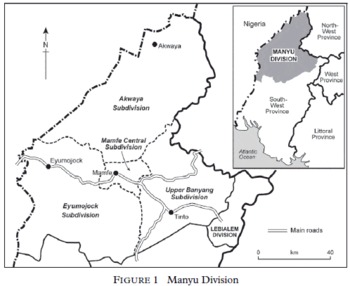
Manyu is the largest, northernmost division of South-West Province, one of Cameroon's two Anglophone provinces (see Figure 1). With the higher Grassfields of North-West Province to the east, Manyu forms part of the Cross River catchment, draining into Nigeria to the west and mostly covered with rainforest or converted to agriculture. Following an insurrection in 1904, German colonial administrators chose the settlement of Mamfe as their district headquarters because it was in a populous area at the head of the navigable stretch of the Manyu River (Niger-Thomas 2000). Mamfe remains the divisional capital, presiding over four subdivisions. Mamfe Central is the smallest and most densely settled, including Mamfe Town and surrounding villages. Upper Banyang rises into the eastern hills of the division. Eyumojock is the predominantly lowland area south and west of Mamfe Central, bordering Nigeria. And Akwaya is the northern part of the division, mostly hilly and enclaved and also bordering Nigeria.
Manyu encompasses several ethnic groups, overlapping in territory and produced by colonial reification of more fluid entities. The Banyang predominate in Mamfe Central and Upper Banyang, while the Ejagham form the majority in Eyumojock. Fieldwork was conducted mostly in Mamfe Central and the neighbouring ‘Central Ejagham’ area of Eyumojock, so the article focuses on the Banyang and Ejagham. Like most other ethnic groups in South-West Province, those in Manyu have a relatively flat political structure, described as acephalous, decentralized, diffuse, segmentary or stateless (Konings and Nyamnjoh Reference Konings and Nyamnjoh2003; Nyamnjoh and Rowlands Reference Nyamnjoh and Rowlands1998; Röschenthaler Reference Röschenthaler2004; Ruel Reference Ruel1969). Chieftaincy is often a wholly colonial construct and relatively weak in authority, although the village is the basic and most important unit of neotraditional government. Ties may exist at higher levels, usually through clans – village groups defined by perceived common descent – but these are more fluid with no fixed political authority (Ruel Reference Ruel1969).
Movements of people into and through South-West Province, including Manyu, are longstanding. Most Manyu groups acted as middlemen in the Atlantic slave trade (Röschenthaler Reference Röschenthaler2004). Large influxes of outsiders from the more densely populated Grassfields and from south-east Nigeria continued during the colonial and post-independence periods, driven partly by development of plantation agriculture on the fertile volcanic soils of South-West Province (Geschiere and Gugler Reference Geschiere and Gugler1998; Konings Reference Konings1993) and augmented by refugees from the Biafran war of 1967–70. These influxes have always been socio-politically contentious but significant populations of Nigerian immigrants or itinerant traders, mostly Igbo, are still found in Mamfe and some other Manyu towns and villages (Amaazee Reference Amaazee1990; Konings 1993). Distinctions between ‘autochthons’ and ‘strangers’ are therefore long-established sources of discord in South-West Province (Geschiere and Gugler Reference Fisiy and Goheen1998; Nyamnjoh and Rowlands Reference Nyamnjoh and Rowlands1998).
HOMETOWN ASSOCIATIONS FOR MANYU DIVISION
Historical development
Manyu's rich associational life, noted for over a century (Röschenthaler 2004), relates partly to this long history of movement and trade, which brought new associational forms from Nigeria and, more recently, new social relations and associations in the context of economic outmigration. In the 1950s and 1960s, the anthropologist Malcolm Ruel found that outmigration in Manyu was already considerable. In 1953–4, he estimated the Banyang as numbering some 18,000 in their homeland but a further 4,000–5,000 men and women were working elsewhere, mainly in plantations and towns of coastal areas of Cameroon, with up to 40 per cent of men absent from some villages (Ruel Reference Ruel1964). He observed early hometown-type associations among the Banyang in the form of ‘clan unions’ based on the village groups mentioned above. These appeared c. 1949–50, starting with the Mamfe Town Union and then spreading rapidly outwards into the division. Ruel's description points to similarities with contemporary village development associations but for various reasons the clan unions became defunct by the end of the 1950s. During that decade, a ‘clan federation’ of three neighbouring unions became the largest association created up to that time among the Banyang, although it covered only part of present-day Upper Banyang Subdivision.
In the 1960s and 1970s ethnically based groups were banned in Cameroon, ostensibly in the interests of nation building, although this did not prevent Manyu migrants from associating (see below). Associations evaded censure by removing ethnic references from their names and constitutions while actually continuing much as before (Mercer et al. 2008). Since the late 1980s and early 1990s, ethnicity and the politics of belonging have become increasingly important in Cameroon, intertwined with political liberalization and growing neopatrimonialism (Hickey Reference Hickey2004). Also, international development discourse has moved away from statist, centralist policies to an emphasis on ‘bypassing the state’ via ‘civil society’ and decentralized forms of development (Geschiere Reference Geschiere, Englund and Nyamnjoh2004). Hometown associations, generally known in Cameroon as ‘cultural and development associations’ and able to register legally since 1990,Footnote 2 have mushroomed in this new political landscape. Their growth has been further driven by economic crisis and mismanagement, which have left rural areas neglected except in relatively few communities benefiting from particular clientelistic arrangements (Nkwi Reference Nkwi1997).
Manyu today shows territorially based associations ranging from sub-village to divisional level. There are also explicitly ethnic bodies such as the Ejagham Cultural Association, while some territorial associations such as clan groups reflect sub-ethnic identity. The two tiers of association currently most active and visible – divisional and village – are now discussed. Other types of association fall outside the scope of the article but two are worth mentioning. Since 2001, cultural and development associations have been established both in Cameroon and overseas for Manyu's subdivisions, a territorial level intermediate to the two discussed here, but it is too early fully to gauge their character and role. At province level, Manyu people play an important part in the South West Elites Association (SWELA): such bodies have been encouraged by the government as vehicles for capturing provincial constituencies (Geschiere Reference Geschiere, Englund and Nyamnjoh2004; Nyamnjoh and Rowlands Reference Nyamnjoh and Rowlands1998).
Manyu Elements Cultural Association
Accounts of the origins of the Manyu Elements Cultural Association (MECA) varied but were broadly consistent. Manyu people began associating in Yaoundé in the 1960s, earlier forms evolving into MECA probably in the 1970s. A key figure was the late Emmanuel Tabi Egbe: the most important national-level government elite from Manyu to date, E. T. Egbe was the first patron of MECA-Yaoundé and its meetings were held in his house in the city for some years.
Manyu diasporas in other cities and countries emulated the Yaoundé model. Today MECAs exist in Douala and some urban centres in Anglophone Cameroon, including Bamenda, Buea, Kumba and Limbe, but not in Mamfe itself. They are also found in Nigeria, the US and some European countries. Each city's MECA is constituted independently, so MECA is not a single transnational association with branches in different locations. Rather, the ‘branches’ are all separate associations even though they have the same name and, within Cameroon at least, similar constitutions. Each MECA is thus largely autonomous, usually supporting home development projects on a bilateral basis, although MECA-Yaoundé maintains some primacy among MECAs in Cameroon and sometimes acts as a liaison point for overseas MECAs' funding projects in Manyu. Attempts at federation, either through the now-defunct ‘General MECA’ umbrella body or the ‘Manyu World Conference’, have been unsuccessful.Footnote 3 Still, the term ‘MECA’ is used in Cameroon and where appropriate in this discussion to mean all MECAs. Each MECA is ‘open to all Manyu citizens’ (MECA-Yaoundé 1996: Reference Mercer, Page and Evans2) resident in the city concerned. In Cameroon, membership is not direct but through ‘family groups’ – mostly village-level meeting groups with each usually constituting the branch of the respective village development association, although some represent higher territorial or sub-ethnic (clan or above) levels.
Other Manyu groups loosely affiliated to MECA include the Manyu All Students Union and, in Yaoundé, the Manyu Solidarity Foundation, which makes awards to high-achieving Manyu students. MECA also engages with Efokhoyu, a network of many women's groups in Manyu (the name means ‘umbrella’ in Kenyang).Footnote 4 However, women are not greatly involved in the MECA leadership despite many female Manyu elites working, like their male counterparts, as civil servants, teachers, lecturers and politicians. The (male) president of MECA-Yaoundé claimed that there was nothing to stop a woman being president,Footnote 5 but in reality patriarchal structures reproduced within MECA, particularly the male initiation society ngbe (see below), may form a significant social obstacle to female engagement at this level. Women are very active in running family groups, though, and some of these have a women's president alongside (though subordinate to) the male president.
Mutual support initially motivated the Manyu diaspora to form these various groups, as in most hometown associations elsewhere. MECA and its precursors also showed a relatively early concern with development at home, perhaps echoing the activities of the clan unions. Despite being an association for the whole division, MECA's historical and present development projects have concentrated on the divisional headquarters, Mamfe Town. This is to some extent a conscious policy: to strengthen services centrally where anyone in the division can in theory use them,Footnote 6 and to prevent MECA leaders from favouring their home villages. Construction of Mamfe's town hall is an early project claimed by MECA, although its historical role in this is disputed.Footnote 7 More recently, MECA has supported improvements at Mamfe's general hospital. Its latest project, however, is troubled, long-running, expensive and unfinished: MECA-USA has constructed a building in the hospital grounds to house a mortuary and dispensary, but this has never been equipped and remains an empty shell.Footnote 8 The benefits of a few other MECA projects are spread around the division, notably medicines distributed to subdivisional and village health centres.9
Village development associations
Most villages in the study area have a village development association (VDA), a form enjoying growth at present. Some central government servants in Manyu claim that they encourage VDA establishment so that villages can make their needs known and access state support.Footnote 10 In fact, associations are usually initiated by village elites in the face of chronic state neglect and economic crisis. Echoing the spread of the clan unions, villages also copy each other: it has become ‘fashionable’ to have a VDA.11
VDAs commonly have branches in Yaoundé and Douala, and sometimes in larger towns in South-West Province such as Buea, Limbe and Kumba. Outside such urban centres, which are larger in size or closer to Manyu, there are usually too few migrants from a particular village to establish a viable VDA. Still, certain VDAs have active members or analogues even in the overseas diaspora: there is apparently a US ‘branch’ of the Ewelle Social and Development Association based in Atlanta, and a few village and sub-ethnic meeting groups in the UK.Footnote 12 Within Cameroon, VDAs are constituted and legally registered along similar lines. They are commonly run by the village chief and traditional council in conjunction with senior elites in the domestic diaspora, but their defined membership varies. People paying contributions through city branches are irrefutably members and, in some cases, membership is restricted to them while in situ villagers are not members. In others, the VDA regards the latter as de facto members even though they do not pay except, sometimes, for particular projects.
Manyu VDAs differ in focus and strength but, again, mutual support is usually paramount, mobilized at monthly branch meetings or as needs dictate, for example if a member dies. At home, VDA development projects commonly observed include construction of town halls, classrooms, health centres and farm access roads, and rehabilitation of pipeborne water systems. The latter continues a long tradition as some Manyu villages were among the first in Anglophone Cameroon to establish water systems through a community development approach (Page Reference Niger-Thomas2000). The development activities of a typical VDA pivot around the village's ‘cultural week’; in some cases the VDA only functions as such at this time,Footnote 13 acting as a focus for activity that is largely conducted through other village forms. Cultural week usually falls over Easter and may be held every year, in alternate years or more irregularly. Domestic diasporic elites come home for the long weekend and discuss potential projects with the traditional council and village community. Once priorities are determined, cash contributions are agreed for diasporic members, levied as a flat rate or on a sliding scale according to income. Elites may also use their positions to lobby central government for support, or to seek donations (cash or in kind) from external sources, usually Western embassies in Yaoundé. Villagers pay a considerably smaller cash levy, sometimes nothing, but provide labour for gathering local building materials (such as sand) and construction.
The diaspora thus supplies most cash for VDA projects and sometimes expertise or manufactured materials (such as cement and galvanized roofing sheets). The effectiveness of VDAs as development actors therefore depends partly on the size and dynamism of the village diaspora. The regent chief of Mbakang, a small village, thus complained that its lack of elites in good jobs hinders development there.Footnote 14 One strong elite is sometimes crucial: for example Chief Professor Samson Negbo Abangma, Deputy Rector of the University of Yaoundé I, is lauded for his efforts in developing his Akwaya village, Bache. Such individuals, described elsewhere in the Cameroonian context as ‘viable’ elitesFootnote 15 or ‘resource persons’ (Nkwi Reference Nkwi1997: 76), are important in mobilizing diasporic action or acting as brokers with the state (Hagberg Reference Hagberg, Englund and Nyamnjoh2004).
The relationship between elites and villagers expressed through VDAs merits examination. Cultural week compares with ‘homecoming’ events elsewhere in West Africa in its pattern of debating and launching development projects at a certain time of year, and financing them from elite donations and a smaller general levy (Trager Reference Trager1998). It has a practical logic as it is otherwise rare for villagers and urban elites to find themselves together en masse. In Manyu, the name ‘cultural week’ itself encapsulates how tradition is invented and deployed to bring urban elites back with their ‘wealth’ – money, skills and connections – and share this with those at home in accordance with socially rooted notions of mutualism and obligation (Fisiy and Goheen Reference Fisiy and Goheen1998; Mohan Reference Mohan2006; Nyamnjoh and Rowlands 1998). Elites failing to do so may be admonished for selfishness (de Jong Reference de Jong1997). Interviews with traditional councils in Manyu seemed to support Gugler's assertion (2002) that the broader vision and knowledge brought by diasporic elites are generally welcomed: they were acknowledged as people who know their home place and usually still have kin there, so they should understand the village's interests and act accordingly. Any disagreements over priorities, it was claimed, were resolved through constructive dialogue, usually in public meetings during cultural week.
However, elites themselves also promulgated the view that they know best, and certainly better than the benighted village folk back home. The issue is further problematized in that the village leadership is not discrete from diasporic elites. In many Manyu villages the chief and some other elders are absent, with day-to-day affairs handled by a regent. The absent chief often works in a middle- or high-ranking position in the civil service or in a parastatal or private business in Yaoundé, Douala or another urban centre, where he is usually involved in the VDA branch. Overlapping with diasporic elites, then, the traditional council – a patriarchal and often gerontocratic body – is not necessarily representative of the wider village community, which may effectively find itself disenfranchised. As Fisiy and Goheen (1998: 384) note, ‘brokerage’ by elites may include determining the type of engagement of their home communities with the state, who is allowed to perform it and to what ends. Under these circumstances, villagers may resent what they see as opportunistic, self-serving interference in village affairs by elites who otherwise neglect their home place (Geschiere Reference Geschiere, Englund and Nyamnjoh2004).
A few dissenting voices indicated such political, economic and social faultlines. Diasporic elites do not always use their considerable influence in village development appropriately and may impose projects or even associations on their village with little engagement with their purported constituency.Footnote 16 Their projects may be inappropriate or unrealistic, driven less by local needs and more by a desire to impress for local or national political purposes. One urban elite criticized the visible ‘town hall inflation’ in Manyu, with every village wanting to show that it has ‘big sons’ through an ‘egocentric project’.Footnote 17 The sizeable hall being built at Ogomoko, with a projected capacity considerably greater than the village population, exemplifies this.Footnote 18 Discord may also arise between domestic and overseas elites: the same informant complained that his VDA's ‘US branch sent us bogus plans for the town hall that we can never realize. They are dreamers. … Their plans are not simple, with several wings like Unity Palace [the President of Cameroon's official residence].’
Overambitious construction projects highlight the lack of resources and erratic funding streams characteristic of VDAs. These projects are frequently implemented piecemeal over several years according to availability of funds, or may stall entirely. Half-built, sometimes overgrown town halls are a familiar sight in Manyu villages and may divert resources from other projects, for example from the school roof and water system in Eyanchang.Footnote 19 Financial constraints also mean that VDAs rarely create productive enterprises (rather than public goods), as noted elsewhere (Mohan Reference Mohan2006). Youth interviewed in Manyu were therefore understandably critical of VDA projects, seeing them as no substitute for much-needed job creation.20
Such frictions are longstanding among hometown associations in West Africa (Trager Reference Trager1998; van den Bersselaar 2005) and show structural problems in their power relations. Hagberg (2004) incisively observes that elites, who generally define activities and provide most material resources, do so as individuals; whereas villagers tend to be treated collectively, both as objects to be ‘developed’ and in doing most of the manual work involved. Differences between the two groups are sometimes negotiated in ways far from the rhetoric of ‘dialogue’ or ‘participation’. Some degree of compulsion to contribute to hometown development is common (Gugler Reference Gugler2002). Within the Manyu village, this is usually enforced not through hometown associations but through neotraditional structures, including ngbe. By contrast, only one instance of state authority being exercised against recalcitrant villagers was recorded during fieldwork: the Divisional Officer summonsed four people from Bachuo Ntai who had refused to pay the 2,000 franc levy for building the town hall, deploying rarely used legal powers – possibly to make an example of those concerned.21
Sanctions can be applied to elites too. One in Yaoundé compared his VDA membership booklet to a ‘passport’ for his village: it recorded his payment of death dues (i.e. contributions to the VDA's branch fund for repatriation and burial expenses for those who die in the city) and levies for various development projects. Non-payment would expose the defaulter to sanctions, usually fines, from the traditional council if he tried to take a body home or receive one there (again illustrating how different social forms become blurred in their roles at village level); or he could be admonished for benefiting from a project to which he had not contributed, for example by taking water from a VDA-funded supply system.Footnote 22 But such situations seem rare: Manyu elites were generally loyal to their VDA and, while their self-interest should not be ignored, they were sometimes genuinely passionate about its attempts to improve village life.
Still, VDAs are not always stable and show fissiparous tendencies, forming or splintering along factional lines. During fieldwork, two large villages where the chieftaincy is disputed (Besongabang and Kembong) both had two associations, one supporting each side in the dispute, with the incumbent chief patronizing one VDA but not the other. Nchang has a single VDA but its branch meetings provide a forum for arguments over the village chieftaincy.Footnote 23 Projects may founder as funding and effort become divided between factions, or they may be used as pawns in local politics. The rival VDAs for Besongabang contributed to construction of a new Presbyterian church, both probably attempting to garner support across the village. One UK-based Besongabang elite criticized the size and cost of the church when water supply is, in his view, a greater priority; but he was still pressurized into making a substantial donation to the church project to show his status in the context of the chieftaincy dispute.24
MOBILIZING FORCES IN HOMETOWN ASSOCIATION ACTIVITY
Having considered reasons and motives underlying hometown association activity, this section analyses how it is mobilized. It looks at how three, interlinked aspects of identity – geohistorical and genealogical; neotraditional; and national political – are constructed and operate at the two levels of association under discussion. Behind apparently monolithic discourses of ‘home’ lies a complex set of identity constructs mobilized at different times for different purposes. Identity is not fixed and passive but intimately and dynamically related to associational life and to other social and political forms.
Geohistorical and genealogical imaginings
The villages engendering the loyalty evident among Manyu people are only a century old, originally established under German rule (Ruel Reference Ruel1962, Reference Vertovec, Vertovec and Cohen1969). From the 1900s, Manyu saw considerable villagization in which previously dispersed settlements were consolidated into compact villages along roads, mostly by persuasion rather than coercion. After the British took possession of the Southern Cameroons in the First World War, they let settlements develop as they wished, although villages remained consolidated and new offshoots did not stray far from main roads. Indeed, road development for motor vehicles encouraged further consolidation, with villagization now driven by transport and trade rather than policy. The village thus became the fundamental unit of settlement.
The Germans also established the village as the basic administrative unit, whose ‘chief’ was responsible to the colonial government. But inhabitants exercised their own agency in shaping the imagined community of the village too. As van den Bersselaar (2005: 53) notes for nearby Igbo-land in south-east Nigeria, ‘[s]ome elements of colonial discourse leached unintentionally into the imagining of the village, others were introduced as part of an explicit attempt at appropriation’. Similarly in Manyu, Ruel (1962: 117) cites the Banyang's own description of villagization as the ‘gathering of the town’, set against their negative view of their earlier, dispersed state. He adds that consolidation was not socially arbitrary, generally bringing together groups who already recognized lineage ties, although these had not previously been reflected in a stable political structure. Villagization thus tended to fix groups that were formerly flexible in composition and allegiances. While spatial concentration and reification of perceived ties created a polity in which greater cohesion and political effectiveness could in theory be achieved (ibid.), in practice the new village often held historical tensions between different lineages that can still surface in chieftaincy and other local disputes (Geschiere Reference Geschiere, Englund and Nyamnjoh2004).
The diaspora was crucial in shaping the village during the colonial period, particularly through hometown association activity. The translocal community affected how the village was bounded in physical space, who was a member, and how it organized itself (van den Bersselaar Reference van den Bersselaar2005). The village's complex historical relationships with pre-colonial settlement groups were retold to create a sense of its antique unity, however obscure and tenuous these relationships were in reality (ibid.). As Anderson (1991) observes, the formation of nationalism (at whatever level) involves collective forgetting – in this case, of the more diffuse and fluid origins of the village – as well as shared remembering of the community's imagined history.
This remembering is evident in Manyu villages and their associations. The village of Bachuo Ntai, for example, recounts its origins through the journey of its founder, Egbe Areng, from Egbekaw via Nchang to the place – a stone (ntai in Kenyang) – where he and his followers decided to settle. The VDA, Ntai Egbe Areng Elements Cultural Association, recalls the village's foundation myth in its name and its meetings, in which anyone speaking begins and ends by clapping twice and saying ‘Ntai’; the group response is ‘Egbe Areng’.Footnote 25 This practical way of managing interventions reinforces members’ sense of their common roots. The preamble of the Association's constitution states that its members are ‘[c]onvinced that the same shared common belief, aspirations and interests [are] embodied in their cultural heritage’ (Ntai Egbe Areng Elements Cultural Association Yaoundé n.d.: Reference Amaazee1). The foundation myth also means that the villagers of Bachuo Ntai, Egbekaw and Nchang see themselves as one clan.26
Similarly, Manyu identity is based on a geopolitical entity of recent construction and with arbitrary borders set by colonial and post-colonial governments. Manyu is an internally heterogeneous space with a fairly short history. Before being demarcated as a unit of colonial administration, the different societies of the area were never governed as a whole nor imagined themselves as such. Independent Cameroon inherited Mamfe Division from British colonial rule, changing its name to Cross River Division in 1969 (Ruel Reference Ruel1969), then to Manyu Division in 1975. Lebialem Division was split off from Manyu in 1992 (see Figure 1); the Manyu diaspora thereby shrank and the newly independent Lebialem diaspora ceased to participate in MECA.Footnote 27 Lebialem already had a somewhat separate identity in that it is regarded, in socio-political terms, as part of the Grassfields despite being part of South-West Province administratively (Nyamnjoh and Rowlands Reference Nyamnjoh and Rowlands1998). Its hierarchical societies are much more akin to those of North-West Province than to the segmented ones of Manyu.Footnote 28 Still, this change in diasporic configuration in response to a redrawn boundary shows how the ‘Manyu community’ is not fixed.
Yet in contemporary Cameroon, it is clearly meaningful to define MECA membership in terms of ‘Manyu citizens’, a category extending to some people who have lived all their lives in urban centres outside of Manyu but still express an attachment there. Given Manyu's lack of historical roots or ethnic homogeneity, it imagines itself in other ways.
Neotraditional forces
The importance of neotraditional forms in constructing local identity in Cameroon is well recognized (Fisiy and Goheen 1998). In Manyu, this is evident at different levels. VDAs deploy a range of identity markers, territorial and ethnocultural (van den Bersselaar Reference van den Bersselaar2005). They usually adopt English names with combinations of the words ‘culture’, ‘development’ and ‘social’ but, in addition to or sometimes instead of this formula, some use words in local languages and/or cultural references. The example of Ntai Egbe Areng is cited above. Another is the Besongabang VDA representing the incumbent chief, called ‘Nkeng’, the Kenyang word for the main beam supporting a roof.Footnote 29 This may originally have been an attempt to convey a sense of political stability and cultural legitimacy in the face of claims by the pretender to the chieftaincy, who headed the rival Besongabang Elements Cultural and Development Association (BECDA).30
Regardless of name, VDAs hold their meetings largely in the respective local language, although their documentation is in English as a legal requirement for registration. VDAs typically see preservation of the home language as one of their roles, also teaching it to members’ city-born children. These languages may be fairly localized: there are three Ejagham dialects, while Kenyang dialects grade between the Upper and Lower Banyang (Ruel Reference Ruel1969). Still, dialects usually transcend village level, as do cultural activities common at VDA meetings such as dances and eating Manyu dishes.Footnote 31 Wider vernacular commonality is created in MECA within Cameroon through the use of Pidgin English as its official spoken language and English as its written language (MECA-Yaoundé 1996).
But the most important neotraditional force promoting both intra- and inter-village cohesion is the male society ngbe, meaning ‘leopard’ (Röschenthaler Reference Röschenthaler2004; Ruel Reference Ruel1969), found in most of Manyu and extending beyond it. Some other initiation societies are similarly transethnic, including the moningkim society for women, but ngbe is ‘undoubtedly the most effective of the traditional political associations within the whole of the Cross River area’ (Ruel Reference Ruel1969: xix). The history of ngbe is debated but it is believed to have originated in Old Calabar in the late seventeenth or early eighteenth century (Ishemo Reference Ishemo2002), entering Manyu via the Ejagham, then diffusing eastwards to the Banyang from the late nineteenth century to the 1920s. Most ngbe songs, status titles and other terminology are in Ejagham or derived from it (Ruel Reference Ruel1969).Footnote 32 Today most Manyu men belong to an ngbe lodge in their home village, as Ruel observed of the Banyang half a century ago (1956). Lodges are independent with no central control, but joining one lodge confers membership of the whole society and entry to any lodge anywhere (Ruel Reference Ruel1969).
Ngbe wields considerable power with interviewees likening it to a village government, but its political role is actually more nuanced (Ruel Reference Ruel1969). In the ‘flat’ societies of Manyu, no individual, however senior, can exercise power in his own name. Authority is vested in the village community and through ngbe this authority can be exercised corporately rather that personally, although in practice it derives from the fact that the leaders of the village and those of ngbe are generally the same men. The political and judicial functions of ngbe are often deployed to mobilize collective action, including VDA development projects, and to sanction recalcitrants.
The role of ngbe in local identity formation is complex. Ishemo (2002: 257) argues that the contested history of ngbe has itself provided space for ‘[e]ach group … to adapt and utilize it in cementing ethnic loyalty and identities as well as legitimating political structures’. Unity within ngbe is maintained through members sharing esoteric knowledge; secrecy, preventing them from discussing society activities with non-initiates; and corporate identity, expressed in the society's symbols and regalia (Ruel Reference Ruel1956). As in other ‘secret societies’ in West Africa it is primarily the act of secrecy, rather than the contents of secrets, that creates a shared identity among members (de Jong Reference de Jong1999). The ngbe identity can promote cohesion between lodges and by extension the polities in which they are based. In the absence of any paramount authority or ethnic homogeneity, ngbe is crucial in imagining communities above village level and in constructing a Manyu-wide ‘tradition’, even though the society's territorial spread is not coterminous with the division and its adoption by the Banyang was historically recent. This cohesive role extends into the domestic diaspora,Footnote 33 where all male MECA elites encountered were initiates: for example the president of MECA-Yaoundé noted that his executive committee ‘are all seseku’, referring to the highest rank in ngbe lodges.34
Ngbe can, however, be another site through which local divisions are expressed. There is sometimes more than one ngbe lodge even in small villages and, in chieftaincy disputes, these lodges may be led by or allied to one side or the other, as in Besongabang.Footnote 35 There are also dissenters from ngbe, particularly among evangelical Christians, who regard its practices as pagan and boorish, at times barbaric.Footnote 36 This view is even shared by some initiates, with certain ngbe lodges moderating and modernizing their practices under pressure from educated elite members.Footnote 37 But while lodges may form seats of local despotism, exclusionism and schismatic village politics, several male Manyu elites interviewed still saw ngbe as the main glue holding Manyu's different ethnic groups together by maintaining a shared culture and values. The caveat is that ngbe does so through men and through patriarchal control.38
National politics
Hometown associations commonly present development as apolitical to overcome differences within the membership and obscure the motives of elites (Hagberg Reference Hagberg, Englund and Nyamnjoh2004; Page Reference Nyamnjoh, de la Cadena and Starn2007). In reality, nurturing political support through associations has long been recognized. In Manyu, a stronghold of the national ruling party, the Cameroon People's Democratic Movement (CPDM), this is visible at village level. VDAs are sometimes run by party activists, or civil servants with evident loyalties; while village chiefs are, since 1977, auxiliaries of the administration (Fisiy and Goheen Reference Fisiy and Goheen1998). But political dynamics are most evident at divisional level. Although MECA is ostensibly apolitical, there are significant breaches of this in practice, particularly through MECA-Yaoundé’s support for the government, reflecting both the high proportion of civil servants in its membership and CPDM support in Manyu. Senior MECA figures campaign for CPDM at election time, even if not formally under the auspices of MECA.39
Another important aspect of the political role of MECA is its patron. Every government of independent Cameroon has included one ‘Manyu minister’ and the first, E.T. Egbe, set the precedent that this minister be nominated as patron of MECA-Yaoundé and thus effectively of other MECAs in Cameroon. This is mirrored in the Manyu women's network Efokhoyu, which always invites the minister's wife to be its matron (all Manyu ministers to date have been men). The symbiosis between an imagined Manyu community and the minister was publicly demonstrated during fieldwork by the inauguration of a new Manyu minister – Justice Hillman Egbe, Minister for Forests and Wildlife, from Takwai in Upper Banyang – as patron of MECA-Yaoundé in March 2005. The event was held in the Yaoundé suburb of Essos, over 300 km from Mamfe, in MECA's ‘Manyu Hall’ which, though incomplete, is a symbol of Manyu identity in the capital. Some 400–500 Manyu people were present and a number of the men, who included absentee village chiefs, wore ngbe caps. The former minister and outgoing patron handed over a carved wooden staff to the new patron, who used it in a form of ngbe ritual in which he named the subdivisions and main ethnic groups of Manyu, asserting his status over them.40
But having deployed ngbe as a uniting force, the new patron stressed a higher unity in his inaugural speech: ‘[b]efore you belong to ngbe … [or] any other group, you are first and foremost a Manyu person. … There is no group above Manyu. … All groups must work in unison’. This may have been a veiled reference to the troubled tenure of his predecessor, Chief Clarkson Tanyi Mbianyor Oben, formerly Minister of Environment and Forestry. His term as patron of MECA-Yaoundé was tainted by dispute over his chieftaincy of Nchang, which was divisive within the Manyu community. Following this speech, the chief of Ndekwai performed a libation and the inauguration also included two dances by groups of Manyu women, including moningkim. The whole event exemplified how hometown association leaders typically seek legitimacy on the basis both of ‘tradition’, in this case neotraditional ritual; and ‘modernity’, in the form of success in national politics, state administration or business (Fisiy and Goheen Reference Fisiy and Goheen1998; Hagberg 2004). Here, neotraditional and national-political forces combined to reinforce Manyu identity, used in turn by the new minister to bolster his support.
Like other ministers, the Manyu minister stages a ‘homecoming’ after his appointment in which he returns to Manyu. Such events can be seen as indicative of a deepening territorialization of national politics (Fonchingong Reference Fonchingong2005; Nyamnjoh Reference Nyamnjoh1999) in which hometown associations are complicit to some extent. The minister has a substantial budget for his homecoming, augmented by contributions from MECA and other levels of association,Footnote 41 and it sits amid a web of neopatrimonialism and attendant reciprocities. Manyu elites usually argued that it is necessary to show support for the current minister to get him to bring development goods to the division. The homecoming is an important part of this charade, a public demonstration that the minister is popular at home, encouraging him to lobby government for development funding for Manyu and showing the government that he can help carry the division for CPDM in future elections. But in Manyu, such efforts have brought little developmental return from successive governments, which some blame on Manyu ministers never holding the strongest portfolios, like Finance or Planning.42
Some MECA members in Yaoundé further criticize this partisanship in its own right. One elite sees MECA mainly as a rallying forum to get Manyu people behind the minister and is not alone in resenting the contributions requested for the homecoming:
MECA is almost like a political association. … MECA doesn't do developmental activities. … Ministers come and talk but nothing is seen. MECA is very, very active during election time … 96 per cent of its members are in CPDM, that's why Manyu has good results for the party. They don't wear the MECA cap, but they are the same people.43
Another is similarly cynical:
During elections, the government needs a channel and MECA is very useful in this respect. It selects certain Manyu elites, finances their journeys to go campaigning, gives them money for drinks. … MECA gives the names of reliable people, supplies people to help the campaign.44
MECA-Douala, with more members from the private sector, claims greater distance from political activity. However, it still supported the minister's homecoming, contributing some 1.7 million francs CFA (cash and pledges), which it admits is more than it could raise for a development project.Footnote 45 Directors of Douala-based parastatals who were MECA members wanted their individual contributions noted when the donation was made at the homecoming reception. In the same month (April Reference Vertovec, Vertovec and Cohen2005), MECAs in Cameroon contributed to the reception for the new Prime Minister, Chief Ephraim Inoni, in Buea, capital of his home province (South-West).
HOMETOWN ASSOCIATIONS, PAROCHIALISM AND CHAUVINISM
We have seen how hometown association activity is mobilized; this section considers to what extent this may reinforce parochialism and chauvinism. Village-level patriotism is certainly evident in VDA activities. One elite – a member of a VDA, MECA (through his VDA, as explained above), a subdivisional association and an explicitly ethnic association – tellingly admitted that ‘if I had to belong to one association, it would be [my VDA], my primary responsibility. All the others are just added pressure. I would not keep records like this [my VDA membership booklet] for the others. MECA would be last.’Footnote 46 An overseas elite made a similar admission: also active in MECA, her subdivisional association and the Manyu Women's Association, her primary loyalty is to her clan meeting group because ‘charity begins at home’.Footnote 47 In Manyu, such feelings are manifested in the few developmental achievements of MECA compared with the more appreciable sum of VDA efforts. This contrast is more striking given that MECAs exist in the global North where their members’ earning potential is relatively higher, whereas most VDAs receive only patchy input from their overseas diasporas.
This patriotism is expressed in other forms. In some villages, certain neotraditional societies differentiate ‘real’ villagers or indigenes from ‘strangers’. One example is etokobi, encountered in Bachuo Ntai and KembongFootnote 48 and which, like ngbe, dates from the Atlantic slave trade. Etokobi was concerned with the strict separation of freeborn from slaves (Röschenthaler Reference Röschenthaler2004) and, in Bachuo Ntai, interviewees still linked it with the claim that ‘strangers’, including immigrant Nigerians, form a substantial minority of the village population. The perceived ‘strangers’, who cannot take part in etokobi dances, may not be immigrants in any meaningful sense but people whose families have lived there for generations and who are then redefined, sometimes in relation to the perceived genealogical structures of the colonially created village (Geschiere Reference Geschiere, Englund and Nyamnjoh2004). Chieftaincy disputes, too, are often rooted in arguments over whether an incumbent chief or pretender is a true indigene of the village, for example in Nchang, where former government minister Clarkson's status as an autochthon is refuted by some.Footnote 49Etokobi and other expressions of village autochthony thus arguably represent a form of reactive micro-ethnicity.
The focus on imagined roots and indigeneity deployed in VDAs and other village practices to mobilize village communities may risk turning into more divisive parochialism. Schism among VDAs along chieftaincy or other local factional lines can itself be seen as part of an increasingly parochial politics of belonging.Footnote 50 That said, competing hometown associations, each claiming to represent the home place, are a longstanding phenomenon (Trager Reference Trager1998; van den Bersselaar 2005). MECAs in Cameroon wisely recognize only one family group for each village rather than legitimize the group fragmentation that sometimes occurs around local disputes. And such schism highlights other, deeper historical factors, showing that far from being timeless and politically stable, the Manyu village is as likely to be divided against itself as pitted against other villages.
The deepening of divisional-level chauvinism, through MECA or other channels, also seems unlikely, partly because Manyu identity is relatively weak compared with more local loyalties, not just village but also ethnic and sub-ethnic. The relationships between different ethnic groups of Manyu deserve closer scrutiny in this respect. Histories of Manyu have tended to focus on the Banyang and Ejagham because of their engagement and status vis-à-vis colonial administrations, reflecting their location in relatively accessible areas of Manyu crossed by important trade routes (Michels Reference Michels2004; Niger-Thomas 2000). Other groups, particularly in ‘Mamfe Overside’ (the area north of the Manyu River, now mainly comprising Akwaya Subdivision), were historically more marginal and are still apparently underrepresented among Manyu urban elites. In interviews, there were also occasional indications of tensions between the Banyang and the Ejagham, although these must be set alongside their long history of cohabitation, cultural exchange and métissage. Overall, then, Manyu seems a rather overimagined community, constructed to engage with the nation state and loosely held together with the ‘meta-identity’ of ngbe. Manyu people deploy this identity selectively for social, political and developmental purposes but, in contrast with subjects of the Grassfield fondoms (kingdoms), they do not see themselves as a ‘nation’.
The evidence for parochialism and chauvinism at different levels of association is therefore limited and equivocal. Instead, associations operate in different ‘registers’ as appropriate to engagement with the home area, the state or, sometimes, the international development industry (Hagberg Reference Hagberg, Englund and Nyamnjoh2004). Typically a more ethnic register plays well at home and in the diaspora; the party-state demands political support, usually by appealing to national unity regardless of ethnicity (however hypocritical this is in contexts where clearly ethnic constituencies have been cultivated); while for donors, both ethnic and political aspects need to be downplayed within the rarefied discourse of what constitutes ‘civil society’ (ibid.). The preamble to the constitution of MECA-Yaoundé, a model for MECA constitutions nationwide, illustrates multiple registers:
Territorial, cultural and national aspects of identity are invoked here. They are mobilized within as well as between different Manyu associations, speaking to different registers according to context and need.
Identity dynamics of Manyu people also vary with the size and nature of their communities in different cities. In Cameroon, MECAs require family groups to have a minimum number of members, pushing them to form clan or other higher-level groupings where migrants from a particular village are too few. In the UK, some Manyu elites expressed concern that the rise of subdivisional and sub-ethnic associations represents a slide into ‘small-small sub-groups’, diluting Manyu solidarity in social and material terms.Footnote 51 This trend has only become possible with increasing immigration but seems largely confined to London with its larger Manyu community, while in the Midlands two new MECAs have formed in recent years. Little is known about what is happening outside the main urban centres in the UK, where Manyu people are fewer; but in Cambridge, for example, one Manyu interviewee spoke of an inchoate association for Anglophone Cameroonians as a whole.Footnote 52 Simple numbers of people are thus important in determining the level at which effective association can happen (Gugler Reference Gugler1991), the identity registers used to mobilize them and, in turn, the role that associations play in reinforcing particular aspects of identity.
SHIFTING IDENTITY AND POLITICAL ENGAGEMENT
The ways in which identity dynamics, particularly ethnicity, relate to the political engagement of Manyu cultural and development associations are similarly mixed. Ethnic or other subnational forms of political mobilization do not necessarily conflict with national citizenship (Mohan and Hickey 2004). This is not to deny that ethnic mobilization can be politically destructive, sometimes violently so, nor that expressions of ethnic identity can be parochial in certain circumstances. But in Africa, ethnic identification is a longstanding basis for collective action in a broader and more relational political sense, rather than necessarily the basis for zero-sum competition (Englund Reference Englund, Englund and Nyamnjoh2004). Mohan and Hickey (2004) point out that, first, state formation in Africa was originally founded on a collection of ethnic identities, so ethnicity is not necessarily inimical to statehood. And second, neither does ethnicity necessarily damage normative ideals such as social justice and equality that are typically (if only nominally) inscribed in notions of national citizenship. On the contrary, with much social behaviour informed by ethnic identity, it can be a stronger repository for cooperative action than national public life (ibid.).
How does this play out in Manyu? The VDAs studied sometimes provide significant development goods; MECA rarely so. Through these efforts, associations may make a constituency ‘known’ to government structures, not only (as state technocratic discourse claims) to access funding or other practical support, but for political recognition (Hagberg Reference Hagberg, Englund and Nyamnjoh2004; Hickey Reference Hickey2004). In such cases they can re-engage populations with national or local government in situations where the social contract has foundered, if it ever existed; Nkwi (1997) argues that successive Cameroonian governments have abandoned such responsibility altogether. While there is evidence for this re-engagement happening through the activities of VDAs and (now) subdivisional associations, MECA's dabblings in national-level politics may be less useful, including its ambiguous relationships with successive Manyu ministers who can deliver few benefits to the division. In fairness, it is the national political context that is against these ministers, not just their minor portfolios. A case in point is that, while the surfacing of roads in Mamfe Town has been hailed as a minor success, people continue to complain, rightly, about poor road links with the rest of the division and the country. The trunk road from Mamfe to Bamenda, capital of North-West Province, is in a deplorable state but seems unlikely to be improved as long as Anglophone solidarity is seen as a threat by central government.
Manyu elites interviewed generally did not see ‘tribalism’ as a danger but rather as a force for social cohesion, particularly faced with the difficult and worsening circumstances of urban life. Indeed, their associations can provide a basis for inter-ethnic relations (Hickey Reference Hickey2004) including cooperation between sub-ethnic entities, as evinced by the formation of the clan federation in late colonial times. Today the structure of MECAs in Cameroon, with membership through family groups, shows how supra-village and inter-ethnic ties can form by federation of smaller units. An example of cooperation between more diverse ethnic groups occurred in construction of the new Catholic cathedral in Mamfe, which saw contributions of labour from at least one branch of a hometown association for a fondom in North-West Province.53
Clearly there are also problems and dangers in hometown association activity. The evidence from across West Africa is mixed and some supports the assertion that the politics of belonging can close down rather than open up spaces for meaningful participation in local decision making (Hickey Reference Hickey2004; Nyamnjoh and Rowlands 1998). This is sometimes evident in Cameroon, where cultural and development associations are vulnerable to manipulation by elites and political parties, and can variously and accurately be labelled as elitist, exclusive, patriarchal and undemocratic (ibid.). These inequalities are inscribed in space: the true decision-making and financial power of associations lies primarily not within the rural communities that they claim to represent, but in cities elsewhere in the country. Events like cultural week may provide more space for engagement between elites and villagers, but again ‘participation’ is heavily loaded in favour of elites. The enforced voluntarism of VDAs is doubly imposed on the rural membership in that, first, villagers are automatically members or levied for money and/or labour for projects. And second, because they are in situ, recalcitrants can more readily be targeted by neotraditional or (rarely) state structures. It may be easier for individuals living in cities to evade membership but even elites in the domestic diaspora risk the power of ‘home’ being turned on them: financial sanctions or social embarrassment and ostracism await if they return to the village without having fulfilled their VDA responsibilities.
But perhaps that is precisely the point. Much of the business of Manyu associations, both in Cameroon and the UK, is about the banal dynamics of social obligation and reciprocity rather than a more problematic politics of belonging. Most discussion at meetings in both the domestic and overseas diasporas concerns neither politics nor development but mutual support, particularly during key life stages or crises: birth, marriage, sickness and, most importantly, death. A death for one village draws contributions from all family groups registered with the relevant MECA in Cameroon. Death, the core historical concern of most hometown associations in sub-Saharan Africa, shows the greatest capacity to generate solidarity and support in Manyu communities in Cameroon and overseas.
CONCLUSIONS
The research leads to a reappraisal of the ways in which hometown association activities should be understood in the belonging debate, in Manyu and more generally. Three points need to be highlighted. First is the importance of historical specificities at different scales even as they interact with contemporary and global processes (Englund Reference Englund, Englund and Nyamnjoh2004). Key among these are the legacies of indirect rule, as borne out in contemporary Manyu with its colonially constructed villages and their disputed chieftaincies (ibid.). Understanding the relatively recent historical circumstances under which ethnicity has been forged, often as a single-stranded identity out of a much messier weft, is also crucial (Hagberg Reference Hagberg, Englund and Nyamnjoh2004).
Second, such a historical view helps avoid teleological analysis of associational development, which would see the current trend towards smaller groups as a one-way process. In reality, the trajectories of Manyu associations are more complex. Lower levels of association may currently be in the ascendant but these have existed for a long time in various forms (Röschenthaler Reference Röschenthaler2004; Ruel Reference Ruel1964). Historically they have tended to provide building blocks for larger units without necessarily being subsumed. In the decades immediately before and after independence, sections of the Manyu community formed clan unions, then a clan federation; these disintegrated before the emergence of divisional-level association, which became MECA, but this still largely comprises village- and clan-level groups. Such fluid processes are recorded for Nigeria, where smaller associations of Igbo migrants have tended to coalesce but the fortunes of larger groups have varied with circumstances (van den Bersselaar Reference van den Bersselaar2005). Among the Yoruba, Trager (1998) similarly observes how individuals who previously promoted associations at a higher territorial level may shift their focus back to village-level activity in response to a new political environment. She notes that fluidity of identity and associational form allows both to respond to changes in administrative units and other socio-political structures in order to exploit new opportunities. Trying to predict the future shape of associational life on the basis of recent trends is a treacherous undertaking.
A third, related point is that the segmented nature of Manyu societies creates opportunities for cohesion as well as the evident divisions. Ruel (1969) stresses that acephalous institutions can by their very nature cooperate at any level, opportunistically, as different needs arise. The existence of MECA, a federation of smaller groups, bears witness to this. And within MECA, ngbe, a decentralized society used to promote and enforce solidarity at village or sub-village level, is deployed to create divisional-level identity.
A retreat into ‘ever-diminishing circles’ (Nyamnjoh Reference Nyamnjoh, de la Cadena and Starn2007) is an ever-present danger but the evidence from Manyu does not on balance point in that direction. Rather, it is more consonant with Vertovec and Cohen's (2002) theorizations of ‘cosmopolitanism’, in which they characterize ever-widening forms of identification as concentric circles, ranging from self up to the whole of humanity. They argue that ongoing processes, including diaspora formation and the rise of identity politics, serve to increase rather than decrease individuals’ points of identification, including non-territorialized forms such as gender, age and religion. The ability to maintain linkages between village and city in itself necessitates operating in different social spaces using different aspects of identity (Fisiy and Goheen Reference Fisiy and Goheen1998). These are evident among many urban Manyu elites, who are active in njangi (small rotating savings and credit clubs), churches, old school associations and professional groups. Like the different levels of cultural and development association to which they belong, these forms are often primarily concerned with mutual support. Their members slip between the aspects of identity involved, however problematically, as tensions and financial difficulties arise when they try to contribute to various associational forms while also supporting their urban families and rural kin in a constant juggling act of priorities (Fisiy and Goheen Reference Fisiy and Goheen1998; Trager 1998). In Manyu itself, already ethnically heterogeneous, identities are further mixed and blurred through mobility, exogamy and transethnic initiation societies. Shifting identity, reflected in the flexible, pragmatic construction of hometown associations, creates little space for real chauvinism. The more divisive possibilities that identity formation offers are instead mitigated by engagement and mutualism in the diverse spaces of daily life.
ACKNOWLEDGEMENTS
The research for the article formed part of the project ‘Development through the diaspora: hometown associations in Africa and Britain’, funded by the Economic and Social Research Council of the UK (award ref. RES-000-23-0757). The article is very much the product of collaborative work on this project with Claire Mercer (London School of Economics and Political Science) and Ben Page (University College London).
In the field, my warmest thanks go to the many Manyu people who supported the research, particularly Margaret Niger-Thomas for introducing me to Manyu; Nso Valintine Nso, my research assistant; and John Egbe Ebai and Dennis Tambe, who guided me into Manyu associations in Yaoundé and the UK respectively. I was fortunate to meet, in Kembong, Hans-Joachim Koloss of the Ethnological Museum Berlin, who gave me useful guidance on anthropological research on Manyu. The article has been greatly improved by the input of Francis Nyamnjoh, Malcolm Ruel and three anonymous reviewers, and thanks also go to Peter Geschiere and Karin Barber for their support throughout the review process. An earlier version was presented at the Canadian Association of African Studies conference in Montreal in April 2006, and I am grateful for the feedback from those who attended. I also thank Ruth Pollington for her diligence in drawing the map. Any errors of fact or analysis remaining and the opinions expressed in the article are my own.
Manyu Division