Introduction
The proportion of older adults engaged in substance use treatment is increasing, in the form of both first-time presentations (Arndt et al., Reference Arndt, Clayton and Schultz2011) and those remaining in treatment long term. Prolonged substance use alongside comorbid physical and mental health problems are thought to accelerate the health decline of those with substance use disorder (SUD) (Benjamin Han et al., Reference Han, Polydorou, Ferris, Blaum, Ross and McNeely2015). The term “older” in health services is typically applied to adults over 65 years of age. However, drug and alcohol (D&A) clients aged 50–60 years have been found to be in such poor physical and mental health (Lintzeris et al., Reference Lintzeris, Rivas, Monds, Leung, Withall and Draper2015, Reference Lintzeris, Monds, Rivas, Leung, Withall and Draper2016) that their health resembles that of people aged 70–80 years in the general population. Given this premature aging observed in D&A clients, the definition of 50+ years of age for “older” adults is therefore thought to be more appropriate (Gfroerer et al., Reference Gfroerer, Penne, Pemberton and Folsom2003; Lofwall et al., Reference Lofwall, Brooner, Bigelow, Kindbom and Strain2005; Rosen et al., Reference Rosen, Smith and Reynolds Iii2008; Han et al., Reference Han, Gfroerer, Colliver and Penne2009; Raja Badrakalimuthu et al., Reference Raja Badrakalimuthu, Tarbuck and Wagle2012; Han et al., Reference Han, Polydorou, Ferris, Blaum, Ross and McNeely2015). In our recent study reporting on the health status of older (aged 50+ years) D&A clients, it was found that participants suffered from a range of health issues, including liver disease, head injury, various pain conditions, depression, and sleep problems (Lintzeris et al., Reference Lintzeris, Rivas, Monds, Leung, Withall and Draper2015). The focus of the current paper will be on the cognitive issues, and self-reported adaptive functioning difficulties, experienced by this cohort.
Estimates of cognitive impairment in individuals with SUD vary widely, but have been reported as one- to two-thirds of individuals presenting for treatment (O'Malley et al., Reference O'Malley, Adamse, Heaton and Gawin1992; Parsons and Nixon, Reference Parsons and Nixon1993; Teicher et al., Reference Teicher, Horner, Roitzsch, Herron and Thevos2002; Grohman and Fals-Stewart, Reference Grohman and Fals-Stewart2004). These deficits range from the relatively transient effects of occasional cannabis use (Solowij and Pesa, Reference Solowij and Pesa2012; Crane et al., Reference Crane, Schuster, Fusar-Poli and Gonzalez2013) to the persistent cognitive disorders associated with chronic alcohol use, including alcohol-related brain damage, and Wernicke–Korsakoff Syndrome (Moriyama et al., Reference Moriyama, Mimura, Kato and Kashima2006; Bowden, Reference Bowden, Ames, Burns and O'Brien2010; Ridley et al., Reference Ridley, Draper and Withall2013). Age is also thought to be a significant risk factor in susceptibility to permanent damage, with the aging brain being more vulnerable to the effects of substance abuse. For example, older drinkers show greater structural and cognitive changes (Pfefferbaum, Reference Pfefferbaum1997; Bates et al., Reference Bates, Labouvie and Voelbel2002; Pfefferbaum et al., Reference Pfefferbaum, Adalsteinsson and Sullivan2006) and are less likely to recover function once they stop drinking, even when controlling for duration of drinking history (Rourke and Grant, Reference Rourke and Grant1999). It is likely that this may be partly due to comorbidity with a primary dementia (Rao and Draper, Reference Rao and Draper2015). Furthermore, a recent study on a cohort of younger onset dementia patients (symptom onset <65 years of age) found that the most prevalent clinical subtype was alcohol-related dementia (Withall et al., Reference Withall, Draper, Seeher and Brodaty2014). In addition, a longer substance use history may increase the potential for cognitive deficits arising from comorbidities that frequently accompany SUD, such as head injury, overdoses, falls, psychiatric conditions, neurological disease, and physical health conditions (RachBeisel et al., Reference RachBeisel, Scott and Dixon1999). Despite these risks, there are scarce data on the prevalence of cognitive impairment in older people attending D&A services – both in Australia and world-wide. This is of particular concern, given the rapid growth in the aging population and the potential impact of this group on health services over the next decade.
While assessment of the level of cognitive functioning within this group is necessary, it is also pertinent to consider the functional correlates of this impairment, particularly with regards to rehabilitation and service provision (Salmon and Forester, Reference Salmon and Forester2012). In non-SUD populations, cognitive decline is accompanied by a decrease in activities of daily living (ADL; Mehta et al., Reference Mehta, Yaffe and Covinsky2002; Tabert et al., Reference Tabert2002). Loneliness and isolation have also been associated with poorer cognitive functioning among older adults (Shankar et al., Reference Shankar, Hamer, McMunn and Steptoe2013), which may also relate to the effect of lack of social support on exacerbating depressive symptoms (Gow et al., Reference Gow, Corley, Starr and Deary2013). While these relationships are yet to be elucidated in a D&A treatment cohort, maintaining functional independence in older people is important for reducing the burden on carers and the healthcare system (Mehta et al., Reference Mehta, Yaffe and Covinsky2002).
For D&A services to be able to deliver appropriate care for this increasing older group of substance users, more information regarding their cognitive profile is required. A greater understanding of the needs of this cohort will also enable better co-ordination with other health and welfare services tailored to this population (Lintzeris et al., Reference Lintzeris, Rivas, Monds, Leung, Withall and Draper2015). Therefore, the main objective of this study was to establish the prevalence of cognitive impairment in patients aged 50+ years attending D&A services, to evaluate the association of cognitive impairment to daily functioning, and to examine the role of risk factors for cognitive impairment (specifically recent substance use, depression, physical health, and education levels), in influencing these cognitive outcomes.
Methods
Design and participants
The focus of this paper is on the cognitive issues experienced by our previously reported cohort of older clients attending D&A Services (Lintzeris et al., Reference Lintzeris, Rivas, Monds, Leung, Withall and Draper2015). Study participants were eligible clients aged 50 years or over who were receiving treatment from outpatient D&A services. The study recruited 99 clients engaged in either Opioid Substitution Therapy (OST; N = 69) or alcohol treatment (EtOH; N = 30). The project was approved by the South East Sydney Local Health District Human Research Ethics Committee. Further details regarding recruitment and physical health are available from our previous paper (Lintzeris et al., Reference Lintzeris, Rivas, Monds, Leung, Withall and Draper2015).
Measures
Demographics and lifetime medical diagnoses were collected by the researchers, as well as data from the following validated instruments:
-
1. Cognition was assessed using the Addenbrooke's Cognitive Examination – Revised (ACE-R; Mioshi et al., Reference Mioshi, Dawson, Mitchell, Arnold and Hodges2006). The ACE-R has five subscales, assessing the domains of attention and orientation, memory, verbal fluency, language, and visuospatial ability. The ACE-R is scored out of 100, with scores <82 suggestive of more severe cognitive impairment and scores <88 suggestive of mild cognitive impairment (MCI). Higher scores indicate better cognitive outcomes.
-
2. The Australian Treatment Outcome Profile (ATOP; Ryan et al., Reference Ryan2014) is a brief clinician/researcher administered instrument validated in Australian D&A treatment populations. The ATOP has also recently been validated for use in an older D&A population (Lintzeris et al., Reference Lintzeris, Monds, Rivas, Leung, Withall and Draper2016). It assesses levels of substance use in the past 28 days, as well as recent physical and psychological health and well-being. Level of substance use is reported for each respective substance (e.g. alcohol and cannabis), with a report of days used/28. Psychological, physical, and overall quality of life are self-reported on a scale of 1–10, where higher scores indicate better self-rated health outcomes.
-
3. The Bayer ADL Scale (Hindmarch et al., Reference Hindmarch, Lehfeld, de Jongh and Erzigkeit1998) assesses ADL, where participants rate from 1 (never) to 10 (always) on how often they experience difficulty managing everyday tasks (e.g. using the telephone, giving directions, and taking a message, etc.). Higher scores indicate greater difficulty with daily activities. The average score across items was used to represent overall level of adaptive functioning.
-
4. The 15-item self-report Geriatric Depression Scale (GDS; Sheikh and Yesavage, Reference Sheikh and Yesavage1986), is a widely used screening instrument assessing depressive symptoms over the past week in the elderly. Scores ≥6 indicate significant symptoms of depression.
-
5. The Lubben Social Network Scale examines social networks (LSNS; Lubben, Reference Lubben1988). Overall scores <12 indicate a risk of social isolation; friend scores <6 and family scores <6 indicate risk of isolation from that particular social group.
-
6. The SF-12v1 (SF12; Ware et al., Reference Ware, Kosinski and Keller1996) examines physical and mental health in the form of two subscales: the Physical Component Summary (PCS) and the Mental Component Summary (MCS). Both PCS and MCS scores are computed using the scores of 12 questions and range from 0 to 100, where a zero score indicates the lowest level of health measured by the scales and 100 indicates the highest level. According to Australian norms (Avery et al., Reference Avery, Dal Grande and Taylor2004), the mean score for PCS in people aged 45–54 years is 49.2 (SD = 9.7) and for MCS is 51.5 (SD = 9.6). In addition, a retrospective medical file audit of selected participants was undertaken. Two clinicians (authors CR and NL) conducted the audit in order to extract information relating to seizure aetiology in participants self-reporting a history of seizures (based on the question: “Have you ever been told by a doctor that you have or have had any of the following medical conditions? Epilepsy, convulsions or fits”); more information regarding the purpose of this process is detailed in the results.
Statistical analyses
All data were analyzed using SPSS v21. Independent samples t-tests and linear regression were used for continuous variables; χ 2 tests and binary logistic regression analyses were used for categorical measures. Measures with established cut-scores (e.g. ACE-R <88 or <82 for mild and more severe cognitive impairment, GDS ≥ 6) were examined both continuously and categorically (impaired/non-impaired groups). To determine whether there was a differential role of treatment type and primary substance of concern for cognitive outcomes, the Alcohol (EtOH) and Opiate Substitution Therapy (OST) groups were compared on ACE-R scores (t-tests for continuous scores and χ 2 for cut-scores). Substances used in the last 28 days and their relationship to cognitive outcomes were analyzed using t-tests for ACE-R continuous scores and χ 2 for cut-scores.
Results
Participant characteristics, substance use, and scale descriptives
Participants had a mean age of 55 years (SD = 4.5, range = 50–71) and 77% were male. The majority (71.7%) were born in Australia, with 6.1% born in England and 9.1% born in New Zealand. The rest of the participants were all born from different countries. Participants reported an average of 11.90 years of formal education (SD = 3.20, range 3–23). The most commonly used substances in the past 28 days were alcohol (mean days used 12.86, SD = 10.18; 44% used), benzodiazepines (prescribed or illicitly obtained; mean days used 15.82, SD = 11.91; 41% used), and cannabis (mean days used 15.00, SD = 10.47; 38% used). A minority of participants reported any recent use of heroin (mean days used 6.23, SD = 7.13; 13% used), pharmaceutical opioids (prescribed or illicitly obtained; mean days used 6.10, SD = 6.76; 10% used), amphetamines (mean days used 4.62, SD = 4.10; 10% used), or cocaine (mean days used 14.50, SD = 15.59; 4% used).
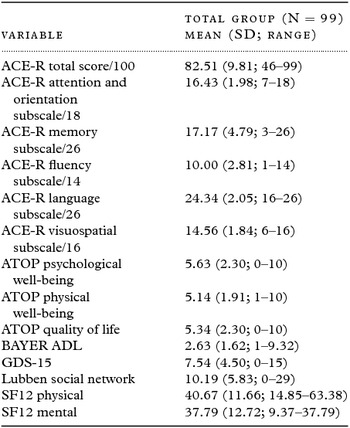
See Table 1 for scale scores on the SF12 (PCS and MCS), GDS, Bayer ADL, LSNS, and ATOP self-rated health outcomes; additional information regarding demographics and scale descriptives has been described elsewhere previously (Lintzeris et al., Reference Lintzeris, Rivas, Monds, Leung, Withall and Draper2015).
ACE-R scores and measures of health and well-being

ACE-R
Table 1 also demonstrates the mean ACE-R and subscale scores overall and by treatment group. The mean ACE-R score of 82.51 (SD = 9.81) in our clients is lower than the cut-off for MCI and approaching the cut-off for more severe cognitive impairment. When examining the proportion of participants falling below the standard <82 cut-off, 41% had a score consistent with more severe cognitive impairment. When using the <88 cut-off, 65% of participants had a score indicative of MCI. Participants neither significantly differed by treatment group (OST vs. EtOH) for any of the scale scores, all p > 0.10, nor did they differ in terms of proportion below the cut-offs, all p > 0.12.
Substance use and ACE-R scores
Independent samples t-tests revealed that there were no significant differences observed at either the <82 or <88 ACE-R cut-offs for the continuous substance use scores (days used/28 of alcohol, benzodiazepines, cannabis, and heroin), all p > 0.07.
Mood, adaptive function, and ACE-R scores
χ 2 tests investigating both ACE-R <82 and <88 cut-offs and depression (GDS scores above and below 6) and both ACE-R <82 and <88 cut-offs and social isolation (LSNS overall) were not significant, all p > 0.16. Independent samples t-tests investigating ACE-R cut-off status for SF12 subscales, Bayer ADL scores and ATOP health questions (psychological health, physical health, and overall quality of life) were also not significant, all p > 0.11.
Predictors of ACE-R scores
Simultaneous multiple linear regressions were conducted to determine predictors of cognitive scores for the ACE-R overall, and for each subscale. The following theoretically valid variables were added as predictors in each model: age, years of formal education, substance use days in the last month/28 (alcohol, heroin, cannabis, and benzodiazepines), scores on the SF12 mental health subscale, history of seizures (yes/no), and history of head injuries requiring medical attention (yes/no). The majority of the regression models were significant, R2 range from 0.15 to 0.29, significant p range 0.003–0.04 (with the exception of memory and fluency, p > 0.10). For overall ACE-R scores along with attention and orientation, memory and fluency, the only significant predictor in these models was seizure history, β range −0.25 to −0.42, p range 0.02 to <0.001; these results suggest an endorsement of a history of seizures is associated with a lower cognitive score. For ACE-R visuospatial scores, seizure history was a significant predictor β =−0.43, p < 0.001; along with an unexpected significant positive association between alcohol and visuospatial scores, β = 0.22, p = 0.04, suggesting more alcohol use is associated with better visuospatial performance.
Retrospective file audit of participants with seizures
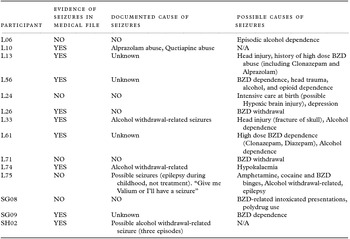
Given the identified relationship of seizure history to cognitive performance, we undertook a more detailed analysis of the nature of the seizures reported. A medical file audit of those 14 participants reporting seizure history was performed to determine if there was a common aetiology for the seizures. Five participants who reported seizure history in the research interview had no seizure history documented in their clinical notes. No participants had a documented formal diagnosis of epilepsy in the clinical notes, although one participant reported receiving sodium valproate, usually prescribed for epilepsy, as a mood stabilizer. Of the nine who did have documentation relating to their seizures in their medical file, four patients were of unknown aetiology, three had seizures relating to alcohol withdrawal, and two appeared to be related to benzodiazepine withdrawal. For those without a documented seizure history, further inspection of records suggested suspected causes of seizures, including withdrawal/dependence and head injury. Further details are provided in the Appendix.
Discussion
This study explored the cognitive status of older (50+) individuals attending outpatient D&A treatment services. Using the cognitive screening tool ACE-R and the cut-offs provided by its authors, 41% scored below the dementia cut-off and nearly two-thirds (65%) performed similar to samples with MCI and in other D&A treatment seeking samples in younger age groups (O'Malley et al., Reference O'Malley, Adamse, Heaton and Gawin1992; Parsons and Nixon, Reference Parsons and Nixon1993; Teicher et al., Reference Teicher, Horner, Roitzsch, Herron and Thevos2002; Grohman and Fals-Stewart, Reference Grohman and Fals-Stewart2004; Mioshi et al., Reference Mioshi, Dawson, Mitchell, Arnold and Hodges2006). Our study should not be interpreted as indicating high rates of dementia as half of the participants reported using two or more substances in the past four weeks, with alcohol, benzodiazepines, and cannabis the main substances used (Lintzeris et al., Reference Lintzeris, Rivas, Monds, Leung, Withall and Draper2015) and this recent substance use likely affected cognitive scores. It is well established that at least 3 months of sobriety, adequate nutrition, and attention to mood disorders is required before optimal cognitive functioning is obtained (e.g. Rosenbloom et al., Reference Rosenbloom, Rohlfing, O'Reilly, Sassoon, Pfefferbaum and Sullivan2007; Kopera et al., Reference Kopera2012). Therefore, it is unclear what proportion of cognitive impairment observed was transient and what reflects more pervasive cognitive dysfunction. However, these data do show how poor their cognitive function is when these issues are not adequately addressed.
Regardless of cause, however, the extent of impaired cognition detected has functional and clinical relevance, with implications for treatment retention and outcome. Cognitive dysfunction has been associated with less treatment compliance in outpatient programs (Aharonovich et al., Reference Aharonovich, Hasin, Brooks, Liu, Bisaga and Nunes2006), poor acquisition of new coping behaviors (Bates et al., Reference Bates, Pawlak, Tonigan and Buckman2006), and denial of addiction (Rinn et al., Reference Rinn, Desai, Rosenblatt and Gastfriend2002). Interestingly, however, use of substances in the last 28 days was not a significant predictor of any cognitive outcomes on the regressions. In addition, associations between cognitive impairment and areas of adaptive and psychological functioning (self-reported mood, social support, physical health, and ability to perform independent ADL) were not found. This is unusual, given that these associations are typically found in non-SUD samples. This may reflect the nature of the group identified, who (1) given the community-based treatment setting, must have had sufficient capacity (both cognitively and physically) to attend the center, and (2) were a group who reported a substantial amount of medical and psychiatric comorbidities, thus limiting the heterogeneity of this sample in comparison to other community groups. However, due to the self-report nature of the substance use questions in combination with potential cognitive dysfunction, it is important to acknowledge that the self-report answers recorded are possibly inaccurate. This may also explain the lack of significant relationship between these variables. In any case, these results suggest that self-report of functional status may not necessarily reflect level of cognitive functioning, and that cognitive status should be evaluated independently regardless of self-report.
Another possibility is that long-term substance use history – including length of heavy use – may have a closer relationship to cognitive outcome than main substance of dependence (i.e. treatment group) or level of recent use. For instance, level of alcohol intake and years of heavy drinking have been more consistently associated with brain volume reductions than overall lifetime intake (Sullivan and Pfefferbaum, Reference Sullivan and Pfefferbaum2005; Crews, Reference Crews2008; Bates et al., Reference Bates, Buckman and Nguyen2013). Given evidence for the potential of brain recovery with abstinence from alcohol (Harper, Reference Harper2009), it is possible that these other measures of substance use history (e.g. number of detoxifications and years of heavy drinking) may be better measures to associate with cognitive outcomes. This requires consideration in future research. In addition, while we considered the last 28 days of substance use in relation to cognitive outcome, this was broader than including specifically acute substance use (i.e. the last few days). It is still possible that the cognitive scores are associated to recent substance use, but a breakdown of substance use into acute, short-term, and long-term use should be considered in further studies.
An important finding of this study was that a history of seizures was a significant predictor of cognitive performance in this group of older substance users. It is well documented that substance users are at increased risk for seizures through indirect mechanisms associated with physical harms of substance use (e.g. infection, head trauma, and metabolic derangement) or through direct mechanisms, such as neurotoxicity or withdrawal (Brust, Reference Brust2002). The suspected causes of seizures involved alcohol and/or benzodiazepine withdrawal, and head injury. As the vulnerability to seizures in both alcohol and benzodiazepine use is thought to be dose related (e.g., with higher amounts of use increasing likelihood of seizures on withdrawal), this may suggest that seizures are a marker of greater severity of substance dependence, with associated poorer cognitive functioning due to this more severe use (Delanty et al., Reference Delanty, Vaughan and French1998; Brust, Reference Brust2006). While recent alcohol use as measured by both the ATOP and AUDIT, and benzodiazepine use (ATOP) were not found to be significantly related to experience of seizures in this sample, it is possible that these users had significant heavy periods of use earlier in their history. A comprehensive evaluation of lifetime intake of substances, not feasible in this current study, would be needed in a larger sample to establish the relationship between extent of alcohol and benzodiazepine use and risk of seizures.
Another possible explanation for the relationship between seizure history and cognitive functioning is that seizures have previously been found to be related to cognitive impairment, particularly when seizures are uncontrolled (Majak and Pitkanen, Reference Majak and Pitkanen2004; Vingerhoets, Reference Vingerhoets2006). Longitudinal investigations are necessary to examine if indeed there is a cumulative effect of experience of seizures on cognitive outcome, or whether they better reflect patterns of substance use. Some anti-seizure medication can also impact cognition (Meador, Reference Meador2002); however, due to the small sample size of the seizure group (N = 14) and the variety of medications these people were prescribed, this was unable to be explored statistically in the present study.
This study had some limitations; the study was cross-sectional and relied on a convenience sample, with under-representation from individuals from the alcohol program. Given the nature of the cross-sectional design, predictive relationships cannot be determined – a longitudinal design is needed to establish cause and effect of the relationships between cognition, risk factors for cognitive impairment (e.g. seizures), substance use and adaptive functioning. In addition, the study relied on client self-report, which in view of the ongoing substance use and rates of cognitive impairment may be unreliable; it is also possible that some of the cognitive dysfunction observed was due to current levels of intoxication in the clients rather than lasting impairment. In addition, the mean age (M = 55) of this group was relatively young, and there is potential for rates of cognitive impairment to further rise as this cohort ages, given the increased vulnerability to damage with age.
Furthermore, it is also possible that 41–65% is an underestimate of cognitive impairment in this group, given that cognitive screening tools may not identify subtle cognitive dysfunction. The screening measure utilized has limited validation in substance use contexts (Ridley et al., under review), although support for its utility in this context comes from studies that have demonstrated the sensitivity of the test to MCI in individuals with subcortical-dementia (Komadina et al., Reference Komadina, Terpening, Huang, Halliday, Naismith and Lewis2011; Rittman et al., Reference Rittman2013) and traumatic brain injury (Gaber, Reference Gaber2008). These patients typically experience difficulties in attention, memory, and executive function that are not dissimilar to the impairments demonstrated by individuals with chronic substance use. Comprehensive neuropsychological assessment remains the gold standard for cognitive evaluation (Cullen et al., Reference Cullen, O'Neill, Evans, Coen and Lawlor2007), and future studies may further this investigation of cognitive status in older adults by conducting more comprehensive evaluations of cognitive functioning in this group and obtaining formal cognitive diagnoses.
Conflict of interest statement
None of the authors have any connections with the tobacco, alcohol, or gaming industry. NL has previously been an investigator on educational grants from Reckitt-Benckiser for unrelated work. NL has received an untied educational grant from Mundipharma. All other authors have nothing to declare.
Description of authors’ roles
Dr Lauren Monds analysed the results and wrote the paper. Dr Nicole Ridley assisted with interpretation of results and assisted in writing the paper. Ms Consuelo Rivas collected the data and assisted with writing the paper. Dr Adrienne Withall aided in designing the study, interpretation of results, and assisted with writing the paper. Professor Brian Draper aided in designing the study, interpretation of results, and assisted with writing the paper. Professor Nicholas Lintzeris designed the study, supervised the data collection, and assisted with writing the paper.
Appendix
Retrospective file audit of N = 14 participants who indicated a history of seizures