INTRODUCTION
Natural populations of high-value tropical timber species face increasing pressure from logging and habitat loss across the New and Old World tropics, jeopardizing both commercial sustainability of trade and, in extreme cases, biological survival (Martini et al. Reference Martini, Rosa and Uhl1994; Hall et al. Reference Hall, Harris, Medjibe and Ashton2003; Kometter et al. Reference Kometter, Martinez, Blundell, Gullison, Steininger and Rice2004). The most valuable widely traded Neotropical timber species, big-leaf mahogany (Swietenia macrophylla, Meliaceae) was listed on Appendix II of the Convention on International Trade in Endangered Species of Fauna and Flora (CITES) at the 12th Conference of Parties (CoP12) in 2002 in response to decades of overexploitation and widespread illegal logging, especially in the Amazon Basin (Rodan et al. Reference Rodan, Newton and Veríssimo1992; Gullison et al. Reference Gullison, Panfil, Strouse and Hubbell1996; Snook Reference Snook1996; Grogan et al. Reference Grogan, Barreto and Veríssimo2002; Blundell & Rodan Reference Blundell and Rodan2003; Blundell Reference Blundell2004; Grogan & Barreto Reference Grogan and Barreto2005). Mahogany is a canopy emergent tree capable of attaining heights of 45 m and above-buttress stem diameters of 2.5 m in Amazonia. It occurs across a vast crescent-shaped natural range in South America tracing seasonally dry tropical forests through Venezuela, Colombia, Ecuador, Peru, Brazil and Bolivia (Lamb Reference Lamb1966). Like most tropical trees, mahogany typically is present at low densities in primary (unlogged) forests, that is, < 1 commercial-sized tree (60–80 cm diameter depending on the country) ha−1 (Veríssimo et al. Reference Veríssimo, Barreto, Tarifa and Uhl1995; Gullison et al. Reference Gullison, Panfil, Strouse and Hubbell1996; Grogan et al. Reference Grogan, Jennings, Landis, Schulze, Baima, Carmo, Norghauer, Oliveira, Pantoja, Pinto, Silva, Vidal and Zimmerman2008). In south-west Amazonia, including Peru, it generally occurs at densities «0.1 ha−1 or much fewer than one tree in 10 ha at landscape scales (Kometter et al. Reference Kometter, Martinez, Blundell, Gullison, Steininger and Rice2004; Grogan et al. Reference Grogan, Jennings, Landis, Schulze, Baima, Carmo, Norghauer, Oliveira, Pantoja, Pinto, Silva, Vidal and Zimmerman2008).
Mahogany has been logged in lowland south-west Amazonia since the 1920s (Hoy Reference Hoy1946; Lamb Reference Lamb1966). During the early decades, loggers exploited populations aggregated along the banks of mid-sized western tributaries of the Amazon River which could be felled directly into flowing water for transport to sawmills downstream, principally Iquitos in Peru and Manaus in Brazil. As these easily accessible populations were depleted, and as technology and overland transportation infrastructures improved, low-density terra firme populations came under increasing pressure during the 1970s and 1980s (White Reference White1978; Grogan et al. Reference Grogan, Barreto and Veríssimo2002; Kometter et al. Reference Kometter, Martinez, Blundell, Gullison, Steininger and Rice2004). Today, intact commercial populations survive only in the most remote regions of south-west Amazonia such as in west Acre and south-west Amazonas (Brazil) and in the Alto Purús region of Peru (Grogan et al. Reference Grogan, Barreto and Veríssimo2002, Reference Grogan, Jennings, Landis, Schulze, Baima, Carmo, Norghauer, Oliveira, Pantoja, Pinto, Silva, Vidal and Zimmerman2008; Fagan & Shoobridge Reference Fagan and Shoobridge2005, Reference Fagan and Shoobridge2007).
Mahogany forms aboveground support roots or buttresses from an early age; these may reach 5 m or more up the lower bole on large trees (Lamb Reference Lamb1966; Grogan Reference Grogan2001). Heart-rot or hollow bole is also common in mahogany, responsible for high wastage rates during logging as sawyers speculatively fell even demonstrably hollow commercial-sized trees in hopes that some portion of the upper bole is merchantable (Veríssimo et al. Reference Veríssimo, Barreto, Tarifa and Uhl1995; Grogan et al. Reference Grogan, Jennings, Landis, Schulze, Baima, Carmo, Norghauer, Oliveira, Pantoja, Pinto, Silva, Vidal and Zimmerman2008).
Since November 2003, mahogany's listing on CITES Appendix II has required verification by producer nations that exported volumes of mahogany sawnwood were harvested legally and in a manner non-detrimental to the species’ role in ecosystems where it naturally occurs. The concept of ‘non-detriment’ is generally understood to mean ‘sustainably managed’ (CITES 2003). Non-detriment findings (NDF) verifying sustainability of trade are made by the CITES Scientific Authority within each producer nation; the CITES Management Authority is responsible for verification of legal origin.
Scientific Authorities take two general approaches to NDF for timber species: (1) sustainability may be evaluated at the level of the production or management unit, based on knowledge of local population parameters such as density, population structure, growth and mortality rates, or (2) sustainability may be verified by setting annual export quotas based on empirical knowledge of national stocks, density patterns, population dynamics and long-term impacts of quota-driven exploitation rates (CITES 2003). At the Second Mahogany Working Group (MWG2) meeting in Belém (Brazil) in October 2003, Scientific Authority representatives from 14 of 17 Central and South American producer nations agreed that, in the absence of empirically sound national inventory data for mahogany, NDF should be made at the level of individual management units based on guidelines enumerated at MWG2 (CITES 2004). Since the Appendix II listing went into effect in November 2003, only one producer nation, Peru, has based NDF on national export quotas (NRDC [National Resources Defense Council] 2006).
Peru's use of export quotas for NDF has been controversial for several reasons. No export quota was set for 2004, the first year the Appendix II listing went into effect, and the 2005 quota (23 621 m3) was based on the unsubstantiated assumption that export levels during previous years were sustainable (INRENA [Instituto Nacional de Recursos Naturales] 2005). Peru's Scientific Authority has repeatedly indicated that empirical knowledge of national mahogany stocks and other information necessary for making NDF based on export quotas is inadequate; an ITTO (International Tropical Timber Organization)-funded national inventory of Peruvian mahogany stocks is scheduled to be completed only in late 2007 (UNALM-FCF [Universidad Nacional Agraria La Molina, Facultad de Ciencias Forestales] 2004; Peru 2004, 2005). Peru's new (since 2001) concession system for forest management has not yet eliminated fraudulent industry nor corrupt regulatory practices (Schulte-Herbrüggen & Rossiter Reference Schulte-Herbrüggen and Rossiter2003; Fagan & Shoobridge Reference Fagan and Shoobridge2005, Reference Fagan and Shoobridge2007; Cerdan Reference Cerdan2007; CITES 2007a). Finally, quantitative assumptions underlying export quotas have been questioned, especially that the ‘average’ commercial-sized mahogany tree from the Peruvian Amazon yields 8.4 m3 of sawn timber for export (INRENA 2006b).
Based on separate visits to Peru in 2006 and 2007, the CITES Secretariat has recommended that ‘export quotas should be based on sound, valid scientific information’, and that to improve control over mahogany's exploitation, studies on the sawn lumber yield from logs should be undertaken (CITES 2006, 2007a). In June 2007, just prior to the 14th CoP in The Hague, the CITES Standing Committee required Peru to adjust the 2007 export quota for mahogany from 13 477 m3 to 4983 m3, the latter quantity representing timber obtained from forest concessions verified by field inspections to be in compliance with forest laws and regulations (CITES 2007b). Even so, the question of the sustainability of mahogany's exploitation in Peru has yet to be adequately addressed by export quotas.
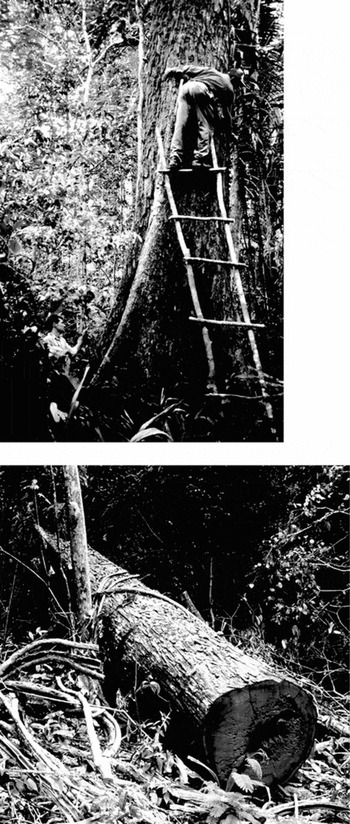
In this paper we analyse a technical aspect of this controversy, namely the relationship between export quotas and the number of standing mahogany trees that must be logged to fill them. We describe how standing tree dimensions, principally stem diameter measured by forest inventory crews at 1.3 m height on the stem above ground (Brokaw & Thompson Reference Brokaw and Thompson2000), are used to estimate roundwood volume in cubic metres. We quantify the impact that two biological issues frequently associated with large timber trees in the tropics, namely aboveground buttresses or support roots and heart-rot creating hollow or defective boles, may have on roundwood estimation (Fig. 1). We discuss conversion efficiency when roundwood is processed or milled into sawn wood, and when export-grade sawnwood is subsequently selected for the international market. Finally, based on these data, we estimate the number of mahogany trees necessary to fill the original and revised 2007 export quotas from Peru, and to provide export volumes reported from Peru since the mid 1990s. These data in turn allow us to estimate the total forest area logged for mahogany during this period based on landscape-scale density data presented by the Peruvian Scientific Authority (UNALM-FCF 2007). We discuss implications of this analysis for the sustainability of international trade in mahogany from Peru.
Above: Measuring mahogany above buttresses in south-west Brazilian Amazonia. Below: Logged 135 cm diameter mahogany showing defective (hollow) base extending up the bole; no merchantable wood could be salvaged from this tree.

METHODS
Mahogany research and inventory sites
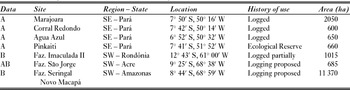
Field data on buttress and heart-rot incidence in mahogany are presented from seven long-term research and inventory sites across southern Amazonia in Brazil (Table 1). All sites were seasonally dry tropical forests, with < 2300 mm annual precipitation and a pronounced dry season lasting two to five months during which < 100 mm of rain falls per month. Soil origins and types ranged widely among sites, with coarser, more freely-draining nutrient-poor soils derived from Precambrian Brazilian Shield bedrock typical at south-eastern sites compared to finer, more water-retentive and nutrient-rich soils derived from Andean alluvium at south-western sites. Landscape physiography and forest structure and composition were similar at south-western sites to forests in Peru where mahogany occurs. In general, mahogany occurs at higher densities but achieves smaller stature in south-eastern forests compared to south-western forests (Grogan et al. Reference Grogan, Jennings, Landis, Schulze, Baima, Carmo, Norghauer, Oliveira, Pantoja, Pinto, Silva, Vidal and Zimmerman2008).
Location of mahogany research (A) and simulation sites (B) in south-east (SE) and south-west (SW) Brazilian Amazonia. See Grogan et al. (Reference Grogan, Jennings, Landis, Schulze, Baima, Carmo, Norghauer, Oliveira, Pantoja, Pinto, Silva, Vidal and Zimmerman2008) for detailed site descriptions.

Relationship between stem diameter and buttress height
Long-term studies of tree diameter increment require replicable diameter measurements at fixed heights above buttresses. We describe the relationship between stem diameter and buttress height for 619 mahogany trees > 20 cm diameter monitored annually since 1997 or 2001 for diameter increment at five sites in south-east and south-west Brazilian Amazonia (Table 1). At all sites, diameter measurements were taken at 1.3 m height above ground or 30 cm above the reach of the tallest buttress at the time of first census.
Impact of buttresses on diameter measurements during forest inventories
We compared tree diameters registered by logging company inventory crews with diameters measured 30 cm above buttresses in long-term diameter increment studies. We consider measurement error to be the difference between recorded ‘diameter at breast height’ and diameter measured above buttresses for long-term increment studies.
Relationship between stem diameter and incidence of heart-rot (defect rate)
We field-checked all trees for hollow bases by tapping the stem on at least two sides with a mallet and judging whether the stem was solid by sound and feel. This test is commonly used by inventory crews to assess tree health; it cannot predict how far up the bole the defective core extends.
Converting stem diameter to roundwood volume
To estimate roundwood volume of standing trees we used a single-entry volume equation developed from over 300 plantation-grown mahogany trees in Sri Lanka (Mayhew & Newton Reference Mayhew and Newton1998):
roundwood volume (m3) = 0.056 − 0.01421(D) + 0.001036(D2)
where D = diameter at 1.3 m height or above buttresses. Roundwood estimates are increasingly uncertain for trees > 90 cm diameter since this was the upper diameter limit of sampled trees.
While double-entry equations (diameter plus commercial or total height) are available for mahogany, accurate height data are difficult and expensive to obtain in closed forest conditions, and are unavailable for most trees at sites in this study. For those trees with height data, volume estimates generated by the single-entry equation were similar to volume estimates generated by the best available double-entry equation for mahogany (Mayhew & Newton Reference Mayhew and Newton1998).
Converting inventory diameter to roundwood volume
Stem diameters of commercial trees were adjusted at a fixed rate to account for observed systematic inventory measurement error due to buttresses. We further corrected estimated roundwood volumes according to a sliding scale derived from field observations, assuming that heart-rot or hollow stem incidence rises from 0% to 50% as trees grow from 60 cm to 150 cm diameter. While no statistically significant regression equation could be derived for this relationship from field data, this approach assumes an age component to heart-rot incidence, and is conservative (underestimates incidence) when compared with field observations. By this scale, 90% of trees 70–90 cm in diameter present fully merchantable boles. Thus, we assume that 10% of the estimated merchantable volume from trees in this size class must be discarded owing to heart-rot, with this percentage rising as trees grow larger.
Simulating mean per tree mahogany roundwood and sawnwood yields at three south-west Amazon sites
We used 100% inventory data from three sites in southwest Brazilian Amazonia (Table 1) to estimate harvest (roundwood) yields (m3) per commercial tree according to current forest management regulations in Peru (90% harvest intensity of trees > 75 cm diameter). At all sites, physiography and forest structure and composition were similar to forests in Peru where mahogany occurs. Commercial populations at each site were ‘logged’ (resampled with replacement) 10 000 times to generate mean, 2.5 percentile, and 97.5 percentile roundwood yield estimates (the last two estimates representing 95% confidence intervals; Simon Reference Simon1997; Resampling Stats, Inc. 2001). For comparative purposes, roundwood yields were estimated both from uncorrected tree diameters and volumes and from corrected diameters and volumes as described above.
Converting roundwood to sawnwood (processed) volume
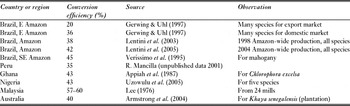
Roundwood-to-sawnwood conversion efficiency indicates the percentage of roundwood that is converted during milling to merchantable sawnwood. Most published studies of roundwood conversion efficiency in the tropics report wastage rates exceeding 50% (Table 2). While roundwood-to-sawnwood conversion efficiency in the Amazon is commonly 32–42% (Gerwing & Uhl Reference Gerwing and Uhl1997; Lentini et al. Reference Lentini, Veríssimo and Sobral2003; 2005; J. Zweede, personal communication 2007), we used a rate of 52% in keeping with conversion efficiency expected for mahogany by the Peruvian Management Authority (INRENA 2005). Considering that sawmill processing technology in south-west Amazonia on average remains below industry standards (R. Mancilla, unpublished data presented at el Grupo de Trabajo sobre la Caoba, Santa Cruz, Bolivia, 3–5 October 2001; J. Grogan, personal observation 2003), and that significant quantities of sawn mahogany from Peru are processed in situ by the highly wasteful cuartoneo (quartering) technique using single or paired chainsaws (Fagan & Shoobridge Reference Fagan and Shoobridge2005, Reference Fagan and Shoobridge2007), we believe this conversion rate to be optimistic.
Published studies of roundwood-to-sawnwood conversion effiency in the tropics.

No data are available to indicate what percentage of processed mahogany sawnwood meets export (primeira) standards. One FSC (Forest Stewardship Council)-certified logging company in Brazil achieved 42% roundwood-to-sawnwood conversion efficiency for ipê (Tabebuia spp.), another high-value tropical timber currently facing high demand from the North American residential decking market; of this, 36% met export standards (i.e. 1 m3 roundwood = 0.15 m3 export-grade sawnwood; L. Sobral, personal communication 2007). Though little mahogany is currently processed in Brazil, an estimated 28–36% of roundwood met export standards during the 1980s and 1990s (Veríssimo et al. Reference Veríssimo, Barreto, Tarifa and Uhl1995; J.-C. Malinski, personal communication 2007). Sills et al. (Reference Sills, Romero, Sabido, Amacher and Sullivan2002) reported that 51% of mahogany sawn during 1997–1999 at one of the most efficient band sawmills in Belize met export standards. For present purposes, we assumed that 50% of processed mahogany in south-western Amazonia met export standards, or 26% of roundwood (half of 52%).
Estimating the number of trees and forest area necessary to fill export quotas
From estimates of export-grade sawnwood yield per commercial tree, we calculated the number of trees at each of three simulation sites required to produce 4983 m3 of sawnwood for export (the revised 2007 export quota for Peru; CITES 2007b), the forest area required to produce this quantity of sawnwood for export given observed commercial densities at each site, and the forest area required to produce this quantity of sawnwood for export given the best available estimate of landscape-scale density of mahogany in Peru (0.0167 trees ha−1; UNALM-FCF 2007; see also Kometter et al. Reference Kometter, Martinez, Blundell, Gullison, Steininger and Rice2004). We calculated the total land area necessary to produce reported export volumes of mahogany from Peru since the mid 1990s based on this landscape-scale density estimate.
RESULTS
Relationships between stem diameter, buttress height, measurement error and heart-rot (defect) rate
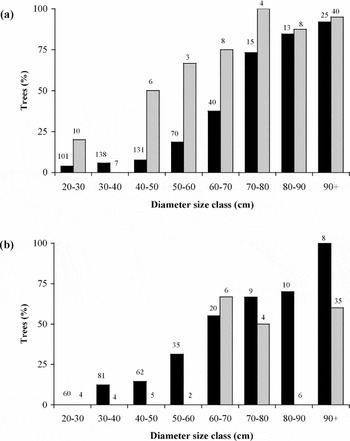
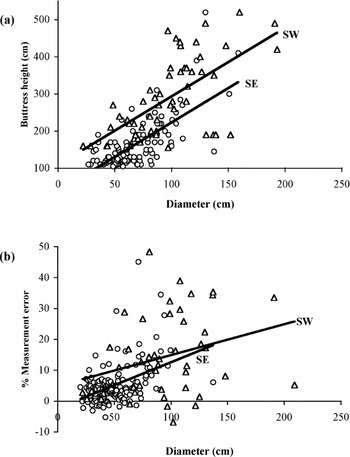
Buttress heights rose steadily on the bole as mahogany trees grew in diameter, with significant positive correlation recorded from both south-east and south-west Amazon sites (Figs 2a, 3a). Overall, 88% of trees > 75 cm diameter, the minimum commercial size in Peru, had buttresses rising higher than the standard measurement height. Buttresses rose as high as 5.2 m on trees exceeding 90 cm diameter.
(a) Mahogany trees in south-east Amazonia (black fill) and south-west Amazonia (grey fill) with buttresses rising > 130 cm height above ground by 10-cm diameter size class. (b) Mahogany trees with heartrot or hollow base, bars as in (a). Numbers above columns show sample numbers by size class.

(a) Buttress height as a function of mahogany stem diameter in south-east (SE) Amazonia (circles) and south-west (SW) Amazonia (triangles). Trend lines show linear regressions for respective sites (SE, SW). (b) Inventory error as a function of stem diameter as in (a).

Inventory crew measurement errors overestimated diameters of nearly all trees > 60 cm diameter in both regions (Fig. 3b). The magnitude of overestimation tended to increase with tree size (and therefore buttress height), but this positive correlation was not significant for commercial-sized trees. Mean % measurement error was 10.1 ± 1.5% (one standard error) and 15.4 ± 2.2% at south-east and south-west sites, respectively (Table 3). Larger mean % measurement error at the unlogged south-west sites was likely owing to the number of very large trees with high buttresses compared to the post-logging inventory at the south-east site where few large trees survived the harvest (Grogan et al. Reference Grogan, Jennings, Landis, Schulze, Baima, Carmo, Norghauer, Oliveira, Pantoja, Pinto, Silva, Vidal and Zimmerman2008).
% Measurement error in mahogany diameter measurements caused by buttresses, comparing forest inventory crew measurements versus actual above-buttress measurements of mahogany trees > 60 cm diameter in south-east and south-west Brazilian Amazonia. All median and mean error measures are positive (overestimates); SE = one standard error.

The incidence of heart-rot or basal defect rose as tree diameter increased. At both south-east and south-west Amazon sites, heart-rot incidence differed between trees > 60 cm diameter and trees < 60 cm diameter (SE: χ2 = 139.3, df = 3, p < 0.001; SW: χ2 = 15.2, df = 3, p < 0.01). Overall, 60% of trees > 60 cm diameter demonstrated evidence of hollow bases (Fig. 2b), while 67% of trees > 90 cm diameter were defective at the base.
Estimating roundwood volume from inventory data
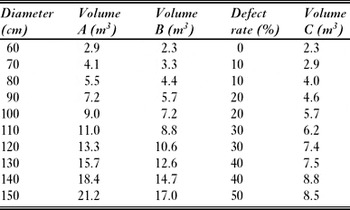
The single-entry volume equation for mahogany (Mayhew & Newton Reference Mayhew and Newton1998) estimates that 60 cm and 150 cm diameter trees yield 2.9 and 21.2 m3 of roundwood, respectively (Table 4). After systematically reducing diameters by 10% due to inventory measurement error, and adjusting for defect rates from 0 to 50% on a sliding scale as trees grow larger, corrected volume estimates for 60 cm and 150 cm diameter trees were 2.3 and 8.5 m3, respectively.
Volume estimates by size class for mahogany trees from 60–150 cm diameter: roundwood volume A from inventory data; roundwood volume B correcting volume A to account for 10% measurement error caused by buttresses; estimated defect rate by size class; roundwood volume C correcting volume B for defect rate.

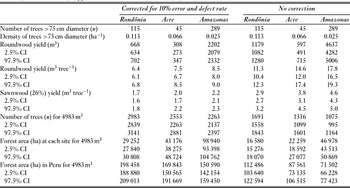
Correcting inventory data from three south-west Amazon sites by these criteria, and simulating logging (resampling 10 000 times) by current Peruvian legal standards at each site (10% retention of trees > 75 cm diameter), we estimate that the mean roundwood volume yield per tree would range from 6.4–8.5 m3 among sites (Table 5). Corrected site-level roundwood volumes ranged from 48–57% of uncorrected volumes, with the lower value from the site (Amazonas) dominated by very large trees (higher defect rate affecting larger volume estimates).
Simulated roundwood and sawnwood yields from three sites in south-western Amazonia following current forest management regulations in Peru (90% harvest intensity of trees > 75 cm diameter). Forest area (ha) required to produce 2007 Peru export quota (4983 m3) is estimated by observed inventory densities and by the best available landscape-scale density estimate of trees > 75 cm diameter in Peru (0.0167 trees ha−1). Upper and lower confidence intervals (CI) at α = 0.05.

Converting roundwood volume to export-grade sawnwood
Applying the 26% conversion efficiency rate, we estimate that mean sawnwood volume yield per tree for export would range from 1.7–2.2 m3 among these three sites (Table 5).
The number of trees and forest area necessary to produce export quotas
At these per tree yield rates and based on observed commercial population densities at three south-west Amazon sites (0.025–0.113 trees > 75 cm diameter ha−1), we estimate that 2260–2980 commercial-sized trees would be harvested from forest areas of 29 250–98 950 ha at these sites to fill Peru's revised 2007 export quota for mahogany of 4983 m3 (Table 5). In Peru, where reported landscape-scale densities are lower, the estimated forest area necessary to produce the 2007 export quota ranges from 150 600–198 450 ha based on commercial population structures observed in Brazil. We estimate that 6120–8070 commercial-sized trees would have been harvested to supply the original 2007 export quota of 13 477 m3, from a forest area in Peru of 407 300–534 750 ha.
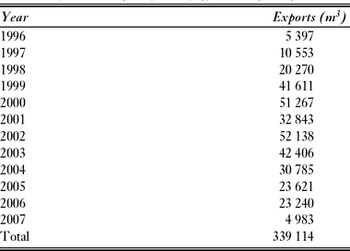
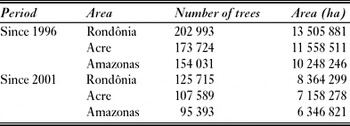
From these data, we estimate that to supply the total reported export volume from Peru since 1996 (including the 2007 export quota) of 339 114 m3 (Table 6), 154 000–203 000 mahogany trees have been logged from a forest area of 10.2–13.5 million ha (Table 7). This area corresponds to 18–25% of mahogany's total natural range of 55 million ha in Peru, or 37–49% of mahogany's estimated remaining range in 2001 of 27.5 million ha (Kometter et al. Reference Kometter, Martinez, Blundell, Gullison, Steininger and Rice2004). These estimates do not account for illegal mahogany production exiting the country via extra-legal channels.
Reported mahogany exports from Peru since 1996. Sources: 1996–1999, UNEP-WCMC CITES Trade Database, UNEP, World Conservation Monitoring Centre, Cambridge, UK; 2000–2007, INRENA (2005; 2006a, b), CITES (Reference Kometter, Martinez, Blundell, Gullison, Steininger and Rice2007b).

Estimated number of trees and forest area (at 0.0167 trees ha−1) necessary to produce reported mahogany exports from Peru since 1996 and 2001 based on estimated harvest and processed yields from three sites in south-west Brazilian Amazonia (see Table 5).

Discussion
Better estimates of the number of trees and forest area that must be logged to fill export quotas for any species can be achieved by improving the empirical basis of assumptions underlying them. For mahogany, inventory data systematically overestimate roundwood volume yields because tree diameters are distorted by buttresses and unmerchantable hollow trees are not discounted. Correcting inventory data from three sites in south-west Amazonia led to 43–52% less roundwood, on average, than anticipated by field data. At the Amazonas site described in this paper, these biological realities nearly unravelled the business plan of the Brazilian logging company attempting to harvest mahogany there in a legal and sustainable manner (L. R. Oliveira, personal communication 2007). For less scrupulous operations, systematic overestimation of roundwood volumes opens a gaping loophole through which large volumes of illegally and unsustainably logged mahogany freely pass (Grogan et al. Reference Grogan, Barreto and Veríssimo2002). Landscape-scale density patterns are also poorly understood for mahogany throughout its range, rendering regional extrapolations as we present here a precarious undertaking.
We readily acknowledge that our assumptions for roundwood-to-sawnwood conversion efficiency are open to question given that reliable data on processing efficiency in Peru are unavailable. In its original 2007 export quota determination for Peru, INRENA assumed a combined 67% conversion efficiency for mahogany (52% sawn commercial wood plus 15% longwood and shortwood; INRENA 2006b), that is, that 1 m3 roundwood yielded 0.67 m3 sawnwood, with no further adjustment made for below-export-grade product. We believe that our assumptions are more realistic, given the general state of sawmill technology in this region and the highly wasteful in situ milling practices commonly used to convert mahogany roundwood into rough planks that can be manually hauled out of remote forests (Fagan & Shoobridge Reference Fagan and Shoobridge2005, Reference Fagan and Shoobridge2007). At the Amazonas site in Brazil, a highly capitalized logging company using above-average sawmill technology achieved roundwood-to-sawnwood conversion efficiency for mahogany of 63%, with 60% of sawnwood meeting international standards (1 m3 roundwood yielded 0.38 m3 export-grade sawnwood; L. R. Oliveira, personal communication 2007). We are confident that our estimates, which assume yield rates 12% lower than this (1 m3 roundwood = 0.26 m3 export-grade sawnwood), are reasonable and probably optimistic for the Peruvian logging sector as a whole.
Our analysis indicates that the Peruvian logging industry will harvest 2260–2980 mahogany trees to fill the 2007 export quota of 4983 m3. The number of trees necessary to fill the original 2007 quota of 13 477 m3 (INRENA 2006b) would have been 6120–8070. Under either quota, far more trees must be harvested than the Peruvian Scientific Authority has indicated can be sustainably logged annually based on preliminary inventory data (961 ± 144 trees > 75 cm diameter, or 549 ± 82 trees > 120 cm diameter; UNALM-FCF 2007). Furthermore, no empirical basis for evaluating the sustainability of these or any other harvest rates has been provided by Peruvian CITES Authorities.
Based on structured interviews with industry, academic and government experts, Kometter et al. (Reference Kometter, Martinez, Blundell, Gullison, Steininger and Rice2004) concluded that 50% of mahogany's 55 million ha natural range in Peru had been commercially exhausted by 2001. Habitat loss and selective logging had further reduced mahogany densities across an additional 42% of this range, leaving 4.4 million ha unlogged. Respondents indicated that, barring significant changes in industry practices, mahogany would be commercially exhausted across 78% of its natural range within 10 years. Considering only export data since 2001, and including the current 2007 export quota (210 016 m3 total; Table 7), we estimate that an additional 6.3–8.4 million ha have been exploited for mahogany since the Kometter et al. (Reference Kometter, Martinez, Blundell, Gullison, Steininger and Rice2004) survey. Because mahogany density patterns are poorly understood and vary widely (Kometter et al. Reference Kometter, Martinez, Blundell, Gullison, Steininger and Rice2004; Grogan et al. Reference Grogan, Jennings, Landis, Schulze, Baima, Carmo, Norghauer, Oliveira, Pantoja, Pinto, Silva, Vidal and Zimmerman2008), it is difficult to know what portion of surviving commercial stocks these estimates represent. We believe that the Peruvian logging industry is likely approaching the end of legally harvestable mahogany stocks for two reasons: extensive illegal exploitation in the remote Alto Purús region (Fagan & Shoobridge Reference Fagan and Shoobridge2005; 2007) indicates that more accessible stocks are severely depleted; and the sharp downward trend in export volumes since 2002 (Table 6) indicates that supply is waning.
Buttresses and heart-rot are not unique to mahogany. Many commercial timber species in the tropics form high buttresses, including Cedrela (Meliaceae, Spanish cedar or cedro), Hymenolobium, Dinizia, Dipteryx (Fabaceae, angelim and cumarú) and Couratari (Lecythidaceae, tauarí) in the Neotropics, Entandrophragma and Khaya (Meliaceae, African mahoganies) in central Africa, and Shorea, Dipterocarpus and Dryobalanops (Dipterocarpaceae, meranti, keruing, kapur) in south-east Asia. Heart-rot extensive enough to render commercial-sized trees unmerchantable typically affects 25–30% of harvestable trees in the Amazon (Holmes et al. Reference Holmes, Blate, Zweede, Pereira, Barreto, Boltz and Bauch2002; Valle et al. Reference Valle, Schulze, Vidal, Grogan and Sales2006; J. Zweede, unpublished data 2007). Field data similar to and improving on those presented here will be necessary to evaluate the impact of international trade on natural populations as logging and forest conversion threaten more and more species with commercial exhaustion.
We question whether non-detriment findings as required under CITES Appendix II can be adequately made for timber species by setting export quotas. Sustainable production occurs by definition at the level of individual trees and local populations within forest management units, and can only be evaluated through detailed field audits. In contrast, export quotas assume absolute knowledge of natural stocks and a shared commitment by a community of producers to transparent harvest and business practices. When the commodity in question grows wild and is particularly valuable to the logger-entrepreneur, export quotas will inevitably resemble an opportunity for abuse, or at least someone else's responsibility, to some portion of that community. Once that happens, it becomes too expensive to play by the rules and the race for the bottom is on.
ACKNOWLEDGEMENTS
We especially thank L. Rogério Oliveira for providing inventory data from Rondônia and Amazonas, and Roberto Kometter for assistance with trade data. Funding support for research inventories was provided by the USDA Forest Service's International Institute of Tropical Forestry, the USDA Forest Service's International Programmes, USAID Brazil, WWF Brazil, the Brazilian Ministry of the Environment (MMA), the State Government of Acre's Secretariat for Forestry and Extractivism (SEFE) and Conservation International. We thank the Brazilian Ministry of Science and Technology (CNPq) for granting permission to conduct fieldwork. The Kayapó of A'Ukre kindly permitted fieldwork within their territory. Field support was provided by Serraria Marajoara Ltda (SEMASA), Madeireira Juary, Acre Brasil Verde, Cacique Madeiras Ltda, and Moacyr Eloi Crocetti Batista e Cia Ltda. We thank Art Blundell, Jeffrey Gerwing, Ari Hershowitz and an anonymous reviewer for comments improving the manuscript. The views expressed here are solely those of the authors.