Space allowance and housing conditions can markedly affect the welfare of farm animals. Intensive farming systems are characterized by a large number of animals per unit of space to maximize production levels (Estevez et al. Reference Estevez, Andersen and Nævdal2007). Increased rearing densities in animal houses result in a reduction of both inter-individual distances and of the space for locomotion; in sheep space reduction leads to more rigid dominance relationships and increased aggressive behaviours (Dove et al. Reference Dove, Beilharz and Black1974; Lynch et al. Reference Lynch, Wood-Gush and Davies1985). In specialized farms, the increase of the number of housed animals has changed the type of diseases that occur, which can be considered a combination of pathogen actions and environmental stress (Hartung, Reference Hartung, Ap Dewi, Axford, Marai and Omed1994). Sevi et al. (Reference Sevi, Massa, Annicchiarico, Dell'Aquila and Muscio1999) found a marked reduction in milk yield, a deterioration of milk quality and an increase in the prevalence of subclinical mastitis in lactating ewes, as space allowance decreased from 2 to 1·5 to 1 m2/ewe. However, information on the impact of high stocking density on sheep immune function is still lacking.
Casamassima et al. (Reference Casamassima, Sevi, Palazzo, Ramacciato, Colella and Bellitti2001) found that the outdoor rearing of ewes during daytime benefited their behavioural needs, such as walking. In addition, ewes kept outdoors gave milk with a lower somatic cell count (SCC) than those housed indoors. Ewes that spent part of the day in an external paddock, however, had a greater space allowance than those confined indoors (Casamassima et al. Reference Casamassima, Sevi, Palazzo, Ramacciato, Colella and Bellitti2001). Thus, space allowance being equal, evidence of a beneficial effect of giving ewes free access to an outdoor area on ewe welfare is still lacking.
The present study was undertaken to investigate changes in immune and behavioural responses, and in production performance of Comisana ewes 1) when enclosed at a high (1·5 m2) and a low stocking density (3 m2) and 2) when enclosed indoors or allowed to use an outdoor area, keeping the area/head constant at 3 m2.
Materials and Methods
Animals and experimental treatments
The study was conducted at the Segezia Experimental Station of the Italian Consiglio per la Ricerca e la Sperimentazione in Agricoltura. The experimental site was approximately 10 km south west of Foggia, Apulia, Southern Italy (latitude: 41° 27′ 6″ and longitude: 15° 33′ 5″) with an elevation of about 100 m above sea level. The climate of this area is Mediterranean, with about 500 mm of annual rainfall, mainly distributed in late autumn and winter, and a 22·1°C mean maximum temperature (often over 30°C from June to August). The experiment lasted 1 year from May 2005 to April 2006 and used 45 healthy Comisana ewes. Before the experiment the animals grazed in the morning and were housed in a prefabricated building during the rest of the day. Ewes were offered a diet composed of a pelleted concentrate, oat grain and vetch/oat hay in the sheepfold.
At the beginning of the experiment, 45 late-lactating ewes (180±12 d in lactation) were divided into 3 groups of 15. The treatments were: 1) high stocking density (HD) with each ewe having 1·5 m2 and penned on straw litter indoors, 2) low stocking density (LD) with each ewe having 3 m2 and penned on straw litter indoors, 3) low stocking density with free access to an outdoor area (LDP) with each ewe having 3 m2 split into 1·5 m2/ewe indoors and 1·5 m2/ewe outdoors. Groups were balanced by parity, body weight (54·3 kg±0·85), body condition score (2·4±0·04), time of lambing, and milk yield recorded in previous lactations. The outdoor area was on flat ground and herbage was mowed to ground level when it reached 5 cm. TIG2-TH thermo-hygrographs (LSI, Settala Premenugo – Milan, Italy), which were placed at a height of 1·5 m from the floor, were used to monitor temperature and humidity inside the building and in the paddock. Data from thermo-hygrographs and the Kelly & Bond's (Reference Kelly and Bond1971) formula were used to calculate the temperature-humidity index (THI). Each pen was provided with two troughs and a crib; feeder space per animal was about 0·45 m. Water was available from automatic drinking troughs. During the first phase of the experiment, the ewes were offered 200 g of a pelletted concentrate in the trough, 200 g of oat grains and 1·6 kg vetch/oat hay in the crib daily in two meals a day (7·30 and 15·00). During drying-off (July and August 2005), the ewes were offered 1·8 kg vetch/oat hay. Before pregnancy (August and September 2005) the ewes were offered 1·8 kg vetch/oat hay and 400 g of oat grains in the crib. During gestation (September 2005–February 2006) the drying-off feeding regimen was used, with a supplement of a specific pelletted concentrate in the trough offered starting from 200–400 g/d per ewe. During lactation (April 2006) the ewes were offered 500 g of a pelleted concentrate in the trough, 200 g of oat grains and 2 kg vetch/oat hay in the crib. Ewes were supplemented with mineral and vitamins throughout the study period.
Cell-mediated immune response
The cell-mediated immune status of sheep was evaluated by means of skin tests which were performed on all the animals at the beginning of the experiment (May 2005) and then during the dry period (July and August 2005), the first phase of pregnancy (November 2005), the transition period (January 2006) and lactation (April 2006). During each test, 1 mg of phytohaemagglutinin (PHA) (Sigma Chemical Co., Italy) dissolved in 1 ml of sterile saline solution was injected intra-dermally into the centre of a 2-cm diameter circle marked on shaved skin on the upper side of each shoulder. The average increase in skinfold thickness (24 h post-injection thickness – pre-injection thickness) of each animal was calculated from the two measurements made with calipers.
Humoural immune responses
One month after the beginning of the experiment (June 2005), 6 mg of chicken egg albumin (OVA) (Sigma Chemical Co., Italy) dissolved in 1 ml of sterile saline solution and 1 ml of incomplete Freund's adjuvant (Sigma Chemical Co., Italy) was injected subcutaneously into both shoulders of each ewe. A second injection without adjuvant was repeated 20 d later. Antibody titres were determined in plasma samples collected in heparinized vacuum tubes (Becton Dickinson, Plymouth, UK) immediately before the first antigen injection and then at 20 d (June 2005), 40 d (July 2005), 60 d (August 2005) and 80 d (September 2005) from the beginning of OVA injection. An ELISA test was performed in 96-well U-bottomed microtitre plates. Wells were coated with 100 μl of antigen (10 mg of OVA/ml of phophate-buffered saline, PBS) at 4°C for 12 h, washed and incubated with 1% skimmed milk (200 μl) at 37°C for 1 h to reduce non-specific binding. After washing, the serum (1:5000 dilution in PBS; 100 μl per well) was added and incubated at 37°C for 1 h. The extent of antibody binding was detected using a horseradish peroxidase-conjugated donkey anti-sheep IgG (Sigma Chemical Co., Italy) (1:20 000 dilution in PBS; 100 μl per well). Optical density was measured at a wavelength of 450 nm. Serum samples were read against a standard curve obtained using scalar dilution of sheep IgG (Sigma Chemical Co., Italy). Data were expressed as mg of anti-OVA IgG/ml. Inter-assay and intra-assay CV was 3·9 and 5·9%, respectively.
Behavioural activities
Starting from the beginning of the experiment and then monthly (1 d per month), behavioural activities of each individual ewe were monitored to assess the effects of housing conditions and space allowance on sheep welfare. Behavioural observations were video-recorded for 8 h (8.30–12.30 and 14.30–18.30) and scan samples were taken from video records every 15 min by a trained observer. At each observation period, posture (standing or lying) and the following behavioural categories were recorded: inactivity (standing or lying down, opened or closed eyes, but no overt activity), walking, eating, drinking, ruminating, self-grooming (self-licking, rubbing against objects), allo-grooming (licking, rubbing each other), crib-biting and aggressive behaviours (butting, clashing, shoulder pushing). Behavioural categories were expressed as the ratio between the sum of the number of times each animal displayed each posture and activity and the number of animals×the number of observations within each group. Aggressive interactions are short-lasting events; therefore the frequency of presentation was measured by continuous recording for the whole 8-h period and expressed as number of events.
Sampling and analysis of milk
After lamb weaning (March 2006), milk from ewes of the three experimental groups was analysed weekly over 6 weeks. Ewes were milked using a highline milking machine (Alfa Laval Agri, SE-147 21 Tumba, Sweden) twice daily at 7.00 and 14.00. Milk yield was recorded daily using graduated measuring cylinders attached to individual milking units. Milk samples, consisting of proportional volumes of morning and evening milk, were collected from each ewe weekly in 200-ml sterile plastic containers after cleaning and disinfecting the teats (70% ethanol) and discharging the first streams of foremilk. Milk samples were carried to our laboratory in transport tankers at 4°C. The following measurements were carried out on milk: pH, total protein, fat and lactose content using an infra red spectrophotometer (Milko Scan 133B; Foss Electric, Hillerød, Denmark) according to the International Dairy Federation (IDF, 1990) standard, and SCC using a Foss Electric Fossomatic 90 cell counter (IDF, 1995). Non-casein nitrogen (NCN) and non-protein nitrogen (NPN) were determined by standard procedures using the Kjeldahl method (IDF, 1993). Casein nitrogen was calculated as the difference between total nitrogen and NCN; whey nitrogen was calculated as the difference between NCN and NPN. All nitrogen data were expressed as protein equivalents using a conversion factor of 6·38.
All procedures were conducted according to the guidelines of the Council Directive 86/609/EEC of 24 November 1986 on the protection of animals used for experimental and other scientific purposes.
Statistical analysis
All the variables were tested for normal distribution using Shapiro-Wilk test (Shapiro & Wilk, Reference Shapiro and Wilk1965) and then processed using ANOVA for repeated measures (SAS, Reference Sevi, Massa, Annicchiarico, Dell'Aquila and Muscio1999). Housing conditions, day of sampling and their interaction were the fixed effects when comparing the responses of ewes in the LD and LDP groups, whereas stocking density, day of sampling and their interaction were tested as fixed effects when comparing the responses of ewes in the LD and HD groups. Individual animal variations within groups were used as error terms. When significant effects (P<0·05) were found, Student's t test was used to locate significant differences between means.
Results
Meteorological data
Meteorological data were recorded during the study period. Maximum outside temperatures were 3–5°C higher than inside temperatures throughout the experiment, whereas minimum outside values were 1–3°C lower than inside ones. Monthly temperature ranges were narrower inside (never over 7·5°C) than outside the experimental building (up to 14°C). Maximum outside air temperatures exceeded 30°C, which is regarded as the upper maximum temperature for sheep (Bhattacharya & Uwayjan, Reference Bhattacharya and Uwayjan1975; Curtis, Reference Curtis1983; Sevi et al. Reference Sevi, Annicchiarico, Albenzio, Taibi, Muscio and Dell'Aquila2001a), in June, July and August 2005, and maximum THI was near or over 78 in July and August 2005. Maximum inside THI exceeded 78 in July 2005 too. Sevi et al. (Reference Sevi, Annicchiarico, Albenzio, Taibi, Muscio and Dell'Aquila2001a) demonstrated that milk production in dairy ewes significantly decreases when THI is greater than 80. Both indoor and outdoor maximum relative humidity was almost always over 70%, which is regarded as the critical limit for sheep welfare (Sevi et al. Reference Sevi, Albenzio, Annicchiarico, Caroprese, Marino and Taibi2002).
Cell-mediated immune responses
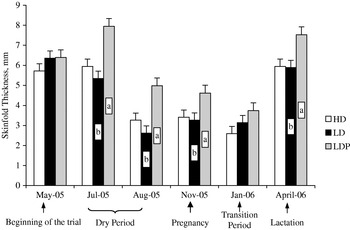
Mean skinfold thickness of ewes reared at low stocking density with free access to an outdoor area (LDP) was higher than that of indoor low stocking density animals (LD; P<0·001); ewes reared at high stocking density (HD) displayed a mean skinfold thickness comparable with that of ewes in the LD group (Fig. 1). Particularly during the dry period (P<0·001), pregnancy (P<0·01) and the lactation (P<0·01) ewes in the LDP treatment displayed higher skinfold thickness in response to phytohaemagglutinin injection than ewes in the LD treatment. Time-related changes were observed (P<0·001) with all the experimental groups exhibiting a lower skinfold thickness during the last phase of the dry period, pregnancy and transition period than during lactation and early dry period.
Skinfold thickness (Least Squares Means±sem) after phytohaemagglutinin (PHA) injection, measured in Comisana ewes subjected to high stocking density (1·5 m2/ewe, HD), low stocking density (3 m2/ewe, LD) and low stocking density with free access to external paddock (3 m2/ewe, LDP) at the beginning of the experiment, at the dry period, during the first phase of pregnancy, during the transition period and at the beginning of lactation. a,b Means with different superscripts differ, P<0·05.

Humoural immune responses
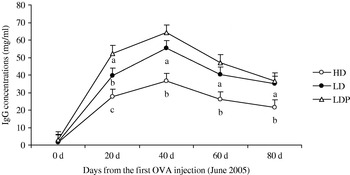
Mean concentration of anti-OVA IgG was higher (P<0·05) in ewes reared at low stocking density with free access to an outdoor area than in low density stocked ewes and higher (P<0·001) in low density stocked ewes than in high density stocked ewes (Fig. 2). Responses to OVA were significantly higher (P<0·05) in the ewes of the LDP treatment than in the ewes of the LD group at 20 d after the first OVA injection. Concentrations of anti-OVA IgG were significantly lower (P<0·001) in ewes of the HD group than in ewes of the LD group throughout the experiment.
Antibody titres to chicken egg albumin (OVA) (Least Squares Means±sem) detected in blood of Comisana ewes subjected to high stocking density (1·5 m2/ewe, HD), low stocking density (3 m2/ewe, LD) and low stocking density with free access to external paddock (3 m2/ewe, LDP) at 0, 20, 40, 60 and 80 dfrom the first OVA injection. a,b,c Means with different superscripts differ, P<0·05.

Behavioural activities
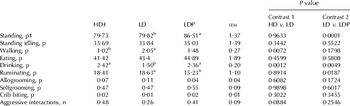
Housing conditions affected sheep behavioural activities, with a greater proportion of low density stocked ewes with free access to an outdoor area observed standing and drinking more than low density stocked indoors ewes (P<0·001 and P<0·01, respectively, Table 1). More ewes stocked at low density indoors ruminated than ewes stocked at low density with free access to an outdoor area (P<0·05). When evaluating the effects of space allowance on sheep behaviours, a lesser (P<0·01) proportion of ewes stocked at low densities drank than ewes stocked at high densities, whereas a greater proportion of ewes of the LD group walked than ewes of the HD group (P<0·01). Aggressive behaviours (butting, clashing, shoulder pushing) among ewes in the HD group tended to be significantly more frequent than among ewes in the LD group (P=0·0884). Irrespective of housing conditions and stocking density, ewe behaviour underwent changes throughout the study period. In particular, the lowest proportion of ewes engaging in ruminating was observed in June, while the lowest proportion of ewes observed eating and standing was observed in August. In September was observed the greatest proportion of ewes engaged in ruminating and drinking. The greatest proportion of ewes engaged in eating and walking was measured in January and February, respectively. Aggressive behaviour was observed more frequently in the last month of the experiment than in the previous months.
Least squares means±sem of behavioural activities recorded in Comisana ewes subjected to high stocking density, low stocking density, and low stocking density with free access to external paddock

a,b Means within a row with different superscripts differ (P<0·05)
† Treatments: HD=high stocking density (1·5 m2/ewe, n=15); LD=low stocking density (3 m2/ewe, n=15); LDP=low stocking density with free access to external paddock (3 m2/ewe, n=15)
‡ Values of behavioural activities are expressed as either proportion of animals (p) or mean number (n) of events
Milk yield and composition
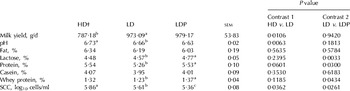
Stocking density influenced milk yield, which was lower in ewes stocked at high densities than in ewes stocked at low densities (P<0·05, Table 2). Milk from ewes in the HD group also had higher pH and SCC than milk from ewes in the LD group (P<0·001 and P<0·05, respectively). Milk yield of low density stocked ewes with free access to an outdoor area was not different from that of low density stocked animals, but milk from ewes of the LDP treatment had higher protein and whey protein contents than milk from ewes of the LD treatment (P<0·05). In addition milk from ewes enclosed outdoors had higher lactose content (P<0·01) and lower SCC (P<0·05) than milk from ewes enclosed indoors. As the experiment progressed, milk yield decreased in all groups (P<0·05) and the concentrations of milk constituents increased slightly.
Least squares means±sem of milk yield and milk composition from Comisana ewes subjected to high stocking density, low stocking density, and low stocking density with free access to external paddock

a,b,c Means within a row with different superscripts differ (P<0·05)
† Treatments: HD=high stocking density (1·5 m2/ewe, n=15); LD=low stocking density (3 m2/ewe, n=15); LDP=low stocking density with free access to external paddock (3 m2/ewe, n=15)
Discussion
Different housing conditions can influence sheep physiological responses, with an increase of energy demand for thermoregulation in ewes maintained in outdoor enclosure during daytime, but no effects of housing conditions on sheep cortisol secretions are documented (Casamassima et al. Reference Casamassima, Sevi, Palazzo, Ramacciato, Colella and Bellitti2001). In buffalo calves and in beef heifers no effects of reduced space allowance on cortisol, cellular and humoural immune responses, or on acute phase proteins were found (Napolitano et al. Reference Napolitano, De Rosa, Grasso, Pacelli and Bordi2004; Fisher et al. Reference Fisher, Crowe, O'Kieli and Enright1997). In sheep, humoural immune responses can give an indication of relative stressfulness caused by both physical and emotional challenges (Caroprese et al. Reference Caroprese, Albenzio, Annicchiarico and Sevi2006a, Reference Caroprese, Napolitano, Albenzio, Annicchiarico, Muscio and Sevi2006b; Napolitano et al. Reference Napolitano, Annicchiarico, Caroprese, De Rosa, Taibi and Sevi2003; Sevi et al. Reference Sevi, Caroprese, Annicchiarico, Albenzio, Taibi and Muscio2003). In the present experiment reduced space allowance had a detrimental effect on humoural responses of sheep. In fact, high density stocked ewes had a lower anti-OVA IgG secretion compared with low density stocked animals. On the other hand, different housing conditions provoked differences in the antibody concentrations against ovalbumin at the beginning of the experiment; subsequently, differences in humoural responses disappeared in low density groups, irrespective of outdoor paddock being available. Casamassima et al. (Reference Casamassima, Sevi, Palazzo, Ramacciato, Colella and Bellitti2001) did not find differences in cell-mediated immune responses of ewes maintained in an external paddock during daytime or confined indoors throughout the day. Bolhuis et al. (Reference Bolhuis, Parmentier, Schouten, Schrama and Wiegant2003) reported differences in immune responses in pigs reared in barren v. enriched housing conditions. Lower antibody concentrations after antigen injection, and lower lymphocyte proliferation in response to mitogens are considered indicators of acute and chronic stress and are commonly used to monitor ruminant well-being (Sevi et al. Reference Sevi, Albenzio, Annicchiarico, Caroprese, Marino and Taibi2002). In the present study, free access to an outdoor area had beneficial effects on lymphocyte proliferation compared with indoor enclosure. In particular, during the dry period, pregnancy, and early lactation, ewes in the low density stocked group with free access to an external paddock exhibited a higher immune response to phytohaemagglutinin injection than ewes kept indoors with the same space allowance. Sheep are very sensitive to changes in the light to dark ratio and light stimuli modulate many of their biological functions, such as reproduction, and feeding activity (Thiéry et al. Reference Thiéry, Chemineau, Hernandez, Migaud and Malpaux2002). Stocking density being equal, differences in T cell responses between ewes with allowed access to an external paddock and ewes with denied access to an external paddock could be influenced by the environmental modulation of the T lymphocyte responses as a result of different rhythmic patterns of hormonal secretions. In addition, seasonal changes in plasma prolactin concentrations could be responsible for fluctuations in cell-mediated responses exhibited during the experiment by all the experimental groups, as reported in Cerna et al. (Reference Cerna, Porras, Valencia, Perera and Zarco2000). The absence of differences among groups in T cell responses during the transition period could be attributed to stress connected with parturition on the effect of photoperiod on ovarian activity and prolactin secretions (Caroprese et al. Reference Caroprese, Albenzio, Annicchiarico and Sevi2006a). Although T and B lymphocytes act as parts of an integrated system, different responses obtained from cell-mediated and humoural immune responses of sheep in the present study are not surprising: previous studies highlighted similar differences, which may be attributed to neuro-endocrine factors influencing T cell functions because of the presence of receptors on T cells for many hormones and peptides produced in the brain (Tompkins & Tompkins, Reference Tompkins, Tompkins, Feldman, Zinkl and Jain2000; Caroprese et al. Reference Caroprese, Napolitano, Albenzio, Annicchiarico, Muscio and Sevi2006b; Besedovsky & Del Rey, Reference Besedovsky, Del Rey, Cinader and Miller1986).
The availability of an external paddock resulted in a higher proportion of ewes with free outdoor access being observed standing compared with indoor animals. Greater levels of activity of ewes with free access to an outdoor area could be considered an effect of a greater number of environmental stimuli perceived by ewes with free access to outdoors. Casamassima et al. (Reference Casamassima, Sevi, Palazzo, Ramacciato, Colella and Bellitti2001) suggested that ewes reared outdoors have greater motivation to investigate the surroundings and this resulted in a higher degree of exploratory and active behaviours compared with ewes reared indoors. The lower proportion of LDP ewes engaged in rumination is connected with standing behaviour. In fact, sheep mainly perform rumination when lying down; so the greater the activity level, the less time spent ruminating. Free access to an outdoor area resulted in greater drinking by LDP ewes, which may be explained by the higher ambient temperatures to which the ewes with the availability of an external paddock were exposed. The low proportion of ewes walking in the high density stocked group may reflect a tendency to reduce physical interactions with other ewes because of crowding and reduced space allowance (Hanlon et al. Reference Hanlon, Rhind, Reid, Burrells, Lawrence, Milne and McMillen1994). In fact, the ewes in the group stocked at high densities tended to exhibit more frequent competitive behaviours. A greater proportion of HD ewes drank compared with low density stocked ewes, and this can be interpreted as a sign of stress. Increased drinking is regarded as an indicator of stressful conditions connected with adjustment of the animals to the surrounding environment (Fraser & Broom, Reference Fraser and Broom1990; Silanikove, Reference Silanikove2000).
High density stocked ewes produced less milk with a higher SCC than low stocking density ewes. A low space allowance of ewes is known to be stressful, resulting in reduced milk yield and quality. This is possibly due to less inter-individual distance and space for locomotion as well as to increased concentration of micro-organisms in the litter and the consequent effects on the bacterial colonization of the udder (Sevi et al. Reference Sevi, Massa, Annicchiarico, Dell'Aquila and Muscio1999, Reference Sevi, Taibi, Muscio, Albenzio, Dantone and Dell'Aquila2001b). On the other hand, free access to an external paddock can result in higher protein content and lower leucocyte concentration in milk compared with indoor confinement (Casamassima et al. Reference Casamassima, Sevi, Palazzo, Ramacciato, Colella and Bellitti2001). The extensive perception of light stimuli in ewes with free access to outdoor paddock can partly explain the increase in milk protein content compared with indoor enclosed ewes; Dahl et al. (Reference Dahl, Buchanan and Tucker2000) pointed out that a rise in duration of daylight can induce an enhanced release of galactopoietic hormones in lactating animals.
In conclusion, ewes confined with a space allowance of 1·5 m2 displayed reduced humoural immune response compared with ewes housed at a stocking density of 3 m2/head. High density stocked ewes also had lower milk yield of poorer quality. Ewes that had free access to an outdoor area displayed an increased cell-mediated immune response compared with the group enclosed indoors, as well as higher protein content and lower SCC in their milk. Therefore, results from the present experiment suggest that a space allowance of 3 m2/ewe is sufficient to sustain the welfare and production performance of housed ewes and that, apart from stocking density, free access to an outdoor areas can have beneficial effects on immune response, and on production performance of lactating ewes.