1 Introduction
Present-day English (PDE), like most of its Germanic sister languages, has multiple ways to express conditionality (Van den Nest Reference Van den Nest, linden, Verstraete and Davidse2010; Auer & Lindström Reference Auer, Lindström, Auer and Pfänder2011). (1a–c) present run-of-the-mill examples of both conjunctional (most notably if) and verb-initial (V1) conditionals.
(1)
(a) If you work harder, (then) you will finish in time.
(b) If you had worked harder, (then) you would have finished in time.
(c) Had you worked harder, (then) you would have finished in time.
Conjunctional conditionals can express conditions whose fulfilment is open, as in (1a), or counterfactual, i.e. for which the speaker believes that the condition is not, cannot, or will not be fulfilled as (1b) (Quirk et al. Reference Quirk, Greenbaum, Leech and Svartvik1985: 1091–3; Iatridou & Embick Reference Iatridou, Embick and Gonzàlez1994; Bhatt & Pancheva Reference Bhatt, Pancheva, Everaert and van Riemsdijk2006).Footnote 2 V1 conditionals like (1c) are (largely) restricted to expressing counterfactuality in PDE. The use of then is optional in both types, as indicated by the brackets. Using then is, however, ungrammatical when the conditional subclause is clause-final, as in (2).
(2) (*Then) you will finish in time, if you work harder.
The constructions in (1) also occur in earlier English, as exemplified by the Old English (OE) (g)if conditional in (3). However, conditionals in earlier English show much more construction-internal variation, with respect to mood, verb choice, restrictions on open and counterfactual V1 conditionals, and in the structure of the clause expressing the result of the condition. I will come back to this below.
(3)


Most studies on conditionality in English are restricted to either conjunctional or V1 conditionals or are synchronic in nature (see Iatridou & Embick Reference Iatridou, Embick and Gonzàlez1994; Bhatt & Pancheva Reference Bhatt, Pancheva, Everaert and van Riemsdijk2006; Van den Nest Reference Van den Nest, linden, Verstraete and Davidse2010; Auer & Lindström Reference Auer, Lindström, Auer and Pfänder2011). This article traces the diachronic development of English conditionals with clause-initial conditions as in (1a–c) and (3), as well as the division of labour between conjunctional and V1 conditionals. I will furthermore study the factors that promote the use of resumptive adverb then. I will also answer the question why its use in conditionals declines over time, but never quite disappears while it does so in other constructions with clauses expressing a similar semantic–pragmatic relationship. The focus will be on conditionals introduced by (g)if, by the finite verb (V1), and by and (meaning ‘if, suppose / provided that, on condition that’; OED). These three have a context-independent conditional reading (contrary to, for example, when). I will show that conjunctional conditionals have always been preferred over V1 conditionals, which eventually became limited to counterfactual uses, as they became restricted to a subset of auxiliaries following the loss of preposing of lexical finite verbs. The results will be compared for both frequency and genre effects to earlier research on the division of labour between the two conditional types by Van den Nest (Reference Van den Nest, linden, Verstraete and Davidse2010) on written OE and by Auer & Lindström (Reference Auer, Lindström, Auer and Pfänder2011) on written German and Swedish. We will see that restrictions on V1 conditionals are not uncommon and that both conditional types have genre and modality preferences.
This article is organised as follows: section 2 discusses in detail the form and meaning of conditionals, the expression of conditionality in (earlier) English, the relation between conditionals and correlatives, and the role of then. Section 3 outlines the methodology for data collection and addresses the diachronic development and the use of the resumptive adverb then. Section 4 concludes.
2 Types of conditionals: form and meaning
Conditionals are used to convey the message that the accuracy of the proposition expressed in the apodosis (or main clause) depends on the fulfilment of the condition expressed in the protasis (or conditional subclause) (Quirk et al. Reference Quirk, Greenbaum, Leech and Svartvik1985: 1088; Bhatt & Pancheva Reference Bhatt, Pancheva, Everaert and van Riemsdijk2006). Together, the two clauses are a semantic–pragmatic unit expressing condition and result (Van den Nest Reference Van den Nest, linden, Verstraete and Davidse2010), as in (4).
(4) If you hurt the cat, she will bite you.
The truth of the prediction ‘she will bite you’ depends on the fulfilment of the condition ‘if you hurt the cat’. Example (4) is a so-called content conditional, involving actual real-world content, as opposed to epistemic conditionals which reflect logical reasoning processes or speech-act conditionals (Sweetser Reference Sweetser1990: 113–21).Footnote 3 In many languages, the protasis can either be clause-initial, as in (4), or clause-final, as in (5) (Iatridou & Embick Reference Iatridou, Embick and Gonzàlez1994; Bhatt & Pancheva Reference Bhatt, Pancheva, Everaert and van Riemsdijk2006).
(5) The cat will bite you, if you hurt her.
Conditionals with clause-final protases like (5) generally allow less variation. In languages like Russian, ‘the clause-final option is unavailable’ (Comrie 1986, cited in Bhatt & Pancheva Reference Bhatt, Pancheva, Everaert and van Riemsdijk2006: 646), while in other languages, such as PDE, German and Dutch, clause-final V1 protases are restricted to counterfactuality (Iatridou & Embick Reference Iatridou, Embick and Gonzàlez1994). Predictably, clause-initial protases are more common cross-linguistically. The protasis–apodosis order expresses the consecutive order of the events most accurately or iconically (see Dancygier & Sweetser Reference Dancygier and Sweetser2005: 173) and presumably facilitates interpretation.
Most Germanic languages have more than one morphosyntactic way of expressing condition–result semantics (Auer & Lindström Reference Auer, Lindström, Auer and Pfänder2011). Well-known strategies for overt marking of the protasis include inflectional marking by imperative/subjunctive morphology (Bhatt & Pancheva Reference Bhatt, Pancheva, Everaert and van Riemsdijk2006), and the use of conditional conjunctions. The latter often find their origin in temporal wh-pronouns, like German wenn in (6), or interrogative conjunctions, like PDE if in (4) (also used in embedded yes/no questions). As such, PDE if – but also Dutch als ‘if’ (Zwart Reference Zwart2011: 106; 282–5) – is generally analysed as a conjunction in C, the canonical position for conjunctions in CP (Conjunction Phrase) (see Kayne 1991, cited in Bhatt & Pancheva Reference Bhatt, Pancheva, Everaert and van Riemsdijk2006: 652).
Another way of marking the conditional protasis is by fronting the finite verb (to C) in the absence of a conjunction (Iatridou & Embick Reference Iatridou, Embick and Gonzàlez1994). These V1 conditionals, although often a characteristic of languages without other indicators of conditionality, can also be found side-by-side with other conditionality marking strategies. PDE V1 conditionals are (largely) restricted to counterfactuality as in (7a), whereas German also permits open V1 conditionals that are neutral towards the fulfilment of the condition, like example (7b).
(6)
(7)


For languages allowing multiple overt ways of expressing conditionality, the choice of a particular conditional type (conjunctional versus V1) not only depends on language-internal factors, but is also influenced by discourse function, genre and modality (Auer & Lindström Reference Auer, Lindström, Auer and Pfänder2011). Present-day Swedish, for example, seems to favour conjunctional (om ‘if’) protases in the written language, but instructive (legal, scientific and regulatory) texts prefer V1 protases. The latter are also favoured in spoken Swedish and used by the speaker to establish an expert-status. Present-day written German also favours V1 over conjunctional protases in instructional texts, but shows an arbitrary distribution elsewhere. In spoken German, V1 conditionals are virtually absent. The division of labour between the different conditional types thus depends on the available morphosyntactic options along with genre and modality (Auer & Lindström Reference Auer, Lindström, Auer and Pfänder2011).
2.1 The expression of conditionality in (earlier) English
The order protasis–apodosis, as in (4), is the most common and versatile way to express conditionality in PDE. The subordinating conjunction if is the most frequent option, but when and whenever are used as well (Quirk et al. Reference Quirk, Greenbaum, Leech and Svartvik1985: 1089). PDE V1 conditionals are (largely) restricted to presenting counterfactual information, as observed above. They are also restricted to a limited set of auxiliaries: had, were and should, the latter marking a high degree of uncertainty. In somewhat literary styles, should and were can sometimes also be used non-counterfactually (Quirk et al. Reference Quirk, Greenbaum, Leech and Svartvik1985: 1094).Footnote 4 Resumptive adverb then can introduce the apodosis in both constructions.
OE, Middle English (ME) and Early Modern English (EModE) conditionals can be introduced by conjunctions like (g)if and and, as in examples (8)–(9), or by various types of V1 conditionals, as in (10) and (11).
(8)
(9)


Conjunction and is especially interesting as it can function as both a coordinator and a subordinating conjunction in ME and EModE (conditionals). Its conditional use ‘may have arisen from a simplified correlative use in which and loosely expresses various relations between two clauses’ (Rissanen Reference Rissanen and Lass1999: 281). Such a paratactic origin is proposed here for all protasis–apodosis order conditionals.
OE V1 conditionals can present both counterfactual and open propositions (Iatridou & Embick Reference Iatridou, Embick and Gonzàlez1994), as in examples (10)–(11). It has been suggested that – as in Icelandic – open OE conditionals require the subjunctive in the protasis, like wurðe in (11) (Bhatt & Pancheva Reference Bhatt, Pancheva, Everaert and van Riemsdijk2006: 683, endnote 23). Conditionals can also be introduced by when and ϸonne (the latter meaning ‘whenever’ (Traugott Reference Traugott and Hogg1992: 258)), originally temporal conjunctions which can induce a conditional interpretation depending on context, but always retain some temporality (Mitchell Reference Mitchell1985: 858; Fischer Reference Fischer and Blake1992: 349).
(10)
(11)


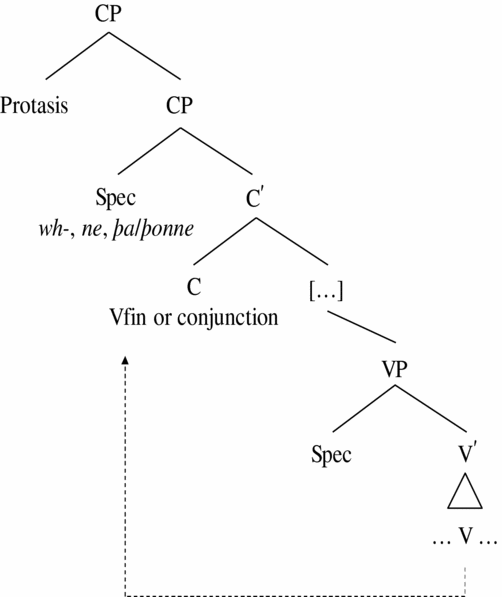
It is generally accepted in the literature that the embedded conjunction and the fronted finite verb in V1 conditionals target the same structural position (C) in the protasis (den Besten Reference den Besten and Abraham1983; Bhatt & Pancheva Reference Bhatt, Pancheva, Everaert and van Riemsdijk2006; Zwart Reference Zwart2011: 106, 282–5), even in OE; see figure 1. This distribution dates back to the shift from parataxis to hypotaxis in (pre-)OE times (Kiparsky Reference Kiparsky, Battye and Roberts1995). Both conjunctional and V1 conditionals in the protasis–apodosis order originate from a paratactic structure exhibiting a semantic–pragmatic (but not syntactic) relationship between two main clauses. Here, the relationship is one condition and result, but it is also found in OE temporal correlative constructions and in OE left dislocations (Links, van Kemenade & Grondelaers Reference Links, van Kemenade and Grondelaers2017). Routinely combined, such semantically–pragmatically related main clauses were ultimately interpreted as one construction, in which the first clause was hypotactically integrated as a subclause into the second. This facilitated the rise of typical subordination markers like conjunctions in C (e.g. conditional if). Another effect was verb-fronting to C, motivated by a need to distinguish main clauses from subclauses (Kiparsky Reference Kiparsky, Battye and Roberts1995). This took the form of (i) special modality related V1 word order patterns (e.g. yes/no questions, imperatives and conditionals); and (ii) Verb-Second (V2) in main clauses primarily triggered by certain types of constituents in Spec, CP (wh-constituents, negatives and demonstrative adverbs like þa/þonne ‘then’ in OE) (Kiparsky Reference Kiparsky, Battye and Roberts1995; Fischer et al. Reference Fischer, van Kemenade, Koopman and van der Wurff2000: 110–29; van Kemenade & Los Reference Kemenade, Los, van Kemenade and Bettelou2006; Van den Nest Reference Van den Nest, linden, Verstraete and Davidse2010). The finite verb moves from V to C (via intermediate head positions) and is directly followed by the subject.Footnote 6 Figure 1 illustrates the < tex − math/ > structure.
Old English clause structureFootnote 5

The use of resumptive adverb þa/þonne in OE main clauses after a conditional protasis or adverbial subclause indicates that – at least in OE – these subclauses are non-integrated, extra-clausal material accounted for by an extra CP-adjoined position above the main clause CP in figure 1 (see Links, van Kemenade & Grondelaers Reference Links, van Kemenade and Grondelaers2017). As such, these constructions represent the stage in between parataxis and full hypotaxis.
Verb-fronting to C (see figure 1) crucially differentiates main clauses from subclauses in OE. As conjunctions and finite verbs both occur in C, OE (g)if conditionals with (g)if directly followed by the finite verb are not found. The paratactic origin also explains why, with the exception of V1 conditionals, V1 subclauses seem to be rare in OE. If V1 conditionals, like conjunctional conditionals, indeed originally consisted of two semantically–pragmatically (but not syntactically) related main clauses (as established for Old Swedish (Wessén 1956, quoted in Auer & Lindström Reference Auer, Lindström, Auer and Pfänder2011: 223–4)), this accounts naturally for why all other uses of V1 in OE are found in various types of main clauses: yes/no questions, imperatives and V1 declaratives (Fischer Reference Fischer and Blake1992: 278; Traugott Reference Traugott and Hogg1992: 184; Fischer et al. Reference Fischer, van Kemenade, Koopman and van der Wurff2000: 53; Ohkado Reference Ohkado2004). In fact, V1 conditionals (in some Germanic languages at least) seem to have emerged out of other verb-fronting structures, most notably yes/no questions (Auer & Lindström Reference Auer, Lindström, Auer and Pfänder2011). Mitchell (Reference Mitchell1985: 848–9) furthermore indicates that OE V1 imperatives can also function as conditionals.Footnote 7 Based on intonation patterns, he argues that these often take the form of two coordinated (paratactic) main clauses in PDE as in (12), but he does not hazard any guess regarding their syntactic status in OE. As the second clause in (13), Mitchell's example (Reference Mitchell1985: 849), is introduced by resumptive adverb þonne, it seems reasonable to assume that – at least in OE – V1 imperatives also fit the structure in figure 1 as þonne establishes a relation between the two clauses. The shared origin of conjunctional and V1 conditionals thus explains their complementary distribution, but not the restriction of PDE V1 conditionals to counterfactuality expressed by certain auxiliaries. This issue will be addressed in 3.2.
(12)
(13)


2.2 Conditionals, correlatives and then
It was observed above that OE conditionals with clause-initial protases (a conditional example is repeated for convenience in (14)) share the same structure with temporal correlative constructions like (15). Both constructions are introduced by a subclause followed by a V2 main clause (optionally) introduced by resumptive adverb þonne or þa ‘then’. In fact, conditionals are themselves either correlatives or are historically derived from correlative constructions in many languages (Bhatt & Pancheva Reference Bhatt, Pancheva, Everaert and van Riemsdijk2006).
(14)
(15)


Resumptive adverb use in the apodosis reinforces the semantic-pragmatic relationship between the two clauses: ðonne ‘then’ in (14) is used in conditionals similarly to correlative proforms in correlative constructions like (15) (Bhatt & Pancheva Reference Bhatt, Pancheva, Everaert and van Riemsdijk2006; Links, van Kemenade & Grondelaers Reference Links, van Kemenade and Grondelaers2017). Resumptive adverbs resume the previous clause as backgrounded and structure the discourse by foregrounding the consequence or temporal event in the main clause, establishing textual cohesion and reminding the reader/listener to pay attention to what is coming (van der Horst Reference Horst1981: 39–41; Enkvist Reference Enkvist, Kastovsky and Szwedek1986; van Kemenade & Los Reference Kemenade, Los, van Kemenade and Bettelou2006; Baker Reference Baker2007: 99; van der Horst Reference Horst2008: 538–9; Los, Reference Los2009; Wårvik Reference Wårvik2013). Their position is the multifunctional first position (Spec, CP) of the OE V2 main clause, which is pragmatically associated with discourse continuity (van Kemenade & Los Reference Kemenade, Los, van Kemenade and Bettelou2006; Los Reference Los2009; Los & van Kemenade in press).
Conditionals followed by a main clause without a resumptive adverb like (16) are also extra-clausal, as in the structure presented in figure 1. Since the trigger for verb placement in C is the resumptive adverb (rather than the protasis itself), I postulate a null resumptive adverb in the Spec, CP of the main clause (for a more detailed discussion see Links, van Kemenade & Grondelaers Reference Links, van Kemenade and Grondelaers2017).
(16)

Although subject-initial apodoses rapidly gain ground from ME onwards, PDE conditional clauses still have a biclausal structure in which the protasis is (CP-) adjoined to the apodosis (Kiparsky Reference Kiparsky, Battye and Roberts1995; Haegeman Reference Haegeman2003, Reference Haegeman2012). Proform then (a descendent of OE þonne; OED), still introduces the apodosis in if-conditionals, as in (17), especially in those conditionals where the connection is inferential (Huddleston & Pullum Reference Huddleston and Pullum2002: 757–8). Then is, however, not obligatory: it has hardly any interpretive contribution (Bhatt & Pancheva Reference Bhatt, Pancheva, Everaert and van Riemsdijk2006) and does not lead to subject-inversion as it did in OE, although its use might come with a certain (intonational) emphasis. As resumptive adverb use is optional in both OE and PDE, the question arises which factors influence their use. This issue will be addressed in section 3.3.
(17) If you hurt the cat, (then) she will bite you.
3 Development over time
As many of the earlier studies on conditionals in English restrict themselves to either OE or PDE, I will now consider the diachronic development of conditionals. The results will add to the observations by Links, van Kemenade & Grondelaers (Reference Links, van Kemenade and Grondelaers2017) for (structurally similar) correlatives and the insights regarding the development of V2. They will also be compared to Van den Nest's (Reference Van den Nest, linden, Verstraete and Davidse2010) findings for OE regarding frequency and to Auer & Lindström's findings (Reference Auer, Lindström, Auer and Pfänder2011) regarding genre effects in (written) German and Swedish. The focus will be on (i) the division of labour between conjunctional and V1 conditionals; (ii) structural developments in the main clause; (iii) the use of resumptive adverbs in conditionals and the factors that contribute to this, especially in EModE; and (iv) the effects of genre.
3.1 Methodology
In order to trace the development of conditionals in English over time, all potential context-independent conditionals with clause-initial protasis introduced by (g)if, and or an initial finite verb were extracted from six subperiods of three corpora. Conditionals introduced by when or OE þonne have not been taken into account as they have a context-dependent conditional reading and they always retain some temporality (Mitchell Reference Mitchell1985: 858; Fischer Reference Fischer and Blake1992: 349). The inclusion of and is based on its use as both a coordinating and subordinating conjunction in ME and EModE (Rissanen Reference Rissanen and Lass1999: 281; Denison Reference Denison and Romaine2008: 302), which is interesting as conditionals with a protasis–apodosis order reflect an earlier paratactic structure. The text selection included prose texts that are unambiguous in their periodization. Period O1 (450–850), O4 (1050–1150) and M2 (1250–1350) were left out due to low word counts and varying text quality. PPCEME period E2 (1570–1639) was chosen over E1 (1500–1569) based on the timing of the loss of V2 by late ME to EModE (Fischer et al. Reference Fischer, van Kemenade, Koopman and van der Wurff2000: 129–37), thus providing data from a period after the loss of V2.
• York–Toronto–Helsinki Parsed Corpus of Old English Prose (YCOE; Taylor et al. Reference Taylor, Warner, Pintzuk and Beths2003)
▪ O2 (850–950) – 291,481 words
▪ O3 (950–1050) – 573,828 words
• Penn–Helsinki Parsed Corpus of Middle English, second edition (PPCME2; Kroch & Taylor Reference Kroch and Taylor2000)
▪ M1 (1150–1250) – 195,494 words
▪ M3 (1350–1420) – 385,994 words
▪ M4 (1420–1500) – 260,116 words
• Penn–Helsinki Parsed Corpus of Early Modern English (PPCEME; Kroch, Santorini & Delfs Reference Kroch, Santorini and Delfs2004)
▪ E2 (1570–1639) – 628,463 words
The texts were searched using XQuery in CorpusStudio (Komen Reference Komen2009, Reference Kemenade, Nevalainen and Traugott2012), a programme that allows user-adaptable features to be extracted from the corpora. Due to annotation differences between the corpora, searching for (g)if and and conditionals required different queries for each corpus. V1 conditionals received the same annotation across the corpora, but were annotated as two separate clauses throughout.Footnote 8 The results were automatically labelled by means of scripts (user defined XQuery functions using the available metadata and tagging in the corpora) for the features resumptive adverb use, mood and genre (based on Links, van Kemenade & Grondelaers’ (Reference Links, van Kemenade and Grondelaers2017) results for correlative constructions, also see section 3.3) as well as for the verb tense, verb type and the orthographic representation of the verb (e.g. give, had) in the protasis. The results were converted into four Cesax databases (Komen Reference Komen2011, Reference Komen, Tyrkkö, Kilpiö, Nevalainen and Rissanen2012), one for each language stage for conjunctional conditionals and one for V1 conditionals diachronically. The Cesax databases allow the data to be viewed, edited and prepared for (statistical) processing. The databases were checked manually to see whether the automatic labelling had been carried out correctly. Non-conditional examples were deleted, and adjustments to the features made as necessary. The four databases were converted to Excel format and subsequently combined for further analysis by means of pivot tables and statistical testing using IBM SPSS Statistics Data Editor versions 22 and 23 in order to analyse the development of conditionals over time.
Additionally, it was determined manually for all the non-imperative V1 conditionals, and conditionals, and a subset of 300 (g)if conditionals (a random sample distributed over the periods similarly to the V1 conditionals) whether the protasis was open or counterfactual. The choice to analyse a sample of (g)if conditionals and not the entire dataset was based on the observation that, although verb tense might provide an indication of whether a conditional is open or counterfactual, it is not a failsafe method. Example (18) indicates that although the past tense gewilnast is used in the protasis (an indication of counterfactuality; Van den Nest, Reference Van den Nest, linden, Verstraete and Davidse2010; Fischer Reference Fischer and Blake1992: 349–50; Traugott Reference Traugott and Hogg1992: 257), the condition is open. The reverse hypothesis does not hold either: not all present tense protases are open, as shown in the and conditional (19). Although it at first seems from (19) that the hawk is lost, the context shows that the hawk is currently missing and later retrieved, indicating that the protasis is in fact counterfactual. As such, the textual context had to be taken into account for each individual (g)if, and and V1 example. V1 imperative conditionals were left out of this part of the analysis to avoid data skewing as these seem to always represent open conditions.
(18)
(19)


3.2 Frequency
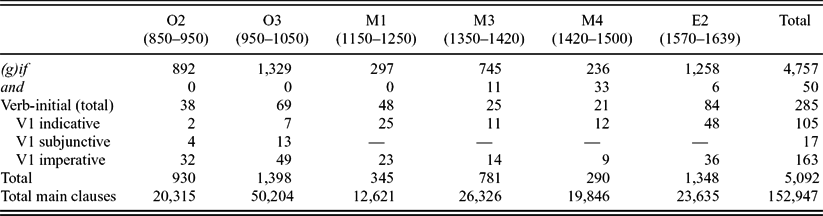
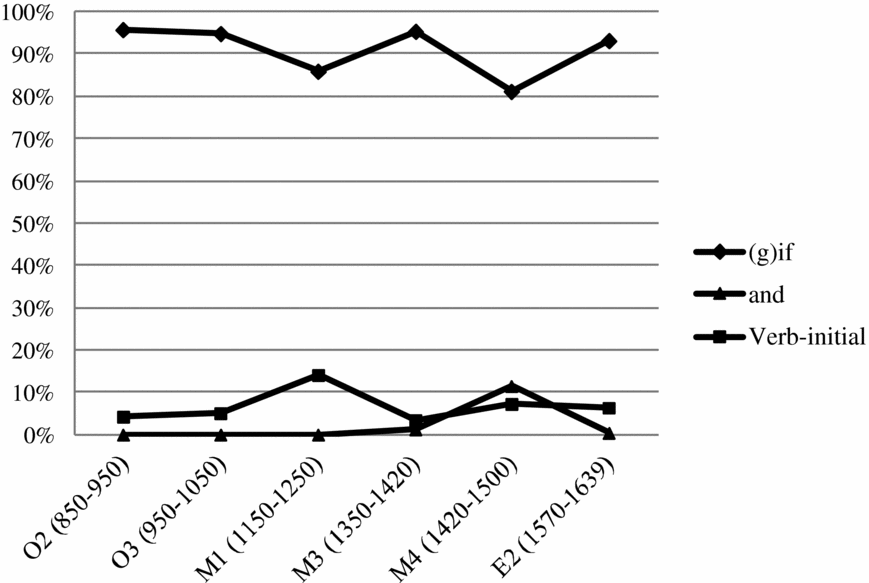
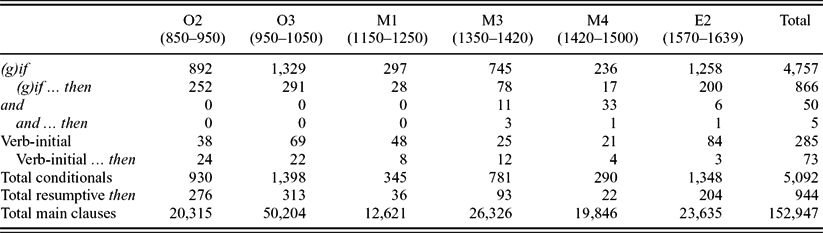
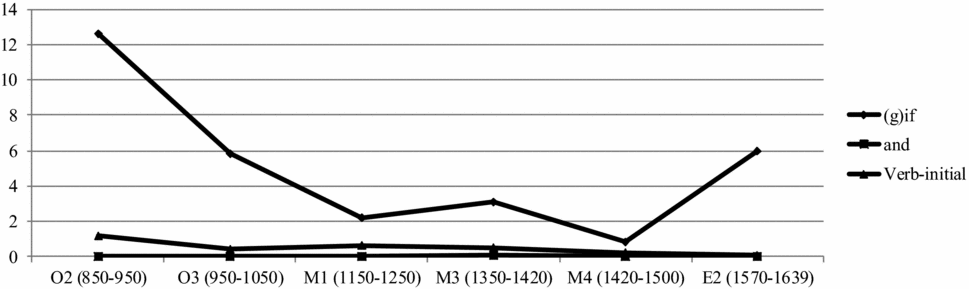
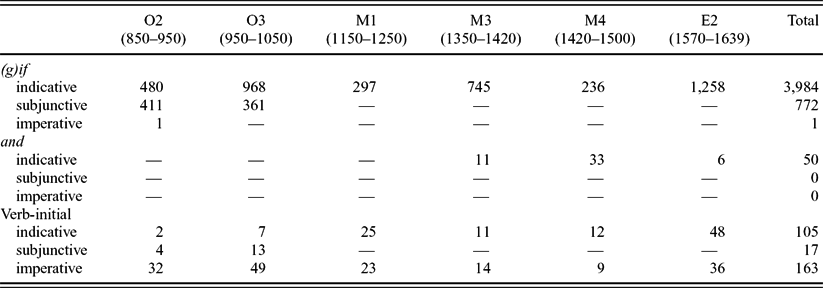
Table 1 and figure 2 give an overview of the data for (g)if, and and V1 conditionals, the latter split by the mood of the finite verb in the protasis. Note that complementiser (g)if comprises both gif in Old English as well as yf / if in later periods.
Absolute frequencies of conditionals over time9

9Total main clauses per period obtained via CorpusStudio (Komen Reference Komen2009, Reference Komen, Tyrkkö, Kilpiö, Nevalainen and Rissanen2012).
Conditionals over time

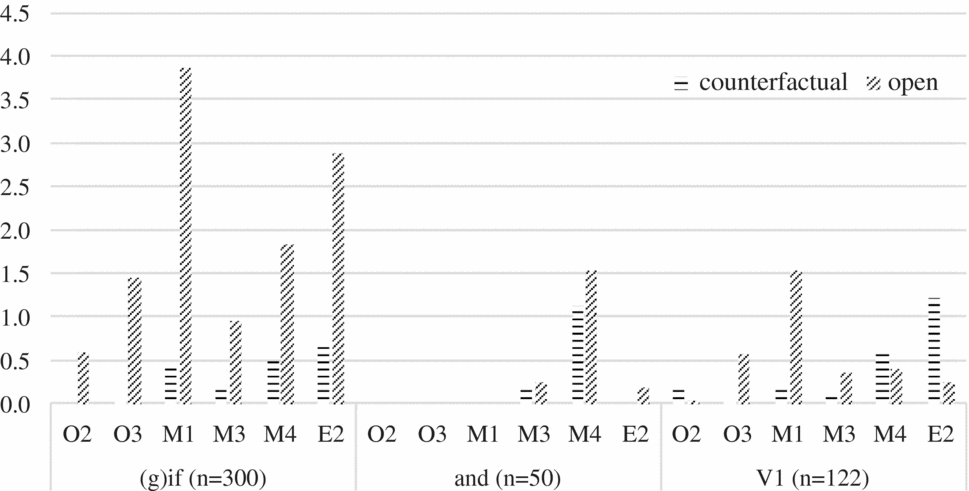
Table 1 and figure 2 show that (g)if conditionals are more frequent than and and V1 conditionals in earlier English. Figure 3 indicates that counterfactual (g)if conditionals are (virtually) absent in OE, although this might be simply a feature of this particular sample. A quick look at the complete OE (g)if data, using the past subjunctive in the protasis as an indication of counterfactuality (Traugott Reference Traugott and Hogg1992: 257; Van den Nest Reference Van den Nest, linden, Verstraete and Davidse2010 for non-imperative V1 conditionals), results in 59 examples. It thus seems reasonable to conclude that (g)if protases can be either open or counterfactual, even in OE. Over time, (g)if protases most frequently contain lexical verbs. Frequently found are forms of ofslean ‘to kill’ as in (20), secgan ‘to say’, þurhwunian ‘to continue’ and dón ‘to do/make/cause’ in OE. The choice for these particular types of verbs is unsurprising as 31 per cent of OE (g)if examples come from legal and moral texts both frequently discussing the consequences of actions. In later periods the lexical verbs come, find, know, make, please and say are frequently found, but their use declines from ME onwards in favour of forms of be, do and modal auxiliaries.
(20)

Distribution of open and counterfactual protases per 1,000 subclauses in a subset of the data

The use of conditional and is marginal in all periods and indeed does not seem to be productive at all before the late thirteenth century (OED; Rissanen Reference Rissanen and Lass1999: 281): the firm establishment of (g)if conditionals by ME most likely restrained their use. Mitchell (Reference Mitchell1985: 843–5) and the Dictionary of Old English (cited in the OED) do present a few OE examples, but Mitchell argues that these also allow a different non-conditional interpretation or can be interpreted as scribal errors. Figure 3 indicates that and conditionals can have both open and counterfactual protases. The syntactic–semantic category of the verb in the protasis is evenly distributed over be as in (9) above, have, lexical verbs and modals. The small peak in M4 (figure 2) is related to 28 occurrences in Malory's Morte D'Arthur, a narrative text with many dialogues in which their use generally flourishes (also see section 3.4).
V1 conditionals were never in serious competition with conjunctional conditionals throughout earlier English (see figure 2), unlike their counterparts in (spoken) Present-day Swedish and German (Auer & Lindström Reference Auer, Lindström, Auer and Pfänder2011). The results confirm Van den Nest's observations (Reference Van den Nest, linden, Verstraete and Davidse2010) that V1 conditionals are marginal in OE.Footnote 10 The present study does find more inverted conditionals (in YCOE), but this higher frequency also includes the imperative V1 conditionals not taken into account by Van den Nest (Reference Van den Nest, linden, Verstraete and Davidse2010). His analysis relates the marginal use of non-imperative V1 conditionals in OE to their establishment as counterfactuals early on, suggesting that this perhaps took place in (early) ME, although he does not provide any evidence. Figure 3, however, indicates that we find both counterfactual and open V1 conditionals in OE and ME. Only after period M4 (1420-1500) do we find more counterfactual than open non-imperative V1 conditionals. The diachronically low frequency of V1 conditionals must thus be related to different factors, namely (i) the already firm establishment of the more versatile conjunctional if-conditional in early OE as seen in figure 2; and (ii) the limitation to counterfactuality caused by evolving restrictions on verb-fronting to C related to modality that arose in English over time (see Biberauer & Roberts Reference Biberauer and Roberts2012)
Although the restrictions on verb-movement to C are essentially a main clause phenomenon, its extension to V1 subclauses follows from their (paratactic) origin as a main clause that became reanalysed as a non-integrated subclause; see figure 1. In OE, the finite lexical verb could still be fronted to C (i.e. V2; Fischer et al. Reference Fischer, van Kemenade, Koopman and van der Wurff2000: 110–29), as in example (21).
(21)

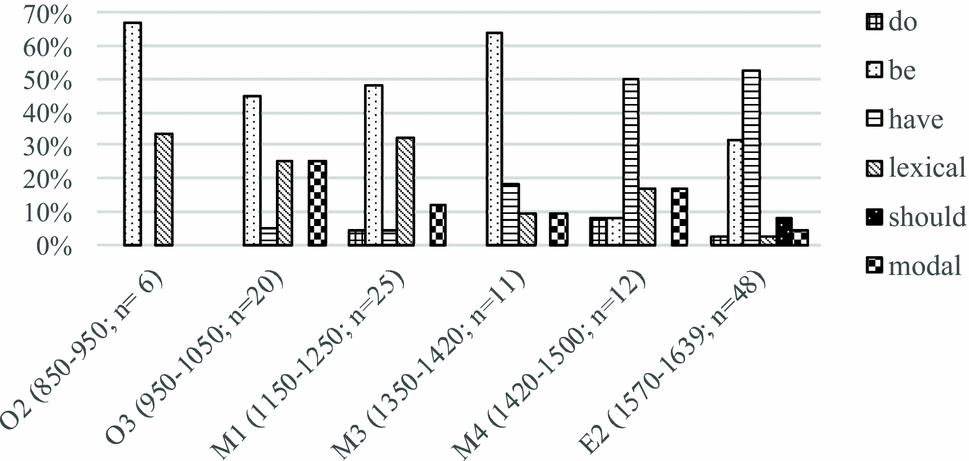
Verb-fronting to C became restricted to finite auxiliaries after the loss of V2 by late ME/EModE (Fischer et al. Reference Fischer, van Kemenade, Koopman and van der Wurff2000: 129–37; Haeberli Reference Haeberli and Lightfoot2002; Los Reference Los2009, Reference Los2012; van Kemenade Reference Kemenade, Nevalainen and Traugott2012) and following the auxiliation of the modals and the rise of auxiliary do during the sixteenth century (Biberauer & Roberts Reference Biberauer and Roberts2012). As a result, V1 (sub)clauses became specialised for modal auxiliaries, and presumably those uses replaced the loss of subjunctive mood marking on the lexical verb. A further semantic limitation arose after the mid nineteenth century (Denison Reference Denison and Romaine2008: 296–304), which restricted V1 subclause word order to the auxiliaries had and should and the past subjunctive form were, which all express tentativeness, possibilities and probabilities and seem thus semantically linked to counterfactual conditions. Figure 4 shows how these restrictions developed diachronically. Note especially that should first appears in period E2. The lexical verbs used in non-imperative V1 conditionals furthermore do not overlap with those most frequently used in (g)if conditionals.
Syntactic–semantic verb type in non-imperative V1 conditionalsFootnote 11

The combination of syntactic and strong semantic restrictions also accounts for Van den Nest's (Reference Van den Nest, linden, Verstraete and Davidse2010) observation regarding the absence of PDE open V1 conditionals like *Does the sun shine, then we'll go for a swim: auxiliary do is semantically empty. The fact that these restrictions do not apply in other West-Germanic languages like Dutch (Zwart Reference Zwart2011: 283, ex. 10.7; Broekhuis & Corver Reference Broekhuis and Corver2016: 1298, ex. 125b) and German (Iatridou & Embick Reference Iatridou, Embick and Gonzàlez1994: 190, ex. 2b), as in the open V1 conditionals in (22) and (7b) with lexical verbs, supports the idea that they do not merely stem from frequency effects. Auer & Lindström (Reference Auer, Lindström, Auer and Pfänder2011) do, however, indicate that spoken Present-day German is getting closer to PDE by restricting counterfactuals to certain auxiliaries, showing that restrictions on the expression of counterfactuality are not uncommon.
(22)

The data presented in table 1 also contain imperative open V1 conditionals. This type is mentioned by Mitchell (Reference Mitchell1985: 848–51), but not by Van den Nest (Reference Van den Nest, linden, Verstraete and Davidse2010). Imperative V1 conditionals are more frequent than non-imperative V1 conditionals, accounting for 57 per cent of the total V1 dataset and 76 per cent of the OE V1 dataset. They seem to partially overlap in meaning with subjunctive V1 conditionals, which can also express obligation along with tentativeness (Traugott Reference Traugott and Hogg1992: 184). Imperative V1 conditionals present the condition as an order, using lexical verbs even in EModE, indicating that the restrictions on non-imperative V1 conditionals do not apply. The main clause usually expresses the consequence of not following this order, but we also find examples of what will happen if the order is carried out, as in example (23).
(23)

In sum, conjunctional and V1 conditionals were never in competition in terms of frequency in the periods investigated here, but – as we will see – each conditional type has its own genre preferences.
3.3 The use of then
The apodosis of both OE conjunctional and V1 conditionals is often introduced by the resumptive adverb ϸonne ‘then’ whose descendant then we still find in PDE conditionals. The similarities between conditionals and correlative constructions as discussed in section 2.2 raise the question whether the use of þonne in both conjunctional and V1 conditionals follows a similar path as resumptives in correlatives for which a relation exists between resumptive adverb use and the availability of V2, the use of indicative mood and subclause length (see Links, van Kemenade & Grondelaers Reference Links, van Kemenade and Grondelaers2017).Footnote 12
Resumptive adverb use in correlatives has virtually disappeared by the end of ME. Table 2 and figure 5 show that this observation also holds for the use of resumptive adverbs in conditionals.Footnote 13 Note that resumptive adverb then in fact comprises the whole range of spelling variants, of which þonne, þenne, than and then are found most frequently.
Absolute frequencies of conditionals with resumptive adverbs over time

Resumptive adverb use in (g)if, and and V1 conditionals over time

Figure 5 shows that resumptive adverb use is highest in OE (g)if-conditionals in which it declines over the ME period to about one instance per 1,000 main clauses by 1500. The use of then after if-protases rises again in EModE and is still found in PDE (Bhatt & Pancheva Reference Bhatt, Pancheva, Everaert and van Riemsdijk2006). Section 3.3.3 discusses these developments in detail.
And conditionals are not attested in OE. They only occur from 1350 (period M3) onwards, but they make little use of (the already declining) resumptive adverbs: only 5 out of the 50 examples found have a resumptive adverb. As their low frequency makes it impossible to draw generalised conclusions, and conditionals will not be discussed in detail here.
Resumptive adverb use following V1 protases is much lower compared to (g)if-conditionals: about half of the V1 conditionals have a resumptive adverb in all periods. Imperative V1 conditionals use more resumptive adverbs in OE and early ME than non-imperatives, but their use declines soon after. The higher frequency of resumptives in imperative open V1 conditionals can be explained by the fact that resumptives seem to have an additional role in these. Resumptive adverbs not only introduce the apodosis, but also seem to emphasise the conditionality of the construction in the sense that the resumptive reinforces that the preceding proposition must be interpreted as a condition and not as merely an imperative statement.
3.3.1 Relation to Verb-Second
The use of resumptive þonne strengthens the relationship between protasis and apodosis, and establishes textual cohesion (van Kemenade & Los Reference Kemenade, Los, van Kemenade and Bettelou2006; Los Reference Los2009; Links, van Kemenade & Grondelaers Reference Links, van Kemenade and Grondelaers2017; Los & van Kemenade in press). Its use is facilitated by the availability of a multifunctional clause-initial position (Spec, CP) in the OE V2 main clause (see sections 2.1 and 2.2). The question is how these main clause characteristics developed over time.
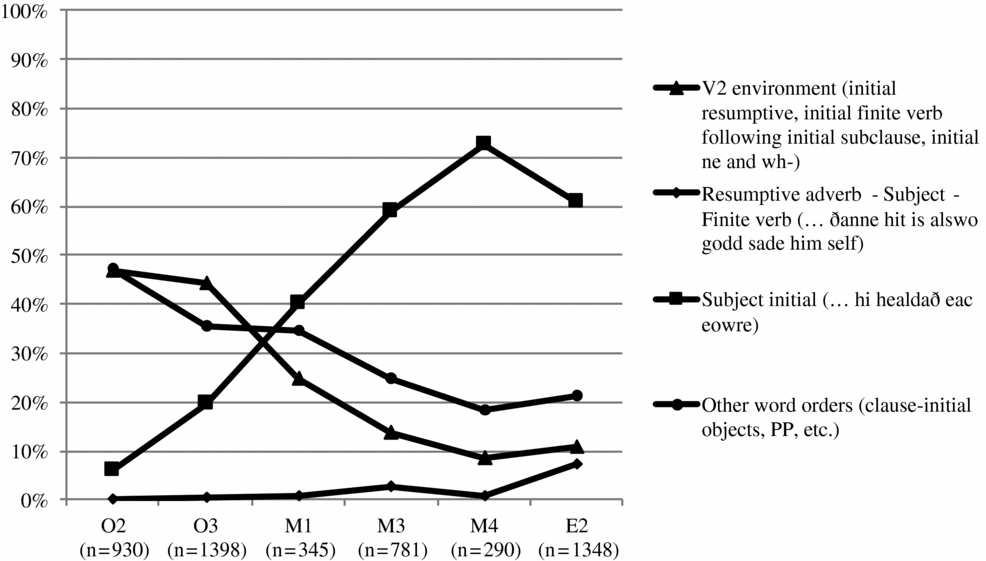
Figure 6 shows that the decline of V2 environments is in line with the loss of resumptive adverbs. The employment of V2 environments with a multifunctional Spec, CP position in conditionals gradually declines and has virtually disappeared before the loss of V2 by late ME to EModE (Fischer et al. Reference Fischer, van Kemenade, Koopman and van der Wurff2000: 129–37; Haeberli Reference Haeberli and Lightfoot2002; Los Reference Los2009; van Kemenade & Westergaard Reference Kemenade and Westergaard2012; Los Reference Los2012). The declining use of resumptive adverbs in the transition from OE to ME removed the trigger for V2 placement in C, resulting in the apodosis becoming an early adopter of the SV order that arose after the loss of V2 (Fischer et al. Reference Fischer, van Kemenade, Koopman and van der Wurff2000: 129–37; van Kemenade Reference Kemenade, Nevalainen and Traugott2012; Links, van Kemenade & Grondelaers Reference Links, van Kemenade and Grondelaers2017). The new subject-initial environment rises from O2 onwards, becoming the most frequent order after period M1. Most competition is found between period O3 and M1. Examples are (24) and (25). The decrease in subject-initial main clauses between period M4 and E2 is related to the increase in the word order resumptive adverb – subject – finite verb, as in (26). This word order option becomes more established after the loss of V2 and is still used in PDE.
Development of V2 and SVO in conditionalsFootnote 14

(24)
(25)
(26)


3.3.2 Conditionals, resumptive adverbs and mood
Links, van Kemenade & Grondelaers (Reference Links, van Kemenade and Grondelaers2017) show that in OE correlatives the feature Mood contributes to the correlative's temporal and conditional expression in the form of resumptive adverb use. A similar relation seems to exist between mood and conditionality in general. Although it has often been put forward that conditionals favour the subjunctive in at least one of the two clauses (Mitchell Reference Mitchell1985: 780, 783–4, 788, 792–3, 797, 805; Fischer Reference Fischer and Blake1992: 349–50; Bhatt & Pancheva Reference Bhatt, Pancheva, Everaert and van Riemsdijk2006; Van den Nest Reference Van den Nest, linden, Verstraete and Davidse2010), Traugott (Reference Traugott and Hogg1992: 256) argues that the prototypical OE (g)if . . .þonne conditional has the indicative in both clauses.
Table 3 shows that both conjunctional and non-imperative V1 conditionals favour the indicative over the subjunctive in the protasis as in (27), even in OE: 63 per cent of protases is indicative. All 789 conditionals with subjunctive verbs are found in OE where the subjunctive is used to express tentativeness, obligations, desires, etc. as in (14) (Traugott Reference Traugott and Hogg1992: 184).Footnote 15
(27)

Mood of finite verbs in clause-initial protases (absolute frequencies)

The suggestion that open OE non-imperative V1 conditionals have the subjunctive does not hold: out of the 20 open V1 conditionals, only 14 have the subjunctive. The results indicate that the need for a specific mood marking conditionality in OE is unnecessary: the conjunction in C already sufficiently expresses the conditional modality in (g)if-conditionals (Mitchell Reference Mitchell1985: 797; Iatridou & Zeijlstra Reference Iatridou and Zeijlstra2014) as does the use of initial verbs in V1 conditionals.
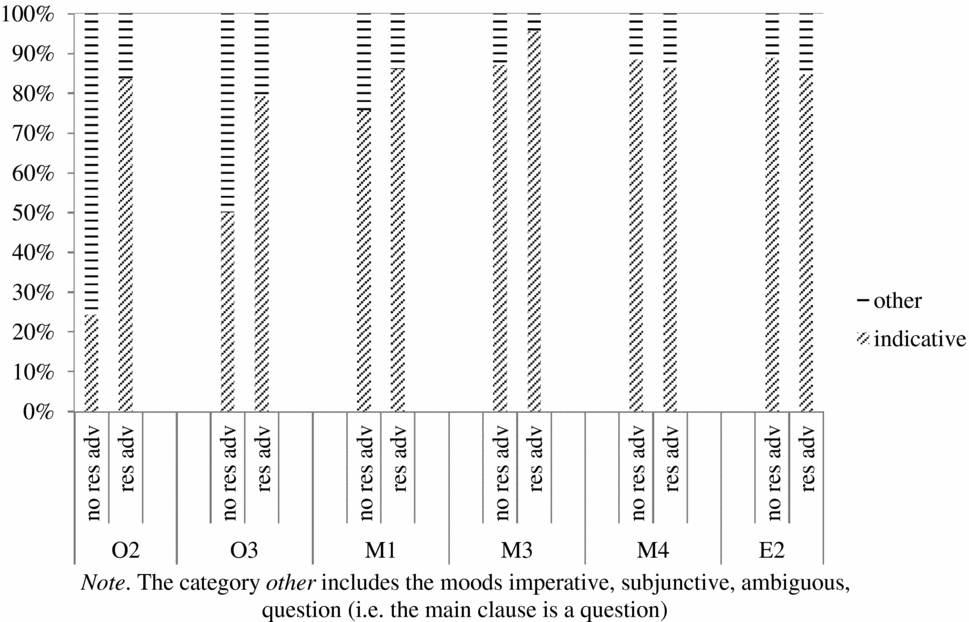
Regarding verbal mood in the main clause, the observation for correlatives that less variation in mood is found in combination with a resumptive adverb (Links, van Kemenade & Grondelaers Reference Links, van Kemenade and Grondelaers2017) also holds for conditionals: indicative mood is preferred in main clauses with resumptive adverbs, as shown in figure 7 and exemplified in (27). This observation is significant for period O2 (χ2 (1) = 218.0906 p < .001), period O3 (χ2 (1) = 115.547 p < .001) and period M3 (χ2 (1) = 9.0047 p < .01) when we take all conditional data together and reduce the variable main clause mood to two categories: indicative vs other. The correlation between the indicative and resumptive adverb use follows from the observation that both represent factual information. The results are largely influenced by the vast amount of (g)if conditionals, especially in period M3 where resumptive adverb use increases slightly as most examples occur in genres (science, moral and narrative) favouring resumptive adverb use (Links, van Kemenade & Grondelaers Reference Links, van Kemenade and Grondelaers2017). The same tendency can be observed for V1 conditionals like (28), but their frequency is too low to test this observation statistically. And conditionals hardly use any resumptive adverbs and no correlation was found.
(28)

Resumptive adverb use and the mood of the finite verb in the apodosis of conditionals

3.3.3 Then in EModE
Figure 5 shows that resumptive adverb use increases again in EModE, but this rise cannot be attributed to the same features facilitating resumptive adverb use in OE. Resumptive adverb use in EModE and PDE conditionals is (still) optional, but when used, resumptives seem to have a certain (intonational) emphasis related to a change in discourse function. Over time, clause-initial adverbials in English decline in anaphoric reference. While clause-initial adverbials often establish discourse links in OE and ME, they tend to represent new rather than old referential information in PDE (Pérez-Guerra 2005, cited in Los Reference Los2009: 112; Los Reference Los2012: 27) and function as frame-setters evoking a contrastive reading (Los & van Kemenade in press).
Resumptive adverbs are used in EModE and PDE only when they serve a clear function, either that of signalling to the reader/listener that something important is coming up (what happens when (not) satisfying the if-clause proposition), or clarifying an inferential connection (Huddleston & Pullum Reference Huddleston and Pullum2002: 757–8). It is thus unsurprising that their use in EModE is related to subclause length measured in words:Footnote 16 long utterances (in this case protases) increase the processing burden on the human brain (see Arnold et al. Reference Arnold, Losongco, Wasow and Ginstrom2000), which can be lightened by using a summarising, signalling and supporting element like a resumptive adverb. Diachronically, resumptive adverb use increases with the length of the protasis in both conjunctional (g)if and V1 conditionals.
In OE (g)if conditionals, the protasis is significantly longer when a resumptive adverb is used, but only by an average of 1.68 words (t(843.932) = −6.069, p (one-tailed) < .001 with a small effect size r = .20; period O2 and O3 taken together). This difference increases to an average of 11.64 words in period E2 (1570-1639) where protases are twice as long when followed by a resumptive (M = 22.59, SE = 2.268) compared to conditionals without one (M = 10.95, SE = .351). This difference was significant at t(208.621) = −5.068, p (one-tailed) < .001 with a medium effect size r = .33.Footnote 17 An example can be seen in (29). These observations do not hold for and conditionals as these use very few resumptive adverbs.
(29) But if the LORD make a new thing, and the earth open her mouth, and swallow them vp, with all that appertaine vnto them, and they go downe quicke into the pit: then ye shall vnderstand that these men haue prouoked the LORD. (authold-e2-h 16,20N.1129)
The correlation between subclause length and resumptive adverb use also holds for the complete set of V1 conditionals, but not diachronically. Subclause length significantly influences resumptive adverb use in only two periods: O3 and M3. V1 conditionals in the later periods use too few resumptive adverbs to obtain any meaningful results. Again, the observation is that subclauses become longer over time. Subclauses in period O3 are also longer when a resumptive adverb is used, but only by an average of 2.21 words (t(67) = -2.361, p (one-tailed) < .05 with a medium effect size r = .28). In period M3, subclauses in inverted conditionals are more than twice as long when a resumptive adverb is used (M = 12.92, SE = 2.8853) compared to when no resumptive adverb is used (M = 5.54, SE = .852) and this difference was significant at t(12.912) = -2.452, p (one-tailed) < .05 with a medium effect size r = .56. (30) gives an example.
(30)

3.4 Genre
Auer & Lindström's study (Reference Auer, Lindström, Auer and Pfänder2011) on conditionality has shown that for the Present-day V2 languages German and Swedish the choice between spoken/written language and genre influences the choice between conjunctional and V1 conditionals. It was observed that spoken Swedish prefers V1 conditionals, whereas these are virtually absent in German. Written Swedish favours conjunctional over V1 conditionals, while German written texts in general show no such preference with the exception of newspaper articles which do favour conjunctional conditionals. V1 conditionals in both German and Swedish favour legal, regulatory (instructions or rules), scientific (law-like regulatories) and instructive texts when used. As it is impossible to investigate the spoken language, the focus here will be on conditionals in written texts in earlier English, some of which intended to be spoken, such as Shakespeare's plays from period E2.
(G)if conditionals, being chosen between 81 and 96 per cent of the time (see table 1 and figure 2), have always been more frequent than and or V1 conditionals, thus patterning with Present-day Swedish. They are also diachronically favoured in all (existing) genres, occurring most frequently in legal, moral, biblical and scientific texts, which are typically aimed at discussing actions and their (possible) consequences.
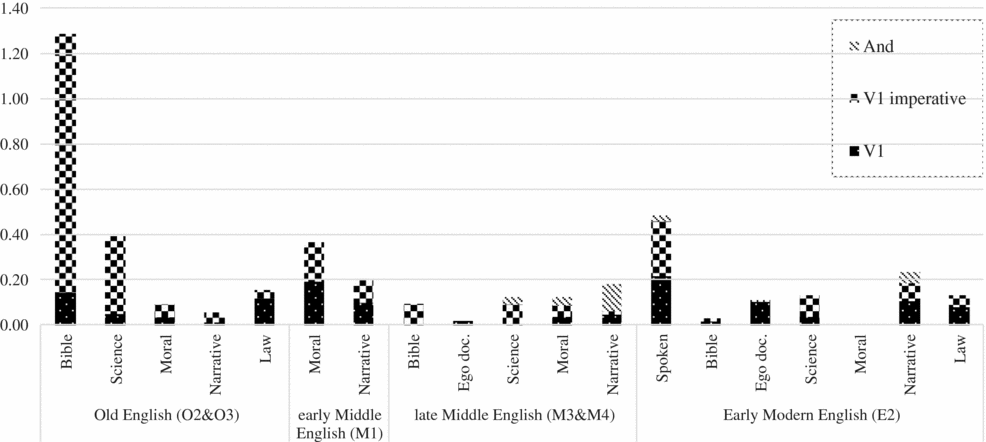
More interesting is thus the distribution across genre of and and V1 conditionals, as shown in figure 8.Footnote 18
Genre preferences in and and V1 conditionals (normalised per 1,000 words)

When used, and conditionals only occur in scientific, moral, narrative, ego documents and spoken (the latter two only in EModE) texts. A clear genre preference for narratives exists in late ME, but this seems influenced by 28 examples from Malory's romance Morte D'Arthur (recall that the overall total of and conditionals is 50). And conditionals are not used in the surviving biblical or legal texts, thus showing a genre preference during their brief usage period.
Non-imperative V1 conditionals favour spoken texts, but since this genre only occurs in EModE, this observation does not hold diachronically. Throughout OE and ME they prefer biblical, moral, narrative and legal texts. Imperative V1 constructions are most often found in OE and late ME biblical texts, OE scientific texts, as well as early ME moral texts and late ME biblical and scientific texts. Like their non-imperative counterparts, they favour EModE spoken texts. V1 conditionals, thus seem to pattern with German and Swedish in preferring scientific (especially imperative V1 conditionals) and legal/instructive (moral or biblical) texts when used, although (g)if conditionals are always preferred over V1 conditionals. For spoken texts, a division as in Swedish does not exists. Although used most frequently in spoken texts, V1 conditionals are not favoured over (g)if conditionals here. The overall results thus show that certain genre preferences are stable across languages and cannot be attributed to frequency effects.
4 Conclusion
This article presented a diachronic perspective on the expression of conditionality in earlier English. My examination of historical data from three corpora (YCOE, PPCME2 and PPCEME) shows that conjunctional conditionals have always been used most frequently, while V1 conditionals have always played a marginal role. The restriction of V1 conditionals to counterfactuality was shown not to be a frequency effect as argued by Van den Nest (Reference Van den Nest, linden, Verstraete and Davidse2010), but related to restrictions on verb-movement to C following the loss of V2 and to a further semantic restriction to had, were and should. The (optional) use of the resumptive adverb then, in both conjunctional and V1 conditionals, reflects the paratactic origin of the construction as two semantic–pragmatic related main clauses that were interpreted as one construction containing a non-integrated subclause and a main clause. Its declining use in ME forced conditionals (but also correlatives) to become early adopters of the SV order arising after the loss of V2. It was shown that resumptive adverb use in both conditional types is influenced by the availability of V2 and indicative mood. In later periods, especially EModE, subclause length plays a key role. When it comes to genre preferences, conjunctional (g)if conditionals are always favoured over and and V1 conditionals, but each type does show certain preferences similar to modern V2 languages.