1. Introduction
The closure of the long-lived Palaeo-Asian Ocean (PAO) generated the Central Asian Orogenic Belt (CAOB), which is situated between the North China and Tarim cratons to the south, Siberian Craton to the north and Baltica Craton to the west (Fig. 1a). The CAOB mainly consists of microcontinents, island arcs, ophiolitic remnants and ocean plate stratigraphy (Wan et al. Reference Wan, Li, Xiao and Windley2018), is famous as the world’s largest accretionary orogenic belt and represents a major site of significant Phanerozoic continental growth (Sengör et al. Reference Sengör, Natalin and Burtman1993; Jahn et al. Reference Jahn, Wu and Chen2000; Badarch et al. Reference Badarch, Cunningham and Windley2002; Xiao et al. 2004, Reference Xiao, Windley, Huang, Han, Yuan, Chen, Sun, Sun and Li2009, Reference Xiao, Windley, Sun, Li, Huang, Han, Yuan, Sun and Chen2015, Reference Xiao, Song, Windley, Li, Han, Wan, Zhang, Ao and Zhang2019). Some authors also call the CAOB the Altaids (Sengör et al. Reference Sengör, Natalin and Burtman1993; Windley et al. Reference Windley, Alexeiev, Xiao, Kroener and Badarch2007). In past decades, many studies have been carried out, focusing on the closure of the ocean, the consequent architecture of the orogenic belt and the related continental growth (Zuo et al. Reference Zuo, Zhang, He and Zhang1990; Wang et al. Reference Wang, Liu, Wang and Wu1993, Reference Wang, Wang and Wang1994; Wu & He, Reference Wu and He1993; Wu et al. Reference Wu, He and Zhang1998; Xiao et al. Reference Xiao, Windley, Hao and Zhai2003, Reference Xiao, Zhang, Qin, Sun and Li2004, Reference Xiao, Windley, Huang, Han, Yuan, Chen, Sun, Sun and Li2009; Charvet et al. Reference Charvet, Shu, Laurent-Charvet, Wang, Faure, Cluzel, Chen and De Jong2011; Xu et al. Reference Xu, Charvet, Chen, Zhao and Shi2013; Liu et al. Reference Liu, Zhao, Sun, Han, Eizenhöfer, Hou, Zhang, Zhu, Wang, Liu and Xu2016, Reference Liu, Zhao, Han, Eizenhöfer, Zhu, Hou, Zhang and Wang2017, Reference Liu, Zhao, Han, Li, Zhu, Eizenhöfer, Zhang, Wang and Tsui2018; Fei et al. Reference Fei, Pan, Xie, Wang and Zhao2019). The PAO is widely accepted to have finally closed along the northern margins of the North China and Tarim cratons (Sengör et al. Reference Sengör, Natalin and Burtman1993; Xiao et al. Reference Xiao, Windley, Sun, Li, Huang, Han, Yuan, Sun and Chen2015, Reference Xiao, Song, Windley, Li, Han, Wan, Zhang, Ao and Zhang2019). However, because of the different research methods used by different authors and the complex processes of accretionary orogenesis in the CAOB, the timing of the final closure of the PAO is still under debate, with a wide time span ranging from the Late Devonian to the Triassic (Xiao et al. Reference Xiao, Windley, Huang, Han, Yuan, Chen, Sun, Sun and Li2009; Han et al. Reference Han, Guo and He2010; Charvet et al. Reference Charvet, Shu, Laurent-Charvet, Wang, Faure, Cluzel, Chen and De Jong2011; Xu et al. Reference Xu, Charvet, Chen, Zhao and Shi2013; Liu et al. Reference Liu, Zhao, Sun, Han, Eizenhöfer, Hou, Zhang, Zhu, Wang, Liu and Xu2016, Reference Liu, Zhao, Han, Eizenhöfer, Zhu, Hou, Zhang and Wang2017).
(a) Geological map of the Central Asian Orogenic Belt (modified after Jahn et al. Reference Jahn, Wu and Chen2000). (b) Geological map of the Alxa area (modified after Feng et al. Reference Feng, Xiao, Windley, Han, Wan, Zhang, Ao, Zhang and Lin2013). Four tectonic zones from north to south: YTZ – Yagan tectonic zone; ZHTZ – Zhusileng–Hangwula tectonic zone; ZSTZ – Zongnaishan–Shalazhashan tectonic zone; NLTZ – Nuru–Langshan tectonic zone.

The northern Alxa area in westernmost Inner Mongolia in China is situated in the central part of the southern CAOB, which is a key location connecting the North China Craton to the east and the Tarim Craton to the west. However, much less attention has been paid to this area, hampering the achievement of a better understanding of the final closure process of the PAO in this part of the southern CAOB. The study region in the northern Alxa area is part of the Yagan metamorphic core complex (Yagan MCC) (Zheng et al. Reference Zheng, Wang and Wang1991; Zheng & Zhang, Reference Zheng and Zhang1994; Webb et al. Reference Webb, Graham, Johnson, Badarch and Hendrix1999). Previous studies inferred that the final closure of the PAO in this area took place during a span from the late Permian to Middle Triassic period according to sedimentary records in the area of the Yagan MCC, but this conclusion has not been well supported by geochronological and geochemical evidence from magmatic rocks (Zheng & Zhang, Reference Zheng and Zhang1994). Late Palaeozoic to Mesozoic magmatic rocks are widespread in the area of the Yagan MCC, mainly including Palaeozoic gabbros and Mesozoic granitic rocks (Fig. 2; Wang & Zheng, Reference Wang and Zheng2002; Wang et al. Reference Wang, Zheng, Li and Gao2004; Feng et al. Reference Feng, Xiao, Windley, Han, Wan, Zhang, Ao, Zhang and Lin2013), which can provide constraints on the evolutionary history of the central part of the southern CAOB and help us better understand the closure process of the PAO. However, only a mylonitic potassic granitic pluton with an isotopic age of 228 Ma, which experienced syn-emplacement extensional deformation (Wang et al. Reference Wang, Zheng, Liu, Li and Ma2002), has been studied in detail, and the Palaeozoic gabbros have not been well studied at all. Therefore, in this study, we present new zircon U–Pb dating results, whole-rock major- and trace-element data and Nd–Hf isotope data for the Palaeozoic gabbros and the Mesozoic granites in the Yagan MCC area. These new data, combined with regional geological data, can provide constraints on the conditions and tectonic settings of magma production and thus constrain the timing of the final closure of the PAO.
Geological map of the studied area (modified after BGNHAR, 1982).

2. Geological background
The Alxa area is located in western Inner Mongolia and separated from the early Palaeozoic North Qilian Orogenic Belt by the Longshoushan Fault to the south and from the North China Craton by the Langshan Fault to the east (Song et al. Reference Song, Xiao, Collins, Glorie, Han and Li2018). Three major fault belts have been recognized in the Alxa area, which are termed, from north to south, the Yagan Fault Belt, the Enger Us Fault Belt and the Quagan Qulu Fault Belt (also called the Badain Jaran Fault) (Wu & He, Reference Wu and He1993). The Yagan Fault Belt has been suggested to represent an important boundary according to the comparable lithology of the southern and northern flanks of the boundary (Zhang et al. Reference Zhang, Pease, Meng, Zheng, Wu, Chen and Gan2017; Liu et al. Reference Liu, Zhao, Han, Li, Zhu, Eizenhöfer, Zhang, Wang and Tsui2018). An ophiolitic mélange belt is exposed along the Enger Us Fault Belt, which is generally regarded as a major suture zone separating the CAOB to the north from the North China Craton to the south (Wang et al. Reference Wang, Wang and Wang1994). An ophiolitic mélange belt also occurs along the Quagan Qulu Fault Belt, which is considered to represent remnants of a back-arc basin that formed as a result of the southward subduction of the Enger Us Ocean (Zheng et al. Reference Zheng, Wu, Zhang, Xu, Meng and Zhang2014). All three faults divide the Alxa area into four major tectonic zones from north to south: the Yagan tectonic zone (YTZ), the Zhusileng–Hangwula tectonic zone (ZHTZ), the Zongnaishan–Shalazhashan tectonic zone (ZSTZ) and the Nuru–Langshan tectonic zone (NLTZ) (Fig. 1b).
The Yagan MCC, which is located in the northern ZHTZ, consists of an upper plate, a lower plate and a master detachment fault (Fig. 2). The upper plate mainly includes Permian, Triassic, Jurassic and Lower Cretaceous rocks. Regionally, the upper Permian rocks experienced folding and lower greenschist-facies metamorphism, while the Upper Triassic rocks are characterized by terrestrial redbeds and conglomerates and did not experience regional metamorphism, which implies that the final closure of the PAO in this area took place in late Permian to Middle Triassic times (Zheng & Zhang, Reference Zheng and Zhang1994; Wang et al. Reference Wang, Zheng, Liu, Li and Ma2002). The study area, which is situated next to the Jindouaobao area, is part of the lower plate of the Yagan MCC. The stratigraphic sequence of the lower plate is mainly Precambrian amphibolite-facies metamorphic rocks. The magmatic rocks distributed in the region mostly consist of Mesozoic granitic plutons, with very few Palaeozoic gabbro intrusive bodies. Between the two plates is the master detachment fault (Wang et al. Reference Wang, Zheng, Li and Gao2004). In the field, a series of normal faults has developed in the study region and has been considered a result of the extensional deformation of the crust in this area (Fig. 2; Zheng & Zhang, Reference Zheng and Zhang1994; Wang & Zheng, Reference Wang and Zheng2002; Wang et al. Reference Wang, Zheng, Liu, Li and Ma2002). The early Mesozoic granitic plutons intrude the Precambrian metamorphic rocks along normal faults. They have been strongly deformed, presenting a linear-shaped texture parallel to the regional extensional shear foliation. The gabbros scattered within the studied area have also been strongly deformed, showing orientation of plagioclase and clinopyroxene to some extent. They formed dykes, and the contact relationships with the country rocks are not visible in the field. Most of the dykes are cut by normal faults, which implies that the gabbro plutons formed before the normal faults (Fig. 2).
3. Samples and analytical methods
3.a. Description of samples
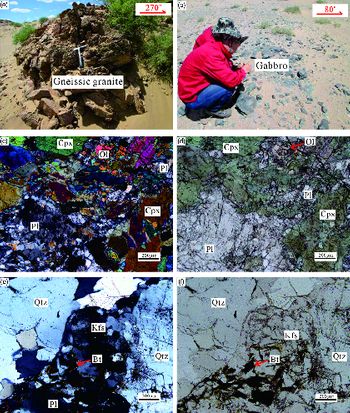
To achieve precise geochemical and geochronological results, in this study, fresh gabbro and granite samples from the Yagan MCC area in the north of the ZHTZ were collected. Field photographs of the gabbro and granite samples are shown in Figure 3a and Figure 3b, respectively. Detailed sampling locations are shown in Figure 2.
Field photographs and microphotographs of the gabbros and granites in the area of the Yagan MCC. (a) Field photographs of granitic rocks. Length of hammer for scale is ~30 cm. (b) Field photographs of gabbroic rocks. (c) Cross-polarized photograph of the gabbro sample 16YG-64. (d) Plane-polarized photograph of the gabbro sample 16YG-64. (e) Cross-polarized photograph of the granite sample 16YG-55. (f) Plane-polarized photograph of the granite sample 16YG-55. Abbreviations: Ol – olivine; Cpx – clinopyroxene; Pl – plagioclase; Qtz – quartz; Kfs – K-feldspar; Bt – biotite.

3.a.1. Gabbro
Six gabbro samples (16YG-62 to 67) were collected from the core of a 750 × 3000 m2 intrusive body (Fig. 2). The gabbro samples have been strongly deformed, showing orientation of plagioclase and clinopyroxene to some extent, and should be called microgabbro. They are black in colour and fine- to medium-grained rocks. The major minerals are plagioclase (± 45 %) and clinopyroxene (± 50 %), with very few olivine grains (± 5 %). Plagioclase is subhedral and has been altered. Clinopyroxene and olivine are euhedral compared to plagioclase and have also been altered to some extent (Fig. 3c, d).
3.a.2. Granites
Six granite samples (16YG-55 to 60) were collected from the core of a 1000 × 1750 m2 intrusion (Fig. 2). The samples have been strongly deformed, presenting a gneissic structure. They show foliation and stretching lineations defined by compositional banding of both K-feldspar and quartz crystals parallel to the regional extensional shear. The samples comprise mainly quartz (± 60 %), plagioclase (± 25 %), K-feldspar (± 10 %) and biotite (± 5 %). Quartz crystals usually present undulatory extinction due to ductile shear deformation. Biotite grains are irregular owing to secondary alteration and display preferred orientations (Fig. 3e, f).
3.b. Analytical methods
3.b.1. Major- and trace-element analyses
Analyses of major and trace elements were carried out at the Key Laboratory of Mineral Resources in Western China, School of Earth Sciences, Lanzhou University. Major elements were determined by inductively coupled plasma optical emission spectroscopy (ICP-OES) using a Leeman Prodigy system with an analytical precision greater than 2 %. Loss on ignition (LOI) was obtained by heating approximately 0.5 g of dried sample powder at 1000 °C for 2 hours. Trace elements were determined by inductively coupled plasma mass spectrometry (ICP-MS) with an Agilent 7700X instrument that was used to analyse solutions of the samples digested by HF + HClO4 acid in bombs. The US Geological Survey rock reference materials AGV-2 and BCR-2 were used for quality control. The relative standard deviation was less than 10 % for the determination of trace elements, including rare earth elements (REEs).
3.b.2. Zircon U–Pb dating
Separation of zircon crystals was completed using conventional heavy liquid and magnetic techniques, and these zircon grains were then mounted in epoxy resin and polished to approximately half thickness at Langfang Chenxin Geological Service Co., Hebei, China. Zircon grains presenting clear and less fractured rims in cathodoluminescence (CL) images were chosen as suitable targets for U–Pb dating. The U–Pb isotope ratios of selected zircons were measured using an Agilent 7500X ICP-MS instrument combined with a Geo-Las200M laser ablation (LA) system at the Key Laboratory of Mineral Resources in Western China, School of Earth Sciences, Lanzhou University. Zircon standard 91500 (Wiedenbeck et al. Reference Wiedenbeck, Alle, Corfu, Griffin, Meier, Oberli, Quadt, Roddick and Spiegel1995) was used as the age standard. Reference glass NIST 610 (Pearce et al. Reference Pearce, Perkins, Westgate, Gorton, Jackson, Neal and Chenery1997) and 29Si were applied as external and internal standards, respectively, during the process of analysing zircon element compositions. The spot diameter was ~30 µm. Data reduction was performed using the Glitter (ver. 4.0) program, and common Pb was corrected using the Common Lead correction (ver. 3.15) program (Andersen, Reference Andersen2002). Concordia plots were created and weighted mean ages calculated using the Isoplot (ver. 3.0) program (Ludwig, Reference Ludwig2003).
3.b.3. Whole-rock Sm–Nd and Lu–Hf isotopes
Whole-rock Sm–Nd and Lu–Hf isotope compositions were determined by a Nu Plasma II multi-collector (MC)-ICP-MS (Nu Instruments, UK) at the Key Laboratory of Mineral Resources in Western China, School of Earth Sciences, Lanzhou University. The US Geological Survey rock reference materials AGV-2 and BCR-2 were used as standard samples. During the process of measurement, JNDI and Alfa Hf standard solution were used for quality control of Nd and Hf, respectively.
4. Results
4.a. Major-element geochemistry
4.a.1. The gabbros
The major-element concentrations of the gabbros are presented in Table 1. The gabbros exhibit low contents of SiO2 (48.88–51.15 wt %), Na2O (1.15–2.47 wt %), K2O (0.42–0.67 wt %), TiO2 (0.36–0.55 wt %) and P2O5 (0.06–0.13 wt %) and high contents of CaO (11.87–13.77 wt %), Al2O3 (14.98–17.10 wt %) and total Fe2O3 (6.86–7.74 wt %). The Mg numbers (100*(Mg2+/(Mg2+ + Fe2+)), 68–69) are relatively high. All gabbro samples plot in the gabbro field on the (Na2O + K2O) versus SiO2 diagram (Fig. 4). They all belong to the metaluminous series (Fig. 5b, d) and present enrichments in Mg and Fe (Fig. 5a).
Major- and trace-element compositions (in ppm) and parameters of the granites and the gabbros in the Yagan MCC area

Total alkali (Na2O + K2O) versus silica (SiO2) diagram (Middlemost, Reference Middlemost1994).

(a) AFM diagram. A – Na2O + K2O; F – FeO + Fe2O3; M – MgO (Irvine & Baragar, Reference Irvine and Baragar1971). (b) Molar Na2O–Al2O3–K2O diagram. (c) K2O versus SiO2 diagram (Rickwood, Reference Rickwood1989). (d) A/NK versus A/CNK diagram (Maniar & Piccoli, Reference Maniar and Piccoli1989).

4.a.2. The granites
The major-element concentrations of the granites are presented in Table 1. The granites in this area show high concentrations of SiO2 (75.19–78.14 wt %) and low concentrations of total Fe2O3 (0.94–1.12 wt %), CaO (0.60–0.96 wt %), TiO2 (0.08–0.18 wt %) and P2O5 (0.01–0.06 wt %). The total alkali (Na2O + K2O) and Al2O3 concentrations are 7.70–8.80 wt % and 11.11–12.74 wt %, respectively. These samples plot in the granite field on the (Na2O + K2O) versus SiO2 diagram (Fig. 4), displaying high-K calc-alkaline (Fig. 5c) and metaluminous to weakly peraluminous affinities with moderate A/CNK (molar ratio of Al2O3/(Na2O + K2O + CaO)) values of 0.78 to 0.90 (Fig. 5b, d).
4.b. Trace-element geochemistry
4.b.1. The gabbros
The trace-element concentrations of the gabbros are shown in Table 1. As shown in the chondrite-normalized REE diagram (Fig. 6a), the gabbros from the region have low REE contents (34.51–51.15 ppm), displaying light REE (LREE) enrichment relative to heavy REEs (HREEs) (LREE/HREE = 3.58–4.32, (La/Yb) N = 3.23–4.32, (La/Sm) N = 1.91–2.44). These features are similar to those of enriched mid-ocean ridge basalt (E-MORB). In addition, the samples show negative Eu anomalies (δEu = 0.76–0.96), which can be attributed to the fractional crystallization of feldspar during the magmatic process. On the primitive mantle-normalized spider diagram (Fig. 6b), all samples present clear enrichments in large ion lithophile elements (LILEs; e.g. Rb, Ba, Sr, Pb and U) and depletions in Nb and Ta without evident Ti depletion.
Chondrite-normalized rare earth element patterns and primitive mantle-normalized multi-element diagrams of (a, b) the gabbros and (c, d) the granites, respectively. Data for chondrite and primitive mantle are from Sun & McDonough (Reference Sun, McDonough, Saunders and Norry1989).

4.b.2. The granites
The trace-element concentrations of the granites are shown in Table 1. On the chondrite-normalized REE diagram (Fig. 6c) all granites show strong LREE enrichments compared to HREEs ((La/Yb) N = 7.67–82.79). Four granite samples have negative Eu anomalies (δEu = 0.48–0.73), interpreted as resulting from the fractional crystallization of feldspar. They are all enriched in LILEs and depleted in high field strength elements (HFSEs; Nb, Ta and Ti) (Fig. 6d).
4.c. Zircon U–Pb ages
4.c.1. The gabbros
The U–Pb isotope analytical results for the zircons from a gabbro sample (16YG-66) are listed in Table 2. The dated sample weighed 20 kg, and ~300 zircon crystals were separated from the gabbro. Then, 25 zircon crystals from the gabbro sample were selected as suitable targets for U–Pb dating. They are generally euhedral with short columnar shapes. In the CL images (Fig. 7a), they exhibit obvious rhythmic zoning, which is characteristic of magmatic zircons (Hanchar & Rudnick, Reference Hanchar and Rudnick1995), and do not present the feature of inherited zircons, generally having igneous cores, namely inherited cores, and metamorphic or recrystallization rims (Hanchar & Rudnick, Reference Hanchar and Rudnick1995; Vavra et al. Reference Vavra, Gebauer, Schmid and Compston1996). Furthermore, the Th/U ratios of zircons from the gabbro vary from 0.35 to 1.03, which is consistent with a magmatic origin (Lei et al. Reference Lei, Shi and Liu2013). Twenty-five grains were analysed, 23 of which yield a weighted mean 206Pb–238U age of 282.2 ± 3.9 Ma (MSWD = 2.0), representing the crystallization age of this gabbro (Fig. 8a).
The zircon U–Pb dating results for the gabbro (YG-66) and the granite (16YG-60), determined by LA-ICP-MS

Cathodoluminescence (CL) images of zircons from (a) the gabbro and (b) the granite.

U–Pb concordia diagrams for zircons from (a) the gabbro and (b) the granite.

4.c.2. The granites
The U–Pb isotope analytical results for the zircons from a granite sample (16YG-60) are listed in Table 2. The dated sample of granite weighed 5 kg, and ~300 zircon crystals were separated from the granite. Twenty-five zircon crystals having euhedral and short columnar shapes were selected from the granite sample. They show oscillatory zoning in the CL images (Fig. 7b), which is a feature of magmatic zircons (Hanchar & Rudnick, Reference Hanchar and Rudnick1995). The high Th/U ratios (0.37–1.14) of these zircon crystals also indicate that the zircons have a magmatic origin (Lei et al. Reference Lei, Shi and Liu2013). Twenty-five analysed grains give a weighted mean 206Pb–238U age of 216.3 ± 3.2 Ma (MSWD = 2.5), which should be the granite crystallization age (Fig. 8b).
4.d. Nd–Hf isotope systems
The Nd and Hf isotope data of four gabbro samples (16YG-62–16YG-65) and four granite samples (16YG-55–16YG-58) are presented in Table 3. The εNd(t) and εHf(t) values were calculated based on the above determined zircon U–Pb ages. The gabbros show low εNd(t) values varying from −0.91 to −0.54 and positive εHf(t) values (2.59–6.37). Meanwhile, the granites are characterized by high εNd(t) values (1.55–1.99) and εHf(t) values ranging from 5.03 to 7.64.
Nd–Hf isotopic compositions of the granites and the gabbros, determined by MC-ICP-MS

5. Discussion
5.a. Characteristics of magma sources
5.a.1. The gabbros
The gabbros have high contents of Al, Ca, Mg and Fe and low contents of Si, K and P, suggesting a parental mantle source instead of crustal materials (Rudnick & Gao, Reference Rudnick and Gao2003). The whole-rock εNd(t) (−0.91 to −0.54) and εHf(t) (2.59 to 6.37) values suggest derivation from an enriched mantle source or a depleted mantle source with crustal contamination (Wu et al. Reference Wu, Li, Zheng and Gao2007). First, various element ratios (e.g. Th/Yb, Th/Zr, Ce/Yb and La/Yb) sensitive to crustal contamination can indicate whether such contamination occurred during their petrogenesis (Campbell & Griffiths, Reference Campbell and Griffiths1992, Reference Campbell and Griffiths1993; Baker et al. Reference Baker, Menzies, Thirlwall and MacPherson1997; Macdonald et al. Reference Macdonald, Rogera, Fitton, Black and Smith2001). The samples show positive correlations between Th/Yb and Th/Zr (Fig. 9a) and between Ce/Yb and La/Yb (Fig. 9b), which suggests contributions from crustal materials. Moreover, the gabbro samples have high values of Ba/Nb (69–931.59) and La/Nb (2.32–3.68) and low Ce/Pb (1.38–3.32) and Nb/U (1.51–4.85) ratios, which are all close to the continental crustal values (Jochum et al. Reference Jochum, Arndt and Hofmann1991; Zhu et al. Reference Zhu, Zeng, Li, Wang and Liu2018). These results conform well to a derivation from depleted mantle with crustal contamination. In addition, the samples have a low SiO2 content (49.89 %) and high Mg no. value (69), which indicate that the gabbro source was not significantly affected by the crustal materials.
(a) Th/Zr versus Th/Yb and (b) La/Yb versus Ce/Yb diagrams for the gabbros.

On the chondrite-normalized REE diagram (Fig. 6a), the gabbros are characterized by enrichments in LREEs, which is similar to the pattern of E-MORB (Sun & McDonough, Reference Sun, McDonough, Saunders and Norry1989). On the primitive mantle-normalized trace-element diagram (Fig. 6b), the gabbros show enrichments in LILEs and depletions in HFSEs, with markedly negative Nb–Ta and slightly negative Zr–Hf anomalies, which show arc geochemical affinities (Woodhead et al. Reference Woodhead, Eggins and Johnson1998; Martin, Reference Martin1999) and imply that the magma source was influenced by slab-derived hydrous fluids or sediment-derived melt (Davidson, Reference Davidson1987). The gabbro samples show high contents of Al2O3 (14.98–17.10 wt %) and low contents of TiO2 (0.36–0.55 wt %) and P2O5 (0.06–0.13 wt %), which is different from typical within-plate basalts (WPB) but more similar to arc basalts (Zhou et al. Reference Zhou, Wu, Ge, Sun, Abdel-Rahman, Zhang and Cheng2005). Moreover, Xia et al. (Reference Xia, Xia, Xu, Li and Ma2007) proposed that magmatic rocks influenced by subduction fluids/melts usually present low Zr contents (< 130 ppm) and Zr/Y ratios (< 4). The gabbro samples have low concentrations of Zr, with an average content of 43.07 ppm, and a low ratio of Zr/Y, at 3.44. As a result, we infer that the gabbro source underwent subduction fluid/melt metasomatism. Overall, we conclude that the magma source of the gabbro samples was depleted mantle influenced by subduction fluids/melts and slightly affected by crustal materials.
5.a.2. The granites
The granite samples have high contents of SiO2 (75.19–78.14 wt %) and K2O (4.92–5.87 wt %) and low contents of MgO (0.08–0.15 wt %), Al2O3 (11.11–12.74 wt %), TiO2 (0.08–0.18 wt %) and P2O5 (0.01–0.06 wt %). They belong to the high-K calc-alkaline series and are metaluminous to weakly peraluminous. The samples present enrichments in LREEs and LILEs (Rb and K), depletions in HFSEs (Nb, Ta and Ti) and negative Eu anomalies (0.48–0.73) except for two samples that show slightly positive Eu anomalies, which is probably related to the existence of plagioclase crystals in their mineralogical composition. The 10000*Ga/Al ratios are high, ranging from 2.55 to 3.52. Furthermore, the granites have low Rb contents (< 220 ppm) and high Zr saturation temperatures (954–1131 °C) (Miller et al. Reference Miller, McDowell and Mapes2003). There features are more similar to those of A-type granites. On some discrimination diagrams for A-type granites (Fig. 10), the samples plot mainly in the A-type field. Therefore, we conclude that these rocks are A-type granites (Jia et al. Reference Jia, Wang and Tang2009). The whole-rock Nd–Hf isotope compositions can be used to constrain the source and petrogenesis of these magmatic rocks (Li et al. Reference Li, Wang, Wilde and Tong2013). The granite samples in the study area have relatively high values of εNd(t) (1.55–1.99), which are different from the Precambrian basement rocks with markedly negative εNd(t) values (−11) in the area of the Yagan MCC (Wang et al. Reference Wang, Zheng, Li and Gao2004). These results suggest a crust–mantle magma mixing process in their petrogenesis. In addition, they have positive εHf(t) values (5.03–7.64), which indicate contributions from mantle materials (Wu et al. Reference Wu, Li, Zheng and Gao2007). Wang et al. (Reference Wang, Zheng, Liu, Li and Ma2002) documented a mylonitic potassic granitic pluton with a zircon U–Pb isotope age of 228 Ma in the area of the Yagan MCC, which shows the characteristics of A-type granite and was derived from the mixing of mantle and crust sources. Overall, the parental magma of the granites was most likely derived from mixing crust and mantle materials.
Chemical classification diagrams: (a) Zr versus 10000Ga/Al; (b) Nb versus 10000Ga/Al; (c) Ce versus 10000Ga/Al; (d) Y versus 10000Ga/Al (after Whalen et al. Reference Whalen, Currie and Chappell1987).

5.b. Tectonic setting
5.b.1. The gabbros
The tectonic setting during the formation of the early Permian magmatic rocks in the north of the ZHTZ remains controversial. Some authors suggested an active continental margin setting (Wu et al. Reference Wu, He and Zhang1998; Liu et al. Reference Liu, Zhao, Han, Li, Zhu, Eizenhöfer, Zhang, Wang and Tsui2018), whereas others argued for a postcollisional setting (Dang et al. Reference Dang, Zhao, Lin, Wu, Kang, Ge, Wu and Liu2011; Zheng et al. Reference Zheng, Wu, Zhang, Feng, Xu, Meng and Zhang2013; Zhang et al. Reference Zhang, Pease, Meng, Zheng, Wu, Chen and Gan2017; Fei et al. Reference Fei, Pan, Xie, Wang and Zhao2019). This controversy partly results from insufficient petrogenetic constraints on the coeval mafic magmatic rocks that are more sensitive in defining key phases of tectonic environments compared to felsic rocks. We suggest that the gabbros should have formed in an active continental margin tectonic setting. In the field, the gabbros scattered within the study area have been strongly deformed, showing orientation of plagioclase and clinopyroxene to some extent. They formed dykes, most of which are cut by normal faults resulting from the extensional deformation of the crust in this region (Fig. 2; Zheng & Zhang, Reference Zheng and Zhang1994; Wang & Zheng, Reference Wang and Zheng2002; Wang et al. Reference Wang, Zheng, Liu, Li and Ma2002). That implies that the formation of the gabbro plutons was prior to the extensional event occurring after the closure of the PAO in study area. The geochemical compositions of gabbro samples can be used to indicate their tectonic setting. Wang et al. (Reference Wang, Wilde, Xu and Pang2016) proposed that arc basalts are characterized by prominent negative Zr–Hf and positive Sr anomalies on primitive mantle-normalized trace-element patterns. The gabbros have these signatures that are different from arc-like continental basalts. Arc basalts can be distinguished from arc-like intracontinental basalts using various tectonic environment discrimination diagrams (Xia et al. Reference Xia, Xia, Xu, Li and Ma2007; Wang et al. Reference Wang, Wilde, Xu and Pang2016). All the samples plot in the fields relevant to arc basalts on these diagrams (Fig. 11). Moreover, coeval granitic rocks showing arc-like geochemical affinities have also been reported in the north of the ZHTZ (Liu, Reference Liu2015; Ren, Reference Ren2015; Yan et al. Reference Yan, Chen, Fan, Ren, Jiang, Lv, Zhao and Fan2015; Liu et al. Reference Liu, Zhao, Han, Li, Zhu, Eizenhöfer, Zhang, Wang and Tsui2018). For example, the 298–290 Ma granitic rocks located near the Guaizihu area were generated by magma mixing and formed in a subduction setting (Liu et al. Reference Liu, Zhao, Han, Li, Zhu, Eizenhöfer, Zhang, Wang and Tsui2018). Finally, Wu (Reference Wu2014) argued that southward subduction, recorded by andesites, occurred in the Mongolia–China border area during late Carboniferous to early Permian times. In conclusion, the early Permian gabbros are interpreted to represent an active continental margin tectonic setting.
Tectonic environment discrimination diagrams for the gabbros: (a) Ti versus Zr (Pearce, Reference Pearce and Wyman1996 a); (b) Zr/Y versus Zr (Pearce & Norry, Reference Pearce and Norry1979); (c) Zr/Sm–Sr/Nd–Ti/V (Wang et al. Reference Wang, Wilde, Xu and Pang2016); (d) V versus Ti (Shervais, Reference Shervais1982). MORB – mid-ocean ridge basalts; WPB – within-plate basalts; IAB – island-arc basalts; IAT – island-arc tholeiites; BABB – back-arc basin basalts; OIB – ocean-island basalts; AB – alkali basalts.

5.b.2. The granites
We suggest that the granites formed in a postcollisional setting. Various tectonic setting discrimination diagrams can be used to infer the tectonic environment of the granites. All the samples plot in the postorogenic granite field on the Al2O3 versus SiO2 and FeOt/(FeOt + MgO) versus SiO2 diagrams (Fig. 12a, b). Moreover, the granites also plot in the postorogenic granite field on the R1 versus R2 diagram (Fig. 12c). The granite samples plot in the volcanic arc granite (VAG) or syncollisional granite (syn-COLG) areas on the Rb versus Y + Nb diagram (Fig. 12d). Pearce (Reference Pearce1996 b) proposed that the Rb versus (Nb + Y) diagram reflects the sources of granites and that variable mixtures of mantle- and crust-derived magmas may cause the postcollisional granites to plot in the VAG or syn-COLG areas. Furthermore, previous studies that focused on voluminous early Mesozoic granitic rocks exposed in the area of the Yagan MCC (Wang et al. Reference Wang, Zheng, Liu, Li and Ma2002, Reference Wang, Zheng, Li and Gao2004) and its adjacent areas, including Beishan (Li et al. Reference Li, Wang, Wilde, Tong, Hong and Guo2012, Reference Li, Wang, Wilde and Tong2013), suggested that these granitic rocks were generated in a postcollisional setting after the closure of the PAO. These features suggest that the granites formed in a postcollisional tectonic setting. In addition, the granites intrude the Precambrian metamorphic rocks in the area of the Yagan MCC along normal faults, which developed as a result of the extensional deformation of the crust in this area (Zheng & Zhang, Reference Zheng and Zhang1994). The granite samples have been strongly deformed, showing foliation and lineations parallel to the regional extensional shearing. The lineations are defined by compositional banding of both K-feldspar and quartz crystals, which is characteristic of syntectonic granites experiencing syn-emplacement extensional deformation (Wang et al. Reference Wang, Zheng, Liu, Li and Ma2002). We infer that the collisional event resulting from the closure of the PAO during late Permian to Early–Middle Triassic times caused crustal thickening in the Yagan MCC area and that delamination of the mantle lithosphere subsequently took place. Upwelling asthenosphere ascended to shallow mantle depths and generated mafic magmas that provided heat and materials to the crust; then, the mantle- and crust-derived magmas mixed (Liu et al. Reference Liu, Zhao, Han, Li, Zhu, Eizenhöfer, Zhang, Wang and Tsui2018). The extensional faults started to develop as the magma was emplaced upwards. This explanation is also consistent with the sedimentary records in the Yagan MCC area. In conclusion, we infer that the Late Triassic granites should have formed in a postcollisional tectonic setting.
Tectonic environment discrimination diagrams for the granites: (a) Al2O3 versus SiO2; (b) FeOt/(FeOt + MgO) versus SiO2 (after Maniar & Piccoli, Reference Maniar and Piccoli1989); (c) R1 versus R2 (after Batchelor & Bowden, Reference Batchelor and Bowden1985); (d) Rb versus Y + Nb (Pearce, Reference Pearce1996 b). IAG – island arc granite; CAG – continental arc granite; CCG – continental collisional granite; POG – post-orogenic granite; RRG – rift-related granite; CEUG – continental epeirorgenic uplift granite; WPG – within-plate granite; VAG – volcanic arc granite; syn-COLG – syncollisional granite; ORG – oceanic ridge granite.

5.c. Tectonic implications for the northern Alxa area
The study area is situated in the north of the ZHTZ. In early Palaeozoic time, the region was probably a passive continental margin, because this area received continuous sedimentation of clastic rocks accompanied by carbonate rocks with abundant Dalmanites fossils (Wu & He, Reference Wu and He1993). However, volcanic activity occurred during late Palaeozoic time. As a result, the region was transformed into an active continental margin during late Palaeozoic time (Wu et al. Reference Wu, He and Zhang1998; Zheng et al. Reference Zheng, Wu, Zhang, Feng, Xu, Meng and Zhang2013).
Based on the geochemical and geochronological characteristics of the magmatic rocks exposed in the northern Alxa area, some authors argued that the late Palaeozoic volcanic activity in this region was related to the northward subduction of the PAO represented by the Enger Us ophiolitic belt (Liu et al. Reference Liu, Zhao, Sun, Han, Eizenhöfer, Hou, Zhang, Zhu, Wang, Liu and Xu2016, Reference Liu, Zhao, Han, Eizenhöfer, Zhu, Hou, Zhang and Wang2017; Zhang et al. Reference Zhang, Pease, Meng, Zheng, Wu, Chen and Gan2017). The Enger Us ophiolitic belt is widely accepted to represent the major suture of the PAO in the Alxa area, and the Quagan Qulu ophiolitic belt represents a back-arc basin. These two ophiolitic belts, together with the arc in the ZSTZ, are considered a late Palaeozoic ocean–arc–back-arc basin system related to the southward subduction of the PAO represented by the Enger Us ophiolitic belt (Zheng et al. Reference Zheng, Wu, Zhang, Xu, Meng and Zhang2014). However, no evidence, such as tectonic deformation, magmatic activity or the sedimentary record, supports the northward subduction of the PAO represented by the Enger Us ophiolitic belt. Therefore, we conclude that the southward subduction of the PAO represented by the Yagan Fault Belt, which is located to the north of the study area and represents an important boundary according to the comparable lithologies on the southern and northern flanks of the boundary (Zhang et al. Reference Zhang, Pease, Meng, Zheng, Wu, Chen and Gan2017; Liu et al. Reference Liu, Zhao, Han, Li, Zhu, Eizenhöfer, Zhang, Wang and Tsui2018), occurred during late Palaeozoic time and was responsible for the late Palaeozoic volcanic activity in the northern ZHTZ.
Zhang et al. (Reference Zhang, Pease, Meng, Zheng, Wu, Chen and Gan2017) documented a Late Devonian monzogranite in the Wudenghan area (Fig. 1b), which is located in the northern ZHTZ, and thought that it probably represents a highly fractionated VAG. Fan (Reference Fan2015) proposed that the late Carboniferous volcanic rocks in the Guaizihu area (Fig. 1b) formed in an active continental margin setting. Combining our results with those of previous studies, we conclude that the oceanic crust represented by the Yagan Fault Belt began to subduct southwards beneath the study area at least in Late Devonian time and that the southward subduction still occurred in early Permian time, as proven by the gabbros in this study and other coeval granitic rocks showing arc-like geochemical affinities. Furthermore, the final closure of the ocean more likely occurred in late Permian to Early–Middle Triassic times. First, in the study area, the extensional structure recorded by the Yagan MCC occurred in Late Triassic time (Wang et al. Reference Wang, Zheng, Liu, Li and Ma2002). Second, the Late Triassic granitic rocks exposed in the study area and adjacent regions, including Beishan, formed in a postcollisional setting (Wang et al. Reference Wang, Zheng, Liu, Li and Ma2002; Li et al. Reference Li, Wang, Wilde, Tong, Hong and Guo2012, Reference Li, Wang, Wilde and Tong2013). Moreover, the study area is the southern continuation of the Tsagaan Uul terrane (Wang et al. Reference Wang, Zheng, Gehrels and Mu2001), which may represent part of the South Gobi microcontinent (Badarch et al. Reference Badarch, Cunningham and Windley2002). Heumann et al. (Reference Heumann, Johnson, Webb, Taylor, Jalbaa and Minjin2012) argued that the Permian and Triassic deposits in the terrane contain a sedimentary record of the final closure of the PAO, which appears to support the late Permian to Early–Middle Triassic amalgamation between the YTZ and the north of the ZHTZ. The upper Permian rocks experienced folding and lower greenschist-facies metamorphism, while the Upper Triassic rocks are characterized by terrestrial redbeds and conglomerates and did not experience regional metamorphism (Zheng & Zhang, Reference Zheng and Zhang1994; Johnson et al. Reference Johnson, Amory, Zinniker, Lamb, Graham, Affolter, Badarch, Draut, Clift and Scholl2008; Heumann et al. Reference Heumann, Johnson, Webb, Taylor, Jalbaa and Minjin2012). Overall, the PAO represented by the Yagan Fault Belt started to subduct southwards at least by Late Devonian time, and the timing of the final closure of the ocean should be the late Permian to Early–Middle Triassic period.
In conclusion, the late Permian to Early–Middle Triassic was a critical period marking the timing of the final closure of the PAO in the northern Alxa area. This inference agrees with integrated magmatic, structural and sedimentary studies in the northern Alxa area. Therefore, we infer that the final closure of the branch of the PAO in the northern Alxa area took place during late Permian to Early–Middle Triassic times. This study does not support the interpretation that the PAO finally closed in Late Devonian–Permian times but instead implies that the final closure of the central part of the PAO in the southern CAOB took place in late Permian to Early–Middle Triassic times.
6. Conclusions
-
(1) The early Permian gabbros were derived from a depleted mantle source metasomatized by subduction fluids/melts, and crustal contamination was involved during the processes of magma migration and emplacement. The gabbros probably formed in an active continental margin tectonic setting in response to the southward subduction of oceanic crust represented by the Yagan Fault Belt.
-
(2) The Late Triassic granites were derived from the mixing of mantle and crustal materials. These granites formed in a postcollisional tectonic setting following the closure of the ocean represented by the Yagan Fault Belt. The area in the northern ZHTZ entered the postcollisional extensional stage in Late Triassic time.
-
(3) In early Palaeozoic time, the area in the northern ZHTZ was a passive continental margin. At least by Late Devonian time, the region changed to an active continental margin in response to the southward subduction of the branch of the PAO represented by the Yagan Fault Belt. The final closure of the PAO in the central part of the southern CAOB occurred in late Permian to Early–Middle Triassic times.
Acknowledgements
The study is supported by the Fundamental Research Funds for the Central Universities (No. Lzujbky-2018-it20) and the China Geological Survey (No. 121201011000161111-01).