Here are the tales currently told: in 1898, the Danish engineer Valdemar Poulsen invented magnetic recording while trying to create the world's first answering machine. Locking himself in a room with his apparatus while yelling ‘Yakob, Yakob’ into a microphone for hours on end, he would eventually create the telegraphone, though it never found commercial success. Thirty years later, an opera-loving inventor, Fritz Pfleumer, responded to the boom in the German cigarette market by designing a cheap, bronze version of the conspicuous gold leaf band that marked high-class cigarettes. He replicated the same process, gluing iron particles onto narrow strips of paper, which he called ‘tönendes Papier’, or sounding paper, the first instance of magnetic tape that could record and playback sound. During the Second World War, Jack Mullin, a soldier in the US Signal Corps, stayed up late at night listening to German orchestral music he deemed too good to be pre-recorded. After the war, he collected working magnetophons, the Nazi-era German tape recorders responsible for the late-night music, took them home and reproduced them. In the years that followed, Bing Crosby, tired of recording two live shows every night for national broadcast, bankrolled Mullin's work with the Ampex corporation to fine-tune tape recording. The fruit of Crosby and Mullin's collaboration, amplified by American capitalism, was magnetic tape recording very much as we know it today – not only for sound but also video, multitrack recording, computer drives, airplane black boxes, and credit cards. Tape proved to be profoundly fungible, usable well beyond the realm of audio recording. Meanwhile, the Soviet Union had also taken tapes and tape recorders as a spoil of war, made most visible in the 1960s when they began releasing wartime recordings of German orchestral music, especially recordings made by Wilhelm Furtwängler, in the 1960s. These tapes would only be repatriated as the Cold War drew to a close in the late 1980s and 1990s.Footnote 1
Rather than disentangling the musicological here from the history of science and technology, I keep these strands intertwined by focusing on the particularities of Fritz Pfleumer's sounding paper, and on its dramatic consequences for tape's early usage. In short, Pfleumer hit upon a radical form of superfice, or focus on media surfaces, that forged new possibilities for creating selective memory within sound media. This superficial, selective memory was ideally suited to reconfiguring time (including both stretching and repetition/looping); to erasure and reuse; and to cutting and splicing. While these three affordances of tape were not always unique to any single place or time, I suggest that each one, respectively, relates closely to a particular historical and geographical moment: Nazi Germany, from 1933 to 1944; the Soviet Union, from the final offensive of the Second World War into the 1960s; and the United States from roughly 1945 to 1950. The particular histories of tape recording's circulation in the Soviet Union and the United States may even suggest a kind of technological exorcism of the ghosts of fascism: in Moscow, tape was quickly embraced by the state apparatus and the treasured Furtwängler recordings would only be released on the official state label (and even then, only after more than a decade had passed); and in America, the tape recorder bloomed in California, splitting time between the tech hubs of the Bay Area and major Hollywood studios, becoming a materialized form of American capitalism and entertainment.
But again, at the root of these particular sonic, sociopolitical uses of tape lies a certain set of technological affordances that were explored and exploited – affordances which emerged from the particular nature of tape recording and its largely unprecedented technical superfice. My argument here about tape, and especially audiotape, resonates strongly with Lucas Hilderbrand's Inherent Vice, in which he argues that the technical affordances of videotape encouraged certain cultural practices such as bootleg recording.Footnote 2 What he characterizes as ‘inherent’ to (i.e., within) tape, I locate more specifically upon the surface of tape – its superfice. But these tapely characteristics are not just circumstantially related: within the context of a presumed longer history of ‘sound recording’, this superfice highlights the possible (but productive!) rupture magnetic tape creates between medium-as-carrier and medium-as-data. This rupture all but demands the recording of other forms of data on tape, which is precisely what happened in the early years of tape: by the early 1950s, tape was used to store not only audio data, but also that of computers and video. Such data is not inscribed, but rather glued and magnetized once-upon-time – upon an unspooling flow of tape – waiting to be looped or stretched, erased, or spliced-out, and then re-recorded upon that same strip of sonic time.
In praise of superfice
Tape is often described as if it were one in a parade of sound recording technologies, from the phonograph and gramophone to the wire recorder to the tape recorder (or perhaps straight to cassettes) and on to DATs, CDs, and MP3s. Somehow, these devices, we fancy, share something substantial – something familial – that binds them together. After all, they all ‘capture sound’, to use Mark Katz's evocative phrase.Footnote 3
Yet tape is not like other sound recording technologies. Its media logics diverge considerably from a generic history of sound recording technologies,Footnote 4 and I would argue that much of that divergence stems from Pfleumer's design of sounding paper, and particularly the way it deals with surface – or superfice, things that sit upon the surface. This uponness of tape, as opposed to the grooves cut into Edison cylinders or gramophone discs, or the charge of the wire itself in wire recordings, arises from Pfleumer's idea to affix iron particles on top of paper, initially, and then on cellulose acetate. This non-inscribed, upon-the-surface form of captured sound had a number of implications for tape, including the possibilities, again, of looping/repeating, cutting/splicing, and erasing/reusing. But all of these seem to emerge from an ethos of anti- or at least non-inscription – an embrace of the cheap, reusable, and spoolable qualities of tape. These traits of tape do allow sonic data to be preserved, but they also call attention to the fact that not everything that was preserved (i.e., recorded) should be preserved forever (i.e., saved). Sonic memory and storage, from then on, could be aggressively selective.
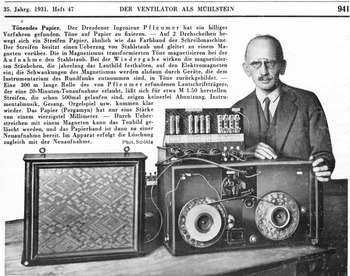
This techno-ideology of selective preservation located upon-the-surface of tape appears to have emerged gradually for Pfleumer and his ‘sounding paper’, or tönendes Papier. An early advertisement for the trade journal Die Umschau from 1931 – three years after Pfleumer's first patent but four years before the public debut of a functioning tape recorder – shows some of the early preoccupations and affordances already understood (Figure 1). Strikingly, it focuses on process and materiality:
Sounding Paper. Pfleumer, the engineer from Dresden, has found a cheap process to fix sounds [Töne] on paper. – A strip of paper, similar to the ink ribbon of a typewriter, moves on two spools. The strip has a coating [Ueberzug] of metal filings and passes over a magnet. The sounds, transformed into magnetism, pass on their charge to the metal filings during recording. During playback, the small magnetized particles, which can hold a sound-image [Lautbild] for years, interact with the electromagnet; the fluctuations in the magnetic charge are then recreated [zurückgebildet] as sounds by equipment that borrow from the machinery of radio broadcasting. – A 300-meter roll of the sound-writing carrier [Lautschriftträger] invented by Pfleumer, which allows for up to 20 minutes of sound recording, can be produced for around 1.50 Marks. Strips, which have already run 500 times, show no signs of wear. Instrumental music, song, organ music, etc., come back clearly. The paper (Pergamyn, or Glassine) is only 1/40th of a millimeter thick (.025 mm). – By passing back over with a magnet, the sound-image [Tonbild] can be erased, and the paper strip is ready for a new recording. In the apparatus, erasing takes place at the same time as the new recording.Footnote 5
Advertisement for ‘sounding paper’, Die Umschau (1931), 37, 941.

The advertisement exhibits several tensions within itself, especially as to whether Pfleumer's invention is a new medium altogether or is more an extension of other media. The opening words alone – ‘sounding paper’ – point to this tension. On the one hand, paper was hardly a new media object or surface. A hasty reading might leave a reader understanding magnetic tape as another kind of writing. And yet paper is doing something quite different here. First, it is not the site of writing or inscription itself, but rather a base layer upon which other layers can be placed, especially the coating, or Ueberzug – literally that which goes on top of (something else) – in this case, made up of metal filings.
In addition, this description borrows heavily from other media and media practices besides paper-based writing: the paper is comparable to typewriter ribbon; tape is a ‘sound-writing carrier’ (Lautschriftträger); and sound is preserved as a kind of image (Lautbild, Tonbild). The tape recorder would only be named the ‘magnetophon’ in 1934 as it approached its hoped-for public debut,Footnote 6 and these media analogies offer some insight into how tape was understood prior to that, both conceptually (i.e., how it functioned) and physically (i.e., how it physically appeared). The name ‘magnetophon’ is no less telling, suggesting that by 1934 the tape recorder was understood both as a sound (-phon, phōnē) recording device and as a part of a magnetic recording (magneto-) history that threaded through Paulson's wire recorder and later metal-tape recorders of the 1920s.Footnote 7
Finally, although the possible uses of tape and tape recording remained largely theoretical in 1931, the advertisement already emphasizes certain key affordances, including duration (20 minutes), affordability/cheap production, durability, thickness, and erasure and reusability. Within a few years, an expanded list of potential or actual uses – time stretching, looping, delay – would be added in the aftermath of the magnetophon's 1935 debut, but these foundational operations give some sense of the ways in which tape's superfice was readily deployed to concrete media ends:
-
• Erasure and reuse. Because tape recording did not inscribe, tape was, like a chalkboard, primed for erasure and reuse. Granted, wax cylinders could also be scraped or shaved, then re-used, but the degradation of the recording medium is then far more pronounced than with tape.Footnote 8 As the 1931 ad already shows, the pass of a magnet could recalibrate the tape surface and simultaneously re-record. Erasure could be selective diachronically but not synchronically (i.e., minutes 4–6 of a recording could be erased, but only in their entirety), leaving a temporal index intact (i.e., minute 7 still follows). Nevertheless it pointed to more radical breakdowns of time to come.
-
• Cut and splice. ‘Sounding paper’ tore easily, a flaw that soon became a feature once reparative glues were developed to enable intentional cutting and splicing on the model of film. But at this point, the phonographic real – the idea that minute 7 included all the sound happening in minute 7, not just semantic sound – touted by commentators from early psychoanalysts to contemporary media theorists, and its indexical time – that minute 7 comes after minute 6 – were traded for a profound capacity for re-ordering. This was, in other words, composing: a literal putting-next-to of these fragments of sound-upon-tape in any sequence with material discarded as desired. Real sound gave way to concrete music.
-
• Repeat (with difference). Reconfigured in a certain way, two cuts plus a splice equals a loop, a fragment of tape endowed with infinitude as the result of its potential for being discarded. But precisely because of its exactness, that looping repetition points to the encroaching difference of entropy, from the shifting perception of the listener's ear to the eventual degradation of the medium itself (contrary to Pfleumer's ads). Counter-intuitively, only a perfect mechanical repetition renders this perpetual slippage of time audible.
-
• Time (expand, unfold, stretch). The question of tape's time begins not with the loop but the spool – or the un-spool. Most basically, spooled ‘sounding paper’ extended the fundamental unit of recordable time from roughly four minutes to twenty-two, a seismic shift for recording symphonic music and opera. But war brought intensified developments, including the Tonschreiber B (discussed below), a tape recorder that exploited the radial time of spooling to create time-stretching; that is, it extended time without affecting pitch, the gold-standard of time axis manipulation.Footnote 9 From then on, frequency and time were effectively decoupled.
The tangle of these foundational operations of tape sets the stage for their eventual – if always selective – usage in the auditory culture of Germany, the Soviet Union, and the United States.
Time I: technics of tape in Nazizeit (1933–1939)
On 19 November 1936, Sir Thomas Beecham and the London Philharmonic Orchestra made the first-known tape recording of a concert in the employees’ auditorium at an I.G. Farben chemical factory in Ludwigshafen, Germany, featuring music by Vaughan Williams, Mozart, Delius, and Rimsky-Korsakov in the first half, then Dvořák's Symphony No. 4 in the second.Footnote 10 The event highlights and brings together two different components of the emergent time of tape. First, musical time: continuous performance could be recorded for over twenty minutes straight, thus exponentially increasing the standard temporal unit of measure from the four-minute 78 rpm record. And second, technical time: there were both occasions for testing, but also a set of temporal questions used to test, measure, and further refine tape. Other such occasions include the 1935 debut of the magnetophon at the International Radio Exhibition, as well as a 1941 exhibition/programme at the Ufa Palast am Zoo in Berlin, featuring recorded performances by Wilhelm Furtwängler and others.Footnote 11 Conductors such as Furtwängler and, to a more limited degree, Herbert von Karajan, recorded extensively in the early years of tape – often in the context of radio broadcasts recorded without break, whether for live or delayed broadcast. These recordings largely took place in 1940–4, after the invention of AC biasing, which dramatically improved the quality of music recordings. But a number of other time-centric technics of tape also emerged in its earliest years, often not just as an application of tape technology but as part of the process of creating and testing tape, a kind of processual loop (invent, test, record) mirroring the actual loops of tape. And while tape is perhaps not a clearly ‘Nazi technology’ per se – such a determination merits a study of its own – this entire process was threaded throughout the years of Nazizeit, the period of the Third Reich.Footnote 12
One of the earliest and most striking examples of such tape-based technics of time is the creation of tape loops. Musicologists might intuit that the tape loop originates in the work of early electroacoustic studios.Footnote 13 But in fact, the tape loop is effectively coeval with tape itself: it not only predated electroacoustic composition but was also a critical tool for the earliest tests of tape and tape recorders.
After Pfleumer's initial discoveries and patents, he contracted in 1932 with AEG, a German electronics company, to help him build the first working tape recorders. They in turn contacted I.G. Farben, a major chemical conglomerate – later and better known as BASF – that would take over the creation of tape stock. (I.G. Farben's product portfolio during the same period as tape's development included Zyklon B gas, notoriously used in Nazi concentration camps.Footnote 14 ) Both companies built tape loops to test their work-in-progress, as BASF engineer and historian Friedrich Engel writes: ‘the AEG team initially tried to produce both recorder and tape . . . For test purposes, they built an endless-loop apparatus on which a 12-meter-long tape circulated.’Footnote 15 I.G. Farben similarly used looping to test their tape products, using ‘a simple arrangement of razor blades . . . to cut the strip into 5 mm wide tapes, which were spliced to form an endless loop’.Footnote 16 Engel underscores the necessity of building a testing apparatus (of which the loop was a critical part) in tandem with the development of tape recording and tape itself: ‘Lack of efficient measuring equipment presented one of the first obstacles to be solved by [the team at I.G. Farben]. They and other scientists developed measuring devices to establish the important electronic, magnetic, and mechanical quality parameters, which they often first had to define.’Footnote 17 In contrast to the aestheticization of the loop that would follow in tape music, the loop here functioned as an ‘epistemic thing’ – a technological object that not only answered particular test questions about tape but also facilitated the understanding of the unusual temporal possibilities that were readily producible with tape.Footnote 18 Put differently, the tape loop preceded tape as a functional medium.
A second set of temporal technics that emerged from the early production of tape, at least conceptually, includes tape delay and manipulating tape speed. These ideas appear to have emerged in response to the first public demonstration of the magnetophon at the 1935 International Radio Exhibition in Berlin. It was warmly received – ‘the “hit” of the show’ – and simultaneously understood as a replacement for the phonograph and also a site for new technological possibilities:
The dealers . . . realized the many important applications of the machine, including its use as a dictation and news-gathering device, as well as the perfect replacement for phonograph records . . . Many people indicated their desire to see variations of the Magnetophon: combined with a telephone; an auxiliary unit for a radio; prerecorded music and entertainment tapes; a special version to create artificial reverberation for open-air concerts; feedback control for indoor performances with sound reinforcement; a device for ‘speed telephoning’, that is, recording a speech at normal speed, playing it back over the phone at a higher speed with the recorder on the other end of the line also working at the increased speed, and then playing back the tape at a normal speed.Footnote 19
Two of these suggested ‘variations’ of the magnetophon stand out for their temporal qualities: artificial reverberation for open-air concerts, effectively a carefully controlled kind of tape delay, a later mainstay of tape recording; and ‘speed telephoning’, which would in fact more than double the total time of a telephone conversation (speech at regular speed, play/record at high speed, listening at regular speed). In both cases, the distinction between time and space begins to blur through tape. They also both incorporate tape into live performance – two hallmarks of early electroacoustic tape music.
A third instance of temporal technics is both more politically fraught and more historically significant: the first time-stretching audio playback device, built for the German army. By 1939, AEG was producing tape recorders for military contracts,Footnote 20 including its Tonschreiber B, a forerunner of granular synthesis and digital audio sampling that could change playback speed without a corresponding shift in frequency (or pitch). It had a special playback device (called the Dehner, or stretcher) with four heads. Dick Rollema describes its playback as follows: ‘When a speech recording is replayed at a lower tape velocity, the drum with the four heads is spun by the motor at such speed that the relative velocity of the tape with respect to the head in contact with it is equal to the original velocity at recording. Therefore, speech is slowed down without affecting the pitch of the voice!’Footnote 21 Rollema continues his description, thinking about the potential to play tape backwards while it moves forward (i.e., in its usual direction):
It is intriguing to consider what exactly happens when Dehner is used. Obviously, the same piece of tape is scanned several times, with consecutive scans more or less overlapping. To me the most surprising fact is that Dehner rotates in such a direction that the heads move in the same direction as the tape. So when revving up Dehner, relative velocity of tape versus heads first decreases, then becomes zero, and then reverses! The tape therefore is scanned backwards!Footnote 22
After the war, this same basic principle would serve as the basis for Dennis Gabor's idea of using a film projector (or hypothetically, he writes, a tape recorder) taking ‘quantum’ samples of sound at a different speed than the original.Footnote 23 These proto-digital playback systems of analogue material are striking for their temporal manipulations – again, this is a far more drastic shift in the time axis manipulation than simply reversing playback, instead playing back at negative velocity relative to the tape in order to make possible such time-stretching.
Time II: recording music in Nazizeit (1936–1945)
In addition to these technical operations, the temporality of tape was also developing in sonic practice: through recording music. The earliest history of tape-recorded music is perhaps most closely associated with the two highest-profile conductors active during the Third Reich: Wilhelm Furtwängler and Herbert von Karajan. While their attitudes towards technology differed dramatically, their experiences in shifting from recording for 78 rpm records to tape illustrate just how dramatic a rupture this new era was. Paradoxically, if only because of his seniority, Furtwängler, who was reputed to be vaguely technophobic in recording contexts, was especially important to this historical moment, while Karajan, who made a point of staying at the forefront of technological advancements in recording from the LP to the CD, was a relatively minor character.
Both conductors found recording 78s unwieldy, especially because it required them to artificially segment music in blocks of roughly four minutes to fit on one side of a 12-inch 78 disc. Despite having an ‘antipathy toward the recording studio’,Footnote 24 Furtwängler understood the potential of recording, writing in Ton und Wort: ‘The practical significance of radio and recordings cannot be overestimated. Their time has come. For music, they possess the possibility of popularizing music enormously.’Footnote 25 Sam Shirakawa describes Furtwängler's contractual workarounds, dating back as early as 1926:
But the medium discomfited him personally and interfered with his own concept of performing as a continuous flow. He loathed being forced to record a piece or a movement lasting, say, 12 minutes in three spurts of four-minute takes – the maximum length of a shellac 78-rpm record. One of the stipulations in his recording contracts allowed him to have the flexibility of making records with any company that would enable him to record in longer takes. The realization of the long-play format was still two decades in the future when he entered the first phase of his recording career, but experiments for that format were going on even as he signed with Polydor.Footnote 26
Such opt-out clauses would be a regular feature in Furtwängler's contracts for years to come.Footnote 27
Karajan gives a more detailed sense of the painstaking process of navigating the constraints of 78 rpm recording in a 1947 letter to EMI's Walter Legge, discussing an upcoming recording of Brahms's German Requiem that would span eight sides:
My dear Walter,
After three more days careful timing, I come to the conclusion that the only possible artistic way of dividing the ‘Requiem’ is in linking the numbers 1, 2, 3 and 5, 6, 7 together. I give you now the full details.
[Side] 1 to C, 2 to F, 3 to C of number II, 4 to G, 5 to 8th bar after L, 6 to 176 bar after B in III, 7 to 6 bar before F, 8 to end of III.Footnote 28
Karajan then proceeds to explain his thinking for every decision. For example, he writes, ‘one could with some hurrying come in the first part to 1 before D and with the second reach the end. But you lose the tranquility which is so important to establish right in the beginning.’Footnote 29 He concludes resolutely: ‘And chief thing of all, every idea is carried either to the end or, where it is part of a greater complex, this is introduced and established before the cut comes.’Footnote 30 These segmentations were apparently already coalescing into a fledgling status quo, since Karajan describes his suggestions as ‘breaking with a tradition’, though they would result in ‘a highly artistic thing’.Footnote 31
As magnetic tape technology improved, new recording opportunities – or rather, a whole new music delivery apparatus – emerged involving tape recording coupled with radio broadcast. As Carolyn Birdsall and others have pointed out, radio was a central part of the Nazi media project, a piece of propagandistic infrastructure that allowed them to disseminate political messages and also show off German culture, especially musical culture.Footnote 32 While radio broadcasts of concerts were not new, the fusion of radio broadcast with tape was. It not only offered a cheap way to re-broadcast concerts (a fact that would confuse American Signal Corps officer Jack Mullin), but also inadvertently generated a massive archive of recordings made in the later years of the war, especially 1942–4, when tape recording was fully operational but key buildings in Berlin (e.g., the old Philharmonie, various opera houses) had not yet been destroyed in bombing raids.
The musical signal flow from conductor's baton to a German family sitting listening to their Volksempfänger home radio receiver followed a slightly circuitous route:
Since there were no adequate facilities for recording in the Philharmonie, Helmut Kruger and Dr. Friedrich Schnapp, who was both the first recording supervisor with RRF [Reichs-Rundfunk] and Furtwängler's personal ‘Tonmeister’ since 1939, had to improvise a sound booth. They started off with a small room in the Philharmonie building and set up transmission operations for broadcasts and recordings. Since the tape machines were too cumbersome to bring to the Philharmonie, land line connections were established with a telephone link between the concert hall and the broadcasting headquarters where the tape machines were located. Most of these events were broadcast live and taped at the same time with a view toward broadcasting them again or turning them into commercial recordings. Other performances were recorded with the same intentions in exactly the same way, but they were made without an audience and broadcast at a later date.Footnote 33
This snaking, telephonic signal path not only extended recording time, allowing for symphonic music and opera to be recorded, but also fused tape and radio together in a striking, perhaps paradoxical, way. Radio, the ultimate ephemeral medium, became the playback apparatus of tape, which, despite its potent storage capacities, offered few options at the time for transmission. The early tape reel was a kind of sonic black box (not coincidentally another magnetic tape technology): data could be readily input, and output was conceptually no problem (the tape recorder was the tape player). And yet this problem of tape playback would bedevil tape's mass appeal for decades. Radio was an elegant, if partial, solution.
The time of the 78 rpm record was not simply shorter, however; both it and tape produced their own unique recording practices and intensities. Yehudi Menuhin describes how the particular time of the medium of the 78 record affects its usage:
[78 rpm recording] was like a performance, because there was the knowledge that no correction was possible. With the advent of tape, the opportunity to play half an hour or five seconds gave much more freedom. Certainly one could give a performance of a whole movement if not a whole concerto. There was something about the concentration of that little wax disc. It was a remarkable feeling. I can see it now, the idea that you are going to a given point. You are recording it, you are not playing it for the public, you are not playing it for any other purpose than just to get it on this little disc.Footnote 34
Recording media produce time. And that particular temporality comes with a whole set of qualities: tape is temporally free, it breathes, it allows a kind of purity of performance. Yet the time of the 78 rpm is euphoric, almost talismanic in its constraints: it gives the performer clear limitations and, by extension, a ‘remarkable feeling’. Tape does not ensure superior performance; rather, it sets up new parameters for what a recording is and how a performer interacts with a recording apparatus. It generates a different kind of temporality – not just longer, but qualitatively different too.
After the war, conductors, performers, and producers – alongside the better-known world of electroacoustic composers – began to explore the possibilities of tape, beyond its capacity for extended recording time. Most prominent among such recording artists who were thinking tapely, so to speak, was without a doubt Glenn Gould.Footnote 35 But Karajan's collaboration with Walter Legge of EMI was also built on tape-based recording: ‘Legge's technological secret’, writes Osborne, ‘was magnetic tape.’Footnote 36 Furtwängler for his part continued to fret about whether tape might not preserve too much, ‘conserv[ing] music for eternity which would leave musicians without any income.’Footnote 37 But Furtwängler was also complicit in one of the earliest tape-based scandals in classical music when tape was used to overdub a missed high note:
[I]n 1954 . . . it was revealed that, in the course of a 1952 recording of Wagner's Tristan und Isolde, featuring Kirsten Flagstad and the Philharmonia Orchestra conducted by Wilhelm Furtwängler (HMV ALP 1030–35), two top Cs were sung for the then elderly Flagstad by the then young Elisabeth Schwarzkopf and edited into the master tape. Although Flagstad had approved the arrangement, she was outraged when the news leaked out. The furor was so great that, despite healthy sales . . . Flagstad refused ever to enter EMI's recording studios again.Footnote 38
This tape-based ventriloquism was apparently understood as a breach of moral trust between recording artist and audience: if Flagstad is Isolde on this recording, then every note belonging to Isolde must belong to the voice of Flagstad. This is the recorded real that listeners (apparently) expected. That real had been violated by tape-based processes. But such were the temporal slippages of tape recording, slippages which would be exploited maximally by Soviet bureaucrats and Bing Crosby alike when tape migrated – albeit forcibly, as a spoil of war – from Germany.
Erasure: trophy tape in the USSR
In a recent interview in conjunction with a new exhibition of ‘trophy art’ paintings at the Pushkin State Museum of Fine Arts in Moscow, curator Irina Antonova stated that Russia's ongoing control of art taken from Germany after the Second World War amounted to a cultural ‘deposit, the price paid for remembering’.Footnote 39 These were the wages of fascism; such trophies were a kind of cultural denazification. In addition to art, invaluable musical materials were also taken after the war, like the Sing-Akademie music manuscript archives, repatriated from Ukraine over a decade ago.Footnote 40 Like these artworks and musical archives, magnetic tape technology and numerous recordings were also taken by the Soviets back to Moscow as a spoil of war, including a particularly large number of recordings conducted by Furtwängler from the RRG radio archives. While the American version of this ‘technology transfer’ is relatively well known (and discussed below), the Soviet case shows different priorities and pressures. If the key tape operations in Germany were related to time (looping, stretching, or simply recording in long takes), the key operation in the Soviet Union was erasure – or the active decision not to erase a recording. As with the radio example above, to store something on a tape is one thing. But to make it accessible at another time or place is another; it requires different resources. The Soviet history of post-war tape is a reminder of the kinds of resources necessary to sustain tape – to archive and circulate it – especially in its early years.
Stephen Lovell's account of Russian radio lays out the basic details of how the Soviets acquired and then used tape in the 1940s – including the frequent uses of erasure and re-recording. Soviet radio had previously relied on disc-cutting technology but by summer 1945, thanks to its status as a wartime ‘trophy’, tape was becoming increasingly widespread. It was already preferred for recording but was also dwindling in supply:
Already convinced of the long-term advantages of magnetic tape over Presto disks, [A. Puzin, the head of the Soviet Radio Committee] wrote to Georgii Malenkov in July 1945 to point out that supplies of magnetic tape brought back from Germany were almost exhausted. As a temporary solution, Puzin requested permission to move back to Moscow a stockpile of 50,000 music recordings on magnetic tape that had been discovered in Prague; he would need five train carriages for the purpose.Footnote 41
The Soviets were apparently more than ready to begin using the new technology in their broadcasting.
The more puzzling question may be how 50,000 tapes ended up in Prague and what exactly was recorded on them. The sheer quantity suggests that tape was not a rarity in the late years of the Third Reich. An offhand comment by Heinz Thiele and Friedrich Engel suggests that Prague had become a temporary archive and duplication relay station for tapes that would have been under perpetual threat of destruction in Berlin. Writing an accompanying text in 1985 for, fittingly, a cassette-tape compilation, Historische Aufnahmen auf Magnet-Tonträgern (Historical Recordings on Magnetic Recording Media), the two write about a collection of popular dance music (e.g., foxtrots and tangos) recorded by the German Dance and Entertainment Orchestra (Das Deutsche Tanz- und Unterhaltungsorchester):
The Orchestra was active in Berlin until fall 1943. For ‘safety reasons’, that is, because of air raids that were becoming increasingly common, the band was relocated to Prague. The band continued making recordings, which were then sent for broadcast on Berlin radio. Germany's most modern dance orchestra had the most modern recording technologies available to them: the AC-biased Magnetophon K-7. Members of the orchestra also give account of some of the first attempts at stereo recording.Footnote 42
Some of the recordings archived there clearly survived – Thiele and Engel include three on their meta-mixtape – but apparently tens of thousands of similar recordings were erased and reused in the Soviet Union.
Limited supplies of tape recorders and reels continued to shape Soviet tape usage in the years that followed the war's end. During the Nuremberg trials (1945–6), Lovell notes, ‘tape was in such short supply that the Soviets were not able to record proceedings in their entirety but had to limit themselves to the speeches and cross-examinations by the Soviet prosecutors’.Footnote 43 In November 1945, the Soviet Radio Committee issued recording guidelines, calling for duplicating important gramophone recordings on tape and recording live performances and making duplicate copies. However, ‘in the interests of saving precious tape, speech was to be recorded only after the text had received prior approval, and such recordings were to be wiped after a week unless there were instructions to the contrary’.Footnote 44 By early 1946, tape had become the preferred recording medium and Soviet engineers had nearly succeeded in building a comparable tape recorder to the German version Magnetofon, with Puzin writing again in summer 1946 to ask for more production of tape recording equipment (magnitofony) to augment the thirty-six studio tape recorders and eight portable units.Footnote 45 As the years passed, production increased and shortages of tape stock and recorders became less acute, though occasionally political exigency still intervened to provoke erasure. For example, on 7 August 1963, radio committees ‘were sternly instructed to remove from tape collections all material that was “out of date in its content”’.Footnote 46 Erasure was clearly understood from a relatively early period to serve not just a tool of pragmatism (i.e., to deal with limited tape stock) but also as a tool – and site – of re-recording political histories.
At the intersection of the Soviet looting of tape recorders, tapes, and art stands the orchestral music recorded by RRG radio mentioned above, especially performances by the Berlin Philharmonic under the direction of Wilhelm Furtwängler. The central figure in the repatriation of those tape recordings was Klaus Lang, Music Editor and Chief of Orchestral Music at the West Berlin public radio station Sender Freies Berlin. One day in spring 1983, Lang was wandering around the record stores of Leningrad's Nevsky Prospect. Unable to read Russian, the distinguished music critic
was as lost as at the beginning of his studies: he could only guess, he couldn't read. So he focused on the portraits of composers and conductors on the record sleeves. And there below – wasn't that Furtwängler? There could be little doubt any more what it was: Wilhelm Furtwängler conducting Bruckner's 5th Symphony, recorded 1942 in the Old Philharmonie in Berlin. ‘What a find!’ thought Klaus Lang. But one thing bothered him: this recording should not exist. The chief of orchestral music combed through the archive of his mind and repeatedly came to the same conclusion: This does not exist! It was lost at the end of the war along with countless others.Footnote 47
In the years that followed, Lang would learn more of the history of these recordings, released in the 1960s on the Melodiya label, as he sought their return from the director of the Music Department at Moscow Radio, Stanislav Stempnevsky. Lang ultimately succeeded in securing the return of the tapes to Sender Freies Berlin on 15 October 1987. Writing in 1989 with the release of these recordings for Deutsche Grammophon, Lang recounted:
At the end of the war the Soviets occupied the headquarters of the Reich Broadcasting Company on Masuren-Allee and found some valuable recordings in the archives there. They knew very well who Wilhelm Furtwängler was, and they understood the importance of [those] concerts . . . Beginning in the 1960s, the concerts with the Berlin Philharmonic Orchestra had been issued on record in the Soviet Union, but . . . only those in the know had been able to pick up the occasional signal audible through the Iron Curtain.Footnote 48
Another batch of tapes would be returned in March 1991, including three early stereo recordings and about 1,500 monaural recordings that had been ‘“abducted” in 1948/49 by a Russian officer to Moscow, where they were guarded like state secrets in various archives’.Footnote 49 That these tapes were not erased and recorded over shows yet again how significant a decision tape erasure (or preservation) was in the Soviet Union. Furtwängler was preserved; the 50,000 wartime reels from Prague, or the week-old political speech, were not. Tape opened up new temporal possibilities, but erasure and re-recording remained critical tools to take full advantage of those emergent temporalities.
Splice: the invisible hand of the American edit
On 1 October 1947, a moose appeared as a guest on Bing Crosby's first radio show of the season for his weekly series, Philco Radio Time. Crosby's opening riff focused on his return from a hunting trip in Canada in which he successfully caught a moose – which he then brought from Canada alive, he joked. During his opening segment, the moose bellows repeatedly as Crosby suggests that the moose is live on his set along with his studio audience. The sound of the moose is the most obvious – perhaps the only obvious – seam in an otherwise smoothly edited show. The noise floor of the moose call recording is noticeably different from the more carefully controlled background levels of the studio. But despite the audibility of the cuts, the inclusion of the moose also seems to be a self-conscious moment of sonic braggadocio, as if to say, ‘Listen to what we can do. Our show is so smoothly edited, we just spliced a moose call into our radio broadcast!’Footnote 50
Although Crosby makes no reference to the technical background of the show's episode, it marks the first time tape was used for the broadcast of an American radio programme. Even still, it is a moment of some ambivalence: Crosby had emphatically embraced tape and was personally bankrolling its development through the Ampex Corporation; however, at the same time, Philco ran multiple advertisements during the show for their own combination radio-gramophone player and other more traditional technologies. Submerged beneath the sonic surface is the show's editing, handled by John ‘Jack’ Mullin, a former Signal Corps officer with the United States military in Europe. Mullin had brought back magnetophon tape recorders from Europe after the war and convinced Crosby to try tape. In the meantime, Mullin taught himself how to cut and splice the tape smoothly. Both Crosby's capital and Mullin's deft editing remained unknown to listeners: these were the invisible (and inaudible) hands behind the broadcast.
Jack Mullin was part of a cohort of US military personnel who were assigned to explore and report on tape and other communications technologies. Mullin first encountered tape at a distance: he heard high-quality orchestral recordings broadcast from Germany and could not understand how such broadcasts were possible in the middle of the night. He recounts:
We had been listening to the BBC as we worked [stationed in England in 1943] until sign off time, and then we fished for something else on the radio. Germany came in loud and clear. The music was appealing. Strauss and Lehar melodies played by a full orchestra – solo arias from Vienese [sic] operettas. What? At this hour? More full orchestra – a male chorus singing songs of the Rhine and so on through the night. How could they do it? The sound was so flawless that we were convinced we were hearing live performances. The usual deficiencies of record scratch and other tell-tale distortions were completely absent.Footnote 51
Mullin (and colleagues) would solve the radio mystery in the years that followed, as he travelled through Europe behind the Allied advance into Germany, collecting dozens of magnetophon recorders until he discovered some of the late models like the K-7 recorder capable of reproducing the sounds he had heard. He was given permission to take two recorders home to the United States, which he disassembled and mailed to himself – a requirement for all ‘war souvenirs’, designed to limit their size.Footnote 52 When he arrived home in California in late 1945, he then set out to rebuild the machines and commercialize his find, along with friends from the Signal Corps such as Richard Ranger, engineer friends, and new acquaintances he would make at companies such as Ampex. Mullin began doing a series of demonstrations for possible partner companies (including Ampex), which in turn led to his meeting with Bing Crosby, who – as the story goes – immediately saw the potential of tape to allow him to pre-record his shows without the concomitant loss of quality that he had been forced to accept with disc-based recording. The Crosby–Mullin–Ampex collaboration would result in the first major commercial production of tape recorders in the United States and, by extension, anywhere in the post-war economy.
None of this story is untrue. But it also obscures the real contributions of this group of Americans while suggesting that tape recording as such would not have come into existence without them – which is probably wrong. More basic forms of tape recording already existed in the United States, and even without them, several other Americans with similar military assignments had also brought back tape recorders, ensuring that tape recording would eventually reach the American market.Footnote 53 Meanwhile in Europe, tape recording technology remained in use in places such as Luxembourg, where it had already taken hold in broadcasting, while spreading to the Soviet Union (as described above) and the United Kingdom (EMI would develop their first BTR tape recorders, also based on the magnetophon, for use at Abbey Road Studios by 1948).Footnote 54 And perhaps most importantly, the German tape industry, while ravaged by the war, was not destroyed outright, and its rebuilding was encouraged by the Americans and other occupying powers. Indeed, as Engel points out, each of the occupying powers had a major tape- or tape recorder-factory in its occupied German territories, helping ensure a rapid revival of German industry related to tape.Footnote 55 While Mullin, Crosby, and others certainly contributed to this process, they might be better understood as the great capitalists of tape: Crosby served as the venture capitalist, investing in this still (mostly) untested technology; Mullin embodied the fledgling military-industrial complex, capitalizing on his knowledge gained at the expense of tax-payers, as he would point out over the course of his career;Footnote 56 and Ampex transitioned from being a private company whose revenue came primarily from military contracts to being a major corporate force in the American electronics market.
Beyond making tape viable in a capitalist system, what the Crosby–Mullin–Ampex collaboration contributed most powerfully to the development of tape was a focus on editing tape – meaning that they not only mastered the cut and splice as technical operations, but they began to think through the cut/splice. The emergence of this thought process is audible in the recorded history of Mullin's demonstrations leading up to the debut of tape on Crosby's show in October 1947. On 16 May 1946, Mullin gave a demonstration of his restored/rebuilt magnetophon at a meeting of the Institute of Radio Engineers. As some attendees and later colleagues described that event, ‘Along with everyone else in the audience, we were overwhelmed by the wonderful sound quality’.Footnote 57 Harold Lindsay, another attendee, described the event with even greater rapture:
The studio in San Francisco was packed to the foyer. We could sense the feelings of anticipation and excitement as the crowd viewed the puzzling array of sound equipment crowding the stage. Jack Mullin opened his presentation with a slide-illustrated technical description of the Magnetophon. Then came the demonstration. Previously recorded musical numbers were played back while, intermittently, live music from a small jazz combo in an adjacent studio was switched with an A/B switch back and forth from live to tape. No one, but no one, in that audience of critical ears was able to detect a difference between live and tape. This brought forth a standing ovation from the spellbound listeners. Equally amazing was the demonstration of the fascinating capabilities of tape editing, including a one-minute stretch of program containing twelve splices, none of which was detected by the listeners.Footnote 58
Mullin's demonstration of editing technique was not simply a sideshow; as he explained elsewhere, the first clear application he and his partner William (Bill) Palmer found for tape was in Palmer's studio, ‘recording off-screen voice and music for films. We worked out cutting and splicing techniques so that the sound track for a complete reel of film (12 minutes long) could be prepared in its final form on tape’, requiring only one transfer to optical soundtrack.Footnote 59
A few months later in October 1946, Mullin and Palmer did another demo in Hollywood for film companies, in which not only did tape prevail over the newest sound-on-film recording systems, but also Mullin's test switch to allow A–B comparisons (i.e., immediate back-and-forth comparisons between two source materials) was itself impressive,Footnote 60 suggesting again, as with the early German loop apparatuses, the centrality of testing to the early history of tape.
In early 1947, a Hollywood film producer who had worked with Bing Crosby's radio show came to visit Mullin and Palmer and had an epiphany about editing. Crosby had begun recording all shows in advance to give him more room for riffing and improvisation; but editing then created certain complexities because of disc-based recording, as Mullin recounts:
They [Crosby's team] had been recording it on disk and then editing from disk to disk with losses in quality which were quite drastic. Furthermore, the difficulties in making some of the cuts and assemblies of parts which were desired were enormous. At times this was so complicated that it was necessary to make ‘pre-dubs’ as they were called. These were short portions of the show which were put together as a section: assembled from the original records by trial and error over and over again, until acceptable. Then, of course, it was necessary to re-record the pre-dub into the final assembly. Thus, it was that some of the material heard on the air was actually a re-recording of a re-recording. These parts were particularly deficient in tone quality.Footnote 61
Mullin then reports that Crosby's colleague ‘watch[ed] me assemble a master tape from bits and pieces and rearrange parts by the simple expedient of using a pair of scissors and adhesive tape’, and then suggested that they work for Crosby's show.Footnote 62 Editing continued to play a central role in Mullin's work, as his first official demo for Crosby's production team primarily demonstrated editing, and not merely sound quality.Footnote 63
On the strength of this tape/editing demo, Mullin and Palmer were invited in August 1947 to record a parallel version of Crosby's new show alongside the in-house, lacquer disc apparatus. This man/machine vs man/machine competition was a new twist on the classic narrative of man vs machine. Mullin, not one for hyperbole, described the moment in which he played back as ‘the most unforgettable moment in [his] life’.Footnote 64 He describes standing by one of his Magnetophon recorders and ‘press[ing] the “PLAYBACK” button’ for Crosby and his team:
The tape came up to speed – then, Opening theme – Crosby:
‘Blue of the Night’
Applause
Introductory Patter: Crosby and Carpenter
Song – Crosby: ‘My Heart Is a Hobo’
Applause
Murdo McKenzie [Crosby's producer] signaled me to ‘cut’. I pressed the ‘STOP’ button. There were surely no more than two seconds of silence, which seemed more like an eternity to me, and then – a shower of compliments. One small machine, one of a pair, side by side on a makeshift table – the only two of their kind in the United States arranged to record and reproduce magnetic tape with such remarkable fidelity, that in a listening demonstration lasting almost five minutes had upset the entire future of sound recording in this country.Footnote 65
Mullin's account here touches on many key issues of early tape: buttons and interface, speed and time, intersections of music and other kinds of sound, fidelity, and (lack of) distortion or noise. Certainly this moment was a key moment in tape history. Yet I would suggest that the less dramatic encounter a few months earlier, in which Mullin had shown off tape's capacity for editing, was equally (or perhaps more) significant. Tape recording was not simply an issue of recording per se, but also of the potential for rendering inaudible the seams between two sounds that were not recorded in direct succession. The phonographic real and its attendant temporalities were obliterated.
Thus, when that first show – recorded for Mullin, alongside the old apparatus – aired on 1 October 1947, it was not simply a triumph of reproducing sound, but also of editing recorded sound, with prospects for capitalizing on that editing. In the months that followed, Ampex would begin producing their first major recorder, the 200-A, bankrolled by Crosby and released in April 1948. And the American tape industry would be launched, while Crosby's show was resuscitated with its improved sound quality. It was the work of many invisible, inaudible hands.
Conclusion: mediums that conjure time
Thus, tape was not a medium of phonographic continuity or holistic ‘real’-ness, even though it was so life-like as to fool radio audiences into thinking it was live: first Jack Mullin listening to Furtwängler from England, and then Jack Mullin re-enacting the same trick by making a pre-recorded Bing Crosby sound live. Instead, tape was a medium first and foremost in the sense of being a conjurer – it conjured time that had never existed or never been heard so clearly in its passage, trimming and parcelling it together, and repackaging it as a single unit. With tape, sound editing was born, but not to a family tree of gramophones and phonographs, but rather of wax tablets, palimpsests and scrolls, chalkboards and mosaics, DNA helixes and cigarettes, acetate film and ticker tape. The non-inscriptive, magnetization-upon-ness of tape allows it to embrace a certain contingency – this moment, even if recorded now, might vanish in the future, whether erased, cut, or looped. Preservation was not forever, anymore; just until the next round of selections and erasures could be made, whether in Moscow or Hollywood or Berlin.
By way of conclusion, sound was only one part of this story. The quirky indexicality of tape and its explicit insistence on its status as a container-like surface would prove remarkably useful for all kinds of data storage, ranging from airplane flight data to credit cards to recordings from outer space. This medium fungibility suggests not that tape was never a sound medium, but that it was, as the early ad for sounding paper points out, a sound-writing carrier. Data and carrier were readily separable, to the point that tape – the quintessential ‘analogue’ medium – would become one of the early carriers of digital data in the form of DAT tapes and other similar media configurations. Tape and its applications in sound illustrated a certain set of media logics that might be applied in vastly different situations. Within five years of Bing Crosby's first tape-recorded radio show in 1947, tape was being actively used in both video and computer memory.
It has recently become fashionable to sonify data. But the early history of tape proved to be a richly productive desonification of data; that is, sound was understood as one of myriad forms of sensory and other data that might be recorded on tape. That data – originally from audio, but later from video, computers or other media – was encoded for and emplaced upon the surface of tape. It was a triumph of superfice.