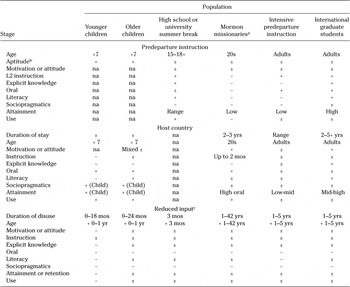
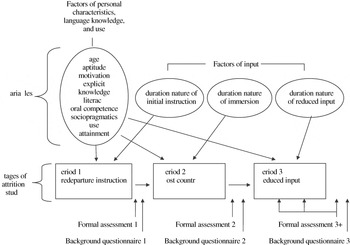
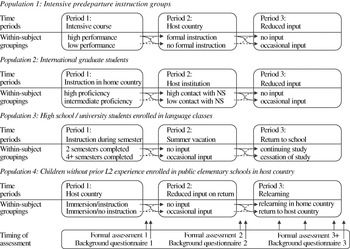
In this review, we outline the main issues in the literature on language attrition. We include first language (L1) attrition as well as second language (L2) attrition in order to establish the general parameters of attrition and retention. Language attrition may refer to loss of language as a result of contact with majority languages, loss of language by communities, or loss of language by individuals in both pathological and nonpathological settings. The goal is to identify factors, states, and outcomes relevant to the nonpathological loss of language competence and performance in individuals who have learned a L2 and to elaborate a model for the assessment of L2 attrition and retention.
Research on L2 attrition can trace its origins as a recognized subfield of SLA to a landmark conference on the loss of language skills held at the University of Pennsylvania in 1980, selected papers from which were subsequently published by Lambert and Freed (Reference Lambert and Freed1982). In this volume, Lambert (Reference Lambert, Lambert and Freed1982) made a notable distinction between criterion variables and predictor variables in language attrition. Henceforth, we will refer to this distinction in terms of linguistic and extralinguistic variables, respectively. Linguistic variables subsume factors such as lexical and morphosyntactic influence from the dominant language, frequency of input, loss of morphological complexity, and a reduction in registers of use, whereas extralinguistic variables include the age of the learners, the length of time without input, and motivation for language maintenance. Both sets of variables come into play in the elaboration of a theoretical model of language attrition and are relevant for the design of materials for language maintenance. Similarly, hypotheses proposed to explain the nature of language attrition may be divided into linguistic and extralinguistic hypotheses. Given the importance of both types of variables, it is implausible that a single hypothesis could lead to a comprehensive understanding of the phenomenon; rather, to understand the processes that take place, it is necessary to develop a multifaceted approach.
Whether focusing on linguistic or extralinguistic aspects, research on L2 loss has generally followed ideas first proposed for L1 attrition. Therefore, this review begins by outlining the most prominent general hypotheses of native language loss.Footnote 1 The most recent contributions to this debate are of particular interest, because they document a significant refinement of investigative techniques and a partial resolution of that most contentious of issues: whether language attrition involves total loss of linguistic representations from the brain or whether the problem is one of access to and restimulation of such representations. Attention then turns to studies specifically focusing on L2 attrition.Footnote 2 Overviews are provided of the hypotheses in play, research designs, measures that have been used to evaluate the data, generally agreed-upon findings, and the variables by which populations may be defined. Finally, the range of possible acquisition and attrition processes in very different populations is considered, and a general model for the assessment of language loss and retention is elaborated.
L1 ATTRITION STUDIES
General Hypotheses Concerning the Nature of L1 Attrition
Schmid (Reference Schmid2002) and Köpke and Schmid (Reference Köpke, Schmid, Schmid, Köpke, Keijzer and Weilemar2004) provided overviews of the general hypotheses that have been proposed for L1 attrition, most of which have subsequently been applied to L2 attrition. However, the majority of studies in both traditions over the last 30 years have adopted a somewhat programmatic tone, looking to future research to determine the nature of attrition rather than rigorously testing hypotheses. We discuss six such proposals that we will term the regression hypothesis, the threshold hypothesis, the interference hypothesis, the simplification hypothesis, the markedness hypothesis, and the dormant language hypothesis.
The regression hypothesis holds that the path of attrition is the mirror image of the path of acquisition. What is learned earlier is maintained longer, and what is learned later is more prone to rapid attrition; this is also referred to as first in, last out. This proposal is also the oldest, set out for the first time by Ribot in the 1880s and later advocated by Freud, specifically in relation to language loss in cases of aphasia, and by Jacobson in terms of the acquisition and attrition of phonology (de Bot & Weltens, Reference de Bot, Weltens, Seliger and Vago1991). Although it is now generally agreed that this account is not applicable to aphasia (Berko-Gleason, Reference Berko-Gleason, Lambert and Freed1982; Caramazza & Zurif, Reference Caramazza, Zurif, Caramazza and Zurif1978), certain influential articles have tentatively proposed that this may be an insightful account of L1 attrition (Andersen, Reference Andersen, Lambert and Freed1982; Berko-Gleason; Seliger, Reference Seliger, Seliger and Vago1991). However, these studies do not investigate the matter empirically, and a review of the literature reveals that there is very little evidence for this surprisingly durable and widely held hypothesis. For example, Jordens, de Bot, and Trapman (Reference Jordens, de Bot and Trapman1989) studied German case-marking, because this phenomenon “meets the conditions of gradualness and a more or less fixed order of acquisition” (p. 180). They found no evidence that the sequence of L1 attrition mirrors the sequence of acquisition, although they cautiously suggested that L2 attrition may follow this pattern. Similarly, Håkansson’s (Reference Håkansson1995) study of syntax and morphology in the language of expatriate Swedes revealed stages of attrition that did not correspond to any known stage of the acquisition of Swedish.
Apart from a general lack of empirical support, there are also theoretical reasons to doubt the validity of this hypothesis. When Schmid (Reference Schmid2002) attempted to tie the regression hypothesis to Chomskyan nativism, such that attrition is the reversal of an innately specified sequence of autonomous linguistic development, there is arguably a misconception of how generative linguists view both L1 and L2 acquisition. Although it is true that there were several early attempts to characterize developmental sequences in terms of innate orderings (Bailey, Madden, & Krashen, Reference Bailey, Madden and Krashen1974; Brown, Reference Brown1973; Dulay & Burt, Reference Dulay and Burt1973, Reference Dulay and Burt1974; Makino, Reference Makino1980), such morpheme-order studies are more often used in generative linguistics as cautionary tales (see textbook treatments such as Gass & Selinker, Reference Gass and Selinker2008, and Hawkins, Reference Hawkins2001). It is not the case that any current proponent of the role of Universal Grammar (UG) in SLA believes that UG actually specifies sequences of development of either morphemes or constructions. Once abstract principles are acquired, control of actual forms depends on much that is acquired piecemeal, such as specifications in lexical entries, and is subject to processing constraints (Lardiere, Reference Lardiere2006; Prévost & White, Reference Prévost and White2000).
A related hypothesis is that what is least vulnerable to language loss is not what is learned first but what is learned best, an important notion being frequency of reinforcement (Berko-Gleason, Reference Berko-Gleason, Lambert and Freed1982; Jordens, de Bot, Van Os, & Schumans, Reference Jordens, de Bot, Van Os, Schumans, Weltens, de Bot and van Els1986; Lambert, Reference Lambert1989). If a certain threshold of use is achieved, a representation may be less susceptible to or even immune from attrition. We use the general term threshold hypothesis to cover various proposals in this vein, including the neurolinguistically based activation threshold hypothesis discussed by Paradis (Reference Paradis, Köpke, Schmid, Keijzer and Dostert2007) and the more general critical threshold hypothesis (Neisser, Reference Neisser1984). The activation threshold hypothesis stems from research with aphasic patients, for whom the facility of reactivation of linguistic representations has been shown to be at least partly dependent on frequency of use prior to brain damage (Paradis, Reference Paradis2004): The higher the activation threshold, the greater the number of activating impulses needed to reactivate the representation. The critical threshold hypothesis is a much broader notion that has had considerable impact in the field of L2 attrition. Neisser suggested that there might be a general critical threshold during learning after which linguistic knowledge becomes permanent, citing as evidence Bahrick’s (Reference Bahrick1984a) report on language retention in L2 learners of Spanish even after 25 years of nonuse.
The threshold hypothesis is intriguing but is inherently flawed as a general hypothesis of attrition in several respects. First, Paradis (Reference Paradis, Köpke, Schmid, Keijzer and Dostert2007) admitted that linguistic subsystems sustained by declarative memory, such as the lexicon, appear to be much more vulnerable to frequency effects than those sustained by procedural memory, including the core linguistic systems of syntax and phonology, and, as such, this hypothesis is not necessarily relevant to the attrition of grammar. This observation is to be expected from the perspective of language acquisition theory, which, by and large, has eschewed the stimulus-reinforcement accounts typical of behaviorist psychology, at least as applied to grammatical knowledge, in the wake of Chomsky’s (Reference Chomsky1959) pivotal critique. A related issue is that, in cases of L1 attrition beyond early childhood, principles of syntax and phonology have been acquired to a level at which production is perfect and consistent; however, such principles are still subject to attrition. These objections aside, types of linguistic knowledge that involve domain-general information, such as the lexicon or principles of pragmatics, may conceivably be more susceptible to frequency effects. Even if restricted to such areas of the language faculty, this hypothesis is in need of much greater refinement before being rendered truly testable. Another general issue with the idea of a threshold for attrition is that unless it is established how well a particular rule or representation had been acquired prior to attrition, testing for retention is all but impossible.
The interference hypothesis holds that attrition is directly due to the increasing influence of the newly dominant, competing language. This proposal has also been called the interlanguage hypothesis or the crosslinguistic influence hypothesis (Köpke & Schmid, Reference Köpke, Schmid, Schmid, Köpke, Keijzer and Weilemar2004), but such terms are easily confused with very different hypotheses in the SLA literature. Given what is known about transfer in SLA and bilingualism, it is likely to be true to some degree and it has been advocated by many researchers (e.g., Altenberg, Reference Altenberg, Seliger and Vago1991; Grosjean & Py, Reference Grosjean and Py1991; Kaufman & Aronoff, Reference Kaufman, Aronoff, Seliger and Vago1991; Köpke, Reference Köpke1999; Pavlenko, Reference Pavlenko, Schmid, Köpke, Keijzer and Weilemar2004). In one version of this proposal, Seliger (Reference Seliger, Seliger and Vago1991) suggested that after a period without L1 input, learners could unconsciously process L2 input as a kind of indirect positive evidence, which causes them to replace those more complex L1 rules with simpler L2 rules in cases in which the two sets of rules have a similar semantic function. However, this is one of many hypotheses in the attrition literature whose potential interest lies in experiments that have not yet been conducted.
Another idea associated with this general hypothesis is that similarity between the L1 and the L2 is a condition for transfer (Andersen, Reference Andersen, Gass and Selinker1983). In her study of the L1 attrition of German in the context of L2 English, Altenberg (Reference Altenberg, Seliger and Vago1991) found plural allomorphs to be more severely affected than gender-marking, and she suggested that gender was less affected because this category was not subject to influence from English. This notion of attrition brought on by transfer in cases of similarity dovetails neatly with one avenue of research on SLA, which suggests that, at least in certain areas of language, one can predict difficulty of acquisition based on similarity between forms and rules (Best, Reference Best and Strange1995; Flege, Reference Flege and Strange1995). Despite the controversy generated by this approach, most researchers would agree that the coexistence of languages in the mind leads to particular grammatical conflicts, and it seems eminently plausible to suppose that interference in L1 attrition might mirror transfer in SLA.
In another approach that emphasizes interference, Pavlenko (Reference Pavlenko, Schmid, Köpke, Keijzer and Weilemar2004) and Isurin (Reference Isurin2007) have argued that increased exposure to a L2 is likely to involve influence on the L1 and that such influence is not necessarily indicative of attrition. Both consider their work to be in line with Cook’s (Reference Cook1991) view of L2 users as having a uniquely blended linguistic knowledge that he terms multicompetence. Despite the merits of this framework and although effects of knowledge of the dominant language will no doubt be visible during the process of attrition, few would consider that language interference is able to provide a comprehensive account of attrition. Certain aspects of language breakdown appear to unfold according to principles internal to the attrition process and irrespective of the particular competing language, a theme taken up by the next proposal.
The simplification hypothesis is not a hypothesis as such but a catch-all term used to refer to a number of processes that all appear to occur in situations of prolonged lack of input, in cases of both L1 and L2 attrition. One such process is the simplification of morphology: Vulnerable aspects of morphology include agreement markers, case systems, and allomorphic variation (Andersen, Reference Andersen, Lambert and Freed1982; Maher, Reference Maher, Seliger and Vago1991). Another is the loss of register control: Language attrition often occurs in situations in which the uses of the language are restricted, and there is often a concomitant attrition of unused registers (Andersen; Maher). It is clear that these phenomena are, to some degree, independent of language transfer and require independent explanation; yet, different hypotheses are still required to explain such phenomena as well as their susceptibility to attrition and their particular sequences of breakdown.
What we term the markedness hypothesis is referred to by Schmid (Reference Schmid2002) as the parameter hypothesis and is one of several ideas presented by Köpke and Schmid (Reference Köpke, Schmid, Schmid, Köpke, Keijzer and Weilemar2004) as the UG hypothesis. The latter term is somewhat misleading, because researchers who assume a role for UG could adopt any number of other hypotheses of attrition and still not subscribe to the hypothesis described here. Håkansson (Reference Håkansson1995) and Sharwood Smith (Reference Sharwood Smith, Hyltenstam and Obler1989) suggested that the process of L1 attrition could involve the unmarking of parameters that have been set to marked values; that is, on the assumption that parameters have a default setting, they will revert to this setting given prolonged lack of input. In contrast, it has also been proposed by Sharwood Smith and Van Buren (Reference Sharwood Smith, Van Buren, Seliger and Vago1991) that marked values of parameters will have the opposite effect: As parameter settings are governed by input and attrition is characterized by lack of input, marked values should persist. The most cited study as evidence for the markedness hypothesis is Håkansson’s. However, just as her work found no support for the regression hypothesis, it does not seem to support the markedness hypothesis either. The frequency with which the markedness hypothesis is cited is out of proportion to the number of empirical investigations devoted to it. Given the lack of enthusiasm for theories of parameter-markedness beyond the 1980s in principles and parameters theory (see Guasti, Reference Guasti2002, for a series of critiques), it is unlikely that this approach will be pursued further in the absence of a general shift in the theory of UG.
The dormant language hypothesis differs from the other hypotheses in that it has been subject to more rigorous definition and more controlled empirical evaluation. Several teams of attrition researchers have attempted to establish whether the end point of attrition is the complete loss of particular kinds of linguistic knowledge or whether vestiges remain in the mind, such that the problem is one of difficulty of access. Earlier research in the debate over loss of representations or loss of access provided interesting but inconclusive findings. Several studies highlighted the dramatic nature of L1 attrition in childhood. For example, Kaufman and Aronoff (Reference Kaufman, Aronoff, Seliger and Vago1991) observed drastic lexical and morphological attrition of L1 Hebrew in a child who had emigrated to the United States from Israel just a few months earlier, at age 2;6. In another case, Nicoladis and Grabois (Reference Nicoladis and Grabois2002) studied the simultaneous loss of Cantonese and acquisition of English in a young Chinese girl adopted by an English-speaking family in Canada, at age 17 months. Interactions with native Cantonese speakers over the 3 months following the child’s arrival revealed a rapid loss in both production and comprehension of this language by the child. However, other studies point to the possibility of retrieval following cases of language loss in situations of relearning. In one early study, Tees and Werker (Reference Tees and Werker1984) investigated English-speaking adults who had been regularly exposed to Hindi during the first few years of life and who were relearning this language in adulthood. Ten early-exposure learners of Hindi and 18 first-time learners of Hindi were tested on a category-change discrimination task that involved a retroflex-dental contrast characteristic of Hindi. The early-exposed participants showed an advantage in the discrimination of the contrast compared to the first-time learners of Hindi. Similar observations are reported by Ammerlaan (Reference Ammerlaan1996), de Bot (Reference de Bot, Goebl, Nelde, Stary and Wölke1996), and Köpke (Reference Köpke1999).
More recently, the loss versus access controversy has become a major topic of conference debate and empirical research following a series of controversial findings by Pallier et al. (Reference Pallier, Dehaene, Poline, LeBihan, Argenti and Dupoux2003), in which event-related brain imaging technology was used to reveal apparent erasure of all traces of L1 knowledge after a prolonged period of total lack of exposure, even when the attrition process did not begin until the age of 8 or 9 years. The potential importance of these findings is such that they merit closer inspection.
Language Lost or Language Mislaid? The Contemporary Debate on Attrition and Retention
Pallier and his colleagues have produced dramatic evidence from both functional magnetic resonance imaging (fMRI) studies and phoneme discrimination tasks that a L1 can apparently be erased from the brain after long periods with no input (Pallier, Reference Pallier, Köpke, Schmid, Keijzer and Dostert2007; Pallier et al., Reference Pallier, Dehaene, Poline, LeBihan, Argenti and Dupoux2003; Ventureyra & Pallier, Reference Ventureyra, Pallier, Schmid, Köpke, Keijzer and Weilemar2004; Ventureyra, Pallier, & Yoo, Reference Ventureyra, Pallier and Yoo2004). According to one interpretation of these results, prolonged lack of input results in total language loss. In a contrasting set of findings, Footnick (Reference Footnick, Köpke, Schmid, Keijzer and Dostert2007) produced new evidence to corroborate long-standing observations that knowledge of a forgotten childhood language can be reawakened using techniques of age-regression hypnosis. Also in apparent contrast to Pallier’s results, Oh and her colleagues have produced a series of articles that investigated situations of reexposure after long periods of lack of language input (Au, Knightly, Jun, & Oh, Reference Au, Knightly, Jun and Oh2002; Oh, Au, & Jun, Reference Oh, Au, Jun, Chandlee, Franchini, Lord and Rheiner2009; Oh, Jun, Knightly, & Au, Reference Oh, Jun, Knightly and Au2003) that point to lasting knowledge of the L1 and suggest that the lack of evidence in fMRI studies is due to the dormant nature of linguistic knowledge following attrition. Given the importance of the debate over whether attrition involves erasure of knowledge or difficulty of access, we will examine these three avenues of investigation in further detail.
Drastic Attrition Following Childhood Adoption
The research conducted by Pallier et al. (Reference Pallier, Dehaene, Poline, LeBihan, Argenti and Dupoux2003) was designed to address certain aspects of the critical period hypothesis (Lenneberg, Reference Lenneberg1967). The usual interpretation of this hypothesis is that the capacity to acquire languages disappears or declines with maturation (Birdsong, Reference Birdsong1999; Herschensohn, Reference Herschensohn2007). As a corollary of this hypothesis, it is commonly inferred that exposure to the L1 should leave long-lasting traces in the neural circuits that subserve language processing. Pallier et al. set out to discover what might remain of native language knowledge in people who had been adopted as children and who had experienced sudden and definitive isolation from their native language. The study population comprised eight adult Koreans whose age of adoption by families in France varied from 3 to 8 years old. They all claimed to have completely forgotten their native language, which is a typical self-assessment in such circumstances (Maury, Reference Maury1999). A control group consisted of eight native monolingual French speakers who had had no exposure to any Asian language.
In a language identification task, participants listened to sentences in Korean, Japanese, Polish, Swedish, and Wolof and had to decide whether the sentences were Korean: The native Koreans failed to recognize sentences as even being Korean, and an ANOVA indicated that their performance was essentially the same as that of the French participants. In a word recognition task, participants had to decide which of two aurally presented Korean words was the correct translation of a written French word displayed on a screen: The Koreans were again indistinguishable from the monolingual French speakers (56% and 52% accuracy, respectively). In a speech segment detection task, participants listened to sentences in French, Korean, Japanese, and Polish, followed 500 ms later by a speech fragment. The participants were asked to indicate whether this fragment had appeared in the sentence. The main purpose of this task was to ensure that participants paid attention to the sentences while brain imaging was performed using event-related fMRI, so as to detect patterns of brain activity as they processed the stimuli. Both Korean and control participants showed better performance for the only language that they could understand (French) than for the other three languages, and performance did not differ significantly between the two groups. The analyses of the fMRI data showed no detectable difference for either participant group in processing Korean or Polish sentences. In sum, the adoptees’ performance on all three tasks appears to confirm their claim to have lost all knowledge of their L1, such that their brains treated input from the attrited language in the same way as input from a language never encountered.
Following this avenue of research, Ventureyra et al. (Reference Ventureyra, Pallier and Yoo2004) designed an experiment to test for more subtle remnants of native language knowledge in the minds of Korean adoptees in France. The participants comprised 18 Korean adoptees whose age of adoption varied from 3 to 9 years old and whose reexposure to Korean had been minimal. There were two control groups that consisted of native speakers of French and Korean, respectively. The study focused on language-particular phonemic contrasts, known to be acquired very early across languages, which, in this case, involved a three-way contrast among tense, plain, and aspirated forms of Korean voiceless stop consonants /p, t, k/ and a two-way contrast between tense and plain /s/. A phoneme discrimination task was administered in which the participants were required to determine whether two pseudowords were identical. The Korean controls behaved very differently from the other two groups, but there were no significant differences between the adoptees and the French control group. Ventureyra et al. concluded that “the Korean adoptees have become like native French speakers in their perception of Korean consonants, and quite unlike native Koreans” (p. 87). These results thus corroborate the evidence from the brain-imaging study reported in Pallier et al. (Reference Pallier, Dehaene, Poline, LeBihan, Argenti and Dupoux2003) and suggest that all traces of a native language may be eradicated from the mind after a long period of complete lack of exposure.
The most radical conclusion one could draw from these studies is that, in the absence of continued input, not a trace of the L1 remains in the brain. However, it must be borne in mind that, in some ways, fMRI is a rather blunt instrument for measuring knowledge of language. If such knowledge is essentially dormant, then patterns of blood flow in the cerebral cortex during exposure to input may not be indicative of language loss but of a lack of active processing of language. In the conclusion of their article, Pallier et al. (Reference Pallier, Dehaene, Poline, LeBihan, Argenti and Dupoux2003) admitted the possibility that there remain “implicit unconscious traces at the level of the microcircuitry of the language processing areas” that fMRI is unable to detect (p. 159). They suggested that the existence of such traces might be tested by means of a (re)learning paradigm: Perhaps participants like the adoptees in the Pallier et al. study would be able to acquire Korean faster and more efficiently than control participants if they were to start as beginners in a Korean language program. Similarly, it remains to be seen if the Korean adoptees in the study by Ventureyra et al. (Reference Ventureyra, Pallier and Yoo2004) might have an advantage in a situation of relearning. It is noteworthy that one individual, who had revisited Korean for several months prior to the study, performed at 80% accuracy on the tense-aspirated contrast. Not enough is known about the type of input such participants were exposed to during the period of attrition, and no assessment exists of their level of knowledge before and after periods of reexposure, so observations on the effects of reexposure on such participants is purely speculative. The conclusions of Pallier et al. and Ventureyra et al. contrast with two other types of recent evidence that suggest that previous knowledge of language confers an advantage in situations of relearning. The first, more controversial type of evidence comes from studies of age-regression hypnosis, and the second comes from studies of heritage language learners. We consider each in turn.
Reactivation of Dormant Linguistic Knowledge Under Hypnosis
Footnick (Reference Footnick, Köpke, Schmid, Keijzer and Dostert2007) argued that both L1 and L2 knowledge acquired in childhood and subsequently forgotten can be made accessible by means of age-regression hypnosis. She cited two early studies that provide a sense of this phenomenon but also convey the lack of linguistic sophistication in previous research in this field. As (Reference As1962) presented the case of an 18-year-old Swedish-born American who had reportedly not spoken any Swedish since he was 7 years old. The boy’s ability to comprehend and produce his attrited language was significantly higher during hypnosis. In the other cited case, Fromm (Reference Fromm1970) described how a 26-year-old Japanese-American with no apparent knowledge of Japanese was age-regressed to 3 years old, whereupon he began to speak rapidly in Japanese without any prompting. Subsequent translation of the transcript revealed that the participant had been placed in a relocation camp with his family during World War II, where, from the age of 1 to 4, he had spoken Japanese. Footnick investigated a 21-year-old university student born in Paris to Togolese parents who spoke only French. From age 2 to 6, he had lived with his grandmother in Togo and spoken Mina. When the participant was age-regressed in 6 monthly sessions to 4 or 5 years old, he engaged in both free conversation and question-and-answer routines in Mina. By the end of the study, he had recovered some ability to understand and produce Mina out of hypnosis.
Although the hypnosis studies are intriguing, several important aspects of experimentation render the evidence ultimately unconvincing. Knowledge of language was not really tested for, except by means of general notions such as the ability to converse and to understand questions. There was no examination of syntax, morphology, phonology, or the lexicon. Additionally, in each case the extent of the participants’ exposure to the relevant language during the period of attrition is essentially unknown. It is quite conceivable that As’s (Reference As1962) participant was exposed to his mother speaking her own language either with Swedish relatives or in the community and that Fromm’s (Reference Fromm1970) participant was similarly exposed to his parents’ language. Footnick (Reference Footnick, Köpke, Schmid, Keijzer and Dostert2007) reported that although the participant in her study had not spoken Mina since the age of 6, he had been exposed to it during family gatherings throughout his life. One cannot assess the degree of recovery if previous levels of acquisition, the quality and quantity of continued input, and the degree of attrition all remain undocumented.
Relearning a Childhood Language in Adulthood
A second line of research that argues against the extreme interpretation of the eradication of native language knowledge involves the performance in formal instruction by two groups of learners: those who have been exposed to a language in early childhood and their classmates who have not (Au et al., Reference Au, Knightly, Jun and Oh2002; Oh et al., Reference Oh, Jun, Knightly and Au2003, Reference Oh, Au, Jun, Chandlee, Franchini, Lord and Rheiner2009). Such studies of relearning have focused on either perception or production of L2 phonology. Au et al. specifically addressed the question of whether overhearing a language in early childhood gave adult learners an advantage over those who had not been significantly exposed to the language until after puberty. At the time of the study, the participants were learners of Spanish at a university in Los Angeles. One learner group had been exposed to several hours of Spanish per week for at least 3 years between birth and age 6. The exposure to Spanish became less frequent thereafter, until age 14, when the participants started receiving formal Spanish instruction in high school. The other learner group had had no input until starting Spanish classes in high school at 14 years old. The participants’ pronunciation of Spanish was evaluated by analyzing voice onset time for the stop consonants /p, t, k/, which is typically shorter in Spanish than in English, and lenition of the voiced stops /b, d, g/ between vowels. Native-speaker ratings of the target consonants showed that, across the board, the early-exposed participants performed in a more Spanish-like fashion than the late L2 learners.
In a related investigation, Oh et al. (Reference Oh, Jun, Knightly and Au2003) studied three groups of students of Korean at a university in Los Angeles. There were 15 childhood speakers, 6 childhood overhearers, none of whom had spoken Korean other than isolated words and phrases after the age of 6 years old, 10 novice learners of Korean, and 12 native speakers. Both the early-exposed participants and the novice learners were enrolled in first-year university Korean language classes and were tested after 4 months of instruction. The targeted aspect of phonology was the three-way contrast studied by Ventureyra et al. (Reference Ventureyra, Pallier and Yoo2004)—that is, plain, aspirated, and tense consonants (e.g., /t/, /th/, and /t’/). The childhood speakers and overhearers were better than first-time learners and performed similarly to native Koreans on a phoneme perception task, but only the childhood speakers reliably contrasted all three consonants on a phoneme perception task.
As noted by Ventureyra et al. (Reference Ventureyra, Pallier and Yoo2004) and Pallier (Reference Pallier, Köpke, Schmid, Keijzer and Dostert2007), the participants in these relearning studies differed fundamentally from those in the adoptee studies, as the adult relearners had had some degree of continued exposure to the relevant language throughout their childhood and teenage years, whereas the adoptees had none. Thus, it is not straightforward to compare the apparently contradictory results of the relearning studies and the adoptee studies. Additionally, levels of knowledge before the period of attrition and immediately prior to relearning are undocumented. Detailed linguistic assessment does not begin until after the presumed attrition has already taken place. Levels of prior knowledge are approximated by self-report or informal family reports (Au et al., Reference Au, Knightly, Jun and Oh2002). Moreover, the multilingual environment of Los Angeles does not compare experimentally to the monolingual situation of the Korean adoptees prior to adoption. We cannot know if the childhood overhearers of Spanish or Korean were sensitive to the relevant contrasts in their early years. Additionally, given that advantages in perception indeed emerged in the experiments, it is impossible to know whether a sensitivity to such aspects of phonology developed over time, because all these participants were exposed to their respective heritage languages to some degree throughout their lives.
In more recent work, Oh et al. (Reference Oh, Au, Jun, Chandlee, Franchini, Lord and Rheiner2009) have suggested that the superior performance of the relearners in their own studies, as compared to the adoptees in the studies by Pallier et al. (Reference Pallier, Dehaene, Poline, LeBihan, Argenti and Dupoux2003) and Ventureyra et al. (Reference Ventureyra, Pallier and Yoo2004), may have been due to two factors: either continued low-level exposure to the language between the onset of attrition and the period of relearning or the time spent relearning the language. If the latter possibility is true, one would predict that the Korean adoptees in the French studies would have a learning advantage over their French peers if they attempted to acquire Korean as adults, as dormant knowledge of the language might resurface in this situation. To test this hypothesis, Oh et al. conducted an experiment with 12 Korean adoptees and 14 novice learners enrolled in first-semester Korean language classes at a university in the United States. The adoptees had been adopted before the age of 1, with one exception who had been adopted at 3 years old (mean age of adoption: 5.4 months). Five had had no exposure to Korean since adoption and seven had had minimal exposure to Korean, mostly in the form of Korean culture classes conducted in English. Eleven novice learners had had no prior exposure to Korean and three had had minimal exposure after age 14, such as overhearing Korean co-workers at their place of employment. Participants were tested after only 8 hr of instruction.
Given the very young age of adoption for most of the adoptees, remnants of L1 phonology were the target of investigation, and the hypothesis was that Korean adoptees would show an advantage over novice learners in the perception of Korean phonemes. Targeted aspects of phonology were aspirated consonants, tense consonants, and lenition of plain consonants in intervocalic position. Participants were given a phoneme identification task, which used standard ABX methodology. As a group, the adoptees were significantly more accurate on aspiration and lenis than the novice learners. Moreover, when those adoptees with no experience of Korean following adoption were analyzed separately, they also exhibited significantly higher rates of accuracy, despite their early age of adoption, their subsequent lack of exposure, and only having been systematically reexposed to Korean for 2 weeks.Footnote 3
Despite the preliminary nature of this investigation and the low number of participants, the results present a striking contrast with those of Pallier et al. (Reference Pallier, Dehaene, Poline, LeBihan, Argenti and Dupoux2003) and Ventureyra et al. (Reference Ventureyra, Pallier and Yoo2004), suggesting that, at least for phonological knowledge acquired in early childhood, attrition is a question not of permanent loss but of difficulty of access. With respect to the research on the Korean adoptees in France, the claim is that knowledge undetectable during the period of attrition might be rapidly restimulated in situations of relearning. Unfortunately, however, the Oh et al. (Reference Oh, Au, Jun, Chandlee, Franchini, Lord and Rheiner2009) study does not prove this. If learners had been tested before the period of relearning and then again during (or following) the period of relearning, we would be able to determine whether exposure to Korean during relearning had had some effect. However, due to the lack of evaluation before the period of instruction, we cannot be sure that the knowledge evinced in experimentation was not already in place before the onset of renewed exposure.
One thing that has emerged over the course of this debate is a sense of certain variables that need to be controlled in order to test whether participants who have experienced abrupt and prolonged lack of exposure completely lose or subconsciously conserve their knowledge of language. Experimentation must ideally involve a reliable assessment of linguistic abilities before attrition, a detailed analysis of linguistic abilities following attrition, and a similarly detailed investigation of language knowledge during the relearning process. No investigation of L1 attrition to date has controlled for all three states of knowledge. Additionally, the frequency and quality of small bouts of input during the period of attrition must be controlled for and analyzed for effect. Cross-sectional studies of the type conducted by these researchers tend to rely on self-report and informal reports from family members concerning these vital doses of input. However, it is hard to envisage careful control of this crucial variable in anything other than longitudinal investigations that tie specific fluctuations in input to specific individuals. We will return to this issue after the review of studies of L2 attrition.
L2 ATTRITION STUDIES
Second language attrition shares many features of L1 attrition; however, because of the additional linguistic and extralinguistic variables involved in the former compared to the latter, it is also more complex. The greatest single difference between L1 and L2 acquisition is variation in degree of success. L1 acquisition is invariably successful, whereas L2 acquisition is not. Many factors have been hypothesized to account for this basic difference in level of attainment and these play a role in L2 attrition as well as acquisition. Additionally, studies of L2 attrition also share many similarities with studies of L1 attrition but must also take the additional variables into account. Although the study of L2 attrition has in many respects paralleled that of L1 attrition and draws on the same seminal works (notably Lambert and Freed’s, 1982, volume that set the attrition research agenda), contributions from related fields also bring other research questions.
Studies of attrition in learners of second or foreign languages are found in the literature at least as early as 1929. The first studies investigated the question of loss of foreign language skills by high school and college students during summer vacations (Cole, Reference Cole1929, for French; Kennedy, Reference Kennedy1932, for Latin; Scherer, Reference Scherer1957, for German). Two further studies on French were reported by Smythe, Jutras, Bramwell, and Gardner (Reference Smythe, Jutras, Bramwell and Gardner1973), just as SLA was gaining currency as an emergent field. Additional studies on attrition during summer vacation conducted within a L2 studies framework included those by Moorcraft and Gardner (1987) on French among Anglophones and by Cohen (Reference Cohen1974, Reference Cohen1975) on Anglophone elementary school children in a Spanish immersion program between first and second grade. A later study of college students and summer vacation was carried out by Hedgcock (Reference Hedgcock1991) between first- and second-year Spanish. The educational perspective is visible by the identification of summer vacation as the period of disuse. Early studies were published in scholarly journals devoted to the study of language, including language teaching, namely The Modern Language Journal and The German Quarterly. Psychologists interested in general issues of memory and attrition such as Bahrick (Reference Bahrick1984a, Reference Bahrick1984b) and Smythe et al. (Reference Smythe, Jutras, Bramwell and Gardner1973) also contributed to the literature on language attrition. As a result of their fields of origin, these studies did not investigate language per se (in terms of linguistic systems) but rather language skills as measured by tests, a characteristic of L2 attrition studies that continues today.
Studies of attrition that focused on change in language structure were conducted by L2 researchers and reflected the interlanguage analyses of the period (Andersen, Reference Andersen, Lambert and Freed1982; Berman & Olshtain, Reference Berman and Olshtain1983; Cohen, Reference Cohen1974, Reference Cohen1975). Such linguistically and acquisitionally oriented studies began to appear in journals devoted to SLA, such as Language Learning (Cohen, Reference Cohen1974, Reference Cohen1975; Gardner, Lalonde, & MacPherson, Reference Gardner, Lalonde and MacPherson1985; Hansen, Umeda, & McKinney, Reference Hansen, Umeda and McKinney2002; Moorcroft & Gardner, Reference Moorcroft and Gardner1987) and Studies in Second Language Acquisition (Cohen, Reference Cohen1989; de Bot & Clyne, Reference de Bot and Clyne1989; Jordens, de Bot, & Trapman, Reference Weltens1989; Olshtain, Reference Olshtain1989; Weltens, van Els, & Schils, Reference Weltens, van Els and Schils1989).
In the following sections, we review attrition hypotheses as they appear in L2 research, discuss research designs, including tasks and measures that have been used to evaluate the data, and review generally agreed-upon findings. We then delineate the general periods of learning and attrition that pertain to the documentation of attrition (or retention) and systematically lay out the most relevant variables. The final section sets out the predictions for particular populations to illustrate our claim that such populations are best viewed in terms of the features that describe their learning and attrition situations. Despite the considerable variation in approaches and method and the inconclusive nature of previous investigations of L2 attrition, we characterize what is needed to develop a testable model of attrition in this domain.
General Hypotheses Concerning the Nature of L2 Attrition
Second language attrition studies have adopted some, but not all, of the hypotheses posited to account for L1 attrition. These often appear as interpretations of findings rather than as hypotheses that frame investigations. Of the six hypotheses posed for L1 attrition, the regression hypothesis, which predicts that the path of attrition is the reverse of the path of acquisition (last in, first out), is the most discussed (Cohen, Reference Cohen1975; Hansen, Reference Hansen and Hansen1999; Hayashi, Reference Hayashi and Hansen1999; Hedgcock, Reference Hedgcock1991). The most important design feature for a regression study is how it establishes the acquisition sequence used as a comparison. Here, we consider four studies that tested the hypothesis and used three different means of establishing an acquisition order.
Cohen (Reference Cohen1975) investigated attrition after a summer vacation of three second-grade children who had participated in a larger study (Cohen, Reference Cohen1974). The children’s development of L2 Spanish in an immersion program had been documented via six elicitation sessions over 20 months from kindergarten to first grade. Cohen (Reference Cohen1975) used the children’s own acquisition record to compare changes in production on an oral elicitation task (oral language achievement measure) before and after summer vacation. Cohen found that two of the three children lost grammatical contrasts that had emerged only 1–3 months before vacation. These differed for the children but included the use of ser and estar “to be,” definite articles, and progressive versus simple present. Hansen (Reference Hansen and Hansen1999) and Hayashi (Reference Hayashi and Hansen1999) tested the regression hypothesis in L2 Japanese in the domain of negation for two very different learner populations—adult missionaries and children who attended Japanese schools during the Japanese occupation of Micronesia. Given the established acquisition sequence for Japanese negation in which bound negators are first suffixed to predicates that are verbs, then nouns, then nominal adjectives, and, finally, adjectives (V-Neg > N-Neg > NA-Neg > A-Neg), they predicted by the regression hypothesis that the order of attrition would be the reverse (A-Neg > NA-Neg > N-Neg > V-Neg). The production data for both populations supported the regression hypothesis, with adjectives showing the greatest loss; both studies used comparison groups to approximate a baseline. Hedgcock (Reference Hedgcock1991) tested the regression hypothesis eliciting oral production data with the Spanish bilingual syntax measure. He established accuracy orders before and after the summer vacation between the first and second years of Spanish instruction at the college level. He concluded that the accuracy orders did not support the regression hypothesis; however, because accuracy orders do not establish acquisition sequences, the analysis provides a better basis for testing the threshold hypothesis.
The critical threshold hypothesis (best learned, last out) claims that there are levels of attainment above which a linguistic system is immune to attrition. What constitutes the critical threshold, or best learned, is not obvious from SLA theory or research, but there have been two attempts to operationalize this notion. Kennedy (Reference Kennedy1932) defined items on a test of Latin morphosyntax as best learned when all students answered correctly. Hedgcock (Reference Hedgcock1991) identified morphemes that were best learned by establishing rank order scores (but these were not consistent across testing times and thus failed to support the prediction). A variation on the critical threshold hypothesis is known as “the more you know, the less you lose” (Hansen, Reference Hansen and Hansen1999, p. 151).Footnote 4 de Bot and Clyne (Reference de Bot and Clyne1989) reported that the informants who reported loss had low proficiency to begin with (Hansen; Nagasawa, Reference Nagasawa and Hansen1999b; Reetz-Kurashige, Reference Reetz-Kurashige and Hansen1999; Smythe et al., Reference Smythe, Jutras, Bramwell and Gardner1973). Clark and Jorden (Reference Clark and Jorden1984) excluded students from their study on the basis that low-level learners show severe attrition, saying that, for first-year foreign language students, “attrition is almost total after a comparatively short period of time away from the classroom” (pp. 16–17). There are also opponents of the critical threshold interpretation, however: Weltens and Grendel (Reference Weltens, Grendel, Schreuder and Weltens1993) cited Smythe et al., Bahrick (Reference Bahrick1984a), and Weltens (Reference Weltens1989) as studies that do not confirm the threshold hypothesis.
Last in, first out and best learned, last out are occasionally collapsed as the following conclusion from Moorcroft and Gardner (Reference Moorcroft and Gardner1987) shows: “the statistical analysis of some individual grammatical elements showed that most recently learned structures are more likely to be affected by loss than others, suggesting that a thoroughly learned structure is relatively immune to language loss” (p. 339). There is no generalized theory of SLA that parallels this perspective in attrition research. Other studies have proposed an initial plateau (Russell, Reference Russell and Robinson1999b; Weltens & van Els, Reference Weltens, van Els, Weltens, de Bot and van Els1986) during which skills are thought to remain relatively stable for a number of years following the onset of disuse of the L2, after which the skills themselves or access to the skills may begin to degrade.
Other hypotheses of attrition such as interference, simplification, and markedness are used to interpret the results of studies that collect production data, but they are not specifically tested in the L2 attrition literature. The dormant language hypothesis surfaces in L2 studies of relearning as the concept of savings (de Bot & Stoessel, Reference de Bot and Stoessel2000; Hansen et al., Reference Hansen, Umeda and McKinney2002), the idea being that relearning a language takes less time than learning it for the first time (credited to Nelson, Reference Nelson1978); thus, the problem is seen as lack of access to unconscious linguistic knowledge rather than total loss. This hypothesis has been tested by means as simple as attrition assessment interviews (Clark & Jorden, Reference Clark and Jorden1984; Russell, Reference Russell and Hansen1999a), which report the ease and speed with which highly advanced language learners can retrieve items in the unused language during interviews or relearning sessions.
Many L2 attrition studies have addressed skill maintenance (reading, listening, speaking, and writing) and the relationship among skills in retention and attrition (productive vs. receptive skills). Others have attempted to provide a general description of L2 attrition. Such inquiries have investigated the lexicon, morphology, and syntax. Retention of the lexicon has been investigated to a greater extent than any other area, perhaps for its apparent ease of testing (but see Meara, Reference Meara2004, for a discussion of this misunderstanding of vocabulary). Recent studies have investigated attributes of fluency, including speech rate, hesitations, filled and unfilled pauses, and repetition. Isolated studies have also examined communicative competence, register, or turn-taking, but it is interesting to note that, as far as we know, only one dissertation (Dugas, Reference Dugas1999) has undertaken an investigation of the attrition of L2 phonology or pronunciation (whereas L1 studies have begun to employ current methods of investigating categorical perception). Researchers such as Cohen (Reference Cohen1974, Reference Cohen1975, Reference Cohen, Weltens, de Bot and van Els1986, Reference Cohen1989) and Olshtain (Reference Olshtain, Weltens, de Bot and van Els1986, Reference Olshtain1989) have also investigated compensatory strategies among attriters.
Research Design
Like acquisition studies that track change over time, attrition studies also measure change over time but with the expectation of documenting loss. The essential design feature of attrition studies is a comparison between knowledge at peak attainment and knowledge during or after loss. Of the 49 empirical L2 studies included in this review, only 31 conducted an actual test of peak attainment, thus establishing a baseline. Timing is crucial, and these samples tend to be collected either just before learners leave the host environment or the instructional setting (3 weeks to immediately before departure) or shortly after returning to the home country or to school (immediately to 2 months after return). The period of observation of attrition tends to be 1–2 years for studies that elicit relatively frequent data samples; researchers report termination when participants become embarrassed by their own lack of ability in the L2 (e.g., Kuhberg, Reference Kuhberg1992). The length of observation covaries with the establishment of a baseline and frequency of testing: Studies that compare scores from school or government tests may run up to 4–5 years but sample only once at the end points (Lowe, Reference Lowe, Lambert and Freed1982), whereas studies of attrition over summer vacation tested immediately before and after summer break because the reduction in input is only 3 months long. Studies that asked participants for retrospective self-assessments or used comparison groups to establish level of peak attainment reported the longest attrition periods from 10 to 50 years (Bahrick, Reference Bahrick1984a, Reference Bahrick1984b; de Bot & Clyne, Reference de Bot and Clyne1989; de Bot & Lintsen, Reference de Bot, Lintsen, Weltens, de Bot and van Els1986; de Bot & Stoessel, Reference de Bot and Stoessel2000; Hansen, Reference Hansen and Hansen1999; Hayashi, Reference Hayashi and Hansen1999).
Also similar to SLA research, some attrition studies are hypothesis-driven, whereas others are not. However, in attrition research, hypothesis-driven studies are in the minority. This may be due at least in part to the fact that to test the regression hypothesis, for example, the design would have to establish an acquisition sequence and an attrition sequence for comparison in the case of languages or structures that have not been previously documented. Similarly, as we have noted, concepts such as best learned or threshold level must be operationalized.
Tasks
Beyond the hallmarks of attrition design, attrition studies show a variety of tasks just as their acquisition counterparts do. The resultant data allow for both direct and indirect assessment. Direct assessment relies on primary language data, whereas indirect assessment does not.
Self-Assessment. One way that researchers have dealt with the problem of comparing learner performance at multiple points in time is to have learners undertake a self-assessment, by either rating their own abilities or estimating the amount of loss in different skill areas. Self-assessment is the major means of indirect assessment and includes studies by Clark and Jorden (Reference Clark and Jorden1984), de Bot and Clyne (Reference de Bot and Clyne1989), Hansen and Chantrill (Reference Hansen, Chantrill and Robinson1999), Nagasawa (Reference Nagasawa and Robinson1999a), and Weltens (e.g., Reference Weltens1989). Clark and Jorden, for example, asked former students to rate their ability to perform specific language tasks (such as ordering a meal in a restaurant or giving an extemporaneous talk on a familiar topic) at two times retrospectively: at peak attainment and at the time of completing the questionnaire. After Clark’s (Reference Clark and Barrows1981; Clark & Jorden) introduction of can-do statements (such as “I can understand almost everything addressed to me by native speakers of the language”), their use became common. Examinations of learner self-reports in light of their demonstrated levels of performance suggest that at least some learners exaggerate or underestimate either their level of peak attainment or decline (Clark & Jorden); as such, learner perception is an unreliable source for assessment. Moreover, self-assessment provides no information on formal linguistic systems.
Written Tasks. Because many of the studies have taken place in universities and other institutions that rely on examinations, most written tasks in the literature tend to be exams. Some studies have used standardized exams (Clark & Jorden, Reference Clark and Jorden1984, used the Educational Testing Service Japanese Proficiency Test; Kennedy, Reference Kennedy1932, used the Pressey Latin Syntax Test; Scherer, Reference Scherer1957, used a nationally standardized German test). Other researchers used government exams: Edwards (Reference Edwards1976) relied on Canadian government language exams and Lowe (Reference Lowe, Lambert and Freed1982) relied on U.S. government language exams. Other studies employed local exams: Cole (Reference Cole1929) used a 3-hr local test including translation of French to English and English to French; other studies with local tests include Weltens (Reference Weltens1989) and Bahrick (Reference Bahrick1984a, Reference Bahrick1984b). Smythe et al. (Reference Smythe, Jutras, Bramwell and Gardner1973) compared their locally developed French achievement tests with the Canadian Achievement Test in French. Weltens and his colleagues (Weltens & van Els, Reference Weltens, van Els, Weltens, de Bot and van Els1986; Weltens et al., Reference Weltens, van Els and Schils1989) examined receptive skills by means of multiple-choice cloze passages, written government exams, and other tasks. For multiple reasons, including educational influence and applications, existing standardized tests, and ease of administration, tests are common in L2 attrition studies but almost totally absent in SLA research, as they are not designed to target particular forms.
Oral Tasks. All oral tasks allow for the assessment of pronunciation, fluency, lexicon, and repair strategies. These tasks vary in amount of interaction and inherent difficulty. Oral tasks are used more frequently with younger learners than with older learners, who more often receive written tests. There is a confound in that many young learners may not be sufficiently literate to take a written exam. However, there is no reason why adult learners must complete written tasks, as the acquisition literature has numerous examples of oral language samples from adults. Spontaneous oral production (with time constraints) tends to discourage the use of explicit knowledge.
Narrative tasks are well represented in attrition studies, particularly in child L2 studies (Cohen, Reference Cohen1989; Olshtain, Reference Olshtain, Weltens, de Bot and van Els1986, Reference Olshtain1989; Reetz-Kurashige, Reference Reetz-Kurashige and Hansen1999; Tomiyama, Reference Tomiyama and Hansen1999a, Reference Tomiyama and Robinson1999b, Reference Tomiyama2000, Reference Tomiyama2008; Yoshitomi, Reference Yoshitomi and Hansen1999). The use of Frog, Where are you? (Mayer, Reference Mayer1969)—a wordless picture book—and other Frog stories were used following the large narrative project in L1 acquisition (Berman & Slobin, Reference Berman and Slobin1994). Given their structure and clear chronological order, narratives are a good tool for the study of verb morphology (tense-aspect forms) and reference (including articles). General syntactic complexity and vocabulary may also be elicited via narratives. Narratives are monologic, which allows the learner to develop the text alone and avoids scaffolding (depending on the interlocutor).
Oral responses to situational prompts are common in SLA research, particularly in the area of pragmatics. Russell (Reference Russell and Hansen1999a, Reference Russell and Robinson1999b) elicited responses to prompts from adult learners. In the studies of Hansen (Reference Hansen and Hansen1999) and Hayashi (Reference Hayashi and Hansen1999), the interviewers posed as a boss or a friend to elicit responses that had to be negated (targeting both grammar and addressee level).
Conversational interviews include both interviews and open-ended conversations for the purpose of collecting language samples. Conversational interviews are interactive speech events that allow for the investigation of turn-taking, comprehension and uptake, response to talk, and communication strategies. Interviewers can respond flexibly to learners’ responses and capitalize on topics of interest. Such tasks can be used with both children and adults. One issue that arises with dyadic elicitation is that learners may rely on the interlocutor or scaffold on interlocutors’ contributions. Studies that collected language samples via conversations and conversational interviews include Berman and Olshtain (Reference Berman and Olshtain1983), Kuhberg (Reference Kuhberg1992), Olshtain (Reference Olshtain, Weltens, de Bot and van Els1986), Tomiyama (Reference Tomiyama2000, Reference Tomiyama2008), and Nakuma (Reference Nakuma1997).
Language proficiency interviews are one means of collecting oral production data and rating learners’ performance at the same time. The best known and the one reported to be used in attrition studies is the ACTFL Oral Proficiency Interview (OPI). The OPI was employed by Clark and Jorden (Reference Clark and Jorden1984), Nagasawa (Reference Nagasawa and Robinson1999a, Reference Nagasawa and Hansen1999b), and Raffaldini (Reference Raffaldini1987). The OPI is a standardized procedure for the global assessment of functional speaking ability. A true OPI is administered by a certified interviewer whose ratings are consistent with those of other interviewers. It is a testing method that evaluates how well a person speaks a language by comparing his or her performance on specific language tasks with the criteria for each of the established proficiency levels described in the ACTFL guidelines. (The guidelines were revised by ACTFL in 1999, so the procedures used in these studies were based on the earlier guidelines.) Raters take into account morphology and syntax as well as communicative competence. The potential for establishing comparability across samples and populations to gauge general preattrition levels is promising, but the availability of certified raters is an issue. This method establishes a descriptive level (and is more precise than descriptions such as second-year Spanish student) but does not replace a linguistic analysis of attainment or attrition.
Grammatically and lexically focused oral elicitations are frequently used, the best known of which is the bilingual syntax measure used by Dulay and Burt (Reference Dulay and Burt1973) with child L2 learners. Hedgcock (Reference Hedgcock1991) tested the regression hypothesis, eliciting oral production data from college students learning Spanish with what he referred to as a modified bilingual syntax measure for Spanish, the text and translation of which can be found in the appendix. Other similar means included the use of illustrated cards and short tasks with first and second graders by Cohen (Reference Cohen1974, Reference Cohen1975, Reference Cohen, Weltens, de Bot and van Els1986); Jordens et al. (Reference Jordens, de Bot and Trapman1989) used a so-called headlines task, in which respondents make complete sentences out of bare forms, to elicit case markers from adult learners of L2 German. Moorcroft and Gardner (Reference Moorcroft and Gardner1987) used 11 prerecorded oral questions in French that listeners heard twice to elicit responses from high school students. Snow, Padilla, and Campbell (Reference Snow, Padilla and Campbell1988) used the speaking subtest of the Modern Language Association’s Spanish Cooperative exam with high school learners. de Bot and Lintsen (Reference de Bot, Lintsen, Weltens, de Bot and van Els1986) used an oral test designed to test aphasia with elderly attriters.
Background Questionnaires. Distinct from both linguistic assessment and self-appraisals, background questionnaires are often useful and arguably necessary in some cases as informal indicators of variables that are difficult to control. For example, it is not always possible to closely monitor participants during their residence abroad, but it is extremely valuable to have information on patterns of contact with native speakers. Almost all of the L2 studies reviewed here used some form of background questionnaire.
Measures of Linguistic Variables
There is surprisingly little analysis of actual language in the studies reviewed here. Only 27 of the 49 L2 studies analyzed language samples, and only a small portion of those conducted interlanguage analyses comparable to those found in SLA studies. Interlanguage analyses include investigations of negation in Japanese (Hansen, Reference Hansen and Hansen1999; Hayashi, Reference Hayashi and Hansen1999), case-marking in German (Jordens et al., Reference Jordens, de Bot and Trapman1989), and a broad comparison of L2 German acquisition and attrition by speakers of L1 Turkish (Kuhberg, Reference Kuhberg1992). Berman and Olshtain (Reference Berman and Olshtain1983) presented a close analysis of the L2 English interlanguage grammar of L1 Hebrew child returnees compared to interlanguage forms found in Israeli English-as-a-foreign-language students who had never been abroad.
Other studies measured change in the lexicon, fluency, complexity, and accuracy by using highly quantified measures. Measures of change in vocabulary include the number of different words (Cohen, Reference Cohen1989), lexical errors (de Bot & Lintsen, Reference de Bot, Lintsen, Weltens, de Bot and van Els1986), total words (Cohen, Reference Cohen, Weltens, de Bot and van Els1986; Russell, Reference Russell and Hansen1999a), and type-token ratios (Tomiyama, Reference Tomiyama2008) as well as words per unit, including words per response (Cohen, Reference Cohen, Weltens, de Bot and van Els1986), words per clause (Tomiyama), words per narrative (Olshtain, Reference Olshtain, Weltens, de Bot and van Els1986), and words per T-unit (Cohen, Reference Cohen1989).
Fluency is generally measured as number of words per unit of time (e.g., syllables per second, Nagasawa, Reference Nagasawa and Robinson1999a; words per minute, Yoshitomi, Reference Yoshitomi and Hansen1999). Filled and unfilled pauses (uh, um, and er vs. silence or hesitations), false starts, repairs, or repetitions are measured by the number of pauses between utterances (Moorcroft & Gardner, Reference Moorcroft and Gardner1987). Other measures consist of length of unfilled pauses, ratio of length of between-utterance pauses to in-utterance pauses, repetition time, gap-filler and hesitation time, number of utterances, total number within utterance pauses, number of between-utterance pauses, number of repetitions, and number of gap fillers (Nakuma, Reference Nakuma1997). Moorcroft and Gardner also measured elapsed time between question and response and length of speaking time. Complexity is typically measured as clauses per T-unit (Tomiyama, Reference Tomiyama2008).
Accuracy is as often measured in errors as in lack of errors. Errors may be counted as the number of errors (de Bot & Lintsen, Reference de Bot, Lintsen, Weltens, de Bot and van Els1986; Olshtain, Reference Olshtain, Weltens, de Bot and van Els1986, Reference Olshtain1989) or a ratio of errors per response (Cohen, Reference Cohen, Weltens, de Bot and van Els1986), errors per T-unit (Russell, Reference Russell and Robinson1999b), or taking the error-free perspective, as the number of error-free T-units (Tomiyama, Reference Tomiyama2008) or frequency of error-free clauses (Yoshitomi, Reference Yoshitomi and Hansen1999). However, analyses that focus on errors miss significant changes in interlanguage whether in acquisition (Gass & Selinker, Reference Gass and Selinker2008) or attrition. A rating of incorrect would classify all acquisitional stages short of the target in the same way and thus fail to document progression or attrition from one interlanguage stage to another. Similarly, quantitative descriptions of language at two points can describe production as faster or slower, as simpler or more complex, as having more or fewer lexical items or more or fewer errors, but these descriptions do not locate the reason for the change within the linguistic system. Word searches or paraphrases, for example, lengthen responses but may indicate reduced lexical access.
Related to both study design and measurement is scope of investigation; studies of L2 attrition are often concerned with discrete areas of competence or performance. The separate investigation of each area (which is reasonable because different areas seem to respond differently) may also diminish analytically the cumulative effect felt by the learners themselves or their interlocutors or instructors. Yoshitomi (Reference Yoshitomi and Hansen1999) argued that small degrees of attrition in individual areas add up to effect overall linguistic performance. Yoshitomi suggested that the investigation of communicative competence through conversation would allow a larger and more accurate picture. Clark (Reference Clark, Lambert and Freed1982) has also called for realistic measures of assessment such as highly face-valid tests of speaking, greater realism in speaking, measures of real-life performance, and an increased use of self-report data using can-do statements to help pinpoint communication difficulties.
To measure when attrition takes place is not straightforward. In spite of the surface evidence, Yoshitomi (Reference Yoshitomi and Hansen1999) has argued that attrition starts as soon as the returnee comes home. Meara (Reference Meara2004) takes a very similar stand based on computer modeling of vocabulary loss. He hypothesizes that there are multiple attrition events that lead to observable attrition. Meara argues that
Vocabulary loss is an observable change in the number of activated words in a vocabulary, and will always be measurable. In the simulations reported here, vocabulary loss is always triggered by attrition events [a small structural change in the vocabulary], but attrition events do not always trigger vocabulary loss events. This seems to be an important theoretical distinction which has been missed in the literature to date. (p. 145)
Meara maintains that attrition events may not lead to immediate loss but weaken the structure of the lexicon; so attrition events can build up, and it looks like one creates an “avalanche of loss” (p. 147). Meara offers at least two important points for work in any area of interlanguage: First, he reminds us that we are investigating systems. This point may be clearer in other areas of the grammar, but Meara emphasizes that the lexicon is not merely a list of words but a series of interconnected relationships, and loss in one area will impact another. This is illustrated by the compensatory strategies that learners use when they cannot retrieve a word they had previously used (Cohen, Reference Cohen1989; Olshtain, Reference Olshtain, Weltens, de Bot and van Els1986). The second point is that attrition may have a silent buildup period during which loss is laying a foundation. This proposal is a very different perspective than that adopted by the plateau view advocated by Russell (Reference Russell and Robinson1999b) and Weltens and van Els (Reference Weltens, van Els, Weltens, de Bot and van Els1986). Finally, Meara’s discussion reminds us that linguistic and cognitive sophistication is called for in a field of inquiry that, at times, favors nonspecialist approaches.
In summary, research design is weak in L2 attrition research compared to other areas of SLA. That said, the facts of natural attrition are rather messy. Many periods of reduced use have a stunning range of continued input, exposure, and use. Different populations are not directly comparable; partial comparisons can only be made in terms of matching variables, as we will show. The chief problem that we see, however, is the inconsistent establishment of peak attainment. Cohort or group scores are not sufficient to establish baselines for attainment against which to measure attrition. Learners must be compared to themselves in longitudinal designs, which means that the cross-sectional study that stands in for longitudinal design in acquisition studies cannot be used in attrition studies. There is no common starting point for attrition, whereas, in acquisition, the assumed starting point for all learners with the same L1 is zero (no L2 knowledge). In addition to necessary revisions to research design in attending to the variables related to learners-attriters, the tasks and analyses used in any study of attrition are crucial. Moreover, areas of investigation could be expanded to include other areas of interest in acquisition (e.g., comprehension and processing), and to investigate these areas, linguistically sophisticated judgment, interpretation, or processing tasks.
Summary of Findings
As in L1, L2 attrition does not affect all components of the interlanguage system uniformly. Many studies focus on determining which areas will be most affected: There is general consensus on a few characteristics of L2 attrition, and these reflect the skills-dominated approach to attrition in L2 studies. The following list includes findings discussed broadly in the literature (findings 1–5) and those referred to with less frequency (findings 6–8).
1. Production skills—namely, speaking and writing—are more vulnerable to attrition than receptive skills—namely, listening and reading (Bahrick, Reference Bahrick1984a, Reference Bahrick1984b; Hedgcock, Reference Hedgcock1991; Lowe, Reference Lowe, Lambert and Freed1982; Scherer, Reference Scherer1957; Snow et al., Reference Snow, Padilla and Campbell1988; Tomiyama, Reference Tomiyama and Hansen1999a, Reference Tomiyama and Robinson1999b). Receptive vocabulary (as opposed to vocabulary that is produced) and receptive grammar are also included as receptive skills (e.g., Scherer) although neither is a skill but rather a component of the L2 grammar. Vocabulary also figures in an undefined skill called understanding.
2. Literacy supports retention and impedes attrition (e.g., Olshtain, Reference Olshtain, Weltens, de Bot and van Els1986). However, there is a confound here with age (see finding 3).
3. Older children retain more than younger children because older children have L2 literacy skills (Olshtain, Reference Olshtain, Weltens, de Bot and van Els1986). One study of adults who developed L2 literacy compared to those from the same cohort who did not suggests that this may hold true, eliminating the confound from child attriters (Hansen & Chantrill, Reference Hansen, Chantrill and Robinson1999).
4. The lexicon has been generally found to be more likely than grammar to show attrition (Kuhberg, Reference Kuhberg1992; Moorcroft & Gardner, Reference Moorcroft and Gardner1987). However, certain types of lexical entries such as formulas, conventional expressions, idioms, and high function or emotional items may be better retained (Berman & Olshtain, Reference Berman and Olshtain1983). In contrast to studies that have concluded that grammar is more resilient than the lexicon, Yoshitomi (Reference Yoshitomi1992) suggested that, for lower level learners, grammar is more likely to show loss than the lexicon.
5. Motivation is implicated both during learning and during attrition (Edwards, Reference Edwards1976; Gardner et al., Reference Gardner, Lalonde and MacPherson1985; Gardner, Lalonde, Moorcroft, & Evers, Reference Gardner, Lalonde, Moorcroft and Evers1987; Moorcraft & Gardner, Reference Moorcroft and Gardner1987; Nagasawa, Reference Nagasawa and Hansen1999b; Snow et al., Reference Snow, Padilla and Campbell1988).
6. There is a decrease in fluency, which has been documented by a range of different measures (Russell, Reference Russell and Hansen1999a; Tomiyama, Reference Tomiyama and Robinson1999b).
7. There is a decrease in vocabulary, which may relate to size (Russell, Reference Russell and Hansen1999a) or access. Cohen (Reference Cohen1989) suggested that loss in vocabulary stems from a lack of access during production, but not comprehension. Similarly, Olshtain (Reference Olshtain1989) reported a reduction in access. See also Schreuder and Weltens (Reference Schreuder, Weltens, Schreuder and Weltens1993).
8. Education supports retention (this may be a confound with literacy; Hansen & Chantrill, Reference Hansen, Chantrill and Robinson1999): Nagasawa (Reference Nagasawa and Robinson1999a, Reference Nagasawa and Hansen1999b) found that a group of master of business administration (MBA) returnees who took classes did better than those who did not (see also de Bot & Clyne, Reference de Bot and Clyne1989; Russell, Reference Russell and Hansen1999a).
Types of Variables
In addition to taking previous findings into account when planning new research in L2 attrition, one must also consider the linguistic and extralinguistic variables in play. Beginning with the linguistic and language-related variables outlined as part of the hypotheses reviewed here, there are level of attainment (a description of the linguistic system), area of the grammar investigated, sociolinguistic competence, receptive versus productive language use, development of L2 literacy skills, and type of lexical item. The nonlinguistic variables that influence attrition include age (at time of acquisition, cessation of acquisition, and period of attrition) and motivation. Other nonlinguistic variables that have been identified consist of variables related to instruction (intensive vs. distributed, formal instruction vs. contact learning), attitude, and very specific external variables, including, quite literally, whether learners undertook the study of a foreign language for God or country (as in the case of missionaries or government employees).
One of the main purposes of this review is to identify the variables that must be taken into account to develop a model of assessment of L2 attrition. To this end, the variables will be reviewed in some detail. Any variable relevant to SLA would also be relevant to, or worth investigating in, a study of attrition. We outline the most frequently discussed variables here.
Population Variables. Many populations were represented in the L2 attrition literature, including three main populations who have been the focus of multiple studies: children returning from other countries, missionaries following time abroad, and college and high school students. Additional populations consist of government employees of the United States and Canada who show some attrition while using the L2 at work (Edwards, Reference Edwards1976; Lowe, Reference Lowe, Lambert and Freed1982), high school and college students in traditional (Bahrick, Reference Bahrick1984a, Reference Bahrick1984b; Gardner et al., Reference Gardner, Lalonde and MacPherson1985) or study-abroad programs (de Bot & Stoessel, Reference de Bot and Stoessel2000), children in immersion programs (Cohen, Reference Cohen1974, Reference Cohen1975, Reference Cohen, Weltens, de Bot and van Els1986, for younger children; Snow et al., Reference Snow, Padilla and Campbell1988, for older children), elderly speakers of L2 Dutch and German immigrants to Australia (de Bot & Clyne, Reference de Bot and Clyne1989; de Bot & Lintsen, Reference de Bot, Lintsen, Weltens, de Bot and van Els1986), elderly Micronesians who learned Japanese as a L2 in elementary schools established by the Japanese during their rule of Micronesia (Hayashi, Reference Hayashi and Hansen1999), and graduate students returning from training abroad (Nagasawa, Reference Nagasawa and Robinson1999a, Reference Nagasawa and Hansen1999b). Additionally, two studies explicitly targeted third languages (Nakuma, Reference Nakuma1997, on third language Spanish of Ghanaian professionals, and Cohen, Reference Cohen1989, on third language Portuguese of Hebrew-English bilingual children), although other studies examined learners who may be third language speakers.
Different populations can be quite distinct and, depending on the characteristics they share (or do not share), one must proceed with caution when attempting to generalize findings across populations. The most studied populations are presented here as groups, but in fact each population is best defined by a series of discrete variables (see Table 1). The three most studied populations are child returnees, returning Mormon missionaries, and high school and college students returning to class after summer vacation. The children most often studied are those whose parents were graduate students or employees at international companies (Berman & Olshtain, Reference Berman and Olshtain1983, and Olshtain, Reference Olshtain, Weltens, de Bot and van Els1986, Reference Olshtain1989, for English L2 with Hebrew L1; Reetz-Kurashige, Reference Reetz-Kurashige and Hansen1999, Tomiyama, Reference Tomiyama and Hansen1999a, Reference Tomiyama and Robinson1999b, Reference Tomiyama2000, Reference Tomiyama2008, and Yoshitomi, Reference Yoshitomi and Hansen1999, for Japanese L1 with English L2; Cohen, Reference Cohen1989, for third language Portuguese, L2-L1 Hebrew and English) and children of migrant workers (Kuhberg, Reference Kuhberg1992, for German L2 with Turkish L1). Both older and younger children are included in this sample. The children who learned English as a L2 typically attended preschool and elementary school in the host country and may or may not have had English-as-a-second-language courses. Older children generally have literacy skills, whereas younger children do not. Most children are described as having achieved language competence appropriate to their age or grade level, and some children are reported to have exceeded grade level in reading. Many Japanese returnees joined special English-as-a-foreign-language courses for returnees upon their return to Japan, but these were reported to employ traditional pedagogical activities with no opportunities for communicative activities. Returning Israeli children apparently had no structured courses; younger children are described as abandoning English, whereas the older children maintained it through reading and expected to use it in school.
Variables at three periods for different learner populations

Note
mos = months; yrs = years; na = not applicable; + shows information was reported, − shows that it was not reported, and ± shows that it was not always reported.
a Recent approaches to intensive predeparture training indicate much more specific attention to the target language (Baker, Reference Baker2007; Schultheiss, Reference Schultheiss2008), which means that current missionaries would have a different profile.
b Variables such as aptitude are not inherently binary; in such cases, binary values reflect the division of learners into high or low groups.
c Reduced input with intensive predeparture participants and international graduate students is estimated.
Returning Mormon missionaries constitute a population of adults who at the ages of 19–23 have had a 2- to 3-year mission during which they communicated daily with native speakers of the host language, most of whom are strangers. Men outnumber women in these samples, which is representative of the missionary population. Additionally, men served 24-, 30-, or 36-month mission assignments, whereas women had shorter assignments of 18-24 months. Their level of instruction prior to departure to the host country varied from no language training at all for missionaries who left prior to 1959 to 2 months after 1959. Hansen and Chantrill (Reference Hansen, Chantrill and Robinson1999) noted that “an unusual aspect of their experience was that, rather than being self-selected, they were directed to learn a foreign language” (p. 280); moreover, the location of service was not known to the missionary candidate at the time of application.
Hansen and Chantrill (Reference Hansen, Chantrill and Robinson1999) characterized the learning that takes place during the extended stay in the host country as “informal” and the peak attainment as showing “high levels of oral competence” achieved through “extensive daily use of the target language” (p. 281). Hansen et al. (Reference Hansen, Umeda and McKinney2002) noted that the missionaries learn and use memorized passages, which we would hesitate to characterize as acquisition: They further explained that there are “lessons that missionaries are required from the beginning to memorize and to use repeatedly in their teaching” (p. 662). Returning missionaries have been studied when they had been home for as little as 1 year or as many as 45 years. During that time, they have had varying language experiences such as continued study, including development of literacy skills not cultivated during the experience abroad. The dominant language of the L2 attrition literature is Japanese, owing largely to the work of Hansen and her colleagues, and more recently has included L2 Chinese and Korean as well (Hansen, Reference Hansen and Hansen1999; Hansen & Chantrill, Reference Hansen, Chantrill and Robinson1999; Hansen & Chen, Reference Hansen and Chen2001; Hansen et al., Reference Hansen, Umeda and McKinney2002; Russell, Reference Russell and Hansen1999a, Reference Russell and Robinson1999b).
College students are a natural group for inclusion in any study of L2 attrition. Populations include college students in Europe, who typically receive longer language training than in the United States and who are exposed to multiple second or foreign languages (Jordens et al., Reference Jordens, de Bot and Trapman1989; Weltens, Reference Weltens1989; Weltens & van Els, Reference Weltens, van Els, Weltens, de Bot and van Els1986; Weltens et al., Reference Weltens, van Els and Schils1989). Another group of college students are those who have participated in study-abroad programs. Nagasawa (Reference Nagasawa and Robinson1999a, Reference Nagasawa and Hansen1999b) studied MBA graduate students who did a summer internship in Japan. Clark and Jorden (Reference Clark and Jorden1984) studied students at Cornell University’s elite, intensive full-year Asian language concentration (FALCON) program. However, the most studied group of high school and college students are those in regular programs who return to language study after the annual summer vacation. Summer vacation is only a short break from traditional instruction (generally 3 months), but, from the literature, it is evident that it is a source of concern for educators. Except for one prep school, which was very exclusive, many of the inquiries are situated in large public universities (Kennedy, Reference Kennedy1932, for Latin; Scherer, Reference Scherer1957, for German; Cole, Reference Cole1929, Moorcraft & Gardner, 1987, and Smythe et al., Reference Smythe, Jutras, Bramwell and Gardner1973, for French; Hedgcock, Reference Hedgcock1991, for Spanish). There are also studies of young children after summer vacation (Cohen, Reference Cohen1974, Reference Cohen1975). Unlike the other two major groups (returnee children and missionaries), the college students return to school in the fall, and unlike their study-abroad counterparts, they have not had host country experience in the intervening months.
These three most frequently investigated populations in the L2 attrition literature are listed in Table 1, with children divided into younger and older groups and with each group represented as a set of variables. We have also added two comparison groups about whom no studies are yet available: learners who embark on periods of study or work abroad following intensive predeparture programs and returning international graduate students. Table 1 is organized in three time periods relevant to most populations: initial instruction, time in host country, and period of reduced input and language use. Relevant variables are listed in the leftmost column. They each apply to some extent at each of the three stages, with the exception of aptitude, which we hold to be stable. Thus, it is listed only once in the acquisition period.
Individual Variables
Age. The age at time of acquisition and host country experience is one of the most salient distinctions in the literature. Child learners have a good chance of acquiring the L2, especially in host environments at levels appropriate to their age and peers, but they also have a greater chance of experiencing attrition. Although older children seem to have a better chance than younger children at retention, this effect of age is confounded by literacy. Older children develop literacy skills in school, which may help not only by anchoring the L2 during the acquisition process but also by supplying a second source of input and by providing continued input, as older children often continue reading in the L2 upon returning home (Olshtain, Reference Olshtain, Weltens, de Bot and van Els1986). Adults may not demonstrate the same ease of acquisition as children and thus show even greater differences in attainment; however, they may have other cognitive, social, and technological resources that facilitate continued contact with the target language, which would thwart attrition and aid retention.
Aptitude. No study reviewed here has dealt with aptitude directly, although Clark and Jorden (Reference Clark and Jorden1984) touched on it. However, the fact that some government-sponsored language programs, such as the Defense Language Institute, screen learners for language aptitude and assign learners to specific languages based on those screenings make aptitude a relevant variable for inclusion. Recent work on individual differences would be of particular use (see, e.g., Robinson, Reference Robinson2005).
Motivation and attitude. Motivation and attitude have been identified as important both during the period of learning and during the period of reduced input and use (Edwards, Reference Edwards1976; Gardner et al., Reference Gardner, Lalonde and MacPherson1985; Nagasawa, Reference Nagasawa and Hansen1999b; Snow et al., Reference Snow, Padilla and Campbell1988). Learners’ motivation may also shift between acquisition and host country periods (Clark & Jorden, Reference Clark and Jorden1984).
Factors of Language Knowledge and Use
Explicit knowledge. One aspect of instruction relevant to attrition may be the introduction of explicit rules. Such rules do not constitute linguistic competence themselves but are part of explicit or conscious knowledge. Depending on the tasks that learners are asked to perform, they may draw on explicit rather than implicit knowledge. Explicit knowledge might be an aspect of instruction with positive consequences for language retention.
Literacy. Although traditional foreign language teaching often emphasized reading even at the expense of oral production and comprehension, the experience of many groups of learners may not include learning to read in the target language. Reading offers a second channel for input, and, as Bardovi-Harlig (Reference Bardovi-Harlig2000) argued with respect to input that may be severely reduced in speech (such as English tense-aspect forms), written input may supply grammatical information otherwise not salient and thus unavailable to lower level learners. Seeing a word or being able to write it may help some learners secure it in memory. Literacy in children covaries with age; the youngest children do not learn how to read or write in their sojourn abroad, whereas older children do. It is worth noting that the group of Mormon missionaries studied in the literature did not receive literacy training in preparation for their missions, but many sought it out during their sojourn abroad or upon returning. Hansen and Chantrill (Reference Hansen, Chantrill and Robinson1999) found that the extent of a learner’s knowledge of Chinese or Japanese characters was a strong predictor of maintenance over four decades; learners who were literate in a L2 maintained oral skills better than learners who had not learned to read and write. Observing an adult population allowed the researchers to avoid the age confound present in the studies of literacy in children. Other studies report that reading is the most stable skill for adults (e.g., Edwards, Reference Edwards1976; Lowe, Reference Lowe, Lambert and Freed1982).
Oral competence. Oral competence is generally agreed to be highly susceptible to attrition. Given that many traditional approaches to foreign language do not include oral competence, it is difficult to conceive of levels of production fluency without direct testing. Oral production may be a classroom learner’s weakest point and thus may be susceptible to attrition for that reason. Other learners such as some missionaries or military personnel may only have oral competence. Claims for fluency through the use of memorized texts (e.g., Hansen, Reference Hansen and Hansen1999) must be separated from tests of creative oral production.
Sociopragmatics. Some studies evaluate learners on register use, which is part of sociopragmatic knowledge (the knowledge of how-to-say-what-to-whom-and-when; see, e.g., Clark & Jorden, Reference Clark and Jorden1984, and Raffaldini, Reference Raffaldini1987, for oral assessments of pragmatics). Given the early date of most attrition studies, learners are unlikely to have been exposed to explicit instruction in pragmatics. Most sociopragmatic knowledge is likely to have developed from contact with native speakers.
Peak attainment. The level of peak attainment is crucial in L2 attrition. Whereas native speakers can be assumed to learn the native language perfectly, L2 learners show a wide range of achievement. This is analogous to what Montrul (Reference Montrul2008) has termed incomplete acquisition in bilinguals; levels of acquisition must be documented rather than assumed. Although attainment may closely correlate with other variables such as length of study or length of residence, it need not and is thus treated separately here. Higher attainment is held to be predictive of higher retention and lower attrition, whereas low attainment is held to be a factor in attrition. Establishing peak attainment is critical to research on attrition. Attainment must be established for any area of linguistic competence or language skills that will be tested subsequently, as grammatical components function independently.
Factors of Input
Duration and nature of instruction. The instruction variable is most grossly defined as the presence or absence of instruction. The absence of instruction is rather clear-cut. In contrast, the presence of instruction introduces a number of additional variables. Traditional instruction (particularly as far back as many of the college studies go) has not been particularly strong on developing oral competence. Other types of instruction—for example, preparation for field work (e.g., missionary, military, or international development assignments)—may not prepare learners in literacy skills, an area of strength in traditional language instruction. Moreover, some language teaching methods (such as cognitive approaches) promote explicit knowledge of rules, whereas others do not. Instruction is often thought to convey an advantage, but this may be because of learned knowledge about the language rather than acquired language competence. Foreign language instruction generally occurs in the predeparture period prior to an experience in the host country where the target language is spoken. The value of duration of instruction is bound to the nature of instruction; several months of classes that emphasize communication skills may outweigh several years of grammar-translation methodology in terms of predicting a degree of oral competence.
Duration and nature of immersion in the host country. Travel to a country where the L2 is spoken is not something undertaken by all learners in the attrition literature, but any such time period is an important variable because there is a probable correspondence to the degree of exposure to naturalistic input and experience of linguistic interaction. However, the duration of the stay is also tied to the nature of the immersion, which can vary in many ways. In some cases, learners may have extensive natural interaction with native speakers, whereas, in other cases, contact with native speakers may be so minimal that attrition actually sets in during this period. Following arrival in the country, formal L2 instruction may cease or learners may seek out further instruction. In the case of school-age children, literacy skills can be learned from general classroom instruction rather than from specific L2 instruction.
Duration and nature of reduced input and use. Periods of disuse reported in the literature range from as little as summer vacation to up to 50 years in Bahrick’s (Reference Bahrick1984a, Reference Bahrick1984b) retrospective studies of high school and college learners of Spanish as a foreign language. The range for the missionary returnees is 1–45 years. In contrast, production studies of children may last up to 1 year or 18 months or until the children become too embarrassed to speak the L2 (Kuhberg, Reference Kuhberg1992). The nature of the period of reduced input and use varies greatly. The case of abrupt, total withdrawal from the L2 is not as frequent in the conditions documented as it is in the L1 literature. Most authors reported that college students had no L2 contact over the summer break. However, in the cases reported (Reetz-Kurashige, Reference Reetz-Kurashige and Hansen1999; Yoshitomi, Reference Yoshitomi and Hansen1999), many of the child Japanese returnees participated in special classes for returnee children, although the authors suggested that, due to lack of opportunities for communication, these traditional receptive-skills focused sessions may not be highly valuable. Younger Israeli returnees (Olshtain, Reference Olshtain, Weltens, de Bot and van Els1986) and Turkish child returnees (Kuhberg) seem to have almost a complete lack of contact with the L2. Returning missionaries may seek out L2 courses and even become literate in the L2 after returning (Hansen et al., Reference Hansen, Umeda and McKinney2002). College students who return from abroad and enroll in courses for 80 min a week (Clark & Jorden, Reference Clark and Jorden1984) or immersion students who enroll in traditional courses (Snow et al., Reference Snow, Padilla and Campbell1988) are also included in the literature. Even federal employees whose L2 use is part of their job are included in the attrition literature (Edwards, Reference Edwards1976; Lowe, Reference Lowe, Lambert and Freed1982). Although L2 in the work environment does not disqualify a learner from an attrition study, L2 in the home environment generally does, and marriage to a target language speaker often leads to disqualification from an attrition study (Hansen et al.). One issue that arises is whether assessment interviews constitute input or use, or both, and thus disrupt the attrition process; however, this seems less pressing given the range of activities in which learners naturally engage independently of attrition studies.
TOWARD A MODEL FOR THE ASSESSMENT OF LANGUAGE ATTRITION AND RETENTION
This section outlines a model for the assessment of L2 attrition based on our review and describes two design factors that we believe should characterize any comprehensive study of L2 attrition. The first is the division of the study into discrete time periods based primarily on changing factors of input, so that quantifiable baseline data may be established against which to compare the process of attrition. The second is the identification of particular populations as sets of features that change over time, in terms of the variables we have suggested. Examples are given of four populations that may be analyzed according to this model.
Discrete Time Periods in the Acquisition-Attrition Process
Any systematic investigation of the attrition process must be tailored to the time periods involved. There are at least four relevant time periods related to attrition in L2 populations, the sequence of which varies according to the population. Not all learners will experience all periods, and what happens within each period may vary for subgroups of learners. For most populations, the first period is one of formal language instruction. This may take the form of several years of academic study or a short intensive course prior to departure to a host country. A second period may take place in a country where the language is spoken. For some learners (e.g., children whose parents are engaged in work or study abroad or aid workers in developing countries), this may be the period of initial acquisition. One time period applicable to all relevant populations is the period of attrition, which may be characterized by disuse, lack of input, or reduced input. This may be a very extended period of time, or just a few months as in the case of summer vacation for students. This stage is often called incubation, but we use the more transparent term period of reduced input. A fourth period during which relearning takes place may also occur, during which time it is possible to investigate the effects of reexposure. However, in some cases, this period of relearning is simultaneously a period of reduced input. For example, when learners return from an input-rich language experience abroad and enroll in traditional classes, this may constitute severely restricted input compared to the experience of daily language use abroad (Nagasawa, Reference Nagasawa and Robinson1999a, Reference Nagasawa and Hansen1999b). Edwards (Reference Edwards1976) showed that federal employees in Canada who passed requisite language exams experienced attrition even while working; L1 English speakers showed attrition of L2 French at work, whereas L1 French speakers of L2 English did not. Lowe (Reference Lowe, Lambert and Freed1982) similarly reported attrition in U.S. employees of the Central Intelligence Agency based on qualifying language scores and scores on subsequent required language tests.
These periods of acquisition and attrition may sometimes be repeated in the history of an individual (such as in the case of learners who take up the study of a language more than once, as reported by Clark & Jorden, Reference Clark and Jorden1984). Moreover, the stages might have quite different characteristics when learners are considered as individuals or as members of certain populations. For example, during a time of reduced input, one learner may have absolutely no L2 input, whereas another may have small but significant periods of exposure. Each of these stages must be investigated to present a principled picture of the attainment and attrition of language learners as a specified group or as individuals.
Populations as Changing Sets of Variables
During each of these time periods, a number of variables are at play, both at the level of the general population being investigated and of subgroups within that population. A learner’s age, aptitude, and motivation all influence the outcome of the periods both for acquisition and attrition. Motivation and attitude may change both within and between periods. In each period, a learner will also have developing, stable, or attriting competence in different submodules of the language. Explicit knowledge, literacy, oral competence, sociopragmatics, and use are components of these variables and, in turn, contribute to attainment at the time in question. Perhaps the most revealing variables for understanding the nature of language attrition are duration and nature of input, which must be described and quantified for the time periods applicable to the study. We recognize that none of these periods is likely to be completely homogenous and may actually be made up of a series of smaller periods, but these are simplified here for the purposes of generalization.
The application of our general model for the assessment of L2 attrition is represented diagrammatically in Figures 1 and 2. Figure 1 exemplifies the tracking of variables for any population, to be measured at three stages of the study by means of two types of assessment: a formal assessment that explores the actual interlanguage system of the populations in question and a background questionnaire that establishes attitudinal and motivational orientation as well as language-contact profiles in addition to the more obvious background variables (e.g., age, other languages spoken or studied, home language, further experiences in host environments). For the sake of clarity, the representation is restricted to one particular sequence of time periods: a period of instruction, a period of immersion in a host country, and a period of reduced input. Although single assessments may suffice at the end of the first two periods, multiple assessments should be made during the period of reduced input to establish baselines for comparison and to detect changes to the system.
General model of variables and requisite schedule of assessment in tracking populations of L2 returnees.

Examples of tracking possible subject groupings over group-specific time periods

In Figure 2, we abstract away from sets of variables to illustrate how the same general model for assessment may be adapted to different populations undergoing various stages of acquisition and attrition. The first and second examples provide a contrast between inexperienced and experienced language learners who study or work abroad following formal instruction. In the first case, labeled “intensive course,” learners are exposed to the language in an intensive introductory course, which lasts perhaps 1 or 2 months, before embarking on a period of study or work abroad. Such groups are as diverse as nonlanguage majors preparing for study abroad, corporate employees prior to international postings, participants in government-sponsored international exchange programs, military personnel, and missionaries. In the second case, labeled “instruction in home country,” international graduate students exemplify learners who have had many years of formal language instruction before the period of immersion in the host country.
For both of these groups, the effects of formal instruction can be assessed either prior to departure or immediately upon arrival. During Period 2, they can be divided into subgroups contrasting, for example, those who do or do not continue to have formal instruction or those who do or do not have regular contact with native speakers. For international graduate students, Period 2 might be simultaneously a period of acquisition and attrition, as they engage in daily contact with native speakers and become more proficient in both colloquial forms and in their area of academic expertise but no longer experience advanced language instruction. To measure processes of attrition and retention in specific areas of language (e.g., definite articles in syntax, phonemic contrasts in phonology, request strategies in pragmatics), it is imperative that levels of attainment be formally documented at the end of Period 2 before attrition sets in. As discussed previously, informal indicators typically used in attrition studies, such as self-reports or perceptions of general fluency, do not suffice. For both populations, Period 3 would be the period of reduced input following their return home. They might then be divided into groups with little or no further contact with the language and groups who experience regular, small bouts of reexposure. Such reexposure could be naturally occurring or could be induced as a means of testing the efficacy of language retention materials, depending on the nature of the study.
The third and fourth examples illustrate the flexibility of this general model of assessment with reference to two further population types. The third case is that of high school or university students in language courses who undergo varying degrees of attrition during their summer vacation. Although assessment of such students during the vacation period is often impractical, it may be possible to subsequently test for the value of occasional, controlled input during this period (e.g., by means of online homework activities), and upon their return, the attrition process could be studied by comparing those who stop studying the language to those who continue. The fourth case is that of children without prior experience of the target language who are enrolled in the public school system when their parents move to the host country for reasons of work or education. For such children, Period 1 is the period of initial acquisition, during which they may or may not have formal language support. Many return to their home countries after gaining considerable fluency in the target language, although their knowledge of the L2 is rarely assessed. In this case, Period 2 is the period of attrition, during which some children have continued access to the language—albeit with impoverished input—and some are entirely cut off from the language. In a study of this population, Period 3 is a time of relearning. The nature of this stage could differ dramatically, as some participants enroll in traditional classes at university in their home country to relearn the forgotten language of their childhood, whereas others might return to the host country as high school students or as adults to experience a more natural form of reacquisition.
These examples provide only a very general idea of the range of populations to which this model of assessment can be applied, and our discussion of these cases is in itself abbreviated. Nevertheless, we hope to have illustrated the value of discrete time periods, the conception of populations as sets of changing variables, and the importance of a schedule of both formal and informal assessments for any study of the processes of L2 attrition and retention.
CONCLUSION
The principle objective of this survey was to determine the current state of knowledge of L2 attrition, so as to elaborate a general model of investigation that could furnish replicable findings in this expanding domain of interest. Following a review of the most prominent hypotheses of native language loss and their status as theoretical underpinning for L2 investigations, an overview was given of research design in studies of L2 attrition, with particular attention paid to the types of tasks developed and the most widely used measures of linguistic variables. This overview provided a platform of sorts for further investigation, yet also revealed the focus on skills that has dominated research in the field up to this point; little is yet known of how specific areas of language knowledge might be differentially affected by prolonged lack of input. One particularly useful outcome of this review was that it allowed for the identification of variables by which populations may be defined as they change characteristics over time and through which comparison and replication studies may be made possible. The model delineated here suggests that populations in studies of L2 attrition are best represented as sets of features, the changing values of which may be tracked as these populations pass through discrete time periods in a general process of acquisition followed by attrition and perhaps a period of relearning.
Our focus on microassessment of particular types of linguistic knowledge leads us to an important observation. Although attrition is generally considered to be a phenomenon distinct from acquisition, experienced by specific types of populations, it might also be thought of as a normal part of the acquisition process, affecting the development of most (perhaps all) L2 learners. From a broad perspective, most learners go through periods in which their use of the language declines—for weeks, months, or years—even if the general process of acquisition subsequently continues. On closer inspection, even in periods of continuous use of the L2, not all aspects of language knowledge are regularly exercised, so that whereas gains are made in some areas, loss may be simultaneously incurred in others. Although acquisition and attrition are naturally entwined, our understanding of the latter is nevertheless likely to be enhanced through the investigation of extreme shifts in input of the type experienced by the populations discussed in this review.
The general model that we have proposed solves the major problems that surface in the attrition literature. It also incorporates the best traits of previous studies into one design for empirical research, which establishes baselines for attainment against which to measure attrition by comparing learners as individuals to themselves in longitudinal designs. In addition to supporting the fine-grained study of attrition, this model also may be used to assess the efficacy of retention materials, as both institutions and individuals strive to prevent or reverse the natural phenomenon of language loss.