The interaction between the state and large-scale business enterprises has played a key role in the catching-up of many “late-industrializing” countries. In particular, various forms of large business or corporate groups, which typically consist of legally independent firms bound together by persistent formal and informal ties, featured prominently in the growth miracles of Japan (kereitsu) and South Korea (chaebols) in the 20th century.Footnote 1 In recent decades, China has also experienced the rapid growth of a complex variety of large corporations and business groups, both in the private sector (such as Alibaba and Wanda Group) and the state-controlled sector.Footnote 2 Within the state-owned enterprise (SOE) system, the rise of over 100 giant business groups and financial institutions, directly controlled by China's central party-state and commonly referred to as centrally controlled businesses (yangqi 央企), is one of the most significant outcomes of China's institutional development.Footnote 3 For some, it epitomizes the achievement of China's gradualist approach to enterprise reform versus the Russian/East European “shock therapy”; for others, it represents the resistance of vested interest groups which hinders China from completing its final steps in its transition to the free market.Footnote 4 How the relations between the central party-state and big business are re-defined will prove to be critical in the next stage of China's system reform.
This article investigates the role of the Chinese Communist Party (CCP) in the rise of China's yangqi. It starts by comparing two competing policy approaches that position the relations between the Party and large enterprises: the separation approach, which argues that the Party should extricate itself completely from the enterprise sector, versus the adaptation approach, which contends that the Party's authority should be adaptively maintained and integrated in the new structures of corporate governance. It examines how the Party's “pro-big business” policies have shaped China's large enterprise reform since the 1960s and led to the formation and growth of the yangqi. The article then goes on to examine the Party's key mechanisms for controlling the yangqi, including the Party's nomenklatura system and personnel management as well as its anti-corruption campaigns and disciplinary force. After analysing how the Party both helps and restricts big businesses, it summarizes three key modes of the Party's intervention in the evolution of the yangqi: institutional and policy entrepreneurship; leveraged personnel control; and residual mobilization capacity. Finally, the article concludes with a discussion of the future prospects for reforming Party–big business relations in China.
Party Authority and Enterprise Reform: The Separation Approach versus the Adaptation Approach
How to define the relationship between the communist party bureaucracy and the “commanding heights” enterprise sector was at the heart of the policy debates on reforming former communist economies in the 1980s and 1990s. The dominant policy approach aimed at dismantling the party-state's authority and separating party functions of any kind from the economic functions of businesses. It reflected the widely held belief in international policy circles that communism was fundamentally incompatible with the governance structure of a modern market economy. Leading transition economists suggested that “to break the power of the party and state bureaucracy might be the key problem of a reform,”Footnote 5 and that “the collapse of communist one-party rule was the sine qua non for an effective transition to a market economy.”Footnote 6 Massive and rapid privatization was proposed as the core strategy of enterprise reform. It was argued that communist governments were “in a race against time” and reform could not be achieved and maintained unless privatization occurred “quickly and on a vast scale.”Footnote 7
Critics of this “transition orthodoxy” on the other hand suggested that there were real possibilities that the existing “old” institutions of command economies, including the communist party bureaucracy itself, might adapt and renew themselves.Footnote 8 According to this perspective, the mainstream views focused too much on the destruction of the old institutions and failed to recognize the dangers of an institutional void and the innovative potential of combining existing institutions with new elements via incremental change.Footnote 9 According to Peter Murrell, “institutional reform is inevitably a long process and inevitably involves changing rather than destroying many of the old institutions; the knowledge acquired from participation in the old system is valuable in producing workable changes.”Footnote 10
As Peter Nolan points out, a scenario might be conceived in which the communist party bureaucracies in the USSR and China could adapt and be effectively transformed into “developmental states.”Footnote 11 Rather than aim to “efficiently close much of the old structure and allow for a rapid expansion of a new one,”Footnote 12 an alternative approach for enterprise reform could be to learn from the statist industrial policies used by Japan and South Korea during their catch-up phase of growth, so the enterprise system built up under the command economy could be upgraded instead of demolished. However, this approach was largely overlooked in the World Bank and IMF's policy prescriptions for transition economies.Footnote 13
The policy evolution of China's enterprise reform has been shaped by the tensions between the separation approach and adaptation approach that compete to define the relations between the CCP and the large state enterprise sector. During the liberalization reform in the mid to late 1980s and under the leadership of Zhao Ziyang 赵紫阳, the separation approach appeared to be the more dominant policy. A series of bold reforms were conducted to disentangle Party organizations from both government agencies and state enterprises. In particular, Zhao Ziyang intended to abolish the Party groups in most government ministries, break up the institutional control held by the enterprise Party committees over professional enterprise management, and transfer the authority to make decisions about top personnel from the Party's Central Organization Department (COD) to the State Council.Footnote 14 After the political crisis in 1989, however, Zhao's reforms were soon abolished.
Since the early 1990s, China's enterprise reform has taken a markedly different approach from Zhao's reform direction and the policy prescriptions advised by the World Bank in the 1980s. Instead of dismantling the Party's control over major state enterprises and trying to ensure that government and business are kept at an “arm's-length,” China has persistently promoted a “national champion” industrial policy, in which selected large state-controlled enterprises are nurtured under the Party's supervision. Such efforts were first evident during the post-1989 retrenchment and were then developed into the “grasping the large, letting go of the small” strategy, which aimed at building China's indigenous, internationally competitive “large corporations, large business groups” (dagongsi dajituan 大公司、大集团), in the mid-1990s. The Asian financial crisis and China's WTO entry did little to alter this aim or the resultant policy framework. On the contrary, the Jiang Zemin 江泽民–Zhu Rongji 朱镕基 administration (1998–2003) strengthened its efforts to consolidate the core of China's existing industrial ministries and financial system into a batch of large centrally controlled business groups and financial institutions. This policy line was continued and enhanced further by the Hu Jintao 胡锦涛–Wen Jiabao 温家宝 administration (2003–2013), under which a new agency, the State-owned Assets Supervision and Administration Commission (SASAC), was set up under the State Council to coordinate enterprise reform, orchestrate the state-led industrial restructuring, and promote the growth and competitiveness of China's yangqi.
The official position on the role of Party authority in the large state-controlled enterprise sector changed from Zhao's approach as well. The issue of “separating the Party from the enterprises” was no longer a goal of reform per se; instead, more efforts were put into exploring alternative governance forms that would interweave and reconcile the Party's control with new corporate governance structures that were more consistent with the norms of a modern market economy. As stressed by Li Yuanchao 李源潮 when serving as the head of the COD, the Party's leadership in the SOE sector should “never be weakened;” furthermore, it was critical to “organically integrate” the Party's leadership with the development of a modern enterprise system.Footnote 15 While calling for bold reforms, the third plenum of the CCP's 18th Central Committee continued to emphasize the importance of strengthening the large state-controlled enterprise sector under the Party's leadership.
This approach of integrating Party authority with a modern corporate governance structure seems to reflect the CCP's stronger belief and confidence in exploring the possibilities of a new hybrid governance by institutional adaptation. How far this approach can go remains an open question at the current stage. As decided at the third plenum of the 18th Central Committee, the CCP has made the modernization of China's governance system and capacity the overall goal of its reforms. A crucial dimension of China's system reform is to restructure party–state–big business relations and create a more effective governance structure that fits with China's emerging new growth model.
This article proposes to contribute to these debates by examining the historical evolution, patterns and prospects of the Party's role in the rise of the yangqi. Despite a growing literature, this field has remained under-researched. As Kjeld Erik Brødsgaard points out, there are serious tensions between the contradictory but co-existing forces for further enterprise autonomy and the CCP's continued central control, which he conceptualizes with the notion of “integrated fragmentation.”Footnote 16 His research has emphasized how Chinese “national champion” business groups have benefited from China's successive rounds of administrative reform since the early 1980s and how the Party has exercised its control over the nomenklatura to govern these groups. This paper goes further to examine how the Party's evolving policy approaches towards large state-controlled enterprises from the 1960s onwards shaped the rise of China's yangqi. It attempts to provide a broader framework for the analysis of the CCP's modes of governance over China's yangqi, which include not only its control over key personnel but also its institutional and policy entrepreneurship as well as its mobilization capacity.
Promoting Big Business: The Party's Helping Hand
The policy approach that maintains the CCP should restructure the Stalinist central industrial ministries into certain forms of large multi-plant, multi-regional business organizations managed under Party control has a long history within the CCP leadership. This school of thought can be traced back to the early 1960s at least, when Liu Shaoqi 刘少奇 proposed that the CCP should establish a number of giant “corporate trusts” (tuolasi 托拉斯) as the socialist China's counterparts of Western monopolistic big business. While this approach was abolished during the Cultural Revolution, its core ideas recurrently emerged. In the 1980s, it led to a batch of large centrally controlled zonggongsi 总公司 (literally translated as general corporation) being established as industry-wide, national administrative corporations. During the 1990s and 2000s, promoting the growth of modern state-controlled big business was endorsed with unprecedented policy priority and commitment.
“Tuolasi” (corporate trust) experiments in the 1960s
As early as in 1949, Liu Shaoqi had developed the idea that the CCP should establish large monopolistic corporations to coordinate factories and mines nationwide. After the Great Leap Forward, Liu Shaoqi proposed that the CCP should learn from the organizational practices of modern big business in advanced capitalist countries and consolidate various state enterprise units into a batch of giant, industry-wide, multi-plant “corporate trusts.” Through these corporate trusts, the Party was to manage enterprises in economic methods instead of administrative methods, to mitigate bureacratism and decentralism in industrial governance, and speed up China's industrial catch up.Footnote 17
The Party briefly experimented with “corporate trust” reforms in the mid-1960s. The focus of Liu Shaoqi's plan was to carve out a group of corporate trusts from the existing central industrial ministries by absorbing their core productive assets. Each of these corporate trusts was supposed to dominate a key sector in the national economy. The experiments began with the light industries (tobacco and salt) and were later expanded to sectors such as coal, automobile, textile machinery, aluminum and power generation. The top personnel in these corporate trusts would be controlled by the Party, and their production activities would need to follow the state's central plan, but the headquarters of the corporate trusts would be given significant managerial autonomy so that they could concentrate sufficient authority in managing their intra-trust subordinate enterprises and exert monopolistic status in their respective sectors.Footnote 18 These experiments deviated significantly from the spirit of Maoism decentralization reform. During the Cultural Revolution, the attempts to build corporate trusts under the Party's unified control were attacked for “reviving capitalism” and bringing about “the tyranny of tiaotiao” (tiaotiao zhuanzheng 条条专政).Footnote 19 Leading figures of the reform experiments, including Liu Shaoqi, Deng Xiaoping 邓小平 and Bo Yibo 薄一波, were purged. Short-lived as they were, the corporate trust experiments of the 1960s can be seen as a precursor to the Party's “pro-big business” industrial policies of the later market reforms and opening up era.
Industry-wide “zonggongsi” experiments in the 1980s
After the Cultural Revolution, Maoist industrial policies were quickly sidelined. During the early 1980s, new efforts, similar to the earlier “corporate trusts” experiments, were made to reform the system of industrial ministries by establishing a cluster of giant centrally controlled, industry-wide corporate entities, which were labelled zonggongsi. By the end of 1982, the State Council had established a total of around 120 nationwide industrial zonggongsi under 38 central ministerial agencies.Footnote 20 They included, for instance, China Automobile Industrial Corporation (CAIC), China Shipbuilding Industrial Corporation (CSIC), China National Offshore Oil Corporation (CNOOC) and China Petrochemical Corporation (Sinopec). Sharing the same philosophy of “anti-decentralism” and “anti-bureaucratism” with the earlier “tuolasi” reform experiments, the goal in creating these zonggongsi was to make them business-oriented organizations with industry-wide coverage and capable of coordinating their subordinate plants with unified leadership and management.
In 1984, Zhao Ziyang placed economic decentralization and enhancing the enterprise autonomy of individual firms at the core of the State Council's new reform plans. Numerous large enterprise units previously controlled by the central industrial ministries were required to be handed over to local governments (primarily at the level of provinces and major cities). As a result, there were intense wrangles among the central policymakers over whether zonggongsi headquarters such as Sinopec were merely extra “nannies,” which were unwanted by their subordinate enterprises (factories) and which should therefore cease to exist.Footnote 21 The outcomes of such battles varied across sectors. Some zonggongsi, such as CSIC and Sinopec, managed to remain but were required to enhance the autonomy of their subordinate enterprises, while other zonggongsi, such as CAIC, failed to maintain their status and were abolished.
When Li Peng 李鹏 took over the State Council in 1988, the zonggongsi experiments regained some momentum. Four new major corporations were established that year: China Nuclear Industrial Corporation, China National Petroleum Corporation (CNPC), China General Coal Mining Corporation and China Weaponry Industrial Corporation. They took over most of the core enterprise units from their respective industrial ministries.Footnote 22 However, the formation of these zonggongsi was an unstable compromise between conflicting policy approaches.Footnote 23 The top business leaders of these zonggongsi, all appointed by the CCP centre and the State Council, were powerful senior technocrats transferred from the central industrial ministries. They were allowed to maintain, at least in the medium term, their head offices' hierarchical administrative control over their subordinate enterprises. However, they were also required to increase the autonomy of their subordinate enterprises, decentralize managerial decision making, and comprehensively implement a “contract responsibility system,” under which their head offices had only very weak control over subordinates. On the whole, in the late 1980s, these zonggongsi occupied very fragile and uncertain positions in the system.
“Grasping the large” experiments since the early 1990s
Following the CCP's leadership transition in the early 1990s, control of China's enterprise reform shifted to a new generation of technocratic leaders with more experience of the large state enterprise sector and central industrial ministries. During the previous two decades, the Party had consistently stressed the importance of nurturing a number of modern “large corporations and large business groups.” They were supposed not only to dominate the “commanding heights” of China's national economy but also gradually become more globally competitive. The pro-big business policies in the 1990s began with the trial policy of “building large business groups” in 1991. This led to the creation of around 55 large business groups nationwide (later expanded to 120) which would pilot the reform experiments.Footnote 24 For example, under the Ministry of Machinery and Electronics Industry, the Jiefang, Dongfeng and Heavy Vehicles firms were reorganized as large business groups, with the Yiqi Factory, Erqi Factory and Heavy Vehicles as their respective group's core enterprise. These large business groups were bestowed with significant managerial autonomy in planning and investment, financing, import and export, personnel management and foreign affairs. Some of them were designated as business groups concerning the lifeblood of the national economy and given preferential planning status similar to that of provincial-level governments.
During the Ninth Five-Year Plan (1996–2001), around 1,000 large SOEs were selected to receive the state's special support. The state's plan was to promote some of these SOEs to the rank of international big business. Overseen by the Party's Central Finance and Economic Working Group, Zhu Rongji was in charge of coordinating the implementation of this programme. The State Economic and Trade Commission (SETC) was responsible for promoting industrial rationalization and consolidation that would benefit targeted large enterprises and business groups, and for providing special support (together with the People's Bank of China (PBOC)) for merger and acquisition deals involving these favoured enterprises. These enterprises, and in particular a select group of 512 deemed to be the most important, were given priority when it came to guaranteeing their credit supply as well as their securities issuance on domestic and overseas capital markets.
At the end of the 1990s, against the background of China's anticipated WTO entry, the CCP accelerated the restructuring of the large SOE sector with a sweeping reform that decoupled enterprises/economic entities from the Party and government organs. Between 1998 and 2003, the Party leadership stripped the administrative hierarchy, headed by the State Council, central Party organs, and army and legal systems, of most of their enterprise units. The core parts of these enterprise units were reorganized into state-controlled business groups, most of which were later placed under the supervision of central SASAC after 2003, while the rest were handed over to local governments.
As a result of the decoupling reform, 530 large non-financial firms with a total of 3,151 subsidiary enterprises were decoupled from 50 central government organs in 1998. These large firms accounted for around 11 per cent of the total assets and over 43 per cent of the total profits of China's non-financial SOEs. They were eventually consolidated into 159 business groups. Among these, 96 were deemed “crucial” and remained under the central party-state's control, while the other 63 were handed over to local authorities.Footnote 25 The big businesses that were carved out during the 1998 decoupling included, for example, the Shenhua Group from the National Development and Planning Commission; China Ocean Shipping Group and China Shipping Group from the Ministry of Transportation; Anshan Steel, Baosteel and Panzhihua Steel from the State Bureau of Metallurgy Industry; China State Construction Engineering Corporation from the Ministry of Construction; and the Poly Group, Sanjiu Group and Xin-xing Pipes Group from the People's Liberation Army.
Between 1999 and 2003, the CCP decoupled more enterprise units and extracted the core assets in the telecommunications, electricity, airline and railway sectors from their original central ministries, and restructured them into a number of large centrally controlled business groups. For example, the core assets of the State Bureau of Civil Aviation Administration were consolidated into five large business groups, including three large airlines and two aviation service providers; the core assets of the Ministry of Electricity Industry were consolidated into seven large business groups, including two grid operators and five power generators. Together with those firms that had already been carved out from their ministries, such as Sinopec, CNPC, FAW Group and Dongfeng Group, China's centrally controlled businesses as a whole absorbed the backbone assets of the old industrial ministry system. All of them maintained their Party units after the decoupling reforms and remain under the Party's control.
SASAC-led restructuring and the rise of the “yangqi” as China's national champions
By 2003, most of the designated “backbone,” and “key” large state enterprise units whose main assets do not involve financial services, had been decoupled and consolidated into 196 large business groupings. SASAC was established in 2003 to “own” and “supervise” these business groups on behalf of the central party-state. Far from being a passive shareholder, SASAC has actively shaped the strategies and structures of its subordinate big businesses. Li Rongrong 李荣融, the founding head of SASAC from 2003 to 2010, stressed that, “China must nurture its own multinationals to challenge the dominance of foreign corporations,” and that SASAC was to “vigorously pursue a strategy of creating major corporate conglomerates” and accelerate the strategic adjustment of China's economic structure.Footnote 26 SASAC had directed that the yangqi should be consolidated into 80–100 large business firms in targeted strategic industries, among which 30 to 50 were supposed to become giant conglomerates with a strong international competitiveness. As Barry Naughton observes, “increasingly, the SASAC formulates its agenda in terms that a Wall Street investment bank would understand.” Each of the centrally controlled businesses was supposed either to become one of the top three market leaders in its core business area, or to be discarded via state-directed mergers, acquisitions or outright bankruptcy.Footnote 27
Following more than a decade of SASAC-led restructuring, a small number of yangqi now sit at the apex of the Chinese business system. By the end of 2014, there were a total of 112 yangqi under SASAC's supervision. Together, they had combined assets of over 53 trillion yuan, combined revenue of over 25 trillion yuan, and combined profits of over 1 trillion yuan, and dominated the perceived lifeblood sectors in China such as nuclear (CNNC and CNECC), aerospace and aviation (CASC, CASIC, AVIC and COMAC), petroleum and petrochemicals (CNPC, Sinopec, CNOOC and Sinochem), telecommunications (China Mobile, China Unicom and China Telecom), electricity (State Grid, China Southern Grid, Huaneng, Datang, Guodian, Huadian and CPI), steel (Ansteel, Baosteel, Wugang/Wisco), automobile (FAW and Dongfeng), and airlines (Air China, China Eastern and China Southern). The big four state-controlled commercial banks (ICBC, CCB, BOC and ABC) had combined assets of over 68 trillion yuan, around 40 per cent of China's total financial assets; they had combined net profits of around 860 billion yuan in 2014.Footnote 28 In 1996, there were only three mainland Chinese companies ranked among the Fortune Global 500 in terms of revenue; in 2015, this had risen to a total of 94, of which 58 are centrally controlled businesses (including financial institutions) and 47 are yangqi under SASAC's supervision. Many of them are building significant operations outside China. From the Stalinist economic bureaucracy to modern big businesses, this aspect of Chinese enterprise reform amounts to no less than a profound institutional transformation.
Controlling Big Business: The Party's Coercive Hand
The rise of the yangqi has featured prominently in China's recent economic growth, but there have been persistent doubts about their relative economic efficiency compared to the private sector, and growing resentment over their privileged position and preferential state support. As a result of enterprise reforms, the Party has allowed the yangqi unprecedented autonomy in business and has encouraged them to expand and compete internationally; however, the interests of the yangqi do not always align with those of the party-state. While the previous section examines the Party's “pro-big business” policies, which have led to the rise of the yangqi, this section focuses on the Party's key mechanisms for controlling the yangqi.
The nomenklatura system and the Party's control over personnel
The nomenklatura system and the Party's control over personnel are crucial instruments used by the Party to maintain its authority over the “national champion” big businesses. The CCP's nomenklatura system can be defined as a set of rules which establish the lists of leading personnel positions across various institutional spheres, such as government, industry, finance and education, over which various levels of Party committees exercise control. The most senior and important personnel appointments are directly managed by the Party's top authority, the COD, while the decision-making authority over positions deemed less important rests with lower level Party units. According to Zhang Quanjing 张全景 (former head of the COD, 1994–1999), while the COD handles the daily management of the CCP central nomenklatura, it does not have ultimate decision-making authority. Although the COD can express its opinion, the appointment and dismissal of those centrally managed cadres who rank at the level of vice-minister and vice-provincial governor have to be decided by the Political Bureau Standing Committee; the appointment and dismissal of those who rank at the level of minister and provincial governor normally have to be decided by the Political Bureau.Footnote 29 The Party secretary, board chairman and CEO (president) of a top yangqi are of a rank equivalent to a vice-minister or even minister, therefore their appointment and dismissal need to go through the Political Bureau, with the COD assisting in the decision-making process and implementation.
The functions of the COD and nomenklatura control in China's large state enterprise sector were established in as early as the 1950s. During the Cultural Revolution, the Party's cadre personnel management system ceased to function properly and the COD was nearly abolished. It was not until 1980, when a new nomenklatura list was issued, that the system was restored. Under the leadership of Hu Yaobang 胡耀邦, a major reform was implemented in 1984 to decentralize the Party's personnel management and curtail the authority of the COD.Footnote 30 Many large enterprises whose personnel appointments previously came under COD management were cut off from the central nomenklatura. After 1989, however, the Party and COD clawed back their control over personnel. A new list of central nomenklatura was issued in 1990 which significantly extended the range and depth of the Party's centralized control over personnel. Not only were all large corporations placed under the State Council included on the 1990 list but also many more “key” industrial plants and institutes subordinated to those large corporations were carefully targeted in the list.Footnote 31
In the late 1990s, the State Council undertook a massive round of administrative restructuring. Despite sectoral differences, one of the top priorities of the 1998 administrative reform led by Zhu Rongji was to transform the traditional central industrial ministry system into a group of modern big businesses under the central party-state's control. In order to push this structural reform through, the Party changed its personnel management system as well. In 1998, the CCP set up two new Party central commissions, the CCP Central Finance Work Commission (CFWC) and Central Large Enterprise Work Commission (CLEWC), to implement the decoupling reforms and unify the management of the resultant carved-out enterprises that were previously administered by various party-state organs. While the CFWC was responsible for overseeing large state-controlled financial institutions, the CLEWC was responsible for managing all the targeted large non-financial enterprises.
As a result, while central control over the management of top personnel in the “commanding heights” large enterprise sector rested with the COD between 1990 and 1998, it was now divided up between the CFWC, the CLEWC and the COD. Reflecting this change, the COD issued a new central nomenklatura list in 1998. Compared with the 1990 list, the range of enterprises covered by the 1998 central nomenklatura was drastically reduced. However, this list only showed the mandate of the COD and did not include those enterprises whose top personnel appointments were controlled by the CFWC and CLEWC (the latter now had a lion share of top cadre management mandates in large non-financial state enterprises).Footnote 32 In effect, the Party's authority over the top personnel in the large state enterprise sector was not significantly weakened by Zhu Rongji's structural reform in the late 1990s.
In 1999, the CLEWC was abolished and replaced by the new CCP Central Enterprise Work Commission (CEWC), with Wu Bangguo 吴邦国 appointed as its head. A total of 163 large business groups were transferred to the CEWC.Footnote 33 Among them, 39 were deemed to concern national security and the lifeline of the national economy. The top leaders of these 39 firms (general managers or CEOs, chairmen and Party secretaries) were included in the central nomenklatura. Their appointments and dismissals need to be approved by the Party through the COD and formally announced by the State Council. The top cadre appointments of the other 124 large enterprises were handed over to the CEWC for approval and would be formally announced by the Ministry of Personnel under the State Council.
The personnel management system set up in 1999 was further modified in 2003 amid a new round of administrative reform. The newly founded SASAC absorbed the CEWC and took over all the non-financial business groups it had previously managed. The division of labour in personnel management between the COD and CEWC consequently had to be coordinated between the COD and SASAC. Among the 196 non-financial yangqi under SASAC's supervision, the COD directly oversees the core leadership positions (including chairman of the board, Party secretary and president/CEO) of 53 top yangqi designated as backbone enterprises that concern national security and the lifeline of the national economy. SASAC only assists the COD in managing these positions. The deputy leadership positions (such as deputy general manager or group vice-president) in these 53 enterprises were handed over to SASAC, which manages these positions through its First Bureau of Enterprise Leaders' Management. The personnel management of the top leadership teams of the other 143 yangqi was also handed over to SASAC, which manages these positions via its Second Bureau of Enterprise Leaders' Management.Footnote 34
The CFWC on the other hand was abolished as the China Banking Regulatory Commission (CBRC) was established and put under the State Council's control. With the COD maintaining control over the core leaders of major financial institutions such as the central bank, five major commercial banks and three policy banks, the authority to manage top financial cadres that was previously concentrated in the CFWC was then divided among the so-called “one bank and three commissions” (yi hang san hui 一行三会), namely, the PBOC, CBRC, China Securities Regulatory Commission (CSRC) and China Insurance Regulatory Commission (CIRC), the latter three of which regulate the banking, securities and insurance sectors respectively. The ownership of the key state-controlled financial institutions were placed under Central Huijin, a financial equivalent of SASAC, which was later brought under the wing of the China Investment Corporation, the national sovereign wealth fund established in 2007.
Anti-corruption and the Party's disciplinary force
Another critical mechanism of control is the Party's disciplinary force, at the top of which is the Party's Central Discipline Inspection Committee (CDIC). The main functions of the CDIC and its subcommittees include, among others, safeguarding the Party's rules, inspecting the implementation of the Party's policy lines, organizing and coordinating anti-corruption work, monitoring the exercise of power by leading cadres, investigating cases of breaches of Party discipline and determining the punishment for Party members in such cases.Footnote 35 At each level of the governance structure of China's large enterprise sector, there are corresponding Party disciplinary subcommittees, including for example in the State Council, SASAC and each of the yangqi. Given its institutional status and mandates, the CDIC's power can be highly arbitrary, especially when it initiates and coordinates anti-corruption campaigns.
During the enterprise reform of the 1990s and the early 2000s, the Party's disciplinary forces did identify and deal with a number of high-profile cases of corruption and breaches of discipline in the large enterprise sector, including Jin Deqin 金德琴 (former vice-chairman of the CITIC Group) in 2000, Wang Xuebing 王雪冰 (former president of the China Construction Bank), Zhu Xiaohua 朱小华 (former chairman of the China Ever-bright Group) and Gao Yan 高严 (former president of the State Grid) in 2002. However, on the whole, the CDIC was not particularly active in monitoring the top personnel of the large state enterprise sector during the Jiang–Zhu administration as the Party's focus was on the sector's overall structural reform. After 2003, however, the Party's disciplinary force stepped up its monitoring of the yangqi. The Hu–Wen administration dealt with major cases of corruption such as Liu Jinbao 刘金宝 (former vice-chairman, Bank of China) in 2004, Zhang Enzhao 张恩照 (former chairman, China Construction Bank) in 2005, Chen Tonghai 陈同海 (former chairman of Sinopec) in 2008, Zhang Chunjiang 张春江 (former vice-chairman of China Mobile) in 2009, and Kang Rixin 康日新 (former CEO of the China National Nuclear Group) in 2010. During this period, to strengthen its monitoring capacity, the Party started to experiment with organizing regular inspection teams and the State Council also set up special supervisory councils to oversee the yangqi.
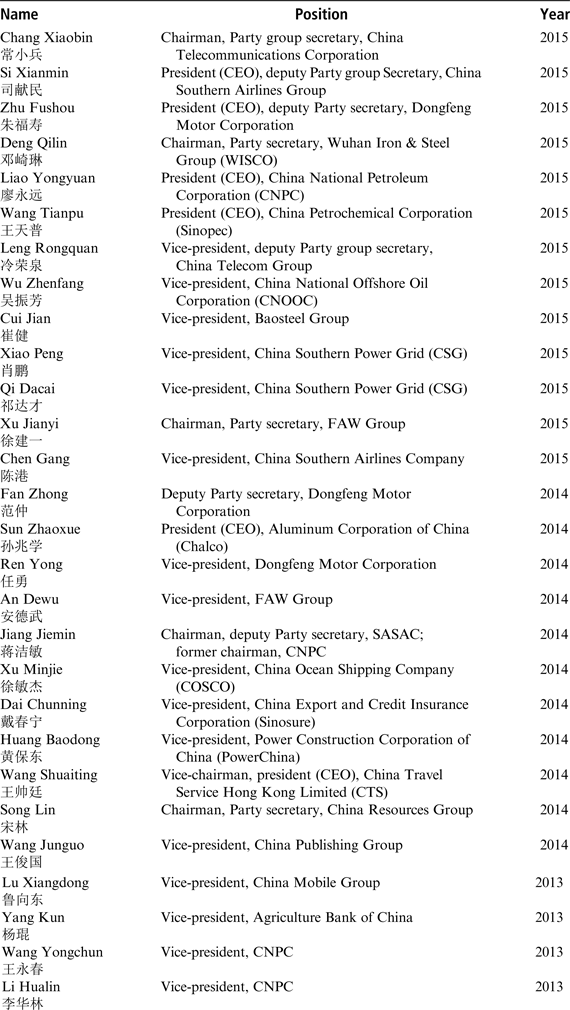
After the leadership succession in 2012, the CCP initiated a major anti-corruption campaign. Under the leadership of Wang Qishan 王岐山, a standing member of the Politburo, the CDIC has gained greater authority and more political weight than it had during the previous two decades. It is at the forefront of the Party's anti-corruption agenda that aims to subject the large state enterprise sector to intense scrutiny and establish stronger mechanisms of accountability within the yangqi. There are now specialized divisions within the CDIC that deal exclusively with the inspection of large state enterprises and financial institutions (CDIC's Fifth and Fourth Discipline Inspection & Supervision Office). Major investigations of national oil companies (CNPC, Sinopec and CNOOC) were conducted, leading to the dismissal of several top business cadres at the chairman/president level, including Jiang Jiemin 蒋洁敏 (former head of SASAC and former chairman, CNPC), Liao Yongyuan 廖永远 (former president, CNPC), Wang Tianpu 王天普 (former president, Sinopec), Sun Zhaoxue 孙兆学 (former president, Chalco), Si Xianmin 司献民 (former president, China Southern Airlines), Zhu Fushou 朱福寿 (former president, Dongfeng Motor) and Chang Xiaobin 常小兵 (former chairman of China Telecom). Since 2013, the CDIC has coordinated various inspection teams to investigate all the major yangqi. As shown in Table 1, as of December 2015, this massive campaign has led to the downfall of over two dozen board-level senior cadres at China's leading yangqi across a wide range of sectors, including energy, telecommunications, automobile, airline, non-ferrous metallurgy, shipping and insurance, and ongoing investigations are being conducted in more firms. The CDIC's current anti-graft movement in the large state enterprise sector is widely seen as a major effort not only to mitigate corruption and cronyism but also to break up resistance from vested interests to new reforms.
Major Cases of Anti-corruption in the Yangqi Sector since the 18th National Congress of the CCP

Source:
Announcements from the CCP Central Disciplinary Commission.
Governing Big Business: Three Modes of Party Intervention
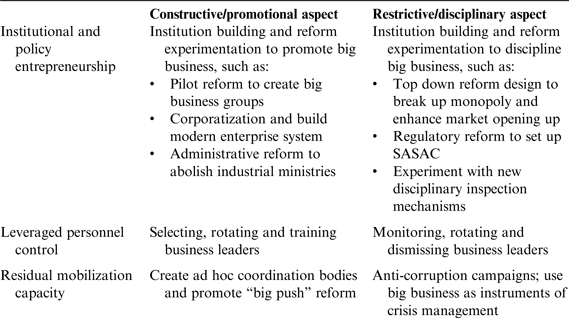
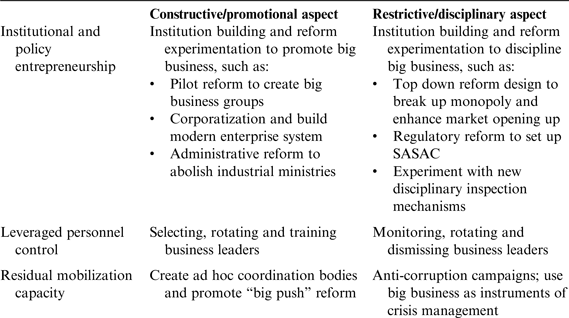
As shown in the previous sections, the CCP has played a complex role in the evolution of Chinese big business in the “commanding heights” sectors. On the one hand, the Party has been crucial in coordinating the state's actions to promote big business and industrial catching-up. It is directly involved in the creation and growth of the yangqi. On the other hand, the Party tries to maintain its authority over the emerging big businesses and adapt its traditional control mechanisms to the new institutional reality. Table 2 identifies and summarizes three key modes of intervention through which the CCP has simultaneously promoted and disciplined its centrally controlled businesses: institutional and policy entrepreneurship; leveraged personnel control; and residual mobilization capacity.
The Party's Three Modes of Intervention
Institutional and policy entrepreneurship
Institutional and policy entrepreneurship can be defined as a feedback process of exploring, experimenting with and expanding new institutional arrangements and policy solutions. Facing the inherent uncertainty of reform, it involves proactively taking on and managing the risks of change. The CCP has served as an institutional builder and policy entrepreneur in the evolution of the yangqi. In particular, the Party coordinated the complicated reforms of the 1990s to establish the institutional infrastructure of a “modern enterprise system” to corporatize traditional SOEs. It managed the tricky challenges of abolishing industrial ministries, breaking up domestic monopolies, laying off redundant workers, and the further opening up of the market that came with China's WTO entry. Through incremental changes and selectively learning from international standards, the CCP gradually reorganized and consolidated the core assets of its old industrial system into a number of giant modern corporations with diversified ownership, many of which listed their minority shares on domestic and international stock markets. Although still at an early stage, the Party is in the process of creating a more robust governance framework to monitor, regulate and discipline big business.
As Sebastian Heilmann points out, underlying the CCP's ability to generate innovations for reforms is a distinctive policy style of “experimentation under hierarchy,” which combines hierarchical control with decentralized experiments. This pattern of policy experimentation is clearly exhibited in the CCP's policy evolution towards big business.Footnote 36 From the “corporate trust” experiments in the 1960s and zonggongsi experiments in the 1980s, to the trial implementation of various “grasping the large” reforms in the 1990s and 2000s, the CCP has followed the policy cycle of setting up pilot experimental points, testing the results, gathering feedback, and selectively expanding “from point to face.” It established the overall goal and policy framework of enterprise reform, and encouraged officials to try out new ways of organizing the large state enterprise sector. Top-down design and guidance was combined with bottom-up experimentation and feedback. The Party can be seen as a meta-organizational entrepreneur in the policy and institutional domain, one that sets up goals, incentivizes innovations, and restructures assets in China's large state enterprise sector.
Leveraged personnel control
The second mode of intervention, leveraged personnel control, focuses on controlling a small number of core personnel at headquarter level in a few selected business firms, each of which maintains its own Party organizational units. The selected core personnel under the Party's centralized control in turn manage a lower layer of core personnel. Thus, layer-by-layer, the Party's authority is leveraged up and passed down. Unlike comprehensive control or non-control, leveraged personnel control tries to grasp the critical nodes of a vast network, with each yangqi being a sub-network of personnel in different key sectors. Following this approach, the Party retreated from directly overseeing the cadre management at the lower-to-middle level of the large state enterprise sector. By doing so, it facilitated intra-business group integration and gave the head offices of the yangqi power over their subordinate enterprise units by allowing them to unify the critical authority of internal personnel management. Consequently, the lower-to-middle-level business management of the yangqi has in general become more depoliticized, technically more professional and more market-oriented than the top level. Empowering the technical level ensures that the yangqi can develop the professional competence needed to compete both nationally and, to some extent, internationally.
The top business leaders of the yangqi who are controlled by the Party are also deeply intertwined with the Party's political processes. Many of them have been elected to the CCP's Central Committee and Central Disciplinary Committee.Footnote 37 Although the abolition of the central industrial ministries and the decoupling reforms in the late 1990s had separated the yangqi from China's formal state bureaucracy, the decoupled firms were headed by the same network of technocrats from the old industrial ministries. As Lin Nan observes, the top business personnel controlled by the Party have synchronized incentives and mobility: they are motivated by both political achievement and business achievement, and can be moved back and forth across the political hierarchy and state-controlled business hierarchy under the Party's direction.Footnote 38 Like their predecessors the industrial ministries, the yangqi serve both as a talent pool from which the Party recruits its top political elites and as a pathway for ambitious cadres to advance their political careers. A significant number of top CCP leaders had previously worked in large centrally controlled state enterprises during their careers, including Jiang Zemin and Li Lanqing 李岚清 (Yiqi, later FAW group), Qiao Shi 乔石 (Anshan Iron & Steel), Zeng Qinghong 曾庆红 (CNOOC), Wu Yi 吴仪 (Sinopec), and Zhou Yongkang 周永康 (CNPC). Since 2003, there have been frequent rotations of key personnel both among the yangqi and between the yangqi and other Party/government posts. The specific mechanisms to trigger such rotations of personnel are complex and in need of further research, but such rotations can work to nurture the capabilities and experience of these cadres, restrain the power of over-dominant business leaders and prevent the entrenchment of factional interests.Footnote 39
Leveraged personnel control implies an inherent incompleteness of authority. It is prone to multi-layer principal-agent problems that often manifest in various forms of cronyism and factionalism. As the recent anti-corruption campaigns reveal, the Party's existing arrangements of monitoring and disciplining top business leaders are too weak to establish effective governance. Corruption is rampant in many yangqi and often involves complex political networks stretching across the Party's hierarchy. For example, the corruption case exposing Zhou Yongkang has also implicated an extensive web of senior oil yangqi executives, local government officials and cadres in the Party's judicial and public security forces who all connect with Zhou Yongkang and his family in complex and hidden ways. Given the informational constraints and incentive distortions, it is difficult for the Party to rely upon leveraged personnel control to monitor and discipline effectively those business leaders who are politically connected and who possess substantial managerial autonomy in the daily business operations of the yangqi.
Residual mobilization capacity
Residual mobilization capacity is defined here as the CCP's remaining capacity to mobilize resources and organize managed campaigns or movements across de jure rational-bureaucratic boundaries.Footnote 40 Like a business firm's reserve capacity, the Party's residual mobilization capacity is now rarely used during normal times. However, in unusual periods and circumstances, such as during major crises and system-wide major challenges, the Party can exploit its residual mobilization capacity to initiate sweeping movements and make breakthrough changes. This mode of intervention is critical in the CCP's relations with the yangqi. On the one hand, it has been used to facilitate enterprise reform. During the extraordinary period of the late 1990s, the CCP was faced with the complex challenges of the Asian financial crisis (1997–1999) and China's anticipated WTO entry. To push through major reforms and cope with the radically changing environment, the CCP set up two top-level ad hoc coordination bodies (the CLEWC and CFWC), which overrode the state bureaucracy to coordinate the sweeping “decoupling” reform, and restructured the entire large state enterprise sector within a few years. Only after completing the reform breakthrough were the two Party commissions absorbed by the normal hierarchy of the state bureaucracy. Since the top leadership succession in 2012, the Party has again been coordinating comprehensive anti-corruption campaigns, which set cleaning up the yangqi sector as a major task.
On the other hand, the yangqi are also used by the Party as its instruments of crisis management and mobilization capacity. After the global financial crisis of 2007–2008, the yangqi were mobilized to expand investment in a broad range of sectors such as infrastructure, railway, shipbuilding, electronics, automobile and steel. Supported by the state-controlled banks, they were at the forefront of implementing China's 4 trillion yuan post-crisis stimulus package. Most recently, following China's stock market crisis in 2015, the yangqi were again mobilized, this time to bail out the market by buying back over-valued shares of their listed companies, which defied the normal logic of business investment.
Conclusion
After over half a century of industrialization under CCP rule, the Chinese economy is now at a transitional stage between the state-led catch-up phase of growth and more mature, market-based growth. As Xi Jinping 习近平 has recently announced, a “new normal” of the Chinese economy is emerging and the Party should accelerate the change of China's growth model by deepening institutional reforms.Footnote 41 During the previous decades, the CCP adopted a highly interventionist “pro-big business” policy approach. It has made remarkable achievements in nurturing the yangqi as the Chinese version of modern big businesses and promoting indigenous industrial catching-up, but it has also generated serious economic distortions and socio-political controversies. Alongside continuous enterprise reforms and market opening, the Party has adaptively maintained its authority and control over China's “commanding heights” large state enterprise sector. However, the existing governance framework remains deeply flawed and there is now growing discontent about the rise of China's yangqi and their involvement in the Party's political processes. As revealed by the recent anti-graft campaigns, the corruption involving the yangqi is further undermining the legitimacy of the CCP's “pro-big business” policy paradigm.
It seems clear now that the pattern of party-state–big business relations should undertake a transition as the Chinese economy is shifting to a new growth model. Among the Party's three modes of intervention, the most important one in the future should be institutional and policy entrepreneurship. As the CCP has largely completed the restructuring and consolidation of China's old Stalinist large-enterprise system into modern business corporations, its institution building and policy innovation in the future should focus on establishing rules, standards and institutions of economic governance more consistent with the norms of global markets. At the level of the Party's authority, both the COD's control over personnel and the disciplinary forces' anti-corruption campaigns should be made more transparent and bounded by clearly defined rules. At the level of the state structure, the CCP should coordinate actions to build up a more effective competition policy framework and strengthen industrial regulatory bodies. Where promotional industrial policies are still needed, there should be a more inclusive and fair policy framework that does not discriminate against private firms. Clear procedures and institutionalized oversights should be established in policymaking and implementation. At the level of the corporate structure, the Party should again lead institutional and policy innovations to establish a more diversified ownership base and a more robust corporate governance framework in the existing yangqi sector. To be sure, the challenges of transition are formidable, but how the Party will reshape its role in governing the yangqi will be critical for the next stage of China's system reform and economic development.
Acknowledgement
This research project was supported by direct grant seed funding from the Faculty of Social Science, The Chinese University of Hong Kong. The author wishes to thank Peter Nolan, Andrew Sheng, Kjeld Erik Brødsgaard, Zheng Yongnian, John Wang, Lance Gore, You Ji, Jean Oi, Andrew Walder and the anonymous reviewers for their helpful comments and suggestions.
Biographical note
Li Chen is an assistant professor in China's political economy at the Centre for China Studies and Faculty of Social Science, The Chinese University of Hong Kong.