Introduction
Hospital-associated infections (HAIs) remain one of the most frequent adverse events affecting patients in healthcare settings worldwide, contributing significantly to morbidity, mortality, and healthcare costs.Reference Mergulhão, Pereira and Fernandes1 Among these, device-associated healthcare-associated infections (DA-HAIs), including catheter-associated urinary tract infections (CAUTIs), central line-associated bloodstream infections (CLABSI), and ventilator-associated pneumonia (VAP), are particularly prevalent in intensive care units (ICUs). Patients with DA-HAIs often experienced prolonged hospital stays, increased healthcare expenditures, and higher mortality rates.Reference Zolfaghari, Seifi and Jaafaripooyan2,Reference Salgado Yepez, Bovera and Rosenthal3 Globally, the burden of DA-HAIs is disproportionately higher in low- and middle-income countries compared to high-income countries, highlighting the need for targeted interventions in resource-limited settings.Reference Bonell, Azarrafiy and Huong4
Shanghai, as one of China’s most advanced medical hubs, has made significant strides in healthcare delivery. Historical data from 2004 to 2009 revealed alarmingly high rates of VAP (20.8 per 1000 ventilator-days), CAUTI (6.4 per 1000 catheter-days), and CLABSI (3.1 per 1000 catheter-days) in Shanghai ICUs.Reference Tao, Hu, Rosenthal, Gao and He5 These surveillance data highlighted the substantial burden of DA-HAIs that Shanghai hospitals faced during this period. In response, the Shanghai Infection Prevention and Control Center (ICP) implemented a series of evidence-based measures, including enhanced surveillance, staff training, and the adoption of standardized infection control protocols. Despite these advancements, there remains a paucity of systematic studies evaluating the long-term impact of these interventions on DA-HAIs trends in Shanghai. Over the past two decades, the dynamic nature of healthcare environments and microbial resistance patterns has created an urgent need for updated data on DA-HAIs in Shanghai.
Additionally, the emergence of antimicrobial resistance (AMR), particularly carbapenem-resistant Enterobacterales (CRE), has further complicated the management of DA-HAIs. Recent studies have documented a concerning rise in multidrug-resistant gram-negative pathogens prevalence among patients with DA-HAIs.Reference Rosenthal, Maki and Mehta6–Reference Enne, Personne, Grgic, Gant and Zumla8 The National Healthcare Safety Network (NHSN) reported that Escherichia coli was one of the most commonly reported pathogens associated with HAIs.Reference Weiner-Lastinger, Abner and Benin9 However, comprehensive information on DA-HAIs in China hospitals is limited. Continuous monitoring of these trends is essential to inform targeted interventions, optimize antibiotic stewardship, and improve patient outcomes.
This study utilized prospective DA-HAIs surveillance data (2017–2023) in Shanghai ICUs to provide updated epidemiological insights into DA-HAIs. We analyzed DA-HAIs incidence patterns across different ICU categories, characterized pathogen distribution profiles, and determined multidrug-resistant organisms (MDROs) detection rates among isolated pathogens.
Methods
Study setting and design
From January, 2017 to December, 2023, Shanghai ICP conducted prospective DA-HAIs surveillance program in 223 ICUs across 74 secondary and tertiary hospitals in Shanghai. The surveillance program adhered to the International Nosocomial Infection Control Consortium (INICC) methodology,Reference Rosenthal, Yin and Nercelles10 prospectively monitoring the occurrence of DA-HAIs in catheterized patients. Trained infection prevention and control personnel (IPCPs) prospectively collected patient-level data from all ICU admissions, including both DA-HAI and non-DA-HAIs cases, from admission until discharge. Independent clinical IPCPs (affiliated clinicians) performed daily bedside surveillance, diagnosing DA-HAIs according to standardized criteria. Patient demographics (sex, age), hospitalization details (admission/discharge dates, length of stay), invasive device utilization (urinary catheter-days, central line-days and mechanical ventilation-days), and DA-HAI outcomes (CLABSI, VAP, CAUTI) were collected. Microbiological data, including pathogen profiles and AMR patterns, were also documented. Finally, all surveillance data were entered monthly into the centralized online system (https://sicc.zs-hospital.sh.cn) by full-time IPCPs. For outcome analyses, we exclusively included patients with indwelling devices for >48 continuous hours (urinary catheters for CAUTI central lines for CLABSI, and mechanical ventilation for VAP), consistent with CDC/NHSN surveillance criteria. The detailed data collection workflow was illustrated in Supplementary Figure S1.
Quality control
All participating hospitals established independent infection control departments staffed with full-time IPCPs (1 per 200–250 beds). Additionally, each clinical department designated at least one affiliated clinician as a part-time IPCP to conduct bedside surveillance. For quality control, the Shanghai ICP provided biannual training on DA-HAIs diagnosis, prevention, and control for IPCPs. All IPCPs completed formal training and obtained certification. Participating hospitals with established informatics infrastructure implemented real-time Hospital Infection Surveillance Systems (HISS) for automated data capture, while all sites maintained standardized prospective surveillance protocols. Biannual data audits were conducted to ensure accuracy with <5% error threshold. And any data with issues were returned to the respective healthcare institutions for further verification by the full-time IPCPs. All the hospitals did susceptibility testing with standard methods in their microbiology laboratories, detailed information could be found in the prior article.Reference Tao, Hu, Rosenthal, Gao and He5
This surveillance program was implemented as a nationally mandated initiative under China’s * Standard for Prevention and Control of Healthcare-Associated Infection in Intensive Care Unit (WS/T 509-2016)* (Link: http://www.nhc.gov.cn/wjw/wsbzxx/wsbz.shtml). The study utilized de-identified quality monitoring data in compliance with the regulations of the National Health Commission of China, which contained no personal privacy information. All data were obtained and analyzed in compliance with Chinese laws and regulations, as well as the ethical principles outlined in the Declaration of Helsinki. The study posed no risks to individual rights or welfare.
Outcomes and definition
The main outcomes were the incidence rates of CLABSI, CAUTI, using the 2008 CDC/NHSN definitions.Reference Teresa and Horan11 For CAUTI, asymptomatic bacteriuria (ASB) was included, and Candida spp. were considered causative pathogens only when patients exhibited at least one clinical symptom (fever, dysuria, urgency, frequency, or suprapubic tenderness) alongside laboratory confirmation (≥105 CFU/mL in urine culture). Although subsequent NHSN updates excluded ASB and Candida spp.,Reference Behera, Jena, Mahapatra and Biswala12,Reference Al-Abdely, Mohammed, Rosenthal, Orellano, ALazhary and Al-Garni13 we retained the 2008 definitions for historical consistency, and VAP was similarly defined using 2008 VAP criteria. The inclusion of Candida spp. reflected its clinical relevance in our patient population. Incidence density was calculated as the number of DA-HAIs cases per 1000 device-days. The study reported MDROs detection rates among patients with DA-HAIs, including carbapenem-resistant Enterobacteriaceae (CRE), carbapenem-resistant Acinetobacter baumannii (CRAB), carbapenem-resistant Pseudomonas aeruginosa isolates were (CRPA), and methicillin-resistant Staphylococcus aureus (MRSA). CRE detection rates were calculated as the number of CRE divided by the number of Enterobacterales identified. Detection rates of other MDROs were calculated using the same method.
Statistical analysis
The annual incidence density of DA-HAIs was calculated and reported as the number of infections per 1000 catheter-days. The total number of microbial isolates from DA-HAIs patients and their relative proportions were reported. The exact binomial test was used to calculate 95% confidence intervals (95% CIs) for the rates, based on the binomial distribution. Joinpoint regression models were performed to identify incidence trends from 2017 to 2023 using the National Cancer Institute’s Joinpoint Regression Program (version 5.2.0). Model selection methods used weighted Bayesian Information Criterion. The number of joinpoints, joinpoint segment, and P values were determined using the Empirical Quantile Methods. For each segment, the annual percent change (APC) and average annual percent change (AAPC) were estimated to characterize trends in DA-HAIs incidence density over time. And their 95%CI was calculated. P < 0.05 with two-tailed was considered to be statistically significant, and Bonferroni adjustment is used to ensure that the approximate overall type I error is less than the specified significance level. Statistical analyses were performed using the R-3.6.1 software.
Results
DA-HAIs incidence and trends
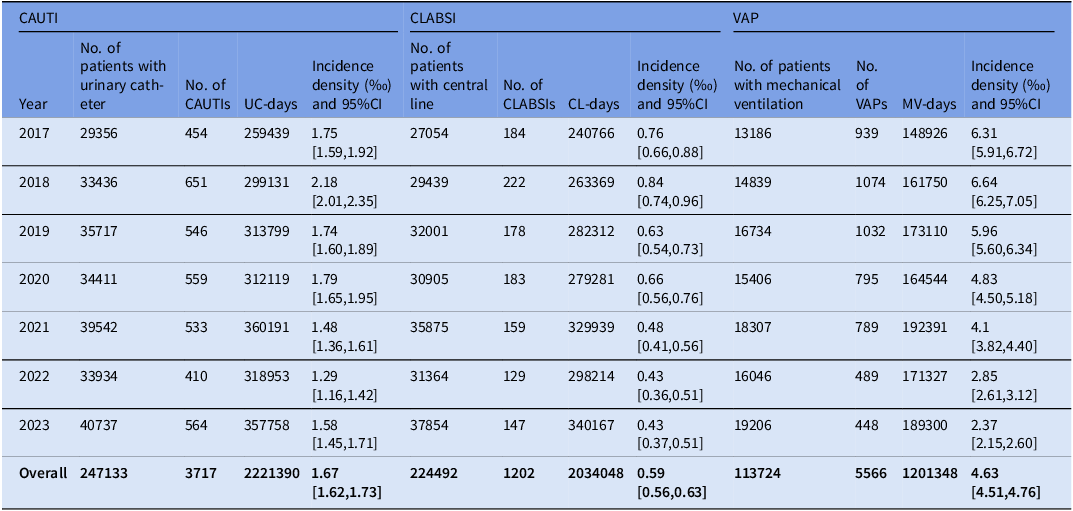
From 2017 to 2023 in Shanghai ICUs, surveillance data revealed: 3717 CAUTIs occurred among 247,133 catheterized patients (2,221,390 catheter-days); 1202 CLABSIs among 224,492 patients with central venous catheters (2,034,048 central line-days); and 5566 VAPs among 113,724 mechanically ventilated patients (1,201,348 ventilator-days). The overall incidence density was 1.67 per 1000 urinary catheter -days for CAUTI (95%CI: 1.62 to 1.73), 0.59 per 1000 central line -days for CLABSI (95%CI: 0.56 to 0.63), and 4.63 per 1000 ventilator-days for VAP (95%CI: 4.51 to 4.76) (Table 1). Table 1 showed the incidence density of DA-HAIs by year. Incidence density of CAUTI was 1.75 per 1000 urinary catheter -days in 2017 and 1.58 per 1000 urinary catheter -days in 2023. A stable trend was found in CAUTI incidence density from 2017 to 2023 with a non-significant AAPC (−5.41 [95%CI: −14.16 to 3.61], P = 0.227) (Table 2, Supplementary Figure S2). Incidence density of CLABSI decreased from 0.76 per 1000 central line-days in 2017 to 0.43 per 1000 central line-days in 2023. Significant decrease was notably observed for CLABSI from 2017 to 2023 (AAPC [95% CI], −11.23% [−16.57, −6.01]; P < .001) (Table 2, Supplementary Figure S2). VAP incidence density decreased from 6.31 per 1000 ventilator-days in 2017 to 2.37 per 1000 ventilator-days in 2023. Shanghai city experienced a greater reduction in VAP incidence density during the study period (AAPC [95% CI], −15.36% [−19.71, −12.56]; P < .001) (Table 2, Supplementary Figure S2). Supplementary Table S1 and Figure S3 showed the device utilization rates from 2017 to 2023, with overall averages of 52.82% for urinary catheters, 47.11% for central venous catheters, and 28.43% for mechanical ventilation. Notably, a slight upward trend was observed in urinary catheter and central venous catheters utilization rates during this period.
Incidence density and 95% CI of DA-HAIs (per 1000 invasive device-days) by year in Shanghai ICUs

UC, urinary catheter; CL, central line; MV, mechanical ventilator; CI, confidence interval. Only patients with indwelling devices for >48 continuous hours (urinary catheters for CAUTI central lines for CLABSI, and mechanical ventilation for VAP) were included.
Trends in Incidence density of DA-HAIs (per 1000 invasive device-days), 2017–2023

APC, annual percent change; AAPC, average annual percent change.
* The time periods were determined by Joinpoint regression analysis which identified 2019 as a significant inflection point (p < 0.05), dividing the study period into two distinct trend segments (2017–2019 and 2020−2023). Both the overall period and preinflection segment are shown for comparison.
The DA-HAIs densities stratified by type of ICUs were shown in Supplementary Table S2. It was found that emergency ICU (1.75 per 1000 urinary-days), general ICU (1.90 per 1000 urinary-days), neurosurgical ICU (1.74 per 1000 urinary-days), and respirator ICU (2.28 per 1000 urinary-days) had a higher CAUTI incidence density compared with overall incidence density of CATUTI. The highest incidence density of CLABSI was found in cardiac surgery ICU (incidence density and 95% CI: 2.11‰ [1.64, 2.67]). The incidence density of VAP in cardiac surgery ICU, neurosurgical ICU and surgical ICU were 15.49, 6.69 and 5.40 per 1000 ventilator-days, respectively.
Organisms isolated and MDROs
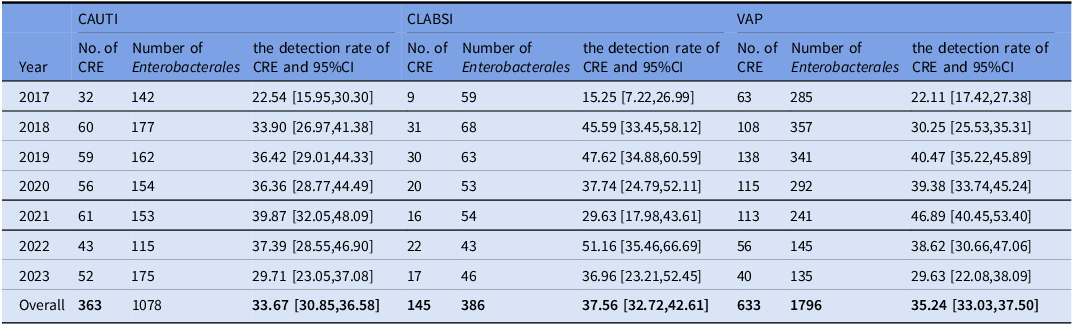
Figure 1 showed the proportion of organisms isolated from DA-HAIs. A total of 3722 organisms were identified in CAUTI patients. The most common organisms were Enterococcus faecium (17.22%), Klebsiella pneumoniae (16.63%), Candida albicans (14.64%), Escherichia coli (10.93%), and Acinetobacter baumannii (6.13%) in CAUTI patients (Figure 1a). The distribution of predominant pathogens remained relatively stable across the study period (2017–2023), with no significant changes in either the ranking or proportional representation of major species. Among 1078 Enterobacterales isolates, 363 (33.7%, Table 3) were identified as CRE. Furthermore, temporal analysis revealed a rise in CRE detection rates among CAUTI patients, from 22.54% in 2017 to 36.42% in 2019 (APC [95% CI]: 29.58% [5.93, 65.46]; P = 0.026; Table, Supplementary Figure S4]. In addition, we characterized the distribution and resistance profiles of other clinically relevant pathogens among CAUTI patients. Our analysis identified 228 Acinetobacter baumannii, 157 Pseudomonas aeruginosa, and 25 Staphylococcus aureus isolates. Analysis of AMR patterns revealed that 21.49% of Acinetobacter baumannii isolates were carbapenem-resistant (CRAB), 16.56% of Pseudomonas aeruginosa isolates were carbapenem-resistant (CRPA), and 48.00% of Staphylococcus aureus isolates were methicillin-resistant (MRSA) (Supplementary Tables S3–S5). Joinpoint regression analysis revealed a statistically significant decreasing trend in CRAB detection rate among CAUTI patients from 2017 to 2023 (AAPC [95%CI]: −15.94% [−24.21, −10.77]; P < .001; Supplementary Figures S5).
The proportion of organisms isolated from DA-HAIs patients. a. CAUTI patients. b. CLABSI patients. c. VAP patients.

Pooled means and 95% CI of the detection rates (%) of CRE among DA-HAIs patients

CI, confidence interval; CRE, carbapenem-resistant Enterobacterales.
A total of 722 organisms were found in patients with CLABSI. Among these, Klebsiella pneumoniae (26.87%), Acinetobacter baumannii (12.47 %), Staphylococcus aureus (8.73%), Candida albicans (5.26%), and Enterococcus faecium (4.99%) were the most frequently isolated organisms (Figure 1b). There were no significant changes in either the ranking or proportional representation of major species across the study period (2017–2023). The overall detection rate of CRE among CLABSI patients was 37.56% (145/386, Table 3). There was no significant increase in CRE detection rate in CLABSI patients from 2017 to 2023 (APC [95% CI]: 8.99% [−17.18, 45.13]; P = 0.490; Table 4, Figure S4]. Among CLABSI patients, we identified 90 Acinetobacter baumannii, 26 Pseudomonas aeruginosa, and 63 Staphylococcus aureus isolates. The multidrug-resistant organism (MDRO) detection rates were 52.22% for CRAB, 15.38% for CRPA, and 46.03% for MRSA (Supplementary Tables S3–S5). Joinpoint Regression analysis revealed a statistically significant increasing trend in CRAB detection rate among CLABSI patients (AAPC [95%CI]: 11.68% [1.66, 39.49]; P = 0.026; Supplementary Figures S6). In contrast, CRPA demonstrated a biphasic pattern: detection rates initially declined from 2017 to 2020 (APC [95% CI]: −47.72% [−65.25, −47.72]; P <.001) but subsequently increased during the 2020–2023 period (APC [95% CI]: 18.32% [18.31, 18.33]; P <0.001; Supplementary Figure S6).
Trends in the detection rate of carbapenem-resistant Enterobacterales among patients with DA-HAIs, 2017–2023

APC, annual percent change; AAPC, average annual percent change.
* The time periods were determined by Joinpoint regression analysis which identified 1 joinpoint (p < 0.05), dividing the study period into two distinct trend segments. Both the overall period and preinflection segment are shown for comparison.
In total, 4817 organisms were identified in VAP patients. Acinetobacter baumannii (37.60 %) was the most frequently isolated organism, followed by Klebsiella pneumoniae (26.66%), then Pseudomonas aeruginosa (13.68%), Staphylococcus aureus (8.49 %) and Escherichia coli (2.93 %) (Figure 2c). There were no significant changes in either the ranking or proportional representation of major species across the study period (2017–2023). The overall CRE detection rate in VAP patients was 35.24% (633/1796, Table 3). The CRE detection rate in VAP patients significantly increased from 2017 to 2021(APC [95% CI]: 19.42 % [12.88, 34.08]; P < 0.001) and decreased from 2021 to 2023 (APC [95% CI]: −22.46% [−34.12, −6.04]; P = 0.002, Table 4, Supplementary Figure S4). In addition, we observed high MDRO detection rates among VAP patients: 76.25% for CRAB, 23.55% for CRPA, and 56.66% for MRSA (Supplementary Tables S3–S5). There were no significant trends in those MDROs among VAP patients (Supplementary Figures S7).
Discussion
In this study, our study demonstrated notable advancements in reducing DA-HAIs rates in Shanghai ICUs, particularly for VAP and CLABSI, underscoring the efficacy of targeted infection control interventions. Despite these improvements, VAP continues to pose a significant challenge, with incidence rates exceeding those reported in US ICUs, highlighting the need for further optimization of preventive strategies.Reference Jonathan, Edwards, Andrus, Dudeck, Pollock and Horan14,Reference Dudeck, Edwards and Allen-Bridson15 Our findings also delineated the microbial profiles associated with DA-HAIs, revealing a concerning rise in the prevalence of CRE among DA-HAIs patients.
Previous studies had demonstrated that the targeted surveillance of DA-HAIs was beneficial for reducing the incidence rate.Reference Li, Cao, Ge, Jiang, Zhou and Zheng16,Reference Edwards, Peterson and Andrus17 In China, the ICU quality control survey, launched in 2015, integrated DA-HAIs-specific quality indicators into its framework, marking a significant step forward in infection control. Notably, the incidence of DA-HAIs in our study were significantly lower than the national ICU quality indicators reported in 2018,Reference Li, Xu and Cai18 reflecting the success of localized efforts. Previous studies have consistently demonstrated that targeted interventions significantly reduce the incidence of DA-HAIs.Reference Dudeck, Edwards and Allen-Bridson15,Reference Ista, van der Hoven and Kornelisse19 However, the cardiac surgery ICU continued to exhibit the highest CLABSI and VAP incidence density compared with that reported by the NHSN,Reference Jonathan, Edwards, Andrus, Dudeck, Pollock and Horan14,Reference Dudeck, Edwards and Allen-Bridson15 underscoring the need for tailored interventions in high-risk settings.
The impact of COVID-19 on DA-HAIs rates has yielded inconsistent findings across studies. Some research found an increased incidence of HAIs, especially for DA-HAIs.Reference Al-Abdely, Mohammed, Rosenthal, Orellano, ALazhary and Al-Garni13,Reference Baccolini, Migliara and Isonne20 Conversely, other studies observed a decline in DA-HAIs among critically ill non-COVID-19 patients.Reference Zand, Vakili and Asmarian21. Additionally, no statistically significant difference in CAUTI incidence was found between COVID positive and COVID-negative patients.Reference Sleziak, Błażejewska and Duszyńska22 Our study observed a significant reduction in VAP and CLABSI during the COVID-19 pandemic period. China’s unique pandemic response including Fangcang shelter hospitals,Reference Fang, Pan and Li23 may have shaped DA-HAIs patterns differently than other hospital systems. However, more research is needed to understand how these measures affected DA-HAIs trends specifically.
Global reports indicated a steady increase in CRE prevalence, particularly in ICU settings where device use was prevalent.Reference Guh, Bulens and Mu24,Reference Logan, Renschler and Gandra25 Klebsiella pneumoniae and Escherichia coli were the predominant CRE isolates, consistent with previous studies.Reference Magill, Edwards and Bamberg26 Our study found while CRE detection rates in CAUTI patients increased significantly during the early study period, stabilization in later years likely reflected the gradual implementation of enhanced antimicrobial stewardship and infection control measures.Reference Cox, Vlieghe and Mendelson27 The detection rate of CRE among CLABSI patients was increased, though not statistically significant. The study also identified concerning upward trends in CRAB (2017–2023) and CRPA (2020–2023) among CLABSI patients. However, it should be noted that the absolute counts of A. baumannii and P. aeruginosa isolates and consequently their carbapenem-resistant variants were relatively limited in our cohort, which may affect the precision of these trend analyses. High detection rate of MDROs among VAP patients were found. The marked increase in CRE detection rates among VAP patients during 2017–2021 was clinically concerning, potentially attributable to overuse of broad-spectrum antibiotics.Reference Vincent, Rello and Marshall28,Reference Zimlichman, Henderson and Tamir29 Notably, this trend reversed during 2021–2023, with CRE rates showing significant decline. Whether this improvement correlates with enhanced antimicrobial stewardship practices or COVID-19 pandemic-related infection control measures requires further investigation. Collectively, these findings emphasized the urgent need for comprehensive, setting-specific strategies to combat CRE across all DA-HAIs in ICUs.
This study has several limitations. First, while potential underreporting of DA-HAIs due to punitive concerns existed, this was mitigated through Shanghai IPC’s biannual data audits and corrective actions, coupled with regular staff training. Second, although we used 2008 NHSN definitions (including ASB for CAUTI and traditional VAP criteria) to maintain historical consistency, this approach may limit comparability with studies using newer criteria and potentially underestimate VAP rates. Third, data availability was restricted to post-2017 due to system upgrades, precluding longer-term trend analysis. Fourthly, the COVID-19 pandemic’s impact on infection rates may have introduced estimation biases.Reference Weiner-Lastinger, Pattabiraman and Konnor30 Lastly, as an observational study, our analysis could identify temporal associations but cannot establish causality regarding intervention effectiveness.
In conclusion, our study has highlighted significant progress in reducing DA-HAIs rates in Shanghai ICUs, particularly for VAP and CLABSI, demonstrating the effectiveness of targeted infection control measures. However, the rising prevalence of CRE among DA-HAIs patients poses a serious public health threat. The observed increase in MDROs was equally concerning.
Supplementary material
The supplementary material for this article can be found at https://doi.org/10.1017/ice.2025.10292.
Acknowledgements
The authors thank all participating hospitals and their IPC teams who assisted with the conduct of surveillance in their hospital, including the surveillance nurses, clinical microbiology laboratory personnel, and the physicians and nurses providing care for the patients during the study.
Financial support
This work was funded by Three year action plan for strengthening the construction of public health system in Shanghai (2023–2025) [GWVI-13], Shanghai Hospital Development Center Foundation [SHDC22024315] and China Medical Board [Grant #23-513].
Competing interests
All authors report no conflicts of interest relevant to this article.