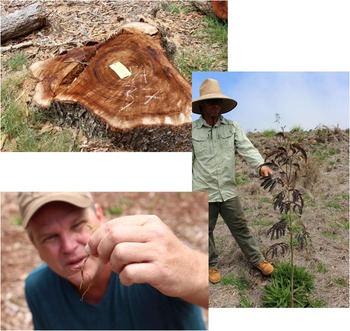
We are hopelessly lost. Over 9,000 feet above sea level, on the Hawaiian volcano, Mauna Kea. At lower altitudes we searched all day, in vain, for surviving Acacia koa trees. Koa is prized by native Hawaiians for making canoes and surfboards. It is also one of the most revered musical instrument tonewoods, with rich red colour, dazzling figure, and warm tone. But koa only grows in a narrow band of elevation (3,000–5,000 feet) here on the Hawaiian Islands. Cattle-grazing, past over-harvesting and high prices paid for sizeable logs means that virtually no mature trees remain of a size sufficient to be made into surfboards or guitars.
With our native Hawaiian friends and guides, Pohaku and Billy, we are in search of such trees, to witness them before it is too late. After hearing our plans for a book that traces guitars all the way back to the tree, Pohaku offered to chaperone us into Hawaiian homelands to visit ancient koa. Climate scientists’ predictions are that global warming may decimate such forests. The thin necklaces of koa that ring Hawaii's volcanos are among those deemed most vulnerable.
We began the day full of energy and excitement. But as the afternoon wears on, Pohaku and Billy grow increasingly frustrated. They know that to find the best koa one must first ascend the volcano, above the tree line, and then descend into its pockets of virgin forest. Yet every rough dirt track, up and down the face of the volcano, leads to dead ends, locked gates and sternly worded ‘do not enter’ signs. These are new security measures intended to protect native Hawaiian homelands and koa trees from unwelcome intruders. The means to protect native lands and precious trees has also locked out their native custodians.
The sun is setting; we're running out of fuel. No cellphone reception or GPS readings. We're off the grid, without a compass. We have no food left. And so, our thoughts turn from the disappointment of not finding koa trees, to matters of our own welfare. How do we get down from here?
Perhaps it was just the thin air, but at this moment a thought struck: is this precisely the kind of existential crisis we face collectively, at a planetary scale? We're adrift, without direction, locked out of the ecosystems that nourish us by the fences of a paranoid security state. Shaken from the comforts of a sedentary modern life, we find ourselves lost and at risk on a biophysically unstable planet. We need to discover a new path, with haste.
Introduction
The world has grown increasingly unstable, haunted by the spectre of catastrophic climate change, habitat loss and species extinctions, while grappling with unparalleled mobilities, economic uncertainty and political instability. Together such conditions signal the advent of the Anthropocene – formally a new planetary epoch in which humans have altered earth systems irretrievably, and culturally a phase of upheaval, of loss and grief for modernist norms of equilibrium and human exceptionalism (Steffen et al. Reference Steffen2011; Head Reference Head2016; Castree Reference Castree2017; Clark et al. Reference Clark, Saldanha and Yusoff2017). If the preceding epoch, the Holocene, was characterised by long-run climatic and biophysical stability (giving rise to agriculture, settled human lifestyles and industrial capitalism), the Anthropocene has as its leitmotifs extremity and unpredictability.
In this paper I ask: what kinds of conceptions are needed to make sense of music in such circumstances of planetary volatility and crisis? Climate change, species extinctions and other related environmental problems are not new topics for musical composition, or for music scholarship (Watkins Reference Watkins2007; Guy Reference Guy2009; Ryan Reference Ryan2014). Yet the advent of the Anthropocene as a biophysical, cultural and political-economic watershed invites further, and urgent, contemplation. In what amounts to perhaps the greatest intellectual challenge of the age, humans will need to reframe the grounds of ontological possibility for our planet, developing a new ‘ethics for the Anthropocene’ across all knowledge fields (Gibson-Graham and Roelvink Reference Gibson-Graham and Roelvink2010; Rose et al. Reference Rose and van Dooren2012; van Dooren Reference van Dooren2016). Conceiving this in music studies, I argue, requires extending our existing precepts on the links between music and environment, and between humans and non-human others.
Across musicology, cultural geography and environmental humanities, a concern with music and environment has grown steadily since the 1990s. A diffuse body of scholarship has nuanced our understandings of how musical texts and performances interact with a variety of urban, rural and ‘natural’ spaces, landscapes and ecosystems (Ryan Reference Ryan2014; Revill Reference Revill2016). With their varying combinations of material, social and cultural actors, biogeographical and anthropogenic contexts shape distinctive soundscapes (Pedelty Reference Pedelty2012). Music scholars are increasingly advocating for research to engage with ‘environmentalities’ (Martinez-Reyes Reference Martinez-Reyes2015), and our collective and pervading sense of planetary crisis, spawning the burgeoning field of ecomusicology (Titon Reference Titon2009; Allen et al. Reference Allen2011; Bendrups et al. Reference Bendrups, Barney and Grant2013; Schippers and Bendrups Reference Schippers and Bendrups2015; Schippers and Grant Reference Schippers and Grant2016). Meanwhile a growing corpus of work is concerned with making sense of our contemporary ecological crisis through creativity, corporeality and performance (Hawkins and Kanngieser Reference Hawkins and Kanngieser2017). Beyond the facts and figures of climate science, creative and artistic expressions interpolate unfolding upheaval.
Nevertheless, earth systems scientists have thus far dominated debate about climate change (Castree et al. Reference Castree2014). Cultural and performative knowledges remain over-shadowed. Theoretical conceptions to comprehend growing planetary instability are barely keeping pace (Rose et al. Reference Rose and van Dooren2012). As with cinema and television, music as cultural text mediates the growing spectre of catastrophe. Innovative compositions and performances translate climate science into creative aural experiences (see for example, https://vimeo.com/69122809). Yet as composer and ecomusicologist Nathan Currier (Reference Currier2014, p. 8) has argued, we need much more than textual re-presentations of environmental crises. The irrefutable evidence of growing ecological, social and political volatility compels responses beyond interpretive texts alone.
At the very same time, ‘new materialist’ ideas in the humanities are spawning conceptual and methodological possibilities around the corporeal, emotional and visceral aspects of creativity in the material spaces of city and country (Duffy et al. Reference Duffy, Waitt, Gorman-Murray and Gibson2011; Ryan Reference Ryan2014; Duff and Sumartojo Reference Duff and Sumartojo2017). Music catalyses and reconfigures relationships between bodies, materials and geographic place. This requires, in Hawkins's (Reference Hawkins2009, p. 183) words, understanding ‘subjects and objects not as fixed oppositions but products of their relating, as co-constituted with multiple social and material reverberations’. Such perspectives seek to de-centre the human within narratives of causality and agency, to ascribe agentic force also to non-human entities – animals, plants, cells, bacteria, metals and so on – with whom humans co-constitute the world (Bennett Reference Bennett2004). Paying attention to the material and corporeal relations between music, musicians and a planet in crisis illuminates problematic entanglements but also the potential for creative responses.
I seek here to connect up these fields – to argue that music and musicians are situated in distinctive, and dynamic, relations with environmental crises, concretely and viscerally. Our scholarly frames of reference, I contend, must extend further than musical texts, towards the very ecosystems, landscapes, materials and beings under threat from Anthropocenic processes of global warming, climate extremity and habitat loss.
I was prompted towards this argument from my own empirical encounters. As the opening recollection from Mauna Kea illustrates, I have for the past three years been involved in an empirical project with my collaborator, Andrew Warren, ‘following’ guitars, and the timbers from which they are made (known as tonewoods), all the way back to the tree (see also Gibson and Warren Reference Gibson and Warren2016). It began with a goal to trace the upstream geographies of guitar-making upon which our cherished musical instruments depend, to learn more of the manufacturing and supply chain issues surrounding the making of guitars. The journey ended up somewhere else entirely: a more catastrophic space characterised by resource scarcity, political contestation and upheaval in existing ways of doing things. A combination of greed, poor forest management, climate change and the perversities of global forestry markets has resulted in worldwide shortages of guitar timbers, or in some cases, outright bans on their use. Over-extraction in an era of unfettered industrial capitalism has threatened species, leading to stricter international regulation of timber trading. A crisis of scarcity has unfolded, emblematic of the Anthropocene's irreversible excess of sustainable planetary thresholds. At the same time, scarcity has forced manufacturers, craftspeople and guitar players to fundamentally reassess their instruments, their component materials and their ecological imprint, in ways that portend more constructive future possibilities.
Meanwhile as a player myself, tracing guitars back to the tree encouraged me to feel a visceral response to the ecological consequences of musical instrument manufacture. For these instruments, so central to the joys and pleasures of music, are gateway objects that invite contemplation of deeper relationships that bind together musicians and non-human others. I came face to face with the biological organisms from which our cherished instruments arise, to comprehend, corporeally, that musicians are ourselves caught up in the extraction and exploitation of natural resources for human gain.
In reflecting upon my own encounters with guitars, timbers and trees, in this paper I suggest three burgeoning themes that re-frame precepts of music and environment: materiality, corporeality and volatility. Each emerged as key themes from the empirical research – the physical qualities of trees and timber, the bodily relations humans develop with such materials, and the prospects of volatile disruptions to the status quo – came to the fore. The three themes are disentangled in dedicated sections below. Within each, the narrative responds to aspects of our research journey, including quotes from luthiers, guitar manufacturers, sawmillers and tonewood specialists interviewed along the way.Footnote 1 Following guitars ‘all the way back to the tree’, I show how material, visceral relations emerge through music as sound, but also via our most cherished artefacts: musical instruments. Connecting the musical instrument to intimate bodily relations, as well as wider geographies of resource use and manufacture, reveals conditions characteristic of the Anthropocene: an epoch of disruption, of entangled and compromised human–nature relations, in which relations of care with non-human entities and materials are invariably renegotiated, from the body to the forest. These three themes offer ways to make sense of rapidly unfurling planetary forces, signalling possibilities for a closer, embodied and material cultural approach to studies of music and environment.
Enchanted wood
Our journey began with the finished musical instrument – the guitar – tracing it ‘in rewind’ to factory and workshop, and from there to sawmill and ultimately, back to the tree. In this, we were inspired by Cook's (Reference Cook2004) geographical methodology to ‘follow’ things, tracing a genealogy of resource extraction, processing and manufacture. This methodology rests on thinking about material-cultural artefacts such as musical instruments not as finished ‘things’, but as assorted materials brought together in coherence via dispersed and relational geographies, transformed through labour and technology for the purposes of being sold for profit, and thence used in certain ways (Castree Reference Castree2004). This technique maps the ‘shadow geographies’ (Thrift Reference Thrift2002, p. 293) lurking in everyday objects – to render visible various deleterious environmental, labour and cultural impacts in upstream commodity production and consumption.
Guitars were accordingly traced from factory to sawmill and ultimately to the forest. Guitar factories and luthiers (craftspeople who make guitars in small volumes, in the hand-made tradition) were visited first across the USA and Australia. Among the firms visited were legendary global brand names in both acoustic and electric guitar manufacture (Taylor, Fender, Gibson), high-end niche firms who combine elite skills, new technologies and materials (Santa Cruz, Cole Clark, Maton) and tiny lutherie workshops. Although sympathetic with small artisanal producers and with associated critiques of the impacts of mass production (cf. Dudley Reference Dudley2014), we sought to avoid simplistic binaries of small-scale craft production vs. large manufacturers (cf. Carr and Gibson Reference Carr and Gibson2016). Tiny and enormous players alike were included. With rare exception, conversations veered quickly from the manufacturing process towards upstream timber resource scarcity, new environmental regulations and a scramble among guitar-makers for viable alternatives.
Following leads gleaned from guitar manufacturers and luthiers, visits were then made to sawmills and tonewood specialists in Tasmania, Hawai'i and the Pacific Northwest, followed by excursions, chaperoned by guitar timber experts and native forests custodians, to see surviving trees. Unforeseen issues were revealed, including the politics of Indigenous peoples’ rights and access to forests, legal complexities around international timber trading, and the advent of privatised forestry (Gibson and Warren Reference Gibson and Warren2018). We witnessed unheralded and underappreciated skills and knowledge among guitar timber specialists and foresters, set against much larger-scale forces at work transforming biodiverse landscapes into monocultural ‘tree farms’ and ‘carbon banks’ (the latter increasingly a feature of carbon trading in the climate-change era). And prompted by extant scarcities and crises, we visited plantation and cultivation experiments undertaken by passionate guitar makers and tonewood specialists, at the fringes of mainstream forestry, to ensure trees are available for future generations to harvest.
In so doing, this project seeks to contribute to a lineage of scholarly research on musical instruments. Extensive research in the ethnomusicological tradition has documented instruments as vital components of local, regional and national musical cultures (Oliver Reference Oliver1988; Neuenfeldt Reference Neuenfeldt1997; Corn Reference Corn1999, Reference Corn2003), and musical mobilities and globalisations (Dawe Reference Dawe2010; Troutman Reference Troutman2016). Likewise histories of musical instruments abound (e.g. Truanquada and King Reference Truanquada and King2012; Shaw and Szego Reference Shaw and Szego2013). Seldom, however, have music scholars foregrounded resource use and sustainability issues, their contemporary mass manufacture or the biological materials from which they are made. A rare and instructive example is Robin Ryan's (Reference Ryan2015) tracing of tree harvesting and sustainability issues for the Australian Aboriginal didjeridu, encompassing wood sourcing, construction and commodification, and attempts to protect Indigenous custodianship in an era defined by both climate change and exploitative commercialism. For Ryan (Reference Ryan2015, p. 15), ‘could the musical instrument become an emblem for the protection and regeneration of natural ecosystems, as opposed to their destruction?’ From unassuming origins, our research journey ‘following’ guitars became increasingly concerned with similar questions.
The guitar is, in this regard, an exemplar through which to reconsider relations between musicians and planetary environmental change. It is the most popular instrument, globally, in terms of sales (Music Trades Reference Trades2015), linking the medieval lutherie tradition to contemporary mass manufacture via increasingly complex global production networks (Gibson and Warren Reference Gibson and Warren2016). The guitar ‘has accommodated more diverse players, techniques, and styles than any other instrument in use today’ (Coehlo Reference Coehlo and Coehlo2003, p. 5). A growing critical scholarship across musicology, cultural studies and history is disentangling the guitar's globalisation, impact and international dimensions of production and consumption (Waksman Reference Waksman2001; Dawe Reference Dawe2010; Dudley Reference Dudley2014; Martinez-Reyes Reference Martinez-Reyes2015; Troutman Reference Troutman2016). Here, I seek to complement and extend such scholarship by tracing guitar production all the way back to the tree. While the cultural and economic significance of what Kevin Dawe (Reference Dawe2010, p. xvii) has called the ‘guitarscape’ is increasingly recognised, the instrument's upstream geographies of manufacture and dependencies on material resources with distinctive biogeographical origins remain obscure.
That this is so belies the degree to which guitars, and guitarists, are via their component materials entangled in dynamic relations with upstream ‘nature’. Through their timbers, guitars invite reflection on cultural relations between musicians and the human and non-human others (makers, sawmillers, trees, forests) necessary for musical instrument manufacture, and therefore also for music making. Timber materials are more than mere utilitarian inputs: they are enchanted materials (Bennett Reference Bennett2010, p. xii) – central to marketability, and to the cultural meanings musicians attach to guitars (Martinez-Reyes Reference Martinez-Reyes2015). Focusing on guitars and the timber from which they are made compels consideration of bodily and affective relations with sound-making objects, with organic materials engineered by musical instrument makers to elicit emotive responses, as well as with upstream forests and plant species from which these materials are sourced.
A clarification is warranted that this paper focuses on timber, rather than solely on a certain type of guitar. To talk of ‘the guitar’ enrols what is actually a family of diverse, related stringed instruments and regional variations – steel string acoustic, classical, flamenco, lap steel, pedal steel, electric, semi-acoustic, resonator slack key, baroque, Weissenborn – each of which involves distinctive designs, playing techniques, preferred materials and processes of manufacture (Dawe Reference Dawe2010; Troutman Reference Troutman2016). As Victor Coehlo (Reference Coehlo and Coehlo2003, p. 3) has succinctly put it, ‘the guitar's development is made up of multiple and overlapping histories’. Key timbers we ‘followed’ back to the tree are used across these instrument types. Mahogany, strongly associated with inter-war Martin acoustics, is also one of the paramount timbers underpinning the iconic Gibson Les Paul electric guitar since the late 1950s (see Martinez-Reyes Reference Martinez-Reyes2015). Manufacturing companies we visited make acoustic as well as electric instruments, lap steels and ukuleles. Sawmills visited process timbers for acoustic, classical and electric guitar models. Areas of overlap therefore surround the story depicted here. The focus is squarely on timber, rather than other input materials such as metals (pivotal to the pickups of electric guitars, but also prominent on acoustic instruments, for example, in strings). At risk is privileging the ‘natural’ components of guitars, entrenching a lineage of romanticist longing that has surrounded acoustic guitar playing and contributed to its mystification (Dawe Reference Dawe2010). The intent is not to entrench the long-held bias, amplified especially in the folk music scene, that posits electric guitars as somehow less ‘authentic’ or ‘natural’ (cf. Grunfeld Reference Grunfeld1969; Waksman Reference Waksman2001). Rather, the spotlight is on an instrument family in which across all of its multiple variants, large manufacturers, craft producers and players alike have revered timber inputs and become embroiled in resource scarcity concerns, ushering a heightened focus on specific timbers, their acoustic qualities, and biogeographical origins.
The result, as I hope to show below, is a fraught and complex relational geography emblematic of the Anthropocene – a geography in which emotionally charged relationships with musical instruments extend beyond affection for much-cherished tone, towards plaintive acknowledgement of the upstream destruction of forests upon which the making of musical instruments depends. In the context of growing socio-ecological volatility, music is visceral and material, captured in the very tools we use to make music.
Materiality
In following guitars back to the tree, materiality and the agentic capacities of non-human others emerged from the outset as central themes. Building guitars is an exercise in calculation (cf. Callon and Muniesa Reference Callon and Muniesa2005), bringing together timbers and other parts in precise combination – a material–technological accomplishment. The finished guitar suggests a coherency of material parts that holds together fragile relations between materials, skills and affordances (Dudley Reference Dudley2014). Patterns, templates and forms are derived from antecedent lutherie experiments and traditions (Pollens Reference Pollens and Coehlo2003). The guitar works as a musical instrument owing to strings being pulled tight under extreme tension, held by an underlying structure from the headstock and tuning pegs to the bridge on the body of the guitar. To amplify plucked or strummed strings, electric guitars use pickups, while for acoustic and classical guitars, the guitar body forms a soundbox within which soundwaves amplify and project outwards through the sound hole. However, because of extreme string tension, and the continuing cellular transformation of timbers after harvest (drying, expanding and contracting with humidity and heat), guitars are perennially prone to breakage and warp. All the while, timbers improve in tone as they age. Guitars hold together via human ingenuity and craft, timber joints and glues (Dudley Reference Dudley2014). They sound better over time, but under string tension they always want to pull themselves apart.
Until recently, a narrow range of timber species were considered suitable for engineering into guitars. Select timbers possessed suitable stiffness, density, elasticity, strength and vitreousness (pleasing sounds when reverberating) as well as an aesthetically attractive appearance (Bennett Reference Bennett2016). As ecomusicologist Aaron Allen has argued, ‘it is a coming together of ecological and cultural factors that creates the value of tree-derived instruments’ (Allen Reference Allen, Cook and Pacini2012, p. 314; see also Ryan Reference Ryan2015). Through centuries of antecedent Spanish and central European craft tradition, luthiers established for instance that spruces (Picea spp.) worked best as acoustic and classical guitar soundboard timbers. They had enough tensile strength to be cut thinly and yet not collapse under extreme string tension, and had straight and parallel grains. Soundboards made from denser, thicker timbers would be stronger, but too heavy to play comfortably, and would sound quieter, and dull. Each guitar part evolved through similar compromises: for necks, mahogany (Swietenia macrophylla) or maple (Acer spp.); for fretboards and bridges, ebony (Diospyros spp.) or rosewoods (Dalbergia spp.); and for acoustic guitar backs and sides, rosewoods and mahogany. Since the inter-war Hawaiian music craze, koa (Acacia koa) has featured on acoustics, electrics, and ukuleles (Truanquada and King Reference Truanquada and King2012; Bennett Reference Bennett2016). Such compromises attempt to balance strength, sound and aesthetic appearance. As Miles Jackson, CEO of Cole Clark guitars, explained:
The best acoustic sounding guitar ever known would use tiny bits of timber. But it's gonna pull apart in about two hours. It would be the best acoustic guitar ever, but everything after that's compromised. A lot of times we'll play a guitar, and go, ‘It's over engineered’, because it's too nice. It'll still be here in 200 years, but you compromise so much on sound. You'll have others which are bloody unbelievable sounding, but it's only gonna last ten years, or five years.
Guitar makers enter into relations of care and compromise with timbers, working between human ingenuity and plant cellular affordances, foretelling material possibilities.
A focus on materiality thus invites questions of agency – non-human, political, intentional, innate – in the ‘processual making of sonic space as socio-material relationality’ (Revill Reference Revill2016, p. 240). Music is less owned by individuals, as Sophia Maalsen (Reference Maalsen2013:iii) suggests, but rather reused and recirculated via materials, technologies and networked communities. She asks a deeper question ‘concerning the nature of musical sounds and their relationship to the people who produce and work with them … practitioners work with musical sounds’, but ‘musical sounds work on practitioners’; they ‘develop a life of their own’.
In this way, the ‘sound of trees’ (Bennett Reference Bennett2016, p. 49) and resulting guitar acoustics have over time worked on manufacturers and tonewood specialists. A heightened awareness of the material and acoustic properties of trees has evolved, prompting distinctive methods of transformation into timber for musical instrument manufacture. David Olsen from Pacific Rim Tonewoods in Washington, United States, described how:
a practiced eye can take a look at a log, and infer a lot of things about that log, about that tree … Such things as the spiral grain of the log, and the number of knots and the density, the quality of the ingrain. Things like rot or pitch pockets are examined. No tree is perfect. In fact, trees are kind of gleefully and wonderfully biological. For example, every spruce tree is going to have a subtle twist to the grain … The other thing is, the trees are never exactly round, they're never symmetric and in the round.
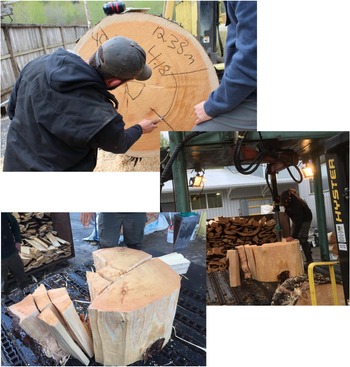
Even in this, the world's largest and most sophisticated tonewood processing sawmill, a bespoke plan is developed for the cutting of each log in order to secure the maximum useable parts while accommodating each tree's biological quirks. Subsequent skills in log splitting (into billets) and quartersawing flat boards from logs (perpendicular to growth rings) are finessed – specialist techniques that improve the acoustic performance of resulting component guitar parts while ensuring requisite strength (Figure 1).
Log-splitting Sitka spruce at Pacific Rim Tonewoods, Washington; experts ‘read’ the log for how to best process it for maximum number of useable soundboards with high-quality acoustic properties. Photos: author.

Guitar-makers thence attempt to balance guitar components acoustically. Whereas mass manufacturers work towards standardised products (with uncertain consequences for overall frequency balance), luthiers and small workshops are able to curate together carefully chosen components from different species, for individual players, and then carve braces and vary thicknesses of parts to ‘tune’ the individual instrument's resonant frequencies (Dudley Reference Dudley2014). As Richard Hoover, founder of Santa Cruz Guitars, explains:
Here's a signature spruce top from Alaska. We're designing a guitar for someone that wants a reasonably warm tone, something that's kind of blended and friendly … Stiffness promotes treble, flexibility promotes bass. So, right now, we've already got the tone the customer wants … Now that we've tuned this top, we're gonna put braces on it, which will give it some structure and hold the string, but also how we shape these is going to be just like moving the graphic equaliser on your sound system. If you're playing bluegrass, you like to push that bass thing all the way to the top. If you're playing a classical style you'd hate that.
‘Planty’ qualities (Head et al. Reference Head, Atchison and Phillips2015, p. 399) both enable and threaten the integrity of the product made from timber. Given such peculiarities, guitar making illuminates the distinctive skills and dispositions required when working against the limits of, but also with the capacities of, organic materials, their genetic inheritances and potentialities. Although many guitars are now made using automated machinery, lessening the use of craft skills with timber (Dudley Reference Dudley2014), as scarcity of guitar timbers escalates, accrued skills with adjudicating and ‘curating’ guitar timber parts within individual instrument have, somewhat contradictorily, become more important.
Such knowledge of material affordances entwines guitar makers and musicians within wider resource geographies. As the craft of guitar making transformed into mass manufacture in the early 1900s, dependence on a narrow range of suitable timbers established a geography of resource use and making practices that linked the factory or workshop to wider, global networks of resource extraction and trading (Gibson and Warren Reference Gibson and Warren2016). These were very specific geographies: preferred timbers came from specific places where trees grew with a strong, single dominant vertical stem, forming even rings and straight grain in environments with consistent, even rainfall. Their trunks needed to be wide enough so that when harvested boards could be cut thinly, and remain strong, of sufficient dimensions to become the faces and backs of guitars. Hence guitar making depended on old trees, at least 100 years old, but usually much older than this – in the order of 300–500 years. Only in certain regions on earth are such conditions met: wet places, old growth tropical and temperate rainforests, typically with rainfall above 3 m/9 ft p.a. In the words of David Kirby, a specialist tonewood supplier: ‘You simply need rainforests to grow a lot of instrument-grade timbers. They are very thirsty’.
Hence, Sitka spruce (Picea sitchensis) comes from its endemic bioregion in the Pacific Northwest, an arc of coastal old growth forests spanning Washington state, British Columbia and Alaska. Rosewoods arose from Amazonia (and were later sourced from Madagascar, Indonesia and parts of India, when Brazilian stocks were exhausted), and ebonies from equatorial Africa. Guitar makers’ dependence on a limited range of materials – in turn a consequence of the cellular properties of tree species – locked into place material networks of resource extraction and supply. Materiality, in short, determined the guitar maker's dependence on forests and biophysical and climatic conditions across a network of quite particular regions, binding makers and trees together into a geography of relating. That geography of relating, as we shall see, persisted through a phase in which guitar making transformed into a mass manufacturing industry, only to come unstuck with accompanying over-harvesting, and the onset of a new era of scarcity.
Corporeality
Our journey tracing guitars back to the tree prompted consideration of a second, related theme: corporeality. Here, theoretical antecedents regarding the body, affect and emotion loom large. Critique is levelled at the subject/object binary and the disavowal of fleshy bodies in cultural ethnography (Probyn Reference Probyn and Rakow1992; Ahmed and Stacey Reference Ahmed and Stacey2001). As Catherine Hoad (Reference Hoad2012, p. 1) has argued , ‘we are always vulnerable to forces that threaten the boundaries of the self’. This theme draws attention to qualities of sound in forging body–space relationships: ‘how the sensual and rhythmic attunement to place contributes to understanding how spaces forge a sense of belonging to others’ (Duffy et al. Reference Duffy, Waitt, Gorman-Murray and Gibson2011, p. 17). Music, beyond discourse and text, impacts on the flesh and materiality of bodies. The body's capacity to affect and be affected by music elicits physiological responses to the external world: ‘Through the corporeal capacity to sense rhythm the feeling/thinking/social body comes alive in situ’ (Duffy et al. Reference Duffy, Waitt, Gorman-Murray and Gibson2011, p. 17).
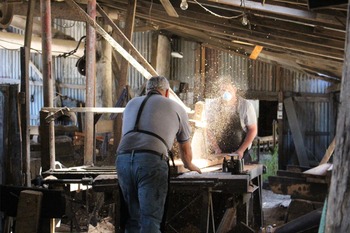
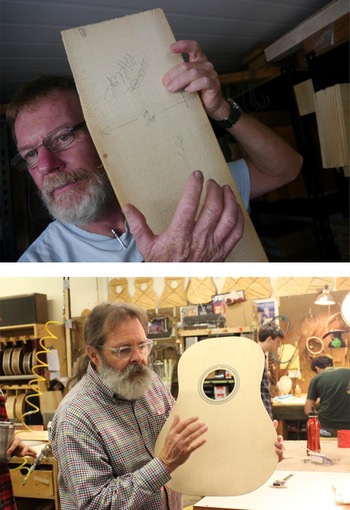
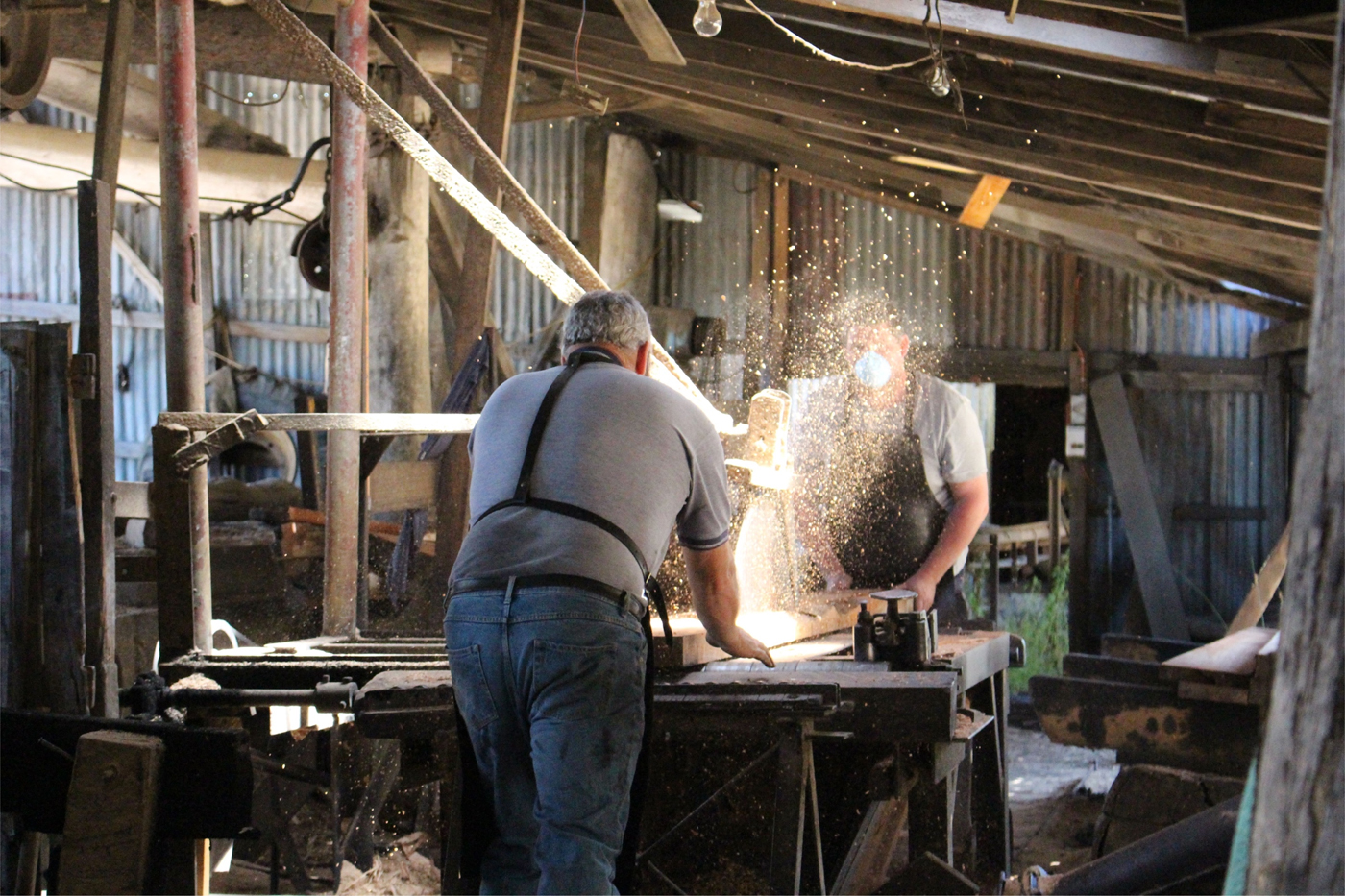
In tracing guitars back to the tree, the theme of corporeality encompassed bodily dispositions and accumulated manual skills among timber and guitar-making experts required to ‘read’ the material qualities of timber for their resonant qualities. It also involved emotional reactions among musicians to guitars’ resulting ‘magic’ tone. Those who harvest trees, cut guitar tonewoods and turn them into fully finished musical instruments, possess gradually accumulated haptic skills – learnt through material interactions with timber, in the hands, via touch and feel (Figure 2). Acclaimed textbooks detail the science of guitar-making (e.g. Gore and Gilet Reference Gore and Gilet2011), but consensus among luthiers is that the trade must be learnt in the hands, through refined interactions with timber – an infinitely variable material (Dudley Reference Dudley2014). Skill with timber ‘lies not in the execution of motor operations but in the sensitivity with which these operations can be adjusted to a close perceptual monitoring of the task as it unfolds’ (Ingold Reference Ingold2017, p. 3). An example is the technique of ‘tap-testing’ instrument sound-boards: tapping an individual piece of timber in a precise location in order to ascertain the frequency spectrum of its reverberations (Figure 3). This technique is necessary for ‘tuning’ the board for use in individual instruments. The material and the corporeal intertwine in adapting the engineering of guitar timbers to achieve acoustic quality.
Les and Joe at Goshen Sawmill, Northeastern Tasmania, process Tasmanian blackwood for guitar making. They use 1940s sawmilling equipment (‘still the best for the job’) and cut blackwood logs by hand, without measurements, using only eyesight and haptic skill in the hands. The log is passed backwards and forwards between the two, across the circular cutting blade, in a kind of ‘dance’. Photo: author.
‘Tap-testing’ soundboards: luthier Michael Connor, NSW, Australia (top); Richard Hoover, Santa Cruz Guitars, Santa Cruz CA (below). Photos: author.

Skill and craft thus evolve in iteration with the genetic qualities of timber to transform guitars into cherished instruments. Guitars with ‘magic’ tone are enchanted corporeal accomplishments, rather than merely utilitarian objects. Musicians make guitars ‘come alive’, through their minds and hands, but guitars only possess such capacities because of iterative, haptic skill in their making, and in the finding and cutting of timber that goes into them.
Meanwhile, musicians develop material and corporeal relations when playing guitars. The guitar ‘demands a certain approach, it requires the player to have specialist knowledge which includes the skills to orientate quickly to the guitar's materiality (shape, weight, layout and sound)’ (Dawe Reference Dawe2010, p. 121). Guitarists describe certain instruments as having a ‘good feel’ – referring to both the texture of wood under fingers and overall reverberating qualities (whether acoustic or electric guitars). Sonic properties are described in terms of sound and vibration through the body. Yet as Miles Jackson from Cole Clark guitars put, ‘Tone is also in the fingers’. Through the brain and fingers, musicians develop relationships with their instruments’ materialities, and with wider planty biogeographies. Via their instruments, musicians can be understood as entering into unfolding visceral relations with the timbers, with the makers and factory workers who conjure objects from them, and indeed, with the trees and forests from which the timbers come. The act of playing a guitar brings together woods, metals and muscles; gears, soundboards and frets. None can exist without the other.
Guitar-playing can thus be thought of as more-than-human, indeed more-than-musical: a practice of enchanted sound-making in which a wider geography and set of actors, including those cutting and finessing wood, the forest and tree, are folded back into the expressive and emotive moment. Beyond a unidirectional view of music-making that posits virtuosity solely with the musician, following guitars back to the tree invites thinking about different kinds of embodied geographies that unfold in relating with non-human entities: plants, craftspeople and fingers in conversation.
Increasingly, musicians’ appreciation for the ‘feel’ and embodied response to guitars is transmuting into acknowledgement of the skill involved in making guitars, and to the rarity and quality of timbers used in their making. Unlike in earlier eras of plentiful timber supply, when brand name, tone and playability were paramount, guitars are now very much marketed through the uniqueness and charisma of their increasingly scarce timbers. Designs more openly display ‘woody’ grain, celebrating rather than concealing plant origins. Visceral relationships across all these actors are shifting, from sawmillers to makers and musicians. While musicians are renowned for being stubbornly attached to a very limited number of ‘traditional’ timbers used in instrument-making, questions of provenance and ecological sustainability are of growing concern (Gill Reference Gill2011). In a state of scarcity and environmental regulation brought on by the Anthropocene (see below), unique stories of timbers from which a guitar is made embellish passionate attachments to the object, and beyond brand recognition provide another means of social distinction within the guitar-playing fraternity. Past over-exploitation of guitar timbers has spawned a new era of compromise and demands for clarity of provenance.
Volatility
If the first two themes, materiality and corporeality, resonate with some degree of familiarity to music scholars, here I wish to add a third, from a somewhat less familiar quarter: volatility. In the case of the guitar, human-driven ecological destruction and accompanying volatility have radically reshaped the geography of musical instrument manufacturing (Gibson and Warren Reference Gibson and Warren2016). Resource scarcity interacts with the materiality and corporeality of musical instrument design and making process, and the means by which an object such as the guitar comes to be in the world, in the lives of musicians.
Of all the themes arising from our journey, most prominent was the spectre of species endangerment – a paramount condition characteristic of the Anthropocene (Steffen et al. Reference Steffen2011). Escalating forces compelled us to contemplate how the materialities and corporealities of music are reshaped by market dynamics, and accompanying ecological volatility. More than three-quarters of the terrestrial biosphere has been transformed into anthropogenic biomes, causing ‘unprecedented global changes in biodiversity as native species are driven to extinction locally and globally’ (Ellis et al. Reference Ellis, Antill and Kreft2012). Expanding international trade in timber for building construction, furniture and designer commodity goods (including musical instruments) has been shown to directly threaten biodiversity in the developing world (Lenzen et al. Reference Lenzen2012). Increasingly large volumes of timber are sold on spot and futures markets, while clandestine supply chains, linked to illegal logging in national parks, persist (Bisschop Reference Bisschop2012). Logging for timber is still the dominant driver of tropical forest loss (even more than highly publicised palm oil plantations), while many critically endangered forests are covered by logging concessions (Abood et al. Reference Abood, Lee, Burivalova, Garcia-Ulloa and Koh2015). Select high-value tree species used in acoustic guitar production grow in limited spatial and climatic contexts, only renewing slowly, over centuries. Such timescales conflict with short-term commercial imperatives, and with predicted climate change impacts on future forest range and habitat scenarios (Iverson et al. Reference Iverson2008).
Such volatility has come to affect instrument making via the very timbers upon which the industry depends, and the material resource geographies that link it with distant, and often unstable, places. The forests from which the timbers derive are now under extreme pressure, bound up in destructive land clearing, and increasingly the focus of global efforts to limit tropical forest loss – emblematic, in other words, of responses to Anthropocenic conditions where humans have driven planetary-scale, systemic change.
Guitars were once luxury instruments, significant investments. Now they are a mass-consumed commodity. Characteristic of the industrial capitalist tendency to over-exploit natural resources for profit, relationships forged in an era of nascent mass manufacturing did not adequately anticipate the implications of endless growth in demand for guitars. As guitar making became a fully fledged industrial capitalist industry, dominated by factory production, raw materials were needed in greater quantities, coming from places where forestry practices were unsustainable, politicised and contested (Gibson and Warren Reference Gibson and Warren2016). Growing environmental awareness of the destructive impacts of tropical forestry on biodiversity loss coincided with the growth of mass markets for guitars. New international frameworks to protect endangered species such as the Convention on the International Trade in Endangered Species (CITES)Footnote 2 and domestic legislation such as the Lacey Act in the United States, now increasingly govern the timbers used in guitar making (Shelley Reference Shelley2012).
As scarcity and growing environmental regulation have challenged the use of traditional timbers, new material geographies of relations with upstream timber suppliers and forests have emerged (Gibson and Warren Reference Gibson and Warren2016). Traditional timbers have become exorbitant to purchase, or are restricted from international trade owing to species endangerment concerns (such as Brazilian rosewood (Dalbergia nigra), which under CITES now has the same legal protection status as elephant ivory). Guitar makers have been forced to consider alternatives. As Patrick Evans from Maton Guitars described, ‘there was an economic imperative in that particularly mahogany was starting to go through the roof, price-wise. Probably the first thing we had to do was to find an alternative for mahogany’. Australian manufacturers turned to native species such as blackwood and bunya pine (Gibson and Warren Reference Gibson and Warren2018). American firms turned to their own more plentiful domestic timbers such as maple and cherry, and new alternative species were trialled.
Further compromises have ensued: alternative timbers that do not sound exactly like the traditional spruces, mahoganies or rosewoods. Established traditions have had to make way for viable and more sustainable substitutes – and not without struggle. As Richard Hoover, CEO of Santa Cruz Guitars explained:
The truth is that there's awesome wood to build guitars out of that are non-traditional, but we inherit the tradition … The traditional woods got stuck to our mind … You can change the world with a guitar, and it's an awesome thing to do. But I haven't seen yet, personally, somebody who's taken an effort to try to make an alternative timber really sophisticated sounding, an orchestral quality instrument. Maybe it can be done, but I haven't seen it yet.
That fewer and fewer future guitars will be built with solid rosewoods, mahoganies and ebonies, and will more likely contain veneers, or alternatives such as Tasmanian Blackwood or maple (semi-jokingly described by Hoover as ‘a red-headed stepchild of woods’), illustrates the zeitgeist of material disruptions in the Anthropocene: past over-exploitation of non-human nature has led to irreversible disruption in established ways of doing things, prompting re-evaluation of resource use practices and new compromises: material relations reconfigured differently between humans and, in this case, a new cohort of tree species.
Continued use of tonewoods with scant regard to provenance has become an increasingly risky practice. One luthier described how ‘flying under the radar may have worked for decades, but with intensified governmental focus on guitar industry activities, doing things the old way involves risks that can easily result in both the loss of a business and personal bankruptcy’. No more was this vividly illustrated than in raids undertaken by Federal agents on Gibson Guitar Co. premises, investigating alleged the use of illegally trade timbers (Shelley Reference Shelley2012). Federal Justice Department marshals raided the Nashville factory (in 2009) and seized a shipment of timbers from Madagascar; then in 2011 raided both Nashville and Memphis plants over shipments of Indian-sourced rosewood (Dalbergia latifolia) that was allegedly of undocumented provenance. Marshals seized wood, electronic files and guitars.
The raids were a watershed for the industry – a disruption emblematic of the Anthropocene's prospects for volatility and challenges to the status quo. The raids and accompanying media coverage sent shockwaves through the guitar-building and playing community; musicians and workers were quoted as feeling stunned to be ‘treated like criminals’ (Gibson Guitar Corp. Reference Corporation2011); and guitarists in possession of vintage instruments panicked about their legal status, and whether taking their guitar on a world tour would risk confiscation.
Crisis and the amplified scarcity emanating from environmental regulation led to reconfigured arrangements of raw materials extractors, traders, makers and musicians. New actors such as verifiers have emerged who could assure guitar manufacturers of timber provenance, while solo-operators and salvagers sourced increasingly rare and expensive logs. Use of alternative species spawned, as did the trend for use of reclaimed timbers – the stories associated with salvaged or unusual timbers becoming a new marketing opportunity for guitar-makers, emphasising the uniqueness of each piece of timber, as well as environmental credentials. Meanwhile the non-profit music-environmental group Reverb.org mounted a campaign in support of the Lacey Act (see: http://reverb.org/no-more-blood-wood-campaign/), aiming to raise knowledge among musicians of the importance of new restrictions on tonewood trading in order to protect biodiversity.
On our journey, we witnessed new relationships between musicians, makers and ‘nature’ in the midst of being reconfigured. The contours of this emerged as we ‘followed’ the guitar to the tree, revealing biographies of the timber but also of the people and landscapes encompassed in timber extraction and use. Patrick Evans from Maton Guitars, for example, described their shift to using more sustainable native timbers, while encouraging factory workers to visit forests on work-related field trips, to learn about upstream forestry management problems and issues: ‘The raw materials thing is so important. Going back to the forests. I think it's great because it strips away all those supply chain layers, and gets you back in the dirt. That's the right thing to do.’
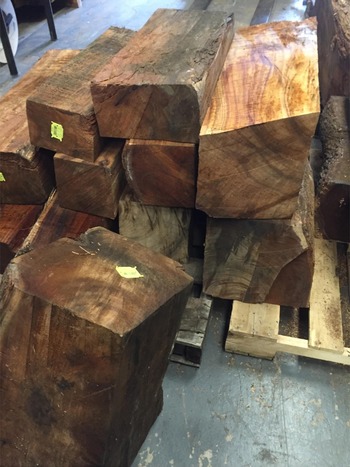
Other reconfigurations of relationships between timbers and trees, sawmillers, forests and foresters included experiments in supply, as scarcity worsened, introducing more actors and intermediaries. This was vividly illustrated in the example of koa, to which I return briefly here to ‘close the circle’ with the paper's introductory scene. Tracing koa back to the tree required a combination of detective work and diplomacy. The starting point was the Port of Honolulu, visiting an exotic wood trader. Here were raw koa billets, harvested from ‘wild’ forests, being processed for guitar and ukulele parts (Figure 4). We were lucky – conversations with the trader (who chose to remain anonymous), revealed that there were very few logs left, and that pieces of this quality very rarely arrive for processing. Vague details and sketchy instructions were given on the people who extracted these logs, and the forests from which they came. No phone numbers or email addresses were available. This proved to be a lead that eventually went dry.
Rare supplies of koa billets from virgin forests on Mauna Kea, Hawaii, recently arrived at a specialist tonewood facility in the Port of Honolulu. What look to the untrained eye as roughly cut pieces of firewood, are priceless, highly figured koa logs. Most were destined for a major US electric and acoustic guitar manufacturer; smaller pieces were cut for local a ukulele manufacture. Photo: author.

We then sought to track down ‘wild’ koa through Pohaku and Billy, our own native Hawaiian contacts on the big island, linked to surfboard-making. This led us to Mauna Kea, and eventually, to getting lost, as in the preface to this paper. We never did find mature koa that day, although we did find a treacherous path down the face of the volcano before our fuel ran out. The next day, chaperoned by the same native Hawaiian elders, we looked elsewhere on the windward side of Hawaii. Remnant groves of ancient koa were found that have survived on steep parts of now privately owned blocks of land that are managed by native Hawaiians through informal agreements.
Still on the koa trail, we also learned of new, trans-oceanic routes for koa supply from Pacific Rim Tonewoods (PRT), a specialist sawmill in the mainland Pacific Northwest, near the Canadian border. PRT's core business is primarily the processing of traditional Sitka spruce logs for soundboards. They recently also entered into partnership with Taylor Guitars and Haleakala Ranch, a cattle-grazing company on the island of Maui, Hawaii, to access koa planted 30 years ago as a weed suppressant on pasture at the correct elevation above sea level. Haleakala Ranch is still owned by a mainland American family, one of the original colonising interests in the Hawaiian islands, after more than 125 years. Only a small fraction of these 30-year old planted trees was useable – essentially the stumps of a small percentage of the trees present in the grove. Nevertheless, the small amounts of timber available were highly figured, with beautiful, prominent grain. Moreover, the trees were available to harvest, with minimal environmental impact, and with no legal ramifications akin to those experienced in protected forests or native Hawaiian homelands. Discussions with ranch owners led to the partnership enabling PRT and Taylor more secure access to the timber.
Here, ensuing experiments with koa took a different form again: PRT began a scientific project documenting each stump, photographing every tonewood board; and then propagating vegetative material from the most figured examples, to form a pool of seedlings, planted subsequently on the same Maui ranch slope. Whether Haleakala's new plantation koa trees produce timber with preferred grain and figure will be known only with their eventual growth and harvest for guitar tonewoods in lifetimes to come (Figure 5). Here, in effect, guitars were being farmed experimentally, as a specialist concern, on a longer timescale – an entirely new approach to the old virgin forest logging model.
A novel experiment in growing koa for guitar tonewoods, Haleakala Ranch, Maui. Trees planted as a weed suppressant last century are harvested and tagged; those with favourable ‘flame’ in their grain are propagated and replanted on the same paddock, for harvest in a future lifetime. Photos: author.

While this new set of relations with trees is ostensibly more sustainable, it has not come without a sense of pathos. Plantation-grown koa represents arguably ‘best practice’ tonewood cultivation in response to resource scarcity. Nevertheless, the scars of past over-harvesting persist. Deep colonial histories linger, linked to the original dispossession of native Hawaiians. While such experiments flourish on private ranch lands, as we witnessed on Mauna Kea, native Hawaiians are increasingly locked out of their own homelands, and from prosaic harvesting of koa for ceremonial practices and wood-based making. The koa story is more than a matter of mere sustainable resource use. Rather, as humanity moves into an epoch of instability, ecological upheaval and greater environmental regulation, such tensions reverberate uneasily, as entangled contradictions of people, power and trees – a hopeful but also melancholy soundtrack for the Anthropocene.
Conclusions
The example of guitars reveals how relations between music and environment are material, and corporeal, while in volatile times of resource scarcity and species extinctions, musicians’ and musical instrument makers’ relationships with nature are reconfigured. A moment of crisis is also an opportunity to reimagine and regenerate the conditions of production. As the security of raw materials supply underpinning industrial, mass manufacturing dissolves, different kinds of arrangements between trees, extractors, salvagers, processors, makers and musicians emerge (Gibson and Warren Reference Gibson and Warren2016). Music is, via its material and corporeal relations, embroiled in unfurling ecological upheavals.
Conceptualising links between music and environment in this way brings to light materialities central to the making of musical instruments (Martinez-Reyes Reference Martinez-Reyes2015; Ryan Reference Ryan2015). It also overtly de-centres the musician as the repository of genius (cf. Duff and Sumartojo Reference Duff and Sumartojo2017). Although some guitars are now made with materials such as carbon fibre that replace wood, they are not especially popular, and at best occupy a limited niche. Beyond a few experimental examples, music making via stringed instruments simply cannot proceed without material knowledges of fine instrument making (Dudley Reference Dudley2014), without specific timbers (Bennett Reference Bennett2016), and without the plant species from which the timbers are sourced. In turn, guitars connect musicians materially with unique biogeographic regions in which such trees grow. The guitar's power ‘comes from its materiality, as a three-dimensional object that presides over a society – it also claims space, place and can be touched’ (Dawe Reference Dawe2010, p. 170). Corporeal engagements with timber in the moments of music-making (via the fingers, and in the ‘feel’ of the instrument) are simultaneously conversational acts with forests and trees, forging a wider geography of material relating spanning continents, and a host of intermediary actors, places and technologies.
And yet, as we discovered, such relatings have been thrown into disarray because of industrial over-exploitation of forests by humans. Watershed moments disrupting existing ways of doing things (such as listing of rosewoods, ebonies and mahoganies on lists of restricted species, and the Gibson factory raids) have signalled a new era of uncertainty, compromise and accommodations of volatility and instability, from which it will not be possible to retreat.
For the future study of music and the environment, an implication is that there are important resource management and sustainability issues linked to music that warrant greater attention (cf. Ryan Reference Ryan2015). In addition, I contend that there are opportunities to explore deeper reconfigurations of human–nature relations. A diverse array of environmental subjectivities is catalysed by and through music (Martinez-Reyes Reference Martinez-Reyes2015), shaped by how material relations emanate from musical acts, objects and events. Anthropocenic disruption is likely to upend existing practices and norms, and resulting corporeal entanglements between bodies, materials and sound can be reinterpreted as new relatings that give credence to the role of non-human actors.
Other material cultural artefacts of music – whether instruments or the material spaces of performances or events – could be explored in a similar light (Bendrups and Weston Reference Bendrups and Weston2015). Anthropocenic disruption itself may prove the catalyst to further analyses – for example how music unleashes material relations and corporeal senses of belonging that enable communities affected by ecological crisis and accompanying disasters to endure catastrophe (cf. Gordon Reference Gordon2016). The ascent of the Anthropocene is likely to unleash further possibilities beyond these examples, necessitating additional analytical frames to those presented here.
In retrospect, it made sense that our conversations with guitar makers, large and small, were dominated by talk of timber, trees, resource scarcity and forest management. Within guitar making and playing communities, timber is much more than mere necessary input raw material. Timber is an infinitively variable and lively material that confounds categories, but that makes stringed instrument manufacture possible (Allen Reference Allen, Cook and Pacini2012). Moreover, timber invites renewed reflection on our visceral responses to sound (Revill Reference Revill2016), and on the agency of plants (Head et al. Reference Head, Atchison and Phillips2015). Tracing material geographies of musical instruments and accompanying corporeal entanglements unleashed deeper reflection on music amidst ecological crisis. Resource scarcity has radically challenged human relationships between music and the non-human world. Such relationships extend well beyond the moments and locations of music-making (with which music studies is more familiar), into changing upstream circuits of manufacture and associated environmental impact. Whether aware of it or not, guitarists are via their musical instruments entangled within shifting geographies of material resource extraction and use. What began as a research journey following guitars all the way back to the tree, led to unpredictable places and circumstances – glimpses, I believe, of the impending volatile landscapes of the Anthropocene. They are landscapes of new connections and relatings, more disruptive and more highly regulated. Upon us is a new era of negotiation and dwelling more precariously with non-human others, of humility and transcendence of human exceptionalism.