The development of stable party systems is a crucial component of democratic consolidation, which remains a challenge in many developing countries. Stable linkages between citizens and political parties are relevant because they allow the integration of diverse interests and preferences in society. Partisanship provides information shortcuts to voters and decreases mobilization costs for politicians (Aldrich Reference Aldrich1995). Party systems where strong party attachments are present have also been associated with regime legitimacy (Diamond et al. Reference Diamond, Linz and Lipset1999), the quality of democracy (Kitschelt Reference Kitschelt1999; Mainwaring Reference Mainwaring1998), and higher barriers of entry for populist and demagogic leaders (Tavits Reference Tavits2005). In contrast, persistently weak ideological linkages to parties might be an indicator of ineffectual political representation (Roberts Reference Roberts2014).
While Latin American democracies have been relatively stable since the third wave of democratization, the relatively low levels of support for parties in power suggest that partisan attachments are still fragile in the region. Partisanship erosion in Venezuela and Argentina provides prominent examples of this phenomenon, and individual levels of party identification vary significantly in other countries (Lupu Reference Lupu, Carlin, Singer and Zechmeister2015; Morgan Reference Morgan2011). What accounts for the differences in individual partisan attachments in the region?
This study explores the role of economic vulnerability in that question. It argues that given the low level of public benefits associated with precarious employment, voters in the informal sector expect less from the state in the redistributive dimension and find it difficult to place their interests and needs on the partisan ideological spectrum. In addition, the expansion of noncontributory social policies has not followed partisan lines, which further reduces the likelihood that voters perceive them as products of ideological competition among parties. Consequently, economically vulnerable individuals are less likely to identify with political parties.
Previous works have studied the processes of consolidation and decay in Latin American party systems and have shown that in several cases, party-society linkages have eroded after market reforms and economic policy have converged (Morgan Reference Morgan2011; Lupu Reference Lupu2014; Roberts Reference Roberts2014). This study analyzes the microfoundations of citizens’ linkages with political parties in this context, providing evidence of how economic vulnerability might reinforce partisan disaffection. The study seeks to understand how voters engage with political parties when facing increased economic vulnerability, in contexts in which parties’ programmatic platforms are ideologically unclear.
The article first examines the literature on the determinants of party identification and then develops an argument linking economic vulnerability and partisan attachment formation in Latin American democracies. Drawing on survey data from the 2010 AmericasBarometer for 17 Latin American countries, the analysis tests whether vulnerability decreases partisan identities and finds that overall, individuals in the informal sector tend to have weaker partisan attachments. It then explores the mechanisms driving these results and presents evidence showing that economically vulnerable individuals are less supportive of state provision of welfare policies. The results are robust to alternative operationalizations and additional robustness checks.
The Social Bases of Party Identification
Early studies suggested that party identification develops early in life and remains highly stable over time (Campbell et al. Reference Campbell, Converse, Miller and Stokes1980; Miller Reference Miller, Budge, Crewe and Farlie1976). Scholars in this tradition thought of party identification as a strong social identity, which could be passed on through socialization in the private realm. This approach views partisanship as a profound affective connection, potentially independent of economic fluctuations and political events (Green et al. Reference Green, Palmquist and Schickler2005). Subsequent studies argued that partisanship is endogenous and thus an accumulation of personal political experiences and evaluations of politics (Fiorina Reference Fiorina1981; Franklin and Jackson Reference Franklin and Jackson1983). In this account, party identification is an information shortcut that voters can continuously update and adjust according to rational evaluations (Aldrich Reference Aldrich1995). Individuals use a “running tally” to evaluate and choose a specific party close to their ideological position.
In many of these studies, however, the assumption is that parties provide meaningful political platforms that appeal to specific groups of voters, who then develop ideological or psychological attachments to specific parties. Also, it is commonly assumed that party systems (and therefore parties’ ideological platforms and policy offers) are stable over time. However, political parties in many Latin American countries lack the required level of institutionalization to create strong intergenerational partisan identities. In addition, political platforms and parties’ positions on relevant issues are often volatile and unclear to voters (Lupu Reference Lupu2013). Voters are also better able to establish programmatic linkages with parties when they can differentiate between party platforms and policy offers. Scholars have shown that partisan attachments are stronger when parties represent truly different options for voters (Morgan Reference Morgan2011; Lupu Reference Lupu, Carlin, Singer and Zechmeister2015; Roberts Reference Roberts2014).
Other studies have explored the connection between the economic and social conditions in societies and the political identities of their citizens (Evans and White-field Reference Evans and Whitefield1993; Huber et al. Reference Huber, Kernell and Leoni2005). In many of these accounts, political attachments are derived from social and economic determinants that are relevant for voters. This article concentrates on the economic dimension, given its importance in the Latin American context. In the majority of countries in the region, ethnic and religious cleavages have not been the most consequential for electoral competition (Dix Reference Dix1989), and recent analyses have found that partisan ideological linkages continue to revolve primarily around economic issues (Kitschelt et al. Reference Kitschelt, Hawkins, Luna, Rosas and Zechmeister2010).
Economic interests and class cleavages have had an especially prominent role in the partisanship literature. Scholars have suggested that in advanced democracies, political preferences are strongly influenced by the occupational structure (Lipset and Rokkan Reference Lipset and Rokkan1967). Workers favor higher levels of redistribution, insurance, labor benefits, and protection from risks, and these interests determine their position on the left-right ideological scale. The logic underlying this framework is that workers take into account the trade-off between paying taxes and receiving benefits and services from the government—a factor also addressed by Meltzer and Richard (Reference Meltzer and Richard1981). This fundamental division of interests is thought to be crucial for understanding the interaction between redistributive demands and partisan alignments. As parties integrate these collective interests in their platforms and policy offers, programmatic party-society linkages are expected to develop.
However, as Roberts (Reference Roberts2002, Reference Roberts2014) states, Latin America is an example of a context where stark economic inequalities have not yet translated into clear class cleavages. The process of economic liberalization following the collapse of the import substitution industrialization model occurred in parallel with the expansion of the informal sector in these countries. The decline of labor unions limited the capacity of the working class to collectively voice its demands and weakened left-of-center parties with bases in the labor movement. Consequently, class cleavages eroded in many countries, even in contexts of high economic inequality. The informalization of the labor market meant that in some countries, many low-income voters were left outside the main social security systems and thus faced higher levels of economic vulnerability. This study focuses on the effect of economic vulnerability associated with the informal sector, given its prevalence in the labor markets in Latin America.
Informality and Economic Risk
The informal sector can be defined as “the unregulated portion of the economy, not covered or insufficiently covered by formal labor arrangements” (Becker Reference Becker2004, 11). Economic activities in the informal sector usually lack access to benefits, such as pensions, sick pay, and health insurance, or written employment contracts (Hussmanns Reference Hussmanns2003; ILO 2017). Most informal jobs are also characterized by their relative instability in terms of pay, workplace, and hours. The informal sector is highly heterogeneous, bringing together individuals of various occupations (Perry et al. Reference Perry, Maloney, Arias, Fajnzylber, Mason and Saavedra-Chanduvi2007). Some occupations in the informal sector are more visible, such as street vending, but informal workers can also be home-based, outsourced, or employees in (formal and informal) firms without a contract or labor benefits. These jobs often involve erratic shifts, and workers do not always share a common workplace with others (Portes and Haller Reference Portes, Haller, Smelser and Swedberg2010; Rudra Reference Rudra2005).
The informal sector represents a large share of the labor market in Latin America. After the collapse of the import substitution model and the subsequent process of economic liberalization, informal sectors became predominant in many Latin American labor markets (Barrientos Reference Barrientos2009; Collier and Handlin Reference Collier and Handlin2009; Alba Vega Reference Alba Vega, Mathews, Ribeiro and Vega2012). According to 2013 estimates from the International Labour Organization, informal employment rates remain high for most countries in the region, ranging from 30.7 percent in Costa Rica to 73.6 percent in Guatemala (ILO 2015, 3).
The structure of labor markets has important implications for the daily lives of many Latin Americans. The historical development of welfare states and labor regulation in the region resulted in mechanisms of social protection linked to formal employment, which is established via legal labor contracts (Perry et al. Reference Perry, Maloney, Arias, Fajnzylber, Mason and Saavedra-Chanduvi2007; Levy Reference Levy2018). Welfare systems evolved to protect formal workers and their dependents with a package of social security benefits such as healthcare, housing, childcare, and pensions (Dion Reference Dion2010). Previous studies have documented extensively how, given the link between formal labor work and social protection, individuals in the informal economy are inadequately equipped to hedge economic risks. This vulnerability is related not only to present-day incomes but also to a heightened level of uncertainty about the future and a lack of protection against the potential negative shocks that come with life transitions, such as illness, job loss, disability, and old age (Martínez Franzoni Reference Martínez Franzoni2008; Martínez Franzoni and Sánchez-Ancochea Reference Martínez Franzoni and Sánchez-Ancochea2014; Benería and Floro Reference Benería, Floro, Razavi and Hassim2006; Levy Reference Levy2018).
This article refers to economic vulnerability as the dimension that captures the lack of risk-hedging mechanisms of individuals who depend on the informal economy. Therefore, the critical characteristic of informality focused on is the level of exclusion from social insurance that these citizens face and how it shapes their expectations about partisan offers and political identities. Citizens living in economic informality remain outside the labor regulatory framework and therefore do not entirely benefit from the main social policy programs provided by the state. The next section explores how the recent expansion of noncontributory programs has shaped redistributive efforts in the region and the extent to which these programs provide social protection mechanisms to uninsured citizens.
Social Policies and Welfare Provision in Latin America
Latin American party systems have struggled to effectively incorporate the needs and interests of voters in the informal sector through welfare policies. During the 1990s, social security systems in the region went through a process of retrenchment that included privatization reforms and decreased spending on existing services (Segura-Ubiergo Reference Segura-Ubiergo2007; Brooks Reference Brooks2009), and labor-based parties were not always successful in implementing market reforms without alienating the working class (Morgan Reference Morgan2011; Roberts Reference Roberts2014).
Governments in the region have nonetheless expanded noncontributory programs in recent years, seeking to improve social services for the uninsured population in the informal sector (Huber and Stephens Reference Huber and Stephens2012; Brooks Reference Brooks2015). Conditional cash transfers (CCTs) have been a crucial policy instrument to this end, and in some cases, these programs have shown additional positive effects, such as bolstering citizen registration among previously excluded sectors, as in the case of Bolsa Família in Brazil (Hunter and Sugiyama Reference Hunter and Sugiyama2018).
Yet the adoption of poverty alleviation programs does not imply an expansion of the welfare system as a whole. While these initiatives indicate an important transformation in social policy patterns across the region (Carnes and Mares Reference Carnes and Mares2015; Garay Reference Garay2016), the provision of these services continues to be fragmented into different programs, and low-income households might not be eligible if they have incomes above a certain threshold. According to ECLAC, 23 programs were operational in the region in 2009, yet the proportion of the total population covered by CCTs was approximately 19 percent (Cecchini and Martínez Reference Cecchini and Martínez2012, 88).
In fact, these programs represent a small proportion of social policy investment in most countries. As Holland and Schneider (Reference Holland and Schneider2017) argue, these policies are “easy,” in the sense of being of low cost and requiring limited state infrastructure. Social security institutions currently coexist with CCTs and other targeted programs, as well as emerging universal social programs. As a result, welfare provision remains uneven across social policy areas in the region. While monetary transfers have become prevalent, only modest increases have occurred in healthcare spending in most Latin American countries (Holland and Schneider Reference Holland and Schneider2017). The size of the benefits recipients receive also varies significantly. In 2008, the monthly transfer in dollars per household ranged from 41 in Mexico (Oportunidades) to 19 in Ecuador (Bono de Desarrollo Humano) (Cecchini and Madariaga Reference Cecchini and Madariaga2011, 130–31).
In sum, in terms of coverage and protection, these programs are not equivalent to access to social insurance. Income transfers do not necessarily eradicate vulnerability against catastrophic negative shocks, such as accidents, disability, chronic illness, or unemployment, which can have a profound impact on household total assets (Krishna Reference Krishna2010), and citizens in the informal sector might not be beneficiaries of particular programs if they do not meet targeting criteria (income threshold, age, gender, etc.). Therefore, the question is whether social benefit exclusion affects citizens’ expectations on the redistributive dimension and the development of partisan attachments.
Economic Vulnerability and Partisanship
Partisanship is an expression of affinity with a political organization, and can be considered an indicator of a programmatic citizen-party linkage. Programmatic linkages are the party-society connections that are ideologically or policy-based, in the sense that individuals evaluate and engage with parties considering their policy offers and performance (Kitschelt and Wilkinson Reference Kitschelt and Wilkinson2007). Citizens’ identification with political parties is thus a sign of their level of programmatic political engagement in a polity. Indeed, previous studies have shown that partisanship erodes when there is a substantial decline of programmatic representation in the party system (see Morgan Reference Morgan2011).
A deterioration in the perception of being represented by the party system is more likely when citizens are unable to place their personal interests and needs in the system’s ideological space (Hajnal and Lee Reference Hajnal and Lee2011). This can occur when public policies and partisan political platforms fail to address the most pressing issues citizens encounter in their daily lives. This article argues that given the limited level of redistribution in Latin America, ideological linkages between parties and economically vulnerable citizens are particularly likely to erode.
Informality, Low Redistribution, and Party Identification
For economically vulnerable voters, the personal economic implications of the policy positions and performance of political parties are central to informing their partisan affinities. Because people living in the informal sector face higher levels of economic risk, we can expect vulnerable voters to care particularly about the economic dimension of the political process. Recent evidence indeed suggests that the effect of economic evaluations on vote choice is magnified for people in the informal sector; their increased vulnerability makes them more sensitive to economic policy outcomes, and they are less likely to support the incumbent when the economy worsens (Singer Reference Singer2016).
Redistributive policies can have a direct impact on the livelihoods of economically vulnerable voters. Therefore, an important source of information on parties’ efficacy in representing these voters’ interests and needs comes from government performance and the net benefits they receive from social policies. The redistributive dimension is crucial in informing these voters whether and which parties propose and implement social policies that improve the voters’ well-being and reduce the livelihood risks they are exposed to.
The truncated nature of welfare systems in the region, however, hinders redistributive policies from becoming a meaningful dimension linking informal voters’ interests with party positions. The process of retrenchment in spending and coverage of social security institutions, along with insufficient noncontributory policies, has limited the redistributive efforts of Latin American governments, and this affects economically vulnerable voters’ expectations about the role of the state.
For instance, previous studies have found that informal workers in Latin America are no more likely to demand more redistribution from the state than formal workers (Berens Reference Berens2015a, b). Holland (Reference Holland2018) shows that the regressive effects of contributory systems in the region, as well as the barriers to access to social programs, have reduced public expectations about social policy, eroding support for redistributive efforts.Footnote 1 This study claims that the disconnection between the structure of the welfare systems in Latin America and the tangible benefits for the economically vulnerable makes it difficult for economically vulnerable voters to develop ideological attachments to political parties. Persistent low levels of redistribution induce skepticism toward social policy offers and increase uncertainty about whether parties provide meaningful differences in the redistributive dimension.
While some Latin American parties have sought to incorporate informal voters via programmatic appeals and policies, this incorporation has been achieved under very specific conditions. As Garay explains, inclusive, far-reaching policies have emerged only after sustained mobilization processes by social organizations and labor unions demanding universal benefits for outsiders, such as those observed in Brazil and Argentina (2016, 41). In the absence of popular mobilization, electoral competition for outsiders has resulted in restrictive social policy with “smaller coverage, lower benefit levels and nonparticipatory implementation” (301). In the case of Mexico, for instance, conservative parties drove noncontributory policy expansion, favoring targeted interventions and reduced state intervention (Garay Reference Garay2016, 224).
Noncontributory policy agendas do not necessarily follow partisan lines, which further reduces the likelihood that voters perceive them as products of ideological competition among parties. Fairfield and Garay (Reference Fairfield and Garay2017) show that right-wing governments in Mexico and Chile have implemented or expanded social assistance programs. Similarly, Niedzwiecki and Pribble (Reference Niedzwiecki and Pribble2017) analyze the Chilean and the Argentine cases and find that the arrival of center-right governments has not produced a retrenchment of income-transfer policies.
Indeed, based on evidence on the effect of CCT provision on electoral behavior in Latin America, Layton and Smith (Reference Layton and Smith2015) find that “the electoral gains reaped from social assistance are not a result of ideologically driven or issue voting among assistance recipients for whom social assistance programs are especially salient” (868, emphasis added).Footnote 2 In general, the expansion of income transfers has not necessarily coincided with left (or right) governments, and parties across the ideological spectrum have endorsed the continuity of these programs. This type of redistribution thus produces coalitions that “straddle ideological cleavages” (Holland and Schneider Reference Holland and Schneider2017, 991). Governments on the left and the right in Latin America have therefore converged around the implementation of noncontributory policies, which makes it more difficult for voters to identify clear partisan alternatives on the redistributive dimension. The dilution of meaningful differences between parties contributes to the erosion of partisan attachments (Morgan Reference Morgan2011; Lupu Reference Lupu, Carlin, Singer and Zechmeister2015).
This study proposes a mechanism linking economic vulnerability and the erosion of partisanship in contexts of low redistribution, such as Latin America. Drawing from the foregoing discussion, the expectation is that, all else equal, economically vulnerable citizens have weaker attachments to political parties and therefore exhibit lower levels of party identification.
A Note on Nonprogrammatic Linkages and the Informal Sector
The erosion of ideological linkages between parties and economically vulnerable citizens does not preclude alternative ways of political engagement. Informal workers in specific occupations (such as street vending) and locations (such as those living in urban slums) have traditionally developed strategies to negotiate the use of the public space to continue their economic activities (Singerman Reference Singerman1996; Cross Reference Cross1998; Hummel Reference Hummel2017; Crossa Niell Reference Crossa Niell2018) and to demand public goods and services for particular locales (Perlman Reference Perlman2010; Agarwala Reference Agarwala2013).Footnote 3
Moreover, economic and livelihood vulnerability might make short-term private benefits more attractive than uncertain policy proposals. Contingent exchanges can be highly attractive and effective in contexts of extended informality, thereby providing incentives for parties to approach these voters with nonprogrammatic appeals (Taylor-Robinson Reference Taylor-Robinson2010). These alternative political linkages can coexist with low levels of partisan identification. The argument in this study relates specifically to the strength of programmatic ties based on preferences and ideology, which are at least partly expressed via partisan identities.
Previous studies have explored the potential effect of clientelism on partisanship. The expectations and findings in this regard are mixed. Some works suggest that in some contexts, nonprogrammatic exchanges might reinforce partisan attachments by securing the political loyalty of certain clienteles (Calvo and Murillo Reference Calvo, Murillo and Levitsky2005). Others contend that the expansion of clientelism in democratic settings may weaken partisanship, as voters get to choose among several nonprogrammatic offers while parties struggle to deliver goods on a large scale (Morgan Reference Morgan2011; Lupu Reference Lupu2014). Thus, while clientelistic linkages represent an alternative way for voters to engage with political parties, it is not entirely clear whether they strengthen or weaken partisan attachments. In addition, clientelism requires political parties to have continuous access to resources, and it might be difficult to escalate nonprogrammatic benefits if demand increases (Morgan and Meléndez Reference Morgan and Meléndez2016; Piattoni Reference Piattoni2001). Therefore, it is not evident that this dynamic replaces the eroding effect of economic vulnerability on partisanship. This issue will be addressed in the empirical section.
Data and Methods
This and the following section test the argument about the relationship between economic vulnerability and partisan identification. The analysis draws on survey data from 17 Latin American countries, as well as country-level data.Footnote 4 The Latin American Public Opinion Project (LAPOP) 2010 wave includes an item about welfare coverage that is suitable for testing the proposed hypotheses. The 2010 sample was used because it is the most recent wave that included this question. Subsequent surveys do not include this item, and previous ones included a similar question only for respondents in the workforce. Descriptive statistics and additional model specifications are available in the online appendix.
Dependent Variable
Partisanship is operationalized using a classic question on party identification (Do you currently identify with a political party? Yes/No). This is a standard measure of party attachments at the individual level, along with questions asking about party closeness (Barnes et al. Reference Barnes, Jennings, Inglehart and Farah1988). Although there are ongoing debates about the appropriate measurement of party identification, questions that allow respondents to declare a “nonidentity” have been shown to provide a more accurate estimate of true party identifiers (Sanders et al. Reference Sanders, Burton and Kneeshaw2002) and to perform better in country samples characterized by multiparty systems and varying partisan trajectories (Anderson and Just Reference Anderson and Just2012; Holmberg Reference Holmberg2003). This operationalization has also been used in previous analyses of partisanship in the Latin American context (Lupu Reference Lupu, Carlin, Singer and Zechmeister2015; Samuels Reference Samuels2006). The resulting variable is dichotomous, taking a value of 1 if the respondent identifies with a political party and 0 otherwise.
Independent Variable
The key independent variable is economic vulnerability associated with informal employment. To operationalize it, I focus on a crucial characteristic of informality in Latin America. Studies on labor regulation in the region have emphasized that a characteristic of Latin American social protection systems is that health insurance (together with other benefits) is commonly linked to formal employment. Given that access to the bundle of social security benefits (including healthcare) is provided via a labor contract, having health insurance works as a reasonable operationalization of formal or informal employment. Indeed, previous work has characterized informality based on access to social protection, given the structure of labor markets and welfare provision in Latin America (Bertranou Reference Bertranou2004). This definition allows the identification of informal status even in the case of workers employed in legally registered firms (Levy Reference Levy2018).Footnote 5 Recent analyses have followed this operationalization approach to explore the relationship between informality and political outcomes (Singer Reference Singer2016; Baker and Velasco Guachalla Reference Baker and Guachalla2018).
LAPOP 2010 surveys include a question about access to health insurance, which is used here as a proxy of informality (“Do you have health insurance? Yes/No”). The percentage of respondents who lack access to health insurance in the total cross-national sample is approximately 60 percent. This coding considers respondents in the workforce who are uninsured and also respondents who are economic dependents and lack health insurance protection. An ideal question would ask about the employment status of the main household earner for each respondent.Footnote 6 But nonworking respondents who lack health insurance are very likely to depend on the income of a head of household with an informal job.Footnote 7
Gasparini (Reference Gasparini and Bertranou2004) notes that in Latin America, health insurance for economic dependents, such as the nonworking spouse and children, is provided mostly through the benefits of the (formal) employment of the head of household.Footnote 8 This analysis therefore measures informal labor status with a dichotomous variable taking a value of 1 if the respondent does not have access to health insurance and 0 if he or she does, thus capturing variation between individuals living in households that receive formal employment benefits and otherwise.
To assess the empirical validity of this operationalization, the analysis correlates the percentage of respondents without health insurance at the country level with other aggregate estimates of informality. The results suggest that reported access to health insurance indeed corresponds to aggregate informality indicators. The correlation coefficient between LAPOP’s country averages and ILO’s estimates is 0.62, and 0.67 when correlated with World Economic Forum’s 2006–2007 estimates (WEF 2006).
Conversely, reported lack of health insurance in LAPOP is negatively related to reported social security coverage of health costs (r = –0.71, data from IADB 2009) and positively associated with reported out-of-pocket expenditures on health (r = 0.74, data from IADB 2009). Table A6 in the appendix presents the complete correlation matrix and description of these measures.
At the individual level, the socioeconomic characteristics of the respondents identified as informal further confirm their economic vulnerability. Individuals who lack health insurance have, on average, lower incomes and fewer years of education than those reporting access to health insurance. They also report having experienced an economic shock in the last year at a higher rate than respondents with health insurance. These descriptive statistics, along with the wording and coding of these variables, are reported in section A7 in the appendix.
Control Variables
To test the effect of noncontributory policies on partisanship and whether these policies might mitigate the impact of economic vulnerability, the analysis uses a variable indicating whether the respondent receives CCTs. The survey question is adapted in each country to include the name of the most prominent income-transfer program.Footnote 9 This question was included only in ten selected country samples: Brazil, Colombia, Ecuador, Bolivia, Mexico, Peru, Venezuela, Chile, Argentina, and Uruguay; therefore the analyses using this variable are based on this set of countries.Footnote 10
The analysis also controls for the effect of vote-buying exposure, to account for the potential impact of nonprogrammatic linkages on partisan identities. It uses a question in the survey asking respondents whether they have been offered a gift or benefit in the past in exchange for their electoral support. A value of 1 is assigned to respondents answering affirmatively to this query, and 0 otherwise.
Following previous research, the study controls for demographic and socioeconomic characteristics. For each respondent, variables are introduced for age, gender, and type of community (rural versus urban). To measure respondents’ economic wellbeing, an index is used that captures access to material goods and services, dividing the population into ten wealth deciles.Footnote 11 In line with previous studies, individual ideological orientations are operationalized using a question that asks respondents to place themselves on the left-right spectrum. The variable right wing takes higher values on the right end of the ideological scale.Footnote 12
At the country level, following Lupu (Reference Lupu, Carlin, Singer and Zechmeister2015), the effects of the level of institutionalization and polarization of the party system are taken into account. These variables are relevant because voters are more likely to develop partisan attachments when they can clearly differentiate party positions and track partisan reputations over time (Lupu Reference Lupu2013). Lupu’s measures of party age (logged) and party system polarization are included. Models were specified using country-level indicators from the year 2008. The indicator of polarization takes into account the average self- placement of voters who voted for each party and then measures the distance between the position of each party and parties’ average position.Footnote 13
Party fragmentation may also have an effect on partisanship. Having multiple parties might increase information costs for voters to establish ideological linkages, making partisan attachments less likely (Lupu Reference Lupu, Carlin, Singer and Zechmeister2015). On the other hand, having more options might facilitate party identification for citizens (Huber et al. Reference Huber, Kernell and Leoni2005). Party fragmentation is operationalized using the effective number of parties in Latin American legislatures as calculated in Lupu Reference Lupu2013, and also considering an alternative measure from Alcántara Reference Alcántara2010, based on data from the Observatory of Representative Institutions (Observatorio de Instituciones Representativas) at the University of Salamanca.
Results
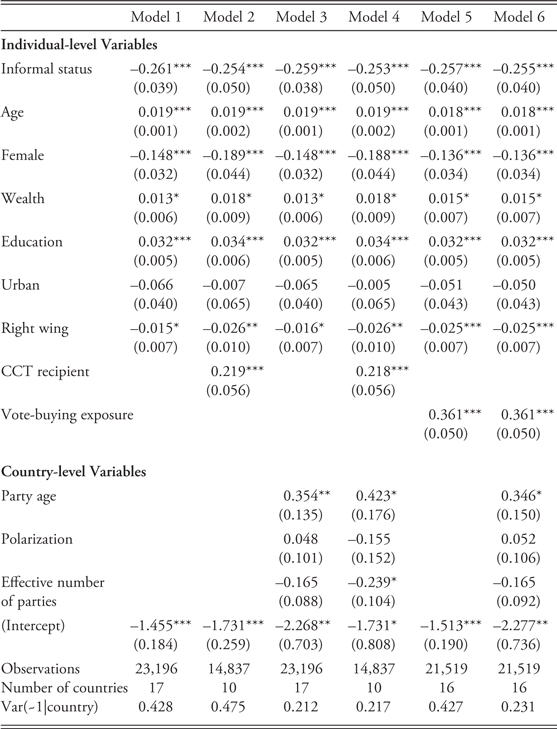
Table 1 shows the results of hierarchical models of party identification. Overall, the results of models 1 to 6 provide strong support for the effect of employment vulnerability on partisan attachments. Controlling for individual- and country-level predictors, the findings show that employment vulnerability has a negative impact on partisanship.
Economic Vulnerability and Party Identification

***p < 0.001, **p < 0.01, *p < 0.05 Standard errors in parentheses
Model 1 tests the effect of economic informality considering a baseline set of individual-level controls. The results reveal that informal status is a powerful predictor of partisanship, even after considering the effect of individual factors that are commonly associated with party identification. Model 2 shows that the effect of employment vulnerability remains robust after taking into account the provision of social assistance via CCTs. Considering that this item is available only for a subset of countries, the number of countries is restricted to ten in this model. Being a recipient of income transfers does increase the likelihood of partisan attachments. Respondents who are beneficiaries of CCT programs tend to feel more identified with political parties, although economic vulnerability continues to be a strong predictor after the inclusion of social assistance. This result suggests that exposure to risk still has an important effect on individual attitudes; even after the expansion of cash transfer programs in the region.
Model 3 tests the effect of employment vulnerability on partisanship considering contextual-level predictors. It includes the same individual-level variables discussed in the previous models and adds the country-level measures described in the data section. The results reveal that the effect of informal status remains robust even when adding country-level variables that contribute to shaping linkages between citizens and parties. The findings indicate that individuals living in countries with more institutionalized parties are more likely to identify with a political party, which suggests that party linkages do tend to solidify as citizens get to evaluate parties over repeated election cycles. These findings are in line with previous work considering the impact of contextual factors on partisanship (Lupu Reference Lupu2013). The results for the individual-level predictors are similar to the ones reported in models 1 and 2.Footnote 14 Model 4 includes the variables in model 3 and adds the individual measure that captures CCT provision. Again, the results show that employment vulnerability has a strong impact on partisanship. As in previous specifications, social policy transfers have a positive impact on partisan attachments.
Party fragmentation appears to weaken party-voter ideological linkages in this specification, suggesting that an increased number of parties does not necessarily mean that citizens will find a meaningful partisan option.Footnote 15 Coefficients for the rest of the individual-level predictors are similar to results in model 3.
In a finding consistent with previous studies, older individuals are more likely to express affinities with political parties, which may reveal that they have had more political exposure and more time to establish partisan attachments (Converse Reference Converse1976; Tilley Reference Tilley2003). Wealthy and more educated respondents also appear to establish linkages to political parties relatively more, backing previous research suggesting that individuals with higher socioeconomic status are more likely to be politically involved (Verba et al. Reference Verba, Nie and Kim1987; Leighley and Nagler Reference Leighley and Nagler1992).
Those respondents who place themselves on the right side of the ideological spectrum tend to have weaker partisan attachments compared with left-leaning Latin Americans. This result is consistent with previous analyses (Lupu Reference Lupu, Carlin, Singer and Zechmeister2015).Footnote 16 Women, on the other hand, are less likely to develop partisan attachments, and this effect holds across all model specifications. This finding aligns with previous research that shows that women in some Latin American countries tend to be less involved in politics and may have weaker ties with political parties (Desposato and Norrander Reference Desposato and Norrander2009). The size of respondents’ communities (rural/urban) does not turn out to be significant in these models.
Finally, models 5 and 6 account for the potential effect of clientelistic exchanges on partisan identities. This additional specification yields the same substantial results regarding informality, which remain negative and significant after controlling for reported exposure to clientelism. In contrast, vote-buying exposure has a positive effect on reported partisanship. The results suggest that while clientelistic exchanges may provide an alternative mechanism altering partisan identification, increased economic vulnerability remains a weakening factor. Furthermore, the size of the vulnerable uninsured population is substantially larger than the proportion of voters who are targeted and engage with clientelistic exchanges, making it unlikely that clientelism completely accounts for the patterns of partisanship observed among economically vulnerable voters (Morgan Reference Morgan2011).
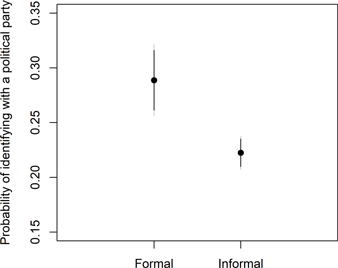
Fixed-effects models are estimated considering the individual-level variables included in models 1, 2, and 5. Results are substantially similar to the ones detailed above (see table A11 in the appendix). Using this specification, the substantive effect of economic vulnerability is calculated, controlling for the individual-level covariates included in model 2. Figure 1 plots a thousand predicted probabilities of identifying with a political party, generated via simulation for a typical respondent. The graph compares these predicted probabilities for two identical respondents: one in the formal sector and one in the informal sector.Footnote 17 The dots denote the mean predicted probabilities for each respondent, and the bars show the 95 percent confidence intervals from the simulated probabilities.
Effect of Economic Vulnerability Associated with Informal Status on Partisanship

All other variables were kept at their means (or modes, in the case of dichotomous variables). The figure shows that individuals in the informal sector are less likely to identify with a political party. Holding all other variables at their means and median values, probability simulations estimate that an economically vulnerable individual in the informal sector is about 22 percent less likely to identify with a political party compared with an individual in the formal sector with very similar characteristics.
Taken together, these results suggest that economic vulnerability associated with informality indeed contributes to eroding partisan identities among voters. After controlling for wealth and ideology, individuals in the informal sector in Latin America tend to have weaker attachments to political parties.
Testing Underlying Mechanisms
The central argument in this article is that in Latin America, members of the informal sector have limited expectations about political platforms and the potential policy benefits associated with electing parties to office. As a consequence, they are less likely to identify with a political party. This section tests this intervening mechanism.
The analysis focuses on decreased expectations about the welfare state in the region. The discussion above suggests that economic vulnerability reduces demand for social policies. To test this relationship, I ran additional models estimating the effect of informality on attitudes toward state provision of healthcare. The dependent variables refer to the support for public provision of health services and pensions (as opposed to private provision). Attitudes are registered on a scale from 1, “strongly disagree,” to 7, “strongly agree.”Footnote 18 Given the high levels of support for welfare policies in Latin America, and following previous works (Cramer and Kaufman Reference Cramer and Kaufman2011; Morgan and Kelly Reference Morgan and Kelly2017), these indicators were recoded into dichotomous variables, so that responses expressing strong support for these social policies have a value of 1 and as 0 otherwise.Footnote 19 Models control for age, gender, education, type of locality, and wealth. Table A3 in the appendix presents the complete results of the specifications for the two dependent variables.
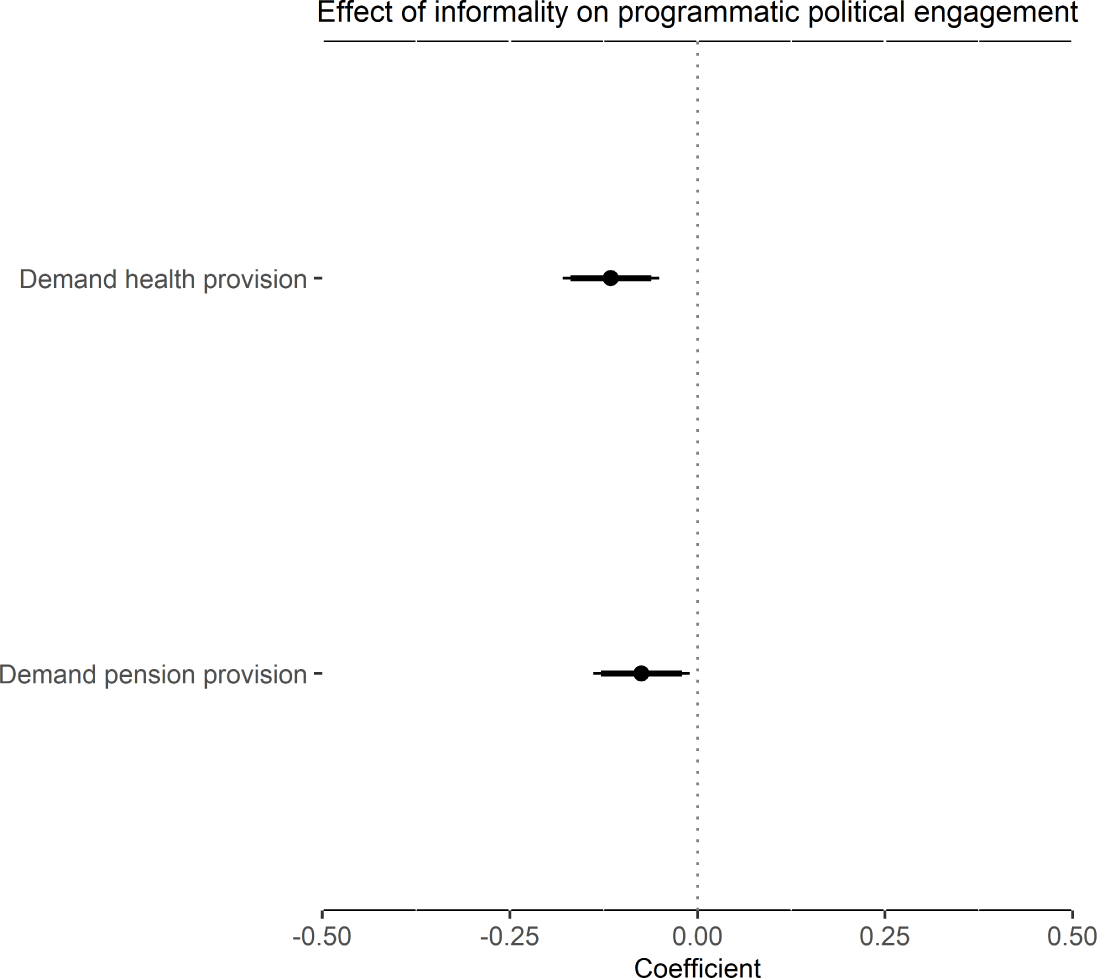
Figure 2 plots the coefficients for informality in the models estimating demand for government healthcare provision and pension provision (the coefficients of the control variables are not shown). The results indicate that all else equal, being in the informal sector is associated with decreased support for state provision of healthcare and pensions, which are policies that have limited benefits or entirely exclude citizens in the informal sector. Informal workers and their families are not the main beneficiaries of social security institutions, which have been the major providers of social services in Latin American countries, and they receive limited (or no) benefits from noncontributory policies. As a consequence, and because these experiences increase the uncertainty about their potential benefits, individuals living in informality are less supportive of increased social policy expenditures.
Effect of Economic Vulnerability Associated with Informal Status on Demand for Public Health Provision and Political Efficacy

If economically vulnerable individuals do not perceive redistributive agendas as meaningful for their daily lives, they might find it difficult to recognize political platforms as effective mechanisms to address their needs.Footnote 20 I claim that ultimately, this dynamic intervenes to weaken partisan attachments. By providing supportive evidence for the connection between economic vulnerability and reduced expectations and demand for welfare policies, the results in this section suggest that this may be the case.
Robustness Checks
To check for robustness of the results presented in the previous sections, the main models were reestimated using two restricted samples. First, to test whether the effect of economic vulnerability is driven by the attitudes of nonworking respondents, I ran models in table 1 in a sample that considers only employed respondents. The results are robust to these alternative specifications, showing a strong negative effect of economic vulnerability on partisanship in the working population. Informal workers are less likely to identify with political parties compared with their counterparts in the formal labor market. Second, to account for the possibility that retired respondents might be receiving income derived from previous formal employment, I excluded this group and reestimated the main models. Again, the findings reported in the empirical sections remain unchanged. See tables A1 and A1a in the appendix for the results of these robustness specifications.
Furthermore, an additional analysis was conducted with a different survey sample, using Latinobarometer data for 2015. The survey does not include an item with the same wording as the one used to operationalize employment vulnerability with LAPOP. However, the Latinobarometer questionnaire asks respondents about their occupation and distinguishes between self-employed and salaried workers. Those respondents who were self-employed and worked as informal vendors or in the agricultural sector were coded as labor market outsiders. The tests controlled for a similar set of covariates as in the models discussed above. The first test was the effect of employment vulnerability on party identification, using a multilevel logit model.Footnote 21 Table A2 in the appendix presents the results of these estimations. Overall, the findings show that individuals who are self-employed in economically vulnerable activities are less likely to identify with political parties. These results provide further evidence to suggest a negative effect of employment vulnerability on partisan attachments in Latin America.
Conclusions
This article argues that in contexts of low redistribution, economic vulnerability has detrimental effects on the formation of linkages between citizens and political parties. Individuals whose lives depend on the informal economy face high economic uncertainty and are inadequately prepared to hedge unexpected risks. Given that these formal labor market outsiders receive lower benefits from public policies, their expectations about the role of parties in improving their livelihood are limited. Strong partisan identities are less likely to emerge among these economically vulnerable voters. Cash transfer benefits seem to provide a potential alternative for the development of programmatic linkages to parties, although these policies continue to cover a fraction of the electorate in many countries, and their ideological underpinnings are unclear. Furthermore, the results indicate that economic vulnerability has a negative effect on partisanship even after taking account of cash transfers, suggesting that these benefits are not substitutes for secure employment in Latin America.
These findings have several important implications. From a theoretical standpoint, informality poses a serious challenge to the consolidation of stable party systems. Even as Latin American countries hold regular democratic elections and exhibit party alternation in power, it is not clear that competing parties are perceived as a vehicle of representation by many voters in economically vulnerable positions. These results echo what we have observed in recent elections in other parts of the world, where vulnerable voters have been shown to desert established parties at higher rates. As dualized economies continue to become prevalent in the global economy, political parties are likely to face greater struggles to attract an important segment of the electorate.
As recent studies suggest, conceptually, economic vulnerability does not equal poverty. Even if a significant part of the population overcomes poverty thresholds, it is unclear whether they will have a sense of stake in the political process if they remain economically insecure and inadequately represented. In addition, the microlevel mechanism tested here might have larger consequences in terms of the strategies of political parties. If voters in the informal sector become indifferent to political parties or skeptical of policy platforms, parties might opt for nonprogrammatic appeals or alternative valence issues when approaching vulnerable voters. Furthermore, political outsiders will have greater opportunities to gain electoral support from disaffected and economically vulnerable citizens.
Supporting Information
Additional supporting materials may be found with the online version of this article at the publisher’s website: Appendix.