The need for social connection and acceptance is one of the most fundamental and universal human needs (Baumeister & Leary, Reference Baumeister and Leary1995). When this need is unmet, it poses serious threats to the well-being of individuals, particularly during adolescence, a developmental period marked by an increased orientation toward peer acceptance (Allen, Porter, McFarland, Marsh, & McElhaney, Reference Allen, Porter, McFarland, Marsh and McElhaney2005; Guyer, Choate, Pine, & Nelson, Reference Guyer, Choate, Pine and Nelson2012). It is not surprising that childhood peer victimization, which involves repeated exposure to adverse experiences in the peer group that likely threaten youths’ sense of social connection, is associated with a host of negative outcomes, including delinquency, antisocial behavior, truancy, and substance abuse, which tend to increase in severity as youth enter adolescence (Hanish & Guerra, Reference Hanish and Guerra2002; Rudolph et al., Reference Rudolph, Lansford, Agoston, Sugimura, Schwartz, Dodge and Bates2014). Moreover, experimental studies in children, adolescents, and adults have shown that experiences of acute exclusion result in impaired self-regulation and greater risk-taking behavior, suggesting a causal link between victimization and risk taking (Baumeister, DeWall, Ciaracco, & Twenge, Reference Baumeister, DeWall, Ciarocco and Twenge2005; DeWall, Baumeister, & Vohs, Reference DeWall, Baumeister and Vohs2008; Mead, Baumeister, Stillman, Rawn, & Vohs, Reference Mead, Baumeister, Stillman, Rawn and Vohs2011; Nesdale & Lambert, Reference Nesdale and Lambert2008; Peake, Dishion, Stormshak, Moore, & Pfeifer, Reference Peake, Dishion, Stormshak, Moore and Pfeifer2013; Twenge, Catanese, & Baumeister, Reference Twenge, Catanese and Baumeister2002). Although this exclusion-risk taking link has been well established, the neural processes by which social exclusion results in greater risk taking and antisocial behavior are not well understood, and it is unclear how a history of chronic victimization intersects with acute exclusion experiences to heighten risk taking and antisocial behavior. In the current study, we employed functional magnetic resonance imaging (fMRI) to examine neural sensitivity during risk taking following an acute episode of exclusion and its link to everyday antisocial behavior in chronically victimized and nonvictimized youth.
Social Exclusion, Risk Taking, and Antisocial Behavior
One promising theory for the exclusion–risk-taking link is that socially excluded individuals engage in risky and antisocial behavior as a way to conform to peer group norms and regain social stature, which may be in the form of perceived popularity, likeability or approval, social acceptance, or attention from peers (Allen et al., Reference Allen, Porter, McFarland, Marsh and McElhaney2005; Dewall & Richman, Reference DeWall and Richman2011; Rawn & Vohls, Reference Rawn and Vohs2011). In particular, adolescents who perceive that their peers value antisocial behavior are more likely to increase their substance use and delinquent behavior, suggesting that youth engage in risk taking to increase their social standing within the peer group (Allen et al., Reference Allen, Porter, McFarland, Marsh and McElhaney2005). Experimental work has shown that adults exposed to social exclusion versus acceptance are more likely to express willingness to try illicit drugs only if given the option to try drugs with new friends as opposed to alone (Mead et al., Reference Mead, Baumeister, Stillman, Rawn and Vohs2011), consistent with the theory that socially excluded individuals may be willing to engage in risky behavior as a way to reestablish their sense of social connection (Dewall & Richman, Reference DeWall and Richman2011; Rawn & Vohls, Reference Rawn and Vohs2011). Thus, the expected value of engaging in risky behavior may become greater due to the increased motivational currency of social approval and connection (Peake et al., Reference Peake, Dishion, Stormshak, Moore and Pfeifer2013).
The Role of Chronic Peer Victimization
Although a few studies have investigated the neural processes involved in heightened risk taking following acute, experimentally manipulated social exclusion (Falk et al., Reference Falk, Cascio, O'Donnell, Carp, Tinney, Bingham and Simons-Morton2014; Peake et al., Reference Peake, Dishion, Stormshak, Moore and Pfeifer2013), no study has examined whether naturally occurring chronic childhood peer victimization sensitizes adolescents to risk taking following social exclusion. This is an important limitation given that the link between childhood peer victimization and later externalizing behaviors is pronounced in youth experiencing chronic compared to little or no victimization (see Dodge & Pettit, Reference Dodge and Pettit2003). Moreover, early childhood victimization and increasing victimization across childhood independently contribute to antisocial behavior in adolescence, highlighting the enduring effects of early victimization experiences for youth's well-being (Rudolph et al., Reference Rudolph, Lansford, Agoston, Sugimura, Schwartz, Dodge and Bates2014). Together, these studies point toward the importance of understanding the legacy of peer victimization experiences for youths’ risk taking and antisocial behavior. Adolescents who are chronically victimized across childhood may be particularly likely to engage in behaviors aimed at restoring their sense of social connection and need to belong following acute exclusion, even if such behaviors are maladaptive or harmful to the self or others.
Neural Systems Involved in Risk Taking and Antisocial Behavior
Recent evidence from developmental neuroimaging research has shown that neural systems important in detecting motivationally and emotionally relevant cues in the environment undergo remodeling during adolescence (see Nelson, Leibenluft, McClure, & Pine, Reference Nelson, Leibenluft, McClure and Pine2005). This research points toward three important neural networks that may be particularly relevant for adolescent social decision making: affective sensitivity, cognitive control, and social cognition. These neural networks are thought to underlie changes in affective and cognitive responses to social experiences at a developmental period when the importance of peers increases (Nelson et al., Reference Nelson, Leibenluft, McClure and Pine2005). Consistent with stress-sensitization models (Monroe & Harkness, Reference Monroe and Harkness2005; Post, Reference Post1992), these neural systems may be altered by chronic early life stressors, such that childhood adversity in the form of peer victimization may enhance the probability of stress-induced alterations of brain function after exposure to subsequent acute stress. As a result, early life stressors may lower the threshold for reactivity to later stress.
Affective network
Upon detecting socially and emotionally relevant cues in one's environment, the affective network, including the amygdala, ventral striatum, and orbitofrontal cortex (OFC), comes online, particularly among adolescents (Guyer, McClure-Tone, Shiffrin, Pine, & Nelson, Reference Guyer, Choate, Pine and Nelson2012). For example, neural regions involved in affective sensitivity show nonlinear developmental trajectories, peaking in functional reactivity during adolescence in response to emotional arousal, reward anticipation, risk taking, and social influence (Cascio, O'Donnell, Bayer, Tinney, & Falk, Reference Cascio, O'Donnell, Bayer, Tinney and Falkin press; Chein, Albert, O'Brien, Uckert, & Steinberg, Reference Chein, Albert, O'Brien, Uckert and Steinberg2011; Ernst et al., Reference Ernst, Nelson, Jazbec, McClure, Monk, Leibenluft, Blair and Pine2005; Galvan et al., Reference Galvan, Hare, Parra, Penn, Voss, Glover and Casey2006; Hare et al., Reference Hare, Tottenham, Galvan, Voss, Glover and Casey2008; Van Leijenhorst et al., Reference Van Leijenhorst, Moor, de Macks, Rombouts, Westenberg and Crone2010). Moreover, adolescent girls and socially anxious youth show heightened affective sensitivity when anticipating peer approval as well as when receiving peer acceptance versus rejection feedback (Guyer et al., Reference Guyer, McClure-Tone, Shiffrin, Pine and Nelson2009, Reference Guyer, Choate, Pine and Nelson2012; Lau et al., Reference Lau, Guyer, Tone, Jenness, Parrish, Pine and Nelson2011). Finally, adolescents who have experienced high levels of peer conflict show heightened affective sensitivity during risk taking, whereas those who report strong peer support show attenuated affective sensitivity during risk taking (Telzer, Fuligni, Lieberman, Miernicki, & Galván, Reference Telzer, Fuligni, Lieberman, Miernicki and Galván2015). Together, these studies provide strong evidence for the role of affective regions in adolescent reward sensitivity and risk taking following social rejection. Because the expected value of high-risk social rewards may increase in chronically victimized youth due to their desire for social connection and stature, this group may show enhanced affective processing during risk taking, which may explain victimized youths’ higher levels of everyday antisocial behavior.
Cognitive control network
Cortical systems comprising neural regions involved in higher order cognition and impulse control (e.g., ventral and dorsal lateral prefrontal cortices [VLPFC and DLPFC]) gradually mature over adolescence and into adulthood (Gogtay et al., Reference Gogtay, Giedd, Lusk, Hayashi, Greenstein, Vaituzis and Thompson2004). This gradual development is thought to result in a more flexible cognitive control system, such that PFC activation is sometimes compromised depending on the social and motivational context (Crone & Dahl, Reference Crone and Dahl2012). Developmental deficits in cognitive control, coupled with heightened affective sensitivity, are thought to underlie adolescents’ increased risk taking (Casey, Jones, & Hare, Reference Casey, Jones and Hare2008). Experimental research has shown that social exclusion is associated with impaired self-regulation, including lower persistence in the face of failure, poorer attentional control, as well as altered PFC activation during risk taking (Baumeister et al., Reference Baumeister, DeWall, Ciarocco and Twenge2005; DeWall, Baumeister, & Vohs, Reference DeWall, Baumeister and Vohs2008; Oaten, Williams, Jones, & Zadro, Reference Oaten, Williams, Jones and Zadro2008; Peake et al., Reference Peake, Dishion, Stormshak, Moore and Pfeifer2013). Thus, adolescents who have experienced chronic peer victimization may have impaired self-regulatory capacities, accounting for their higher risky and antisocial behavior. Reflecting this impairment, chronically victimized youth may evidence less prefrontal activation when making risky choices but more PFC activation when making safe choices (i.e., safe behavior requires more effort). Alternatively, risky behaviors may not occur due to heightened impulsivity or poor self-control, but instead may result from more deliberative decisions to regain social affiliation and acceptance following exclusion (Rawn & Vohs, Reference Rawn and Vohs2011). Therefore, chronically victimized youth may show heightened PFC activation when making risky choices, indicative of more deliberative decision making during risk taking. Such heightened PFC activation may explain victimized youths’ higher levels of everyday antisocial behavior.
Social cognition network
Victimized youth are particularly sensitive to social threat, as reflected in an enhanced tendency to attribute hostile intent to peers (Yeung & Leadbeater, Reference Yeung and Leadbeater2007), heightened threat appraisals in the context of stress (Taylor, Sullivan, & Kliewer, Reference Taylor, Sullivan and Kliewer2013), and heightened concerns about being negatively socially evaluated (Storch, Nock, Masia-Warner, & Barlas, Reference Storch, Nock, Masia-Warner and Barlas2003) and becoming socially isolated (Hunter & Boyle, Reference Hunter and Boyle2004); this sensitivity may lead them to be more concerned about gaining peer approval and thus more likely to adjust their behavior to conform to group norms, a process that recruits neural regions involved in social cognition (e.g., temporoparietal junction [TPJ], posterior superior temporal sulcus [pSTS], medial prefrontal cortex [MPFC], dorsomedial prefrontal cortex [DMPFC], and medial posterior parietal cortex [MPPC]). Adolescents show increased activation in social cognition regions following an experimental social exclusion manipulation, with such increases in social cognitive neural regions predicting increased risk-taking behavior (Falk et al., Reference Falk, Cascio, O'Donnell, Carp, Tinney, Bingham and Simons-Morton2014; Peake et al., Reference Peake, Dishion, Stormshak, Moore and Pfeifer2013). Moreover, adolescents demonstrate greater activation in social cognition regions during mentalizing tasks relative to adults, indicative of adolescents’ greater focus on social processes more generally (Blakemore, Reference Blakemore2010; Burnett, Bird, Moll, Frith, & Blakemore, Reference Burnett, Bird, Moll, Frith and Blakemore2009; Gweon, Dodell-Feder, Bedny, & Saxe, Reference Gweon, Dodell-Feder, Bedny and Saxe2012; van den Bos, van Dijk, Westenberg, Rombouts, & Crone, Reference van den Bos, van Dijk, Westenberg, Rombouts and Crone2011; Wang, Lee, Sigman, & Dapretto, Reference Wang, Lee, Sigman and Dapretto2006). Together, this prior research provides compelling evidence to suggest that socially excluded youth may show greater social–cognitive neural processing during risk taking due to greater social monitoring and a concern with peers’ evaluations of their risky decisions. Such heightened social–cognitive neural processing may explain victimized youths’ higher levels of everyday antisocial behavior.
Study Overview
Taken together, we hypothesized that (a) chronically victimized youth would show greater risk taking (measured during an experimental risk-taking task) and everyday antisocial behavior (measured via self-report); (b) chronically victimized youth would show altered activation in neural regions involved in affective sensitivity, cognitive control, and social cognition during risk taking; and (c) this heightened neural sensitivity would explain (i.e., mediate) group differences in antisocial behavior. To test this hypothesis, we recruited adolescent girls based on well-documented childhood victimization experiences from the second through eighth grades. We focused on adolescent girls because girls tend to be more sensitive and reactive than boys to interpersonal stress (see Hankin, Mermelstein, & Roesch, Reference Hankin, Mermelstein and Roesch2007; Natsuaki et al., Reference Natsuaki, Klimes-Dougan, Ge, Shirtcliff, Hastings and Zahn-Waxler2009; Rudolph, Flynn, Abaied, Groot, & Thompson, Reference Rudolph, Flynn, Abaied, Groot and Thompson2009). Girls show a steep increase in behavioral (i.e., anxiety about peer acceptance) and neural (i.e., heightened affective processing during peer evaluation) sensitivity to social threat that peaks around age 15–16 years (Guyer et al., Reference Guyer, McClure-Tone, Shiffrin, Pine and Nelson2009, Reference Guyer, Choate, Pine and Nelson2012; Kloep, Reference Kloep1999), as well as heightened biological sensitivity (e.g., cortisol peaks) following social rejection challenges (Stroud, Salovey, & Epel, Reference Stroud, Salovey and Epel2002). Moreover, some research suggests that girls evidence more detrimental effects of victimization for both externalizing (Khatri, Kupersmidt, & Patterson, Reference Khatri, Kupersmidt and Patterson2000; Rusby, Forrester, Biglan, & Metzler, Reference Rusby, Forrester, Biglan and Metzler2005) and internalizing (Loukas & Pasch, Reference Loukas and Pasch2013) symptoms (but see Hanish & Guerra, Reference Hanish and Guerra2002, for boys being more reactive than girls, and Rudolph et al., Reference Rudolph, Lansford, Agoston, Sugimura, Schwartz, Dodge and Bates2014, for comparable effects across sex).
Methods
Participants
Forty-six ninth-grade adolescent girls (M age = 15.3 years, SD = 0.34, range = 14.8–16.1 years) were recruited from a longitudinal study that tracked 636 (337 female) youth from second to eighth grade. Each year, youth self-reported on their victimization experiences using the Social Experiences Questionnaire—Revised (Rudolph, Troop-Gordon, Hessel, & Schmidt, Reference Rudolph, Troop-Gordon, Hessel and Schmidt2011; Rudolph et al., Reference Rudolph, Lansford, Agoston, Sugimura, Schwartz, Dodge and Bates2014), which taps overt and relational forms of peer victimization. From this large sample, we recruited adolescent girls based on their victimization scores across the 7 years, such that we recruited the most victimized and least victimized girls. Of the 636 total participants, 115 (66 chronic victims, 49 nonvictims) were identified as eligible to participate based on being female and meeting criteria for low or high peer victimization. Of these, 8 had contraindications for MRI; 6 were not interested in participating; 51 were not recruited because they had moved out of town, were not reachable, or we reached our target sample size of 50 prior to their recruitment; and 4 completed the scan but did not complete the Stoplight Task. Our final sample included 46 adolescent girls, 25 who were classified as chronically victimized and 21 as nonvictimized. Chronically victimized girls scored ≥0.75 SD above the mean on victimization for at least 3 years (range = 3–7 years), with an average of 1.21 SD above the mean across the 7 years (range = 0.76–2.72 SD). Nonvictimized girls scored ≤0.75 below the mean on victimization for at least 3 years (range = 3–7 years) with an average of 0.83 SD below the mean across the 7 years (range = –1.17 to –0.61 SD). Participants were ethnically diverse (African American, n = 10; European American, n = 31; or other, n = 5). The chronically victimized group had marginally more non-White participants (n = 11, 44%) than did the nonvictimized group (n = 4, 19%), χ2 = 3.2, p = .072. Parents provided written consent and adolescents provided written assent in accordance with the university's institutional review board.
Self-reported antisocial behavior
Adolescents completed a 13-item antisocial behavior questionnaire adapted from Nolen-Hoeksema, Stice, Wade, and Bohon (Reference Nolen-Hoeksema, Stice, Wade and Bohon2007). Participants used a 5-point scale (1 = not at all, 5 = extremely) to indicate how much each item describes them (e.g., “I stole things,” “I cut classes or skipped school,” and “I hung around with kids who get in trouble”). Participants completed this measure when they were in the sixth grade and again on the day of the brain scan when they were in the ninth grade (αs = 0.92 and 0.90, respectively). Sixth-grade antisocial behavior was used as a control in mediation analyses examining the neural correlates by which childhood chronic peer victimization experiences are associated with later adolescent antisocial behavior. By controlling for earlier antisocial behavior, we can be relatively more confident of the direction of the effects and that early antisocial behavior does not account for any significant effects.
Risk-taking task procedures
Group membership manipulation
In order to increase the salience of risk taking in a social context, participants were randomly assigned to a team: the red team or the blue team. Prior to the scan, participants were introduced to everyone on their team and the opposing team by viewing a slideshow of pictures of each participant overlaid on a color background representing team membership. The other players, who were half males and half females, were described as participants who had already come in for the study. Participants’ photo was also taken and included in the slideshow to increase the salience of group belonging. Participants were then given instructions on the risk-taking task and instructed that their performance on the task would determine how many points their team won; the faster they completed the driving course, the more points they would earn for their team. At the end of the study, the team with the most points would win. Unfortunately, their team was currently behind, so they should try to help their team earn more points.
Social exclusion experience
Prior to completing the risk-taking task in the scanner, participants were exposed to social exclusion using Cyberball (Williams, Cheung, & Choi, Reference Williams, Cheung and Choi2000), which creates a subjective experience of being excluded. Participants were told they would be playing an online ball-throwing game with two peers (ostensibly in another room) also completing the same study and connected via the Internet. These peers were not part of either team in the group membership manipulation, and participants were not told whether the other participants were part of their team or the other team. Both of the confederates were females.
Throughout the game, the ball was thrown back and forth among the three players, with the participant choosing the recipient of her own throws, and the throws of the other two “players” determined by the preset program. Participants could see the photograph of the other two players on a computer screen as well as their own “hand” that they controlled using a button-box. Participants completed two rounds of Cyberball, one during which they were equally included, and a second during which the participant was excluded after 10 throws. Providing validity for the exclusion experience, chronically victimized girls reported feeling significantly more rejected following Cyberball (M = 3.25, SD = 0.68) than did nonvictimized girls (M = 2.66, SD = 0.51), t (44) = 2.92, p < .005, as measured by the Need-Threat Scale (Williams et al., Reference Williams, Cheung and Choi2000), a 12-item self-report measure that assesses participants’ feelings of self-esteem, belongingness, and social control during the Cyberball game (e.g., “I felt rejected” or “I felt disconnected”).
Risk-taking task
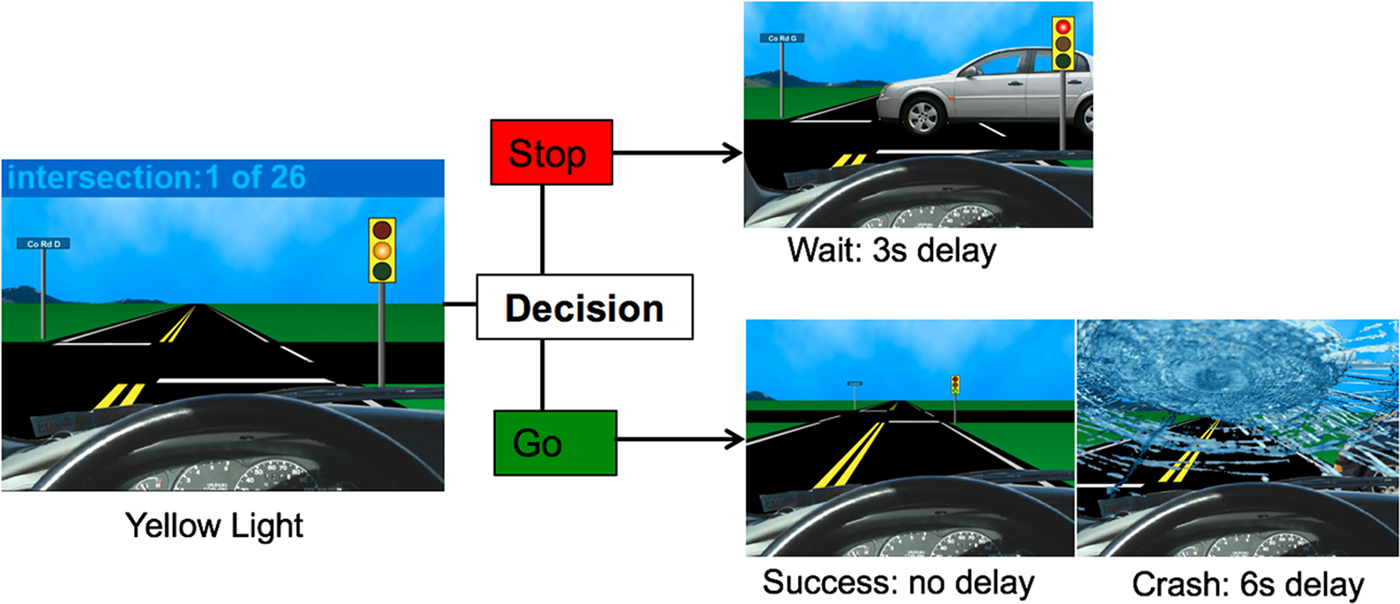
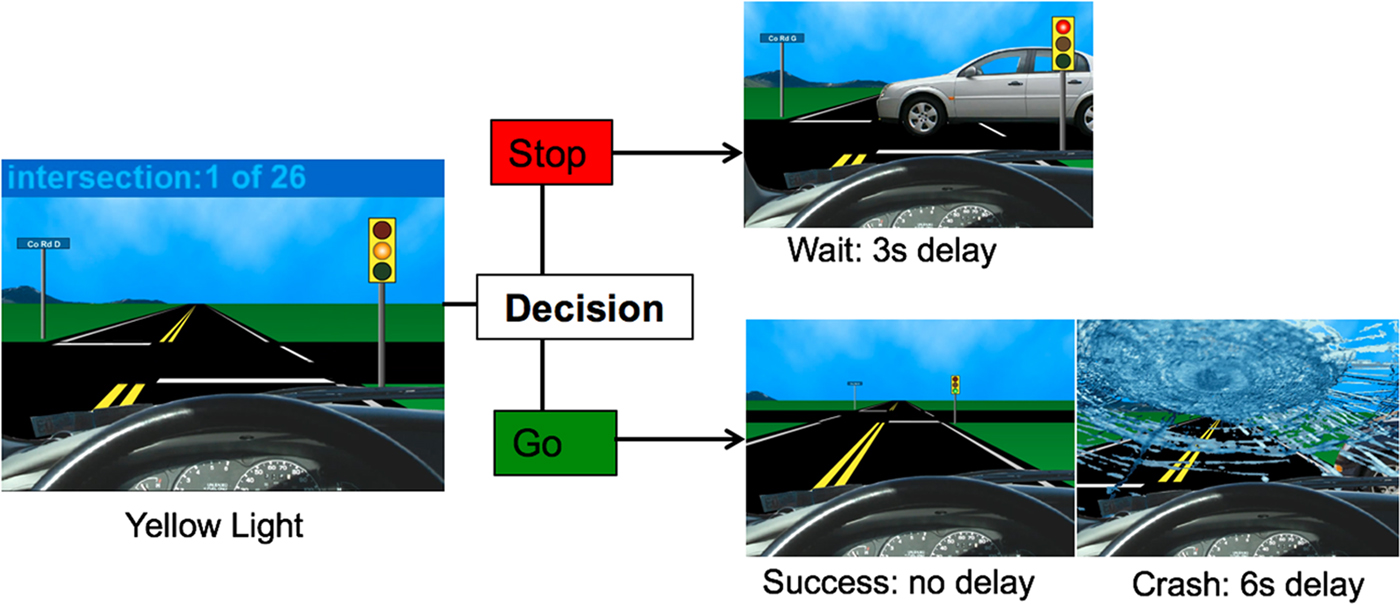
Adolescents completed the Stoplight Task, which is a well-validated risk-taking game that has shown robust behavioral and neural effects in adolescents (Chein et al., Reference Chein, Albert, O'Brien, Uckert and Steinberg2011; Gardner & Steinberg, Reference Gardner and Steinberg2005; Peake et al., Reference Peake, Dishion, Stormshak, Moore and Pfeifer2013; Telzer et al., Reference Telzer, Fuligni, Lieberman, Miernicki and Galván2015). During the task, participants complete a simulated driving course in which they encounter a number of yellow stoplights and must decide whether to “stop” or “go” at each intersection (see Figure 1). Participants were instructed that a decision to “go” through the intersection is the fastest option (no delay), but they risk the possibility of crashing, which causes a long delay (6 s). If they choose to “stop,” participants do not risk crashing, but it results in a short delay (3 s). Participants were told that the goal is to get through the driving course in as short a time as possible, and the faster they complete the game, the more points they will earn for their team. Participants completed 26 intersections; 8 intersections out of the 26 total intersections had cars approaching on the cross street, resulting in a crash if the participant made a “go” decision, but this was not explicitly revealed to participants. The timing of traffic signals and the presence of a car on the cross street varied so as to be unpredictable by the participant and to introduce variable intertribal intervals.
(Color online) Stoplight Task.
Participants played the Stoplight Task twice. Prior to the scan, participants completed one entire round of the task. This round was used as a baseline to test whether victimized and nonvictimized participants would show different risk-taking behaviors before the group membership manipulation and prior to the social exclusion task. During the scan, directly following the social exclusion task, participants completed a second round of the Stoplight Task that was identical in timing and number of intersections as the first round.
fMRI data acquisition and analysis
fMRI data acquisition
Imaging data were collected using a 3 Tesla Siemens Trio MRI scanner. The Stoplight task included T2*-weighted echoplanar images (slice thickness = 3 mm, 38 slices, repetition time [TR] = 2 s, echo time [TE] = 25 ms, matrix = 92 × 92, field of view [FOV] = 230 mm, voxel size 2.5 × 2.5 × 3 mm3). Structural scans consisted of a T2*weighted, matched-bandwidth, high-resolution, anatomical scan (TR = 4 s, TE = 64 ms, FOV = 230, matrix = 192 × 192, slice thickness = 3 mm, 38 slices) and a T1* magnetization-prepared rapid-acquisition gradient echo (TR = 1.9 s, TE = 2.3 ms, FOV = 230, matrix = 256 × 256, sagittal plane, slice thickness = 1 mm, 192 slices). The orientation for the matched-bandwidth and echoplanar images scans was oblique axial to maximize brain coverage.
fMRI data preprocessing and analysis
Neuroimaging data were preprocessed and analyzed using Statistical Parametric Mapping (SPM8; Wellcome Department of Cognitive Neurology, Institute of Neurology, London). Preprocessing for each participant's images included spatial realignment to correct for head motion (no participant exceeded 2 mm of maximum image-to-image motion in any direction). The realigned functional data were coregistered to the high-resolution magnetization-prepared rapid-acquisition gradient echo, which was then segmented into cerebrospinal fluid, gray matter, and white matter. The normalization transformation matrix from the segmentation step was then applied to the functional and T2 structural images, thus transforming them into standard stereotactic space as defined by the Montreal Neurological Institute and the International Consortium for Brain Mapping. The normalized functional data were smoothed using an 8-mm Gaussian kernel, full width at half maximum, to increase the signal to noise ratio.
Statistical analyses were performed using the general linear model in SPM8. Each trial was convolved with the canonical hemodynamic response function. High-pass temporal filtering with a cutoff of 128 s was applied to remove low-frequency drift in the time series. Serial autocorrelations were estimated with a restricted maximum likelihood algorithm with an autoregressive model order of 1.
In each participant's fixed-effects analysis, a general linear model was created with four regressors of interest, modeled as events: two decision regressors (stop and go; i.e., safe and risky) and two outcome regressors (crash and pass). In addition, the wait time after safe decisions was modeled as well as the final “game over” period, in order to remove these from the implicit baseline. Because the task was self-paced, the duration of the decision trials (stop or go) represented the time from which the traffic light appeared until the participant made a response, and the duration for the outcome (pass or crash) was 1 s. The onset of the crash event corresponded to another car crashing into the participant's car. The pass and wait events had no specific onset time. However, because the crash events happened at most 2 s after the yellow light, we modeled the pass and wait events as being 2 s after the yellow light, the point at which the outcome of the risky decision was clear. Each was modeled with a 1-s duration. Null events, consisting of the jittered intertrial intervals, were not explicitly modeled and therefore constituted an implicit baseline. The parameter estimates resulting from the general linear model were used to create linear contrast images comparing each of four event conditions (decisions: risky, safe; outcomes: crash, pass). Random effects, group-level analyses were performed on all individual subject contrasts using GLMFlex. GLMFlex corrects for variance-covariance inequality, partitions error terms, removes outliers and sudden activation changes in the brain, and analyzes all voxels containing data (http://mrtools.mgh.harvard.edu/index.php/GLM_Flex).
We conducted independent samples t tests at the group level to examine differences in neural activation during risk taking. Our main analyses focus on “go” decisions, as these trials encompass adolescents’ risky choices, which are the focus of the current study. However, we also examined group differences in neural activation during safe decisions (i.e., “stop”) as well as when receiving a positive outcome (i.e., successfully passing through the intersection following a risky choice). We did not model negative outcomes (i.e., crashes), as we did not have enough trials in this condition to model.
To correct for multiple comparisons, we conducted a Monte Carlo simulation implemented using 3dClustSim in the software package AFNI (Ward, Reference Ward2000). We used our group-level brain mask, which included only gray matter. Results of the simulation indicated a voxelwise threshold of p < .005 combined with a minimum cluster size of 42 voxels for the whole brain, corresponding to p < .05, falsewise error corrected. We used the MarsBaR toolbox to extract parameter estimates from significant clusters in the group-level analyses.
Results
Behavioral results
Group differences in risk taking and antisocial behavior
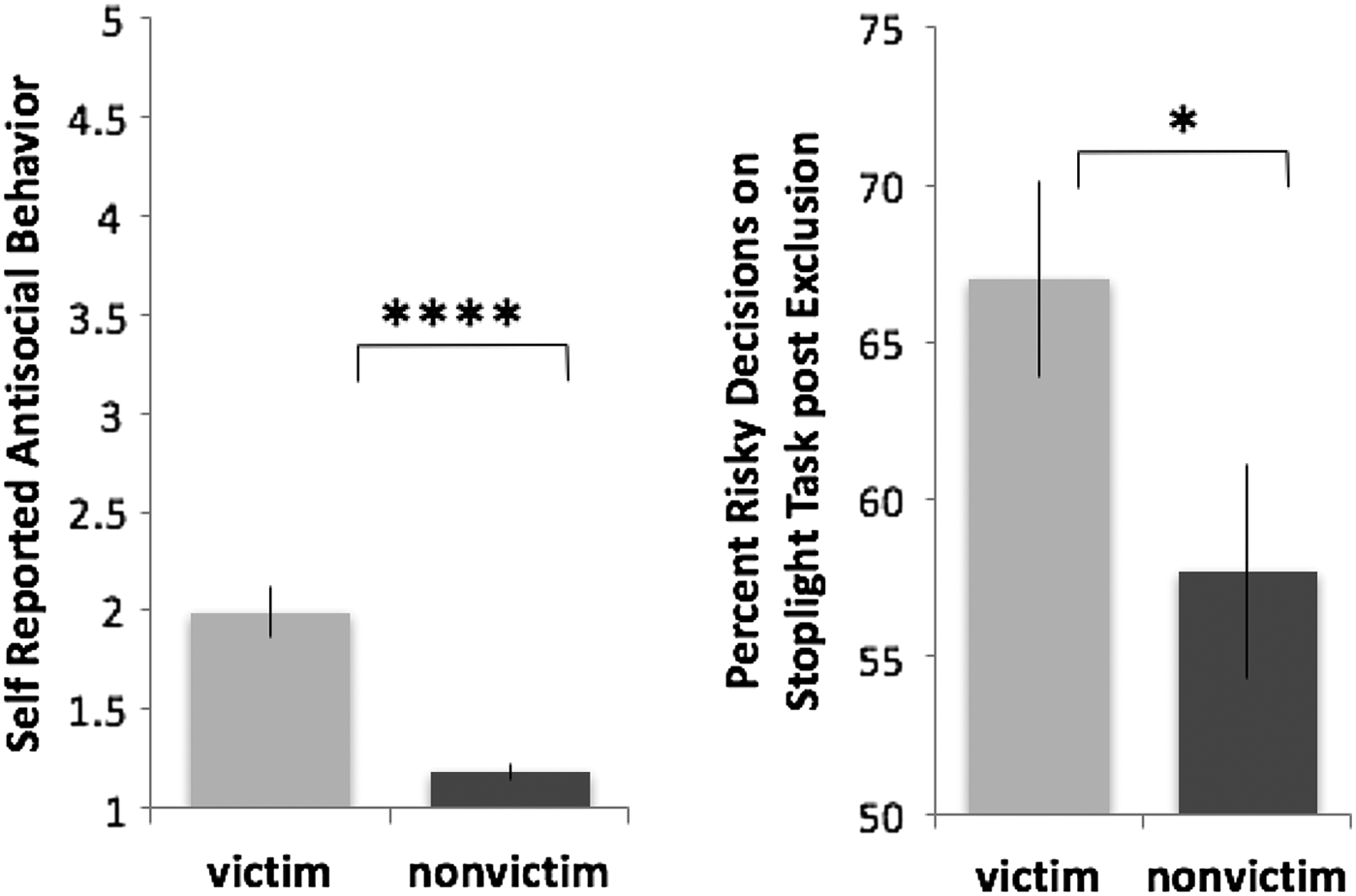
In terms of risk-taking behavior on the Stoplight Task, we found a significant Group (victim, nonvictim) × Time (preexclusion, postexclusion) interaction, F (1, 44) = 4.95, p < .05, η2 = 0.10. Prior to being socially excluded, and when the goal of the task was not yet described as a team game, chronically victimized (63.1% of intersections) and nonvictimized (63.3% of intersections) youth did not differ in the number of risky choices (i.e., “go”), t (44) = 0.07, ns, Cohen d = 0.018, whereas after the social exclusion experience, chronically victimized girls made significantly more risky choices than nonvictimized girls, t (44) = 2.11, p < .05, Cohen d = 0.62 (Figure 2), an effect that remained significant when controlling for ethnicity.
Victimization group differences in (left) self-reported antisocial behavior and (right) risky decisions on the Stoplight Task following social exclusion.

In terms of self-reported antisocial behavior, chronically victimized youth reported significantly greater antisocial behavior than nonvictimized youth in the ninth grade, t (44) = 5.50, p < .0001, Cohen d = 1.70 (Figure 2). These effects remained significant when controlling for sixth-grade antisocial behavior as well as ethnicity. Ethnicity was not associated with risk-taking behavior on the task or with antisocial behavior.
fMRI results
Group differences in neural reactivity during risky decisions
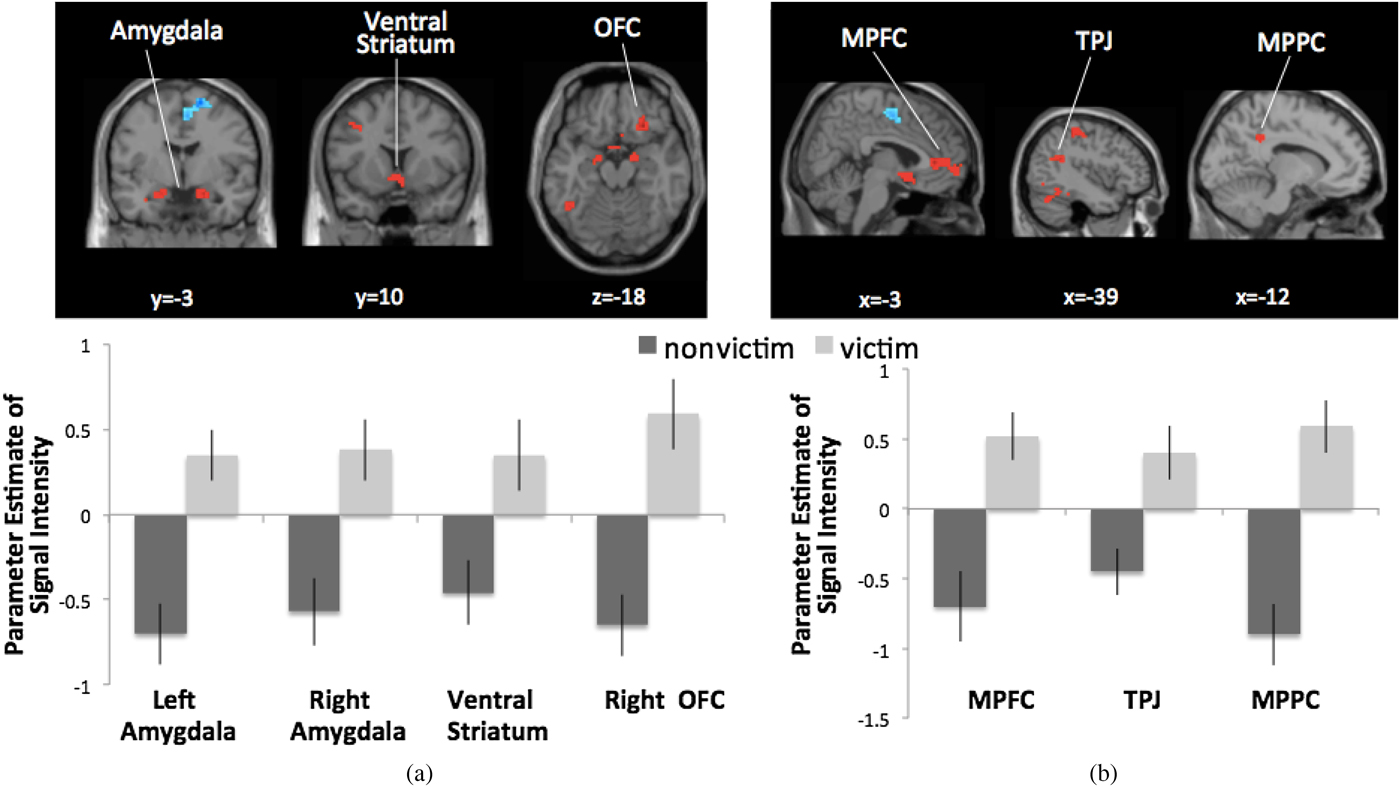
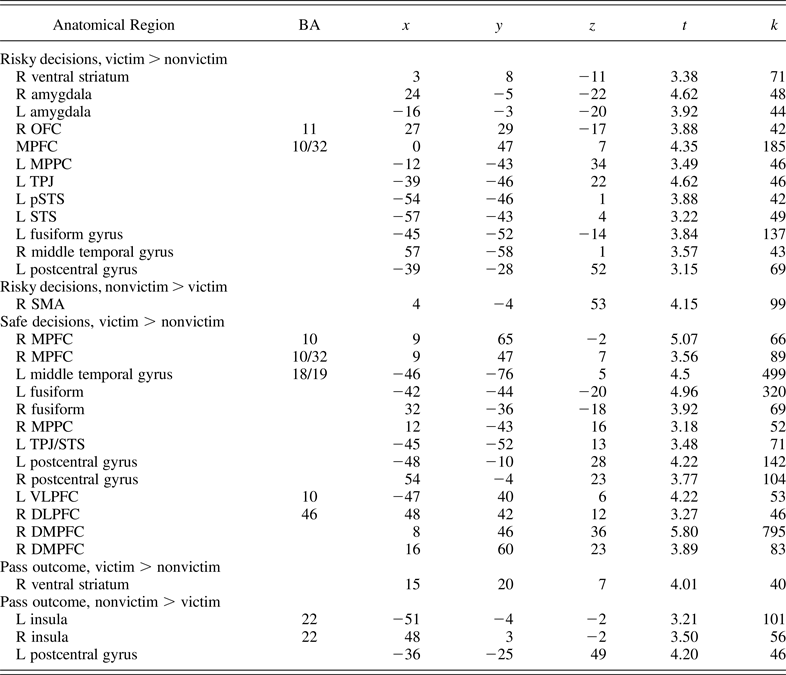
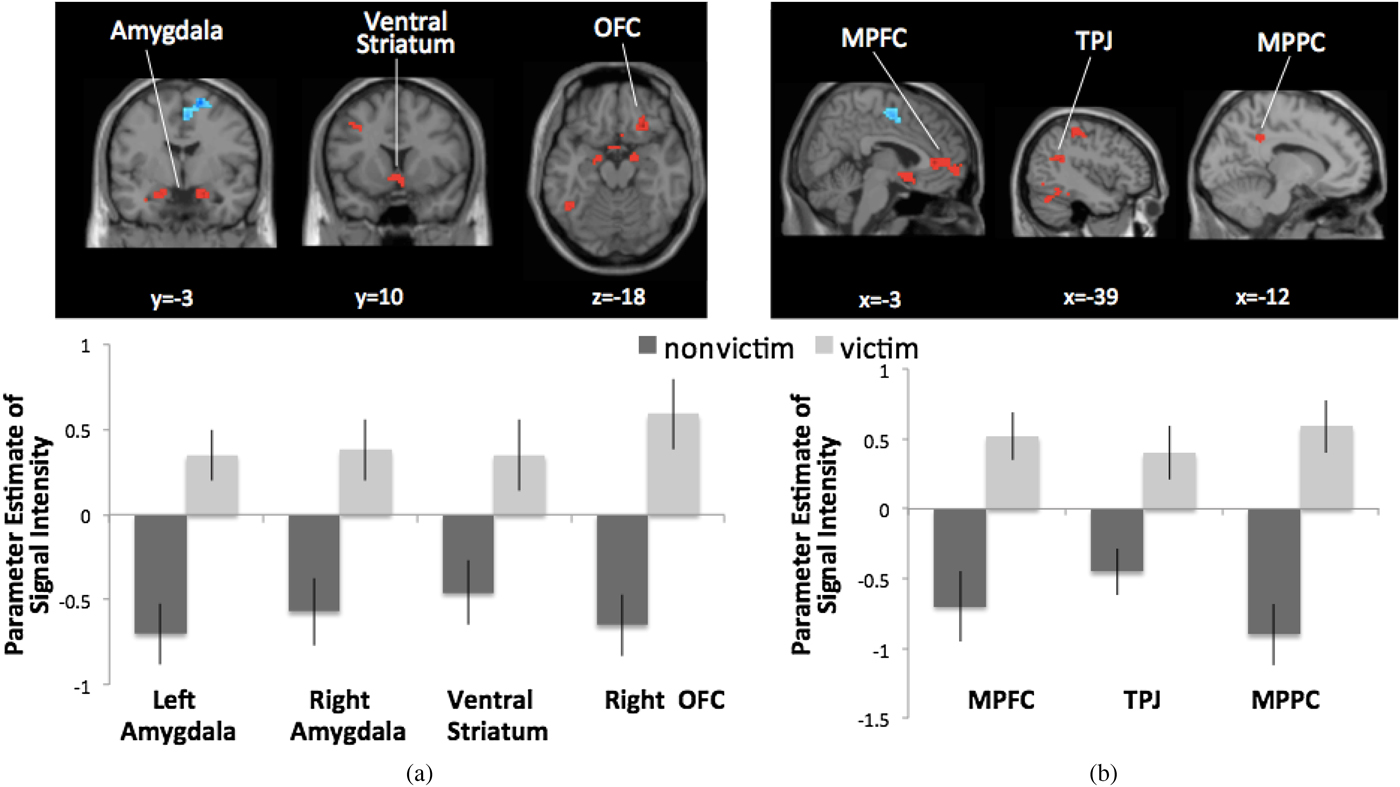
We conducted whole-brain, independent samples t tests to examine group differences in neural reactivity when making risky decisions (i.e., “go” through yellow light; see Table 1). Victimized girls showed greater reactivity in several brain regions involved in affective sensitivity, including the bilateral amygdala, ventral striatum, and OFC (Figure 3a), as well as regions involved in social cognition, including the MPFC, TPJ, and MPPC (Figure 3b). For descriptive purposes, we extracted parameter estimates of signal intensity from each significant cluster from the contrast risky decisions relative to baseline. We plotted the parameter estimates for victimized and nonvictimized girls separately (Figure 3). Because the baseline represents the majority of the task (e.g., driving, time between stoplights, and time immediately before making a decision), it is not an ideal control and is therefore used only for descriptive purposes. Thus, the relative activation in each group compared to baseline should be interpreted with caution. Nonvictimized girls showed greater activation in the supplementary motor area (Table 1).
(Color online) Victimization group differences in neural activation when making risky decisions on the Stoplight Task. Victimized adolescents showed significantly greater activation than nonvictimized adolescents in neural regions involved in (a) affective sensitivity and (b) social cognition.
Group differences in neural reactivity
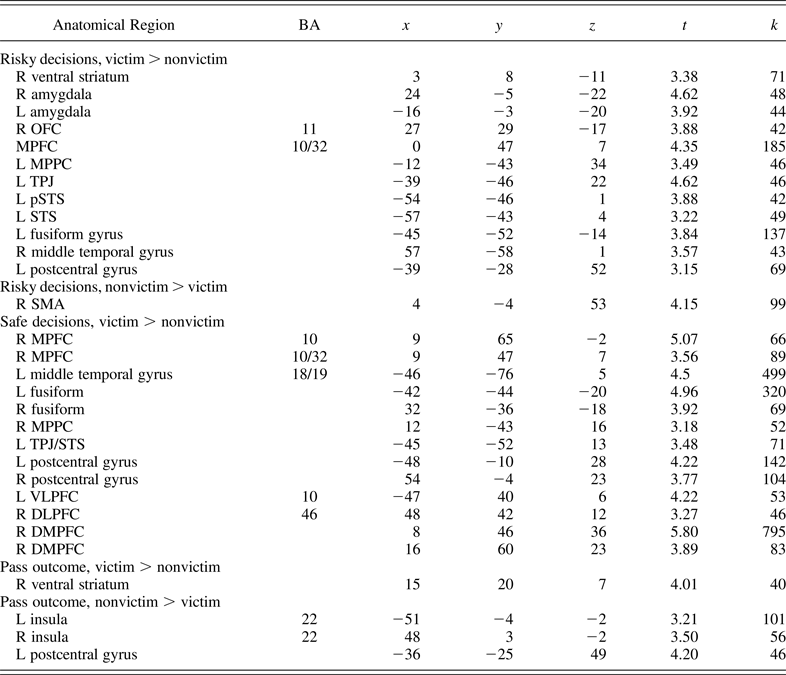
Note: BA, putative Broadman areas; x, y, and z, MNI coordinates; t, the t score at those coordinates (local maxima); k, the number of voxels in each significant cluster; R, right hemisphere; L, left hemisphere; OFC, orbital frontal cortex; MPFC, medial prefrontal cortex; MPPC, medial posterior parietal cortex; TPJ, temporoparietal junction; STS, superior temporal sulcus; SMA, supplementary motor area; VLPFC, ventrolateral prefrontal cortex; DLPFC, dorsolateral prefrontal cortex; DMPFC, dorsomedial prefrontal cortex.
Group differences in neural reactivity during safe decisions
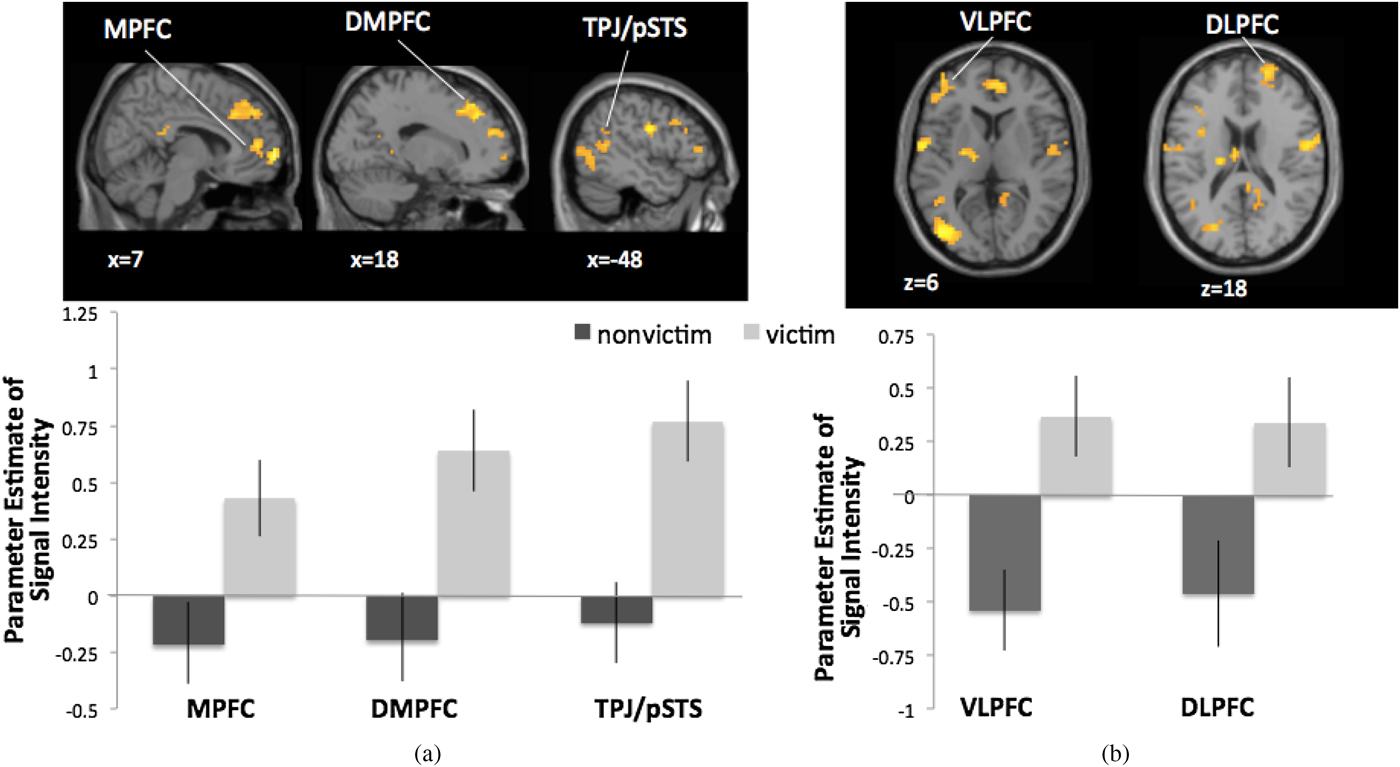
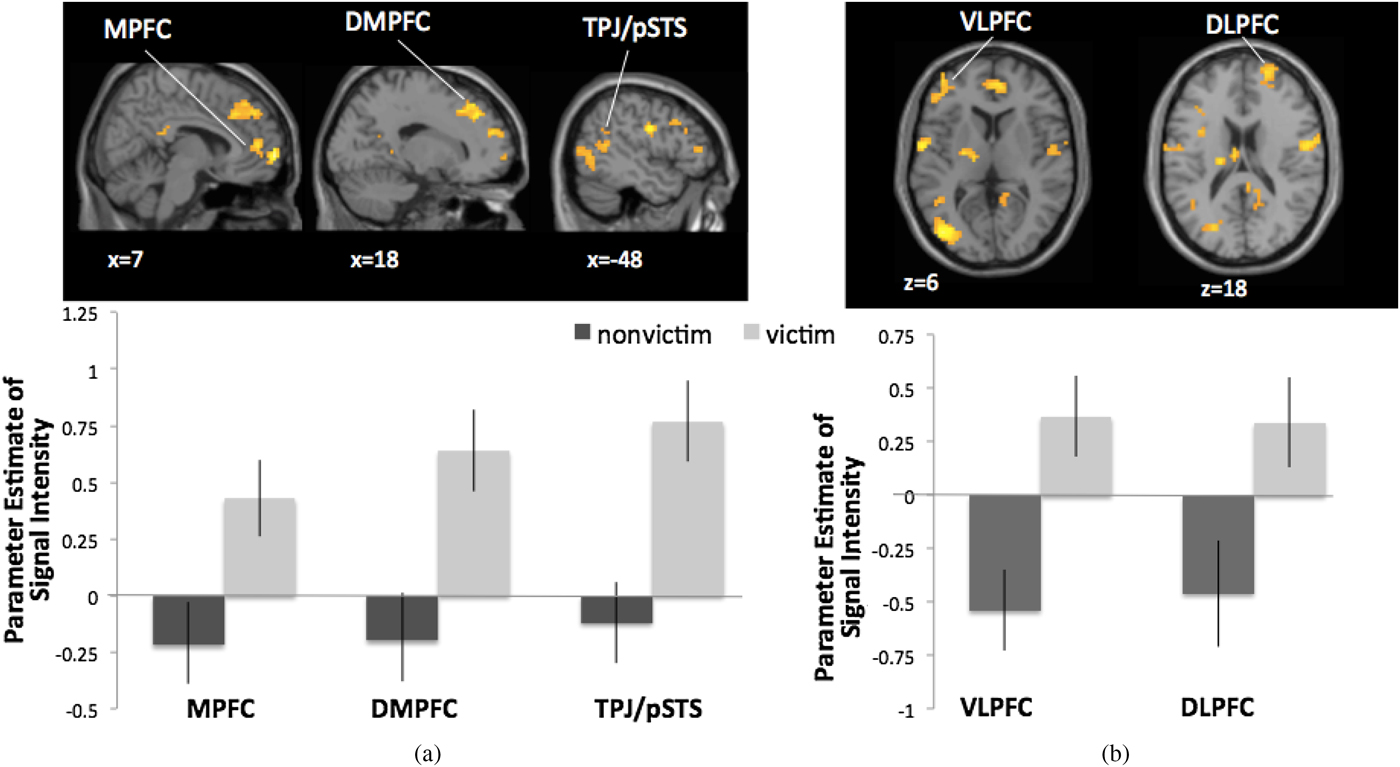
When making safe decisions (i.e., “stop” at yellow light), victimized girls showed greater activation in brain regions involved in social cognition, including the MPFC, DMPFC, TPJ, MPPC, and STS (Figure 4a), as well as regions involved in cognitive control, including the VLPFC and DLPFC (Figure 4b, Table 1). For descriptive purposes, we extracted parameter estimates of signal intensity from each significant cluster from the contrast safe decisions relative to baseline. We plotted the parameter estimates for victimized and nonvictimized girls separately (Figure 4). Nonvictimized girls did not show greater activation in any brain regions during safe decisions.
(Color online) Victimization group differences in neural activation when making safe decisions on the Stoplight Task. Victimized adolescents showed significantly greater activation than nonvictimized adolescents in neural regions involved in (a) social cognition and (b) cognitive control.
Group differences in neural reactivity during pass outcomes
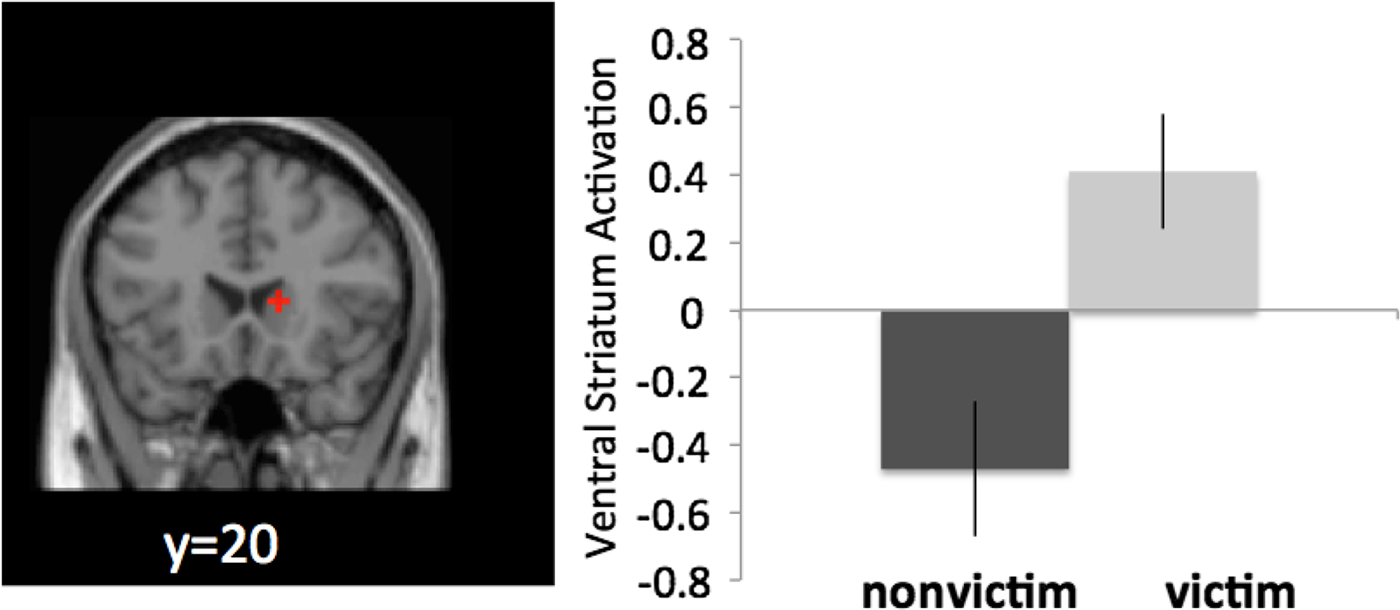
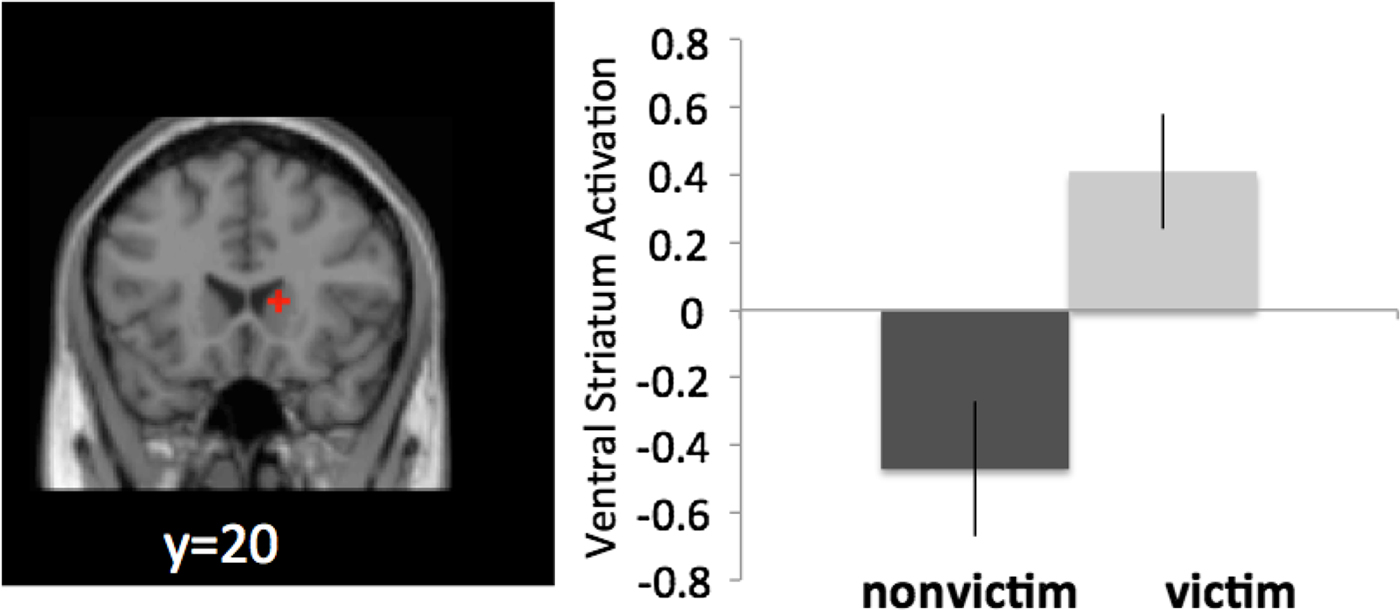
When adolescents successfully passed through an intersection without crashing following a risky decision, victimized girls showed greater activation than nonvictimized girls in the striatum (Figure 5; Table 1). For descriptive purposes, we extracted parameter estimates of signal intensity from each significant cluster from the contrast pass outcomes relative to baseline. We plotted the parameter estimates for victimized and nonvictimized girls separately (Figure 5). Nonvictimized girls showed greater activation in the bilateral insula (Table 1). Due to the low frequency of crash events (i.e., there were only eight possible crash events, with most participants having only one to five total crashes), we did not have enough trials to run analyses for the crash outcome.Footnote 1
(Color online) Victimization group differences in neural activation following risky decisions on the Stoplight Task (i.e., pass outcome). Victimized adolescents showed significantly greater activation than nonvictimized adolescents in the ventral striatum.
Association between neural reactivity during risky decisions and antisocial behavior
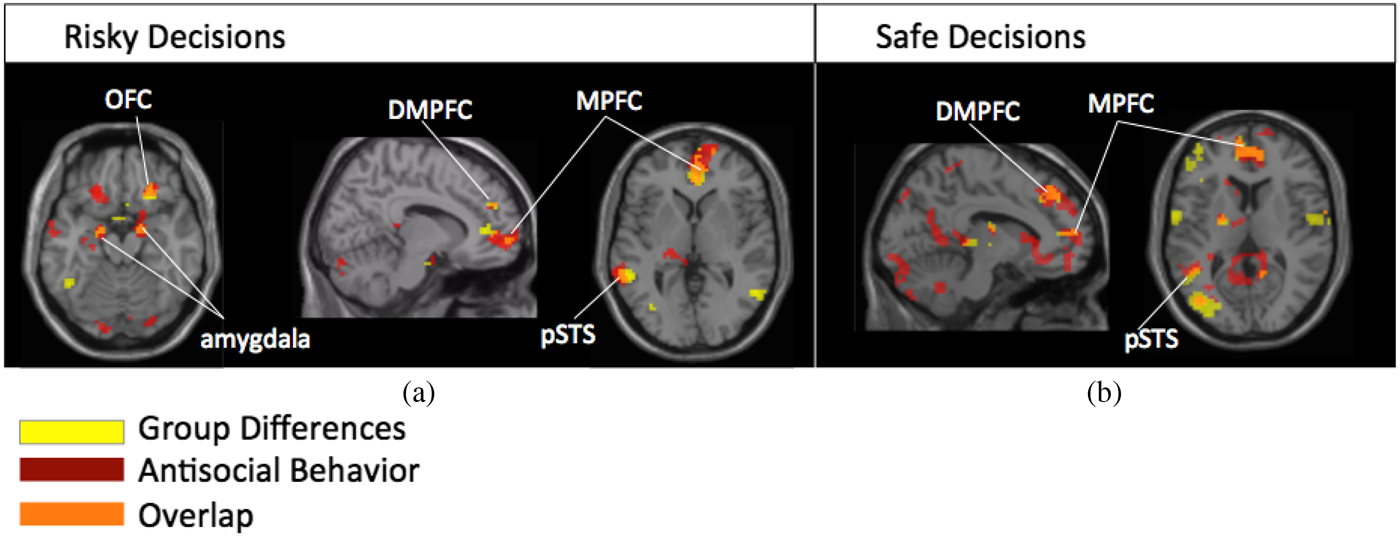
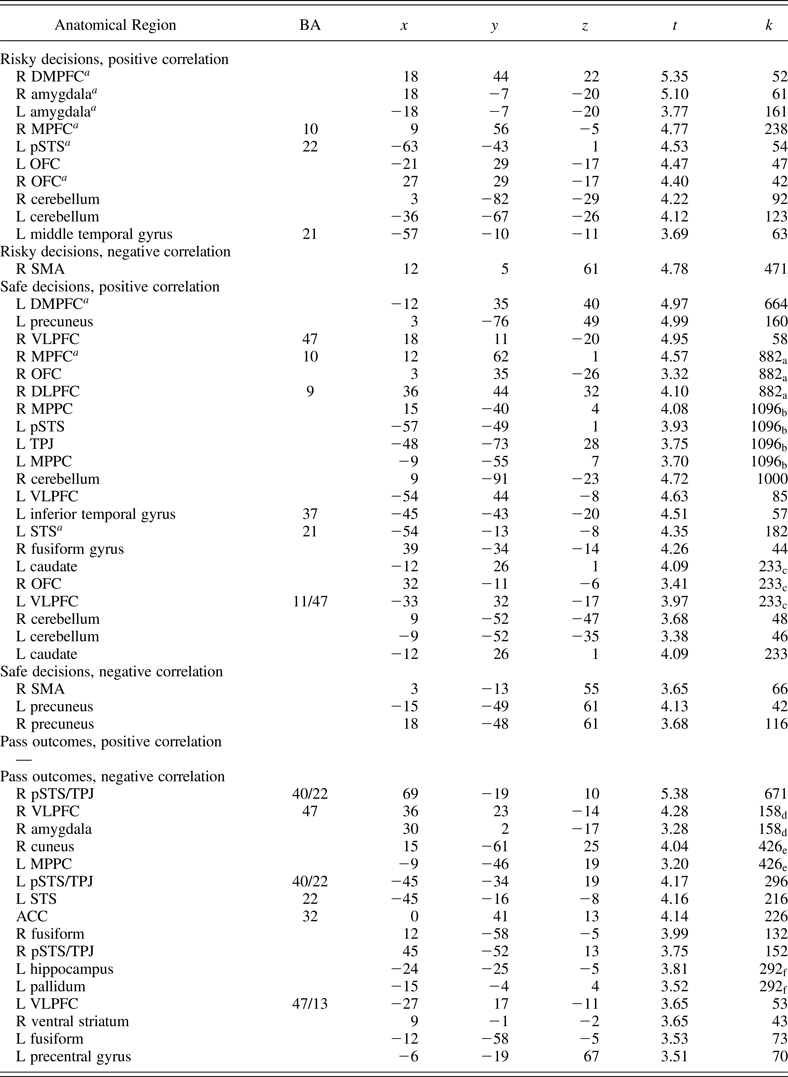
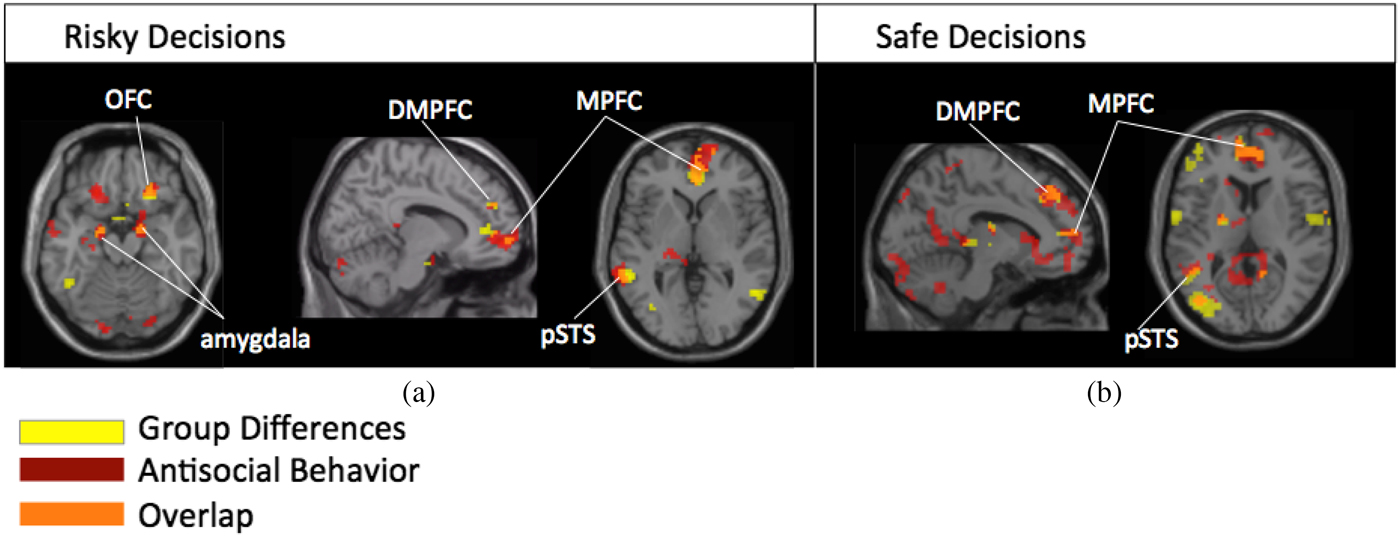
We examined how adolescents’ neural reactivity during risky decisions was associated with self-reported antisocial behavior. In whole-brain regression analyses, we regressed antisocial behavior on neural reactivity when making risky decisions (i.e., “go” through yellow light). Adolescents reporting higher antisocial behavior showed greater activation in several brain regions involved in affective sensitivity, including the bilateral amygdala and OFC, as well as regions involved in social cognition, including the MPFC, DMPFC, and pSTS (Table 2). Many of these regions overlap with those that demonstrated group differences during risk taking (bilateral amygdala, OFC, MPFC, and pSTS; see Figure 6a).
(Color online) Neural regions identified in whole-brain analyses comparing group differences (i.e., victim > nonvictim; depicted in yellow online only) and antisocial behavior (depicted in red online only) during risk taking. Regions showing overlap between the two independent analyses are depicted in orange online only.
Activation in neural regions during risk taking correlated with antisocial behavior
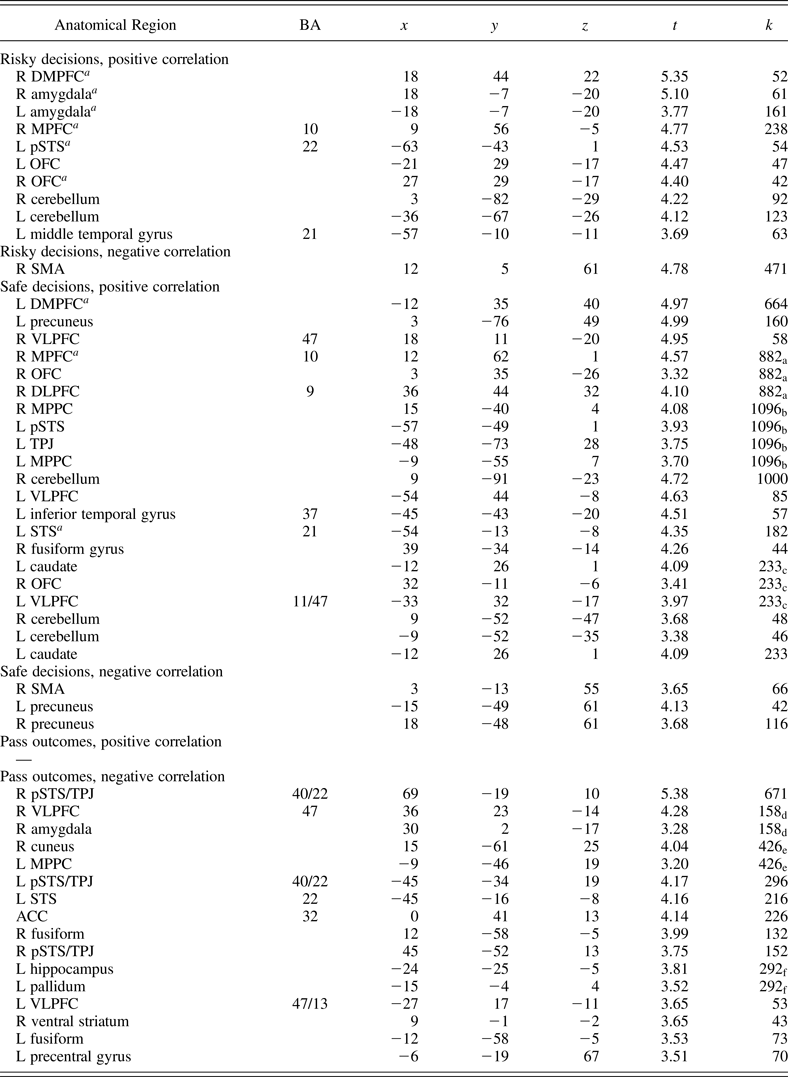
Note: BA, putative Broadman areas; x, y, and z, MNI coordinates; t, the t score at those coordinates (local maxima); k, the number of voxels in each significant cluster; R, right hemisphere; DMPFC, dorsomedial prefrontal cortex; L, left hemisphere; MPFC, medial prefrontal cortex; STS, superior temporal sulcus; OFC, orbital frontal cortex; SMA, supplementary motor area; VLPFC, ventrolateral prefrontal cortex; DLPFC, dorsolateral prefrontal cortex; MPPC, medial posterior parietal cortex; TPJ, temporoparietal junction.
a The cluster of activation overlaps with that found for the group differences analyses (Table 1) and was used in mediation analyses. Clusters that share the same subscript are part of the same cluster of activation.
Association between neural reactivity during safe decisions and antisocial behavior
When making safe decisions (i.e., “stop” at yellow light), antisocial behavior was associated with greater activation in brain regions involved in social cognition, including the MPFC, DMPFC, TPJ, pSTS, and MPPC, as well as regions involved in cognitive control, including the VLPFC and DLPFC (Table 2). Many of these regions overlap with those that demonstrated group differences during safe decisions (MPFC, DMPFC, and pSTS).
Association between neural reactivity during pass outcomes and antisocial behavior
When adolescents successfully passed through an intersection without crashing following a risky decision, greater antisocial behavior was associated with less activation in brain regions involved in affective sensitivity, including the bilateral amygdala, and brain regions involved in social cognition, including the TPJ, STS, MPFC, and DMPFC (Table 2). Greater antisocial behavior was not associated with heightened activation in any brain region.
Neural reactivity as a mediator of group differences in antisocial behavior
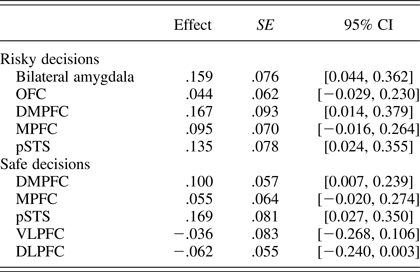
Given that similar neural patterns were found when examining group differences in neural activation and associations between neural activation and antisocial behavior, we examined whether group differences in neural reactivity explained chronically victimized girls’ greater antisocial behavior. To this end, we extracted parameter estimates of signal intensity from the regions of interest that showed overlap in the two sets of independent analyses (see Figure 6 and Table 2, note clusters with an asterisk are those that showed overlap). We calculated the magnitude and the significance of the indirect effects of group status (victim = 1, nonvictim = 0) on antisocial behavior through neural reactivity using the procedures described by Preacher and Hayes (Reference Preacher and Hayes2008), in which bootstrapping was performed with 1,000 samples and a bias-corrected confidence interval was created for the indirect effect. Sixth-grade antisocial behavior was used a control variable in all mediation models. By controlling for earlier antisocial behavior, we can be more confident of the direction of the effects such that early antisocial behavior does not account for any significant effects. For risky decisions, the indirect effect of victimization on antisocial behavior through adolescents’ neural sensitivity was significant (i.e., the 95% confidence interval did not include 0) for the bilateral amygdala, DMPFC, and pSTS (see Table 3). For safe decisions, the indirect effect of victimization on antisocial behavior through adolescents’ neural sensitivity was significant for the DMPFC and pSTS (see Table 3).
Indirect effect of mediation models for group differences (victim vs. nonvictim) on antisocial behavior via neural activation
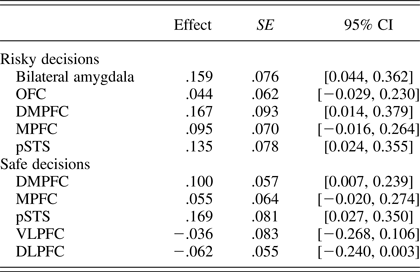
Note: OFC, orbital frontal cortex; DMPFC, dorsomedial prefrontal cortex; MPFC, medial prefrontal cortex; STS, superior temporal sulcus; VLPFC, ventrolateral prefrontal cortex; DLPFC, dorsolateral prefrontal cortex.
Discussion
Peer victimization is a salient and distressing experience, conferring significant risk for poor adjustment outcomes including risky and antisocial behavior (Hanish & Guerra, Reference Hanish and Guerra2002; Laird, Jordan, Dodge, Pettit, & Bates, Reference Laird, Jordan, Dodge, Pettit and Bates2001; Parker & Asher, Reference Parker and Asher1987; Prinstein & La Greca, Reference Prinstein and La Greca2004; Rudolph et al., Reference Rudolph, Lansford, Agoston, Sugimura, Schwartz, Dodge and Bates2014). Although significant research reveals a prospective association between exposure to peer victimization and antisocial behavior, research has not explored the neural processes underlying this link. Drawing from experimental research documenting the effect of acute social exclusion on risk taking and associated neural activity (Peake et al., Reference Peake, Dishion, Stormshak, Moore and Pfeifer2013), the present study examined whether chronically victimized girls show differences in neural processing following exclusion and whether these differences help to account for the association between chronic victimization and subsequent antisocial behavior in adolescence. At the behavioral level, we confirmed that chronic peer victimization was significantly associated with more risky behavior following acute exclusion measured via an experimental task and with more antisocial behavior in everyday life measured via self-report. At the neural level, we found group differences in neural regions involved in affective sensitivity, social cognition, and cognitive control during the risk-taking task; moreover, several of these group differences mediated the association between chronic victimization and antisocial behavior.
Although prior research has examined risk taking following acute, experimentally manipulated social exclusion (e.g., Falk et al., Reference Falk, Cascio, O'Donnell, Carp, Tinney, Bingham and Simons-Morton2014; Peake et al., Reference Peake, Dishion, Stormshak, Moore and Pfeifer2013), and prior studies have shown that chronically rejected and victimized youth show heightened neural sensitivity to social threat (Rudolph, Miernicki, Troop-Gordon, Davis, & Telzer, Reference Rudolph, Miernicki, Troop-Gordon, Davis and Telzerin press; Will, van Lier, Crone, & Güroğlu, Reference Will, van Lier, Crone and Güroğlu2016), our findings are the first to show that the neural correlates of risk taking differ in youth with versus without a history of chronic peer victimization. Not all youth respond to social exclusion similarly, and it is important to understand the processes by which those with a history of chronic victimization react following such experiences. We show that risk-taking behavior prior to a social exclusion manipulation did not differ in victimized and nonvictimized girls. However, following the exclusion experience, and when the goal of the risk-taking task was described as a means to gain points for one's collective team, chronically victimized and nonvictimized girls showed distinct patterns of behavior, such that the victimized youth showed greater risk taking than nonvictimized youth. These findings provide further evidence that the potential goals of engaging in risk taking are different among adolescents who have a history of victimization experiences, and suggest that acute instances of social exclusion may trigger heightened sensitivity and an orientation to group belonging via risk taking in this group. These findings are also consistent with experimental work in adults, which shows that being exposed to acute social exclusion increases one's willingness to try illicit drugs only if given the option to try drugs with new friends as opposed to alone, consistent with the theory that socially excluded individuals may be willing to engage in risky behavior as a way to reestablish their sense of social connection (Mead et al., Reference Mead, Baumeister, Stillman, Rawn and Vohs2011).
At the neural level, we found that chronically victimized and nonvictimized adolescent girls showed differing patterns of activation during the risk-taking task. In particular, victimized adolescents showed significantly greater activation in the ventral striatum, amygdala, and OFC when making risky choices. Moreover, heightened amygdala activation mediated victimization group differences in self-reported antisocial behavior. Because the ventral striatum, amygdala, and OFC are involved in emotional arousal, reward anticipation, and social influence, particularly during adolescence (Cascio et al., in press; Chein et al., Reference Chein, Albert, O'Brien, Uckert and Steinberg2011; Ernst et al., Reference Ernst, Nelson, Jazbec, McClure, Monk, Leibenluft, Blair and Pine2005; Galvan et al., Reference Galvan, Hare, Parra, Penn, Voss, Glover and Casey2006; Hare et al., Reference Hare, Tottenham, Galvan, Voss, Glover and Casey2008; Van Leijenhorst et al., Reference Van Leijenhorst, Moor, de Macks, Rombouts, Westenberg and Crone2010), our findings suggest that the expected value of high-risk rewards is heightened in youth who have a history of peer victimization. Our risk-taking task manipulation had participants complete the task in order to gain points for their collective team. Heightened affective sensitivity is consistent with the idea that victimized girls have a strong need for approval (i.e., they are sensitive to receiving positive judgments from peers). Thus, chronically victimized youth may find risky choices more appealing as they provide a sense of expected social reward or social connection, consistent with theory and research suggesting that increases in risk taking following social exclusion occur as a means to regain social status (Dewall & Richman, Reference DeWall and Richman2011; Rawn & Vohls, Reference Rawn and Vohs2011). Therefore, the expected value of high-risk rewards may become greater due to the increased motivational currency of social approval and connection (Peake et al., Reference Peake, Dishion, Stormshak, Moore and Pfeifer2013). Unfortunately, although the ultimate aim may be the restoration of the victim's status, increased risky behavior may actually serve to perpetuate social standing in the peer group (Nesdale & Lambert, Reference Nesdale and Lambert2008). Thus, rejected individuals may engage in risk-taking behaviors as a way to gain immediate rewards rather than focusing on the more abstract and long-term consequences of their behavior and making efforts to develop their relationships in more adaptive ways. An alternative explanation is that this heightened affective sensitivity reflects greater sensitivity to negative social feedback (i.e., chronically victimized youth were more worried about disappointing teammates). Thus, heightened amygdala activation in particular may represent avoidance emotions.
In addition to heightened affective sensitivity when making risky choices, we found greater ventral striatum activation among chronically victimized youth during successful passes (i.e., successfully passing without a crash following a risky decision). Because the ventral striatum is involved in reward processing and is associated with greater risk-taking behavior during adolescence (Galvan et al., Reference Galvan, Hare, Parra, Penn, Voss, Glover and Casey2006, Reference Galvan, Hare, Voss, Glover and Casey2007; Qu, Galvan, Fugligni, Lieberman, & Telzer, Reference Qu, Galvan, Fuligni, Lieberman and Telzer2015; Telzer et al., Reference Telzer, Fuligni, Lieberman, Miernicki and Galván2015), our findings suggest that in addition to anticipatory activation (i.e., when making the decision to go), the outcome itself is a potentially more rewarding event for chronically victimized adolescents. Because both real and anticipated rewards reinforce behavior (Knutson & Greer, Reference Knutson and Greer2008), this heightened affective activation during reward anticipation (i.e., go decisions) and reward outcome (i.e., successful passes) may be increasing chronically victimized girls’ sensitivity to risk taking.
Adolescents who have experienced chronic levels of peer victimization may also have impaired self-regulatory capacities. Although we did not find altered PFC activation during risky choices, we found that when making safe decisions, chronically victimized youth showed heightened activation in the VLPFC and DLPFC. These regions are involved in the ability to regulate and control one's prepotent thoughts and behaviors as well as emotion regulation (Baker, Frith, & Dolan, Reference Baker, Frith and Dolan1997; Gray, Braver, & Raichle, Reference Gray, Braver and Raichle2002) and are relatively late developing structures of the brain (Gogtay et al., Reference Gogtay, Giedd, Lusk, Hayashi, Greenstein, Vaituzis and Thompson2004). Particularly in the context of heightened affective sensitivity, cognitive resources may become overwhelmed or taxed, resulting in impaired cognitive control (Casey et al., Reference Casey, Jones and Hare2008; Hare et al., Reference Hare, Tottenham, Galvan, Voss, Glover and Casey2008). Because victimized girls made significantly more risky decisions during the Stoplight Task, their prepotent choice may be to be risky. Thus, victimized youth may necessitate greater cognitive control to make safe choices, requiring them to recruit the PFC to a greater extent than nonvictimized youth. These findings are consistent with prior research showing that adolescents who experience high levels of peer conflict show heightened VLPFC and DLPFC activation during risk taking (Telzer et al., Reference Telzer, Fuligni, Lieberman, Miernicki and Galván2015), and adolescents who have experienced acute social exclusion show greater DLPFC activation when making safe decisions during the same task as the current study (Peake et al., Reference Peake, Dishion, Stormshak, Moore and Pfeifer2013). However, the mediation analyses did not identify altered PFC activation as a mechanism by which victimization is associated with greater antisocial behavior.
We also found significant group differences in neural regions involved in social cognition. During both safe (i.e., “stop”) and risky (i.e., “go”) decisions, chronically victimized adolescents showed heightened activation in the MPFC, DMPFC, TPJ/pSTS, and MPPC. These findings are consistent with prior research, which has shown that youth experiencing acute, experimentally manipulated social exclusion show heightened mentalizing activation during risky decision making (Peake et al., Reference Peake, Dishion, Stormshak, Moore and Pfeifer2013). This heightened mentalizing may reflect social monitoring and a concern with peers’ evaluations of one's own risky decisions. Therefore, when considering what decision to make, either safe or risky, chronically victimized youth may be preemptively adjusting their behavior to fit the expected group norms, a process involving mentalizing. Adolescents who perceive that their peers value antisocial behavior are most likely to adjust their own behavior to fit the expected group norms (Allen et al., Reference Allen, Porter, McFarland, Marsh and McElhaney2005). This heightened social–cognitive processing does not imply better perspective-taking abilities, but rather, a greater focus on peer approval, as highlighted in prior experimental studies (Falk et al., Reference Falk, Cascio, O'Donnell, Carp, Tinney, Bingham and Simons-Morton2014; Peake et al., Reference Peake, Dishion, Stormshak, Moore and Pfeifer2013). While we suggest that these regions are representing neural processing associated with social monitoring and a concern with peers’ evaluations, social–cognitive neural regions have multiple, complex roles, and heightened activation in these regions during risk taking has also been linked to more optimal behaviors and less risk taking. For instance, in the presence of their mother, adolescents make fewer risky decisions than when alone, which is associated with heightened MPFC activation in the presence of their mother (Telzer, Ichien, & Qu, Reference Telzer, Ichien and Qu2015). Therefore, greater social–cognitive neural processing is not necessarily a vulnerability for poor decision making, nor is it indicative of better perspective-taking abilities, but instead represents a neurobiological signal for thinking about others’ mental states. The meaning of this activation will depend on the social and motivational context.
In addition to social–cognition, the MPFC and MPPC have been linked to self-referential processing (D'Argembeau et al., Reference D'Argembeau, Collette, Van der Linden, Laureys, Del Fiore, Degueldre, Luxen and Salmon2005; Gusnard, Akbudak, Shulman, & Raichle, Reference Gusnard, Akbudak, Shulman and Raichle2001; Mitchell, Banaji, & Macrae, Reference Mitchell, Banaji and Macrae2005; Pfeifer, Lieberman, & Dapretto, Reference Pfeifer, Lieberman and Dapretto2007). Therefore, group differences in these neural regions may also be related to self-referential processing, including self-reflection. It may be that chronically victimized adolescents view their performance on this task as more relevant to their self-worth and engage in more internal, self-related thinking when being both risky and safe.
Our findings provide novel evidence for the role of affective sensitivity, cognitive control, and social cognition in experiences of risk taking following social rejection. Future research should examine whether the patterns found in the current study are similar or different in males given that adolescent females show heightened social sensitivity relative to males (Guyer et al., Reference Guyer, McClure-Tone, Shiffrin, Pine and Nelson2009, 2012; Kloep, Reference Kloep1999). In addition, we only had scan data available for the risk-taking task following the social exclusion experience, so we were unable to examine changes in neural activation before and after the exclusion. Prior research has found important differences in neural processing during risk taking pre- and postsocial exclusion (Peake et al., Reference Peake, Dishion, Stormshak, Moore and Pfeifer2013). In addition, although our study was longitudinal in nature, our effects are correlational, and we therefore cannot be certain about the causal direction of effects. It is possible, for example, that youth already evidence altered neural processing in childhood prior to their chronic victimization experiences. Therefore, future research should examine how neural responses change across development as a function of victimization. Finally, adolescents in this study were a community sample, which is a strength of the study allowing for greater generalizability in the effects. Nonetheless, our antisocial behavior scores were negatively skewed. Future studies should recruit higher risk adolescents who are engaging in high rates of antisocial behavior. Further, while our measure of antisocial behavior captures several aspects of risk taking (e.g., cutting school, and rule breaking), future studies should examine more specific risk-taking outcomes, such as substance use and risky sexual behaviors.
In conclusion, our results highlight the neural processes by which a legacy of peer victimization gets under the skin. Our findings show that chronic peer victimization may sensitize adolescents to risk-taking behavior following acute exclusion, perhaps as a means to regain social status and connect with the peer group. These findings have important implications for interventions designed to reduce antisocial behavior in at-risk populations. Given the fundamental need to belong (Baumeister & Leary, Reference Baumeister and Leary1995), teachers, parents, and policymakers can focus on finding ways for victimized youth to attain a sense of social connection in more adaptive ways that do not entail risky behavior or deviant peer affiliation.