Does naming and shaming by international nongovernmental organizations (INGOs) and Western media affect human rights conditions in target states? The focus on global civil society in international relationsFootnote 1 has led to a vast literature that does not reach a consensus on the effectiveness of INGO and press advocacy in stopping human rights abuses.Footnote 2 Proponents allege that INGOs and the press have a positive influence on the politics and practices of human rights.Footnote 3 ‘Naming and shaming’ as a technique has many supporters, on both the academic and practitioner sides.Footnote 4 Those more critical of INGO and international press efficacy have found evidence that they have either no effect, a conditional effect,Footnote 5 or in some cases a negative effectFootnote 6 on human rights practices. These mixed findings reveal a lack of consensus from a scholarly perspective, even while INGOs have received recognition for their contribution to furthering human rights in target countries.Footnote 7
We ask in this article whether the power of the pen – that is, naming and shaming – changes the behaviour of states that violate human rights. Clearly, when INGOs and the international press choose to report on a given country's human rights practices, the response from the target state matters for how ‘effective’ an INGO's effort is. On the flip side, INGOs are strategic actors, and as such select from a menu of advocacy techniques for a given case based on organizational calculations. We approach the analysis of state responses to INGO and press naming and shaming from the perspective of domestic institutional constraints and incentives in violator states. Our contribution addresses the differential effects that naming and shaming may have in different political regimes. While democracies and hybrid regimes – which combine democratic and authoritarian elements – might have, on the whole, better respect for human rights,Footnote 8 this does not automatically make them more responsive to INGO advocacy and media scrutiny. We argue that the effectiveness of international efforts to name and shame may be contingent on regime type, but that autocracies may actually be more receptive to INGO and media naming and shaming than non-autocracies, a grouping that combines democracies and hybrid regimes.
Our argument stands in contrast to extant arguments that discuss transnational advocacy as a way to mobilize or empower domestic actors.Footnote 9 We posit that it is not the domestic mobilization that matters most, but, in fact, the expectations and information capacity of leaders who create opportunities for international naming and shaming to work. We theorize that because democracies and hybrid regimes are more likely to have two key institutional components, organized political opposition and a free press, rulers in these regimes can better estimate the domestic political costs and benefits that would result from disregarding international human rights standards in their actions. Consequently, they are more resolute in their decisions to ignore international norms when they choose to pursue such policies. Revelations of information about human rights abuses are relatively more common in regimes with a political opposition and a free press, while autocracies tend to restrict opposition activity and have a more restricted press. Thus, the reporting of abuses by INGOs and the international press should have larger proportional effects in autocratic systems, because international reporting has a much greater potential to alter public perceptions of behaviour in violator regimes.
We test this conjecture using data on media reporting and the advocacy efforts of Amnesty International (AI) – including both background reporting and press releases and Urgent Action petitions (UAs), for the period 1975–2004. Consistent with our expectations, we find that press reporting and INGO advocacy in fact do affect the behaviour of states with regard to human rights, and this effect is contingent on regime type: naming and shaming is associated with better outcomes in autocracies but worse or insignificant outcomes in non-autocracies. Moreover, we demonstrate that these findings are not due to selection bias in naming and shaming efforts: the Western media and AI do not disproportionately target countries with improving human rights records – if anything, the evidence suggests that they select harder cases.
In the next section, we outline the basic scholarly findings on human rights INGOs and naming and shaming. Subsequently, we discuss our informational theory of how we can explain the effects of INGOs on practices relating to human rights in states by examining the interaction between regime type and naming and shaming. The third section introduces the data, our estimation strategy, and presents results. Finally, we discuss how our research provides future pathways for scholarship on INGOs and human rights, and the relevance of our findings for important theoretical discussions about the role of INGOs in international relations.
Literature Review
Human rights analysts began the examination of patterns of state behaviour in earnest using cross-national data to discover what sort of states would be more or less likely to respect human rights. The most important findings to emerge from those analyses are that states that are more autocratic, at lower levels of economic development and engaged in civil conflict are more likely to violate human rights.Footnote 10 Refinements to those initial findings emphasize the ephemeral nature of improvements based solely on changes in regime type.Footnote 11 Others have elaborated on the regime type thesis, suggesting that consolidated regimes, whether autocratic or democratic, are less likely to violate human rights than those that fall in-betweenFootnote 12 – so-called ‘hybrid regimes’ that combine elements of democracy and autocracy in governance. Other findings suggest that the association between democracy and better respect for physical integrity rights is only evident at relatively high thresholds of democracy.Footnote 13 A popular argument about democratic ‘lock-in’ stresses that new democracies ratified human rights instruments in Europe precisely to ensure that their successors could not backpedal on human rights commitments.Footnote 14 Regardless of the number of revisions, the empirical evidence points to a positive effect of democracy on respect for human rights. Intuitively, the link makes sense, as democracies tend to protect at least basic civil and/or political rights, and there is some ostensible link between the rulers and the ruled.Footnote 15
By contrast, the findings on the effects of INGO advocacy on human rights outcomes are decidedly mixed. As Hafner-Burton and Ron suggest, these mixed findings break down along methodological lines, with qualitative researchers asserting positive effects and quantitative researchers, in the main, finding little or no effect.Footnote 16 Thus, while some claim that INGOs and transnational networks exert pressure on states and even cause them to shift tactics in some instances,Footnote 17 other findings suggest that naming and shaming by INGOs has no systematic effect on human rights outcomes.Footnote 18 Still, there are large-n studies that find INGOs (and other international organizations) can change government behaviour in terms of state-sponsored killings.Footnote 19 States are the main targets of INGO advocacy, but INGOs might also influence the way human rights violations are reported, especially in states that are not central to Western media agendas.Footnote 20 It may be that the external influences of INGOs, like the influence of international treaties, require receptive domestic audiences with which to build coalitions or an existent strong civil society in order for advocacy to have effect.Footnote 21 The positive effect that some posit merely from the presence of civil society actors such as INGOs in democratizing international politicsFootnote 22 is increasingly met with gloomier perspectives that blame INGOs for wrongheadedness in their policy directives.Footnote 23
We can think about the effect of INGOs by examining the effect of another non-state actor, the media. Newspapers and other outlets seem to fare similarly to INGOs. Research suggests that open media and press coverage have a positive effect on the protection of rights,Footnote 24 albeit only for the most democratic regimes.Footnote 25 The effect, however, might be tainted by the information paradox, which describes how greater media coverage of abuses leads to a heightened awareness of them and, therefore, the finding of more instances of them in the world.Footnote 26 On the whole, the media (similar to INGOs) provides negative coverage, revealing journalists’ biases in favour of reporting on abuses, rather than improvements. For example, American daily newspapers tend to focus negative attention on repressive countries that lack open media access.Footnote 27
From the literature, we can derive two general perspectives. First, regime type matters for human rights practices. Specifically, political democracy seems to exert a positive effect on respect for human rights. The logic is that democratic values – freedom of speech and association, equality – are naturally compatible with basic human rights values that protect those same rights and others, such as the freedom from torture or arbitrary arrest.
Extending the logic to international criticism of a regime's human rights practices, democracies should respond to criticisms of their failure to respect human rights by changing their behaviour. One perspective on the role of INGOs vis-à-vis states is as agents of socialization for international norms. That is, human rights INGOs might help to bring states into compliance with norms through persuasion. In The Power of Human Rights, Risse, Ropp and Sikkink show how states socialize one another to human rights norms, often with the assistance of INGO monitoring and reporting.Footnote 28 INGOs can socialize states similarly to the way that IGOs help to socialize states through membership and participationFootnote 29 or interaction through military involvement.Footnote 30 Non-state actors might serve as an external impetus for change by providing a basis from which states may be brought into compliance with new norms and rules in a given community.Footnote 31 Thus, through persuasion and other mechanisms, states are brought into compliance with extant human rights (or other) norms. From a rationalist perspective, INGOs might be able to shift the underlying preferences, or create higher costs for non-compliance with international norms. This logic underlies the findings that states ratify human rights treaties in order to seek foreign aid benefitsFootnote 32 or preferential trade agreements.Footnote 33
We adopt a different stance, one that focuses on domestic institutional constraints in violator countries that mediate the translation of international human rights scrutiny into changes in human rights practices. While not rejecting the rationalist or the socialization theses, we assert that non-state actors have the capacity to change state behaviour, and that INGO action is mediated by the institutional incentives and constraints facing the target regime. The responsiveness of a state to any given INGO critique is shaped by the political context in which the critique is received. We build on a growing literature that emphasizes how domestic institutions shape states’ adoption (or not) of human rights treaties and compliance with human rights normsFootnote 34 by adding that states’ domestic constraints affect whether states respond with improved human rights behaviour to naming and shaming.
Theory and Hypotheses
Our theory emphasizes the institutional incentives and constraints facing violator governments, which condition their responses to INGO naming and shaming. Others have examined the variation in the domestic uptake of international norms as a function of prior domestic conditions.Footnote 35 Theories of compliance with international institutions and norms suggest that compliance does not occur in the absence of domestic demands. Without such demands, states do not have reasons to comply with international agreements.Footnote 36 Leaders of states are constrained in their ability to change policy by their domestic supporters, and the nature of their support coalition conditions their flexibility in responding to international incentives.Footnote 37 Simmons has described how differences between democratic states’ commitment and compliance with international human rights treaties can be explained by looking at key domestic institutions, such as federalism, an independent judiciary and the distribution of power between the executive and the legislative branches.Footnote 38 For autocratic regimes, Vreeland asks why regimes with well-known torture records have signed the Convention Against Torture. He demonstrates that the presence of multiple parties encourages states to ratify human rights treaties as a concession to domestic challengers to the regime.Footnote 39 In doing so, he focuses attention on the internal political dynamics of non-democratic systems.
Autocracies, Non-Autocracies and Political Costs
In developing our argument regarding the interactions between regime type and INGO naming and shaming, we make several assumptions. First, we assume that when regimes disregard international human rights norms, they do so, for the most part, in a purposive manner: leaders do not abuse human rights unless they expect the net political benefit to be positive.Footnote 40 Secondly, we assume that the net political benefit is dependent on whether the abuse is covert or overt. Covert abuses are those from which the expected political benefit is positive as long as knowledge of the act is not public and widespread – if covert abuses are widely reported, they become political liabilities for the regime. As long as covert abuses are kept secret, the expected political benefit is positive. If, however, these abuses become public, the expected political benefit is negative. Overt abuses are those from which the expected benefit increases, or at least is non-decreasing, with the extent of public knowledge of the abuse.
The general examples of torture and capital punishment serve to illustrate the key conceptual differences between overt and covert human rights abuses. In most instances, torture would be a classic covert form of abuse.Footnote 41 It is nearly universally condemned, with 157 countries having either signed or ratified the United Nations Convention against Torture and Other Cruel, Inhuman or Degrading Treatment or Punishment.Footnote 42 Holdouts include ‘pariah states’ North Korea, Iran, Myanmar and Zimbabwe. Most of the countries that routinely engage in torture are legally opposed to it, and certainly do not go to great lengths to publicize their activities in this area,Footnote 43 in some cases adopting practices that deliberately do not leave evidence of torture.Footnote 44 Nonetheless, research also shows the persistence of torture as state practice, even in liberal democracies, and that it can be seen as a useful tool for autocratic and non-autocratic regimes alike when engaged in civil war.Footnote 45 Capital punishment, while considered by many human rights organizations to be a form of cruel and inhuman punishment, is an overt practice justified in part because of its deterrent effect on criminality. The United States and Japan, two consolidated democracies, both have the death penalty in some jurisdictions, and large majorities are in favour of its use.
The availability (or lack thereof) of information determines whether abuses tend to be covert or overt. Relatively open media and acceptance of political dissent characterize democracies, and so we would expect that, in such regimes, the majority of abuses would be overt, rather than covert in nature. The converse is also true: since autocracies often do not allow for dissent, and have controlled media, covert abuses should be more prevalent in an absolute sense. Data on AI targeting for UAs bears this out: the overwhelming majority of UAs targeting the United States (88 per cent) and Japan (75 per cent), two consolidated democracies, concern the death penalty, while virtually none (0.1 and 0 per cent, respectively), address torture. In contrast, consolidated autocracies that practise the death penalty, such as Syria and Myanmar, are targeted relatively infrequently for the use of the death penalty (6 and 13 per cent, respectively), but comparatively often for the use of torture (41 and 40 per cent, respectively).
Before deciding to disregard international human rights norms in their actions, rulers assess the probability that their actions will be widely reported. The likelihood that the two types of abuses can be expected to become public will differ across regime types. More open political systems have domestic monitoring mechanisms that act as a check on covert human abuses. This distinction is useful in answering what kinds of domestic institutions encourage states to respond or ignore INGO condemnation.
We focus on the presence of organized political opposition and the independence of the press to demonstrate why INGOs will be likely to have a greater effect in autocratic regimes. As a consequence, we make a theoretical distinction between autocratic and non-autocratic regimes, rather than the more common democratic and non-democratic regimes categories. Hybrid regimes – regimes that combine democratic and authoritarian elements – are more similar to democracies than autocracies with respect to some of the key aspects of political democracy: the presence of organized political opposition and an independent (if not entirely free) press. Vreeland makes the case that only the most repressive autocrats need not resort to the torture of political opponents, because the opposition either does not exist or has been silenced.Footnote 46 Only the most autocratic regimes, by extension, can hide covert abuses, because the legitimation of alternative points of view in hybrid or democratic systems means that the incentives to defect or reveal bad practices increase. Ironically, because of their control over power, the most autocratic regimes are also those autocracies that are least likely to torture.Footnote 47
Data on political opposition and media freedoms provide empirical support for our theoretical distinction between autocracy and non-autocracy. The Polity project's Competitiveness of Participation (PARCOMP) variable measures the extent of government restrictions on political competition, and ranges from 1 (‘repressed: no significant oppositional activity is permitted outside the ranks of the regime or ruling party’) to 5 (‘competitive: there are relatively stable and enduring secular political groups which regularly compete for political office’).Footnote 48 In 2009, all autocracies were characterized by either repressed or suppressed patterns of political competition, while all the most consolidated democracies (Polity2 = 10) had ‘competitive’ political systems.Footnote 49 However, the next most competitive participatory systems, which Polity labels ‘Transitional’, were found in political systems ranging from the institutionalized and relatively democratic, like India (Polity2 finds India = 9), to monarchies (Jordan = 3). Factionalized party systems (PARCOMP = 3) were found in regimes ranging from ethnically fragmented democracies (Belgium, 8, and Lebanon, 7) to dominant party, semi-authoritarian countries like Togo (−4) and Cameroon (−4). The presence of political opposition unites hybrid regimes and democracies and separates both from autocracies.Footnote 50
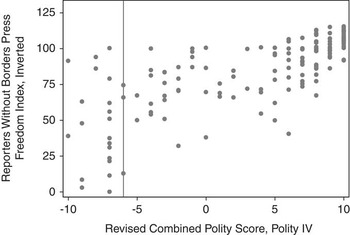
Regarding press freedoms, a similar picture emerges: autocracies are systematically different from democracies and hybrid regimes. Figure 1 plots the 21-point Polity2 scale against Reporters Without Borders’ Worldwide Press Freedom Index for 2009.Footnote 51 Press freedom is more varied across regime types, with relatively high levels of press freedom coexisting with highly autocratic political institutions in countries like Qatar and Kuwait. However, autocratic countries are much more likely to have extremely low values for press freedoms: of the bottom fifth percentile countries with respect to press freedom, all are autocracies. While some autocracies have higher levels of press freedom, no non-autocracies have extremely low values for press freedom. Because democracies and hybrid regimes share organized oppositions and minimal press freedoms, and autocracies lack the former and are less likely to have the latter, the autocracy versus non-autocracy distinction captures meaningful differences in the domestic sources of information about and revelation of covert human rights abuses.
Regime type and press freedom, 2009

Democratic domestic institutions can actually weaken the influence of INGO naming and shaming. Organized political opposition can benefit from revealing and/or highlighting information that rulers would rather were kept secret, and thus has incentives to bring covert abuses to light. Consequently, the value of INGO revelation of human rights abuse is lower in systems characterized by a political opposition. In these systems, the opposition has political incentives to report damaging information about the regime's actions. Whether elections are competitive or not, opposition parties have incentives to monitor and criticise the regime or party in power.Footnote 52 In contrast, in political systems characterized by an absence of opposition parties, the ruler's expected cost of engaging in covert abuses will be lower because the probability of those abuses becoming public is lower.
Protections for a free press also serve a revelatory role. Reporters who are unencumbered by restrictions or threats on their livelihood can investigate human rights abuses by the state or non-state actors, for example, and disseminate them for domestic and international consumption. These kinds of reports, while damaging to the perpetrators of abuse, also devalue potential informational impact of INGO reporting, even as they often provide the evidentiary basis for INGO reports and advocacy efforts.Footnote 53 INGO naming and shaming will be less effective in states where a relatively free press has already covered human rights abuses, or at least serves as a watchdog of government actions, because INGO reporting and shaming is less likely to be a new source of information about regime behaviour.
The logic that information can have differential effects across regime types finds its roots in some work on the effect of hybrid regimes on the incidence of conflict.Footnote 54 Researchers have found that it is the process of building democratic regimes that increases the likelihood of going to war, and in particular, the role of a biased and inchoate media that fans the flames of violence.Footnote 55 Others have found too that autocratic regimes with political oppositions are prone to more torture.Footnote 56 Put differently, it seems that hybrid regimes lead to ‘more murder in the middle’,Footnote 57 with stable democracies and autocracies alike faring better in respect of human rights. In these examples, it is clear that having partially democratic institutions, or partially institutionalized democracy, does not always improve human rights outcomes. However, all of these works also point to the role of political information for domestic politics. The less capable opponents are in getting or producing alternative accounts to the official line, the less likely human rights abuses by the regime will be discovered and publicized, and the less they can form domestic support for an opposition. In extremely repressive regimes, therefore, the simple act of providing information creates difficulty for leaders. In those cases, without INGO or international media critique, human rights abuses would be less widely recognized.
We expect that democracies and hybrid regimes, ceteris paribus, will engage in fewer abuses – whether covert or overt – than autocracies. This conjecture is well substantiated in the general literature on human rights. However, we expect that the gap between democracies and hybrid regimes, on one hand, and democracies and autocracies, on the other, will be comparatively larger with respect to covert abuses than overt abuses. Autocracies should engage in comparatively more covert abuses than democracies and hybrid regimes, because the probability of reporting on any given abuse is lower in autocratic systems. Democracies and hybrid regimes will engage in fewer human rights abuses, but a larger proportion of the human rights abuses committed by non-autocracies will be overt, and thus generate net domestic political benefits. A larger proportion of human rights abuses in autocracies will be covert, and their net political benefits will be contingent on whether they remain relatively secret or not. These abuses will be covert in large part because of an absence of information about their occurrence (due to lack of media coverage or political opposition).
While the distinction between overt and covert abuses demonstrates how the flow of information varies domestically depending on regime type, we also highlight how international naming and shaming can shift what information becomes available. One of the key elements of naming and shaming is public recognition of human rights abuses: naming and shaming, whether by the press or INGOs, makes abuses common knowledge. Thus, while naming and shaming by the press and INGOs increases the probability that covert abuses will become widely known and common knowledge, it should have little effect on overt abuses, which are already known in the domestic and international political context. For this reason, naming and shaming should have differential effects in autocracies and non-autocracies. Because covert abuses are relatively more common in autocracies than non-autocracies, naming and shaming is more likely to convey information that turns covert abuses into common knowledge, imposing net political liabilities. Self-interested, autocratic leaders would thus be more likely to change their behaviour and curtail abuses in the face of international naming and shaming.
In democracies and hybrid regimes, however, INGO and press naming and shaming should not have an abuse-suppressing effect. Because naming and shaming is more likely to target overt forms of abuse, it conveys less information that might alter the domestic political calculus of democratic and hybrid-regime governments. Elected officials have already accounted for political costs, and act on human rights (among other things) in accordance with those calculations. INGO and press criticism, especially INGO condemnation, do not change these costs dramatically. Put differently, if democratic rulers abuse rights, it is because they have expected that, even if they get found out, they can get away with it – and even benefit from it – politically.
Colombia offers an illustrative example of this theoretical logic at work. In 2000, the United States began implementing Plan Colombia, a massive foreign aid programme designed to help Colombia's democratic government address the cocaine trade and combat two left-wing insurgent groups: the Revolutionary Armed Forces of Colombia (FARC) and the National Liberation Army (ELN). Both the Western media and AI followed these developments with keen interest, issuing eighteen media stories, twenty-one background reports and press releases, and fifty-nine UAs that year. Two years later, Colombians elected Álvaro Uribe with a first-round majority, largely on the strength of his hardline, anti-guerrilla platform. Despite international concern over the likely consequences of Uribe's policies, Colombian voters made clear that their desire for progress in combating the FARC and ELN outweighed their concerns about the human rights implications of fighting these long-running rural insurgencies. Human rights conditions in Colombia deteriorated under Uribe, earning a 0 on the CIRI Physical Integrity Index for the years 2002–06 – the year Uribe was re-elected with 62.3 per cent of the vote, the first Colombian president to be re-elected in over a century. Despite international outcry, Colombian public opinion trumped any potential leverage that the international community might have had; in a sense, many Colombians voted for Uribe precisely because they knew he would be willing to violate international human rights standards in pursuit of ending the civil war.Footnote 58
This argument yields the following testable hypothesis:
HYPOTHESIS 1: INGO and press naming and shaming is more likely to improve respect for human rights in autocracies than in non-autocracies.
Data, Estimation and Results
To investigate the interactions between INGO targeting and regime type, and their effects on aggregate human rights outcomes, we analyse a sample of 157 countries for the period 1975–2004, although the availability of independent and control variables sometimes restricts temporal and cross-section coverage. First, we discuss our operationalizations of respect for human rights and our measures of INGO and press shaming, as well as our control variables and estimation strategy. Secondly, we present the findings of our statistical analyses.
The Dependent Variable: Respect for Human Rights
We investigate the effect of INGO naming and shaming on respect for human rights. We use two measures that capture different bundles of rights. The first, the CIRI Physical Integrity Index, measures ‘the rights not to be tortured, summarily executed, disappeared, or imprisoned for political beliefs’.Footnote 59 The index ranges from 0 (no government respect for these rights) to 8 (full government respect for these rights). The second, Freedom House's Civil Liberties Index, measures ‘freedoms of expression and belief, associational and organizational rights, rule of law, and personal autonomy without interference from the state.’Footnote 60 The index ranges from 1 (extreme repression marked by the absence of civil liberties) to 7 (no violations). In order for results to be comparable across the measures, we use the inverse of the Freedom House measures in our analyses, so that higher values represent greater respect for human rights. Taken together, these measures represent a broad spectrum of human rights.
Independent Variables: Regime Type and Naming and Shaming: Media Coverage and INGO Reporting
The preceding literature review suggests that the effects of naming and shaming may be contingent on attributes of the country being shamed. Whereas other studies have focused on the interaction between foreign aid dependence and shaming, we focus on regime type. Regime type allows us to consider the institutional constraints on leaders’ behaviour, and potentially tells us something about the impact that information about human rights abuses will have on government actions. To operationalize regime type, we use the Polity IV Polity2 variable, coded by Marshall, Jaggers and Gurr.Footnote 61 The original variable ranges from −10 (most autocratic) to 10 (most democratic). We use a dichotomous variable Autocracy, with any country–year having a POLITY value of −6 or below being coded as 1, and country–year Polity2 values ≥ −5 as 0.
We focus on three types of naming and shaming: Western media coverage, AI reporting and the use of UAs by AI to communicate with violator states. The first two have been the subject of extensive study by human rights scholars, while the third has been unexamined, at least from a quantitative perspective, to date. To measure coverage of human rights abuses in Western media, we use the average number of stories mentioning human rights in a country in a particular year in Newsweek and The Economist.Footnote 62 Although this measure is far from comprehensive, Ramos, Ron and Thoms’ analysis demonstrates that it is a reasonable proxy for Western media attention. Our measure of INGO press shaming is the count of AI press releases and background reports published on a country in a particular year.Footnote 63 Ron, Ramos and Rodgers collected the data by analysing the index headings and titles of AI press releases and background reports. Earlier studies have found weak or negative effects of INGO and media naming and shaming on respect for human rights in violator countries.
We introduce a third measure of naming and shaming: AI's UAs. Letter-writing to violator governments has long been AI's claim to fame. The International Secretariat (in London) issues UAs based on assessments by the regional research teams. UAs are only initiated when a research team deems that a particular case is time-sensitive, and therefore cannot wait for the long process of data verification for fear that bodily harm or death is imminent. They are, therefore, not issued for most cases that AI encounters in its day-to-day monitoring of countries’ human rights behaviour. Each UA counted in our data represents a dossier issued by the Secretariat to national-level offices that documents the name of the individual whose rights might have been abused, a description of known circumstances around his/her abuse, the government or actor that perpetrated the violation, and contact information for relevant officials who might be able to put an end to the abuses. These dossiers are distributed at the national-level to interested individuals in the UA Network, who then write letters in immediate appeal against the violations described in the dossier.Footnote 64
Controls
All models include controls for level and rate of economic development, as the extant literature finds a positive relationship between level of development and respect for human rights. We include real gross domestic product (GDP) per capita and the percentage annual growth rate.Footnote 65 We include a control for population, and a control for the incidence of civil conflict, as governments fighting internal wars have been demonstrated to perform significantly worse in respecting human rights.Footnote 66 Finally, we include a dummy variable for membership in the Organization for Economic Cooperation and Development (OECD), as these countries have long been recognized as having high levels of respect for human rights, even relative to their comparatively high levels of economic development and democracy.Footnote 67
Estimation and Results
Because the dependent variable is an ordinal categorical variable, we used ordered probit regression.Footnote 68 We include a lagged dependent variable to address both serial correlation and the dynamic nature of our theory: we expect that respect for human rights at time t is a function of respect for human rights at time t−1 as modified by the independent variables.Footnote 69 All independent variables and controls are lagged one year. We include period dummies to net out the effect of world events, changes in media coverage and changes in AI behaviour that would affect all countries equally in a particular year.Footnote 70 In order to address cross-country heteroscedasticity, we estimate Huber–White robust standard errors clustered on countries. These modelling choices are consistent with recent contributions to the quantitative study of human rights, and avoid problems arising from using ordinary least squares (OLS) estimation with categorical dependent variables.Footnote 71
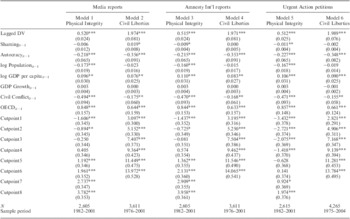
Models 1–6 shown in Table 1 include the measure of shaming and autocratic regime type, as well as controls. Models 1–2 assess the effect of media reporting, Models 3–4, AI reporting, and Models 5–6, UAs. Odd number models address physical integrity rights, while even number models address civil liberties. In each model, the coefficient on shaming is negative, indicating that efforts to name and shame by Western media and AI are associated with worse human rights outcomes, although this relationship is only statistically significant with respect to physical integrity rights. Autocracy is associated with worse human rights outcomes relative to full democracies and hybrid regimes. In each case, these findings are consistent with prominent studies in the field of human rights.Footnote 72 The same can be said of the control variables. The lagged dependent variable is highly significant: past human rights performance affects present performance. Wealthier countries, as proxied by GDP per capita and OECD membership, have better human rights performance, although lagged economic growth does not have a statistically significant effect. Larger countries tend to have worse physical integrity rights, although population size does not affect civil liberties. Countries experiencing civil conflicts have statistically significantly worse outcomes on both indicators.
Naming and Shaming and Changes in Respect for Human Rights, 1975–2004

Notes: Robust standard errors, clustered on countries, in parentheses. Period dummies not shown.
*p < 0.05, **p < 0.01, ***p < 0.001.
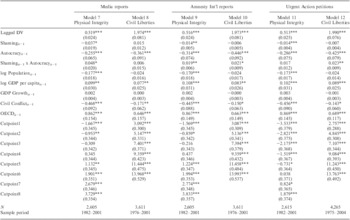
Models 7–12 shown in Table 2 add to these an interaction term for shaming and autocratic regime type. Again, the coefficients on the various measures of shaming and autocratic regime type are negative and statistically significant – always in the case of the Autocracy indicator and frequently in the case of the shaming variables. However, the coefficients on the interaction terms are positive, and statistically significant in the cases of media reporting and AI reporting and their effects on physical integrity, AI reporting and civil liberties, and in the case of UAs and their effect on civil liberties. In these cases, the three coefficients (Shamingit −1, Autocracyit −1, and Shamingit −1 x Autocracyit −1) are jointly statistically significant at p < 0.01. In all models where the interaction term is significant, the coefficient on the interaction (Shamingit −1 x Autocracyit −1) term is larger than the coefficient on the un-interacted term, indicating that the net effect of shaming in autocracies is positive: shaming is associated with better human rights outcomes in autocracies the following year, ceteris paribus.
Naming and Shaming and Changes in Respect for Human Rights, 1975–2004

Notes: Robust standard errors, clustered on countries, in parentheses. Period dummies not shown.
*p < 0.05, **p < 0.01, ***p < 0.001.
Because the marginal effects of estimated probit coefficients are contingent on the values of other independent variables in the model, we use CLARIFY in order to simulate quantities of interest.Footnote 73 Holding the value of the other independent variables at their means or medians (in the case of dichotomous variables), the baseline probability of a country scoring 0 on the physical integrity rights scale, conditional on having scored a 0 the previous year, is 0.22 in non-autocracies and 0.30 in autocracies. Moving from zero media reporting to five stories in the previous year increases the probability of a non-autocracy scoring 0 to 0.28 (an increase of 27 per cent) but decreases that probability to 0.28 in autocracies (a decrease of 6 per cent).
Another way of demonstrating substantive significance is to look at the effects of changes for a particular country. In 1999, the Republic of Congo, a relatively ‘hard’ autocracy (Polity2 = −8), was embroiled in a civil war that claimed over 10,000 lives and characterized by mass human rights abuses (physical integrity rights = 0), yet received relatively little Western press coverage (one story), which would predict a 0.5 probability of scoring 0 on physical integrity rights in the following year. Had the Republic of Congo received the same type of Western media coverage as Colombia received one year later, that probability would have decreased to 0.42, or 15 per cent. The probability of the Republic of Congo scoring a 3 or 4 (on par with present day Turkey or Argentina) would have increased by 33 per cent and 50 per cent, respectively.
For AI reporting, the finding is similar: the net effect of shaming on physical integrity rights is negative in non-autocracies, but positive in autocracies. The marginal effect is slightly smaller: moving from zero to five AI background reports and press releases in the previous year increases the probability of being in category zero by 14 per cent in non-autocracies but decreases the probability by 3 per cent in autocracies. Moving from zero to fifteen AI background reports and press releases in the previous year changes these probabilities to 47 per cent and −9 per cent, respectively. AI reporting also has a similar impact on civil liberties, both in terms of statistical and substantive significance.
In the case of UAs, the interaction effect between shaming and autocracy is positive and significant with respect to civil liberties, but not with respect to physical integrity rights. Conditional on having been in category 1 (extreme repression) the previous year, moving from zero to five UAs in autocracies decreases the probability of being in category 1 by 3 per cent. The small marginal effect of UAs may be attributable in part to UAs being targeted at specific violations and individuals, while outcomes are measured at the aggregate, country level.Footnote 74
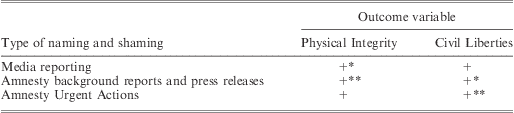
Table 3 summarizes the findings of our empirical analysis regarding the interaction between autocratic regime type and the various types of naming and shaming. The consistent picture is one of a small but positive effect of Western press and AI shaming on respect for human rights, both in terms of physical integrity and civil liberties, in autocratic countries, and either a null or negative effect in non-autocratic countries.
Naming and Shaming and Changes in Respect for Human Rights in Autocracies
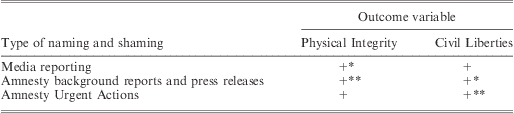
Notes: Positive and negative signs denote direction of coefficient on the interaction term between naming and shaming and autocracy. *p < 0.05, **p < 0.01.
Selecting on Type: What Kind of Autocracies?
One possible alternative explanation for our findings is that the Western press and INGOs, such as AI, engage in strategic selection of cases to name and shame based on how likely they are to succeed. If that were the case, these findings might simply indicate that the press and INGOs target autocracies that are more likely to have improving human rights records than the non-autocracies they target. Upon further analysis, however, we can reasonably reject the concern that selection effects drive our results.
The results presented here are ‘naïve’ in both the statistical and theoretical senses. Statistically, these models assume quasi-random assignment of the ‘treatment’: that INGO efforts to shame are not a function of the other independent variables in the model, and that INGO targeting is not a function of target-country levels of democracy, economic development, and the incidence of civil conflict, or other unobserved factors. Theoretically, this assumption may be problematic, in the sense that both the media and AI are strategic – or at least intentional – in their decisions to target a country for shaming.Footnote 75 If the media and AI were choosing to shame autocratic countries in which respect for human rights were likely to improve and non-autocracies in which respect for human rights were likely to diminish, the outcome would be consistent with the results presented here. Put simply: are the media and AI selecting on success in autocracies and failure in democracies?
Theoretically, why would the media and AI select on success contingent on regime type? Both the media and AI are driven by imperatives – profit, in the case of media, donor involvement and membership politics, in the case of AI – that shape their choice to cover human rights violations in a given state. Others have demonstrated media bias against non-free press countries, with more repressive countries receiving more media attention.Footnote 76 By its own account, AI seeks to cover the gamut of rights protected in international instruments.Footnote 77 We would expect that the INGO would try to cover as many violations in as many countries as possible. Even the largest human rights organization in the world faces competition, and AI is aware of the information provided by media savvy alternatives such as Human Rights First and Human Rights Watch. Yet all of this would suggest that AI and the Western press would select on success irrespective of regime type.
Furthermore, we might expect that INGOs might pursue ‘least likely’ cases, such as campaigning against the death penalty in the United States, as a response to membership pressure in the case of AI, as a symbolic gesture of resistance to a practice other countries have largely abandoned, or in anticipation of a large return. Then, the INGO that can claim credit for achieving the unlikely, such as ending the death penalty in the United States, would enhance its status and credibility. The success that AI has with UAs and other advocacy in autocracies, therefore, is not an artefact of organizational selection on regime type per se, but instead demonstrates how domestic institutions shape state susceptibility to external INGO critiques.
Statistically, these issues are often dealt with using Heckman selection models or instrumental variables analysis. Neither is appropriate given the nature of the dependent variable (ordinal-categorical) and the paucity of quality instruments (exogenous variables that are correlated with the independent variable of interest (shaming) but not with the outcome variable (human rights)). Instead, we address the potential for selection effects two ways. The first is to present negative binomial models of media and AI shaming as a function of the independent variables in the model. The second is to look at sub-samples, autocracies and non-autocracies, and investigate whether the human rights trajectories in the sub-samples are different for countries that were targeted and not targeted for shaming.
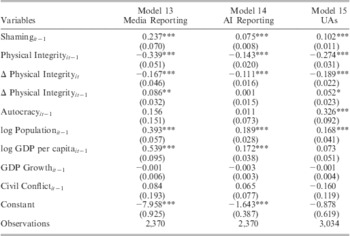
Table 4 presents the results of negative binomial count models of media reporting, AI reporting, and UAs. The models include the independent variables from the models in the previous section as well as two variables, the contemporaneous and one-year lagged first differences of physical integrity, that model the trajectory of human rights in a country that is targeted for shaming. If these values are positive, the country's human rights score improved; if negative, they got worse. If the media and AI were selecting on success, then prima facie evidence of this would be a positive correlation between changes in respect for human rights and reporting on that country. The coefficients on the contemporaneous first difference of physical integrity are uniformly negative and significant: countries with improving human rights scores get targeted less, ceteris paribus. The positive coefficient on the lagged first difference (in the case of media shaming and UAs) suggests that there may be a retrenchment effect: countries whose records were improving but then backslid appear to be targeted more often. Moreover, regime type only affects targeting in the case of UAs, with autocracies targeted somewhat more.
Targeting of News and AI Coverage, 1983–2005

Notes: Robust standard errors, clustered on countries, in parentheses.
*p < 0.05, **p < 0.01, ***p < 0.001
What if, however, there are differences in the human rights trajectories of targeted countries and non-targeted countries within regime type? If this were the case, we would expect the lagged first difference to be different for autocracies that were targeted and autocracies that were not targeted. In the case of each measure of targeting, t-tests indicate that, if anything, autocracies that were targeted for shaming had worse human rights trajectories than autocracies that were not (mean Δ Physical Integrityit if targeted for UAs = −0.147, if not targeted, 0.057, difference is statistically significant at p < 0.05). The same holds true for non-autocracies. The results of these tests suggest that neither the Western press nor AI is selecting on success – to the contrary, they appear to be selecting against success by picking the toughest cases. This empirical evidence thus suggests that our findings, if anything, may understate the effect of INGO naming and shaming in autocracies.
Discussion and Conclusion
In this article we set out to address inconsistent findings regarding the effect of Western press scrutiny and INGOs’ advocacy on respect for human rights in target states. The analysis above demonstrates clearly that Western press and INGO naming and shaming does matter, and, in fact, can increase the probability that states will improve their respect for human rights. The effect of Western media and INGO shaming, however, is conditional. By considering the interactive effect of regime type with different types of naming and shaming techniques, we find that naming and shaming can affect states’ behaviour and, in fact, is associated with improvements in human rights conditions under autocratic regimes, but not hybrid or democratic regimes.
The marginal effects presented here are, in the main, not particularly large. The effects of controls, and of autocracy itself, are much larger than the effects of INGO shaming. In itself, such findings are not surprising – it is reasonable, as in the case of Colombia, that domestic factors are much more important for shaping human rights practices than international efforts. The relative influence of domestic factors, however, does not render international attempts at advocacy useless. International advocacy matters for encouraging adherence to international human rights norms, and can catalyse domestic action,Footnote 78 especially in those political systems where domestic checks on the regime are most lacking.
Our findings point to new directions for future research. First, further research into the interrelationships between AI reporting and Western media reporting is warranted. The estimated effects of AI background reporting and press releases on human rights abuses do not account for the indirect role they may play in setting the agenda: alerting Western media to particular abuses and prompting Western audiences to care about and demand coverage of human rights issues. At present, these data are not sufficiently temporally disaggregated to test for these relationships. Secondly, the influence of Western media reporting and INGO advocacy on human rights outcomes in targeted countries suggests that further attention needs to be paid to the factors, both domestic and international, that determine where Western reporters and human rights organizations devote their attention. In 2000, Brazil was targeted by the Western press for human rights reporting only once, while Chile, a country with a comparatively much better human rights record at the time, was targeted ten times. Examining these types of discrepancies would be useful. Thirdly, this analysis does not address variation in types of autocracies, other than to point out the differences between strongly autocratic and weakly autocratic, hybrid regimes. These findings indicate that autocracies respond differently to naming and shaming than non-autocracies, but they do not indicate whether naming and shaming may have different impacts in personal dictatorships or military regimes.
This article synthesizes disparate theoretical approaches to understanding the effects of INGOs on state behaviour. Our argument rests on a consideration of institutional constraints on government behaviour, and how those constraints interact with international pressures. Contrary to dominant explanations, then, the argument and evidence presented here are not about one-sided state socialization to human rights standards or the rational response of states to incentives to comply with human rights, but rather how political institutions and press and INGO behaviour interact to affect human rights outcomes.
By establishing that naming and shaming has a contingent effect on improving respect for human rights, we provide qualified yet clear evidence of the importance of press and INGO coverage of human rights abuses – not just from an informational perspective, but in terms of outcomes that have real effects for people's lives. The finding that autocracies are more susceptible to Western press and INGO criticism contributes to a literature that had either found or assumed that autocracies were less responsive to criticism in general on human rights grounds. Differences in regime type – and their corresponding institutions – are one reason why INGOs seem more effective in some circumstances than others. Recent research has focused on neighbourhood effects, foreign aid dependence and the presence or absence of domestic human rights organizations and diplomatic pressure by third party states and organizations as factors that mediate the relationship between naming and shaming and human rights outcomes.Footnote 79 Our contribution, in contrast, focuses on domestic political institutions and incentives in target states. While Western press and INGOs are not the only reason why states improve their human rights performance, we contribute to a growing body of literature that demonstrates the pen, whether wielded by reporters or global civil society, can encourage states to improve their respect for human rights.