Introduction
Uniformity is an important measure of performance when optimising feed and feeding programmes of a population of broilers, as it relates to the spread of meat yield in the processing plant (Madsen and Pedersen, Reference MADSEN and PEDERSEN2010). Poor uniformity reduces revenue and increases waste (Deming, Reference DEMING2000) so broiler producers need to take account of any factors that may influence this. The potential performance of a broiler flock depends largely on the inherent genotype of the population and the extent to which this varies between individuals (Emmans and Fisher, Reference EMMANS and FISHER1986). However, many factors conspire to constrain this potential performance resulting in a wider spread of body weights at harvest than would be the case if all birds grew at their potential (Gous and Berhe, Reference GOUS and BERHE2006).
The theory of feed intake proposed by Emmans (Reference EMMANS1981) suggests that a bird will attempt to consume sufficient amounts of a given feed to enable it to grow at its genetic potential, thus overconsuming energy if the feed is marginally deficient in an essential nutrient, such as an amino acid. It is apparent that strains of broilers and individuals within a strain overconsume energy to different extents when faced with a marginally deficient feed (Gous et al., Reference GOUS, EMMANS, BROADBENT and FISHER1990; Corzo et al., Reference CORZO, MCDANIEL, KIDD, MILLER, BOREN and FANCHER2004; Kemp et al., Reference KEMP, FISHER and KENNY2005; Berhe and Gous, Reference BERHE and GOUS2008). It is likely therefore that such feeds will reduce uniformity, as some birds will be capable of consuming more than others and the latter would benefit from the extra feed intake.
But it is not only the variation between individuals in their response to a given feed or environment that contributes to the response of a population of birds to a feeding programme in a given environment. Variation also exists in the environmental conditions to which the birds are subjected, as well as the composition of the feed used. Each of these sources of variation will be addressed in the following review, but emphasis will be placed on the genotype x environment interactions that result from the feeding of marginally deficient feeds.
Genetic variation
Individuals within a population of broilers vary in many respects, the most important in this context being their potential rates of body and feather protein growth (more specifically their rates of maturing, B), their mature body and feather protein weights (Pm) and their ability to deposit lipid when faced with a nutrient deficiency. Emmans and Fisher (Reference EMMANS and FISHER1986) have given estimates of the variation of these parameters within a population, coefficients of variation (CV) being 0.06-0.10 for Pm, 0.02 for the scaled rate parameter B* (=BPm0.27), and 0.04 for the rate of lipid deposition (LDR). Differences between males and females in these genetic parameters are considerably greater than the CV's given above, the mean Pm in females being between 0.7 and 0.8 of that of males, the rates of maturing of body and feather protein of females being 0.95-0.98 and 1.04-1.06 of the male values respectively. The lipid to protein ratio in females is between 1.6 and 2.0 times that of males (Hancock et al., Reference HANCOCK, BRADFORD, EMMANS and GOUS1995; Gous et al., Reference GOUS, PYM, MANNION and WU1996; Reference GOUS, MORAN, STILBORN, BRADFORD and EMMANS1999).
Most quantitative biological traits of commercial importance are described by a normal distribution curve, this being the basis on which genetic selection is made. However, the full expression of these traits is possible only if the environment (including, in this case, the feed offered) is not limiting. In practice the expression of genetic potential in the highest producers is often constrained, and the smallest birds are often culled, thereby limiting the range (Curnow and Torenbeek, Reference CURNOW and TORENBEEK1996) and changing the shape of the distribution. This might result in a distribution that is positively or negatively skewed depending on the constraints applied. The trait identified as having the greatest effect in altering the distribution of weights at harvesting was the rate of feathering (FR).
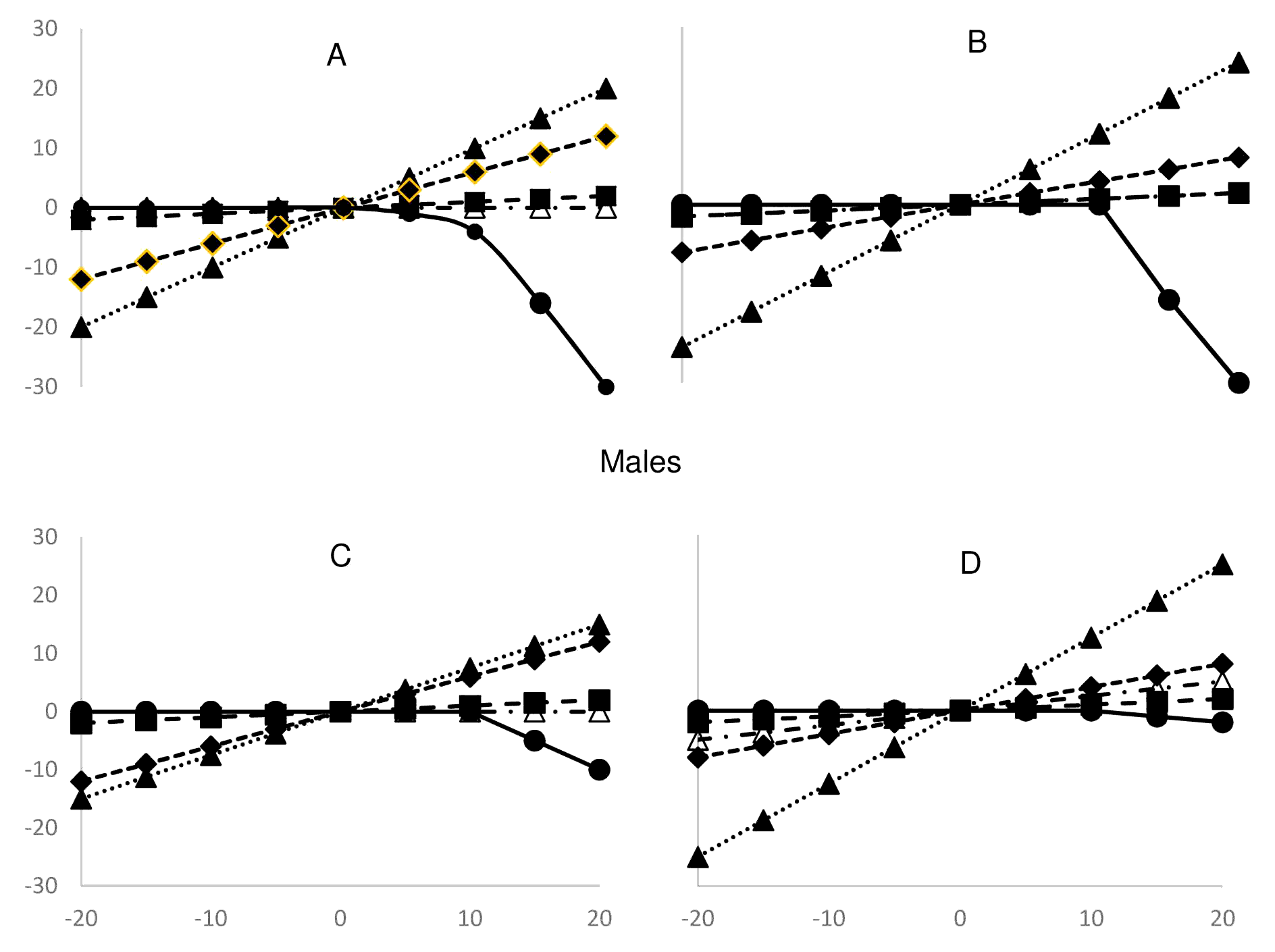
In a sensitivity analysis of the effects of variation in each of the above traits, as well as initial body weight (W0), on the performance of broilers, Gous and Berhe (Reference GOUS and BERHE2006) found that feed intake, and resulting body weight, increased almost linearly with B*, Pm and LDR. However, the effect of FR was non-linear; i.e. when a population of broilers was generated in which each of the above genetic parameters ranged from -2 to +2 SD's around the mean, the CV's for 35 d body weight and cumulative feed intake remained below 0.03 when B*, Pm and LDR were made stochastic, but increased to 0.20 and 0.22 respectively for FR. Lower rates of feathering caused feed intake to increase to keep birds warm, whilst higher rates resulted in an increased depression of feed intake and body growth, which was more pronounced in females than in males, and more severe among males fed a low lysine diet in the starter period. This genotype x environment interaction would therefore be a particularly important source of variation in fast-growing strains of broiler kept in hot conditions and fed poor quality feed (Gous and Berhe, Reference GOUS and BERHE2006) ( Figure 1 ).
The relative effect on simulated feed intake in male and female broilers fed a lysine-limiting feed containing 9 (A, C) or 16 g lysine/kg (B, D) from 7 to 21 d when the means of each of five genetic parameters were increased or decreased by 0.05, 0.1, 0.15 or 0.20 whilst holding the five remaining genetic parameters constant (B = ...▲...; FR = __●__; LPRm = - - -■- - -; Pm = - . -∆- . -; and Wo = ---♦--) (from Gous and Berhe, Reference GOUS and BERHE2006).

Variation in the environment within a broiler house
Controlling the physical microenvironment in a broiler house is an important element in optimising the production process (Reece and Lott, Reference REECE and LOTT1982; Mitchell, Reference MITCHELL1985; Parmar et al., Reference PARMAR, DIEHL, COLLINS and HULET1992; Aerts et al., Reference AERTS, BERCKMANS, SAEVELS, DECUYPERE and BUYSE2000). However, depending on the system used for such control, variation in the environment within a poultry building may be considerable, impacting significantly on the performance of broilers housed in different areas of the house. Many factors contribute to this variation such as unadjusted inlet openings, unsealed cracks, dirty fan shutters, loose curtains, the amount of time the fans run, the total length of the timer cycle and the position of thermo-sensors (Al Homidan et al., Reference AL HOMIDAN, ROBERTSON and PETCHEY1997; Reference AL HOMIDAN, ROBERTSON and PETCHEY1998). The behaviour of the broilers themselves will cause variations in temperature along the length of the house as a result of mass migrations and clustering in some areas (Wathes and Clark, Reference WATHES and CLARK1981) which will affect thermoregulation. Such variation in the environment is likely to be positively correlated with the variation in the weight of the end product of the production process, raising the question whether the optimum feeds or the feeding programme should be adjusted to take account of this variation.
The vertical temperature profile in a poultry house is affected by many factors, including heat controls, the flock and solar radiation, microbial fermentation in the litter, heat fluxes between poultry house air and the soil, walls and roofs due to temperature gradients, moisture loss from the litter and natural convection around broilers (Van Beek and Beeking, Reference VAN BEEK and BEEKING1995; Boshouwers et al., Reference BOSHOUWERS, DAVELAAR, LANDMAN, NICAISE and VAN DEN BOS1996). However, of greater importance in a tunnel-ventilated house is the variation that exists in the horizontal temperature profile at bird level. Winter and summer conditions alter this profile, with differences in temperature along the length of the house being considerably greater in winter than in summer. In winter, chicks often migrate towards the air inlets thereby increasing the stocking density in that area, and the temperature differential in the early stages of growth can be as high as 7-9°C (Xin et al., Reference XIN, BERRY, TABLER and BARTON1994) and remains at least 3.5°C cooler at the far end, with 7% higher relative humidity, by the end of the production cycle. In summer, because of the higher ventilation rates used, Xin et al. (Reference XIN, BERRY, TABLER and BARTON1994) found little difference in temperature at either end of the house. Many factors interact to influence this gradient, so it would be expected that the temperature and humidity gradient would differ markedly between houses and between seasons.
Poor air quality, due to environmental contaminants such as carbon monoxide, carbon dioxide, ammonia and dust, reduces performance, increases the potential for respiratory disease and may increase mortality (Weaver and Meijerhof, Reference WEAVER and MEIJERHOF1991). Conditions at the exhaust end of a tunnel-ventilated broiler house may be far more hostile than at the inlet end, especially in winter, resulting in variation in the performance of the flock (Miragliotta et al., Reference MIRAGLIOTTA, NÄÄS, MANZIONE and DO NASCIMENTO2006; Miles et al., Reference MILES, ROWE and OWENS2008).
Because of the range of body weights and potential growth rates in a broiler house at any one time there may be some advantage in providing a range of temperatures in the house so that the fastest growers can move to a cooler area where their potential is more likely to be achieved. However, at high stocking rates it may be impossible for the necessary migration of birds to take place.
The effects of variation in temperature, humidity and air quality in the broiler house on the range of body weights present in the house at the end of the production cycle cannot be estimated empirically because of the expected interactions between these environmental factors and potential body protein growth rate, feathering rate and the chemical and physical composition of the feed, all of which are expected to vary also.
Variation in the nutrient content of the feed
Variation in the nutrient content of feeds for broilers in a commercial operation is due mainly to three sources: variation in ingredient composition, mixer inefficiency (including weighing errors), and separation after mixing and during transportation (Çiftci and Ercan, Reference ÇIFTCI and ERCAN2003).
Sources of variation in the physical and chemical characteristics of grains used in poultry feeds include variety, seasonal effects, growth sites (Metayer et al., Reference METAYER, GROSJEAN and CASTING1993), crop treatment and grain fumigants, post-harvest storage conditions and period of storage and processing (Dale, Reference DALE1996; Hughes and Choct, Reference HUGHES and CHOCT1999), rainfall and environmental temperature patterns during the period of grain maturation, genetic effects, level of fertiliser usage (Metayer et al., Reference METAYER, GROSJEAN and CASTING1993; Hughes and Choct, Reference HUGHES and CHOCT1999) and inclusion rate (Senkoylu and Dale, Reference SENKOYLU and DALE1999). It has been suggested (Nott and Combs, Reference NOTT and COMBS1967) that this type of variation should be dealt with in the formulation process by including a margin of safety but the mathematical result is that the linear programme over-formulates nutrients. As a consequence, feeds have wasted nutrients and become more costly. A more statistically and economically sound approach is through linear stochastic programming (Roush et al., Reference ROUSH, CRAVENER and ZHANG1996). The consequences resulting from the physical and chemical variation in feedstuffs and through mixer inefficiency must be seen to differ from the variation brought about through particle separation, which is intuitively less random than the first two types of variation.
Performance is adversely affected when variation in nutrient content in feeds is increased (Duncan, Reference DUNCAN1989; McCoy et al., Reference MCCOY, BEHNKE, HANCOCK and MCELLHINEY1994). Some of the more sophisticated feed formulation programmes used in the feed industry, which attempt to account for variation in nutrient content in the ingredients used in the feed, generally favour the use of ingredients that exhibit the least amount of variation, thereby potentially reducing the variation in performance of the broilers being fed such feeds. However, whereas natural variation in the composition of a feed has zero cost, a considerable cost is incurred when attempting to reduce variation, as these non-linear programmes demonstrate (Roush et al., Reference ROUSH, PURSWELL and BRANTON2007), so there is an economic limit to the extent to which a reduction in variation in nutrient content should be attempted.
Fawcett et al. (Reference FAWCETT, WEBSTER, THORNTON, ROAN and MORGAN1992) attempted to determine this limit by predicting the response of broilers, in margin/m2, to a range of dietary lysine and ME contents with the use of the ‘Poultry Growth Model’ of Emmans (Reference EMMANS1981), and then integrating the bivariate probability distribution for different degrees of variation in nutrient content over the response surface to determine the value of reducing the variance in the feed. This approach, although interesting, does not simulate the day-to-day variation in feed nutrient content to which broilers are subjected in practice. A more useful technique would be to predict the response of each bird in the population to random variations in feed quality on each day of the growing period, thereby obtaining a more realistic assessment of the effect of variation in feed quality. This would require a stochastic approach in defining the composition of the feed offered to the broilers as well as the broilers themselves.
Such an approach is a useful tool for determining the upper limit to the value of variance reduction, but does not address the issue of further systematic variation in nutrient content brought about by separation during road, rail, auger, blower or chain transportation. Such variation tends to separate the fine from the coarse particles, particularly when the feed is conveyed in a mash form, or when the quality of pellets is poor, resulting in a high proportion of fine particles. This problem does not appear to be addressed in the literature, so the variation introduced in this way is unknown, but could be considerable. This variation is likely to be systematic, in that separation would take place along the length of the feeder lines, with fines being left behind as the coarser particles move to the end of the line. If the fines consist predominantly of major and minor minerals and vitamins, bone development could be worse at the far end of a broiler house compared with the end at which the feed is introduced.
Feed form influences performance more than does particle size (Amerah et al., Reference AMERAH, RAVINDRAN, LENTLE and THOMAS2007). The effect of such nutrient separation could be modelled in the same way as are the systematic changes that take place in the environment within a broiler house, the birds along the length of the house being subjected to changes in temperature, humidity and air quality. But it is not only the chemical separation of the feed that takes place that influences performance along the length of a broiler house; the physical nature of the feed may also be affected.
Pelleted feeds are known to improve feed conversion efficiency when compared with mash (Leeson et al., Reference LEESON, CASTON, SUMMERS and LEE1999; Lemme et al., Reference LEMME, WIJTTEN, VAN WICHEN, PETRI and LANGHOUT2006; Lilly et al., Reference LILLY, GEHRING, BEAMAN, TURK, SPEROW and MORITZ2011). Jensen et al. (Reference JENSEN, MERRILL, REDDY and MCGINNIS1962) proved that this was due to the shorter period of time spent by the broilers consuming pellets, resulting in lower energy expenditure. The physical nature of the feed therefore has an effect on performance and, because some automatic feeding equipment used in broiler houses is abrasive, causing the pellets to break down, the amount of time spent eating, and hence the energy expended in eating, would be expected to differ between birds housed close to the feed hopper and those situated a long distance away.
Nutritional interventions
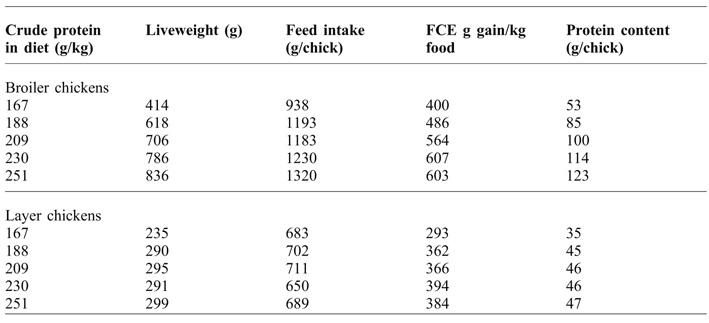
As the potential growth rate of broilers has been increased by genetic selection, so the daily amino acid and energy requirements of the bird become higher, but these do not increase in the same proportion. The requirement for amino acids increases proportionately faster than does the energy requirement, thus a higher amino acid to energy ratio is required in faster growing strains of broiler (Gous et al., Reference GOUS, EMMANS, BROADBENT and FISHER1990; Havenstein et al., Reference HAVENSTEIN, FERKET, SCHEIDELER and RIVES1994). Many nutritionists believe, incorrectly, that broilers will simply increase their intake of an inadequate feed in order to obtain sufficient of the limiting nutrients. Whereas broilers may attempt to do so, it is seldom that they achieve the intake required to enable them to grow at their potential. This is well illustrated by the results of an experiment by Morris and Njuru (Reference MORRIS and NJURU1990) who fed diets of increasing protein content to broilers and to laying-type cockerels. The maximum gain in weight and in protein content in the laying-type chickens was achieved on diets with considerably lower protein contents (188 g/kg) than was needed to maximise the gain in the broilers (251 g/kg) ( Table 1 ). Even on marginally deficient protein levels the broilers were unable to consume sufficient to grow at their potential. The inability to consume sufficient intakes of a marginally deficient feed would be more pronounced with the broiler genotypes available at present, these having been subjected to a further 25 years of selection for feed efficiency since the above publication, which would have further reduced the ability of broilers to attain slaughter weight (Pym and Solvyns, Reference PYM and SOLVYNS1979).
Liveweight, feed intake, feed conversion efficiency (FCE) and protein content of broiler and layer-type chickens at 21 d of age (after Morris and Njuru, Reference MORRIS and NJURU1990).

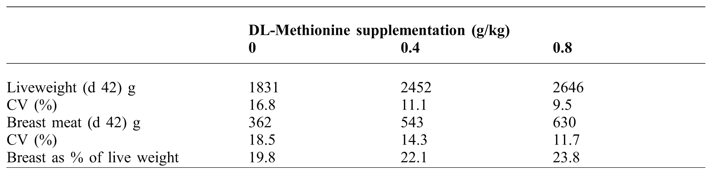
There is strong evidence that uniformity is increased by feeding higher levels of a limiting amino acid or protein (Duncan, Reference DUNCAN1988; Lemme, 2003; Berhe and Gous, Reference BERHE and GOUS2008). This is illustrated by the data in Table 2 where the coefficient of variation (CV %) in liveweight at 42 d was reduced by 40% and breast meat yield by 47% through the supplementation of DL Methionine to a basal feed (Lemme, 2003).
Supplemental vitamins have been reported to improve uniformity in a broiler flock. McNaughton (Reference MCNAUGHTON1995) reported continuing economic responses in several characteristics up to the highest level of vitamins tested. There was little convincing evidence in his trial that the response to vitamin level depended on the level of stress applied, as performance improved with increasing vitamin doses even when no stress was applied.
The effect of graded levels of DL-Methionine on liveweight and breast meat yield in broilers (1-42 d) (after Lemme, 2003).

The reason for the improved uniformity was that the requirements of a greater proportion of the population were met as the concentration of the limiting feed resource was increased. Fisher et al. (Reference FISHER, MORRIS and JENNINGS1973) showed that the response of an individual (laying hen) to an increasing supply of an amino acid differed markedly from that of the population from which the individual was drawn. Whereas the response of each hen can be assumed to be linear, up to a point where output plateaus (the genetic potential), the population response is a continuous, asymptotic curve with no abrupt threshold. This population response curve, the mean response of a group of individuals at a time, is the result of the variation that exists in both body weight (maintenance requirement) and the potential egg output of the population. The same principle applies with broilers where the most demanding birds will respond to higher concentrations of amino acids whereas those with a lower potential will have their requirements met at a lower protein concentration. This so-called Reading Model (Fisher et al., Reference FISHER, MORRIS and JENNINGS1973) was first used to determine the optimum economic intake of the limiting amino acid for a flock of hens. The increased egg output of those birds with above-average requirements for maintenance and above-average maximum potential egg outputs justifies the cost of increasing the amino acid intake by all birds. This model has subsequently been applied successfully to growing broilers (Freeman, Reference FREEMAN1979; Clark et al., Reference CLARK, GOUS and MORRIS1982).
In a population of growing broilers, as with laying hens, at any point in time, body weights and potential outputs (growth rates) will be normally distributed about a mean value, but in addition to this, because each bird is growing and feed intake is increasing, variation in growth rate within each animal over time needs to be considered (Gous and Morris, Reference GOUS and MORRIS1985). This is not as critical in the case of laying hens, as these birds are in a relatively steady state over time. To account for these interactions a mechanistic model that accurately simulates feed intake and growth of an individual broiler over time is necessary.
Such a model, based on the theory of feed intake and growth of Emmans (Reference EMMANS1987) has been developed (EFG Software, 2015). This simulates the growth of a single bird, taking account of genetic parameters, diet composition and feeding programme, environment, stocking density and other factors that may affect the outcome of production decisions in practice. The model works by calculating the desired amount of a given feed the bird needs to consume each day to grow at its potential, and will predict the consequences in feed intake, growth and carcass composition if this intake is constrained by feed bulk or an environment that is too hot to allow the bird to lose sufficient heat to that environment.
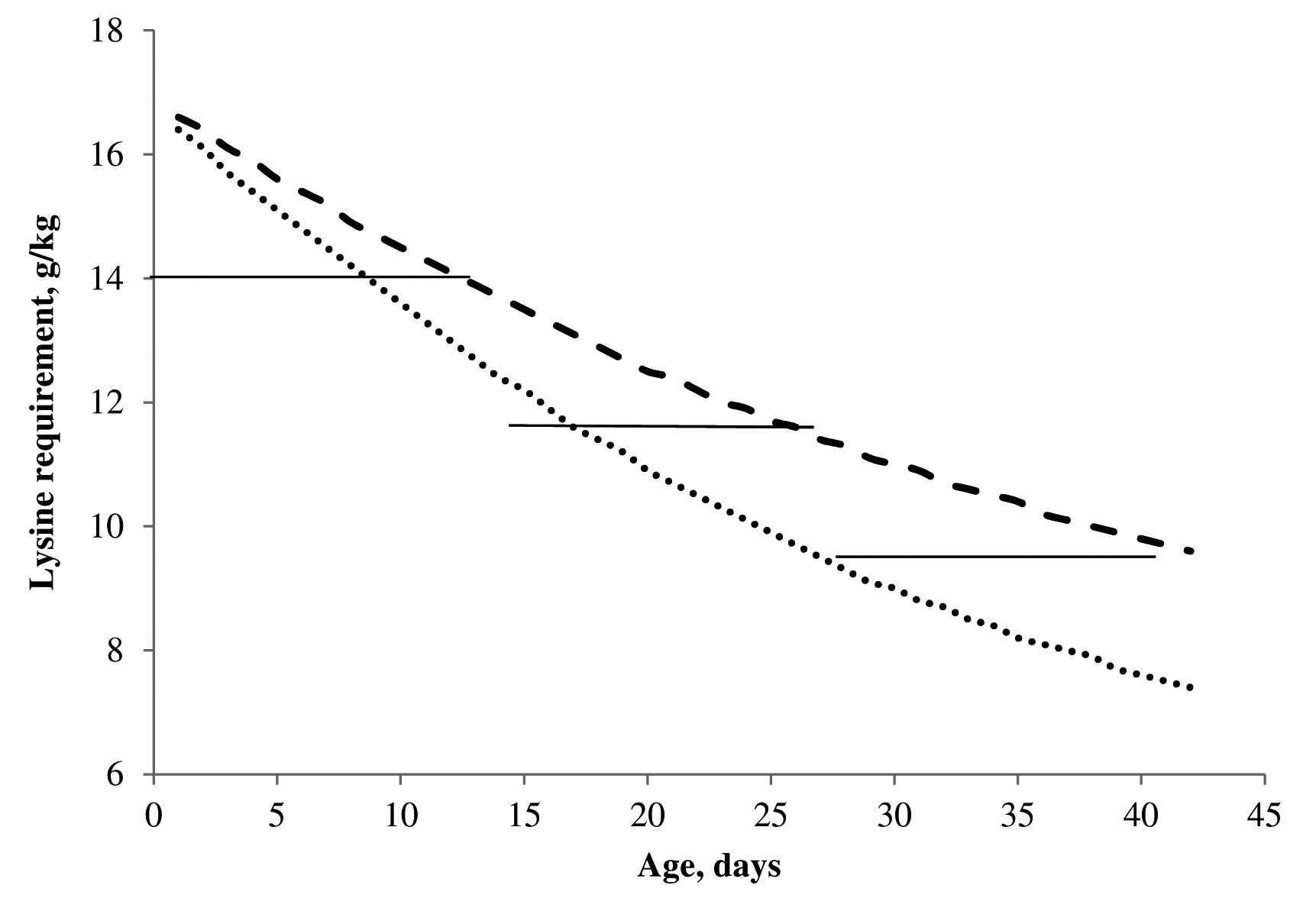
As mentioned above, male and female broilers have different growth characteristics which will impact on the way in which they should be fed and housed during growth. Because males have the potential to grow faster, and to a larger size, than females their amino acid requirements for potential growth would be expected to be higher. When their lysine requirements for maintenance and potential body and feather protein growth are calculated and converted to a feed concentration, these are similar for males and females at day-old, but as the growing period progresses male broilers require considerably more lysine than females, with this difference increasing throughout the growing period ( Figure 2 ).
Feed content of lysine (g/kg) required to enable male (dashed line) and female (dotted line) broilers to grow at their potential at a feed energy content of 13 MJ ME/kg, simulated using the EFG broiler growth model (EFG Software, 2015). Horizontal lines illustrate the lysine contents of three feeds used as an example of a feeding programme.

It is clear from Figure 2 that by growing males and females on the same feed the formulation used would be a compromise between that required by each sex. Feeding a fixed protein content during each of the phases of growth is likely to result in male broilers being under-fed amino acids for longer periods than females. Birds are capable of partially overcoming the effect of being underfed protein, and to do so they need to be capable of overconsuming energy, and would need to be housed in cool conditions (Emmans, Reference EMMANS1987).
Birds with a low propensity to fatten, such as turkeys (Bacon et al., Reference BACON, NESTOR and RENNER1986) and modern broilers (Zuidhof et al., Reference ZUIDHOF, SCHNEIDER, CARNEY, KORVER and ROBINSON2014), would be disadvantaged when presented with a feed marginally limiting in protein as they would be unable to store the excess energy as body lipid, with the resultant feed intake being lower than desired, and weight gain being below potential. Modern broiler strains are becoming leaner through selection (Gous et al., Reference GOUS, EMMANS, BROADBENT and FISHER1990; Zuidhof et al., Reference ZUIDHOF, SCHNEIDER, CARNEY, KORVER and ROBINSON2014) so they are becoming less capable of overcoming marginal dietary deficiencies than genotypes of the past, and this would explain why uniformity is increased when higher protein and vitamin levels are included in the feed.
The ability to lose heat to the environment is another factor influencing the ability of birds to overcome nutrient deficiencies. For a broiler to be able to grow at its potential it needs to be able to lose the heat that is produced in growing at that rate, including the heat generated by maintaining itself, for growth and in digesting feed (Emmans, Reference EMMANS1987). Clearly, the density of feather cover will play a major role in determining the extent to which heat can be lost to the environment. Feather growth differs markedly between genotypes and sexes, especially in feather-sexable strains and this variation will impact severely on feed intake and hence body weight at harvesting, especially on marginally to severely deficient feeds.
Initial (day-old) body weight has an impact on final body weight, the response being almost linear, as illustrated in Figure 1 . In a simulation exercise using the EFG broiler growth model (EFG Software, 2015), for initial body weights varying from 35 to 60 g, the simulated 42-d body weights ranged from 3099 to 3373 g, a range of 274 g. This is without taking account of social stresses and difficulties experienced by smaller chicks in reaching the feeders and drinkers, which would have the effect of further increasing variation in final weight. Although Neto et al. (Reference NETO, SUREK, DA ROCHA, DAHLE and MAIORKA2013) found no improvement in uniformity at 42 d when grouping day-old chicks according to weight and rearing them in these groups, Singh and Nagra (Reference SINGH and NAGRA2011) reported that the largest chicks at day-old retained this advantage by 35 d in both male and female broilers. If possible, broiler producers should reduce the range of day-old chick weights by obtaining chicks from the same donor flock if the objective is to improve uniformity in the end-product.
Future research
There are two specific areas of investigation worth pursuing if conventional commercial broiler rearing practices are to be updated to ensure more uniform outputs. These relate to management issues arising from separate sex rearing and precision feeding. Deaton et al. (Reference DEATON, REECE, KUBENA and MAY1973) could find no advantage in rearing sexes separately, whereas Da Costa et al. (Reference DA COSTA, COLSON, FROST, HALLEY and PESTI2017a; Reference DA COSTA, COLSON, FROST, HALLEY and PESTI2017b) using modern broiler strains, recorded substantial gains especially among female broilers when the sexes were reared separately. The advantages were, as expected, better uniformity, faster growth among the females, and greater income, the amount being dependent on the market targeted and feed and meat price scenarios. Sex separation was shown to be especially important where feed prices were high. Gains from sex separation were markedly higher for the Ross 708 than for the Ross 308 broilers. These observations demonstrate the need to consider all aspects of the production process, the genotype, the environment and the economic circumstances, when determining the optimum feeding and management strategy to use. Both Deaton et al. (Reference DEATON, REECE, KUBENA and MAY1973) and Da Costa et al. (Reference DA COSTA, COLSON, FROST, HALLEY and PESTI2017a; Reference DA COSTA, COLSON, FROST, HALLEY and PESTI2017b) used the same feed for both sexes thereby failing to reap the full benefit of the practise.
The cost of separating the sexes at day-old can be off-set by the added income derived from separate sex rearing. Less expensive methods of sexing, requiring less time spent per chick, are worth investigating as this will encourage broiler producers to make use of this practise.
The added advantages of separate sex rearing, besides being in greater control of uniformity, of being able to feed each sex according to its optimum economic requirements and to provide an optimal environment for each sex, are largely negated when the two sexes are separated within the same broiler house. This practise is sometimes used, with the females being harvested first and the males then moving into the vacated space thereby reducing the constraining effect of stocking density on growth. To maximise the advantages of separate sex rearing each sex should be reared in a separate house, and, in large operations, on separate sites. Different methods of providing the extra floor space required by male broilers would be worth investigating.
Where it is infeasible to separate the sexes during rearing, there are two methods that could be investigated of providing separately the required nutrients to males and females, thereby tackling the issue of the two sexes requiring different nutrient contents for optimum economic performance. These methods involve precision feeding and choice feeding. Precision feeding has been used effectively to provide growing pigs (Pomar et al., Reference POMAR, HAUSCHILD, ZHANGI, POMAR and LOVATTO2009) and broiler breeders (Zuidhof et al., Reference ZUIDHOF, FEDORAK, OUELLETTE and WENGER2017) with tailored diets on an individual basis, and this technique might in the future become available to the broiler industry for the same purpose. Considerably more research is required before this will become commercially viable as there would be a need for large numbers of feeding devices to be positioned throughout each house and these would need to distinguish between males and females before dispensing the correct blend of feeds.
Choice feeding has a greater chance of being implemented successfully in a commercial broiler house. Different versions of choice feeding have been researched and implemented in practice, including feeding whole grain (wheat, barley, cracked maize or sorghum) and a balancer (Cumming, Reference CUMMING1994; Bennett et al., Reference BENNETT, CLASSEN and RIDDELL1995; Rose et al., Reference ROSE, FIELDEN, FOOTE and GARDIN1995; Bennett et al., Reference BENNETT, CLASSEN and RIDDELL2002) or simultaneously feeding a high and a low protein feed (Bradford and Gous, Reference BRADFORD and GOUS1991; Reference BRADFORD and GOUS1992). Where whole grain feeding has been attempted the grain has usually been dispensed in increasing proportions of the complete feed as the birds have grown, and the added advantage of this practice, apart from the ability of the two sexes to consume different proportions of the two components, is that the whole grain does not need to be ground and it encourages the gizzard to grow (Plavnik et al., Reference PLAVNIK, MACOVSKY and SKLAN2002) and this in turn improves the digestion of feed and the health of the gut (Hetland et al., Reference HETLAND, SVIHUS and KROGDAHL2003).
Where both sexes are reared together, the maximum advantage of separate sex feeding may be achieved with the use of a high- and a low-protein feed being presented in separate feeders adjacent to one another. These feeders would need to be narrower than those conventionally used, and the two feeds would need to be supplied via separate bulk tanks. The feeds could be iso-energetic and each contain the necessary trace elements and additives, this being an advantage over the feeding of wheat in place of the balancer. The additional capital outlay would be offset by the improved growth rates and feed efficiencies realised by more accurately meeting the protein requirements of the two sexes. It may be worth researching different types of feeding equipment and different combinations of feed protein levels under commercial conditions to determine whether the maximum benefit of separate sex feeding can be achieved in this way.
Conclusions
The spread of product yield in the processing plant is influenced by variation in genotype, environment and feed composition and form. Variation within a commercial genotype, when birds are reared at their potential, is small and cannot be reduced except by separating the sexes and providing a feed and an environment relevant to their differing potential growth rates. Poor nutrition and environmental conditions can considerably increase the spread of body weights and compositions within a flock of broilers thereby reducing revenue and increasing waste. Feeds marginally deficient in one or more essential nutrients will encourage birds to overconsume energy in an attempt to obtain sufficient of the limiting nutrient, and in so doing will increase carcass fatness. Differences between birds within a genotype in their ability to overconsume energy will result in a wider spread of body weights and fatness than if the birds were fed adequate amounts of the limiting nutrient(s). Feeding higher than conventional levels of balanced protein and vitamins, reducing the environmental temperature in the broiler house, minimising the range of day-old body weights, using good quality pellets, rearing sexes separately and/or making use of choice feeding will all result in a higher degree of uniformity within the flock.