Kylie and her mother had just landed from Madrid. Exhausted from the long-haul flight, they drove their rental car straight from the airport to the hospital, arriving in the same leggings and layers that they had put on forty-eight hours earlier.* Their clothing revealed the geography of Kylie's clinical trajectory: Kylie's proud Seahawks sweatshirt reflected her many months spent at Seattle Children's Hospital just after diagnosis, and her mother's cowboy boots divulged Kylie's time at St. Jude Hospital. Souvenirs from Los Angeles and Spain were packed in the six purple roller suitcases they wheeled into the hospital room with them; they had been on the move, away from home, for more than a year.
Kylie had been diagnosed with Stage IV osteosarcoma at age 6 — about 19 months prior to our (A.S.P.) first encounter. At the time of diagnosis, she had a primary large mass in her left distal femur and three lung metastases. Beyond the unwanted though expected port infections and pancytopenia, roadblocks dotted her clinical course: severe mucositis, multiple episodes of sepsis, repeated transfusions, renal insufficiency, and relapse. Just prior to our initial meeting, while at a complementary medicine center in Spain, she developed severe headaches localized to her left temple and a watery, red right eye. Her family and clinicians feared what MRI and PET-CT confirmed: Kylie's sarcoma had relapsed for a second time with a recurrent periorbital mass.
Kylie's mother made plans to rush back to the States for Kylie to restart chemotherapy immediately on a Phase I/II clinical trial. Energized on hour one of my night shift as a pediatrics intern at a midwestern tertiary care hospital, I entered Kylie's room expecting to move quickly through the usual processes of admission: history, physical exam, admission orders, medication reconciliation, and communication with the Pediatric Hematology Oncology team about chemotherapy plans.
When I got to medication reconciliation, the process came to a halt. As Kylie's mother unzipped the largest roller suitcase, she began pulling out bottle after bottle of medications labeled with names I did not recognize. The institute they had visited in Spain recommended a non-formulary probiotic, several vitamin combinations, and a handful of other herbal supplements. Beginning months before her trip to Europe, Kylie had been taking cannabis oil in an unregulated, nonpharmaceutical form to attempt to stave off the nausea that kept her from school, play, meals, and often even simple conversation.
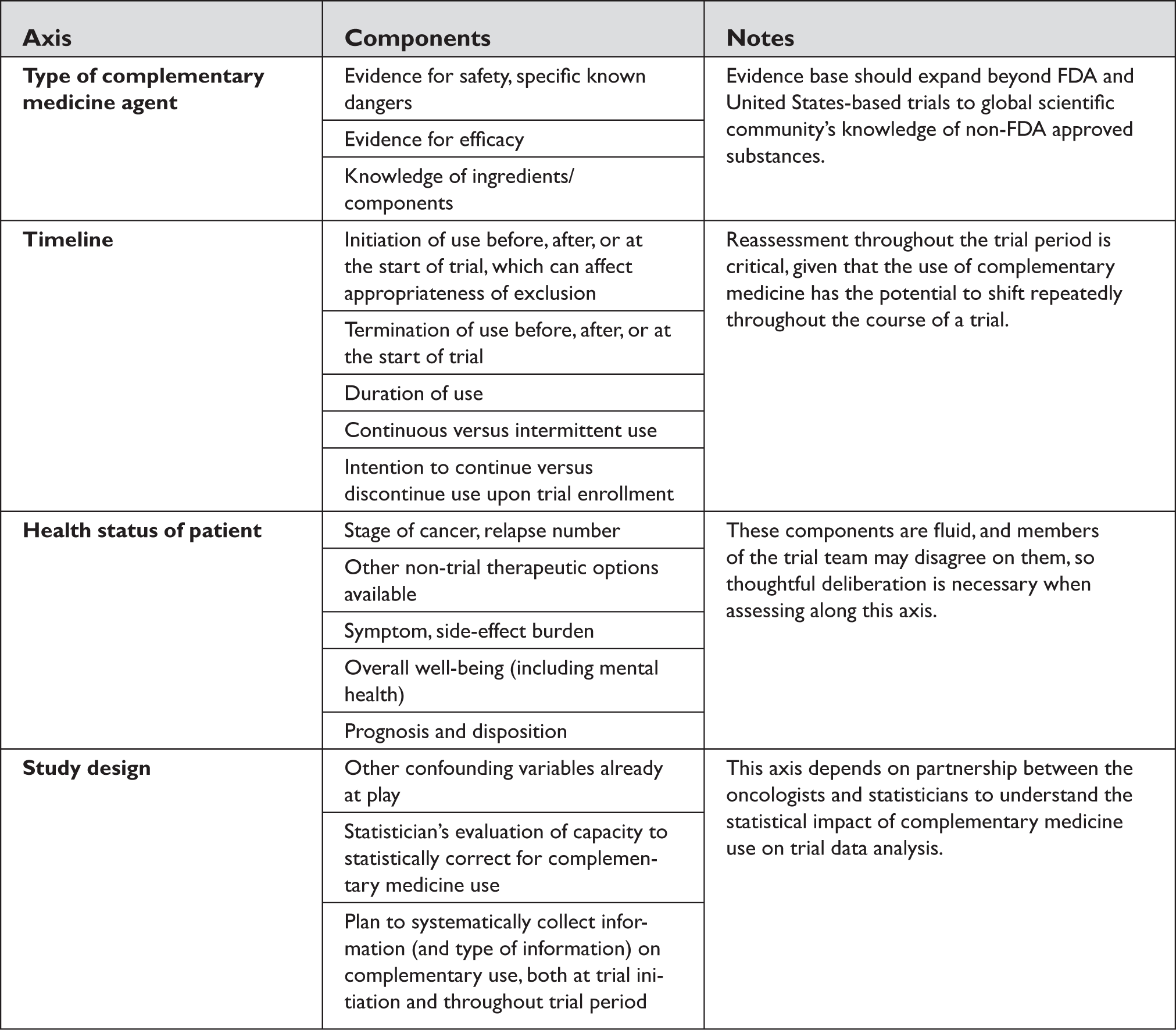
This paper will discuss the ethical challenges introduced when medication reconciliation for pediatric oncology patient-participants enrolled in clinical trials reveals the use of chemical complementary medicine — vitamins, herbs, supplements, cannabis — alongside protocol therapeutic agents. Considering the blurry delineation between clinical ethics and research ethics, particularly in pediatric cancer patients for whom first-, second-, and third-line regimens have not been effective, it will demonstrate how complementary medicine-related protocol violations introduce ethical questions of who should be included and excluded from clinical trials. Finally, it will provide ethically based recommendations in Table 1 on how to manage decision-making regarding inclusion and exclusion from pediatric oncology clinical trials.
Axes for assessment of inclusion or exclusion from pediatric oncology clinical trials.

For childhood cancer patients, the process of medication reconciliation frequently reveals substances being administered by parents that are not approved by the FDA, including vitamins, herbal supplements, homeopathic agents, probiotics, and cannabis. Patients and parents choose to use complementary medicine not only for symptom and side-effect relief — including pain, nausea, pruritis, fatigue, and anxiety — but also with the hope that the patient's overall health status will improve or the medications may even help cure the malignancy.
Off-Protocol Revelations through Medication Reconciliation
Over the next few hours, while simultaneously admitting four additional patients, I worked with Kylie's mother and the hospital pediatric pharmacy team to figure out how to reconcile her home medications with the medications she would receive while in the hospital for re-initiation of salvage chemotherapy, which is often undertaken in the hope of improving the length or quality of life rather than cure. We considered substituting the unlabeled probiotic from Spain with the Culturelle™, the only probiotic on our formulary, but Kylie's family was not comfortable risking foregoing the promised anti-neoplastic benefits of the as-yet untested Spanish supplement. Similarly, the hospital pharmacy team offered our usual armamentarium of anti-emetics — ondansetron, prochlorperazine, promethazine, metoclopramide, and diphenhydramine — but Kylie had tried them all, and none worked as well as the cannabis oil that her mother carried with them from Europe.
This experience with Kylie and her mother was not unique. Medication reconciliation is a required step for any hospital admission. United States quality-of-care standards delineate that medication reconciliation is a key indicator of quality clinical care and a fundamental responsibility of physicians — not only for oncology but for all inpatient clinical care.Reference Rose, Fischer and Paasche-Orlow1 The process is intended to ensure that necessary medications are administered and that inappropriate (both unnecessary and potentially harmful) medications are eliminated. Rose and colleagues note that medication reconciliation has the potential to improve patient outcomes by preventing inpatient and outpatient medication errors, mitigate problematic polypharmacy, and in doing both, prevent readmission.2 Hospitals measure what percentage of admitted patients have their home medications reviewed and reconciled with inpatient medication orders, aiming to ensure that every patient admitted has his or her medications undergo such review. In fact, since 2005, the Joint Commission prioritized medication reconciliation as a National Patient Safety Goal, given the extent to which it has a positive impact on patient outcomes.Reference Greenwald, Halasylamani, Greene, LaCivita, Stucky, Benjamin, Reid, Griffin, Vaida and Williams3
Clinicians have repeatedly encountered the challenges presented by the required medication reconciliation process.4 For childhood cancer patients, the process of medication reconciliation frequently reveals substances being administered by parents that are not approved by the FDA, including vitamins, herbal supplements, homeopathic agents, probiotics, and cannabis. Patients and parents choose to use complementary medicine not only for symptom and side-effect relief — including pain, nausea, pruritis, fatigue, and anxiety — but also with the hope that the patient's overall health status will improve or the medications may even help cure the malignancy.Reference Bishop, Prescott, Chan, Saville, von Elm and Lewith5
The Growing use of Complementary Medicine in Pediatric Oncology
Complementary medicine use is common among pediatric cancer patients. In a recent retrospective study of 133 pediatric oncology patients at a tertiary care academic children's hospital in Bern, Switzerland, between 2002 and 2011, over half of parents surveyed had given their children complementary medicine with the goal of improving patients' overall condition.6 A systemic review by Bishop and colleagues analyzed twenty-eight survey-based studies carried out between 1975 and 2005, including data from 3526 pediatric cancer patients. The study revealed complementary medicine use rates between six percent and ninety-one percent, with herbal remedies being the most frequent form of complementary medicine.7 Diorio and colleagues highlight not only the overall dearth of research on complementary medicine in pediatric oncology (despite its frequent use), but also the fact that most of the research on the topic evaluates the safety and efficacy of substances for symptom control rather than for cure.8 Their systematic review of literature, focusing on the use of complementary medicine agents specifically with curative intent, deemed nearly all the studies they found to be of low quality. They analyzed twenty-two studies, three of which were RCTs and the majority of which were case studies. They called for a paradigm shift in which the complementary medicine and pediatric oncology communities work together to do “N of 1 studies” — the only feasible type, given the very small number of eligible participants — in order to evaluate safety, toxicity, and efficacy for both supportive care and cure.
Pediatric cancer research has examined complementary medicine to some extent, given its inevitable intersections with mainstream biomedical cancer treatments. Research to date examines the safety, efficacy, and outcomes of individual complementary medicines; determines safe and effective dosing recommendations for various substances; elucidates mechanisms of action of specific substances; and highlights possible interactions with mainstream biomedical therapies.Reference Cantrell and Ruble9 Despite this growing body of research, limited data prevents clear understanding of the effects of various complementary medicine agents and thereby makes complementary medicine use an uncontrolled variable in clinical trials. Importantly, the pediatric oncology scientific community has not focused on communicating to the public the scientific rationale and/or evidence for and against various complementary medicines. Amassing more data, even through such limited studies with limited generaliz-ability, could enhance the delivery of evidence-based care to many patients and research subjects. Nonetheless the research community must balance the need for more information with the need for stewardship of limited resources, aiming to maximize knowledge gleaned for dollars invested. The lack of generalizability of individual case studies implies that studies that are more rigorous in their statistical design should be preferentially funded.
Increased Complementary Medicine Use Among Patient-Participants on Salvage Regimens
As regimens fail and children embark on salvage chemotherapy regimens, families become more desperate to find something that might curb tumor growth and ameliorate burdensome symptoms. Accordingly, the frequency of complementary medicine use increases with failure of initial treatment regimens, so that the same patient-participants who are enrolled in early clinical trials — Phase I and II — are those most likely to use complementary medicine. A study of fifty-four pediatric cancer patients for whom first-line treatment was not effective showed that eighty-two percent were using complementary medicine, half of whom had either initiated or increased use following first-line therapy failure.10
In contemplating such decisions by parents to integrate complementary medicine into pediatric cancer therapeutic regimens, it is important to consider the tragic context that parents face as they try to care for their children. Hinds and colleagues used qualitative methods to explore what it means to be a “good parent” while making major medical decisions for a very sick child, specifically deciding on enrollment in a Phase I clinical trial, electing DNR status, and initiating comfort care (continued symptom control with no further treatment with curative intent). This qualitative work illuminates the complexity of determining what counts as protection and care for extremely sick children, a powerful reminder to clinicians to maintain empathy for parents making these extremely difficult decisions for their children. Hinds and colleagues remind us of the importance of supporting parents as their children near death.Reference Hinds, Oakes, Hicks, Powell, Srivastava, Spunt, Harper, Baker, West and Furman11
Sometime between Seattle Children's and St. Jude, Kylie's mother joined a Facebook support group for parents of children with osteosarcoma. Informal, middle-of-the-night, virtual conversations helped her get through the most difficult hospitalizations. They provided camaraderie, helped formulate questions for clinicians, conveyed news of research and clinical trials, and suggested alternative and complementary treatments. At first, she used the support group to access virtual shoulders to cry on while alone in hospital rooms late at night, but over time, she began to find out more about what other families were trying for their children with osteosarcoma, to which oncology centers they were going, and which medications were working for them. One rainy Sunday afternoon, she heard about the pediatric oncology team in Spain that was using a variety of supplements, with report of improvement in overall well-being and possibly some decrease in tumor burden. That initial conversation, traversing geography with virtual connectivity, led to Kylie's eventual evaluation and treatment at the Spanish institute. Social media conversations like these are common and increase with parental desperation as traditional regimes fail to help patients. Such technology-mediated engagement drives use of complementary medicine as parents attempt to care for their children, whose refractory malignancies make them ever harder to protect.
We are at a critical historical moment in which both novel biomedical therapies under clinical trials abound and information on complementary therapies is being exchanged virtually at lightning speed. Patients and their parents digest this information as they try to manage symptoms and side effects, strive for cure, and serve as responsible patients and “good parents.” The dynamics of this technology-infused moment demand an ethical analysis of how to respond to the recognition of off-protocol complementary therapies in pediatric patient-participants enrolled in oncology clinical trials.
Protocol Violations and the Ethics of Trial Exclusion
Some clinicians argue that complementary treatments are dangerous and thus strongly advise against them in order to prevent physiologic complications and financial hardship.Reference Cheng, Chiang and Kuo12 Of course, there is a wide spectrum of possibility for adverse effects of complementary medicines. While multivitamins pose limited risk, a supplement such as St. John's Wort is known to enhance the metabolism of chemotherapeutic drugs, potentially causing significant complications. Kemper and Cohen propose a model for deciding whether to recommend that a pediatric patient use a complementary medicine, which they call “A common-sense guide to CAM treatment recommendations.” They lay out two axes — “Is the therapy effective?” and “Is the therapy safe?” If the complementary medicine is both effective and safe, they argue that it should be recommended. If it is safe but not effective, it should be tolerated. If it is effective but not safe, it should either be discouraged or allowed with close monitoring. If it is neither effective nor safe, it should be discouraged.Reference Kemper and Cohen13
There are many ethical uncertainties surrounding the safety and efficacy of complementary medicine use as pediatric cancer patients approach the end of life. Our focus is on the ethical questions that arise when pediatric oncology clinical trial participants in particular use such complementary medicines. Informal, off-record integration of unregulated substances into treatment regimens by patients and parents introduces unanticipated variability into pediatric oncology trials and thereby raises questions about the quality of knowledge produced through such research. Consequently, the fundamental challenge is determining how to respond to protocol violations that are revealed through medication reconciliation. The practical ethical question at stake is defining the terms of exclusion and inclusion in research. If complementary medicine use is discovered in the course of research, should it be considered a protocol violation? Should patients who are receiving off-protocol complementary therapies be excluded from studies?
A core question is to what extent do ad hoc, off-protocol complementary medicine additions invalidate study data, making it unreliable and not generalizable. Ethicists and statisticians need to collaborate with pediatric oncology trialists to devise an approach that can correct for the variation introduced by off-protocol complementary medicine use by patient-participants. Furthermore, the informed consent process for pediatric oncology trials, especially for children with advanced cancer, must include good education on the effects of off-protocol complementary medicine use on study data. It should also indicate the ramifications for inclusion and exclusion from the study if complementary medicine is used at the time of enrollment or initiated mid-trial. Ongoing bidirectional communication between the study team and families of patient-participants enrolled in the study is critical to ensure disclosure of complementary medicine use and responsible guidance on the consequences of such use for study inclusion and exclusion.
In considering whether to exclude study participants who use off-protocol complementary medicine, two values are at stake. The first value is the preservation of data quality and relatedly the integrity of knowledge produced through research. Starting with the assumption that the primary purpose of such research is to benefit future pediatric cancer patients (rather than the patient-participants who are currently enrolled in a study), research ethics must ask how the inclusion or exclusion of off-protocol complementary therapies — alternatively conceptualized as the acceptance of protocol violations — influences data quality and therefore calls into question the benefit of the knowledge produced. One reason to exclude participants using off-protocol complementary medicine would be to limit uncontrolled variables and confounding factors from clinical trials. This exclusion, however, would apply to a large percentage of patients eligible for pediatric oncology trials (particularly Phase I and II trials, whose participants have limited evidence-based treatment options remaining, so that patients and parents tend to be seeking any possibly efficacious treatments), so the N remaining after exclusion may be too low to yield statistically significant findings.14 It follows that eliminating participants with complementary medicine-related protocol violations from the study in an effort to preserve data quality could paradoxically weaken the statistical significance of the data produced. This would make the knowledge produced less valuable, undermining the value of the research itself.
The second value at stake in trying to determine whether to exclude research participants using complementary medicine outside of study protocol is the promotion of the welfare of the individual participant-patient. Welfare includes symptom and side-effect management, overall well-being (including mental health parameters such as anxiety and depression), morbidity, and mortality. Assuming that the purpose of clinical care is to benefit the individual patient receiving treatment, clinical ethics must ask how complementary medicine influences the welfare of the patient receiving care and treatment. If the complementary therapies being used by enrolled patient-participants improve any number of outcomes — symptom and side-effect control, overall well-being, morbidity, or mortality — then might it be unethical to exclude those enrolled patient-participants from trials in the name of research purity? Assessment of well-being would not be complete without considering the social and emotional health of the parents of patient-participants; supporting parents helps them find coping strategies while their child is still alive (so that they can maintain the capacity to parent despite tremendous adversity) and after their child has died.15 Pediatric Palliative Care is a crucial facet of such support for patients and family members, and a necessary element of any clinical care plan, whether or not the patient is enrolled in a clinical trial.Reference Peppercorn, Smith, Helft, Debono, Berry, Wollins, Hayes, Von Roenn and Schnipper16
Even as the two above-described values — the preservation of data quality and knowledge integrity produced through research and the promotion of patient-participant well-being (in all its dimensions) — seem distinct, careful analysis reveals their intersections. Trial-generated knowledge has the possibility to benefit not only future potential recipients of treatments but also individual patient-participants currently enrolled in a study, particularly when participant-patients with progressive malignancies have few treatment options remaining. Therefore, the data quality and integrity of knowledge produced through a clinical trial can affect the well-being of the individuals enrolled in the trial. Furthermore, IRBs are generally not permitted to approve pediatric research that confers risk unless the study offers the “prospect of direct benefit.”Reference Kodish17
The Unclear Line Between Clinical and Research Ethics
Historically, clinical and research ethics have been distinguished and even dichotomized.Reference Kass, Faden, Goodman, Pronovost, Tunis and Beauchamp18 Due to the complicated history of medical research in the United States and globally, research subjects receive special protections against the risk of harm. Institutional safeguards aim to ensure that clinical research is ethical, including requiring written protocols, Institutional Review Board (IRB) review, informed consent processes, and ongoing oversight. These safeguards are based on the idea that research is riskier than accepted clinical treatment.
Clinical ethics is an approach to clinical decision-making that identifies, analyzes, and resolves ethical uncertainties related to patient care.Reference Jonsen, Siegler and Winslade19 It uses ethical principles to elucidate the moral context in which clinician-patient interactions unfold. The goal is to benefit the individual patient. Research ethics, on the other hand, examines the study design, planning, execution, analysis, and reporting of clinical research. The goal is to generate generalizable clinical knowledge to promote the welfare of potential future patients. Emanuel and colleagues articulate seven requirements for a clinical trial to be ethical: 1) value — enhancements of health or knowledge must be derived from the research, 2) scientific validity, 3) fair subject section, 4) favorable risk-benefit ratio, 5) independent review, 6) informed consent, and 7) respect for enrolled subjects.Reference Emanuel, Wendler and Grady20
Despite these distinctive definitions, research and clinical care may be closely intertwined, challenging the dichotomy between clinical ethics and research ethics.Reference Lantos21 In practice, the experiences of patients and families like Kylie's make it clear that the two inevitably overlap. In high-stakes, salvage regimen-type trials, the distinction between clinical and research ethics becomes muddied. Many patients are enrolled in some form of clinical research, blurring the line between clinical care and research – and consequently between clinical ethics and research ethics. As first-, second-, and third-line regimens fail to help patients, patients enter a “more murky area of innovative therapies,”22 that sometimes falls under the purview of formalized clinical trials but other times simply involves off-label or slightly modified use of non-research medications. These patients' experience characterizes the sometimes nebulous distinction between clinical treatment and research.
A more nuanced ethical analysis integrates research and clinical ethics to evaluate complementary medicine-related protocol violations in pediatric cancer research from the perspectives of both the individual patient-participant and the population of current and future pediatric patients who have the potential to benefit from knowledge production through clinical trials.
The Choreography of Medication Reconciliation
When confronted with the question of whether to include or exclude patients who are using or have used complementary medicine from pediatric oncology trials, trialists must navigate the distinction between clinical ethics and research ethics. The aim should be to balance data quality, knowledge integrity, and patient-participant well-being, by assessing four axes, as shown in Table 1.
Though these four axes by no means provide a complete map for a balanced assessment of data quality, knowledge integrity, and patient-participant wellbeing, they offer a guide for initiating thoughtful consideration of complementary medicine use among trial patient-participants.
The clinical team (and specifically the clinical trial team) often discovers patients' use of complementary medicine through the process of medication reconciliation (in inpatient or outpatient settings) as in Kylie's case. Inevitably, if particular exclusion criteria relevant to complementary medicine use have been established for the clinical trial, a negotiation between clinical team and parent and/or patient-participant ensues, resulting in a decision about whether the patient should be included in the trial or how that patient can modify his/her regimen to qualify for the trial. The complexity of such negotiations stages a dance between family and trialists. This involves three steps: 1) the patient or parent revealing complementary medicine use; 2) the clinical trial team leading the parent or patient toward full disclosure of ingredients (when known), variation in use, or discontinuation of such complementary medicine use; and 3) the patient or parent then responding, either by following the clinical trial team's recommendation in order to qualify for the trial or pulling away from the trial, deciding to prioritize continuation of complementary medicine use ahead of enrollment in the trial.
Of course, this choreography plays out not simply between two partners, but rather within a triad, a quartet, or even more stakeholders. In pediatric cancer research, the patient-participant him- or herself sits close to, although often separate from, the parent(s). In Kylie's case, her age of 8 years at the time of our first encounter meant that she was not yet old enough to consent but might be capable of providing assent. In a different case, where a parent and a pre-adolescent or adolescent patient disagree on the decision of whether to discontinue using a complementary therapy, whose preference should prevail? Can the minor patient decide to continue treating nausea and thereby exclude him-herself from a clinical trial in which the parents would like the patient to participate?
Starting with the assumption that assent includes helping minors understand their medical condition from an appropriate developmental perspective, elucidating what they can expect with a particular intervention, and evaluating how well they understand each, Sisk and colleagues propose three models for the role of the physician in child-parent disagreement over assent and consent. They aim to support the patient and family in “reach[ing] a decision that is in the best interests of the child and…that parents and the child can agree on and collaboratively enact.” A “deference model” (leaning toward the preference of the parents) is appropriate in some cases, while an “advocative model” (leaning toward the preference of the child) will be called for in others.Reference Sisk, DuBois, Kodish, Wolfe and Feudtner23 In most cases, however, an “arbitrative model” using “shuttle diplomacy” to move back and forth between parents and patient to help them “work out a deal” suitable to both parties will be optimal. Trialists working with older patients and their families to negotiate a decision about whether to include or exclude a potential patient-participant from a trial — as well as whether to stop complementary medicine use in order to allow enrollment in a trial — can also benefit from employing this arbitrative model to help ensure that assent is established.
Given the intricacy of such choreography and risk of inappropriately influencing the patient toward one route or another (for example, by applying unfair pressure to stop complementary medicine use), one might ask whether the best option for the clinical trial team is to avoid asking for disclosure of off-protocol substances, or even to recommend against the patient and parents revealing any complementary medicine use. Voices in pediatric cancer treatment — clinicians and researchers alike — espouse openness between families and care providers, encouraging bidirectional communication about complementary medicine use.24 Nonetheless, when such communication yields knowledge of trial enrollees using complementary medicine alongside protocol therapeutics, those same investigators face the question of what effect complementary medicine use has on the generalizability of studies. How might closing one's eyes to off-protocol treatments influence the generalizability of the results from that trial?
The community of pediatric cancer researchers — including the clinicians, scientists, statisticians, and ethicists involved in trials — has an obligation to determine how to approach medication reconciliation for patient-participants who are enrolled in or who are being evaluated for possible enrollment in pediatric oncology trials.
The community of pediatric cancer researchers — including the clinicians, scientists, statisticians, and ethicists involved in trials — has an obligation to determine how to approach medication reconciliation for patient-participants who are enrolled in or who are being evaluated for possible enrollment in pediatric oncology trials. Which substances should be included in medication reconciliation? Do we want to know about patient-participants' off-protocol complementary medicine use, and if so, what are the steps we should take to evaluate its effects on data quality, knowledge integrity, and patient well-being? Perhaps the growing cadre of subspecialized Pediatric Integrative Medicine physicians can be a useful resource in trying to answer these questions, helping us to drive the research on this topic and evaluate specific complementary medicines in the setting of particular pediatric oncology trials. Pediatric cancer researchers, parents, and children will need to address these challenges moving forward.
Acknowledgements
Preparation of this article and symposium was supported by the National Institutes of Health (NIH), National Human Genome Research Institute (NHGRI), and National Cancer Institute (NCI) grant R01HG008605 on “LawSeqSM: Building a Sound Legal Foundation for Translating Genomics into Clinical Application” (Susan M. Wolf, Ellen Wright Clayton, Frances Lawrenz, Principal Investigators).