Introduction
Indiana ranks sixth in watermelon production in the United States with 2,630 ha planted in 2019 at a farm value of $35.3 million (USDA-NASS 2020). Watermelon yield and fruit number can be greatly reduced by weed interference (Adkins et al. Reference Adkins, Stall, Santos, Olson and Ferrell2010; Buker et al. Reference Buker, Stall, Olson and Schilling2003; Gilbert et al. Reference Gilbert, Stall, Chase and Charudattan2008; Monks and Schultheis Reference Monks and Schultheis1998). Polyethylene mulch used on the majority of commercial watermelon production hectares in Indiana provides satisfactory weed suppression with two exceptions: numerous weeds can emerge in the transplanting holes, and yellow nutsedge (Cyperus esculentus L.) can pierce and grow through the mulch. However, weeds can and usually do emerge in portions of the field not covered with polyethylene mulch. Due to its procumbent habit, watermelon vines grow into these “row middles,” which contain approximately half of the watermelon’s aboveground biomass. Weeds in the row middles can compete with the low-growing watermelon crop, especially for light.
Historically, row middle weed control in Indiana relied heavily on cultivation. However, to effectively cultivate row middles, a producer must first turn watermelon vines back into the row by hand so that they are not damaged during cultivation. With increasing labor costs and reduced access to labor, producers are relying more on herbicides to provide residual control of weeds in row middles. The grower standard herbicide application for row middles consists of clomazone plus ethalfluralin applied after transplanting, but prior to weed emergence. Ethalfluralin has documented watermelon crop safety in potted greenhouse experiments (Cohen et al. Reference Cohen, Eizenberg, Edelstien, Horev, Lande, Porat, Achdari and Hershenhorn2008) and when applied to row middles (Johnson and Mullinix Reference Johnson and Mullinix2002). However, Grey et al. (Reference Grey, Bridges and NeSmith2000) reported injury and yield loss to both direct-seeded and transplanted ‘Royal Sweet’ watermelon when ethalfluralin was applied to bare ground before planting/transplanting with or without soil incorporation. Mitchem et al. (Reference Mitchem, Monks and Mills1997) also reported crop injury and reduced yield from preplant and preplant-incorporated ethalfluralin applications made to transplanted ‘Royal Sweet’ watermelon grown on bare ground. Foliar injury to watermelons treated with clomazone has been documented, although foliar injury did not always result in a reduction in yield (Boyhan et al. Reference Boyhan, Kovach, Norton, Abrahams, Hollingsworth and Dangler1995; Cohen et al. Reference Cohen, Eizenberg, Edelstien, Horev, Lande, Porat, Achdari and Hershenhorn2008; Grey et al. Reference Grey, Bridges and NeSmith2000).
Flumioxazin is a protoporphyrinogen oxidase (PPO) inhibitor that primarily provides residual control of broadleaf weeds (Shaner Reference Shaner2014). Additionally, flumioxazin has some POST control efficacy, resulting in nonselective necrosis of green plant tissues it contacts. Published literature documenting watermelon crop safety to flumioxazin and other PPO-inhibitors is limited. Umeda et al. (Reference Umeda, MacNeil, Lund and Roberts2001) reported acceptable crop tolerance (injury <30%) to direct-seeded ‘Calsweet’ watermelon when flumioxazin was applied immediately after planting at rates <50 g ai ha−1. However, this rate is less than half of the minimum use rate on the product label (Anonymous 2017). Bertucci et al. (Reference Bertucci, Jennings, Monks, Jordan, Schultheis, Louws and Waldschmidt2018) applied a different PPO-inhibitor, fomesafen, to a raised bed prior to covering in plastic mulch and reported ≤2% watermelon injury through 4 wk after transplanting (WAP) and no reduction in yield of ‘Traveler’ and ‘Exclamation’ watermelon.
Flumioxazin is labeled in select states with a special local needs label under section 24(c) of the Federal Insecticide, Fungicide, and Rodenticide Act (7 U.S.C. §136 et seq.). The objectives of this research were to evaluate watermelon crop tolerance to flumioxazin and establish use patterns with sufficient crop safety in an effort to support the registration of flumioxazin through a section 24(c) label in Indiana.
Materials and Methods
Field trials were conducted in 2016 and 2017 at the Southwest Purdue Agricultural Center (SWPAC; 38.7391°N, 87.4877°W) in Vincennes, IN. Triploid ‘Fascination’ watermelon seeds were planted in a SWPAC greenhouse on April 18, 2016, and April 20, 2017. ‘SP6’ pollenizer seeds were planted on April 20, 2016, and a mix of ‘Wingman’, ‘Accomplice’, and ‘Ace Plus’ were planted April 14, 2017. All watermelon seeds were planted in 50-cell black seedling flats filled with a peat-based potting media (Metro-Mix 360; Sungro Horticulture, Agawam, MA).
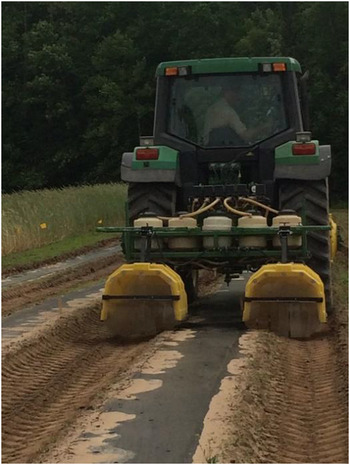
Trials were conducted on an Ade loamy fine sand (coarse-loamy, mixed, superactive, mesic Lamellic Argiudolls) with pH 6.9 and 1% organic matter. Fields were prepared with conventional tillage by a combination of disking and field cultivation prior to the formation of raised beds, 1.8 m apart on-center, and laying black plastic mulch. Plots consisted of three adjacent beds, each 7.3 m long in 2016 and 9.8 m long in 2017. Row middles, the portion of the field between plastic-covered rows, were cultivated the day before applying treatments to eliminate emerged weeds. Treatments were applied on May 25, 2016, and 2017, after plastic was laid, but prior to transplanting and consisted of row middle applications of clomazone (210 g ai ha−1) plus ethafluralin (672 g ai ha−1), flumioxazin (107 g ai ha−1), and flumioxazin (88 g ha−1) plus pyroxasulfone (112 g ai ha−1); and a broadcast application of flumioxazin (107 g ha−1). Additionally, a nontreated check was included for comparison. Consult Table 1 for herbicide product and manufacturer information. Row middle applications were made with a tractor-mounted hooded sprayer (Figure 1) designed to apply herbicide in a 51-cm-wide band on each side of the row in such a manner as to avoid contact with the polyethylene mulch. Flumioxazin was broadcast applied by adding additional nozzles between the two hoods so that in addition to row middles, herbicide was applied over the top of the polyethylene mulch. All applications used TeeJet 80015VS tips (Spraying Systems Co., Wheaton, IL) calibrated to deliver 94 L ha−1 at 207 kPa.
Product and manufacturer information for flumioxazin tolerance trials.

A row-middle herbicide application is made with a hooded sprayer in 2016.

Transplanting holes were punched into the polyethylene mulch and triploid watermelon seedlings were transplanted with an in-row spacing of 1.2 m on May 26, 2016, and 2017, resulting in 18 and 24 plants per plot, respectively. Pollenizer seedlings were interplanted between every other triploid plant in the same row. Crop fertility and insect and disease management were implemented according to the recommendations in the Midwest Vegetable Production Guide for Commercial Growers (GLVWG 2021) and based on the MELcast disease-forecasting model (Latin and Egel Reference Latin and Egel2001). Clethodim (119 g ai ha−1) plus nonionic surfactant (0.25% vol/vol) was applied on June 22, 2016, and June 19, 2017, to control emerged grasses.
In 2016, the length of the longest vine of three plants per plot was measured on June 8 [13 d after transplanting (DAP)] and June 20 (25 DAP). In 2017, normalized difference vegetation index (NDVI) was measured on June 8 (13 DAP), June 15 (20 DAP), and June 26 (31 DAP) using a handheld crop sensor (GreenSeeker; Trimble, Westminster, CO). NDVI was calculated using Equation 1:
 $${\rm{NDVI}} = ({\rm{NIR}} - {\rm{R}})/({\rm{NIR}} + {\rm{R}})$$
where NIR and R represent the reflectance of near infrared (780 nm) and red light (660 nm), respectively.
A visual estimate of the percentage of row middles occupied by weeds and the weed species present in row middles were recorded on June 20, 2016 (25 DAP), and June 21, 2017 (26 DAP). Plots were harvested four times each year: July 27 and August 3, 10, and 18, 2016; and July 26 and August 2, 9, and 16, 2017. Fruits were graded into marketable and cull grades and weighed individually. Cull fruits were those that were smaller than 3.6 kg, misshapen, or consisted of defects from sunburn or animal damage. Total yield was calculated as the sum of marketable and cull yield.
The experiment design was a randomized complete block with four replications. Data were subjected to ANOVA using the MIXED procedure in SAS software (SAS 9.4; SAS Institute, Cary, NC). For data collected in both years (weed control and watermelon yield), treatment was considered a fixed effect, whereas replication and year were considered random effects. For data collected in a single year only (vine length and NDVI), treatment was considered a fixed effect, whereas replication was considered a random effect. Means were separated by Fisher’s protected LSD (P ≤ 0.05).
Results and Discussion
Crop Injury
In 2016, average vine length of the nontreated check was 37 and 70 cm at 13 and 25 DAP, respectively (Table 2). Vine length was reduced by the broadcast application of flumioxazin, resulting in average vine lengths of 16 and 28 cm at 13 and 25 DAP, respectively. In 2017, NDVI values of the nontreated check were 0.1713, 0.5200, and 0.7900 at 13, 20, and 31 DAP, respectively. NDVI values observed 31 DAP were similar to those reported by Trout et al. (Reference Trout, Johnson and Gartung2008) for watermelon at “full cover” (0.80). The broadcast application of flumioxazin resulted in decreased NDVI values at 20 (0.4075) and 31 DAP (0.7475) compared with the nontreated check. All other herbicide treatments had average vine length and NDVI values similar to those of the nontreated check. Although two different methods were used to measure crop injury, both methods are indicators of crop canopy cover, and results from 2016 and 2017 validate one another. Trout et al. (Reference Trout, Johnson and Gartung2008) reported that NDVI and percent crop canopy cover displayed a strong linear relationship, and the authors concluded that “NDVI can potentially provide… estimates of [crop canopy] for horticultural crops with minimal requirement for supporting information.”
Average watermelon vine length in 2016 and NDVI in 2017.

a Rates are presented as grams of active ingredient per hectare (g ai ha−1).
b Abbreviations: NDVI, normalized difference vegetation index (Equation 1); DAP, days after transplanting.
c All other treatments were directed to row middles only.
Weed Control
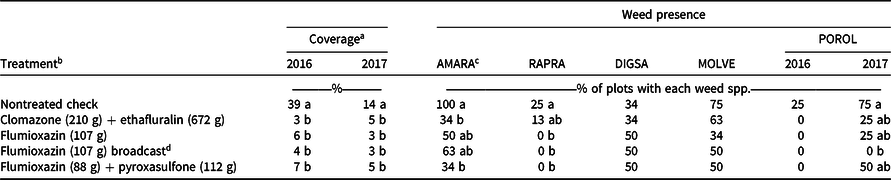
Weeds present across multiple plots included waterhemp [Amaranthus tuberculatus (Moq.) J.D. Sauer], redroot pigweed (Amaranthus retroflexus L.), wild radish (Raphanus raphanistrum L.), carpetweed (Mollugo verticillata L.), large crabgrass [Digitaria sanguinalis (L.) Scop.], and common purslane (Portulaca oleracea L.). Fall panicum (Panicum dichotomiflorum Michx.), Pennsylvania smartweed (Polygonum pensylvanicum L.), ivyleaf morningglory (Ipomoea hederacea Jacp.), and yellow nutsedge (Cyperus esculentus L.) were recorded in only one plot each. Data for waterhemp and redroot pigweed were combined and analyzed collectively as Amaranthus spp. Data for the visually estimated percentage of row middle area covered by weeds 25/26 DAP had a significant (P ≤ 0.0001) treatment-by-year interaction and were analyzed separately by year. With the exception of common purslane (P = 0.0489), relative presence of weed species observed in the trial did not display a treatment-by-year interaction. Therefore, data for the relative presence of pigweeds, wild radish, large crabgrass, and carpetweed were analyzed across both 2016 and 2017, and common purslane was analyzed separately by year. Due to a lack of field-wide distribution, weeds present in only one plot were not analyzed for treatment effects. Weedy ground cover in row middles of the nontreated check was 39% and 14% in 2016 and 2017, respectively (Table 3). Weedy ground cover in all other treatments was significantly less, at ≤7% and ≤5% in 2016 and 2017, respectively.
Percent of row middle area covered in weeds and weed species present 25 and 26 d after transplanting in 2016 and 2017, respectively, and pooled across 2016 and 2017.

a The proportion of row middles occupied by all weed species.
b Rates are presented as grams of active ingredient per hectare (g ai ha−1).
c Abbreviations: AMARA, waterhemp plus redroot pigweed; RAPRA, wild radish; DIGSA, large crabgrass; MOLVE, carpetweed; POROL, common purslane.
d All other treatments were directed to row middles only.
Amaranthus spp. were the most common weeds observed and appeared in all nontreated plots. Pooled across both 2016 and 2017, wild radish, large crabgrass, and carpetweed were present in 25%, 34%, and 75%, respectively, of nontreated check plots. Common purslane was present in 25% and 75% of nontreated check plots in 2016 and 2017, respectively. Compared with the nontreated check plots, Amaranthus spp. were present in fewer plots (34%) treated with clomazone plus ethalfluralin and flumioxazin plus pyroxasulfone. All flumioxazin-containing treatments resulted in a reduced presence of wild radish (0%) compared with that found in the nontreated check.
Yield
Due to a lack of treatment-by-year interaction, data for marketable yield (P = 0.8350) and fruit number (P = 0.6165), total yield (P = 0.8819) and fruit number (P = 0.6835), cull yield (P = 0.8853) and fruit number (P = 0.6854), and average marketable (P = 0.6258) and total (P = 0.5934) individual fruit weights were analyzed across both 2016 and 2017. Marketable, total, and cull yield of the nontreated check was 77,931, 78,939, and 1,009 kg ha−1, respectively (Table 4). The only treatment that differed from the nontreated check was the broadcast application of flumioxazin, which produced significantly less marketable (64,894 kg ha−1) and total watermelon yield (65,170 kg ha−1). The nontreated check yielded 11,115 marketable and 11,278 total fruit ha−1. Again, the only treatment that differed from the nontreated check was the broadcast application of flumioxazin with 9,550 marketable and 9,604 total fruit ha−1. Cull fruit yield and fruit number did not differ among treatments in this study. Mean fruit weight of the nontreated check was 7 kg and was statistically similar to the mean fruit weight in all other treatments. Results from the present study are similar to those reported by Gilbert et al. (Reference Gilbert, Stall, Chase and Charudattan2008) who reported that despite reductions in ‘Mardi Gras’ watermelon yield and fruit number due to American black nightshade interference, individual fruit weight was not reduced. Similarly, Buker et al. (Reference Buker, Stall, Olson and Schilling2003) reported reduced ‘Fiesta’ watermelon yield and fruit number associated with yellow nutsedge interference, but no effect on average fruit weight was observed. The data from the present study suggest that the observed reduction in watermelon yield from the broadcast flumioxazin application was due to reduced fruit number and not average fruit weight.
Watermelon yield, fruit number, and fruit weight in 2016 and 2017.

a Rates are presented as grams of active ingredient per hectare (g ai ha-1).
b All other treatments were directed to row middles only.
Randell et al. (Reference Randell, Vance and Culpepper2020) applied halosulfuron-methyl over the top of plastic mulch-covered raised beds at different time intervals prior to transplanting ‘Sangria’ watermelon and reported the greatest injury and marketable yield loss occurred when halosulfuron was applied 1 d before transplanting. Injury and yield loss were significantly reduced by extending the interval between herbicide application and transplanting. The investigators speculated that halosulfuron was bound to the plastic mulch and required rainfall or overhead irrigation to be removed from the plastic prior to transplanting to improve crop safety. The same scenario is likely in our study, resulting in crop injury and yield loss from a broadcast application of flumioxazin. To minimize the risk of crop injury, a row middle flumioxazin application should be made prior to transplanting and should not come in contact with the plastic mulch. Additional research should be conducted with flumioxazin alone and in combination with pyroxasulfone to better understand how these herbicides best fit into an overall weed management program in commercial watermelon production systems in Indiana.
Acknowledgments
We thank Valent USA, LLC for financial support of this project. This work was supported by the U.S. Department of Agriculture-National Institute of Food and Agriculture through Hatch project 1010574. We thank Eric Ott, Angie Thompson, Bill Davis, and Barbara Joyner for their technical assistance. No conflicts of interest have been declared.