INTRODUCTION
Recent examples of terrorism and urban unrest committed by ethnic minority migrants in Western Europe have renewed public interest in questions of alienation and assimilation.Footnote 2 Many Europeans have been particularly shocked by the fact that individuals born and raised in their society could feel so alienated as to resort to violence. To prevent this violent behavior from spreading, European governments have intensified policies promoting attachment to mainstream society among ethnic minority migrants (Ash Reference Ash2005; Joppke Reference Joppke2007).
The question of why some ethnic minority migrants are more likely than others to be alienated is often posed at the individual level, in order to predict the likelihood that any given person will resort to violence.Footnote 3 This article steps back to consider attitudes at the group level, noting significant differences in levels of attachment to mainstream society across ethnic minority migrant groups. The group-level approach focuses less on individual trajectories that may lead to radicalization and more on broad patterns of incorporation.
In particular, I examine attitudes toward mainstream society among Caribbeans and South Asians in Britain.Footnote 4 Conventional wisdom predicts that Caribbeans should be more likely than South Asians to have positive attitudes toward British society, in part because Caribbeans are more socially and culturally assimilated (Goulbourne Reference Goulbourne1991). In addition, much of the current debate around ethnic minority alienation in Britain focuses on the fact that recent terrorist activity has primarily been committed by Muslim South Asians (Uberoi Reference Uberoi2007). This article presents evidence that runs counter to these predictions, with data suggesting that South Asians are more likely than Caribbeans to have high levels of positive national identification, high levels of trust, and less pessimistic expectations for discrimination in Britain.
To account for these dynamics, I develop an argument about the importance of ethnic minority migrants' expectations. I start by claiming that cultural and social assimilation (based on fluency in the host-country language, cultural and religious practices, intermarriage rates, residential patterns, and discrimination and stigmatization dynamics) is important for shaping expectations for incorporation. I posit that migrant groups with greater cultural and social assimilation will be more likely to have high expectations and when they face incorporation difficulties, will be more likely to develop pessimistic attitudes. In comparison, groups with less cultural and social assimilation will have lower expectations for incorporation. When these groups face incorporation difficulties, they will be less likely to have pessimistic attitudes. I use this argument to explain why Caribbeans are less likely than South Asians to have positive attitudes toward mainstream British society.
In the next section, I present a brief historical background of Caribbean and South Asian migration to Britain. Second, I review literature on ethnic minority incorporation and situate my argument in relation to existing work. Third, I review the data, measures, and methods used to analyze ethnic minority attitudes in Britain. Fourth, I present evidence demonstrating that South Asians are more likely than Caribbeans to have positive attitudes concerning mainstream British society. In the fifth section, I assert that cultural and social assimilation dynamics were crucial for shaping expectations for incorporation among Caribbeans and South Asians. In the three subsequent sections, I develop my argument about the relationship between expectations and attitudes by examining the trajectory of Caribbean and South Asian incorporation in Britain through early migrant mobilization, socioeconomic difficulties, and recent political trends. The last section discusses the implications of these findings and extensions for future research.
CARIBBEAN AND SOUTH ASIAN MIGRATION TO BRITAIN
Non-British ethnic minority groups have lived in Britain for centuries. Trade with foreign territories during medieval and Renaissance times created a constant stream of ethnic minority servants, slaves, and seamen passing through and settling in Britain (Gundara and Duffield, Reference Gundara and Duffield1992). Ethnic minority population numbers rose to unprecedented levels in Britain during the years following World War II, and the two largest ethnic minority groups to migrate during this time period were Caribbeans and South Asians.Footnote 5 In 2001, the Caribbean and South Asian percentage of the British population was over forty-five times larger than it had been in 1951.Footnote 6
The dramatic post–World War II growth in Britain's non-White population was the result of both push and pull factors. High population growth, high population density, high unemployment rates, and political instability at home provided incentives for Caribbeans and South Asians to emigrate. In addition, wartime deaths and rapid industrial economic expansion created acute labor shortages for Britain, which provided jobs for incoming migrants. Moreover, as citizens of the British Commonwealth, Caribbeans and South Asians had legal privileges that facilitated their migration to Britain (Spencer Reference Spencer1997).
This article takes a broad overview and refers to “Caribbeans” and “South Asians” as groups, but it is important to note the diversity within each category. Most notably, among South Asians one often distinguishes between Indians (who are primarily Hindu and have some of the highest socioeconomic outcomes in Britain) and Bangladeshis and Pakistanis (who are primarily Muslim and have some of the worst socioeconomic outcomes in Britain) (Hiro [1971] Reference Hiro1991; Modood and Berthoud, Reference Modood and Berthoud1997). Among Caribbeans, first-generation migrants initially tended to identify more with their particular island of origin than with an umbrella “Caribbean” community (Nanton Reference Nanton1999). This article does not deny the existence of diversity within the “Caribbean” and “South Asian” categories, or the possibility for various individual-level dynamics to shape attitudes toward mainstream society. But, this article examines broad trends, which suggest divergent incorporation patterns are emerging for Caribbeans and South Asians in Britain.
EXISTING LITERATURE
Existing literature identifies several possible trajectories to explain ethnic minority migrant incorporation. The two main schools of thought are straight line assimilation and segmented assimilation.
Straight Line Assimilation
Straight line assimilation literature focuses on the development of incorporation over time. A core claim of this literature is that full assimilation (the absence of functional differences between a migrant group and the native population) is best understood as a process that develops over time and across generations. One of the earliest formulations of straight line assimilation identified seven stages for migrants on the path toward full assimilation. The most important stage was cultural and structural/social assimilation, which would then facilitate marital and identificational assimilation, which would then reduce the likelihood of experiencing prejudice or discrimination. This would prepare migrants to finally achieve civic assimilation and full participation in the host society (Gordon Reference Gordon1964). This literature was primarily developed to account for the incorporation of Southern and Eastern European migrants in the United States in the early to mid-twentieth century, but recent research argues that the concept of a process that develops over time and across generations remains relevant for contemporary non-White migrants (Perlmann and Waldinger, Reference Perlmann and Waldinger1997). In addition, recent research has expanded the definition of assimilation to include changes within the host society as migrant and native populations converge over time (Alba and Nee, Reference Alba and Nee2003).
Due to its focus on incorporation as a process that develops over time, straight line assimilation literature may be particularly useful for explaining why groups that migrated at different times have different incorporation outcomes. However, it cannot account for attitudes among Caribbeans and South Asians in Britain, for three main reasons. First, straight line assimilation literature focuses on time spent in the host country as a key independent variable, but Caribbeans and South Asians arrived in Britain during the same time period.
Second, straight line assimilation literature highlights cultural and social assimilation as the most important foundation of future incorporation success and therefore of migrant attitudes and identification. Yet, Caribbeans are generally considered to be more culturally and socially assimilated than South Asians in Britain. For example, Caribbeans are more likely than South Asians to be fluent in English (Heath and Yu, Reference Heath and Yu2002, pp. 18–19; Smith Reference Smith1977) and to marry native Whites (Berrington Reference Berrington, Coleman and Salt1996). Caribbeans are also less likely than South Asians to live in ethnically segregated neighborhoods (Modood and Berthoud, Reference Modood and Berthoud1997) and to engage in cultural and religious practices that are distinct from mainstream British practices (Hiro [1971] Reference Hiro1991).
Finally, the initial seven-stage model of assimilation predicted that cultural and social assimilation would precede attitudinal assimilation, which would precede the absence of prejudice and discrimination. The logic behind this claim was that as migrants become culturally and socially like natives, they will adopt natives' attitudes, which will give natives fewer incentives to be prejudiced or to discriminate. However, results among Caribbeans and South Asians in Britain present a twist on these predictions. Caribbeans are generally viewed as cultural insiders in British society, while South Asians are more likely to be stigmatized as inassimilable outsiders subject to more intense discrimination (Hiro [1971] Reference Hiro1991; Modood and Berthoud, Reference Modood and Berthoud1997). Yet, although South Asians still suffer from more prejudice and discrimination, they have developed attitudes that are more positive than those of Caribbeans and at times more positive than those of mainstream Whites. These results suggest that straight line assimilation cannot fully account for the incorporation trajectories observed in contemporary Britain.
Segmented Assimilation
Segmented assimilation literature emerged in the early 1990s as a challenge to straight line assimilation literature. A core claim of segmented assimilation is that incorporation for contemporary migrants does not inevitably improve over time and that positive incorporation on one dimension does not necessarily lead to successful incorporation on other dimensions. Although earlier migrants may have accessed straight line assimilation over the course of several generations, segmented assimilation examines the multiple ways in which incorporation outcomes vary across indicators for contemporary migrants (Gans Reference Gans2007; Portes and Rumbaut, Reference Portes and Rumbaut2001; Portes and Zhou, Reference Portes and Zhou1993).Footnote 7
Within the general segmented assimilation framework, there are several strands of literature that identify specific mechanisms for explaining the diversity of incorporation outcomes among contemporary migrants. One argument focuses on economic changes, such as deindustrialization and a dwindling supply of upwardly mobile working-class jobs that have reduced the opportunities for low-skill migrants to access social mobility (Gans Reference Gans1992). According to this logic, when contemporary migrants suffer from blocked or downward mobility, they will be prone to adopt negative attitudes toward mainstream society. Evidence from Britain may appear to support this argument as second-generation Caribbeans suffer from higher unemployment rates than first-generation Caribbeans, which is in part considered evidence of difficulty adjusting to new postindustrial labor market conditions (Li and Heath, Reference Li and Heath2008). Moreover, Indians enjoy some of the best outcomes of any ethnic group in Britain, which might explain why they are more likely than Caribbeans to have positive attitudes toward mainstream society (Heath and McMahon, Reference Heath, McMahon, Loury, Modood and Teles2005; Heath and Yu, Reference Heath and Yu2002; Modood and Berthoud, Reference Modood and Berthoud1997). However, Bangladeshis and Pakistanis have some of the worst socioeconomic outcomes in Britain and are the groups most likely to be segregated in economically disadvantaged neighborhoods (Cabinet Office Strategy Unit 2003; Li and Heath, Reference Li and Heath2008; Simpson Reference Simpson2004). Yet, despite these economic disadvantages, Bangladeshis and Pakistanis are more likely than Caribbeans to have positive attitudes toward mainstream society.
A second strand of segmented assimilation literature claims that diverse incorporation outcomes are less a function of general economic changes and more a function of racialization and discrimination. This literature has largely been developed in the United States and is based on the assumption that the Black-White racial divide is fundamental. According to this perspective, when specific groups become associated with highly stigmatized African Americans, those groups become vulnerable to the discrimination and difficulties faced by African Americans. As a result, when migrants suffer from intense and negative stigmatization, they are more likely to develop an “oppositional culture” with hostile attitudes toward mainstream society (Portes et al., Reference Portes, Fernández-Kelly and Haller2005; Waters Reference Waters1999). Although this literature may help account for various outcomes in the United States, it does not appear to fit data in Britain where the group facing more intense and negative stigmatization—South Asians—is also the group with higher levels of positive attitudes. Moreover, there is no evidence that negative Caribbean attitudes in Britain can be explained by convergence with a disadvantaged native group that would be analogous to African Americans in the United States.Footnote 8 Furthermore, data from Britain indicate that Black Africans are more likely than Black Caribbeans to have positive attitudes toward mainstream society.Footnote 9 This suggests that racialization alone cannot account for attitudes among migrant groups in Britain and that the racial divide may operate differently in Britain and in the United States.
A final branch of segmented assimilation literature argues that theories about racialization overlook the diversity of contemporary migration, which goes beyond a Black-White divide. This perspective claims that the importance of race, ethnicity, or class for incorporation outcomes will vary across groups and individuals. According to this logic there may be several pathways for migrant identity and attitude formation (Bean and Stevens, Reference Bean and Stevens2003; Lee and Bean, Reference Lee and Bean2004).
One pathway emerges when discrimination prompts negative attitudes toward mainstream society (reactive identification). However, as mentioned earlier, in Britain the group facing more intense and negative stigmatization and discrimination (South Asians) is also the group with higher levels of positive attitudes. Reactive identification, therefore, does not appear to account for attitudes among Caribbeans and South Asians in Britain. A second pathway emerges when migrant groups use ethnic enclaves and identities to further social mobility (selective assimilation). According to this logic, groups with important ethnic enclaves will be less likely to have positive attitudes toward mainstream society. However, the migrants most likely to use ethnic enclaves and selective assimilation strategies in Britain are South Asians. As recent research suggests, South Asian networks have been vital for economic and political gains (Dancygier Reference Dancygier2007; Gidoomal Reference Gidoomal1997; Maxwell Reference Maxwell2006). Finally, a third pathway emerges when ethnic minority migrants are largely incorporated but use ethnic identities as an optional form of individualistic expression (symbolic ethnicity). According to this logic, one would expect Caribbeans—who are generally considered better incorporated than South Asians—to converge with Whites on most attitudinal indicators but to have lower levels of positive British identification as evidence of their symbolic ethnicity. However, data presented later in this article suggest that Caribbean attitudes are consistently more negative than those of British Whites, while South Asian attitudes are consistently more positive than those of Caribbeans.
My Argument: The Importance of Expectations
In this article, I claim that neither straight line assimilation nor segmented assimilation can account for attitudinal dynamics among Caribbeans and South Asians in Britain. Instead, I develop an argument about the importance of the context of reception and migrants' expectations for incorporation. I start by claiming that cultural and social assimilation (based on fluency in the host-country language, cultural and religious practices, intermarriage rates, residential patterns, and discrimination and stigmatization dynamics) is important for shaping expectations for incorporation. I posit that migrant groups with greater cultural and social assimilation will be more likely to have high expectations, and when they face incorporation difficulties, they will be more likely to develop pessimistic attitudes. In comparison, groups with less cultural and social assimilation will have lower expectations. When these groups face incorporation difficulties, they will be less likely to have pessimistic attitudes.
This argument builds on various strands of research. I agree with straight line assimilation literature that initial cultural and social outcomes are essential for understanding how subsequent incorporation will develop. However, straight line assimilation focuses on the capacity of cultural and social assimilation to promote improved incorporation outcomes. In comparison, my argument focuses on how cultural and social assimilation can structure expectations that may make migrants vulnerable to disappointment, while cultural and social segregation can provide a buffer against incorporation difficulties.
My argument also builds on a core insight of segmented assimilation literature: the initial context of reception and the initial incorporation outcomes will not automatically progress to future outcomes as if in a straight line. However, none of the mechanisms currently used by segmented assimilation to understand diverse incorporation outcomes (broad economic shifts, racialization and discrimination, ethnic enclaves, and symbolic ethnicity) can account for attitudinal dynamics among Caribbeans and South Asians in Britain. In comparison, my focus on the connection between cultural and social assimilation, expectations, and attitudes suggests an alternative way in which incorporation outcomes can segment. Furthermore, my argument suggests a new way of understanding how discrimination and stigmatization operate. Instead of assuming that discrimination and stigmatization will automatically lead to negative incorporation outcomes, my argument provides evidence for the paradox that discrimination and stigmatization may support lower expectations that provide a buffer against negative attitudes and may even facilitate optimism and positive attitudes. Finally, this focus on expectations builds on a tradition in modernization literature of analyzing how higher expectations during periods of societal transition may be more difficult to fulfill and therefore may potentially lead to instability (Huntington Reference Huntington1986, pp. 47–59).
DATA SOURCES, METHODS, AND MEASURES
This article relies on several sources of data. To document attitudinal outcomes, I use public opinion data. Public opinion data provide a broad overview of attitudinal dynamics across groups and facilitate general statements about trends toward convergence or divergence among Caribbeans and South Asians.
In most British public opinion surveys, ethnic minority migrant samples are too small for detailed analysis of specific ethnic minority groups. However, this article relies on four recent surveys with ethnic minority booster samples: the 2001, 2003, 2005, and 2007 Home Office Citizenship Surveys (HOCS).Footnote 10 Each survey provides several questions about attitudes toward mainstream society, which I divide into three subsets: national identification, levels of trust, and expectations for discrimination.
National identification is important because it gauges the extent to which ethnic minority migrants are attached to a mainstream identity and consider themselves to be part of British society. There are two kinds of trust examined in the HOCS: political trust and social trust. Political trust is important because it measures the extent to which ethnic minority migrants feel that mainstream political institutions adequately represent their interests. Social trust is important because it measures the extent to which ethnic minority migrants feel connected to other members of society. Finally, expectations for discrimination are important because they indicate the degree to which ethnic minority migrants feel comfortable and confident in their ability to participate in mainstream society. Together, these attitudes provide a broad snapshot of the degree to which Caribbeans and South Asians are attached to or alienated from British society.
To develop the argument that accounts for the attitudinal outcomes, I turn to qualitative evidence from interview data and secondary literature. Qualitative evidence provides a detailed analysis of the mechanisms underlying the attitudinal divergence. Qualitative evidence also allows me to trace the importance of a wide range of historical factors, which, given existing data, would not be possible with quantitative analysis. In particular, I conducted seventy-one face-to-face semistructured interviews in the greater London area between August 2005 and July 2007. The subjects were chosen through purposive snowball sampling aimed at finding people involved in ethnic minority migrant politics, including politicians (9%); bureaucrats (20%); activists and community workers (59%); and professors, journalists, and other experts (13%). Of the seventy-one interviews, thirty-one were with Caribbeans and twenty-two were with South Asians. The interviews were not designed to provide a representative sample of either ethnic group. However, when combined with secondary literature and archival data, the interviews provide crucial insight on how Caribbeans and South Asians experience incorporation and develop attitudes toward British society.
RESULTS: ATTITUDE DIVERGENCE AMONG CARIBBEANS AND SOUTH ASIANS
Figure 1 presents results for national identification, trust, and expectations for discrimination. The data are calculated from the percentage of responses coded as positive toward mainstream British society. For questions about British identity, a positive response is one in which respondents positively identify with Britain. Similarly, for a question about trust in political institutions, a positive response is one in which respondents trust politicians. For questions about discrimination, a positive response is one in which respondents do not expect discrimination. More details about the questions and coding can be found in the Appendix.
British ID, Trust, and Discrimination Attitudes
Sources: 2001, 2003, 2005, 2007 Home Office Citizenship Surveys

For each question, there are three series of data: one for Caribbeans, one for Indians, and one for Bangladeshis and Pakistanis.Footnote 11 Data for each group are presented in Figure 1 as the difference in positive respondents in comparison to native Whites. A score of 20% for Indians indicates that the percentage of Indians with positive responses to that question is twenty percentage points higher than that of native Whites. Conversely, a score of −20% for Indians indicates that the percentage of Indians with positive responses to that question is twenty percentage points lower than that of native Whites. These data facilitate a quick overview of whether ethnic minority migrant attitudes are converging or diverging and how ethnic minority attitudes relate to those of native Whites.
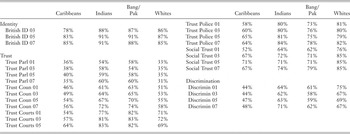
The data in Figure 1 suggest several trends. First, across all survey questions, South Asians are more optimistic than Caribbeans. For questions about British identification, the number of South Asians with positive responses is three to ten percentage points greater than that of Caribbeans. For most of the questions about trust, South Asians are fifteen to twenty-five percentage points more likely than Caribbeans to have positive responses.Footnote 12 Finally, for questions about discrimination, South Asians are ten to twenty percentage points more likely than Caribbeans to have optimistic views about not being discriminated against in potential situations in Britain.Footnote 13 These results suggest that South Asians are more likely than Caribbeans to have positive attitudes toward mainstream British society.Footnote 14
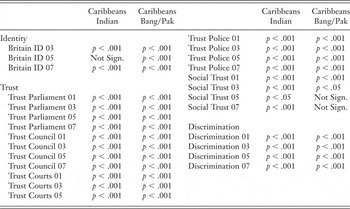
Table A.2 in the Appendix presents p values from statistical significance tests on the differences in attitudes among Caribbeans and South Asians. Of the fifty-two data points (twenty-six questions with differences for Caribbean-Indians and Caribbean-Bangladeshis/Pakistanis), forty-nine are statistically significant with a p value of 0.05 or lower. Forty-seven of the data points are statistically significant at p < 0.001. These results suggest that there are systematic differences among Caribbeans and South Asians in terms of attitudes toward mainstream British society.Footnote 15
In addition to differences between Caribbeans and South Asians, Figure 1 suggests several trends for differences between ethnic minority migrants and native British Whites. For questions on national identity and trust in the Parliament, the courts, and the local council, Caribbean attitudes are close to or slightly less positive than those of Whites, while South Asian attitudes are generally more positive than those of Whites. For questions on trust in the police, social trust, and expectations for discrimination, South Asian attitudes are close to or slightly less positive than those of Whites, while Caribbeans are ten to thirty percentage points less likely than Whites to have positive attitudes.
It is not surprising that Caribbeans and South Asians are less likely than Whites to have positive attitudes about the police and about expectations for discrimination. Ethnic minority migrant groups are generally considered to be more vulnerable to police harassment and discrimination than native British Whites. However, the fact that South Asians have higher levels of British identification and trust than Whites suggests that South Asians have significant levels of positive attachment to mainstream British society. In comparison, Caribbeans' attitudes are often less positive than those of South Asians and Whites, which suggests that Caribbeans may tend toward alienation from mainstream attitudinal norms.
INITIAL CULTURAL AND SOCIAL ASSIMILATION AND EXPECTATIONS FOR FUTURE INCORPORATION
Upon arrival in Britain during the 1940s, 1950s, and 1960s, Caribbeans and South Asians shared many similarities in their incorporation trajectories. Both groups arrived to fill labor shortages in low-level jobs, faced housing and employment discrimination, and were forced to take jobs that were beneath their educational qualifications (Daniel Reference Daniel1968; Smith Reference Smith1977). However, there were important differences between the groups. In particular, Caribbeans' cultural and social assimilation (defined here as greater fluency in the host-country language, mainstream cultural and religious practices, higher intermarriage rates, and lower levels of residential segregation and discrimination and stigmatization) created higher expectations compared to South Asians for incorporation into British society.
Higher Expectations among Caribbeans
British colonialism in the Caribbean lasted over 300 years, from the beginning of the seventeenth to the middle of the twentieth century. As a result, at the time of the post–World War II migration, modern Caribbean cultures were in many ways the creation of their colonizers. In fact, the hegemonic position of British culture during colonialism meant that Caribbean migrants had been taught British history, literature, art, and social traditions, often at the expense of their own local history (Hiro [1971] Reference Hiro1991, pp. 19–21; Nanton Reference Nanton1999). Despite the phenotype and cultural markers that distinguished Caribbeans from White Britons (e.g., accent, culinary customs, or artistic practices, such as music and dance), many migrants were prepared to identify as British and to partake in mainstream British cultural practices. For example, a 1965 study of immigrant integration in Bristol posed a number of questions about local knowledge, customs, and slang. Less than half of the Indian and Pakistani respondents were able to answer more than five of the twenty-nine questions correctly, compared to over 90% of Caribbean respondents (Richmond Reference Richmond1973, pp. 254–257).Footnote 16
Caribbeans' greater likelihood of having reliable English language skills and their familiarity with British culture facilitated work in secure public-sector jobs. In comparison, first-generation South Asians were less familiar with British culture and were more likely to work in positions that did not require interaction with mainstream society, such as in low-skilled industrial jobs or ethnic-enclave retail positions (Spencer Reference Spencer1997). For the most part, Caribbeans' public-sector positions offered more job security and social welfare benefits than the jobs that many South Asians were forced to take (Nanton Reference Nanton1999). During the 1950s, 1960s, and 1970s, Caribbeans' ability to access public-sector jobs and to participate in mainstream society was an advantage that created expectations for smooth incorporation.
The following quotations from Caribbean migrants give a flavor of their expectation for assimilation in British society:
Grenada was definitely part of the Empire. England was certainly the only place to come after you've finished. It's like going to finishing school really. All the educators, the inspectors, and so on, came down from England. We didn't see England as a separate entity. For example, in my convent school we spent a lot of time knitting little bits of wool for people during the war…. We wept when the Catholic Church was bombed; we rejoiced [that] the statue of the Virgin Mary wasn't hurt…. They were lining up to join up and defend the mother country.
Jamaicans were always singing songs like “Land of Hope and Glory and mother of the free” and “Rule Britannia, Britannia rules the waves.” The training that we had was typical British…. We were made to understand that we were British
(Phillips and Phillips, Reference Phillips and Phillips1998, pp. 13–14).South Asian Segregation and Lower Expectations
In comparison to Caribbeans, South Asians in Britain knew in no uncertain terms that they were arriving in a country with a different language and different religious practices, social organization, and historical traditions. In comparison to in the Caribbean, British colonialism in South Asia was relatively short and did not have the same pervasive cultural influence. The British East India Company was formed in 1600, but its role was primarily economic, and there were relatively few British settlers in India until the nineteenth century. Moreover, despite British educational and administrative institutions that trained local bureaucrats, many traditional South Asian social structures remained intact during colonialism, and South Asians were more likely than Caribbeans to have religious and cultural practices that were unfamiliar to the British mainstream (Bayly Reference Bayly1990). One implication of these different colonial experiences was that South Asian migrants were less likely than Caribbean migrants to expect full participation in British society (Hiro [1971] Reference Hiro1991, p. 113).
South Asians' limited understanding of the English language and British customs meant they often worked and lived on the margins of society. While Caribbeans could access secure public-sector employment during the 1940s, 1950s, and 1960s, South Asians were relegated to unskilled or semiskilled manual-labor jobs in heavy engineering (e.g., foundries, steel mills) and textiles (Hiro [1971] Reference Hiro1991, p. 117). These low-level industrial jobs offered less security and fewer social welfare benefits than the public-sector jobs of first-generation Caribbeans. Moreover, low-level industrial jobs were often unpleasant, dangerous, and hazardous to workers' health.
In addition to concentration in low-level industrial jobs, first-generation South Asians in Britain were more likely than first-generation Caribbeans to open their own businesses and retail outlets. Without access to mainstream jobs or financing, many South Asians turned to modest self-employment in curry houses and grocery stores as a way to control their own destiny and make the best out of their limited options (Clark and Drinkwater, Reference Clark and Drinkwater1998; Metcalf et al., Reference Metcalf, Modood and Virdee1996, pp. 3–9).
It is important to clarify that my claim about South Asians' lower expectations does not refer to opportunities for educational attainment and social mobility. In fact, many observers have applauded the strong commitment to education and work among many South Asian migrants in Britain (Hiro [1971] Reference Hiro1991). However, South Asians' cultural and social segregation created lower expectations for acceptance and participation in mainstream British society. According to a South Asian community worker:
Asians are the ones with social exclusion, culture gaps, language problems. They have real cultural adaptation problems, different ideas. The men don't want the women working outside the home, for example. People are here for ten, twenty, thirty years; they make money, but they don't even try to mix with the English ways.Footnote 17
In summary, this section has claimed that Caribbeans have higher expectations than South Asians for incorporation into British society because of their relatively higher levels of cultural and social assimilation. In the next three sections, I analyze the relationship between expectations and divergent Caribbean and South Asian attitudes toward mainstream society by examining the trajectory of their incorporation through early migrant mobilization, socioeconomic difficulties, and recent political trends.
EARLY MIGRANT MOBILIZATION: DASHED EXPECTATIONS, CIVIL RIGHTS STRUGGLES, AND THE 1981 RIOTS
In the initial years of migration, Caribbeans and South Asians were both subject to discrimination and anti-immigrant violence (Daniel Reference Daniel1968). Yet, due to different expectations, early Caribbean migrants were more likely than early South Asian migrants to be disappointed about their integration prospects. This disjuncture between expectations and realities created incentives for Caribbeans to be at the forefront of ethnic minority civil rights activism and protests during the 1960s, 1970s, and early 1980s. In some respects, this protest activity was an early indication of Caribbeans' dissatisfaction with mainstream British society.
Survey data from the early 1970s provide evidence that Caribbeans were already more frustrated than other migrant groups at the difficulties of adjusting to life in Britain. At the time, 51% of Caribbean migrants, compared to only 22% of South Asians, felt it was more difficult than they expected to earn a living in England. Also, 50% of Caribbean migrants found it more difficult than they expected to find housing, compared to only 37% of South Asians. Finally, the study found that 33% of Caribbean migrants found it more difficult than they expected to develop a social life with native English people, compared to only 14% of South Asians (Richmond Reference Richmond1973, pp. 248–250).
Frustration with incomplete incorporation led many Caribbeans to become activists. In the 1950s, 1960s, and 1970s, Caribbeans were at the forefront of Britain's civil rights movement and were among the most prominent activists who lobbied the British government for antidiscrimination legislation, including the Race Relations Acts of 1965, 1968, and 1976, as well as the establishment of the Commission for Racial Equality (Sewell Reference Sewell1993). Part of this prominence was undoubtedly because Caribbean leaders were often the best suited to negotiate with mainstream political elites due to their cultural and social assimilation (Hiro [1971] Reference Hiro1991). However, there have also been assimilated and politically savvy South Asian activists in Britain (e.g., leaders of the Indian Workers Associations). Therefore, an additional explanation for Caribbeans' prominence as activists is the fact that Caribbeans were more likely to consider themselves as members of British society and therefore would complain when they were not treated as equals (Shukra Reference Shukra1998, pp. 10–25). According to a longtime South Asian activist, “Generally speaking, Caribbeans have always been more strident. Asians have less anger and do things economically. For years we tried to mobilize Asians, but they were not as angry.”Footnote 18
Caribbean anger at incomplete incorporation continued to be a rallying point in the 1970s and 1980s. Despite the legislative victories of the 1960s civil rights movements, ethnic minorities were more likely than native Whites to live in substandard housing, attend substandard schools, and face dismal employment prospects. Many ethnic minority young people complained of police harassment and intrusive stop-and-search procedures that reduced their faith in the capacity of mainstream institutions to protect them (Smith Reference Smith1977). This frustration culminated in the riots of 1981 that started in the Caribbean neighborhood of Brixton in London, and eventually spread across the country (Alleyne Reference Alleyne2002; Gilroy Reference Gilroy1987, pp. 85–109). The 1981 riots were a dramatic signal to British society that ethnic minority migrants were unhappy with their incorporation progress.
Caribbeans were the primary ethnic minority actors in these events, but not because their objective conditions were dramatically worse than those of South Asians. In fact, on many measures of socioeconomic well-being, Caribbeans enjoyed advantages relative to Bangladeshis and Pakistanis (Modood and Berthoud, Reference Modood and Berthoud1997). Moreover, soon after their arrival South Asians formed a wide range of organizations and networks that helped develop cultural and religious institutions and provided social welfare services (Hiro [1971] Reference Hiro1991, pp. 76, 139–140). However, these early South Asian organizations often avoided mainstream politics because they were unfamiliar with the culture, language, and politics of British society. In addition, dense and insular South Asian communities tended to seek support among themselves rather than look for government assistance (Hiro [1971] Reference Hiro1991; Solomos and Back, Reference Solomos and Back1995). In comparison, Caribbeans' early political engagement and clashes with British institutions can be interpreted as evidence of greater involvement in mainstream society and dissatisfaction with incomplete incorporation (Goulbourne Reference Goulbourne1991).
SOCIOECONOMIC DIFFICULTIES
Both Caribbeans and South Asians have suffered from a number of socioeconomic difficulties during their incorporation into British society. However, Caribbeans' higher expectations have led to disappointment over their socioeconomic difficulties, while South Asians have not necessarily expected to be accepted by mainstream British society and have often been prepared to ignore incorporation difficulties and focus on strategies for long-term success.
Persistent Difficulties and Pessimism among Caribbeans
In many respects, Caribbean socioeconomic incorporation in Britain is bifurcated. There is a strong trend toward upward occupational mobility, but there is also a strong trend toward educational underachievement and high unemployment rates among the second and third generations. In light of Caribbeans' higher expectations, these persistent educational and employment difficulties have further contributed to Caribbeans' pessimistic attitudes concerning mainstream British society.
Recent research suggests that among the first generation, all ethnic minority migrant groups in Britain have experienced more upward mobility than downward mobility. Moreover, first-generation migrants may suffer occupational disadvantages relative to native British Whites of the same class background, but the second generation appears to have occupational outcomes that converge with those of Whites of the same class background.Footnote 19 However, although employed Caribbeans may access upward mobility both within and across generations, there is evidence of significant disadvantage in unemployment rates. For example, Caribbean unemployment rates in the 1990s were roughly two to three times as high as those of Whites and Indians.Footnote 20 In addition, Caribbean unemployment rates were similar to those of Pakistanis and Bangladeshis, groups that arrived in Britain with fewer economic, social, and cultural incorporation resources than Caribbeans.Footnote 21
Moreover, Caribbeans' high unemployment rates have been exacerbated by significant educational difficulties, especially among the second generation. Educational underperformance among Caribbean males has been a public problem in Britain since the 1970s and has inspired countless government and academic studies, research commissions, and investigations (Coard Reference Coard1971; Rampton Reference Rampton1981; Swann Reference Swann1985). Caribbeans are now the ethnic group most likely to be expelled from school and the most susceptible to juvenile delinquency and criminal activity (Education Commission 2003).
The employment and educational difficulties faced by young Caribbeans in Britain contribute to lower levels of positive attitudes toward mainstream society in several ways. First, the fact that young Caribbeans seem to face more educational difficulties than other groups has led parents to complain about instructor discrimination and racist curricula. Many Caribbean parents have become skeptical of the capacity of the mainstream British school system to adequately prepare their children for success (Maylor et al., Reference Maylor, Read, Mendick, Ross and Rollock2007). As a result, many Caribbean parents and children have lost hope and do not feel anchored in mainstream society. For example, a Caribbean youth worker who mentors young boys from various ethnic backgrounds explained how many young Caribbeans feel adrift:
The Caribbean kids usually need a lot of work. The goal is usually just to get them to stay in school. I can't even think about university! It's tough. They are in between cultures. They have no “Caribbean” culture to identify with the way the Asian kids have their religion. But, [Caribbeans] also do not feel connected to the [British] society that does not help them.Footnote 22
The fact that other groups (most notably Indians) have avoided these educational and employment problems can create feelings of jealousy and confusion among Caribbeans who wonder where things went wrong. The director of a mental health resource center for Caribbeans explains that “Caribbeans always felt that opportunities should be there, so when they encounter discrimination they get mental problems. It's not like other groups—Africans, Asians—they seize whatever they can get. No complex about what they ‘should’ have.”Footnote 23 Moreover, even Caribbeans who achieve economic success are affected by the fact that a large and visible percentage of the second and third generations has failed to build upon the position of the first generation and leverage cultural and social assimilation advantages. According to a middle-class, college-educated Caribbean civil servant:
When I was in grammar school there were only six Black students, and three of them were expelled. There were so few of us they focused on proving their Blackness, which wasn't necessary. It was sad, they were capable and smart. They could have been channeled in the right direction. The teachers were not necessarily racist, but they didn't know how to deal with those issues…. I've done well, but what is going on saddens me. This society pays lip service to equality, but that's not what happens. People don't believe that.Footnote 24
Difficulties Tempered by Optimism among South Asians
South Asians have suffered many of the same socioeconomic problems as Caribbeans, including discrimination and being forced to take jobs below their educational qualifications (Daniel Reference Daniel1968; Smith Reference Smith1977). During the early years of migration, South Asians were particularly vulnerable to occupational difficulties because their foreign educational qualifications were not valued in Britain, and their foreign cultural practices were not welcomed in many mainstream companies. These difficulties could have created widespread alienation from and negative attitudes toward mainstream British society. Instead, because South Asians did not necessarily expect to be accepted by mainstream society, they were often prepared to ignore the incorporation difficulties and focus on strategies for long-term success.
According to a second-generation Indian entrepreneur in London:
My father experienced so much racism. He was a chief researcher at Dr. Scholl's when some incident occurred where he decided he had enough and would work for himself. He opened his own manufacturing company for shampoo, and we were the workforce. My father's health was poor and we had nothing. My brother and I did everything from manufacturing to selling.Footnote 25
Experiences such as this were difficult, but South Asians never expected full incorporation in British society and were encouraged by all forms of success. The same second-generation Indian entrepreneur quoted above explains how he built on his father's turbulent experiences:
Race and ethnicity has been a problem, but we work hard to overcome it. The Asian mind-set is built on hard work and is determined to succeed…. I'm British (except when playing cricket), and I tell my kids all the time that they are British, and this is their country. I am not always accepted as British, but I want to say the educated British person accepts us, because they know we have value, but the uneducated person just sees us as competition.Footnote 26
In recent years, the most pressing socioeconomic difficulties have been among Bangladeshis and Pakistanis, who tend to suffer from the highest unemployment rates in Britain and are the most likely to live in neighborhoods with high levels of deprivation. In comparison, Indians have better educational outcomes (higher test scores, better high school and university graduation rates) than most groups in Britain, including Whites and Caribbeans. Among men, Indians have greater percentages of individuals employed in professional occupations and higher average incomes than most groups in Britain, including Whites and Caribbeans (Heath and Yu, Reference Heath and Yu2002; Li and Heath, Reference Li and Heath2008; Modood and Berthoud, Reference Modood and Berthoud1997).
Socioeconomic success among Indians may help account for their positive responses toward mainstream British society. But, socioeconomic success cannot explain why Bangladeshi and Pakistani attitudes toward mainstream society are more positive than those of Caribbeans despite the fact that Bangladeshis and Pakistanis suffer from greater socioeconomic disadvantage. My argument focuses on the role of lower expectations and suggests that we should find evidence that Bangladeshis and Pakistanis do not expect instant incorporation and are prepared to endure substantial difficulties. In the following quotation, a Pakistani community organizer and local councilor explains how he manages the fact that his Muslim organization suffers from limited resources:
We have no funding, no website, no staff. We have no money. Our community is poor and cannot afford to support all the programs it needs. But, things take time. You cannot get everything overnight. Everyone chips in a few pounds to support the language classes, the after-school classes. Investing in the future, that's the only way.Footnote 27
RECENT POLITICS: CARIBBEAN DECLINE AND SOUTH ASIAN ENGAGEMENT
Caribbeans were at the forefront of Britain's civil rights struggles and early ethnic politics, but over time the slow pace of political change has given way to feelings of disappointment and disillusionment. In comparison, South Asian activists have remained optimistic and engaged despite difficulties.
Low Levels of Caribbean Political Engagement
Caribbeans were central to Britain's civil rights struggles during the 1950s, 1960s, and 1970s. When the first non-White ethnic minority Members of Parliament (MPs) of the post–World War II era were elected in 1987, one was Indian, one was African, and two were Caribbean. This imbalance in favor of Caribbeans was not huge. But, it did suggest that Caribbeans were among the most prominent and successful ethnic minority politicians in Britain (Shukra Reference Shukra1998, pp. 71–73).
Despite this head start among elected officials, political change is slow and many Caribbean communities remain politically marginalized. Among national-level politicians (MPs and Lords), there is a growing number of Caribbeans and South Asians, and each group may soon be represented relative to its percentage of the population. However, on local councils Caribbeans find it difficult to achieve proportional representation even in communities with large Caribbean populations. Moreover, Caribbeans often find it more difficult than do other ethnic minority groups to have influence over local politicians and access to government resources (Dancygier Reference Dancygier2007; Le Lohé Reference Le Lohé and Saggar1998; Maxwell Reference Maxwell2008b). These difficulties have been exacerbated by the fact that Caribbeans tend to have some of the lowest turnout levels in Britain (Purdam et al., Reference Purdam, Fieldhouse, Russell and Kalra2002), which suggests a general lack of engagement in mainstream institutions.
One explanation for this lack of engagement is that Caribbeans' expectations for incorporation have not been met. According to a Caribbean councilor in London:
Yes we are “alienated,” yes we are pissed off, yes we don't vote, yes we don't seize our destiny here, but it's for a reason. It's because discrimination is very real. It wasn't supposed to be this way. My mother thought she was coming to “Mother England,” but nobody thinks I deserve to be here. I've been harassed, made ill, and I won't even tell you the stories about what happened to my brother at his job on the police force. So yes, most Caribbeans don't vote, we're not involved, and I'm alone here in the local council, but there's a reason behind all of that.Footnote 28
Among many Caribbeans, there is a sense that earlier efforts at assimilation and engagement with mainstream British society were not successful, so it is no longer worth believing in or participating in mainstream politics. A longtime Caribbean activist, who was involved in prominent civil rights organizations during the 1960s, explains how the mantle of engagement has passed from Caribbeans to South Asians:
The energy of the Asian activists is amazing; they are still trying to solve the problems of adaptation so they're getting involved in politics and controlling local councils. We used to have energy like that in the West Indian community, but so many of our people now are less mobilized. [There is] less cohesion, less unity; there is a big gap between the generations; they have no mission anymore.Footnote 29
South Asian Political Optimism
South Asian political activists were less likely to engage mainstream parties during the 1950s and 1960s, but things slowly began to change in the 1970s as South Asian community leaders became increasingly familiar with the British political system. In addition, mainstream political elites were increasingly seeking ways to incorporate the rising ethnic minority migrant-origin electorate. South Asian leaders demonstrated that politicians' ties to the migrant community could be important for voter mobilization, which was valuable to mainstream political parties (Hahlo Reference Hahlo1998).
As South Asians began participating in mainstream British politics during the 1980s and 1990s, it was possible that disappointment at the slow pace of change would emerge, much as it had among Caribbeans. For example, South Asians continue to be underrepresented among MPs in comparison to Caribbeans (Maxwell Reference Maxwell2008b), and have been publicly stigmatized as suspected terrorists and subject to increasingly invasive stop-and-search procedures as part of the government's antiterrorism measures (Uberoi Reference Uberoi2007). However, despite incentives for disillusionment and contrary to reports that South Asians are becoming hostile outsiders in Britain, South Asian attitudes toward mainstream society have remained relatively positive, as demonstrated in this article. In addition, South Asians have sustained consistently high turnout rates (Cutts et al., Reference Cutts, Fieldhouse, Purdam, Steel and Tranmer2007; Dancygier Reference Dancygier2007), which have helped promote influence over local politicians and access to government resources (Le Lohé Reference Le Lohé and Saggar1998; Maxwell Reference Maxwell2008b).
In this article, I contend that one reason South Asians have been able to sustain political engagement, despite the slow pace of change and numerous incorporation difficulties, is because of their relatively moderate expectations for incorporation. For example, one of the biggest political issues for South Asians in recent decades has been getting permission to build large temples and mosques. In many cases, native British Whites protested against the construction of these temples and mosques, on the grounds that such construction would be invasive and unwanted examples of foreign culture. In one community in the northwestern suburbs of London, the Swaminarayan Hindus spent almost forty years trying to build what would eventually become the largest Hindu temple outside of India.Footnote 30 During these decades of struggle, Indian Hindu leaders were not deterred by rejections because they never expected to be accepted by native Whites. This focus allowed the leaders to continue the slow process of submitting endless revisions of planning proposals, and eventually the temple was built (Maxwell Reference Maxwell2008b).
Muslim South Asians have faced similar obstacles while pursuing community projects. According to the organizer of an Islamic cultural center in London:
This is a tough time for Muslims in Britain and Europe. [We get] lots of calls insulting the center and police cameras monitoring who enters the center. But we know how to get public funding. There is a stigma against Muslims, so your name is important. We changed the name of our cricket club from Islamic Cricket Club to Wandsworth Cricket Club, and we got more funding. That's all. We know how to get support.Footnote 31
Caribbeans in Britain also have a long history of successful struggles for local community projects that were initially rejected by mainstream British Whites (Goulbourne Reference Goulbourne1991; Sewell Reference Sewell1993). However, Caribbeans' expectations for full incorporation in British society leave them more vulnerable to negative attitudes when political difficulties arise. In comparison, South Asians are more likely to focus on the small changes they can make. In the following quotation a Bangladeshi Labour Party member explains his problems with the Labour Party, as well as his optimism about the possibilities for a small left-wing party, called the Respect Coalition, to enact change:
I have been a member of the Labour Party for twenty-six years. Still, I know what to expect. Racism runs deep among the council, and they don't want to hire Bengalis. They claim they cannot find qualified people, but I don't think they want to find them. I am glad that Respect is gaining influence to challenge Labour's dominance.Footnote 32
South Asians have historically been less culturally assimilated and less politically influential than Caribbeans, but due to lower expectations, they are more likely to focus on the positive developments that occur. The following quotation from a South Asian community worker evokes this sense of forward-looking hope:
In the past things were different, it was difficult to wear Asian clothes in the street, and none of the council staff would come to Diwali celebrations. But now things have changed. Asian culture is much more visible and the community is more engaged. We have gotten involved in business and politics. I still get different treatment and less eye contact when I wear Asian clothes, but things are getting better.Footnote 33
CONCLUSION
This article has presented evidence suggesting that Caribbeans and South Asians have developed distinct attitudes toward mainstream British society. In particular, South Asians are more likely than Caribbeans to have high levels of positive national identification, high levels of trust, and optimistic expectations for being treated fairly. To explain this attitudinal divergence, I developed an argument connecting assimilation, expectations, and attitudes among ethnic minority migrants. I claimed that initial levels of cultural and social assimilation increase expectations for incorporation. When migrants with high expectations face incorporation difficulties, they will be more likely to develop pessimistic attitudes. In comparison, cultural segregation lowers expectations for incorporation. When migrants with lower expectations face incorporation difficulties, they will be less likely to have pessimistic attitudes.
The findings in this article have several implications. First, the attitudinal divergence among Caribbeans and South Asians suggests that there is important diversity among ethnic minority migrant groups in terms of assimilation and expectations in mainstream society. Second, the combination of cultural and social assimilation and pessimistic attitudes among Caribbeans builds on recent work that suggests more work needs to be done to deepen Caribbeans' engagement in British society beyond the cultural realm (Reynolds Reference Reynolds2006). On the other hand, the combination of cultural segregation and positive attitudes among South Asians builds on recent work that suggests cultural and social proximity are not necessary for ethnic minority migrants to feel connected to mainstream society (Maxwell Reference Maxwell2006, Reference Maxwell2008a, Reference Maxwellforthcoming). Together, these results suggest that there are important tensions and trade-offs across incorporation dimensions.
This article offers a counterpoint to contemporary literature on racialization, stigmatization, and discrimination. Unlike literature that focuses only on the ways in which initial assimilation leads to positive incorporation and discrimination leads to difficulties, this article provokes a more nuanced understanding of how both assimilation and discrimination create different expectations that can either lead to disillusionment or support resilience in the face of obstacles. Of course this article does not suggest that South Asians are not hurt by their incorporation difficulties merely because they have lower expectations. Similarly, this article does not suggest that Caribbeans are unable to persevere and flourish despite incorporation difficulties merely because they are more likely to be frustrated. In reality, the lived experience of an ethnic minority migrant involves a complex mixture of ever-changing emotions and experiences that are not uniform for all members of the same ethnic group. However, this article analyzes trends that point to general differences across groups. In particular, this article examines how the ways in which incorporation are framed can vary across groups and have important ramifications for how different groups perceive the incorporation process.
APPENDIX
VARIABLES IN THE 2001, 2003, 2005, 2007 HOME OFFICE CITIZENSHIP SURVEYS
British ID
“How strongly do you belong to Britain?”
0 (not at all strongly), 1 (not very strongly), 2 (fairly strongly), 3 (very strongly)
Very strongly and fairly strongly responses were coded as positive attachments to mainstream society.
Trust in Political Institutions
Parliament: “How much do you trust Parliament?”
Courts: “How much do you trust the courts?”
Local council: “How much do you trust the local council?”
Police: “How much do you trust the police?”
0 (not at all), 1 (not very much), 2 (a fair amount), 3 (a lot)
A lot and a fair amount responses were coded as positive attachments to mainstream society.
Social Trust
“How much can people be trusted?”
0 (none of the people in the neighborhood can be trusted), 1 (a few of the people …), 2 (some of the people …), 3 (many of the people …)
Some of the people and many of the people responses were coded as positive attachments to mainstream society.
Discrimination
“Would you be treated worse than other races as a member of the public in the following situations?”
2001 Survey: interacting with a local doctor, a local hospital, a local school, the housing department, the local council, a private landlord, the armed forces, a bank, a supermarket chain, an insurance company, a petrol station, the court, the Crown Prosecution, the Home Office, the police, the fire service, immigration authorities, the prison service, the probation service.
2003 Survey: interacting with a local doctor, a local school, the housing department, the local council, a landlord, the armed forces, an insurance company, a bank, a job centre, the court, the Crown Prosecution, the Home Office, the police, immigration officials, prison, and a probation officer.
2005 Survey: interacting with a local doctor, a local hospital, the health service, a local school, the education system, the housing department, the local council, a private landlord, the court, the Crown Prosecution, the Home Office, the police, the local police, immigration authorities, the prison service, the probation service.
Responses were coded as positive attachments to mainstream society if respondents did not expect discrimination in any of these situations.
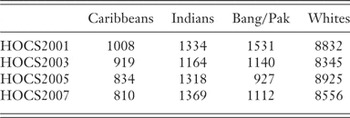
Ethnic Group Sample Sizes in the Four HOCS

Sources: 2001, 2003, 2005, 2007 Home Office Citizenship Surveys
Statistical Significance of Difference in Positive Attitudes toward British Society

Sources: 2001, 2003, 2005, 2007 Home Office Citizenship Surveys
Positive Responses for Attitudes toward British Society

Sources: 2001, 2003, 2005, 2007 Home Office Citizenship Surveys
British ID, Trust, and Discrimination Attitudes for Foreign-Born Respondents
Sources: 2001, 2003, 2005, 2007 Home Office Citizenship Surveys

National ID, Trust, and Discrimination Attitudes for British-Born Respondents Compared to Native British Whites, 49 Years Old and Younger
Sources: 2001, 2003, 2005, 2007 Home Office Citizenship Surveys