Implications
This study has potential implications for the formulation of diets for early-weaned pigs, as it suggests that they lack the capacity to fully digest a standard weaner diet, which may predispose them to post-weaning disease.
Introduction
Early weaning of pigs involves a period of rapid adaptation to multiple stressors. These include removal from the sow, mixing with novel pigs, loss of protective anti-microbial milk components and a change of diet with its nutritional and immunological consequences. The latter involves a change of both dietary form and composition, often along with a period of anorexia. Finally, weaning conventionally involves moving animals to new accommodation associated with both environmental and microbial challenge. All of this occurs when the pig’s gastrointestinal (Spreeuwenberg et al., Reference Spreeuwenberg, Verdonk, Gaskins and Verstegen2001) and immune system is poorly developed (McCracken et al., Reference McCracken, Spurlock, Roos, Zuckermann and Gaskins1999), and when maternally derived passive immunity has waned. It is, therefore, not surprising that this is also a period of heightened sensitivity to disease and poor growth. Given the European Union (EU) ban on the prophylactic use of antibiotics, it is important to establish alternative strategies to support the piglet during this ‘at risk’ period. It is crucial to identify the relative importance of the stressors, listed above, to animal performance and disease susceptibility. To achieve the latter aim, it is necessary to separate the stressors and to study the impact of each one, where possible, in isolation (McCracken et al., Reference McCracken, Gaskins, Ruwe-Kaiser, Klasing and Jewell1995). Various studies have shown that particularly intestinal morphology is affected during the weaning transition, generally resulting in a decrease in villous height and an increase in crypt depth (Pluske, Reference Pluske2001). Such villous atrophy leads to a loss of mature enterocytes, which carry brush-border enzymes, such as aminopeptidases, and various carbohydrases (Miller et al., Reference Miller, James, Smith and Bourne1986). Impairing these enzyme systems can result in a reduced digestive capacity of the intestine, in particular with respect to protein and carbohydrates utilisation.
Pre-weaning and immediate post-weaning development in young piglets is important for their subsequent performance. One crucial aspect is the fate of protein and amino acids in the piglet’s gastrointestinal tract (GIT) as protein accretion, that is, the digestion of proteins followed by the absorption and utilisation of dietary amino acids, has a direct impact on muscle development and thus on body weight gain. Protein digestion and absorption are largely completed at the level of the terminal ileum. Protein entering the large intestine is lost for the animal in terms of body accretion, as it will be fermented and cannot be absorbed and used by the animal. Moreover, this surplus protein serves as a substrate for the hindgut microbiota, yielding toxic products, such as ammonia and amines, and favouring heterofermentative, potentially pathogenic bacteria, such as Clostridium spp., thus increasing the risk of diarrhoea.
In order to optimise protein digestion and absorption in the GIT, the evaluation of protein digestion and nitrogen flow with emphasis on endogenous nitrogen losses and microbial nitrogen in piglets is of importance. However, not much work is reported about this topic in very young piglets, especially with regard to endogenous nitrogen losses, true ileal protein digestibility and the contribution of microbial nitrogen at the terminal ileum.
We hypothesise that diets based on milk or cereals exert a different effect on mucosal architecture and ileal nitrogen metabolism in the absence of other stressors associated with conventional weaning. Thus, the objectives of our study were to investigate the flow of dietary, endogenous and microbial nitrogen and amino acid digestibility and intestinal morphology at the terminal ileum in piglets fed either a diet based on milk or cereals. Our study uses piglets removed from their sow at approximately 13 days and fed hourly with a milk substitute based on cow’s milk as a model of suckling pigs.
Material and methods
The experiment was conducted at the University of Bristol, School of Clinical Veterinary Science. All procedures were carried out under a UK Home Office licence.
Animals, diets and experimental procedures
Seven piglets from each of two litters were collected at 12 to 14 days of age from a commercial pig farm and transported to the isolator unit at the University of Bristol’s School of Clinical Veterinary Science. The isolator unit consists of a suite of a high efficiency particulate air-filtered, positive pressure (50 pascals) rooms equipped with individual cages (80 × 70 × 45 cm), group pens, an automated feeding system for liquid diets and a separate operating room. The light regime was set to a cycle of 12-h light and 12-h darkness and ambient temperature to 30°C (Thorpe, Reference Thorpe1999).
Upon arrival (experimental day 1), piglets were cleaned and disinfected thoroughly by passing them through a warm disinfectant bath (Virkon®, RS Biotech, Finedon, Northants, UK). Each pig received a 3-day prophylactic antibiotic course (7 mg/kg BW/day amoxycillin intramuscularly (Clamoxyl™, Pfizer Ltd, Sandwich, Kent, UK)). They were housed in a group pen for approximately 36 h in order to adapt them to consuming milk substitute from a trough. They were subsequently allotted to individual cages and fed hourly. The experimental design is depicted in Figure 1.
Experimental design of a study investigating ileal digestibility and intestinal morphology in early-weaned piglets fed either milk substitute or a weaner diet.

Piglets were fed hourly with a commercial milk substitute prepared at 200 g per litre (‘Piggi-Milk’, Parnutt Foods Limited, Sleaford, Lincolnshire, UK; 19.5 MJ/kg digestible energy (DE), 240 g/kg crude protein (CP)) at an initial rate of one 50 ml feed each hour, using automatic pumps. The volume of milk delivered was adjusted so that immediately before weaning at 28 days of age; each animal was receiving a 90-ml feed each hour. The volume of any feed refused was recorded and the actual feed intake was calculated as 261 g dry matter intake (DMI)/g.
From 15 to 25 days of age, all piglets were fed 0.5 g 15N-labelled yeast suspended in 50 ml milk substitute twice daily. The 15N-yeast was produced according to the description of Kluess (Reference Kluess2004).
Animals were fitted with a simple T-cannula at the terminal ileum and a permanent indwelling jugular catheter at 19 ± 2 days of age during the first experimental week (Thorpe, Reference Thorpe1999; Kluess, Reference Kluess2004).
At 28 days of age, piglets were maintained on 90 ml hourly feeds and were allocated to one of two treatments, distributing litters equally: piglets in the control group continued to receive Piggi-Milk, whereas piglets in the experimental group were fed a ‘standard’ weaning diet (14.0 MJ/kg DE and 213 g/kg CP) prepared as slurry at 250 g per litre (Table 1). In both diets, PEG 4000 (Fisher Scientific, Loughborough, UK) was included at a level of 20 g/kg feed serving as indigestible marker for later digestibility calculation. Animals were fed a restricted amount during the experimental period in order to try and achieve an equivalent energy intake (397 g DMI/day for 7.7 MJ/day DE, control; and 499 g DMI/day for 7.0 MJ/day DE, weaner diet) after the dietary change.
Composition of weaner diet used in the experimental period

†Trace elements and vitamin premix; content/kg: 25.70 g ZnO; 16.00 g CuSO4; 11.70 g MnO; 50.00 g FeCO3; 0.32 Ca(IO3)2; 1.905 g CoSO4; 6.00 g Na2SeO4 premix (1% Se); 0.72 g A; 600.000/120.000 IU vitamin A/D3; 0.012 g vitamin D3; 5.37 g vitamin E; 1.76 g vitamin K3 (menadione); 0.40 g vitamin B1; 2.50 g vitamin B2; 6.00 g niacin; 3.00 g pantothenate; 2.00 g vitamin B6; 2.00 g biotine; 0.40 g folic acid; 10.00 g vitamin B12; 20.00 g vitamin C; 266.67 g choline chloride.
Blood samples, serving as the precursor pool for measurement of endogenous nitrogen losses, were collected twice daily from the indwelling jugular catheter. In two piglets (one in each group), the catheters failed and only intermittent blood sampling was possible. Plasma was separated by centrifugation (2500 r.p.m., 10 min), mixed with 10% trichloroacetic acid and centrifuged a second time (4000 r.p.m., 10 min). The supernatant, that is, the protein-free fraction, was stored at 4°C until laboratory analysis. Ileal samples were collected for 24 h with several changes of collection bags during 7 days after dietary change and pooled to provide a single daily sample. Animals were killed at day 37 by means of intravenous injection of 4.5 ml pentobarbital (Euthatal®, Rhône Mérieux Ltd, Essex, UK), and tissue samples were taken from 25%, 50% and 75% of the small intestine (SI; distance from stomach to ileo–caecal junction), fixed in 10% formalin and stained subsequently.
Laboratory analysis
Daily digesta samples were blended thoroughly and PEG 4000 was determined photometrically in fresh digesta as well as in diets according to the method of Ishikawa (Reference Ishikawa1966). Remaining digesta was freeze-dried and finely ground through a 1-mm screen. DM content was determined by the Weender standard procedure (Naumann and Bassler, Reference Naumann and Bassler1993), that is, drying samples at 105°C for at least 3 h until weight stability. Nitrogen content and 15N-enrichment in ileal digesta and plasma were analysed by means of isotope-ratio-mass-spectrometer (IRMS; DELTA S, Finnigan, Waltham, MA, USA). In preparation, organic nitrogen was converted into ammonium chloride and subsequently 15N was measured. Amino acid analysis was determined according to the methods of Kreienbring and Wünsche (Reference Kreienbring and Wünsche1974) and Kreienbring (Reference Kreienbring1987) by means of ion-exchange column chromatography (200 × 4.6 mm column) of basic, acid and oxidised hydrolysates on a Biochrom 20 Plus Amino Acid Analyser (Biochrom Ltd, Cambridge, UK).
D-alanine, serving as a marker for microbial nitrogen, was determined in ileal digesta according to the method of Schoenhusen et al. (Reference Schoenhusen, Voigt, Hennig, Kuhla, Zitnan and Souffrant2008).
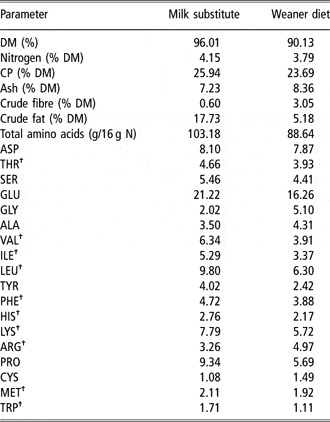
Furthermore, representative samples were taken from milk substitute and weaner diet and analysed for DM, CP, crude fibre, ash and fat by Weender standard procedure (Naumann and Bassler, Reference Naumann and Bassler1993). Nitrogen, amino acid content and D-alanine were measured as described above. Chemical composition of the milk substitute and the weaner diet is given in Table 2.
Analysed nutrient content of milk substitute and weaner diet applied in the experimental period

DM = dry matter; CP = crude protein; ASP = asparagine; THR = threonine; SER = serine; GLU = glutamine; GLY = glycine; ALA = alanine; VAL = valine; ILE = isoleucine; LEU = leucine; TYR = tyrosine; PHE = phenylalanine; HIS = histidine; LYS = lysine; ARG = arginine; PRO = proline; CYS = cysteine; MET = methionine; TRP = tryptophan.
†Essential amino acids.
Histological sections of the SI wall were prepared and stained with hematoxylin and eosin and villous height (n > 15), and crypt depth (n > 20) was measured for each sample using VID III image analysis software (Synoptics Ltd, Cambridge, UK). Subsequently, mean values were calculated per pig and intestinal site.
Calculation of digestibility
Apparent ileal nitrogen digestibility was determined on the basis of the indigestible marker PEG 4000 and its respective ratio in diet and ileal digesta (equation 1: Schneider and Flatt, Reference Schneider and Flatt1975) for each daily sampling.
Calculation of apparent ileal nitrogen digestibility (AIDN; %) and apparent ileal amino acid digestibility (AIDAA; %)

Furthermore, the 15N enrichment was measured in ileal digesta and blood plasma in each animal, which enabled the estimation of endogenous nitrogen losses (ENL) at the terminal ileum (equation 2).
Calculation of endogenous nitrogen losses (percentage of total nitrogen) at ileal level

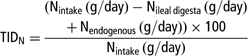
The apparent ileal nitrogen digestibility was corrected on the basis of the estimated ENL and true ileal nitrogen digestibility (TIDN) was calculated according to equation 3.
Calculation of true ileal nitrogen digestibility (TIDN; %)
Statistical analysis
Data, unless otherwise stated, were analysed using repeated measures ANOVA including treatment (control v. weaned) and either sampling occasion or site (25% v. 50% v. 75%) as fixed effects in the case of dietary or morphological measurements, respectively. Litter was included as a random effect; and the treatment × occasion or treatment × site interaction was also included. Suitable denominators for the calculation of F ratios were determined using an algorithm described by Zar (Reference Zar1996). The F ratios for treatment and litter were calculated using the mean sum of squares for piglet as the denominator, while the F ratios for all other effects used the error mean sum of squares as the denominator. Potential violations of the sphericity assumption were adjusted for using a combination of the methods of Huynh–Feldt and Greenhouse–Geisser as suggested by Stevens (Reference Stevens1996).
Results
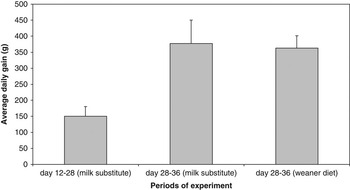
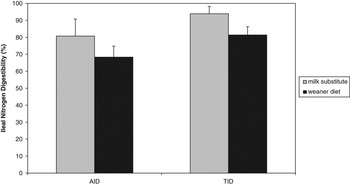
Average daily gain (ADG) of piglets in the ‘pre-weaning’ phase, when both groups were fed milk substitute, was 150 ± 30 g (mean ± s.e.m.); this approximately doubled in the ‘post-weaning’ period in both experimental groups (Figure 2). There was no difference in ADG between the control and the weaned group (P < 0.05) after dietary change. Total ileal nitrogen, comprising of endogenous, microbial and exogenous, that is, non-digested nitrogen, was significantly higher in pigs fed the weaner diets compared with the milk substitute group. We observed a significant time effect, that is, a decline in total ileal nitrogen in the weaner diet group and considerable shifts in total ileal nitrogen over time in the milk substitute group (Figure 3). AIDN and TIDN were significantly higher in the control group compared with the weaned group (Figure 4) averaged over the 7 days after dietary change. Endogenous nitrogen did not differ between groups when expressed either as daily flow (g/day) or related to dry matter intake (g/100 g DMI), whereas microbial and exogenous nitrogen were significantly higher in the weaned group (Table 3).
Average daily gain (means ± s.e.m.) of piglets before (days 12 to 28) and after (days 28 to 36) the dietary change fed either milk substitute or a weaner diet; effect of diet before v. after dietary change, P < 0.001; effect of diet after dietary change, P > 0.05.

Kinetics of total ileal nitrogen flow (means ± s.e.m.) of early-weaned piglets in the first week post-dietary change fed either milk substitute or a weaner diet; effect of diet on total ileal N, P < 0.001; effect of day on total ileal N, P < 0.001.

Apparent (AID) and true (TID) ileal nitrogen digestibility (means ± s.e.m.) of early-weaned piglets fed either milk substitute or a weaner diet; effect of diet on digestibility (AID and TID), P < 0.001.

Ileal nitrogen flow (means ± s.e.m.) of early-weaned piglets fed either milk substitute or a weaner diet

DMI = dry matter intake; ns = non-significant.
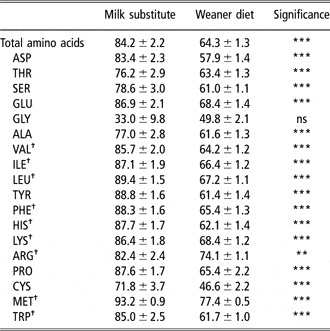
The digestibility of the sum of amino acids was significantly higher (P < 0.001) in the control group, fed milk substitute, compared with its counterparts fed the weaner diet (Table 4). For the individual amino acids, we obtained the same picture with the exception of glycine, which was numerically higher digestible in the weaner group. However, glycine digestibility did not differ significantly between treatments (milk substitute 33% v. 50% weaner diet, P > 0.05), most likely due to the high standard deviation in the milk substitute group.
Apparent ileal digestibility (%) of amino acids (mean ± s.e.m.) of early-weaned piglets fed either milk substitute or a weaner diet

ASP = asparagine; THR = threonine; SER = serine; GLU = glutamine; GLY = glycine; ns = non-significant; ALA = alanine; VAL = valine; ILE = isoleucine; LEU = leucine; TYR = tyrosine; PHE = phenylalanine; HIS = histidine; LYS = lysine; ARG = arginine; PRO = proline; CYS = cysteine; MET = methionine; TRP = tryptophan.
†Essential amino acids.
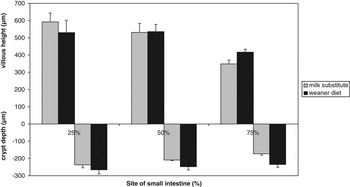
Villous height and crypt depth decreased significantly along the proximo-distal axis (25%, 50% and 75%) of the SI (Figure 5). Additionally, crypt depth was significantly affected by the dietary treatment, displaying deeper crypts in piglets fed the weaner diet compared with the milk substitute group (P < 0.01) as shown in Figure 5. In contrast, villous height was not influenced by the dietary treatment and there was no interaction between treatment and site.
Villous height and crypt depth (±s.e.m.) at three sites of the small intestine (25%, 50% and 75%) of early-weaned piglets fed either milk substitute or a weaner diet; effect of diet on villous height, P > 0.05; crypt depth, P < 0.01; effect of site on villous height, P < 0.001; crypt depth, P < 0.05.

Discussion
We conducted an experiment to investigate the impact of dietary composition on SI morphology and the digestion of protein and amino acids in piglets. During the experimental period, we could exclude stressors seen under natural weaning conditions such as weaning anorexia, social and environmental changes.
Our data show clearly that changing the diet of piglets abruptly to one based on cereals was associated with significantly lower ileal nitrogen and amino acid digestibility compared with the control animals fed milk substitute (Figure 4; Table 4). Absolute flow rates of total nitrogen at the terminal ileum were significantly higher in piglets fed the weaner diet, which was mainly caused by a higher microbial and non-digested dietary nitrogen contribution. The nature of change in the microbiota is not entirely clear; changes may have occurred as a result of an increase in microbial diversity (Konstantinov et al., Reference Konstantinov, Favier, Yun Zhu, Williams, Kluess, Souffrant, de Vos, Akkermans and Smidt2004; Kluess, Reference Kluess2004) as well as due to an increase in the number of pre-existing microorganisms.
The majority of the studies, investigating endogenous nitrogen losses, have been conducted in weaned and growing pigs receiving solid feed. Data about ileal digestibility of nitrogen and amino acids, endogenous and microbial nitrogen contribution in pre-weaning piglets fed sow’s milk or milk substitute are scarce. Wilson and Leibholz (Reference Wilson and Leibholz1981) conducted various experiments to investigate the digestion of nitrogen and amino acids and endogenous nitrogen losses in artificially reared piglets fed either diets based on milk (pellets/liquid) or soybean protein (pellets). Data were obtained for animals between 14 and 35 days of age fed ad libitum and at two-hourly intervals (liquid milk diet). Initial body weight and growth performance were comparable to our own piglets and daily nitrogen intake in the 35-day-old animals equalled that of the pigs used in our experiment. Their estimate of ileal digestibility of nitrogen was similar to present data, with a clearly higher digestibility in pigs fed milk protein-based diets over those fed soybean meal. Apparent ileal digestibility of the individual amino acids (essential and non-essential) was considerably lower for the milk protein fed animals in the Wilson and Leibholz study as compared to our results for the control group, whereas data from the soybean-fed group were comparable with our group fed the weaner diet. With respect to the endogenous nitrogen losses, they reported different levels of ileal flow, which could in part be explained by the use of different methodology (nitrogen-free method in the Wilson and Leibholz study, in comparison with the 15N-tracer technique in our study).
Another study dealing with ENL, ileal nitrogen dynamics and amino acid digestibility in very young piglets was conducted by Mavromichalis et al. (Reference Mavromichalis, Parr, Gabert and Baker2001). They determined AIDN in unweaned cannulated piglets fed sow’s milk and TIDN by means of enzymatically hydrolysed casein-based diet and indigestible soluble markers (co-EDTA, YbCl3). They reported comparable values to the milk substitute group in our own study (92.8% TIDN). Another interesting point was the use of sow’s milk in this study; the authors analysed the amino acid composition of the harvested sow’s milk and discussed the particular amino acid digestibility in relation to the main milk components, casein and whey. Casein is the main dietary source of amino acids in suckling piglets, whereas whey proteins include several immunoglobulins, in particular IgA. Approximately 20% of the IgA has been shown to be excreted undigested in human infants, which could explain why amino acids in sow’s milk are not 100% digestible, as one would assume in such a highly digestible diet. Comparing the nitrogen and amino acid content of sow’s milk (reported in Mavromichalis et al., Reference Mavromichalis, Parr, Gabert and Baker2001) with the substitute based on bovine milk as used in our study revealed a surprisingly similar composition, although nitrogen content was slightly lower (4.2% v. 4.8%), most amino acids were approximately equal, except for proline, arginine and methionine, which showed a markedly lower content (2.42%, 0.85% and 0.55% DM v. 3.59%, 1.37% and 0.64% DM) than in sow milk.
Besides ENL, we were also interested in the contribution of microbial nitrogen at the terminal ileum in young piglets. We estimated the contribution of microbial N at about 2.5% of total ileal nitrogen, and in absolute values at 0.08 ± 0.004 g/day (milk fed) and 0.15 ± 0.01 g/day (weaner diet).
There is little information about bacterial nitrogen in ileal digesta in piglets around weaning. Wünsche et al. (Reference Wünsche, Volker, Souffrant and Borgmann1991) determined the bacterial nitrogen contribution in ileal digesta of pigs, applying different methods for digesta collection: post-valve T-cannula and end-to-end or end-to-side ileorectal anastomosis. The authors assessed the average bacterial nitrogen as approximately 25% of total ileal nitrogen. They are in good agreement with studies from Schulze et al. (Reference Schulze, van Leeuwen, Verstegen, Huisman, Souffrant and Ahrens1994) and Bartelt et al. (Reference Bartelt, Bergner, Drochner, Kijora and Gotz1994). Reported data on bacterial nitrogen in ileal digesta are considerably higher than those we obtained in our studies. The main reason for this difference can be attributed to the animals used. These authors used growing or fattening pigs and in one case miniature pigs (Bartelt et al., Reference Bartelt, Bergner, Drochner, Kijora and Gotz1994) with an average body weight well above 25 kg. It can be assumed that the bacterial N contribution in such animals is much higher than in piglets aged 28 days due to a longer adaptation time to solid, cereal-based feed and a different experimental environment. Furthermore, the mentioned research groups applied diaminopimelic acid (DAPA) as a bacterial marker and determined it in an isolated bacterial fraction; in contrast to our study in which D-alanine was determined directly in digesta. However, Huang et al. (Reference Huang, Sauer and Marty2001) reported lower values for bacterial nitrogen in ileal digesta of growing pigs, ranging between 14% and 21% of total ileal nitrogen, although applying DAPA in isolated bacterial fraction. Such differences between studies using the same methods indicate that besides an age-dependent increase in bacterial mass, there also exists a high level of variability between pigs with respect to the bacterial fraction in the SI. This assumption is supported by the investigations of Wünsche et al. (Reference Wünsche, Volker, Souffrant and Borgmann1991).
At present, the use of D-alanine as a bacterial marker is prevalent in the ruminant studies in which it is regarded as superior to DAPA (Garrett et al., Reference Garrett, Goodrich and Meiske1987; Schoenhusen et al., Reference Schoenhusen, Voigt, Hennig, Kuhla, Zitnan and Souffrant2008). There is only one short communication that refers to the use of D-alanine in pigs (Hennig et al., Reference Hennig, Schönhusen and Souffrant1999). However, the authors used growing miniature and saddleback pigs with an average body weight above 25 kg and therefore reported higher bacterial N in ileal digesta. Literature dealing with the assessment of bacterial nitrogen contribution in the SI of weaning piglets is sparse. Our studies were a first attempt to establish D-alanine as a direct microbial marker in young monogastric animals, but further investigations are required.
Intestinal morphology was also assessed at three sites in the SI, at 25%, 50% and 75%. Small intestinal morphology of piglets receiving milk replacer constantly was very similar to that of suckling piglets, with respect to villous height and crypt depth, as reported in the literature (van Beers-Schreurs et al., Reference van Beers-Schreurs, Nabuurs, Vellenga, Kalsbeek-van der Valk, Wensing and Breukink1998; Hedemann et al., Reference Hedemann, Hojsgaard and Jensen2003) and in our prior studies. In these studies conducted just before the present experiment in the same facilities (Harris, Reference Harris2005), isolator-reared piglets were compared with those raised by their dam. The data showed that there was no difference for villous height and crypt depth between piglets from the isolator and those raised by their dam. This also supported the hypothesis that the use of artificially reared, milk substitute-fed piglets is a good model for the study of the suckling piglet.
Interestingly, villous height did not differ between the two treatments, but there was a significant increase in crypt depth at all three sites in the group fed the weaner diet. The observation that villous height was unaffected by dietary change is supportive of the view that the villous atrophy normally associated with weaning is due to the period of anorexia that occurs immediately post-weaning (Pluske, Reference Pluske2001). Weaning anorexia is a multifactorial phenomenon, which we tried to discern in our study in order to focus on the dietary aspect only. The decrease in feed intake was prevented by providing the weaner diet as slurry, which is in agreement with earlier publications (van Beers-Schreurs et al., Reference van Beers-Schreurs, Nabuurs, Vellenga, Kalsbeek-van der Valk, Wensing and Breukink1998; Dunshea et al., Reference Dunshea, Kerton, Eason and King1999). Therefore, effects on intestinal morphology can be largely attributed to the change in diet composition, excluding the previously mentioned factors occurring during weaning transition.
Crypt hyperplasia occurring in the absence of villous atrophy is, however, a novel observation. A possible explanation is that the pig’s immune system is directly responding to novel antigens (cereal, fish protein concentrate and soybean) being presented at the gut mucosa. Bailey et al. (Reference Bailey, Miller, Telemo, Stokes and Bourne1993) have reported that pigs show a systemic antibody response to antigens within the weaning diet and experience a transient period of sensitivity before the development of oral tolerance. The hyperplasia of the crypt could be indicative of a type III, cell-mediated hypersensitivity response (Miller et al., Reference Miller, Newby, Stokes, Hampson and Bourne1983). Another possibility is the impact of the gastrointestinal microbiota, as one can assume that the microorganisms differ between the milk-fed and cereal-fed animals. Shirkey et al. (Reference Shirkey, Siggers, Goldade, Marshall, Drew, Laarveld and van Kessel2006) showed a great effect of bacterial inoculum in sterile piglets on villous height and crypt depth, with mono-associated animals displaying longer villi and shallower crypts in the distal SI as compared to animals associated with a mixed inoculum from porcine faeces. This shows clearly the effect of intestinal microbiota on gut morphology. However, as we did not investigate the microbiota in the scope of this study, we can only speculate about the difference between experimental groups.
Conclusion
We determined endogenous nitrogen losses, and subsequently true ileal digestibility, and investigated the intestinal morphology in a piglet model. Our data show that the imposed dietary change to a cereal-based diet resulted in a decrease in ileal digestibility of nitrogen and amino acids compared with a milk-based diet, which was mainly due to an increase in exogenous and microbial nitrogen flow at the terminal ileum. This is likely to have an impact on large intestinal fermentation as more protein can enter the hindgut.
Furthermore, we could show for the first time that dietary change without a decrease in feed intake (weaning anorexia) maintained villous height but resulted in a significant crypt hyperplasia. The latter is hypothesised to be related to a hypersensitivity response towards dietary antigens or to a shift in the gastrointestinal microbiota, but requires further research in order to elucidate this effect.
On the basis of our results, we can state that we developed an experimental model that enables us to discern the various factors associated with weaning, in particular weaning anorexia and dietary composition. This is a useful experimental setup to investigate the weaning transition of piglets more in depth.
Acknowledgment
This study was financially supported by the European Union in the frame of the project ‘Healthypigut’ (contract no. QLK5-CT-2000-00522).
For the accurate and fast analysis of the samples, we thank Mrs Aenne Köpnick, Mrs Mareile Gratopp, Mrs Brigitte Waischnow and Mrs Christa Schwarzat, and Mrs Jenni Fowler for her indispensable help in practical conduct of this experiment.