Do citizens care whether their governments’ policies breach international law (IL)? Or are other imperatives such as moral egregiousness, criticism by the international community, or other denouncements more influential in shifting domestic opinion? These questions are particularly relevant in the human rights arena, where domestic mechanisms play a crucial role in holding governments to account for actions that contravene IL.Footnote 1 Campaigns by human rights nongovernmental organizations (NGOs) and international organizations regularly center on making citizens aware of abuses, attempting to get them to think about these practices as unacceptable and in breach of accepted principles or duties, and mobilizing individuals to push for change—as well as making formal interventions via international organizations.Footnote 2
A growing experimental literature explores these and related questions, commonly finding that citizens are less willing to support policies that breach international human rights law.Footnote 3 A broader body of experimental work—on military intervention, trade policy, drone strikes, humanitarian intervention, and climate change—largely echoes these findings.Footnote 4 This research sheds important light on whether and how IL can be harnessed for more humane policy, but its heavy focus on legal frames is not consistent with the reality that abuses can typically be couched in a variety of ways. It also focuses heavily on policy attitudes. Studies of whether (and why) individuals decide to take action are relatively rare, even though many prominent theories of human rights law see this as a key link in the chain of framing and policy accountability.Footnote 5
This research note considers whether people respond differently to abuses if they are framed differently—as violating IL, being morally repugnant, or harming the country's international reputation. This approach extends the existing literature on IL framing by working from the basis that frames rarely exist in a vacuum where only one frame is available. Frames compete with each other, and with other sources of information, for our attention. Accordingly, any actor seeking to influence a debate must consider not only whether to frame, but also how to frame. Also, our understanding of how effective frames may (or may not) be in the human rights arena is limited: while some frames may change attitudes (at least in the short term), can they also impel individuals to political action?Footnote 6
We examine these questions in the context of refugee policy, which has attracted limited focus in the experimental international relations / IL literature, despite its high political salience in many countries. We focus on Australia's “boat arrivals” policy, which, while among advanced democracies’ most draconian, is not unique.Footnote 7 Most legal scholars agree that it breaches key principles enshrined in international human rights law, most importantly detention, treatment of children, and protection regardless of method of arrival.Footnote 8 These principles have important moral foundations, and underpin domestic concerns that the policy tarnishes Australia's global reputation.Footnote 9
In a novel survey experiment, we expose a nationally representative sample of Australians to one of three experimental conditions (or a control), each highlighting a different norm or obligation the policy breaches. We make several key findings. First, framing current policy as violating IL, morally repugnant, or reputationally costly reduces policy support. But, second, the frames are not interchangeable in their impacts on attitudes. International legal frames have the strongest effects, generating significantly more attitudinal opposition than moral or reputational frames. Third, it is much harder to induce action than to change attitudes.
On the question of whether to frame, we find evidence of causal mediation for each frame versus the control, but this does not explain much of the total difference in interest in mobilizing (which is generally very low). We also find that framing (as opposed to saying nothing at all) may provoke anti-mobilization reactions, and we offer some tentative ideas why. On the question of how to frame, we find that couching policy in IL or moral terms results in similar willingness to take action. Both framing approaches provoke more willingness to mobilize than does highlighting international reputational costs, but for different reasons. Couching current policy in international legal, rather than reputational, terms makes people more interested in mobilizing largely because it changes attitudes about the policy itself. In contrast, calling attention to moral principles over reputation drives up willingness to take action chiefly through some other process(es) independent of attitudes. In both cases, it is also possible that reputational frames stir up unique anti-mobilization reactions.
Frames, Attitudes, and Action
Framing is the act of selecting some part of a perceived reality and making it more prominent, which in turn can influence whether targets notice a problem, how they make sense of it, whether they remember it, and how they act on it.Footnote 10 Scholars usually emphasize two components of framing: selecting information and arguments about why a practice is good or bad; and using established narratives, tropes, or images to shape how people understand what is at stake and weigh the various considerations.Footnote 11 In practice, human rights campaigns rarely engage in one without the other. For instance, the anti-apartheid movement drew attention to the injustice of mobility restrictions and counterinsurgency tactics, while also encouraging the public to view these as racist and a violation of civil rights.Footnote 12 This is relevant in the design of our survey experiment (discussed later), which uses both components.
Four key points have emerged from studies on framing effects, human rights, and mobilization. First, frames seldom exist in a vacuum where only one message is available. Instead, there are usually a variety of ways to frame the same human rights problem, even for actors with the same policy goal.Footnote 13 Second, changing peoples’ opinions is not always easy, but frames are usually more successful when they appeal to individuals’ experiences or to principles that are valued in their society.Footnote 14
Third, inciting action is usually harder than shifting attitudes because action is costlier. This is especially challenging in the human rights arena, where ordinary citizens usually do not have a material stake in abuses and typically struggle to connect personally with the plight of the abused.Footnote 15 Finally, frames that invoke standards or principles that people care about can nonetheless successfully change attitudes and incite mobilization. A common strategy in such cases involves linking the problem to a standard that a wider audience values. Women's rights groups, for instance, have long understood this and have framed their efforts as a matter of equality, liberty, democracy, and discrimination, depending on the prevailing discourse at the time.Footnote 16
Our survey experiment compares three frames commonly found in the international human rights literature: violation of IL, immorality, and harm to a country's international reputation. Here, we provide a brief overview of each and discuss empirical findings where relevant.
Scholars identify three key reasons why citizens may oppose policies that breach IL. Laws clarify which practices are acceptable, which can increase sensitivity to “rights gaps.”Footnote 17 Appealing to treaties also invokes the rule of law, which may be more universally accepted and objective where other principles are more ambiguous within and across societies.Footnote 18 Finally, invoking law can incite other judgments about whether a particular practice is acceptable.Footnote 19 Prominent theories of international human rights law also advance specific arguments about how legal obligation spurs mobilization.Footnote 20 In addition to making people more critical of policy (which may directly incite action), laws may help make this process more successful by providing a focal point for collective action and another tool in the enforcement arsenal.Footnote 21
Most experimental human rights research has focused on how people perceive international legal breach, and much of it finds that people oppose practices that are framed as violating IL. Americans oppose the use of torture on captured combatants in contravention of the UN Convention against Torture and solitary confinement if it violates international legal standards, and they support punitive measures against governments that refuse to obey IL.Footnote 22 In the related but distinct area of war conduct, international legal frames reduce Americans’ support for civilian bombings and drone strikes.Footnote 23 Some findings are more mixed, especially in non-US respondent pools.Footnote 24 Whereas Indian citizens are less supportive of torturing opposition groups if this is inconsistent with international legal obligations, Argentines are not responsive to these frames, and Israelis are more supportive of torture if it contravenes IL.Footnote 25 Another study finds a similar “backlash” among Turks, who are most likely to back restrictive refugee policies if they breach IL.Footnote 26 To our knowledge, there is no experimental work on how IL affects willingness to mobilize. The finding that activists value it as a tool for holding leaders to account is consistent with this notion, but not conclusive about impacts on mobilization in practice.Footnote 27
Moral framing underpins the practice of “naming and shaming” human rights violators.Footnote 28 But which moral principle a frame taps into can make a big difference. For instance, a frame that emphasizes a duty to prevent and alleviate all forms of human suffering would likely incite stronger criticism of restrictive refugee policy than a frame that accentuates an obligation to attend to family, kin, or fellow citizens—and these impacts would likely vary from person to person depending on their own moral values.Footnote 29 To be broadly effective in changing attitudes, moral frames must appeal to principles that attract the support of, and are salient to, the target population.Footnote 30 The bar for spurring mobilization is even higher: moral frames must make people feel “entitled to act on their outrage.”Footnote 31 Activists often accomplish this by transforming an issue that only a few people have a material stake in into one that everyone has a moral stake in.
Two experimental studies indicate that framing human rights as a moral challenge affects policy attitudes. One finds that even the simple act of asking people to consider the morality of targeting enemy civilians in wartime makes them less willing to condone the practice.Footnote 32 The other reports that framing civilian bombings as immoral reduces support for the practice.Footnote 33 To our knowledge, only one experimental study compares the impact of different frames on attitudes, but it finds no difference between couching civilian bombing as immoral, emphasizing international legal breach, or appealing to both simultaneously.Footnote 34 Turning to mobilization, one (non-experimental) study argues that framing developing-world debt relief in religious terms was successful in mobilizing American Christians because it evoked a value they held dear; yet this frame fell flat in more secular societies.Footnote 35 We are unaware of any experimental work on moral frames and human rights action. Beyond the human rights arena, scholars report that whereas moral frames can incite attitudinal change, they do not necessarily rouse political action.Footnote 36
In the human rights arena, (some) governments demonstrably seek to garner a reputation as members of the international community “in good standing.”Footnote 37 But do individuals care about their country's global reputation, and are they willing to act on that basis? The crisis bargaining and conflict literature demonstrates that citizens care about maintaining a reputation for resolve and keeping promises, and that hawks and doves care about different elements of reputation.Footnote 38 It is unclear whether these insights carry over to human rights, where discourse focuses more heavily on “good standing” and adherence to international principles.
There is little individual-level evidence about how frames affect attitudes toward human rights, or how these frames compare to others on offer. One study, while not specifically focused on frames, finds that Americans who support humanitarian intervention are motivated more by moral duty than by reputational concerns.Footnote 39 Another finds that “naming and shaming” reduces support for abusive policies, but the difference falls short of statistical significance.Footnote 40 To our knowledge, there is no experimental research on how invoking international reputation affects human rights mobilization. Observational evidence from the issue of developing-world debt suggests that the movement became much more successful in Japan when activists abandoned a religious frame and adopted more culturally salient terms like “being a good international citizen.”Footnote 41
The strongest counterargument to this is that framing human rights in legal, moral, or reputational terms can induce backlash. For instance, individuals may not consider IL a viable or legitimate source of domestic authority.Footnote 42 Framing a question in legal terms may also cue cost/benefit thinking, suppressing other considerations like moral duties. Whether the latter have a stronger pro-rights pull is an open question. Moral framing also faces significant hurdles when there are competing perspectives on what is acceptable and salient.Footnote 43 Backlash against international reputational appeals has received less attention in the human rights literature, but it is not hard to imagine—following research on international conflict—that they could backfire among people who care about other aspects of reputation, are tired of hearing this criticism, or simply think governments should focus on other concerns.Footnote 44
International Refugee Law and Policy in Australia
In 2020, the world's population included over 34 million refugees and asylum-seekers. Globally, before the COVID-19 pandemic hit, more than 4,650 people submitted new asylum applications each day.Footnote 45 Along with climate change, refugee displacement is one of the world's most pressing challenges, with profound implications for economic stability and national security. Some have called it a “wicked problem” that forces democratically elected leaders to strike a balance between protecting vulnerable people and sustaining support for these policies (which are often unpopular) at home.Footnote 46 The COVID-19 pandemic has rendered these questions more complex, though no less pressing.
We focus on Australia for several reasons. First, refugee politics is salient there, making our survey relevant to respondents and our findings germane to current debates.Footnote 47 Second, while acknowledging that each country is unique and that Australia's refugee politics (and boat arrivals in particular) are highly charged, it shares with other advanced democracies a long history of immigration and asylum.Footnote 48 Its refugee population per capita is virtually identical to Britain's and is very much in the middle of the worldwide distribution.Footnote 49 Its policies toward boat arrivals are draconian, but they are not unique.Footnote 50 Similar elements have been replicated or are under discussion in the US, Canada, and the UK, to name a few.Footnote 51 Third, most existing experimental human rights agreement research relies on American respondents. Following others, we argue that it is crucial to investigate whether findings “travel.”Footnote 52
Refugee resettlement first became politically salient in Australia in 1976, when a Vietnamese fishing boat carrying five Indochinese refugees arrived in Darwin Harbour; two thousand followed over the subsequent five years.Footnote 53 In response, the Australian government introduced policies to deter asylum-seekers from attempting the ocean passage, while prioritizing those who applied from abroad. The arrival of a Norwegian freighter, the MV Tampa, whose crew rescued almost five hundred Hazara refugees from international waters near Australia in 2001, thrust the issue into the limelight again, where it has remained ever since.Footnote 54
The Tampa incident spurred the entrenchment of two particularly problematic practices (from a human rights perspective).Footnote 55 The first is “turnbacks,” where the government's coast guard intercepts vessels bringing asylum-seekers and turns—or even tows—them back to their departure point. The second is mandatory detention at Australian-run facilities offshore. A third practice, child detention, was less a deliberate policy choice than a result of the reality that refugees often travel as families, or have children while in detention. Most elements of these policies enjoy bipartisan political support in Parliament, but reactions have been more critical among segments of the Australian population and abroad.Footnote 56
These three elements are at the heart of Australia's current policy. They are also part of our experiment (discussed later), but they are not the experimental treatment. Rather, they form the underlying basis for why current policy is problematic. Our experiment holds that basis constant but varies how it is framed—as breaching IL, morally objectionable, or reputationally harmful.
Legal Basis
Legal scholars and practitioners argue that Australia's designation of asylum-seekers who arrive by boat as “illegal” breaches the UN Refugee Convention, which requires that asylum-seekers who enter without a visa not be penalized as long as they show good cause for how they arrived.Footnote 57 Most also agree that turnbacks breach the Refugee Convention's “non-refoulement” principle, which requires parties not to expel or return refugees when doing so would threaten their life or freedom.Footnote 58 Australia's offshore detention system violates the Convention's requirements of humane treatment and protection from arbitrary detention, as well as various rights enshrined in the International Covenant on Civil and Political Rights.Footnote 59 A UN Special Rapporteur has found that the detention system violates the Convention Against Torture, and a class-action suit on this matter is currently underway in the Australian High Court.Footnote 60
For decades, Australian Human Rights Commissioners have been unanimous that mandatory immigration detention breaches international legal obligations to children, most notably the requirement that young people be detained only as a last resort, and never arbitrarily.Footnote 61 The Commission has identified a range of breaches of the Convention on the Rights of the Child, including deprivation of liberty, arbitrary and unlawful interference in family life, failure to provide education and a safe environment, and failure to act in the best interests of unaccompanied minors. The report makes evident that detention, especially when indefinite, breaches the Convention on the Rights of the Child by causing children extreme physical, emotional, psychological, and developmental distress.Footnote 62
Moral Basis
The moral principle that refugees should not be punished for how they arrived is crucial because it is often gravely dangerous or impossible for those fleeing persecution to obtain a visa beforehand. Even those who see our main moral duties as being to our own community may maintain that we have a moral obligation not to return refugees who reach our shores if this would result in significant harm or loss of life.Footnote 63 Detainees suffer neglect, inhumane treatment, and serious abuse—and in some cases they were left to fend for themselves after the Manus Island facility closed.Footnote 64 Physicians argue that mandatory detention constitutes torture because it is designed to deter or punish those who arrive by boat by exposing them to conditions that maximize suffering and suicidality.Footnote 65 Others argue that the system is particularly morally bereft because it is deliberate and not the result of capacity problems.Footnote 66
Critics see the harm to children as especially heinous. The moral premise that young people should not be imprisoned is well accepted: “Detaining children because of their parents’ migration status will always violate the principle of the best interests of the child.”Footnote 67 The Australian Medical Association unequivocally condemns the practice due to the risks to children's development and health, and over 80 percent of Australian pediatricians agree that it is a form of child abuse.Footnote 68 However, removing children from detention breaches the moral imperative that families should not be separated. The government has argued that detention of children is necessary for this reason.
International Reputational Basis
UN officials and many member states have criticized Australia's turnbacks as a “poor benchmark” for Australia's neighbors that “should not be considered a model by any country.”Footnote 69 Some argue that the turnbacks compromise Australia's ability to use its reputation as a “good global citizen” to press for advantage, in addition to infuriating regional allies and undermining long-term cooperation.Footnote 70 The UN and many member states have condemned Australia's offshore detention system for decades, most notably during its (nonetheless successful) 2017 bid for a seat on the UN Human Rights Council and during its 2015 Universal Periodic Review in that body—during which a prominent Australian scholar noted, “It was manifestly clear that we are not role models on asylum. We are pariahs.”Footnote 71 When two detainees won human rights and literary awards, mainstream media labeled it an embarrassment that “cast a lasting stain on the country's human rights reputation.”Footnote 72
Australia's detention of children has gained worldwide attention, and is arguably the most infamous aspect of the country's boat arrivals policy. The despair and the degree of physical and psychological trauma they have experienced are documented in the “Nauru files,” a cache of over two thousand leaked reports from the detention facility.Footnote 73 The files unleashed concern throughout the Australian and international press about harm to the country's international standing and possibly entrenching a “pariah status.”Footnote 74
Text Analysis of Australian Media Coverage
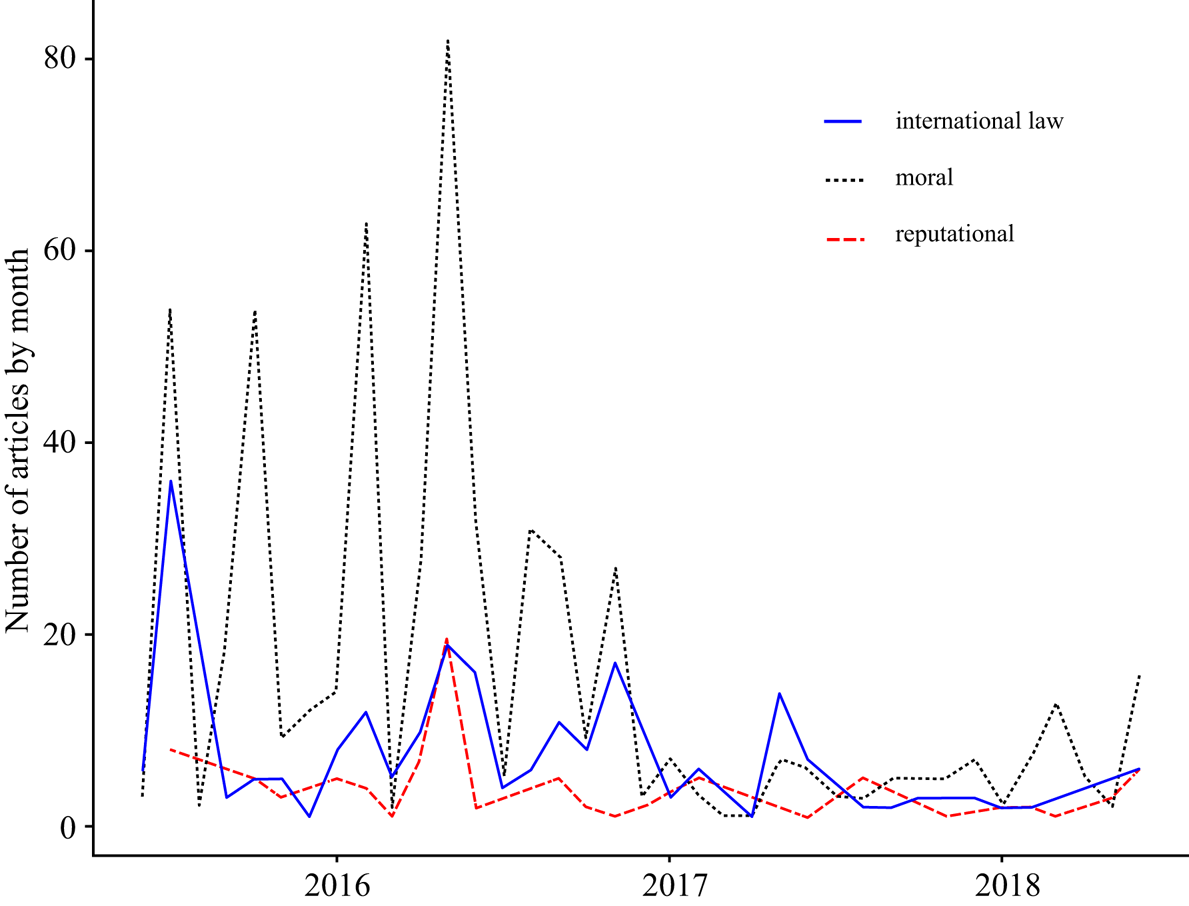
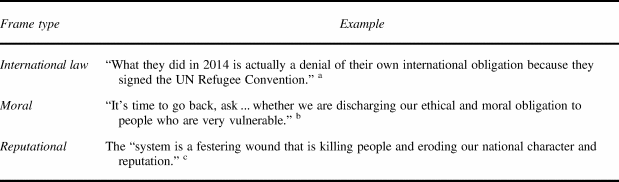
We have argued that Australia's current policy can be framed as breaching IL, or violating moral standards, or harming the country's international reputation. These form the basis of our survey experiment in which we investigate whether these frames are present in Australian public discourse. We used Factiva to collect all articles that included the word boat along with refugee or asylum in the major daily Australian newspapers for the three years prior to our survey experiment (details are in the online supplement). Table 1 presents an example of each frame from the corpus. Moral frames appear the most frequently, followed by international legal and then reputational frames (Figure 1).Footnote 75 The reasons for this are unclear, and of course article prevalence is a blunt and imperfect measure of frame prevalence. Nonetheless, we argue that the data shown in Figure 1 provide sufficient confidence in the external validity of our frames.
International legal, moral, and reputational frames in the Australian media on boat arrivals and refugees

Example frames from Australian media coverage of Australia's “boat arrivals” policy

a. Jewell Topsfield, “Fate Uncertain for Refugees in Indonesia Awaiting Resettlement in US,” The Age, 31 January 2017.
b. Editor, “The Figures Are In: $2b for Human Misery Is Not a Great Result,” Sydney Morning Herald, 21 August 2016.
c. Cameron Stewart, “Moral Compass in a Spin over Asylum-Seekers,” The Australian, 12 May 2016.
A Survey Experiment on Perceptions of Australian Boat Arrival Policy
We conducted our survey experiment using Ipsos, which maintains a respondent panel that is representative of the Australian population in terms of geographic coverage, gender, and other demographics.Footnote 76 All respondents received an initial three-sentence, factual overview of existing policy. Because there is a great deal of misperception and misinformation on this topic, it was important to ensure that all respondents had some baseline accurate information. Three treatment groups then received a framing treatment, while the fourth (control) group proceeded directly to attitudinal questions.
We limited the scope of our frames in three main ways. First, we concentrated on Australia's policy toward refugees who arrive by boat, because it offers a clear and tangible context in which to test some of the literature's most common frames. The breaches of IL, moral challenges, and reputational costs are evident and well documented. For most respondents, refugees in general—and those who arrive by boat in particular—are an outgroup.Footnote 77 Consequently, baseline support for restrictive policy should be higher than in a hypothetical involving an ingroup member. However, it is unclear whether this should affect the treatment impacts. On the one hand, it is possible that no type or amount of positive framing alters attitudes in contexts where negative attitudes are deeply entrenched.Footnote 78 On the other hand, it is precisely in the context of negative attitudes that there is the most “room to move” opinion. Overall, we do not have strong theoretical reasons to expect our frames to have different impacts in contexts involving other types of refugee/migrant/rights abuse, but this is an interesting question to explore in future research.
Second, we focused on frames that criticize existing policy. Australian public discourse is replete with alternate frames: common narratives in support of current policy include security concerns or deterrence, “queue jumping,” “unlawful” migration, and the dangers of the ocean passage.Footnote 79 However, we investigated frames that criticize existing policy because these align most closely with the relevant literature, and for comparability reasons. Third, our frames were diagnostic: they identified a problem and attributed blame.Footnote 80 This scope condition was necessary to make the project tractable, and it aligns with vignettes in existing research. Nonetheless, in future research, it would be illuminating to investigate whether prognostic, motivational, or other types of frame are most successful at getting people to mobilize.Footnote 81
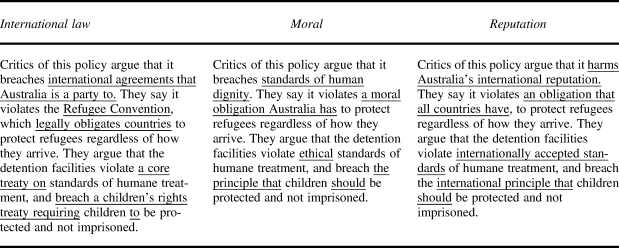
The experiment involved presenting each respondent with the same underlying information while varying some key consideration(s): anchored in IL, morality, or international reputation. One-quarter of respondents—the control group—received no additional information.Footnote 82 The remaining respondents were randomly shown one of the three frames indicated in Table 2. We then asked all respondents whether they approve or disapprove of existing policy, and whether they would sign a petition, donate to an NGO, or attend a protest urging a change to these policies.Footnote 83
Experimental treatment vignettes

Our approach naturally has limitations. While frames are ubiquitous in public discourse on this debate in Australia and elsewhere, drawing a causal path from frame exposure to policy attitudes and action in practice is challenging. It is harder for people to “tune out” frames in a survey than in the real world, and for reasons discussed earlier, our analysis does not explore counter-frames.Footnote 84 Furthermore, in line with other studies that use quasi-behavioral measures, we ask respondents whether they would participate in various types of political action.Footnote 85 Of course, this does not tell us whether they would actually take those actions—but it does measure intent beyond expression of attitudes.
Results
Policy Attitudes
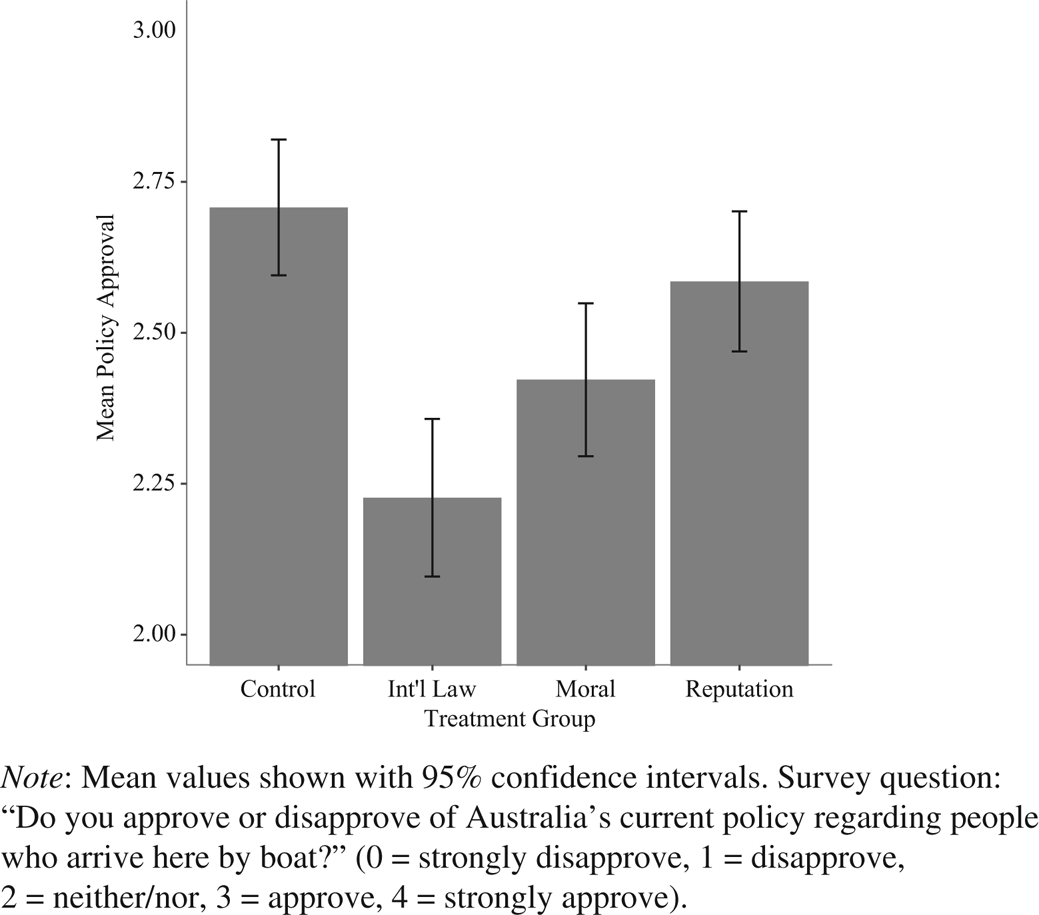
We begin by exploring graphically whether policy attitudes differ across treatment groups. Figure 2 displays mean policy approval values, along with 95 percent confidence intervals. Across all groups, the policy is popular—the mean value across the entire sample is 2.5 on a scale from 0 to 4, with over half of respondents approving or strongly approving. This is consistent with historical surveys.Footnote 86 As expected, the control group approves most strongly; all the treatment groups are less approving, but with interesting variation.Footnote 87 Those who receive the IL frame are most strongly opposed, followed by those who receive the moral frame. Of the three interventions, reading about harm to Australia's reputation has the smallest impact.
Attitudes toward Australia's boat arrival policy

Before engaging in hypothesis testing, we consider the question of balance across treatment groups. There is significant debate over whether balance testing is even statistically justified. Some argue that it is statistically meaningless if we know that treatments were assigned randomly via automation (which is now standard with firms such as Ipsos). From this perspective, balance testing is inappropriate and potentially problematic because it is based on the flawed notion that random assignment implies equal distribution of all characteristics across treatments (when, in fact, it guarantees only that those characteristics are distributed stochastically). Put simply, randomized data are “clean” and should be treated as such: balance testing and inclusion of pretreatment covariates in treatment effects models are unwarranted.Footnote 88
Those who favor balance testing point to two main considerations. First, it can help identify and control for differential attrition rates or faulty randomization mechanisms. Second, even in the absence of attrition or randomization problems, imbalance that arises by chance potentially poses a threat to inference, and therefore should be identified. The most common procedure is to include pretreatment covariates in the outcome model, potentially with interactions of the treatment and the pretreatment covariate(s) and/or robust standard errors, to control for heteroskedasticity. This approach can minimize bias in comparisons of the treatment and control groups, increase estimate precision, and allow the researcher to assess heterogeneity in treatment effects.Footnote 89 On the other hand, critics argue that even randomization that produces improbable distributions should be sufficient for inference, and that balancing might induce false positives (or negatives).Footnote 90
We see merit in both arguments. Rather than taking sides, we use both approaches. Looking first at balance, we observe that the distribution of pretreatment covariates across the four groups is equal, for the most part, but with some imbalance on ethnic attitudes and voting intentions. This potentially undermines inference because ethnic attitudes and party preference are presumably latent to views on boat arrivals. For parsimony, we report unbalanced OLS results in the main text, and present models with covariates in the online supplement. Our results are largely consistent whether or not we adjust for unbalanced randomization, and are robust to alternate specifications.Footnote 91
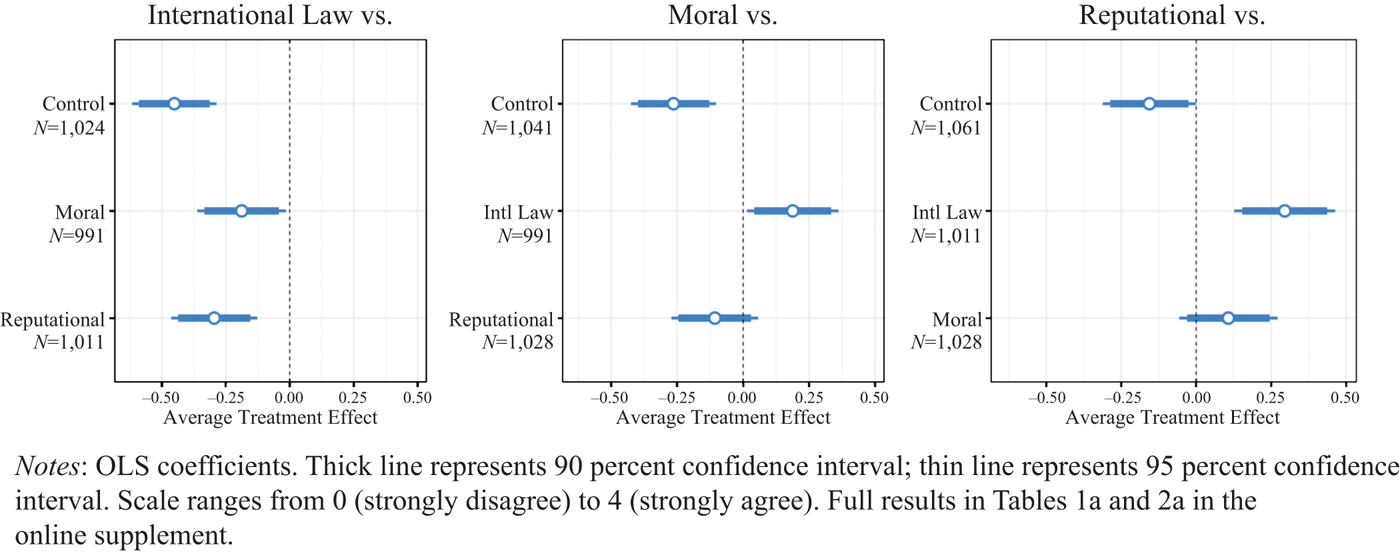
Because we are interested in comparing each frame against the control condition as well as alternate frames, we do several sets of comparisons (Figure 3). These indicate whether the frames’ impacts differ from the control, and whether they are distinct from each other. For example, if we want to know how each frame compares to the control, we should look across the first row of each slide. If we want to know whether appealing to IL has stronger or weaker impacts compared to moral appeals, we should look to the second row of the first slide (or, conversely, the second row of the second slide).
Average treatment effects, policy approval

Three main findings emerge from our analyses of policy attitudes. First, each experimental condition has negative and statistically significant effects compared to the control, suggesting that framing Australia's policy as a breach of IL, as morally repugnant, or as reputationally damaging significantly decreases its support. This is not altogether surprising given that survey respondents tend to respond negatively to negative frames, but it is nonetheless useful to know that perspectives are responsive to framing—in an area where attitudes are thought to be deeply entrenched (and, according to some, unmovable).Footnote 92
Second, emphasizing breach of international legal obligations has a much stronger (negative) impact on policy attitudes than moral or reputational framing, as evidenced by its larger and statistically significant average treatment effect in comparison to the two other treatment conditions. One potential explanation for this finding is that law offers greater clarity. While one can question whether treaty obligations are relevant, just as one can debate whether moral standards are applicable or international reputation worth caring about, treaties make it near impossible for governments to credibly claim that the standards were unclear, unknown, or never consented to. This may, in turn, lead to greater sensitivity to “rights gaps.”Footnote 93 Future research should gauge whether this is the case with carefully tailored survey measures.
Third, moral frames have stronger effects than reputational frames, but this difference is not statistically significant at standard thresholds.Footnote 94 In other words, when it comes to reducing policy support, couching debates in moral terms is probably a better strategy than emphasizing reputational costs, but we cannot be sure of this. However, we are confident that it is a better strategy than saying nothing, and inferior to invoking IL.
We also conducted the analyses with several predictors as robustness checks. The results appear in the online supplement (Table 1a, model 2). The coefficients become slightly smaller, and the reputational treatment becomes less significant, but overall, the findings do not differ in any notable way from those reported in Figure 3. Consistent with expectations and previous research, we find that more educated people and women oppose Australia's current policy. Conversely, those with less tolerant attitudes regarding other ethnic groups, and wealthier individuals (controlling for education), are more supportive. The results are also as expected with regard to partisan politics: in comparison to those who supported the center-right coalition currently in office, Labor supporters, Greens supporters, and independents are more critical. Power analysis (see Table 3a of the online supplement) shows that the sample is sufficiently powered for the most part, but not for the comparison of the moral and reputational treatments.Footnote 95 A larger sample would likely result in a significant difference between these two groups, but that hypothesis cannot be confirmed here.
Policy Action
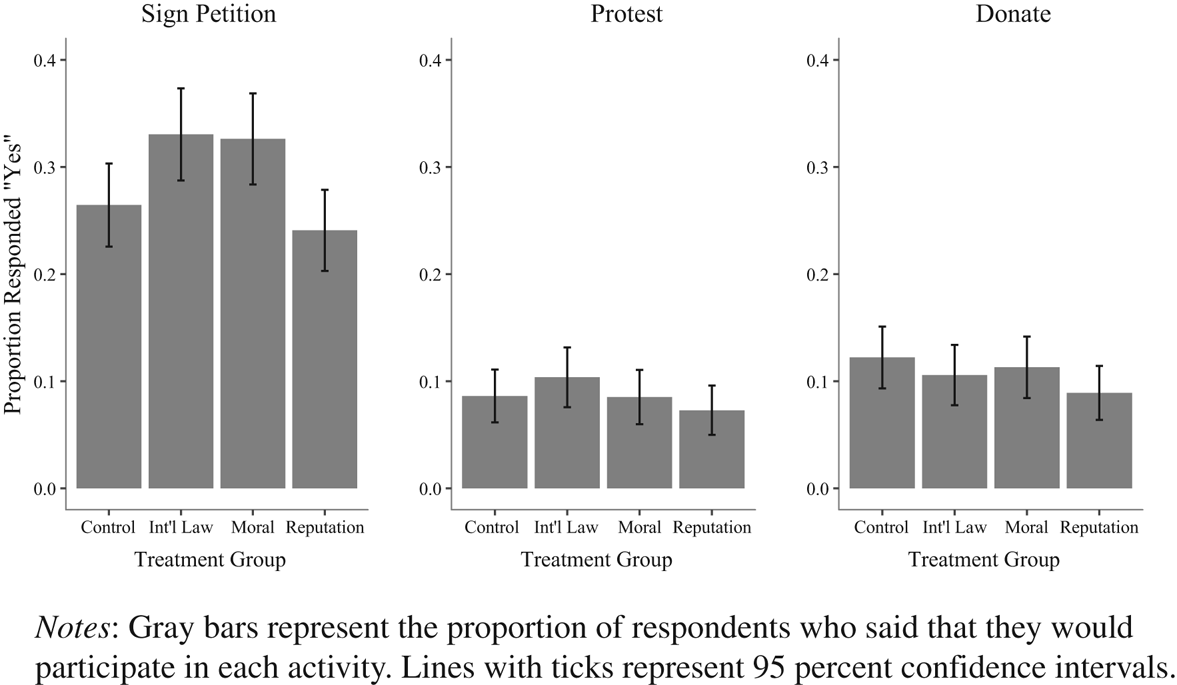
We argued earlier that research on the framing of human rights issues should expand its scope by exploring whether individuals can be mobilized to act. Here, we explore respondents’ stated willingness to sign a petition, attend a protest, or donate to an NGO in opposition to the existing policy. Figure 4 displays the percentage of respondents in each group who reported willingness to participate in each activity.
Policy action

It is immediately clear from Figure 4 that people are not particularly enthusiastic about taking any form of action, although they are more willing to sign a petition than to attend a protest or to donate.Footnote 96 This is not surprising: in most contexts, signing a petition requires very little effort, while protesting involves time, and donating of course involves money. This is also consistent with resource mobilization theory, which has shown that people become less willing to engage as actions become costlier.Footnote 97
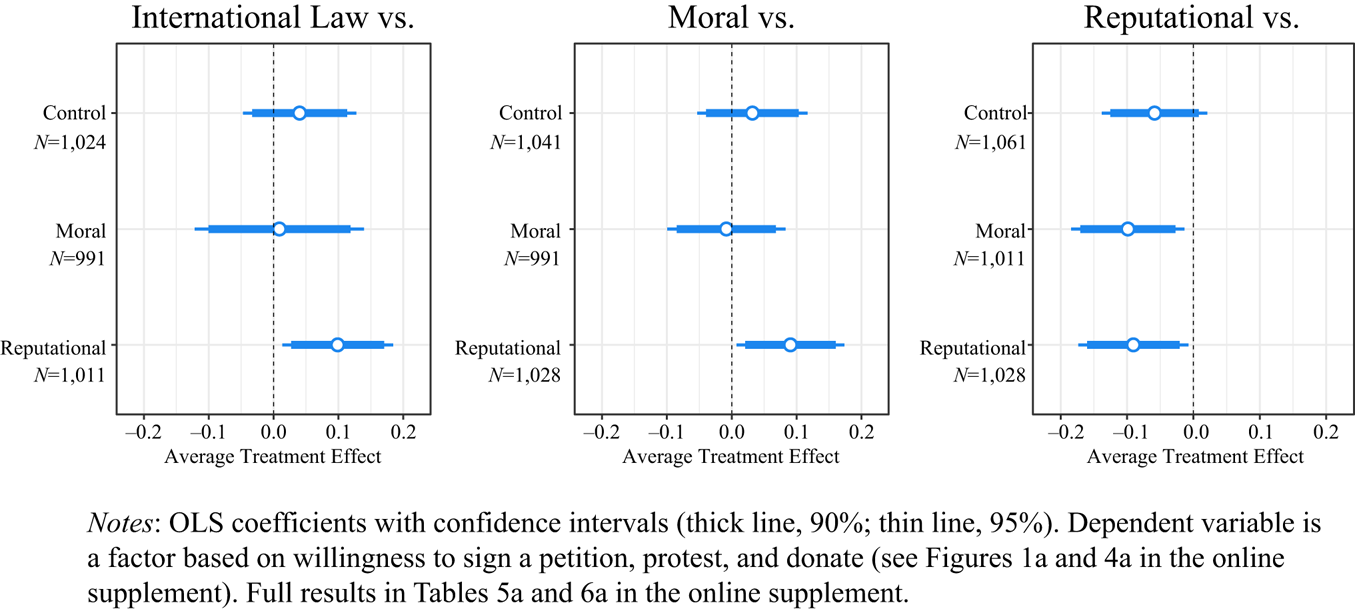
For hypothesis testing, we collapse the three policy action variables into one scale for parsimony, and conduct OLS analyses.Footnote 98 Figure 5 displays the comparisons using the same approach as for policy attitudes. Three main findings emerge. First, the IL and moral groups are more likely than the control to be interested in mobilizing, but these differences are not distinguishable from zero at standard thresholds. Second, the reputational group is less interested than the control in taking action, although this also falls short of standard thresholds of statistical significance. Third, consistent with the policy approval results, the IL and moral treatments have significantly stronger effects on mobilization than the reputational treatment.Footnote 99
Average treatment effects, policy action

Overall, these findings are consistent with our analyses of policy attitudes in some comparisons—particularly that respondents who have received an IL or moral frame are more likely to express interest in acting. However, it is surprising that (1) the treatment groups are not more strongly in favor of mobilizing versus the control; and (2) the reputational group is less interested in mobilizing than the control. Based on the policy approval findings, we would also have expected a larger difference between the IL and moral groups, but that does not appear to be the case. (We speculate why in the next section).
Three points are worth mentioning here. First, baseline interest in acting is very low (Figure 4). In theory, treatments can have strong effects precisely in contexts where there is “room to move,” but our survey suggests the contrary: it is challenging (for our frames) to stimulate interest in policy action—even when it is straightforward to shift policy attitudes. Second, given how small the treatment effects are in most cases, the study design is underpowered. In future studies, larger samples would be necessary to determine actual effect sizes.Footnote 100 Low power can produce Type I errors, so caution is warranted. Low power also decreases the likelihood that we are observing the true population effect—effects that we do observe may reflect noise rather than reality.Footnote 101 For both reasons, caution is warranted.
Finally, given that our frames are negative, it is possible and perhaps even likely that they generate negative reactions simply because negativity sticks.Footnote 102 As we discuss soon, there may also be specific substance to this negativity—perhaps a “backlash of inaction” of sorts.
Consistent with other work, we also find that educational attainment and being a Labor or Greens supporter drive up interest in mobilization, and that people who are older or have less tolerant views of people of other ethnicities are typically less interested in political action on Australia's boat arrivals policy.Footnote 103
Mediation Analysis
Thus far, we have considered policy attitudes and action in isolation. We now bring them together, asking whether exposure to a particular frame makes people more willing to mobilize by generating discontent with current policy. To do this, we conduct causal mediation analysis. Some scholars contend that mediation analysis is not sensible if direct links between a treatment and dependent variable do not exist.Footnote 104 We agree with others that this criterion is overly restrictive; some relationships might exist only via mediation, while in other relationships, a mediated and an oppositely signed direct effect may both exist but may be perceptible only if parsed via mediation analysis.Footnote 105 Both are theoretically interesting and worth investigating empirically.
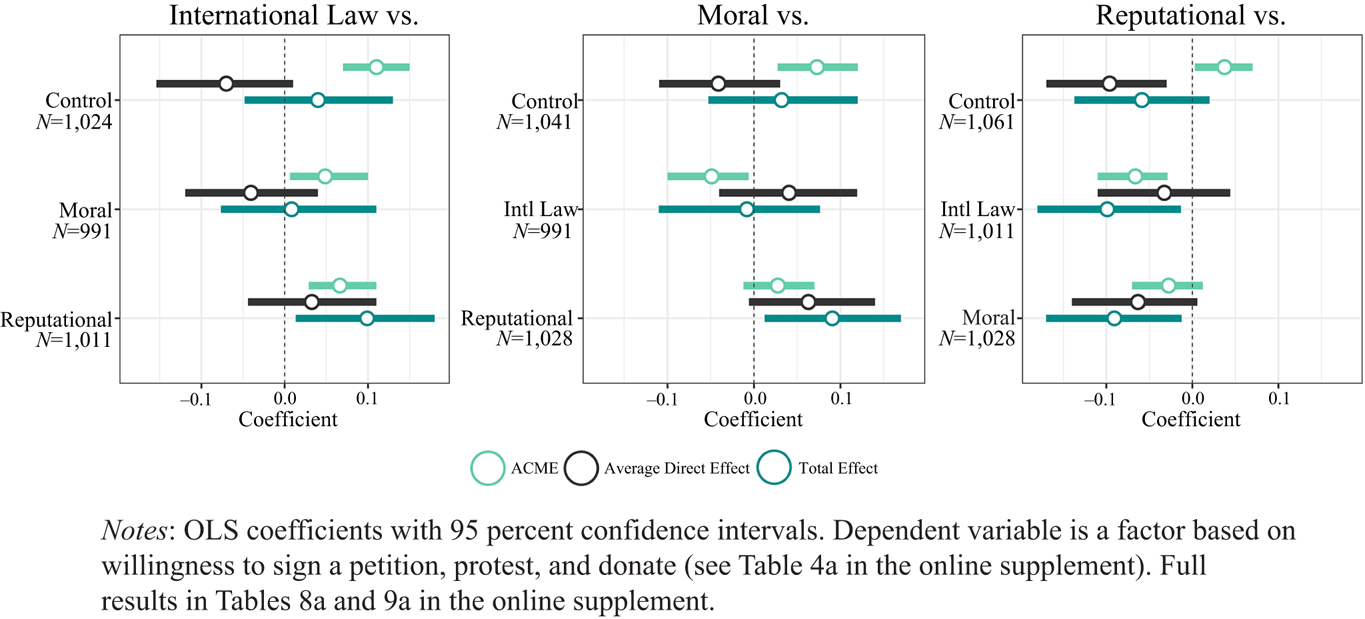
Figure 6 displays the results of the mediation analysis.Footnote 106 We again note that the results should be interpreted with caution, given the concerns about power. We focus first on comparisons to the control. The average causal mediation effect is positive and statistically significant for each treatment group. The relationship between frames and mobilization is most strongly conditioned by policy attitudes for the IL group, followed by the moral, then the reputational.Footnote 107 However, in no case do frame-induced shifts in policy attitudes explain much of the total difference in interest in mobilizing, as evidenced by the low proportion mediated. Most who receive these frames and in turn develop more critical attitudes do not subsequently become more likely to say they would try to “do something” about it.
Mediation analysis

We also find evidence of competitive mediation in these comparisons to the control, as indicated by the negative direct effect. This suggests an omitted mediator that operates in tandem with attitudinal shifts, which reduces interest in mobilizing.Footnote 108 Given that it exists for each frame (versus the control), this may simply reflect a common negative response to the negative tenor of our frames.Footnote 109 It is also possible that respondents are experiencing a more complex reaction to the frame content, perhaps a “backlash of inaction” of sorts. This might involve sense of guilt (which can demobilize),Footnote 110 hopelessness over whether action would indeed lead to policy change, or a genuine distaste for what the message is conveying. And this may be one reason some refugee activist groups increasingly emphasize positive messages in their appeals for change.Footnote 111 Future research could disentangle these possibilities with specifically tailored questions. The total effect echoes the average treatment effect in Figure 5 as one would expect, so we do not discuss it further.
Turning to frame comparisons, causal mediation effects are strongest for the IL group. Compared to moral appeals, IL frames impact more strongly on mobilization via attitudinal change. However, this pathway does not explain much of the total variation in mobilization.Footnote 112 There are no other notable (direct) effects on mobilization in that comparison. Ultimately, as in Figure 5, framing current policy in international legal or moral terms has roughly the same net impact on stated interest in taking action.
We reported that couching debates in international legal or moral terms resulted in significantly more (expressed) interest in mobilizing than emphasizing reputational considerations (Figure 5). The mediation analysis sheds some light on why. Invoking IL over reputation incites action (chiefly) by generating discontent.Footnote 113 This may be because IL offers greater clarity that abuses breach an accepted standard, which in turn makes people believe either that mobilization is more appropriate or that it is more likely to matter (or both). In contrast, while invoking morality over reputation also spurs greater interest in taking action, this is primarily through a process other than attitudinal change.Footnote 114 It could be because moral appeals provoke pro-mobilization responses (complimentary mediation). For instance, appealing to morality may foment a stronger sense of duty, independent of what it does to policy perceptions.Footnote 115
In both comparisons (IL versus reputational and moral versus reputational), it is also possible that reputational frames are invoking unique(ly strong) anti-mobilization reactions (competitive mediation), such as the “backlash of inaction” discussed earlier. They are two sides of the same coin in our model setup. When asked what he thought of recent UN criticisms of Australia's immigration detention, then prime minister Tony Abbott said, “I really think Australians are sick of being lectured to by the United Nations.”Footnote 116 Our results suggest that he might have been right (on that question). Further research could shed light on this via questions that aim to gauge these different reactions.
Conclusion
This research note is based on two key premises. First, frames seldom exist in a vacuum where only one message is available; rather, norm entrepreneurs are invariably as concerned with which message to send as they are with whether to send it. Second, changing attitudes is important, but so, too, is inciting action. Our survey experiment on Australia's “boat arrivals” policy confirms that it matters whether abuses are framed: citizens do care when their government breaches IL, flouts moral duties, or takes actions that harm the country's international reputation. It also matters how abuses are framed: citizens care most about international legal violations, followed by moral, and finally reputational transgressions.
We also find that translating that care into action is challenging. On the question of whether to frame, our results are suggestive of two distinct challenges. First, most people simply are not interested in mobilizing, even if they are aware of the associated problems and have consequently become more critical of what their government is doing. Second, any kind of negative framing may make people less interested in taking action. On the question of how to frame, our study indicates that appealing to IL or moral considerations is more effective than invoking reputational harm, although for different reasons. Our research consistently shows that emphasizing international reputational harm has the weakest impacts on mobilization, and may even be worse than saying nothing at all.
We see several important implications for future research on IL, human rights, and related areas. One key question is whether our findings hold in other contexts, countries, or framing approaches. Australia's refugee policy is highly salient in domestic politics, and while not unique, it is undeniably controversial. On the one hand, this may give experimental frames stronger impacts because people draw from underlying emotional tropes. On the other hand, it could dampen impacts because predispositions are entrenched,Footnote 117 or because Australians have learned over time that no amount of mobilization will yield significant policy change. Only with further cross-national research will we know whether and when these findings travel.
We urge future research in this vein to explore attitudes as well as action: this is key to testing some of the literature's most prominent theories. Our findings also point to important questions about the processes that underlie differential responses to frames. We have suggested that IL frames may have the strongest impacts because they offer clarity that a standard has been breached, whereas moral frames may provoke the strongest sense of duty. It is also possible that all negative frames, and especially reputational frames, elicit feelings of guilt and/or despondency. Further theoretical development and survey questions specifically aimed at gauging these complex reactions can shed light on these important questions.
Data Availability Statement
Replication files for this research note may be found at <https://doi.org/10.7910/DVN/D012BP>.
Supplementary Material
Supplementary material for this research note is available at https://doi.org/10.1017/S0020818322000133.
Acknowledgments
For comments throughout this project's development, we thank our colleagues at the ANU, as well as Renee Jeffery, Ferran Martinez I Coma, Duncan McDonnell, and Haig Patapan. For very helpful advice on specific questions, we thank Pat Leslie, Kosuke Imai, and James Druckman.
Funding
We gratefully acknowledge financial support from the ANU School of Politics and International Relations, and the ANU Department of International Relations.