


In 1666, the Portuguese Jesuit Thomas Pereira (1645–1708) set sail from Lisbon for his mission to evangelise the world, never to see his homeland again. He stayed in Goa for four and a half years, travelling in 1671 to Macau, a coastal city in southern China leased to Portugal as a trading port in 1557. Word of his musical talent reached the Kangxi emperor (r. 1661–1722), who summoned Pereira to Beijing in 1672.Footnote 1 During his audience with the emperor in 1676, Pereira demonstrated his outstanding ability in musical dictation by transcribing a song performed by the emperor and his musicians and repeating the exact same song without words in every musical detail.Footnote 2 Marvelled and impressed, the emperor developed so strong an interest in Pereira’s musical knowledge that he ordered Pereira to accompany him on his trip to Tartary in 1685, so that Pereira could teach him about European music. He also asked Pereira to write books on music in Chinese, hoping that ‘this art is known and preserved in our empire’ (communique esta arte em nosso Reyno et conserue).Footnote 3 As a book writer, music teacher, organ builder and clock maker, Pereira would serve the court until his death.
Until the decline of the Society of Jesus, the Jesuits played an important role in transmitting European knowledge to China from the early seventeenth century to the mid-eighteenth century. Their cartographical expertise contributed to the making of maps.Footnote 4 Their experience with artillery aided the construction of cannons.Footnote 5 Their knowledge of mathematics and astronomy was used by the court to carry out calendar reforms, so that the date and time of eclipses and other celestial events could be predicted accurately, legitimating the court and its mandate to govern.Footnote 6 The Kangxi emperor had a vast interest in the different branches of scientific knowledge, including music. In his leisure time, he wrote short essays discussing various natural phenomena, such as resonance.Footnote 7 Not only had he arranged lectures with the court Jesuits to study European sciences, but he also commissioned compilations and books on mathematics, calendrical astronomy and music.Footnote 8
For Jesuit missionaries, the introduction of European knowledge to China was a means of networking, enabling them to gain access to the court and convert China top-down.Footnote 9 In response to an anti-Christian persecution supported by local officials in 1691 in Hangzhou, Pereira and Antoine Thomas (1644–1709; the other acting director of the Astronomical Bureau) petitioned Kangxi on behalf of the Hangzhou Christians in their memorial written in February 1692.Footnote 10 In the memorial, they emphasised the Jesuits’ contributions to China via the writing of books on European knowledge for more than twenty years: ‘Our fathers wrote many books in the palace . . . on European sciences, such as astronomy, arithmetic, geometry, philosophy. Among them is one on music written by Father Thomas Pereira, who, abridging [the part on] practice, taught speculation and received no less admiration from many’.Footnote 11
Pereira’s writings can be matched with two anonymous Qing-era Chinese treatises on Western music theory: A Compilation of the Essentials of Music (Lülü zuanyao 律呂纂要) and A Summary of the Essentials of Music (Lülü jieyao 律呂節要).Footnote 12 The former introduces Western staff notation, the Guidonian hand, durus and mollis modes and some basic rules of counterpoint, including the resolution of dissonances. The latter deals with the theory of just intonation and acoustic theories of sound, such as the cause of consonance and dissonance. While scholars have agreed that Pereira is the author of A Compilation, consensus has not yet been reached about his authorship of A Summary.Footnote 13 Nor has there been any attempt to trace the sources and the dissemination of Pereira’s writings outside the Chinese court.
Offering a case study of how Western music theory was recast in a new cultural context, in this essay I establish Pereira’s authorship of A Summary, examine its possible sources, and explore how the theories in the sources, particularly the theory of consonance, were reconstructed by Pereira and in turn by the Chinese readers to suit their own agendas. Some theories introduced by Pereira, especially the rules of counterpoint and the theory of consonance, were originally formulated for a specific musical texture that did not exist in traditional Chinese music: polyphony.Footnote 14 To investigate the Chinese reaction to these theories, I analyse a Chinese music treatise commissioned by Kangxi in 1713 – The True Doctrine of Music (Lülü zhengyi 律呂正義) – which incorporated part of the contents of Pereira’s treatises, then examine its dissemination outside the court. By focusing on the ways in which Pereira and his Chinese readers selected and transformed European theories, we can see that they were not passive translators or learners, but active, collaborative creators of knowledge.
Scholars studying the transmission of Western music theory to China in the seventeenth century often focus on Pereira’s A Compilation and its adaptation in the supplementary volume (xubian 續編) of the Chinese music treatise The True Doctrine of Music, comparing the two treatises with the methods of classical textual philology and analysing the cultural translation of Western musical terms into Chinese.Footnote 15 They tend to see the cross-cultural transmission of knowledge as a communicative process that bridges linguistic and cultural differences through translation, facilitated by mobile vectors (e.g. human and book) that can be transported from one place to another. As a means to enhance the mobility of knowledge across cultures that use different languages, translation constitutes ‘the process of transforming a specific piece of one language into another language’.Footnote 16 Such a process includes matching equivalent words in the two languages and using pre-existing words, transliterations and neologisms to represent imported concepts absent in the existing lexicon of the target language.Footnote 17 Here I do not look at the translation process per se. While translation is a means of familiarising the unfamiliar and a result of seeing the self in the other, it also comes with the selection, dissemination and creation of knowledge. To analyse the ways in which Pereira and his Chinese readers, as collaborative agents of knowledge production, interacted with Western music theory, I shall apply Susan L. Star and James R. Griesemer’s concept of ‘boundary object’ and the concept of ‘actor-network’ as methodology.
Western Music Theory as Boundary Object
The True Doctrine of Music can be seen as a product of collaboration among Kangxi, Pereira and its authors: Kangxi gave instructions to his officials based on his vision of the final product; Pereira introduced musical knowledge from Europe in his own writings; the authors integrated Pereira’s writings with other bodies of knowledge in their treatise. As court officials, when writing the treatises ordered by Kangxi, Pereira and the authors shared the goal of providing the emperor with what he needed in exchange for his favour. On the other hand, because of their different political, cultural and religious backgrounds, they did not necessarily have a consensus on the ideal outcome of their collaborative project of introducing European music theories to China. As a Jesuit working for the Chinese court, Pereira’s ultimate goal was to promote Christianity and European culture in the foreign land, but the Chinese court has its own agenda for music. To consolidate its rule as a foreign minority over China, whose population was predominantly Han, the Manchu regime needed to seek support from the Han elite. To this end, the Manchu government under Kangxi’s rule incorporated Confucian rituals of the Cheng-Zhu School on a grand scale, which also dissociated the rituals from the preceding Ming dynasty (1368–1644).Footnote 18The True Doctrine of Music was written as an orthodox music treatise that superseded pre-existing treatises in its approach to restoring ancient Confucian ritual music. One of the authors of the treatise, Li Guangdi李光地 (1642–1718), a renowned Confucian scholar who himself wrote extensively on music, shared the same interest with the emperor in restoring the music of the ancient sagely kings, an interest different from that of Pereira.Footnote 19 The different goals held by Pereira and his Chinese readers led them to acquire quite different understandings of the meanings and functions of European music theories in the Chinese context, all of which were reflected in their dissemination of knowledge.
In this sense, the European music theories transmitted by Pereira can be analysed as a ‘boundary object’, a concept coined by Star and Griesemer as an alternative to the models developed by Bruno Latour, Michel Callon and John Law to explain scientific collaboration.Footnote 20 Whereas the latter suggest that the interests and goals of different participants in a scientific project, such as the scientists, sponsors and journal editors, have to be reconciled to enhance collaboration, Star and Griesemer contend that the participants can still collaborate with one another even without a consensus. For instance, the effort of amateur collectors in collecting animal specimens for a natural museum is motivated by the goal of preserving nature, but the professional scientists are more interested in developing theories about ecology and evolution by analysing the specimens collected, thus having more specific requirements for how specimens should be collected, recorded and labelled. Therefore, the collectors and the scientists, while handling the same set of specimens in collaboration, act towards and interpret them in different ways. Still, the scientists would need to ensure that the collectors, in a collaborative manner, would abide by their specific requirements in collecting, recording and labelling animal specimens.Footnote 21 As defined by Star and Griesemer, boundary objects are ‘objects which are both plastic enough to adapt to local needs and the constraints of the several parties employing them, yet robust enough to maintain a common identity across sites. They are weakly structured in common use, and become strongly structured in individual site use. These objects may be abstract or concrete.’Footnote 22 Rather than understanding boundary in terms of the centre–periphery model, Star sees boundary as a space shared by two social worlds that act upon the same object.Footnote 23
As boundary objects, the European music theories introduced by Pereira became a site of negotiation among Pereira, his Jesuit colleagues, Kangxi and the authors of The True Doctrine of Music, all of whom inscribed the theories with different meanings and endowed them with different applications. The potential of theory as a boundary object lies in its intrinsic plasticity and the plurality of text as its vector. Be it prescriptive or descriptive, a theory can be perpetually modified and reinterpreted in accordance with new empirical data, a new explanatory need, or a new idea arising from the intellectual context, until it is replaced by a completely new theory or changed to such an extent that it loses its identity or a recognisable linkage to its origin.
Originally devised to explain the workings of European polyphonic music, Pereira’s music theories needed to be adapted to the new cultural context. Just as the Europeans’ interest in Chinese and Egyptian music in the seventeenth and eighteenth centuries was kindled by their pursuit of a universal basis of music, the Chinese belief in universal principles of music provided the framework for them to study foreign music in order to shed light on their own music.Footnote 24 Not only were Pereira’s theories applied to interpret a new set of empirical data, i.e. Chinese court music, but his theories also had to be reconciled with the local music theories that had been used to analyse the patterns of that set of data.
Pereira’s theories were not just instruments for pure epistemological engagement. Music theory can serve to explain, often on a purportedly objective basis, the aesthetic value of music, making it a convenient rhetorical tool for promoting or devaluing certain kinds of music.Footnote 25 This function serves well for Pereira as an ambassador of European sacred music in China. Besides building pipe organs for churches, a cultural symbol associating Christianity with Europe’s technological power, he also attempted to promote polyphonic music in China by addressing its beauty in his music treatises, albeit to no avail.Footnote 26
The missionaries’ goal in cultural promotion often shapes the research questions of scholars who identify with their perspectives. David Irving, attempting to ‘measure the relative success of European missionaries in transplanting music to early modern Asia’, asks ‘to what extent’ European music books were understood, appreciated and made use of by Asian musicians.Footnote 27 Without assuming that the books have to be understood, appreciated and used in particular ‘correct’ ways, I prefer to answer instead the question how the Chinese readers made use of – and more importantly, made sense of – Pereira’s writings.
The concept of boundary objects, which is based on a model of collaboration, allows us to understand the transmission of European music theory to early modern China as an interactive exchange between two imperial powers rather than a hegemonic imposition from the West.Footnote 28 To the Kangxi emperor, the Jesuits were foreign servants helping him to consolidate his political power with their knowledge and language skills, not agents of Western imperialism. At the same time he was also vigilant with regard to Jesuit activities that could cause harm to his empire.Footnote 29 In return for their services, the Jesuits sought the Chinese emperor’s support for the activities of the Society of Jesus in China and used their status in the court to advance the national interests of their own countries.Footnote 30 In short, there is an exchange between Kangxi’s political power and the Jesuits’ intellectual and linguistic power.
This relatively balanced power relation between the Chinese and the Europeans in the Qing court had given Western music a different status in China from that in the twentieth century, when the Chinese were busy keeping up with the technological and political progress of the West after having been humiliated by their gunboats and cannons. In the twentieth century, common-practice Western music, characterised by the use of tonal harmony, was often regarded as a model for modernising Chinese music as it embodied internationality and modernity.Footnote 31 In contrast, Pereira’s promotion of counterpoint did not convince the Chinese that monophonic and heterophonic music were inferior to polyphonic music. For the purpose of restoring ancient Chinese court music, Western music in early Qing China was not marked among other music in terms of its progressivity, but in its elements in common with Chinese music.
The Chinese readers’ interest in applying European music theory to explain Chinese music also influenced the way in which they made sense of the theory of consonance. By introducing the theory of consonance in his writing, Pereira essentially transmitted a mechanical theory of pitch that emerged in seventeenth-century Europe; the theory marked the transition from a numerical to a physical understanding of pitch as part of the European scientific revolution. From the legendary Pythagorean hammers to Gioseffo Zarlino’s (1517–90) senario, musical intervals and their degrees of consonance had been understood as manifested properties of their numerical ratios. Such a Platonistic view of pitch took a mechanistic turn in the seventeenth century, when theorists started to associate the mathematical property of pitch with the physical vibration of sound.Footnote 32
Although the correspondence between musical intervals and their frequency ratios is discussed in Pereira’s A Summary, the significance of this observation in reconceptualising pitch had eluded the Chinese readers. Just as the Jesuit introduction of Copernicus’s and Galileo’s writings to China had not transformed the Chinese into believers in heliocentrism, Pereira’s writings on the mechanical theory of pitch had not resulted in a paradigm shift in Chinese music theory in the seventeenth and eighteenth centuries; musical pitches were still conceptualised in terms of the physical dimensions of the musical instruments producing the pitches rather than the frequencies of the pitches. Refuting the conventional account that ‘Chinese rejected the early fruits of modern science because of some intellectual or linguistic failing, or a metaphysical indisposition’, Nathan Sivin suggested that heliocentrism did not flourish in China because the Jesuits did not convey the revolutionary significance of Copernicus’s and Galileo’s writings in their translations.Footnote 33 However, it may be unfair to attribute the blame solely to the Jesuits, as their local collaborators also had a role in shaping the transmitted knowledge as a boundary object.
To understand why Pereira’s acoustic and music theories failed to develop in China in the seventeenth and eighteenth centuries, it is necessary to examine the cultural and political context in which The True Doctrine of Music and Pereira’s A Summary and A Compilation were written. In his essay discussing the validity of the question ‘why scientific revolution did not happen in China’, Sivin suggested that the development or abandonment of scientific laws and hypothesis is determined by social and cultural values.Footnote 34 The transferability of music theory from one place to another is similar to that of agricultural techniques and technologies, which depends as much on the social and cultural context as on local variations in soil or weather.Footnote 35
By social context, I do not mean such coherent social structures as ‘bureaucratic feudalism’, which Joseph Needham believes to be the main social condition that had inhibited the rise of modern science in China.Footnote 36 As noted by Mark Elvin, Chinese society was not a static, homogeneous entity that could be neatly described by such a label.Footnote 37 Scholars of science and technology studies, such as Latour and Law, have also cast doubt on sociological constructs that assume any community to form a coherent unity, giving rise to an alternative approach to the socio-historical study of science coined as ‘actor-network theory’.Footnote 38
Latour proposed that a society is made up of ‘associations between heterogeneous elements’, including non-human actors, which have agency when they can make a difference in a situation or influence the action of a human actor.Footnote 39 In this sense, the theory of consonance transmitted by Pereira originally emerged from a network comprising the composers of polyphonic music; the various pitch intervals generated between the independent musical parts; the differential pleasantness of these intervals, which inspired the natural philosophers to provide an explanation; and the written scripts and printing technologies that facilitated the circulation of their explanations. When the theory entered China, it was dissociated from these heterogeneous actors and reassembled with new ones, some of which were similar to the old elements (e.g. printing technologies), some entirely different (e.g. the court officials who attempted to reconstruct ancient music, monophonic and heterophonic music, pre-existing Chinese music theory and the Chinese script).
As suggested by Benjamin Piekut, using actor-network theory as a methodology is to ‘register the effects of anything that acts in a given situation, regardless of whether that actor is human, technological, discursive, or material’.Footnote 40 Taking into consideration the effects of a wide range of actors, from Pereia and his Chinese readers to the musical and intellectual discourses to which they were accustomed, from the acoustic property of strings and pipes to the technological character of movable types, I shall discuss the different goals of Pereira and the Chinese writers in constructing music theory, analyse the historical influences that shaped the Chinese readers’ approaches to adapting foreign knowledge, and explore the conditions under which Pereira’s knowledge was circulated, so as to gain a deeper insight into the fate of seventeenth-century European music theory as a localised boundary object in Qing China. But first it is necessary to verify Pereira’s authorship of A Summary.
The Author and the Sources of A Summary
To clarify Pereira’s role as the author of A Summary, let us first look at the above-mentioned memorial again (see p. 00). The apparent separation between practice and speculation mentioned by the two Jesuit writers in the 1692 memorial was integral to a popular way in which music theory was classified in seventeenth-century Europe. ‘Practice’ denotes practical music (musica practica), which deals with practical knowledge with respect to sight-singing, performance, and composition, such as solfège and the rules of counterpoint, while ‘speculation’ denotes speculative music (musica speculativa), which deals with the numerical ratios of musical intervals and their association with celestial motions. Nonetheless this division between practical and speculative music is not always strict and their meanings change over time. In the seventeenth century, musico-cosmological models, such as Robert Fludd’s (1574–1637) macrocosm, were abandoned, rejected as empirically inaccurate, or adapted to new empirical data of planetary motions. Kepler’s celestial choir, which associates different musical pitches with different velocities of the planets, was devised to take into consideration the changing velocities of a planet with an elliptic orbit instead of a circular one. Musical pitches and consonances, formerly understood in purely mathematical terms, such as the lengths of strings, were then explained in terms of the mechanical motion of the strings and the frequencies of their vibrations. Speculative music was gradually moving towards the science of acoustics.Footnote 41
Although A Summary of the Essentials of Music contains no mention of its author, Pereira’s authorship of the treatise can be inferred by examining its content in relation to a passage in the preface to the supplementary volume of The True Doctrine of Music, which divides the contents of Pereira’s writings into two familiar categories:
Portuguese Xu Risheng [Thomas Pereira] is adept in music. . . . His books have two main themes. One is the mechanism of sound production in strings and pipes, and the cause of consonance and dissonance; the other theme is the principles of identifying and organising musical tones, the use of hard [sharp] and soft [flat] signs in distinguishing between the yin [mollis] and yang [durus] modes, and signs of long and short, slow and fast [rhythm and metre] in regulating the durations of notes.
有西洋波爾都哈兒國人徐日昇者,精於音樂….其書之大要有二,一則論管律絃度生聲之由,聲字相合不相合之故;一則定審音合度之規用,剛柔二記以辨陰陽二調之異用,長短遲速等號,以節聲字之分。 Footnote 42
The first theme corresponds to speculative music theory and the second theme corresponds to practical music theory. If we look at the contents of A Summary of the Essentials of Music, we can find the corresponding chapters that discuss the mechanism of the production of sound (lun suo yi sheng sheng zhi you 論所以生聲之由) and the cause of consonance and dissonance (lun xiang he bu he yin zhi you 論相合不合音之由) respectively.Footnote 43 The part on practical music theory is discussed in A Compilation of the Essentials of Music.
In the chapter on the cause of consonance and dissonance, Pereira first introduced the relationship between the length of a string and the frequency of its vibration. The shorter the string, the faster it vibrates and the greater the number of times it vibrates within a given time. Then he went on to explain the phenomenon of consonance:
If [two strings], with many or few vibrations [at a given time], return [from the terminal points] at the same time, the two tones will sound agreeable. This is called consonance. If the interval between their simultaneous return is very short, the two tones will sound very agreeable and it is called excellent consonance.
苟戰多戰少所動之回轉,若有互相遇合之處,其二音聽之為和順,即謂相合音也。互相遇合間甚近,其二音聽之為極順,謂極相合音。 Footnote 44
This theory defines consonance by the degree of concurrence of the vibration cycles of two strings. Labelled the coincidence theory of consonance by H. Floris Cohen, it was discussed by many sixteenth- and seventeenth-century European natural philosophers, including Giovanni Battista Benedetti (1530–90), Galileo Galilei (1564–1642), Isaac Beeckman (1588–1637), Marin Mersenne (1588–1648), Thomas Hobbes (1588–1679), René Descartes (1596–1650) and Athanasius Kircher (1602–80).Footnote 45 Given the numerous sources, how might Pereira have acquired his ideas about musical consonance?
In her study on the supplementary volume of The True Doctrine of Music, which was mainly based on Pereira’s Compilation, Gerlinde Gild-Bohne suggested that Pereira’s sources were Zarlino’s Istitutioni harmoniche (1558) and Kircher’s Musurgia universalis (1650).Footnote 46 Whereas Zarlino did not discuss the coincidence theory of consonance in his treatise, we can indeed find the theory discussed in Kircher’s Musurgia universalis (Book IX) in a manner similar to Pereira’s. For instance, Kircher wrote: ‘So if the fast and slow movements [of the strings] are proportionate at the same time, and easily coincide with each other, consonance arises; if [the movements] are really disproportionate and without any coincidence or do not result in any meeting, dissonance arises.’Footnote 47 However, as I shall show below, there are passages in Pereira’s writings that cannot be traced to Musurgia universalis, suggesting that he had also referred to other sources.
In seventeenth-century Europe there was a variety of ways in which scientific thoughts were transmitted. Other than in printed books, a text could be circulated in various forms, such as marginalia, book slips, letters, notebooks, textbooks, and lecture notes. Readers could engage in different modes of reading and note-taking, from critical to literal. Mersenne, who occasionally used Descartes’s views in his Harmonie universelle as his own, often exchanged views with Descartes on contemporary scholastic writings. In his letters to Mersenne Descartes comments on Galileo’s Discourses and Mathematical Demonstrations Relating to Two New Sciences (Discorsi e dimostrazioni matematiche intorno a due nuove scienze; henceforth Two New Sciences), published in 1638. Mersenne would then copy Descartes’s comments in the margins of his own copies of the book, and turned some of these marginalia into part of his annotations in his Harmonie universelle. Mersenne’s annotations were in turn copied by another anonymous scholar in a notebook.Footnote 48
The Jesuit curriculum around Pereira’s time offered up-to-date lectures on natural philosophy, as it was considered an essential prerequisite to theology. Therefore, writings by modern writers, such as Galileo, Copernicus and Descartes, were incorporated in the curriculum, albeit with censorship. Silvestro Mauro (1619–87), a philosophy professor at the Collegio Romano, referred to Galileo’s Two New Sciences in his lecture notes in relation to Aristotle’s writings. The lecture notes were then published by his student Andreas Portner in 1658 with the title Quaestiones Philosophicae.Footnote 49 Pereira might have learnt about the coincidence theory of consonance from the philosophy courses at the College of Arts in Coimbra when he was receiving his Jesuit training there from 1663 to 1666. He may also have learnt it from the philosophy course that he took at the college of Goa from 1667 to 1668.Footnote 50
It is likely that Pereira was acquainted, through letters, lecture notes, or the original book, with Galileo’s discussion of the cause of consonance and dissonance in the last part of the First Day in his Two New Sciences. Both Pereira and Galileo used expressions such as ‘vibration’ (vibrazione) and ‘return’ (ritorno) to describe motion of the string. Benedetti used ‘percussions’ (percussiones) instead of these two words. Mersenne, who also used ‘return’ (retour) to describe sound vibration, is likewise a plausible candidate. It is possible that Pereira also knew about Mersenne’s writings, but his illustrative models bear the closest similarity to Galileo’s.
Familiarising and Fine-Tuning Galileo’s Theory of Consonance
In his Two New Sciences, Galileo broke down the vibrating motions of two strings into several moments and compared their positions from moment to moment to illustrate the concurrence of their vibration cycles. The movements of vibrating strings with different lengths are represented in terms of movements along line segments of different lengths. Explaining the case of the octave, which is produced by two strings in a ratio of 2:1, Galileo wrote:
Let AB denote the length of a wave emitted by the lower string and CD that of a higher string which is emitting the octave of AB; divide AB in the middle at E. If the two strings begin their motions at A and C, it is clear that when the sharp vibration has reached the end D, the other vibration will have travelled only as far as E, which, not being a terminal point, will emit no pulse; but there is a blow delivered at D. Accordingly when the one wave comes back from D to C, the other passes on from E to B; hence the two pulses from B and C strike the drum of the ear simultaneously.Footnote 51
Pereira also compared the vibrations of two strings in similar manner, but he added another layer of analogy to visualise the movement along a line segment. Before presenting a moment-to-moment description of the motion of the vibrating string as Galileo did, Pereira described two people walking at the same pace along a road back and forth. One walks through the whole road and the other walks half of it. When the former reaches the opposite end of the road, the latter, returning from the middle of the road, also reaches the end where he departed. Pereira used this analogy to facilitate the understanding of readers new to the subject, such as the Kangxi emperor and the authors of The True Doctrine of Music. To this end, he also avoided using abstract terms, such as ‘commensurable in number’ (commensurabili di numero), which Galileo used to describe the concurrence of vibration cycles. While Galileo used the moment-to-moment analysis to explain only the cases of the octave and the fifth, Pereira applied it to every interval that he discussed in the treatise, including major fourth, major third, and major second, so as to demonstrate the increase in interval between the simultaneous returns of the vibrating strings that produce the musical intervals.Footnote 52
Another illustrative model used by Pereira that is characteristic of Galileo is the pendulum, which is used to explain and visualise the concurrence of the vibration cycles of strings. Although we can see diagrams and passages similar to Galileo’s elucidation of the vibrating motions of two strings in Hobbes’s Elements of Philosophy and Kircher’s Musurgia universalis (Book IX), neither author mentions the pendulum.Footnote 53
Pereira suggested that the interval between the simultaneous return of two vibrating strings from their terminal points can be checked by observing two pendulums with the same swinging periods as those two strings:
If [one] wants to know the interval [at which the strings return] at the same time, [he can] observe the swinging of the pendulum of the clock. For instance, when the large pendulum swings one time, the small pendulum swings two times. When [the small pendulum swings] the third time, they will swing back together. The interval of [their returning] at the same time is very close.
欲知互相遇合間之遠近,看驗時儀遊墜之擺動。大遊墜一次,小遊墜兩次,第三次同回來,互相遇合間甚近。Footnote 54
In this passage, Pereira described the pendulum as a part of the pendulum clock, a newly imported technological product familiar to Kangxi and the court officials. Despite Pereira’s attempt to familiarise them with the pendulum as a model to study the mechanical motion of string, he did not explain the connection between the motions of the pendulum and the string, but only implied that their motions are comparable by setting up an analogy between them. Unlike Galileo, Pereira did not discuss the numerical relation between the length of the pendulum and the period of its swing, which is different from that of the vibrating string.Footnote 55
An important deviation of Pereira’s theory from Galileo’s is that Pereira omitted Galileo’s physiological explanation of the perception of dissonance. Galileo explained dissonance as a result of the disorderly pulses striking the eardrum when two strings do not have concurrent vibration cycles, which means that the more pulses are created by one string alone between the simultaneous returns of two strings, the more dissonant the sound is.Footnote 56 For instance, the perfect fifth with a ratio of 3:2 has only three pulses created by a single string; the major second, with a ratio of 9:8, has fifteen pulses created by a single string, and hence is a dissonance. Without taking the eardrum into account, Pereira explained dissonance only in terms of the interval between the simultaneous return of two vibrating strings from their terminal ends.
The intention behind such an omission was not a mere simplification of Galileo’s theory; it reflects Pereira’s attempt to fine-tune the mechanical explanation of consonance to better account for the practical use and ranking of consonant and dissonant intervals based on subjective perception. In the following paragraphs, I shall first discuss the defect of the coincidence theory of consonance, then give an example of how Mersenne dealt with it, and finally explain how Pereira’s omission of Galileo’s physiological theory helps to solve part of the problem.
If we rank the degrees of consonance of musical intervals according to the coincidence theory of consonance, we shall find that the ranking does not conform to perception according to seventeenth-century practice. The theory also does not explain why a perfect fourth is a dissonance when it is formed with the bass. According to Pereira’s theory, the major sixth should have the same degree of consonance as the major third. For both musical intervals, the interval between the simultaneous return of the longer and shorter strings from their terminal points is the same, but the major third was generally regarded as a more pleasant consonance than the major sixth.
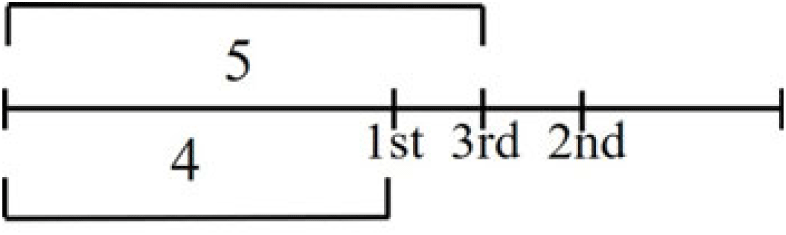
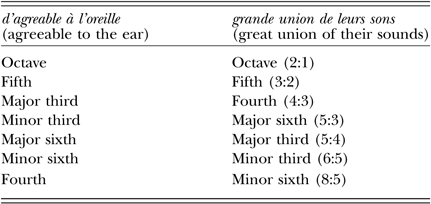
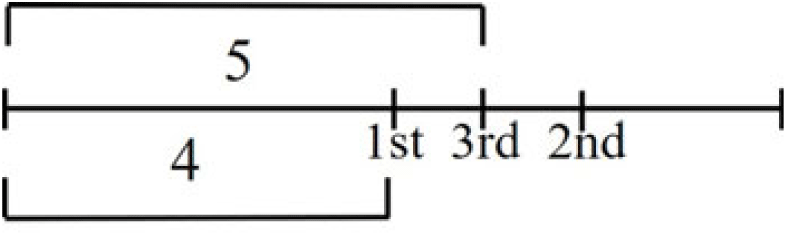
In response to this incompatibility between physical theory and perception, Mersenne created two rankings of the musical intervals, one based on the intervals’ degrees of consonance as defined by the coincidence theory of consonance and one based on their pleasantness to the ear (see Table 1).Footnote 57 Notwithstanding his differentiation between mechanical consonance and perceptual consonance, Mersenne did not give up on explaining the pleasantness of some musical intervals that contradicts the coincidence theory of consonance. He provided three reasons why the major third is a more pleasant consonance than the major sixth. First, the difference between the two terms of the ratio of a major third (5:4) is smaller than that of a major sixth (5:3), the former by a fourth [(5–4)/4=1/4] and the latter by two thirds [(5–3)/3=2/3]. Second, the major third is derived from the third bisection of the monochord (see Figure 1). Third, the trumpet produces the major third immediately after the perfect fourth.Footnote 58
Mersenne’s two rankings of consonant intervals, one according to the intervals’ pleasantness to the ear, the other according to the coincidence theory of consonance
The third bisection of the monochord in Mersenne’s Harmonie universelle. Let AB be bisected at C (first bisection), CB at E (second bisection), and CE at D (third bisection), then AD to AC equals to 5:4, which is the ratio of the major third. The first bisection produces the octave (AB:AC = 2:1) and the second bisection produces the perfect fifth (AE:AC = 3:2)
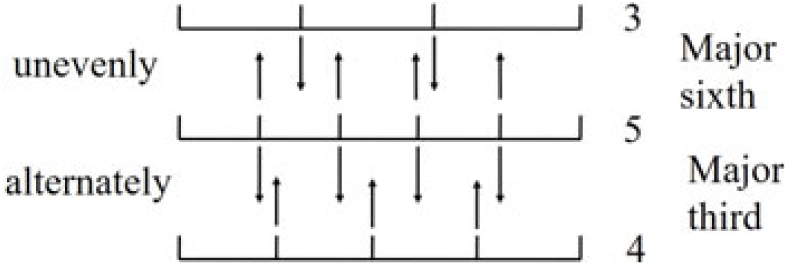
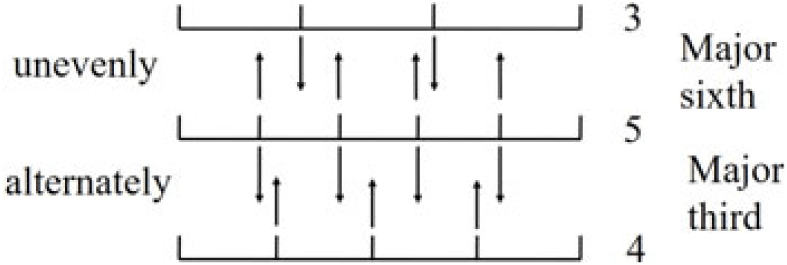
In his explanation as to why the major third is more consonant than the major sixth, Pereira adopted a view similar to the first reason proposed by Mersenne: ‘The length of the third scale degree, which is four units, is close to the length of the first scale degree, which is five units; the length of the sixth scale degree, which is three units, is far from the length of the first scale degree, which is five units.’Footnote 59 Yet Pereira also added an explanation that was not discussed by Mersenne. He proposed that if two strings beat the air alternately before their simultaneous arrival at the terminal points, the sound will be more pleasant. Therefore, a major third sounds more pleasant than a major sixth because its two vibrating strings strike the terminal point alternately, whereas in the case of the major sixth, the three vibration cycles of the longer string are distributed unevenly among the five vibration cycles of the shorter string (see Figure 2).Footnote 60 This theory is in conflict with Galileo’s theory of dissonance, according to which the major third is less consonant than the major sixth as it generates one more vibration cycle than the major sixth, thus producing pulses that strike the eardrum more frequently. However, this additional vibration cycle becomes a merit in Pereira’s theory; it allows alternate vibration cycles between the longer string and the shorter string. It is likely that Pereira did not adopt Galileo’s theory of dissonance as it complicates his own theory of the pleasantness of the major third.
A diagram illustrating Pereira’s explanation of why the major third is more consonant than the major sixth
Pereira’s most innovative approach is his synthesis of the coincidence theory of consonance and Thomas Hobbes’s theory on air movement in pipes into a theory of consonance in pipes. According to Thomas Hobbes, when the air enters a pipe, it can hit the inner wall of the pipe with a small or large angle of incidence. If the angle is small, then the sound will be unclear. If the angle is large enough, the air will be reflected to the other side of the pipe wall, so ‘successive repercussions will be made from side to side’.Footnote 61 This means that the air will travel along a zigzag pathway through the pipe. Pereira extended this theory to explain the phenomenon of consonance and dissonance in pipes. He suggested that the number of times the air hits the inner wall of a pipe is determined by the angle of incidence of the air and the inner circumference of the pipe. If the air enters a narrow pipe with a small angle of incidence, it will hit the inner wall less frequently. If the air enters a wide pipe with a large angle of incidence, it will hit the inner wall more frequently. Pereira then proposed that the frequency of the air hitting the wall of a pipe can be seen as the vibration frequency of a string when explaining the cause of consonance and dissonance in pipes. When the air in two pipes hits the inner walls of the pipes at the same time frequently, the musical interval produced by the two pipes is a consonance. When there are few or no occasions where the air in two pipes hits the inner walls of the pipes at the same time, the musical interval produced by the two pipes is a dissonance.Footnote 62
Having discussed Pereira’s writings, we have arrived at the following question: how did the Chinese readers of Pereira’s treatises use his theories?
Local Reduction and Reconstruction
Pereira’s writings were incorporated into The True Doctrine of Music (Lülü zhengyi 律呂正義), a Chinese music treatise commissioned by the Kangxi emperor. Printed in 1714, six years after Pereira’s death in 1708, the treatise was written by a group of court officials, Li Guangdi, Wei Tingzhen 魏廷珍 (1669–1756), Mei Juecheng 梅瑴成 (1681–1764) and Wang Lansheng 王蘭生 (1679–1737), led by Kangxi’s third son Yinzhi 胤祉 (also known as Yunzhi 允祉, 1677–1732). It consists of two main volumes (shangbian 上編 and xiabian 下編, literally ‘upper part’ and ‘lower part’, henceforth first volume and second volume) and a supplementary volume (xubian 續編). The main volumes discuss the standardisation of pitches, the tunings of strings and pipes, the relationship between pitch standards and scale notes, and the construction and measurements of different musical instruments. The supplementary volume, which focuses on the Western theory of practical music, is a shortened version of Pereira’s Compilation of the Essentials of Music with additional content contributed by the Italian Lazarist Teodorico Pedrini.Footnote 63 In their memorial to Kangxi, Pereira and Thomas mentioned that Pereira had abbreviated his writings on practical music theory (see above, p. 00). It is likely that he abridged his writings at the request of Kangxi or the authors of The True Doctrine of Music.
In A Summary, Pereira stressed more than once that polyphonic music, which has more than one melody playing simultaneously, is more beautiful than monophonic music, which is as ‘boring’ (keyan 可厭) as eating the same food and seeing the same colour all the time.Footnote 64 This showed his attempt to promote polyphonic music in China. To teach the Chinese readers how to compose polyphonic music, Pereira devoted a section in A Compilation to the basic skills of writing counterpoint, discussing voice-leading rules and the use of dissonances.Footnote 65
However, this section was completely omitted in the supplementary volume of The True Doctrine of Music, which also abbreviated the section on mollis and durus modes, though it retained in large part the sections on European staff notation, solfège and the Guidonian hand. According to an account by Sir George Staunton, a British diplomat who came to China in 1790, staff notation was used by a select group of Chinese court musicians.Footnote 66 It seems that what the Chinese found most useful was staff notation instead of knowledge about contrapuntal writing.
The reason why the authors of The True Doctrine of Music omitted Pereira’s passage on counterpoint may be that polyphonic music is too different from Chinese music, which is mainly monophonic or heterophonic. What the authors were seeking is similarity rather than difference. In the preface to A Compilation, the authors explained their aim of incorporating Pereira’s writings in the treatise. They give a brief account of an earlier transmission of foreign musical knowledge to China. During the reign of the Emperor Wu of Zhou (r. 560–78), Suzipo 蘇袛婆, a musician from Kucha (Qiuci 龜茲), introduced the seven scale degrees and five scales in her music to Zheng Yi 鄭譯 (540–91), a reformer of court music in the Sui dynasty (581–619). Zheng observed that there were similar scale degrees and scales in Chinese music. Based on Suzipo’s musical system, he expanded the five scales into seven scales and created eighty-four mode-keys (gongdiao 宮調; 7 modes × 12 keys = 84 mode-keys), which the authors of the treatise regarded as fundamental to the principle of changing from one mode-key to another (xuangong zhuandiao 旋宮轉調) in music after the Tang (618–905) and Song (960–1279) dynasties. They lamented that the principle was lost since no one developed and promoted Zheng’s theory. The authors stated that the ‘musical modes and rhythms’ (shenglü jiezou 聲律節奏) discussed by Pereira and Pedrini and the Chinese musical system’s pitches and modes discussed in the classics are ‘two sides of the same coin’ (xiang biaoli 相表裏), so they introduced their theories as a reference for theorists and practitioners.Footnote 67
Similar to Zheng Yi, the authors The True Doctrine of Music did not attempt to develop Chinese music by incorporating new elements, such as counterpoint, from European music. They were instead trying to seek inspiration from the common elements to reconstruct a lost musical system. The difference between Chinese and European music was downplayed in the treatise by under-representing European musical elements perceived as different from Chinese music. In A Compilation, we can see from time to time annotations suggesting the Chinese counterparts of European musical modes and scale degrees. For instance, following a passage discussing the use of accidentals to indicate shifts between cantus durus and cantus mollis, an annotation suggests that it is similar to chu diao 出調 (‘going out of the mode’) in Chinese operas and ‘free arias’ (nanbei qu 南北曲).Footnote 68 What was foregrounded was commonality.
According to Pereira and Thomas’s memorial, Pereira’s writings on speculative music theory seem to have been well received. However, the coincidence theory introduced by Pereira is based on the simple ratios of musical intervals tuned in just intonation. Although just intonation is also used by some Chinese musical instruments, such as the qin (a Chinese seven-string zither), where harmonics is an important technique, the orthodox tuning for ceremonial music in the Chinese court is the ‘adding-and-subtracting-thirds’ method (sanfen sunyi fa 三分損益法), which is discussed in many Chinese classics. Similar to Pythagorean tuning, it employs the cycle of fifths to generate eleven pitches from a reference pitch. Except for the fifth and the octave, all the musical intervals in the ‘adding-and-subtracting-thirds’ tuning system are not in simple ratios. Therefore, the degree of consonance and dissonance of musical intervals tuned in the ‘adding-and-subtracting-thirds’ method, except the octave and the fifth, cannot be explained in terms of the coincidence theory of consonance. Furthermore, the texture of traditional Chinese music is mostly monophonic or heterophonic. The idea of having a harmonious musical sound is also an important aspect of Chinese musical aesthetics, but there was no theory that ranked other musical intervals according to their degree of consonance. Then what was Pereira’s theory used for?
In 1713, Yinzhi, the chief editor of The True Doctrine of Music, submitted a chapter of the treatise to Kangxi with a memorial, where he, seeking Kangxi’s advice, reported that the authors had used the illustrations and examples in Pereira’s A Summary to explain the acoustic difference between strings and pipes when they are cut into half.Footnote 69 This chapter corresponds to the chapter ‘Ming guanxian quanban yingsheng butong’ 明管絃全半應聲不同 (‘Understanding why the ratio 2:1 is different in strings and pipes in terms of consonance’) in the first volume of the extant editions of the treatise.Footnote 70
The tuning theory of pipes had long been a conundrum in Chinese music history, because the acoustic length of a pipe is longer than its actual length. In the case of strings, the octave is produced by two strings whose lengths are in the ratio 2:1. However, when the lengths of two pipes are in the ratio 2:1, an interval larger than an octave is produced. Jing Fang 京房, a scholar who lived during 77–37 bce, suggested that pipes cannot be used in tuning, so one must use a monochord to standardise the lengths for tuning.Footnote 71 Music theorists such as Xun Xu 荀勗 (c. 221–89) and Zhu Zaiyu 朱載堉(1536–1611) had proposed different tuning methods to solve the problem.Footnote 72 At the other end of the world, Mersenne was also puzzled by this phenomenon and discussed this in his Harmonie universelle. Footnote 73
The authors of The True Doctrine of Music found that two pipes whose lengths are in the ratio 2:1 produce a ninth instead of an octave, and they noticed that the octave is instead produced by two pipes whose lengths are in a ratio of 9:4. Since the octave is a perfect consonance and the ninth is a dissonance, they applied Pereira’s coincidence theory of consonance for pipes to explain why two pipes with lengths in the ratio 2:1 produce a dissonance while those in the ratio 9:4 produce a consonance.
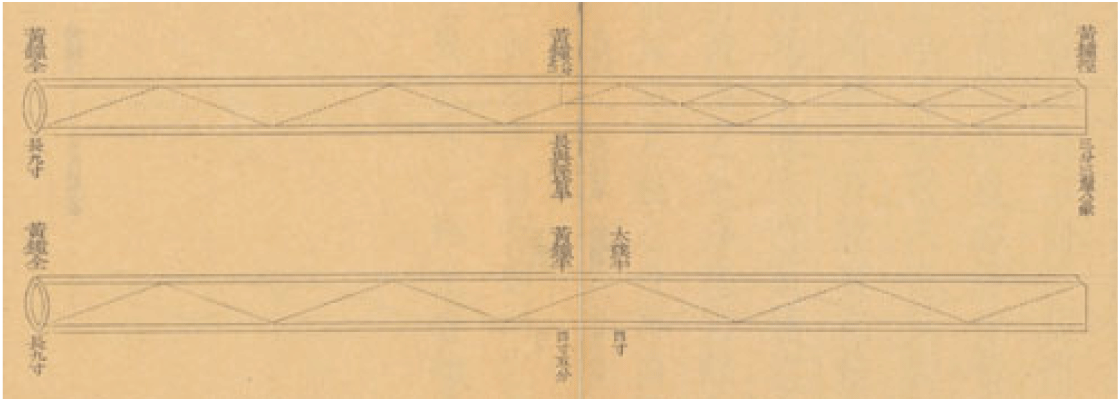
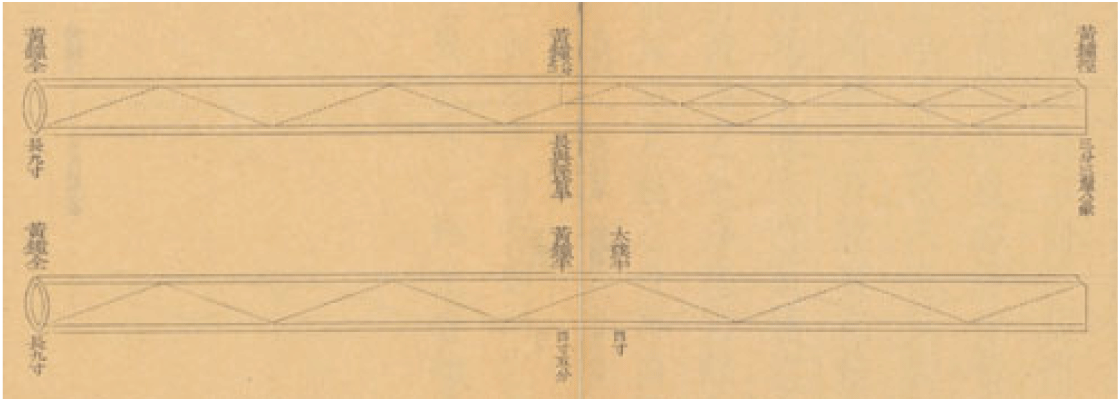
However, there are some problems with Pereira’s theory that would create difficulties in their application. First, his theory suggests that consonance and dissonance in pipes are only caused by the width but not by the length of the pipe: ‘the pitch heights of the eight scale degrees are determined by the lengths of their respective pipes, whereas consonant and dissonant intervals are caused by the widths of the pipes’.Footnote 74 This means that he associated frequency ratios with the phenomenon of consonance but dissociated them from musical intervals, but they are interrelated. According to his theory, pipes with the same width but different lengths will always produce consonances, which is impossible. Pereira even drew a diagram contradicting his theory that a pipe’s width determines the angle of incidence of the air blown in; the diagram, using dotted zigzag lines to represent the pathways along which the air travels, shows a wide pipe and a narrow pipe with air blown in at the same angle of incidence.Footnote 75 This misleading diagram was later reproduced in The True Doctrine of Music (see Figure 3, top), showing its influence on the treatise’s authors.
An illustration from The True Doctrine of Music (Lülü zhengyi 律呂正義) explaining consonances in pipes. The dotted lines represent the pathways along which the blown-in air travels. Top: A diagram borrowed from Pereira’s A Summary, showing a small pipe drawn within a large pipe that doubles its length and diameter. Bottom: A diagram explaining why the ratio 9:4 produces perfect consonance in pipes. © Harvard-Yenching Library
Second, he did not indicate how one can calculate the angle of incidence of the air hitting the inner wall of the pipe. In the same way that he introduced the pendulum model, there was no mathematical demonstration as to how the frequency of the air hitting the inner wall of the pipe can be calculated from the width of the pipe. Nor did he demonstrate how his theory can be applied to explain the degree of consonance of different musical intervals as he did in the case of strings.
Third, by treating the movement of air in pipes and the motion of strings as commensurable, Pereira also did not deal with the acoustic lengths of pipes, which is the key to solving the problem faced by the authors of The True Doctrine of Music. Since Pereira had already died by the time The True Doctrine of Music was being drafted, he could no longer clarify the meanings of his writings for the authors, nor could the authors receive advice from him as to the possible ways of applying his theory.
In order to make sense of Pereira’s theory, the authors of The True Doctrine of Music reinterpreted it to fit their own model. They used pipes of the same width and determined that the air hits the inner wall of the pipe of huangzhong (the counterpart of C) nine times, as it is 9 cun.Footnote 76 Yet they did not draw other diagrams that represent the pipes which are 4.5 cun and 4 cun. Nor did they determine the angles of incidence at which the air hits the inner walls of these pipes and compare them with the case of the pipe of huangzhong (C). Their reproduction of Pereira’s diagram (see Figure 3 above, top), which shows a wide pipe and a narrow pipe with air blown in at the same angle of incidence, reflects that they were misled by it to assume that the angle of incidence at which the air is blown into the pipe is the same for all lengths and widths.
The authors explained that in the pipe of huangzhong (C), the air does not hit the inner wall of the pipe at the position of the half huangzhong (the C at an octave), which is at 4.5 cun from the mouth of the 9-cun pipe (Figure 3, bottom). Therefore, pipes with lengths in the ratio 2:1 will produce a dissonance (bu ying 不應, ‘not agreeing’). In contrast, the air hits the inner wall of the pipe at the position of half taicu (the D at an octave), which is at 4 cun from the mouth the 9-cun pipe. Therefore, pipes with lengths in a ratio of 9:4 will produce a consonance (xiang ying 相應, ‘agreeing with each other’).Footnote 77 We can see that they associated pitch names with the standardised lengths in tuning rather than with their perceived absolute pitches. Their theory is as untenable as Pereira’s, since the number of times the air hits the inner wall of the pipe is arbitrarily determined in order to fit their theory.
Pereira’s writings on speculative music theory were not only reconstructed, but also heavily reduced. The adoption of A Summary by the Chinese was even more selective than their adoption of A Compilation. The detailed descriptions of the vibrating motions of strings with different length ratios, which span more than twenty folios, were condensed into a few sentences. Pereira’s analogy of two persons walking along a line for two vibrating strings as well as his reference to the pendulum were omitted. Since the authors’ goal was to explain the acoustic incommensurability between strings and pipes, they only discussed the case of perfect consonance, i.e. the octave (1:2).Footnote 78 Such truncation of Pereira’s writings made the coincidence theory of consonance harder to understand.
Furthermore, except for the coincidence theory of consonance, the authors of The True Doctrine of Music did not discuss any of his other theories: the production of sound in different musical instruments and its transmission,Footnote 79 the tuning of the pipe organ with just intonation and with pipes of varied widths,Footnote 80 the solution of the Pythagorean comma by reducing the interval size of the perfect fifth (‘Lun tui wu yin’ 論退五音),Footnote 81 and the resolution of dissonances.Footnote 82 By picking out only the theories that they deemed useful, the authors of The True Doctrine of Music hindered the dissemination of other theories discussed by Pereira. As the rules of counterpoint introduced in A Compilation and the message promoting polyphonic music in A Summary had never been circulated outside the court, the chance of their reaching a reader who might be interested in learning counterpoint was significantly reduced.
Lost in Circulation
All extant copies of A Compilation and A Summary were kept at the National Palace Museum and the National Library of China in Beijing, suggesting that the two treatises had limited circulation within the court.Footnote 83 This means that Pereira’s theories could only be made known to a wider audience through the circulation of The True Doctrine of Music, but this was also not readily available. In addition to the fact that his writings were largely omitted or reconstructed in the treatise, the circulation of The True Doctrine of Music was not much wider than that of Pereira’s treatises. Some copies of the treatise had been consigned to the library shelves of book collectors. Though it is difficult to establish a citation index, few later writings refer to the treatise. Even when the authors made reference to material probably derived from the treatise, they seldom discussed Pereira’s theories.
The Catalogue of Chinese Ancient Rare Books (Zhongguo guji shanben shumu 中國古籍善本書目) lists four editions: (1) Kanxi reign bronze movable-type edition in four juan; (2) Kangxi reign bronze movable-type edition in five juan; (3) Yongzheng reign (1723–35) bronze movable-type edition in five juan; (4) Yongzheng reign woodblock print edition in five juan.Footnote 84 The supplementary volume that incorporates Pereira’s writings is not included in the first edition. The first three editions were all printed with bronze movable types. According to the Catalogue, in addition to the National Palace Museum Library in Beijing, there are only two other libraries in China that hold copies of the bronze movable-type editions.
The limited circulation of the movable-type editions lies in the technological complexities of printing Chinese characters. In the West, movable-type printing had dominated the book industry since the late fifteenth century as it allowed the rapid printing of multiple copies of a single text, but woodblock printing remained the dominant form of printing in China for it was more economical, since the demand on literacy is lower for block carvers than for typesetters.Footnote 85 While movable-type printing had enhanced book circulation in the West, it was not necessarily the case in China.
Printing with movable types imposes a greater limitation on circulation than using woodblocks for it is less favourable for reprinting. Unless the publisher is already certain about the popularity of a book, making a large number of copies in the first print run would risk leaving substantial quantities of obsolete inventory. But resetting each page of the whole text for a new print run is laborious and expensive.Footnote 86 Fixing the formes of all pages to avoid resetting is similarly costly, especially if it is a lengthy text. The production of movable types is expensive owing to the huge number of Chinese characters (four thousand common characters), and a great number of types will be required if one fixes the setting for every page of a book. More than 120,000 types (700 pages × 180 characters) would be needed to reprint The True Doctrine of Music without resetting the types. In 1720, six years after the treatise was printed, Kangxi commissioned the voluminous Compendium of Books Past and Present (Gujin tushu jicheng 古今圖書集成), which was printed with bronze movable types. The printing of the ten-thousand-juan compendium resulted in the production of a huge number of types. According to an accounting record in 1733, there were 1,015,433 bronze movable types stored in the Hall of Martial Valor (Wuying dian 武英殿), a centre for compiling and printing books in the palace.Footnote 87 But even with such a huge number of types one could only print around five thousand different pages of texts if they were not reset.
It is more plausible to assume that the types used for printing The True Doctrine of Music were disassembled so that they could be reused for printing the Compendium and other books, such as The Essential Principles of Mathematics (Shuli jingyun 數理精蘊). The transient nature of movable-type setting had concerned the officials involved in the compilation of the Compendium of Music and Calendrical Astronomy, a set of books that contains The True Doctrine of Music, The Essential Principles of Mathematics and the Compendium of Calendrical Astronomy (Lixiang Kaocheng 曆象考成), all commissioned by the Kangxi emperor. In 1725, Yunlu 允祿 and He Guozong 何國宗 (d. 1767) submitted a memorial to the Yongzheng emperor, suggesting that woodblocks should be carved to print new copies of The True Doctrine of Music and Essential Principles of Mathematics since the movable types ‘could not achieve eternity’ (bu neng chui zhu yongjiu 不能垂諸永久).Footnote 88
The woodblock print edition was more widely circulated than the movable-type edition, as can be inferred from the relatively large number of extant copies. The Catalogue of Chinese Ancient Rare Books records six libraries in China that hold the woodblock print edition. Other than the libraries in China, copies having the same book layout can also be found in many libraries in other places, such as the National Taiwan University Library, the Tokyo University Library, the Princeton University Library, and the SOAS Library, University of London. It is likely that some of the copies are reprints or re-engraved editions from the Qianlong era (1735–96). The reprinting had led to the increasing deterioration of the printing blocks, leaving traces on extant copies.Footnote 89 Also, the woodblock print edition produced during Yongzheng’s reign was not circulated outside the court until Qianlong’s reign.
In 1736, Mei Juecheng, one of the authors of The True Doctrine of Music, wrote a memorial to Qianlong addressing the limited circulation of the Compendium of the Origin of Music and Calendrical Astronomy: ‘The printing blocks are now stored at the Ministry of Rites. There are no re-engraved editions outside [the court], so [the compendium] is not able to circulate.’Footnote 90 Mei made several suggestions about how the compendium should be distributed. First, the Ministry of Rites should recruit commercial publishers to print copies from the printing blocks stored at the Ministry, so that they could be sold outside the court. Clerks (shuli 書吏) working at the Ministry should be prohibited from extorting the publishers. Second, the Ministry of Rites should send copies to the government schools of Zhili and other provinces (shengzhi shuyuan 省直書院), so that students could study the compendium.Footnote 91 Third, since it was a long journey from other provinces to the capital, rather than asking publishers from these provinces to travel, Mei proposed that the Ministry of Rites should print several hundred copies and distribute a number of copies to publishers in each province according to its size, so as to allow voluntary re-engraving.Footnote 92 Clearly a plan for circulating the compendium outside the court had not been devised until this point. Only a few copies of the movable-type editions were printed. The circulation of the woodblock print edition had also been limited. For more than twenty years, the printed copies of The True Doctrine of Music had been confined to the court.
Even after Qianlong approved Mei’s suggestions, circulation was still limited in some places. In 1739, the governor of Gansu Province Yuan Zhancheng 元展成 (d. 1744) reported in a memorial that they had not yet received any copy of the compendium and would like to request a copy for publishing.Footnote 93 Yuan’s memorial suggests that even three years after Qianlong had ordered the distribution of the Compendium of the Origin of Music and Calendrical Astronomy, not every province actually received copies of the compendium, as suggested by Mei. Furthermore, even though commercial publishers were encouraged to re-engrave the compendium for sale, few would probably be willing to do so, for the cost was too high. This was true for the other books commissioned by Kangxi.Footnote 94 Earlier in 1738, Qianlong ordered the provincial governors to administer the renovation of the printing blocks kept in the provincial treasuries to facilitate printing as there were few students and publishers who had printed the books.Footnote 95
Notwithstanding these limitations, circulation of The True Doctrine of Music did increase during Qianlong’s reign, when writings about the treatise began to emerge. Nevertheless, their engagement with the treatise was usually selective. To see how Pereira’s theories in The True Doctrine of Music were received by its readers, I shall analyse three music treatises written in the mid-eighteenth century, namely Wang Tan’s 王坦 (c. 1700) Principles of the Qin (Qin zhi 琴旨, 1744), Cao Tingdong’s 曹庭棟 (1700–85) Qin Studies (Qin xue 琴學, 1750), and He Mengyao’s 何夢瑤 (1693–1764) Annotations (Genghe lu 賡和錄, c. 1751). While the three treatises have different levels of engagement with The True Doctrine of Music, none of them deals with the supplementary volume of The True Doctrine of Music, where Pereira’s practical theories are discussed. The ways in which the three authors engaged with the earlier treatise reflect their different purposes of writing.
A common concern in Cao Tingdong’s and Wang Tan’s treatises is the tuning of the qin. Both Cao Tingdong and Wang Tan were qin players. Wang was a famous qin player in Tongzhou 通州, Jiangsu Province and was acclaimed as a ‘national champion’ (guoshou 國手).Footnote 96 Cao was less famous in qin playing. He was born to a literati clan in Jiaxian 嘉善, Zhejiang Province. He obtained a degree by purchase (lingongsheng 廩貢生), but failed the provincial examination (xiangshi 鄉試), a higher-level civil service examination. In mid-life, he began to write on different subjects.Footnote 97 As qin players who were well-versed in the orthodox tuning of pitch-pipes as recorded in many classical Chinese texts, Wang and Cao shared the same concern with the authors of The True Doctrine of Music: the acoustical incommensurability between strings and pipes; they argued that pitches of the pitch-pipes and the qin would not correspond if they were tuned with the same set of ratios. Following The True Doctrine of Music, the two authors suggest that in the case of pipes, huangzhong (counterpart of C) is consonant with half taicu instead of with half huangzhong, whereas the pitch of a string is consonant with the pitch of another string whose length is half that of the former string.Footnote 98
However, Wang and Cao did not use Pereira’s coincidence theory of consonance, as reinterpreted in the earlier treatise, to explain this phenomenon; Pereira’s theory is absent in their writings. Wang proposed that pipes and strings are different – in that strings are solid (shi 實) and pipes are hollow (xu 虛) – without elaborating on how the forms of these two instruments are mechanically related to their different acoustic properties.Footnote 99 Cao also explained the difference in terms of shi and xu, but in different senses: ‘actual’ and ‘false’. Rather than applying the terms to the shapes of the instruments, which Wang referred to as ti 體 (substance), Cao used the terms to depict the relationship between the lengths of the instruments and the pitches they produce, which he conceptualised as yong 用 (function). Cao argued that because ‘the sound of a string is produced by striking the string per se’ (xian yi chu qi benti er shengsheng 絃以觸其本體而生聲), a string generates pitches according to its actual length (qi yong shi 其用實, literally ‘its function is actual’).
As for the sound production of pipes, Cao explained the mechanism in terms of the air column inside, but instead of adopting Hobbes’s and Pereira’s theory about air movement in pipes – the air repeatedly rebounds from the pipe wall and travels along a zigzag pathway – he only stated that the air is ‘expelled out of the open end of the pipe’ (biji er chu guandi 逼激而出管底). Cao suggested that the expelled air travels a certain distance before the pipe could produce a sound, just like when a musket is fired, smoke is seen coming out of the muzzle before a sound is heard; therefore, a pipe does not generate pitches according to its actual length (qi yong xu 其用虛, literally ‘its function is false’).Footnote 100 Cao’s theory is close to the modern explanation that the acoustic length of a pipe is longer than its actual length because air vibration inside the pipe extends beyond the end of the pipe.
There are several possible reasons why Wang and Cao did not refer to Pereira’s theory. They might not have read the entire The True Doctrine of Music, or have only read excerpts of the treatise from secondary sources. It is also possible that they had read the discussion on Pereira’s theory, but since they thought that their own theories could better explain the incommensurability between strings and pipes in pitch generation, they chose not to mention Pereira’s theory in their writings as they did not want to directly refute a theory discussed in a treatise commissioned by a late emperor.
While Wang and Cao did not extensively discuss the theories in The True Doctrine of Music, He Mengyao’s Annotations shows a relatively comprehensive engagement with the earlier treatise. It contains annotated versions of The True Doctrine of Music and two other music treatises: Cai Yuanding’s 蔡元定 (1135–1198) New Treatise on Music (律呂新書 Lülü xinshu) and part of Cao Tingdong’s Qin Studies. In his annotations to The True Doctrine of Music, He Mengyao not only elaborated on the text to clarify it, but also attempted to fill the gaps in the theories.Footnote 101 Unlike Cao and Wang, who wrote specialised treatises about the qin, He aimed to offer a more general education in music theory by reviewing pre-existing treatises in the form of annotations.
He Mengyao wrote Annotations as an educator. After retiring from the civil service and returning to Guangdong in 1750, he served as a school principal in three academies successively.Footnote 102 He wrote Annotations as a textbook in music theory for his students and printed it with his own income.Footnote 103
He Mengyao’s comprehensive reading of The True Doctrine of Music enabled him to critically engage with the reinterpreted version of Pereira’s coincidence theory of consonance for pipes. In The True Doctrine of Music, the authors stated that when one blows into the pipe of huangzhong (the counterpart of C), which is 9 cun, the air – repeatedly rebounding along a zigzag pathway – hits the inner wall of the pipe at the position of half taicu (the counterpart of D), which is at 4 cun from the mouth of the pipe; as a result, if two pipes have the same width and their lengths are in a ratio of 9:4, they will produce a consonant interval.Footnote 104 He Mengyao spotted a problem in the theory: since the rebounding air was supposed to hit the wall of the 9-cun pipe nine times, it would also hit the wall at 5 cun from the mouth of the pipe, but the pitches produced by a 5-cun pipe 9-cun pipe do not form a consonant interval.Footnote 105
He did not refute the theory because of this problem. Rather, he tried to explain the problem by making an analogy between the uneven momentum of the air along the pipe and the uneven arms of the steelyard balance. If the load (ben 本, ‘head’) and the counterbalance (mo 末, ‘end’) have the same weight, then the balance beam can be suspended from a pivot at the midpoint of the beam. If the load is heavier than the counterbalance, then the balance beam has to be suspended from a pivot close to the load (zai zhongyao zhi qian 在中腰之前, ‘in front of the middle waist’), so that the beam is balanced. He Mengyao compared a steelyard balance with even arms to the string, and a steelyard balance with uneven arms to the pipe. He suggested that strings are stretched by force, and the force at the two ends of a string is even (wu benmo qiangruo zhi fen 無本末強弱之分, ‘no difference in strength and weakness, head and end’). In contrast, pipes are struck by air, and since the air will lose momentum along the pipe, the air near the mouth of the pipe has a greater momentum than that near the end of the pipe (ben sheng er mo shuai 本盛而末衰, ‘the head is strong and the end is weak’).Footnote 106
Similar to a steelyard balance with a heavy load and a light counterbalance, which is balanced at a pivot close to the load (ben), the uneven air column inside the pipe is ‘balanced’ at 4 cun from the mouth, which is closer to the mouth of the pipe than 5 cun; therefore, a 4-cun pipe instead of a 5-cun pipe will produce a pitch consonant with that of a 9-cun pipe. By comparing the load of the steelyard balance to the mouth of the pipe (both are referred to as ‘ben’), the counterbalance to the end of the pipe (both are referred to as ‘mo’), and the position of the balance’s pivot to the position of the ‘pivot’ of air column inside the pipe, He attempted to solve the problem that he discerned in the coincidence theory of consonance for pipes discussed in The True Doctrine of Music.Footnote 107
However, He Mengyao’s explanation did not really solve the problem. The air travelling through the pipe will hit the inner wall nine times, at 1 cun, 2 cun, 3 cun, …, 9 cun from the mouth. The positions at 1 cun, 2 cun and 3 cun are also close to the mouth of the pipe. Without knowing the air’s rate of change in momentum along the pipe, it is impossible to determine at which position is the air column ‘balanced’. He’s critical instinct was right; the theory is problematic. But he was too eager to render it right.
Notwithstanding He’s intelligence, there is a part in The True Doctrine of Music that he was not able understand. In his annotation to the passage that explains the perfect consonance of the octave in terms of the coinciding cycles of vibrating strings, He wrote ‘unclear’ (weixiang 未詳). Yet he did not give up on making sense of the passage. He imagined that there are two persons playing two zithers, qin A and qin B respectively. One strikes the open third string of qin A and waits until the note dies away completely, then immediately strikes the same string while pressing it in the middle, and waits again for the note to die away. The other player strikes the third string of qin B while pressing it in the middle, waits until the note dies away completely, then repeats the action twice. He then wrote that the string of qin A has ‘vibrated one and a half times’ (gudong yi ci ban 鼓動一次半), and the string of qin B three times, finally concluding that ‘the notes of the two qin start and end at the same time’ (liang qinsheng zhi qizhi shihou fu tong fu 兩琴聲之起止時候符同乎).Footnote 108
This thought experiment clearly reflects He’s lack of understanding of the concept of vibration frequency, which has nothing to do with note duration. Without knowing what is meant by ‘vibrating one time’ or one cycle of vibration, He did not know how to count string vibrations in his imagination; thus he totally misinterpreted the coincidence theory of consonance. Yet this misunderstanding could not be attributed to He’s intellectual capacity. The authors of The Doctrine of True Music only provided a very brief discussion of the theory. The moment-to-moment descriptions of vibrating strings in Pereira’s A Summary were completely omitted, not to mention the analogies and diagrams he used to aid understanding. If there is anything to blame for He’s misunderstanding of the coincidence theory of consonance, it is that he did not have the privilege of reading the original text written by Pereira.
From the three cases discussed above, we can see that The True Doctrine of Music had – assuming that Wang, Cao, and He obtained their copies in their home provinces: Jiangsu, Zhejiang and Guangdong – circulated in different provinces. Yet the circulation of The True Doctrine of Music does not equal the circulation of Pereira’s theory, which is absent in Cao’s and Wang’s discussion on the theory of The True Doctrine of Music. He Mengyao’s treatise might have the potential to serve as a tertiary source of Pereira’s theory. But given that he wrote the text for teaching his own students and that he funded the printing of his own book, the circulation of Annotations was undoubtedly limited.
Conclusion
In studying the transmission of Western knowledge to China, sinologists tend to explain communication failure by attributing the problem either to the Western transmitters or to the Chinese receivers in terms of linguistic barrier or intellectual failing. However, discrepancies in understanding the coincidence theory of consonance between Pereira and the authors of The True Doctrine of Music stem rather from a cultural difference between Western and Chinese musical practices. Originally serving as an explanation of the ranking of consonances, which was non-existent in the discourse of Chinese music theory, the coincidence theory of consonance was not devised to explain the difference between the acoustic lengths of pipes and strings, which was a phenomenon still poorly understood in both China and Europe in the seventeenth century. Notwithstanding having a different agenda, the Chinese writers saw the explanatory potential in Pereira’s theory of consonance for pipes to solve a core problem in their theoretical discourse on tuning. There was no consensus between Pereira and the authors of The True Doctrine of Music as to how the coincidence theory of consonance should be used, making it a boundary object. It contributed to the Chinese readers’ understanding of the acoustics of strings and pipes. At the same time, it was also shaped by them.
The coincidence theory of consonance was reconstructed not only by Pereira and his Chinese readers, but also by the difference in acoustic properties between strings and pipes. It is this difference that created a possible point of fusion between European and Chinese music theories. The pitch-pipe became what Alexander Rehding calls an ‘epistemic thing’, functioning as ‘a filter that allows certain propositions to be made in sound’.Footnote 109 Both Pereira and the authors of The True Doctrine of Music tried to make propositions about consonance in pipes, notwithstanding that the latter’s theory deviated from the former’s because of a different interest. They were definitely not giants of science who would pioneer modern theories of acoustics. Their theories have their own problems. Yet they both attempted to make sense of others’ theories and generate new knowledge with their creativity.
Explaining the intervallic relationship between pitches in terms of the relative frequency of mechanical vibration, the theory of consonance introduced by Pereira had the potential to reorient the development of tuning theory in China, which had conceptualised absolute pitch in terms of the length and width of pitch-pipes. Certainly, the development from relative frequency to absolute frequency was not an easy one. Pereira did not introduce Mersenne’s Laws in his writings. The method of using an enormously long and heavy cord to count its number of vibrations is not easy to think of.Footnote 110 But there was an even greater impediment. As observed by Thomas Irvine, ‘dialogue around 1750 between Westerners and Chinese about music – and indeed all subjects – was obscured by the contingencies of the entangled network that made it possible’.Footnote 111 Pereira’s A Summary was not circulated outside the court. What was circulated was The True Doctrine of Music, which did not have a much larger readership and presented an abridged and distorted version of Pereira’s theory.
Had Pereira’s original books been more widely disseminated, they might have found a reader who could be inspired by the descriptions of the vibrating strings to develop his own vibration theory of pitch. As a reader who was able to read The True Doctrine of Music critically, He Mengyao had such a potential, but his understanding of the coincidence theory of consonance was hindered by the heavily abridged text. There might also have been a few readers, perhaps some Chinese converts who had heard organ music in a church, who would become interested in learning counterpoint or just intonation.Footnote 112 Certainly, we cannot know about something that did not happen. There is not a parallel universe for us to observe this alternative history. What actually happened is that none of the readers discussed in this article saw the significance of the coincidence theory of consonance in providing a mechanical conceptualisation of pitch that could develop into a more accurate method of representing absolute pitch than using the length and width of pipes. European music theory, once having crossed the cultural boundary, was truncated and fertilised with new pollens by the local gardeners; the new plant was allowed to replicate and disperse, but its offspring did not receive enough nutrients and eventually withered.
That said, we need not construct a narrative of progress or failure out of this cultural exchange. Failure means not being able to achieve a goal or perform a normal function. Although Pereira did fail to promote polyphonic music in China, his greater goal – obtaining the emperor’s support for Christianity – was achieved successfully. The authors of The True Doctrine of Music also achieved their main goal – finishing their work with the aid of Pereira’s writings and satisfying the emperor. Until the twentieth century, learning European counterpoint was neither a goal nor a normal function of the Chinese. The emergence of polyphonic music might be an advanced stage in the development of European music, but it was not necessary for Chinese music to develop in the same direction if we believe in multi-linear evolutionism; the best heterophonic music need not be inferior to the best polyphonic music.