Introduction
The distinctive position of the Anglican Church within the ecclesiological spectrum is characterized by its three-fold commitment to the authority of scripture, church tradition, and reason. Anglican diversity partly reflects the emphases of different traditions (often referred to as churchmanship) on different aspects of this three-fold commitment. Within the Anglican Church in England, long-established and well-defined differences exist between the Evangelical Anglican and Anglo-Catholic wings.Footnote 1 These traditions trace their roots to revivals in the nineteenth century when the reformed tradition ushered in the Evangelical Movement (see, for e.g., Hylson-SmithFootnote 2) and the Catholic tradition ushered in the Tractarian or Oxford Movement (see, for e.g., Hylson-SmithFootnote 3). DanielFootnote 4 explains the difference between the Evangelical Anglican and Anglo-Catholic traditions in terms of authority: the Evangelical Anglican movement appeals more to the authority of Scripture, while the Anglo-Catholic movement appeals more to the authority of church tradition. The Evangelical Anglican movement highlights the significance of scripture, evangelism, and personal faith, downplaying the significance of tradition, church, and sacraments, while the opposite is true for the Anglo-Catholic movement. Francis and LankshearFootnote 5 characterized the Evangelical Anglican movement as emphasizing ‘biblical theology, biblical inspiration and authority, personal conversion, justification by grace through faith, centrality of preaching ministry, and simplicity in clerical dress with cassock, surplice, preaching scarf and hood’. They characterized the Anglo-Catholic movement as emphasizing ‘sacramental theology, sacramental grace, confession, centrality of sacramental ministry, and richness in eucharistic vestments, ritual and ornaments’.
The Evangelical and Anglo-Catholic movements within the Church of England clearly emphasize and value the different elements of doctrine and practice. This study aims to investigate whether these different emphases and values are related to psychological type theory. Psychological type theory is increasingly used by churches in the UK (see, for e.g., Duncan,Footnote 6 Goldsmith and Wharton,Footnote 7 Delmage,Footnote 8 and FrancisFootnote 9) and significant claims have been made about its ability to inform inter- and intra-church dialogue. For example, GoldsmithFootnote 10 suggests that ‘much contemporary debate and division in theology is, to my mind, not so much about theology as about personality’. Is psychological type theory also related to the different theology, rituals, and practices of Evangelical Anglican and Anglo-Catholic congregations? In order to answer this question, psychological type theory will now be introduced, and the potential of this theory will be explored to account for observed differences between the two church traditions.
Psychological type theory was originally proposed by Carl Gustav JungFootnote 11 and then developed and operationalized in instruments like the Myers–Briggs Type Indicator (MBTI),Footnote 12 the Keirsey Temperament Sorter (KTS),Footnote 13 and the Francis Psychological Type Sorter.Footnote 14 The theory distinguishes between two orientations, two perceiving functions, two judging functions, and two attitudes toward the outer world.
The two orientations are concerned with whether individuals draw energy from the outside world or from their inner world. Extraverts (E) are orientated toward the outer world; they are energized by the events and people around them. They enjoy communicating and thrive in stimulating and exciting environments. They tend to focus their attention on what is happening outside themselves. They are usually open, sociable people who enjoy having many friends. Introverts (I) are orientated toward, and energized by, their inner world; they tend to enjoy solitude, silence, and contemplation. They may prefer to have a small circle of intimate friends rather than many acquaintances.
The two perceiving functions are concerned with the way in which people gather and process information. Sensing types (S) focus on the realities of a situation as perceived by their senses. They attend to specific details rather than the overall picture, and are concerned with the actual, the real, and the practical. They are typically down to earth and matter of fact. Intuitive types (N), on the other hand, focus on the possibilities of a situation, using their imagination to perceive patterns and relationships. They attend to the overall picture rather than specific details and are concerned with possibilities and abstract theories. They are typically imaginative and innovative.
The two judging functions are concerned with the way in which people make decisions and judgments. Thinking types (T) prefer to make judgments based on objective, rational logic. They value integrity and justice, and are known for their truthfulness and desire for fairness, often attaching more importance to principles than to cultivating harmony. Feeling types (F) prefer to make judgments based on subjective, personal values. They prize compassion and mercy, are known for their tactfulness and their desire for peace, and generally attach more importance to promoting harmony than to adhering to abstract principles.
The two attitudes toward the outer world indicate which of the two sets of functions (that is, Perceiving S/N, or Judging T/F) is preferred in dealings with the outer world. Judging types (J) actively judge external stimuli so they tend to order, rationalize, and structure their outer world. They enjoy routine and established patterns, preferring to reach goals by following schedules and using lists, timetables, or diaries. They tend to be punctual, organized, and tidy, to make decisions quickly and to stick to them. Perceiving types (P) passively perceive external stimuli, so they tend to avoid imposing order on the outer world. They are more reflective, perceptive, and open than the judging types and have a flexible, open-ended approach to life. They enjoy change and spontaneity, preferring to leave projects open in order to adapt and improve them.
Psychological type theory has been thoroughly criticized and evaluated in terms of psychological conceptualization and empirical operationalizationFootnote 15, and theological implications (see LeechFootnote 16). In a recent review and assessment of these issues, FrancisFootnote 17 concluded that psychological type theory offers a valuable psychological and theological resource, provided that realistic claims are made regarding the nature of this research. In terms of psychological conceptualization, type theory describes a limited but core range of individual differences. It does not purport to offer a full description of individual differences in human personality as offered, for example, by the Eysenckian three-dimensional model,Footnote 18 or by the Five Factor Model.Footnote 19 In terms of empirical operationalization, type scales provide highly reliable measures in terms of the continuous scale scores underpinning the categorization procedures. Type sorters are less reliable at assigning individuals to dichotomous categories. In terms of theological interpretation, type theory can be properly integrated within a doctrine of creation, which embraces the full range of individual differences within the divine intentionality (Gen. 1.27-28). It is a mistake to argue that type theory is grounded in a deterministic worldview, which ignores the gospel potential for repentance, change, and salvation.
In a review of empirical research, Francis and RossFootnote 20 drew attention to the importance of the perceiving functions (S and N) in religious contexts, and this has been confirmed by subsequent research (Francis and Jones,Footnote 21 FrancisFootnote 22). Moreover, there are many ways in which these distinctions between sensing and intuition map onto the distinctive and distinguishing features of the Evangelical Anglican and the Anglo-Catholic movements. Evangelical Anglicanism seems to place more value than Anglo-Catholicism on a sensing expression of faith, while Anglo-Catholicism seems to place more value than Evangelical Anglicanism on an intuitive experience of faith. This contrast emerges in a number of ways.
First, the liturgy in Evangelical Anglican churches stresses an exegetical exposition of the content, facts, and truths of the revealed word of God encapsulated in Scripture (S). The liturgy in Anglo-Catholic churches stresses the mystery of the mass, and the ways in which ritual, vestments, music, and incense can convey the ineffability of encountering God (N). Second, what precisely individuals believe about the content of their faith matters more in Evangelical Anglican churches because salvation is linked to this personal expression of faith (S). What matters more in Anglo-Catholic churches is how individuals engage with the sacramental practice and less weight is placed on the articulated expression of belief (N). For Evangelical Anglicans, the heart of worship resides more in the Ministry of the Word (S); for Anglo-Catholics, the heart of worship resides more in the Ministry of the Sacrament (N). Third, the less adorned and more austere buildings associated with the Evangelical Anglican tradition were designed to focus the mind on cerebral activity and set a context for learning the details of the faith (S). The more ornate and more extravagant buildings associated with the Anglo-Catholic tradition were designed to spark the imagination and set a context for being led into the mystery of faith (N).
The contrast in the perceiving processes preferred by Evangelical Anglicans and Anglo-Catholics is perhaps typified by some of the communion hymns inspired by these two traditions. In the Anglo-Catholic tradition, the intuitive function (N) is nurtured by hymns such as:
Let all mortal flesh keep silence
and with fear and trembling stand;
ponder nothing earthly-minded,
for with blessing in his hand
Christ our God to earth descendeth,
our full homage to demand.Footnote 23
In the Evangelical Anglican tradition, the sensing function (S) is nurtured by hymns such as:
Here, O my Lord, I see Thee face to face;
here would I touch and handle things unseen;
here grasp with firmer hand eternal grace,
and all my weariness upon Thee lean.
Here would I feed upon the bread of God,
here drink with Thee the royal wine of heaven;
here would I lay aside each earthly load,
here taste afresh the calm of sin forgiven.Footnote 24
As yet, there is relatively little published research data on the psychological type profile of church congregations in England. In a foundational study reported by Francis et al.,Footnote 25 five typical Anglican churches in central England invited their regular attenders to complete the MBTI. Data were provided by 327 churchgoers. Overall, in these congregations, there were clear preferences for introversion, sensing, feeling, and judging (ISFJ). In a second smaller study reported by Craig et al.,Footnote 26 three typical Anglican groups of churches in Wales invited their regular attenders to complete the Francis Psychological Type Scales. Data were provided by 101 churchgoers. Once again, in these congregations, there were clear preferences for ISFJ. No attempt, however, was made in these studies to test for differences between the congregations.
In a third much larger study, CraigFootnote 27 reported on the psychological type profile of 2,658 people attending church services in 95 congregations across the United Kingdom and across several denominations, using the Francis Psychological Type Scales. For the first time, Craig’s study examined whether there were significant differences in type profile between different types of churches. Craig’s analysis was specifically concerned to ascertain whether rural congregations were different in type profile from congregations in non-rural areas. The data demonstrated that rural churchgoers achieved higher scores on sensing, while urban churchgoers achieved higher scores on intuition. No significant differences were found between the scores of rural churchgoers and urban churchgoers on the scales of extraversion and introversion, thinking and feeling, or judging and perceiving. Unfortunately, this study reports only scale scores and not type categories, making direct comparison with other studies difficult. Craig suggested that rural churchgoers’ preference for sensing may reflect a more conservative approach to issues of faith and belief in rural churches compared with urban churches.
Against this background, the present study was designed to test the hypothesis that there is a significant difference between the psychological type profile of Evangelical Anglican congregations and Anglo-Catholic congregations, in terms of there being a higher proportion of intuitives among the Anglo-Catholics than among the Evangelical Anglicans. This hypothesis is being tested by means of the KTS.
The KTS was first developed by Keirsey and BatesFootnote 28 to provide an accessible operationalization of psychological type theory. In 1995, a revised edition of the KTS was published, which included a number of significant changes to the original wording of the items.Footnote 29 Evidence for the internal consistency and reliability of the KTS has been reported in a study by Waskel and ColemanFootnote 30 among a sample of 331 university students in the USA. In this study, the KTS indices achieved CronbachFootnote 31 alpha coefficients of 0.74 (EI), 0.89 (SN), 0.87 (TF), and 0.88 (JP). More recently, Fearn, Francis and Wilcox,Footnote 32 in a study among 367 university students in the UK, found that the KTS indices achieved Cronbach alpha coefficients of 0.68 (EI), 0.73 (SN), 0.74 (TF), and 0.82 (JP). From the studies surveyed, it may be concluded that the KTS indices are generally internally consistent, in that they tend to achieve Cronbach alpha coefficients around the level deemed satisfactory by KlineFootnote 33 of 0.70 and by De VellisFootnote 34 of 0.65. The KTS has also been shown to demonstrate concurrent validity with other measures of psychological type such as the MBTI.Footnote 35
Method
Procedure
People attending two Evangelical Anglican and four Anglo-Catholic churches in central England completed the 1995 edition of the KTS. The churches were assigned to tradition a priori using information supplied by incumbents. Incumbents indicated that these congregations mostly drew worshippers from a wide area beyond the geographical parish.
Measure
Psychological type was assessed by the KTS, a self-report, pencil and paper, forced-choice format questionnaire, which contains seventy items, each consisting of two pairs of characteristics from which participants are asked to select the characteristic that they feel best represents their personality. There are 10 items assessing E or I, and 20 for each of the other dimensions (S or N, F or T, J or P). The number of choices for each orientation or function is used as a score, indicating degree of preference for that aspect of personality. The scores for functions in a dimension (for e.g., S and N) are necessarily complementary.
Sample
Data were provided by 290 churchgoers, of whom 114 (39%) were male and 176 (61%) were female. Just under a third of the sample attended Anglo-Catholic churches (N = 91, 32%) and just over two-thirds attended Evangelical Anglican churches (N = 199, 68%). Among the sample, 7% were under the age of 30, 13% in their thirties, 21% in their forties, 21% in their fifties, 24% in their sixties, and 15% were aged 70 or above. Nearly 9 out of 10 (88%) claimed they attended church at least once a week.
Data analysis
Studies employing recognized type sorters (whether the MBTI or the KTS) published within the scientific literature, need to adjudicate between employing the continuous underlying scale scores or the type categories derived from these scale scores (see Francis and JonesFootnote 36). The choice between these two methods is more than personal perspective and needs to reflect the genre of research to which a contribution is being made. Since the present study has been designed to contribute to that body of literature based on type categorization, it is this method of analysis that will be employed.
For initial analyses, participants were assigned a psychological type preference in each dimension (I or E, S or N, T or F, J or P) based on the highest score in each contrasting pair. Assignment was made both by using the model provided by the KTS (where ties are treated as missing), and by using the model proposed by the MBTI (where ties are scored in favour of I, N, F, or J). The latter method, which improved the sample size but made no significant differences to the overall results, has been employed in generating the statistics reported in the following analysis. The scientific literature concerned with psychological type has developed a highly distinctive way of presenting type-related data. The conventional format of ‘type tables’ has been employed in the present paper to allow the findings from this study to be located easily alongside other relevant studies in the literature.
Results
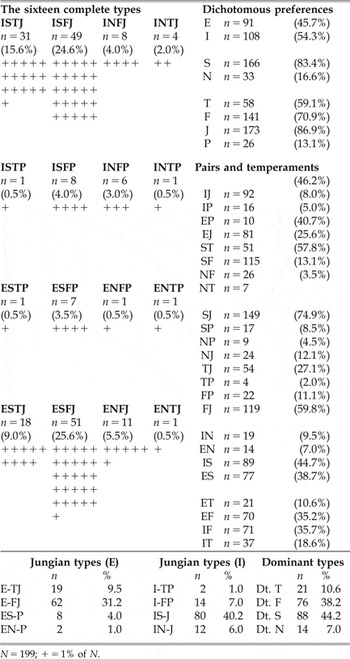
The type distribution of the 199 churchgoers attending Evangelical Anglican churches is presented in Table 1. These data demonstrate that there is slight preference for introversion over extraversion (54% compared with 46%), and more marked preferences for sensing over intuition (83% compared with 17%), for feeling over thinking (71% compared with 29%), and for judging over perceiving (87% compared with 13%). The three types most strongly represented in the Evangelical Anglican congregations are ESFJ (26%), ISFJ (25%), and ISTJ (16%).
Type distribution for Evangelical Anglicans

N = 199; + = 1% of N.
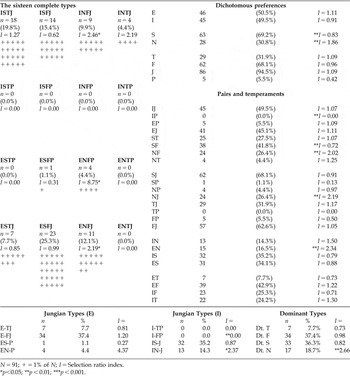
The type distribution of the 91 churchgoers attending Anglo-Catholic churches is presented in Table 2. These data demonstrate that there is a balance in preference between introversion and extraversion (50% and 51%), but marked preferences for sensing over intuition (69% compared with 31%), for feeling over thinking (68% compared with 32%), and for judging over perceiving (95% compared with 6%). The three types most strongly represented in the Anglo-Catholic congregations are ESFJ (25%), ISTJ (20%), and ISFJ (15%).
Type distribution for Anglican Catholics compared with Evangelical Anglicans

N = 91; + = 1% of N; I = Selection ratio index.
*p<0.05; **p < 0.01; ***p < 0.001.
Table 2 also employs the selection ratio index (I) to compare the statistical significance of differences in the type profiles presented by the two types of churches. The selection ratio is an extension of chi-square, adjusted for multiple simultaneous comparisons. These data demonstrate that there are no significant differences between the two types of churches in the proportions of introverts and extraverts, in the proportions of thinkers and feelers, and in the proportions of judgers and perceivers. There are, however, significant differences in the proportions of sensers and intuitives in the two types of churches. While just 17% of the Evangelical Anglicans prefer intuition, the proportion rises to 31% of the Anglo-Catholics. Looked at from the opposite perspective, while 83% of the Evangelical Anglicans prefer sensing, the proportion drops to 69% of the Anglo-Catholics.
Jungian typology also speaks in terms of an individual’s dominant strength in terms of one of the four functions of sensing, intuition, feeling, and thinking. The dominant strengths in both types of churches are sensing (44% of Evangelical Anglicans and 36% of Anglo-Catholics) and feeling (38% of Evangelical Anglicans and 37% of Anglo-Catholics). Dominant thinkers account for 11% of Evangelical Anglicans and 8% of Anglo-Catholics. Dominant intuitives account for 7% of Evangelical Anglicans, but for a significantly higher proportion of Anglo-Catholics (19%).
Discussion and Conclusion
The aim of the present study was to examine the psychological type preferences of a small number of Anglican congregations in England, drawing particular attention to the potential for Anglo-Catholic churches attracting a higher proportion of intuitives in comparison with Evangelical Anglican churches. Four main conclusions can be drawn from the data generated by this study.
The first conclusion is that, when the present study is placed alongside the two earlier studies reported by Francis et al.Footnote 37 and by Craig et al.,Footnote 38 a common profile begins to emerge concerning the main strengths of these Anglican congregations in England and Wales. In all three studies, the same 3 of the 16 Jungian psychological types account for a large proportion of Anglican churchgoers. Taken together, ISTJ, ISFJ, and ESFJ account, in the present study, for 66% of the Evangelical Anglicans and 61% of Anglo-Catholics, for 75% of the churchgoers in the study by Craig et al.,Footnote 39 and for 50% of the churchgoers in the study by Francis et al.Footnote 40 According to the United Kingdom population norms published by Kendall,Footnote 41 these three types account for a considerably smaller proportion of the population as a whole (39%). Type theory suggests that groups find it easier to attract newcomers who conform to the dominant types within the group. Moreover, the study of church leavers reported by Richter and FrancisFootnote 42 found that one of the recurrent reasons given for leaving church was the feeling that the individual somehow failed ‘to fit in’. Anglican churches may need to be particularly alert to the danger of excluding people unintentionally on the basis of incompatible psychological type profiles.
The second conclusion is that Anglican congregations tend to be biased heavily in favour of feelers over thinkers. Feelers account, in the present study, for 71% of the Evangelical Anglicans and for 68% of the Anglo-Catholics, for 65% of the churchgoers in the study by Craig et al.,Footnote 43 and for 64% of the churchgoers in the study reported by Francis et al.Footnote 44 According to the United Kingdom population norms published by KendallFootnote 45 a considerably smaller proportion of the population as a whole prefers feeling (54%). Moreover, in the United Kingdom population as a whole, the majority of women prefer feeling over thinking, while the majority of men prefer thinking over feeling.Footnote 46 The finding that Anglican congregations prefer feeling offers further evidence regarding the feminization of the churches in the United Kingdom,Footnote 47 and highlights another dimension of the challenge currently facing the Church of England regarding ministry and mission among men.
The third conclusion is that Anglican congregations tend to be biased heavily in favour of sensers over intuitives. Sensers account, in the present study, for 83% of the Evangelical Anglicans and for 69% of the Anglo-Catholics, for 85% of the churchgoers in the study by Craig et al.,Footnote 48 and for 72% of the churchgoers in the study reported by Francis et al.Footnote 49 Congregations which are heavily shaped by a preference for sensing may experience difficulty in welcoming and integrating intuitives.Footnote 50
The fourth conclusion is the most important and offers new insight into Anglican diversity on the basis of the present study. The data confirm the key conclusion that, while both Evangelical Anglicans and Anglo-Catholic congregations contain higher numbers of sensers than intutivies, nonetheless a larger number of intuitives make their spiritual home in Anglo-Catholic congregations than in Evangelical Anglican congregations. Here is evidence to connect psychological type preferences with differences in church tradition and style. According to the present data, 18% of the Anglo-Catholics were dominant intuitives, compared with 7% of the Evangelical Anglicans. According to the United Kingdom population norms published by Kendall,Footnote 51 dominant intuition accounts for just 12% of the population as a whole. In comparison with the population norms, intuitives are over-represented in Anglo-Catholic congregations and under-represented in Evangelical Anglican congregations. This is consistent with the following characteristics of Anglo-Catholic preference and of the preferred style of intuitives. On the one hand, Anglo-Catholic focus tends to be on the ineffability of the mass, the transcendence of God, sacramental practice, and being led in the mystery of faith. On the other hand, intuitive types are conceptualized as being focused upon imagination, possibilities, and meanings (see, for e.g., Myers and MyersFootnote 52) and are thought to ‘have a transcendent view of God, and can be captivated by allowing their minds to contemplate the splendour and the mystery and the otherness’.Footnote 53
This main conclusion that a larger number of intuitives make their spiritual home in Anglo-Catholic congregations than in Evangelical Anglican congregations may highlight further value in the diversity and breadth of the Anglican Communion. If individual differences in personality are conceptualized as part of the rich diversity intended by the creator God (who creates in the image of God not only male and female, but diverse races and diverse personalities), then there needs to be room within the Body of Christ to nurture the spiritual development of intuitives as well as sensers. Held together within the one communion, Anglicanism appears to embody such potential. There are, however, two practical implications for Anglican practice that may emerge from this view. First, intuitive churchgoers may feel less at home in Evangelical Anglican congregations than in Anglo-Catholic congregations, and sensing churchgoers may feel less at home in Anglo-Catholic congregations than in Evangelical Anglican congregations. If this is true, intuitives linked with Evangelical Anglican churches and sensers linked with Anglo-Catholic churches may be more susceptible to disengagement from congregational life and to join the category of church leavers as discussed by Richter and Francis.Footnote 54 Second, some of the difficulties and tensions experienced within Anglicanism between the different church traditions may be due, in part, to different psychological type preferences, rather than wholly to theological differences. In dealing with conflict between traditions it is important to distinguish issues of preferred style from issues of doctrinal substance.
The limitation with the present study is clearly that it has been based on a small number of congregations in central England. The findings and implications, however, are sufficiently intriguing to stimulate further systematic replication with larger samples of churches across other parts of the Anglican Communion.