Introduction
Dementia is one of the most common disorders of old age (Ferri et al., Reference Ferri2005; Marengoni et al., Reference Marengoni, Winblad, Karp and Fratiglioni2008) and a leading cause of mortality and disability in high-income countries (Lopez et al., Reference Lopez, Mathers, Ezzati, Jamison and Murray2006). Medications temporarily reduce symptoms for some, but without modifying the underlying course of the disorder, which is related to many underlying causes. Narrow assessment of cognition and functional ability is insufficient for clinical decision-making and policy development as they only reflect a part of the impact of dementia (Whitehouse, Reference Whitehouse2000). Treatment is increasingly focused on improving or maintaining optimal quality of life (QoL; Ettema et al., Reference Ettema, Dröes, de Lange, Mellenbergh and Ribbe2005a) as this has become a key outcome for evaluating the effectiveness of dementia interventions (Small et al., Reference Small1997; Whitehouse, Reference Whitehouse2000; Moniz-Cook et al., Reference Moniz-Cook2008).
Health-related quality of life (HRQL) can be defined as the individual's perception of the impact of a health condition on everyday life (Bullinger et al., Reference Bullinger, Anderson, Cella and Aaronson1993). It differs from the concept of quality of life in that HRQL includes only aspects of quality of life that are affected by a health condition. Despite the lack of agreement of what domains constitute HRQL, most authors appear to agree upon the multidimensional and subjective nature of the concept and that the assessment should include measurement of positive and negative dimensions (Lawton, Reference Lawton1994; The WHOQOL Group, 1995; Brown et al., Reference Brown, Bowling and Flynn2004; Ready, Reference Ready, Jenkinson, Michele and Bromber2011).
Multiple measures have been developed specifically for assessing HRQL in patients with Alzheimer's disease or related dementias.
These instruments can be either generic HRQL questionnaires used in dementia populations such as the World Health Organization Quality of Life Assessment (WHOQOL) or Schedule for the Evaluation of Individual Quality of Life (SEIQoL; The WHOQOL Group, 1998; Schölzel-Dorenbos, Reference Schölzel-Dorenbos2000), dimension specific scales such as the Progressive deteriorations Scale (PDS) (DeJong et al., Reference DeJong, Osterlund and Roy1989) or dementia specific such as the Quality of Life in Alzheimer's Disease (QoL-AD) or the DEMQOL (Logsdon et al., Reference Logsdon, Gibbons, McCurry and Teri1999; Smith et al., Reference Smith2005a). A number of studies have reviewed the different instruments used to measure HRQL in dementia (e.g. Ready and Ott, Reference Ready and Ott2003; Ettema et al., Reference Ettema, Dröes, de Lange, Mellenbergh and Ribbe2005a). However, no attempt has been made as yet to synthesize the findings across the different reviews. Although one study has discussed the appropriateness of different scales (Schozel-Dorenbos et al., Reference Schozel-Dorenbos2007), this did not use a systematic methodology. No review has assessed the features of the different scales in detail in order to assess their suitability in different contexts.
The aim of this paper is to synthesize the evidence from reviews on HRQL instruments for dementia and any new literature to bring together and provide an update on dementia-specific HRQL measures providing details of their features including: number of items, scoring, data-collection method, severity in which the instrument may be administered, domains, time frame, countries where the scales were developed or validated, and measures of reliability and validity. The suitability of the scales in different contexts is discussed. Conceptualization and operationalization of dementia-specific HRQL domains by each dementia-specific instrument are analyzed and compared for consistency.
Methods
In order to synthesize the evidence from reviews on HRQL instruments in dementia, J. Perales conducted an electronic search in PubMed from inception to December 2011 using a combination of key words that included quality of life and dementia as major topic Mesh terms and specifying reviews as type of publication. The publications could be in either English or Spanish language.
In order to identify previous and new literature, a second electronic search was conducted of PsycINFO and PubMed, from inception to December 2011 using a combination of words that included quality of life and dementia as major topic Mesh terms or keywords. The criteria for inclusion were: (i) papers, abstracts or scale manuals that were published in English or Spanish language on dementia-specific HRQL measures developed for use with on patients with AD or mixed dementia; and (ii) reporting on the development, description of the dimensions, and psychometric properties of an instrument. In order to report country of validation of the scales, those papers with abstracts in English irrespective of the rest of the text were also included. Generic, domain-specific QoL measures such as those measuring only activities of daily living (DeJong et al., Reference DeJong, Osterlund and Roy1989) and Parkinson's disease-specific HRQL measures are beyond the scope of this review and were excluded. This review excluded considerations of caregiver quality of life except where this was related to measures of patient HRQL.
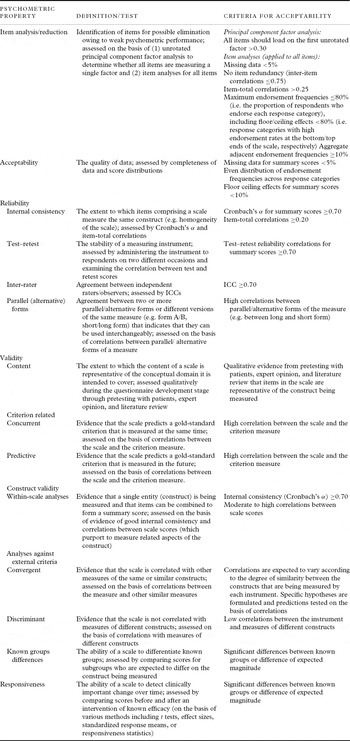
Literature selection was undertaken in two phases. In phase 1, titles and abstracts of all papers were independently reviewed (J. Perales and T.D. Cosco) to exclude non-related publications. Full-text papers accepted in phase 1 were reviewed in order to extract the appropriate information (phase 2). In case of discrepancy, if no agreement was met by both readers after discussion, a third author would decide (B.C.M. Stephan). In order to rate the psychometric quality assessment of each of the instruments, standardized criteria was used. These criteria are shown in Table 1.

Results
Reviews identified (literature search 1)
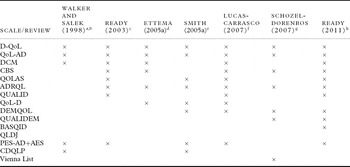
Of the 271 papers identified in the first literature search, eight were reviews on HRQL instruments in dementia (Salek et al., Reference Salek, Walker and Bayer1998; Walker et al., Reference Walker, Salek and Bayer1998; Ready and Ott, Reference Ready and Ott2003; Ettema et al., Reference Ettema, Dröes, de Lange, Mellenbergh and Ribbe2005a; Smith et al., Reference Smith2005a; Lucas-Carrasco, Reference Lucas-Carrasco2007; Schozel-Dorenbos et al., Reference Schozel-Dorenbos2007; Ready, Reference Ready, Jenkinson, Michele and Bromber2011). Only four (Salek et al., Reference Salek, Walker and Bayer1998; Walker et al., Reference Walker, Salek and Bayer1998; Ready and Ott, Reference Ready and Ott2003; Ettema et al., Reference Ettema, Dröes, de Lange, Mellenbergh and Ribbe2005a) used a systematic approach. Table 2 shows the dementia-specific HRQL instruments included in each of the eight reviews identified. Although the number of reviews increases by year of publication, there are some inconsistencies in the instruments included. The reviews highlight the wide variation in instruments, their items, and methods of scoring, psychometric properties, data collection method, severity of dementia, and the populations used to assess validity and reliability.
Dementia-specific HRQL instruments included in each of the eight reviews identified in our search

aSalek et al. (Reference Salek, Walker and Bayer1998); bWalker et al. (Reference Walker, Salek and Bayer1998); cReady and Ott (Reference Ready and Ott2003); dEttema et al. (Reference Ettema, Dröes, de Lange, Mellenbergh and Ribbe2005a); eSmith et al. (Reference Smith2005a); fLucas-Carrasco (Reference Lucas-Carrasco2007); gSchozel-Dorenbos et al. (Reference Schozel-Dorenbos2007); hReady (Reference Ready, Jenkinson, Michele and Bromber2011).
ADRQL: Alzheimer Disease Related Quality of Life; BASQID: The Bath Assessment of Subjective Quality of Life in Dementia; CDQLP: The Community Dementia Quality of Life Profile; CBS: Cornell-Brown Scale for Quality of Life in Dementia; DCM: Dementia Care Mapping; D-QoL: Dementia Quality of Life Instrument; QLDJ: Quality of Life for Older People Experiencing Dementia; QoL-AD: Quality of Life in Alzheimer's Disease; QoL-D: Quality of Life for Dementia; QOLAS: Quality of Life Assessment Schedule; QUALID: Quality of Life in Late-Stage Dementia Scale.
Instruments identified (literature search 2)
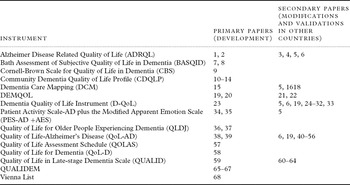
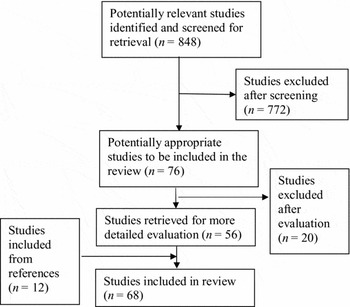
Figure 1 shows the selection process for the review on dementia-specific HRQL. In total, 848 papers were identified. After the title-abstract screen, 76 papers remained. Based on the full-text search, 68 publications covering 15 different dementia-specific HRQL scales were identified and included in this review. The dementia-specific HRQL measures reviewed included: the Alzheimer Disease Related Quality of Life (ADRQL), Bath Assessment of Subjective Quality of Life in Dementia (BASQUID), Cornell-Brown Scale for Quality of Life in Dementia (CBS), Dementia Care Mapping (DCM), Dementia Quality of Life Instrument (D-QoL), DEMQOL, Patient Activity Scale-AD plus the Modified Apparent Emotion Scale (PES-AD + AES), Quality of Life in Late-stage Dementia Scale (QUALID), QoL-AD, Quality of Life Assessment Schedule (QOLAS), Quality of Life for Dementia (QoL-D), QUALIDEM, Quality of Life for Older People Experiencing Dementia (QLDJ), Vienna List, and the Community Dementia Quality of Life Profile. As shown in Table 2, none of the reviews included the QLDJ or identified all the instruments. Table 3 shows the publications reviewed for each of the instruments. Some publications have assessed the psychometric properties of more than one instrument at a time (Edelman et al., Reference Edelman, Fulton, Kuhn and Chang2005; Sloane et al., Reference Sloane, Zimmerman, Williams, Reed, Gil and Preisser2005; Smith et al., Reference Smith2005a).
Primary and secondary papers on dementia-specific HRQL measures identified in our search

References. 1: Rabins et al. (Reference Rabins, Kasper, Kleinman and Black1999); 2: Black et al. (Reference Black, Rabins and Kasper1999); 3: Kasper et al. (Reference Kasper, Black, Shore and Rabins2009); 4: Black et al. (Reference Black, Rabins and Kasper2009); 5: Sloane et al. (Reference Sloane, Zimmerman, Williams, Reed, Gil and Preisser2005); 6: Edelman et al. (Reference Edelman, Fulton, Kuhn and Chang2005); 7: Trigg et al. (Reference Trigg, Jones and Skevington2007a); 8: Trigg et al. (Reference Trigg, Skevington and Jones2007b); 9: Ready et al. (Reference Ready, Ott, Grace and Fernandez2002); 10: Salek et al. (Reference Salek, Walker and Bayer1999); 11: Salek et al. (Reference Salek, Schwartzberg and Bayer1996); 12: Walker et al. (Reference Walker, Salek and Bayer2001a); 13: Walker et al. (Reference Walker, Salek and Bayer2001b); 14: Salek et al. (Reference Salek, Ramgoolam, Edwards, Luscambe and Bayer1997); 15: Fossey et al. (Reference Fossey, Lee and Ballard2002); 16: Sloane et al. (Reference Sloane2007); 17: Suzuki et al. (Reference Suzuki2008); 18: Brooker and Surr (Reference Brooker and Surr2006); 19: Smith et al. (Reference Smith2005a); 20: Smith et al. (Reference Smith2005b); 21: Smith et al. (Reference Smith2007); 22: Lucas-Carrasco et al. (Reference Lucas-Carrasco, Lamping, Banerjee, Rejas, Smith and Gómez-Benito2010); 23: Brod et al. (Reference Brod, Stewart, Sands and Walton1999); 24: Adler and Resnick (Reference Adler and Resnick2010); 25: Lucas-Carrasco et al. (Reference Lucas-Carrasco, Gómez-Benito, Rejas and Brod2011); 26: Chiu et al. (Reference Chiu, Shyu and Huang2008); 27: Chiu et al. (Reference Chiu, Chiu, Hsu, Lee, Chen and Kao2010); 28: Karim et al. (Reference Karim, Ramanna, Petit, Doward and Burns2008); 29: Ready et al. (Reference Ready, Ott and Grace2007); 30: Suzuki et al. (Reference Suzuki, Uchida, Kanamori and Ooshiro2005); 31: Suzuki et al. (Reference Suzuki, Kanamori, Greiner, Ito and Ooshiro2006); 32: Bosboom and Jonkers (Reference Bosboom and Jonkers2001); 33: Porzsolt et al. (Reference Porzsolt, Kojer, Schmidl, Greimel, Sigle, Richter and Eisemann2004); 34: Albert et al. (Reference Albert1996); 35: Albert et al. (Reference Albert2001); 36: Yamamoto-Mitani et al. (Reference Yamamoto-Mitani, Abe, Okita, Hayashi, Sugishita and Kamata2002); 37: Yamamoto-Mitani et al. (Reference Yamamoto-Mitani, Abe, Okita, Hayashi, Sugishita and Kamata2004); 38: Logsdon et al. (Reference Logsdon, Gibbons, McCurry and Teri1999); 39: Logsdon et al. (Reference Logsdon, Gibbons, McCurry and Teri2002); 40: León-Salas et al. (Reference León-Salas, Logsdon, Olazarán, Martínez-Martín and The2011); 41: Chan et al. (Reference Chan, Chu, Lee, Li and Yu2011); 42: Fuh and Wang (Reference Fuh and Wang2006); 43: Hoe et al. (Reference Hoe, Katona, Roch and Livingston2005); 44: Lin Kiat Yap et al. (Reference Lin Kiat Yap2008); 45: Matsui et al. (Reference Matsui2006); 46: Hao-ying and Guo-dong (Reference Hao-ying and Guo-dong2005); 47: Rosas-Carrasco et al. (Reference Rosas-Carrasco, Torres-Arreola, Guerra-Silla, Torres-Castro and Gutierrez-Robledo2010); 48: Shin (Reference Shin2006); 49: Novelli et al. (Reference Novelli, Nitrini and Caramelli2010); 50: Novelli et al. (Reference Novelli, Dal Rovere, Nitrini and Caramelli2005); 51: Patterson et al. (Reference Patterson2006); 52: Revell et al. (Reference Revell, Caskie, Willis and Schaie2009); 53: Selai et al. (Reference Selai, Vaughan, Harvey and Logsdon2001b); 54: Thorgrimsen et al. (Reference Thorgrimsen2003); 55: Wolak et al. (Reference Wolak2009); 56: Merchant et al. (Reference Merchant, Hope and Hope2004); 57: Selai et al. (Reference Selai, Trimble, Rossor and Harvey2001a); 58: Terada et al. (Reference Terada2002); 59: Weiner et al. (Reference Weiner, Martin-Cook, Svetlik, Saine, Foster and Fontaine2000); 60: Barca et al. (Reference Barca, Engedal, Laks and Selbaek2011); 61: Falk et al. (Reference Falk, Persson and Wijk2007); 62: Garre-Olmo et al. (Reference Garre-Olmo2010); 63: Martin-Cook et al. (Reference Martin-Cook, Hynan, Rice-Koch, Svetlik and Weiner2005); 64: Schalkwijk et al. (Reference Schalkwijk, Verlare, Muller, Knol and Van Der Steen2009); 65: Ettema et al. (Reference Ettema and Lange2007); 66: Bouman et al. (Reference Bouman2011); 67: Ettema and Lange (Reference Ettema and Lange2007); 68: Porzsolt et al. (Reference Porzsolt, Kojer, Schmidl, Greimel, Sigle, Richter and Eisemann2004).
Flow chart of paper selection for the review on dementia-specific health-related quality-of-life instruments.

Instrument features
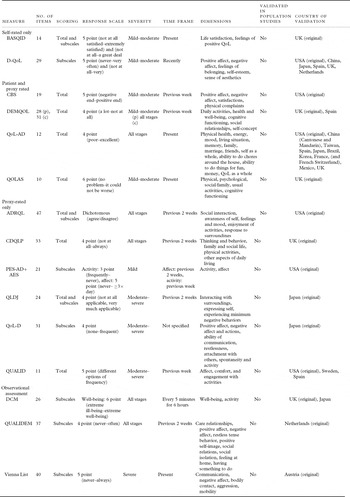
Table 4 summarizes the characteristics of the original version of each of the 15 different instruments and reports the existence of validations in other countries. There are two instruments where only self-report is possible, six proxy-report-only measures, four measures that include both self and proxy ratings, and three observer-rated instruments. The number of items varies between 10 in the QOLAS and 47 in the ADRQL. Three scales can obtain both total and subscale scores whereas six can only obtain subscale scores and six only total scores. Response scales vary from being binary to six-point Likert scales. Most response scales of observation-rated measures or those rated only by proxies ask about frequency of a certain behavior, whereas the other types of instruments vary between quality, how much of a problem, satisfaction, or worry of a trait. The psychometric properties of self-report only measures (Brod et al., Reference Brod, Stewart, Sands and Walton1999; Trigg et al., Reference Trigg, Jones and Skevington2007a) have been tested in patients with mild-moderate dementia severity as have all measures using both types of report except for DEMQOL-proxy and QoL-AD. Two proxy-report only (Salek et al., Reference Salek, Ramgoolam, Edwards, Luscambe and Bayer1997; Black et al., Reference Black, Rabins and Kasper1999) and two observer-rated instruments (Fossey et al., Reference Fossey, Lee and Ballard2002; Ettema and Lange, Reference Ettema and Lange2007) have tested their psychometric properties in patients of all dementia severity whereas the psychometric properties of the rest have been tested in patients with moderate-severe dementia severity. The time frame of the questions is usually either in the present or in the previous week/two weeks. The number of dimensions ranges from two in the case of the DCM and PES-AD+AES to 13 in the QoL-AD. Most instruments have been developed in the USA (6) (Albert et al., Reference Albert1996; Black et al., Reference Black, Rabins and Kasper1999; Brod et al., Reference Brod, Stewart, Sands and Walton1999; Logsdon et al., Reference Logsdon, Gibbons, McCurry and Teri1999; Weiner et al., Reference Weiner, Martin-Cook, Svetlik, Saine, Foster and Fontaine2000; Ready et al., Reference Ready, Ott, Grace and Fernandez2002) or the UK (5) (Salek et al., Reference Salek, Ramgoolam, Edwards, Luscambe and Bayer1997; Selai et al., Reference Selai, Trimble, Rossor and Harvey2001a; Fossey et al., Reference Fossey, Lee and Ballard2002; Smith et al., Reference Smith2005a; Trigg et al., Reference Trigg, Skevington and Jones2007b). However, other instruments have also been developed in Japan (2) (Terada et al., Reference Terada2002; Yamamoto-Mitani et al., Reference Yamamoto-Mitani, Abe, Okita, Hayashi, Sugishita and Kamata2002), the Netherlands (1) (Ettema et al., Reference Ettema, Droes, Lange de, Mellenbergh and Ribbe2007) and Austria (1) (Porzsolt et al., Reference Porzsolt, Kojer, Schmidl, Greimel, Sigle, Richter and Eisemann2004). Five instruments (Brod et al., Reference Brod, Stewart, Sands and Walton1999; Logsdon et al., Reference Logsdon, Gibbons, McCurry and Teri1999; Weiner et al., Reference Weiner, Martin-Cook, Svetlik, Saine, Foster and Fontaine2000; Fossey et al., Reference Fossey, Lee and Ballard2002; Smith et al., Reference Smith2005a) have been validated in other countries. None of the samples used to assess the psychometric properties of each of the instruments were population based.
Dementia-specific instruments reviewed and their characteristics

p = patient version, c = caregiver version.
ADRQL: Alzheimer Disease-Related Quality of Life; BASQID: The Bath Assessment of Subjective Quality of Life in Dementia; CDQLP: The Community Dementia Quality of Life Profile; DCM: Dementia Care Mapping; D-QoL: Dementia Quality of Life Instrument; QLDJ: Quality of Life for Older People Experiencing Dementia; QoL-AD: Quality of Life in Alzheimer's Disease; QoL-D: Quality of Life for Dementia; QOLAS: Quality of Life Assessment Schedule; QUALID: Quality of Life in Late-stage Dementia Scale.
Conceptualization and operationalization
The most common domains across different dementia-specific HRQL instruments are mood, social interaction, enjoyment of activities/sense of aesthetics, and self-esteem/self-concept. Other common domains are cognition, activities, health, living conditions, and feelings of usefulness. Domains are operationalized differently across instruments. Most domains are operationalized either through the patient or proxy's perception of the different domains or through the rating of observational behaviors or contexts.
Most instruments measure mood as positive and negative affect although two exceptions are the QoL-AD, which asks for mood in general, and the QOLAS, which needs to be given two examples within the mood domain by the respondent. Common items on positive affect are cheerfulness, happiness, contentment, and calm. The most common items indicating negative effect are sadness, anger, worry, and anxiety. Proxy and observation-based instruments usually measure either observational indicators of patient's mood (such as crying) or proxy's perception of the patient's mood. A similar trend can be observed in other dimensions. For example, social interaction has been assessed as the perception by the patient or the proxy of the patient's quality of interactions such as worries about not having enough company, satisfaction or problems with social relationships, or through observation-based ratings such as frequency of visiting friends, talking or seeking or rejecting contact with people. Enjoyment of activities has been measured through perception, satisfaction, or worry about enjoyment of different activities, or observation-based assessments such as voluntarily participation in activities and talking about work or activities. A special case is the domain sense of aesthetics, which has been defined as the ability to enjoy sensory stimuli. Items on self-esteem involve perceptions of usefulness, self-confidence, and satisfaction with oneself. Observer-based ratings consist usually in noticing that patients mention they are worthless, hopeless, or useless. Some questionnaires such as the ADRQL measure awareness of self with items such as responding to one's own name. Some instruments also include activities of daily living in their assessment of HRQL. These items have been measured as the patient or proxy's perception of the ability to do chores such as walking, cooking, eating, and shopping or how much problem or worry these activities involve. The same applies to the assessment of cognitive functioning. Other domains that have not been included so often include self-rated health, financial, and living context.
Psychometric properties
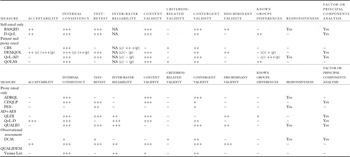
Table 5 shows the psychometric quality assessment using the criteria shown in Table 1. Ten instruments (Albert et al., Reference Albert1996; Salek et al., Reference Salek, Ramgoolam, Edwards, Luscambe and Bayer1997; Black et al., Reference Black, Rabins and Kasper1999; Logsdon et al., Reference Logsdon, Gibbons, McCurry and Teri1999; Weiner et al., Reference Weiner, Martin-Cook, Svetlik, Saine, Foster and Fontaine2000; Selai et al., Reference Selai, Trimble, Rossor and Harvey2001a; Fossey et al., Reference Fossey, Lee and Ballard2002; Ready et al., Reference Ready, Ott, Grace and Fernandez2002; Yamamoto-Mitani et al., Reference Yamamoto-Mitani, Abe, Okita, Hayashi, Sugishita and Kamata2002; Porzsolt et al., Reference Porzsolt, Kojer, Schmidl, Greimel, Sigle, Richter and Eisemann2004) either were not tested for acceptability or did not meet the criteria. Regarding reliability, all instruments but PES-AD+AES, DCM, and DEMQOL-Proxy show good evidence of internal consistency. Eight instruments (Salek et al., Reference Salek, Ramgoolam, Edwards, Luscambe and Bayer1997; Brod et al., Reference Brod, Stewart, Sands and Walton1999; Logsdon et al., Reference Logsdon, Gibbons, McCurry and Teri1999; Weiner et al., Reference Weiner, Martin-Cook, Svetlik, Saine, Foster and Fontaine2000; Yamamoto-Mitani et al., Reference Yamamoto-Mitani, Abe, Okita, Hayashi, Sugishita and Kamata2002; Smith et al., Reference Smith2005a; Ettema et al., Reference Ettema, Droes, Lange de, Mellenbergh and Ribbe2007; Trigg et al., Reference Trigg, Skevington and Jones2007b) showed good evidence of test–retest reliability. Among those instruments assessed by a proxy or an observer, six instruments assessed inter-rater reliability, most of them showing good evidence. Regarding validity, ten instruments showed good evidence of content validity (Salek et al., Reference Salek, Ramgoolam, Edwards, Luscambe and Bayer1997; Black et al., Reference Black, Rabins and Kasper1999; Brod et al., Reference Brod, Stewart, Sands and Walton1999; Logsdon et al., Reference Logsdon, Gibbons, McCurry and Teri1999; Selai et al., Reference Selai, Trimble, Rossor and Harvey2001a; Terada et al., Reference Terada2002; Yamamoto-Mitani et al., Reference Yamamoto-Mitani, Abe, Okita, Hayashi, Sugishita and Kamata2002; Smith et al., Reference Smith2005a; Ettema et al., Reference Ettema, Droes, Lange de, Mellenbergh and Ribbe2007; Trigg et al., Reference Trigg, Skevington and Jones2007b). Despite the fact that criterion-related validity cannot be tested due to the lack of a gold standard, two measures (Selai et al., Reference Selai, Trimble, Rossor and Harvey2001a; Ready et al., Reference Ready, Ott, Grace and Fernandez2002) claim to show some evidence of it, perhaps referring to convergent validity. Regarding analyses against external criteria, 14 instruments (Albert et al., Reference Albert1996; Salek et al., Reference Salek, Ramgoolam, Edwards, Luscambe and Bayer1997; Black et al., Reference Black, Rabins and Kasper1999; Brod et al., Reference Brod, Stewart, Sands and Walton1999; Logsdon et al., Reference Logsdon, Gibbons, McCurry and Teri1999; Weiner et al., Reference Weiner, Martin-Cook, Svetlik, Saine, Foster and Fontaine2000; Selai et al., Reference Selai, Trimble, Rossor and Harvey2001a; Fossey et al., Reference Fossey, Lee and Ballard2002; Ready et al., Reference Ready, Ott, Grace and Fernandez2002; Terada et al., Reference Terada2002; Porzsolt et al., Reference Porzsolt, Kojer, Schmidl, Greimel, Sigle, Richter and Eisemann2004; Smith et al., Reference Smith2005a; Ettema et al., Reference Ettema, Droes, Lange de, Mellenbergh and Ribbe2007; Trigg et al., Reference Trigg, Skevington and Jones2007b) show evidence of convergent validity but not discriminant or known groups differences. Six measures have shown responsiveness (D-QoL, BASQID, QoL-AD, ADRQL, QUALID, and DCM). Finally, the factorial structure of nine instruments has been analyzed (Brod et al., Reference Brod, Stewart, Sands and Walton1999; Salek et al., Reference Salek, Walker and Bayer1999; Weiner et al., Reference Weiner, Martin-Cook, Svetlik, Saine, Foster and Fontaine2000; Fossey et al., Reference Fossey, Lee and Ballard2002; Terada et al., Reference Terada2002; Yamamoto-Mitani et al., Reference Yamamoto-Mitani, Abe, Okita, Hayashi, Sugishita and Kamata2002; Smith et al., Reference Smith2005a; Trigg et al., Reference Trigg, Skevington and Jones2007b; Revell et al., Reference Revell, Caskie, Willis and Schaie2009), most of them finding subscales.
Psychometric properties of the dementia-specific instruments

p = patient version; c = caregiver version.

ADRQL: Alzheimer Disease-Related Quality of Life; BASQID: The Bath Assessment of Subjective Quality of Life in Dementia; CDQLP: The Community Dementia Quality of Life Profile; CBS: Cornell-Brown Scale for Quality of Life in Dementia; DCM: Dementia Care Mapping; D-QoL: Dementia Quality of Life Instrument; QLDJ: Quality of Life for Older People Experiencing Dementia; QoL-AD: Quality of Life in Alzheimer's Disease; QoLAS: Quality of Life Assessment Schedule; QUALID: Quality of Life in Late-stage Dementia Scale.
Discussion
This review synthesizes the information on dementia specific HRQL instruments from reviews (Salek et al., Reference Salek, Walker and Bayer1998; Walker et al., Reference Walker, Salek and Bayer1998; Ready and Ott, Reference Ready and Ott2003; Ettema et al., Reference Ettema, Dröes, de Lange, Mellenbergh and Ribbe2005a; Smith et al., Reference Smith2005a; Lucas-Carrasco, Reference Lucas-Carrasco2007; Schozel-Dorenbos et al., Reference Schozel-Dorenbos2007; Ready, Reference Ready, Jenkinson, Michele and Bromber2011) and builds on these by gathering them all into a single study and identifying one new measure, the QLDJ.
While this is a systematic review, we did not include measures assessing only a specific domain of HRQL such as the PDS (DeJong et al., Reference DeJong, Osterlund and Roy1989), or generic HRQL scales that are not tailored to people with dementia (Rabins et al., Reference Rabins, Kasper, Kleinman and Black1999; Silberfeld et al., Reference Silberfeld, Rueda, Krahn and Naglie2002). Their focus on health and function imply that HRQL will decrease automatically with disease progression (Ettema et al., Reference Ettema, Dröes, de Lange, Mellenbergh and Ribbe2005a) and some of these lack evidence on validity or reliability in dementia populations (Ettema et al., Reference Ettema, Dröes, de Lange, Mellenbergh and Ribbe2005a). We also did not include instruments that measure the QoL of caregivers of people with dementia as these are outside the scope of this review. The literature searches were conducted in English and in Anglophone databases and, therefore, instruments developed in non-English-speaking countries without a translation available would have been missed. However, regarding instrument development and validation, we accepted any publication as long as the abstract was in English or Spanish.
Conceptualization and operationalization
The concept of HRQL in dementia has been influenced by the broader concept of QoL that refers to “evaluation by subjective and social-normative criteria, of the behavioral and environmental situation of a person” (Lawton, Reference Lawton1994). There has been a movement in QoL toward the measurement of the experience of the person, including usually perceptions or satisfactions with psychological, physical, and social domains (Ettema et al., Reference Ettema, Dröes, de Lange, Ooms, Mellenbergh and Ribbe2005b). In dementia-specific HRQL instruments, the measurement is also aimed at capturing the experience of the person with dementia. Domains commonly measured are mood, self-esteem, social interaction, and enjoyment of activities. Similarly to the general concept of QoL, normative measures such as income or cognitive tests (different to perception or satisfaction with such domains) have been excluded and considered as a different outcome (Brod et al., Reference Brod, Stewart, Sands and Walton1999; Rabins et al., Reference Rabins, Kasper, Kleinman and Black1999). Conceptual frameworks do not differ in essence with Lawton's model of HRQL in dementia (Lawton, Reference Lawton1994), although they limit the number of domains. Different perspectives on HRQL abound and are manifest in the variety of domains represented in the different scales. For example, the measurement of HRQL using the ADRQL will widely differ to the one using the CDQLP since they have very few domains in common. Instruments also differ in their breadth of the assessment and whether subjective experience of the person with dementia is assessed or proxy measures (observational or not) are used instead. While self-reported measures are more appropriate for measuring the patient's own experience, in severe stages, the use of instruments based on proxy ratings is inevitable. Further, we found that there is no single protocol for assessing the different domains across instruments. This limits cross-study comparability.
Country of development and validation
Most dementia-specific HRQL measures were developed in the USA and UK. A number of scales have been validated in other countries such as Spain and Japan (Suzuki et al., Reference Suzuki, Uchida, Kanamori and Ooshiro2005, Reference Suzuki, Kanamori, Greiner, Ito and Ooshiro2006; Matsui et al., Reference Matsui2006), increasing the availability. The QoL-AD has been validated in at least ten different countries and the D-QoL has been validated in at least five different countries in the Americas, Europe, and Asia. This allows for cross-county comparisons. However, the concept of HRQL may vary across different cultures and culturally specific scales may also be needed. Further, for validation studies is the issue of the representativeness of samples used in development and validations studies. None of the 15 instruments have been developed using a population-based sample raising issues of generalizability.
Dementia severity
Decisions for scale selection will depend on the dementia severity. Self-rated instruments would be more appropriate for mild-moderate stages and proxy and observer-rated instruments more appropriate at more severe stages of the disease. Most of the extant dementia-specific HRQL measures are proxy rated. This is a consequence of the idea that people with dementia are not able to rate their own HRQL due to cognitive impairment. However, there is a strong movement in measurement of HRQL in dementia to obtain self-reports from the individual with dementia where possible given recent findings that suggest that people with mild to moderate dementia are aware and able to assess their HRQL (Brod et al., Reference Brod, Stewart, Sands and Walton1999; Mozley et al., Reference Mozley1999; Selai et al., Reference Selai, Trimble, Rossor and Harvey2001a; Logsdon et al., Reference Logsdon, Gibbons, McCurry and Teri2002; Ready et al., Reference Ready, Ott, Grace and Fernandez2002; Smith et al., Reference Smith2005a; Trigg et al., Reference Trigg, Skevington and Jones2007b). Proxy informants have a different point of view on the patient's HRQL and tend to give lower rating than people with dementia (Logsdon et al., Reference Logsdon, Gibbons, McCurry and Teri2002; Thorgrimsen et al., Reference Thorgrimsen2003). Even with careful training of observers, it is uncertain whether the observed behaviors represent the most important and relevant aspects of HRQL, as these measures have been developed to assess the subjective perceptions of QoL. However, it has been shown that proxies are as good as patients in detecting changes in HRQL over time (Sneeuw et al., Reference Sneeuw1997). Studies suggest that these differences in reporting can be explained by the disability paradox, caregiver states such as depression or burden and the lack of patient's insight (Carr and Higginson, Reference Carr and Higginson2001; Logsdon et al., Reference Logsdon, Gibbons, McCurry and Teri2002; Novella et al., Reference Novella, Jochum, Jolly, Morrone, Bureau and Blanchard2012), but also by methodological issues such as precision bias or response bias (Smith et al., Reference Smith2005a). Obtaining information from both sources (patients and caregivers) is important since they reflect different and imperfect measurements of “true” state and may be contrasted, providing richer information. A different approach is assessing HRQL using different instruments covering all dementia severities (Edelman et al., Reference Edelman, Fulton, Kuhn and Chang2005); however, this method can be confusing since different conceptual frameworks are assumed when using different measures.
Purpose of assessment
Instruments may be used for clinical practice or for research. For clinical practice, since the main aim is to help the individual to continue living in the optimal fashion, the optimal scale will be the one that lets the persons with dementia assess a personal perception of HRQL allowing a more individualized and, therefore, effective treatment plan. To date, there is only one scale that allows this type of assessment, the QOLAS (Selai et al., Reference Selai, Trimble, Rossor and Harvey2001a). This is a double edged sword since a drawback of this measure in research is that, for this same reason, scores of the different participants or the same participant in different stages might not reflect the same concept of HRQL and, therefore, comparisons do not seem to be completely pertinent. This raises the question of whether people can learn to consider certain aspects when assessing their HRQL and dismiss others. This would be useful for improving HRQL in dementia.
For cross-sectional studies, operationalization, country of development/validation and data collection method will guide the selection of the scale. However, when it comes to longitudinal designs, the use of proxy and observer-rated scales seems more appropriate since severity of dementia is likely to change over time. For both longitudinal and randomized control trials, responsiveness is an important factor. To date, at least six instruments have proved to have a certain degree of responsiveness or sensitivity to change. These measures are the BASQID, QoL-AD, ADRQL, QUALID, PES-AD+AES, and DCM. (Black et al., Reference Black, Rabins and Kasper1999; Albert et al., Reference Albert2001; Fossey et al., Reference Fossey, Lee and Ballard2002; Thorgrimsen et al., Reference Thorgrimsen2003; Martin-Cook et al., Reference Martin-Cook, Hynan, Rice-Koch, Svetlik and Weiner2005; Trigg et al., Reference Trigg, Skevington and Jones2007b).
Psychometric properties
Almost every measure showed good evidence of internal consistency, and most measures have at least tested reliability in two different ways. All self-rated instruments and one scale of each of the other data collection methods showed at least some good evidence of acceptability. These scales are the D-QoL and BASQID for self-rated, DEMQOL for both self and proxy rated, and QoL-D and QUALIDEM for proxy-rated. Content validity has been mostly reached by qualitative evidence from pretesting with patients, expert opinion, and literature review that items in the scale are representative of the construct. In-depth qualitative interviews with people with dementia and/or their carers were conducted for the D-QoL, DEMQOL, BASQID, ADRQL, QUALIDEM, and QoL-D in order to generate the scale items. A special case is the QOLAS, in which the items are tailored to each respondent. Although two measures (Selai et al., Reference Selai, Trimble, Rossor and Harvey2001a; Ready et al., Reference Ready, Ott, Grace and Fernandez2002) claim to measure it, criterion-related validity cannot be assessed due to the lack of a gold standard with which to compare it. Convergent validity has mainly been assessed by means of correlations between the scales and measures of dementia severity (Albert et al., Reference Albert1996; Salek et al., Reference Salek, Schwartzberg and Bayer1996; Brod et al., Reference Brod, Stewart, Sands and Walton1999; Rabins et al., Reference Rabins, Kasper, Kleinman and Black1999; Weiner et al., Reference Weiner, Martin-Cook, Svetlik, Saine, Foster and Fontaine2000; Selai et al., Reference Selai, Trimble, Rossor and Harvey2001a; Ready et al., Reference Ready, Ott, Grace and Fernandez2002; Yamamoto-Mitani et al., Reference Yamamoto-Mitani, Abe, Okita, Hayashi, Sugishita and Kamata2002; Porzsolt et al., Reference Porzsolt, Kojer, Schmidl, Greimel, Sigle, Richter and Eisemann2004; Smith et al., Reference Smith2005a; Ettema et al., Reference Ettema, Droes, Lange de, Mellenbergh and Ribbe2007; Trigg et al., Reference Trigg, Skevington and Jones2007b), depression (Rabins et al., Reference Rabins, Kasper, Kleinman and Black1999; Selai et al., Reference Selai, Trimble, Rossor and Harvey2001a; Logsdon et al., Reference Logsdon, Gibbons, McCurry and Teri2002; Smith et al., Reference Smith2005a; Ettema et al., Reference Ettema, Droes, Lange de, Mellenbergh and Ribbe2007), activities of daily living (Rabins et al., Reference Rabins, Kasper, Kleinman and Black1999; Weiner et al., Reference Weiner, Martin-Cook, Svetlik, Saine, Foster and Fontaine2000; Selai et al., Reference Selai, Trimble, Rossor and Harvey2001a; Logsdon et al., Reference Logsdon, Gibbons, McCurry and Teri2002; Terada et al., Reference Terada2002; Yamamoto-Mitani et al., Reference Yamamoto-Mitani, Abe, Okita, Hayashi, Sugishita and Kamata2002; Porzsolt et al., Reference Porzsolt, Kojer, Schmidl, Greimel, Sigle, Richter and Eisemann2004; Smith et al., Reference Smith2005a), behavioral and psychological symptoms (Weiner et al., Reference Weiner, Martin-Cook, Svetlik, Saine, Foster and Fontaine2000; Ettema et al., Reference Ettema, Droes, Lange de, Mellenbergh and Ribbe2007), and other measures of QoL (Fossey et al., Reference Fossey, Lee and Ballard2002; Smith et al., Reference Smith2005a; Trigg et al., Reference Trigg, Skevington and Jones2007b). Discriminant validity has not often been assessed and usually includes associations with gender, age, or caregiver characteristics.
Scoring
A profile score or subscales of nine out of 15 instruments can be obtained. Within these nine, three (ADRQL, QLDJ, and BASQID) (Rabins et al., Reference Rabins, Kasper, Kleinman and Black1999; Yamamoto-Mitani et al., Reference Yamamoto-Mitani, Abe, Okita, Hayashi, Sugishita and Kamata2002; Trigg et al., Reference Trigg, Skevington and Jones2007b) can also calculate a total HRQL score. The possibility of calculating subscale scores is vital for the assessment of HRQL. First, because HRQL is by definition a multidimensional concept and, therefore, the scores should represent each domain. Second, if HRQL is to be used in order to assess treatment benefits, subscale scores may shape those treatments.
Conclusion
There has been much development on the measurement of dementia-specific HRQL in the last two decades. This is perhaps due to the lack of consensus on the concept of HRQL in dementia. It is also a reflection of the importance of assessing HRQL in this group of people (Karlawish et al., Reference Karlawish, Klocinski, Merz, Clark and Asch2000; Whitehouse, Reference Whitehouse2000; Moniz-Cook et al., Reference Moniz-Cook2008). The fact that dementia may be expressed in many different ways makes the concept of HRQL in dementia even more complex. The suitability of the scale depends on several factors; namely countries (development/validation), dementia severity (mild, moderate, or severe), data collection method (patient, proxy, both, or observer rating), purpose of the assessment (clinical practice, research), conceptualization and operationalization (domains and items), psychometric properties (validity and reliability), and scoring (total scores vs. subscales). Many studies do not specifically set out to measure dementia-specific HRQL but do include related items as part of their surveys that together may function as a HRQL scale (e.g. items on depression, social interaction, or enjoyment of activities). This paper may also be useful for mapping HRQL dimensions in such studies maximizing the value of existing resources. In order to do so, item analyses could determine the performance of frequently used questions in dementia HRQL instruments. These items could also be mapped onto already existing conceptual frameworks. The items to be used will depend on how severe the dementia is and how the information was administered. However, validity and reliability will have to be analyzed if this is to be conducted. Future studies validating each scale across samples (community vs. clinical), populations, and cohorts are needed to be able to generalize results.
Conflict of interest
None.
Description of authors’ roles
J. Perales conducted literature review, the data collection, and wrote the paper. T.D. Cosco conducted the literature review and assisted with writing the paper. B.C.M. Stephan supervised the data collection and assisted with writing the paper. J.M. Haro assisted with writing the paper. C. Brayne supervised the data collection, development of the paper, and assisted with writing the paper.
Acknowledgments
J. Perales is grateful to the Instituto de Salud Carlos III for a predoctoral grant (PFIS) and to Professors Betty E. Black and Sam Salek for providing additional literature.