The syllable plays a key role in lexical access during reading in several languages. A remarkable phenomenon is that words composed of high-frequency syllables produce longer reaction times and more errors than words with less frequent syllables (Carreiras, Álvarez, & de Vega, Reference Carreiras, Álvarez and de Vega1993). This is known as the inhibitory effect of positional syllable frequency (PSF). The PSF inhibitory effect was first documented in Spanish (Carreiras et al., Reference Carreiras, Álvarez and de Vega1993) and has been replicated in German (Conrad & Jacobs, Reference Conrad and Jacobs2004), French (Mathey & Zagar, Reference Mathey and Zagar2002), and Portuguese (Morais, Content, Cary, Mehler, & Seguí, Reference Morais, Content, Cary, Mehler and Segui1989).
The PSF inhibitory effect implies a connection between graphemes, phonemes, the initial syllable, and the mental lexicon, so it has been taken as an indicator of the acquisition of word reading skills. Results from studies in French and Spanish have suggested that the inhibitory effect requires a long period of reading experience, beyond the 5th grade (e.g., Maïonchi-Pino, Magnan, & Écalle, Reference Maïonchi-Pino, Magnan and Écalle2010a, Reference Maïonchi-Pino, Magnan and Écalle2010b). However, two striking findings challenge the idea that the inhibitory effect requires a high level of reading experience. Goikoetxea (Reference Goikoetxea2005) found inhibitory effects in a sample of 1st-grade Spanish readers. In the same line, Luque, López-Zamora, Álvarez, and Bordoy (Reference Luque, López-Zamora, Álvarez and Bordoy2013) found large magnitude effects on 2nd- and 4th-grade Spanish poor readers. The main goal of this paper is to examine whether the inhibitory effect requires a long period of experience to build up automatic and fast connections between words and syllables, or if it relies on early settled structural properties of the lexical access system.
An accepted theoretical framework explains the inhibitory effect through two main processes: the activation and competition of the lexical candidates (e.g., Jacobs, Rey, Ziegler, & Grainger, Reference Jacobs, Rey, Ziegler, Grainger, Grainger and Jacobs1998). When a printed word is read, a sublexical orthographic code generates activation of the corresponding set of phoneme representations. As Perry, Ziegler and Zorzi (Reference Perry, Ziegler and Zorzi2010) stated, the phonological representation of a word is not a linear string of phonemes. By contrast, words are rather structured into their syllabic constituents. These syllabic representations are phonologically defined, therefore they only receive bottom-up activation from phoneme representations (e.g., Álvarez, Carreiras, & Perea, Reference Álvarez, Carreiras and Perea2004). As syllabic representations activate polysyllabic words that share the initial syllable, high syllable frequencies are associated with the activation of a greater number of words that compete with each other. This competition process requires a longer amount of time. The combination of these two main processes explains the inhibitory effect of PSF during lexical access.
The facilitation effect operates in the same direction as lexical frequency (LF), producing additive effects. Thus, the facilitation of PSF and LF additive effects failed to provide information about the functional connection between the sublexical and word representations involved in lexical access. By contrast, the inhibitory effects of the PSF presented the opposite pattern. The initial syllable should have activated a sufficient number of lexical candidates before the whole-word orthographic inputs or the second syllable spreads their influence. Therefore, the inhibitory effect might be taken as a milestone in the acquisition of word reading skills.
Few studies on PSF with school-age readers have been reported, and their results are inconclusive. We consider French language studies. Chetail and Mathey (Reference Chetail and Mathey2009) studied syllable activation during visual word recognition, specifically examining whether syllable effects were affected by word orthographic information. They selected words according to the frequency of their initial syllable (high vs. low) and the frequency of the orthographic correspondence of this syllable (high vs. low). A lexical decision task was performed by adult skilled readers and 5th-grade children. Although both groups showed the inhibitory effect, they differed in the type of stimuli that activated this effect. In adults, the inhibitory effect was only found in syllables with low-frequency orthographic correspondence (e.g., hantise vs. tyran), whereas 5th-grade readers only showed the effect in syllables with high-frequency orthographic correspondence (e.g., antenne vs. tissu). According to the authors, “Such data can be explained by an increase in speed and strength of spreading activation between sublexical and lexical units throughout reading experience” (p. 969). In contrast, Maïonchi-Pino et al. (Reference Maïonchi-Pino, Magnan and Écalle2010a, Reference Maïonchi-Pino, Magnan and Écalle2010b) investigated the role of syllables in the normal acquisition of reading by French children at three grade levels (1st, 3rd, and 5th) using a modified version of Colé, Magnan, and Grainger’s (Reference Colé, Magnan and Grainger1999) paradigm. The participants had to respond whenever a visually presented target syllable (e.g., SO) appeared at the beginning of a printed word (e.g., SOLDIER). The target had either a consonant–vowel or consonant–vowel–consonant structure, and did or did not correspond to the initial syllable of the target-bearing word.
Although Maïonchi-Pino et al. (Reference Maïonchi-Pino, Magnan and Écalle2010a, Reference Maïonchi-Pino, Magnan and Écalle2010b) found other interesting results, they did not observe any inhibitory effects. These authors proposed the hypothesis of the noninhibitory PSF effect. They argued that school-age readers need to increase their vocabulary and connect words along with their syllabic structures before the inhibitory syllable frequency effect appears. In brief, studies in French suggest that the inhibitory effect requires a long period of reading experience to attain fast and strong connections between sublexical and lexical units.
Overall, three studies conducted in Spanish are consistent with the above-mentioned studies. Jiménez and Rodrigo (Reference Jiménez and Rodrigo1994) examined whether IQ could account for differences in reading between 8- to 13-year-old normal readers and readers with learning disabilities in Spanish. A lexical decision (LD) task was carried out considering length, PSF, and familiarity as word parameters. The results showed the typical interaction between familiarity and PSF of the inhibitory effect: less familiar words with frequent syllables were read slower than familiar words. Unfortunately, it was not possible to determine the exact age at which the inhibitory effect was verified because the age factor was not considered in the design. However, according to the results from two subsequent studies with Spanish children, the inhibitory effect appears after the age of 9. Jiménez, Guzmán, and Artiles (Reference Jiménez, Guzmán and Artiles1997) analyzed the effects of PSF on visual word recognition in the context of different methods of learning to read (code-oriented vs. whole language). Again, a LD task was applied, including word length, PSF, and word familiarity as factors. Six- and 7-year-old school readers showed reliable facilitating effects of PSF, but not inhibitory effects. Similarly, Jiménez and Hernández (Reference Jiménez and Hernández2000) employed a reading-level matching design to test the hypothesis that children with reading disabilities are characterized by poor phonological skills. Again, 7- and 9-year-old normal readers, tested on an LD task, failed to show inhibitory effects. In short, according to these results the inhibitory effect is acquired late in reading skill development, which is in line with the results from the French-language studies.
However, two Spanish studies challenged the assumption that the inhibitory effect is a late acquisition. Goikoetxea (Reference Goikoetxea2005) used a masked priming paradigm with children in kindergarten and 1st grade. Goikoetxea’s results showed that, similar to adults, children’s responses were inhibited when the word was preceded by a brief masked presentation of another word sharing the same initial syllable. She stated that beginner readers use a syllabic level of representation for lexical access from the early stages of literacy. Furthermore, she claimed that the initial access to the mental lexicon could be attained through the initial syllable. Nevertheless, these results and interpretations present two limitations. First, significant results were limited to a subject analysis of variance, with no item analysis being reported. Second, the high proportion of incorrect responses reached 40.2%, which led to removal of 45.5% to 46.0% of the related and unrelated trials, respectively. The inclusion of slightly more experienced readers could overcome this limitation.
A second study by Luque et al. (Reference Luque, López-Zamora, Álvarez and Bordoy2013) added a striking finding that challenges the idea that high-speed or automatic phonological processing is required for the inhibitory effect to occur. Using an LD task, Luque et al. (Reference Luque, López-Zamora, Álvarez and Bordoy2013) found reliable inhibitory effects in typical school-age readers and children with dyslexia in 2nd (M age = 7.8 years) and 4th grades (M age = 9.7 years). The children with dyslexia showed a strong inhibitory effect, even larger than control typical readers. It is worth noting that readers with dyslexia showed the characteristic reading speed impairment (Wimmer, Reference Wimmer1993), with word and pseudoword reading times significantly longer than the control group’s responses. These results suggest that high-speed phonological processing might not be a prerequisite for the inhibitory effect. Furthermore, the size of the inhibitory effect did not interact with the school grade. This result is notable because, although 4th-grade participants had had 2 more years of reading experience compared to 2nd-grade participants, this difference had no apparent effect on the lexical processes involved in the inhibitory effect.
Despite these results, Luque et al. (Reference Luque, López-Zamora, Álvarez and Bordoy2013) failed to find conclusive results for the inhibitory effect acquisition, given the analysis of variance by items did not yield significant differences in typical 2nd-grade readers. Fortunately, there is also a positive corollary from this study. By simply improving the item selection, a conclusive inhibitory effect in 2nd-grade children might emerge.
In sum, some studies have suggested that a certain amount of reading experience is needed to achieve the inhibitory effect (Chetail & Mathey, Reference Chetail and Mathey2009; Jiménez et al., Reference Jiménez, Guzmán and Artiles1997; Jiménez & Hernández, Reference Jiménez and Hernández2000; Maïonchi-Pino et al., Reference Maïonchi-Pino, Magnan and Écalle2010a, Reference Maïonchi-Pino, Magnan and Écalle2010b). By contrast, the results of other studies (Goikoetxea, Reference Goikoetxea2005; Luque et al., Reference Luque, López-Zamora, Álvarez and Bordoy2013) demand an alternative or complementary explanation. Luque et al. (Reference Luque, López-Zamora, Álvarez and Bordoy2013) suggested that the inhibitory effect could also rely on the structural properties of the lexical access system rather than being just a consequence of children’s reading skill level. Thus, the unanswered question that clearly arises from this review is whether the inhibitory effect can be properly verified before the age of 9 or 10. The main goal of this paper is to explore this question.
To disentangle these contradictory results, it is necessary to optimize the experimental conditions. The first issue to consider is which paradigm is the most appropriate. The inhibitory effect was not the main goal of the studies reviewed and it might be difficult to observe under some conditions. In addition, the experimental paradigm applied in several of the previous studies was not the original one (Goikoetxea, Reference Goikoetxea2005; Maïonchi-Pino et al., Reference Maïonchi-Pino, Magnan and Écalle2010a, Reference Maïonchi-Pino, Magnan and Écalle2010b). Therefore, in the current study, we used a LD task with no modification of the original specifications by Carreiras et al. (Reference Carreiras, Álvarez and de Vega1993).
In addition, a thorough reading of Jiménez and Hernández’s (Reference Jiménez and Hernández2000) results indicated that the stimuli and the procedure might be also revised. The means and standard deviations of the Jiménez and Hernández (Reference Jiménez and Hernández2000; see Table 1) study revealed some interesting results. First, in the short nonfamiliar word condition, words with low-frequency syllables were read faster than words with high-frequency syllables by all the groups. The same pattern was observed in the condition with long familiar words. Therefore, the results pointed to the inhibitory effect, although separate analyses of the nonfamiliar word conditions were not reported. In previous research on adult readers, long words did not show a clear inhibitory effect (Álvarez et al., Reference Álvarez, de Vega and Carreiras1998). Therefore, in the current study only disyllabic words with a consonant–vowel initial syllable were used, which is the simplest and most frequent syllabic structure in Spanish (around 59%; see Quilis, Reference Quilis1993). Other syllable types are less frequent and may not activate a sufficient amount of high-frequency neighbor words, a necessary condition to observe the inhibitory effect.
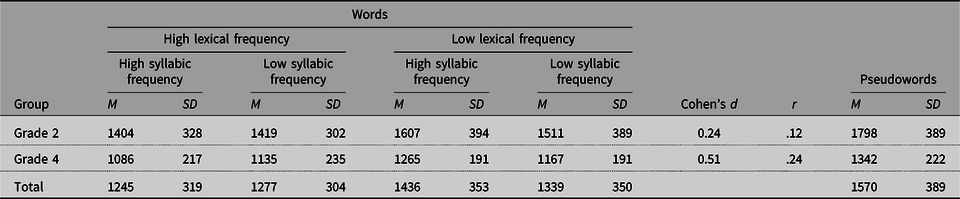
Mean reaction times (in ms) in the lexical decision task, Cohenś d, and r effect size

Second, the study by Jiménez and Hernández (Reference Jiménez and Hernández2000) showed very high standard deviations, both in the typical reading control group and in the reading disability groups. Responses with reaction times higher than 5 s were within 1 SD of the mean. Although 2nd graders showed higher accuracy rates than 1st graders in the Goicoetxea study (Reference Goikoetxea2005), some of them were still decoding at a syllabic pace, while others have overcome this stage showing an early level of automatic decoding. They were at the same school grade, but at a different reading learning stage. As it is now well known, the inhibitory effect is based on a tiny speed difference, neither low accuracy rates nor a syllabic pace decoding level are good conditions to show it up. For this reason, we will select 2nd-grade readers who have reached a certain level of automatic decoding ability.
Under these experimental conditions, we explored two alternative hypotheses. We expected to find the PSF inhibitory effect in 2nd-grade school children, supporting the results found by Goikoetxea (Reference Goikoetxea2005), Luque et al. (Reference Luque, López-Zamora, Álvarez and Bordoy2013), and others about the early role of syllables in lexical access in Spanish (Álvarez, García-Saavedra, Luque and Taft, Reference Álvarez, García-Saavedra, Luque and Taft2017; Jiménez, García, O’Shanahan, & Rojas, Reference Jiménez, García, O’Shanahan and Rojas2010). On the contrary, if the connections between words and syllabic structures increase with practice, as children’s vocabulary grows, the inhibitory effect might be found only in older children. To explore the developmental course of the inhibitory effect of PSF, we have selected a 4th-grade group. Significant differences between 2nd- and 4th-grade groups would support Maïonchi-Pino et al.’s (Reference Maïonchi-Pino, Magnan and Écalle2010a) assumption that the acquisition process lengthens over time. By contrast, nonsignificant differences between groups would be closer to Luque et al.’s (Reference Luque, López-Zamora, Álvarez and Bordoy2013) approach, suggesting that the inhibitory effect relies heavily on the structural properties of the lexical access system.
Method
Participants
The sample of this study was constituted by 40 children in 2nd grade (M = 93.07 months; SD = 4.85) and 40 children in 4th grade (M = 118.64 months; SD = 5.41) from four public schools in Málaga (Spain). Three procedures were applied to select participants with a minimum level of automatic decoding. First, a participant was included in the study if his/her score in TECLE (Test de Eficacia Lectora, Marín & Carrillo, Reference Marín, Carrillo, Cuadro, Costa, Trias and Ponce de León1999) was between the mean and the mean +1.0 SD. The scores in TECLE were different, F (1, 79) = 328.457, p < .001, between 2nd grade (M = 20.4, SD = 2.9) and 4th grade (M = 35.6, SD = 8.5). Nonverbal intelligence was measured with the RAVEN test (Raven & Court, Reference Raven and Court1996) to confirm that all children were in the typical range (M = 68.7, SD = 15.7). Second, special care was taken to exclude children with neurological, auditory, visual, or sensory–motor deficits and those with problems used as exclusion criteria for a specific learning disability diagnosis, according to the official school records. Third, following their class teacher’s recommendations, we also excluded children who presented a low significant knowledge of the Spanish oral language or/and a very poor schooling trajectory (usually due to immigrant status). Fourth and finally, according to the information provided by the teachers, all children had learned to read using a phonics method.
Materials and design
For each participant, global reading ability was assessed with the TECLE, a forced-choice sentence completion test (Marín & Carrillo, 1997). The test consisted of 64 sentences that were missing the final word. Four options were proposed for each sentence, and the participant had to choose the correct option. All of the incorrect options were orthographically similar to the target: two were pseudowords and the third was a real word. For example, for the correct response “problema” (problem), the pseudoword foils were “probrema” and “proglema” and the word foil was “protesta” (protest). Participants read silently and completed as many sentences as they could in 5 min. Each participant’s score was the number of correct responses. As the participant progressed through the test, the complexity of each task increased: sentences became longer, words became less frequent, and syntactic, cognitive, and pragmatic aspects of the sentences became more complex. For example, the first sentence was “Tu pelota es de color … rogo, roco, robo, rojo” (The color of your ball is … red) and the last sentence was “Ten mucho cuidado para que la máquina no caiga al agua, ya que no es … sumergible, sumengible, sunergible, sustituirle” (Be very careful the machine does not fall into the water because it is not … submersible). The reliability of this test was evaluated using the test–retest technique on 376 primary schoolchildren with an interval of approximately 1 month between tests (Cuadro, Costa, Trias, & Ponce de León, Reference Cuadro, Costa, Trias and Ponce de León2008). The correlation was substantial and significant (r = .880, p < .001). Cuadro et al. (Reference Cuadro, Costa, Trias and Ponce de León2008) also calculated the predictive validity: the correlation between the total score and the expert criterion of a teacher. The correlation showed a significant, positive, and moderate correlation (r = 0.402, p < .001) between teacher assessment and test results.
For the LD task, 120 disyllabic items (60 words and 60 pseudowords) were used. The 60 disyllabic words between 4 and 6 letters long were selected from Buscapalabras (Davis & Perea, Reference Davis and Perea2005), an orthographic and phonological corpus based on the Spanish written language. The pseudowords were constructed by taking the initial syllables of the experimental words and then adding second syllables to form items that resembled real words, but that do not actually exist in the Spanish language.
Two factors were manipulated in the item selection: the token syllable frequency of the initial syllable frequency (SF; high vs. low) and the LF (high vs. low) in a 2 × 2 experimental design. The range of the high-frequency syllabic condition included words that had an initial syllable with a token syllable frequency between 1,974 and 5,535 per million (M = 4,647, SD = 1,669). The range of the low-frequency syllabic condition included words that had an initial syllable with a token syllable frequency between 7 and 386 (M = 180, SD = 96). The frequency of the second syllable was controlled as much as possible by selecting, in each condition, words with a similar frequency in this variable (all p > .05). The word frequency was calculated using the standard measure Log 10, obtained from the base-10 logarithm of the total word frequency (per million) of the corpus. The high word-frequency condition included words between 75 and 398 (M = 176, SD = 108), and the low word-frequency condition included words between 1.4 and 6.4 (M = 4, SD = 2). The orthographic neighborhood and the length of the items were controlled in the four conditions (p > .05). The pseudowords were constructed by taking the initial syllables of the experimental word list and then adding second syllables to form items that resembled real words but that do not actually exist in the Spanish language.
Procedure
The TECLE test was collectively administered to each classroom. Children listened to instructions and received two example trials. They were informed that they should work as quickly as possible because they had only 5 min to complete the task. Before the test began, two examples were shown to each participant.
The LD task was individually administered on personal computers. Reaction times and accuracy rates were measured using the E-Prime 1.02 experimental software in a task that lasted on average 3.5 min (SD = 0.9). The subjects were instructed to pay attention to the written stimuli that appeared on the screen. The stimuli were presented randomly and the children had to press a labelled key (“yes”/“no”) to indicate whether the visual stimulus was a real word (e.g., “madre”) or not (e.g., “mapel”) as quickly and accurately as possible. Each trial began with a fixation point (*****) in the center of the screen that lasted 1500 ms until the experimental item appeared. The item remained on the screen until one of the keys was pressed or after 7000 ms, then a new trial began. The experiment terminated when the participant had completed all 120 items. Prior to the experimental test, the participants were trained in the task, and were required to correctly answer 80% of the items.
Results
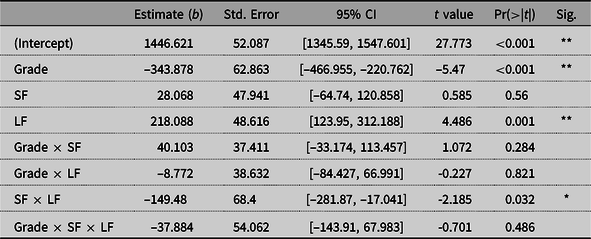
Mixed-effects model analyses were conducted separately for reaction times and accuracy rates, taking participant and item variability simultaneously into account (Baayen, Davidson, & Bates, Reference Baayen, Davidson and Bates2008; Bates, Reference Bates2005). The analyses were performed using the R statistics software with the package lme4 (Bates & Maechler, Reference Bates and Maechler2009). The syllable frequency (Shigh vs. low) and lexical frequency (high vs. low) factors were entered as within-group factors, and school grade as the between-group factor (2nd and 4th). Incorrect answers, times lower than 150 ms and higher than 4000 ms, as well as reaction times either higher or lower than 2.0 SD were excluded (15.4% of the original data), following the procedure used in previous studies (Álvarez, et al., Reference Álvarez, García-Saavedra, Luque and Taft2017; Luque et al., Reference Luque, López-Zamora, Álvarez and Bordoy2013). We used a fitted mixed-design analyses of variance with Satterthwaite approximation for degrees of freedom. Following Barr, Levy, Scheepers, and Tily (Reference Barr, Levy, Scheepers and Tily2013), the model was estimated with all repeated measures factors as fixed and random slopes across participant. The model formula used was Model = rt ~ Grade * Syllable Frequency * Lexical Frequency + (1|subject) + (1|item).
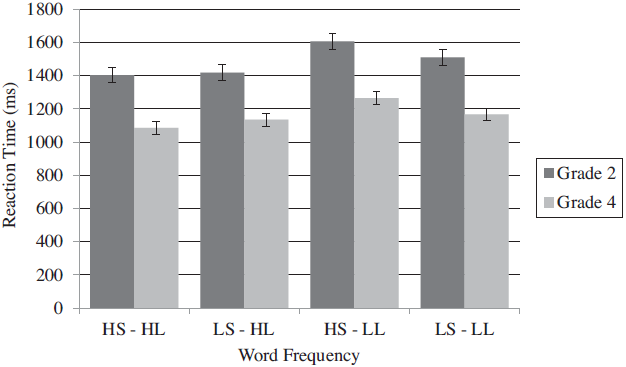
The results showed significant main effects of LF, t = 4.48, b = 218.088, SE = 48.616, p = .001, and School Grade, t = 5.47, b = –343.878, SE = 62.8, p = .001. None of the three-way or two-way interactions that included school grade were significant (all p >.050). There were no significant differences between school grade with regard to SF or LF, but 4th graders were observed to have shorter reaction times than 2nd graders (see Table 2).
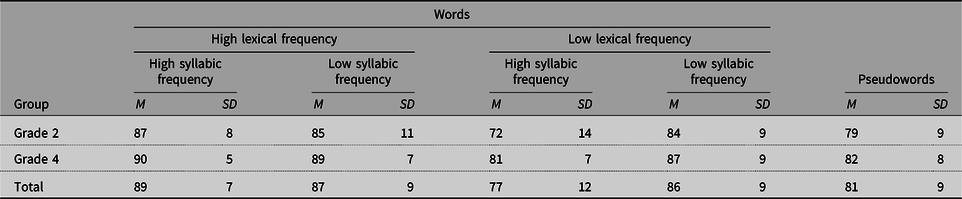
Accuracy (in %) of the lexical decision task

The interaction between SF and LF was significant for the entire sample, t = –2.185, b = –149.48, SE = 68.4, p = .032. The mixed-model post hoc analyses with Hochberg family-wise post hoc Type I error correction (Hochberg, Reference Hochberg1988) showed that the inhibition effect of PSF appeared only in low-LF words, z = 2.691, b = 120.3, p = .007 (Table 3).
Results of the linear mixed-effects model for response times

*p > .05.**p > .001.
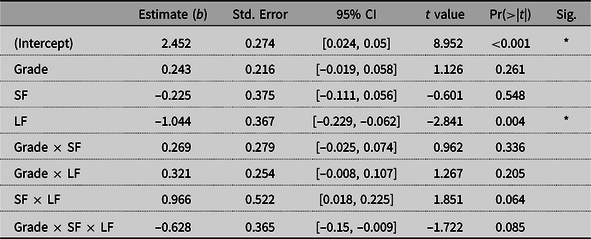
A second set of statistical analyses were applied using the mixed model with logit family function for binomial data to examine accuracy rates. The model formula used was Model = ac ~ Grade * Syllable Frequency * Lexical Frequency + (1|subject) + (1|item). The model showed that only LF was significant, z = −2.84, b = –1.04, p < .004 (Table 4).
Results of the logistic mixed-effects model for accuracy rates

*p > .05.
Nonsignificant effects cannot be safely taken as evidence against a hypothesis in null hypothesis significance testing (e.g., Dienes, Reference Dienes2014), we additionally used Bayes factors to determine the support of those effects. The analyses were carried out using JASP software (Version 0.11.1; JASP Team, Reference Jasp2019). The analysis confirmed the previous results, as SF × Grade (BF10 = 0.273), LF × Grade (BF10 = 0.265), and the triple interaction SF × LF × Grade (BF10 = 0.255), showed substantial evidence in favor of the null hypothesis, using the classification scheme of Wetzels et al. (Reference Wetzels, Matzke, Lee, Rouder, Iverson and Wagenmakers2011). Only the main effect of SF (BF10 = 1.423) presented an anecdotal evidence against the null hypothesis.
Finally, we calculated Cohen’s d and the effect-size correlation, r, using the means and standard deviations of high syllabic versus low syllabic frequencies in the low LF condition (see Table 1). Small effect sizes were found in both groups. The 2nd graders showed a Cohen’s d of 0.24, and an effect size of 0.12. The 4th graders showed a Cohen’s d of .51, and an effect size of 0.24. Both effect sizes are usually considered small.
Discussion
Our main objective was to examine when young Spanish readers exhibited the inhibitory effect. Our results support the two major claims of an early inhibitory effect hypothesis. First, the inhibitory effect was found in Grade 2 readers. Second, there were no differences between 2nd and 4th graders in the magnitude of the inhibitory effect (Figure 1). Linear mixed-model analyses showed a general inhibitory effect and no third-level interaction. Bayes analyses confirmed there was not substantial evidence in favor of any interaction trend. Finally, Cohen’s d analysis confirmed that children in Grade 2 and 4 showed small sizes of the inhibitory effect.
Mean reaction times of the lexical decision task. High syllable frequency (HS). Low syllable frequency (LS). High lexical frequency (HL). Low lexical frequency (LL). Whiskers denote the standard error of the mean.

As stated above, two hypotheses had emerged. Maïonchi-Pino et al. (Reference Maïonchi-Pino, Magnan and Écalle2010a) explicitly proposed the hypothesis of the noninhibitory syllable frequency effect. They put forth two related points to defend the delayed acquisition of the inhibitory effect. First, it is necessary to increase the stock of lexical item candidates. Second, the mapping between initial syllables and words could take a long time to establish. The authors wrote, “while learning to read, the stock of lexical candidates is not sufficiently large to inhibit the role of high-frequency syllables” (Maïonchi-Pino et al., Reference Maïonchi-Pino, Magnan and Écalle2010a, p. 79). The learning process would improve the mapping between high-frequency syllables and the beginning of words, while the limited mental lexicon increases progressively. In line with the delayed acquisition hypothesis, Chetail and Mathey (Reference Chetail and Mathey2009) stated that the learning processes would lead to a faster phonological activation process and such high-speed decoding would be a critical factor necessary to achieve the inhibitory effect.
Opposite conclusions can be drawn from Goikoetxea (Reference Goikoetxea2005) and Luque et al. (Reference Luque, López-Zamora, Álvarez and Bordoy2013). Goikoetxea (Reference Goikoetxea2005) found the inhibitory effect in first-grade readers, and thus concluded that first-grade Spanish readers use a syllabic level of representation from the beginning of literacy development. Furthermore, she stated that the initial access to the mental lexicon could be attained through the first syllable. In this way, the coupling between the initial syllables and words would not imply a long and arduous acquisition process. In addition, it is clear that first-grade readers have not yet reached automatic phonological processing. Consistent with this point, Luque et al. (Reference Luque, López-Zamora, Álvarez and Bordoy2013) showed than even poor readers can show an inhibitory effect, suggesting that high-speed phonological processes are not a necessary condition for the inhibitory effect to emerge.
The recent CDP++ computational model (Perry et al., Reference Perry, Ziegler and Zorzi2010) would serve as the arena to discuss our results. The model presents sublexical and lexical representations, distinguishing among letters, phonemes, and words. Thus, the CDP++ model allows a transparent explanation of the activation and competition processes of lexical candidates. Following the connectionist dual process model, a two-layer associative sublexical network produces an output that activates a set of units on the phoneme nodes module. However, Perry et al. (Reference Perry, Ziegler and Zorzi2010) stated that phonological representations are not a linear string of phonemes, but rather they are structured into their syllabic constituents. Empirical evidence supports this claim: visual word recognition in Spanish shows sequential properties with a bias toward the initial syllable (Álvarez, Carreifas, & de Vega, Reference Álvarez, Carreiras and de Vega2000). In this way, the initial syllable activates a set of high-frequency words from the phonological lexicon. Several pieces of evidence support the phonological nature of the process of lexical candidate activation (Álvarez et al., Reference Álvarez, Carreiras and Perea2004; Conrad, Grainger, & Jacobs, Reference Conrad, Grainger and Jacobs2007; López-Zamora, Luque, Álvarez & Cobos, Reference López-Zamora, Luque, Álvarez and Cobos2012).
As Álvarez, Carreiras, and Taft (Reference Álvarez, Carreiras and Taft2001) showed, words with high-frequency initial syllables are more likely to activate words of higher LF than do words with low-frequency syllables. This explains why the syllable frequency effect tends to be stronger in low-frequency words. Thus, it is the mutual inhibition between the low-frequency words— with high-frequency initial syllables—and some high-frequency activated words that underlies the syllable frequency effect (Álvarez et al., Reference Álvarez, Carreiras and Perea2004).
We can derive some important ideas from the previous explanation. The existence of a number of high-frequency lexical candidates is an essential condition to produce an inhibitory effect. However, if the inhibitory effect is based on a stock of high-frequency lexical candidates, then the necessary stock could be settled at an early stage. It is easy to accept that first graders have not yet attained the full orthographic lexicon, but Goikoetxea (Reference Goikoetxea2005) showed that it is not necessary to develop a full orthographic lexicon to obtain a source of inhibition. In contrast, Luque et al. (Reference Luque, López-Zamora, Álvarez and Bordoy2013) showed how 2nd- and 4th-grade poor readers with slow phonological decoding processes exhibited a strong inhibitory effect, even larger than the effect observed in normal readers. According to the self-teaching hypothesis (Share, Reference Share1999), poor readers acquire fewer orthographic representations than normal readers do. Therefore, competing lexical candidates can be activated and then produce an inhibitory effect even with poor or undeveloped orthographic representations.
In addition, our results undoubtedly show that the mapping between high-frequency syllables and a stock of high-frequency words can be acquired in second grade. Phonological and orthographic sources might be hard to disentangle in a rather transparent orthography where frequencies are highly correlated. However, these mappings are most likely phonological in nature. Strong evidence shows that some phonological connections are settled before literacy begins to develop, shaping phoneme awareness and predating the influence of alphabetic reading skills (Caravolas & Landerl, Reference Caravolas and Landerl2010; Ziegler & Goswami, Reference Ziegler and Goswami2005). As early as the age of 3 to 4, preschool Spanish children show awareness of the syllabic units in tasks that require the explicit manipulation of the relation between initial syllables and words (Carrillo, Reference Carrillo1994). Therefore, simple syllabic structures might be fully connected to high-frequency words in the prereading stage.
Doignon-Camus and Zagar (Reference Doignon-Camus and Zagar2014) built on these ideas to develop the “syllabic bridge” hypothesis. They showed that prereaders are able to learn statistical properties of letter co-occurrences after a few minutes of exposure. These authors also showed that these associations between letters and syllables represent a faster and more direct way to learn spelling-to-sound correspondences in French than a classic letter-to-sound learning system. Moreover, some studies have shown that a short learning period of grapheme-to-phoneme correspondences is necessary in order to observe the functional role of the syllable inside the lexical access system (Chetail & Mathey, Reference Chetail and Mathey2008). In this vein, Goikoetxea (Reference Goikoetxea2005), Álvarez et al. (Reference Álvarez, García-Saavedra, Luque and Taft2017), and Jiménez et al. (Reference Jiménez, García, O’Shanahan and Rojas2010) also supported a similar view in Spanish about the early role of syllables in lexical access. Finally, we claim that the preexisting oral system—with words connected to their initial corresponding syllables—is later linked to the output of the grapheme–phoneme module by means of literacy. In this way, neither a large stock of lexical candidates nor a long learning process is necessary to observe the inhibitory effect.
Furthermore, the idea that the connections between syllables and words are well established at an earlier stage is reinforced by another remarkable finding: the lack of interaction between school grade and the inhibitory effect in our study. Additional analyses were carried out to ensure the correct interpretation of this lack of interaction (see Bayes analyses in the Results section). If the acquisition of these connections was related to the inhibitory effect, a trend of interaction would be observed. In contrast, the magnitude of the inhibitory effect got almost the same size across the two school grade groups, supporting that the inhibitory effect was not determined by related to participants’ reading experience.
Given that the selection of the participants focused on children with a certain level of automatic decoding, we must be cautious in generalizing the conclusions about the grade level. Nevertheless, we can derive from our findings that even early school grade readers might show inhibitory effects, whenever they have reached a certain level of decoding skill. Additional support for this interpretation is that the small effect size of the inhibitory effect reached by our participants is equivalent to the effect size found in adult skilled readers (e.g., López-Zamora et al. Reference López-Zamora, Luque, Álvarez and Cobos2012), and even by 2nd- and 4th-grade poor readers (Luque et al., Reference Luque, López-Zamora, Álvarez and Bordoy2013). Taken together, these results lead to the conclusion that the size of the inhibitory effect is small, no matter the automatic decoding speed, the learning difficulty, or the age.
Let us consider an alternative explanation to the necessity of achieving high-speed decoding processes. As most studies have included adult samples, it has been attributed a major role of full-word orthographic representation in inhibiting other lexical candidates. This point of view seems to be implicit in the Maïonchi-Pino et al. (Reference Maïonchi-Pino, Magnan and Écalle2010a) noninhibitory hypothesis. They stated that repetitive exposure to frequent syllabic structures facilitates the mapping of these frequently encountered structures with the beginning of words. In this way, the spoken syllables would guide associations with larger orthographic units, connecting the phonological and the orthographic lexicons. Chetail and Mathey (Reference Chetail and Mathey2009) also supported the idea that orthographic syllables play a meaningful role in the inhibitory effect. Both claims might be partially right, but they might not provide a complete explanation. While the activation processes are mainly phonological in nature, inhibition may come from two different sources: the orthographic lexical representations or the second phonologically defined syllable. Thus, the initial syllable would activate some high-frequency lexical candidates, while the second syllable would complete the activation of the low-frequency lexical target word. Hence, from this point of view, all the competing items could have been activated inside the phonological lexicon, while orthographic representations would not play a major role.
Our results seriously challenge the need of a fully developed orthographic lexicon. Only the use of a syllabic level of representation from the beginning of literacy can explain that both age groups showed equivalent inhibitory effects, despite the fact that 2nd graders were slower decoders than 4th graders were. More important, the inhibitory effect was of the same magnitude in the group of slow phonological decoders—poor readers—that could not have accurate or fluent orthographical representations (Luque et al., Reference Luque, López-Zamora, Álvarez and Bordoy2013). Thus, the straightforward conclusion is that competent high-speed decoding processes are not a necessary condition for the inhibitory effect to emerge.
In conclusion, our results reinforce the idea that there is a close connection between prereading oral language skills and the literacy process. The fact that preliterate children can solve explicit phonological awareness tasks must be taken as evidence that sublexical representations (syllables) are connected to their corresponding words early on. Learning to read involves the connection of these preexisting oral representations with written symbols. The previously established oral representations are probably enough to show an inhibitory effect as soon as they are connected to a letter–sound node, as it was shown by Goikoetxea (Reference Goikoetxea2005). This transfer can be boosted because Spanish is a syllable-timed language. In this way, the inhibitory effect is a consequence of the structure of the lexical access system itself, and the properties of this oral lexical access system are incorporated to the reading network. We also claim that the lexical activation and competition processes underlying the inhibitory effect are fully settled when a child is in Grade 2 and remain similar in Grade 4.
However, there are restrictions and/or limitations to observing the inhibitory effect. Longer words, syllabic structures other than consonant–vowel types or the frequency of orthographic correspondences, can alter the dynamics of the lexical access system. Nevertheless, although unrelated to our main hypotheses, in this study the global syllable frequency effect and the inhibitory effect on the high LF condition were not found. It is possible that controlling the facilitatory bigrams effects might have produced a significant syllable frequency effect. Alternatively, the use of high LF words may have prevented any syllable condition effect, and a wider frequency range in the high-frequency words may have produced significant inhibitory results. It is a future challenge to develop a more refined selection of items under increasingly restrictive conditions. These limitations are greater for young children samples, concerning the variation within children’s performance. In any case, we believe that the observed phenomenon is mainly phonological in nature, so the connection with the orthographic lexicon observed in studies with older readers would be a consequence of the later development of these orthographic representations. Thus, phonological representations precede orthographic ones and they determine the main structural and functional properties of the lexical access system.
Acknowledgments
This research was supported by Grants PSI2015-65848-R from the Spanish government and FEDER Funds.