1. Introduction
Among mycologists, questions persist about what entities should be treated as the fundamental units of fungal populations (Burnett Reference Burnett2003). Certain features of fungi, such as being very small and often developing underground, ensure that there will always be practical difficulties associated with studying populations of these organisms (Anderson and Kohn Reference Anderson and Kohn1998). Questions about how to properly understand fungal population dynamics are often taken to involve something more than merely practical considerations, however. The fungi that have proved most difficult to understand are heterokaryotic fungi, including the familiar mushroom producing fungi in the group Basidiomycota. Decades of research on these organisms have unlocked many secrets about their biological organization, yet consensus about the proper analysis of heterokaryotic fungal populations and individuals has remained elusive. One reason for the lack of consensus is undoubtedly continuing discussion surrounding the units of selection debate (see Okasha Reference Okasha2006). Heterokaryotic fungi, however, exhibit characteristics that would make them difficult to categorize even in the absence of any overarching dispute about evolutionary theory.
The aim of this article is to articulate a coherent view about populations of heterokaryotic basidiomycete fungi and the individuals that comprise them. The framework I employ is a version of the one developed in Godfrey-Smith (Reference Godfrey-Smith2009). The article is organized as follows. First, I discuss the role of individuality in evolutionary theoretical contexts generally. This discussion includes an articulation of some concepts that will be become central later on: the minimal concept of a Darwinian population and the derivative concept of a Darwinian individual. Next, I argue that entities at (at least) two levels of the biological hierarchy satisfy the minimal concept in heterokaryotic fungi: mycelia and submycelial elements (particularly nuclei). That entities at two different levels of the hierarchy constitute evolvable populations invites a question about how to understand the relation between these two populations. In the final section of the article, I provide a preliminary sketch of an answer, which involves moving beyond the minimal concept of a Darwinian population to investigate in more detail the properties of populations of submycelial elements. I employ a comparative perspective. The phenomenon of intraorganismal genetic heterogeneity (IGH) plays a substantial role in the final section. The existence of heterokaryotic fungi demonstrates that organisms can be composed of entities that are quite divergent genetically. This idea runs contrary to a common view, according to which genetically distinct entities do not engage in cooperative behavior with one another and tend to degrade the integrity of whatever entity they are parts of. Heterokaryotic fungi show that organisms need not always be composed of genetically identical (or similar) parts and that the evolution of such organisms is not rare or unusual.
Philosophers of biology have not paid a great deal of attention to fungal biology. Fungi, however, are a diverse and ecologically important group of organisms inhabiting this planet and will inevitably play a role in a full and accurate understanding of living things. Another goal of this article is therefore to make philosophers aware of the biology of the fungi, with the intention of contributing to the reorientation of general discussions about the nature of biological individuality, organismality, and evolutionary transitions (much as Clarke has done through an analysis of plant evolution and individuality; see Clarke Reference Clarke, Sterelny and Calcott2011a, Reference Calcott2012).
2. Evolution and Individuality/Darwinian Individuals
Evolutionary explanations of a certain type always employ a criterion of biological individuality, most often tacitly. In particular, population biologists must not only be able to distinguish individuals in a population from their neighbors synchronically; fitness calculations also require the ability to distinguish parents from their offspring diachronically. So counting individuals is essential to doing the kind of demographic work required for evolutionary explanation of trait distributions in populations (Godfrey-Smith Reference Godfrey-Smith2009; Clarke Reference Calcott2011b). Thus, there is a certain category of biological individual, which I call the evolutionary individual, that necessarily arises in the context of evolutionary explanation. Any particular account of evolutionary individuality will be linked to a particular account of the process of natural selection.
The best account of selection is found in the work of Darwin himself (Reference Darwin1859/1966).Footnote 1 Darwin’s recipe for evolutionary change was later modified by others (esp. Lewontin Reference Lewontin1970). In recent years, this classical approach has been revisited by Godfrey-Smith. Godfrey-Smith articulates what he refers to as the “minimal concept” of a Darwinian population: “A Darwinian population in the minimal sense is a collection of causally connected individual things in which there is variation in character, which leads to differences in reproductive output (differences in how much or how quickly individuals reproduce) and which is inherited to some extent. Inheritance is understood as similarity between parent and offspring, due to the causal role of the parents” (Reference Godfrey-Smith2009, 39). Godfrey-Smith argues that the minimal concept is central to understanding Darwinian phenomena. Populations that satisfy the minimal concept have the potential to evolve by natural selection. In investigating whether a particular system has the capacity to evolve by natural selection, one starting point is to assess the system in light of the minimal concept. Godfrey-Smith suggests that an initially inclusive and permissive attitude about which populations satisfy the minimal concept is appropriate. Further, more fine-grained characteristics of evolving populations are important in understanding evolutionary processes. But if a population satisfies the minimal concept, that is enough to warrant consideration of that population from a Darwinian perspective.
As Godfrey-Smith notes, the minimal concept is merely a starting point for understanding the process of natural selection. A category of paradigm Darwinian populations can be distinguished from more minimal ones. Paradigm Darwinian populations are ones in which “significant novelty can emerge” and that result in “complex and adapted structures” (Reference Godfrey-Smith2009, 41). The distinction can be made clearer by noting that Darwinian populations can vary with respect to several parameters. The two most important in the context of this article are the abundance of variation (Godfrey-Smith’s V parameter) and competitive interaction with respect to reproduction (Godfrey-Smith’s α parameter; Reference Godfrey-Smith2009, 63). The degree to which these parameters are instantiated in a population affects whether the population in question is capable of undergoing the kind of adaptive evolution that occurs within paradigm Darwinian populations. I say more about how these two parameters are relevant to heterokaryotic fungal populations in the final section of this article. The distinction between paradigm and minimal Darwinian populations, and the characterization of certain variable features of Darwinian populations such as V and α, go beyond the recipe for natural selection in Lewontin’s (Reference Lewontin1970) discussion.
Once the concept of a Darwinian population has been developed, a derivative concept of a Darwinian individual can be articulated. A Darwinian individual is “any member of a Darwinian population” (Godfrey-Smith Reference Godfrey-Smith2009, 40). The way the term “individual” is being employed here is different from other biological usages (cf. Santelices Reference Santelices1999; Clarke Reference Calcott2011b). Darwinian individuals are essentially reproducing things. Understanding the fitness and inheritance of individuals requires the ability to assess whether one individual is a parent of another. An important feature of Darwinian individuals is that they can be entities at any level of the biological hierarchy at which Darwinian populations are found. According to Godfrey-Smith, Darwinian individuals include but are not limited to individual viruses, genes, organelles, cells, multicellular organisms, and sometimes groups of multicellular organisms (Reference Godfrey-Smith2009). Correspondingly, there can be evolving populations at each of these levels. Importantly, the minimal concept does not rule out the possibility that there can be biological systems in which more than one Darwinian population can be located. Such coextensive Darwinian populations may have various relations to one another.
The category of the reproducer is an important one in Godfrey-Smith’s framework. Reproducers are Darwinian individuals, biological entities that stand in parent-offspring relationships. As noted, there are various kinds of entities that can stand in such relationships. Godfrey-Smith develops a scheme for categorizing reproducers. The two most important kinds of reproducers in heterokaryotic fungi are scaffolded and collective reproducers. Scaffolded reproducers are “entities which get reproduced as part of the reproduction of some larger unit. … Their reproduction is dependent on an elaborate scaffolding of some kind that is external to them” (Reference Godfrey-Smith2009, 88). Genes are paradigmatic scaffolded reproducers. Collective reproducers are “reproducing entities with parts that themselves have the capacity to reproduce, where the parts do so largely through their own resources rather than through the coordinated activity of the whole” (87). Multicellular organisms are paradigmatic collective reproducers. Collective reproducers are distinguished by the presence of three (variable) parameters: bottlenecks, germ lines, and integration. High “values” of these parameters “are associated with clearer or more definite cases of reproduction, as opposed to more marginal ones” (94). Single-celled bottlenecks between generations, specialized germ tissue that is sequestered early in development, and a high degree of integration among an entity’s parts are indicative that the entity in question is a collective reproducer, so part of a Darwinian population. I say more about the role of reproduction in characterizing fungal populations and individuals in the next section.
It is worth noting that Godfrey-Smith (Reference Godfrey-Smith2009) does not discuss fungal populations in any significant detail. One question about the Darwinian populations framework is whether it can make sense of the population structure of types of organisms with which it has never come into contact. Part of the message of this article is that putting the biological details of fungi into the Darwinian populations machine and turning the crank provides a coherent and hitherto unarticulated view about fungal populations and individuals.
3. Heterokaryotic Fungi and Darwinian Populations
In this section, I argue that the particular combination of biological characteristics exhibited by heterokaryotic basidiomycete fungi make it prima facie difficult to identify and classify individuals and populations. I suggest that three fungal structures are potential candidates for being members of populations that satisfy the minimal concept of a Darwinian population: genets, mycelia, and submycelial elements such as nuclei. I argue that fungal genets should not be treated as Darwinian individuals but that contiguous mycelia should. I also argue that submycelial elements, certainly nuclei and perhaps mitochondria, should be treated as Darwinian individuals.
3.1. Fungal Biology and the Issue of Individuality
Fungi exhibit several distinctive biological features that make it difficult to identify individuals and populations. Unlike many familiar metazoan organisms, a fungus has no determinate species-typical body plan that develops from a single-celled spore. Fungi make their living by colonizing and consuming ephemeral substrates, and indeterminate growth is one solution to this adaptive problem (Webster and Weber Reference Webster and Weber2007). Fungal growth is sometimes achieved by specialized filamentous structures called hyphae. In filamentous basidiomycete fungi, hyphae are often divided into sections by structures called septa. Septa allow cytoplasm to flow freely through hyphae but keep nuclei contained in cell-like compartments. A typical, but not universal, feature of fungi is the development of a network of hyphae, called a mycelium. Mycelia are important fungal structures, often found underground, through which cytoplasm flows freely. This feature of fungal organization has led some mycologists to view a mycelium as an entity akin to a giant multinucleate cell.
Some mycologists have pointed out that fungi are modular, as opposed to unitary, organisms. Various fungal structures can be considered repeatable modules, including nuclei, septate sections of hyphae, hyphae themselves, and even contiguous mycelia. The repeatable nature of hyphal structures in particular, and their ability to flexibly anastomose (fuse) with other hyphae, is part of what bestows upon fungi their capacity for indeterminate growth.
Any part of a fungal mycelium can be physiologically detached from the whole and, if exposed to a suitable substrate, can persist and eventually produce reproductive structures. Hence, there is not a distinction between germ tissue and soma tissue in fungi. Before the production of reproductive structures, there is no part of a fungus that is dedicated exclusively to reproduction. This aspect of fungi contrasts with many familiar metazoan organisms, which tend to sequester a germ line relatively early in their ontogeny (Buss Reference Buss1987). Fungi are certainly not unique in this regard. It has been argued that plants also lack a distinction between germ tissue and soma tissue, which leads, in part, to potential confusion about their population structure (Clarke Reference Clarke, Sterelny and Calcott2011a, Reference Calcott2012). Moreover, part of the message of Buss (Reference Buss1987) is that there is tremendous variation in how early different organisms sequester their germ cells in development. The modular parts of entities that do not sequester their germ tissue early in development tend to have more autonomy and tend to behave more like Darwinian individuals in their own right (cf. Godfrey-Smith Reference Godfrey-Smith2009).
Both sexual and asexual reproduction commonly occur in basidiomycete fungi. In asexual reproduction, spores that contain mitotically derived nuclei are formed and dispersed via specialized reproductive structures. The mycelia that develop from these asexual spores are genetically identical to their parent, though they are not physiologically contiguous with their parent. When two genetically identical mycelia come into contact with one another, the mycelia can fuse to become physiologically integrated and contiguous (Webster and Weber Reference Webster and Weber2007, 510).
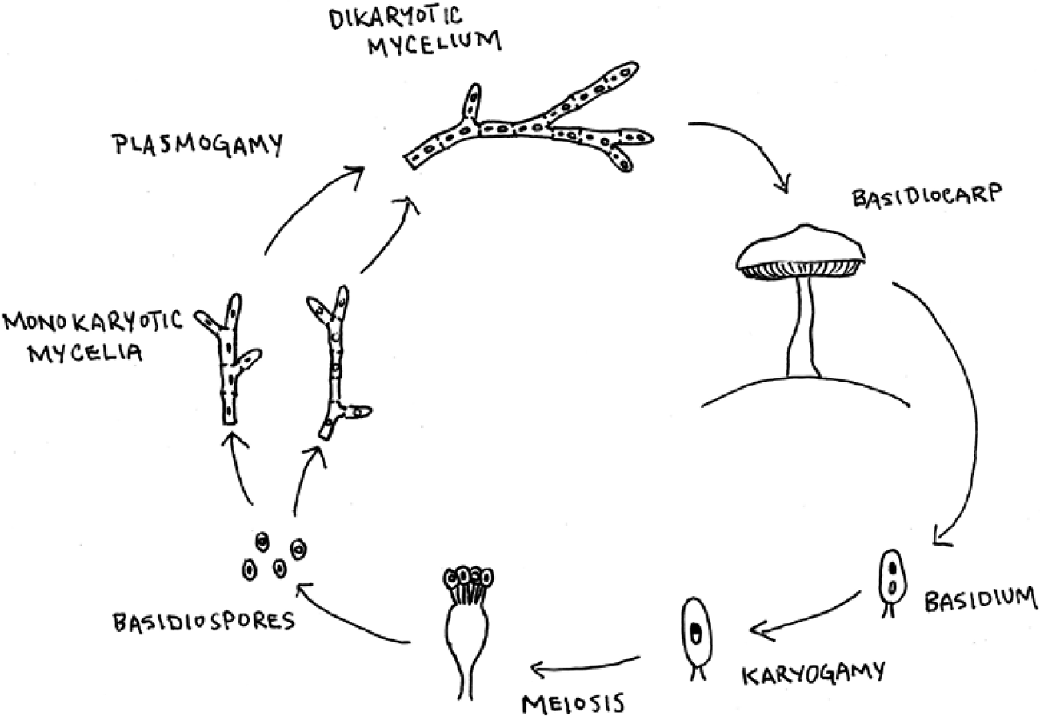
The heterokaryotic condition is common in some fungal groups, in particular the phyla Ascomycota, Basidiomycota, and Glomeromycota. Heterokaryosis occurs when a single fungus, at some point during its life cycle, has genetically distinct nuclei ensconced in a common cytoplasm. Although there is tremendous variation in the detailed life cycles of heterokaryotic fungi, the idealized life cycle of organisms classified in the phylum Basidiomycota is well understood. This group, the focus of this article, includes the familiar mushroom-producing fungi. The life cycle can be described as follows. A basidiocarp (more commonly known as a mushroom or toadstool) produces spores, called basidiospores, via the process of meiosis. A single basidiospore that lands on a suitable substrate develops to produce a haploid monokaryotic mycelium, called the primary mycelium. The primary mycelium is septate, composed of many individual cell-like compartments through which cytoplasm can freely flow. There is one nucleus in each septate cell that is mitotically derived from the progenitor haploid nucleus. The nuclei cannot migrate freely throughout the mycelium. Two primary mycelia fuse if they have the right combination of mating type alleles. Fusion results in plasmogamy, the joining of cytoplasm, between the two primary mycelia, which unite to form a secondary mycelium. The secondary mycelium is septate, but each cell contains two distinct haploid nuclei, each mitotically derived from the progenitor nuclei in the primary mycelial parents. An organism organized in this way is called a dikaryon because it has two distinct haploid nuclei that coexist without fusing in each cell in the mycelium; if the nuclei are genetically different from one another, as they often are in basidiomycete fungi, then the organism is called a heterokaryon. A basidiomycete fungus can exist in the dikaryotic stage for long periods of time and can sometimes form and disperse asexual dikaryotic spores. Eventually, sexual reproductive structures are formed, called basidiocarps (mushrooms). Once a basidiocarp has formed, the two haploid nuclei fuse (a process called karyogamy) and undergo meiosis, resulting in the production and ultimate dispersal of basidiospores. Some basidiospores will develop into primary mycelia, completing the life cycle (see fig. 1).
Typical basidiomycete life cycle.

The biological characteristics of heterokaryotic fungi make the task of identifying fungal individuals different from more familiar cases. One way of understanding this is by thinking comparatively. Consider a human being. It is relatively unproblematic to determine where one individual human being ends and another begins. Each human being begins life as a single-celled zygote. Each zygote is genetically unique (except in the case of monozygotic twins). It develops in a familiar, species-specific way. Germ cells are sequestered early in a human being’s ontogeny, ensuring reproductive division of labor between germ and soma tissues. A human being consists of heterogeneous tissues and structures, integrated into a functional whole. Sexual reproduction results in the production of a genetically unique zygote. This suite of biological characteristics makes it unproblematic to discriminate human beings one from another, both synchronically and diachronically. Humans can be easily told apart from their neighbors and their offspring.
In fungi, some of these biological characteristics are either missing or are less pronounced. Single-celled beginnings are common in the fungi, because of the production of spores. In the case of the Basidiomycota, however, primary mycelia fuse to create dikaryotic, physiologically integrated, secondary mycelia. There is fusion between two unrelated individuals, creating a new physiological whole. This is similar to sex. However, dikaryotic fungal mycelia are unlike many other sexually produced offspring because karyogamy, the fusion of parental haploid nuclei, is delayed until reproductive structures develop. Heterokaryotic fungi thus contain nuclei from different origins, ensconced in a common cytoplasm, each contributing to the creation and maintenance of a common internal environment on which they all depend for their continued persistence. There are some other organisms (e.g., some rhodophytes) that exhibit this kind of heterokaryosis. However, the majority of organisms do not undergo a prolonged heterokaryotic developmental stage. The source of variation among nuclei in a basidiomycete fungus is distinctive and different from the inevitable developmental mosaicism that can be found in plants and most animals (see Godfrey-Smith [Reference Godfrey-Smith2009] for a good discussion of mosacism).
The material derived from one fungal sexual event may be spread over a wide area and is not necessarily physiologically connected due to asexual reproduction or accidental physiological disruption. There is often very little integration between genetically identical or very similar mycelia.
The suite of biological characteristics exhibited by fungi seems like a chaotic combination when compared to the characteristics of more familiar metazoan organisms. In particular, it is not at all clear what the fundamental selectional units are in fungal systems, and thus it is not clear how to discriminate evolutionary individuals or the populations that they make up. Understandably, there has been much debate about how to conceptualize fungal individuals (Buller Reference Buller1931; Pontecorvo Reference Pontecorvo1946; Buss Reference Buss1987; Rayner Reference Rayner1991; Burnett Reference Burnett2003; Anderson and Kohn Reference Anderson, Kohn, Heitman, Casselton, Taylor and Kronstad2007; James et al. Reference James, Stenlid, Olson and Johannesson2008).
3.2. Darwinian Individuals: Genets, Mycelia, and Submycelial Elements
One way to begin to answer questions about populations of heterokaryotic basidiomycete fungi is to investigate which features of fungi satisfy the minimal concept of a Darwinian population, articulated in section 2. As Godfrey-Smith suggests, initially it is best to have a permissive and inclusive attitude. It will be possible to make more fine-grained distinctions later. In this section, I discuss and evaluate three kinds of entities that seem like prima facie plausible candidates for being Darwinian individuals that make up Darwinian populations: genets, mycelia, and submycelial elements.
At this point it is necessary to borrow some terminology from plant biology. The terms “genet” and “ramet” are commonly used by plant biologists (Stout Reference Stout1929; Harper Reference Harper1977; Clarke Reference Clarke, Sterelny and Calcott2011a). A ramet is a semiautonomous repeatable structure such as an individual shoot, meristem, or plant (the unit that is treated as a ramet is often different for different plant groups). A genet consists of all the material that is produced as a result of one sexual event, the collective group of ramets that develop from a zygote. Some mycologists argue that these terms can be applied to fungi. Burnett makes the case: “One solution to the problem of identifying fungal individuals is to recognize that the functional unit is the mycelial clone and to adopt the term first coined to describe clonal higher plants, namely the genet, i.e. the product of single zygote. … In the Basidiomycotina … the term genet is applied to the dikaryotic mycelium derived from the fusion of two monokaryons, themselves derived from individual basidiospores, i.e. the products of a single zygotic meiosis. Similarly, if a dikaryon reproduces asexually, its products are part of the same genet” (Reference Burnett2003, 65). The suggestion here is that genetically homogeneous entities are relevant evolutionary units, regardless of whether they are physiologically contiguous or functionally integrated. This idea has been influential among biologists (Janzen Reference Janzen1977; cf. Huxley Reference Huxley1852). Contiguous mycelia, on this view, may be treated as ramets. Groups of genetically identical or very similar ramets would qualify as genets.
Prima facie it seems plausible that a population of fungal genets satisfies the minimal concept of a Darwinian population. Each fungal genet, whether dikaryotic or monokaryotic, is genetically distinct. This ensures that any causally connected group of fungal genets will exhibit variation. Such variation could manifest itself in terms of differences in reproductive output. Distinct genets presumably have different survival and reproductive regimes and, hence, different propensities to give rise to offspring genets. Moreover, sexual descendants of particular genets tend to resemble their parents more than they tend to resemble other individuals in the population. Genets pass the minimal test for being members of a Darwinian population.
There are reasons, however, to resist categorizing physiologically noncontiguous genets as Darwinian individuals. Recall that Darwinian individuals are essentially reproducing entities. It is certainly possible to distinguish between growth and reproduction in fungal genets. Asexual production of spores and the resulting mycelia would count as growth of one individual as opposed to creation of a new one. But it is in thinking about these issues that problems begin to arise. Why should we think of several spatiotemporally scattered material parts as belonging to one collectively reproducing entity? This kind of thinking has historically been resisted (Huxley Reference Huxley1912); it should be resisted in this case as well. The main reason to resist treating fungal genets as Darwinian individuals has to do with the lack of functional integration of parts. Ramets comprising fungal genets are contiguous mycelia that are genetically identical. These ramets are not necessarily located near each other in time or space, and there is no reason to think that they are cooperating in any way. There is no division of labor or functional integration among noncontiguous mycelia, either physiological or reproductive. Genets themselves are too physiologically diffuse to count as collectively reproducing entities, as they score very low on Godfrey-Smith’s functional integration criterion. Fungal genets are only marginally reproducing entities (sensu Godfrey-Smith Reference Godfrey-Smith2009). So fungal genets are not Darwinian individuals.
There are, however, other fungal entities that may make good candidates for individuals that comprise Darwinian populations. The work of Alan Rayner, a mycologist who articulated the concept of the “individualistic mycelium,” can be recruited here. The individualistic mycelium “envisaged somatic rejection responses as a mechanism maintaining the identity of individual mycelia within natural populations by preventing physiological integration with others of different genetic origin. In outcrossing basidiomycete populations, these individuals are secondary mycelia” (Reference Rayner1991, 57). The individualistic mycelium perspective is one in which the fungal ramet is given a privileged position as a biologically relevant individual. A fungal ramet is any physiologically contiguous mycelium, regardless of its genetic makeup (homokaryotic or heterokaryotic). If two ramets come into contact with one another and become physiologically integrated, that constitutes the creation of one individual where once there were two. If a somatic rejection response kicks in when the two ramets meet, then two physiologically distinct individuals remain. Do populations of fungal ramets, contiguous mycelia, satisfy the minimal concept of a Darwinian population? There is certainly variation among mycelia (although perhaps not much between ramets that are asexual clones of one another). The variation among ramets contributes to fitness differences between them. It is also the case that mycelial offspring will tend to resemble their parents, whether they are produced sexually or asexually. So the minimal criteria for a group of causally connected ramets being a Darwinian population are met.
The individualistic mycelium perspective is not subject to the same criticism as the proposal that genets are Darwinian individuals. Individual mycelia are reproducing entities. The mechanisms underlying the multiplication of these organisms are diverse, but whether mycelia produce offspring is not in question. A mycelium can create offspring clonally, via physiological detachment of a chunk of mycelium or via the production of asexual reproductive structures and spores. Some mycelia also reproduce sexually, as in the production of basidiospores. Furthermore, there can be no doubt that an individual mycelium exhibits a much higher degree of functional integration and cohesion than a genet composed of many ramets that do not interact. Mycelia are not spatially distributed in a way that threatens their integration in the same way that genets are. There are diverse parts working for the maintenance and reproduction of the whole. Even if the parts of contiguous mycelia are not seamlessly integrated and retain some independence from each other, as is probably the case in very large mycelia, the fact remains that they are physiological wholes, unlike many fungal genets. Contiguous mycelia are Darwinian individuals that constitute Darwinian populations.
As Rayner emphasizes, there are evolved mechanisms ensuring the integrity of individual mycelia: somatic incompatibility responses. Much current research focuses on mechanisms that regulate the tendency of various filamentous fungal mycelia to fuse with other mycelia to create (or prohibit the creation of) a new physiological whole (Glass and Kaneko Reference Glass and Kaneko2003; Pawlowska Reference Pawlowska2005; Anderson and Kohn Reference Anderson, Kohn, Heitman, Casselton, Taylor and Kronstad2007; cf. Pradeu Reference Pradeu and Vitanza2012). Somatic fusion is undoubtedly one of the causes of heterokaryotic mycelia in certain fungi. Contemporary research suggests that somatic fusion is limited to very close relatives. The argument is that limiting fusion in this way is an adaptive response to the potential problem of mycelial invasion by parasitic elements like viruses or competitive, uncooperative nuclei. Buss memorably makes the point: “Just as Haldane should have been content ‘to give his life for two sibs or eight cousins,’ a fungus should be equally willing to fuse with its close relatives, for fusion with close kin diminishes the potential costs of fusion while preserving its benefits” (Reference Buss1987, 155). One of the most promising areas of research in this area involves the articulation of models that explicitly treat somatic fusion in fungi as an aspect of social evolution (Aanen et al. Reference Aanen, Debets, Arjan, de Visser and Hoekstra2008). That mycelia sometimes fuse with one another and sometimes do not reveals that they engage in fitness-affecting interactions with each other. This warrants treating them as composing a Darwinian population. Moreover, there is empirical evidence for mycelium-level evolution. Burnett documents cases of evolution for fungicide resistance in pathogens and selection for increased, or specific, pathogenicity under agricultural conditions (Reference Burnett2003, 198–202).
At this point it might be tempting to suppose that the question of fungal individuality has been sufficiently answered. Fungal individuals are contiguous mycelia; that is all there is to say. However, part of what makes fungi so biologically unusual is that they are often heterokaryotic, and this fact has led many mycologists to think of fungi in a fundamentally different way from the one I have so far articulated.
At some point or other in the life cycle, many fungi go through a phase in which there are genetically distinct nuclei from two or more origins ensconced within a common cytoplasm. The dikaryotic stage of basidiomycete fungi is an example. This leads to the proposal that individual nuclei qualify as Darwinian individuals comprising their own Darwinian population.
There are several phenomena that can occur during fungal growth and reproduction that result in the shuffling about of nuclei (for a recent review, see Anderson and Kohn Reference Anderson, Kohn, Heitman, Casselton, Taylor and Kronstad2007). One type of nuclear transfer occurs when there is a di-mon mating (sometimes referred to as the “Buller phenomenon”). Monokaryotic primary mycelia sometimes pair with dikaryotic mycelia of the same species. The dikaryotic mycelium transfers one nuclear type to the monokaryotic partner. The result is a new dikaryotic individual mycelium and the proliferation of one nuclear type from the original dikaryon. There is sometimes selection among the nuclei that get transferred to the monokaryon, as some nuclei seem to be preferred by monokaryotic individuals for unknown reasons (Webster and Weber Reference Webster and Weber2007, 510).
Indeed, many of the mechanisms underlying nuclear reassortment and transfer among mycelia are not well understood. These phenomena do take place, however, even among fungi that are somatically incompatible. Johannesson and Stenlid, for example, report that nuclear exchange occurs in a natural population of the basidiomycete fungal pathogen Heterobasidion annosum. Johannesson and Stenlid recognize that their data put pressure on the individualistic mycelium view: “The discovery of nuclear transfer and reassortment between heterokaryotic H. annosum mycelia challenges the concept of the individualistic mycelium. Strict control of an association between two nuclei is not maintained over time or space. Instead, the opportunity for homokaryotization gives rise to a degree of promiscuity and remating. The frequent remating between mycelia allows for traits inherited in a particular nucleus to be selected for in numerous combinations with other conspecific nuclei, each combination with its own domain and resources. Based on these data, the operational selection unit in basidiomycetes is the nucleus itself” (Reference Johannesson and Stenlid2004, 569).
A perspective according to which fungal mycelia are themselves Darwinian arenas for populations of nuclei (and, perhaps, mitochondria) is not a new one (Pontecorvo Reference Pontecorvo1946; Lewontin Reference Lewontin1970; Buss Reference Buss1987). Here, for example, is Pontecorvo: “We may be justified in considering a hypha as a mass of cytoplasm with a population of nuclei. Such a population is subject to: (1) variation in numbers; (2) drift—i.e., random variation in the proportions of the different kinds of nucleus; (3) migration—i.e., influx and outflow of nuclei, following hyphal anastomoses; (4) mutation; and (5) selection” (Reference Pontecorvo1946, 199).
Fungal nuclei maintain some degree of agency and potential for antisocial behavior, even when situated within a mycelium on which they depend for their persistence and replication. These facts lead naturally to a view according to which nuclei are best treated as Darwinian individuals. In many systems, fungal nuclei clearly satisfy the minimal concept of a Darwinian population. There is variation among nuclei that can have an effect on their reproductive success. Moreover, nuclei are high-fidelity replicating units and, thus, satisfy the inheritance requirement. Hence, individual nuclei constitute a Darwinian population in fungal systems.Footnote 2
I have argued that there are (at least) two salient Darwinian populations in heterokaryotic fungi. One population consists of individual mycelia. The other consists of submycelial elements, particularly nuclei (and perhaps mitochondria). Darwinian evolutionary change can potentially occur at each of these levels, although it is a different and further matter to determine how often such change actually occurs. That there are two levels of Darwinian populations in heterokaryotic fungi suggests that a multilevel perspective on fungal organismal organization is appropriate (for a multilevel perspective on organismality, see Folse and Roughgarden [Reference Folse and Roughgarden2010]; for a multilevel perspective on plants, see Clarke [Reference Clarke, Sterelny and Calcott2011a]). A multilevel perspective not only reflects the structure of heterokaryotic fungal systems but allows for the articulation of further interesting questions, which I discuss in the next section. A multilevel perspective on fungal organization is rarely explicitly articulated in the literature on fungal evolution. Most mycologists think of the selectional unit as being either mycelial (Rayner Reference Rayner1991; Burnett Reference Burnett2003) or nuclear (Pontecorvo Reference Pontecorvo1946; Buss Reference Buss1987; Johannesson and Stenlid Reference Johannesson and Stenlid2004; Anderson and Kohn Reference Anderson, Kohn, Heitman, Casselton, Taylor and Kronstad2007; James et al. Reference James, Stenlid, Olson and Johannesson2008). It is worth pointing out, however, that something akin to a multilevel perspective on fungi has been articulated by at least one mycologist, Rowland Davis: “In fact, any mycelium must be viewed simultaneously as an integrated organism and as a population of nuclei in a morphologically patterned cytoplasmic environment” (Reference Davis, Ainsworth, Sussman and Sparrow1966, 567).Footnote 3
4. Moving beyond the Minimal Concept
The claim that there are two distinct Darwinian populations coexisting in heterokaryotic fungal systems invites a question about the relation that these two populations bear to each other. Answering this question requires moving beyond the minimal concept of a Darwinian population and investigating more specific features of populations in fungi. The aim in this section is to make some headway toward an account of the precise relation between Darwinian populations of mycelia and submycelial elements in basidiomycete fungi. The focus will be on the characteristics of populations of submycelial elements. My discussion will be embedded within a larger set of issues pertaining to evolutionary transitions in individuality.
There is a traditional view among biologists that individuals are genetically homogeneous (Santelices Reference Santelices1999). Part of what is distinctive about fungi is that the heterokaryotic condition basically ensures IGH. Nuclei from different origins not only cooperatively coexist in a common cytoplasmic environment, but sometimes they compete. Darwinian phenomena can occur at the nuclear level (Pontecorvo Reference Pontecorvo1946; Johannesson and Stenlid Reference Johannesson and Stenlid2004; Anderson and Kohn Reference Anderson, Kohn, Heitman, Casselton, Taylor and Kronstad2007; James et al. Reference James, Stenlid, Olson and Johannesson2008). It is not at all clear that standard views about biological individuality, according to which entities that occupy the hierarchical level of the organism are genetically homogeneous, have the resources to clearly integrate these facts about fungal biology into a broader evolutionary theoretical context.
My suggestion is that Godfrey-Smith’s Darwinian populations framework can be brought to bear in a way that helpfully illuminates certain features that are characteristic of heterokaryotic fungi. Just because a population satisfies the minimal concept does not mean that it is evolutionarily significant. As Godfrey-Smith notes, “A summary citing just variation, heredity, and fitness differences does not distinguish the events that gave us eyes and brains from a dull process of sorting fixed types within a population” (Reference Godfrey-Smith2009, 41). Darwinian populations that generate complex adaptations have features that other more mundane Darwinian populations do not have. Just what kind of evolution a population will undergo depends on many parameters. In what follows, I discuss two important and variable characteristics of Darwinian populations (i.e., variation and competition; Godfrey-Smith’s V and α parameters; see Reference Godfrey-Smith2009, chap. 3). I examine the roles that these characteristics play in populations of submycelial elements in heterokaryotic fungi. I employ a comparative perspective.
Darwinian individuals often have parts that are themselves Darwinian individuals; fungi are not unusual in this regard. Consider a particular human being. That human being is a Darwinian individual in virtue of its capacity for reproduction and its causal connection to other reproducing human beings. Now consider the cells that make up that particular human being. The cells are themselves Darwinian individuals. They vary and reproduce at different rates. However, the cells of a particular human being do not constitute the kind of Darwinian population that generates complex, adaptive change at the level of the cell. This is, of course, good for the individual human. Selective processes occurring among the parts of a human being tend to decrease the fitness of that individual (consider, e.g., meiotic drive and cancer).
A human being has certain evolved mechanisms that make its parts less Darwinian. The population of cells that make up a human being has been “de-Darwinized,” as Godfrey-Smith puts it (Reference Godfrey-Smith2009, 100–103). A human’s cells are all very closely related to each other in virtue of their recent descent from an initial zygotic cell. The zygotic single-celled bottleneck serves to reduce the variation among the cells that make up the human being. The bottleneck also enables, but does not compel, a high degree of cooperation between a human’s cells; their fitnesses are aligned in virtue of their close kinship.
Another reason that the cells of a human being are not usually competitive has to do with the existence of germ tissue in the organism. Germ cells are sequestered early in the ontogeny of a human being, ensuring that all the nongerm parts of that human being (the soma) will work for the good of those germ cells. If somatic parts were to become sufficiently uncooperative, then none of that individual’s parts would be passed on to the next generation. So single-celled bottlenecks and sequestered germ lines are (evolved) mechanisms that de-Darwinize a population of cells that makes up a multicellular entity by reducing the variation that exists in those cells and by enforcing cooperation among them (Grosberg and Strathmann Reference Grosberg and Strathmann2007; Godfrey-Smith Reference Godfrey-Smith2009).
These mechanisms are often treated as central in discussions about evolutionary transitions in individuality (Buss Reference Buss1987; Michod Reference Michod1999; Calcott and Sterelny Reference Calcott and Sterelny2011). From the Darwinian populations perspective, these are “transitions that involve the origin of new kinds of biological individual” (Godfrey-Smith Reference Godfrey-Smith2009, 122; Reference Godfrey-Smith, Calcott and Sterelny2011b). The transition that is most relevant in the context of fungal evolution is the transition to multicellularity. Reproducing multicellular entities have evolved independently several times, and in several ways, from aggregates of single-celled organisms (Grosberg and Strathmann Reference Grosberg and Strathmann2007). Suppression of conflict among lower-level entities is often taken to be necessary for the evolution of a higher-level individual. Reduction in variation, and concomitant alignment of fitness of lower-level entities, is one way to achieve suppression of conflict. Germ line sequestration is another. Organisms that begin life as a single cell and sequester their germ lines early in ontogeny are often taken to be paradigmatic biological individuals (cf. Buss Reference Buss1987).
Thinking about heterokaryotic fungi from the perspective of the Darwinian populations framework and its approach to transitions in individuality sheds some light on these systems. Fungal mycelia, I have argued, have parts that are themselves Darwinian individuals: nuclei. However, there is more variation among nuclei in a heterokaryotic mycelium than there is among a population of endogenous cells that constitute a particular human being. All endogenous cells in a human being are descended from that individual’s zygote. Inevitable somatic mutations during development create genetic variation among these cells. Nevertheless, the cells will be very similar to one another because they are so recently descended from a common ancestor. By contrast, the nuclei within a heterokaryotic fungus have genetically distinct ancestors. The source of variation among the nuclei is thus not limited to mutation during mitotic division but also occurs because of nuclear reassortment and transfer among conspecifics. This inevitably leads to more competition between those submycelial nuclei than there is between the endogenous cells of a well-functioning human being. Nuclear populations in heterokaryotic fungi have not been de-Darwinized to nearly the same extent that human cells have. The population of nuclei in a heterokaryotic fungal mycelium is closer to a paradigm Darwinian population than the cells in an individual human being are because they score higher on the V and α parameters. The evolutionary forces at work among the parts of a mycelium are thus potentially much stronger than those acting on the parts of a human being. It is this fact that justifies the approach taken by some mycologists who treat nuclei as constituting a Darwinian population in their own right.
Darwinian processes occurring on parts of a human being tend to have adverse effects on the fitness of that individual. Competition and evolution at the lower level threaten the integrity of the entity at the higher level. Human beings and other animals have therefore evolved mechanisms that severely limit the possibility for Darwinian processes to occur at the cellular or genetic level.
It is possible to raise questions about fungi, however. If there is so much variation and potential conflict among the nuclei that are parts of a heterokaryotic mycelium, why does the whole not disintegrate? What keeps an individual mycelium together, given that some form of natural selection regularly occurs among its parts? These questions seem pressing only given the assumption that processes of selection taking place at the lower level will always have an adverse effect on the higher-level entity, as they do in human beings. But multilevel selection theory does not dictate that this must be a general rule. It is possible that fungi have evolved to maintain a limited amount of variation and competition in at least some of the parts that make up a mycelial network.
Recent work in biology has recognized that IGH is much more common than has traditionally been recognized, and this has influenced discussion about biological individuality (Hutchings and Booth Reference Hutchings and Booth2004; Pineda-Krch and Lehtilä Reference Pineda-Krch and Lehtilä2004; Tuomi Reference Tuomi2004). In particular, it has been suggested that there are potential benefits to a higher-level organism in having parts that themselves participate in Darwinian processes (Otto and Hastings Reference Otto and Hastings1998; Pineda-Krch and Lehtilä Reference Pineda-Krch and Lehtilä2004; Clarke Reference Clarke, Sterelny and Calcott2011a). This suggestion is somewhat at odds with the traditional literature on transitions in individuality, which tends toward the view that suppression of conflict at the lower level is necessary for the evolution of adapted higher-level entities. Tuomi remarks that “with regards to the evolution of individuality, one may further question whether the restriction of IGH really is the defining issue in the transition from a lower to a higher level” (Reference Tuomi2004, 1183).
Heterokaryotic fungi are a good model system for thinking about these issues. There are several possible advantageous effects that IGH may have on an organism, at least one of which is relevant to fungi: synergism (Buss Reference Buss1982; Pineda-Krch and Lehtilä Reference Pineda-Krch and Lehtilä2004). Synergism occurs when “genetically distinct lineages interact so that their combined phenotype is different from the sum of their separate phenotypes” (Pineda-Krch and Lehtilä Reference Pineda-Krch and Lehtilä2004, 1172). In fungal systems, synergism is sometimes exhibited in the phenomenon of “chimeric vigor,” in which a chimeric fungal individual, the product of mycelial fusion, is better able to exploit the resources in its environment than either of its genetic constituents could on its own (Pontecorvo Reference Pontecorvo1946; Buss Reference Buss1982). Evolution would presumably favor the capacity of fungi to somatically fuse in situations in which the environmental conditions would make it adaptive. IGH is thus plausibly an adaptation in at least some fungi, at least some of the time.
When it comes to the prevalence of somatic fusion in fungi, however, it is best to maintain a cautious attitude. Somatic fusion can be a very risky endeavor, as it invites potential parasites and makes possible an arena for competition among cheating conspecifics (Grosberg and Strathmann Reference Grosberg and Strathmann2007). Although it was once thought that hyphal fusion is ubiquitous in fungi (Buller Reference Buller1931), fusions are now believed to be limited to close kin or even genetically identical mycelia for many species (Buss Reference Buss1987; Rayner Reference Rayner1991; Glass and Kaneko Reference Glass and Kaneko2003; Webster and Weber Reference Webster and Weber2007; Aanen et al. Reference Aanen, Debets, Arjan, de Visser and Hoekstra2008). Undoubtedly, hyphal fusion does occur and can result in evolutionary phenomena among nuclear populations (Johannesson and Stenlid Reference Johannesson and Stenlid2004; Anderson and Kohn Reference Anderson, Kohn, Heitman, Casselton, Taylor and Kronstad2007; James et al. Reference James, Stenlid, Olson and Johannesson2008).
It is thus implausible to suggest that IGH regularly results in evolutionary processes among submycelial elements that threaten mycelial integrity. There is no doubt that nuclei are shuffled about among different mycelia via mechanisms that are not well understood and that such shuffling is sometimes but not always adaptive for the mycelia that harbor them (Johannesson and Stenlid Reference Johannesson and Stenlid2004; Anderson and Kohn Reference Anderson, Kohn, Heitman, Casselton, Taylor and Kronstad2007; James et al. Reference James, Stenlid, Olson and Johannesson2008). In general, however, fungal nuclei within a mycelium do not constitute the kind of Darwinian population in which competition is so intense as to render the mycelium unable to persist. Even though there is some IGH and submycelial selection in fungi that appears to be adaptive and actively maintained, there is enough mycelial control over that heterogeneity that competition does not result in a “tragedy of the commons” (Hardin Reference Hardin1968), a disintegration of the mycelium (although James et al. [Reference James, Stenlid, Olson and Johannesson2008] emphasize the cost to the mycelium of reproductive competition among nuclei). Mycelial individuals maintain their status as organisms, despite the existence of substantial amounts of IGH.
There are several mechanisms that serve to regulate competition between nuclei in heterokaryotic fungi. First, fungi, like many other organisms, routinely go through single-celled bottlenecks at various points during growth and reproduction; spores are the primary delivery system of fungal DNA. These bottlenecks function the same way in fungi that they do in other organisms: to limit variation in genetic material of a developing individual (Grosberg and Strathmann Reference Grosberg and Strathmann2007). Second, in secondary mycelia in basidiomycete fungi, clamp connections regularly occur. These are complex and distinctive hyphal adaptations that limit competition between nuclei in the dikaryotic phase of the life cycle. The functional role of clamp connections is to regulate the mitotic divisions of haploid nuclei in such a way that neither of the nuclei can outreproduce the other (Buss Reference Buss1987). Clamp connections ensure that each septate cell in a mycelium contains just one mitotic descendant of each parental nucleus. The third fungal mechanism that regulates competition between nuclei is heterokaryon incompatibility, a non-self-recognition system. This involves the genetically programmed cell death of anastomoses (fusion) of mycelia among incompatible fungi (Glass and Kaneko Reference Glass and Kaneko2003).
There is no division between germ and soma tissue in fungi until late in their development, immediately before spore formation. Thus, fungi simply do not employ one of the evolved mechanisms that many animals do to enforce cooperation between their parts. There are two evolutionary consequences of this delay in the production of germ tissue in fungi. First, it is plausibly adaptive for fungi not to sequester germ material early in development. As I have noted, IGH is common in mycelia. It can arise via fusion or via mutation of nuclear material during mitotic division. In either case, a possible scenario is that, due to its genetic properties, a particular sector of a mycelium may be more efficient than the rest of the mycelium at exploiting external resources or engaging in some metabolic activity (Anderson and Kohn Reference Anderson, Kohn, Heitman, Casselton, Taylor and Kronstad2007). This might make the mycelium fitter overall. It would be adaptive for that mycelium to relegate resources for spore production to the fitter part of the mycelium, and not to the less fit parts. In this kind of scenario, something akin to germ line selection would occur over the ontogeny of the fungal mycelium. Deleterious mutations would be eliminated by a process of selection between submycelial elements, and the mycelium as whole would become fitter. There would be concordant selection between the population of submycelial elements and the mycelium that harbors them precisely because there is delayed germ tissue production (Otto and Orive Reference Otto and Orive1995; Otto and Hastings Reference Otto and Hastings1998).
Another evolutionary consequence of delaying the formation of germ tissue involves the prospects for further downstream evolution. If an organism sequesters germ tissue early in ontogeny, then there is a sense in which the evolutionary fates of the parts of the organism have been tied together. Every part’s eggs have been put into one basket, and now every part has to work for the good of the whole if it is to make it to the next generation. Once this kind of structure is in place, heterogeneous parts that work harmoniously as a whole will tend to evolve (Dawkins Reference Dawkins1982; Godfrey-Smith Reference Godfrey-Smith2009; Folse and Roughgarden Reference Folse and Roughgarden2010).
In fungi, however, there is no guarantee that all the parts of the organism have the same fate. Germ tissue can arise in any part of a mycelium that exhibits IGH. This means that the structure necessary for the evolution of functional integration of heterogeneous parts is not necessarily in place in heterokaryotic fungi. This may explain why fungi are not typically viewed as being as complex as some other organisms, animals in particular. It is possible that the delay in germ tissue formation precludes an evolutionary trajectory in which fungi might evolve to become significantly more complex. Of course, there is some debate about just how a term like “complexity” ought to be used in biological discourse, so I advance this idea with caution. In a similar vein, there might be a tendency to treat fungi as organisms that are somehow “stuck in the middle” of an evolutionary transition. Fungi do not have germ tissue, and their parts do not fully cooperate, which might render their individuality or organismality suspect. Someone might argue that fungi are, at best, degenerate organisms. They aspire to, but have not quite made it all the way to, full individuality (cf. Huxley Reference Huxley1912). I suggest that such a perspective is not warranted. Heterokaryotic fungal mycelia are full-fledged organisms and full-fledged individuals. They have the characteristics they do because of their evolutionary etiology and their ecological requirements. The fact that they have historically caused conceptual trouble for mycologists concerned with understanding populations and the individuals that comprise them is not relevant to their status as biological individuals. The trouble stems from limited theoretical resources, not from the structural and causal facts about fungi themselves.