Introduction
The study of fossils embedded in amber allows a more detailed description and potentially better paleoecological interpretations than the study of conventional compression fossils (Martínez-Delclòs et al., Reference Martínez-Delclòs, Briggs and Peñalver2004). Consequently, researchers have shown an increasing interest in this type of specimen, and fossil insects from Cretaceous ambers have been extensively studied in the past few years. However, the lack or inaccessibility of important characters in beetles, such as genitalia, renders it difficult to classify them into Recent families. Therefore, very few researchers have attempted to address this group.
Beetles in amber collections are not as abundant as was hoped considering their present diversity, with more than 386,500 species described as extant or as fossils (Ślipiński et al., Reference Ślipiński, Leschen and Lawrence2011). They represent around 3% of bioinclusions in amber collections from the Cretaceous (Peris et al., 2016), with the exception of Burmese amber, where they account for 16% (Shi et al., Reference Shi, Grimaldi, Harlow, Wang, Wang, Wang, Lei, Li and Li2012). Despite this low number, they usually rank fourth or fifth among the arthropod orders found.
Recently, the use of nondestructive techniques to study fossils has revolutionized paleontological studies (Tafforeau et al., Reference Tafforeau2006; Lak et al., Reference Lak, Néraudeau, Nel, Cloetens, Perrichot and Tafforeau2008; Soriano et al., Reference Soriano2010). Propagation phase-contrast X-ray synchrotron microtomography (PPC-SRµCT) now makes possible to describe not only a fossil’s general characters, but also its particularities and hidden or internal characters (if preserved; Perreau and Tafforeau, Reference Perreau and Tafforeau2011; Riedel et al., Reference Riedel, Rolo, Cecilia and Van de Kamp2012). This increases the level of detail in the description, even for specimens embedded in opaque amber (Peris et al., Reference Peris, Thayer and Néraudeau2014c).
Dermestidae is a cosmopolitan family that includes 1,420 described species (Háva, Reference Háva2015). They are commonly known as skin beetles due to their feeding habits as most dermestids are scavengers, feeding on dried animal or plant materials.
Species of Attagenus Latreille, Reference Latreille1802 are frequently found embedded in Cenozoic ambers (Háva, Reference Háva2015), and here it is the first one described from the Mesozoic. Using the PPC-SRµCT technique, we have established remarkable stasis for diagnostic characters of Attagenus.
Geological and paleontological context
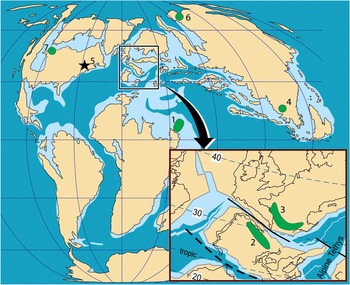
New Jersey amber (also called Raritan amber because of the formation where it is found) occurs throughout Cretaceous outcrops of the Atlantic Coastal Plain in the northeastern United States (Fig. 1), within clay, sand, and lignite strata (Grimaldi et al., Reference Grimaldi, Shedrinsky and Wampler2000). The amber-bearing levels lie within the South Amboy Fire Clay and Old Bridge Sand members of the Raritan Formation, which are Turonian in age (93–89 Ma; Christopher, Reference Christopher1979; Grimaldi and Nascimbene, Reference Grimaldi and Nascimbene2010). The specimen studied here was found in the Old Crossman’s Clay Pit in Sayreville (Middlesex County), which forms part of the South Amboy Fire Clay Member.
Main areas with amber deposits from the Cretaceous with abundant bioinclusions. (1) Lebanon (Barremian); (2) Spain (Albian); (3) France (Albian–Santonian); (4) Myanmar (Cenomanian); (5) New Jersey (Turonian); (6) Taimyr (Late Cretaceous, unknown); (7) Canada (Campanian). (5) New Jersey amber on the Atlantic Coastal Plain of the northeastern United States is marked with a star. The paleogeographic map corresponds to the middle Albian (105 Ma). Modified from Najarro et al. (Reference Najarro, Peñalver, Rosales, Pérez-de la Fuente, Daviero-Gomez, Gomez and Delclòs2009).

Amber from this member is abundantly associated with coarse lignite and is found 6–7 m deep, interbedded with thinner sand and coal (lignitic) layers. The excellent preservation of several fragile pieces of amber and the lack of erosion in this region together indicate that there has been no reworking. The deposits are thus preserved in situ as originally buried (Grimaldi and Nascimbene, Reference Grimaldi and Nascimbene2010). The environment where the material was buried under anoxic conditions is thought to have been an interdistributary system of shallow, brackish water channels in a tide-influenced delta, rich in organic matter sediments (Grimaldi et al., Reference Grimaldi, Shedrinsky and Wampler2000). Detailed information about the geology and geography of the New Jersey amber deposits can be found in works by Grimaldi et al. (Reference Grimaldi, Shedrinsky and Wampler2000) and Grimaldi and Nascimbene (Reference Grimaldi and Nascimbene2010).
The New Jersey amber forest was dominated by conifers. Wood remains, cone scales, and leafy shoots from the sediment associated with the amber clearly suggest a Pinaceae or Cupressaceae sensu lato (including Taxodiaceae) origin for the amber (Grimaldi et al., Reference Grimaldi, Shedrinsky and Wampler2000; Grimaldi and Nascimbene, Reference Grimaldi and Nascimbene2010).
Materials and methods
The original amber piece was cut and polished before being embedded in a transparent epoxy resin according to Nascimbene and Silverstein (Reference Nascimbene and Silverstein2000). Photographs were taken using a Canon 500D camera attached to a Nikon SMZ800 stereomicroscope. All illustrations were produced using CORELDRAW X7.
We performed a successful segmentation of the specimen using the PPC-SRμCT technique on the BM05 beamline of the European Synchrotron Radiation Facility (Grenoble, France), employing a propagation phase protocol as described by Tafforeau et al. (Reference Tafforeau2006). The scan consisted of 1,500 projections acquired through a 180º rotation and 0.9 seconds exposure time; the beam was set at 25 keV using a double multilayer monochromator, a propagation distance of 50 mm, and continuous scanning mode.
After acquisition, the data were reconstructed using a filtered back-projection algorithm implemented in PyHST software (ESRF, Grenoble). The residual ring artifacts were corrected on reconstructed slices with an in-house system. Data were then converted into 16 bits and cropped to fit the size of the specimens. This was later virtually extracted and dissected using a semimanual region-growing segmentation protocol in VGStudioMax 2.1 software (Volume Graphics, Heidelberg, Germany).
Systematic paleontology
Order Coleoptera Linnaeus, Reference Linnaeus1758
Suborder Polyphaga Emery, Reference Emery1886
Superfamily Bostrichoidea Latreille, Reference Latreille1802
Family Dermestidae Latreille, Reference Latreille1807
Remarks
We followed the family-group classification of Bouchard et al. (Reference Bouchard2011). The specific terminology for describing Coleoptera follows that of Lawrence et al. (Reference Lawrence, Hastings, Dallwitz, Paine and Zurcher1999, Reference Lawrence, Beutel, Leschen and Ślipiński2010).
Subfamily Attageninae Casey, Reference Casey1900
Tribe Attagenini Casey, Reference Casey1900
Genus Attagenus Latreille, Reference Latreille1802
Subgenus Aethriostoma (Motschulsky, Reference Motschulsky1868)
Type species
Attagenus (Aethriostoma) undulatus Motschulsky, Reference Motschulsky1868.
Other species in Attagenus (Aethriostoma)
A. irroratus Blackburn, Reference Blackburn1903, A. madecassus (Pic, Reference Pic1916), A. sparsutus (Reitter, Reference Reitter1881), A. stachi Mroczkowski, Reference Mroczkowski1958, and A. undulatus (Motschulsky, Reference Motschulsky1868).
Recent distribution
Reunion I.; Comoros Is.; Kenya; Madagascar; Mauritius I.; Seychelles Is.; Tanzania; Buru I.; Cambodia; China; India; Indonesia Is.; Laos; Malaysia; Mariana Is.; Myanmar; Nepal; Philippines I.; Sri Lanka I.; Tibet; Thailand; Vietnam; Papua New Guinea; Hawaiian Is.; and Chile.
Attagenus (Aethriostoma) turonianensis new species
Figures 2.1–2.6, 3.1–3.4, 4.1–4.3
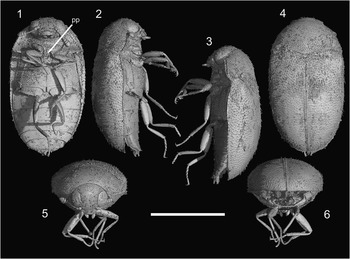
PPC–SRμCT reconstruction of Attagenus (Aethriostoma) turonianensis n. sp., holotype AMNH NJ–719. (1) Ventral view; (2) right lateral view; (3) left lateral view; (4) dorsal view; (5) anterior view; (6) posterior view. Scale bar=1 mm. pp=prosternal process.

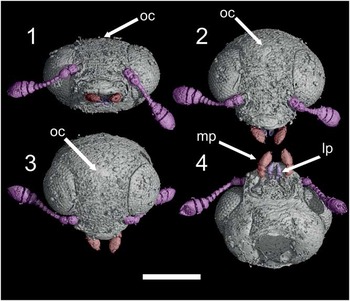
Head PPC–SRμCT reconstruction of Attagenus (Aethriostoma) turonianensis n. sp., holotype AMNH NJ–719. (1) Anterior view; (2) anterodorsal view; (3) dorsal view; (4) ventral view. Scale bar=0.25 mm. oc=ocellus; mp=maxillary palpi; lp=labial palpi.

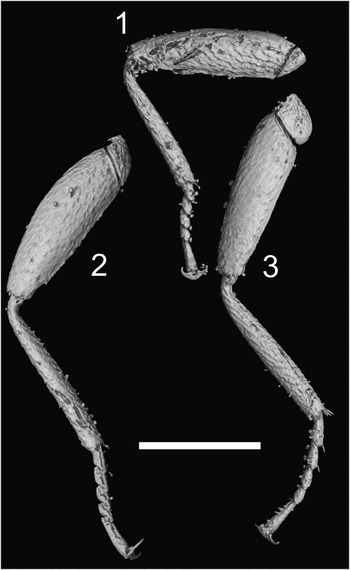
Legs PPC–SRμCT reconstruction of Attagenus (Aethriostoma) turonianensis n. sp., holotype AMNH NJ–719. (1) Proleg; (2) mesoleg; (3) metaleg. Scale bar=0.25 mm.

Diagnosis
Body small, less than 2 mm, elongated, oval; last antennomere with maximum width basally, narrowed toward rounded apex; terminal maxillary palpomeres broad; prosternal process broad; metaventrite nearly twice as long as wide.
Etymology
Specific epithet after the age of the amber where the specimen was found.
Holotype
AMNH NJ–719, male, complete, and well preserved. Housed in the American Museum of Natural History (New York, USA).
Occurrence
Old Crossman’s Clay Pit in Sayreville (Middlesex County, New Jersey, USA); South Amboy Fire Clay Member (Raritan Formation), Turonian in age.
Description
Body length 1.81 mm measured in dorsal view, but the head is declined and inserted in prothorax (Fig. 2.2); maximum body width 1.02 mm; ratio of body length to greatest body width 1.5. Body elongated, oval, moderately convex dorsally and ventrally (Fig. 2); dorsal surface with conspicuous, rather thick, and short recumbent hairs. Head, pronotum, and elytra with uniform, fine, dense punctures, smaller in diameter than eye facets; punctures on ventral side coarser than those on dorsal side, punctures wider than eye facets (Fig. 2).
Head markedly narrower than anterior prothoracic width (Fig. 2.1), triangular, hypognathous, with elongate rostrum; strongly declined, almost completely hidden from view from above. Eyes protuberant, entire, rounded, emarginated, coarsely faceted, and dorsally separated by about one eye diameter. One single ocellus located frontally, between the eyes (Fig. 3.2, 3.3). Antennal insertion exposed from above in antennal cavities; antennae 11-segmented, capitate, with 3-segmented, well-developed club, extending posteriorly to one-third of length of prosternum (Fig. 2.1). Scape cup-shaped, 1.3 times as long as wide (Fig. 3.1); pedicel basally as wide as scape, almost as long as wide, becoming narrower toward apex; antennomeres 3–10 wider apically; antennomeres 5–10 wider than long, becoming more transverse toward the apex of the antenna; antennomeres 9–11 forming a club; antennomeres 9 and 10 transverse; antennomere 9 almost as long as antennomeres 7 and 8 together; antennomere 10 slightly wider and shorter than antennomere 9; antennomere 11 as long as antennomeres 9 and 10 together, maximum width basally, as wide as antennomere 10, narrower toward the apex, rounded in the apex (Fig. 3). Maxillary palpi with four palpomeres; basal palpomere small; apical palpomere broad, subcylindrical, twice as long as wide, as long as the previous three palpomeres (Fig. 3.3). Labial palpi with three palpomeres.
Prothorax transverse, 2.1 times as long as wide, anterior margin of pronotum arcuate, posterior margin bisinuate, posterior angles of pronotum projecting posteriorly (Fig. 2). All margins on pronotum distinctly carinate. Base of prothorax as wide as combined elytral base. Prosternum not forming a ‘collar,’ therefore mouthparts free (Fig. 2.2, 2.3). Prosternal process broad, parallel-sided, apically rounded, overlapping mesoventrite.
Scutellum large, triangular, with acute apex (Fig. 2.4). Ratio of elytral length to greatest width 1.3; ratio of elytral length to pronotal length 2.8. Elytra entire, covering the whole abdomen posteriorly. Elytral disk not striate, margins carinate. Epipleura well developed, not reaching the apex of the elytra (Fig. 2.1).
Procoxae large, transverse, slightly projecting; distinctly separated by a distance similar to club width (Fig. 2.1). Mesocoxae transverse, slightly projecting; widely separated by a distance similar to club length (Fig. 2.1). Metaventrite slightly longer than prosternum and mesoventrite together; disk of metaventrite nearly twice as wide as long, metanepisternum exposed along the entire length, as wide as the length of antennomeres 10 and 11 combined, parallel-sided; posterior margin of metaventrite between coxae arcuate and deeply excised. Metacoxae oblique, almost reaching elytral margins, grooved posteriorly to receive the femora; distinctly separated by the same distance as procoxae (Fig. 2.1). Trochanters prominent, femora weakly flattened, wider medially; tibiae weakly flattened, wider apically; tibiae spinose in apical margin (Fig. 4). Tarsal formula 5–5–5, tarsi about 0.6–0.8 times tibial length. Tarsomeres 1–4 increasing in length from protarsi to metatarsi. Tarsomeres 5 always distinctly the longest, as long as the previous four combined in protarsi, 0.6 times the length of previous tarsomeres in mesotarsi and metatarsi (Fig. 4). Tarsal claws simple.
Five abdominal ventrites (Fig. 2). Abdomen with intercoxal process of ventrite 1 below the metaventrite posterior margin. Ventrite 1 the longest, 1.3 times the length of ventrite 2; ventrite 2 is 1.3 times the length of ventrite 3; ventrite 3 as long as ventrite 4; ventrite 5 as long as ventrite 2, rounded at apex.
Remarks
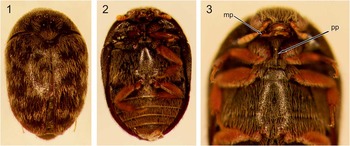
Attagenus (Aethriostoma) turonianensis n. sp. has the following features of the family Dermestidae, as given by Kirejtshuk and Azar (Reference Kirejshuk and Azar2009): (1) small head deflected and inserted into prothorax, (2) developed antennal club, (3) posterior angles of pronotum usually somewhat projecting posteriorly, (4) complete lateral carina of prothorax, (5) excavate metacoxae, and (6) tarsomeres simple. Within the family, the new species can be considered in Attageninae because (1) the prosternum does not form a ‘collar’ and (2) the mouthparts are free; it can be considered in Attagenini because (1) the antennal club has 3 compact antennomeres; (2) the elytra are not shortened; and (3) the abdomen has five visible ventrites. The subgenus Aethriostoma differs from the nominotypical subgenus Attagenus in that (1) the disc of metaventrite is nearly twice as wide as long; (2) the body is strongly convex; and (3) the body is broadly oval (in Attagenus s. str., the disc of metaventrite is nearly twice as long as wide, and the body is more narrowly obovate and less convex). This is the first fossil species belonging to the subgenus Aethriostoma; Attagenus (Aethriostoma) turonianensis n. sp. results almost externally indistinguishable from the Recent species A. (Aethriostoma) undulatus, but differs from this latter in the diagnostic characters; in A. undulatus (Fig. 5) the body is 3.0–3.5 mm; the last antennomere is flat and suboval (Fig. 5.2); the prosternal process is narrow and short; and the terminal maxillary palpomere is very narrow and long (Fig. 5.3).
Habitus views of extant Dermestidae species Attagenus (Aethriostoma) undulates. (1) Dorsal view; (2) ventral view; (3) details of ventral habitus. The specimen is 3.05 mm in length.

Discussion
In a phylogenetic analysis of larvae, Kiselyova and McHugh (Reference Kiselyova and McHugh2006) considered Dermestidae to be a monophyletic clade (excluding Orphilus Erichson, Reference Erichson1848), and they hypothesized that the family had a pre-Mesozoic origin. Because most genera have adult representatives that feed on angiosperm pollen and nectars, a conservative estimate for the origin of the family was the Late Cretaceous (Kiselyova and McHugh, Reference Kiselyova and McHugh2006), just after flowers had become widely distributed (Friis et al., Reference Friis, Crane and Pedersen2011).
The fossil record of the family is abundantly documented from the Cenozoic (Háva, Reference Háva2015). However, dermestids from the Mesozoic have only been found embedded in amber. Cretonodes Kirejtshuk and Azar, Reference Kirejshuk and Azar2009 is the oldest representative of the family, described from Barremian (Maksoud et al., Reference Maksoud, Granier, Azar, Gèze, Paicheler and Moreno-Bedmar2014) Lebanese amber (Fig. 1). In addition, four more specimens of the same origin are awaiting description. All five specimens are from the fossil tribe Cretonodini Kirejtshuk and Azar, Reference Kirejshuk and Azar2009 (Kirejtshuk and Azar, Reference Kirejtshuk and Azar2013). Nine adult specimens from Albian Spanish amber (Fig. 1) have been recorded (Peris et al., Reference Peris, Philips and Delcòs2016); in addition, Cockerell (Reference Cockerell1917a) described Dermestes larvalis Cockerell, Reference Cockerell1917a from a larva embedded in Cenomanian Myanmar amber (Fig. 1), and Grimaldi et al. (Reference Grimaldi, Engel and Nascimbene2002) and Grimaldi and Engel (Reference Grimaldi and Engel2005) have named two larvae from Myanmar amber. With the fossil described as Cretonodes, the origin of Dermestidae was confirmed as being at least from the Early Cretaceous (Kirejtshuk and Azar, Reference Kirejshuk and Azar2009). None of the remaining adult specimens from the Mesozoic have been described yet, making Attagenus (Aethriostoma) turonianensis n. sp. the oldest record of the subfamily Attageninae to date. The information presented here also confirms diversification of the family by the mid-Cretaceous.
Kiselyova and McHugh (Reference Kiselyova and McHugh2006) postulated a Laurasian origin for the family, using the distribution of Attagenini as one of their supporting arguments. Attagenini seems to follow an archaic pattern, mostly occupying the Northern Hemisphere, very scarcely distributed in Africa, and mostly absent from the Australian and Neotropical regions. Nevertheless, the Recent genus Attagenus is cosmopolitan, currently encompassing ~200 Recent and fossil species (Háva, Reference Háva2015), while the subgenus Aethriostoma has a very limited distribution in Oriental, Australian, and Afrotropical regions, being mainly found on islands. Kiselyova and McHugh (Reference Kiselyova and McHugh2006) attributed the puzzling distribution of Attagenus, as well as that of Egidyella Reitter, Reference Reitter1899, to the ancestral and wider distribution worldwide in the past, now restricted to more limited areas. Judging from the new species described here, the subgenus Aethriostoma was present in North America during the mid-Cretaceous, which demonstrates a wider distribution for this taxon in the past. Nevertheless, at the same time, the oldest representatives of the family were from Gondwanan Lebanese amber (Kirejtshuk and Azar, 2009, Reference Kirejtshuk and Azar2013), followed by representatives in Spanish amber, both from the Early Cretaceous. The Iberian Plate was an isolated landmass between Laurasia and Gondwana during most of the Cretaceous. Extinct dermestids described in a new tribe from Lebanese amber, together with similarity for Late Cretaceous fossils (from Laurasia) with Recent fauna, slightly alter the idea proposed by Kiselyova and McHugh (Reference Kiselyova and McHugh2006). The family indisputably had a Gondwanan distribution in the Early Cretaceous.
Fauna described in amber usually provide examples of taxa with a current limited paleobiogeographical distribution, mainly restricted to warm areas of the southern hemisphere. It is possible to cite several examples among Diptera, Coleoptera, and even Araneae with a different distribution in the past (Peris et al., Reference Peris, Kolibáč and Delclòs2014b). A growing number of Cenozoic dermestids are being discovered and described as Recent genera; but examples of bradytely (‘arrested evolution’ in Simpson, Reference Simpson1944) are becoming more abundant among Mesozoic beetles too. Slow rates of morphological change appear to have maintained fossils unaltered over millions of years.
Examples of bradytely in beetles described from Cretaceous ambers are known from Spain with the ptinid Actenobius magneoculus Peris, Philips, and Delclòs, 2015; from France with the staphylinids Stenus inexpectatus Schlüter, Reference Schlüter1978 and Clidicus cretaceous Kirejtshuk, Kurbatov, and Nel, 2015, the ripiphorid Macrosiagon ebboi Perrichot, Nel, and Néraudeau, Reference Perrichot, Nel and Néraudeau2004, and the bostrichid Stephanopachys vetus Peris, Delclòs, and Perrichot, 2014 in Peris et al., 2014; from Myanmar with the dermestid Dermestes larvalis, the elaterids Acmaeodera burmitina Cockerell, Reference Cockerell1917b and Elater burmitinus Cockerell, Reference Cockerell1917b, the staphylinids Octavius electrospinosus Clarke and Chatzimanolis, Reference Clarke and Chatzimanolis2009 and Protodasycerus aenigmaticus Yamamoto, Reference Yamamoto2016, the scolytine Microborus inertus Cognato and Grimaldi, Reference Cognato and Grimaldi2009, the carabid Oodes kachinensis Liu, 2015 in Liu et al., Reference Liu, Shi, Cai, Liang and Huang2015, and the hybosorid Hybosorus ocampoi Bai and Zhang, 2015 in Bai et al., Reference Bai, Zhang, Ren, Shi and Yang2015; and from New Jersey with the staphylinid Phloeocharis agerata Chatzimanolis, Newton, and Engel, 2013 in Chatzimanolis et al., Reference Chatzimanolis, Newton, Soriano and Engel2013, the ptinid Stegobium raritanensis Peris, Philips, and Delclòs, 2015 and the dermestid Attagenus (Aethriostoma) turonianensis n. sp. described here (Cockerell, Reference Cockerell1917a, Reference Cockerellb; Schlüter, Reference Schlüter1978; Bellamy, Reference Bellamy1995; Perrichot et al., Reference Perrichot, Nel and Néraudeau2004; Clarke and Chatzimanolis, Reference Clarke and Chatzimanolis2009; Cognato and Grimaldi, Reference Cognato and Grimaldi2009; Chatzimanolis et al., Reference Chatzimanolis, Newton, Soriano and Engel2013; Peris et al., Reference Peris, Delclòs, Soriano and Perrichot2014a, Reference Peris, Philips and Delcòs2015, Reference Peris, Ruzzier, Perrichot and Delclòs2016; Bai et al., Reference Bai, Zhang, Ren, Shi and Yang2015; Kirejtshuk et al., Reference Kirejtshuk, Kurvatov and Nel2015; Liu et al., Reference Liu, Shi, Cai, Liang and Huang2015; Yamamoto, Reference Yamamoto2016). Examples of more species described in 2016 may be found in Peris (2016).
An analysis of bradytely in all the previous examples reveals ecology as the common factor. While some of these groups are subcortical (Ptinidae, Bostrichidae, and Scolytinae), others live in mesic habitats (Staphylinidae, Hybosoridae, Elateridae, and Carabidae). Most Dermestidae species have necrophagous feeding habits. Their larvae mainly feed on the carcasses of vertebrate or invertebrate animals. As adults, they commonly feed on flowers, pollen, or nectar. However, a few species of dermestids, including the genus Attagenus, are known to feed on plant debris. Plant debris is abundantly found in amber deposits from New Jersey (Grimaldi et al., Reference Grimaldi, Shedrinsky and Wampler2000), which was possibly the substrate for Attagenus (Aethriostoma) turonianensis n. sp. The constraints of a subcortical habitat as well as the constant conditions of mesic environments over geological time could have favored bradytely. Nevertheless, what is common to all these cited cases is their small size, and this, together with their habitats, has protected them from extinction and strong selection.
Conclusions
To date, Attagenus (Aethriostoma) turonianensis n. sp. is the oldest known representative of the subfamily Attageninae. It is dated as Turonian (Late Cretaceous) in age. The oldest representatives of the family are only known from Lebanese and Spanish ambers. Those from Lebanon all belong to an extinct group that could be either an ancestral group from which the rest of the family derived or, alternatively, a derived and extinct group that did not survive to the present day. Those from Spanish amber have not yet been studied. Spanish amber is geographically located between Lebanese and New Jersey amber and is dated intermediately between these two sites. A study of the fossil fauna from Spain will yield more detailed conclusions about the origin and diversification of the family.
However, according to the new species described here, it is possible to conclude that this family of beetles dispersed and colonized the Earth’s surface from at least the Early Cretaceous, showing variability among known fossil specimens. Some of the variability described was preserved unchanged for almost 100 million years and may have been favored by their small size together with a mesic habitat.
Acknowledgments
We thank D.A. Grimaldi for lending the specimen studied here and P. Tafforeau for his support imaging the specimen on the BM05 beamline at the ESRF. C. Soriano assisted with synchrotron reconstructions. This research received support from the Collection Study Grant Program financed by the American Museum of Natural History. This work is part of the first author’s Ph.D. thesis supported by grants from the Spanish Ministry of Education, Culture and Sports. This study is a contribution to project AMBARES (CGL2011-23948) and AMBERIA (CGL2014-52163), funded by the Spanish Ministry of Economy and Competitiveness.