INTRODUCTION
The family Microcionidae Carter (Reference Carter1875) consists of nine genera, 12 subgenera and 484 described species (van Soest et al., Reference Van Soest, Boury–esnault, Hooper, Rützler, De Voogd, Alvarez, Hajdu, Pisera, Manconi, Schoenberg, Janussen, Tabachnick, Klautau, Picton, Kelly, Vacelet, Dohrmann, Diaz and Cárdenas2014). It is one of the most important, ecologically successful groups of Porifera, distributed worldwide (Hooper, Reference Hooper1996, Reference Hooper, Hooper and Van Soest2002). Clathria Schmidt, Reference Schmidt1862 is the richest genus within the family Microcionidae, with 355 described species (van Soest et al., Reference Van Soest, Boury–esnault, Hooper, Rützler, De Voogd, Alvarez, Hajdu, Pisera, Manconi, Schoenberg, Janussen, Tabachnick, Klautau, Picton, Kelly, Vacelet, Dohrmann, Diaz and Cárdenas2014). The definition of this genus is necessarily broad to encompass the seven subgenera included in it. Among them, Clathria (Microciona) Bowerbank, Reference Bowerbank1862 is characterized by the presence of encrusting growth form and hymedesmioid skeleton, with erect fibre nodes cored by plumose tracts of principal and echinating spicules standing erect on the substrate (Hooper, Reference Hooper, Hooper and Van Soest2002). Despite the subgenus being composed of 99 species, only nine of them occur in the Tropical Western Atlantic Ocean (van Soest et al., Reference Van Soest, Boury–esnault, Hooper, Rützler, De Voogd, Alvarez, Hajdu, Pisera, Manconi, Schoenberg, Janussen, Tabachnick, Klautau, Picton, Kelly, Vacelet, Dohrmann, Diaz and Cárdenas2014). Two of these nine species are known from Brazil: Clathria (Microciona) calla (de Laubenfels, Reference De Laubenfels1934) from Pernambuco State and São Pedro and São Paulo Archipelago, and Clathria (Microciona) campecheae Hooper, Reference Hooper1996 from Rio de Janeiro and São Paulo States (Muricy et al., Reference Muricy, Lopes, Hajdu, Carvalho, Moraes, Klautau, Menegola and Pinheiro2011). This paper describes a new species of Clathria (Microciona) from Sergipe State, north-eastern Brazil.
MATERIALS AND METHODS
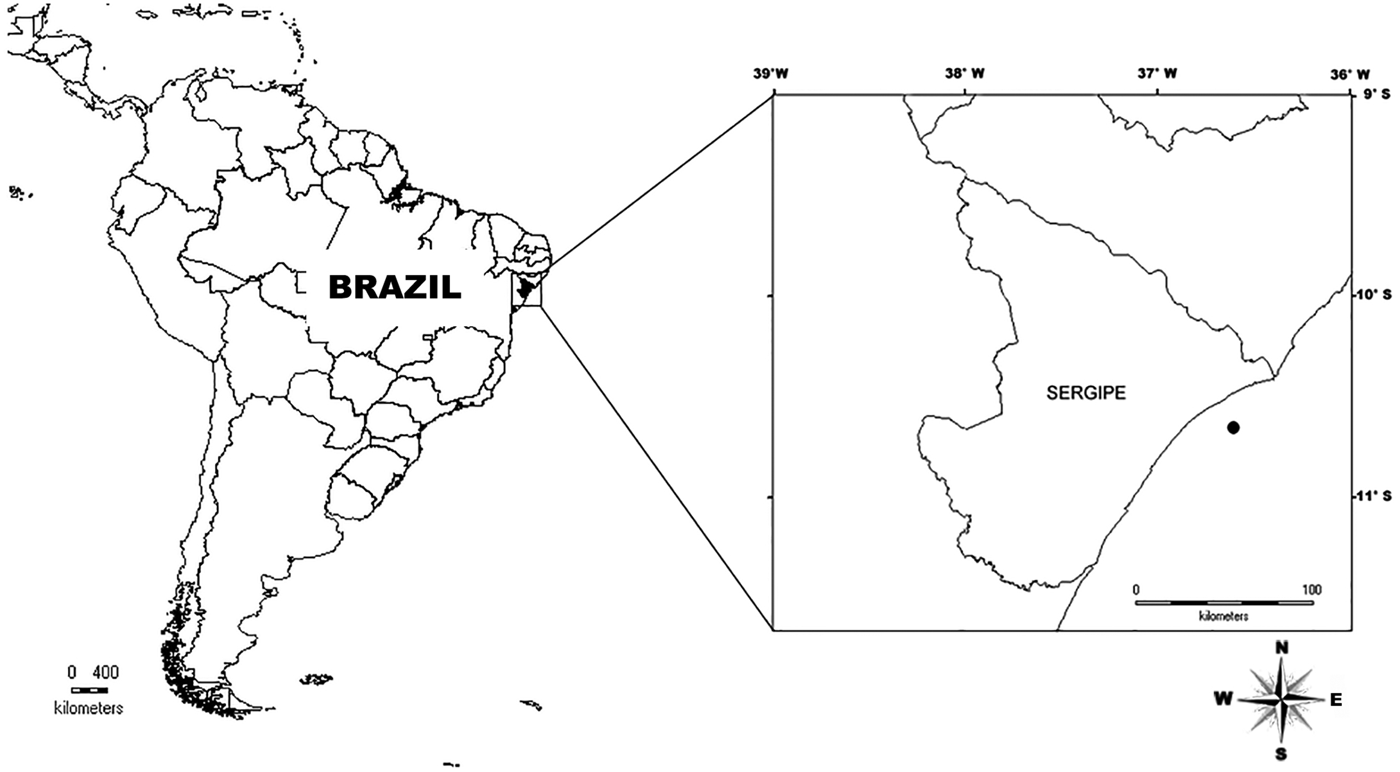
Samples were collected in 2003 at 20 m depth, on the continental shelf of Sergipe State, by trawling (Figure 1). In the laboratory, the specimens were fixed in 10% formaldehyde and thereafter preserved in 70% ethyl alcohol. Dissociated spicule mounts and skeletal sections were made using classical procedures for Demospongiae, observed through an optical microscope and scanning electron microscopy (SEM) (Hajdu et al., Reference Hajdu, Peixinho and Fernandez2011). Spicule measurements presented as minimum–mean–maximum, length/width and N = 30. The holotype of Clathria (Microciona) achelata sp. nov. is deposited in the Porifera collection of Museu Nacional, Universidade Federal do Rio de Janeiro (MNRJ) and the paratype is deposited in the Porifera collection of Universidade Federal de Sergipe (UFSPOR).
Collection site (black dot) of Clathria (Microciona) achelata sp. nov. off Pirambu city, Sergipe State, Brazil (10°45′36″S 36°36′08″W).

SYSTEMATICS
Order POECILOSCLERIDA Topsent, Reference Topsent1928
Suborder MICROCIONINA Hajdu et al., Reference Hajdu, Van Soest, Hooper, Van Soest, Van Kempen and Braekman1994
Family MICROCIONIDAE Carter, 1875
Genus Clathria Schmidt, Reference Schmidt1862
Subgenus Clathria (Microciona) Bowerbank, Reference Bowerbank1862
Definition:Clathria with persistently encrusting growth form, with hymedesmioid skeletal architecture consisting of a basal layer of spongin, typically with ascending, plumose, non–anastomosing spongin fibre nodes, and megascleres embedded and erect on basal layer (from Hooper, Reference Hooper, Hooper and Van Soest2002).
Clathria (Microciona) achelata sp. nov.
(Figures 2 & 3; Table 1)
Clathria (Microciona) achelata sp. nov. (A) Holotype (MNRJ17615); (B) Paratype (UFSPOR93); (C, D) Transverse section through skeleton (under the echinating spicules is the skeleton of Haliclona (Halichoclona) dura). Scale bars: A, 1600 μm; B, 750 μm; C, 120 μm; D, 82 μm.
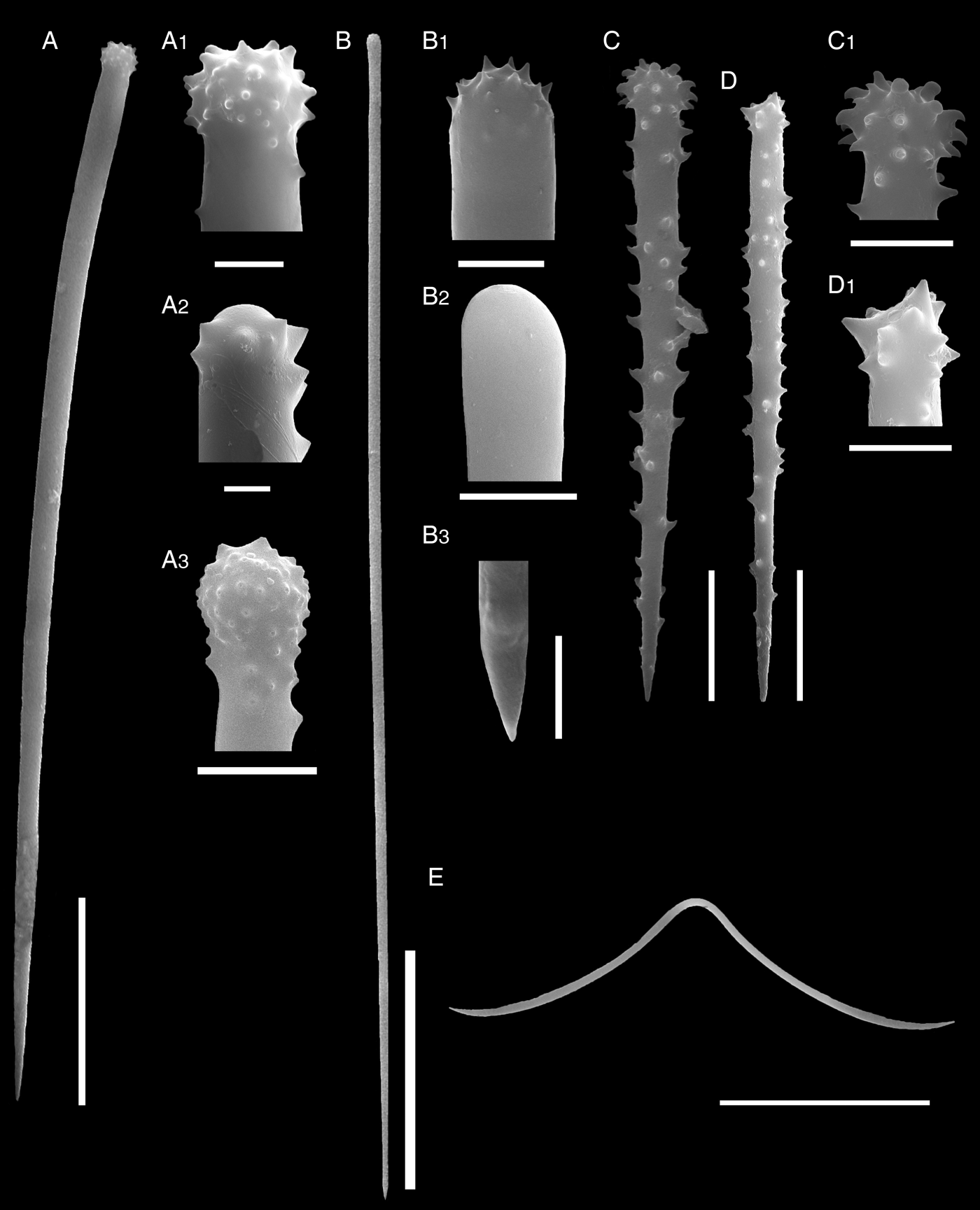
Clathria (Microciona) achelata sp. nov., SEM images of spicules, (A–A3) Choanosomal principal subtylostyle and details of heads; (B–B3) Subectosomal auxiliary subtylostyle and details of heads and points; (C–C1) Acanthostyle I and detail of heads; (D–D1) Acanthostyle II and detail of heads; (E) Wing-shaped toxa I. Scale bars: A, B, E, 50 μm; A1–A3, B1, B3, 5 μm; C, D, 15 μm; C1–D1, 5 μm; B2, 3 μm.
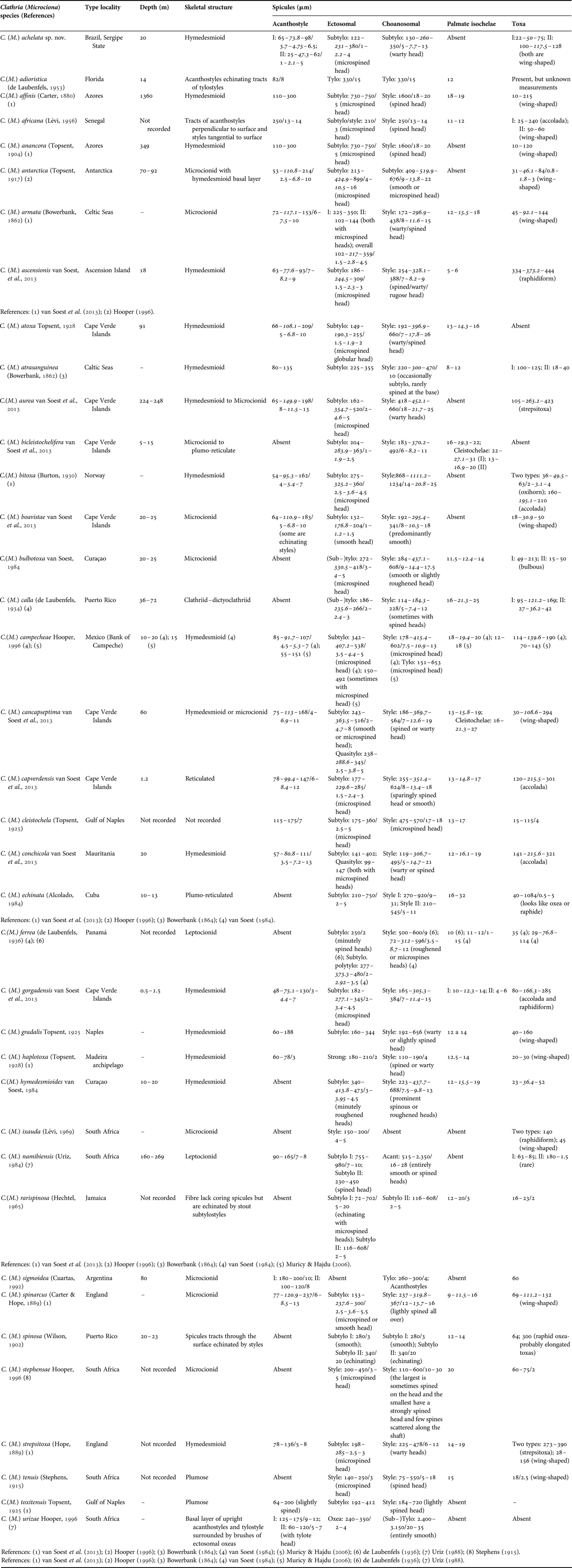
Comparative micrometric data of the spicules and skeletal organization of species of Clathria (Microciona) from the Atlantic Ocean. Values are in micrometres (μm), expressed as: minimum–maximum or minimum–mean–maximum; length or length/width. Data are from the original descriptions, or from references numbered in parentheses and listed below the table. Legends: Subtylo., Subtylostyle; Tylo, Tylostyle; Acant., Acanthostyle; Quasitylo, Quasitylote; Polytylo, Polytylote.
TYPE MATERIAL
Holotype. MNRJ17615, off Pirambu (10°45′36″S 36°36′08″W), Sergipe State, Brazil, 20 m depth, coll. Cosme Assis & Damião Assis (VI/2003).
Paratype. UFSPOR93 (same data as the holotype).
DIAGNOSIS
Clathria (Microciona) achelata sp. nov. is the only Clathria (Microciona) in the Tropical Western Atlantic with two categories of true acanthostyles, long subectosomal subtylostyles, long choanosomal subtylostyles and wing-shaped toxas as microscleres. Chelae absent.
DESCRIPTION
A very thin encrusting sponge, less than 1 mm thick. The surface is optically hispid, but smooth to the touch. Its colour in ethanol is light brown to dark purple (Figure 2A, B).
Skeleton
Hymedesmioid, with single principal choanosomal subtylostyles surrounded by larger echinating acanthostyles I and smaller acanthostyles II all standing erect on the substrate with their heads embedded in the basal spongin skeleton and their points protruding through the surface. At the surface, subectosomal auxiliary subtylostyles are scattered below the ectosomal region, tangentially arranged (Figure 2C, D).
Spicules
Choanosomal principal subtylostyles – long, slightly curved, thick, sharply pointed with slightly swollen tuberculated heads (some variations occur – see Figure 3A1–A3), 130–260–350/5–7.7–13 μm (Figures 3A & 4A); Subectosomal auxiliary subtylostyles – long, straight, thin, with slightly subtylote microspined or rarely smooth heads, 122–231–380/1–2.2–4 μm (Figures 3B & 4B) Acanthostyles I – straight, heavily spined all over, with hook-like spines on the centre of the shaft and lobed/spined projections on the head, 65–73.8–98/3.7–4.75–6.5 μm (Figures 3C & 4C); Acanthostyles II – straight, heavily spined all over, smaller and thinner than acanthostyles I, 25–47.3–62/1–2.1–5 μm (Figures 3D & 4D); Toxas are rare, wing-shaped, with deeply arched centre and reflexed points, possibly divisible in a larger (100–117.5–128 μm) (Figures 3E & 4E) or smaller (22–50–75 μm) category (Figure 4F). Chelae absent.
Clathria (Microciona) achelata sp. nov., light microscope images of the spicules, (A) Choanosomal principal subtylostyle; (B) Subectosomal auxiliary subtylostyle; (C) Acanthostyle I; (D) Acanthostyle II; (E) Wing-shaped toxa I; (F) Wing-shaped toxa II. Scale bars: A–F, 21 μm.
ECOLOGY
The specimens were collected at 20 m depth. The paratype was observed encrusting another sponge, Haliclona (Halichoclona) dura Sandes et al., 2014 (see Figure 2C) and the holotype was agglutinating coralline algae.
GEOGRAPHIC DISTRIBUTION
Tropical South-western Atlantic, north-eastern Brazil, Sergipe State.
ETYMOLOGY
The name refers to the absence of chelae in this species.
REMARKS
The new species is assigned to Clathria (Microciona) because of its encrusting growth form and hymedesmioid skeleton, consisting of single choanosomal principal subtylostyles erect on the basal layer of spongin surrounded by two categories of erect echinating acanthostyles, with subectosomal auxiliary subtylostyles tangentially arranged at the surface, and with only toxas as microscleres. Some species of Clathria (Thalysias) de Duchassaing & Michelotti, Reference De Duchassaing and Michelotti1864 also have encrusting growth form and hymedesmioid skeleton, but in this subgenus there are two categories of ectosomal spicules with the smaller category of auxiliary styles or subtylostyles erected as bouquets of spicules surrounding larger protruding choanosomal spicules or forming a continuous palisade. Even the size of the subectosomal subtylostyles of the new species is within the range of the smaller category of some species of the subgenus Thalysias (see Galindo et al., Reference Galindo, Hooper and Pinheiro2014, p. 584–586, table 1), Clathria (Microciona) achelata sp. nov. has only one category of ectosomal spicules tangentially arranged below the ectosome, suggesting allocation to Microciona is the best fit for the new species.
Clathria (Microciona) sigmoidea (Cuartas, Reference Cuartas1992) and Clathria (Microciona) urizae Hooper, Reference Hooper1996 are the only species of this subgenus from the Atlantic Ocean that have two categories of acanthostyles, as observed in C. (M.) achelata sp. nov. However, Clathria (M.) sigmoidea differs from the new species in having smooth tylostyles, smaller toxas, allegedly lacking ectosomal spicules and possessing sigmas, but both latter require verification from re-examination of type material, and Clathria (M.) urizae differs from the new species in having larger acanthostyles, ectosomal oxeas, smooth choanosomal (sub-)tylostyles and lacking of toxas (Table 1).
Clathria (Microciona) achelata sp. nov. is the only species of Clathria (Microciona) from the Tropical Western Atlantic Ocean that does not have chelae. Only eight species of Clathria (Microciona) from the Atlantic Ocean lack chelae. Three of these species have hymedesmioid skeleton: Clathria (Microciona) anancora (Topsent, Reference Topsent1904); Clathria (Microciona) aurea van Soest et al., Reference Van Soest, Beglinger and De Voogd2013 and Clathria (Microciona) bitoxa (Burton, Reference Burton1930). All these differ from C. (M.) achelata sp. nov. in having only one category of acanthostyle. In addition, C. (M.) anancora has ectosomal subtylostyles and choanosomal styles larger than the new species, C. (M.) aurea has strepsitoxas (accolada toxas with twisted median curvature) and C. (M.) bitoxa has toxas in two distinct morphologies (oxihorn and accolada types) (Table 1). All these characteristics differentiate these three species from C. (M.) achelata sp. nov.
In the Brazilian Coast, Clathria (M.) achelata sp. nov. differs from Clathria (Microciona) campecheae Hooper, Reference Hooper1996 and Clathria (Microciona) calla de Laubenfels, Reference De Laubenfels1934 due to the presence of two categories of acanthostyles and absence of chelae. Besides that, C. (M.) campecheae has ectosomal and choanosomal spicules larger than new species, while C. (M.) calla does not have acanthostyle and its choanosomal and ectosomal spicules are smooth (Table 1).
The absence of chelae and the presence of two categories of acanthostyles are characteristic features delimiting the new species from other species of Clathria (Microciona) in the Atlantic.
ACKNOWLEDGEMENTS
We are grateful to the Petrobras and Laboratório de Bentos Costeiro of the Universidade Federal de Sergipe (UFS), especially to Dr Carmen Regina Parisotto Guimarães for the loan of the material. The authors are also grateful to Dr Janaína Melo, Fábia Melo, Diego Oliveira and MSc. George Garcia Santos for SEM operation at Centro de Tecnologias Estratégicas do Nordeste (CETENE). Two anonymous reviewers are also thanked for valuable suggestions that helped us to improve this manuscript.
FINANCIAL SUPPORT
Thanks to the Fundação de Amparo a Ciência e Tecnologia do Estado de Pernambuco (FACEPE) and the Conselho Nacional de Desenvolvimento Científico e Tecnológico (CNPq) for financial support.