Introduction
Fully mature seeds of oilseed rape (Brassica napus) usually have low primary dormancy (Momoh et al., Reference Momoh, Zhou and Kristiansson2002; Gruber et al., Reference Gruber, Pekrun and Claupein2004; Gulden et al., Reference Gulden, Thomas and Shirtliffe2004a). According to Huang et al. (Reference Huang, Gruber, Stockmann and Claupein2016a), the primary dormancy in developing B. napus seeds rapidly decreases from initial levels of 70−99% at 30−40 days after flowering to 0−15% within the next 14 days. However, the level of dormancy that is being changed over time and averages to 30–50% of the initial dormancy is commonly found in mature seeds and is dependent on the variety. Non-dormant mature seeds of B. napus can become secondarily dormant by environmental conditions such as darkness in combination with the osmotic stress and hypoxia after harvest (Pekrun et al., Reference Pekrun, Hewitt and Lutman1998; Gulden et al., Reference Gulden, Shirtliffe and Thomas2003, 2004a,b). The potential for oilseed rape seeds to become dormant is dependent on variety, and was found in several B. napus gene pools such as China, Western Europe and Canada (Momoh et al., Reference Momoh, Zhou and Kristiansson2002; Gulden et al., Reference Gulden, Thomas and Shirtliffe2004b, Gruber et al. Reference Gruber, Emrich and Claupein2009). Weber et al. (Reference Weber, Frick, Gruber and Claupein2010) investigated the potential of secondary dormancy in 44 B. napus varieties and they classified these varieties into high (>40%), medium (20–40%), and low (<20%) secondary dormancy levels, similar to the work of Gruber and Claupein (Reference Gruber and Claupein2008).
Dormant seeds can remain in the soil seed bank for several years and become a weed problem if they germinate and develop into volunteers in other crops. Volunteer B. napus can emerge in different crops over long periods – from the last month of the summer to spring in semi-arid (Soltani et al., Reference Soltani, Soltani, Galeshi, Ghaderi-Far and Zeinali2013) and temperate climates (Gruber and Claupein, Reference Gruber and Claupein2008). There are herbicides available that effectively control volunteer B. napus in cereals such as wheat. The control of herbicide-tolerant volunteers (both conventionally bred or transgenic) in any other crop might be more difficult. Major problems may arise when the volunteer B. napus emerges in a B. napus crop. These plants can cause very high crop densities and thus create agronomic problems. They can be a source of gene dispersal in space by pollen and can spoil the quality of the sown B. napus by the introduction of unwanted seed admixture (Jørgensen et al., Reference Jørgensen, Hauser and Jørgensen2007; Schwabe et al., Reference Schwabe, Gruber and Claupein2016).
The prediction of weed seedling emergence depends on a knowledge of the dynamics of dormancy changes (Batlla and Benech-Arnold, Reference Batlla and Benech-Arnold2004). Temperature and water potential are the two major environmental factors that regulate germination and dormancy in seeds (Bradford, Reference Bradford2002). The hydrotime (HT) model describes the effect of water potential on seed germination and dormancy (Gummerson, Reference Gummerson1986; Bradford, Reference Bradford1990, Reference Bradford2002; Alvarado and Bradford, Reference Alvarado and Bradford2005). This model has three parameters: (1) the hydrotime constant, θH (MPa-hours or MPa-days), (2) the base water potential, ψb(g) (MPa), and (3) the standard deviation of the ψb(g) (σψb). Thermal time and hydrotime have been successfully combined into a hydrothermal time model (HTT; Gummerson, Reference Gummerson1986; Bradford, Reference Bradford1990, Reference Bradford2002). The HTT model has been successful in describing the germination time courses across water potentials (ψ) and temperatures (T) in the sub-optimal range (i.e. between the minimum and the optimum temperatures; Bradford, Reference Bradford2002; Alvarado and Bradford, Reference Alvarado and Bradford2005). The HT and the HTT parameters are meaningful from a biological perspective and these models have wide applications that assist in analysing the effects of dormancy or environmental conditions on seed germination (Dutta and Bradford, Reference Dutta and Bradford1994; Bauer et al., Reference Bauer, Meyer and Allen1998; Meyer et al., Reference Meyer, Debaene-Gill and Allen2000; Bair et al., Reference Bair, Meyer and Allen2006; Gianinetti and Cohn, Reference Gianinetti and Cohn2007; Meyer and Allen, Reference Meyer and Allen2009; Soltani et al., Reference Soltani, Baskin, Baskin, Soltani, Galeshi, Ghaderi-far and Zeinali2016).
Physiological dormancy (PD) is the most common type of dormancy in plant species; in physiological dormancy, non-deep is the most common level of PD (Baskin and Baskin, Reference Baskin and Baskin2014). Non-deep PD has existed in many seeds of plant species that can be broken by cold (imbibed seeds at 0 to 10°C) or warm (imbibed seeds at ≥15°C) stratification (Baskin and Baskin, Reference Baskin and Baskin2006, 2014). Dormancy of the B. napus seeds can be broken by alternating temperatures and light (12 h, 3°C, darkness/12 h, 30°C, light) across seven days (Weber et al., Reference Weber, Frick, Gruber and Claupein2010). Brassica napus seeds do not usually experience this condition when they are deeply buried in the soil seed bank. It has been reported that some B. napus seeds can persist in the soil for over ten years (Lutman et al., Reference Lutman, Freeman and Pekrun2003). Therefore, it seems that the conditions of deep burial (darkness in combination with water stress and hypoxia) are responsible for the persistence of B. napus seeds in the soil seed bank. Induced dormant seeds of B. napus showed a dormancy/non-dormancy cycle (Schlink, Reference Schlink1994) and they had a high level of germinability (tested at the dark/light conditions after being dug out from the soil) from midsummer to spring in semi-arid conditions (Soltani et al., Reference Soltani, Soltani, Galeshi, Ghaderi-Far and Zeinali2013). Colbach et al. (Reference Colbach, Dürr, Gruber and Pekrun2008) also showed that during the evaluation of their model, there was a cycle of dormancy in buried B. napus seeds and the fraction of non-dormant seeds was at its highest level in December. This evidence showed that the decreasing dormancy of B. napus seeds may occur in the soil seed bank even under the condition of darkness. However, the extent to which dormancy can be overcome at different temperature regimes (in darkness) in B. napus seeds has not yet been studied. The potential for secondary dormancy induction can be important for a dormancy/non-dormancy cycle. Based on the explained details, we hypothesized that (1) the potential of secondary dormancy induction is different in B. napus genotypes; (2) light has a key role in releasing B. napus seed dormancy, but the seeds may come out of dormancy in conditions of darkness as well; (3) warm stratification at temperature regimes of ≥15°C (an average) may control dormancy loss in B. napus seeds; and (4) the process of secondary dormancy loss could be described using the hydrothermal time model.
Materials and methods
The potential of secondary dormancy induction – experiment 1
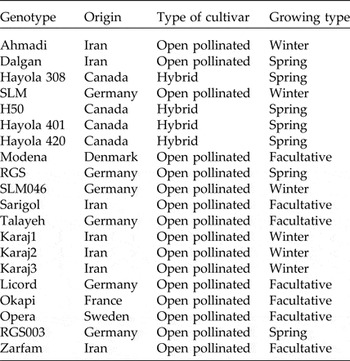
Seeds of 20 winter and spring genotypes were provided by the Seed and Plant Improvement Institute, Karaj, Iran (see Table 1). The seeds were produced in the growing season of 2014–2015 in Karaj (35°50′ N, 51°00′ E, 1312 m above sea-level, 14.2°C mean annual temperature, and 251 mm mean annual precipitation). The seeds were tested for germination after harvest at 20°C under the condition of darkness. Four replicates of 50 mature seeds (without dormancy induction) were incubated in darkness at the mentioned temperature and the final germination percentage was determined after two weeks. After this, the harvested seeds were kept in the laboratory at 20 ± 5°C, 40 ± 10% relative humidity, in the dark until the beginning of each experiment.
Oilseed rape genotypes and their characteristics used for experiments with dormancy induction, produced in Karaj in the growing season 2014–2015

The seeds were tested for secondary dormancy according to the Hohenheim standard dormancy test (HSDT; Weber et al., Reference Weber, Frick, Gruber and Claupein2010; Huang et al., Reference Huang, Gruber, Stockmann and Claupein2016a). This method consists of three sequential processes, as follows:
-
(1) Secondary dormancy induction: four replicates of 100 seeds for each genotype were imbibed in 6 ml of a polyethylene glycol 6000 solution (354.4 g l−1, −1.5 MPa; Michel and Kaufmann, Reference Michel and Kaufmann1973) in 9-cm plastic Petri dishes with double layers of filter paper. The seeds were kept in darkness and at 20°C in an incubator for 14 days. The Petri dishes were placed in metal boxes to exclude any light and to provide a dark condition.
-
(2) Identification of non-dormant seeds: after dormancy induction, the seeds were transferred to new Petri dishes equipped with double layers of filter paper and 6 ml deionized water in darkness at 20°C (14 days). After 14 days, the seeds were checked for germination as non-dormant seeds could germinate, but the seeds that were induced into secondary dormancy could not. All handling of the seeds (e.g. for the counting and removal of the germinated seeds) was conducted under a green safety light (500–600 nm).
-
(3) Identification of secondary dormant seeds: the remaining seeds were exposed to alternating light and temperature (12 h, 3°C, darkness/12 h, 30°C, light) for 7 days. The germinated seeds were considered as induced into secondary dormancy. There were very few or no intact seeds at all. The identification experiment for the potential of secondary dormancy (HSDT) was repeated twice, and the data were pooled together.
Analyses of variance for germination percentage (GP) and secondary dormancy (SD) were performed according to completely randomized designs using the PROC GLM procedure of the statistical software SAS (SAS Institute Inc., Cary, NC, USA, 2011). The data were log10 transformed before the analysis to ensure homogeneity of variance was initiated.
Stratification and germination temperature regimes – experiment 2
Genotypes were classified into high (>40 %), medium (20–40%), and low (<20%) secondary dormancy levels, and two spring genotypes were chosen (based on the results from the experiment. These were: RGS003, which possesses a high potential for dormancy induction (hereafter HSD), and Hayola 308, which possesses a medium potential to induce secondary dormancy (hereafter MSD). Among high secondary dormancy level genotypes, RGS003 (spring type) with a disposition of about 42% secondary dormancy has been chosen because of the low primary dormancy level, and therefore, the other selected genotype Hayola 308 was also a spring type with a disposition of about 20% secondary dormancy. The experiment was conducted in four steps:
-
(1) Secondary dormancy induction: secondary dormancy was induced as in experiment 1 according to Weber et al. (Reference Weber, Frick, Gruber and Claupein2010). 18,000 seeds (in three replicates of 3000 seeds for each genotype) were imbibed in PEG solution adjusted to −1.5 MPa (Michel and Kaufmann, Reference Michel and Kaufmann1973) and were kept in darkness and at 20°C for 14 days.
-
(2) Temperature regimes to overcome dormancy (cold or warm stratification): after secondary dormancy induction, the seeds were extracted and subjected to fixed or alternating (12 h/12 h) temperature regimes (30, 5, 15–30, 15–25, 5–15 and 5–30°C; total 36 = 3 × 2 × 6 Petri dishes). This step was performed in darkness and was provided in the same manner as the previous experiment. To moist stratify, the seeds were placed on a medium of solidified agar–water (1% w/v) in 15-cm Petri dishes (Steadman et al., Reference Steadman, Bignell and Michael2004). The Petri dishes were kept at fixed or alternating temperature regimes for a single week. After moist stratification in different temperature regimes, the germinated seeds were counted under a green safety light and removed.
-
(3) Post-stratification germination tests: after stratification, the remaining seeds for each stratification and genotype were tested for germination in deionized water and different temperatures of 10, 15, 20, 25 and 30°C, and darkness in three replicates (total 180 = 6 × 2 × 5 × 3 Petri dishes). After 14 days, the germinated seeds were counted.
-
(4) Viability test: after the germination test, the remaining seeds were tested for viability by the crush test and most of them were viable (Borza et al., Reference Borza, Westerman and Liebman2007; Taab and Andersson, Reference Taab and Andersson2009; Soltani et al., Reference Soltani, Baskin, Baskin, Soltani, Galeshi, Ghaderi-far and Zeinali2016).
Modelling of dormancy loss – experiment 3
The seeds of the HSD and the MSD genotypes were used in this experiment. This experiment was conducted in two parts. These parts are described below:
-
(1) Germination modelling of non-dormant seeds: in this part of the experiment, the seeds were tested for germination after harvest without any inducing dormancy treatment. The germination was tested at five water potentials (0, −0.15, −0.3, −0.5 and −0.8 MPa) at 20°C. Four replicates of 50 mature seeds (without dormancy induction) were incubated in darkness at the aforementioned temperature and water potentials. The water potentials were maintained with solutions of polyethylene glycol 6000 (Michel and Kaufmann, Reference Michel and Kaufmann1973). Before seed placement, the filter paper was soaked in Petri dishes containing osmotic solutions for the desired water potential for 24 h. The seeds were monitored for germination daily (for 2 weeks) and they were considered to be germinated when the radicle was ≥2 mm long.
-
(2) Modelling of secondary dormancy loss: this part of the experiment was conducted in three steps. These were:
-
(i) Secondary dormancy induction: secondary dormancy was induced as the first process in experiment 1 according to Weber et al. (Reference Weber, Frick, Gruber and Claupein2010) with 30,000 seeds (three replicates with 5000 seeds for each genotype).
-
(ii) Warm stratification (5–30°C) periods: after dormancy induction, the seeds were extracted and exposed to a stratification temperature of 5–30°C for different periods of 0, 1, 3 and 5 days in darkness. For warm stratification, the seeds were placed on a medium of solidified agar–water (1% w/v) in 15-cm Petri dishes (Steadman et al., Reference Steadman, Bignell and Michael2004) at the mentioned temperature.
-
(iii) Germination test: after the warm stratification, germinated seeds were removed and the intact seeds were tested for germination at five water potentials (0, −0.15, −0.3, −0.5 and −0.8 MPa) and four temperatures (5, 10, 15 and 20°C). The water potentials were maintained with solutions of polyethylene glycol 6000 for each temperature and the water potential, separately (Michel and Kaufmann, Reference Michel and Kaufmann1973). There were 480 Petri dishes (4 × 5 × 4 × 2 × 3) in total, out of which 50 seeds were tested for germination.
-
The hydrotime model (HT; Gummerson, Reference Gummerson1986; Bradford, Reference Bradford1990; Dahal and Bradford, Reference Dahal and Bradford1990) was used to describe the seed germination (before any dormancy induction or warm stratification treatments) response to water potential for each genotype and germination temperature. The hydrotime constant (θH, MPa-hours) was calculated as follows:
 $${\rm \theta} _{\rm H} = {\rm} \left( {\Psi {\rm} - {\rm} \Psi _{\rm b}\left( {\rm g} \right)} \right)t_{\rm g},$$
where ψ is the actual seed water potential (MPa), ψb(g) is the base water potential (MPa) defined for a specific germination fraction (g), and t g is the time (hours) to radicle protrusion of fraction g (%) of the seed population. Assuming that the variation in ψb within each genotype follows a normal distribution, the hydrotime parameters were estimated by repeated probit analysis of the following equation (2), varying θH until the best fit is reached for each genotype (Dahal and Bradford, Reference Dahal and Bradford1990):
 $${\rm probit}{\rm} \left( {\rm g} \right){\rm} = {\rm} \left[ {\Psi {\rm} - {\rm} \left( {\rm {\theta} _{\rm H}/{\rm t}_{\rm g}} \right){\rm} - {\rm} \Psi _{\rm b}\left( {50} \right)} \right]/{\rm \sigma} _{\Psi {\rm b}},$$
where ψb(50) is the median, and ψb and σψb are the standard deviations in ψb among the seeds within the genotypes. All three hydrotime parameters were estimated by this method for each genotype separately.
A hydrothermal time (HTT) model was used to describe germination in the course of time when both water potential and the temperature were varied (Gummerson, Reference Gummerson1986; Dahal and Bradford, Reference Dahal and Bradford1994):
 $${\rm \theta} _{{\rm HT}} = {\rm} (\Psi - \Psi _{\rm b}( {\rm g} ))\left( {T- T_{\rm b}} \right)t_{\rm g},$$
where θHT is the hydrothermal time constant (MPa-degree-hours), T is the temperature and T b is the base temperature for germination. Using a base temperature of 3.79°C (Soltani et al., Reference Soltani, Soltani, Galeshi, Ghaderi-Far and Zeinali2013), the parameters θHT, Ψb(50) and σΨb were estimated by a probit procedure according to the following equation (Dahal and Bradford, Reference Dahal and Bradford1994):
 $${\rm probit}{\rm} \left( {\rm g} \right){\rm} = {\rm} \left\{ {\left[ {\Psi {\rm} - {\rm \theta} _{{\rm HT}}/\left( {T- T_{\rm b}} \right)t_{\rm g}} \right]{\rm} - {\rm} \Psi _{\rm b}\left( {50} \right)} \right\}/{\rm \sigma} _{\Psi {\rm b}}.$$
All three hydrothermal time parameters were estimated by repeated probit for each treatment separately as described by Dahal and Bradford (Reference Dahal and Bradford1994).
Seedling emergence in the field condition – experiment 4
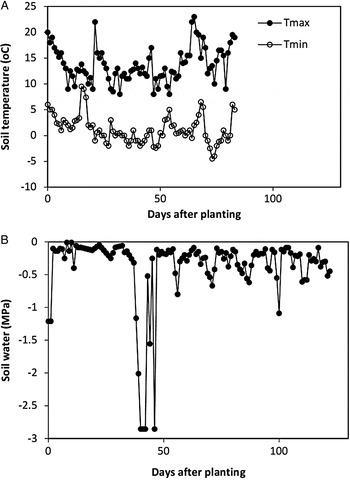
This experiment was carried out at the research farm of the Abourahian Campus, University of Tehran, Pakdasht, Tehran, Iran (35°28′ N, 51°40′ E, 1003 m above sea-level). The soil was a clay loam (37.1% sand, 26.2% silt, and 36.7% clay, 0.75 organic matter, pH 7.7). The seeds of the HSD and the MSD genotypes were used in this experiment as mentioned in the second experiment. Dormancy induction of seeds was performed as explained in the previous experiments. The seeds of induced and not-induced dormancy of the two genotypes were sown in four replicates on 17 November 2015. The experiment consisted of 16 micro-plots (0.3 × 0.5 m) that were unearthed at random; 100 seeds per microplot were sown by hand at a depth of 3–5 cm. Seedling emergence was recorded daily for 122 days and removed after each counting. The maximum and minimum soil temperatures were recorded daily during the experiment using a min/max thermometer buried at a soil depth of 5 cm (Fig. 1A). Soil moisture content (g g–1) was measured by daily soil sampling and converted to soil water potential (MPa) based on the soil moisture release curve (Saxton et al., Reference Saxton, Rawls, Romberger and Papendick1986) (Fig. 1B). The estimates of the time taken for cumulative emergence to reach 50% of seedling emergence (t 50) for each replicate were interpolated from the emergence time courses as described by Soltani et al. (Reference Soltani, Ghaderi-Far, Baskin and Baskin2015).
Minimum (T min) and maximum (T max) soil temperature (A) and soil water dynamics (B) 122 days after planting in a field experiment in Tehran, Iran, in 2015. T max and T min were available until 83 days after planting date.

Results
The potential of secondary dormancy induction
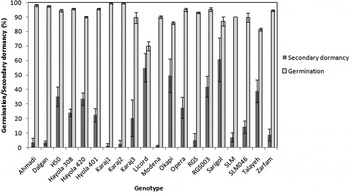
There was variation among the different genotypes of B. napus in germination percentage (GP) and secondary dormancy (SD) induction, and the genotypes were significantly different in GP and SD (Fig. 2). The potential of dormancy induction (as a result of HSDT) was lower than 20% in nine genotypes (low secondary dormancy), between 20 and 40% in seven genotypes (medium secondary dormancy), and higher than 40% in four genotypes (high secondary dormancy). The highest potential of dormancy was observed in the genotypes of Sarigol (60.7%), Licord (55.0%), Okapi (49.7%) and RGS003 (42.0%) (Fig. 2). The initial germination percentages were from 70 to 99.5% in the seeds before any treatment (Fig. 2). The seeds were not tested for primary dormancy using tetrazolium, but, as a result of HSDT, most of the seeds were viable. Therefore, less than 100% initial germination percentage is mostly a consequence of primary dormancy. The highest levels of primary dormancy were observed in Licord, Talayeh, Okapi and Sarigol.
The potential for secondary dormancy according to the Hohenheim standard dormancy test (HSDT; Weber et al., Reference Weber, Frick, Gruber and Claupein2010) and germination (%) after harvest before any treatment in 20 oilseed rape genotypes cultivated in Iran. Most seeds were viable as results of the HSDT, less than 100% of germination after the harvest can show primary dormancy. The effect of genotype was significant for F values of 17.94 for germination percentage and 23.47 for the potential of secondary dormancy induction. Error bars are ± 1SE.

Stratification and germination temperature regimes
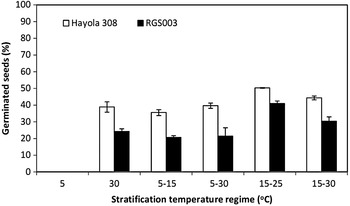
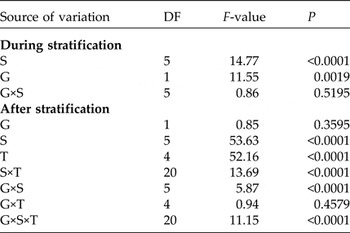
The analysis of variance showed significant effects of stratification (cold or warm) temperature regimes and genotype on germination during stratification (Table 2). After stratification, the effects of stratification temperature regimes (S) and incubation temperatures (T) on germination were observed to be significant, but the genotypes (G) were not different (Table 2). The interaction effect of G × S × T significantly changed post-stratification germination (Table 2). During stratification, some seeds germinated with different percentages depending on the stratification temperature regimes and the secondary dormancy potential (Fig. 3). No germination occurred during stratification at 5°C for both genotypes. Maximum germination occurred between 15 and 25°C for both genotypes, with germination rates of 50.3 and 40.9% for MSD and HSD, respectively (Fig. 3). The proportion of germinating seeds during the period of moist stratification was significantly higher in the MSD in comparison with those in the HSD at all temperature regimes (except for 5°C).
Germination (%) during stratification of imbibed seeds of oilseed rape at different fixed and alternating temperatures (in darkness) for two oilseed rape genotypes with different potentials for secondary dormancy (Hayola 308, medium secondary dormancy; RGS003, high secondary dormancy), after artificial dormancy induction according to Weber et al. (Reference Weber, Frick, Gruber and Claupein2010). Table 2 shows the analysis of variation during stratification. Error bars are ± 1SE.

Analysis of variance for germination of oilseed rape during stratification and after stratification, as affected by genotype (G), stratification temperature regime (S), germination temperature (T) and their interactions

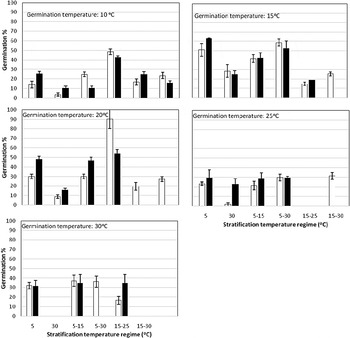
Stratified seeds at 5°C were germinated to a greater extent at 15°C than at the other germination temperatures (Fig. 4). The germination of stratified seeds at 30°C was low at all incubation temperatures; the maximum germination percentage was observed at 15°C (28.3 and 25% for MSD and HSD, respectively), while the minimum germination (percentage) occurred at 30°C (zero for both genotypes). Stratification at alternating temperatures of 5 to 30°C relieved secondary dormancy more than the other alternating temperatures, especially at incubation temperatures of 15 and 20°C (Fig. 4).
Post-stratification germination tests at different incubation temperatures for two oilseed rape genotypes with medium secondary dormancy (MSD, Hayola 308: white) and high secondary dormancy (HSD, RGS003: black). Germination did not occur in some temperature regimes. Error bars are ± 1SE.

Modelling of dormancy loss
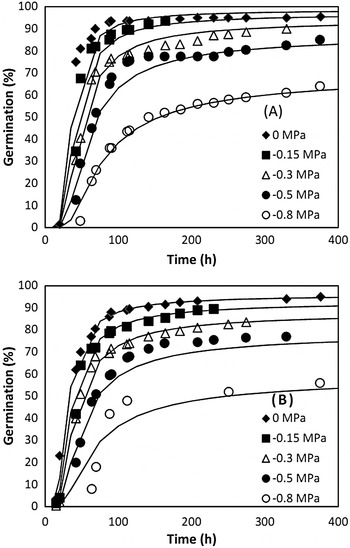
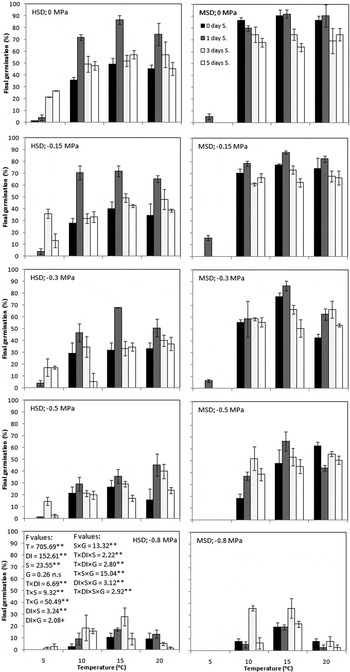
For the not-induced secondary dormant seeds (without any treatment), the hydrotime model accurately described seed germination time courses across ψ for each cultivar (Fig. 5). The ψb(50) values were −1.05 and −1.06 MPa for the MSD and the HSD genotypes before secondary dormancy inducing (Fig. 5), and they increased to −0.59 and −0.01 after secondary dormancy inducing in not-stratified seeds at a germination temperature of 20°C (data not shown). The analysis of variance showed significant effects of the incubation temperature (T), dormancy induction (DI), stratification period (S) and genotype (G), and their interaction with the final germination percentage, except for the effect of G (Fig. 6). After dormancy induction, the germination percentage was very low at 5°C and the seeds did not germinate without warm stratification in both genotypes (Fig. 6). The maximum germination percentages were observed at day 1 warm stratification in both genotypes, and they were about 91 and 87% for the MSD (20°C and 0 MPa) and the HSD (15°C and 0 MPa), respectively (Fig. 6). The germination percentage decreased with a reducing water potential and at the reduced water potential, the effect of warm stratification on the germination percentage was higher than 0 MPa for MSD (Fig. 6).
Germination time courses for seeds of two oilseed rape genotypes with medium secondary dormancy (A: Hayola 308) and high secondary dormancy (B: RGS003) before any treatment (without secondary dormancy induction or loss) at five water potentials at 20°C. Symbols indicate observations, and lines the prediction of the germination time courses by the hydrotime model: θH, Ψb(50), σΨb and R 2 were 38.86 (MPa-hours), –1.049 (MPa), 0.475 MPa, and 0.95 in Hayola 308, and 44.72 (MPa-hours), –1.063 (MPa), 0.637 MPa and 0.89 in RGS003.

Final germination percentage for induced secondary dormancy in HSD (RGS003) and MSD (Hayola 308) at different stratification periods, incubation temperature and water potentials. F-values of incubation temperature (T), dormancy induction (DI), stratification period (S) and genotype (G) and their interaction are indicated. The + and ** indicate significance at P < 0.1 and P < 0.01, respectively, and ‘n.s.’ denotes a non-significant effect. Error bars are ± 1SE.

The hydrothermal time model (HTT) generally fitted the observed germination data well at each warm stratification period and genotype (Table 3). The warm stratification decreased ψb(50) especially for the HSD and a one-day warm stratification had the lowest ψb(50) in the HSD in comparison with other stratification durations (Table 3). The lowest ψb(50) was observed in three days warm stratification for the MSD and in all stratification durations; the MSD seeds had lower ψb(50) than HSD seeds. No pattern was observed in hydrothermal time (θHT) values with the changing stratification periods of MSD, but the θHT value was quite low in one-day stratification compared with the other stratification periods for the HSD (Table 3). In total, the value of θHT was higher in the induced dormant seeds compared with the stratified seeds for the HSD. Warm stratification of the MSD seeds also decreased the θHT values except in three-day stratification.
Parameter estimates of the hydrothermal time model, describing seed germination of two oilseed rape genotypes with medium secondary dormancy (MSD, Hayola 308) and high secondary dormancy (HSD, RGS003) during different durations of warm stratification at ranges of temperatures (5, 10, 15 and 20°C) and water potentials (0, –0.15, –0.3, –0.5 and –0.8 MPa)

θHT, hydrothermal time constant; Ψb(50), median base water potential; σΨb, standard deviation for base water potential; R 2, coefficient of determination.
Seedling emergence in the field condition
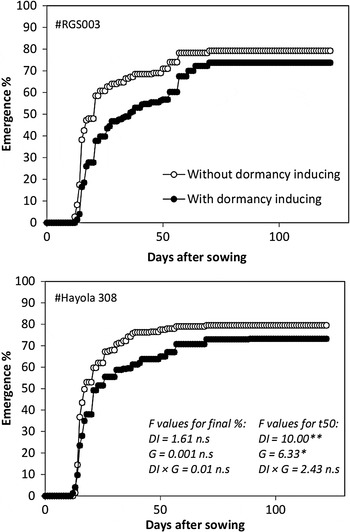
The analysis of variance showed significant effects of secondary dormancy induction (DI) and genotype (G) on time up to 50% of the emergence (t 50); however, they were insignificant for the final emergence percentage (Fig. 7). The interaction effect of the G×DI had not significantly changed t 50 and the final emergence percentage (Fig. 7). The emergence of seeds with induced secondary dormancy was started later and it finished after the seeds without dormancy induction. The t 50 values were significantly different in the induced and the not-induced seeds, and this resulted in 17.1 and 20.2 days for the MSD and the HSD without dormancy induction (Fig. 7), and 22.3 and 35.6 days for the MSD and the HSD with preceding dormancy induction. Both genotypes exhibited similar final emergence percentages, with a slightly higher overall emergence without dormancy induction (79.5 and 79.3% for MSD and HSD, respectively) than with preceding dormancy induction (73.3 and 73.8 % for MSD and HSD, respectively; Fig. 7).
Cumulative seedling emergence for seeds of two oilseed rape genotypes with medium secondary dormancy (MSD, Hayola 308) and high secondary dormancy (HSD, RGS003) without secondary dormancy (white) and with secondary dormancy (black). Effect of secondary dormancy induction (DI), genotype (G) and their interaction (DI × G) are indicated for final emergence (%) and time to 50% of emergence (t 50; day). The * and ** indicate significance at P < 0.05 and P < 0.01, respectively, and ‘n.s.’ denotes non-significant effects.

Discussion
We observed a wide variation of secondary dormancy from nearly zero to 60% in the 20 genotypes that are currently cultivated in Iran. This confirmed our hypothesis that the potential of secondary dormancy induction is different in the B. napus genotypes. This variation has been previously observed for European, Canadian and Chinese oilseed rape (Momoh et al., Reference Momoh, Zhou and Kristiansson2002; Gruber et al., Reference Gruber, Pekrun and Claupein2004, 2009; Gulden et al., Reference Gulden, Thomas and Shirtliffe2004a; Weber et al., Reference Weber, Frick, Gruber and Claupein2010). Knowledge about the variation of secondary dormancy in B. napus genotypes can help breeders focus on genotypes with low secondary dormancy potential and assist farmers in reducing the problems encountered from volunteers. Storage periods, seed size and maturity have an effect on secondary dormancy within a genotype (Momoh et al., Reference Momoh, Zhou and Kristiansson2002; Gruber et al., Reference Gruber, Pekrun and Claupein2004; Gulden et al., Reference Gulden, Thomas and Shirtliffe2004a; Huang et al., Reference Huang, Gruber, Stockmann and Claupein2016a).
The MSD genotype (Hayola 308) germinated with a higher percentage than the HSD genotype (RGS003) during stratification, which can be a consequence of the differences in the disposition of secondary dormancy between both of the genotypes. The seeds of the MSD genotypes seem to show not only a generally lower number of seeds which become dormant in the standard dormancy inductive conditions, but also their dormancy state may be different in comparison with the HSD genotypes. This difference could probably be much more clearly shown if very contrasting genotypes could be compared, for example, a genotype with a potential dormancy level of <10% and another genotype with a potential dormancy level of >80%. The differences in the germination of HSD seeds, and to a lesser extent, the germination of MSD seeds, seem to be linked to temperature regimes during stratification. If these seeds were exposed to low incubation temperatures, the preceding stratification temperature had little effect, but if the seeds were exposed to high incubation temperatures, they germinated only if the preceding stratification was in low to medium temperatures. Consequently, after a period of warm environmental conditions (but which did not break dormancy), the dormant oilseed rape seeds would germinate in the subsequent low to medium temperatures. If temperatures stay high, and other germination conditions such as water are provided, the dormancy would not be broken. Transferred to agricultural practice, it would mean that germination of the seed bank of B. napus could take place successfully in autumn (when temperatures change from warm to cool) and in spring (when temperatures change from cool to warm), but less so during the summer months when the temperature is high for a long time.
Secondary dormancy was induced in non-dormant seeds in darkness in combination with the water stress condition. It has been previously reported that water stress induced secondary dormancy in B. napus (Momoh et al., Reference Momoh, Zhou and Kristiansson2002), Arabidopsis thaliana (Auge et al., Reference Auge, Blair, Burghardt, Coughlan, Edwards, Leverett and Donohue2015), Sinapis arvensis (Soltani et al., Reference Soltani, Baskin, Baskin, Soltani, Galeshi, Ghaderi-far and Zeinali2016), and Bromus tectorum (Hawkins et al., Reference Hawkins, Allen and Meyer2017). In the current study, the germination of induced dormant seeds differed, depending on the stratification temperature regimes, incubation temperatures and water potential. Warm stratification had a greater impact on the germination percentage of the HSD in comparison with MSD at 0 MPa. However, the germination percentages were higher in warm stratification in comparison with no stratification at lower water potentials in both genotypes (Fig. 6). After warm stratification, the range of incubation temperatures and water potentials was wider. It has been indicated that during dormancy, the loss of a range of environmental conditions permissive for seed germination gradually widens until it is maximal, and reversely, as dormancy is induced, the range of temperatures under which germination occurs, narrows, until germination cannot take place at any temperature and the seeds are fully dormant (Vegis, Reference Vegis1964; Batlla and Benech-Arnold, Reference Batlla and Benech-Arnold2015). It seems that warm stratification could not fully release secondary dormancy, and longer periods of warm stratification (in the dark) also would not be effective in fully overcoming dormancy. Warm stratification (in the dark) can only reduce the intensity of dormancy; B. napus seeds with high potential of dormancy induction can fully overcome dormancy at alternating temperatures and the presence of light as hypothesized previously. Therefore, it seems that secondary dormancy is imposed by conditions of deep burial (darkness in combination with water stress and more constant temperatures); burial depth might be more important to seed persistence than secondary dormancy induction and release. When B. napus seeds are located in the upper soil layers that are exposed to required water, light and alternating temperatures, they can overcome dormancy in a few days.
The secondary dormant seeds of B. napus become less dormant during warm stratification in darkness (Fig. 4). In no stratification, the lowest water potential for germination [ψb(50)] was observed at 15°C (showing lowest dormancy). This means that when HSD seeds have a high level of dormancy, they can germinate with high percentage at 15°C (not low or high temperatures). After warm stratification, the seeds of both HSD and MSD were germinated (low percentage) at 5°C, but there was no germination for the not-stratified seeds. One-day stratification also increased germination at 20°C for the HSD seeds. Therefore, after warm stratification (dormancy releasing), the minimum and the maximum temperatures at which the seeds can germinate, respectively, decreased and increased. Previously, the cardinal temperatures for the germination of B. napus were determined and the base temperature for Hayola 308 was 5°C for germination percentage (Farzaneh et al., Reference Farzaneh, Soltani, Zeinali and Ghaderi-far2014). There is no report for RGS003, but it has been indicated that the base temperature for the germination percentage of oilseed rape cultivars ranged between 1 and 5°C (Farzaneh et al., Reference Farzaneh, Soltani, Zeinali and Ghaderi-far2014).
Hydrothermal (HTT) time models can explain dormancy states within a seed population. Dormancy loss is usually associated with more negative values of ψb(50) and lower values of θHT. The reduction of ψb(50) during seed dormancy loss in B. napus in this study (Table 3) is consistent with the results of previous studies on Lactuca sativa (Dutta and Bradford, Reference Dutta and Bradford1994), Bromus tectorum (Bauer et al., Reference Bauer, Meyer and Allen1998; Meyer and Allen, Reference Meyer and Allen2009; Bair et al., Reference Bair, Meyer and Allen2006), Elymus elymoides (Meyer et al., Reference Meyer, Debaene-Gill and Allen2000), Solanum tuberosum L. (Alvarado and Bradford, Reference Alvarado and Bradford2005), and Oryza sativa (Gianinetti and Cohn, Reference Gianinetti and Cohn2007). The values of ψb(50) were more negative for the MSD than the HSD after dormancy induction at different temperatures, and linked with a high level of secondary dormancy in the HSD. The ψb(50) values were more negative for non-dormant seeds (without dormancy induction) than those seeds with dormancy induction. After warm stratification, ψb(50) values moved to more negative values than those seeds which possessed induced dormancy and were not stratified. However, the ψb(50) values were also more negative for the non-dormant seeds in comparison with those seeds with secondary dormancy that were stratified. It seems that the dormancy was not fully released after warm stratification in the dark. In the laboratory, alternating temperatures and light (12 h, 3°C, darkness/12 h, 30°C, light) can break secondary dormancy in B. napus without fail (Weber et al., Reference Weber, Frick, Gruber and Claupein2010). The current study indicated that the alternating temperatures of 5–30, 5–15 and 15–25°C (in darkness) can also reduce secondary dormancy, but not as 3−3°C (dark/light) does. These temperatures (5–15 and 15–25°C) occur from midsummer to spring in the north of Iran, Europe and many other areas of the world. Previously, it has been claimed that B. napus seeds in the soil seed bank had the highest level of germinability (lower dormancy) from midsummer to spring in Iran (Soltani et al., Reference Soltani, Soltani, Galeshi, Ghaderi-Far and Zeinali2013).
Secondary dormancy delayed the seedling emergence of both the MSD and the HSD in the field, but the final emergence percentages were almost the same (Fig. 7). The seeds were also exposed to light for minutes during the sowing time and this can reduce the light requirement for germination. It had been reported that the B. napus variety with the high dormancy would lead to a long-term volunteer emergence in comparison with the low dormancy variety, but the annual seedling emergence was lower in the high dormancy variety (Huang et al., Reference Huang, Gruber and Claupein2016b). It is well known that seed dormancy can increase time to germination by increasing the time needed to break dormancy prior to germination (Roberts and Smith, Reference Roberts, Smith and Khan1977; Benech-Arnold et al., Reference Benech-Arnold, Ghersa, Sanchez and Insausti1990; Vleeshouwers, Reference Vleeshouwers1998; Chen et al., Reference Chen, Baskin, Baskin and Chien2013). The current study showed that the time to 50% of seedling emergence was 5.3 and 15.4 days longer in the MSD and the HSD seeds, respectively, after induction of secondary dormancy (Fig. 8). Therefore, the secondary dormancy can be released in the upper soil layers of the field in a few days. Short periods (less than one week) of alternating temperatures in the field obviously alleviated secondary dormancy. After planting, the maximum and the minimum temperatures were about 20 and 5°C, and both of these temperatures were decreased until spring (Fig. 1A). As indicated here, one week of moist stratification at these temperatures can release dormancy in B. napus (Fig. 4).
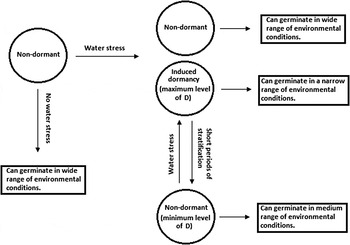
Postulated scheme for dormancy cycling in oilseed rape seeds. Water potentials lower than –1.5 MPa are considered as water stress. D denotes dormancy. Dormancy release can be performed in short periods of stratification (less than one week) at alternating temperatures. Seeds become non-dormant only at the alternating temperature (warm stratification) conditions in light.

This study provides information which may explain the dormancy cycling of oilseed rape seeds. Water stress can induce dormancy (if the seeds have the genetic potential for secondary dormancy) and alternating temperatures can reduce dormancy in B. napus seeds. Changes in the status of dormancy can occur several times a year if the seeds experience dry periods – there would not be any changes if the seeds experience no water stress. Therefore, it is possible to observe cycles between dormancy and non-dormancy in B. napus seeds with the potential of secondary dormancy, but this is not a constant condition. If the seeds never experience water stress, they would not fall dormant, and there would not be any cycle. Secondary dormancy and the dormancy cycle are less important to seed persistence than the dormancy imposed by the conditions of deep burial in the soil seed bank. However, the dormancy cycle as a result of water stress and temperature regimes, may enable seeds to sense the time of the year and light to indicate where they are located. If buried deeply, no light can access the seeds, and the temperature is more even. This is a signal for the seed that indicates that it is buried too deeply for emergence. These conditions will ensure the survival of the germinated seeds.
The main conclusions are presented schematically in Fig. 8. Some of the B. napus seeds remain non-dormant after water stress and these seeds can germinate across a wide range of environmental conditions. Secondary dormancy induces the other seeds after water stress and they can enter the cycle of dormancy ↔ non-dormancy. The range of germination temperatures for those seeds that lost their dormancy during the cycle is not as wide as those seeds that never entered the cycle. Dormant seeds of B. napus cannot become non-dormant again under the condition of darkness, but usually the level of dormancy can change from a maximum level (after water stress) to minimum level (after warm stratification). Alternating temperatures can reduce dormancy in oilseed rape seeds, but dormant seeds require alternating temperatures and light to become fully non-dormant.
The usage of seeds with low potential of secondary dormancy is the best strategy to reduce the risk of developing a soil seed bank of volunteer B. napus. However, from agro-ecological points of view, the following strategies are useful:
-
(1) As water stress can induce secondary dormancy, soil tillage should be avoided immediately after harvest, and keeping the moisture in the soil can promote seedling emergence of shattered seeds and the seedlings can then be destroyed by subsequent cultivations.
-
(2) As alternating temperature can release secondary dormancy in less than a week, a feasible strategy to control an already existing soil seed bank of oilseed rape is to wait for temperatures of 5–30, 5–15 and 15–25°C in between midsummer and spring, keeping the soil moisture at field capacity. This condition leads to seedling emergence of existing seeds in the upper layers of the soil; these seedlings should be removed without soil tillage. Finally, the results from this study are for spring varieties of B. napus, and the winter varieties might respond differently.