Introduction
It is easier to understand otolithic function if we utilise the basic rules of biophysics. The otoliths weigh approximately three times as much as the surrounding milieu. Physics dictates that because of this difference, rapid deceleration (with or without an actual head blow) could result in damage to the macula, because of the differential inertia during the deceleration. As a result of post-deceleration injury, patients often present with subtle complaints (such as ‘walking on pillows’ or ‘feeling a little drunk’). Many of these complaints have been delineated in the literature.Reference Mallinson and Longridge1–Reference Mallinson, Longridge and Peacock4
At the time of the publication of earlier papers (in the pre vestibular-evoked myogenic potential era), otolithic pathology could not be documented, but it was suggested that ‘in patients with these complaints, the inner ear was the likely cause of the disorder’ (page 813).Reference Mallinson and Longridge1 Many of the patients in our present study said they feel a little unsteady all the time: ‘like I have two drinks in me’, ‘like I'm on a boat’ or ‘like I'm walking on pillows’. These are recognised otolithic complaints.Reference Basta, Todt, Scherer, Clarke and Ernst3 These patients also often have abnormal vestibular-evoked myogenic potential results, which again supports their complaints as being of otolithic origin. In a study carried out in 2011, almost all patients who described a tilting or translation of their environment (without any other vestibular symptoms) had abnormal vestibular-evoked myogenic potentials.Reference Lee, Park, Lee, Park, Lee and Sung5 That paper suggested that such complaints indicated saccular and/or utricular dysfunction, to the point where ‘otolithic vertigo’ should be regarded as a clinical entity.
History taking in the otolithic patient is crucial. Patients with otolithic disease often have subtle complaints that are difficult to describe. Patients are often reluctant to verbalise subtle complaints, as they are sometimes not outwardly noticeable. A patient's inability to verbalise could be misinterpreted as being due to the after-effects of a mild traumatic brain injury. This is often thought of as a generalised effect of trauma, rather than due to specific pathology.Reference Lee, Park, Lee, Park, Lee and Sung5 As discussed in detail by Hoffer et al.,Reference Hoffer, Schubert and Balaban6 mild traumatic brain injury patients can also suffer vestibular damage.
Often, clinicians (and patients) do not consider imbalance or unsteadiness as a specific symptom suggesting structural pathology, but rather as a generalised consequence of trauma.Reference Ernst, Basta, Seidl, Todt, Scherer and Clarke7 It is helpful to document pathology in these patients, to confirm that they are suffering from legitimate disease; this is of critical importance, especially in the trauma population.
Balance deficits and postural instability are commonly reported post-concussion.Reference Kleffelgaard, Roe, Soberg and Bergland8 In one study, 43 per cent of post-concussion patients reported balance problems.Reference Lovell, Collins and Bradley9 Balance issues have been reported to last for years post-concussion. Consequently, it has been stated that the assessment and treatment of the vestibular system and postural stability are an important component of the physiotherapy plan after a concussion.Reference Kleffelgaard, Roe, Soberg and Bergland8 We strongly agree with this statement, as it is also crucial to address any vestibular deficit in the concussion patient.
More understanding is being developed about ‘concussion’ injuries. It has been stated that after concussion, ‘…vestibular rehabilitation has been used as a method of treatment in patients with persistent dizziness and balance deficits that have not resolved with rest’ (page 87).Reference Alsalaheen, Mucha, Morris, Whitney, Furman and Camiolo-Reddy10 While rest is an important element of standard therapy during recovery from mild traumatic brain injury, a concern is that rest is strongly contraindicated in the patient with vestibular pathology. It has been shown that the recovery process can be blocked when submitting baboons to sensorimotor restriction after vestibular injury.Reference Lacour, Roll and Appaix11 The same has also been shown in cats restricted for more than 5 days after labyrinthectomy.Reference Xerri and Lacour12 A similar scenario has been suggested in humans, to the point where it is emphasised that there is a critical early window of internal processes for reorganisation and of rehabilitation interventions.Reference Lacour and Bernard-Demanze13
The present study was designed to address the symptom set described by patients after a deceleration injury, a set of complaints which suggested to us that perhaps these patients had suffered peripheral vestibular (specifically otolithic) pathology, as opposed to ‘traumatic brain injury’. In our companion paper, we outlined the importance of utilising sound stimuli for cervical and ocular vestibular-evoked myogenic potentials.Reference Mallinson and Longridge14 Sound-induced vestibular-evoked myogenic potential testing is a sensitive, accurate and reliable measurement technique that aids in delineating unilateral and bilateral vestibular pathology.
Materials and methods
This study compared measured vestibular abnormalities in two cohorts of patients, one suffering traumatic vestibular injury and the other suffering spontaneous pathology. Both groups had complaints of chronic peripheral vestibular pathology (of more than one year in duration) without significant remission of their symptoms.
Our patients were all referred by specialists, who sent them for vestibular assessment at our tertiary and quaternary care neuro-otology unit. All traumatic and non-traumatic patients seen over an 18-month period who had ongoing persistent symptoms of vestibular incapacity, including dizziness, vertigo, nausea and imbalance, were included in the study.
All patients underwent a full vestibular test battery including full video-oculography with caloric testing, computerised dynamic posturography, and cervical and ocular vestibular-evoked myogenic potential testing. Vestibular-evoked myogenic potential assessment was carried out in the manner described in the companion paper.Reference Mallinson and Longridge14 Patients who were not capable of providing a detailed history or completing testing, because of an acute illness or physical limitations (e.g. visual impairment, orthopaedic limitations), were excluded.
All patients underwent hearing testing to rule out a conductive hearing deficit. Vanspauwen et al. showed that an air–bone gap at 500 Hz of more than 10 dB can affect cervical vestibular-evoked myogenic potentials.Reference Vanspauwen, Wuyts and Van de Heyning15 This was considered when analysing ocular vestibular-evoked myogenic potentials; these patients were still assessed in the manner described, but the results are interpreted with caution.
We analysed 44 patients referred for assessment of persistent post-traumatic complaints of vestibular origin (an acceleration/deceleration trauma group). We compared these patients to 30 patients referred with persistent non-traumatic vestibular complaints. Similarities and differences in these two groups of patients were compared.
Our study was approved by the Clinical Research Ethics Board of the University of British Columbia and Vancouver General Hospital (approval number: H15-00494). This study was granted expedited approval and did not require informed consent, as it was classified as a retrospective chart review.
Results
There was an approximately equal distribution of male and female trauma patients (most of this group had been involved in automobile crashes). There were more females than males in the non-traumatic group.
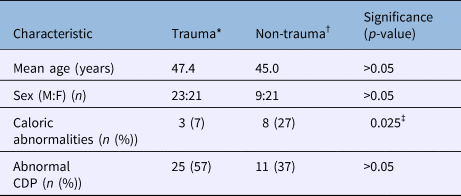
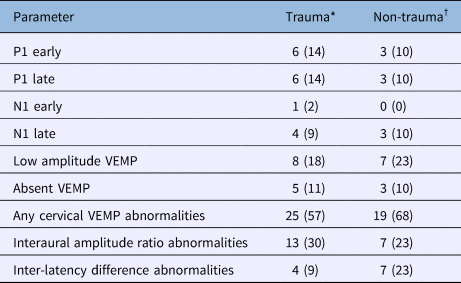
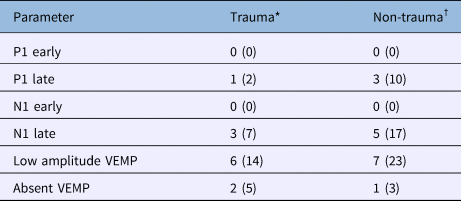
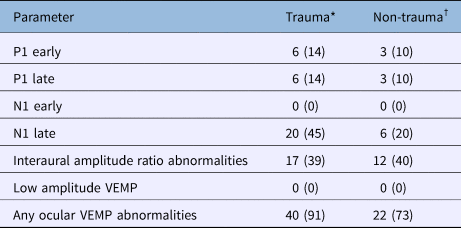
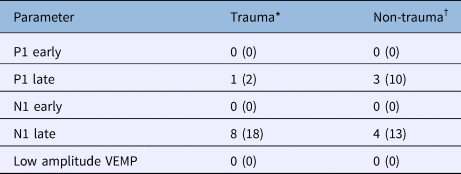
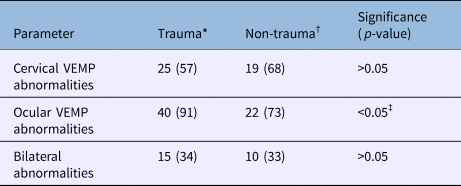
There was a significant difference in the rate of caloric abnormalities, with 27 per cent of the non-trauma group having abnormal calorics. In the trauma group, this figure was only 7 per cent (Table 1). Tables 2 and 3 respectively detail unilateral and bilateral cervical vestibular-evoked myogenic potential abnormalities in the two groups. Tables 4 and 5 respectively detail unilateral and bilateral ocular vestibular-evoked myogenic potential abnormalities. All measured vestibular-evoked myogenic potential parameters showed no difference in results between the two groups. Table 6 details the rates of abnormalities in the trauma and non-trauma groups.
Summary of study results

*n = 44; †n = 30. ‡Statistically significant result. M = males; F = females; CDP = computerised dynamic posturography
Unilateral cervical vestibular-evoked myogenic potential abnormalities

Data represent numbers (and percentages). *n = 44; †n = 30. VEMP = vestibular-evoked myogenic potential
Bilateral cervical vestibular-evoked myogenic potential abnormalities

Data represent numbers (and percentages). *n = 44; †n = 30. VEMP = vestibular-evoked myogenic potential
Unilateral ocular vestibular-evoked myogenic potential abnormalities

Data represent numbers (and percentages). *n = 44; †n = 30. VEMP = vestibular-evoked myogenic potential
Bilateral ocular vestibular-evoked myogenic potential abnormalities

Data represent numbers (and percentages). *n = 44; †n = 30. VEMP = vestibular-evoked myogenic potential
Abnormality rates in both groups

Data represent numbers (and percentages). *n = 44; †n = 30. ‡Statistically significant result. VEMP = vestibular-evoked myogenic potential
The data showed a wide range of abnormalities on vestibular-evoked myogenic potential testing. There were no significant differences between the rate of abnormalities in the trauma and non-trauma patients for each given parameter. Table 6 shows a high rate of measured abnormalities (outside two standard deviations from the norm) in cervical and ocular vestibular-evoked myogenic potentials in both groups. There was an abnormality of at least one cervical vestibular-evoked myogenic potential parameter in just over half of the trauma patients and in two-thirds of the non-trauma patients. An ocular vestibular-evoked myogenic potential abnormality was present in 91 per cent of the trauma patients and in 73 per cent of the non-trauma patients (Table 4). This latter difference was significant (p = 0.05).
There was a significant difference (p = 0.025) in caloric results in this study, with the non-trauma group having a higher rate of abnormalities. This is to be expected, as the aim of calorics is to detect unilateral vestibular deficit, and the main referring complaint of the non-traumatic group was usually episodic vertigo (signifying unilateral vestibular disease). Inter-latency difference is another indicator of unilateral vestibular pathology.Reference Beyea and Zeitouni16 Interestingly, the inter-latency difference (reported to be sensitive to vestibular diseaseReference Beyea and Zeitouni16) also showed a trend towards being more prevalent in the non-trauma group. This also makes sense if we assume that most of our non-trauma patients had unilateral disease.
With caloric testing, there are upper and lower normative windows for slow phase velocity, but abnormalities outside of these normative parameters are rarely found. With vestibular-evoked myogenic potentials, latencies above or below normative data occur commonly, as this study shows.
Discussion
The patients in our study had longstanding vestibular disease and almost all patients had some measured abnormality. The measurement of abnormalities can confirm the existence of organic disease in these patients, who are often markedly handicapped by their symptoms.
Cervical and ocular vestibular-evoked myogenic potentials were frequently abnormal in both of our patient groups. As a means of assessing otolithic ear disease, it is useful to have several parameters to measure responses (as is the case in vestibular-evoked myogenic potentials). In patients with trauma, both sides frequently have different abnormalities (which is not surprising, as a deceleration injury may well cause a different momentum effect on the otoliths of each ear, depending on the direction of the insult and position of the head at the time of any impact). When analysing ocular vestibular-evoked myogenic potential data, a so-called ‘floor effect’ should be considered (a response near background levels), which means that there is no such parameter as a ‘low amplitude’ ocular vestibular-evoked myogenic potential. Janky et al. reported that ocular vestibular-evoked myogenic potential abnormalities are more likely to be detected than cervical vestibular-evoked myogenic potential abnormalities.Reference Janky, Nguyen, Welgampola, Zuniga and Carey17 Our study confirms that ocular vestibular-evoked myogenic potential testing is a more effective means of determining whether disease is present.
Both of our subject groups (trauma and non-trauma) are ‘atypical’ in that they have inexplicably failed to recover and have persistent complaints which have not resolved over a period of at least one year; some patients’ symptoms have persisted for many years. As a tertiary and quaternary regional referral centre, we have a 15-month waiting list; the fact that patients' symptoms persist at the time of assessment delineates them as atypical, as they probably have not compensated effectively.
Why has compensation and recovery failed? Standard vestibular-evoked myogenic potential analysis only includes amplitude measurements and comparisons. If the amplitude of the responses is equal but low, the results are regarded as ‘normal’. If we fail to measure an abnormality because the pathology is bilateral, the assumption may be made that the patient's complaints are of central origin or are psychiatric, and ‘post-concussion therapy’ is invoked. This therapy is inappropriate for the patient with vestibular pathology; it usually involves rest (bed rest if possible) for periods of time up to a month. In a patient who is suffering from bilateral vestibular pathology, this can compromise the compensation process, potentially on a long-term or perhaps permanent basis. Measurement of absolute low amplitudes (two standard deviations from the normal) and, similarly, latencies outside of the normal range, allow for the detection of previously unrecognised abnormalities within data obtained in a standard manner, and potentially prevent this management error. Interestingly, a recent study found that children who participated in regular activity earlier after concussion recovered twice as quickly and had decreased chances of prolonged symptoms.Reference Zemek, Barrowman, Freedman, Gravel, Gagnon and McGahern18 That study defined concussion as ‘a direct blow with an impulsive force transmitted to the head’; this is similar to the whiplash cohort in our trauma group. Although traditional vestibular assessments were not carried out in that concussion cohort,Reference Zemek, Barrowman, Freedman, Gravel, Gagnon and McGahern18 we wonder if perhaps some subjects had also suffered from vestibular damage, similar to our trauma patients.
The question of bilateral pathology is poorly addressed in the literature. It is suggested in most textbooks that vestibular pathology is almost exclusively unilateral. In a study by Calo et al., a high degree of bilateral otolithic pathology was reported after whiplash injury.Reference Calo, Liberati, Fiorita, Logroscino, Vetrugno and Scarano2 Bilateral vestibular-evoked myogenic potential abnormalities in trauma also support the physiological argument (and the theory dictated by physics) that a rapid deceleration of the head (and hence the otoliths) may well result in bilateral injury. Bilateral pathology can be detected by side-specific vestibular-evoked myogenic potential testing. It probably results in long-term incapacity, because there is not a normal ‘non-damaged’ side against which to compensate.Reference Curthoys, Halmagyi and Büttner19, Reference Curthoys, Halmagyi and Bronstein20 It is important to delineate the side of pathology, but it becomes even more important if pathology is bilateral (so that the level of function can be accurately delineated on each side). Briefly put, it is stated that patients with bilateral vestibular pathology will find it difficult to recover, as there is not a normal side to compensate against.Reference Curthoys, Halmagyi and Büttner19, Reference Curthoys, Halmagyi and Bronstein20 Failure to compensate (in the absence of central pathology) is a red flag with respect to the presence of bilateral pathology, and the results of this study support this conjecture. Utilisation of an ‘amplitude-only’ based technique, similar to the Phillipszoon–Jongkees asymmetry assessment, for vestibular-evoked myogenic potential amplitudes misses the presence of bilateral pathology shown by latency abnormalities.
• Vestibular disease patients (traumatic and non-traumatic) with persistent vestibular symptoms were evaluated for over a year
• Their failure to recover is poorly understood and not addressed well in the literature; causes are sometimes regarded as non-organic
• This study indicated that many patients had bilateral pathology, which contributed to their inability to recover
• Measured abnormalities on testing is helpful for the clinician and reassures the patient that they have organic disease
As discussed, standard caloric testing is rarely helpful in detecting bilateral vestibular deficits. Using a tone burst stimulus, latency measurements (when compared to normative data) are helpful in indicating bilateral deficits. This is the prime reason for using tone burst vestibular-evoked myogenic potentials. One-third of the patients in both our (trauma and non-trauma) groups suffered bilateral pathology (Table 6). This could account for the number of extremely motivated and co-operative patients we see who have inexplicably failed to recover. In addition, our previous work has demonstrated virtually identical patient histories for these two groups.Reference Mallinson and Longridge1
In this study, the rate of ocular vestibular-evoked myogenic potential abnormalities was higher than the rate of cervical vestibular-evoked myogenic potential abnormalities, in agreement with Janky et al.Reference Janky, Nguyen, Welgampola, Zuniga and Carey17 In addition, the rate of ocular vestibular-evoked myogenic potential abnormalities was significantly higher in the trauma patients, suggesting that the utricle is more susceptible to deceleration-related forces. Perhaps because of its horizontal orientation and lack of a need to cope with the impact of vertical movements (e.g. heel strike), the utricle may be a less robust structure, which may make it more vulnerable to acceleration and deceleration injuries.
Different research groups have reported a high rate of bilateral otolithic pathology after trauma, especially whiplash.Reference Calo, Liberati, Fiorita, Logroscino, Vetrugno and Scarano2, Reference Lee, Park, Lee, Park, Lee and Sung5 The present study supports these findings. Although Curthoys and Halmagyi (in 1999) emphasised that poor compensation may indicate bilateral pathology, the possibility of bilateral pathology is more or less discounted in the literature.Reference Curthoys, Halmagyi and Büttner19 Even the most recent discussion of compensation details unilateral vestibular deficits almost exclusively, with virtually no mention of bilateral disease. They state that for compensation to take place after a unilateral lesion, there needs to be an ‘adequate level of function of the remaining labyrinth’, and if this is not the case the patient ‘may suffer postural disequilibrium and gait ataxia virtually for the rest of their lives’ (page 67).Reference Curthoys, Halmagyi and Bronstein20
Conclusion
Our data indicate that the otoliths are highly susceptible to damage, which may have occurred spontaneously, in conjunction with common vestibular pathology or in association with a deceleration injury. This damage is often bilateral, and the ongoing symptoms suffered by these patients can be persistently debilitating. The fact that a patient does not have a ‘normal’ side against which to compensate may explain their failure to recover. As otolithic complaints can be subtle and difficult to describe, patients are often at risk of being labelled psychiatric, and can be considered as having lingering ‘post-concussion’ sequelae (with inappropriate management involving rest), rather than obtaining a more accurate diagnosis of vestibular disease, in which reassurance, motivation, mobilisation and vestibular therapy are indicated.
As yet, the only localised medical interventions easily available to otolaryngologists are intratympanic topical steroids and topical ablation with the aminoglycoside gentamicin. As the next generation of otolaryngologists develop new procedures, including intracochlear and intra-labyrinthine medicine and surgery, vestibular-evoked myogenic potential assessment will be a useful technique for detecting which side(s) and which part(s) of the inner ear these procedures can be applied to.
Competing interests
None declared