As global society has observed the rise of women's rights and their development in a context of globalization, much research has focused on the conditions under which women's rights are acquired (e.g., Fallon Reference Fallon2003; Ferree Reference Ferree, Ferree and Tripp2006; Viterna and Fallon Reference Viterna and Fallon2008). These include domestic conditions, such as democratization, economic development, and women's representation in national politics, as well as transnational conditions, such as neoliberal restructuring and transnational women's movements. Most studies, however, focus merely on one dimension of women's rights or explore one case in depth. Few studies compare cases of women's rights cross-nationally or longitudinally. This limitation can create much confusion in determining the factors that are influential or negligible for women's rights. By replicating and extending a recently published article focusing on women's social rights (Yoo Reference Yoo2011), I seek to distinguish the factors that are more and less influential in explaining women's political, economic, and social rights globally.
According to Marshall's (Reference Marshall1950) classic work on citizenship, civil rights emerge before political and social rights. Feminist scholars who critique the lack of gender perspective in Marshall's analysis, however, suggest that for women, the acquisition of political rights is foundational to gaining other rights (Dietz Reference Dietz and Phillips1998; Walby Reference Walby1994) or, alternatively, that sometimes, in transitional democracies, women focus on their economic and social well-being first before acquiring political rights (Fallon Reference Fallon2003). As many feminist scholars point out, the rights that are taken for granted for men are not automatically accorded to women. Women's control of their sexuality, bodies, and reproductive functions in the family, at the workplace, and within communities are the categories most conflated with other rights and often marginalized (e.g., Breines and Gordon Reference Breines and Gordon1983; Russell Reference Russell1982; Yllo and Bograd Reference Yllo and Bograd1988). Orloff also argues that an analysis of gender relations should consider “an examination of family law and the legal frameworks and social programs dealing with legal personhood and the control of one's bodily capacities and functions” (Reference Orloff1993, 309). This indicates the necessity to consider women's political, economic, and social rights simultaneously. There is also a significant time lag between the acquisition and protection of women's political rights and of their economic/social rights. If this were only a matter of time, the gap existing in women's rights would disappear when women's political rights were fully acquired. Empirical studies, however, always point out the deterioration of women's economic and social rights when governments are under the pressure of globalization, even if women's political rights are relatively stable (e.g., Acker Reference Acker2004; Moghadam Reference Moghadam1999; Sadasivam Reference Sadasivam1997; Sutton Reference Sutton2010). Therefore, the gap in governments' practices on, and legal protection of, women's rights not only is attributable to domestic or historical conditions of colonialism but also depends on transnational conditions (Yuval-Davis Reference Yuval-Davis1997).
By exploring the domestic and international factors affecting each dimension of women's rights, I identify the conditions that widen the gap between women's political rights and economic/social rights. Among various potential factors, feminist scholars have focused on both the negative and positive effects of neoliberal restructuring on women's policies (e.g., Sadasivam Reference Sadasivam1997; Song Reference Song2008; Sutton Reference Sutton2010), as well as on the transnational opportunity structure (e.g., Ferree Reference Ferree, Ferree and Tripp2006; Moghadam Reference Moghadam2000). Combining these two perspectives on governments' practices on women's rights, this research yields a meaningful comparison among more than 130 countries throughout almost two decades. In addition, empirical studies suggest that regional-level analysis is equally significant for women's rights studies (e.g., Adams and Kang Reference Adams and Kang2007). Therefore, I also extend the study to examine the regional/cultural context of each civilization (Huntington Reference Huntington1993; Reference Huntington1996). The supplemental separate analysis of Western and non-Western cases also shows that the effects of neoliberalism and transnational feminism differ by context.
THEORETICAL BACKGROUND
Neoliberal Forms of Global Restructuring and Women's Rights
Previous research finds that financial globalization—that is, trade openness, foreign direct investment (FDI) inflows—has both positive and negative effects on women's rights. Scholars who emphasize the negative aspects of economic globalization suggest that it diminishes women's economic and social rights because a massive inflow of foreign capital through multinational corporations or export-oriented industrialization (EOI) always favors cheap women's labor (Joekes Reference Joekes1982; Lim Reference Lim, Nash and Fernandez-Kelly1983). All job opportunities and incomes related to these foreign-led industries (e.g., textiles, garments, shoes, and electronics) are vulnerable, depending on the sector's expansion or contraction (Pyle Reference Pyle and Chafetz1999; Standing Reference Standing1999). Women in small-business sectors are more likely to suffer from financial globalization as they occupy a disadvantaged position in the world system (Moghadam Reference Moghadam1999; Pyle and Ward Reference Pyle and Ward2003). But scholars also argue that the massive inflow of foreign capital and investment led women-friendly labor regulations in East and Southeast Asia (Ghosh Reference Ghosh2002; Maki Reference Maki1993; Palley Reference Palley1990). In some countries and contexts with increased job opportunities, women gained a sense of economic agency and the ability to negotiate with their parents and husbands (Barrientos, Kabeer, and Hossain Reference Barrientos, Kabeer and Hossain2004; Kabeer Reference Kabeer2005).
In addition to trade and financial liberalization, structural adjustment programs (SAPs) have also been a crucial aspect of globalization, as international organizations—such as the World Bank and the International Monetary Fund—lent their money to countries facing economic crises (Peterson and Runyan Reference Peterson and Runyan1999). The receiving countries have to restructure their policies, programs, budgets, and spending to accommodate these organizations' loan conditions, which are intended to improve the economic conditions and well-being of the recipient countries. Yet much research points out that neoliberal restructuring has negative effects on women's economic and social status. For example, Colombian women suffered from low wages (approximately $120–$130 [U.S.] per month) and poor working conditions (causing repetitive stress injuries and poor posture) in the export-led flower industry (Talcott Reference Talcott2003). The flower industry is one of the traditional sectors for which the World Bank and the IMF have recommended a development strategy (Talcott Reference Talcott2003; Thrupp Reference Thrupp and Collinson1997). Sub-Saharan African women also suffer from the state's reduced ability to provide basic education and from the privatization of primary and secondary education due to recently introduced SAPs (Ampofo et al. Reference Ampofo, Beoku-Betts, Njambi and Osirim2004). Furthermore, IMF-led structural-adjustment programs have often brought about the feminization of poverty through low-income markets, the exploitation of women in sex work, and reductions in public spending on education, health, and housing in Asian, Latin American, and Caribbean countries (Fernandez-Kelly Reference Fernandez-Kelly, Kincaid and Portes1994; Sassen Reference Sassen1998). Thus, neoliberal policies can have direct negative effects on governments' recognition of women's economic and social rights.
Though neoliberal policies have been proven to diminish women's social and economic status, there is little research examining the effects of neoliberalism on women's political rights. This gap in research exists partly because, in most countries, women acquired most of their political rights in the 1970s and 1980s, when neoliberalism regained popularity. It is certainly possible that neoliberalism has had a positive influence on women's political participation or policies on women, and women always have the ability to act as proactive agents against economic globalization at the local level (Mohanty Reference Mohanty, Alexander and Mohanty1997; Salzinger Reference Salzinger2004). Yet, at least in terms of guarantees and recognition of women's political rights, research on the effect of neoliberalism has been neglected. Furthermore, if there is a significant negative effect of neoliberal restructuring on women's economic and social rights and no positive effect of neoliberalism on women's political rights, or if there is a positive effect of neoliberalism on women's political rights, then it is possible that financial globalization and neoliberal restructuring widen the gap between women's political rights and economic/social rights.
Transnational Opportunity Structure and Women's Rights
Feminism scholars have found that newly emerged transnational networks among non-state actors, women's international nongovernmental organizations (WINGOs), and international organizations have provided a new opportunity structure for women's rights movements and the proliferation of state reforms of gender policies (Jaquette and Wolchik Reference Jaquette and Sharon1998; Moghadam Reference Moghadam2005; Sassen Reference Sassen1998; Walby Reference Walby2011). Along with the effects of transnational feminist networks on governments' policies on women, the cooperation between local women's NGOs and transnational feminist networks empowers women's mobilization in newly democratized countries (Jaquette and Wolchik Reference Jaquette and Sharon1998; Seidman Reference Seidman1999; Viterna and Fallon Reference Viterna and Fallon2008). Local women's groups increasingly begin to recognize the importance of transnational organizing for their rights. They find that the resources they can reach through various international linkages are valuable for their political agenda. For example, the post-Soviet Russian women's movement developed through contacts with foreign women's organizations, Western feminist literature, Western-sponsored seminars for women, and growing knowledge of international laws, norms, and standards regarding women's issues (Sperling, Ferree, and Risman Reference Sperling, Ferree and Risman2001). Although critics have raised concerns about the cultural dimension of cross-border politics and the impact of state intervention in the transnational opportunity structure (TOS) (Fernandes Reference Fernandes2005; Mills Reference Mills2005; Thayer Reference Thayer2010), these linkages provide—in a series of ways—“a political context that seems open to feminism, particularly as it takes up the discourses of human rights and development” (Ferree Reference Ferree, Ferree and Tripp2006, 10; see Tarrow Reference Tarrow2005).
First, WINGOs play an important role in the transnational opportunity structure, where a variety of advocacy networks facilitate feminism (Ferree Reference Ferree, Ferree and Tripp2006; Keck and Sikkink Reference Keck and Sikkink1998). Scholars argue that these NGO networks, which link global and local feminism and women's social movements, scholars, activists, and policymakers, improve the overall level of women's rights. In a globalized context, these advocacy networks bring transnational activism for women. Swider (Reference Swider, Ferree and Tripp2006) shows how migrant domestic workers in Hong Kong gained economic rights through a coalition among women's organizations and transnational movements in a financial crisis. This kind of networking has formed not only at the transnational level but at the regional level as well. Adams (Reference Adams, Ferree and Tripp2006) also traces the development of regional networking in Africa from the 1950s to the Reference King, Tomz and Witternberg2000s, which helped improve women's human rights, representation in politics, and economic empowerment in African Union countries.
Some scholars, however, criticize the limits of these transnational advocacy networks, as represented through the activities of WINGOs, international NGO forums, international human rights conventions, and international conferences, in promoting women's rights. Local grassroots NGOs for women's rights, for example, are always short of funds (Fernandes Reference Fernandes2005). In cases where such NGOs are funded through foreign agencies, especially through key WINGOs based in Western countries, they may suffer from competition with other local women's organizations (Viterna and Fallon Reference Viterna and Fallon2008). Additionally, in Argentina, women's groups avoid getting financial assistance from international NGOs because the latter tend to dictate local agendas (Borland Reference Borland2004; Lang Reference Lang2009). Moreover, local activists observe that INGOs focus exclusively on civil and political rights at the local level due to the selective mandates that they have set for themselves (Gathii and Nyamu Reference Gathii and Nyamu1996). When INGOs are strongly focused on limited mandates, sometimes the role of local NGOs is only that of “serving as a source of information on human rights violations to support the advocacy efforts of the INGOs” (Gathii and Nyamu Reference Gathii and Nyamu1996, 295), and this confirms the information paradox that Keck and Sikkink (Reference Keck and Sikkink1998) point out. Local groups cannot choose their agendas for themselves if they are closely related to international groups (Bagiç Reference Bagiç, Ferree and Tripp2006) and, in this case, it is hard to measure the effectiveness of the agenda set by transnational advocacy organizations.
Second, Ferree (Reference Ferree, Ferree and Tripp2006) suggests that women's policy machinery, which includes administrative structure and positions targeted to women, can improve gender inequality.Footnote 1 But the mere existence of such machinery automatically brings gender equality: “They are tools, like levers, that require active use—there needs to be pressure put on the lever for it to budge anything within the system of male power” (Ferree Reference Ferree, Ferree and Tripp2006, 12). Ratification of the Convention on the Elimination of All Forms of Discrimination Against Women (CEDAW) is an excellent gauge of the effect of women's policy machinery on women's rights. Many empirical studies have shown that CEDAW ratification promotes the founding of ministries of women's affairs (Berkovitch Reference Berkovitch1999) and female participation in parliaments (Gray, Kittilson, and Sandholtz Reference Gray, Kittilson and Sandholtz2006). Within a nation-state, CEDAW ratification can provide ample opportunities for developing women's policy machinery.
Third, with regard to shaping women's political agenda at the global level, a series of UN conferences on women in Mexico City (1975), Copenhagen (1980), Nairobi (1985), and Beijing (1995) played an important role in creating a transnational advocacy network and improving women's rights. These conferences are important in promoting women's rights in terms of “knowledge-creation strategies” (Ferree Reference Ferree, Ferree and Tripp2006, 14). Women use the shared knowledge from the conferences to promote their transnational activism and, eventually, women's rights (Baden and Goetz Reference Baden and Goetz1997). Of this series, the 1995 Fourth World Conference on Women in Beijing gained the highest level of attention, as gender issues entered the “mainstream” of international development discourses (Baden and Goetz Reference Baden and Goetz1997), and it created global awareness about women's issues (Keck and Sikkink Reference Keck and Sikkink1998; West Reference West, Meyer and Prügl1999). Ferree (2006, 14–15) points out that the Beijing Conference on Women and the associated NGO Forum represent the most influential venues for producing terms such as “gender mainstreaming” or “gender budgeting” and sharing them in transnational networks.
Regional/Cultural Thesis and Women's Rights
Alongside neoliberal restructuring and the TOS, it is equally important to consider the significance of countries' cultural and religious context in women's rights studies. After the Cold War ended, the lines of confrontation between nation-states were redrawn along cultural and religious divisions (Huntington Reference Huntington1993; Reference Huntington1996). This shake-up may mean that Western liberal values dominate over the values of non-Western countries in human rights treaties (Beckfield Reference Beckfield2003; Cole Reference Cole2005) and that the concept of “women's rights” is diffused from Western to non-Western countries. Non-Western countries can be less receptive than Western countries to the influences of world culture and world society, and Western countries may be more likely to recognize women's rights because they have selective affinities to Western-originated world culture (Beckfield Reference Beckfield2003; Cole Reference Cole2005). Therefore, the distinction between Western and non-Western cases is important in studying the effects of transnational conditions on women's rights.
In addition, most research on women's status emphasizes the importance of religious ideology. As religious values often strengthen patriarchal systems, social relations, and male domination over economic resources (Paxton and Hughes Reference Paxton and Hughes2007; Paxton, Kunovich, and Hughes Reference Paxton, Kunovich and Hughes2007; Reynolds Reference Reynolds1999), practices on women's rights and women's social movements are often conditioned in the context of religion and its values. The effects of Islamic culture are the most significant in determining gender policies. Rozario (Reference Rozario2006) also shows how patriarchal norms legitimated by religious values made women adopt the practice of wearing the burqa (veil) again in contemporary Bangladesh. In addition to religious values, recent literature on women's rights has also emphasized the role of regional institutions and a country's regional context. Latin American women experienced the advancement of women's rights in terms of a reduction in domestic violence achieved through a network of regional institutions (Friedman Reference Friedman2009). In the same line of argument, Adams and Kang (Reference Adams and Kang2007) found that the regional advocacy network helped in creating the African Union Protocol to the Charter on Human and People's Rights on the Rights of Women in Africa.
DATA
The data used for the key dependent variables in this research come from the Cingranelli-Richards (CIRI) Human Rights Dataset (Cingranelli and Richards Reference Cingranelli and Richards2010b). The complete data set for this research covers 134 countries from 1984 to 2003.Footnote 2 The total numbers of observations for women's political rights, economic rights, and social rights are, respectively, 2,241, 2,203, and 2,168. The data set consists of 25 Western countries, 20 Latin countries, 15 Orthodox countries, 6 Buddhist countries, 3 Confucian countries, 2 Hindu countries, 29 Muslim countries, and 34 African countries. The maximum number of observations per country is 20, and the minimum number is 4. The average number of observations per country is around 16 for each dependent variable. The composition of the data set is reliable for tracking global trends in women's political, economic, and social rights.
Though much empirical research has been conducted using the CIRI human rights data (e.g., Abouharb and Cingranelli Reference Abouharb and Cingranelli2006; Richards and Gelleny Reference Richards and Gelleny2007), scholars have been critical of the quality of this data because the coding is based on the annual U.S. State Department “Country Reports on Human Rights Practices.” It is, therefore, possible that there is a bias in favor of U.S. allies (Poe, Carey, and Vazquez Reference Poe, Carey and Vazquez2001). Previous research, however, also shows that there has been agreement between the U.S. State Department “Country Reports” and Amnesty International Annual Report, a nongovernmental source (Cingranelli and Richards Reference Cingranelli and Richards2010a; Poe, Carey, and Vazquez Reference Poe, Carey and Vazquez2001). Nevertheless, I tested the reported results with a control variable measuring a country's alliance with the United States (Gibler and Sarkees Reference Gibler and Sarkees2004), and there was no substantial change from the reported models. In addition, I am well aware of the nature of the CIRI data, which measure women's rights using ordinal indicators. As Cingranelli and Richards (Reference Cingranelli and Richards2010a, 406–7) point out, “given the quality of existing systematic sources of information on human rights, only ordinal measurement schemes are appropriate”, and some concepts such as women's rights “do not lend themselves to counts.” Therefore, this strategic approach to women's rights issues based on the CIRI human rights data will be helpful for capturing governments' practices on women and for comparing these practices among countries.
I now turn to the independent variables in the analysis.
Women's Rights Measures
This study uses the aggregate measure of the women's rights index from the CIRI human rights data set. The CIRI indicator of women's political rights includes the basic rights to vote, to run for political office, to hold elected and appointed government positions, to join political parties, and to petition government officials (Cingranelli and Richards Reference Cingranelli and Richards2008). The CIRI indicator of women's economic rights includes the rights to receive equal pay for equal work, to make a free choice of profession or employment, to be gainfully employed, to enjoy equality in hiring and promotion practices, to have job security, not to be discriminated against by employers, to be free from sexual harassment in the workplace, to work at night, to work in occupations classified as dangerous, and to work in the military and the police force (Cingranelli and Richards Reference Cingranelli and Richards2008). The third indicator, of women's social rights, reflects the most private aspects of individual life, such as the rights to receive an equal inheritance; to enter into marriage on a basis of equality with men; to participate in social, cultural, and community activities; to get an education; to be free from genital mutilation; and to be free from forced sterilization (Cingranelli and Richards Reference Cingranelli and Richards2008). The CIRI index for women's political, economic, and social rights has an ordinal scale of 0 to 3. Lower values indicate less recognition by governments of women's rights, and higher values indicate more recognition.Footnote 3
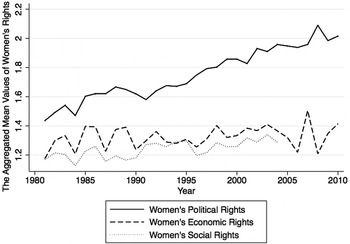
Figure 1 presents the longitudinal pattern of women's political, economic, and social rights from the current available CIRI data set. For women's social rights, the data are only available through 2004. At the world level, the mean value of women's political rights increases at the highest rate, from around 1.4 to 2. The mean values of women's economic and social rights start at around 1.2 and increase by only about 0.2 over these 20 years. This confirms that there is a lag between women's political rights and women's economic/social rights. The mean value of women's economic rights shows a decrease in the late 1980s and the early 1990s. The drastic drop in women's economic rights is also noticeable at the start of the late-2000s recession in 2007. The mean value of women's social rights also declined slightly in the middle of the 1990s. Although Figure 1 presents increasing trends for all three types of rights, the current gap between women's political rights and women's economic/social rights seems to have been growing since 1981.
The aggregated mean values of women's political, economic, and social rights, 1981–2010.

Key Factors Influencing Women's Rights
As measures of neoliberalism, I use net inflow of FDI (% of GDP) and trade openness (% of GDP) from the World Development Indicators (WDI) (World Bank Reference Bank2010).Footnote 4 I also use the structural adjustment program variable from Abouharb and Cingranelli (Reference Abouharb and Cingranelli2006).Footnote 5 They construct a dummy variable called IMF or World Bank structural adjustment agreement (SAA) implementation that measures whether a country enters into an SAA with the IMF/World Bank in a given year. They also find that the number of years for which a country has been subject to an IMF/World Bank SAA is significant in explaining governments' recognition of human rights (Abouharb and Cingranelli Reference Abouharb and Cingranelli2007). Thus, the primary variable for explaining neoliberal restructuring through IMF/World Bank programs is the cumulative number of years for which a given country has been subject to an IMF/World Bank structural adjustment agreement. These variables are lagged by three years to follow the convention of previous research and control for the increase over time in the dependent variables (Boyle and Kim Reference Boyle and Kim2009).
To measure women's transnational opportunity structure, I include three variables representing CEDAW ratification status, membership in WINGOs, and the UN Beijing Conference on Women. I treat each country's CEDAW ratification status as a dummy variable (years with ratification = 1, all other years = 0) (UNDP 2009). Data on membership in WINGOs indicate the level of representativeness of WINGOs in a given country. The WINGOs data code country-level membership information for the years 1984, 1988, 1992, 1995, 2000, and 2003 (Paxton, Hughes, and Green Reference Paxton, Hughes and Green2006). To improve data availability over the time period covered, I interpolate the missing values based on one observation per each of those six years. This follows the previous research on INGOs (Boli and Thomas Reference Boli and George1999; Boyle and Kim Reference Boyle and Kim2009). To capture the periodic effect of the UN Beijing Conference on Women, I code the years from 1995 to 1998 as “1” and the other years as “0” (True and Mintrom Reference True and Mintrom2001).
Finally, to measure the effects of regional/cultural variation, I assign a dummy variable for each civilization classified in Huntington (Reference Huntington1996).
Control Variables
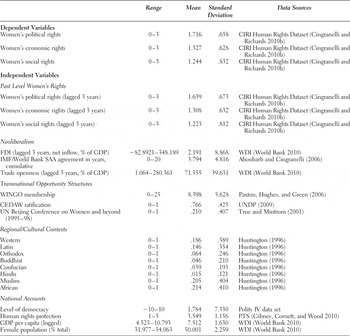
To control for domestic characteristics of each country, I include the following variables in the analysis: level of democracy (Polity IV data set), level of human rights protection (Political Terror Scale data set), industrialization (GDP per capita, logged), female population size (% of total population), and the previous level of women's rights (lagged three years). The inclusion of the dependent variables with a three-year lag eliminates the problem of serial correlation and is done to be consistent with the neoliberalism indicators. Table 1 shows the descriptive statistics of all the variables used in this analysis.
Descriptive statistics

METHOD
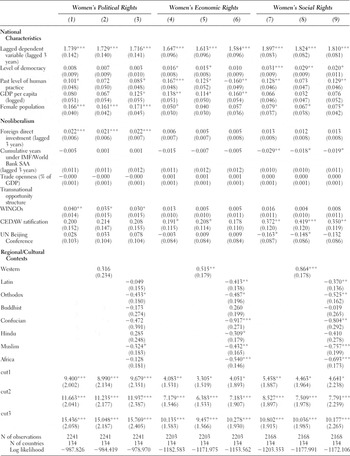
I reproduce the findings from my previous study of the general effects of neoliberal restructuring and the transnational opportunity structure on women's social rights (Yoo Reference Yoo2011) in Table 2 (Model 7).Footnote 6 On the basis of these findings, I extend my models to women's political and economic rights (Models 1–6) and test the effects of regional/cultural contexts. The results obtained on the three dimensions of women's rights provide new theoretical implications that the previous study on women's social rights did not capture. In addition, by comparing findings from the reproduced model of women's social rights, this research can determine whether neoliberal restructuring programs and the TOS affect the other dimensions of women's political and economic rights.
Ordered probit model for women's political, economic, and social rights, 1984–2003

Notes: Standard errors in parentheses (two-tailed test).
+p < 0.10, * p < 0.05, ** p < 0.01, *** p < 0.001
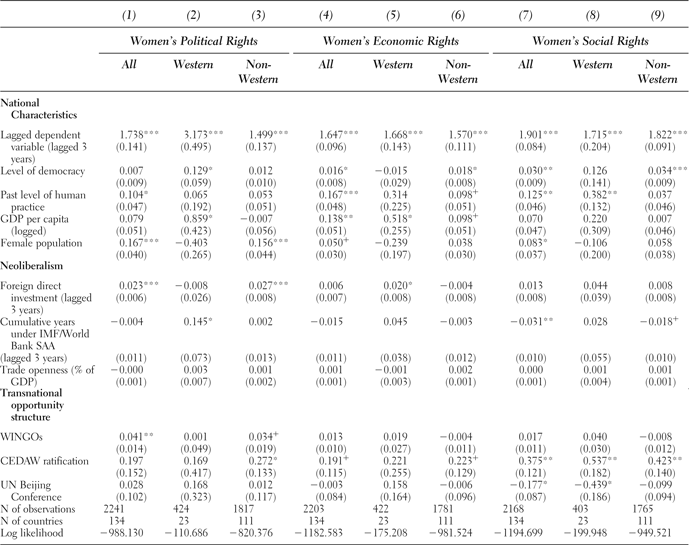
To show the contextual effects of regional/cultural variables, I start with the baseline model, including all neoliberalism and TOS variables (Models 1, 4, 7). Then I compare Western and non-Western countries by including the Western dummy variable (Models 2, 5, 8). The inclusion of the Latin, Orthodox, Confucian, Hindu, Buddhist, Muslim, and African dummy variables in the models (Models 3, 6, 9) compares the effects of regional/cultural context among non-Western countries only. Finally, I examine the separate models for Western and non-Western countries to trace how the effects of key independent variables differ from Western and non-Western contexts in Table 3.
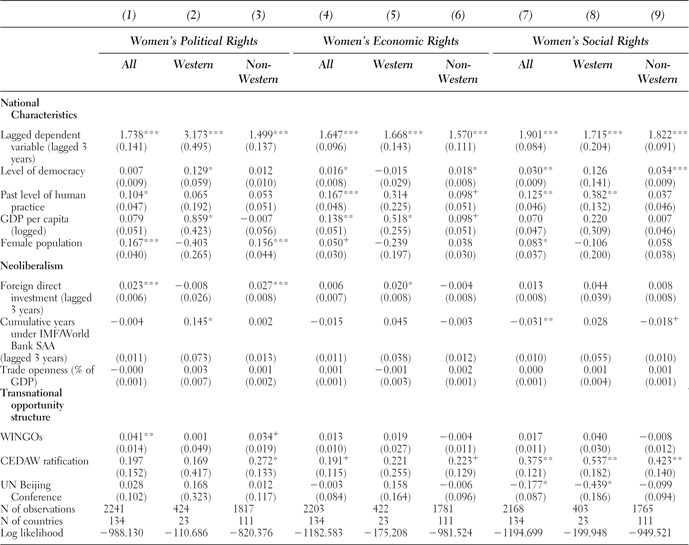
Ordered probit model for women's political, economic, and social rights, 1984–2003, Western/non-Western countries
Notes: Standard errors in parentheses (two-tailed test).
+p < 0.10, * p < 0.05, ** p < 0.01, *** p < 0.001
RESULTS
Table 2 presents the results from ordered probit models for each dimension of women's political, economic, and social rights. In these ordered probit models, positive coefficients denote an increased likelihood of having a higher level of women's rights, and negative coefficients denote a decreased likelihood (Long Reference Long1997). As expected, for all three dependent variables, past levels of women's rights (lagged form of the dependent variable) are positively associated with the current level of women's rights in a given country. It is interesting that the level of democracy is irrelevant in explaining women's political rights. For women's economic rights, the level of democracy shows positive effects (Models 4–5), but it loses its significance when non-Western dummy variables are included (Model 6). For women's social rights, higher level of democracy increases the likelihood of being in a higher level of women's social-rights protection. The past level of human rights protection also shows positive effects on three dependent variables, but the Western dummy variable wipes out the positive effect in women's political and social rights (Model 2 and 8). This is probably because certain levels of political and social rights are achieved in Western countries so that the past level of human rights protection is no longer influential.
It is worth noting that the significance of the effect of GDP per capita does not achieve the p < .10 threshold in explaining women's social rights. For women's political rights, the effect becomes significant when all non-Western dummy variables are included (Model 3, p < .05). For non-Western countries, economic development is still an important factor for increasing the likelihood of being in a higher women's political-rights category. In the sense that economic development can increase job opportunities/welfare packets, women's economic rights are positively associated with GDP per capital increase. This indicates that national affluence can facilitate the higher economic status of women.
Among the neoliberalism variables, FDI inflow (lagged three years) has a strong positive effect on women's political rights (p < .01), while IMF/World Bank SAA and trade openness have no effects. This result may be explained, at least in part, by the empirical research arguing that neoliberal restructuring provided ample opportunities for women in organizing (Mohanty Reference Mohanty, Alexander and Mohanty1997). The positive effect of foreign direct investment also supports the thesis of women's political empowerment in the process of democratization (Alvarez Reference Alvarez1990), which creates a more favorable environment for foreign investors. The results do not suggest a simplistic argument such as that FDI directly leads to a higher level of women's political rights; however, the significance of FDI partially supports the argument that governments make an effort to be attractive to foreign investors by allowing women's basic political right to participate in national politics.
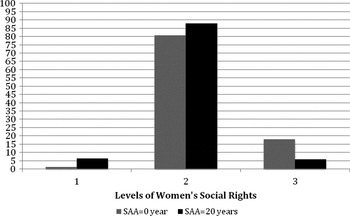
For women's economic rights (Models 4–6), the results show that the neoliberalism variables are insignificant for explaining governments' practices. But the longer a country is subject to IMF/World Bank SAA programs, the more likely it is to have a lower level of women's social rights. Although the significance weakens throughout the models (p < .05 in Model 7 and p < .10 in Models 8 and 9), the negative effect of this variable is consistent even when the Western and non-Western dummy variables are added. For ease of interpretation, I provide the expected probabilities for women's social rights at the minimum and maximum cumulative years of IMF/World Bank SAA implementation in Figure 2.Footnote 7 The maximum duration of IMF/World Bank SAA implementation is 20 years and the minimum duration of IMF/World Bank SAA implementation is 0 years.
Expected probabilities of SAA for women's social rights.

Figure 2 shows that countries with 0 years of SAA implementation are more likely to fall into higher categories of women's social rights (3), while countries with 20 years of SAA implementation are more likely to have a lower level of women's social rights (1 or 2).Footnote 8 With other independent variables set at their mean or mode, the probability that a country with 0 years of SAA implementation falls at the highest level of women's social rights (3) is about 18%, while that of a country with 20 years of SAA implementation is about 6%. By contrast, the probability of being in the lowest category of women's social rights for countries with no SAA implementation history is 1.3%. Yet the countries with 20 years of SAA implementation have a 6% chance of being in the lowest level of women's social rights protection. In sum, it is possible that the positive effects of FDI inflow on women's political rights and the negative effects of IMF/World Bank SAA implementation on women's social rights widen the gap between these two rights.
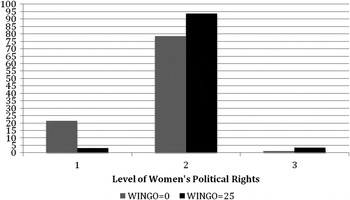
For TOS variables, WINGOs also have a strong positive effect on women's political rights. The linkage between local and global women's movements clearly improves governments' recognition of women's political representation and participation. The WINGO variable, however, does not have any effect on women's economic and social rights. This result is consistent when the Western and non-Western dummy variables are taken into account in Models 5, 6, 8, and 9. Unlike the case of women's political rights, international women's movements have not been influential in changing women's economic and social rights. To explain this effect in more quantitative terms, I also report the expected probabilities for women's political rights at minimum and maximum numbers of WINGO. As Figure 3 shows, the probability of being in the highest category of women's political rights is larger when the maximum value of WINGO is 25. For countries with no WINGOs, the probability of being in category 1 is 21%, which is about 17% larger than for countries with the maximum number of WINGOs. Similarly, countries with the maximum number of WINGOs have higher probabilities of being in the higher categories (2 or 3) than countries with no WINGOs.
Expected probabilities of WINGOs for women's political rights.

Among other TOS variables, CEDAW ratification status and the UN Beijing Conference do not have significant effects on the index of women's political rights. In Model 5, it seems that CEDAW ratification increases the level of women's economic rights (p < .10), but its effects are not significant when non-Western blocks are added to the model (Model 6). The results for women's social rights (Models 7–9) demonstrate interesting facts about international women's movements. For women's social rights, CEDAW ratification status has a strong positive effect on women's social rights. Yet this effect should be considered carefully because CEDAW ratification is also effective as a part of international women's advocacy efforts.Footnote 9 The UN Beijing Conference shows a weak negative effect on women's social rights (in Model 7 and 8); however, this effect disappears when non-Western countries are added to the model.
The Western vs. non-Western comparison in Model 2 does not support effects of Western civilization on women's political rights. The comparison among non-Western countries shows that the Orthodox and Muslim variables have negative effects on all three dimensions of women's rights. This is because most Orthodox countries are former Soviet countries, which were still in the process of democratization and economic development. In comparison with women's political rights (Model 3), Latin, Confucian, Muslim, and African countries are still struggling with their cultural/religious legacy when it comes to economic and social rights, even though the process of democratization and transnational advocacy networks have opened new doors for women (e.g., Adams and Kang Reference Adams and Kang2007; Fernandes Reference Fernandes2005; Viterna and Fallon Reference Fallon2008). The social and economic status of women is more closely related to the cultural and political geography of a given country.
To compare the separate effects of neoliberalism and TOS variables between Western and non-Western countries, I provide the results of Western cases and non-Western cases for each dependent variable in Table 3. Among neoliberalism variables, the positive effects of FDI inflows on women's political rights, and the negative effects of IMF/World Bank SAA, become insignificant in Western countries. In Western countries, the IMF/World Bank SAA variable has a positive effect on women's political rights at the p < .05 level. This positive effect, however, can be explained by the existence of Eastern European countries in Western cases, where rapid democratization and economic development occurred in the 1990s.Footnote 10 Notably, FDI inflows also increase the likelihood of having a higher level of women's economic rights in Western countries (Model 5). The changes in postsocialist countries may contribute to the increase of women's economic rights, but it is more likely that Western countries have been more attuned to market-friendly policies for FDI (Bandelj Reference Bandelj2009; Jensen Reference Jensen2006). In addition, IMF/World BANK SAA does not have degradative effects on women's social rights in Western countries.
Examining the effects of TOS in Western and non-Western countries, the analysis shows that the WINGOs increase the likelihood of having a higher level of women's political rights in non-Western countries (Model 3). The effects of CEDAW ratification in women's social rights are stable in Western and non-Western countries. It is worth noting that when the two subsamples are compared, CEDAW ratification also shows positive signs in women's political and economic rights in non-Western countries. This suggests that ratification of CEDAW in non-Western countries actually improves governments' recognition of women's political and economic rights, though the overall global trend of CEDAW is likely to improve women's social rights. The UN Beijing Conference does not improve any level of women's political and economic rights. Rather, in Western countries, the UN Beijing Conference shows negative influence on women's social rights. As in the case of women's political rights, this is due to the existence of Eastern European countries in Western cases. Following the collapse of the Soviet Union, many postsocialist countries are suffering from eroded social benefits and redefined motherhood (Ashwin Reference Ashwin2000). Thus, the negative effect of the UN Beijing Conference is not the actual effect of the conference but the periodical effect of 1995 to 1998.
DISCUSSION
This study analyzses the factors influencing the levels of women's political, economic, and social rights in a context of increasing neoliberal restructuring and transnational activism. There are many empirical studies exploring cases of women's status in depth; however, my goal is to identify how neoliberal restructuring and women's movements in the transnational opportunity structure affect women's rights on a broad, global scale, in 134 countries over the period 1984–2003. Although many scholars challenge the claim that women acquire economic/social rights after securing political rights, the empirical data show that the gap between women's political rights and economic/social rights has been growing wider in a majority of countries, even where women's political rights have reached a certain level. This research helps explain which factors widen the gap between these different aspects of women's rights. In addition to this main approach, I also examine the differences of key variable effects between Western and non-Western countries by dividing the cases into two groups. This additional analysis also provides support for the differential effects of neoliberalism and TOS in Western and non-Western countries.
My analysis is based on two theoretical perspectives, neoliberalism and the transnational opportunity structure. I find that WINGOs are influential in promoting governments' recognition of women's political rights only, while having insignificant effects on women's economic and social rights. Among the neoliberalism variables, net FDI inflow has a positive impact on governments' recognition of women's political rights. This supports the notion that governments that want to be attractive recipients of foreign capital try to rearrange their domestic political environments to make them favorable for foreign investors (e.g., Bandelj Reference Bandelj2009). In addition, previous research finds that a higher level of women's economic and social rights has a spillover effect into a higher domestic level of women's rights via transnational trade and FDI (Neumayer and Soysa Reference Neumayer and Soysa2011). It is possible that investing countries require a higher level of political rights in their recipient countries.
These positive effects of WINGOs and FDI inflows on women's political rights, however, apply only to non-Western countries, where women's political rights still need some levers to be improved. Although this finding does not refute the claim that WINGOs are active in Western countries, it may suggest that the rate of change caused by Western WINGOs is slower than non-Western, mostly developing, countries. For example, the growth of women's INGOs is much faster in developing countries than in developed countries so that its effects are more significant in non-Western countries.Footnote 11
The most interesting finding in this analysis is that WINGOs have different effects on governments' practices regarding women's political rights and other rights. The insignificant effects of WINGOs on women's economic/social rights suggest that transnational activists are more inclined to improve women's political rights (Gathii and Nyamu Reference Gathii and Nyamu1996). There can be several reasons. First, scholars have pointed out the limitations of WINGOs with respect to issues of gender relations, military defense, and models of economic development (Clark, Friedman, and Hochstetler Reference Clark, Friedman and Hochstetler1998). Governments usually see these issues as non-negotiable with NGOs, and if government-sponsored NGOs (GONGOs) are present, then it is very difficult for WINGOs to have autonomous power over gender-related issues, that is, women's economic/social rights issues. Due to project funding status and bureaucratic burdens, the activities of the transnational advocacy network (TAN) can lose the momentum needed to engineer real changes for women's equality.
Second, WINGOs are still struggling with unaligned NGO frames of gender issues (Clark, Friedman, and Hochstetler Reference Clark, Friedman and Hochstetler1998; Joachim Reference Joachim2003). Joachim (Reference Joachim2003) finds that the influence of NGOs is limited in the beginning of the agenda setting process. As many gender issues directly related to women's economic/social rights (e.g., human trafficking and domestic violence) are currently at the stage of being developed and framed as WINGO agendas, it is possible that the influence of WINGOs has not yet reached these domains. And more importantly, women's transnational movements are still trapped in the maze of devising effective methods to empower domestic movements to improve women's economic and social status (Tripp Reference Tripp, Ferree and Tripp2006). Lang (Reference Lang2009) also points out that the European women's TAN is suffering from limited trust in strategies for gender mainstreaming.
In addition, the lack of an effect on economic/social rights could be a result of the detachment of international women's movements from domestic movements. As Tripp (Reference Tripp, Ferree and Tripp2006) claimed, transnational feminist actors should be careful to avoid the “rescue paradigm” and be sensitive to local needs and issues.
At the global level, however, WINGOs are still the main leverage for improving women's political rights, and their effects are more salient in non-Western countries. If WINGOs can overcome the obstacles that exist in their relations to governments and domestic NGOs, then WINGOs can become essential vehicles for the improvement in women's status in other domains as well.
At the global level, CEDAW shows meaningful effects only on improving women's social rights. Yet the subsample analysis indicates that the positive effects of CEDAW ratification existed in women's political and economic rights in non-Western countries. This effect is partly due to the fact that most Western countries have achieved the highest level of women's political/economic rights, but developing countries still have relatively lower levels of women's political and economic rights. In fact, for Western countries, CEDAW ratification does not necessarily equate to improved levels of women's political and economic rights. Altough the international community traditionally focuses on women's political and economic rights, such as representation of women in national politics or equal pay law (Berkovitch Reference Berkovitch1999; Paxton, Hughes, and Green Reference Paxton, Hughes and Green2006), CEDAW ratification has been the first international human rights instrument to focus on marginalized women's and gender concerns. Given that the period covered in this analysis is from 1984 to 2003, it is expected that CEDAW ratification centered around marginalized women's social status has a more significant effect on women's social rights in both Western and non-Western countries.
The insignificance of the UN Beijing Conference is also a result of the detachment between agenda setting and real practices that improve women's status at the local level. Although the Beijing Conference itself was effective in terms of networking, lobbying, and discussing possible strategies among WINGOs, NGOs, and governments at the global level, there are still several obstacles for the conference to bring the diffusion of gender mainstreaming at the local level. As WINGOs are not efficient at improving women's economic/social rights, the agencies at the conference, mostly representatives of WINGOs and NGOs, are struggling with drawing consensus among them and with the existence of GONGOs (Clark, Friedman, and Hochstetler Reference Clark, Friedman and Hochstetler1998). For the same reasons that WINGOs are ineffective, the mere existence of the international conference itself was not enough to leverage women's rights at the local level. To effect favorable legislation for women and gender-mainstreaming issues, the conference should have some legal obligations to governments, such as CEDAW, or other means to enforce governments' acceptance of the Beijing Platform for Action.
While TOS variables of both WINGOs and CEDAW ratification significantly improve the level of women's rights, neoliberal restructuring through IMF/World Bank SAAs has a negative effect on women's social rights. The more years a country is subject to an IMF/World Bank structural adjustment program, the more it harms the government's recognition of women's social rights. Previous studies of neoliberal factors on women's status emphasize the deterioration of women's social rights in various domains of women's private lives, especially in developing countries (Cornia, Jolly and Stewart Reference Cornia, Jolly and Stewart1987; Moghadam Reference Moghadam1999). Additionally, when nation-states enter into a structural adjustment agreement with the IMF or World Bank, they also have to keep its conditional terms, which require governments to cut their welfare budgets and programs. This also explains the degradation of women's social rights when countries are under successive years of IMF/World Bank implementation. Additional positive effects of FDI on women's political rights can also be explained by foreign investors' preference for politically stable countries (Jensen Reference Jensen2006). When countries are open to foreign investment (i.e., in developing countries), FDI inflows increase the likelihood of their having a higher level of women's political rights. In sum, both the negative effect of IMF/World Bank SAAs and the positive effect of FDI are the main factors widening the gap between women's political rights and social rights.
Finally, this research shows that regional/cultural difference is still a major factor in the downshifting of women's economic and social rights. Western countries are more likely to have higher levels of women's economic and social rights, though they have an insignificant effect on women's political rights. When a comparison is made among non-Western countries only, the Latin, Orthodox, Confucian, Muslim, and Africa dummy variables in my analyses have negative effects on women's economic and social rights. Several researchers have pointed out the limits of feminist activism in Latin America due to lack of autonomy in funding (Borland Reference Borland2004; Thayer Reference Thayer2010; Viterna and Fallon Reference Viterna and Fallon2008) and closed professional networks (Fernandes Reference Fernandes2005). Additionally, much research has been done on transnational activism for Muslim and African women and its success (Adams and Kang Reference Adams and Kang2007; Moghadam Reference Moghadam2000); from it has come the finding that domestic Muslim and African activists can suffer from transnational movements' oversimplification of issues or disregard of context (e.g., the case of Amina Lawal Kurami in Tripp Reference Tripp, Ferree and Tripp2006). As the results show a strong influence of non-Western cultures on women's economic and social rights even after taking account of neoliberalism and transnational opportunity structures, researchers and activists should approach the issue of women's rights more from the perspective of regional/cultural systems than from a Western perspective. Additional analysis examining the different effects of key independent variables between Western and non-Western countries supports this idea.
This analysis has some limitations in that the data constituting the CIRI index of women's rights do not measure specific aspects of women's lives, such as the fertility rate, secondary education enrollment rate, or incidence of sexual harassment in the workplace; rather, the index measures governments' practices. But the CIRI index is the only data set that can measure the general level of women's rights in more than 190 countries (Cingranelli and Richards Reference Cingranelli and Richards2010a). In addition, the data provide ample opportunity to observe the global effects of neoliberalism and transnational activism on women's rights. Furthermore, this research explores the positioning of women's rights against the backdrop of expansion of the transnational feminist network. In most cases, universal human rights are discussed in gender-neutral contexts, and women's rights are easily marginalized or considered to be particular rights. Although quantitative research cannot capture the contradictions and tensions in the ways that the transnational network of women's activism plays out in various local contexts, this analysis of women's rights at the global level does yield the important finding that gender inequality must be addressed in order to expand human rights as universal rights.