Introduction
During the last decade, the literature on interest representation in Europe has seen a remarkable transformation, both in terms of empirical research and in theoretical richness. Although there was already a well-established and lively tradition of scholarly research on the variety of national systems of interest intermediation across member states of the European Union (EU), as well as on the similarities and differences between them and the American system (Streeck and Smitter Reference Streeck and Schmitter1991; Traxler and Smitter Reference Traxler and Schmitter1995; Eising Reference Eising2003; Gruning et al. Reference Gruning, Struanck and Gilmore2008; Dür and Mateo Reference Dür and Mateo2013; Rommetvedt et al. Reference Rommetvedt, Thesen, Christiansen and Nørgaard2014), it was only with the remarkable growth of interest representation at the supranational level of the EU following the adoption of the Single European Act (1986) that the EU’s system of interest representation became a subject of scholarly interest (Jordan et al. Reference Jordan, McLaughlin and Maloney1993; Mazey and Richardson Reference Mazey and Richardson1993; Greenwood Reference Greenwood1997).
The recognition of the existence of an EU-level system of interest intermediation that was largely independent from those of the individual member states paved the way for two important developments. First, scholars began engaging in a conceptual debate on the nature of the EU’s system of interest intermediation. Largely connecting to the corporatism debate in comparative politics, several studies have concentrated on whether national traditions of interest intermediation have been transferred upward to the supranational level (for a literature review, see Woll Reference Woll2006). Second, and perhaps most importantly from the perspective of developing generalisable propositions on lobbying in Europe, scholars began to explicitly compare patterns of the interest intermediation practices in the United States (US) and in Europe. As a result of these comparative efforts, the study of interest representation in Europe has become much less inward-looking and has started to catch up with the existing scholarship on US politics. This has allowed for the literatures on lobbying in these two political environments to become much more closely aligned (Woll Reference Woll2006, Reference Woll2012; Mahoney and Baumgartner Reference Mahoney and Baumgartner2008). Although significant obstacles still remain in the development of an overarching theory of interest representation through which we can compare lobbying practices in Europe and the US (Lowery et al. Reference Lowery, Poppelaars and Berkhout2008), scholars are increasingly devoting their energy to systematic comparisons of the systems of interest intermediation across the Atlantic (Thomas Reference Thomas2004; McGrath Reference McGrath2005; Mahoney Reference Mahoney2007a; Mahoney and Baumgartner Reference Mahoney and Baumgartner2008; Thomas and Hrebenar Reference Thomas and Hrebenar2009; Woll Reference Woll2012).
One of the observations around which there is widespread consensus is that lobbying in the US and Europe is characterised by markedly different styles. In this article, the concept “lobbying style” refers to the set of strategies organised interest groups use when they seek to influence public policymaking. Analytically, it excludes aspects such as how interest groups mobilise and interact with their members, or how institutional systems of private-public relationships emerge and evolve. Although US lobbying is frequently depicted as confrontational, aggressive, specialised and based on financial contributions and legal tactics, Europe’s lobbying style tends to be more consensus-oriented, constructive, soft-spoken and rooted in long-term relationships and trust among different stakeholders (Woll Reference Woll2012).
There are two possible explanations for these differences. The first posits that the distinct lobbying styles across the Atlantic reflect different political cultures (McGrath Reference McGrath2002; Thomas Reference Thomas2004). According to this view, different political traditions and normative perspectives on the role of societal interests account for the observed differences in lobbying styles. The second explanation attributes the distinct lobbying styles to differences in the institutional contexts within which European and American lobbyists operate (Coen Reference Coen1998; Broscheid and Coen Reference Broscheid and Coen2003; Greenwood Reference Greenwood2003; Mahoney Reference Mahoney2008; Woll Reference Woll2012). The consensus-oriented policy-making institutions such as proportional representation, coalition governments and multiparty systems that prevail in many European countries as well as at the EU-level are seen as the primary reason why interest groups formulate their demands in constructive terms and moderate their approach. Ultimately, the typical European lobbying style is supposed to lead to problem-solving interactions with policymakers. In contrast, the majoritarian and bipartisan nature of US politics tends to result in a more confrontational and winner-takes-all style.
An empirical assessment of the explanatory power of these two competing explanations has, however, proved problematic so far. Generally, previous analyses have not been able to convincingly show whether the observed differences in styles are due to the ingrained political culture or the institutional contexts in which lobbyists operate. Scholars tend to provide evidence in support for either the cultural or the institutional hypothesis without considering, and thus controlling for, its more direct alternative. Those who explicitly consider this question either deem it impossible to discriminate between the relevance of these two contending perspectives (Thomas and Hrebenar Reference Thomas and Hrebenar2009, 138) or take a position on the basis of a conceptual reflection that is supported by case-study evidence (Woll Reference Woll2012).
Ascertaining whether interest groups behave in certain ways because of internalised cultural norms or as a result of an adaptation to the institutional context within which they are operating is inherently problematic, as these two explanations are both likely to be consistent with our observations when looking at patterns of lobbying within political systems. As lobbyists are normally studied within their specific political context (for instance, within the US or within the EU and its member states), most studies are not suitable for disentangling the causal effects of the two explanatory factors in the observed variations.
In this article, we assess the relative explanatory power of the cultural and institutional arguments by keeping the value of one of the two explanatory variables constant. Rather than focussing exclusively on lobbying within the two political systems, we also analyse lobbying by European and American lobbyists at international political venues. This allows us to observe whether European and US lobbying styles remain different when lobbyists operate in the same context, which differs from their respective national context – this would give support to the cultural argument – or whether they start to develop similar strategies when they enter the same institutional environment – this would give support to the institutional argument. For our empirical analysis, we rely on 114 interviews with European and US lobbyists who attended either the World Trade Organization (WTO) Ministerial Conference in 2012 or one of the United Nation (UN) Climate Summits in 2011 and 2012. Our analysis shows that observed differences in how European and American lobbyists operate in national settings are not reflected in how they acted at the 2012 WTO Ministerial Conference and the 2011 and 2012 UN Climate Summits. These results are therefore more consistent with an institutional explanation, which presumes that EU and US lobbying reflects a strategic adaptation to the institutional context rather than deeply ingrained cultural factors.
Explaining the different lobbying styles in Europe and the US
There is widespread consensus that the lobbying styles in the US and Europe are markedly different. We define a lobbying style as the set of strategies organised interest groups use when they seek to influence public policymaking; it refers to the manners in which organised interest groups put forward their concerns (Woll Reference Woll2012). Lobbying style is a latent concept, which can be operationalised by observing the concrete advocacy practices interest groups develop. A lobbying style exists if the observed patterns of behaviour consistently share similar characteristics.
Lobbying tactics in the two political systems vary on a number of different dimensions (McGrath Reference McGrath2002; Thomas Reference Thomas2004; Mahoney Reference Mahoney2007a; Mahoney and Baumgartner Reference Mahoney and Baumgartner2008; Thomas and Hrebenar Reference Thomas and Hrebenar2009; Woll Reference Woll2012). First, US lobbyists tend to be more adversarial and aggressive than their European counterparts. For instance, US lobbyists are accustomed to a direct and confrontational style based on threats and pressure, often coupled with legal strategies, whereas European lobbyists usually pursue subtle and more consensus-oriented tactics based on constructive and informed participation. Second, US lobbyists tend to rely on outside lobbying tactics, targeting the media and the public over particular issues, whereas European lobbyists are more inclined to rely on inside lobbying tactics, attempting to gain access to policymakers through the provision of expertise and information. Unsurprisingly, tactics aimed at killing policy proposals are widely employed in the US, whereas European lobbying is much more oriented towards problem-solving and revising the content of policy proposals (Mahoney Reference Mahoney2007a; Mahoney and Baumgartner Reference Mahoney and Baumgartner2008). Third, although US lobbying practices resemble the classical pluralist model of interest intermediation in which individual groups compete for political influence, the practices of European lobbyists more closely resemble corporatist models of interest intermediation, in which interest groups coordinate their positions and create stable and institutionalised patterns of interaction and cooperation. Many analyses point to this fundamental difference when they argue that European interest groups operate through EU-wide organisations that help them coordinate and aggregate the different interests within and across sectors, as well as across national boundaries, and to channel these demands efficiently within the EU’s complex multilevel institutional structure (Coen Reference Coen1998; Broscheid and Coen Reference Broscheid and Coen2003; Greenwood Reference Greenwood2003; Eising Reference Eising2004). This explains why peak associations have a much more central standing in Europe than in the US (Woll Reference Woll2006, Reference Woll2012) and why US lobbyists more frequently operate through ad hoc issue-specific coalitions (Mahoney Reference Mahoney2007b).
As advocacy behaviour in Europe and the US tends to differ quite consistently along these different dimensions, scholars now seem to have converged on the idea that lobbying styles in the US and Europe can be characterised as two ideal types. Woll (Reference Woll2012) distinguishes between the “brash” lobbying style in the US and the “soft-spoken” European lobbying style. The former is frequently confrontational, aggressive, specialised and based on financial contributions and legal tactics, whereas the latter is more consensus-oriented, constructive, soft-spoken and rooted in long-term relationships and trust.
Two explanations have been offered for this variation in lobbying styles. The first explanation suggests that the differences are attributable to the varying opportunities and constraints existent within the American and European institutional environments. Existing analyses have so far focussed on institutional factors such as varying levels of electoral accountability and insulation (Grande Reference Grande1996; Coen Reference Coen1998; Bouwen Reference Bouwen2004), rules concerning the introduction of policy proposals and levels of regulation of lobbying activities (Mahoney Reference Mahoney2007a), and more generally the prevalence of institutional mechanisms in many European countries and the EU – proportional representation, coalition government and multiparty system – which stimulate consensual modes of policymaking (Woll Reference Woll2012). Despite the lack of agreement on the institutional characteristics that matter most, a considerable body of literature suggests that these different institutional conditions decisively shape lobbying styles.
A second explanation suggests that culture should be considered the key explanatory factor. Thomas (Reference Thomas2004) explicitly speaks of American and European political cultures, conceiving of lobbying styles as an expression of cultural traits. Similarly, McGrath (Reference McGrath2002, Reference McGrath2005) argues that the US and Europe have particular cultural norms and values that shape their lobbying practices. Thomas and Hrebenar (Reference Thomas and Hrebenar2009) also highlight the potential benefits to focussing on the role of culture in comparative research on lobbying practices (see also Gardner Reference Gardner1991; Cowles Reference Cowles1996; Thomas Reference Thomas2002). This cultural argument suggests that, in contrast to the institutional one, lobbying styles do not just reflect some adaptation to a particular institutional context, but rather echo more deeply internalised norms that produce long-term tendencies and patterns of behaviour that are relatively impermeable to changing institutional incentives and constraints.
Scholars have so far not conducted systematic and explicit tests of the cultural and institutional explanations. Most of the research reviewed above provides empirical evidence that would support both the cultural and institutional explanation, and does not explicitly show which explanation can best account for the observed differences. In other words, often the cultural hypothesis is not controlled for when assessing the validity of the institutional hypothesis and vice versa. In our view, this absence of systematic tests should not be ascribed to scholarly shortsightedness. Rather, we believe it reflects a deeper methodological challenge and problem with the comparative analysis of different lobbying practices more generally – namely, observational equivalence. In comparative research designs that focus primarily on lobbying within political settings, inferring causality from the observed evidence is a daunting task because the two explanatory variables, culture and institutions, are usually consistent with the observations.
The few analyses that have given explicit consideration to the question of assessing the relative explanatory power of these two propositions illustrate this methodological difficulty nicely. For instance, although Thomas and Hrebenar (Reference Thomas and Hrebenar2009, 138) argue that it is analytically useful to distinguish between the cultural and institutional factors, they conclude that because these factors would lead to similar outcomes, ascertaining their relative importance may be impossible. Woll (Reference Woll2012) also recognises the difficulty of ascertaining whether culture is an effect or a cause of institutional developments, but takes a position in favour of the institutional hypothesis by arguing that particular cultures are endogenous to institutions, and thus ultimately reflect the incentives and constraints of different institutional opportunity structures. Yet, although theoretically plausible, this position is not substantiated by any systematic empirical evidence. Although it is certainly plausible to claim that institutions can generate particular cultures in the long term, we need to be able to ascertain empirically whether a particular institution actually generated particular lobbying practices that may reflect a specific lobbying culture. If institutional incentives and constraints are primordial, then the lobbying practices of lobbyists originating from distinct national backgrounds should converge if these lobbyists start operating in a new institutional setting that is distinct from their national context.
Coping with observational equivalence
Thus far we have argued that analyses focussing on domestic lobbying practices in multiple political systems face difficulties when it comes to assessing the relative importance of the institutional and cultural explanations. However, problems of observational equivalence can be resolved if one devises a research design that keeps the influence of one of the two explanatory factors under control.
The institutional perspective suggests that interest groups will adapt their lobbying styles to the institutional context within which they operate. Hence, European and US lobbyists should be expected to use different lobbying styles in different institutional contexts, such as in their respective political systems, whereas they should develop similar styles when they operate within the same institutional context, such as, for instance, international policy-making venues. On the contrary, the cultural argument suggests that lobbying styles are sticky, heavily internalised and reflect a long-standing experience with domestic political practices. This means that they should remain fairly constant, irrespective of the institutional context within which lobbyists operate. A lobbyist will not, according to the cultural explanation, significantly adapt his or her lobbying style if he or she is suddenly confronted with a different institutional venue. As has been correctly pointed out, political culture is a notoriously difficult concept to operationalise and sometimes becomes something of a catch-all for observations of country-specific political practices (Woll Reference Woll2006). However, this concept can be usefully applied if one accepts the definition of lobbying culture as “learned behavior shaping the conduct of lobbying practices and techniques” (Thomas and Hrebenar Reference Thomas and Hrebenar2009, 139). As stated, this characterisation submits that a certain lobbying style can entail more than just a strategic adaptation to a new environment and reflect long-term routines that lobbying groups have internalised as a result of their embeddedness in a particular domestic cultural setting, routines that are difficult to change when entering a new institutional context. However, culture is not an entirely static phenomenon and can certainly change. As much as the lobbying style may reflect the adaptation to a particular domestic cultural context, lobbying styles can be expected to change as a result of processes of adaptation when the context in which organisations operate changes. Yet, these contexts, precisely because they usually reflect deeply ingrained norms, habits, customs and mental frames, can be expected to be far less susceptible to sudden fluctuations in the short or medium term. Hence, in order to corroborate the cultural argument, one should observe that European and US lobbyists not only show different lobbying styles in their respective (and different) domestic political systems, but that significant differences remain visible when they shift their activities to the same institutional context.
Hence, problems with observational equivalence can potentially be addressed by investigating not only how European and US interest groups behave in their respective political systems but also how they behave within the same institutional context. Consequently, we assess the relevance of the institutional and cultural claims by comparing the lobbying practices of European and American societal interests both in their domestic setting and in the context of international policy-making venues.
Our research design enables us to compare European and American interest group lobbying both when the institutional context within which they operate varies and when it remains constant. In this way, we ensure that the observed outcomes will be meaningful in terms of what factors matter most in shaping lobbying styles. Observing that American and European lobbyists employ their typical “native” lobbying styles both when they operate in domestic and international institutional settings would provide support for the cultural explanation (i.e. that some deeper cultural factors affect advocacy behaviour, irrespective of institutional incentives and constraints). If there were instead systematic differences between how American and European interest groups lobby in domestic contexts, but substantial similarities in international institutional settings, the analysis would instead support the institutional explanation (i.e. that lobbyists adapt to the institutional context within which they operate). Yet, one might argue that the lobbying practices observed at the global level are a result of the socialisation of prevailing national cultures within international institutions. This would confront us with a similar problem of observational equivalence and would render it difficult to assess the explanatory power of the institutional and cultural hypotheses at the domestic level. Instead of looking at “American” or “European” lobbyists, the observed lobbying practices would reflect “global” advocates who happen to be European or American.
However, we do not think that such an international lobbying culture has emerged during the past few decades. It is true that international policy-making venues tend to be more consensus oriented than national ones, both because of the prevailing decision-making rule of consensus and because of the lack of a structured party-based system of political representation. Yet, the history of international organisations is replete with important examples of how an aggressive and confrontational lobbying style can be successfully employed to steer the course of events in international negotiations (Aaronson Reference Aaronson2001; Dür and Mateo Reference Dür and Mateo2014). More generally, various scholars have documented that global policymaking processes are increasingly surrounded by protests, media campaigns and contentious political activities (Betsill and Corell Reference Betsill and Corell2001; Bob Reference Bob2005; Barakso Reference Barakso2010; Muñoz-Cabré Reference Muñoz-Cabré2011; Hadden Reference Hadden2015). Our own fieldwork at three global diplomatic conferences shows that, while attending the conference, half of the interviewed lobbyists dedicated 50% or more of their advocacy efforts to outside strategies compared with inside strategies (Hanegraaff Reference Hanegraaff, De Bruycker and Beyers2015). In short, there is not one single appropriate type of lobbying that prevails at the global level. The absence of a typical global lobbying style is also due to the fact that it takes considerable time for lobbyists to internalise long-term routines ingrained in a particular institutional setting. As the international institutional venues we analyse have been created quite recently (i.e. the UN Climate Summits and the WTO Ministerial Conferences), it is unlikely that they developed a robust lobbying culture.
One final issue concerns the fact that the set of European interest groups that lobbies at international venues is somewhat heterogeneous. It consists of lobbyists working on behalf of EU-level interest groups as well as a diverse set of lobbyists having their roots in one EU member state. However, we believe it is plausible to assume that both national and EU-level lobbyists operate in a largely similar, Europeanised context. For one, although each national European context represents a distinct political and institutional environment, compared with the US, most European lobbyists operate in an environment that is generally much less majoritarian and more consensual than the US context. In addition, and most importantly, all European lobbyists are politically active within the EU multilevel institutional context because trade and international climate negotiations are largely EU competencies. This means both that there is always one EU delegation – headed by the European Commission – representing the EU and negotiating on behalf of the member states, and that European lobbyists will, on top of targeting national venues, also address the European institutions – the European Commission, the European Parliament and the Council – based in Brussels. These characteristics of the issue areas we consider have plausibly fostered a process of Europeanisation in the form of a significant convergence of patterns of public-private interaction at the European and member-state levels (Falkner Reference Falkner2000).
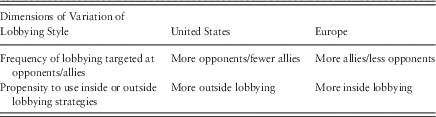
As mentioned earlier, we conceive of lobbying styles as a consistent pattern of behavioural practices lobbyists undertake to influence policy-making outcomes. Our analysis concentrates on two aspects in the development of lobbying strategies; each aspect represents a potentially critical dimension for characterising the ideal types of European and American lobbying styles (see Table 1). We assess whether there are significant differences between American and European lobbyists along these two dimensions in both domestic and international settings. If so, and along the expected directions, it would give support to the cultural explanation. The observation that differences detected in domestic settings do not correspond to similar differences in international settings with respect to these two dimensions would instead give support to the institutional argument. These dimensions are directly related to the general observation that US lobbyists tend to be more direct and confrontational, as well as more inclined to rely on threats and pressure, whereas their European counterparts usually pursue a more subtle, constructive, soft-spoken and consensus-oriented approach.
Strategies of interest groups
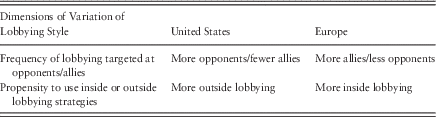
The first dimension concerns the lobbying targets. Research into lobbying targets aims to explain why interest groups would lobby friendly, undecided or opposing policymakers (Milbrath Reference Milbrath1963; Zeigler Reference Zeigler1964; Dexter Reference Dexter1969; Austen-Smith and Wright Reference Austen-Smith and Wright1994; Kollman Reference Kollman1997; Hojnacki and Kimball Reference Hojnacki and Kimball1998, Reference Hojnacki and Kimball1999; Hall and Deardorff Reference Hall and Deardorff2006; Mahoney Reference Mahoney2008; Baumgartner and Mahoney Reference Baumgartner and Mahoney2014; Marshall 2014; Beyers and Hanegraaff Reference Beyers and Hanegraaff2015). The observation that US lobbyists are more confrontational than European interest groups leads us to hypothesise that the former target policymakers with opposing views, their opponents, more often. In contrast, European lobbyists, with a focus on consensus-seeking and confrontation avoidance would be much more inclined to bargain with their allies and like-minded policymakers. The second dimension concerns the propensity to employ inside or outside lobbying strategies. Much scholarly literature suggests that US lobbyists are more inclined to rely on outside strategies – namely, to target the media and try to raise public awareness for specific policy causes. This contrasts with the predisposition of European lobbyists to use inside strategies and to seek access by providing policymakers with policy-relevant expertise and information (Hojnacki Reference Hojnacki1997; Kollman Reference Kollman1998; Holyoke Reference Holyoke2003; Beyers Reference Beyers2004; Binderkrantz Reference Binderkrantz2005; Kriesi et al. Reference Kriesi, Tresch and Jochum2007; Mahoney Reference Mahoney2007a; Culpepper Reference Culpepper2011; Dür and Mateo Reference Dür and Mateo2013).
Research design
Our analysis is based on data we obtained through interviews conducted at three sessions of two different global diplomatic conferences – the WTO Ministerial Conference of 2012 in Geneva and the United Nations Framework Convention on Climate Change (UNFCCC) Conference of the Parties of Durban (2011) and Doha (2012). At these events, a small team of three to four researchers randomly asked attendees to participate in an interview of about 30 minutes. During the interviews, respondents were asked to mention one specific issue they were working on and the strategies they used to influence policymakers regarding this issue (see Baumgartner et al. Reference Baumgartner, Berry, Hojnacki, Leech and Kimball2009). Furthermore, they were asked to provide information about the organisation they work for. In total, 348 attendees were interviewed at these three events. For the purpose of this particular article, we selected only the respondents who worked for organisations that claim to represent a European- or a US-based constituency; this provided us with 165 respondents. However, not all these interviewees lobbied actively in their respective domestic settings or at the global level. For instance, these events also attract many researchers and policy experts. After removing those who claimed explicitly that they did not attend the ministerial conferences for influence-seeking purposes, we have a sample of 114 respondents who clearly identify themselves as lobbyists seeking policy influence. This includes counting 37 lobbyists from the US and 77 from Europe.
Interviewing lobbyists on the spot during events such as global diplomatic conferences has some important advantages over other types of data collection strategies such as web surveys or phone interviews. First, this strategy gave us the chance to talk face-to-face to a group of lobbyists originating from many countries in a relatively short time span. Second, as we interviewed on the spot, response bias due to memory effects were minimised. Third, as the interviewed European and US lobbyists were active on similar issues in one particular field (climate or trade), the design kept policy-specific idiosyncrasies under control, which increases the robustness and reliability of our findings.Footnote 1 Finally, because these conferences are held only once a year, the primary habitat for the sampled lobbyists remains the domestic level, which is crucial if we aim to analyse how European and US lobbyist act in a different context. To be sure, we captured lobbyists with the domestic level as their primary habitat, we excluded lobbyists who indicated to be active in multiple countries and retained those who mentioned that they were active only in the US or in Europe.
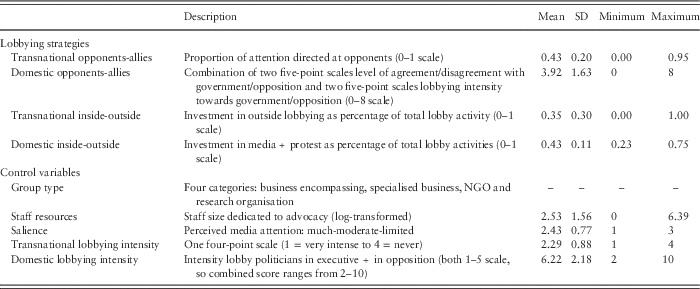
Lobbying style was captured by operationalising the two specific strategic dimensions presented in Table 1. During the interviews, we asked respondents about their usage of different types of strategies at the domestic level and the international level (with regard to the specific issue on which they were active). In this way, we could differentiate between the domestic strategies and international strategies employed by the same interest group representative. To see whether there were differences between Europe and the US, we have the origin of each lobbyist – that is whether he or she represents a US or a European interest group – as our crucial independent variable. To make sure the findings were robust, we added a set of control variables that are usually considered as crucial explanatory factors for variation in lobbying strategies, such as organisational type (Beyers Reference Beyers2004; Bouwen Reference Bouwen2004; Binderkrantz Reference Binderkrantz2005; Kriesi et al. Reference Kriesi, Tresch and Jochum2007; Mahoney Reference Mahoney2007a; Dür and Matteo Reference Dür and Mateo2013; Hanegraaff et al. Reference Hanegraaff2016) and issue characteristics (Kollman Reference Kollman1998; Holyoke Reference Holyoke2003; Culpepper Reference Culpepper2011; Klüver 2012).
As stated, we focussed on two strategic aspects of the different lobbying styles. In each instance, we compared European and US lobbyists’ use of these strategies within their own political system and at the global diplomatic conferences. To make the measures of these strategies comparable across political venues, we needed to consider the fact that the variables are constructed in a slightly different way, because the political context did not always allow us to word the interview questions in exactly the same way. Most importantly, for the domestic level, we had to distinguish between the political leaders who represent government and opposition parties, whereas such distinctions are rather difficult to make for global policymaking. The exact construction of the two sets of dependent variables is explained below. Note that the alterations in the wording do not pose a serious challenge to our findings. As we did not need to compare, for example, outside lobbying at the global level with outside lobbying at the national level, we could afford to work with slightly different measures for both levels (Table 2).
Overview of the different measures of the dependent variables
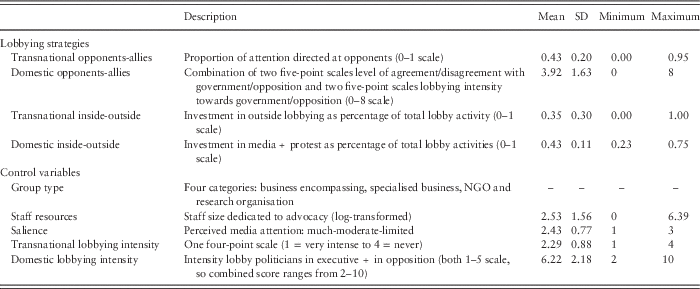
Note: For opponents-allies, a low score means more lobbying of allies, and a high score means more opponents; for inside-outside, a high score means more outside lobbying, and a low score means more inside lobbying. NGO=Non-Governmental Organization.
For the first set of dependent variables – namely, those that concern a lobbyist’s relative focus towards allies or opponents – the variable at the international level was created from the answers to the following question about the one issue that the respondents indicated they were primarily interested in:
On this issue could you indicate which percentage of your advocacy efforts were dedicated to like-minded policymakers, policymakers who did not decide yet, and policymakers who opposed your views?
For instance, an interviewee might indicate that his or her organisation focussed 75% of its efforts on like-minded policymakers, 15% on uncommitted policymakers and 10% on policymakers with opposing views. This way we could measure the extent to which interest groups focussed on allies or opponents (see Beyers and Hanegraaff Reference Beyers and Hanegraaff2014). As we are interested in the relative focus on allies and opponents, from these results we constructed a proportional scale between 0 and 1 that weighs the inclination to lobby allies in relation to lobbying opponents. More precisely, we developed an index in which the proportion of the time that like-minded policymakers were lobbied was subtracted from the proportion of time the lobbyist targeted opponents. We rescaled the index to a proportion by adding 1 and dividing the result by 2, which gives a measure of the proportion of opponents lobbied relative to allies. Hence, a lobbyist scoring higher than 0.50 spends more than half of its resources on opponents, whereas scoring lower than 0.50 means that the lobbyist spends most resources on allies. To give an example, a lobbyist who responded that he or she spent 60% of his or her lobbying efforts on like-minded legislators, 20% on uncommitted legislators and 20% on opponents received a proportional index of 0.30 or
 $${{(0.20\,{\minus}\,0.60){\plus}1} \over 2}$$
.
To measure a lobbyist’s relative focus on allies or opponents at the domestic level, we combined the answers to four questions.Footnote 2 To calculate the extent to which groups lobby allies or opponents, we compared the level of agreement of groups with the government and the opposition, and the intensity with which they lobbied each. To give an example, if a lobbyist indicated to completely agree with the position of the government (a score of 1) and lobbied the government intensely (a score of 1), the interest group gained a score of 0 referring to a high propensity to lobby allies. In contrast, if interest groups completely disagreed with their government (a score of 5), yet lobbied these actors intensely (a score of 1), they received a score of 4, indicating a very high propensity to lobby opponents in government. Likewise, we compared the level of agreement of each lobbyist with the policy position of opposition parties and the intensity with which they lobby these actors. After this, we added up both scores, which provided us with a scale from 0 to 8.Footnote 3 The lower the score, the stronger the relative focus on friendly lobbying and vice versa.
The second dependent variable concerns the relative use of inside or outside lobbying in the international and the domestic setting. For the international level, this variable is measured with the following question, again about the one issue that the respondents indicated that they were primarily interested in:
On this issue could you indicate which percentage of your advocacy efforts were dedicated to in- and outside strategies?
For instance, a lobbyist could indicate that he or she focussed 75% of his or her efforts on inside strategies and 25% on outside strategies. The answer to this question provides us with a relative assessment of the use of inside and outside lobbying at global diplomatic conferences, where the amount of inside lobbying is given as a proportion of the total lobbying activities (i.e. relative to the use of outside lobbying). Thus, the higher the score, the more a lobbyist uses outside lobbying; the lower the score, the more a lobbyist relies on inside lobbying.
For the relative use of inside and outside lobbying at the domestic level, we calculated the inclination to use outside lobbying as a proportion of the total lobbying efforts at the national level. The tendency for outside lobbying was constructed by combining the Likert items for two variables – namely, the extent to which media and protest strategies were used (ranging from 1 meaning “very often” to 5 meaning “never”). Total lobbying effort was constructed through an additive index of questions on the use of four strategies, including, next to media and protest activities, the intensity of lobbying politicians in government and the intensity of lobbying politicians who represent opposition parties (applying the same five-point Likert items). Dividing the outside lobbying efforts by the total lobbying efforts provides us the relative use of outside lobbying in the domestic context. As for transnational lobbying, the higher the score, the more the relative focus on outside lobbying and vice versa.
Our main independent variable is whether a lobbyist originates from Europe or the US; in total, we interviewed 77 lobbyists from Europe and 37 lobbyists from the US. To make sure that our observations are robust, we added some control variables, which the literature has identified as potentially relevant for explaining variation in lobbying strategies. These control variables are related to both organisational and issue characteristics. First, we have a measure for organisational type. We distinguish between specialised business groups, encompassing business associations, Non-Governmental Organizations (NGOs), labour unions and research organisations. Specialised business groups defend the interests of product-level economic sectors, whereas encompassing business groups represent multiple economic sectors (Bouwen Reference Bouwen2004; Binderkrantz Reference Binderkrantz2005; Kriesi et al. Reference Kriesi, Tresch and Jochum2007; Mahoney Reference Mahoney2007a; Dür and Matteo Reference Dür and Mateo2013; Beyers and Hanegraaff Reference Beyers and Hanegraaff2014). To differentiate between these two types of business organisations, we coded all organisations according to the ISIC classification system. Organisations representing issue areas that corresponded with ISIC levels 3 or 4 were coded as specialised business organisations, whereas organisations coded at the ISIC 1 or 2 levels were categorised as encompassing business associations.Footnote 4 In addition, NGOs were coded by considering the broad areas they are active in and how these organisations brand themselves. Labour unions are groups that defend the interests of workers, either generally or in specific economic sectors; these were also coded based on the ISIC classification. The research organisations we came across in our sample were primarily funded by governments (or leading political parties) and their basic goal was to build and disseminate knowledge regarding a certain topic. In total, we relied on the interviews with representatives from 39 business organisations, 52 NGOs and 23 research organisations. Second, we controlled for the amount of resources interest groups have (Eising Reference Eising2007; Mahoney Reference Mahoney2007a; Dür and Mateo Reference Dür and Mateo2013). To measure the resource endowment of organisations, we asked the lobbyists the number of staff their organisations employed for advocacy and public affairs purposes. Owing to a skewed distribution, we log-transformed this variable. Third, we included a measure of perceived issue salience. For this, we asked the respondents to indicate whether the issue gained (1) strong, (2) medium or (3) weak attention in the national media (Kollman Reference Kollman1998; Holyoke Reference Holyoke2003; Culpepper Reference Culpepper2011; Hanegraaff et al. Reference Hanegraaff2016).
Finally, one might expect that lobbying styles depend on the intensity of the lobbying efforts or the overall propensity with which lobbyists contact policymakers. The directness of the lobbying strategies might be reflected by the fact that more opponents are targeted or that lobbyists seek more public attention (Bouwen Reference Bouwen2004; Eising Reference Eising2004, Reference Eising2007; Dür and Mateo Reference Dür and Mateo2013). We controlled for this with the following questions. For the international level, we asked the following question:
At this conference, do you often, regularly, occasionally, or never advocate for the issue of concern? (answers range from 1 to 4).
The answers provided us with an ordinal score, where a lower score refers to more intensive lobbying activities, and a higher score refers to less intensive lobbying activities. For the domestic context, we combined the results of two interview questions – namely, those pertaining to the intensity of contact with government actors and opposition policymakers. For these variables, we have five-point Likert items, where a lower score indicates more intensive lobbying and a higher score refers to less intensive lobbying. To come up with one measure, we added the values of both indicators. For instance, if a lobbyist indicated that he or she focussed intensely on government actors (score of 1) and never on opposition parties (score of 5), then the overall intensity had a score of 6. The method provided us with a scale ranging from 2 (1+1) to 10 (5+5). As for lobbying intensity at the transnational level, a lower value indicates more intense lobbying, whereas a higher value indicates more limited lobbying.
Data analysis
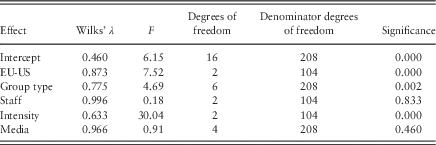
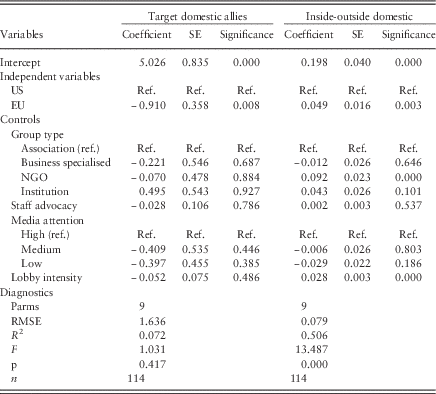
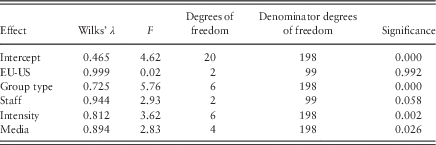
We used a multivariate analysis of variance (MANOVA) to examine our hypotheses. MANOVA is an ideal approach because the dependent variable – “lobbying style” – is not being directly observed, but is measured through two indicators that are the dependent variables in our models. A particular lobbying style is conceived as a latent variable that explains variation in the usage of specific lobbying strategies, particularly outside/inside lobbying and lobbying opponents/allies. This implies that, in modelling the effect of each independent variable, MANOVA controls for the correlation between the two dependent variables (for more details on this technique, see Tacq Reference Tacq1997, 345–354). As we aimed to compare this lobbying style at the domestic and the transnational level, we provided two multivariate analyses: one for the domestic level and one for the transnational level. In this way, we tested whether or not European and US groups act differently or similarly at domestic and transnational political venues.Footnote 5 Tables 3 and 4 provide the results of the multivariate analysis for the domestic level and Tables 5 and 6 show the results for the transnational level.
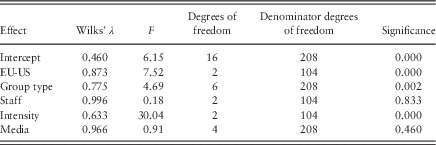
Multivariate analysis of variance results: domestic lobbying
Note: EU=European Union; US=United States.
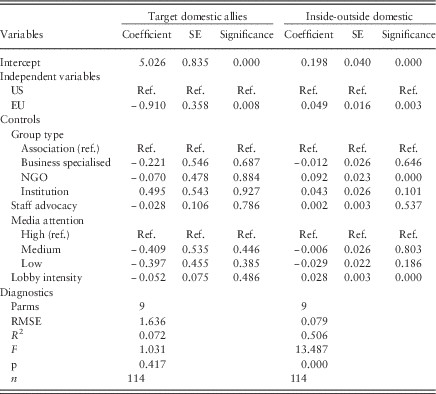
Analysis of variance: domestic lobbying
Note: US=United States; EU=European Union; RMSE=root mean square error.
Multivariate analysis of variance results: transnational lobbying
Note: EU=European Union; US=United States.
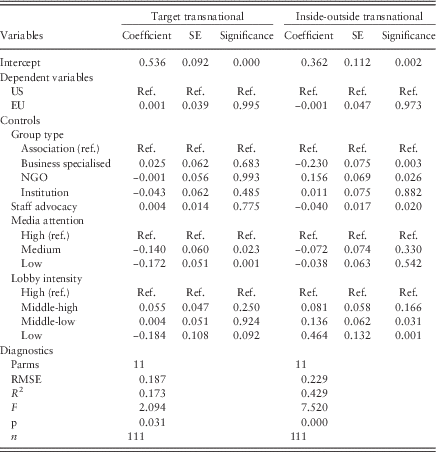
Analysis of variance: transnational lobbying
Note: US=United States; EU=European Union; RMSE=root mean square error.
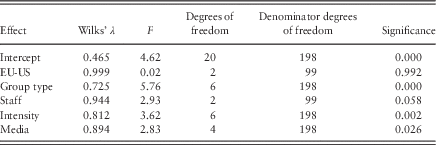
We start with the findings for the domestic level. The results show that, as expected, at the domestic level, European and American lobbyists clearly act in a different way. Table 3, first, provides the results of the multivariate analysis. The results show that the lobbying strategies at the domestic level can in part be explained by the domestic sphere the lobbyists come from (see the Europe-US variable in Table 3). Furthermore, we explored the different individual variables to test for the between-subject effects and the separate regression coefficient of each dependent variable. The results of these tests are reported in Table 4. Again, in line with previous studies, the findings clearly confirm that European and US lobbyists use different strategies at the domestic level (Thomas Reference Thomas2004; McGrath Reference McGrath2005; Mahoney Reference Mahoney2007a; Mahoney and Baumgartner Reference Mahoney and Baumgartner2008; Thomas and Hrebenar Reference Thomas and Hrebenar2009; Woll Reference Woll2012). First, the results show that the European lobbyists indeed relied less on outside lobbying than the US lobbyists when operating at home and that these differences are statistically significant. Second, the European lobbyists focussed more on their allies, whereas the US lobbyists paid more attention to their opponents, which is again consistent with the literature (Milbrath Reference Milbrath1963; Zeigler Reference Zeigler1964; Dexter Reference Dexter1969; Kollman Reference Kollman1997; Hojnacki and Kimball Reference Hojnacki and Kimball1998, Reference Hojnacki and Kimball1999; Baumgartner and Mahoney 2002; Hall and Deardorff Reference Hall and Deardorff2006; Mahoney Reference Mahoney2008; Beyers and Hanegraaff Reference Beyers and Hanegraaff2014). The results for other important predictors of lobbying strategies are also in line with previous research (see control variables). For instance, as expected, NGOs relied more on outside lobbying tactics, whereas salience increases the propensity of lobbyists to target legislative opponents. These results are important as they show that our data are consistent with the differences between European and US lobbyists that have generally been posited in the literature. It means that it is justifiable to use these results as a benchmark to study the lobbying strategies of European and US lobbyists when they operate in a similar context – namely, at international diplomatic conferences.
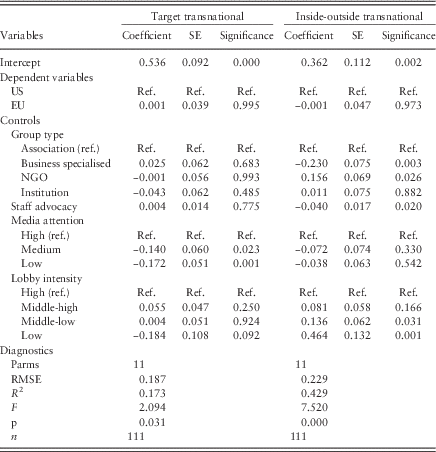
To see what strategies lobbyists use at international venues, we conducted a comparable multivariate analysis for which the results are reported in Table 5. The results show that the combination of two tactics – outside versus inside lobbying and lobbying opponents or allies – at international venues cannot be explained by the domestic origin of the lobbyists. We observe no meaningful difference between European and US lobbyists. To see whether these findings are consistent for both strategies (inside versus outside lobbying and lobbying allies or opponents), we explored the individual tactics to check the between-subject effects and regression coefficients of each dependent variable. These results are reported in Table 6.
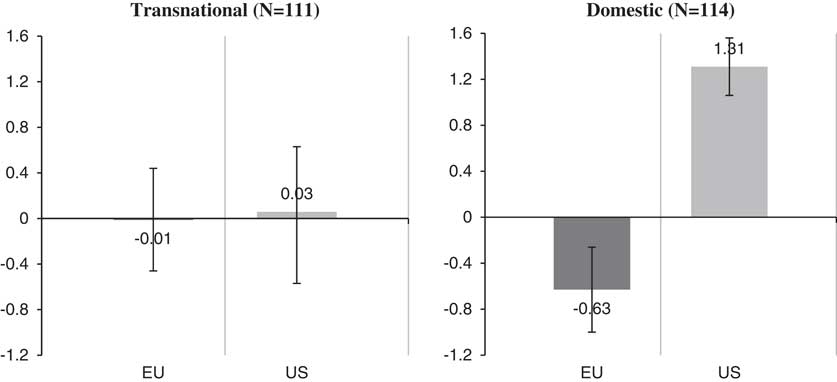
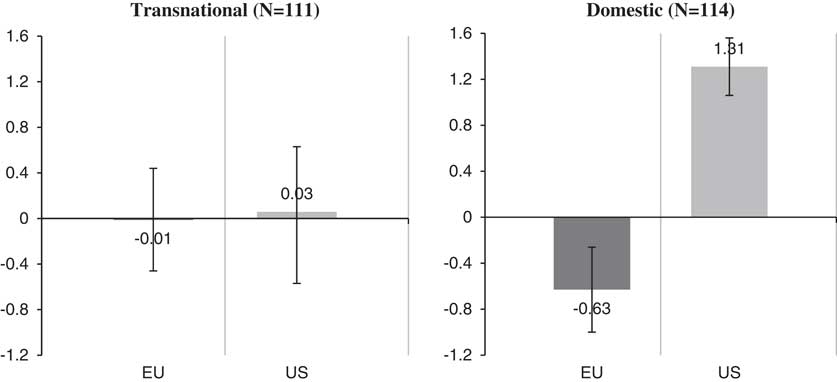
What are the main findings? We first looked at the relative importance of lobbying allies and opponents. To visualise the difference between the European and the American lobbyists, we standardised plotted predicted values regarding whom they are likely to target.Footnote 6 There is a substantial difference between European and American lobbyists concerning the strategies they deploy within their country of origin (the predicted outcome for American lobbyists is substantially higher compared with European lobbyists). As indicated by the insignificant regression results (see left figure), this difference disappears when these lobbyists become active at a similar venue (moreover, the slight effect we observe is even in the reversed direction). Although there is hardly a difference between American and European lobbyists at the transnational level, at the national level, American lobbyists score 1.6 SDs above the average (0), whereas EU lobbyists scored 0.6 SDs below the average. Combined, these results provide support for the institutional hypothesis, as lobbyists seem to adjust their lobbying strategies – in terms of whether or not they address allies or opponents – to the institutional setting in which they operate (see Figure 1).
Standardised predicted values (y-axis) lobbying allies and opponents Note: A high score indicates more lobbying of opponents; a low score indicates more lobbying of allies; 95% confidence intervals. EU=European Union; US=United States.
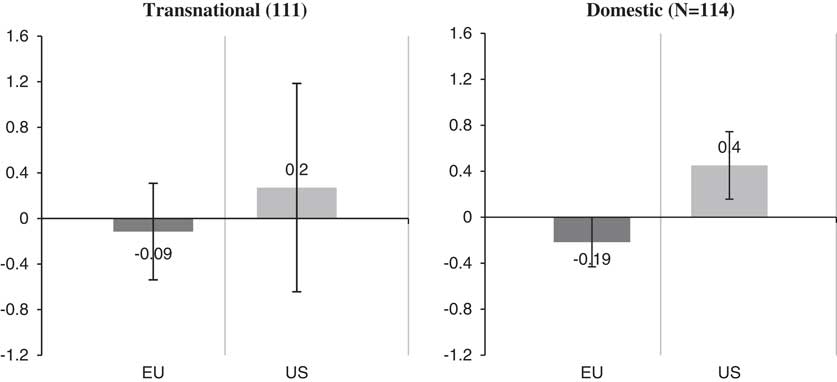
For the relative focus on inside and outside lobbying, we observe a similar pattern. Although we saw substantial and significant differences between the use of inside and outside lobbying tactics domestically, these differences disappear completely at international venues. In other words, at the global diplomatic conferences, and controlling for other potential factors influencing the varying use of lobbying strategies, European and US lobbyists develop a highly similar approach regarding the use of inside and outside tactics. To visualise this effect, we again plotted the predicted values (see Figure 2). In the left figure, we plotted the use of inside and outside lobbying at global diplomatic conferences and we observed no statistically significant difference. In contrast, the right panel plots the domestic relative use of these strategies and shows a clear statistically significant difference between Europeans and Americans.
Standardised predicted values (y-axis) lobbying inside and outside Note: A high score indicates more outside lobbying; a low score indicates more inside lobbying; 95% confidence intervals. EU=European Union; US=United States.
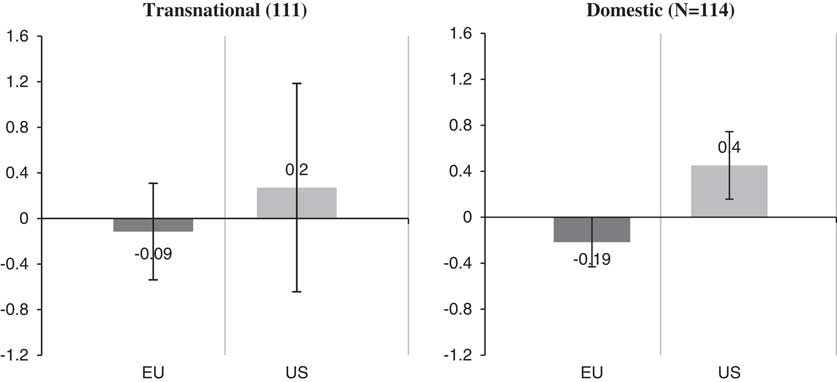
At first sight, when looking at the raw predicted values, one might conclude that the difference between European and American lobbyists is, despite being significant, not overly large. For instance, the predicted outcome – on a scale ranging from 0 to 1 – for European lobbyists is 0.41 and for the Americans 0.46. Note also that, on average, both European and American lobbyists are targeting allies more than opponents and they both use more inside lobbying. Yet, this difference is the net effect of the country of origin on the relative use of inside versus outside lobbying. Despite these aggregate similarities, there are statistically significant and meaningful differences at the lower ends of the scale. When we consider the standardised predicted values, we observed that, at the lower ends of the scale, there are substantial and meaningful differences between outside and inside lobbying at the domestic level compared with the transnational level. The predicted difference between American and European lobbyists is 0.29 SDs at the domestic level, whereas this difference increased to 0.59 at the transnational level (see Figure 2).
Nonetheless, when relying uncritically on significance tests, we might run the risk of erroneously accepting our hypotheses (a so-called type I error). To further check for robustness, we conducted two linear regressions (one for each dependent variable) in which we bootstrapped the analyses (see Online Appendix 1A). The bootstrapping tests the same model for n=1,000 randomly created data sets (n=1,000) and computes the statistics for each data set. All in all, these results point out that our results are robust, as in each model the level of significance remains the same.Footnote 7 Combined, these results, again, give support to the institutional hypothesis – namely, that European and American lobbyists adapt their lobbying strategies to institutional circumstances.
Conclusion
Existing differences between European and American lobbying styles are usually ascribed to either cultural or institutional differences. In the first case, varying lobbying styles are explained by pointing to distinct and deeply rooted political cultures. In the second case, differences in lobbying styles are deemed to result from the institutional context within which lobbyists operate. Identifying whether it is a matter of culture or institutions has proved problematic, as both cultural and institutional explanations are usually consistent with the observed outcomes in research designs that focus predominantly on lobbying within Europe or the US. This article has sought to overcome this problem of observational equivalence by comparing how European and American lobbyists behaved both in domestic and in international settings. With this strategy, we were able to ascertain whether existing differences in how lobbyists behave in their respective political systems were also present at international institutional venues, and thus to assess institutional and cultural explanations for differences in lobbying practices across the Atlantic.
Our analysis shows that European and American lobbyists are inclined to strategically adapt to the institutional context within which they operate (Greenwood Reference Greenwood2003; Mahoney Reference Mahoney2008; Woll Reference Woll2012). Considering two possible dimensions of lobbying strategies, each representing a critical dimension that characterises the American and European lobbying styles, we found that transatlantic differences are not reflected in how European and American lobbyists operated at the 2012 WTO Ministerial Conference and at the 2011 and 2012 UN Climate Summit. These results are clearly inconsistent with a cultural explanation, which suggests that lobbying styles are deeply ingrained and, therefore, should remain fairly constant and unmalleable, even if there is a sudden shift to another political venue. Our findings are, therefore, more consistent with an institutional explanation, which presumes that changes in specific institutional conditions will result in distinct lobbying styles.
We acknowledge that further research could address some of the limitations of this study. For instance, although our operationalisation of lobbying style is consistent with previous research (Broscheid and Coen Reference Broscheid and Coen2003; Mahoney Reference Mahoney2008; Woll Reference Woll2012), a more nuanced and fine-grained measurement of lobbying strategies could highlight important differences in the ways in which EU or US lobbyists interact with opponents or allies (e.g. more or less cooperatively) or the types of claims they advance through inside or outside strategies (e.g. more or less radical). Moreover, other lobbying strategies, such as the propensity to operate alone or through networks and coalitions (Mahoney Reference Mahoney2008; Woll Reference Woll2012), could be usefully taken into account when analysing lobbying styles across the Atlantic. Our current data set does not allow us to compare these aspects at both the international and the domestic levels, and we therefore encourage further studies to expand on our work. Yet, despite these limitations, the outcomes of the lobbying strategies we analysed are quite unambiguous. American and European lobbyists behave very differently when they are at home, but their lobbying styles converge when they shift to the same institutional venues. We, therefore, deem an institutional explanation to be more powerful and plausible than a cultural one.
Several important implications of our analysis deserve attention. First, the results show the stringent effect of the institutional context on the behaviour of interest groups. Although the differences between the styles of European and American lobbyists at home are widely documented, interestingly, these differences seem to dissipate when these lobbyists start operating in the same institutional context (which is distinct from the respective national contexts). This is an important finding as it reflects on a long-lasting puzzle about the effects of institutional adaptation and cultural restraints in lobbying practices (Mahoney Reference Mahoney2008; Woll Reference Woll2012). Second, our findings also indicate the usefulness of developing a more general conceptual toolkit to explain and compare the behaviour of interest groups across countries and political systems. Clearly context matters a lot, but this does not mean that lobbyists or interest groups are prisoners of a specific and idiosyncratic context. On the contrary, lobbyists are flexible and adapt their advocacy strategies to the institutional context in which they operate (Lowery 2007; Lowery et al. 2008).
Our analytical findings also have some relevant real-world implications. If it is true that the institutional context matters more than profound national cultures, then we can expect that the increasing interaction of lobbyists with a different national background at similar international fora may, after a while, engender a gradual convergence in lobbying practices and tactics. The (in)compatibility of lobbying styles might be a critical factor in shaping the likelihood of success of the growing number of regulatory initiatives in which the EU and the US are currently involved. For instance, the ongoing negotiations for the conclusion of a Transatlantic Trade and Investment Partnership are just one example of such an international regulatory cooperation. Ascertaining whether institutions or culture affect lobbying styles is relevant in order to assess whether the creation of a new venue for transatlantic cooperation can be expected to engender similar patterns of state-society interactions across the Atlantic and how they may affect the nature of these regulatory initiatives. If fundamental differences in lobbying styles would persist, this may affect the prospect of transatlantic regulatory cooperation negatively.
Acknowledgements
The research content presented in this article was made possible by the Research Foundation-Flanders (FWO) (Odysseus Programme, project number G.0908.09). More specifically, the authors thank their respondents for their willingness to take part in the survey. In addition, we acknowledge the research assistance of Tom Donas, Iskander De Bruycker and Bert Fraussen who helped us with conducting the interviews. Arlo Poletti acknowledges funding received from the FWO (postdoctoral research award, grant number 6098/12C7415N).
Supplementary material
To view supplementary material for this article, please visit http://dx.doi.org/10.1017/S0143814X16000052