Disasters are considered a major global problem, threatening human health and well-being and seriously threatening sustainable development in most countries. Both natural and man-made hazards have various effects that, in addition to injury and illness, loss of life, and destruction of property and assets, cause social and economic disruptions, destruction of infrastructure and human services, and damage to the environment.Reference Peyravi, Marzaleh and Khorram-Manesh 1 In recent years, the occurrence and severity of disasters have increased. Iran is a high-risk area and considered the eleventh-most country prone to different kinds of natural hazards worldwide. Earthquakes, floods, and drought are the most common disasters in Iran.Reference Guha-Sapir, Hoyois and Wallemacq 2
Some of the worst damage caused by disasters, after life injuries, is the damage to health infrastructure, such as hospitals and health centers; this limits access to health care services and medical care. After disasters, the need for health services in disaster-stricken areas increases sharply. However, the expert staff and required resources ratio are insufficient compared to the number of victims and injured people.Reference Han, Liang and Jiang 3 –Reference Loewen, Pinchoff and Ngo 5
One of the most vulnerable groups in the case of disasters is women, who tend to survive disasters more frequently than men. Low incomes, limited facilities, the responsibility for taking care of children and family members, special nutritional needs during breastfeeding and pregnancy, limited ability to move during pregnancy, and biological and social differences are the main causes of vulnerability in women during disasters.Reference McQuilkin, Udhayashankar and Niescierenko 6 , Reference Bahmanjanbeh, Kohan and Yarmohammadian 7 According to related reports, more than 30% of disaster-stricken women populations are of reproductive age (15-49 years). In addition to physical injuries, women are exposed to other adverse health factors. Women need frequent visits to public health centers during pregnancy, after giving birth, breastfeeding, and taking care of the baby.Reference Watanabe, Iwama and Nishigori 8 , 9 Natural disasters can affect women’s reproductive health (RH) through various mechanisms, including limited access to reproductive and sexual health services; pregnancy and childbirth care services; counseling and family planning services; midwifery services for women of childbearing age, childbirth and postpartum; and limited access to transportation services for receiving the health care mentioned.Reference Loewen, Pinchoff and Ngo 5 , Reference Stephens and Lassa 10 However, RH services are not among the priorities of response to disasters, and this area has not received enough attention in recent years.Reference Bahmanjanbeh, Kohan and Yarmohammadian 7 Midwifery care should be carried out continuously to monitor the mother’s health, fetus, and newborn, and delay in diagnosing pregnancy problems, such as pre-eclampsia, bleeding during pregnancy, infectious diseases, and malnutrition, increases the risk to the fetus and mother’s health. It also limits access to family planning methods and increases unplanned pregnancy, abortion, and genital infection. Therefore, one of the necessary services required after disasters is reproductive health services. 9
In the studies related to RH in Iran, researchers have mainly focused on the negative effects of natural disasters on the affected people’s reproductive health. These studies often deal with RH indicators of affected women and their consequences, such as unplanned pregnancy rates, abortion rate, stillbirth rate, and access to contraceptives and usage status. In addition, the studies have mainly investigated psychological complications, physical injuries, sexual health, and fertility regulation after disasters;Reference Kohan, Yarmohammadian and Bahmanjanbeh 11 however, they have not studied the challenges and management interventions to provide RH services according to women’s needs based on culture, existing health infrastructure, population health, and type of disaster.Reference Sohrabizadeh, Jahangiri and Jazani 12 , Reference Sohrabizadeh 13 In general, in Iran, despite the negative effects of previous disasters on RH, little research has been done on the challenges of providing RH services after disasters.Reference Sohrabizadeh, Tourani and Khankeh 14 , Reference Sohrabizadeh, Jahangiri and Khani-Jazani 15
Identifying post-disaster RH challenges can help us understand how to reduce adverse health effects, improve quality of life, improve the performance of post-disaster RH systems, and better prepare for future disasters. Another noteworthy point is that Iran has cultural diversity. It is one of the most culturally diverse countries in the world, including the Azeri, Kurds, Ler, Baluch, Fars, etc. We have several cultures with very different beliefs. A sensitive topic like reproductive health has different meanings in different cultures. According to this, the RH inference between different ethnicities is very diverse in such countries and exploring it and finding relevant knowledge may be applicable to other multicultural countries. Based on this, we conducted the current study with the aim of examining the RH status after disasters, negative factors affecting the reproductive health of women, and related challenges in Iran by systematic review method.
Methods
This systematic review was undertaken based on the guidelines of the Preferred Reporting Items for Systematic Reviews and Meta-Analyses (PRISMA) in the field of post-disaster reproductive health in Iran.Reference Moher, Shamseer and Clarke 16 Therefore, searching for articles in scientific databases, selecting articles, evaluating the quality of articles, and extracting data were done by 2 individual researchers independently.
Searching for Studies
Searching for articles in the international scientific databases of Web of Science, PubMed, Scopus, and Google scholar and the internal databases of Scientific Information Database (SID) and Magiran were done until May 2022. The keywords of woman, women, reproductive, female, reproductive health, family planning, contraceptive, pregnant, pregnancy, maternity, prenatal care, antenatal, birth, postpartum, breastfeeding, disaster, natural disaster, crisis, earthquake, flood, and Iran were searched in the title, abstract and full text of the articles individually and together using OR and AND operators.
Inclusion and exclusion criteria
Based on the PICO model, we reviewed the Persian and English articles related to RH in women exposed to disasters in Iran (registered disasters in national or international databases). From the total of these studies, those that investigated various aspects of RH including menstruation, pregnancy, reproductive health services in disasters, and related challenges were selected. Then, the quality of the selected articles was checked and the ones of good quality were included in the study. Studies that were not in the field of disasters or reproductive health or were conducted on specific populations, such as the population living in camps or displaced persons, articles that lacked the desired quality, review studies, case reports, and letters to the editor were excluded from the study.
PubMed syntax search

Google Scholar syntax search

SCOPUS syntax search

Quality assessment of articles
The quality assessment of the articles was done based on 22 parts of the STROBE (Strengthening the Reporting of Observational Studies in Epidemiology) checklist, which examines observance of the principles of writing and implementation in the title, the method of reporting findings, limitations, and conclusions. A score was assigned to each part of this checklist based on its importance; the maximum possible score is 33. In this study, a score of 20 was considered acceptable.Reference Von Elm, Altman and Egger 17
Data extraction
Initially, the articles were scrutinized by 2 researchers independently by examining the title and abstract, considering the inclusion and exclusion criteria. Then, the full text of the articles was examined by these 2 individuals, and if both rejected the articles, the reason was mentioned. In case of disagreement between them, the article was refereed by a third person. Data extraction was done using a previously prepared checklist that included the corresponding author’s name, study location, study time, sample size, and study type.
Selection of studies
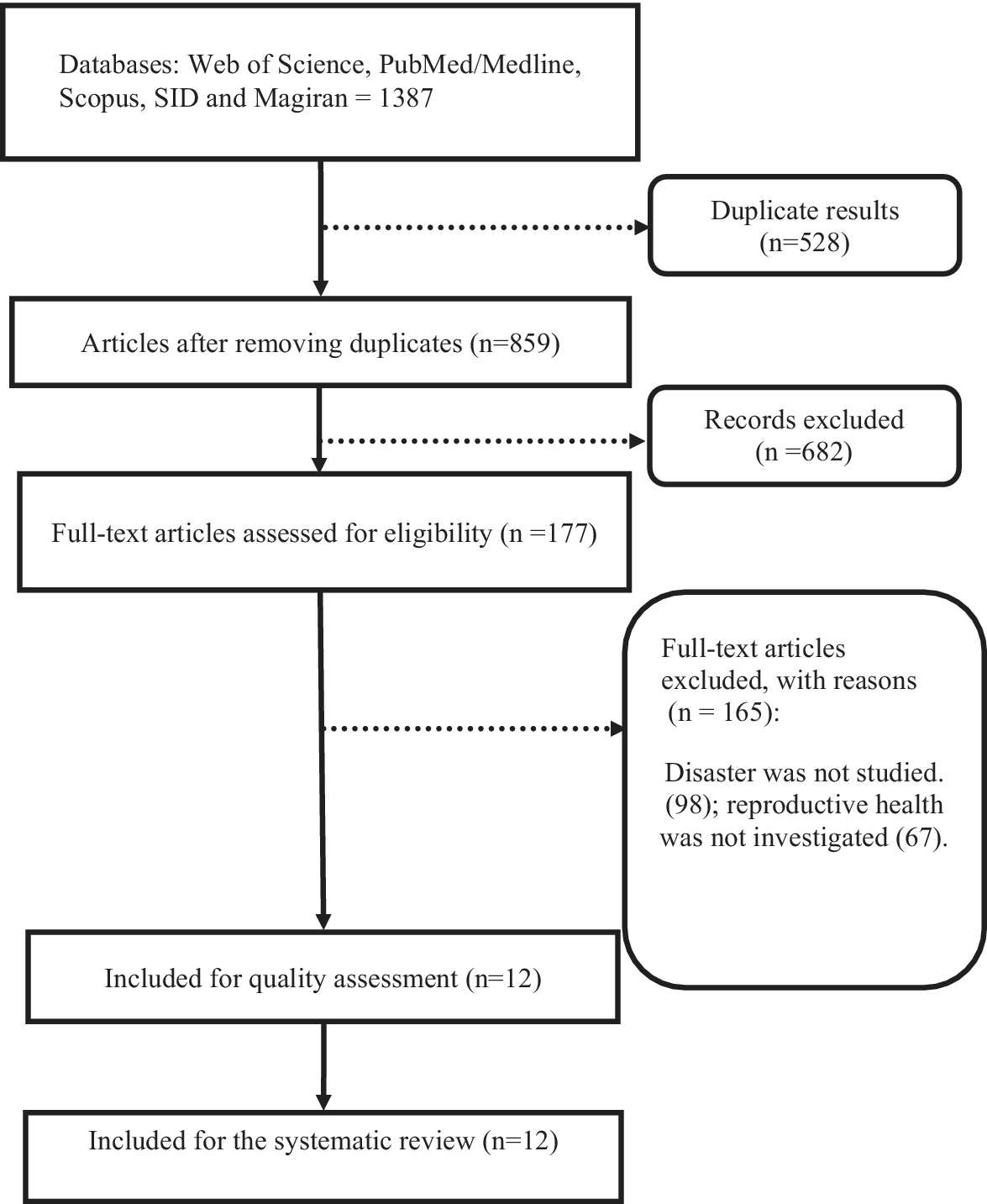
1387 studies were extracted by searching the databases. Initially, the articles were entered into the Endnote software, and after the first review, 528 articles were excluded from the study due to duplication. Then, by examining the titles and abstracts of the studies, 682 articles were excluded due to their irrelevance, and after reviewing the full text of the articles, 165 articles were removed because they were not examining reproductive health or the occurrence of disasters. Finally, 12 articles met the inclusion criteria and were included in the systematic review process (Figure 1). Analysis of articles was done using the qualitative content analysis methodReference Graneheim and Lundman 18 to explore challenges related to post-disaster reproductive health in Iran.
The PRISMA flow diagram.

Results
This systematic review was conducted incorporating 12 articles spanning from 2011-2019, each contributing valuable insights to the understanding of post-disaster reproductive health challenges.
The meticulous evaluation of study quality revealed that 8 of the reviewed articles demonstrated a high level of rigor, while 4 fell within the category of medium quality. This discernment regarding the quality of the studies serves as a critical foundation for the subsequent analysis and interpretation of findings. For comprehensive insight into the nature of these studies, Table 1 provides a detailed presentation of the characteristics inherent in each of the reviewed articles.
Characteristics of the articles included in the systematic review

The investigation into the post-disaster reproductive health challenges faced by Iranian women, as outlined in this systematic review, illuminates a multifaceted landscape of impacts on various aspects of reproductive health. The synthesized findings offer a comprehensive understanding of the repercussions that disasters, particularly earthquakes, impose on women’s reproductive well-being. Through an exploration into the factors influencing reproductive health post-disasters, this investigation has discerned 2 primary categories of factors: individual factors and management factors.
Individual factors related to reproductive health
In the realm of individual factors, challenges affecting reproductive health included: physical injuries and illnesses before or during disaster; emotional impact and mental disorders caused by disaster due to family member or livelihood loss; imposing excessive work on women such as taking care of children and doing housework in a small and inappropriate space; and cultural and religious factors that cause shame to express women’s diseases and problems. In such situations, a woman’s condition can endanger the family’s cohesion due to their important role in the family. Family separation may occur due to death, hospitalization, physical injuries such as spinal cord injury, and psychological effects such as depression, which, in some cases, leads to family destruction, men’s remarriage, and women’s inability to reproduce. In contrast to these factors, at the social level, ability to communicate with the community, strengthening the emotional spirit, and returning to their job improved women’s reproductive health.
In terms of physical health, the women faced with the earthquake had physical injuries or physical weakness that limited their activities. In addition, underlying diseases such as high blood pressure and migraine had increased in affected people, which led to dependence on other people and affected their reproductive health; some of these women were recommended to not get pregnant. In addition, lack of access to health and medical services was a serious problem for women. Inappropriate living conditions after the earthquake exposed women and children to illness, death, irregular menstruation, and unwanted pregnancy.
In this regard, menstrual disorders, reproductive system problems, physical problems, mental disturbance, mental preoccupation, the feeling of failure, fear and anxiety, fatigue, helplessness, and loneliness were effective on women’s menstrual problems. Considering local cultural beliefs, women and girls sought to hide menstrual problems due to unfavorable attitudes and behavior and the lack of cooperation of mothers with girls due to shame. Consequently, negative attitudes toward menstruation lead to ignorance of menstrual problems.
Concerning mental health, most women exposed to the earthquake experienced psychological disorders, including fear, anxiety, and depression. Death of loved ones, fear of experiencing another earthquake, loss of home and property, and sacrificing one’s life to save the children were among the factors that influenced women’s mental health to the point where they could not even think about their reproductive health.
Considering the field of reproductive health, the needs and priorities of women’s fertility and breastfeeding were not evaluated and prioritized after the earthquake. Some personal factors that affect breastfeeding after disasters included: maternal factors (physical factors, such as inadequate nutrition and physical injuries, and psychological factors, such as depression, fear, and anxiety caused by the aftershock or another earthquake; lack of self-efficacy to take care of the baby; neonatal factors (child’s injury or underlying diseases); and factors related to the socio-cultural context (lack of private environment, insufficient support from other family members, and the excessive burden of work on the mother to take care of other family members).
Studies showed that not paying attention to these matters affects fertility, contraceptive services, and fetal and neonatal complications such as stillbirth, abortion, low birth weight and premature birth, menstrual disorders, and the spread of sexually transmitted diseases. As a result, there is a need to provide services related to RH according to the mentioned challenges above. In addition, RH facilities, such as planned services, counseling, appropriate trained human resources, etc. should be provided.
Management Factors Related to Reproductive Health
We find that management factors play the main role in post disaster reproductive health because women in disaster-stricken areas have been exposed to all kinds of damage and do not have enough facilities and resources to deal with this situation. Reproductive health services, pregnant women care, sanitary equipment for women, privacy, antenatal care, emergency obstetric care, and family planning services were often unavailable due to management challenges. Shortage of sanitary items and menstrual counseling during disasters; ignoring the priority of providing services to women; inappropriateness of women’s access to bathrooms; lack of female personnel and female specialists; lack of counseling program to control fear, anxiety, stress, and mental disorders; inefficient management attitude; and men’s dominance during disasters have been mentioned as other factors that have originated from management challenges.
In the Iranian context, women tend to discuss their reproductive problems with female health care providers. However, providing services by male personnel prevented women from talking about reproductive health issues such as pregnancy, menstrual disorders, sexually transmitted diseases, and contraception. In addition, Iranian women were not adequately educated about reproductive health challenges after disasters, including sexual violence and sexually transmitted diseases. Also, men’s reproductive health, which plays an important role in managing women’s reproductive health, such as pregnancy, abortion, and violence, is not seen.
Based on our findings, lack of systematic RH need assessment after disasters, not allocating enough money for women’s needs, the absence of women in managerial roles to deal with disaster risk management, and prioritizing men’s rescue as the rescued men can help to rescue other people, are some of factors that affect the women’s vulnerability in the face of disasters. Insufficient presence of human resources in the field of reproductive health, such as midwives and lack of training of rescuers in taking care of pregnant mothers and newborns, are considerable. Also, lack of planning to provide reproductive health services caused health service providers to engage in unrelated work. In most disaster-stricken areas, the inappropriateness of the services and programs affected women’s reproductive health and caused many problems. For example, widespread and unmanaged distribution of powdered milk in the affected areas led to encouraging mothers to feed newborns with powdered milk and it decreased breastfeeding.
Finally, the managerial challenges above have been categorized into 6 groups: ignoring cultural factors, lack of planning, lack of training, insufficient data collection, ignoring men’s reproductive health, and lack of monitoring systems.
In general, management in planning, prioritization, procurement, and provision of services is essential in ensuring reproductive health. We find that there is a need to review the management principles of responding to disasters in the field of reproductive health in order to prioritize actions such as training midwives, using female doctors and gynecologists, and providing health services and sanitary items by health centers, which leads to improving the RH in disasters. In the provision of reproductive health services from a managerial point of view, attention should be paid to the availability of services, the suitability of services based on needs, the cost of services, and cultural and social factors.
Discussion
This systematic review study investigated reproductive health in disasters and its related factors in Iran. Based on the findings, factors related to reproductive health were categorized into individual factors and managerial factors in response to disasters. Regarding individual factors, the first case was that women had suffered physical injuries due to exposure to disasters, disrupting their performance, while they were also responsible for taking care of other family members. The second case was related to mental disorders and illnesses caused by the death of loved ones, injuries to other family members, loss of home and shelter, and loss of property and assets, while inappropriate living conditions, such as place of residence and lack of facilities, affected this aspect. The third factor was the culture and beliefs ruling the region, which led to the shame of women from being among men, going to a male doctor, and expressing fertility problems and other problems related to females. Decreasing the fertility rate after disasters is considered an influential factor concerning disasters. Studies have shown that after disasters, women did not want to get pregnant due to physical and mental damage, lack of suitable living space, and insecurity, and women even mentioned that they would terminate their pregnancy if they became pregnant.Reference Koyama 30 In line with the results of this study, the study by Liu et al. in China undertaken after the earthquake, 89.4% of women stated that they had no plans for pregnancy, and 67.1% stated that they would terminate it if they became pregnant.Reference Liu, Han and Xiao 31 One of the main reasons for the decrease in fertility was the lack of desire to engage in sexual activity after disasters so that in the earthquake-stricken areas that had multiple aftershocks with a longer interval, the fertility rate was reduced and then inclined with several months delay, the causes of which were mentioned to be insecurity.Reference He, Chen and Zhang 32 , Reference Zotti, Williams and Wako 33
A systematic review by Lee et al. noted that disasters lead to reduced fertility. Physical disasters had different effects in different populations and led to positive or negative effects on fertility, but in the outbreak of diseases and technological disasters, the effects were negative. One of the reasons was the short duration of physical disasters and the long duration of the spread of diseases and technological disasters, and that these effects were the same and negative with the passage of time after disasters even up to 5 years.Reference Lee, Batyra and Castro 34 However, the destructive economic effects were high in both types of disasters, which is one of the causes of fertility reduction after disasters.Reference Finlay 35 In other cases, physical and psychological damage caused by disasters can affect women’s fertility, and in cases where these damages lead to long-term effects, it can delay fertility in the long term.Reference Harville and Northland 36
The most important issues for women after disasters were the physical, mental, and health effects of the disaster. The rate of death, injuries, fractures, and mobility limitation in women was high, and these factors led to women’s dependence on other family members and reduced their quality of life.Reference Liu, Han and Xiao 31 , Reference Jacobs and Harville 37 Mental health is considered another challenge for women after disasters. Studies have shown that women experience fear, anxiety, stress, despair, and depression after disasters.Reference Watanabe, Iwama and Nishigori 38 , Reference Cénat and Derivois 39 On the other hand, women ignore their treatment for various reasons, such as the death of family members, poverty, and the huge burden of livelihood activities and taking care of other family members.Reference Drolet, Dominelli and Alston 40 Studies have mentioned that one of the factors affecting women’s mental health after disasters is social-economic problems.
Accordingly, social and economic support after disasters is one of the most powerful factors in improving women’s health.Reference Xu, Herrman and Bentley 41 In general, disturbing women’s health after disasters influences the well-being of all family members, especially children. So, improving mothers’ health and capabilities affects the health of other family members.Reference Drolet, Dominelli and Alston 40
In general, women are more vulnerable to natural disasters and apart from the role of gender, socio-economic factors including education, age, economic status, pregnancy, having children, and living environment affect the vulnerability of women faced with natural disasters. More importantly, the vulnerabilities caused by natural disasters are influenced by the physical and psychological changes of people and environmental changes and can affect women’s reproductive health in different ways.Reference Koyama 30 Based on this, there is a need to provide mutual services in the field of women’s reproductive health, taking into account their individual conditions, such as the type of disaster, living environment, damage status, living conditions, and social and economic conditions, so that women’s reproductive health can be improved after disasters.
The ability of women to recover, improve, and stabilize their situation and their family depends on the available facilities, welfare services, and health services available to them after disasters. As a result, managing services and prioritizing their distribution in response to disasters seem essential. The current study showed that management factors related to reproductive health, such as not prioritizing reproductive health in disaster response planning, not providing facilities and equipment needed for reproductive services, lack of female trained personnel among rescuers to provide services to women, lack of adequate and private space for women in temporary accommodations, the long distance from the place of reproductive services to women’s residence, and the lack of a suitable transportation system were the main factors affecting reproductive health. In the review study done by Stephens et al., who investigated the consequences and needs of reproductive health in disasters, they investigated gynecological disorders and childbirth and found pelvic inflammation and signs of sexual infection in women after facing disasters had increased compared to before the disaster. Women also mentioned decreased access to pregnancy prevention methods after disasters. This study highlights that destruction of infrastructure, interruption in service provision, increase in insecurity, increase in sexually transmitted diseases, insufficient budget, lack of female personnel, insufficient coordination between organizations, and political and legal obstacles were among the factors affecting sexual health after disasters.Reference Stephens and Lassa 10 In their review study, Loewen and colleagues examined post-disaster reproductive health in women in low- and middle-income countries. According to the findings, infrastructure damage was one of the most important challenges for women who needed access to reproductive health services after disasters, followed by a lack of trained staff, transportation, and equipment. It was also mentioned that after disasters, access to family planning services decreased, and unwanted pregnancies increased.Reference Loewen, Pinchoff and Ngo 5 In the study by Gribble et al., they investigated breastfeeding support in emergencies. They figured out that women need support to feed their babies with breast milk in emergencies because feeding with powdered milk endangers the baby’s health and requires significant financial resources. In addition to ensuring the health of the baby, feeding with breast milk is also effective for the mother’s health in terms of reducing postpartum bleeding and maternal anemia and preventing premature and unwanted pregnancy. However, mothers often undermine breastfeeding in emergencies due to the indiscriminate distribution of breast milk substitutes and lack of breastfeeding support. Thus, there is a need to protect the health and well-being of mothers and babies by controlling the distribution of breast-milk substitutes, and providing supportive environments, medical assistance, and practical training to breastfeeding women. Also, more cooperation between nutrition and reproductive health departments is necessary to promote breastfeeding in emergencies.Reference Gribble, McGrath and MacLaine 42 Mirmohammadali et al. divided the necessary components for the professional competence of midwives in response to disasters into 6 components, including safe pregnancy, safe childbirth, women’s health care, pregnancy prevention, violence, and sexually transmitted infections and taking care of the children. Accordingly, training midwives to respond to disasters in the field of reproductive health should focus on these 6 components.Reference Ie, Nasrabadi and Sohrabizadeh 43
Taghizadeh et al. investigated the professional competence of midwives in disasters. According to the findings, midwives’ professional knowledge and skills were insufficient during disasters, especially in managing mothers with chronic diseases and trauma, identifying women who need referrals, and stabilizing the condition of mothers during referrals.Reference Taghizadeh, Rad and Kazemnejad 44 In another study by Taghizadeh et al., who investigated the self-efficacy of midwives in disasters, the self-efficacy score of midwives was at an average level. Among the examined components, cooperation with the health service delivery team members and adaptation to psychological pressures in disasters, management of health service delivery in disasters, and assessment of women’s physical and psychological needs scored the least.Reference Taghizadeh, Kazem Nejad and Khoshknaz 45
Despite the difficult conditions after disasters, studies have shown that women have a high potential to help themselves and other family members. However, women are not safe from the effects of physical, mental, and economic damage, as well as damage to shelter and assets and insecurity. As a result, they need economic support, treatment, and services to recover. Therefore, providing services and care related to suitable housing, necessary equipment and facilities, and post-disaster health and treatment services is necessary to empower women after disasters. Ultimately, all these services can promote reproductive health.Reference Felmingham and Bryant 46 , Reference Ranse and Lenson 47
In general, in Iran, reproductive health services are not provided according to the needs of women after disasters. In the reproductive health services after disasters in Iran, there are various defects, among which we can point out the lack of equipment, lack of female specialists, lack of access to RH services and equipment, and lack of privacy. Based on this, it is necessary to pay attention to these issues in disaster risk management programs and provide services based on the needs of women and target groups to improve reproductive health, which is often neglected in disasters.
Limitations
There are some limitations regarding the current study. First, few studies have been conducted in Iran on post-disaster reproductive health. Second, previous studies have failed to examine all aspects of reproductive health. Third, most studies have examined earthquakes, while other disasters have not been investigated. Fourth, the studies’ sample size was small, and some were of low quality.
Conclusion
Based on the findings, individual factors and management factors including cultural factors, lack of planning, lack of training, insufficient collected data, ignoring various aspects of reproductive health, lack of monitoring of service delivery and injuries, and physical and mental diseases are factors related to reproductive health after disasters in Iran. As a result, there is a need to provide services according to the needs and conditions of the affected women, considering the above-mentioned cases, in order to improve the quality of reproductive health services after disasters. It is also recommended to conduct interventional or scenario studies to investigate the effects of the said interventions in a pilot form on exposed communities.
Considering the cultural diversity in Iran and the increase in immigration from developing countries to European countries and high-income countries, familiarization with the nature of reproductive health after disasters and its meaning in countries like Iran is recommended. This cultural diversity helps host countries to better manage migrant issues.
Competing interest
The authors declare no conflict of interest.