Introduction
Insects recognise many volatile odour compounds in the environment primarily via their olfactory sensing systems, which induce behaviours such as foraging, mating and oviposition (Birkett et al., Reference Birkett, Agelopoulos, Jensen, Jespersen, Pickett, Prijs, Thomas, Trapman, Wadhams and Woodcock2004; Pelosi et al., Reference Pelosi, Iovinella, Felicioli and Dani2014). The detection of olfactory compounds is a complex process involving numerous molecular actors, including odorant-binding proteins (OBPs), chemosensory proteins (CSPs), odorant receptors (ORs), sensory neuron membrane proteins (SNMPs) and odorant-degrading enzymes (ODEs) (Leal, Reference Leal2013; Wang et al., Reference Wang, Liu, Zhou, Yi, Pan, Wang, Zhang, Wang, Yang and Xi2018; Li et al., Reference Li, Xu, Yao, Yang, Dewer, Zhang, Zhu and Zhang2021).
OBPs and CSPs produced in the lymph of the chemosensilla play essential roles in the first step of information interpretation. In general, the entry of chemical signals into a sensillum is mediated by OBPs present at high concentrations (up to 10 mM) in the lymph between the dendritic membrane and the cuticular wall (Leal, Reference Leal2013; Pelosi et al., Reference Pelosi, Iovinella, Zhu, Wang and Dani2018a). OBPs and CSPs can perform the first filtering function in olfactory discrimination and ferry odorants through the sensillum lymph to the membrane of olfactory sensory neuron (OSN) dendrites (Fleischer, et al., Reference Fleischer, Pregitzer, Breer and Krieger2018; Pelosi et al., Reference Pelosi, Zhu and Knoll2018b). Then, odour molecules are transmitted to ORs to activate signal transduction (Leal, Reference Leal2013; Chen et al., Reference Chen, Pan, Ma, Wang, He and He2018). Eventually, odour molecules are inactivated by ODEs to maintain receptor activity (Wang et al., Reference Wang, Liu, Zhou, Yi, Pan, Wang, Zhang, Wang, Yang and Xi2018).
OBPs are small soluble globular proteins (10–30 kDa) with six highly conserved cysteine residues (referred to as C1−C6). Insect OBPs are divided into three categories according to their length, including long-chain (~160 aa), medium-chain (~120 aa) and short-chain (~110 aa) classes, which are related to their potential structure and function. CSPs are small, acidic, water-soluble proteins and are abundant in the lymph (Pelosi et al., Reference Pelosi, Zhou, Ban and Calvello2006, 2014). They are characterised by four cysteine residues forming two disulphide bonds (C1–C2 and C3–C4). These disulphide bonds in OBPs and CSPs form a hydrophobic pocket for ligand binding (Lagarde et al., Reference Lagarde, Spinelli, Qiao, Tegoni, Pelosi and Cambillau2011; Tsitsanou et al., Reference Tsitsanou, Drakou, Thireou, Gruber, Kythreoti, Azem, Fessas, Eliopoulos, Iatrou and Zographos2013). Many CSPs have been identified via genome and transcriptome analyses in several insect species (Zhang et al., Reference Zhang, Ye, Yang and Dong2014; Ingham et al., Reference Ingham, Anthousi, Douris, Harding, Lycett, Morris, Vontas and Ranson2020).
SNMPs can interact with OBPs and either serve as receptors for OBP-odour complexes or contribute to the offloading of odour molecules from OBPs in proximity to true odour receptor proteins (Fleischer et al., Reference Fleischer, Pregitzer, Breer and Krieger2018). SNMPs are protein homologues of the CD36 family, whose members have been proposed to be associated with odour detection because of their olfactory-specific expression and localisation within OSNs (Benton et al., Reference Benton, Vannice and Vosshall2007; Jin et al., Reference Jin, Ha and Smith2008; Vogt et al., Reference Vogt, Miller, Litvack, Fandino, Sparks, Staples, Friedman and Dickens2009; Pregitzer et al., Reference Pregitzer, Schubert, Breer, Hansson, Sachse and Krieger2012). SNMPs can be divided into the SNMP1 and SNMP2 subfamilies. The SNMP1 subfamily, which is specifically expressed in pheromone-specific OSNs, is mainly involved in pheromone sensing (Vogt et al., Reference Vogt, Miller, Litvack, Fandino, Sparks, Staples, Friedman and Dickens2009). SNMPs are essential for detecting pheromones in Drosophila melanogaster and the Hessian fly and for activating the pheromone receptor in Heliothis virescens (Benton et al., Reference Benton, Vannice and Vosshall2007; Pregitzer et al., Reference Pregitzer, Greschista, Breer and Krieger2014). However, the precise function of the SNMP2 subfamily is still poorly understood.
The rice water weevil, Lissorhoptrus oryzophilus Kuschel (Coleoptera: Curculionidae), is a noxious invasive insect that is listed as a quarantine species worldwide. The ability to survive for a long time under extreme conditions and the capacity for parthenogenesis contribute to the geographical expansion and rapid increase in populations of L. oryzophilus (Aghaee and Godfrey, Reference Aghaee and Godfrey2014). Root-feeding larvae hide in leaf tissue under water and are the main cause of damage to rice crops, potentially decreasing the yield by 25% in untreated rice (Chen et al., Reference Chen, Chen and Zhou2005; Yang et al., Reference Yang, Zhang, Wang, Wang, Pan, Zhang and Xi2018). Lissorhoptrus oryzophilus mainly feeds on aquatic and semiaquatic plants of the families Poaceae and Cyperaceae (Palrang et al., Reference Palrang, Grigarick, Oraze and Hesler1994; Tindall and Stout, Reference Tindall and Stout2003). However, the main chemical control methods applied are usually ineffective in this pest and result in environmental pollution and pest resistance (Saito et al., Reference Saito, Hirai and Way2005; Aghaee and Godfrey, Reference Aghaee and Godfrey2014). Transplantation promptly triggers the movement of overwintered L. oryzophilus from weeds on levees to rice, and the weevils prefer to oviposit on young plant tissues (Palrang et al., Reference Palrang, Grigarick, Oraze and Hesler1994; Thompson and Quisenberry, Reference Thompson and Quisenberry1995). These crucial behaviours indicate that L. oryzophilus may depend on a discriminating chemosensory system. Therefore, there is an urgent need to understand L. oryzophilus chemosensory-related genes and to develop effective and safe molecular targets for reducing insect populations.
Here, we applied SMRTseq to provide a more complete view of female L. oryzophilus transcriptomes. We successfully identified putative chemosensory genes, including 31 OBPs, six CSPs and three SNMPs. We aim to facilitate the understanding of gene structure and provide a valuable resource for the further investigation of gene functions to develop more effective and accurate control measures for L. oryzophilus management.
Materials and methods
Insect rearing and tissue collection
Wild females of the rice water weevil L. oryzophilus Kuschel (Coleoptera: Curculionidae) were collected from paddies in southwestern Changchun, Jilin, China and maintained on rice seedlings at 25 °C and under 70% relative humidity and a 16-h L:8-h D photoperiod as described in a previous study (Zhang et al., Reference Zhang, Yang, Zhang, Wang, Wang, Liu and Xi2019). All the samples were raised and collected under laboratory conditions within 1 week. To illustrate tissue expression patterns, samples of L. oryzophilus antennae, heads, thoraxes, abdomens, legs and wings were collected in three independent biological replicates. Adults were dissected on ice. Samples were cleaned with 75% ethanol, immediately frozen in liquid nitrogen and stored at −80 °C until total RNA extraction.
Transcriptome analysis
A total of 1000 pairs of adult antennae were subjected to RNA extraction using TRIzol reagent following the manufacturer's instructions (Invitrogen, Carlsbad, CA, USA). The RNA sample was then treated with DNaseI from an RNA purification kit (Takara, Dalian, China). Subsequently, the RNA concentration and purity were assessed using a Nanodrop ND-1000 spectrophotometer (NanoDrop Technologies, Wilmington, DE, USA). Finally, a 200 μg RNA sample was sent for PacBio single-molecule long-read sequencing according to the strategy of PE100 sequencing (Biomarker, Beijing, China) in parallel.
The construction of the library was based on Pacific Bioscience's SMRTSeq sequencing protocol. The Clontech SMARTER cDNA synthesis kit was used to reverse transcribe the RNA samples into cDNA. The amplified cDNA was subjected to quality control, and the average fragment size was estimated by using Qubit 2.0 (Invitrogen, Carlsbad, CA, USA) and an Agilent 2100 Bioanalyzer (Agilent, Palo Alto, CA, USA). A SMRT cell was constructed and then sequenced on a PacBio RSII sequencer according to standard protocols (MagBead Standard Seq v2 loading, 1 × 180 min movie) using P6-C4 chemistry.
Functional annotation of transcripts
Transcripts were annotated with BlastX against public protein databases, including the National Center for Biotechnology Information (NCBI), nonredundant protein (Nr), Swiss-Prot, Protein Family (Pfam), Gene Ontology (GO) and Kyoto Encyclopedia of Genes and Genomes (KEGG) databases (e-value 10−5). Information on the sequences with the highest similarity was assigned to the query transcript. The biological functions of the expressed proteins were annotated in the KEGG databases using BlastKOALA (Kanehisa et al., Reference Kanehisa, Goto, Kawashima, Okuno and Hattori2004). After discarding repetitive K numbers, KEGG pathway annotation and KEGG BRITE analysis were conducted by employing KO Assignment and KEGG Mapping (Mao et al., Reference Mao, Cai, Olyarchuk and Wei2005). KEGG functional enrichments were integrated and displayed using FuncTree (Mao et al., Reference Mao, Cai, Olyarchuk and Wei2005).
Olfactory gene identification
Candidate unigenes encoding putative OBPs, CSPs and SNMPs were identified, and the annotation results were rechecked using BLASTx in NCBI protein databases (http://www.ncbi.nlm.nih.gov/). Signal peptides were predicted with SignalP 4.1 (http://www.cbs.dtu.dk/services/SignalP). Amino acid sequence alignments were performed using ClustalW software (http://www.clustal.org/clustal2/), and the protein features of cysteine residues were noted.
Phylogenetic tree construction
Neighbour-jointing phylogenetic trees of L. oryzophilus OBPs, CSPs and SNMPs were constructed based on the p-distance model in MEGA 7.0 software (http://www.megasoftware.net/). In the tree, genes from L. oryzophilus are indicated by an enlarged font size and red colour.
Expression analysis of chemosensory genes
Quantitative real-time PCR (qRT-PCR) was used to evaluate the relative expression of 12 OBPs and four CSPs in different tissues of L. oryzophilus. qRT-PCR was performed using a StepOne Plus Real-time PCR System (Applied Biosystems, Foster City, CA, USA) with SYBR Premix ExTaq II (Takara, Dalian, China) under the following conditions: 95 °C for 30 s and 40 cycles of 95 °C for 5 s and 60 °C for 34 s. After amplification, a dissociation step of 95 °C for 15 s, 60 °C for 1 min and 95 °C for 15 s was performed to ensure that only specific products were amplified (Yi et al., Reference Yi, Yang, Wang, Wang, Zhang, Liu and Xi2018). Tubulin was used as a reference gene as reported previously (Yuan et al., Reference Yuan, Jiang, Wang, Yu, Zhou, Liu, Yang, Cheng, Gurr, Way and Zhu2016). The qRT-PCR results were normalised to the expression level of the reference tubulin gene, and the expression levels of chemosensory receptor genes were calculated using the 2−ΔΔCt method. Each reaction was performed in triplicate from three replicates. The primers used for qRT-PCR for all tested genes are listed in Supplementary table S1.
Statistical analysis
Relative expression levels of chemosensory genes in various tissues were analysed with one-way analysis of variance (ANOVA) followed by pairwise or multiple comparisons. A value of P < 0.05 was considered statistically significant. Statistical analyses were performed using the SPSS 22.0 software package (IBM SPSS, Somers, NY, USA).
Results
SMRT sequencing
The female L. oryzophilus libraries were sequenced using Pacific RSII SMRT sequencing (SMRTseq), and a total of 17.13 GB of transcriptome data were obtained. SMRTseq analysis produced a representative full-length transcriptome of 577,058 ROIs containing a total of 1,365,647,089 base pairs (bp), with a mean length of 2366 bp, including 43.1% (250,561) full-length read nonchimaeric sequences (FLNCs).
Functional annotation of transcripts
All 54,378 SMRTseq transcripts were aligned using the NR, Swiss-Prot, KEGG, KOG, GO and Pfam databases, and a total of 38,706 (70.75) transcripts were functionally annotated and classified into functional groups. The greatest number was annotated in the NR database (38,461), followed by Pfam (26,721) and KOG (26,586). The success rates in single databases ranged from 23.00 to 70.30% (Supplementary table S2).
The distribution of homologues of L. oryzophilus sequences among other species was predicted by protein sequence alignments in the NR database. Among all annotated L. oryzophilus transcripts, 81.38% showed the best match to coleopteran sequences, with the best alignment to the sequences of Dendroctonus ponderosae (51.84%), followed by those of Tribolium castaneum (29.07%) (Supplementary fig. S1).
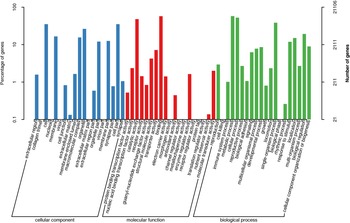
Based on GO database annotation, 21,106 identified transcripts were allocated to at least one GO term. The two most abundant GO terms in the ‘molecular function’ category were ‘binding’ (12,157) and ‘catalytic activity’ (10,173). In the ‘biological process’ category, the transcripts were mostly enriched in the ‘metabolic process’ (12,219) and ‘cellular process’ (11,103) terms. In the ‘cellular component’ category, ‘cell’ (7434), ‘cell part’ (7447) and ‘organelle’ (5546) were the most abundant terms (fig. 1).
Gene Ontology (GO) functional annotation of L. oryzophilus transcripts.

In the COG database, the transcripts were mostly enriched in ‘general function prediction only’ (3785), ‘replication, recombination and repair’ (1914), ‘translation, ribosomal structure and biogenesis’ (1268) and ‘transcription’ (1248) (Supplementary Fig. S2).
KEGG analysis
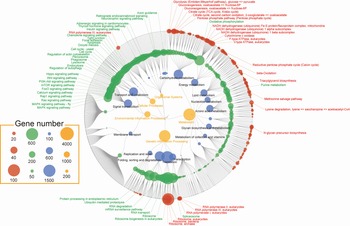
The KEGG pathway enrichment analysis revealed that the greatest numbers of identified proteins were involved in two biological categories: genetic information processing and metabolism (fig. 2). In the metabolism category, the proteins were mainly linked to the metabolism of carbohydrates (n = 963), amino acids (n = 561), lipids (n = 525) and energy (n = 548; oxidative phosphorylation). In the genetic information processing category, translation (n = 1560; ribosome, RNA transport, ribosome biogenesis in eukaryotes and spliceosome) and folding, sorting and degradation (n = 1059; protein processing in endoplasmic reticulum and ubiquitin-mediated proteolysis) were the major processes. Two additional enriched pathways, environmental information processing (n = 941) and cellular processes (n = 836), are also presented in fig. 2. Only a limited number of proteins (n = 239) were involved in organismal systems. Notably, signal transduction pathways were enriched in the environmental information processing category (n = 711), including the ‘MAPK signalling pathway’ (ko04010, 58 KOs), ‘cAMP signalling pathway’ (ko04024, 50 KOs), ‘Ras signalling pathway’ (ko04014, 47 KOs) and ‘cGMP-PKG signalling pathway’ (ko04022, 42 KOs). In the ‘cellular processes’ category, ‘endocytosis’ (ko04144, 86 KOs) was the most enriched pathway.
Enriched biological processes and associated pathways (Kyoto Encyclopedia of Genes and Genomes, KEGG) of L. oryzophilus transcripts. Each node in the tree represents a specific biological function defined by the KEGG database. Node sizes indicate counts of standard deviation of the KO's relative abundance assigned to that function.

Identification of putative OBP genes
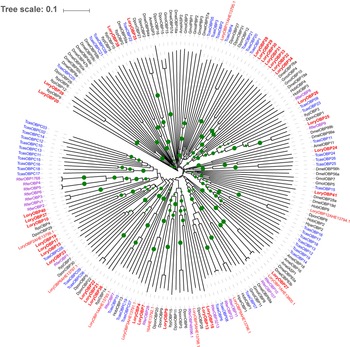
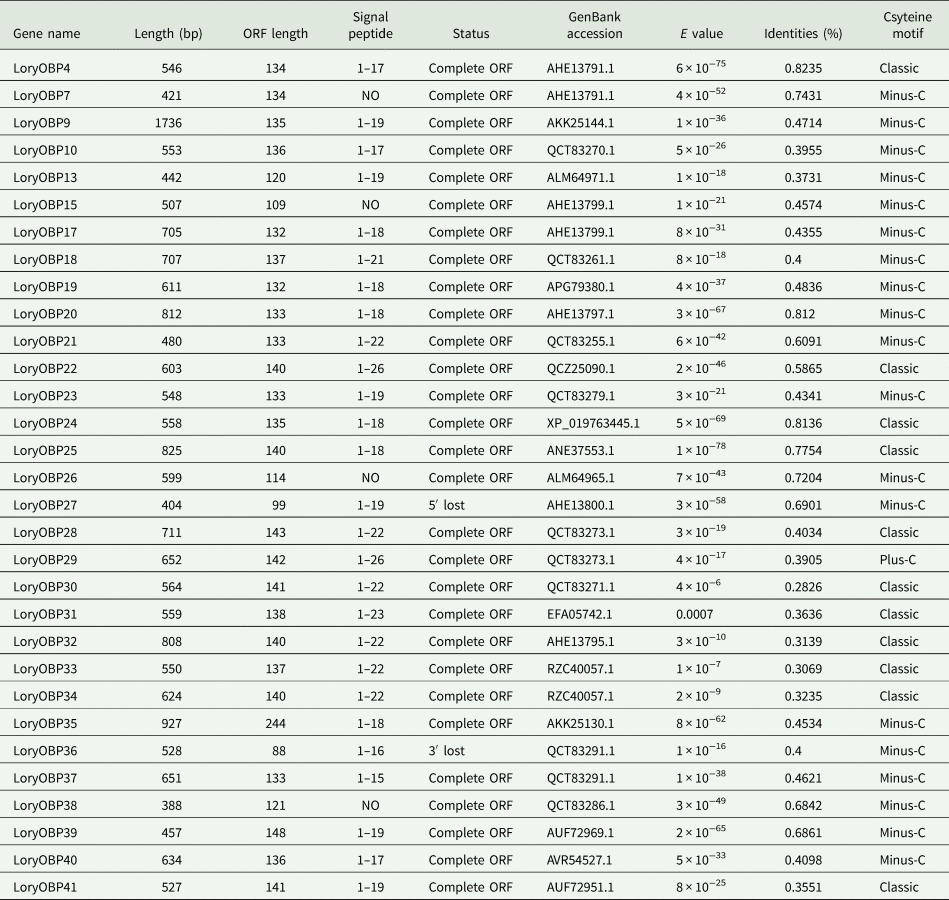
Previously, 10 sequences of L. oryzophilus OBPs were published following transcriptome sequencing. According to the NR annotation and the identification of a six-cysteine signature with a strict spacing pattern of C1-X15-39-C2-X3-C3-X21-44-C4-X7-12-C5-X8-C6 (Supplementary Fig. S3), a total of 31 LoryOBP genes were identified (table 1), including the newly identified OBPs LoryOBP17–41 and LoryOBP4, 7, 9, 10,13 and 15. Among all the putative OBPs identified in the present work, 28 LoryOBPs were predicted to be full-length genes with a signal peptide at the N-terminus and a complete open reading frame (ORF) of 114 to 244 aa. A phylogenetic tree was constructed using the amino acid sequences of LoryOBPs and other insect OBPs, including sequences from T. castaneum, Ips typographus, D. ponderosae, H. oblita, H. parallela, R. ferrugineus, D. melanogaster, A. mellifera and G. molesta (fig. 3). The phylogenetic tree indicated that these LoryOBPs were distributed in different subfamilies together with the OBPs of other species. Seven LoryOBPs (LoryOBP28-34) were clustered in a species-specific clade. LoryOBP27 was clustered with DmelOBP83a and DmelOBP83a, and LoryOBP35 and LoryOBP41 were close to DmelOBP59a and DmelOBP28a.
Phylogenetic tree of OBPs from L. oryzophilus and other species. Bootstrap values based on 1000 replicates are shown as green dots. L. oryzophilus OBPs (LoryOBPs) are displayed in red. Other OBPs included are from Tribolium castaneum (TcasOBPs), Ips typographus (ItypOBPs), Dendroctonus ponderosae (DponOBPs), Holotrichia oblita (HoblOBPs), Holotrichia parallela (HparOBPs), Rhynchophorus ferrugineus (RferOBPs), Drosophila melanogaster (DmelOBPs), Apis mellifera (AmelOBPs) and Grapholita molesta (GmolOBPs).

List of OBPs in L. oryzophilus

Identification of putative CSP genes
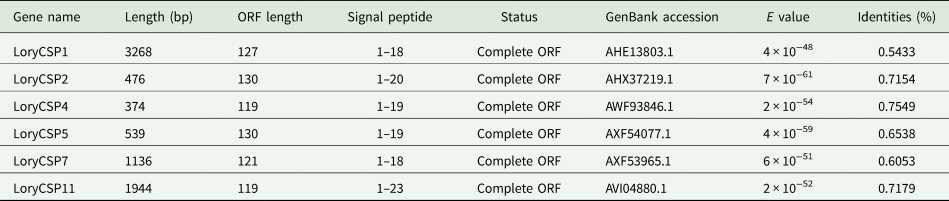
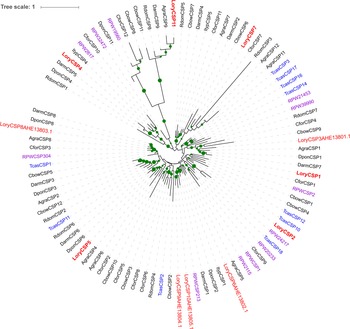
Six new full-length CSPs with four conserved cysteine residues were identified. The ORFs encoded proteins with between 119 and 130 amino acids. A BLAST search revealed that all LoryCSPs exhibited high identities (>54%) with the CSPs of other species, especially those of Anthonomus grandis and Conogethes punctiferalis (>70%) (table 2). We further performed an amino acid sequence alignment of 11 LoryCSPs. A four-cysteine signature with a strict spacing pattern of C1-X6-C2-X18-C3-X2-C4 was noted within the alignment (Supplementary Fig. S4). In addition, aromatic residues (54Y (Tyr), 116 W (Trp) or F (Phe)) were highly conserved in the L. oryzophilus CSPs. These 11 candidates LoryCSPs were phylogenetically analysed with those from five other species (fig. 4). All 11 LoryCSPs were evenly distributed in various clades.
List of CSPs in L. oryzophilus

Phylogenetic tree analysis of CSPs. Bootstrap values based on 1000 replicates are shown as green dots. L. oryzophilus OBPs (LoryCSPs) are displayed in red. Other CSPs included are from Tribolium castaneum (TcasCSPs), Ips typographus (ItypCSPs), Dendroctonus ponderosae (DponCSPs), Rhynchophorus ferrugineus (RPWs), Anthonomus grandis (AgraCSPs), Colaphellus bowringi (CbowCSPs), Dendroctonus armandi (DarmCSPs), Rhyzopertha dominica (RdomCSPs) and Cylas formicarius (CforCSPs).

Identification of putative SNMP genes
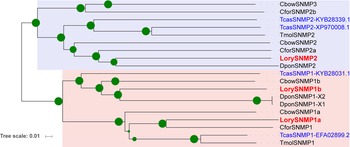
In the L. oryzophilus transcriptomes, we identified three SNMP genes. Two of them seemed to be full-length genes, while the other had lost some of their 5′ sequences. These three SNMPs showed the best BLAST hits to D. ponderosae SNMP1a (69.50% similarity with LorySNMP1a), SNMP1-X2 (56.56% similarity with LorySNMP1b) and SNMP2 (51.42% similarity with LorySNMP2) sequences according to NCBI BLASTp (table 3). Based on phylogenetic analysis and BLASTx searches, LorySNMP1a, LorySNMP1b and LorySNMP2 clustered with known Coleopteran SNMP groups, and L. oryzophilus and D. ponderosae showed an expansion of SNMP1 genes (fig. 5).
Neighbour-jointing tree of SNMP deduced gene products. Bootstrap values based on 1000 replicates are shown as green dots. Other SNMPs included are from Tribolium castaneum (TcasSNMPs), Ips typographus (ItypSNMPs), Dendroctonus ponderosae (DponSNMPs), Colaphellus bowringi (CbowSNMPs), Tenebrio molitor (TmolSNMPs) and Cylas formicarius (CforSNMPs).

List of SNMPs in L. oryzophilus

qRT-PCR verification of candidate chemosensory genes
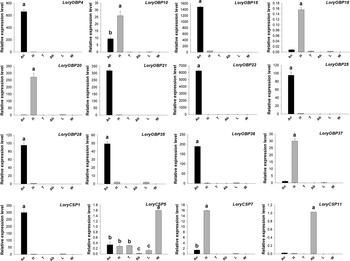
To validate the expression profiles of chemosensory genes, we selected 12 LoryOBP genes and four LoryCSP genes for analysis by qRT-PCR (fig. 6). The 12 LoryOBPs mainly showed three expression types: biased expression in antennae (LoryOBP4, 15, 21, 22, 25, 28, 35 and 36); significantly higher expression in the head than in other tissues (LoryOBP18, 20 and 37); and expression only in the antennae and head (LoryOBP10). Among the four tested LoryCSPs, LoryCSP1 was highly enriched in the antennae, and LoryCSP5 was expressed in most tissues and was abundant in the wings. LoryCSP7 was expressed in the head and antennae, and LoryCSP11 was highly enriched in the abdomen.
RT-qPCR analysis of L. oryzophilus OBPs and CSPs. Gene expression levels in female antennae (An), head (H), thorax (T), abdomen (Ab), legs (L) and wings (W). Statistical analysis was performed by ANOVA (P < 0.05). Error bars indicate ± S.D. of the mean.

Discussion
With the development of transcriptomic next-generation sequencing (NGS), the scope of NGS studies has gradually increased to cover almost all insect orders. L. oryzophilus has the characteristics of environmental adaptability and parthenogenesis, which contribute to the serious damage this species causes to rice crops. To increase our understanding of the genes associated with environmental adaptation and olfaction, short-read NGS transcriptome sequencing of L. oryzophilus was carried out previously. However, the data obtained from short-read NGS sequencing were limited by sequence number and sequence length. Since traditional gene cloning by the rapid amplification of cDNA ends (RACE) technique for further functional studies of important genes has been proven to be expensive, time-consuming and inefficient, we employed SMRT sequencing for the transcriptome profiling of adult female antennae and generated many new gene models. This effort represents the first complete SMRT sequencing analysis of L. oryzophilus.
Insect OBPs and CSPs are suitable for structural and functional research based on their characteristics of being relatively small and stable (Robertson et al., Reference Robertson, Martos, Sears, Todres, Walden and Nardi1999; Touhara and Vosshall, Reference Touhara and Vosshall2009; Carey et al., Reference Carey, Wang, Su, Zwiebel and Carlson2010; Pelosi et al., Reference Pelosi, Zhu and Knoll2018b). Prior to this study, only partial cDNA sequences of OBPs and CSPs had been identified in L. oryzophilus (10 OBPs and five CSPs) (Yuan et al., Reference Yuan, Jiang, Wang, Yu, Zhou, Liu, Yang, Cheng, Gurr, Way and Zhu2016). In the current study, we obtained 31 OBPs and six CSPs based on the SMRTseq datasets. The number of L. oryzophilus CSPs identified in the current study was similar to the number of CSPs identified in most coleopteran insects, including Colaphellus bowringi, Cylas formicarius, R. ferrugineus and D. ponderosae (12, 12, 12 and 11 CSPs, respectively) (Andersson et al., Reference Andersson, Grosse-Wilde, Keeling, Bengtsson, Yuen, Li, Hillbur, Bohlmann, Hansson and Schlyter2013; Li et al., Reference Li, Zhu, Wang, Wang, He, Chen, Sun, Deng and Zhang2015; Antony et al., Reference Antony, Soffan, Jakse, Abdelazim, Aldosari, Aldawood and Pain2016; Bin et al., Reference Bin, Qu, Pu, Wu and Lin2017). LoryOBP27 clustered with DmelOBP83a, which belongs to the ABPX subfamily (Swarup et al., Reference Swarup, Morozova, Sridhar, Nokes and Anholt2014). LoryOBP35 and LoryOBP41 are related to DmelOBP59a and DmelOBP28a, which have been reported to be involved in bitter taste perception (Swarup et al., Reference Swarup, Morozova, Sridhar, Nokes and Anholt2014; Yin et al., Reference Yin, Wang, Fang, Zhang, Cao, Li and Leal2019). However, no newly identified LoryOBPs clustered with the functionally analysed OBPs of coleopteran insects, such as OBPs from H. parallela and H. oblita, and the biological function of these LoryOBPs requires a fair amount of further exploration (Wang et al., Reference Wang, Guan, Zhong, Li, Yin and Cao2013; Zhuang et al., Reference Zhuang, Wang, Wang, Zhong, Cao, Li and Yin2014; Yin et al., Reference Yin, Wang, Fang, Zhang, Cao, Li and Leal2019).
The high identities of the LoryCSPs to sequences from other species indicate that CSPs are more conserved than OBPs across evolution in phylogenetically distant species (Stensmyr et al., Reference Stensmyr, Dweck, Farhan, Ibba, Strutz, Mukunda, Linz, Grabe, Steck, Lavista-Llanos, Wicher, Sachse, Knaden, Becher, Seki and Hansson2012). Expression profiles provide clues for deducing the potential functions of tested genes. Our study showed that the expression of all LoryOBPs is biased towards the antennae. Based on the high expression levels and antenna-biased expression of LoryOBP4, LoryOBP15 and LoryOBP22, these three OBPs of L. oryzophilus will be important targets for further study. Each LoryCSP showed a unique expression pattern, which suggests that they present different functions. For example, LoryCSP1 was mainly expressed in antennae, and their expression pattern was consistent with that of CSPs of Glossina morsitans morsitans, which are widely expressed in the antennae, indicating that LoryCSP1 may bind the pheromone of host plants for host location (Liu et al., Reference Liu, He, Lehane, Lehane, Hertz-Fowler, Berriman, Field and Zhou2012). LoryCSP11 was abundantly expressed in the female abdomen and may be closely related to the oviposition behaviour of female adults (Hua et al., Reference Hua, Zhang, Cui, Wang, Wang, Luo, Lv and Ma2013). CSPs have also been reported to be involved in carbon dioxide detection, larval development and regenerating legs based on whether they are present in antennae, tarsi or the labarum (Kitabayashi et al., Reference Kitabayashi, Arai, Kubo and Natori1998; Angeli et al., Reference Angeli, Ceron, Scaloni, Monti, Monteforti, Minnocci, Petacchi and Pelosi1999; Forêt et al., Reference Forêt, Wanner and Maleszka2007; Jacquin-Joly et al., Reference Jacquin-Joly, Vogt, Francois and Nagnan-Le Meillour2001). Compared to those of OBPs, little is known about the functions of CSPs. Therefore, the physiological functions of these proteins warrant future investigations, such as gene knockdown studies and ligand binding assays. Head-specific LoryOBP10, 18, 20 and 37 and LoryCSP7 might have a gustatory function in addition to an olfactory function, as this species exhibits a very large nose in the head with plentiful sensilla (Hua et al., Reference Hua, Zhang, Cui, Wang, Wang, Luo, Lv and Ma2013). Three SNMPs were also identified in L. oryzophilus. SNMPs have been reported to bind and transport hydrophobic ligands located in ORNs (Benton et al., Reference Benton, Vannice and Vosshall2007; Vogt et al., Reference Vogt, Miller, Litvack, Fandino, Sparks, Staples, Friedman and Dickens2009). SNMP1 is usually expressed in neuronal cells that respond to pheromones, whereas SNMP2 is usually expressed in supporting cells (Forstner et al., Reference Forstner, Gohl, Gondesen, Raming, Breer and Krieger2008). However, the detailed mechanism of SNMP action in insects remains unclear and needs to be further studied for verification.
In conclusion, we obtained comprehensive information from the L. oryzophilus transcriptome by using RNA-seq analysis. Major genes related to chemoreception were identified, including 31 OBPs, six CSPs and three SNMPs. Detailed information on chemosensory genes provides a basis for elucidating the molecular mechanism of the interactions between olfactory-related behaviours of L. oryzophilus and the ecosystem, which would facilitate a better application of L. oryzophilus as a biological control agent.
Supplementary material
The supplementary material for this article can be found at https://doi.org/10.1017/S0007485321000857
Acknowledgements
This research was supported by the project of disciplinary crossing and integration from Jilin University (JLUXKJC2020107) and National Key Research and Development Program of China (2018YFD0201000 and 2017YFD0200600).
Author contributions
Y.P. and X.X.Z. performed the experiments and data analyses and wrote the manuscript. Z.W. helped draft the manuscript. L.Z.Q. and X.S.Z offered insect samples. J.H.X. and J.H.Z. provided critical revisions to the article. All authors gave final approval for publication.
Conflict of interest
The authors declare no competing interests.