Fieldwork in ethnomusicology is often characterised by a wide gamut of memories, ranging from those recounted by informants during ethnographic interviews to others consumed by the consciousness of the ethnographer, both when in the field as well as back home, and long afterwards. Memories shared by informants with the ethnographer emerge from the lives and experiences of people within the tradition. Such memories are often expressed through narratives and anecdotes, in most instances embellished with a hint of nostalgia. Memories of this kind may contribute towards the construction and eventual documentation of the music tradition's oral history as well as the identification of individuals that had or still have leading roles in the same tradition. The other category of memories includes those generated through situations and circumstances experienced by the ethnographer during the participant observation process. Such memories are the most intimate for the researcher and, most probably, the ones with an everlasting effect on his or her consciousness. These are memories against which the present is understood and interpreted. Moreover, memories in this category should prove to be beneficial for people both inside and outside the music tradition, as these may add more insight to the scrutiny of what takes place in what Bohlman refers to as the ‘space between self and other’ (Reference Bohlman2002, 37).
By citing examples from the Arab–Andalusian musical tradition of maʾlūf in Libya, this paper assesses the values ingrained in both categories of memory and the benefits attained in their documentation and eventual preservation. The maʾlūf tradition (literally translated as ‘familiar’ or ‘customary’) was allegedly brought to Libya by Andalusian refugees escaping the Christian Reconquista of Spain between the tenth and seventeenth centuries.Footnote 1 This musical tradition flourished in Libya, particularly in the capital Tripoli, through the presence of Sufi congregations which employed this music in their rituals that are still held in zāwiyas (Sufi lodges).Footnote 2 From the 1960s onwards, maʾlūf began to be performed both in its ‘authentic’ form in the context of Sufi celebrations as well as by professional ensembles of Arabic music employing Western instruments such as the violin, cello and double bass.Footnote 3
This article highlights the importance for people in this musical tradition to preserve and document memories of their own interaction and collaboration with the ethnographer, as that would add another perspective to the investigation of the space described by Bohlman above. In all this, memories are both central and multifarious and are, therefore, waiting to be preserved, documented and analysed on a level of importance equal to any other data collected from the field. Reflecting back on my fieldwork in Libya between 2002 and 2005, fieldwork transpires as a compilation of memories that originate in the field, and sometimes even beforehand, and that continue mushrooming in times and places away from it. In this sense, fieldwork experience becomes ‘a unique biographical episode which is retrospectively transformed by our memories and reminiscences of it’ (Coffey Reference Coffey1999, 110). Past fieldwork keeps on evolving, transforming itself as if in a kaleidoscope, and growing in the consciousness of the ethnographer.
Memories from my Libya fieldwork belonging to the first category include those shared with me by musicians, sheikhs of maʾlūf, maʾlūf aficionados and participants in Sufi lodges. The second category includes memories which emerged out of my presence at events and situations in which maʾlūf played a central role. These events include concerts and rehearsals of maʾlūf by the professional ensemble of the then leading musician Hassan Araibi, and the singing of maʾlūf in zāwiyas and outside during celebrations like the mawlid (when Muslims celebrate the birth of the Prophet Muhammad). In this category, I also include my own recollections following the recent dramatic news from Libya, wondering what might have happened to the people I knew from my research on the maʾlūf tradition and, by implication, what might happen to the tradition itself. This is a kind of ‘flashbulb memory’ in which ‘a present experience sparks a memory of an earlier experience, the connections between them generating further interpretation’ (Collins and Gallinat Reference Collins and Gallinat2010, 11). The memories I gathered both during and after my fieldwork have illuminated continuities between the past and present, provided additional information when information from the sound source was insufficient, and, also, generated reflections and rethinking about the tradition in the context of a new social and political scenario.
Memories, narratives and history
Throughout its history, the maʾlūf in Libya maintained continuity thanks to the commitment of dedicated sheikhs who knew the tradition intimately and passed it on to others during sessions in zāwiyas, at their own homes, and sometimes even during friendly chats in the middle of an open market. Anecdotes recalling these efforts were several. The recounting of such accounts were, in most cases, intensified by a deep sense of nostalgia – the kind of nostalgia that embraces a past that will never return but which should nevertheless be an inspiration for the present and the future.
Informants in zāwiyas narrated stories of sheikhs who had included in the maʾlūf, till today venerated for its ‘authentic’ aura, their own lyrics to melodies which had been derived from the musical traditions of colonisers and neighbouring countries. One such case is that of Sheikh Jamal ad-Din al-Miladi (1881–1963), who had set his own words to Tunisian and Egyptian melodies, which eventually found themselves in the repertoire of the Libyan maʾlūf in the form of muʾāraḍāt (plural of muʾāraḍa: ‘pastiche verses’). As understood here, the making of a muʾāraḍa implies the making of a new song that follows the rhyme, metre and melody of another well-known song.
Another sheikh remembered for his muʾāraḍāt was Sheikh Ali Amin Sayala, who was born in Tripoli in 1860. Informants explained to me how the sheikh was unpretentious in claiming authorship for the making of maʾlūf lyrics. The sheikh wanted to compose muʾāraḍāt for all the love poetry found in the maʾlūf, changing them to words in praise of the Prophet. I still remember one informant explaining to me that his father had told him that Sheikh Ali was ordered to quit composing muʾāraḍāt by another well-known Libyan ‘sheikh maʾlūf’ by the name of Sheikh Muhammad Abdulsalam al-Faituri al-Misurati, who had told Sheikh Ali to stop tampering with the lyrics of the maʾlūf. Aware of Sheikh Muhammad's knowledge, love and passion for this tradition, Sheikh Ali obeyed with due humility.
Other sheikhs who were frequently mentioned for the tension between old and newly introduced lyrics in maʾlūf were two brothers, Sheikh Jamal Muhammad and Sheikh Kamel Muhammad al-Ghadiy. The former was known for his strong memory of maʾlūf lyrics and his continuous efforts to revive and promulgate texts on the verge of extinction. According to Sheikh Hassan Araibi (see Figure 1), one of my main informants in Libya, Sheikh Jamal used to send maʾlūf texts to a committee established by the Libyan Ministry of Culture in 1964, and chaired by Araibi himself, to be recorded as part of a preservation project of the maʾlūf financed by the same ministry. He used to supply this text in its written form through Sheikh Ali Mankusa, who at that time was one of his maʾlūf students. Sheikh Hassan Araibi remarked to me that some of the verses sent to the above committee by Sheikh Jamal were unknown even to its eldest members.
Sheikh Hassan Araibi (Tripoli, June 2002).

Traces of Turkish melodies in the Libyan maʾlūf had frequently evoked the figure of Sheikh Gheddur Afandi, known for having employed Turkish melodies in his repertoire. The sheikh was a prominent sheikh maʾlūf and Qur'an reciter, who served as an imam (religious leader) to the Ottoman Army in Tripoli. Accounts about this sheikh refer to the fact that he was also married to a Turkish woman and, consequently, strongly exposed to Turkish culture. The military march-like melodies of certain maʾlūf melodies have led Abdalla El Sibaei (see Figure 2), a retired professor of Arab musicology, to attribute these melodies to Turkish military music. According to him, some of these melodies suggest sources of ‘expert’ music making, such as that of Ottoman military bands regularly heard marching in the streets of Tripoli during the Turkish occupation.
Professor Abdalla El Sibaei playing the ʿūd (Tripoli, April 2003).

The overall tone of most of these narratives and anecdotes was one of loss of a past, of which both informants and myself as the researcher can only live and experience remnants; as if the essence of maʾlūf is found in its past and these anecdotes were being told not only to keep them alive through transmission but also to establish a contrast with contemporary life and stress the distinctiveness of the maʾlūf.
Situations, events and memories
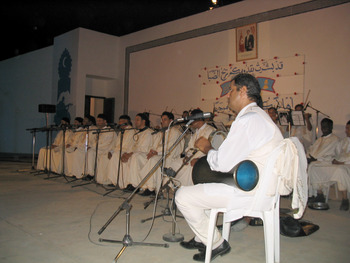
My attendance at rehearsals and other events during my fieldwork was a means of meeting people and talking to them. From the informants' point of view, I assume that their encounter with me was a means by which they could learn what and how I thought about their musical tradition and about them both as a group and as individuals. This two-directional mode of thinking about each other was very evident during the rehearsals that I attended with the maʾlūf ensemble of Hassan Araibi (see Figure 3). ‘You're one of us’ was the common expression that I used to hear from the members of this ensemble. ‘Come to our rehearsals whenever you feel the need to do so’; ‘Ask as many questions as you like’; ‘You're most welcome to join us on our trip to Testour’; and other expressions of goodwill. As my trips to Libya became more frequent, and after two consecutive trips with the ensemble to the town of Testour in Tunisia to participate in the annual maʾlūf festival and staying with them in the same hostel for a week or so, and following some articles I had published about them (see, for example, Ciantar Reference Ciantar2002a, Reference Ciantar2002b, Reference Ciantar2003), the initial statement began to attain added meaning implying a sense of gratitude for the fact that a Western music researcher was appreciating and valuing their musical tradition and making it known to the world. This links in nicely with what Rice (Reference Rice2014, 31) notes: ‘Not only do we choose our research subjects; they choose to work with us as well, sometimes, indeed usually, because they think they and their musical tradition will benefit from the interaction as well’. The ensemble members' interest in internationalising their musical tradition and efforts, which till that time were only recognised at local and pan-Arab levels, was both strong and sought for. A very restricted number of Libyan maʾlūf performances started to be uploaded to YouTube by the ensemble members at around the same time of my research. The urge to open up to a new, perhaps, liberal social set-up was being forecasted by the musical tradition of which they were a part and the new directions that they were channelling it through in an attempt to reach a global audience. It's a situation similar to that explained by Blacking when asserting that change in music ‘is important to watch because, owing to the deep-rooted nature of music, it may precede and forecast other changes in society. It is like a stage of feeling towards a new order of things’ (Reference Blacking and Byron1995, 172).
Sheikh Hassan Araibi's ensemble performing in Tunisia (Testour, July 2003).

Memories of the events I attended are several. I still remember attending the day-long maʾlūf cortege (see Figure 4) on mawlid day in Tripoli's madīnat al-qadīma (old city). Throughout the cortege, everybody seemed to be united by the same fraternal sentiment kindled by the maʾlūf singing and the celebrations of the mawlid. The overall ambience was embellished by the ululations of women standing by the side of the street, observing without getting directly involved in the performance of maʾlūf as, in that context, that was solely a role for men. At the very front of the cortege, children and youths were firing crackers, transforming a celebration that was by its very nature religious into a more social one. In the context of all that festivity, and whenever I look at photos of those celebrations, what strongly comes to my mind is Sheikh Abu Sama's (see Figure 5) comment that these youths are changing everything, even a celebration which is fundamentally religious and, therefore, deserved more respect. His concern stemmed from his preoccupation that a Westerner might get the wrong impression of the real meaning of the cortege and, by extension, of the celebration itself. The sheikh asked me what I thought of the cortege and whether I understood the religious aspect of it. The value of the religious aspect and its projection to the outside world was sacred for him, being himself not only a faithful practitioner but also a sheikh maʾlūf and a sheikh dhikr (Sufi devotional practice, lit. ‘remembrance’). Voices from the field never cease to sound; on the contrary, they keep on complementing the evocation of memories and the rethinking of them.
A maʾlūf cortege on mawlid day in the madīnat al- qadīma (Tripoli, 1 May 2004).

The author with Sheikh Abu Sama (Tripoli, 1 May 2004).

The field extends itself to spaces that are physically away from the actual site. Memory plays a central role in this perceptual construction of the field. The events that led to the fall of the Gaddafi regime and the more recent political events not only triggered memories in me, but also the impression of ongoing fieldwork as mediated by social media. News about Libya coalesced with memories of informants explaining to me how strong the maʾlūf tradition is in their country. On the Internet I viewed pictures of the maʾlūf festival being organised in the midst of political turmoil, with the new Libyan flag flapping at the back of the stage and patrons seated in the front rows who were different from the ones I used to see during my fieldwork.Footnote 4 The tormenting thought of sending emails to recipients who might no longer be with us, as I had received no reply from them, pushed me to enquire more about the tradition and, consequently, about what had happened to its practitioners whom I knew so well. Online images put my mind at ease about some of them, but also increased my preoccupation with finding out about so many others whom I could not trace. Ethnography is felt here as it is being pieced together out of the circumstances of the present as well as the observations and memories of the past (Coleman Reference Coleman, Collins and Gallinat2010, 216).
Informant–ethnographer interaction
As I remarked above, the benefits for people within the tradition to preserve memories of their rapport with ethnographers in the field are several. One such benefit lies in the historical value that an insider's perspective of such relationships may offer to a complete history of the musical tradition in question. Such memories will complement the memories in the two categories mentioned above. Through their interactions with ethnographers, informants attain insight into how their musical tradition is viewed by others and also into how the outside world sees the world surrounding that same tradition. How a musical tradition is seen and understood from the outside has a tremendous impact on the tradition under investigation, as musicians within it forge strategies in response to those views that would direct the tradition in one direction and not another. And all that would become part of the music's history. For instance, during my second trip to the Tunisian town of Testour with Hassan Araibi's ensemble, I realised that these musicians also brought with them instruments normally employed in a traditional maʾlūf cortege, like the one mentioned above. These were brought after I had expressed an opinion to one of the ensemble musicians that the ‘old’ maʾlūf should occasionally be exhibited along with the new, so that new listeners to this musical tradition would make a distinction between the two forms. Actually, my suggestion was taken up by the ensemble during its July 2003 participation in the Testour Festival of Andalusian Music. Prior to their on-stage performance, the musicians moved slowly in front of the stage singing the ‘old’ maʾlūf both to highlight the difference between the two forms as well as to ‘exhibit the source of origin of the new form’, as one of the musicians told me (see Figure 6).
Members of Sheikh Hassan Araibi's ensemble performing the ‘old’ maʾlūf (Testour, July 2003).

Making the study of music accessible to other fields of study is becoming consistently more important. Sound archives are becoming increasingly essential resources for researchers hailing from different disciplines. Human rapports, communal sentiments, and the place of the self in a range of social and cultural contexts are preserved in song lyrics, the documentation and analysis of musical performances, and the documentation of events in which music plays a central role. These are resources that are being utilised seriously by scholars from a wide range of disciplines. The documentation of insiders' memories of their interaction with ethnographers through music should add more value to any existing documentation. The dialogic relationship between ethnographers and informants implies scrutiny which in itself is two-directional. It is precisely the nature of that two-directional mode of relationship which should transpire to be of interest to scholars in the humanities and other disciplines. They would see in music, and the social interactions that it involves, a way of learning more about human rapports with otherness.
The documentation of such interactions may be preserved in the form of narratives similar to the ones described in the first category above. Such narratives may bring forth, for example, issues regarding loyalty and trust between informant and ethnographer. It was precisely this sense of growing loyalty and trust that I had taken care not to disrupt during my fieldwork by, for instance, not attending rehearsals by other ensembles in Tripoli, as that could have had serious implications for my rapport with my informants and, consequently, on my fieldwork. Their own perspective of this expressed in narratives which were then preserved would add another valuable insight to what I had written in this regard. Throughout my fieldwork I sensed a kind of, what I call, ‘communication filtering’ that discerned what should or should not be divulged to the world outside represented in the persona of a foreign researcher. In my case, such filters varied from the use of dialectical Arabic, which made understanding almost impossible, to questions that were never answered, as, for my informants, they sounded rather political and, therefore, risky to give a reply to in the context of a totalitarian state in which suspicion boldly reigned. Memories from the inside which are eventually preserved would help the people within the tradition analyse their changing consciousness as a nation, their identity as citizens belonging to a particular place at a particular time in history, their ongoing changing view of the outside world, as well as their strategies to deal on territories of social relations foreign to them.
Conclusion
Memories evoke the past in the present. They serve as a context for the rethinking of our experiences, feelings, thoughts, actions, interactions and relationships as researchers in the field. The notion of the field as an activity which is not bounded by time and space may be further enhanced by the mental processes of memory. Memories recounted to me by my informants in Libya were precious as, through them, I could trace continuities between the past and present. As indicated above, they have provided me with that required background knowledge when information from the sound source was insufficient. The documentation and preservation of the interaction of people from within the tradition with foreign ethnographers may prove beneficial for a full history of the music tradition itself. In this sense, ethnography benefits from the multiplicity of different voices being that of the ethnographer, the informant or any other voice passed on to us from the past. Memory to be really collective should encompass all these voices, as they all have something intriguing to say both about the music tradition in question as well as about the people who in some way or other participate in it and sustain its existence.