




1. Introduction
Advective transport of heat and mass by fluid motions is fundamental to planetary and astrophysical processes and many engineering applications (Balbus & Hawley Reference Balbus and Hawley1998; Kays, Crawford & Weigand Reference Kays, Crawford and Weigand2005). Efficient advective transport contributes to energy savings in buildings (Lake, Rezaie & Beyerlein Reference Lake, Rezaie and Beyerlein2017), process industry (Keil Reference Keil2018) and data centres (Alben Reference Alben2017), and can be obtained by, e.g., applying wall roughness (Zhu et al. Reference Zhu, Stevens, Shishkina, Verzicco and Lohse2019) and flow control (Yamamoto, Hasegawa & Kasagi Reference Yamamoto, Hasegawa and Kasagi2013; Kaithakkal, Kametani & Hasegawa Reference Kaithakkal, Kametani and Hasegawa2020). In particular, optimal transport given minimal power input generates energy savings in applications (Alben Reference Alben2017; Motoki, Kawahara & Shimizu Reference Motoki, Kawahara and Shimizu2018), but optimization is challenging since flow vortices and eddies generally transport momentum and heat/mass at similar rates. This so-called Reynolds analogy between transport of momentum and heat/mass was postulated by Reynolds (Reference Reynolds1874), and applies to many shear flows (Kays Reference Kays1994; Kays et al. Reference Kays, Crawford and Weigand2005; Pirozzoli, Bernardini & Orlandi Reference Pirozzoli, Bernardini and Orlandi2016) including astrophysical flows (Guan & Gammie Reference Guan and Gammie2009) when Prandtl numbers are close to unity (Ziefuß & Mehdizadeh Reference Ziefuß and Mehdizadeh2020). The Reynolds analogy is used for modelling advective transport in engineering (Kays et al. Reference Kays, Crawford and Weigand2005), geophysical (Bretherton & Park Reference Bretherton and Park2009) and astrophysical flows (Birnsteil, Dullemond & Brauer Reference Birnsteil, Dullemond and Brauer2010), but implies that higher heat/mass transfer goes together with higher momentum transfer and thus power input (Yamamoto et al. Reference Yamamoto, Hasegawa and Kasagi2013).
In recent theoretical studies, incompressible steady flows are computed that maximize heat transfer for a given power input (Hassanzadeh, Chini & Doering Reference Hassanzadeh, Chini and Doering2014; Alben Reference Alben2017; Motoki et al. Reference Motoki, Kawahara and Shimizu2018; Souza, Tobasco & Doering Reference Souza, Tobasco and Doering2020). Motoki et al. (Reference Motoki, Kawahara and Shimizu2018) consider plane Couette flow and show that the optimized flow has a much higher heat transfer for a given power input than ordinary turbulent flow. The computed optimized flows are not required to obey known momentum equations in these theoretical studies – that is, these optimal flows can be obtained applying a body force, but the body force can be arbitrary and does not (necessarily) have a familiar form. It is therefore not clear if this optimal transport is realizable, although Alben (Reference Alben2017) and Motoki et al. (Reference Motoki, Kawahara and Shimizu2018) suggest that optimal flows can be approached by applying smart forcing or control techniques. I show through direct numerical simulations (DNSs) that in existing flows, namely incompressible plane Couette flow (PCF) and Taylor–Couette flow (TCF) subject to a Coriolis force, passive tracer transport can be much faster than momentum transport, in violation of the Reynolds analogy. It is thus possible to significantly change the ratio of wall-to-wall heat/mass to momentum transport by a simple Coriolis body force. Momentum transport in Couette flows has been explored extensively (Salewski & Eckhardt Reference Salewski and Eckhardt2015; Grossmann, Lohse & Sun Reference Grossmann, Lohse and Sun2016) owing to its relevance for, e.g., astrophysics. TCF with heat or mass transport finds applications in, for example, cooling of electrical motors (Fénot et al. Reference Fénot, Bertin, Dorignac and Lalizel2011) and chemical reactors and bioreactors (Nemri, Charton & Climent Reference Nemri, Charton and Climent2016).
2. Governing equations and numerical procedure
TCF is a shear flow created between two rotating concentric cylinders, while PCF is the small-gap limit  $d/r_i \rightarrow 0$ (
 $\eta =r_i/r_o \rightarrow 1$) of TCF, where
 $d$ is the gap between the cylinders/walls and
 $r_i$ and
 $r_o$ the inner and outer radii, respectively. In these flows I study passive tracer transport, mimicking heat and mass transport when the temperature/mass does not affect the flow. Hereafter, the passive tracer is called temperature for convenience, but the only body force affecting the flow is the Coriolis force, which does not perform any work.
Fluid motion and passive tracer transport in the PCF and TCF DNSs are governed by the Navier–Stokes and advection–diffusion equations,
 \begin{gather} \frac{\partial \boldsymbol{U}}{\partial t} + \boldsymbol{U} \boldsymbol{\cdot} \boldsymbol{\nabla} \boldsymbol{U} ={-} \boldsymbol{\nabla} P + \frac{1}{Re} \nabla^2 \boldsymbol{U} - R_\Omega (\boldsymbol{e}_z \times \boldsymbol{U}), \end{gather}
 \begin{gather}\frac{\partial T}{\partial t} + \boldsymbol{U} \boldsymbol{\cdot} \boldsymbol{\nabla} T = \frac{1}{PrRe} \nabla^2 T , \end{gather}
together with  $\boldsymbol {\nabla } \boldsymbol {\cdot } \boldsymbol {U}=0$. The imposed azimuthal (streamwise) velocity and temperature at the inner and outer no-slip and iso-thermal walls,
 ${\pm }U_w$ and
 ${\pm }T_w$, respectively, are constant. Velocity
 $\boldsymbol {U}$ is normalized by
 $U_w$, temperature
 $T$ by
 $T_w$ and length by
 $d$. The modified non-dimensional pressure
 $P$ includes the centrifugal force (Salewski & Eckhardt Reference Salewski and Eckhardt2015). The rotation axis, defined by the unit vector
 $\boldsymbol {e}_z$, is the spanwise and central axis in PCF and TCF, respectively, as in Brauckmann, Salewski & Eckhardt (Reference Brauckmann, Salewski and Eckhardt2016), and is parallel with the mean flow vorticity. Sketches of the flow geometries are presented in the supplementary material available at https://doi.org/10.1017/jfm.2020.1176. A Reynolds number
 $Re= \Delta U d /\nu$ and rotation number
 $R_\Omega = 2 \varOmega d / \Delta U$, where
 $\Delta U= 2 U_w$,
 $\nu$ is the kinematic viscosity and
 $\varOmega$ is the imposed system rotation, characterize the flow.
 $R_\Omega$ is defined such that it is negative for cyclonic flows (same sign for shear and rotation) and positive for anti-cyclonic flows. These parameters are equivalent to the shear Reynolds and rotation numbers used by Dubrulle et al. (Reference Dubrulle, Dauchot, Daviaud, Longaretti, Richard and Zahn2005) and Brauckmann et al. (Reference Brauckmann, Salewski and Eckhardt2016). The rotating reference frame for TCF can naturally be translated back to a laboratory reference frame (Ezeta et al. Reference Ezeta, Sacco, Bakhuis, Huisman, Ostilla-Mónico, Verzicco, Sun and Lohse2020).
 $Pr=\nu /\alpha$ is the Prandtl number with
 $\alpha$ the thermal diffusivity.
From (2.1) and (2.2), it follows that in PCF the wall-to-wall mean dimensionless momentum  $J^m = \langle U V \rangle - \partial _y \langle U \rangle /Re$ and heat fluxes
 $J^h = \langle V T \rangle - \partial _y \langle T \rangle / (Re Pr )$ are conserved, and in TCF the angular velocity flux
 $J^m = r^3 ( \langle V \omega \rangle - \partial _r \langle \omega \rangle /Re )$ and heat current
 $J^h = r [ \langle V T \rangle - \partial _r \langle T \rangle / (Re Pr) ]$ are conserved (Brauckmann et al. Reference Brauckmann, Salewski and Eckhardt2016). Here,
 $\omega =U/r$ is the angular velocity,
 $U$ and
 $V$ the streamwise (azimuthal) and wall-normal (radial) velocity, and
 $\langle \cdots \rangle$ denotes averaging over time and area at constant wall-normal (radial) distance in PCF (TCF). The Nusselt numbers
 $Nu_m = J^m/J^m_{lam}$ and
 $Nu_h = J^h/J^h_{lam}$ quantify the wall-to-wall (angular) momentum transport (Brauckmann et al. Reference Brauckmann, Salewski and Eckhardt2016) and heat transport, respectively. The subscript ‘lam’ implies the molecular (conductive) flux for laminar flow. For laminar PCF,
 $J^m_{lam} = - 1 /Re$ and
 $J^h_{lam} = - 1 / {Re Pr}$. For laminar TCF,
 $J^m_{lam} = - 2\eta /(Re (1-\eta )^2)$ (Brauckmann et al. Reference Brauckmann, Salewski and Eckhardt2016) and
 $J^h_{lam} = 2/(Re Pr \ln \eta )$.
 $Nu_m$ specifies the force (torque) needed to shear the flow in units of that in laminar PCF (TCF), and
 $Nu_h$ is the heat flux in units of that in laminar flow.
To study the influence of Coriolis forces on momentum and heat transfer, I have carried out several DNS series at constant  $Re$ up to
 $40\,000$ with varying
 $R_\Omega$ – i.e. eight DNS series of PCF at a constant
 $Re=240$, 400, 800, 1600, 3200, 6400,
 $17\,200$ and
 $40\,000$, respectively, and eight DNS series of TCF at a constant
 $Re=400$, 1152, 2593, 3889, 8750,
 $19\,688$,
 $29\,531$ and
 $40\,000$, respectively, all at varying
 $R_\Omega$. The supplementary material presents tables with
 $Re$ and
 $R_\Omega$ parameters of all DNSs. In PCF,
 $Pr=1$ and in TCF,
 $Pr=0.7$ and
 $\eta = 0.714$.
The governing equations for PCF are solved with a Fourier–Fourier–Chebyshev algorithm, with periodic boundary conditions in the streamwise and spanwise directions (Chevalier et al. Reference Chevalier, Schlatter, Lundbladh and Henningson2014). The computational domain sizes are  $6{\rm \pi} d$ and
 $2{\rm \pi} d$ in the streamwise and spanwise directions, respectively, which is large enough to accommodate several pairs of counter-rotating large-scale vortices. The governing equations for TCF in cylindrical coordinates are solved with a Fourier–Fourier-finite-difference algorithm (Boersma Reference Boersma2011; Peeters et al. Reference Peeters, Pecnik, Rohde, van der Hagen and Boersma2016), with periodic boundary conditions in the axial and azimuthal directions. In the radial direction, a sixth-order compact-finite-difference scheme is used. Like others, I do not simulate the flow around the entire cylinder but use a domain with reduced size in the azimuthal direction. Previously, it has been verified that changing the domain size has little effect on the computed torque (Brauckmann & Eckhardt Reference Brauckmann and Eckhardt2013; Brauckmann et al. Reference Brauckmann, Salewski and Eckhardt2016). The computational domain size in the DNSs of TCF, listed in table 1, is basically the same as in the DNSs of Brauckmann & Eckhardt (Reference Brauckmann and Eckhardt2013) up to
 $Re=29\,531$ and wide enough to capture at least one pair of counter-rotating Taylor vortices. In the DNSs at
 $Re=40\,000$, the domain is significantly larger.
Domain size in the DNSs of TCF.  $L_\theta$ is the azimuthal domain size at the centreline, and
 $L_z$ is the axial domain size.

The resolution increases with  $Re$ to keep the grid spacing in terms of viscous wall units within acceptable bounds. At
 $Re=40\,000$, the streamwise and spanwise grid spacings in the PCF DNSs are
 $\Delta x^+ \leq 13$ and
 $\Delta z^+ \leq 6.5$, respectively, and in the TCF DNSs, the azimuthal and axial grid spacings are
 $\Delta x^+ =12.4$ and
 $\Delta z^+ =5.9$, respectively at
 $R_\Omega =0.3$ and smaller at higher
 $R_\Omega$. This is the grid spacing in terms of Fourier modes and viscous wall units, comparable to the grid spacing in other well-resolved DNSs of wall flows (Lee & Moser Reference Lee and Moser2015). The number of Chebyshev modes or radial grid points with near-wall clustering is 192 or more at this
 $Re$.
The DNSs of PCF and TCF are either initialized with perturbations to trigger vortices or with the fields of a DNS at another  $R_\Omega$. They are run for a sufficiently long time to reach a statistically stationary state and then run for a long period to obtain well-converged statistics. I have verified that the Nusselt numbers do not change when the DNSs are continued. For several DNSs of PCF, I have also validated that changing the domain size and resolution does not affect the results. The DNS results of TCF for
 $Nu_m$ agree well with previous DNSs of Brauckmann & Eckhardt (Reference Brauckmann and Eckhardt2013) and Ostilla et al. (Reference Ostilla, Stevens, Grossmann, Verzicco and Lohse2013). These validations are presented in the supplementary material.
3. Results
Figure 1(a,b) shows that momentum transfer in terms of  $Nu_m$ naturally grows with
 $Re$ but also varies with
 $R_\Omega$ in the DNSs owing to changing flow features (Salewski & Eckhardt Reference Salewski and Eckhardt2015; Grossmann et al. Reference Grossmann, Lohse and Sun2016). At
 $R_\Omega =0$, PCF is linearly stable yet turbulent when
 $Re \gtrsim 1600$ owing to subcritical transition and therefore
 $Nu_m>1$. TCF is linearly unstable and
 $Nu_m >1$ if
 $R_\Omega =0$ at all
 $Re$ (Dubrulle et al. Reference Dubrulle, Dauchot, Daviaud, Longaretti, Richard and Zahn2005). In both flows,
 $Nu_m$ first grows with
 $R_\Omega$ due to destabilization by anticyclonic rotation and then declines towards unity for
 $R_\Omega \rightarrow 1$ when the flow approaches the linearly stability limit
 $R^c_\Omega$ and relaminarizes (Dubrulle et al. Reference Dubrulle, Dauchot, Daviaud, Longaretti, Richard and Zahn2005). Disturbances and turbulence cannot sustain beyond
 $R^c_\Omega$, even at higher
 $Re$ (Ostilla-Mónoci et al. Reference Ostilla-Mónoci, van der Poel, Verzicco, Grossmann and LohseReference Ostilla-Mónoci, Verzicco, Grossmann and Lohse2014b). Momentum transport is maximal around
 $R_\Omega =0.2$ in PCF and around
 $R_\Omega =0.3$ to 0.1 at low to high
 $Re$ in TCF, consistent with previous numerical (Brauckmann & Eckhardt Reference Brauckmann and Eckhardt2013; Salewski & Eckhardt Reference Salewski and Eckhardt2015; Brauckmann et al. Reference Brauckmann, Salewski and Eckhardt2016) and experimental observations (van Gils et al. Reference van Gils, Huisman, Bruggert, Sun and Lohse2011). This broad maximum is linked to intermittent bursts in the outer layer in TCF and to strong vortical motions in PCF (Brauckmann & Eckhardt Reference Brauckmann and Eckhardt2013; Brauckmann et al. Reference Brauckmann, Salewski and Eckhardt2016). Another narrow maximum in
 $Nu_m$ caused by shear instabilities appears in PCF at
 $R_\Omega \approx 0.02$ when
 $Re \gtrsim 10^4$ (Brauckmann & Eckhardt Reference Brauckmann and Eckhardt2013), but my DNSs do not cover this narrow region near
 $R_\Omega =0$ and therefore do not reveal this second maximum. With rising
 $Re$, the narrow maximum overtakes the broad maximum, which disappears in TCF with
 $\eta = 0.91$ if
 $Re$ is higher than in my DNSs (Ezeta et al. Reference Ezeta, Sacco, Bakhuis, Huisman, Ostilla-Mónico, Verzicco, Sun and Lohse2020).
(a)  $Nu_m$ and (c)
 $Nu_h$ for PCF. (b)
 $Nu_m$ and (d)
 $Nu_h$ for TCF. Each line/colour represents a different constant
 $Re$, and dots denote DNS results. The horizontal dashed line marks
 $Nu_m,Nu_h =1$. Arrows show trends for increasing
 $Re$ listed in § 2.

Heat transfer in terms of  $Nu_h$ behaves similarly to
 $Nu_m$ at low
 $R_\Omega$ but differently at higher
 $R_\Omega$ (figure 1c,d). Its maximum is higher and at higher
 $R_\Omega$ for almost all
 $Re$, demonstrating that flow structures causing optimal momentum transport do not necessarily cause optimal heat transport. At higher
 $Re$,
 $Nu_h$ is maximal near
 $R_\Omega =0.5$ in both PCF and TCF and then sharply declines when
 $R_\Omega \rightarrow 1$ and the flow relaminarizes. This means that in a laboratory instead of a rotating frame of reference, maximal momentum transfer in higher
 $Re$ TCF happens with moderate counter-rotation, whereas maximal heat transfer happens with co-rotating inner and outer cylinders. The growths of the maximum
 $Nu_m$ and
 $Nu_h$ over all
 $R_\Omega$ at fixed
 $Re$ show similar trends with
 $Re$ in PCF and TCF and follow
 $Nu_m,Nu_h \sim Re^{0.6}$ at higher
 $Re$ (figure 2). Experiments show that for
 $Re > 3\times 10^4$, the scaling
 $Nu_m \sim Re^{0.78}$ for all
 $R_\Omega$ in TCF (Ostilla-Mónoci et al. Reference Ostilla-Mónoci, Verzicco, Grossmann and Lohse2014a,b). It is therefore possible that at higher
 $Re$, the maximum
 $Nu_h$ follows a different scaling than
 $Nu_h \sim Re^{0.6}$ observed here.
Maximum value of  $Nu_m$ and
 $Nu_h$ over
 $R_\Omega$ at fixed
 $Re$ in PCF and TCF as function of
 $Re$. The dotted black line shows the scaling
 $Nu\sim Re ^{0.6}$.

The ratio  $\text {HTE}=Nu_h/Nu_m$, shown in figure 3, is a measure of heat transfer efficiency since
 $Nu_m$ is proportional to the power input (van Gils et al. Reference van Gils, Huisman, Bruggert, Sun and Lohse2011).An equivalent measure is considered in heat transfer optimization studies by Yamamoto et al. (Reference Yamamoto, Hasegawa and Kasagi2013), Motoki et al. (Reference Motoki, Kawahara and Shimizu2018) and Kaithakkal et al. (Reference Kaithakkal, Kametani and Hasegawa2020). A high similarity between momentum and heat transport can be expected at
 $R_\Omega =0$ in PCF because
 $Pr=1$, and momentum and heat transport are similarly forced. This is vindicated by the DNSs: the difference between
 $Nu_h$ and
 $Nu_m$ is not more than 2 % at all
 $Re$ and accordingly
 $\text {HTE}\simeq 1$, meaning that the Reynolds analogy perfectly applies.
 $\text {HTE}$ is somewhat smaller in TCF at
 $R_\Omega =0$ because
 $Pr < 1$, but it is still near unity so that the Reynolds analogy approximately holds. Clear differences in heat and momentum transport emerge for increasing
 $R_\Omega$. HTE rapidly grows with
 $R_\Omega$ in PCF and TCF and reaches a maximum around
 $R_\Omega \approx 0.85\text {--}0.99$ at low to high
 $Re$ before abruptly dropping to unity for
 $R_\Omega \geq 1$. Its maximum grows from about two at the lowest
 $Re$ to eight and more than six at
 $Re=40\,000$ in PCF and TCF, respectively (figures 3 and 4a). In TCF, the maximum HTE seems to level off at higher
 $Re$, while in PCF it continues to grow. TCF with a fixed outer and rotating inner cylinder in a laboratory frame corresponds to
 $R_\Omega =1-\eta =0.29$ and has a
 $\text {HTE} \leq 1.18$ over all
 $Re$ considered here, much less than the maximum possible
 $\text {HTE}$. Note that Couette flow is linearly unstable very near
 $R_\Omega =1$ (Nagata Reference Nagata1990; Esser & Grossmann Reference Esser and Grossmann1996), so flow motions can be sustained even very near
 $R_\Omega =1$. Figure 4(b) shows that the
 $\text {HTE}$ has a similar trend in PCF and TCF near
 $R_\Omega =1$ for
 $Re \geq 17\,200$. DNS results for TCF at the three
 $Re$ are hardly distinguishable since they overlap, although the computational domain sizes are different, suggesting the results are indifferent to this aspect. Some of the dissimilarities between heat transfer in PCF and TCF can be attributed to the different values of
 $Pr$ in the two cases. DNSs of heat transfer in turbulent channel flow support that
 $Nu_h \sim Pr^{1/2}$ for
 $Pr$ near unity (Pirozzoli et al. Reference Pirozzoli, Bernardini and Orlandi2016), indicating that
 $Nu_h$ and
 $\text {HTE}$ are a factor
 $0.7^{-1/2}$ larger in TCF if
 $Pr=1$, as in PCF, instead of
 $0.7$, as used here. The differences observed in, e.g., figures 2 and 4 between PCF and TCF results indeed largely disappear (not shown here), and
 $Nu_h$ is almost unity in TCF at
 $R_\Omega =0$ after this scaling.
HTE as function of  $R_\Omega$ in (a) PCF and (b) TCF. Each line/colour represents a different constant
 $Re$. Arrows show trends for increasing
 $Re$ listed in § 2, and dots signify DNS results. The black line in (a) shows the high-
 $Re$ limit.

(a) Maximum  $\text {HTE}$ over
 $R_\Omega$ at fixed
 $Re$ in PCF and TCF as function of
 $Re$. (b) Log–log plot of
 $\text {HTE}$ versus
 $1-R_\Omega$ in PCF at
 $Re = 17\,200$ and
 $40\,000$ and TCF at
 $Re=19\,688$,
 $25\,531$ and
 $40\,000$. The black solid line shows the high-
 $Re$ limit
 $\text {HTE}=1/(1-R_\Omega )$.
 $Nu_h/Nu^r_h$ versus
 $Nu_m/Nu^r_m$ at fixed
 $Re$ for (c) PCF and (d) TCF.
 $Nu^r_{m,h}$ is the reference Nusselt number corresponding to the non-rotating case (
 $R_\Omega =0$) in PCF and the fixed outer cylinder case (
 $R_\Omega =1-\eta =0.29$) in TCF.
 $R_\Omega$ increases in the counterclockwise direction.

Results for  $\text {HTE}$ can be compared to theoretical optimal heat transport for
 $Pr=1$ in PCF with an arbitrary body force calculated by Motoki et al. (Reference Motoki, Kawahara and Shimizu2018), who maximized heat and momentum transport dissimilarity by optimizing the ratio of total scalar dissipation to total energy dissipation
 $\varepsilon _S/\varepsilon _E$. For rotating PCF, with no energy input by the Coriolis force,
 $\text {HTE}$ is equivalent to
 $\varepsilon _S/\varepsilon _E$. If
 $Re \leq 800$ and rotating PCF is streamwise-invariant as discussed later,
 $\varepsilon _S/\varepsilon _E$ calculated by Motoki et al. (Reference Motoki, Kawahara and Shimizu2018) is nearly equal to the maximal
 $\text {HTE}$ found here, implying that heat transport in rotating PCF is near optimal. At higher
 $Re$, results diverge: the optimal
 $\varepsilon _S/\varepsilon _E$ calculated by Motoki et al. (Reference Motoki, Kawahara and Shimizu2018) at
 $Re=1600$,
 $6400$ and
 $40\,000$, shown in their figure 7, is respectively 1.6, 2.6 and 3.1 times higher than the maximal
 $\text {HTE}$ in rotating PCF. Their optimal heat transfer rate is also higher than in turbulent PCF without body forces. Thus, even though the dissimilarity between heat and momentum can be large in rotating PCF, it is theoretically possible to enhance it further through other body forces. Another factor which may contribute to the observed difference is that rotating PCF is unsteady and turbulent for
 $Re > 800$, whereas Motoki et al. (Reference Motoki, Kawahara and Shimizu2018) only considered optimal heat transport in steady PCF.
 $\text {HTE}$ defines the heat to momentum transfer ratio. In applications of advective heat/mass transfer, one may seek to optimize other variables owing to constraints (Webb Reference Webb1981; Hesselgreaves Reference Hesselgreaves2000; Yamamoto et al. Reference Yamamoto, Hasegawa and Kasagi2013) – for example, to enhance heat transfer for equal power input or to reduce power input for equal heat transfer. Figure 4(c,d) therefore show
 $Nu_h/Nu^r_h$ versus
 $Nu_m/Nu^r_m$ for PCF and TCF at fixed
 $Re$ and varying
 $R_\Omega$ for the highest
 $Re$. Here,
 $Nu^r_{m,h}$ are Nusselt numbers in the reference case at the same
 $Re$. For PCF the non-rotating case (
 $R_\Omega =0$) is taken as reference, whereas for TCF the fixed outer cylinder case in a laboratory frame (
 $R_\Omega =1-\eta =0.29$) is taken as reference because of its experimental relevance. Cases left of the dotted line have a higher
 $\text {HTE}$ than the reference case. Some
 $R_\Omega$ cases in PCF have the same wall-to-wall momentum transfer (
 $Nu_m/Nu^r_m \simeq 1$) but much higher heat transfer per unit area (
 $Nu_h/Nu^r_h > 1$), or the same heat transfer (
 $Nu_h/Nu^r_h \simeq 1$) but much lower momentum transfer (
 $Nu_m/Nu^r_m < 1$) than at
 $R_\Omega =0$ (figure 4c). At
 $Re = 40\,000$ and
 $R_\Omega =0.5$,
 $Nu_h/Nu^r_h =1.4$ and
 $Nu_m/Nu^r_m =0.8$, giving a
 $\text {HTE}=1.8$, and at
 $R_\Omega =0.9$,
 $Nu_h/Nu^r_h \simeq 1$ and
 $Nu_m/Nu^r_m \simeq 0.21$, giving a
 $\text {HTE}=4.7$. In TCF only a few cases have a somewhat higher heat transfer and/or lower momentum transfer than the reference case (figure 4d) since
 $Nu_h$ is already high at
 $R_\Omega =0.29$ (figure 1d). However,
 $\text {HTE}$ can be much higher than 1.18 as in the reference case, as shown before. When
 $\eta$ increases, we can expect
 $Nu_h/Nu^r_h$ versus
 $Nu_m/Nu^r_m$ curves for TCF to resemble curves for PCF if the fixed outer cylinder case is taken as reference since this case corresponds to
 $R_\Omega =1-\eta$, which approaches zero.
In anticyclonic rotating Couette flows, heat is thus transported much faster than momentum, in violation of the Reynolds analogy, when approaching the linear stability limit  $R^c_\Omega \simeq 1$. Mean velocity and temperature profiles reflect the transport anomaly: at
 $R_\Omega =0$ these are barely distinguishable in PCF, but when
 $R_\Omega \rightarrow 1$ the mean temperature
 $\langle T \rangle$ has a thin boundary layer and nearly linear centre profile and clearly differs from the mean streamwise velocity
 $\langle U\rangle$, which approaches the linear laminar profile (figure 5a). Here,
 $\langle \cdot \rangle$ denotes averaging over time and wall-parallel planes. Mean velocity and temperature profiles in TCF are not shown but behave similarly. The thermal boundary layer becomes thinner with
 $Re$ and changes more rapidly than the velocity boundary layer for
 $R_\Omega$ near
 $R^c_\Omega$, leading to a growth of the maximum HTE.
(a) Profiles of  $\langle U\rangle$ and
 $\langle T\rangle$ in PCF at
 $Re=40\,000$ and
 $R_\Omega =0$ and 0.9. (b) Profiles of the root-mean-square of the streamwise and wall-normal velocity fluctuations
 $u'$ and
 $v'$, respectively, and temperature fluctuation
 $\theta '$ in PCF at
 $(Re;R_\Omega )=(40\,000;0.98)$. Mean and fluctuating velocity and temperature are scaled by
 $U_w$ and
 $T_w$, respectively, and
 $y$ is the distance to the wall (
 $y/d=0$ or 1 at the walls).

Insight into the transport anomaly and small streamwise velocity fluctuations and related weak momentum transport at high  $R_\Omega$ is obtained by studying the action of the Coriolis force. Consider the mean shear and Coriolis force term in the governing equation for
 $u$ in PCF, that is
 $v(2\varOmega - \partial _y \langle U \rangle )$, where
 $u$ and
 $v$ are the streamwise and wall-normal velocity fluctuations, respectively; if
 $\varOmega > 0$, the Coriolis force reduces production of
 $u$ by mean shear when
 $v\neq 0$. Note that the absolute mean vorticity
 $\partial _y \langle U \rangle - 2 \varOmega \approx 0$ about the channel centre at sufficiently high
 $R_\Omega$ (Brauckmann et al. Reference Brauckmann, Salewski and Eckhardt2016; Kawata & Alfredsson Reference Kawata and Alfredsson2016) and in the whole channel if
 $R_\Omega \rightarrow 1$. The Coriolis term in the Reynolds stress transport equation of
 $\langle uu \rangle$ then counterbalances the production term, and the only term producing
 $\langle uu \rangle$ is the pressure–strain correlation (Brethouwer Reference Brethouwer2017). If a fluid particle is displaced in the wall-normal direction by vortical motions, the Coriolis force basically accelerates or decelerates the particle so that its streamwise velocity approaches the local mean velocity. Figure 5(b) confirms that
 $u'=\langle uu \rangle ^{1/2}$ is small in PCF if
 $R_\Omega \rightarrow 1$, while
 $v'=\langle vv \rangle ^{1/2}$ is larger because vortical motions survive as long as
 $R_\Omega < R^c_\Omega$ and produce a high heat flux and intense temperature fluctuations that are not directly affected by the Coriolis force. Observations in TCF (not shown) are again similar: the specific angular momentum is nearly constant if
 $R_\Omega \rightarrow 1$, implying neutral stability according to Rayleigh's criterion (Brauckmann et al. Reference Brauckmann, Salewski and Eckhardt2016) and strongly reduced azimuthal velocity fluctuations.
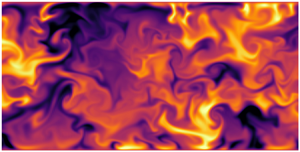
Steady streamwise-invariant Taylor vortices are present at low  $Re$. These are seen in visualizations of the flow field (not shown here) and indicated by the visualizations of the temperature field in figure 6(a,b). These vortices appear above the stability limit (Nagata Reference Nagata1990; Esser & Grossmann Reference Esser and Grossmann1996) and echo structures producing optimal heat transport in theoretical studies of PCF (Motoki et al. Reference Motoki, Kawahara and Shimizu2018). They transport considerable heat but little momentum since streamwise velocity fluctuations are small when
 $R_\Omega \rightarrow 1$, as discussed above. For streamwise-invariant PCF with
 $Pr=1$, one can further quantify this and derive from (2.1) and (2.2)
 \begin{equation} \hat{u}/U_w=(1-R_\Omega)\hat{\theta}/T_w, \end{equation}
where  $\hat {u}$ and
 $\hat {\theta }$ are the streamwise velocity and temperature deviations from the laminar situation, respectively. Further, using a variable transformation as in Zhang et al. (Reference Zhang, Xia, Shi and Chen2019) gives
 \begin{equation} \text{HTE}=1+\frac{R_\Omega}{1-R_\Omega}\frac{Nu_m-1}{Nu_m}. \end{equation}
Eckhardt, Doering & Whitehead (Reference Eckhardt, Doering and Whitehead2020) derive exact relations between heat and momentum transport in two-dimensional Rayleigh–Bénard convection and rotating PCF that are equivalent to (3.2). Relations (3.1) and (3.2) are exact as long as  $Re \leq 800$ and PCF is streamwise-invariant. Equation (3.1) shows that
 $\hat {u}$ declines relative to
 $\hat {\theta }$ when
 $R_\Omega \rightarrow 1$; and (3.2) shows that
 $\text {HTE}=1$ if
 $R_\Omega =0$, but
 $\text {HTE}>1$ if
 $0 < R_\Omega < 1$ and
 $Nu_m > 1$, so heat is transported more efficiently than momentum. Equation (3.2) further suggests a growing
 $\text {HTE}$ with
 $Re$ as
 $Nu_m$ increases. In the high
 $Re$-limit,
 $Nu_m \rightarrow \infty$, and consequently
 $\text {HTE} \rightarrow 1/(1-R_\Omega )$ for streamwise-invariant PCF. The simulated
 $\text {HTE}$ is lower because of finite
 $Re$ and turbulence, but for
 $0\leq R_\Omega \leq 0.25$ when quasi two-dimensional streamwise vortices dominate transport (Brauckmann et al. Reference Brauckmann, Salewski and Eckhardt2016), this high-
 $Re$ limit, shown by the black solid line in figure 3(a), closely matches DNSs.
Snapshot of the instantaneous temperature fluctuation field at (a,b)  $Re=400$ and
 $R_\Omega =0.9$ and (c,d)
 $Re=40\,000$ and
 $R_\Omega =0.99$ in (a,c) PCF and (b,d) TCF in a cross-stream plane. In (b) the full and in (a,c,d) a part of the spanwise/axial domain is shown.

In TCF both curvature and rotation play a role. In the rotating reference frame, the centripetal/Coriolis acceleration terms caused by streamline curvature in the non-dimensional equations of motion for TCF in cylindrical coordinates scale with the curvature number  $R_C = (1-\eta )/\sqrt {\eta }$ – see the supplementary material and Dubrulle et al. (Reference Dubrulle, Dauchot, Daviaud, Longaretti, Richard and Zahn2005) and Brauckmann et al. (Reference Brauckmann, Salewski and Eckhardt2016). Curvature effects should therefore disappear if
 $\eta \rightarrow 1$ and consequently
 $R_C \rightarrow 0$. TCF properties are indeed similar to those of PCF, and profiles of
 $Nu_m$ as a function of
 $R_\Omega$ collapse for
 $\eta \geq 0.9$ if
 $Re$ is equal, see Brauckmann et al. (Reference Brauckmann, Salewski and Eckhardt2016), confirming that
 $Re$ and
 $R_\Omega$ appropriately describe Couette flows and the TCF to PCF transition. We can then also expect heat transfer in PCF and TCF with
 $\eta \geq 0.9$ to be similar if both
 $Re$ and
 $R_\Omega$ are equal. By contrast, when
 $\eta < 0.9$ and
 $R_\Omega$ is low, curvature effects are important. TCF is then continuously turbulent in the inner partition while strongly intermittent in the outer partition due to a stabilizing influence of curvature (see Brauckmann et al. (Reference Brauckmann, Salewski and Eckhardt2016)), and this affects momentum transfer.
However, beyond a critical  $R_\Omega$, TCF is fully turbulent in the outer partition as well, and curvature effects are again less important. Consider the ratio of the curvature and rotation terms in the equations of motion given by
 $R_C U/(2R_\Omega )$, where
 $U$ is the streamwise velocity scaled by
 $U_w$ – see the supplementary material for details. When
 $R_\Omega$ is sufficiently high, this ratio is less than unity, and therefore rotation influences should dominate even if
 $\eta < 0.9$. For
 $R_\Omega \gtrsim 0.2$,
 $Nu_m$ collapses for
 $\eta \geq 0.71$ and
 $Re$ as well as
 $R_\Omega$ are equal, as shown by Brauckmann et al. (Reference Brauckmann, Salewski and Eckhardt2016) for moderate
 $Re$, which agrees with that idea. Also in the present study,
 $Nu_m$ as function of
 $R_\Omega$ in PCF and TCF collapse for
 $Re=400$ and
 $40\,000$ and
 $R_\Omega \gtrsim 0.3$. This is not explicitly shown but can be inferred by comparing figures 1(a) and 1(b). In the other cases
 $Re$ is different, which complicates a comparison. When rotation influences dominate and
 $Nu_m$ is similar, we can expect that
 $Nu_h$ is also similar in PCF and TCF. That appears to be true for the present cases once the differences in
 $Pr$ have been accounted for. For lower
 $R_\Omega$, curvature effects are noticeable and cause differences in
 $Nu_m$ and
 $Nu_h$ in TCF and PCF, see figure 1.
 $\text {HTE}$ seems to be less affected by curvature for
 $R_\Omega \geq 0$, although it could possibly cause a difference in heat and momentum transfer.
To summarize, streamline curvature has a noticeable effect on heat and mass transfer when it partly stabilizes TCF for  $\eta < 0.9$ and sufficiently low
 $R_\Omega$. When
 $\eta \geq 0.9$ or when
 $R_\Omega$ is sufficiently high and stabilization of TCF in the outer partition does not occur, curvature effects appear to have a small or negligible influence on heat and momentum transfer.
Couette flows are fully turbulent at higher  $Re$ and also when HTE is maximal, leading to plume-like thermal structures (figure 6c,d). Above
 $Re\approx 10^4$, high values of HTE are accompanied by strong recurring low-frequency bursts of turbulence in both PCF and TCF. Such turbulent bursts are evident in time series of the volume-integrated turbulent kinetic energy
 $K$ (figure 7a) and emerge if
 $R_\Omega \gtrsim 0.94$. These are persistent and approximately periodic and come along with bursts of enstrophy and temperature fluctuations and significant changes of shear stresses and heat fluxes at the wall. A phase-space plot illustrates the approximate limit cycle dynamics (figure 7b). The burst frequency declines for
 $R_\Omega \rightarrow 1$ because the flow becomes more stable and follows a similar scaling in all cases (figure 7c). During the approximate limit cycle oscillations, PCF and TCF are supercritical and continuously though weakly turbulent between the bursts. I have verified that PCF is also linearly unstable if the mean velocity profile from the DNSs is used in the stability analysis, instead of the laminar one. The growth rate of the most unstable mode follows a similar trend as the burst frequency (figure 7c), suggesting that the bursts are related to linear instabilities.
(a) Time series of  $K$ in PCF at
 $R_\Omega =0.97$ and TCF at
 $R_\Omega =0.98$ and
 $Re=40\,000$. Time is non-dimensionalized by the shear rate
 $S=\Delta U/d$. (b) Phase space plot of volume integrated
 $K$ and enstrophy
 $\omega ^2$, and wall shear stress
 $\tau _w$ in PCF at
 $Re=40\,000$ and
 $R_\Omega =0.99$. Yellow and blue colours indicate large and small temperature fluctuations, respectively. (c) Frequency of the bursts non-dimensionalized by
 $S$ for PCF and TCF. The black solid line gives the growth rate of the most unstable mode in PCF predicted by linear theory.

4. Concluding remarks
The key conclusion of my study is that even a simple Coriolis body force can strongly change heat/mass transfer rates and can make heat/mass transfer much faster than momentum transfer in shear flows, as indicated theoretically recently (Alben Reference Alben2017; Motoki et al. Reference Motoki, Kawahara and Shimizu2018). Optimization of heat/mass transfer by body forces is thus a promising avenue for further research. The mechanism of momentum transport reduction by the Coriolis force does not depend on  $Re$, implying that the observed dissimilarity between momentum and heat/mass transfer, found in both plane Couette and Taylor–Couette flow, persists at higher
 $Re$. The highest dissimilarity happens in rotating Couette flows close to the inviscid neutral stability state when momentum transfer is more strongly reduced than heat/mass transfer. Also, other rotating shear flows tend to evolve towards the neutral stability state (Métais et al. Reference Métais, Flores, Yanase, Riley and Lesieur1995; Barri & Andersson Reference Barri and Andersson2010), suggesting that heat and mass are transported much faster than momentum in such flows. Dissimilarity between momentum and heat transport is also found in rotating channel flow (Matsubara & Alfredsson Reference Matsubara and Alfredsson1996; Brethouwer Reference Brethouwer2018, Reference Brethouwer2019), albeit in a limited region where the flow approaches the zero-absolute-mean-vorticity state, and in shear flows with buoyancy forces (Li & Bou-Zeid Reference Li and Bou-Zeid2011; Pirozzoli et al. Reference Pirozzoli, Bernardini, Verzicco and Orlandi2017). In DNS and rapid distortion theory of rotating uniformly sheared turbulence, Brethouwer (Reference Brethouwer2005) observed turbulent Prandtl numbers much smaller than one when the zero-absolute-mean-vorticity state is approached, which also implies fast heat transport. This all suggests that other engineering and astrophysical flows also display dissimilarities between heat or mass transfer and momentum transfer. Another implication of the present study is that heat and mass transfer modelling in flows with body forces requires careful consideration since the Reynolds analogy can fail.
Supplementary material
Supplementary material is available at https://doi.org/10.1017/jfm.2020.1176.
Acknowledgements
The author is grateful to Professor G. Kawahara and Dr S. Motoki for the data on optimal transport in PCF, and to Bendiks Jan Boersma for providing and helping with the DNS code for TCF.
Funding
SNIC is acknowledged for providing computational resources in Sweden. The author further acknowledges financial support from the Swedish Research Council (grant number 621-2016-03533).
Declaration of interests
The author reports no conflict of interests.


 Open access

