Introduction
Delirium is an acute neuropsychiatric syndrome characterised by disturbance of consciousness and attention, cognition and perception for a brief period of time and tends to fluctuate during the course of the day. It occurs in 10–30% of the hospitalised medically ill patients, and it is associated with both increased mortality and longer hospitalisation (1,Reference Michaud, Büla and Berney2). The management of delirium is challenging for clinicians and involves both aetiological and symptomatic treatment. Although supportive and environmental measures are useful, the cornerstone of treatment is drug administration (Reference Meagher3).
High-potency typical antipsychotics such as haloperidol have been used as the first choice in the treatment of delirium. Haloperidol is the most studied agent and is commonly used by clinicians in all medical settings. It has the advantage of intravenous administration. However, haloperidol is frequently associated with adverse effects such as extrapyramidal symptoms, which are more frequent in the elderly and seriously medically ill patients, who are most vulnerable to delirium.
Atypical antipsychotics including risperidone, quetiapine and olanzapine have been widely used for treatment not only for schizophrenia symptoms but also delirium, because they are at least as effective as haloperidol and they are clearly better tolerated (4–7).
Paliperidone is the 9-hydroxy, active metabolite of risperidone, and shares some similarities in its receptor-binding profile with that of risperidone (Reference Richelson and Souder8). Paliperidone has no affinity for cholinergic muscarinic receptors and would not be expected to cause anticholinergic adverse effects such as dry mouth and constipation (9) and, therefore, is expected to have an advantage on the treatment of delirium.
In several studies, risperidone was proved effective and safe in the treatment of delirium (Reference Han and Kim5,Reference Ozbolt, Paniagua and Kaiser10,Reference Prakanrattana and Prapaitrakool11). However, clinical trial of paliperidone for the treatment of the patients with delirium has yet to be published. Therefore, this prospective open-label trial aimed to determine the efficacy of paliperidone in the treatment of delirium.
Methods
Subjects
Male and female patients aged over 18 who were referred to psychiatrists at Korea University Ansan Hospital between October and December 2009 were eligible to enter the study if they had delirium symptoms according the Diagnostic and Statistical Manual of Mental disorders, Fourth Edition (DSM-IV) (12), had a score of 13 on the Delirium Rating Scale (DRS) (Reference Trzepacz, Baker and Greenhouse13).
Each patient was examined by trained psychiatrists using the Structured Clinical Interview for DSM-IV Axis I Disorders. Patients with previous diagnosis of dementia, severe psychiatric pathology (psychotic disorders, bipolar depression and severe recurrent major depression), pregnant women, drug or alcohol-dependent and abstinent patients, those treated with antipsychotics over 3 weeks before recruitment, those had a history of a prior hypersensitivity to paliperidone or risperidone and those aged below 18 years, were excluded. We also excluded patients with physical restraint because of severe agitation, as paliperidone is available only through oral administration that makes it difficult to guarantee drug compliance in these cases. Patients signed the informed consent previously approved by the Institutional Review Board, or in those cases they were unable to do so, the consent was signed by their legal representatives.
Measurements
The severity of delirium was evaluated using the DRS (Reference Trzepacz, Baker and Greenhouse13) and the Memorial Delirium Assessment Scale (MDAS) (Reference Breitbart, Rosenfeld, Roth, Smith, Cohen and Passik14). The DRS is a 10-item, clinician-rated symptom scale to identify delirium in the medically ill patients. Items are scored from 0 to 3 or 0 to 4, and the temporal onset of symptoms, perceptual disturbances, hallucinations, delusions, psychomotor behaviour, cognitive status, presence of an underlying organic pathology, sleep-wake disturbances and fluctuation of symptoms are evaluated. Cut-off scores of 10 and 12 have been suggested to distinguish patients with delirium from patients with other neuropsychiatric diseases (Reference Rosen, Sweet, Mulsant, Rifai, Pasternak and Zubenko15). The cut-off score in this study was 13. The DRS was used as a screening tool in this study. The MDAS is a physician-rated instrument designed to measure the severity of delirium. Behavioural manifestations and cognitive deficit can be evaluated using this scale. The MDAS yields a global score ranging from 0 to 30, with a suggested cut-off score of 13 for delirium.
Procedure
Each patient was evaluated at baseline using the DRS and MDAS. Paliperidone was started at a dose of 3 mg/day, and administered orally once per day, in the evening. No other psychotropic drugs were used. The dosage was increased up to 9 mg/day depending on the status of delirium during the 7 days. The patients were examined at the same time everyday for 7 days. Day 7 of treatment was considered the endpoint of the study. If the dose could not be increased because of adverse effects or the patient's poor physical condition, the dose was continued for 7 days and the study was terminated after confirming the absence of a marked change of symptoms. A marked improvement was defined as >50% reduction in the baseline severity score of MDAS, a moderate improvement as 25–50% reduction and no improvement as 0–25% change in the score. Adverse effects were also investigated during the study. The period of onset of effect was defined as the time from the start of paliperidone to any reduction in the baseline MDAS score.
For statistical analysis, Student's t-test (paired and two-tailed) and repeated measures analysis of variance were performed, and the difference was considered to be significant at p < 0.05. The study protocol was reviewed and approved by the Institutional Review Board.
Results
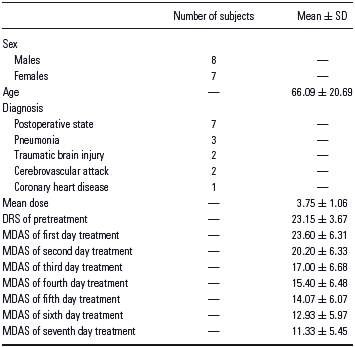
A total of 15 of 30 patients evaluated were enrolled in this study. Fifteen patients were excluded for the following reasons: oral administration of medication was not suitable for six patients, four patients required physical restraints, two patients were diagnosed as Alzheimer's dementia, the aetiology of delirium in two patients was alcohol abstinence and one patient was experiencing a terminal event. The subjects consisted of eight males and seven females. The age of subjects was 66.09 ± 20.69 years. Medical diagnoses of subjects included: pneumonia (n = 3), traumatic brain injury (n = 2), cerebrovascular attack (n = 2), postoperative state because of orthopaedic problems (n = 4), postoperative state because of gastrointestinal problems (n = 3) and coronary heart disease (n = 1). Mean maintenance dose of paliperidone was 3.75 ± 1.06 mg/day (Table 1).
Characteristics of subjects and changes of MDAS
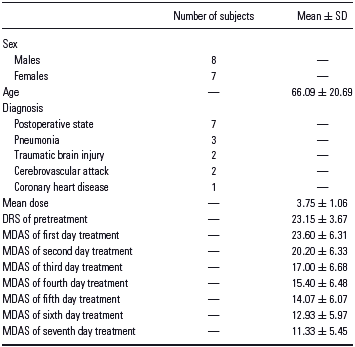
DRS, Delirium Rating Scale; MDAS, Memorial Delirium Assessment Scale.
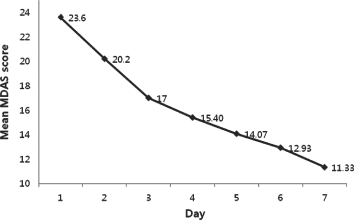
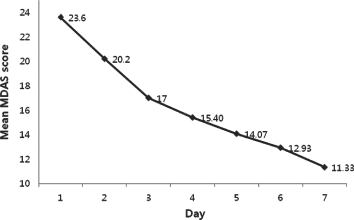
Paliperidone was associated with a significant improvement on MDAS from baseline to endpoint (Fig. 1). The mean MDAS scores for the total samples were 23.60 ± 6.31 at baseline and 11.33 ± 5.45 at the end of the study. There was a significant decrease from baseline throughout the study period (F = 9.638, p = 0.002) and from baseline to endpoint (t = 6.78, p < 0.001). Nine of 15 patients (60%) showed a marked improvement, 4 (26.7%) a moderate improvement and 2 (13.3%) showed no improvement. The appropriate dose in the 11 patients who were assessed as having experienced a marked or moderate improvement averaged 3.36 mg/day. There was no correlation between the symptom severity and efficacy.
Change in Memorial Delirium Assessment Scale scores.
No serious adverse effects were observed, and none of the patients discontinued paliperidone because of adverse effects. Two patients experienced akathisia at a paliperidone dose of 6 mg/day, which disappeared when treatment was combined with β-blocker. No changes in biochemical and haematological examinations, urinalysis or blood pressure were noted.
A post hoc power analysis was performed G*Power 3.1.2 (GPower Software Inc., Kiel, Germany). The power of this study was 0.99 (t-test, two-tailed, α = 0.05; correlation between groups = 0.493 and effect size = 2.056).
Discussion
This prospective, open-label study shows that treatment of hospitalised patients with low-dose paliperidone for 7 days is associated with a decrease in symptoms of delirium and improvement in patient functioning. To the best our knowledge, this study is the first report on the paliperidone use for delirium treatment.
Thirteen of 15 patients improved on most measures of delirium. These findings were considered to have occurred in response to treatment with paliperidone because patients in whom the aetiological factors of delirium could be eliminated and those whose delirium was quite likely to resolve spontaneously were excluded from the study. The dose of paliperidone was lower than those generally used to treat schizophrenia (Reference Canuso, Youssef, Bossie, Turkoz, Schreiner and Simpson16–Reference Marino and Caballero18). The mean appropriate dose averaged 3.75 ± 1.06 mg/day.
No serious adverse effects were noted. Two patients experienced akathisia, but it is easily treated with β-blocker. Atypical antipsychotics have the obvious advantage of low potential adverse effects. Delirious patients, in general, are more sensitive to medication adverse effects including anticholinergic effects, orthostatic hypotension, parkinsonism, tardive dyskinesia and cognitive impairment than patients with general psychotic conditions (Reference Tueth19). Drug-induced movement disorder may not only add to medical morbidity but can further confuse an already complicated clinical picture (Reference Tune20). Another consideration in the choice of an antipsychotic in the treatment of delirium is its anticholinergic profile. The cumulative anticholinergic burden from various concomitant medications has been implicated in the development of delirium (Reference Tune20,Reference Tune21). Therefore, choosing an atypical antipsychotics with no or low affinity for muscarinic receptors, such as paliperidone, might provide an advantage over agent with greater anticholinergic properties. In this aspect of tolerability, no subject in this study discontinued paliperidone, and there were no reported serious side-effects, and only two patients complained of akathisia, which suggests satisfactory tolerability of this drug in patients with delirium.
Paliperidone is a benzisoxazole derivative and is considered to be the major active metabolite of risperidone. Similar to risperidone, paliperidone has an affinity for 5-HT1D, 5-HT2B, 5-HT7 and D3 receptors (Reference Richelson and Souder8,Reference Schotte, Janssen and Gommeren22,Reference Leysen, Janssen, Megens and Schotte23). However, the inhibition constant values for binding to D2 and 5-HT2A receptors are lower for paliperidone than risperidone (0.16 vs. 5.9 nmol/l and 0.25 vs. 4.8 nmol/l, respectively) (Reference Schotte, Janssen and Gommeren22–Reference Megens, Awouters and Schotte24). Also, paliperidone has shown weaker affinity for α1- or α2-adrenergic receptors compared with that of risperidone in vitro; therefore, hypothetically, it may cause less orthostasis compared with risperidone (Reference Richelson and Souder8). In addition, paliperidone has no affinity for cholinergic, muscarinic and β1- or β2-adrenergic receptors. As a result, it may be hypothesised that paliperidone causes less weight gain compared with other second-generation antipsychotics (9,Reference Luthringer, Staner and Noel25,Reference Miller26).
In contrast to risperidone and other antipsychotics, paliperidone undergoes limited hepatic metabolism. Four metabolic pathways were identified as being involved in the elimination of paliperidone, each of which accounted for up to a maximum of 6.5% of the biotransformation of the total dose. Renal excretion was the major route of elimination with 59% of the dose excreted unchanged in urine. About half of the renal excretion occurred by active secretion (Reference Vermeir, Naessens and Remmerie27). As the cytochrome P450 2D6 pathway is minimally involved in the metabolism of paliperidone, clinically significant pharmacokinetic drug interactions with drugs that inhibit this enzyme are unlikely. Risperidone, by comparison, has known drug–drug interactions with the cytochrome P450 2D6 inhibitors, fluoxetine and paroxetine.
This study has some limitations. First, it was a prospective open-label study with small sample size. For the assessment of the efficacy of treatment, randomised double blind case–control study using the larger sample is crucial. Second, the patients who required physical restraint and unable to use oral medications were excluded because paliperidone is available only through oral administration that makes it difficult to guarantee drug compliance. These exclusion criteria may have created a selection bias. Third, the observation period was too short to evaluate the long-term efficacy and adverse effects of paliperidone in delirium patients. Finally, although the patients treated with antipsychotics were excluded from the study, most of the patients were very ill and were treated with several concurrent medications, which may have resulted in confounding factor. The validity of generalising these results to a wider population of patients with pre-existing delirium remains to be confirmed in larger double blind studies.
In conclusion, this small open-label pilot study indicates that low-dose paliperidone is effective in reducing behavioural disturbances and symptoms in delirium and is well tolerated in delirious patients. Although it is too early to tell whether paliperidone might be the treatment choice of delirium, further systematic controlled studies should be warranted.