THE EXCAVATIONS By John Gooder
Inveresk fort is situated on the Firth of Forth east of Edinburgh. It is contemporary with the Antonine Wall (c. a.d. 140–165)Footnote 1 for which it was well placed to act as part of a system of coastal defence as well as a supply base and port.Footnote 2 The environs have yielded the most extensive evidence for extramural activity of any Roman fort in Scotland.Footnote 3 There is a large vicus to the east, with a bath-house probably associated with a mansio, field-systems to the east, north and south, burials to the north and a series of temporary camps to the south and south-east. Yet the Mithraeum was an unexpected discovery during excavations associated with the construction of a replacement cricket pavilion by East Lothian Council within Lewisvale Park. Much of the area is a Scheduled Ancient Monument and the conditions of Scheduled Monument Consent required the pavilion development to be monitored.
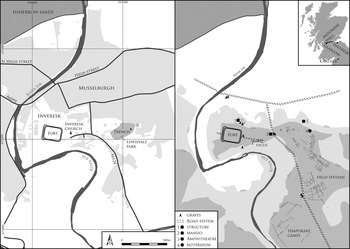
The site chosen for the pavilion largely occupied that of its predecessor within a grassed area near the northern edge of the scheduled area (fig. 1).Footnote 4 Located c. 750 m to the east of the fort on the same low east–west ridge, the current level parkland has been subject to extensive modern landscaping. The site's overall aspect is to the north where the land slopes down to the Firth of Forth. The monitored topsoil strip commenced on 22 March 2010; a ditch feature and the Roman altars were revealed on that day and the following morning. The remains were excavated between 24 March and 5 April 2010. Excavation focused on recovery of the altars and, as the dedications were not visible, the possibility of the site being a Mithraeum was not obvious during fieldwork. The dedications were not revealed until more than a year later when funding was granted to turn the altars over and begin the post-excavation process. The structural evidence was disentangled in post-excavation analysis in discussion with Eberhard Sauer and Fraser Hunter. The site would repay further investigation when the opportunity arises, to look for more subtle indications of features that would typically be associated with a Mithraeum which may have been overlooked by the initial field methodology in the absence of a detailed research hypothesis.
Location map. Left, modern topography; the light grey shaded area marks built-up areas. Right, reconstruction of the Roman complex, with 10 m and 20 m contours to show topography. (Drawing: Jamie Humble/AOC Archaeology)

A Roman presence had long been suspected from antiquarian finds.Footnote 5 Excavation by Ian Richmond in 1946 and 1947 established the general form and dimensions of the fort and suggested two periods of Antonine occupation, but recent work has questioned this.Footnote 6 Three seasons of excavation in 1991, 1993 and 1999 by GUARD Archaeology revealed much of the western third of the fort and its defences and suggested that there were three phases of occupation.Footnote 7 Excavations within the vicus at Inveresk Gate unearthed three distinct phases of civil occupation, each maintaining the same building grid.Footnote 8 These overlay an early box rampart and ditch which formed a concentric outwork interpreted as the fort's construction enclosure.Footnote 9
Within the wider landscape aerial photography has revealed a palimpsest of Roman field-systems interwoven with camps and earlier sites.Footnote 10 To the east of the vicus the Lewisvale Park Roman field-systems have been investigated by geophysical survey and excavation.Footnote 11 Excavations to the north at Park Lane in 1995 revealed a curvilinear arrangement of pits and an associated rectangular post-built structure interpreted as a timber amphitheatre.Footnote 12 To the south the considerable cropmark evidence of field-systems and camps has been investigated at Howe Mire and Monktonhall.Footnote 13
Only two Roman altars have previously been found at Inveresk, both dedicated by Quintus Lusius Sabinianus, the Imperial Procurator. One, found in 1565 but now lost, was dedicated to Apollo Grannus; it came from Eskgrove, in association with a hypocaust.Footnote 14 The suggested mansio at this site would provide a suitably refined residence for the visiting procurator.Footnote 15 The fragmentary second altar was found within the fort interior, where it seems to have been reused as a building stone. It bears two inscriptions, the latter over-cutting that of Sabinianus.Footnote 16
FIELDWORK RESULTS
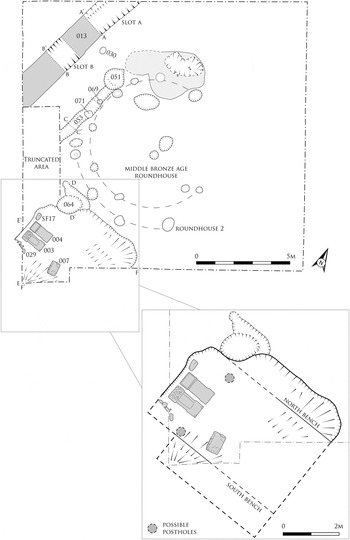
The excavation area, rectangular in plan, amounted to c. 218 square metres (fig. 2). The eastern third had been subject to considerable disturbance during the building of the original cricket pavilion, with the natural subsoil truncated by foundations or service trenches and overlain with building detritus. Archaeological features were concentrated in the western half of the site. Overburden comprised a loamy imported garden soil overlying a thin buried soil in the south-west; the natural subsoil was orange sand/gravel with rare patches of fine yellow or pale brown silt.
Trench plan, with detail of Mithraeum. The western end of the northern bench was obscured while the altars were being removed, and its likely extent is projected. (Drawing: Jamie Humble/AOC Archaeology)

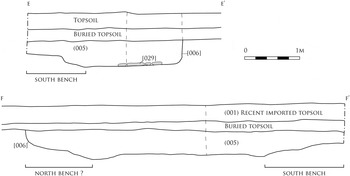
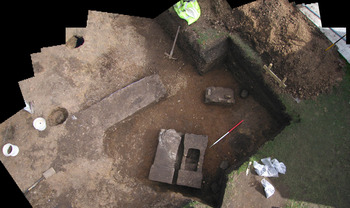
Two phases of archaeological activity were present. The earlier is a series of Middle Bronze Age remains, comprising the partial remains of two timber-built roundhouses and associated pottery; this will be reported on in detail elsewhere. The second, Roman, phase can be interpreted as a coherent set of structural remains. The most prominent feature comprised a large shallow rectangular pit [006] lying in the south-west corner of the site which was only partially exposed and continued into the southern and western sections. Its maximum exposed extent was 6.0 m east–west by 5.3 m north–south by 0.40 m deep; assuming a symmetrical layout gives an original width of c. 5.4 m. It possessed a steep, near-vertical cut in the western section (fig. 3 E–E’), where there was an extension 3.3 m wide and 1.3 m long to receive the altars. The long sides were stepped (fig. 3 F–F’; this feature was recorded partially in plan and section in the field, though its significance was only recognised in post-excavation). The steps created two benches in the gravel, c. 1.0 m wide and preserved to a height of 0.25 m. Their rather irregular profile in places suggests they had seen some use or, perhaps more likely, been damaged when the temple was dismantled, possibly as a source of material to cover and conceal the altars. No floor deposits were recorded. At the eastern end, the northern bench seems to curve into the section, perhaps forming a step from the entrance. A pair of possible post-holes was identified in post-excavation at the end of the benches, and other unrecorded ones must be anticipated. Two Roman altars, [003] to Sol and [004] to Mithras, lay in the recess at the western end, protruding from its single mid-brown silty sand fill [005]. Excavation later revealed an associated altar base [007] sitting on the base of the pit (fig. 4).
Trench edge sections of Mithraeum [006]. Note that these are not perpendicular to the feature. (Drawing: Jamie Humble/AOC Archaeology)

The Mithraeum with the altars in situ. (Photo: AOC Archaeology)

The two altars had been carefully placed parallel on a west–east alignment with their tops to the east. They lay face down, only some 0.10 m apart, in the western part of pit [006], close to its near-vertical edge. The altar base [007] sat upright 0.90 m to the south-east, its long axis near perpendicular to the altars. The heavily damaged rears of the altars and extensive cracks probably derive from later plough attrition, although cracks to the sides of the Sol altar, which had a central recess, may have been caused by stresses created by its lowering. The altar base is probably related to the Mithras altar, indicating the altars were not simply toppled in situ but were carefully removed and laid down. The available space would have allowed other sculpture in the recess.
Excavation of a notch within the western trench section to facilitate lifting the Sol altar exposed a small area of paving [029] formed of horizontal tightly-packed small flat stones. Pit [006] produced the bulk of the Roman finds from the site, including ceramic sherds, lead fragments and ironwork.
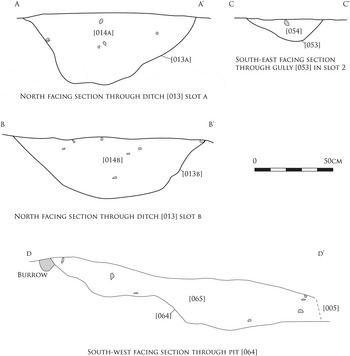
An irregularly shaped pit [064], measuring 1.92 by 1.53 by 0.32 m, conjoined pit [006] in the north, at the outer angle of the bench and the recess. It had steep sides on the west but shallow on the north-west, gradually sloping onto an irregular base (fig. 5 D–D’), and was disturbed by an animal burrow in the north. Its fill [065] was indistinguishable from fill [005] of pit [006] on excavation and in subsequent soil chemistry analysis. Much of a colour-coated beaker was recovered from it.
Sections of selected features. (Drawing: Jamie Humble/AOC Archaeology)

A linear ditch [013], running almost north–south, crossed the north-west corner of the excavation area. The feature was investigated by two slots (A and B). Its width varied from 1.35 to 1.50 m and its depth from 0.45 to 0.70 m. In Slot A it had a sharp break of slope to a flattish base, the west side running at c. 40 degrees with a slight break and a steeper slope on the east side. In Slot B it was shallower (0.47 m) and less steep (fig. 5 A–A’, B–B’). Pottery from its fill [014] indicates an early to mid-second-century date.
Gully [053] paralleled the course of ditch [013] at a distance of 2.2 m to the east. Averaging 0.46 m wide and 0.20 m deep, the feature ran south for 6 m from pit [051] before entering the south-west trench section (fig. 5 C–C’). Two intrusive post-medieval sherds were recovered from the upper part of its fill. Two post-hole features [069] and [071] lay 0.6 m apart within the base of gully [053].Footnote 17 A further small post-hole [030] lay between pit [051] and ditch [013].
DISCUSSION
The formal in-situ deposition of the altars face down within a large pit is an extremely significant find. Altar discoveries more usually occur outwith their original context either as stray, broken finds within later soils or as reused stonework salvaged and integrated into later buildings.
Pit [006] could not be fully exposed and its full form, lateral extent and whether further altars are present remain unknown. Given the damage to the altars, the pit and other features had obviously suffered considerable reduction in original depth by ploughing. A number of factors support interpretation as a Mithraeum. The size of the pit indicates it was not dug simply for deposition of the altars. The lateral steps cut into the gravel form the typical side benches, while the presence of paving [029] indicates that the recess had been at least partly floored. Both altars had been removed from any bases but are likely to be close to their original position against an end wall in a recess opposite the presumed entrance.Footnote 18 This careful, face-down decommissioning would have protected the highly decorated fronts (of particular significance to devotees) from damage during the dismantling of the Mithraeum and subsequent backfilling of the construction pit.
Annexe pit [064] contained a votive offering of a fine Colchester-made beaker. Given that the fill is indistinguishable from the main infill of [006], this probably represents a ritual deposit contemporary with the burial of the altars and the closure of the Mithraeum. Assuming that there was once a wall around the pit edge, this pit must have been cut once the wall was removed at a late stage in the demolition of the building.
Linear ditch [013] might easily be taken as a simple field boundary were it not for the adjacent parallel gully [053]. This suggests a shared function in demarcating a precinct around the Mithraeum. The function of gully [053] is open to interpretation. It may be a drain leading away from the Mithraeum as water permeation into the building would have been a persistent problem. Alternatively, its alignment paralleling ditch [013] may suggest a boundary function, such as a bedding trench for a wall, controlling access to the Mithraeum. In this interpretation, pit [051] or post-hole [030] could act as the foundation setting for a gate-post.
THE ALTARS By Fraser Hunter, Martin Henig and Eberhard SauerFootnote 19
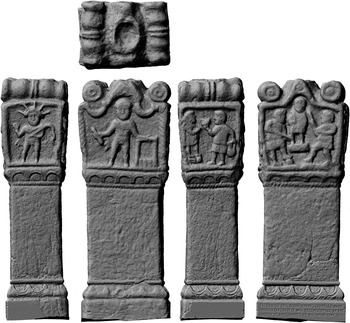
The two sandstone altars were linked by themes and deities common in Mithraic beliefs. One was dedicated to Mithras, identified here with Apollo by the attributes depicted on the sides of the altar. The other, to Sol, featured a dramatic portrait of the deity, pierced to allow light through, with the Four Seasons shown above. Both were erected by the same man, G(aius) Cas(sius) Fla(…), a centurion. His tria nomina identify him as a citizen; in the context of an auxiliary fort, he is likely to have been the fort commander or in charge of a vexillation of legionaries (see further discussion by Roger Tomlin, below).
THE SOL ALTAR (figs 6–11)
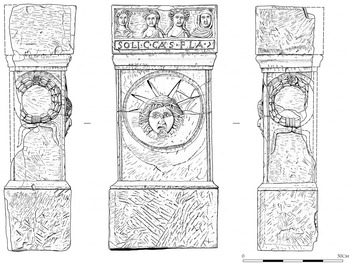
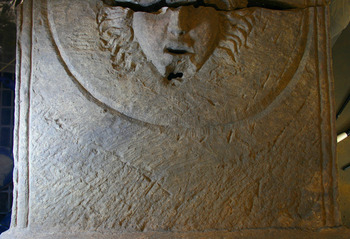
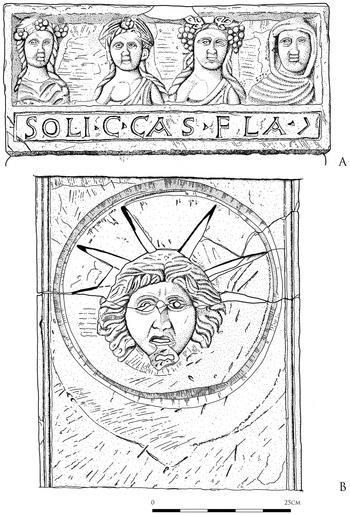
The shaft of the Sol altar (figs 6–7) is decorated with a relief head of the youthful god with flowing locks surrounded by a nimbus (or set on a slightly domed shield), the six rays pierced to allow light to flow through; the mouth and pupils of the eyes are similarly pierced. The chin broke off during manufacture; tool marks on the fracture surface represent keying points for a plaster repair (fig. 8).
The Sol altar: front and sides. (Drawing: Alan Braby)

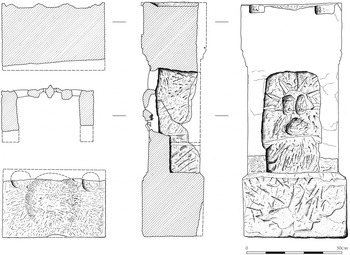
The Sol altar: top, rear and sections. (Drawing: Alan Braby)

Sol: detail showing chin repair and layout error in nimbus. (Photo: AOC Archaeology)

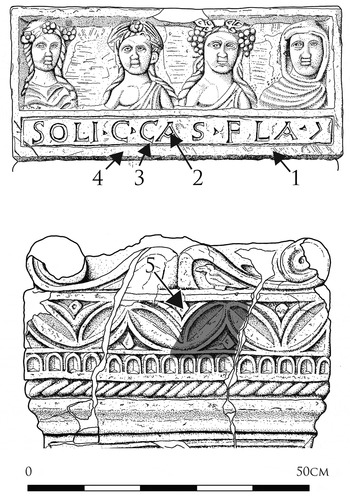
Details of the sculpture and inscriptions on the Sol altar. (Drawing: Alan Braby)

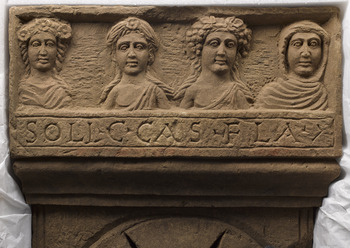
The Seasons and inscription on the Sol altar. (Photo: Neil McLean, © National Museums Scotland)

The rear of the shaft was hollowed to take a light source (fig. 7). A lampstand or candlestick placed on the base of the hollow would need to be quite high to be effective, which perhaps explains why there is evidence that the arrangement was modified; the narrow transverse shelf behind the mouth has two lateral shelves set slightly below it, perhaps to take a wooden plank raising a light source above the base of the recess. The sandstone in the mouth area is oxidised, probably due to heat from a candle or lamp.Footnote 20 A vertical rod was carefully inserted behind the nostrils; presumably something once looped round this, either an attachment to stabilise the light source or something which was suspended behind the mouth. It is unusual that the mouth and nose are pierced, and an acoustical role cannot be ruled out.
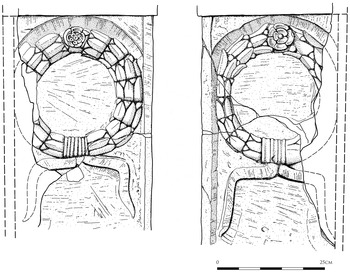
The capital carries the inscription and a panel with relief busts of the Four Seasons as female personifications, showing traces of red and white paint (figs 9a and 10). Spring has a garland in her hair with three rosettes, her hair falling in two long corkscrew tresses onto the shoulders. She is dressed in a tunic with a central V-fold. Summer sports a wreath with a central rosette on her head; her hairstyle is similar to that of Spring. An off-the-shoulder dress exposes her right breast. Autumn wears a garland of ivy leaves flanked by bunches of grapes. Her dress and hair match those of Summer. Winter is well muffled, with her cloak pulled over her head. The altar top has a simple sunken focus with two hollows probably for lamps or candles at the rear corners, truncated by a fracture at the back of the altar (fig. 7); lead was run in to hold cylindrical objects in place. The sides bear wreaths in relief (fig. 11); these could be generic emblems of the invincible sun, but also had a specific role in Mithraic beliefs as recorded by Tertullian:Footnote 21 ‘a wreath offered to him on the point of his sword and then placed on his head must be pushed off … with the words that Mithras alone is his wreath.’ A wreath can be found on the front of the Mithraic altar from Rudchester on which is inscribed the single word ‘Deo’, meaning ‘to the God’.Footnote 22
Wreaths on the sides of the Sol altar. (Drawing: Alan Braby)

The quality of the finish varies, with the base and wreath on the right side of the altar notably better finished than the left. There were a number of errors in layout, notably in the outline of the nimbus, which was partly laid out and then moved (figs 8 and 9b),Footnote 23 but the quality of the relief sculpture is high. It is likely that the front was once plastered, given the clear irregularities in its layout which would not be concealed in the low lighting of the temple. No visible evidence survived, but gesso traces were found in eroded pigment traces on the capital, and the plaster repair chin would have been less noticeable if the whole front was coated. The Mithraic relief from Carrawburgh provides a parallel, as traces of white gesso imply the whole surface was once plastered and traces of paint survive.Footnote 24
Around 80 mm above the base of the shaft, a large part of the rear has sheared off, removing the rear edge of the shaft including the borders and part of the wreath. The stone has split along bedding planes, probably due to plough damage. As found, the altar had broken horizontally in two across the god's face. Dimensions (mm): H 1260, W 545, T 305–25. Base H 290–310; moulding 36–44; shaft H 570, W 480, T 245–65; top moulding H 44; capital H 250 by 545 by 340.
THE MITHRAS ALTAR (figs 12–15)
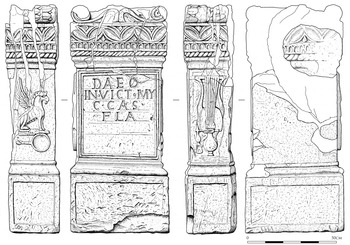
The second altar was dedicated to Mithras. Curiously, the inscription fills only part of the field; there are marking-out lines for a six-line inscription, but only four were used (fig. 12). The damaged top (fig. 13a) has a circular focus with well-finished flat rim and rather rough interior, flanked by cylindrical bolsters decorated with leaf-scales (probably thunderbolts, but the details are not clear). Their surviving front ends have raised spiral ornament leading into swelling triangular fields which rise to a rounded top and dip slightly where they meet. Each contains a raven. Below this, a decorative frieze runs round all four sides, with three decorative bands separated by flat ribbons: a leaf frieze, a row of arcades and an S-twist cable. The moulding at the boundary with the shaft is half-rounded with a concavity before a lower-relief rounded line (a cyma reversa moulding).
The altar to Mithras. (Drawing: Alan Braby)

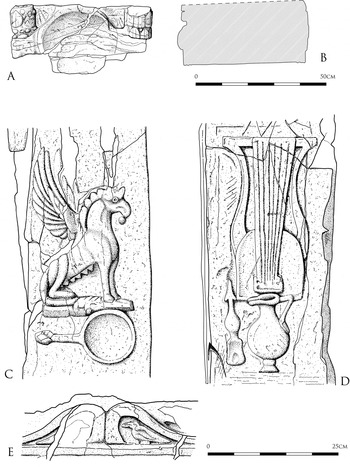
Details of the Mithras altar. A: top view; B: section (for location see fig. 12); C: left side with griffin and pan; D: right side with lyre, plectrum and jug; E: ravens on capital. (Drawings: Alan Braby)

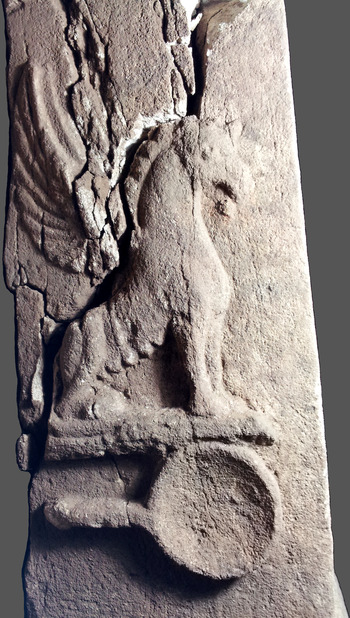
Left side of the Mithras altar, showing griffin, ?torch and handled pan. (Photo: Fraser Hunter)

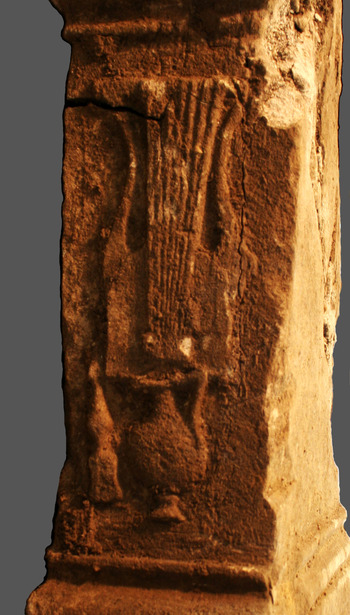
Right side of the Mithras altar, showing lyre, plectrum and jug. (Photo: AOC Archaeology)

Two ravens within the scrollwork on the front provide a clear link to the Mithraic cult (fig. 13e). The raven is frequently found in Mithraic iconography, probably as a messenger of the Sun, and was also the first grade of initiation in the cult or the first priestly grade.Footnote 25 Individual ravens are harder to parallel than examples where ravens are included in scenes, although one side of an altar from Carnuntum (Austria) has a raven, ear of corn and snake.Footnote 26
The sides show attributes of Mithras (a torch), Apollo (a griffin, lyre, and an unusual object identifiable as a plectrum) and vessels employed for ritual hand-washingFootnote 27 (a jug and a handled bowl) in relief. On the left side (figs 13c and 14) the seated eagle-headed griffin, its wings raised, faces right holding a pellet (a natural iron inclusion which has been retained) in its hooked beak. A row of five teats under the belly identifies the creature as female (perhaps on the analogy of sphinxes, which are always shown as female). The creature's anatomy is well defined, with powerful legs and clear musculature; its tail runs under its hind foot.Footnote 28 It appears to sit on a tapered relief feature which is best seen as a torch — a significant object in Mithraism, being the attribute of Cautes and Cautopates, attendants of the god. Below is a shallow vessel with circular bowl and slightly offset cylindrical handle with worn ram-headed terminal.
The right side figures a lyre, a plectrum and a jug (figs 13d and 15). The lyre is discussed by Graeme Lawson below. Slightly overlapping its base is a round-bellied jug facing left, with a simple horizontal channelled spout and an angled handle attached to the rim and belly. There is a knobbed stem between the belly and the slightly damaged flared foot. Below and to the left of the lyre is an object with a swollen shank tapering into a barbed arrow-like tip and spatulate base with flared sides. These features find resonances in some of the plectra depicted elsewhere in Roman art. Most comparanda are smaller in size and are not shown separately but in the act of performance.Footnote 29 However, Christophe Vendries has gathered the rare depictions of such objects in connection with lyres but not actually in use, and the parallels are convincing.Footnote 30
As found, the altar was intact apart from parts of the rear of the capital, which had become detached by ploughing and been dragged elsewhere. However, it had degraded considerably during burial and after retrieval, and it fragmented badly during conservation, making it hard to clarify some of the details. Dimensions (mm): overall H 1265, W 560, T 280. Base H 405; shaft H 517, W 500, T 245; capital H 350.
The lyre By Graeme Lawson
The depiction of the lyre is unusually well planned and finely executed: symmetrical, with straight and evenly-spaced strings arranged in an upward fan. Their number, seven, is significant, being the number which the Latin poets (following earlier Greek traditions) attributed to Terpander of Lesvos and his legendary improvements to the lyre (Latin cithara).Footnote 31 At their lower end there is a small angular feature representing the bridge, the structure that communicates the vibrations of the strings to the sound-board for amplification. The arms describe the tapering S-shapes common to many Roman depictions of lyres. The base of the sound-box exhibits the straight edge and square corners typical of the larger wooden-bodied lyres at this time, or at least of Roman attempts at representing such instruments in pictures.
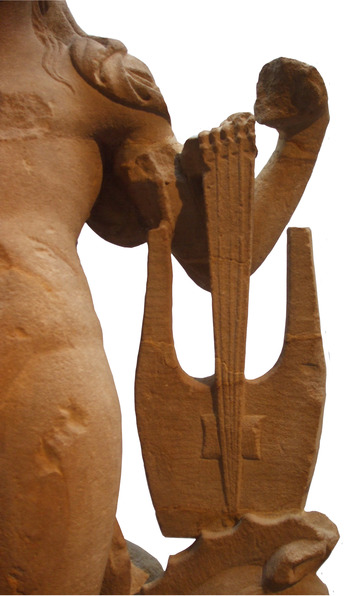
Many Roman images of lyres appear stylised, however,Footnote 32 and no wooden example or fragment has yet been recovered within the area of the Empire. Amongst the more convincing comparanda is one preserved on a fine marble statue of Apollo and griffin from Hochscheid, Hunsrück (Germany) (fig. 16).Footnote 33 The upper edge of the Inveresk sound-box bulges upwards in the manner of wooden lyres shown in Hellenistic art, which in turn echo the shape of the Classical Greek kithara and ultimately the posterior anatomy of the carapace of the tortoise Testudo graeca. The upper end of the lyre has been damaged since the altar was lifted, but still preserves the form of the connecting bar or ‘yoke’ to which the strings would have been attached and tuned, though without any attempt to represent the tuning mechanisms. The lower end reveals a frontal view, including the sound-board and bridge, the latter presenting the shape of a letter U. Whereas the Hochscheid bridge appears to be free-standing, like later lyre bridges, and held in place by the tension of the strings, here the strings appear instead to attach directly to the bridge. Although awkward to engineer, this is a common enough device of Roman artists and could well be authentic. They are preserved in some ancient Egyptian lyres.Footnote 34 Could the U-shape represent a structure of this sort? Perhaps. But there are hints of uncertainty on the sculptor's part. In particular, the jug is carefully positioned so as partly to obscure this most technical of details.Footnote 35 A handy illustration of how easily such a U-shape could represent a free-standing bridge instead can be seen in the upside-down bridge shown on David's lyre in the twelfth-century Harley Psalter.Footnote 36
Statue of Apollo and his lyre from Hochscheid, Hunsrück, Germany. (© Graeme Lawson, courtesy of Rheinisches Landesmuseum Trier)

Apart from conventional mass-produced images of lyres signifying Apollo on Roman coins and moulded in terra sigillata, notable individual images include a small lead plaque from Lydney, Gloucestershire, and a much worn relief showing the god formerly built into the corner of Compton Dando parish church in Somerset.Footnote 37 But the Inveresk instrument is arguably the finest yet seen, in terms of both detail and preservation. The question remains open as to how far this particular lyre may have been drawn from contemporary musical life and how much it owes to iconographical tradition (such as artistic convention and/or books of patterns). At this very early date, however, perhaps its most important cultural aspect is not so much its organology (its type, structure and musical use) as the identity of the personage and the art form that it represents. If it does indeed allude to Apollo Citharoedus, it is our earliest securely dated indication of his cult in northern Britain and thereby, indirectly, our earliest Insular evidence of his stocks-in-trade: verse and song and the inspiration of poets. It is hard to imagine that he would have been thus invoked in a culture that did not know and value poetry, and this may prove significant because, like so much of the high culture of Roman Britain, actual poetry is now so very thin on the ground. Poetic fragments and extracts do survive in some memorial and dedicatory inscriptions, including hexametric Greek verse from CorbridgeFootnote 38 and at York five Latin hexameter lines dedicated by Q. Core[llius] Fortis in memory of his daughter Corellia Optata.Footnote 39 But so far there is nothing in Britain to match the alphabetical notations of the melodies preserved in Greek inscriptions and on Hellenistic papyri.
THE ALTAR BASE
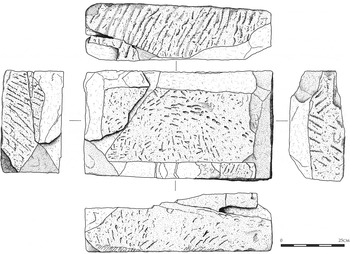
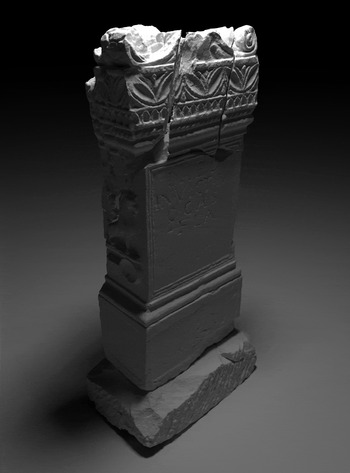
A separate rectangular base found a short distance away in the pit fits this altar (fig. 17).Footnote 40 The rear and left side are neatly dressed with heavy diagonal pick-dressing; the right side is less well finished. The front has been chisel-smoothed. A rectangular recess carved into the top (285 by c. 575 mm) is surrounded by a raised flat rim, badly damaged; the dimensions of the recess closely match the base of the Mithras altar (fig. 18). The lip was reddened compared to the rest of the block, suggesting it may have been coloured. Dimensions: 705 by 405 by 230 mm.
The altar base. (Drawing: Alan Braby)

Scan of the Mithras altar set on the altar base. (Graeme Cavers/AOC Archaeology)

MODIFICATIONS
Both altars show signs of modification in their planning. This is clearest in the Sol altar, where the layout of the nimbus and rays was changed (there is an unfinished ray on the interior), while the chin was repaired. The different levels of shelf in the rear indicate functional adaptations during the altar's use rather than in its manufacture. The layout of the inscription on the Mithraic altar is unusual in leaving so much space; as this was clearly not an off-the-shelf piece, it suggests the letter cutter and carver were not the same person.
THE INSCRIPTIONS By R.S.O. Tomlin
THE SOL ALTARFootnote 41
Only the capital is inscribed (letter height 33 mm). Below a rectangular recess with the four female busts of the Seasons is a rectangular panel defined by a scribed line above a painted red band. The panel is inscribed:
SOLI Δ C Δ CAS Δ FL[.] 7
Soli G(aius) Cas(sius) Fl [a(…)] (centurio)
‘To the Sun, the centurion Gaius Cas(sius?) Fla(vianus?) (dedicated this altar).’
THE MITHRAS ALTARFootnote 42
A recent break across the top of the die has affected the end of the first line. On the face, within a panel 0.41 by 0.44 m defined by a moulding, is inscribed:
DAEO | INVICTo MY | C CAS | FLA
d<a>eo | invicto My(thrae) | G(aius) Cas(sius) Fla(…)
‘To the Unconquered God Mithras, Gaius Cas(sius?) Fla(vianus?) (dedicated this altar).’
Letter heights: 1, 50 mm; 2, 48–50 mm; 3, 45–48 mm; 4, 42–45 mm. The lettering is quite well drawn and executed, but line 2 shows signs of crowding towards the end (notably in the diminutive O) although two-fifths of the panel was not used. There is no centurial sign below line 4, in contrast to the Sol altar, despite there being ample space for it.
DAEO for deo is ‘hypercorrect’, but has not previously occurred in Britain, and is rare elsewhere.Footnote 43 The name of Mithras is sometimes spelled with Y instead of IFootnote 44 and is sometimes abbreviated to the initial letter M where the formulation (for example deo invicto) and the context made the dedication obvious.Footnote 45 The abbreviation to MY is most unusual, but also occurs in AE 1974, 477 (Noricum).
The attributes on either side of the die suggest Apollo (specifically Apollo Citharoedus), who is explicitly identified with the Unconquered Sun and Mithras in the Rudchester Mithraeum.Footnote 46 Another altar from InvereskFootnote 47 was dedicated to Apollo Grannus.
The dedicator was a centurion and a Roman citizen, and thus likely to have been legionary, especially since his altars are of such outstanding quality. The form of A in line 1 (and probably in 3 and 4), which also occurs in the Sol altar, line 3, is also significant: with its angled cross-bar, it is peculiar to distance slabs of the Twentieth Legion on the Antonine WallFootnote 48 and is found elsewhere in Britain only at the legion's base of Chester.Footnote 49 This strongly suggests that he was a centurion in the vexillation of that legion responsible for building part of the Wall, and that his altar is contemporary with this work in the early a.d. 140s. His post at Inveresk is unstated, but presumably he commanded a legionary detachment stationed there,Footnote 50 or was acting-commander (praepositus) of an auxiliary unit in garrison.
Statistically his gentilicium is very likely to be Cassius, since this Italian and provincial nomen is so widespread, especially in Cisalpine Gaul according to TLL Onomasticon, but a few rare nomina are also possible, for example Castricius. His cognomen was probably Flavus, Flavinus or Flavianus, but Flaccus is also possible. He is otherwise unknown in Britain, and apparently not attested elsewhere; he cannot be identified with T(itus) Cassius Flavinus, centurion of Legion X Gemina buried at Tarraco,Footnote 51 nor with Cassius Flav[…], centurion of Legion XV Apollinaris at Carnuntum,Footnote 52 since this legion had left before a.d. 117. It is strange that G(aius) Cas(…) Fla(…) should have abbreviated his name in both inscriptions to this extent: in the Sol altar space was limited, but it was ample in the other. However, like his fellow-centurion Maximius Gaetulicus at Newstead,Footnote 53 he also did not identify his legion; and he abbreviated the god's name as well.
TECHNICAL ASSESSMENT OF THE MASONRY By Peter HillFootnote 54
A qualitative assessment of the two altars and altar base examined the tool marks and methods of working in order to gain technical information about the standards of workmanship.
STANDARDS
Judgement of the standard of workmanship is made by reference to what would be readily achievable by an averagely skilled trained mason. Faces should be straight to within 1–2 mm in 300 mm, whether finished by punch or blade.Footnote 55 Mouldings should be worked straight within 1–2 mm, having due regard to the difficulty of working some hollow mouldings.Footnote 56 In addition to the accuracy of working, there should be good evidence of skill and care for the finished appearance.
The judgements may seem over-harsh, considering that the work was probably carried out by soldiers. But some at least would have been trained as stonemasons and their work ought to be recognisable even though worked building stone in the north of the province was often less than high quality. However, occasional examples of good, professional workmanship are found, and it is important to be able to discriminate between these and the general run of work. The skilled Roman stonemason, soldier or civilian, was quite capable of this standard.
THE SOL ALTAR
This altar was clearly expensive in terms of both time and skill. The relief carvings were certainly carried out with considerable care and a skilful use of the tools. Given the thinness of the stone on the crown and especially the fact that the stone is face-bedded, it is a little surprising that the rays did not break off while the stone was being cut away at the back. This took skill, but perhaps also a little ingenuity. One possibility is that the stone might have been laid face down on a thick bed of sand to give some support to the face during this operation, which would still have taken considerable care. There is a strong likelihood that the altar was at least roughed out, apart from the areas of the god's face and the busts, the back was hollowed out, and then the face finished off.
The lettering is bold but the letter forms are a little suspect and there appears to be a certain lack of skill in cutting straight lines. The use of colour, indicated by the pigment, will have improved the appearance. The preparation of the flat panel to receive the inscription was certainly carried out with skill and care to give a truly flat, if not rubbed, surface.
The moulding on the face of the capital is quite good on the roll, which is the easiest part to get right, but the quirkFootnote 57 at the top is poorly finished. The two sides of the capital are finished rather differently, with the left-hand return being the better. The cyma reversa mouldings are adequate, with the left-hand again being the better worked and of the better appearance of the two. Given the care taken with most of the capital, the top and focus are something of a disappointment. The work is neat enough except for some of the focus but the use of the punch gives a very unsophisticated appearance.
The die, with its moulding down each side, was prepared quite well on the whole, but the quality rather tails off towards the bottom. The error on the groove outlining the roundel was a major mistake but, if the whole altar were coloured, this might have been disguised by filling it with plaster. The head and radiate crown were carefully finished but the first ray to the left, which was shorter than the rest, could and should have been quickly corrected. On the sides of the die, the laurel wreaths were carefully and skilfully worked. The poor background at the base of both panels is careless, but could possibly have been due to the mason working in poor light. The base is poor. The mouldings on the face and both returns are little more than amateur and the unfinished work on the back of the lower left return is a serious let-down.
The level of care generally taken with the carved elements (the god, wreaths and busts) and the sometimes mediocre and unfinished work on some other parts of the altar carry the suggestion, and it is no more than that, that two different hands were at work. First the mason, who was trained to a reasonable level of skill but no more, worked all the mouldings, the faces and the interior, leaving the areas for carving roughly blocked out — that is, left roughly worked or standing proud ready for the carver to continue. The fact that the laurel wreaths on the sides were very carefully worked compared to the panels they are carved on tends to support this view. If the carver completed the background of the panels it would explain his lack of interest in flat areas. Either man could have cut the letters but whoever he was, he was not a trained letter cutter.
In many ways this typifies work on Roman altars. The capital and upper part of the die face received more attention than the rest and, even within this area, the quality could be very variable. The base was there just to support the rest and received little care and attention.
THE MITHRAS ALTAR
This piece was worked with greater care and skill than is usually apparent on Roman altars. It is unfortunate the stone was not of better quality: not only has it delaminated along the bedding planes, but if it had been a little harder and finer-grained the detail would have survived much better.
Despite the poor state, it is reasonably clear that all the vertical surfaces on the capital were carefully worked to a straight edge before the carving was begun. The left-hand return is not squareFootnote 58 to the front, but this is not an uncommon fault. What was visible of the top, between the left-hand bolster and the pediment, was very crudely finished and is at variance with all the rest of the piece. As noted with the Sol altar, for unknown reasons the top is often much less well finished that the rest.
The face of the die was very carefully worked and both the sunken panel and the surrounding small mouldings are difficult to fault, especially given the coarse grain size of the stone. The inscription is somewhat less good. It was carefully laid out with marking lines for top and bottom of each line (it is a reasonable assumption that the marking out for the top line has weathered away) and the lines are all of the same height. However, the letter forms and the cutting of individual letters leave something to be desired. Some of this, such as the left-hand upright of the M, is almost certainly due to the nature of the stone, but some faults are the result either of carelessness or lack of experience in letter cutting.
The three occurrences of letter A all have the dropped, angled cross bar, a feature shared with the Sol altar. On the Sol altar A has widely spread legs, whereas on the Mithras altar the angle is tighter and more normal. However, the angled cross bar is unusual and it is extremely likely that the same man — or two men from the same workshop — cut the letters on both altars. Parallels indicate a connection to the Twentieth Legion, as Roger Tomlin notes (above).
The carvings on the sides of the die are excellent. It is unfortunate, and a little surprising, that the background to the lyre towards the front of the stone is not very cleanly finished although that at the back appears to be rather better, whereas the background to the griffin was probably always very good. It seems an error was made in the working of the handled bowl, which cuts into the torch, as the handle is not centrally aligned on the pan.
It is common on Roman altars for the base to be much less well finished than the rest, but here the sunken panels, always an expensive feature, appear on all three sides and are generally quite well worked, although the right side is better than either the front or the left side. The front is remarkably close to square to both the returns.
It is noteworthy that the foliage decoration on the front and sides of the capital was continued on the back, as was the sunken panel on the base. This will have added very significantly to the cost of the altar and emphasises the dedicator's determination to have an altar of the highest class.
This altar was worked by a man who was highly skilled and paid attention to detail. The only serious criticisms are the roughness of part of the top, which is common, and the comparatively rather poor background to the lyre, although the instrument itself is well-observed. The lettering is best described as adequate, but the man was certainly not a letter cutter by trade.
The stone is dedicated by the same man who commissioned the Sol altar, but apart from the similarity in letters A, there does not seem to be anything to confirm or otherwise that they were worked by the same man.
THE ALTAR BASE
The working of the block to an approximate rectangular shape was carried out quite roughly but provided an adequate base, most of which would presumably be below ground level.Footnote 59 It closely resembles the working of typical foundation stones beneath a heavy pier in Roman military engineering. Where it differs from such items is in the traces left of chiselling to the upper part and what is left of the upstand at the front. Here it was seen as important to provide a clean finish for the visible part.
The sinking was carried out in a similar way to most of the base: a reasonably clean line to the inner edge of the upstand was all that was required as the rest would be hidden by the altar. It appears that the sinking was just the size to accept the base of the Mithras altar.
LITHOLOGY By Fiona McGibbonFootnote 60
The two altars and altar base were examined macroscopically and representative thin sections of each were examined microscopically. To put them into their local context, 21 other pieces of Roman sculpture or inscriptions from Inveresk were also examined macroscopically. Petrographic features of the altar sandstones suggested a geological mode of genesis similar to that of Carboniferous sandstones in the area. This led to the investigation of local sandstone exposures in the intertidal zone at Joppa, just east of Inveresk (and at Skateraw, near Dunbar) for comparison with these artefact lithologies. This report summarises the key conclusions.
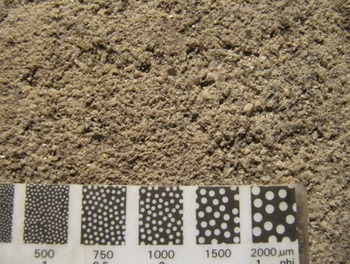
The two altars were made of different sandstone types. The Mithras altar and the altar base are similar in being made of poorly sorted, coarse-grained, bleached white sandstone with an inventory of detrital grains (muscovite, biotite, kaolinitised feldspar) including angular garnet fragments, which is relatively unusual and a key diagnostic feature (fig. 19). The differences between the Mithras altar and base are not considered significant and are typical of the heterogeneities seen across outcrops of such sandstones. Although the altar base was of a very homogeneous block of such material, the Mithras altar, being larger, showed evidence of bedding with grain size variation between beds and horizons of particularly coarse angular grains of quartz and some rounded milky quartz pebbles. The overall character of the Mithras (and altar base) sandstone is typical of fluvial sandstones in which grain-size variations are easily explained in terms of current velocity fluctuations at the time of deposition. Their bleached appearance and other aspects of their petrography suggest that the sandstones are ganisters, leached zones found beneath coal seams in sedimentary sequences.
Detail of the lithological structure of the Mithras altar (scale in microns). (Photo: Fiona McGibbon)

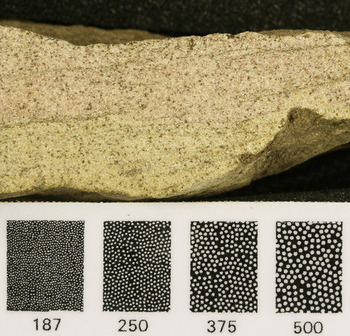
The Sol altar, by contrast, is fashioned from a pink, well-sorted sandstone of much finer grain size (fig. 20). It shares some minor components (mica and kaolinitised feldspar) with the Mithras sandstone and also has a clay matrix, but it lacks detrital garnet grains. The colour of the Sol sandstone results from iron staining of the clay matrix and is variable in its distribution. Iron minerals form a spaced distribution of speckles, sometimes concentrated on particular horizons thought to represent bedding planes, and can also form secondary leisegang rings where iron has washed into the sandstone after deposition. The Sol sandstone is remarkably homogeneous and the slab showed little variation. Its homogeneity, finer grain size and better-cemented nature make it the far better choice of material for stone carving. The difference in the sandstones of the two altars could be explained by variations in the depositional character of the original sediment followed by subtle differences in their post-depositional history. Both sandstone types share common features with local sandstones of the Carboniferous Period.
Section of Sol altar cut for thin section, showing detail of the lithological structure (scale in microns). (Photo: Dawn McLaren/AOC Archaeology)

Both the Sol and Mithras altars show evidence of bedding parallel to the face (i.e. to the long dimension of the stones). This would offer homogeneity on the planar surface that was to be carved (a blank canvas) and shows skill in selection and quarrying of the original material. Most slab-like carved stones, even more recent grave slabs of sedimentary or other layered lithologies, share this feature. If bedding ran perpendicular to the front and back of such slabs it would be liable to break along bedding planes when made vertical and would also be a lithological distraction from the carving itself. The Mithras altar shows carving through one layer into another of different grain size, with the front of the stone showing pebbly coarse patches. It was a poorer choice of starting material than the Sol stone.
Hollowing out the rear of the Sol altar and the perforations to depict sun rays have reduced the thickness of the slab so much that it is severely weakened in the centre, where it is now broken. This would suggest that the stone was not robust for transport in its carved form and seems to rule out overland transport of the altar as a finished item from any distance.Footnote 61 The block itself is of a robust, well-bonded sandstone, which is fine-grained and very homogeneous. Its fine grain size, homogeneity and well-cemented nature allowed the fine detail in the depiction of the Seasons at the top of the stone.
REGIONAL GEOLOGICAL CONTEXT
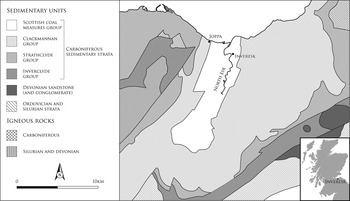
Inveresk sits within the Midlothian Coalfield, a wide syncline of Carboniferous-age sedimentary rocks (fig. 21).Footnote 62 This is part of a far larger area of Carboniferous and Devonian-age strata which are exposed across the width and length of the Midland Valley, stretching from the Highland Boundary Fault to the Southern Upland Fault. This large area offers many potential sources of sandstone of various geological ages. Carboniferous and Devonian-period sandstones were deposited in various depositional environments from arid terrestrial to deltaic to marine, and at various palaeolatitudes from subequatorial desert to tropical equatorial. Consequently the sandstones vary widely in type and appearance. Generally, Devonian-age sandstones are characteristically red due to the presence of hematite (iron oxide), leading to the lithostratigraphic term Old Red Sandstone. They are also generally well sorted and fine grained. Carboniferous-age sandstones vary widely in grain size and colour, ranging from bleached white to iron-stained, either an ochre colour by the presence of hydrated iron oxide (limonite) or red (due to hematite).
Outline geological map of the Midlothian coalfield. The rocks at Joppa are in the Passage Formation which is part of the Clackmannan Group. (Drawing: Jamie Humble/AOC Archaeology)

During the Carboniferous Period (359–299Ma) the Midland Valley of Scotland was an area of low ground flanked to the north by the Highlands and to the south by the Southern Uplands massif, much as it still is today but with far greater topographic contrast. It formed a substantial, fault-bounded depositional basin contemporary with other examples in northern and central England and much further afield in which great thicknesses of sediment accumulated. Palaeogeographic mapsFootnote 63 suggest this local basin was part of far larger one, forming a relatively narrow seaway which had an east–west extent of more than 3,000 km, extending as far as Russia where similar deltaic sediments are found.
The distribution of relevant sandstone formations has been mapped around Inveresk (fig. 21).Footnote 64 Of course not all of this offers exposure at the surface, but there must be countless exposures in river gorges and coastal cliffs in the area. It is hard to look at the modern landscape, refashioned near Inveresk by extensive open-cast coal mining, motorway and housing developments, in terms of how it might have offered exposures of sandstone for Roman stonemasons nearly two millennia ago. Coal extraction has radically changed the landscape and even redirected river systems. As such, it is unlikely that a specific locality can be suggested as a Roman quarry site. However, if locally available sandstones are of similar character to the artefacts examined, a local source of stone seems possible, indeed likely.
STONE SOURCES AT ROMAN INVERESK
Table 2 (see online Supplementary Material) summarises the petrographic features of other stone artefacts examined from the Inveresk complex. The voussoir slabs from Mire HoweFootnote 65 are made from the same distinctive white, coarse-grained sandstone with detrital fragments of garnet as the Mithras altar and the base. The Procurator altarFootnote 66 is also grouped with these objects due to convincing lithological similarity. Sandstones of similar petrographic character and containing detrital garnet were found with little effort in coastal exposures at Joppa not far from Inveresk. It is not suggested that these were the actual sources of the sandstone for the Mithras altar and lithologically similar artefacts, but it is significant that similar sandstones are locally available. The geology of the area offers a potential outcrop of this particular sandstone type in a horseshoe-shaped belt that sweeps inland for c. 20 km before looping round and ending up back at the coast near the Musselburgh ash lagoons (fig. 21). Actual exposures will be dictated by faults and by the landscape of the area, with river gorges being the best examples of inland exposure today. There are abundant exposures of other sandstones in the wider area, some of which share some petrographic characteristics with the distinct Mithras lithology, such as at Skateraw, near Dunbar. Carboniferous sandstones, however, are not limited to the Midland Valley, this local trough being only a small part of a laterally extensive series of depositional basins that stretch as far east as Russia and south into northern and central England.
Eight sandstone architectural objects, pilaster shafts, capitals and basesFootnote 67 were found to be of matching medium-grained ferruginous sandstone, sharing many detailed petrographic features in common. These objects, although differing in colour, are similar in grain size and sorting to the Sol altar. They differ markedly from the sandstones used to fashion the Mithras altar and related objects. Such finer-grained ferruginous sandstones are typical of many local Carboniferous-age strata and there are any number of potential local sources. The Carberry tombstoneFootnote 68 is of much coarser grain size than the pilasters but is similarly ferruginous and includes carbonaceous material which is typical of Carboniferous sandstones.
The pinecone sculptureFootnote 69 is the odd one out in this assemblage, being made of very well-sorted homogeneous red sandstone suggestive of an arid depositional environment rather than the fluvial depositional environment suggested by Carboniferous sandstones. In the context of the Midland Valley this would suggest a Devonian-age sandstone of which there are countless potential local sources. Desert red sandstones of Permian age offer a better petrographic match, however, and such material would have been sourced from further afield: the nearest outcrops can be found in northern England, Dumfries and Galloway, Ayrshire or Arran.
PIGMENT ANALYSIS By Ruth SiddallFootnote 70
SUMMARY
The inscription on the Sol altar has a band which shows traces of white paint and then a thinner band below that painted red (fig. 10). The white pigment is bone white and gypsum; the red pigment is a red ochre, probably derived from silty to muddy beds within a red sandstone (litharenite) deposit.
The Mithras altar has an ornately carved leaf frieze in its upper section with traces of an orange-red paint on the central bud of a fan of foliage. The pigment used here is a mixture of a red ochre, very similar to that used in the Sol altar, plus a yellow clay ochre rich in goethite. An ultraviolet (UV)-fluorescent area elsewhere on the frieze suggests a lime wash.
On both altars the paint was applied directly to the substrate in a single coat, with no evidence of a preparation paint layer. The use of ochres is unsurprising in a provincial setting. The use of bone white on the Sol altar is of interest as this pigment has not been widely identified in Roman art.
METHODOLOGY
Samples (fig. 22) were taken from the edges of paint patches using a scalpel. Where possible two samples were taken of each paint colour from different parts of the paint scheme (only one patch of paint was available on the Mithras altar). In addition, the altar was examined under UV light during conservation. This revealed a faint fluorescence on part of the leaf frieze which suggests a light lime wash.
Sampling locations for pigments. Grey shading marks area where ultraviolet fluorescence was observed. (Ruth Siddall, Alan Braby and Jamie Humble/AOC Archaeology)

The primary identification technique was optical polarising light microscopy (PLM). PLM provides prima facie evidence of the colour of pigment phases used. This in turn gives evidence of technological choices such as colour mixing to vary the hue of paints. It also allows identification of different polymorphs of phases used, i.e. iron oxides from ore deposits or iron oxides from earth deposits, providing information on material provenance. Particle size and shape can also reveal a wealth of information concerning pigment manufacture, either in the form of processing of natural pigments or the chemical methodology used in the manufacture of synthetic phases. It is also possible to characterise many organic-based pigments derived from plant and animal dyes using PLM, especially with the use of UV microscopy and macroscopic examination. Further analytical techniques are used as required for more secure identifications.Footnote 71
THE RANGE OF RED AND WHITE PIGMENTS KNOWN FROM ROMAN PAINTINGFootnote 72
During the Roman period, red paint was produced from a rather limited range of materials, all of which are easily distinguished using PLM. As in all cultures, red ochres based on iron oxide are the most commonly observed. A synthetic variety of lead (IV) oxide known as red lead was also used (made by roasting white lead or metallic lead). Pinks were produced with the plant-derived dye madder. The most expensive and therefore prestigious red paint used in the Roman period was cinnabar, a naturally occurring mercury sulphide mineral. It is possible that the Romans also had the technology to produce synthetic mercury sulphide, the pigment known as vermillion. Red and pink paints and dyes may also have been produced from exotic materials such as the plant resin known as Dragon's Blood and from beetles (carmine). However, no evidence of these materials has yet been discovered in Roman painting.
White pigments were derived from a wide range of natural and synthetic sources. Those derived from minerals can come from varieties of limestones, such as chalk, or from calcined limestones (lime/whitewash). Other mineral deposits are white kaolinite-rich clays, gypsum and calcined gypsum (gesso) and diatomaceous earths. White pigments may be derived from the inorganic skeletons and shells of animals. These are pigments made from boiled animal bones, seashells and avian egg shells. The synthetic white pigment known to the Romans is white lead (lead carbonate hydroxide) which was produced by exposing metallic lead to the fumes of acetic acid (vinegar). The reaction between the two chemicals producing a white rime on the surface of the lead which could be scraped off to produce a stable and opaque white pigment. All of these phases are distinctive using PLM, with the exception of white lead which tends to form extremely fine particles which are easily overlooked. However, a test for lead (described in the online Supplementary Material) will alert the analyst to the presence of this pigment in samples.
RESULTS AND DISCUSSION
The Sol altar
Red: red iron oxide (hematite) is the main colouring component of this pigment. It is present in finely disseminated particles, coarser-grained red hematite, and coating quartz and other sand grains. The presence of quartz, chert and feldspar indicates an iron-rich sandstone (litharenite) as the primary source of this pigment. It is a variety of red ochre, probably derived from soils or weathering deposits associated with the Devonian Old Red Sandstones of the Scottish Midland Valley. Very little has been done to purify this pigment — it appears to have been used almost straight from its geological source. A fragment of either cow or horse hair, 0.5 mm long, in this sample may have come from the painter's brush, though it may be contamination (online fig. 63).
White: this pigment was sampled in two locations on the inscription. One sample (#2) proved to be unrepresentative, containing more of the stone substrate than the actual pigment. Particles of the red paint used were present as well as charcoal. These components may be disregarded as intentional components of the pigment and are contamination. A few particles of gesso were observed. Sample #4 was also contaminated with the substrate stone and contained abundant quartz and iron oxide minerals derived from this stone. However, particles of bone white were identified, along with abundant mechanically-crushed quartz. The pigment in the white paint is therefore composed of bone white and gypsum which was crushed using a clean quartz sand to aid the grinding process.
The Mithras altar
The orange-red paint used is a mixture of at least two components. The main constituents are a red ochre associated with a red sandstone deposit and a high-quality yellow clay ochre containing goethite, clay (possibly kaolinite) and perhaps ferrihydrite. It is possible that the ferrihydrite was derived from a third source, perhaps associated with metal mining (ferrihydrite is the main orange-coloured iron oxide hydroxide associated with acid mine drainage). The red sandstone source is very similar to that observed in the Sol altar and could also feasibly have been derived from the Devonian Old Red Sandstones of the Midland Valley. The yellow clay ochre is of high quality and purity. It could have been either locally derived or imported from England or even further afield. Secure sourcing of ochres is often not possible as they are ubiquitous in the geological landscape.
Although securely identified, the occurrence of a particle of pink madder pigment is probably not an intended additive to this pigment mix; particles would be more abundant if this was the case. It is more likely to be a contaminant from the artist's palette or workshop.
THE LEAD By Dawn McLaren
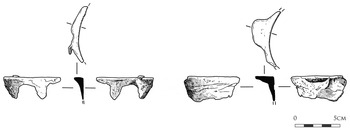
Five curving, molten-looking strips of lead were recovered from the pit fill in proximity to the Sol altar (fig. 23). The pieces are L- or U-shaped in section and gently curving along their longitudinal axis. Each piece bears the impression of porous stone on the convex surfaces, indicating that the molten lead was poured directly onto stone. The opposing concave face of at least two of the pieces is smooth with vertical linear impressions which survive from contact with the surface of a straight-sided or steeply-angled, perhaps cylindrical object. These impressions indicate that the lead was used as a bonding agent or adhesive to attach an object to the surface of the altar. Their curvature matches the two hollows which flank the sunken focus on the upper surface of the Sol altar. The lead appears to have been run in between the stone of the altar and the cylindrical base of a metal fitting, perhaps the foot-ring of an open iron lamp,Footnote 73 lampstand or candle-holder. This would have created a permanent fixing.
Selection of lead fragments associated with the Sol altar. (Drawing: Alan Braby)

POTTERY By Louisa Campbell
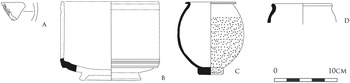
Seven sherds making up a substantial part (c. 50 per cent) of a colour-coated roughcast beaker came from pit [064], adjacent to the one which held the altars. It is a product of the kilns of Colchester, manufactured between a.d. 120 and the mid-second century. The profile (fig. 24C) conforms with the Colchester cornice-rimmed form 391.Footnote 74 The fine fabric is creamy with black iron ore, mica, quartz sand and calcareous fleck inclusions, while the beaker is decorated in roughcast with applied clay pellets measuring between 2 and 4 mm across the base through to a plain band c. 20 mm below the rim. A chocolate to reddish-brown slip covers the exterior with an orangey slip in the interior; much of the exterior slip has worn off, exposing the sandy fabric.
Pottery. A–B: samian; C: colour-coated beaker; D: black burnished ware. (Drawing: Louisa Campbell/Jamie Humble)

This was a long-lived and treasured beaker, as evidenced by the extreme wearing down of the exterior slip to a light orange, extremely thin layer across the entire central section where fingers would have grasped the vessel for the consumption of wine. It is likely to have been a votive offering at the time the adjacent altars were buried and may have been deposited largely intact (the feature had been disturbed by burrows). It may well have constituted an element of a Roman soldier's ‘military kit’Footnote 75 and moved around with its owner while he campaigned across northern Britain. Ritually used feasting and drinking vessels, some of which were broken and symbolically incorporated into human burials for use in the afterlife or used to pour libations over graves,Footnote 76 are common elements of Roman funerary ritesFootnote 77 and similar deposits of vessels, whole or part, were common in Mithraea (see below).
The remainder of the small assemblage came from ditch [013]; all are Antonine in date, but offer no closer dating. The three samian sherds derive from Lezoux (Central Gaul) during the early to mid-second century: two heavily chipped sherds from the basal wall of a Dragendorff 37 decorated bowl, and one from the grooved basal section of a Dragendorff 30 bowl (fig. 24A–B). This latter is uncommon on Roman military sites in Scotland and not represented among previous excavations at Inveresk. Two coarseware sherds with soot residues derive from the rim and wall of a black burnished ware 1 cooking pot of Gillam type 122,Footnote 78 manufactured during the early to mid-second century (fig. 24D).
OTHER FINDS By Dawn McLaren and Fraser Hunter
A squared-off rectangular building stone (sf. 17) found near the altars in the same pit is slightly tapered in plan and rather weathered. It had been relatively crudely flaked to shape. 435 by 230 by H 130 mm.
The fine tang from an iron knife and nine nails (3 intact, 6 fragments)Footnote 79 came from the fill of the altar pit [005]. The varying condition of the nails and the rarity of clenched examples (which would indicate deposition within timber) suggest that they were expediently discarded within the pit rather than deriving from decay of an in-situ wooden structure.
THE ENVIRONMENTAL EVIDENCE By Jackaline Robertson
Assessment of flotation samples revealed a scattering of cereal caryopses throughout the deposits around the altars, ditch, gully and pits.Footnote 80 The assemblage comprised barley, bread/club wheat and oat. The caryopses were concentrated in small numbers with no obvious evidence of selective or deliberate disposal. Some displayed evidence of a weevil infestation, which is a common problem affecting grain stored at Roman military sites. It is unlikely these caryopses were deliberately destroyed to curtail the weevil infestation as this does not appear extensive enough to warrant large-scale destruction of a valuable food source. These remains are probably representative of domestic waste in the form of cooking and cleaning debris which accumulated accidently within these features.
DISCUSSION AND WIDER CONTEXT By Fraser Hunter, Martin Henig and Eberhard Sauer
THE ALTARS
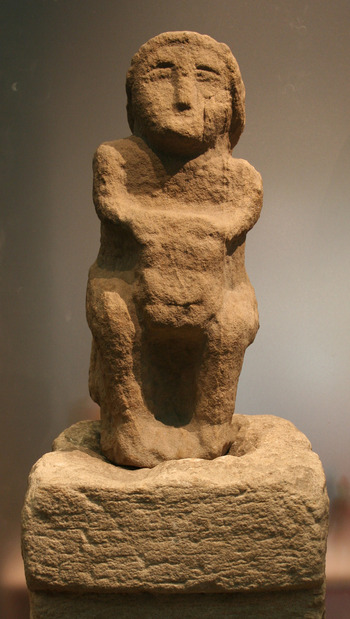
The Inveresk find is a wonderful tale of the unexpected, providing us with the earliest secure evidence of Mithras in Britain as well as the most northerly Mithraeum in the Roman world. The co-occurrence of Mithras and Sol is unsurprising — the two are linked in Mithraic iconography and often co-identified in inscriptions.Footnote 81 Indeed Ian Richmond suggested the High Rochester inscription was originally dedicated to the two gods but modified to amalgamate them.Footnote 82 The identification of Apollo with Mithras in his role as god of light is readily paralleled: an altar from Rudchester is dedicated ‘to the Sun God Apollo Invincible Mithras’,Footnote 83 while one dedicated to Apollo from Whitley Castle, Northumberland, links these deities in its imagery (fig. 25). The rear shows two torch bearers (the different torch positions suggesting they represent the Mithraic Cautes and Cautopates) flanking a statue, while Apollo appears on the left side in the guise of Sol, with nimbus and whip. On the front he stands with what are probably lyre and plectrum, the attributes found at Inveresk.Footnote 84 A further connection between Mithras and Apollo may come from a statue in the Carrawburgh Mithraeum. This is normally identified as a Mother Goddess,Footnote 85 which would be extremely unusual in a Mithraic context, but inspection of it suggests it can plausibly be seen as Apollo, seated with a cloak around his waist (accounting for the apparently female proportions) and holding an object which resembles a lyre (fig. 26).
Altar to Apollo, Whitley Castle (H 1.4 m). (Scans by NU Digital Heritage, Newcastle University, by courtesy of Dr R. Collins)

Statuette probably of Apollo with lyre, from the Mithraeum at Carrawburgh (statuette H 0.34 m). (© Society of Antiquaries of Newcastle upon Tyne/Great North Museum)

The presence of the Seasons on the Sol altar encapsulates concepts of the passing of time and wider cosmology. Seasons often occur in Mithraic imagery. For instance, a bull-slaying scene from Sidon (Lebanon) includes the Seasons in the corners, while they also occur on a relief from Nida-Heddernheim (Germany).Footnote 86 Not all are female; Seasons are shown as children on the bull-slaying relief from Sidon,Footnote 87 while both male and female Seasons appear on a bull-slaying relief from Rückingen (Germany) and a bronze plaque from Brigetio (Hungary).Footnote 88 At first sight, the row of busts at Inveresk evokes the rows of family busts found on the tombs of freedmen in Rome in the late Republic and early Empire.Footnote 89 However, friezes with animal or human figural ornament can be found on other northern altars.Footnote 90 The idea of deities in rows is also found on the frontier in reliefs of the genii cucullati or the matres Footnote 91 and on a monumental scale in the frieze over the great arch from London, probably representing the days of the week, with the Seasons here depicted in roundels in the arch spandrels.Footnote 92
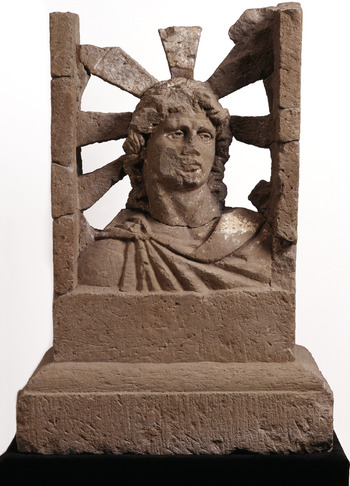
Rays are a standard feature of Sol's imagery, but the dramatic piercing of the stone is more unusual. Wortmann has collated evidence of such pierced altars, which were strongly associated with Mithraic cults.Footnote 93 Similar pierced sun-crowns are found on reliefs of both Sol and Mithras as sun god. Mithras is shown in this way at Carrawburgh,Footnote 94 while an altar jointly dedicated to Sol and Mithras from Bingen (Germany) has a similar bust, now mostly lost;Footnote 95 an altar from Mundelsheim (Germany) has a similar sun-crown (fig. 27).Footnote 96 In the darkness of the semi-subterranean temple, this would have made for a dramatic image. The drama may have been intensified in the case of Inveresk. Behind the nose is an iron fastening rod which once held something in or behind the mouth. It seems over-engineered if it was simply to provide additional fastening for a candlestick. Was this intended to make the light flicker round an obstacle, or perhaps hold something moving in the heat of the flame? Was it intended to evoke a visual impression of the god speaking, or even have been involved in some acoustical role to make the god ‘speak’?Footnote 97 None of the similar altars are recorded as having such a feature.
Sol altar from Mundelsheim, Baden-Württemberg (H 0.7 m). (Image © P. Frankenstein, H. Zwietasch; Landesmuseum Württemberg, Stuttgart)

Plaques featuring busts of Sol with pierced rays, known in stone from the Mithraeum in the Baths of Caracalla and in lead from the S. Prisca Mithraeum (both in Rome),Footnote 98 may have fitted over niches in altars which held lamps. Merkelbach identified such niches on the rear of the Mithras altar from Rudchester (the upper shows hints of rays on its edges) and noted a similar altar from Aquincum (Hungary).Footnote 99 There are two examples from the Stockstadt I Mithraeum (Germany): one an altar bearing a damaged image of Sol with a rectangular hole cut through the base, the other uninscribed with a square niche cut into one face, the edges recessed to take a cover;Footnote 100 WortmannFootnote 101 noted further examples from Rome and Ostia, while BoppertFootnote 102 added a fragmentary example from the temple of Isis and Magna Mater at Mainz. The uninscribed central altar from Mithraeum II at Güglingen had a rectangular perforation with a recess for a cover.Footnote 103 Sun and moon played an oppositional role in Mithraic beliefs and altars of Luna from Bonn, Mundelsheim and Ostia have a cutaway crescent moon which could be lit from behind.Footnote 104 A related find from the second Bonn Mithraeum is a terracotta altar with star-shaped piercings.Footnote 105
Careful use of light is seen in other Mithraic material. For instance, the openwork scene of Mithras’ birth from an egg at Housesteads suggests it was meant to be backlit,Footnote 106 while openwork bull-killing scenes imply a similar interest in lighting effects.Footnote 107 WortmannFootnote 108 noted a series of other sculptures with Mithraic associations which show arrangements for lighting. These examples highlight the key symbolic role of light in the cult. The Inveresk Sol altar may have a further link to light: the two unusual sockets at the rear corners were probably intended to hold lamps or candles, fixed in place by lead. This feature is otherwise rare on altars, though a related practice is seen on a rock-cut bull-killing scene from Jajce (Bosnia) with niches cut into it for lamps.Footnote 109
Parallels for the attributes of the deities have already been noted. Vessels for ritual hand-washing (a jug and shallow ram-headed-handled bowl) are very commonly depicted on altars.Footnote 110 Parallels for the non-figural decoration can be found among the stylistic repertoire of sculptors in the military zone. The leaf frieze is found on altars from the Housesteads Mithraeum, Carrawburgh (Coventina's Well) and Drumburgh,Footnote 111 while arcading is present on altars from Castlesteads and Greetland.Footnote 112 An altar to Coventina from Carrawburgh combines both,Footnote 113 while one to Jupiter Taranus from Chester has both leaf frieze and inverted arcading.Footnote 114
The mouldings rising to an apex seen on the Mithras stone can be paralleled quite widely;Footnote 115 the only Scottish parallel comes from Newstead.Footnote 116 The style shows considerable diversity, with some rising to a single peak and some a double, as at Inveresk; many have rosettes on the bolster ends, with spirals linking into the mouldings as at Inveresk being rare.Footnote 117 The space in the apex is normally undecorated: there are examples with simple geometric motifs and one vegetal motif, but only an altar from Housesteads has figural decoration, in this case bucrania and paterae.Footnote 118 While the elements from the Mithras altar can be paralleled, the combination is a unique one.
THE MITHRAEUM
Details of the Mithraeum are not entirely clear, as it was only partially excavated and efforts focused on the recovery of the altars; more subtle features were not fully investigated,Footnote 119 hence it would be worth future re-examination in the field when the opportunity arises. The careful burial of the altars and the presence of the base for the Mithras altar indicate that they originally stood in a recess at the end of the central sunken aisle of the Mithraeum. The overall feature, aligned almost west–east, was 6.0 m long and c. 5.4 m wide; it was dug to leave steps in the gravel along the edges some 1.0 m wide and 0.25 m tall which formed benches, with the central aisle a maximum of c. 3.3 m wide, though it could have been significantly narrower if some of the benches had been dug away or damaged upon demolition.
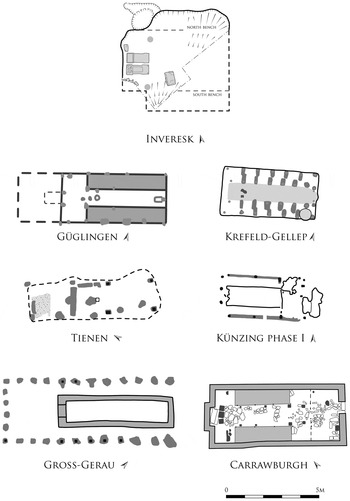
Other British examplesFootnote 120 are stone-built, but wooden Mithraea are known elsewhere, for instance at Krefeld-Gellep, Künzing, Heidelberg II, Güglingen II in Germany and Tienen (Belgium) (Table 1; fig. 28).Footnote 121 The altars were found side by side and parallel to each other just inside the west edge of the pit, at the end of the central aisle. Mithraic stone monuments are often found in the central aisle, as in the partially wooden Mithras temple at Groß-GerauFootnote 122 and the wooden Mithraeum at Künzing,Footnote 123 whether deliberately buried or covered by sediments over time and thus invisible to later stone robbers. The Inveresk altars, lying parallel to each other, were intentionally concealed; they were not violated or deliberately damaged, which must be seen as a respectful burial. Perhaps a key Mithraist left the site and other worshippers faded away; more probably, the temple was carefully decommissioned when the army withdrew. Such deliberate burial finds parallel locally in the treatment of the Antonine Wall distance slabs.Footnote 124
Comparative plans of timber, timber-and-stone, and stone Mithraea. See Table 1 for sources for timber buildings; others from Huld-Zetsche Reference Huld-Zetsche and Spickermann2001, Abb. 4; Richmond and Gillam Reference Richmond and Gillam1951, fig. 7. (Drawing: Jamie Humble/AOC Archaeology)

SIZES AND ALIGNMENTS OF TIMBER MITHRAEA (alignment lists the likely altar end first)

The Inveresk discoveries lie some 750 m from the east gate of the fort, near the edge of the raised beach. This is rather further from the fort than other known British Mithraea,Footnote 125 reflecting the scale of the extensive settlement around the fort complex (fig. 1, right).Footnote 126 While nothing was previously recorded in the immediate locale, to the north, at a similar distance from the fort, are enigmatic remains of a curvilinear enclosure with a curious attached post-built structure,Footnote 127 while to the south lie Roman field-systems. In the more immediate context, it is noteworthy that ditch [013] and gully slot [053] run parallel to the end of the pit, suggesting they are connected. There is evidence from other sites (such as Tienen (Belgium) and Martigny (Switzerland)) for Mithraea sitting inside their own enclosures, allowing privacy for any rituals taking place around the building.Footnote 128 There are no cropmarks in the immediate area. Some 60 m to the south-east, an area normally interpreted as field-systems ends in a right-angle open towards the Mithraeum, but the alignment differs from that of the ditches [013/053], so they are unlikely to be connected.Footnote 129
The sparsity of associated finds is disappointing if unsurprising given that relatively little was excavated and bone did not survive, but it limits conclusions on wider cult practice.Footnote 130 The only relevant find is the deposition of a large portion of a well-worn fineware beaker in a pit immediately beside the sunken ‘cave’. Deposition of ceramics related to ritual feasts finds ready parallel in other Mithraea.Footnote 131 Drinking vessels are a common vessel type from such sites, but the context of these and other ceramics varies. Some are in foundation pits linked to the consecration of the site or its rebuilding, as found under the altars at Carrawburgh and Tienen;Footnote 132 some are linked to key feasts held at the site, as at Tienen,Footnote 133 or marking its boundaries, as at Martigny.Footnote 134 The latter came from a pit which was thought to have been filled with water at certain times, while a similar role is likely for the tank within the Bornheim-Sechtem (Germany) Mithraeum which contained an intact beaker.Footnote 135 Sometimes the deposition was linked to the site's abandonment, as with the deposit of three lamps and an incense-burner at the Rudchester Mithraeum.Footnote 136 However, vessels, especially drinking vessels, could also be deposited during the life of the building; the Carrawburgh Mithraeum provides excellent examples,Footnote 137 with at least 13 separate deposits of intact or near-intact pots, mostly single finds and mostly of drinking beakers, but not all clearly linked to foundation or abandonment.Footnote 138 It suggests vessels could be deposited at other significant moments in the cult's activities; for instance, sherds of two beakers were incorporated in matched positions in the benches of the Carrawburgh Mithraeum.Footnote 139 The Inveresk beaker was clearly incomplete when deposited. This echoes the Carrawburgh example just noted, as well as the feast debris from Tienen, where there was a consistent practice of depositing only part of each vessel.Footnote 140 The pit at Inveresk sits outside the Mithraeum hollow but cuts into it, implying there was no wall around the Mithraeum at that point and thus suggesting it relates to the building's decommissioning and removal.
THE DEDICATOR AND THE SCULPTOR
Roger Tomlin has already noted the strands of evidence which suggest that the dedicator was a centurion of the Twentieth Legion: parallels in letter forms indicate the carving was done by a mason from this legion. G(aius) Cas(sius) Fla(…) could have been in charge of the auxiliary unit, or at the site with a legionary detachment, perhaps connected with the building of the Antonine Wall (which would suggest a date in the early a.d. 140s for his presence there) or other building works. The quality of the carving reflects the presence of the best sculptors attached to the legion being in Scotland at the time, when they produced distance slabs along the Antonine WallFootnote 141 and similar inscribed reliefs for the gates and headquarters of forts.Footnote 142 They were perhaps easily persuaded to produce private commissions for a fort commander.Footnote 143 It is likely that local stone sources were used, and the pigments too are most likely local.
The dedicator left no overt statement of his role in the cult, as is normal, but there are hints that he was a high-ranking Mithraist. The penultimate grade, heliodromus (runner of the sun), had attributes of the torch, seven-rayed crown and whip;Footnote 144 the presence of torch and ray-crown on these altars hints that this may have been his standing.
MITHRAS IN ROMAN BRITAIN IN THE SECOND CENTURY AND BEYOND
This is the first Mithraic evidence from Scotland, providing the most northerly evidence of the cult so far known.Footnote 145 It is also the earliest certain evidence for the cult in Britain, refuting arguments that it was only introduced to Britain after the abandonment of the Antonine Wall.Footnote 146 Other datable manifestations are predominantly third century, with some continuing into the fourth,Footnote 147 but many inscriptions are not well dated. For instance, the Whitley Castle altar was set up on pillars capped with coins, one of Diva Faustina,Footnote 148 but this Antonine dating was rejected because of the lack of Mithraic evidence in Antonine Scotland at the time.Footnote 149 The Inveresk find makes the dating plausible, though the coins must be used warily; they provide only a terminus post quem, as in such a ritualistic context much older coins could have been selected.
The distribution of Mithraic cult sites in Britain known from sculpture and inscriptions shows a strong focus in auxiliary forts in the military zones (Hadrian's Wall and its hinterland and the military areas of Wales), the legionary fortresses and the cosmopolitan centre of London;Footnote 150 portable artefacts broaden this only slightly.Footnote 151 It is little surprise to find such mid-second-century evidence, as the cult is known on the Rhine and Danube frontiers from the late first century and became widespread in the second century.Footnote 152 The military connection is also unsurprising — this male-only cult was popular with soldiers in Britain, where at least 86 per cent of known votaries are associated with the army.Footnote 153 Over half of identifiable worshippers in Britain are officers,Footnote 154 a pattern which the Inveresk find fits. In no other part of the Roman Empire do soldiers account for more than 20 per cent of known Mithras votaries.Footnote 155 The unusually strong association of Mithras with the army in Britain is also reflected in the distribution of evidence; all known Mithraic monuments are found in military sites or major towns and, unlike Upper Germany for example, none at smaller civilian settlements.Footnote 156 Martin HenigFootnote 157 and Lindsay Allason-JonesFootnote 158 noted the small size of British Mithraea; they suggested they were for a select, rather elite group of believers, and argued the patronage of the commanding officer was a key part of their introduction and sustenance. Of course, Mithraea were always quite small, almost certainly to preserve a personal atmosphere amongst the congregation. Where Mithras was popular on the Continent, as at Ostia, Rome, Nida, Carnuntum, Poetovio and Aquincum, multiple Mithraea were built rather than larger ones.
CONCLUSION
The Inveresk find is remarkable on several counts. It provides clear evidence that the cult was active in Britain in the mid-second century. The deliberate burial of the altars meant that the carving is generally in excellent condition (although one of the stones has since decayed quite badly) and they have preserved rare traces of a range of pigments. The individual elements of the sculptures are familiar from Mithraic iconography, but their particular combination here is unique. Mithras is clearly assimilated to Apollo, given the attributes depicted on this altar. The second altar, with Sol and the Seasons, is remarkable for the quality of the carving and the implied complexity of its use: the recess on the rear, the pierced rays and features, and in particular the evidence of an iron mounting behind the nose, hint at a range of light (and perhaps sound) effects as part of the rituals. The donor was probably a legionary centurion, and links in letter form strongly suggest the stones were the product of a mason of the Twentieth Legion, most likely using local stone sources. The discovery is a testament to the value of development control work in revealing such tales of the unexpected. The constraints, of course, are also frustrating. It would be ideal to see the rest of the timber Mithraeum and its surroundings, but this remains a possibility for the future. For the moment, the Inveresk Mithraeum and its contents provide a vivid glimpse into the worship of Mithras on the northern frontier.
SUPPLEMENTARY MATERIAL: CONTENTS
For supplementary material for this article please visit http://dx.doi.org/10.1017/S0068113X16000295.
Note: the Supplementary Material includes online figs 1–65 and Tables 2 and 3.
appendix 1: Full description of the altars By Fraser Hunter and Martin Henig, with a note on the lyre by Graeme Lawson
appendix 2: Technical assessment of stone-working on the Inveresk altars and base By Peter Hill
appendix 3: Lithological descriptions and provenance of the Inveresk altars and other Roman sculpture and inscriptions from Inveresk By Fiona McGibbon
appendix 4: Analysis of red and white pigments from the Inveresk altars By Ruth Siddall
Bibliography
ACKNOWLEDGEMENTS
The excavations were undertaken by AOC Archaeology Group, led by John Gooder. The lifting of the altars was arranged by the late Alex Quinn; their conservation was undertaken by AOC Archaeology with stone consolidation by Graciela Ainsworth and colleagues. We are grateful to Andrew Robertson, Gary Miller and Mark Nelson of East Lothian Council; George Findlater of Historic Environment Scotland and the Historic Environment Scotland Conservation Group for advice on stone conservation and the pigments; Lawrence Keppie for initial observations on the find; John Purser and Graeme Lawson for very helpful comments on the lyre and the acoustic possibilities of the Sol altar. The work was funded by East Lothian Council. Illustrations are by Alan Hunter Blair, Stefan Sagrott and Jamie Humble (site drawings) and Alan Braby (the stonework and artefacts). Our thanks to the Editor and the two anonymous referees for some very helpful suggestions on an earlier draft.
ABBREVIATIONS
- AE:
-
L'Année Épigraphique
- CIL:
-
Corpus Inscriptionum Latinarum
- ILS:
-
Inscriptiones Latinae Selectae, H. Dessau (ed.) (Berlin 1892–1916)
- RIB I:
-
Collingwood and Wright Reference Collingwood and Wright1965
- RIB III:
-
Tomlin et al. Reference Tomlin, Wright and Hassall2009
- TLL Onomasticon:
-
Thesaurus Linguae Latinae