Introduction
The common blue mussel Mytilus edulis Linnaeus is an epifaunal bivalve species that lives in shallow water, from the tidal zone down to depths of several metres. The adults are attached by byssus threads to rocks or stones. It can live in sheltered areas and along exposed shores, and it is common in boreal and low-arctic regions. In the wintertime in Arctic regions, the sea freezes and the mussels are protected by the ice. They can survive a long dormant period during the winter, and shifting thaw and freezing in autumn and spring. However, they cannot survive if the ice-free summer season is too short.
Mytilus edulis extended its geographical range north of its present northern range limit in many parts of the Arctic during the early to mid-Holocene. This has been discussed extensively (for examples see Andrews Reference Andrews1972; Blake Reference Blake2006; Feyling-Hanssen 1975; Hjort and others Reference Hjort, Mangerud, Adrielson, Bondevik, Landvik and Salvigsen1995; Salvigsen and others Reference Salvigsen, Forman and Miller1992; Salvigsen Reference Salvigsen2002; Dyke and others Reference Dyke, Dale and McNeely1996).
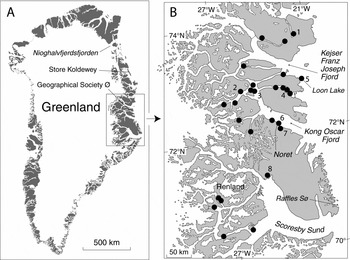
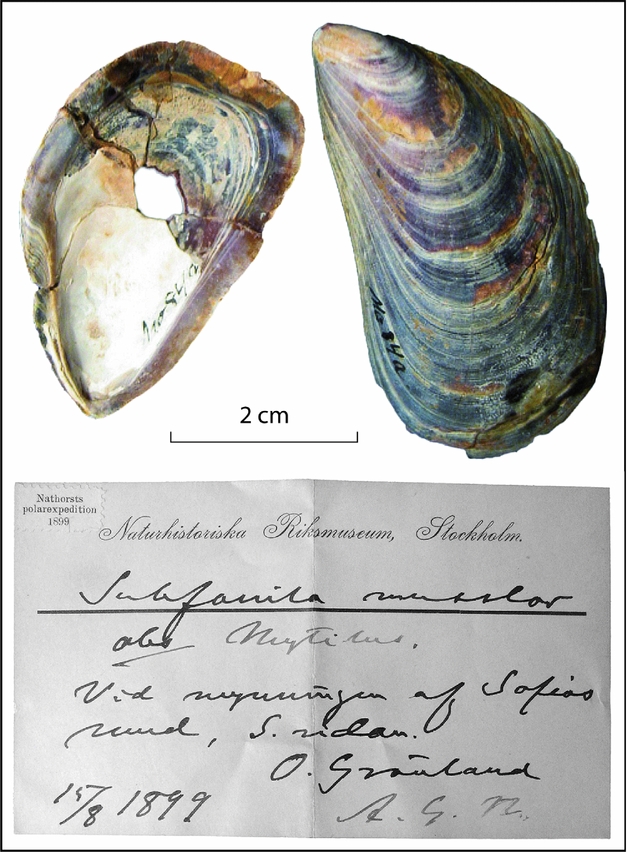
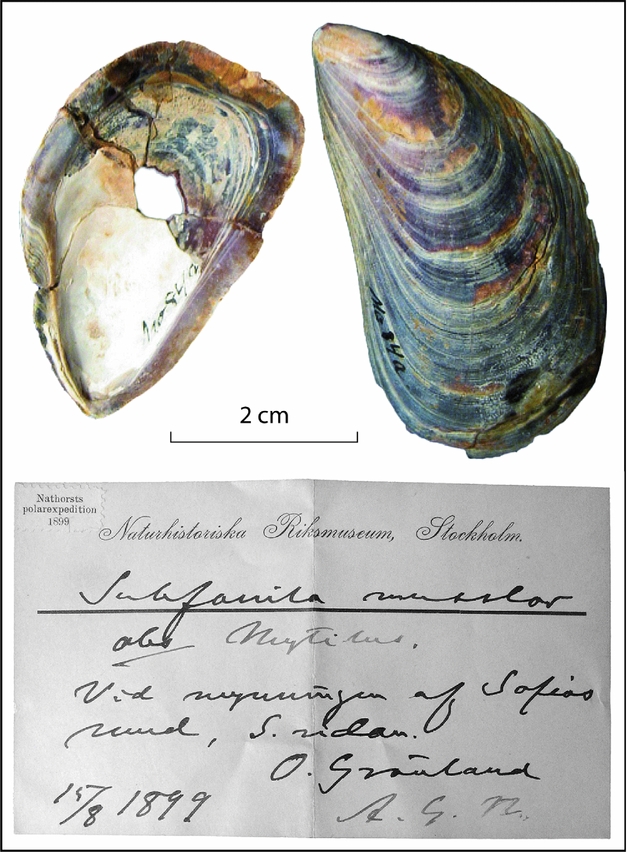
Mytilus edulis also extended its range into central East Greenland (Fig. 1), where shells of it were first found in Holocene deposits in 1899 by Nathorst (Reference Nathorst1901; Fig. 2). Its former occurrence in the region is important, because it is locally extinct, as discussed by Jensen (Reference Jensen1905) and Noe-Nygaard (Reference Noe-Nygaard1932) who concluded that it lived there during the Holocene thermal maximum. This hypothesis was confirmed when fossil shells of the species were dated using radiocarbon age determination (Hjort and Funder Reference Hjort and Funder1974). However, before the introduction of 14C dating by accelerator mass spectrometry (AMS) in the late 1970s, it was usually necessary to use a large number of shells to date a sample of Arctic shells, because shells of most Arctic mollusc species are relatively small. Most of the ages reported by Hjort and Funder (Reference Hjort and Funder1974) were carried out on other species present in the samples, or Mytilus edulis only constituted a minor part of the shell sample. Furthermore, many of the early shell ages have standard deviations of ±200 years or more, which limits their usefulness. In recent years, a number of AMS ages on single shells of Mytilus edulis have been obtained. These extend the known temporal range of the species in central East Greenland. Here we report these new ages and present a compilation of published ages. We use the material to discuss the duration of the Holocene thermal maximum in this region.
A: Map of Greenland showing the location of the study area in central East Greenland. B: Map of central East Greenland showing localities with recorded finds of Mytilus edulis shells in Holocene deposits. Dots with numbers are dated records (Table 1). Some of the dots represent several finds within a small area.

Two shells of Mytilus edulis collected in central East Greenland by the Swedish geologist and palaeobotanist A.G. Nathorst in 1899. The shells are now housed in the division of palaeozoology at the Swedish Museum of Natural History in Stockholm. The text on the label translates: Subfossil mussels, Mytilus. Near the mouth of Sofia Sund, on the south side, East Greenland. Photograph by J. Hägström.
Mytilus edulis is also known from interglacial deposits in Greenland. Most of them are of the last interglacial age (Vosgerau and others Reference Vosgerau, Funder, Kelly, Knudsen, Kronborg, Madsen and Sejrup1994; Kelly and others Reference Kelly, Funder, Houmark-Nielsen, Knudsen, Kronborg, Landvik and Sorby1999), but a single specimen has also been found in member B of the Kap København Formation, which is dated to c.2 Ma (Símonarson and others Reference Símonarson, Petersen and Funder1998; Bennike and others Reference Bennike, Knudsen, Abrahamsen, Böcher, Cremer and Wagner2010). These pre-Holocene finds will not be discussed in this note.
Methods
The new shell samples were dated by AMS at the Radiocarbon Dating Laboratory, Lund University. These ages and ages designated AAR, OS and Lu in Table 1 were corrected for isotopic fractionation by normalising to a δ13C value of –25‰ on the PDB scale. Ages designated Y and M were corrected for isotopic fractionation by normalising to a δ13C value of 0‰ on the PDB scale, or they were not corrected for isotopic fractionation. These ages have been corrected following Hjort and Funder (Reference Hjort and Funder1974). The ages were calibrated using the Marine09 radiocarbon age calibration curves (Reimer and others Reference Reimer, Baillie, Bard, Bayliss, Beck, Blackwell, Bronk Ramsey, Buck, Burr, Edwards, Friedrich, Grootes, Guilderson, Hajdas, Heaton, Hogg, Hughen, Kaiser, Kromer, McCormac, Manning, Reimer, Richards, Southon, Talamo, Turney, van der Plicht and Weyhenmeyer2009). A local sea water reservoir age of 550 years has been used (Hjort and Funder Reference Hjort and Funder1974).
Radiocarbon age determinations of Mytilus edulis shells from East Greenland

$: A: Astarte sp., Ab: Astarte borealis, Am: Astarte montagui, Cc: Clinocardium ciliatum, Ha: Hitalle arctica, M: Macoma sp., Mc: Macoma calcarea, Me: Mytilus edulis, Mt: Mya truncata, Sg: Serripes groenlandicus.
*: AMS ages, the other ages are conventional 14C ages.
Results and discussion
A total of 14 radiocarbon ages on Mytilus edulis shells or shell faunas comprising M. edulis are now available from central East Greenland (Table 1). The oldest dated shell gave an age of 9434–9519 cal. years BP and the youngest dated shell gave an age of 5420–5563 cal. years BP. The other age determinations fall into the intervening time interval.
The oldest and youngest ages are AMS age determinations, which were conducted on single shells. The ages published between 1962 and 1975 (Table 1) are conventional ages that were carried out on multiple shells, and Mytilus edulis shells often comprised only a small part of the samples. These ages may represent samples that consist of a mixture of shells of different ages. However, the old ages fall between the oldest and youngest AMS ages, and are similar to the other AMS ages. Hence it appears that M. edulis occurred continuously in East Greenland from the time of its arrival until it became locally extinct, presumably in the mid-Holocene.
The oldest age derives from a locality on western Geographical Society Ø, which may indicate that the species first colonised areas along the outer coast (Fig. 1, locality 5). It has been assumed that Mytilus edulis immigrated to East Greenland from Svalbard, where the species already was established in the earliest Holocene, with the oldest age around 10,100 cal. years BP (Salvigsen Reference Salvigsen2002). The ocean currents bring surface waters from the Svalbard region to northern Greenland by the West Spitsbergen Current and south along the east coast of Greenland by the East Greenland Current. The currents could transport live mussels attached by byssus threads to seaweed, driftwood or rock fragments from Svalbard to Greenland. These items could be carried to East Greenland by sea ice, which would most likely strand at the outer coast. It is also possible that eggs or pelagic larvae of Mytilus edulis were transported to East Greenland.
The typical current velocity in the East Greenland Current is 10–15 cm sec−1 or around 1 km per day (Aagaard and Coachman Reference Aagard and Coachman1968). The distance from Svalbard to East Greenland is some 1200 km, so it would take several years for eggs, larvae or adult animals to make the voyage. The eggs of Mytilus are small, with a thin membrane, and a single individual may spawn several million eggs. Normally the pelagic larvae settle on sea weed after four to eight weeks. This is followed by a secondary post-larval dispersal phase by ‘byssus drifting’, and when the shell reaches a length of 2 mm the animal settles on some firm substrate. It is difficult to see how Mytilus edulis could accomplish a journey that lasted several years. Adult specimens can survive in a dormant stage for a winter, but hardly for several years.
An alternative transport vector could be migrating birds, which has been suggested as important in this context for seeds and fruits as for well as fresh-water organisms in the colonisation of Greenland after the last deglaciation (Bennike Reference Bennike1999). Many thousands of geese migrate to East Greenland from Northwest Europe and Iceland each spring to breed, but these birds arrive when the sea is still frozen. However, equivalent numbers also arrive in the summer, when they come to moult. A common flying speed of geese is 60 km per hour, so the c.600 km long journey from Iceland takes c.10 hours. Small Mytilus edulis specimens could probably survive such a journey without drying out if they adhered to the feet or feathers. In this context we note that a shell of the marine gastropod Littorina sp. was reported by Funder (Reference Funder1978) from the inner part of Scoresby Sund. Littorina does not live in the area today, and Funder suggested that the shell was brought there by a goose. It should also be mentioned that salt lakes around the world are colonised by marine molluscs, which must have be dispersed by birds. Birds have, for example, been suggested as an important agent for the dispersal of marine molluscs from the sea to Saharan salt lakes, hundreds of kilometres inland (Rose Reference Rose1972) and for dispersal of fossil marine molluscs in North America (Wesselingh and others Reference Wesselingh, Cadée and Renema1999). Living bivalves may also survive ingestion by birds (Mackie Reference Mackie1979), but such dispersal is probably limited to short distances. Mytilus is usually dioeceous, with separate males and females, and successful dispersal by birds would mean that either a gravid female was transported to East Greenland, or at least one male and one female were transported to the same area. However, hermaphroditism has been observed in Mytilus populations (Sugiura Reference Sugiura1962) so maybe it would be sufficient with a single individual.
Mytilus edulis spread from the outer coast to the inner fjord region. It is possible that it did not colonise the fjords until the ice sheet margin attained a position similar to the present, which occurred around 8000 cal. years BP (Bennike and Wagner in press). According to the fossil distribution, the species reached its peak occurrence in the middle part of the fjord region, which is also where the highest sea surface summer temperatures are found at present.
The former presence of Mytilus edulis in central East Greenland could perhaps be attributed to a larger extent of the fjord water layer than at present. The fjord water forms in early summer after ice break up, and it disappears when sea ice begins to form. The salinity is reduced due to influence from meltwater and river water and the temperature is elevated as a result of solar insolation. The maximum temperatures in the surface water reach 5–8°C in the inner parts of the fjords, and at 5m depth the maximum temperatures are c.2–4°C (Ockelmann Reference Ockelmann1958). In this context it is important to note that Mytilus edulis requires a summer water temperature of at least 4°C (Peacock 1993). During the early to mid-Holocene, when summer insolation was higher than at present, the fjord water layer was presumably more extensive than at present. We suggest that Mytilus edulis disappeared from central East Greenland due to the steady decrease in summer insolation during the Holocene (Berger and Loutre Reference Berger and Loutre1991), which would lead to shorter ice free summers and diminished development of the fjord water layer.
It has been suggested that the former presence of Mytilus in central East Greenland could be a consequence of a greater influx of Atlantic Water than today (Hjort and Funder Reference Hjort and Funder1974). However, Atlantic Water is found at depths over 200–400m in East Greenland (Ockelmann Reference Ockelmann1958), far below the level at which Mytilus lived. It could be that increased inflow of Atlantic Water to East Greenland would lead to warming of the surface water. However, the surface water is separated from the Atlantic Water by the cold Polar Water, and it is unlikely that the surface water would be warmed.
A total of around 300 radiocarbon age determinations on marine shells are available from central East Greenland (unpublished compilation). Of these ages c.125 are older than the oldest Mytilus edulis age. This shows that early Holocene raised marine deposits are widespread in the region, but the large number may also reflect the fact that Quaternary scientists often have used shells in order to provide minimum ages for the last deglaciation. In contrast, only three shell age determinations are younger than the youngest Mytilus edulis age, which shows that late Holocene raised marine deposits are absent from the region. This is a consequence of the sea level history, with the relative sea level approaching the present sea level in the mid- to late Holocene. The three youngest 14C ages of Mytilus shells are from marine silt at a level of c.1 m above sea level. Hence it is possible that the lack of younger ages reflects a lack of younger raised marine deposits. Younger marine sediments are found below the present sea level, and a number of marine cores have been recovered from the region. However, there are no reports on Mytilus edulis shells from marine cores, which may reflect that it lives in the littoral zone. We have sampled one sequence from the marine basin Noret, but no shells of Mytilus were found in the core that was sampled at a position c.300m from the nearest shore, at a water depth of c.45m (Treu Reference Treu2011). However, the presence of Mytilus edulis shell fragments in a core from the isolation basin Loon Lake (Wagner and others 2010) shows that it is possible to find Mytilus remains in sediment cores from central East Greenland, but it is probably necessary to target small, shallow basins. However it may be, the timing of the local extinction of Mytilus edulis in East Greenland is not well constrained.
Even though more than one hundred years have passed since shells of Mytilus edulis were first found in central East Greenland, only three other locally extinct species have been documented from Holocene deposits in the region. One is also a marine bivalve, Mysella sovaliki that has been recorded from a single locality (Wagner and others 2010). The second is the terrestrial beetle Phratora (Phyllodecta) cf. polaris that has been found at three localities (Bennike and others Reference Bennike, Björck, Böcher and Walker2000). The finds are dated to between 8700 and 7900 cal. years BP. The third is the reindeer Rangifer tarandus that died out c.100 years ago, perhaps during some severe winters during the peak of the Little Ice Age (Bennike Reference Bennike1997).
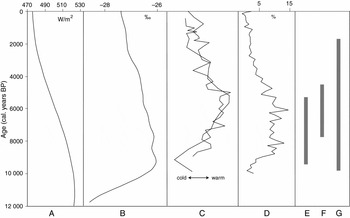
Several other records from the region also document the Holocene thermal maximum (Fig. 3). For example, a record of biogenic silica from a lake sediment sequence on Geographical Society Ø shows a Holocene thermal maximum from c.9000 to 6500 cal. years BP (Wagner and others Reference Wagner, Melles, Hahne, Nielsen and Hubberten2000). Radiocarbon dating of shells of marine molluscs, bones of marine mammals and driftwood shows that Nioghalvfjerdsfjorden, which is now covered by a floating outlet glacier, was glacier-free during a period from c.7700 to 4500 cal. years BP (Bennike and Weidick Reference Bennike and Weidick2001). Chironomid assemblages in two lake sediment sequences from Store Koldewey indicate higher summer air temperatures from c.8000 to 5000 cal. years BP than at present (Schmidt and others Reference Schmidt, Wagner, Heiri, Klug, Bennike and Melles2011). Whether the difference in timing between different records is real or due to different threshold values being passed at different times is currently unknown. However, it is clear that the Holocene thermal maximum occurred earlier in the ice core record from Renland, where it is dated to c.10,000 to 7000 years BP (Vinther and others Reference Vinther, Buchardt, Clausen, Dahl-Jensen, Johnsen, Fisher, Koerner, Raynaud, Lipenkov, Andersen, Blunier, Rasmussen, Steffensen and Svensson2009). The delay seen in the non-ice core records may reflect that marked recession of the ice margin occurred in the early Holocene, and large parts of the East Greenland region had not been deglaciated (Bennike and Björck Reference Bennike and Björck2002).
Holocene records from East Greenland. A: June insolation at 60°N (Berger and Loutre Reference Berger and Loutre1991). B: Uplift-corrected millennial scale trends in the Renland ice core δ18O values (Vinther and others Reference Vinther, Buchardt, Clausen, Dahl-Jensen, Johnsen, Fisher, Koerner, Raynaud, Lipenkov, Andersen, Blunier, Rasmussen, Steffensen and Svensson2009). C: Chironomid-inferred summer temperatures from two lake sediment records from Store Koldewey (Schmidt and others Reference Schmidt, Wagner, Heiri, Klug, Bennike and Melles2011). D: Concentration of biogenic silica in a lake sediment record (Wagner and others Reference Wagner, Melles, Hahne, Nielsen and Hubberten2000). E: Range of Mytilus edulis in central East Greenland (this work). F: Range of dated marine fossils at Nioghalvfjerdsfjorden (Bennike and Weidick Reference Bennike and Weidick2001). G: Range of period without perennial ice cover on Raffles Sø (Cremer and others Reference Cremer, Wagner, Melles and Hubberten2001).

Conclusions
We conclude that Mytilus edulis lived continuously in East Greenland at least from c.9500 to c.5400 cal. years BP. The oldest age is from a shell found at the outer coast, and the species may have spread to central and inner fjords after a millennium. It is possible that the species was dispersed from Iceland by geese rather than from Svalbard by ocean currents. The occurrence of Mytilus indicates elevated sea surface temperatures. It probably died out in the region because the ice free summer period became shorter due to declining summer insolation in the mid- and late Holocene. The timing of the Holocene thermal maximum in the lowlands of East Greenland was later than recorded in an ice core from Renland.
Acknowledgements
The shells were dated under the supervision of Göran Skog, Lund University. The Carlsberg Foundation is gratefully thanked for funding. The authors are grateful to Wes Blake and an anonymous referee for constructive comments that helped to improve the manuscript.